Mr McEldon – who received an OBE for services to business growth in the North East – will retire next year
16:16, 08 Jun 2026Updated 16:23, 08 Jun 2026
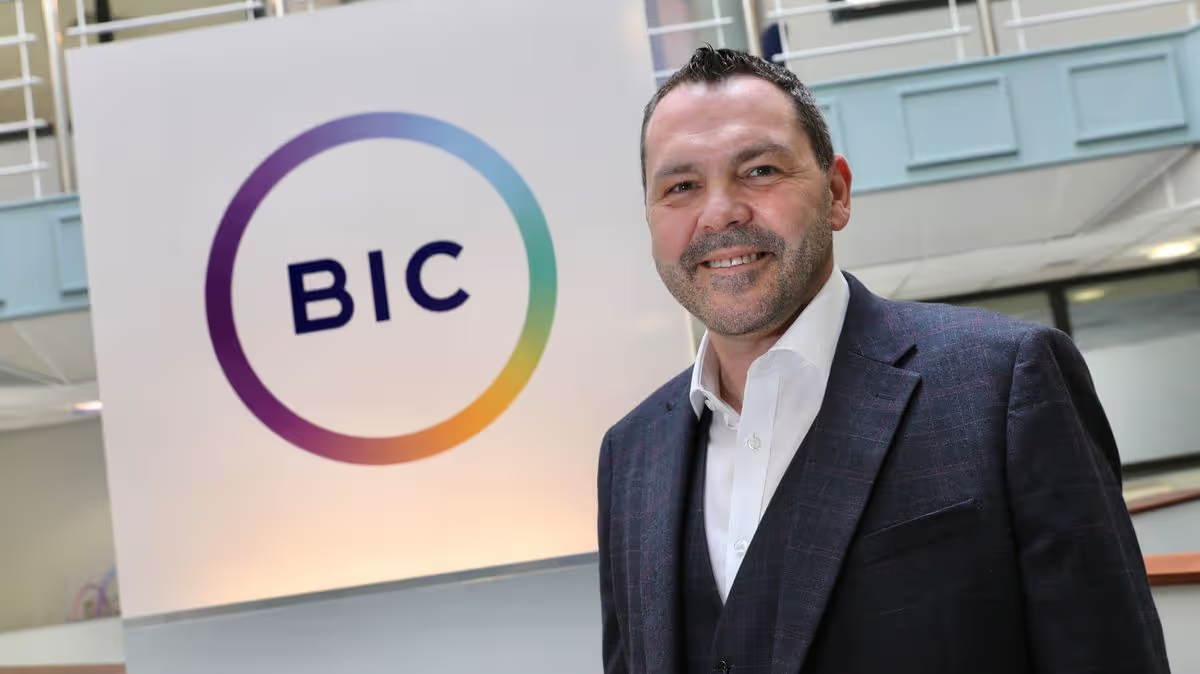
Paul McEldon, chief executive of North East BIC(Image: North East BIC)
A North East business leader is set to step down from his role at the head of a business support organisation after more than 25 years in the job.
Paul McEldon has been chief executive of the North East BIC since 2001, having joined the organisation in 1994. He has announced plans to retire next year, with the organisation starting the search for his successor.
Advertisement
The BIC, which has offices in Sunderland, was inspired by a European business model of fusing workspace with business support. It has become one of the region’s largest social enterprises, with a recent impact report revealing that it has boosted the regional economy by over £2.5bn.
The BIC’s four business centres have provided a home to more than 1,100 businesses over the past three decades and its events and support have helped more than 8,000 people set up and grow their own firms. Mr McEldon’s role in leading the organisation saw him receive an OBE in 2021 for services to local growth in the North East.
He said: “It has been an absolute honour to be part of the BIC team for the past 32 years and to have had the privilege of working with so many amazing people on the journey.
“Over the time we have served the region, we have created a business community unlike anything else in the North East, but this would never have been possible had it not been for our fantastic team.
Advertisement
“Everyone from our advisers to the maintenance teams, office staff and our receptionists are what make the BIC such a special organisation and if you speak to any of our customers, be they tenants or business support recipients, I am sure they will testify to that. They truly embody everything the BIC stands for.
“Now the time has come for me to step down and focus on the board work I do, which I thoroughly enjoy and which keeps me really busy. I do so in the knowledge that we have the incredible people already in place to ensure the BIC remains a force for good for another three decades and beyond.”
The BIC is recruiting for a new chief executive, with the successful applicant expected to be in post by Christmas. Mr McEldon will continue working with his successor for several months to ensure a smooth handover of activities.
BIC chair Kevan Carrick said: “Paul has been a driving force behind the North East BIC during his tenure, overseeing its growth into one of the region’s most respected business support organisations. Under his leadership, the BIC has provided vital workspace, mentoring, and innovation support to hundreds of businesses across the North East, helping to create thousands of jobs and contributing significantly to the region’s economic development.
Advertisement
“On behalf of the entire board, I want to express our sincere gratitude to Paul for his extraordinary dedication and the lasting legacy he has built at the BIC. His contribution to business support in the North East is immeasurable.”
Lavazza said its Tablì tabs are made of 100% coffee, without any gelatin, coating or binders.
Source: Lavazza
Lavazza is bringing its espresso tablets to the U.S., aiming to loosen Keurig Dr Pepper’s grip on the single-serve coffee category.
Advertisement
The Italian coffee giant unveiled Tablì last year and launched the new brewing system first in Italy. The tablets, made of compressed ground coffee without a coating, binder or gelatin, can only be used with a Tablì coffee machine made by Lavazza. Each tablet is marked with the words “100% coffee. At launch, the tabs will come in five varieties: espresso, double espresso, decaf espresso, super crema and lungo, or a “long shot” espresso brewed with more water.
“The result that we’ve been able to achieve was through a very complicated industrial process in order to be able to have [the coffee tablet] very compact, to be able to deliver it without destroying it, to have it able to work in a coffee machine,” Lavazza CEO Antonio Baravalle told CNBC.
Tablì is the result of Lavazza’s acquisition of the Italian startup Caffemotive in 2020. The new system took five years of development, more than 15 patents and a new production facility in Gattinara, Italy, to bring it to market.
Its launch in the U.S. comes as the country becomes an increasingly important part of Lavazza’s business. In 2025, the company’s North American turnover — or revenue — jumped 26.9%, according to Lavazza.
Advertisement
“We are strongly investing in the USA because we think it is an important space for us,” Baravalle said, adding that Lavazza aims to eventually have a €1 billion ($1.15 billion) business in the U.S.
“The brand is growing, in terms of equity, extremely well,” Baravalle said. “We’ve spent a lot of money, for us, in the last two years, and we’re going to do that for the next five years.”

More than 130 years after its founding, the Lavazza family still privately owns the Italian company. In 2025, it reported net profit of €92 million on net revenues of €3.9 billion, according to Lavazza’s latest annual report.

In the U.S., it generates more than $100 million in annual dollar sales through retailers like Target and Walmart. For context, Keurig reported annual net sales of $3.99 billion for its U.S. coffee segment in 2025.
Advertisement
The majority of Keurig’s coffee revenue comes from its K-cups. In the U.S., Keurig has dominated the single-serve coffee market for more than a decade, although Nestle’s Nespresso has won over customers in recent years. Keurig holds about half of the total U.S. market share for fresh ground coffee pods, according to data from Euromonitor International. Nespresso holds a roughly 7% share.
Of course, Lavazza sells K-cup pods in the U.S. through a partnership with Keurig.
Baravalle said he does not expect to beat Keurig or Nespresso.
“For us, it’s important to find our own space, but we are talking about two giants, and one of them, we have an important contract with that we are very happy [with],” he said.
Advertisement
A sustainability play
Lavazza is betting that sustainability is still a top consideration for many coffee drinkers, although Baravalle said that can differ across countries.
For years, Keurig’s pods have been dogged by questions about waste, leaving an opening for a competitor with a more environmentally-friendly product. The company previously claimed that 100% of its K-cups have been recyclable since the end of 2020.
In 2024, the Securities and Exchange Commission charged the beverage giant with making misleading statements over the recyclability of its pods. Keurig agreed to pay $1.5 million in penalties without admitting or denying the SEC’s findings. The company’s website now reads, “Check locally, not recycled in many communities.”
Nespresso’s aluminum pods are more easily recycled through the brand’s free mail-back service.
Advertisement
As Lavazza launches a potential competitor, Keurig has its own plans for plastic- and aluminum-free coffee pods. This fall, the company plans to launch K-Rounds, which uses a plant-based coating to preserve the ground coffee inside the puck-shaped pod. The innovation is thanks to a multi-year partnership with Delica Switzerland, the maker of the CoffeeB system, which uses plastic-free coffee balls that have gained traction in parts of Europe.
Lavazza will officially launch Tablì in the U.S. in August. A $99.99 bundle that includes the machine, a 60-count variety pack of tabs and a milk frother is available now to pre-order on the company’s website.
In May, Baravalle said the company was still determining its pricing strategy as it conducted consumer research to understand how much coffee drinkers were willing to pay.
“We are also waiting to see how some big, huge competitors will move in the industry, trying to offer something similar,” Baravalle said. “But, for sure, Lavazza has premium positioning, and we’re not going to do something different from that.”
Summit Therapeutics Inc. (SMMT) Goldman Sachs 47th Annual Global Healthcare Conference 2026 June 8, 2026 10:00 AM EDT
Company Participants
Allen Yang – Head of R&D Strategy Robert Duggan – Co-CEO & Executive Chairman Mahkam Zanganeh – Co-CEO, President & Director Manmeet Soni – COO, CFO & Director
Conference Call Participants
Advertisement
Salveen Richter – Goldman Sachs Group, Inc., Research Division
Presentation
Salveen Richter Goldman Sachs Group, Inc., Research Division
Advertisement
Great. Good morning, everyone. It’s my pleasure to introduce the Summit Therapeutics team. With us, we have Bob Duggan, Co-CEO with Maky Zanganeh, Co-CEO; Manmeet Soni, CFO; Allen Yang, CRDSO; and Dave Gancarz, CBSO.
Question-and-Answer Session
Advertisement
Salveen Richter Goldman Sachs Group, Inc., Research Division
To start here, a big picture question. Ivo is the leading PD-1 or L1 VEGF asset in development and China-based Phase III frontline lung cancer survival data was just recognized by the plenary at ASCO. Walk us through your overall strategy here, including across the various tumor types and combination approaches as you look to maintain your position and expand upon global development?
Allen Yang Head of R&D Strategy
Advertisement
Yes. We’re trying to keep that a little bit close to our chest because every time we announce something, our competitors announce the same thing and say we’re going to do it as well. But when we think about PD-1, VEGF, first of all, I think that PD-1 versus PD-L1 does make a difference. I don’t know if it changes too much your strategy, but it might change your overall baseline efficacy.
But with that said, 3 years ago, when we were looking at this asset, we did the boil the ocean exercise. We looked at all the PD-1 indications, all the VEGF approved indications. There was a lot of sort of history around those 2 targets that they are validated targets. And we looked at where
An unprecedented concentration crisis in global technology equities has evolved into a structural trap for investors, triggering a violent “Black Monday” unwind that is reverberating across Asian emerging markets, such as Korea and Taiwan. Active portfolio managers are increasingly being forced to dump their best-performing chip heavyweights because these explosive stocks have grown too large for risk compliance limits.
This structural anomaly has distorted regional benchmarks, accelerated a massive migration from active to passive funds, and triggered a historic correction.
The structural breakdown manifested in extreme volatility across the region’s tech hubs. South Korea’s Kospi index plunged more than 8% shortly after the market opened, triggering a mandatory 20-minute trading halt before narrowing its drop as memory giants Samsung Electronics and SK Hynix rebounded from their session lows.
The core of the market distortion lies in a mechanical paradox: As tech giants outperform, active funds are legally or structurally required to trim their holdings to manage concentration risks. Just three mega-cap tech firms—Taiwan Semiconductor Manufacturing Co. (TSMC), Samsung, and SK Hynix—now command nearly a third of the MSCI Asia Pacific ex-Japan Index.
The concentration is even more extreme on a national level. TSMC occupies a staggering 41.5% of Taiwan’s TAIEX, while Samsung and SK Hynix together comprise 55% of South Korea’s KOSPI.
Live Events
“We have been forced sellers of TSMC, Samsung and MediaTek,” Sam Konrad, investment manager for Asia Equity Income at Jupiter Asset Management, was quoted as saying by Bloomberg. His fund must shed these chipmaking stocks despite explosive year-to-date gains of 52% for TSMC, 159% for Samsung, and 184% for MediaTek. This mechanism creates an institutional dilemma where strong performance mandates divestment, artificially capping the upside for active portfolios trying to beat their benchmarks.”As equities continue to outperform, funds will find it increasingly difficult to add exposure, reinforcing a cycle of forced selling and enlarging underweight positions even amid strong fundamentals,” Herald Van der Linde, head of equity strategy for Asia Pacific at HSBC in Hong Kong, noted in a research report. HSBC data confirms that TSMC has become the largest portfolio underweight among Asian and global emerging-market funds.
Emerging Market Exhaustion and Fund Outflows
Data from Elara Securities India confirms that the Global Emerging Market (GEM) trade is experiencing its first major phase of sustained exhaustion since its rally began. GEM fund redemptions expanded to $3 billion, the largest outflow since December 2021, marking a clear breakdown in momentum.
The capital flight has extended significantly beyond Korea and Taiwan to hit other major emerging markets. China saw foreign investors pull $3.7 billion, the largest single-week redemption in over a year, while South Korea logged six consecutive weeks of foreign outflows, compounded by a record $27.9 billion foreign portfolio rebalancing outflow.
Advertisement
The systemic nature of the unwind is visible in the broader indices. Goldman Sachs data reveals that while the MSCI Asia Pacific ex-Japan index is up 27% year-to-date, it is actually down 4% when South Korea and Taiwan are excluded.
This regional distortion has accelerated a massive, unprecedented migration from active stock-picking to passive indexing. Over the last five years, Asia’s active funds have suffered $269 billion of cumulative outflows. Meanwhile, passive funds have accumulated $510 billion, with a quarter of that volume arriving in just the last six months.
“The size of recent inflows into the region’s passive funds… has no precedent across the last 10 years,” said William Bratton, head of cash equity research for Asia-Pacific at BNP Paribas Securities.
This phenomenon mirrors the “Magnificent Seven” dynamic on Wall Street, where tech giants account for about a third of the S&P 500. However, concentration in Asia has unfolded at a faster and more extreme pace, turning regional indices into concentrated bets on just one or two stocks and undermining the diversification benefits of benchmark investing.
Advertisement
Broader Trade Implications
The shockwaves from the AI tech unwinding are bleeding directly into structural commodities and the wider electrification ecosystem. Precious metal funds witnessed $2.8 billion of outflows, driven heavily by gold (-$2.1 billion) and silver (-$910 million, a 12-week high redemption), while energy funds recorded their second consecutive week of outflows. These asset classes had operated as indirect beneficiaries of the global AI infrastructure and electrification trade.
Furthermore, Wall Street’s nine-week winning streak concluded abruptly following a hot jobs report that ignited fears of a hawkish policy pivot by the US Federal Reserve, sending technology stocks into their largest one-day decline.
Despite the steep selloffs, which saw South Korean equities slide 12% and Taiwan fall 6% from their record highs, market opinions remain starkly divided on whether this correction marks a peak or a buying opportunity.
Some money managers are exploiting the correction to pivot to alternatives further down the supply chain, like mid-sized semiconductor equipment makers, or shifting money toward cheaper domestic themes like robotics. China’s CSI Robot Index actually bucked the broader market declines, rising 1.4%.
HORAN Wealth LLC is an SEC registered investment advisor that manages investment portfolios for individuals and institutions. Our firm utilizes a disciplined investing approach that should create wealth for our clients over time. Our investment bias is to invest in companies that generate a steady return over time, i.e., singles and doubles. This singles and doubles approach tends to lead to investments in higher quality dividend growth/cash flow growth companies. On the other hand, there are times when a company’s stock price seems to be trading below its fair valuation. Short term gains are possible in these situations. I have been managing investment portfolios for individuals and institutions for over fifteen years and believe investing is like running a marathon and not a sprint. Taking the road less traveled, more often than not, leads to higher returns. Visit: The Blog of HORAN Capital Advisors at (https://horanwealth.com/insights/market-commentary-blog)
Novo Nordisk and Eli Lilly took their GLP-1 pill battle to the preeminent obesity meeting this weekend as they prepare for the next sea change in how patients receive their drugs.
Novo Nordisk on Sunday announced that prescriptions of the Wegovy pill have topped 3 million since it entered the U.S. market about five months ago. The Danish drugmaker’s CEO Mike Doustdar celebrated the milestone, saying in an interview with CNBC that Novo was able to accelerate prescriptions even as Lilly introduced its own GLP-1 pill in April.
“If that’s not acceleration, then I don’t know what is,” Doustdar told CNBC this weekend at the American Diabetes Association’s Scientific Sessions.
Advertisement
Meanwhile, Lilly CEO Dave Ricks told CNBC that prescriptions of its pill Foundayo are “markedly higher” than the 20,000 that Lilly reported about six weeks ago around its first-quarter earnings release, without giving a specific number. He said the number builds week over week and that Lilly is pleased with the progress.
The competition for the weight loss pill market is only the latest for the longtime rivals. Signs of that tension were evident throughout the industry event this weekend. Cars drove around advertising Novo’s Wegovy pill, while pictures of Lilly’s Foundayo pill covered some of the floors of the convention center in New Orleans.
And the two companies will soon make their case for their daily pills and their weekly shots to seniors. Starting in July, millions of people with Medicare will be able to access GLP-1 drugs for weight loss for $50 a month. Until now, Medicare beneficiaries have had to pay out of pocket for the obesity drugs, costing them potentially hundreds of dollars a month. Both companies say they’re focused on raising awareness of the program, though they have different pitches.
Weight loss pills available: A heap of GLP-1 pills
Advertisement
Aprott | Istock | Getty Images
Doustdar thinks the program could be an opportunity to regain some of the ground Novo’s Wegovy shot has lost to Lilly’s Zepbound. The drugmaker plans to advertise Wegovy’s other health benefits on its label, he said, like the fact that it can decrease the risk of cardiovascular problems like heart attacks and strokes. He said Novo should win with seniors “if common sense is to prevail, and I put myself in their shoes.”
“With the Wegovy high dose, why would you not take a product that has the same efficacy, percentage wise, than my competitor?” he said. “On top of it, you get kidney, liver, heart, stroke protection, let’s say free of charge. I would take it if I was 10 years older.”
Lilly’s pitch to seniors is convenience. The company’s pill Foundayo can be taken at any time of day with food, water and other medicines, whereas Novo’s pill needs to be taken on an empty stomach with little water and requires fasting for 30 minutes afterward.
Advertisement
“The main thing is, it’s easy,” Ricks said. “This is something that can just go in your daily routine. Most seniors are on many other medications, and they’ve got their pill case, and they use that every day, and this will just fit right into that without any extra thought.”
Ricks said Lilly is working closely with the government to prepare, and he’s confident that Humana, which will process prescription requests, will do a good job. He thinks the program will be popular with seniors and that longer term, the initiative could help prove that obesity care should be “regular health care.”
“We have to prove that in this pilot and prove cost effectiveness and then kind of reset what we expect from our health insurance, which is obesity care should be health care,” Ricks said.
Lilly and Novo are trying to increase insurance coverage of GLP-1 drugs for obesity. At least one analysis found the drugs to be cost effective, but employers have balked at paying for them because so many people could be eligible for the treatments and many patients stop them after achieving a weight loss goal. Health insurance company Cigna last week said it would stop covering the medicines for its own employees.
Advertisement
At Lilly, less than 20% of the company’s beneficiaries are using the drugs for weight loss, and people are staying on them, Ricks said. Lilly is conducting an internal study to measure its health costs and outcomes like hospitalization rate, progression to diabetes and cardiovascular events. Lilly plans to publish those results later this year, he said.
The next stage in the GLP-1 race
While they prepare for Medicare coverage, both companies are trying to introduce more drugs to treat obesity. At the conference this weekend, Lilly presented Phase 3 data for retatrutide, an experimental triple agonist that helped people lose an average of 28% of their body weight when they stayed on the drug. Nearly half of people lost more than 30% of their body weight, an amount that’s similar to bariatric surgery. The drug also helped improve related conditions like knee osteoarthritis and sleep apnea.
Initially, Ricks expects retatrutide to primarily be used to treat people with higher body mass indexes, or BMI. He also sees promise for the second-lowest strength of the drug. It helped people lose an average of 19% of their body weight with fewer side effects than the higher strengths.
One question was whether Lilly would make retatrutide available on its direct-to-consumer sales platformLillyDirect once it’s approved by the Food and Drug Administration because it’s so powerful. Lilly “absolutely” plans to make the drug available there, Ricks said.
Advertisement
For Novo, the next drug on the horizon is called CagriSema. It combines the main ingredient of Wegovy with another molecule called cagrilintide, which mimics another hormone called amylin. The drug’s efficacy has underwhelmed investors since it has showed weight loss that is similar to Lilly’s Zepbound and less than Lilly’s retatrutide. Doustdar thinks the drug’s edge in effectiveness over Wegovy, even if only a few percentage points, is meaningful, and said he’s committed to launching CagriSema. Novo expects an approval decision from the U.S. Food and Drug Administration on the drug in the fourth quarter of this year.
“If I have to forget about CagriSema, a lot of other products have to be forgotten about as well,” Doustdar said. “I don’t think it should work that way.”
Doustdar took over as chief executive almost one year ago after a major shakeup that led to the departure of the company’s former leader and thousands of employees being laid off. He’s tasked with reinvigorating sales of Wegovy, the company’s pipeline and its stock price. Eventually, he said Novo will be more diversified within the area of cardiometabolic health — like diabetes and obesity — and some of the “adjacencies.”
In the meantime, Doustdar said the early success of the Wegovy pill has helped Novo regain some momentum.
Advertisement
“The pill was a great example of people getting confident that we can do this, that at Novo Nordisk, better days are ahead of them and not just behind,” he said. “So we also have to really make sure that we turn these positive moments that right now we’re in into a longer term trend, so we gain the trust day by day and improve that both internally as well as, of course, externally, and I will work hard to make sure that this continues.”
A United Airlines plane taxis at Los Angeles International Airport on April 21, 2026 in Los Angeles, California.
Justin Sullivan | Getty Images
RIO DE JANEIRO — United Airlines CEO Scott Kirby said he doesn’t expect more airline consolidation in the U.S. and he’s not interested in pursuing a merger for his airline after American Airlines rejected the idea of a combination earlier this year.
Advertisement
“United’s not going to do a deal just to do a deal,” Kirby told reporters Sunday on the sidelines of the International Air Transport Association’s annual meeting.
When asked about the wave of consolidation that has brought togetherAllegiant and Sun Country this year, and Alaska Airlines and Hawaiian Airlines in 2024, Kirby said further combination opportunities look unlikely: “There’s nothing,” he said.
“It’s a lot harder,” he said. “I’ve been … one of the primary architects of consolidation in the United States. I’ve been around a lot of these deals. It’s hard, and you shouldn’t do deals that don’t make economic sense.”
But earlier this year Kirby discussed the possibility of combining with American, where Kirby used to work, floating the idea to the Trump administration, CNBC previously reported.
Kirby later said in a statement that he had hoped a combined airline would compete with big foreign rivals, though some analysts said the tie-up would face insurmountable regulatory hurdles.
A merger “requires support from everyone,” Kirby told reporters at the IATA conference. “We would need the unions, we’d need the customers, the shareholders, the regulators and the management team.”
He said, however, regarding American’s management team, “we don’t have that, clearly, so we can’t get it done without them.”
Advertisement
Delta Air Lines President Peter Carter similarly told CNBC on Saturday that he doesn’t see a merger or acquisition in Delta’s future. He said the carrier’s longtime strategy has been partnerships and joint ventures, which include those in South Korea, Mexico and Europe.
Because the U.S. domestic air travel market is so mature, international travel is the future, Carter said. He added he wants to take on United, the second most-profitable airline in the U.S., in the lucrative trans-Pacific market.
Technicians work on an engine at GE Aerospace’s engine shop in Lafayette, Indiana.
Leslie Josephs/CNBC
RIO DE JANEIRO — Airplane engine makers have fallen short of what they promised airlines, major carriers’ CEOs say, a problem vexing an industry that has struggled for years with aircraft shortages and more recently, a doubling of fuel prices.
Advertisement
It’s a paradox: Engine makers dazzled carriers with more fuel-efficient options for new planes from Boeing and Airbus. But production shortfalls and disappointing reliability with those engines are becoming costly problems, CEOs said in interviews at the industry’s largest annual gathering here.
Airline executives said they’re being forced to remove engines and take them for maintenance into crowded shops earlier than expected, which is driving up costs and sucking up the fuel savings they were supposed to get from the engines.
Airline leaders told CNBC this week that travel demand is still strong despite higher fares, so having aircraft on the ground means money left on the table, just as a $100 billion higher fuel bill this year is slashing airline profit prospects.
Alexis von Hoensbroech, CEO of Canada’s WestJet, told CNBC in an interview ahead of the more than 370-airline International Air Transport Association’s annual assembly that the new engines promising fuel savings of around 15% or more compared with earlier models were “engineering marvels.”
Advertisement
“However, as you push the limits, it sometimes comes at the cost of reliability, and what we all are seeing is that those engines have to go into unscheduled maintenance far more frequently than prior engine generations,” he said.
Newer models of aircraft engines burn hotter, allowing them to use less fuel. That’s key since fuel is airlines’ biggest cost after labor. But that can also mean they wear out faster, which can ground planes, though carriers keep some spare engines.
Von Hoensbroech and other airline executives told CNBC that the new the engines have not reached the reliability that airlines need, through there have been improvements.
“That’s a big struggle, because it adds a lot of costs,” he said. “So a lot of the fuel savings are in fact eaten up by unplanned maintenance costs.”
Advertisement
‘Lack of engines’
Manufacturers have invested heavily in expanding engine overhaul and other maintenance capabilities, while third-party shops have also seen a windfall.
New engines are costly, but aircraft production is still behind schedule, and that’s keeping older engine values up, too.
For example, a CFM56 engine made by GE Aerospace and its French partner Safran that powers older Boeing 737s was going for $9.2 million at the start of the year, up 17% since 2019, according to IBA Group. A Pratt & Whitney PW1127 for newer Airbus narrow-body planes was up more than 57% over that time, according to the aviation intelligence and advisory company.
Willie Walsh, the outgoing director general of IATA, told the conference in Rio de Janeiro that he is “deeply disappointed customers have not dented manufacturer finances,” and pointed to a jump in engine supplier profits.
“My message to the engine [original equipment manufacturers] is simple: Stop gouging us and get back to making great engines that work and that last,” he said. “Allowing these failures to extend into the next decade is totally unacceptable to the customers.”
For its part, GE Aerospace, which makes engines for both Airbus narrow-body A320 planes and Boeing narrow-body and wide-body aircraft, said it has been working on improvements and has also increased output.
“We’ve made significant investments to enhance time-on-wing, reduce cost of ownership, and increase output and we will continue to invest to drive meaningful improvements,” the company said in a statement. “While there is more to do, we are making progress every day to continue to deliver long-term value for our customers.”
GE powers Boeing’s bestselling 737 Max with its CFM joint venture with France’s Safran. Those Leap engines are also options on the Airbus A320 narrow-body planes, with Pratt & Whitney as the other. GE engines also are used on a majority of 787 Dreamliners.
Advertisement
United Airlines CEO Scott Kirby praised GE for making improvements, but said there are still concerns for the industry.
“The biggest constraint for at least the next five years is going to be lack of engines,” Kirby said.
A Rolls Royce jet engine on display at the Rolls-Royce aircraft jet engine production and repair facility in Blankenfelde on February 28, 2023 near Berlin, Germany.
Omer Messinger | Getty Images News | Getty Images
Advertisement
He pointed to a shortfall of parts like forgings and castings and said when it comes to smoothing out supply, “I don’t really think we’ve started yet.”
Pratt and some of its customers have the added problem of a manufacturing defect from several years ago. The issue forced airlines to ground planes with those engines, which was one of the biggest challenges that hit now-defunct Spirit Airlines. Pratt’s parent, RTX, didn’t immediately comment.
Rolls-Royce, another manufacturer, said it is still working on efficiency. The company said it has invested £1 billion ($1.33 billion) in its Trent engine fleet and a mode that “offers up to triple time on wing, resulting in improved fleet planning and a reduced maintenance burden for customers.”
A 20-year-old McDonald’s worker in Northern California is facing multiple surgeries after a co-worker allegedly hurled hot cooking oil at him, leaving him with severe second-degree burns across nearly a quarter of his body, according to his mother.
Jacob Smith was working as a shift manager at a McDonald’s in Yuba City when the shocking attack unfolded, his mother, Amber Smith, wrote in a GoFundMe post to raise money for her son’s medical expenses.
Advertisement
“He was in the office getting ready to count the money when he saw out of the corner of his eye something, and he just turned, and the oil was just thrown on him,” she told KCRA.
Jacob suffered “severe second-degree burns” over roughly 22% of his body — including to his face, neck, right arm and back — and was admitted to the intensive care unit, where his pain has been so severe that doctors have limited options for additional medication, according to his mother.
Jacob Smith, 20, is facing multiple surgeries after suffering burns to nearly a quarter of his body, his mother said. (GoFundMe / Unknown)
“The pain he’s experiencing is so excruciating that they can’t give him a level of pain medicine outside of the ICU,” she told the outlet.
Advertisement
Jacob Smith was working as a shift manager at a McDonald’s in Yuba City when a co-worker allegedly threw hot cooking oil on him. (GoFundMe / Unknown)
Police identified the suspect as 23-year-old Jalani Bluett, a fellow McDonald’s employee who allegedly left the restaurant before officers arrived. Authorities later located and arrested Bluett after seeking the public’s help in finding him.
At the time Bluett was being sought, the Sutter County Sheriff’s Office said he is “at risk due to a diagnosis and vulnerabilities.”
Jalani Bluett, 23, was identified as the suspect. Bluett, a co-worker of Jacob’s at McDonald’s, allegedly left the restaurant before officers arrived. (Sutter County Sheriff’s Office / Unknown)
During Bluett’s arraignment, Yuba City Police Lt. Michael Bullard told KXTV that the suspect was being held on charges including assault with a deadly weapon, mayhem and serious felony assault resulting in great bodily injury. He is being held in Sutter County without bail.
Advertisement
Amber Smith said her son is scheduled to undergo skin graft surgery because some of the burns are particularly deep.
Jacob Smith wrote in a message posted on GoFundMe that he thanks God for saving his eye. (GoFundMe / Unknown)
Despite the ordeal, Jacob has remained remarkably upbeat.
“As much as I want to be angry, or want to hate people and be scared of people, it’s just so hard to be when I have so many people showing their love for me,” he wrote in a message shared on the fundraiser page. “I’m not sad, and I’m not angry, and the pain doesn’t cause me grief because I know it’s necessary to heal.”
Advertisement
He also thanked his family, friends and faith for helping him through the recovery process, writing, “Thank you to God for saving my eye and giving me awesome family and friends.”
CUPERTINO, Calif. — Apple Inc. CEO Tim Cook opened the 2026 Worldwide Developers Conference on Monday with a keynote address that placed artificial intelligence and the next generation of software updates at the center of the company’s strategy, marking his final appearance in that role before stepping down later this year.
The event, running June 8-12 at Apple’s headquarters, drew developers, investors and technology observers eager for details on advancements across iOS, macOS, iPadOS, watchOS, tvOS and visionOS. Cook’s keynote, beginning at 1 p.m. ET, set the tone for the week by emphasizing practical AI integration and ecosystem enhancements designed to strengthen Apple’s position in an increasingly competitive landscape.
Apple has faced questions about the pace of its artificial intelligence rollout compared with rivals. The company introduced Apple Intelligence last year, featuring writing tools, image editing and Visual Intelligence capabilities. While these features have been well-received in targeted applications, analysts and users have called for more transformative advancements, particularly in the digital assistant Siri.
Advertisement
Monday’s presentation is expected to preview a significantly upgraded Siri that leverages Google’s Gemini AI models for enhanced conversational abilities and multi-step task handling. The assistant is anticipated to gain its own dedicated app and appear more prominently in the Dynamic Island on iPhones. Additional integrations, such as in the Camera app for quick information extraction from nutrition labels, aim to make Siri more proactive and useful in daily scenarios.
The keynote also highlighted broader software improvements. iOS updates are likely to focus on deeper Apple Intelligence integration, enhanced privacy controls and productivity features. macOS advancements may emphasize better cross-device continuity and AI-assisted workflows for creative professionals. Similar refinements are expected across other platforms, creating a more cohesive experience for users with multiple Apple devices.
For developers, the conference provides essential tools and APIs to build applications that leverage Apple Intelligence. More than 100 video sessions are scheduled throughout the week, offering technical deep dives and opportunities to explore new capabilities. The Platforms State of the Union, set for 4 p.m. ET, will offer a more detailed look at the technologies behind the keynote announcements.
Cook’s appearance carried added significance as his final WWDC keynote as CEO. He is expected to transition to an expanded board role in early September, marking the end of an era that began when he succeeded Steve Jobs in 2011. Under Cook’s leadership, Apple has grown into one of the world’s most valuable companies, with a focus on services, ecosystem loyalty and privacy as core pillars.
Advertisement
Investor attention centered on whether Apple can demonstrate a clearer path for turning AI features into stronger iPhone demand and services revenue growth. Bernstein analyst Mark Newman recently noted that Apple Intelligence “presents a huge opportunity to reinvent the company, accelerate product replacement cycles, and drive increased services revenue.”
Evercore ISI analyst Amit Daryanani echoed this view, stating that Apple’s edge lies in its massive distribution network. “We don’t think Apple needs to win the frontier-model race to monetize AI, but rather its edge is in distribution to a ~1.25B iPhone install base,” he wrote.
Apple’s deliberate approach to AI emphasizes on-device processing for privacy and efficiency. This strategy distinguishes it from cloud-heavy competitors but has also limited access to the most powerful frontier models, prompting partnerships such as the one with Google for Siri. The company has invested heavily in silicon development, data centers and machine learning talent to support its ambitions.
The event comes at a pivotal time for Apple. Shares have experienced mixed performance in 2026, reflecting concerns about AI leadership and slowing growth in core hardware segments. A compelling demonstration of progress could help reassure markets and re-accelerate device upgrade cycles.
Advertisement
WWDC serves as Apple’s annual platform to regain narrative control in the AI conversation. By showcasing practical, user-focused applications rather than flashy demonstrations, the company aims to differentiate itself through seamless ecosystem experiences. The conference typically generates significant media coverage and social conversation, with live streaming available on Apple’s website and YouTube.
For developers, the week offers hands-on sessions to explore new tools that enable third-party apps to leverage Apple Intelligence. This strategy allows Apple to extend its AI reach while maintaining control over the core user experience and privacy standards.
As the keynote concluded, attention shifted to the week’s technical sessions and the potential for surprise announcements. Apple has a strong track record of using WWDC to introduce features that define the next era of its products. This year’s focus on making Siri smarter and more capable represents another step in that tradition.
The Platforms State of the Union will provide developers with deeper insights into the tools and frameworks supporting the new features. This session often includes code examples, best practices and forward-looking roadmaps that help the developer community prepare for the fall software releases.
Advertisement
Apple’s emphasis on responsible AI development, including transparency and user control, aligns with its longstanding privacy-first philosophy. The company has positioned its AI strategy as one that prioritizes user benefit and data protection over rapid feature expansion.
Investor reaction to the keynote will likely influence Apple’s stock performance in the coming days. While the event is primarily developer-focused, its announcements often have immediate implications for product demand, services growth and competitive positioning.
As Cook prepares to step back from day-to-day leadership, the conference offers a platform to demonstrate the strength of Apple’s innovation pipeline and the vision guiding its next chapter. The company’s ability to translate its vast resources and engineering talent into compelling AI experiences will shape its trajectory for years to come.
WWDC 2026 arrives at a critical juncture for Apple. The tech giant’s success in AI will influence not only its financial performance but also its cultural relevance in an industry increasingly defined by artificial intelligence capabilities.
Advertisement
The week ahead promises technical depth, strategic announcements and a glimpse into Apple’s future. As developers and users digest the information, the focus will remain on how these updates translate into real-world benefits and whether they position Apple more competitively in the AI era.
The Welsh Retail Consortium has released retail footfall numbers for May
15:20, 08 Jun 2026Updated 15:23, 08 Jun 2026
Shoppers in Cardiff city centre(Image: WalesOnline/Rob Browne)
Retailers in Wales has reported the highest fall in shoppers of any UK nation.
According to new research from the Welsh Retail Consortium retailers on the high street, shopping centres and retail parks , experienced a 5% year-on-year fall in May in footfall. Scotland saw footfall up 0.4% year-on-year with Northern Ireland, down 1% and England declining 3%. Of all the nations and regions of the UK, only in the south-west of England was the fall greater than Wales at 5.3%.
Advertisement
Year-on-year Welsh shopping centre footfall was down 6.3% with retail park footfall down 2.7%. Of the core cities of the UK, Cardiff has the second biggest decline of 6.9% in May, behind Liverpool, down 9.4%. Only two cities saw footfall up on May last year, with Belfast marginally improving by 0.1% and Edinburgh 2.5%.
Head of the Welsh Retail Consortium, Sara Jones, said: “tending a worrying run of decline in 2026. More concerning still, Wales has lagged behind the other UK nations on footfall recovery in five of the last six months. That underlines just how fragile consumer confidence remains, with households still under pressure and spending subdued. Hot weather is also likely to have diverted shoppers away from more planned retail trips, but the bigger picture is clear: Welsh shops are facing a tough trading environment, with no meaningful recovery yet in sight.
“Against that backdrop, retailers will welcome the commitment made by the First Minister in the Senedd to explore business rates reform through the town centres taskforce. But with footfall falling and Wales lagging behind every other nation, the priority now has to be delivery. In its first 100 days, the Welsh Government must move quickly to back high streets through meaningful rates reform, a planning system that supports investment, and a joined-up strategy that gives retailers the confidence to invest in stores, jobs and town centres across Wales.”
The research was carried out for the Welsh Retail Consortium by Sensormatic Solutions. Retail consultant with the firm, Andy Sumpter, said: “May proved a challenging month for Welsh retail, with footfall falling 5% year on year, the weakest performance in the UK. While brighter weather earlier in the month may have offered some support, the late May heatwave appears to have dampened activity, limiting recovery as the month progressed.
Advertisement
“Consumer confidence may be edging up slightly, but it remains fragile, with geopolitical uncertainty continuing to weigh on discretionary spend. Shopping behaviour also continues to evolve. While visits to retailers within Shopping Centres remained firmly negative, overall visits to shopping centres performed more strongly – highlighting that consumers are still visiting destinations but engaging more selectively once there.
“While May reinforces the pressures facing Welsh retail, it also points to changing behaviour rather than a complete withdrawal from physical spaces. For retailers, the challenge and the opportunity lie in converting these more cautious, considered visits into meaningful spend, by delivering the right mix of value, relevance and experience as we move towards the summer months.”
You must be logged in to post a comment Login