The Tuesday letters page struggles to understand the Xbox exclusivity policy, as a reader encourages more games to go head-to-head with GTA 6.
Games Inbox is a collection of our readers’ letters, comments, and opinions. To join in with the discussions yourself email gamecentral@metro.co.uk
Direct assumption So the Nintendo Direct we’ve all been waiting for is finally here. 50 minutes of pure Nintendo showcase, ready to disappoint us all!
Will the Zelda: Ocarina Of Time remake be there? I have no idea, but I do know that Nintendo will hate the idea that it leaked and that if there’s anything they can do to shuffle it around the schedules, and not make it this year’s game, they will. But yeah, overall I think it’s likely.
Advertisement
I just hope they don’t waste too much time on Splatoon Raiders and Fire Emblem and other things we already know about. That quote from the boss seems to prove they know they need to impress but I’m not convinced, Nintendo hates to do the obvious and they did say it was only games for this year.
Personally, I’m guessing maybe a couple more Switch 2 editions (Super Smash Bros. Ultimate, anyone?) and maybe this rumour about a new Wario Land game, or something else small scale. That and The Duskbloods and you’re doing okay, although I really don’t see 2026 being a classic year for Nintendo overall. Bagul
Expert, exclusive gaming analysis
Sign up to the GameCentral newsletter for a unique take on the week in gaming, alongside the latest reviews and more. Delivered to your inbox every Saturday morning.
Advertisement
Small hopes I’m excited about the idea of a Zelda: Ocarina Of Time remake as anyone but at the same time, does it not seem a bit disappointing that the biggest game of 2026 from Nintendo is going to be a remake? We’ve had virtually nothing from them so far this year (even their best game, Pokémon Pokopia, they didn’t actually make themselves) and Splatoon Raiders and Fire Emblem: Fortune’s Weave are hard to get that excited about.
And what else will we have other than Zelda, if that is true? Probably not much else. Maybe some smaller games but I can’t imagine them suddenly pulling two or three triple-A games out of the bag, that are all going to be released this year. I agree with GC’s summary of the Switch 2’s first year, it’s not been a disaster, but it’s certainly been a disappointment. Cubit
Just as you remember Anyone a bit disappointed by Persona 4 Revival reveal? I was left feeling silly for expecting the graphics and character models to be a bit more lifelike; I mean of course it’s anime style (duh). But I’m therefore wondering what the point of it is. In fact, the graphics themselves still look last gen at best.
Advertisement
Meanwhile, I think Fumito Ueda’s new project looks very exciting. I recently played through ICO again on the PlayStation 2 and it has aged so well, even the graphics. There’s an example of perfect art direction. Owen Pile (NongWen – PSN ID)
GC: Persona 4 is also a PlayStation 2 game, so there are improvements in the remake. But we agree, it doesn’t look any different than you remember it, especially as it’s clearly using the Persona 5 engine.
The only way is up Yes, good bring back exclusives. Either people want Xbox to have exclusives or not, which is it? Seems to me they can’t win either way, people will complain regardless. Besides, the only annoying thing about that showcase for me, as a Xbox Series X owner is that I know I don’t have the time or money for all those games.
Advertisement
I haven’t played Gears Of War and Halo since the sequels, but I will go back to Game Pass for those two games.
I was kind of hoping Xbox would announce a price cut, no matter how modest. Or perhaps £25 off the Xbox Series X25, which would be clever marketing, I think.
Also, I have to mention Metro 2039. Wow, it looks incredible. Metro Exodus, in my opinion had one of the best campaigns for a first person shooter I have ever seen, with such well written characters. So I’m really looking forward to that one. Stephen
GC: Thanks to the memory crisis, hardware prices are never coming down, for anything.
Advertisement
The long haul I hate falling for the rumour bandwagon.
There is some great stuff coming out in the next year, but as nostalgic as I am, I was excited to see a new WipEout game from Sony, but I think they do not realise how important the original games sold the PlayStation in Europe, and helped establish the brand they are today.
Also, another gripe. Where are the PS5 Pro official console covers already? GarBo
Advertisement
GC: If the rumours are correct – that Sony is only now looking to bring back some of its older brands – that would mean any new entry is many years away from actually coming out.
Logical decision I have been struggling to come up with an explanation for Microsoft’s exclusive announcements and I just can’t do it. Nothing about it makes any sense, including everything they’ve said to try and explain it.
Maybe they’re doing it to please hardcore Xbox fans but you’re talking about a noisy minority there, that’s never going to be happy with anything you do. You have two exclusives they’re going to demand four and more until they’re not satisfied with anything but all of them.
The obvious problem with doing it, is that you’re not making as much money, because you’re not selling on PlayStation 5 and less people have an Xbox nowadays. Plus, you’re not getting people into the Gears Of War franchise, which is especially going to annoy those who bought last year’s remaster and planned to get E-Day as well.
Advertisement
But at the end of the day the question that cuts through all the nonsense is why those two games? Why are Gears of War: E-Day and Clockwork Revolution exclusives but others aren’t? Either they made that decision based on logic that they can explain to us or they just picked them at random, which is it?
What worries me is that the answer is likely to be closer to the random explanation, because I really don’t have any confidence Xbox knows what it’s doing anymore. Focus
Counter-programming I think it’d be neat to see more games going up against GTA 6 this November that are completely different to it. A collection of Barbie games is pretty extreme but I’m sure there are plenty of other games that are nothing like GTA and would interest people that are not interested in the game.
I mean, statistically, there’s got to be far more people that don’t care about GTA 6 than do, so I don’t see why you can’t release some cosy games, strategy games, maybe even some horror games, since it will be dark out by that point. GTA 6 isn’t going to cover any of the angles and some people are going to prefer that kind of thing to just another gangster sim. Taylor Moon
Advertisement
Don’t miss Gaming news! Add us as a Preferred Source
As a loyal GameCentral reader, we want to make sure you never miss our articles when searching for gaming stories. We have all the latest video games news, reviews, previews, and interviews, with a vibrant community of highly engaged readers.
Click the button below and tick Metro.co.uk to ensure you see stories from us first in Google Search.
GameCentral has been delivering unique games news and reviews for over a decade
Advertisement
Wrong audience It’s been obvious for a while now that the average age of gamers is skewing very old (in comparison to the stereotype of what a gamer is). As someone in their thirties this should please me, as it should mean that companies will try to design games more to please people like me.
However, I do not find this to really be the case. We are seeing a slight turn towards more single-player games at the moment but mostly publishers seem frustrated that the average age is creeping up and that young people are not buying their games, and so they target them even more.
Sony and Ubisoft aren’t making these endless live service games to appeal to thirtysomethings. Coming up with the new Fortnite is not something that’s going to excite anyone that’s 37.
It makes me think of The Mandalorian and Grogu movie, which was made primarily for younger audiences. Except they weren’t interested in it and since older fans never wanted it in the first place it ended up being a movie for no one.
Advertisement
I think there’s a danger of a lot of games falling in the same category, because at the end of the day companies prefer to have younger fans, because then they can get their claws in early and keep them spending for decades.
They know that anyone approaching their middle age and beyond is going to have less time to play games and probably won’t fall for microtransactions gimmicks as much, so we’re not really the audience they want. Gaston
Inbox also-rans The big Nintendo Direct we’ve all been waiting for is Tuesday? You better have that Mario peaking from behind a curtain photo or it won’t be tradition! Onibee
GC: You betcha!
Advertisement
It was so weird to see the Activision logo come up and it wasn’t for Call Of Duty. Even better that it was Spyro. Let’s hope it’s Prototype next! Stoz
The small print New Inbox updates appear every weekday morning, with special Hot Topic Inboxes at the weekend. Readers’ letters are used on merit and may be edited for length and content.
You can also submit your own 500 to 600-word Reader’s Feature at any time via email or our Submit Stuff page, which if used will be shown in the next available weekend slot.
Advertisement
You can also leave your comments below and don’t forget to follow us on Twitter.
The homes form part of bigger plans to build up to 3,000 homes
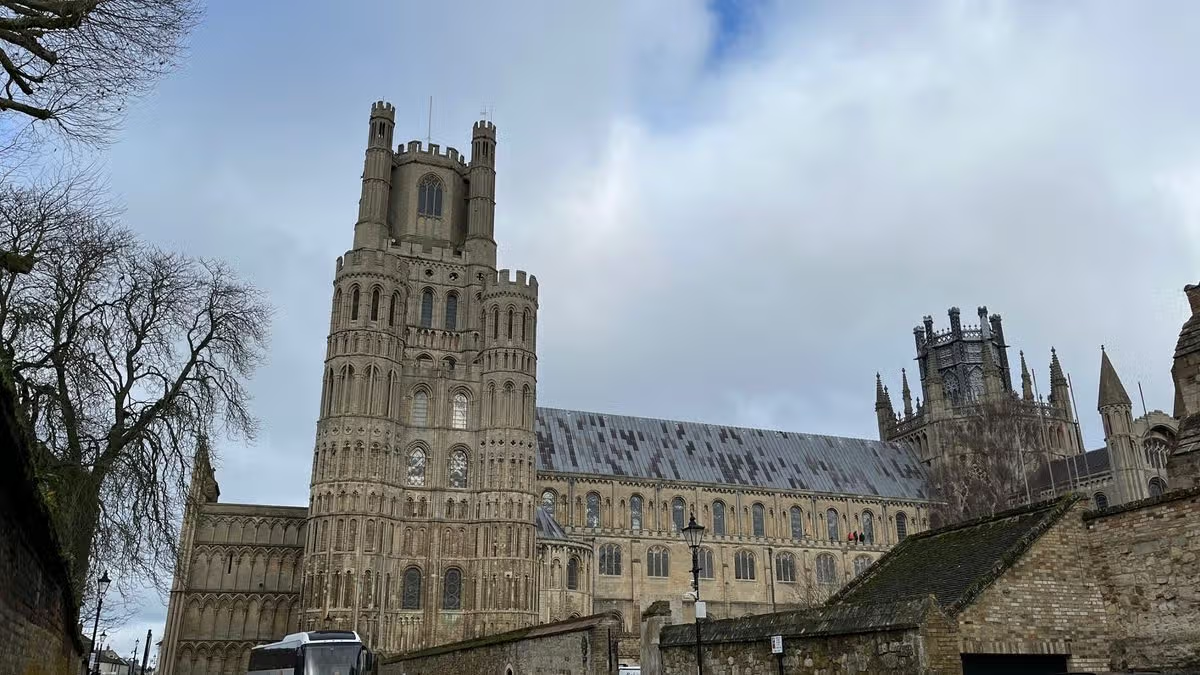
Plans for more than 1,600 new homes could present a “significant opportunity” to extend a Cambridgeshire city, according to an investment group. The Church Commissioners for England, which manages the Church of England’s investment portfolio, has submitted plans for up to 1,607 new homes in Ely.
Advertisement
The plans are for land at High Flyer Farm on the north of Apollo Chase. They also propose an extension to Ely Country Park, a community allotment/orchard, and an extension to the Chesttisham Business Park. The site covers 85.21 hectares.
The applicant said: “The redevelopment of the site will contribute towards meeting the council’s housing requirements within the planned growth strategy for Ely, delivering a range of homes including affordable housing to meet local needs, alongside significant publicly accessible open space and landscape enhancement.”
They added that the plans would aim to create an “attractive, distinctive and inclusive new neighbourhood of exemplary design quality”.
The housing development is also seen as a “significant opportunity” to extend Ely to the north. The applicant added: “The development at Highflyer Farm North represents the final jigsaw piece in completing the planned northern growth of Ely to create a sustainable and well connected new neighbourhood on the northern edge of Ely.”
Advertisement
Extending Ely Country Park as part of the plans will support the applicant’s aim for around 45 per cent of the site to be accessible open space. The extension of Chettisham Business Park aims to “support local jobs and a balanced mixed-use extension”.
The plans form part of the larger Ely1 allocation in the East Cambridgeshire District Council Local Plan for 2015. This covers around 210 hectares of land and plans for up to 3,000 homes.
The applicant also proposes to build two new primary schools and two local centres to “incorporate retail and community facilities”.
Garry Smithies, 37, of no fixed address, is accused of threatening a cyclist with a Stanley knife in a public place and wounding him with intent to cause him grievous bodily harm in Museum Street on Thursday.
He was not asked to enter a plea.
As the wounding charge can only be tried by a judge and jury, he was sent to York Crown Court. He was remanded in custody.
Advertisement
He will appear before the higher court on August 17 for a plea and trial preparation hearing when he will be expected to enter his plea.
A cyclist was taken to hospital on Thursday following an incident at 8.08pm which led to a police cordon being set up for a time around Museum Gardens. He was in his 50s and from Leeds.
A 37-year-man was arrested later the same evening.
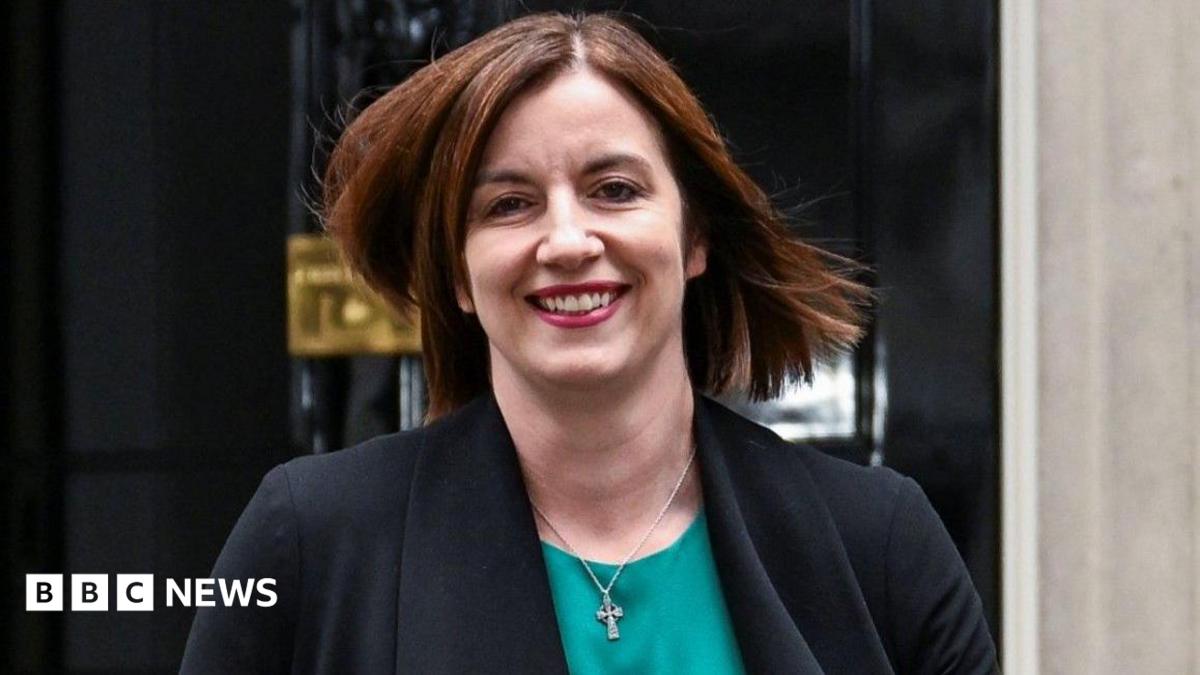
Prime Minister Andy Burnham has appointed Bridget Phillipson as Labour Party chair.
A Labour spokesperson said Phillipson, who is also minister for women and equalities, will work closely with deputy Labour leader Lucy Powell to modernise the party ready for the next general election.
Phillipson and Powell went head to head for the deputy leader position last year, after a race triggered by Angela Rayner’s resignation, with Powell emerging victorious following 54% support from the party membership, external.
Phillipson had been education secretary under Sir Keir Starmer but that job was also handed to Powell by Burnham when he appointed his cabinet last week.
Advertisement
Announcing Phillipson’s appointment, Burnham said she would help the party focus on preparations for a new digital campaigning environment.
“She will play a vital role in ensuring the Labour Party is match fit for the next election,” he said.
She replaces Anna Turley who was made a minister in the Home Office last week.
The leadership team, which also includes chief whip Anneliese Midgley, is expected to focus on culture change, and building the infrastructure and policy platform needed by 2029, which is the latest an election can be held.
“I joined our party as a teenager and saw first hand the difference a Labour government makes,” she said.
“I’ll work with members to build the election-winning machine that sees off Reform [UK] for good and secures a second Labour term.”
Welcoming her, Powell said: “Working together, we will ensure the party continues to lead the way in campaigning, with the strongest ground operation in British politics as we prepare for the next general election.”
An Islamic charity accused of being an outpost of the Iranian regime in London has the right to bring workers into Britain.
The Islamic Centre of England in Maida Vale appears on a Home Office list of organisations with approval to sponsor skilled worker visas.
Licensed visa sponsors have been officially vetted and approved by the Home Office to hire non-UK citizens.
The centre remains on the list despite claims it has been involved in spreading pro-Tehran propaganda and has successfully issued a number of certificates of sponsorship – documents required for migrant workers applying to enter Britain.
Advertisement
It is currently under investigation by the Charity Commission over alleged ties to Tehran.
The charity was reported to the watchdog earlier this year for hosting a ‘community bazaar’ where stalls sold pro-Tehran key rings and Hezbollah-themed phone cases.
Other stalls sold stickers featuring the silhouette of General Qassim Soleimani, former head of the Islamic Revolutionary Guard Corps (IRGC). When Soleimani was killed in an American air strike in 2020, the centre hosted a candlelit vigil.
Shadow national security minister Alicia Kearns called for the centre to be immediately removed from the list.
Advertisement
The Islamic Centre of England in Maida Vale appears on a Home Office list of organisations with approval to sponsor skilled worker visas
‘This is a bona-fide backdoor into the UK for Iranian agents,’ she said.
‘For years I’ve worked to get the Islamic Centre of England, an indoctrination hub, shut down.’
Advertisement
Kasra Aarabi, director of research on the IRGC at United Against Nuclear Iran, a non-profit organisation, called its inclusion on the Home Office list ‘truly appalling’.
He added: ‘This is no ordinary mosque or charity. It operates as the UK office of the Iranian regime’s supreme leader. The situation is far worse than has been reported.’
In response, the centre insisted it was not a representative of ‘any government, political entity, or individual’.
A spokesman said: ‘Like many charities, faith organisations and other eligible institutions in the UK, the centre holds a Home Office sponsor licence, which allows it to sponsor skilled workers where it meets the requirements of the UK’s immigration system.
Advertisement
‘We recognise that questions have previously been raised about the centre and its perceived relationship with the Iranian government. The centre has consistently maintained that it is an independent UK charity and carries out its activities in accordance with UK law and its charitable objectives.’
A string of Islamic bookshops flogging anti-Semitic texts also appear on the visa list.
Some of the books being sold offer outrageous claims, such as one saying that Jewish people have a ‘wicked nature’, while other texts have been labelled as a radicalisation threat by our prisons.
One of those on sale is Milestones by Sayyid Qutb, an influential former Muslim Brotherhood leader who believed Islam should govern every aspect of society.
Advertisement
His work also denounces ‘world Jewry’.
Other texts include those by Hasan al-Banna, the Brotherhood’s founder, and Bilal Philips, a cleric banned by the Home Office, who offered advice on beating wives.
The books sold by these businesses are not illegal in the UK and in some cases are sold through a number of mainstream platforms.
There is no suggestion of wrongdoing on the part of the businesses.
Advertisement
But Chris Philp MP, Shadow Home Secretary, said: ‘It is clear the ‘skilled’ visa route is being abused.
Advertisement
‘This is not skilled work by any definition – it is a blatant loophole, exploited by businesses who should never have been trusted with a sponsor licence in the first place.
‘We don’t want extremists in this country.
‘I would like to see these organisations lose their sponsor licence and anyone they have brought into the country who is still here on a temporary work visa deported.
‘The Government must urgently review this.’
Advertisement
Skilled worker visa certificates were introduced in 2020 as part of a post-Brexit immigration overhaul.
The scheme, overseen by the Home Office, allowed registered employers to bring workers into the country to fill jobs meeting a specific skill level.
Businesses such as vape shops and newsagents are among those to have been given licences, drawing questions over whether all those brought over are truly ‘skilled’.
Dozens of official certificates of sponsorship, the paperwork needed to apply for a skilled worker visa, have been issued by Islamic bookshops.
Advertisement
Home Office figures show that one of those stores, in Birmingham, has issued up to 16 skilled worker certificates since 2021.
A Home Office register says more than 120,000 organisations are licensed to issue certificates of visa sponsorship in the UK.
These organisations range from huge firms such as Barclays Bank to small corner shops and vape stores.
A Home Office spokesman said: ‘The Islamic Centre of England has not sponsored any workers since 2022, and the Charity Commission is currently investigating this organisation.
Advertisement
‘We treat the threat posed by the Iranian regime and those who do its bidding with the utmost seriousness. That’s why we have fast-tracked a change in the law to outlaw support for the IRGC, equipping the police and intelligence service with more powers to disrupt those working on their behalf, and making it easier to prosecute them.
‘If wrongdoing is uncovered, those responsible will face the full force of the law, with the possibility of lengthy prison sentences, loss of licences and further civil action.’
Visitors will be able to see Father Christmas as well as enjoy food and drink along the trail
This article contains affiliate links, we will receive a commission on any sales we generate from it. Learn more
Advertisement
Tickets are now on sale for a major Christmas event in Cambridgeshire. Christmas at Wimpole will return with a brand-new light trail at the National Trust estate in 2026.
The event will take place between November 20 and January 3. It has been created by award-winning light trail producers, with seasonal music accompanying the visual displays.
Visitors will also be able to glimpse Father Christmas and enjoy food and drink at stalls along the way. A spokesperson for the event said it will be “bigger, bolder and more spectacular than ever”.
James Dakin, director of live experiences at RG Live, a subsidiary of Sony Music, said: “Christmas at Wimpole 2026 promises an evening of light, wonder and festive joy, set against the remarkable backdrop of the Wimpole Estate.
Advertisement
“It is the kind of experience that turns a simple winter walk into a shared Christmas moment, with bold new installations, beautiful details and plenty of surprises along the route. From the first glow of the trail to the Christmas Cathedral, we want visitors to feel fully immersed in the festive season and to create a night people will remember.”
Hilary Wilson, visitor experience manager, said: “Christmas at Wimpole is all about bringing people together and creating those special moments that make the festive season so memorable. Whether you’re visiting with family, friends or loved ones, the trail offers a chance to step away from the everyday, enjoy the magic of the estate, and soak up the spirit of Christmas.”
Pentagon plans to stretch remaining Ukraine aid until 2029, report says
The Pentagon has told members of Congress it does not expect to finish spending the remaining $400m in military aid for Ukraine until fiscal year 2029, according to a Reuters report, a timeline that has frustrated lawmakers as Kyiv faces growing shortages of air defence weapons.
The disclosure comes ahead of Ukrainian president Volodymyr Zelensky’s visit to Washington, where he is expected to meet Donald Trump at the White House and later address all 100 US senators.
Zelensky is expected to press for additional air defence systems and the completion of a drone cooperation agreement with the US.
Advertisement
According to Reuters, the Pentagon outlined its spending schedule in a letter sent to Congress in May. While the funds are expected to be placed under contract by the end of fiscal year 2026, final deliveries are not projected until the fiscal year ending 30 September 2029, after the end of Trump’s second term in office.
The funds, approved by Congress last year with bipartisan backing, have reportedly not yet been obligated or disbursed, despite repeated complaints from lawmakers over delays in getting military assistance to Ukraine.
Shweta Sharma28 July 2026 04:02
Advertisement
Watch: Burnham reassures Zelensky of unwavering support for Ukraine despite change in PM
Burnham reassures Zelensky of unwavering support for Ukraine despite change in PM
Bryony Gooch28 July 2026 03:00
In pictures: Zelensky at HM Naval Base in Portsmouth
(Reuters)
(Reuters)
Bryony Gooch28 July 2026 02:00
Watch: Zelensky seeks ‘new page’ in UK relations under new PM
Zelensky seeks ‘new page’ in UK relations under new PM
Bryony Gooch28 July 2026 01:00
Advertisement
In pictures: Zelensky and Burnham meet and view Ukrainian equipment and meet Ukrainian personnel at HM Naval Base in Portsmouth
(PA)
(PA)
Bryony Gooch28 July 2026 00:00
Watch: Ukraine gunner shoots down attack drones with rifle from open cockpit
Ukraine gunner shoots down attack drones with rifle from open cockpit
Bryony Gooch27 July 2026 23:00
Advertisement
What’s on the agenda for Tuesday?
Volodymyr Zelensky will land in the United States on Tuesday where he will attend the funeral of late senator Lindsey Graham, who championed stronger sanctions on Russia from the US.
The Ukrainian president is also expected to meet separately with Donald Trump at the White House.
(AP)
Bryony Gooch27 July 2026 22:00
Watch: Ukrainian intelligence destroys Russian Triumf air defence system in occupied Crimea
Ukrainian intelligence destroys Russian Triumf air defence system in occupied Crimea
Bryony Gooch27 July 2026 21:00
Advertisement
US-Russia space crew lands back on Earth after eight-month ISS stint
Bryony Gooch27 July 2026 20:00
Watch: Ukrainian rear gunner shoots down attack drones with rifle from open cockpit
Ukrainian rear gunner shoots down attack drones with rifle from open cockpit
A study by Pepper Money ranked more than 300 locations across England and Wales using factors including house prices, mortgage affordability, rental costs and local earnings to determine where buyers can get the best value for money.
Middlesbrough topped the nationwide index, ahead of Burnley in Lancashire and Merthyr Tydfil in Wales.
Researchers found the town’s combination of lower-than-average house prices, affordable mortgage repayments and relatively strong earnings made it the most attractive location for aspiring homeowners.
Advertisement
The average first-time buyer property in Middlesbrough costs £123,831 — less than half the UK average of £261,700.
Pepper Money said local earnings compare well with house prices, making it easier for buyers to save for a deposit and keep mortgage costs manageable.
The North East emerged as the strongest-performing region overall, with the study suggesting it offers some of the best opportunities for people looking to buy rather than rent.
In total, 13 of the top 20 locations were in either the North East or North West, reinforcing the North’s reputation as one of the most affordable parts of the country for first-time buyers.
Advertisement
According to the research, every North East local authority except Northumberland has lower monthly mortgage costs than local rental prices.
Across the region, the average monthly mortgage payment is £699, compared with a national average of £1,310. In Middlesbrough this is estimated to be £157 per month cheaper than renting.
In Middlesbrough, County Durham and Hartlepool, mortgage payments also account for just 24% of monthly earnings – among the lowest proportions recorded in the study.
Pepper Money said the findings show that despite ongoing challenges in the housing market, there are still many parts of the UK where buying is more cost-effective than renting, with 41% of areas analysed proving cheaper to buy in than rent.
Advertisement
Researchers used Office for National Statistics data on earnings, property prices and rental costs, alongside mortgage affordability calculations, to compile the rankings.
After a wet weekend for most Scots, the end of July stays damp
Experts believe a dozen Scots areas will see rain on Tuesday, as millions of Brits will be soaked.
Advertisement
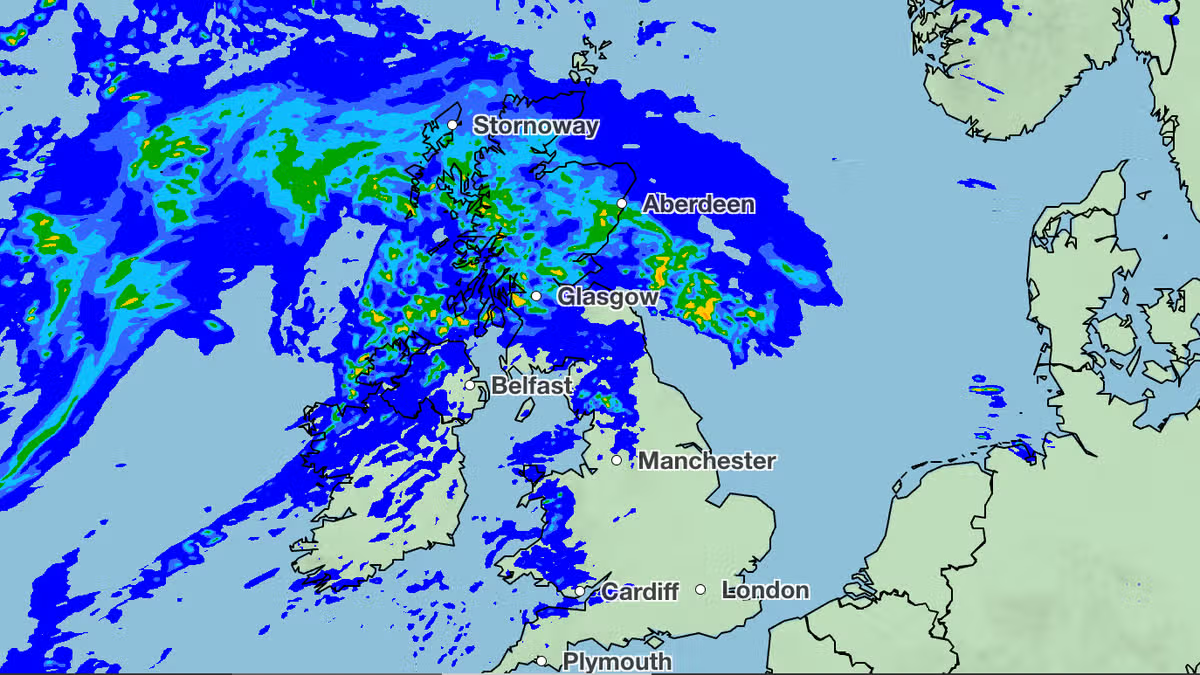
The Met Office believes more than 50 areas of the UK are expected to see rain on Tuesday (July 28) including 12 in Scotland. Rainclouds will move north-eastwards, drenching Northern Ireland, swathes of Wales, south west England, and northern England before hitting Scotland.
The heaviest rain will fall around 3am, when an orange rain cell is forecast to hit central Scotland and deliver 8-16mm of rain around the South Lanarkshire village of Douglas, the Met Office map shows. Once the heavy stops in mid-morning, scattered showers will persist for most of the day in Northern Ireland, north Wales, north west England, and Scotland.
However, it looks like it will stay dry in the Midlands, East Anglia, and southern England.
The Met Office forecast for Tuesday said: “Heavy rain in the north will ease and move away northeastwards on Tuesday, replaced by sunshine and locally heavy showers. England and Wales mostly dry with some hot sunshine developing.”
Advertisement
According to the Met Office’s map, 53 council areas will see some form of rain. It’s estimated 12 Scots, four Northern Irish, nine Welsh, and 28 English top-tier council areas will be hit by precipitation.
Temperatures are set to remain warm and typical for late July. Glasgow will see 20C, Edinburgh 21C, and Aberdeen 22C. Over the Irish Sea, Northern Ireland’s high will be 23C in Newry.
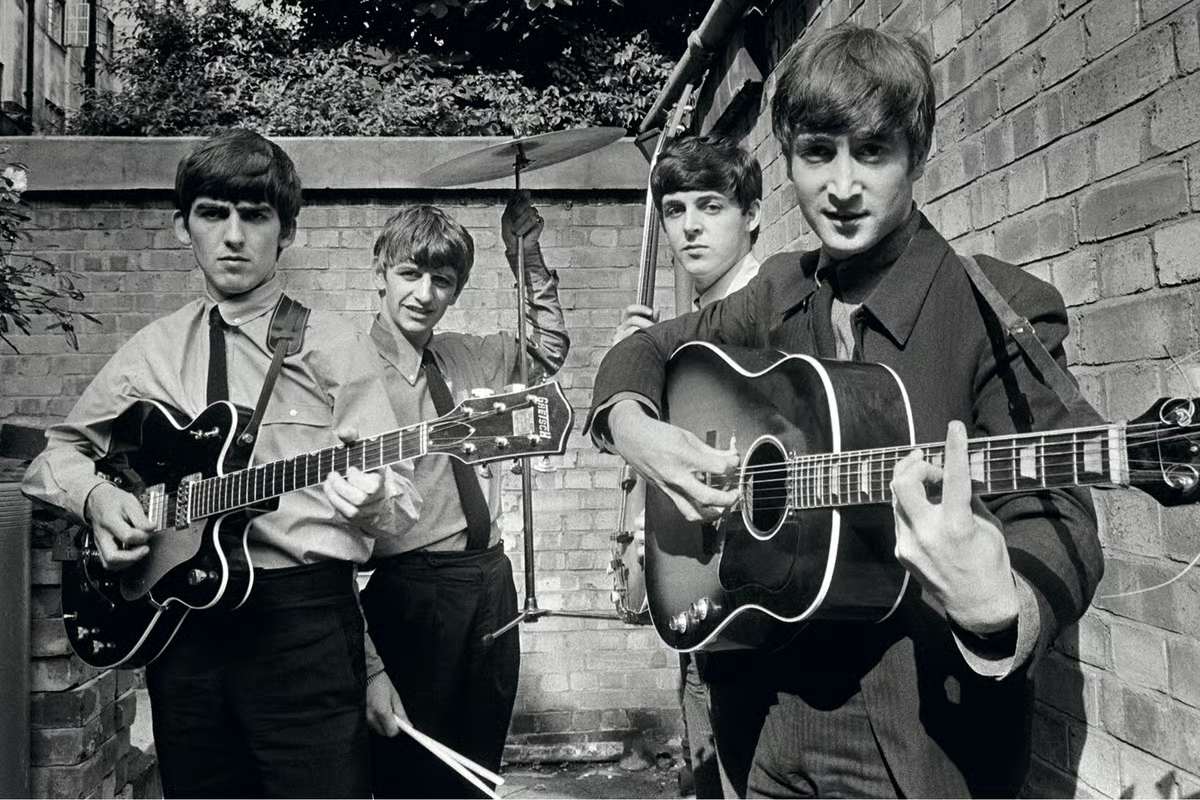
“Since launching the Music Photography Awards in 2022, we’ve deepened our commitment to the art form and re-examined how we interact with visual culture. Whether it’s the detail in a fine art photograph, honouring our roots with iconic image-makers, or working with a new wave of creators, we hope to present an Abbey Road, reframed.”
Forty years on from disappearance which shocked the world, Suzy Lamplugh murder probe finally set to be shelved – as police make one last call for witnesses to end family’s agony and help them find her body
Detectives investigating the murder of Suzy Lamplugh have made one last plea for information as they prepared to shelve the 40-year-old investigation into her disappearance.
With the prime suspect now dead, the Metropolitan Police said they remain determined to ‘find her resting place and bring her back’.
Scotland Yard detectives expect to spend the next year contacting around 30 potential witnesses, who are still believed to be alive, after they initially called in with tip-offs and leads when estate agent Ms Lamplugh vanished in Fulham, west London, on Monday, July 28, 1986.
The 25-year-old’s body has never been found, and remains the Met’s largest active murder investigation.
Advertisement
Police have now told Ms Lamplugh’s family the case will become ‘inactive’ next year, but are hopeful advances in forensic testing or a key witness breaking their silence will finally solve the mystery.
Detective Chief Inspector Teresa Foster, who leads the Met’s cold case homicide team, said: ‘We’re not going to give up on trying to find where Suzy is. But yes, it is difficult.
‘It is going to take a change in forensics or technology, or a change of allegiance, or someone coming forward with new information. It is going to be very difficult now after 40 years.’
Asked what detectives hope to achieve as the case prepares to be wound down, she said: ‘It’s finding Suzy. For us and for Suzy’s family, it is finding her.
Advertisement
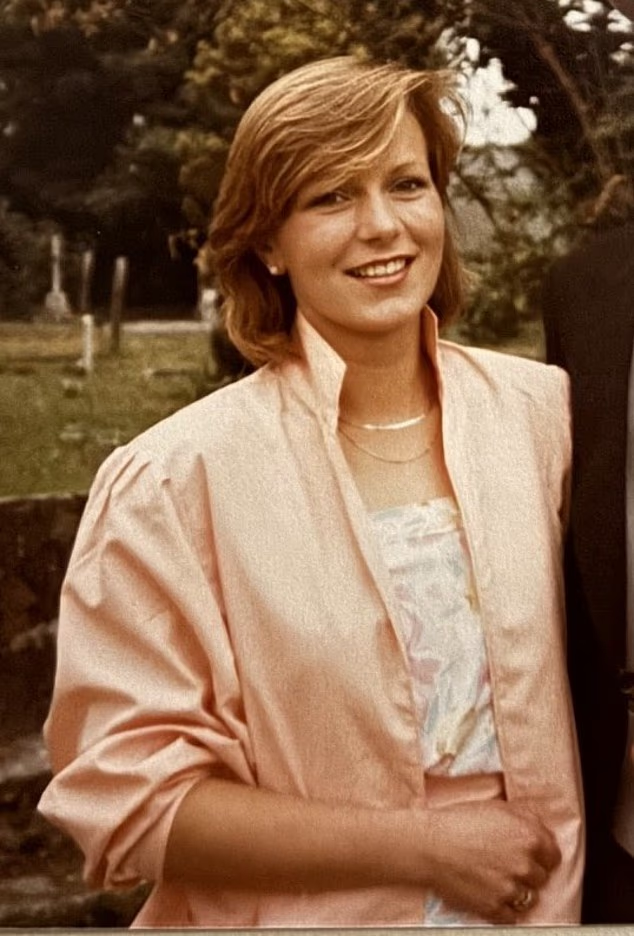
Suzy Lamplugh – pictured in new photographs released by her family today – was 25 was she vanished in Fulham in 1986
Suzy, pictured (right) for the last time alongside her siblings, brother Richard, and sisters Lizzie and Tamsin
The Lamplugh family – (left to right, back row) Richard, Lizzie, Suzy, Tamsin, Paul and Diane (seated)
Advertisement
John Cannan was the prime suspect in the search for Ms Lamplugh’s killer. But he died in prison in 2024
Suzy Lamplugh (second left) with her siblings, (left to right) Richard, Tamsin and Lizzie
‘It’s finding her resting place and bringing her back.’
Ms Lamplugh was working for Sturgis’ estate agents in Fulham when she left the office to show a home to a potential client. The appointment marked in her diary was with a ‘Mr Kipper’.
Advertisement
Witnesses saw Ms Lamplugh standing outside the address in nearby Shorrolds Road, looking as if she was waiting for someone.
Around ten minutes later, a next-door neighbour heard someone leaving the property and saw Ms Lamplugh outside with a dark-haired man in a charcoal-coloured suit.
But by mid-afternoon, office colleagues had become concerned about her whereabouts and contacted police.
Her abandoned white Ford Fiesta was found, badly parked, a mile away from Shorrolds Road, at 10pm.
Advertisement
The vehicle was unlocked, the handbrake was off, and Ms Lamplugh’s purse was left inside the car door.
She was never seen again.
A newly released family photograph of Ms Lamplugh, whose body has never been recovered
Ms Lamplugh worked as an estate agent in Fulham, and lived in nearby Putney
Advertisement
Her disappearance made headlines around the world
The prime suspect in the case, John Cannan, the middle-class son of a successful car salesman, died in prison in 2024 after being jailed for life in 1989 for the abduction and murder of newlywed Shirley Banks from Bristol.
I know why Jack the Ripper was protected for so long
Advertisement
Hi, I’m Alex Matthews, Editor of The Crime Desk.
In 2014, we revealed the bombshell evidence identifying Aaron Kosminski as the fabled Jack the Ripper. Now, we can reveal his astonishing connection to the Freemasons and claims this motivated his killings and protected him from life in prison.
He had been out on licence from prison when Ms Lamplugh disappeared, having previously been jailed for raping a pregnant woman in front of her own mother and toddler, as well as two robberies.
He was identified as the key suspect in the Lamplugh case in 2002, but always denied involvement. No forensic evidence has ever been found linking him to what happened.
Advertisement
DCI Foster said she and her team remain ‘haunted’ by the fact the case – which unfolded on the doorstep of the case team’s headquarters in Putney – remains unsolved.
She said: ‘It does haunt me because we’ve never found her, she’s never been seen.
‘I think everybody at some stage, who lives in London, can think: That could have been me.’
She said the case was headline news around the world, and remembers hearing about it as a schoolgirl in New Zealand where she grew up.
Advertisement
‘This was a huge story then, and it was just shocking,’ she said.
A young Suzy, pictured alongside her family, including parents Diana and Paul
‘I think for us that are invested in this, it upsets us. We’re very close to the family as well.
‘So yes, it does haunt that we can’t give answers, and we know that we’re up against it 40 years later.’
Advertisement
The Met has recently secured convictions of three historic killers – Janice Nix, who scalded her stepdaughter to death in the bath, and brothers Michael and Anthony Stewart for murdering a civil servant – following disclosures from family members.
And DCI Foster urged those with information about this decades-old case also come forward.
In a direct appeal to anyone for witnesses, she said: ‘We’re not going to stop looking for Suzy.
‘If anybody has that information, you know we’ll take it forward, but we’ll also safeguard them, protect them in any way we can.’
Advertisement
Ms Lamplugh’s parents, Diana and Paul, died in 2011 and 2018 respectively without knowing what happened to their eldest daughter.
Their legacy is the Suzy Lamplugh Trust, a charity they set up in their daughter’s honour which focuses on personal safety, stalking and harassment.
DCI Foster said the surviving family members ‘totally understand’ that the investigation will eventually be deemed inactive.
But she said: ‘It’s not going to be closed.
Advertisement
‘I’ve said to the family that any information comes in from anywhere, we still raise it as an action.’





















































You must be logged in to post a comment Login