Calum Frame, prosecuting, said the women had known each other for almost all of their lives.
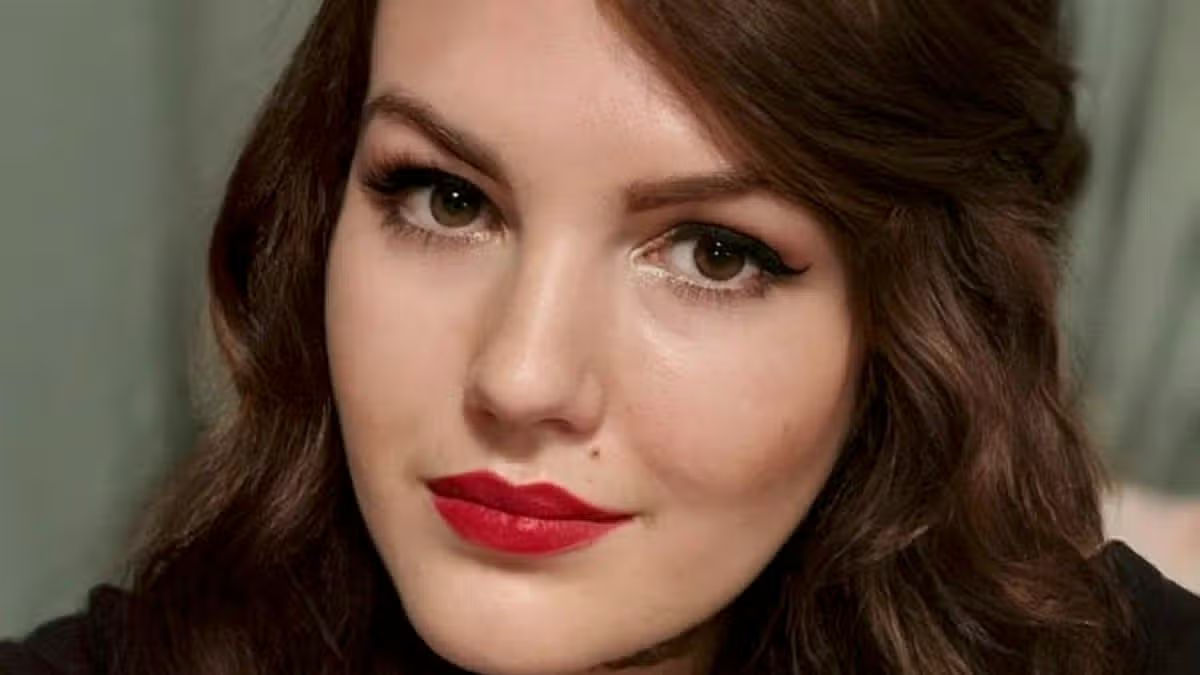
A woman has been jailed for 15 months after battering her partner on the head with a wooden shelf.

Advertisement
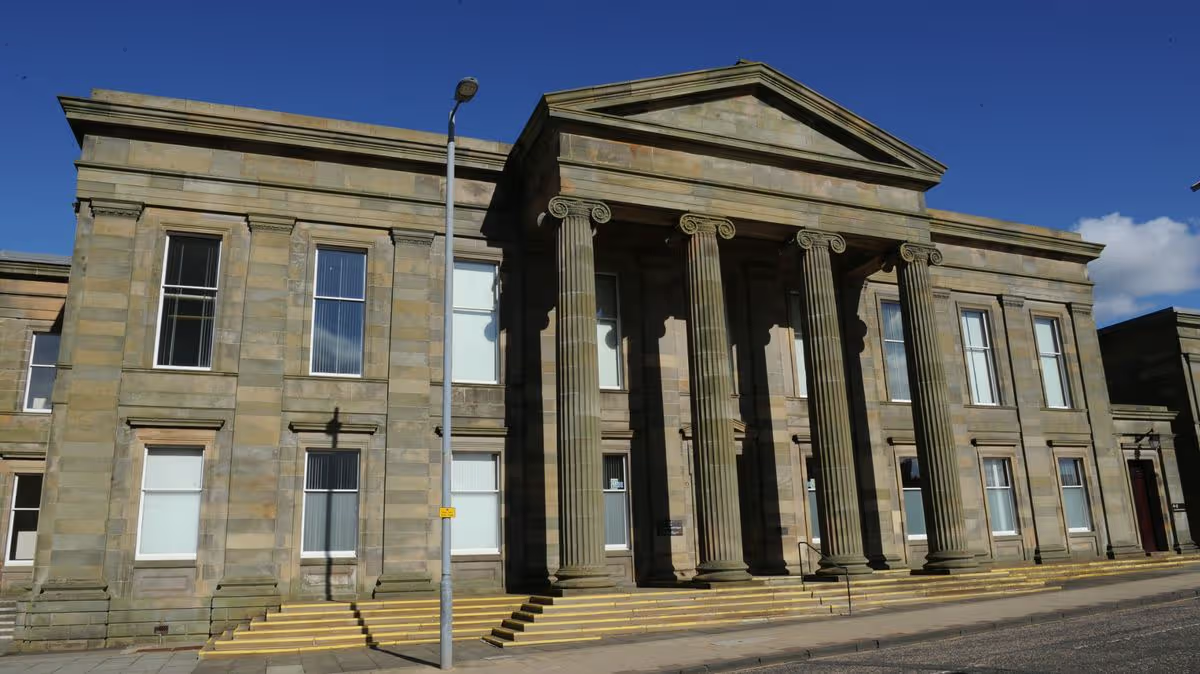
Danielle Wilson and her partner’s relationship had been “toxic”, Hamilton Sheriff Court was told.
Wilson, 33, of Smyllum Road, Lanark, admitted assaulting the victim to her severe injury and permanent disfigurement.
The attack happened at a house in Telford Road, East Kilbride, in the early hours of December 10, 2024.
The Crown accepted that Wilson acted under provocation, having been hit by her partner first.
Advertisement
Calum Frame, prosecuting, said the women had known each other for almost all of their lives.
They had been in a relationship for around four months at the time of the assault. They both have children with previous partners.
Mr Frame told the court that the victim had taken alcohol and valium before falling asleep.
Her recollection of events was “hazy” but she remembered Wilson waking her and being struck on the head.
Advertisement
Mr Frame said: “Police were contacted by a neighbour. Officers came upon [the victim] in the street around 1.30am.
“She had a laceration to the top of her head that required four stitches and has left a scar.”
Wilson also admitted breaching bail conditions by having contact with the woman at a later date and failing to comply with a curfew.
Defence lawyer Laura Kiernan said Wilson had been annoyed after she was woken by one of the victim’s friends who had turned up at the door late at night.
Advertisement
Ms Kiernan stated: “My client then woke [the victim] who struck her first with a shelf. My client hit her back with this item but she accepts it was not self-defence.
“Both of these women have difficulties with their mental health and substance abuse.
“Danielle Wilson suffers from post-traumatic stress disorder and at the time of this incident was really struggling with addictions.
“Both were using crack cocaine and it’s no surprise the relationship became toxic.
Advertisement
“My client has attended Cocaine Anonymous. She has a support worker and is seeking rehabilitation.”
Sheriff Liam Murphy said it was a serious assault committed while Wilson was on bail for other matters.
The sheriff told her: “I take account of the provocation and all that has been said on your behalf, but there is no alternative to custody.”
*Don’t miss the latest headlines from around Lanarkshire. Sign up to our newsletters here.
Advertisement
And did you know Lanarkshire Live had its own app? Download yours for free here.
The colon is about one and a half metres long and plays a vital role in moving waste through the body. In rare cases, it can become so stretched that it begins to lose its ability to work properly, like an elastic band that has lost its spring.
This is known as megacolon. Megacolon is not a single disease, but a term used to describe a colon that has become much wider than normal. The cause is important: some forms develop gradually, while others can become life-threatening within days.
One form of megacolon develops before birth. In Hirschsprung disease, some babies are born without the nerve cells that normally help the lower part of the colon push stool through the bowel. Stool becomes trapped and the section of bowel above the affected area begins to stretch.
Babies with Hirschsprung disease may fail to pass their first stool within the usual time after birth. They can also develop a swollen abdomen, vomiting, constipation or feeding difficulties.
Advertisement
The condition cannot currently be prevented because it develops while the baby is in the womb. Treatment usually involves surgery to remove the section of bowel without the normal nerve supply.
Megacolon that develops later in life
Another form, known as acquired megacolon, develops later in life. Symptoms can include constipation, abdominal bloating and pain.
Chronic constipation, meaning constipation that persists over time, is common worldwide. It affects about one in ten adults on average, although estimates vary between countries and studies. The vast majority of people with constipation will never develop megacolon, however, which remains rare.
Advertisement
The exact cause of acquired megacolon is still unclear. Research suggests that changes affecting the nerves and muscles of the bowel may interfere with the colon’s ability to move stool normally. Some medications and neurological conditions have also been linked to acquired megacolon, although most people taking these medicines or living with these conditions will never develop it.
Because the causes are not fully understood, there is no guaranteed way to prevent acquired megacolon. Treatment depends on the likely cause and the severity of the symptoms. Some people improve with dietary changes or medication. Others need specialist treatments, and surgery may be necessary in severe cases.
Ogilvie syndrome
A rapidly enlarged colon can also develop in people who are already seriously unwell. Acute colonic pseudo-obstruction, also known as Ogilvie syndrome, most often affects people in hospital after major surgery, infection, trauma or another serious illness.
The bowel appears to be blocked, although there is no physical obstruction. Instead, the colon stops moving its contents along effectively.
Advertisement
The abdomen can swell quickly. This becomes dangerous if the colon stretches so much that it loses its blood supply or tears.
Doctors usually begin by treating the underlying trigger. They may correct dehydration or electrolyte imbalances, meaning abnormal levels of salts such as sodium or potassium in the blood. They may also stop medicines that slow the bowel and monitor the patient closely while the colon has a chance to recover.
If this does not work, doctors may use a medicine called neostigmine to stimulate the bowel. They may also need to relieve the pressure by removing trapped gas from the colon. This can involve inserting a tube into the bowel during an endoscopic procedure using a flexible camera.
Toxic megacolon: a medical emergency
Toxic megacolon occurs when severe inflammation causes the colon to widen rapidly and the person becomes seriously unwell.
Advertisement
It is most often associated with ulcerative colitis, a form of inflammatory bowel disease in which the immune system mistakenly attacks the lining of the colon. Severe bowel infections can also cause toxic megacolon, including infections with Clostridioides difficile, usually known as C. diff.
Symptoms can include fever, a fast heartbeat, severe abdominal pain, bloody diarrhoea, dehydration and a swollen abdomen. The greatest concern is that the bowel could tear, allowing bacteria to spread into the abdomen and bloodstream.
Reducing the risk of toxic megacolon means treating the conditions that can cause it. For someone with inflammatory bowel disease, this includes seeking medical advice promptly if a flare-up worsens, particularly if they develop bloody diarrhoea, fever or abdominal swelling. Bowel infections also need prompt diagnosis and appropriate treatment.
Once toxic megacolon develops, it requires urgent hospital care. Treatment may include fluids through a drip, close monitoring and medication to reduce inflammation or treat infection. If the colon does not improve quickly, or if there are signs that it may tear, surgery to remove the colon can be lifesaving.
Advertisement
The different forms of megacolon have very different causes, but they share one important feature: the colon becomes enlarged and less able to do its job.
Because this can develop quickly, severe abdominal swelling should never be dismissed as “just constipation”, especially when it is accompanied by pain, fever, vomiting or bloody diarrhoea.
When the bowel stops working properly, early action matters. The sooner the warning signs are recognised, the better the chance of preventing a dangerous complication.
The second day of the sentencing hearing of 30 people involved in the Ely riots is due to begin. The violence began following the deaths of two teenage boys in an electric bike collision on May 22, 2023.
Around 150 people attended the riot which saw hours of violence and vandalism take place on the streets on and near Wilson Road in the west Cardiff suburb.
Kyrees Sullivan, 16, and Harvey Evans, 15, were killed while riding an electric bike through the streets in the area. The two young boys were involved in a fatal collision and were later pronounced dead at the scene. Stay in the know by making sure you’re receiving our daily newsletter
The mothers of the two teenagers attempted to run to their children, grief-stricken and in desperation, but their path was blocked by the police.
Advertisement
Moments after the collision large crowds consisting of members of the close-knit community of Ely came out to witness the horror as it unfolded.
Shock and sadness quickly turned to distress and anger at how the police were handling the scene and as rumours circulated that the police were responsible for the death of Kyrees and Harvey who had previously been pursued by a police van.
During the first day of the sentencing hearing on Monday, the court heard statements from police officers about the day of the riot. Matthew Cobbe, prosecuting, read out the details of injuries suffered by police officers, including one who was set alight.
Judge Tracey Lloyd-Clarke ordered him to be taken to a cell.
Advertisement
The court also heard about the involvement of Michaela Gonzales, 37, in the rioting. The court was told that the defendant threw a bottle at police before hiding behind a car.
Today, defendants Lee Robinson, Callum O’Sullivan, Asdon O’Dare and Kyle Telemaque are due to be sentenced this morning, and Harvey James, Jasmine Smith and Tyler Stapleton are due to be sentenced this afternoon.
See all the key updates from the day in court below and sign up to get daily breaking news updates on your phone by joining our WhatsApp community here:
Homelessness in the UK is reaching critical levels, with more than 380,000 people estimated to be without a home in England alone as of late 2025.
There is also a growing recognition that neurodivergent people are over-represented among homeless populations. But much of this comes from anecdotal reports from service providers or localised research projects looking at specific neurodivergences like autism or attention deficit hyperactivity disorder (ADHD).
So, our new research explored why this may be so. Our findings demonstrate how neurodivergent people may face exclusion at various points throughout their social lives, education and employment. In turn, this can lead to increased financial hardship and a higher chance of homelessness.
As homelessness rises across the UK, public debate tends to focus on housing supply or personal responsibility. For example, housing and homelessness charity Shelter highlights the chronic shortage of social housing and an increasingly unaffordable private rented sector.
Advertisement
We spoke at length with six neurodivergent people, from one local authority area, who had experienced homelessness or insecure housing. To structure the interviews, we asked participants to create a life map.
This is a visual timeline of important events that were meaningful to them, such as education, employment, becoming homeless, seeking support and diagnosis. We analysed the life maps and the participant accounts, identifying three central themes across their stories.
First, ambiguity around diagnosis often confused things and delayed or blocked access to support. Second, participants often seemed to have fallen through the gaps at critical points across their lives, where support should have been available. And third, once in crisis, navigating services was often experienced as inaccessible, slow and demoralising.
A lifetime of missed support
There were a number of points in our participants’ lives where support had been needed but was ultimately missed. This had knock-on effects on their ability to remain in education or employment. In turn, this created a lack of opportunities and affected financial security.
Advertisement
For some participants, these challenges began in school. Most described being bullied – an experience that is unfortunately common for many neurodivergent children. Faced with a lack of support for the bullying, participants took their own action, by changing schools, moving areas, or even leaving school altogether.
Those who went on to higher education experienced a lack of specialist neurodivergent support, alongside challenges with living away from home for the first time. Some turned to alcohol in order to manage social anxiety.
Neurodivergent people may face unique pathways into homelessness. Travers Lewis/Shutterstock
Neurodivergent adults are known to experience significant employment gaps. Our participants also outlined numerous challenges to securing and keeping a job. One described being unable to find a placement for some work experience required to complete a qualification. They believed that this was due to stigma associated with their diagnosis.
For others, jobs that may be considered entry-level, such as customer service or retail jobs, presented unanticipated difficulties, including sensory overwhelm and social anxiety. UK employers are required by law to make changes to remove or reduce potential disadvantage faced by disabled employees, which are known as “reasonable adjustments”. But most participants reported a lack of these in practice.
Advertisement
When our participants hit a crisis point and sought help for their housing needs, many experienced the services as confusing or unsupportive of their needs. Most described long waits for various supports and services, often in unsuitable, temporary accommodation.
Sensory and social challenges in these environments contributed to mental health deterioration. Long waiting lists to access therapy or diagnostic assessments also left participants feeling trapped and unable to move forward with their lives.
‘Society doesn’t care about you’
Respondents described patterns of persistent exclusion, starting in early life, that had paved the way to homelessness. Once in need of housing support, they found significant barriers to accessing services that had been designed by and for neurotypical people.
When offered temporary accommodation, in many cases this did not meet their neurodivergent needs. For example, most participants described being placed in busy, “chaotic” hostels that they were desperate to leave. In one case, a person with significant sensory sensitivities was living in shared temporary accommodation next-door to a nightclub which played loud music throughout the night, affecting their sleep.
Advertisement
We also noticed that participants appeared to have internalised these experiences. For example, they blamed themselves and felt like “society doesn’t care about you”, as one described. This affected both their self-esteem and their engagement with services.
Many people may face similar circumstances yet do not necessarily find themselves homeless. For our participants, however, hardship was heightened by reduced social networks to fall back on during hard times. They described difficulties in maintaining regular contact with friends. They were sometimes rejected by their family and others, due to a lack of understanding of their differences.
The stories we heard were powerful and hard-hitting. They show the serious effects of exclusion which may build up over a person’s life.
Advertisement
There were also many points at which early support or prevention could have been put into place, for example, in education, workplaces and when accessing health and social care. There are now a growing number of toolkits and guidance for services working with neurodivergent people facing homelessness.
Taken together, our findings show how neurodivergent people may face unique pathways into homelessness. It demonstrates why earlier, more joined-up inclusion and support is vital for prevention.
Parents have been sharing their shock over this morning’s incident at Co-op Academy Manchester.
Many became aware of the incident from posts on Facebook and received confirmation from the school shortly before 10.30am that everyone was safe and the incident had ‘been contained’.
One mum, whose son was already on his way home when she received the message, said:
Advertisement
“This is all so scary. Parents found nothing out from school, it was all from Facebook. My child should be enjoying the last few days in school and not worrying and being in lockdown.”
Another said she went to collect her daughter from school and only received confirmation of what had happened once she’d got to the site.
Iran’s allocation of fan tickets for the group stage of the World Cup has been revoked just days before the start of the tournament, says the country’s football federation.
The World Cup, co-hosted by Canada, Mexico and the United States, begins on Thursday, with Iran scheduled to play New Zealand on 15 June and Belgium on 21 June – both in Los Angeles – before facing Egypt in Seattle on 26 June.
Iran’s governing body says Fifa regulations state each federation involved in the World Cup receives 8% of the tickets for each of their matches, to distribute to supporters.
It added that it had already begun selling tickets but can no longer provide them to fans, some of whom have already made travel arrangements.
Advertisement
“Depriving Iranian supporters of access to their lawful and official allocation of tickets is an action contrary to the spirit of governing international competitions and the principle of equality among participating countries,” the FFIRI statement said.
“This development raises serious questions about the interference of non-sporting and political considerations in the organisation of the world’s biggest football event.”
The FFIRI also called on Fifa “to uphold the principles of neutrality, fairness, and established regulations”.
It was a huge shock. I honestly had no idea they were dangerous.
You see warnings on cigarette packets, and photos of people with lung cancer, but you never see a picture of a person with skin cancer in a tanning shop.
Advertisement
It’s not just a lack of warning about the health risks.
Earlier this year, a BBC investigation found tanning companies spreading dangerous misinformation on social media about how sunbeds can actually be good for you; falsely claiming, for example, that doctors prescribe sunbeds for issues like seasonal depression and skin disorders.
I don’t want anyone to be convinced that sunbeds can be beneficial to our mental or physical health.
This is highly damaging misinformation, and it’s terrifying. I wish I hadn’t experienced the very real dangers of sunbeds first hand; but, as I learned that day with the nurse, I have.
Advertisement
And I paid the price.
Everyone Katie knew used sunbeds (Picture: Katie McVeigh)
I didn’t even think of myself as an excessive user. I might have gone two or three times a week before a holiday or night out. But then I wouldn’t go again for months.
‘That’s still a form of sunbed abuse,’ the nurse told me. She likened it to binge drinking – avoiding booze all week and then getting drunk on a Saturday night.
I was only 16 when I went on a sunbed for the first time. Everyone I knew did it – my mum, aunts, cousins and friends.
My mum was going to the tanning shop and asked if I wanted to go with her. I had a three-minute tan that first time and afterwards I felt great – like I was glowing.
Advertisement
I found out later that it’s actually illegal for tanning shops, beauty salons and other commercial premises in the UK to allow anyone under 18 to use a sunbed, but no one ever asked my age.
But I was hooked. I started tanning regularly. I’m very pale, with a lot of moles, so I felt like it gave my skin a base colour.
After giving birth Katie went back to the tanning shops (Picture: Katie McVeigh)
Everyone around me was doing it.
On the weekends, my friends and I would make a trip to our local salon. I rarely went alone – it was more of a social thing. If somebody else was going, I’d tag along.
I left school at 16 and went into hairdressing so there was a big focus on beauty. You got your hair done, you got your nails done and you got a tan.
Advertisement
I grew up in Belfast, which is one of the UK’s sunbed hotspots – according to charity Melanoma Focus, 37% of adults in Belfast use sunbeds. It’s just the done thing.
By the time I turned 20 I fell pregnant with my daughter Connie, now four, and during my pregnancy I didn’t go near sunbeds. To me it felt like smoking or drinking while pregnant – it was just something I didn’t think it was right to do.
But after giving birth I went back to the tanning shops. It felt like a wee treat and a bit of ‘me time’.
In the chaos of being a first-time mum, I found it was also a lot quicker than getting my nails or hair done – it was easier to fit in around childcare.
Advertisement
Learn more about skin cancer symptoms
The main symptoms of melanoma skin cancer can include a new mole, or a change to an existing mole. These can appear anywhere on the body.
Normal moles tend to be:
Small
Round
Smooth-edged
One colour
Unchanging
Melanomas can be:
Larger
Unevenly shaped
A mix of colours
Changing in appearance
Other signs of melanoma could include moles that are swollen, sore, bleeding, crusty or or itchy. You can learn more here.
The main symptom of non-melanoma skin cancer is a growth or unusual patch on the skin, which can vary in size, texture and colour. You can learn more here.
Advertisement
Then, in the summer of 2022 I noticed a black mole growing on my right cheek.
I’m a fairly moley person so at first I wasn’t too worried, but then it started looking different to my other moles – it kept scabbing over, dropping off, then growing again. This went on for a couple of months.
I sent photos to my GP. They weren’t worried either but they referred me to a dermatologist just to be on the safe side.
Advertisement
In September 2022 I had the mole removed at a dermatology clinic and sent away to be biopsied. It would take six weeks to get my results, and during that time I didn’t really think about it. There hadn’t been any red flags yet.
Finally, the clinic called me and invited me to go in for my results.
It was awkward to arrange childcare, so I asked them why I couldn’t get them over the phone.
They told me I needed to go in person and to bring someone with me. That’s when I first realised.
Advertisement
One mole in particular started to look different to her other moles (Picture: Katie McVeigh)
Driving to the clinic, I started to feel anxious. The phone call had unsettled me, something didn’t feel right.
At first, they said it looked like Stage 2 Melanoma and referred me to the Ulster Hospital, in Belfast, to have a larger section of tissue on my face – where the mole had been – removed.
They couldn’t tell me what my face would look like afterwards or how big the scar would be, but by that time my priority was staying alive.
I knew things were more serious than I’d first thought.
I had the surgery in February 2023 and also woke up with a scar on my neck where an associated lymph node had been removed – to test to see if the cancer had spread.
Advertisement
Waiting for the next set of resultsto find out if it had spread into my lymph nodes – six weeks felt like six years.
I was crying a lot, although of course I tried to hide my upset from Connie. I just told her mummy was poorly and needed to go to hospital to get better.
The results showed the melanoma had spread to my lymph nodes so it was upgraded to Stage 3 and I was referred to Belfast City Hospital’s Cancer Centre for MRI and CT scans to check it hadn’t spread anywhere else, which thankfully it hadn’t.
Katie is now cancer-free (Picture: Katie McVeigh)
That’s when it really began to sink in that I had cancer. People think if they get a bad mole it will just be removed and that’s that, but melanoma means cancer.
My family and friends were a huge support, and also helped keep Connie occupied and entertained.
Advertisement
This month, I’ve come to the end of a year of targeted immunotherapy treatment, and I’m now cancer-free.
But it isn’t over – I’ll now have five years of monitoring scans every six months, to make sure the cancer doesn’t come back.
They will also do mole-mapping – it’s where I have to stand in my underwear and every single mole on my body is measured and photographed. They can then track any changes every time they check my moles.
My mum and other family members have stopped using sunbeds now. A lot of my friends have stopped too, but not all – people still think it won’t happen to them.
Advertisement
Katie’s biggest fear now is not being around to see Connie grow up (Picture: Katie McVeigh)
That’s what I thought until it happened to me.
It’s not just sunbeds – getting sunburnt is another risk factor for developing skin cancer, and I remember getting burnt on family holidays as a child.
One year, as a 10-year-old, in Egypt was particularly bad – I remember my shoulders were so blistered that my mum applied Greek yoghurt from the hotel bar to cool our skin.
We always think our sunburns are just something we need to quickly recover from, and never consider the long-term effects.
And now, my biggest fear now is not being around to see Connie grow up.
Advertisement
I’m a mum and she needs me. I’ve seen other people my age, with the same diagnosis, tragically pass away.
This is very real and skin cancer needs to be taken more seriously – as do the claims that some unscrupulous companies are putting in front of impressionable teenagers.
If I could travel back in time I’d tell my younger self that having a tan is just not worth it, and I would tell everyone else to look at everything you have – and not be tempted to play Russian roulette with your life.
As told to Jade Beecroft
Advertisement
This article was originally published on February 11, 2026.
Stephen Bradford and Dale Simpson took over the Ganton Greyhound Inn last month, replacing Steve and Sharon Padfield, who had ran it since 2019.
The pub, with its restaurant and guest house had been on the market since last autumn for £895,000.
Stephen was born in Middlesborough and raised in Redcar. He initially worked as a carpenter/ joiner in Middlesborough before travelling the world and on to New Zealand, aged 21, where he worked in hospitality.
He spent 10 years working bars, pubs, restaurants and then hotels. He started at the bottom and worked his way up to management.
Stephen returned to the UK in 2015, where he managed hotels and renovated properties, before launching a hospitality development company in 2018.
On his first project, a guest house in Llandudno, Wales, he met his wife Helen.
After making a success of this project, he sought another project and began talking to a childhood friend he used to have business ideas with 25 years ago, leading to a new partnership.
Advertisement
Helen, Stephen, Dale and Jodi outside the pub (Image: Pic supplied)
Dale grew up in Skelton, Cleveland, attending school in Saltburn, where he met his partner Jodi and raised their three children there.
After 25 years in the army, Dale was ready for a new mission, leading him to partner with his close friend Stephen.
Dale said: “’Throughout my military service, I’ve learned that success relies entirely on two things: meticulous attention to detail and taking care of the people around you. Today, my co-owner and I are applying those exact principles to hospitality.
“Whether you are stopping by our restaurant for a hearty, locally sourced meal, staying in one of our 15 beautiful rooms, or relaxing in the bar after a round at Ganton Golf Club or quenching your thirst after watching the Ganton Cricket team, our goal is to provide a seamless, welcoming, “home-from-home” experience.
Advertisement
“I look forward to greeting you at the bar and ensuring your stay in North Yorkshire is nothing short of exceptional!’
The pair say they were attracted to the pub as it was a landmark, freehold 18th Century property, which gives them the freedom to run the business how they like.
It is free of brewery ties, allowing them to source the Yorkshire ales, spirits and wines from whichever independent suppliers they choose.
The prime location by the A64 gives “an incredible volume of passing trade.”
Advertisement
The pair also note the pub is right next to the top-class Ganton Golf Course, making it the perfect 19th hole. The area is a haven for walkers and tourists.
The pub itself is an iconic historic coaching inn, widely celebrated for its cosy, traditional atmosphere, complete with complete with open log fires, exposed beams, and a sprawling beer garden for the summer months.
It also delivers three revenue streams from its bar lounge, home-cooked food and 15 en-suite guest letting rooms.
Dale and Stephen say business has been fantastic since they took over, with them receiving a warm welcome from locals and passing travellers.
Advertisement
Dale said: “Taking over from the previous long-term custodians, meant we stepped into an already running business with a very healthy book of forward reservations already stretching into the year.”
They plan to extend the opening hours, including opening on Sundays, which the previous owners did not. Sunday service will include Sunday roast.
The pair are refreshing the menu, with a focus on freshly-prepared local produce, classic pub favourites with a modern culinary twist.
There will be some updates to the bar area and some bedrooms, whilst maintaining the pub’s character.
Advertisement
Dale added: “Stephen and I would like to thank everyone that has supported us so far, our family and friends and the locals that are most welcome back to their local The Ganton Greyhound. Special Thanks to our parents who continue to support us, without their input this would never be possible.”
Have you been to the Ganton Greyhound Inn? What did you think? Share your memories in the comments below.
DJ Afrojack has said he’s lucky to be alive after narrowly escaping a metal blade that smashed through his car’s windscreen and likened the moment to Final Destination
11:18, 09 Jun 2026Updated 11:18, 09 Jun 2026
DJ Afrojack has shared that he almost died when a metal blade smashed through his car’s windscreen and only narrowly missed his face. The 38-year-old DJ posted a clip to social media, where he likened the moment to something from the film Final Destination.
In the video posted to Instagram, he showed his cracked windscreen with the metal blade still stuck in it. The position of the blade showed that it had crashed through the windscreen over the central console, and will have landed very close to both the driver and any front seat passengers. DJ Afrojack, whose real name is Nick Leonardus van de Wall, wrote over the video: “POV: Final Destination but it’s not a movie.”
Final Destination is a film franchise that follows a group of people who escape death only to be killed off in a series of unlikely incidents orchestrated by Death itself.
He also said in the caption that he felt “lucky” to have survived it: “We got lucky, will post full update later.” The caption was accompanied by a series of distressed face emojis.
Fans quickly shared their support for Afrojack. One wrote: “Brother… so glad you’re safe.” Another said: “Glad you are ok bro. God’s protection is with you.” A third added: “OMG so glad you’re ok fam. That’s scary AF.”
Advertisement
The DJ later shared another series of videos and pictures of the car with the blade in the window, which was being driven by his friend Nick Fuso. He said in the caption: “Sometime life sends me a reminder of how lucky I am to be here..
“Blessed with my family, blessed with my friends, and blessed with breathing. This was the scariest thing i’ve ever seen and my friend @nickfuso too, for @fritsvandeclips the second scariest thing.
“Thanks for the warning, thanks for this life, lets go get more life n more music!! Thanks @nickfuso for not crashing the car after your final destination moment, and tnx to my team (and @officialhardrock ) for still getting us to the finish line!!”
Advertisement
He finished by sending a “big thanks” to his wife, Elettra Lamborghini, “for always being there for me even in the scariest moments”. DJ Afrojack married the Geordie Shore star in 2020 in a Lake Como wedding.
Their wedding was a spectacle where their family and friends watched them exchange their vows. Elettra has her roots in the spotlight as the granddaughter of car founder Ferruccio Lamborghini and she had her own taste of fame on Geordie Shore in 2017. The two were engaged for 10 months before getting married.
Finally, Afrojack posted a picture from his spot on a plane and poked fun at the incident, which happened on the way to the airport. He said: “Team no car made it to Monterrey.”
Greater Manchester Police were called to Co-op Academy Manchester on Plant Hill Road shortly after the start of the school day.
Emergency services, including police officers, paramedics and an air ambulance, attended the scene as the school was placed into lockdown.
Police confirmed that three people suffered injuries, ‘thought to be knife wounds, although none are believed to be serious at this stage.
Advertisement
Officers arrested a schoolgirl in connection with the incident and investigations remain ongoing.
Images from the scene showed several police and ambulance vehicles stationed both outside the school gates and within the school grounds, while a helicopter was seen circling overhead.
In a statement, Greater Manchester Police said: “Officers are currently responding to an incident at a school on Plant Hill Road, Blackley where a schoolgirl has been arrested.
“Three people have been injured, however injuries aren’t believed to be serious at this time.”
Advertisement
The force added that emergency services remain at the scene and are working closely with the school.
Officers also sought to reassure parents and the wider community that there is no ongoing threat.
“There is not believed to be any wider threat to the pupils and staff in the school,” police said.
Co-op Academy Manchester, located on Plant Hill Road in Higher Blackley, serves around 1,600 pupils aged between 11 and 16.
Advertisement
Further updates are expected as enquiries continue.
A group of men were reported to police while driving laps around a Cambridgeshire city centre shouting verbal abuse at pedestrians
11:02, 09 Jun 2026Updated 11:11, 09 Jun 2026
A group of men drove around Peterborough city centre shouting verbal abuse at pedestrians and trying to get women into a car, according to Cambridgeshire Police. Officers received a report about a group of men driving laps around the city centre during an evening, calling women names and trying to get them into the car.
The driver has since been given a community protection warning (CPW). This bans him from the city centre and other areas that have night-time economy businesses, between 8pm and 6am for three months.
A police spokesperson explained: “A CPW is a letter of warning which addresses the behaviours and may include conditions such as not to be in a specific location at certain hours. If the behaviour continues, a Community Protection Notice (CPN) may be issued, which details formal action required to be taken to prevent further behaviour. Failure to comply with a CPN is an arrestable offence and could lead to a criminal prosecution.
Advertisement
“The man was also handed a section 59 warning, which is given to those committing vehicle-related anti-social behaviour. The warning applies to both the vehicle and the driver. This means that if either is involved in anti-social behaviour the vehicle can be seized.”
You must be logged in to post a comment Login