
It was a huge shock. I honestly had no idea they were dangerous.
You see warnings on cigarette packets, and photos of people with lung cancer, but you never see a picture of a person with skin cancer in a tanning shop.
Advertisement
It’s not just a lack of warning about the health risks.
Earlier this year, a BBC investigation found tanning companies spreading dangerous misinformation on social media about how sunbeds can actually be good for you; falsely claiming, for example, that doctors prescribe sunbeds for issues like seasonal depression and skin disorders.
I don’t want anyone to be convinced that sunbeds can be beneficial to our mental or physical health.
This is highly damaging misinformation, and it’s terrifying. I wish I hadn’t experienced the very real dangers of sunbeds first hand; but, as I learned that day with the nurse, I have.
Advertisement
And I paid the price.
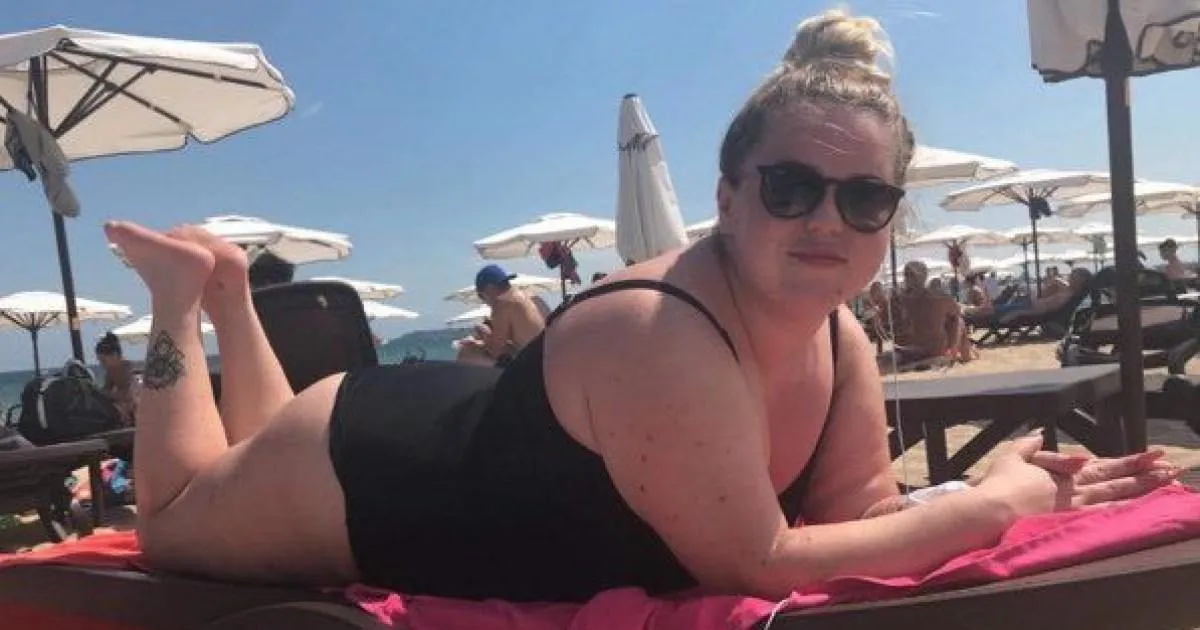
Everyone Katie knew used sunbeds (Picture: Katie McVeigh)
I didn’t even think of myself as an excessive user. I might have gone two or three times a week before a holiday or night out. But then I wouldn’t go again for months.
‘That’s still a form of sunbed abuse,’ the nurse told me. She likened it to binge drinking – avoiding booze all week and then getting drunk on a Saturday night.
I was only 16 when I went on a sunbed for the first time. Everyone I knew did it – my mum, aunts, cousins and friends.
My mum was going to the tanning shop and asked if I wanted to go with her. I had a three-minute tan that first time and afterwards I felt great – like I was glowing.
Advertisement
I found out later that it’s actually illegal for tanning shops, beauty salons and other commercial premises in the UK to allow anyone under 18 to use a sunbed, but no one ever asked my age.
But I was hooked. I started tanning regularly. I’m very pale, with a lot of moles, so I felt like it gave my skin a base colour.
After giving birth Katie went back to the tanning shops (Picture: Katie McVeigh)
Everyone around me was doing it.
On the weekends, my friends and I would make a trip to our local salon. I rarely went alone – it was more of a social thing. If somebody else was going, I’d tag along.
I left school at 16 and went into hairdressing so there was a big focus on beauty. You got your hair done, you got your nails done and you got a tan.
Advertisement
I grew up in Belfast, which is one of the UK’s sunbed hotspots – according to charity Melanoma Focus, 37% of adults in Belfast use sunbeds. It’s just the done thing.
By the time I turned 20 I fell pregnant with my daughter Connie, now four, and during my pregnancy I didn’t go near sunbeds. To me it felt like smoking or drinking while pregnant – it was just something I didn’t think it was right to do.
But after giving birth I went back to the tanning shops. It felt like a wee treat and a bit of ‘me time’.
In the chaos of being a first-time mum, I found it was also a lot quicker than getting my nails or hair done – it was easier to fit in around childcare.
Advertisement
Learn more about skin cancer symptoms
The main symptoms of melanoma skin cancer can include a new mole, or a change to an existing mole. These can appear anywhere on the body.
Normal moles tend to be:
Small
Round
Smooth-edged
One colour
Unchanging
Melanomas can be:
Larger
Unevenly shaped
A mix of colours
Changing in appearance
Other signs of melanoma could include moles that are swollen, sore, bleeding, crusty or or itchy. You can learn more here.
The main symptom of non-melanoma skin cancer is a growth or unusual patch on the skin, which can vary in size, texture and colour. You can learn more here.
Advertisement
Then, in the summer of 2022 I noticed a black mole growing on my right cheek.
I’m a fairly moley person so at first I wasn’t too worried, but then it started looking different to my other moles – it kept scabbing over, dropping off, then growing again. This went on for a couple of months.
I sent photos to my GP. They weren’t worried either but they referred me to a dermatologist just to be on the safe side.
Advertisement
In September 2022 I had the mole removed at a dermatology clinic and sent away to be biopsied. It would take six weeks to get my results, and during that time I didn’t really think about it. There hadn’t been any red flags yet.
Finally, the clinic called me and invited me to go in for my results.
It was awkward to arrange childcare, so I asked them why I couldn’t get them over the phone.
They told me I needed to go in person and to bring someone with me. That’s when I first realised.
Advertisement
One mole in particular started to look different to her other moles (Picture: Katie McVeigh)
Driving to the clinic, I started to feel anxious. The phone call had unsettled me, something didn’t feel right.
At first, they said it looked like Stage 2 Melanoma and referred me to the Ulster Hospital, in Belfast, to have a larger section of tissue on my face – where the mole had been – removed.
They couldn’t tell me what my face would look like afterwards or how big the scar would be, but by that time my priority was staying alive.
I knew things were more serious than I’d first thought.
I had the surgery in February 2023 and also woke up with a scar on my neck where an associated lymph node had been removed – to test to see if the cancer had spread.
Advertisement
Waiting for the next set of resultsto find out if it had spread into my lymph nodes – six weeks felt like six years.
I was crying a lot, although of course I tried to hide my upset from Connie. I just told her mummy was poorly and needed to go to hospital to get better.
The results showed the melanoma had spread to my lymph nodes so it was upgraded to Stage 3 and I was referred to Belfast City Hospital’s Cancer Centre for MRI and CT scans to check it hadn’t spread anywhere else, which thankfully it hadn’t.
Katie is now cancer-free (Picture: Katie McVeigh)
That’s when it really began to sink in that I had cancer. People think if they get a bad mole it will just be removed and that’s that, but melanoma means cancer.
My family and friends were a huge support, and also helped keep Connie occupied and entertained.
Advertisement
This month, I’ve come to the end of a year of targeted immunotherapy treatment, and I’m now cancer-free.
But it isn’t over – I’ll now have five years of monitoring scans every six months, to make sure the cancer doesn’t come back.
They will also do mole-mapping – it’s where I have to stand in my underwear and every single mole on my body is measured and photographed. They can then track any changes every time they check my moles.
My mum and other family members have stopped using sunbeds now. A lot of my friends have stopped too, but not all – people still think it won’t happen to them.
Advertisement
Katie’s biggest fear now is not being around to see Connie grow up (Picture: Katie McVeigh)
That’s what I thought until it happened to me.
It’s not just sunbeds – getting sunburnt is another risk factor for developing skin cancer, and I remember getting burnt on family holidays as a child.
One year, as a 10-year-old, in Egypt was particularly bad – I remember my shoulders were so blistered that my mum applied Greek yoghurt from the hotel bar to cool our skin.
We always think our sunburns are just something we need to quickly recover from, and never consider the long-term effects.
And now, my biggest fear now is not being around to see Connie grow up.
Advertisement
I’m a mum and she needs me. I’ve seen other people my age, with the same diagnosis, tragically pass away.
This is very real and skin cancer needs to be taken more seriously – as do the claims that some unscrupulous companies are putting in front of impressionable teenagers.
If I could travel back in time I’d tell my younger self that having a tan is just not worth it, and I would tell everyone else to look at everything you have – and not be tempted to play Russian roulette with your life.
As told to Jade Beecroft
Advertisement
This article was originally published on February 11, 2026.
Louise Cameron was found barely conscious next to her son Rhys when her mothe Carole and sister Donna called at her Billingham home to check on her on September 15 last year.
Teesside Crown Court heard the 41-year-old made a series of heartbreaking confessions as police tried to get to the bottom of what happened to her eight-year-old disabled son.
A jury was told the mother-of-three allegedly poisoned her son with methadone and morphine over the weekend in September last year.
Advertisement
Mrs Justice Heather William DBE told jurors that they would not have to find the defendant guilty or not guilty of murder but rule on the facts of the evidence heard during the trial.
Cameron is accused of killing Rhys between Saturday, September 13, and Monday, September 15.
The ambulance service alerted police after attending a property on Marsh House Avenue, Billingham, and finding the young boy.
Opening the case, David Lamb KC, prosecuting, said: “Rhys was lying on the left side of his mother’s bed, on his back with the covers pulled over him.
Advertisement
“To Donna it looked like Rhys was asleep however she knew that he was dead. He had white foam around his mouth.”
Jurors heard how it was clear to paramedics that the youngster had been dead for some time and no attempts were made to resuscitate him.
Mr Lamb said Cameron made a number of statements to police officers which were captured on their body-worn cameras.
The clearly distressed mother was heard to say she was “getting done for murder” and that “I’ve just murdered Rhys, haven’t I?”.
Advertisement
The barrister added: “The defendant stated that ‘I wasn’t leaving Rhys to be, because I know what will happen to him and it’s not happening, I didn’t want to hurt him, I didn’t want to have to stab him, or drown him or hurt him, I didn’t want to hurt him’.”
The force said it is carrying out an ongoing investigation into reports of a serious assault which took place outside a bar in Saturday Market, Beverley, around 8.30pm on Saturday, February 28.
Recommended reading:
A Humberside Police spokesperson said: “Since receiving that report, extensive enquiries have been conducted including gathering CCTV from the area, speaking to businesses and several witnesses.
Advertisement
“As a result of these enquiries, we are releasing CCTV images of two men which we believe may be able to assist in our enquiries.
“We are appealing for help to locate and identify both men.
“If you see them, know who they are or have any other information which may assist with our investigation, contact us on our non-emergency number 101 quoting crime reference 26*28611.
“Alternatively, if you wish to remain anonymous you can make a report via the independent charity Crimestoppers on 0800 555 111.”
Belfast stabbing: Hilary Benn praises those who ‘stepped forward at immense risk to their own safety’
A man from Sudan has been arrested over a knife attack in Belfast which prime minister Sir Keir Starmer condemned as “horrific” and “abhorrent”.
The man aged in his 30s has been arrested on suspicion of attempted murder following the “brutal” assault on Monday night which left the alleged victim with significant injuries to his face, neck and back, the Police Service of Northern Ireland (PSNI) said.
The PSNI has launched a “critical incident” in response to the attack, which was captured on video and appears to show a man stabbing at the victim’s head and neck while he was on the ground.
The clip shows people, including one with a hurling stick, intervening to stop the man attacking the victim in the residential area close to the busy Antrim Road in north Belfast.
Northern Ireland secretary Hilary Benn thanked those who tried to stop the attack, saying “you showed the very best of humanity”.
Advertisement
Man seriously injured in stabbing: Starmer condemns attack
Jane Dalton9 June 2026 13:40
Hero bystanders who intervened praised as ‘best of humanity’
When the 2026 FIFA World Cup begins on June 11, 2026, matches will be played across 16 cities in the United States, Canada and Mexico. Millions of fans will arrive through multiple airports and will pack into stadiums, airports, hotels, bars and public transit systems over five weeks.
That makes the World Cup not just a sporting event but a weekslong experiment in global mixing that creates a perfect environment for infectious diseases to spread. Events of this scale rarely cause major outbreaks, but they do create opportunities for outbreaks and for health systems to be tested.
The World Cup begins on June 11, 2026, matches will be played across 16 cities in the United States, Canada and Mexico (Getty Images)
The possibilities range from the dramatic but unlikely (an imported Ebola case) to the much more probable (flu and measles spreading through crowded venues) and the largely overlooked (spikes in sexually transmitted infections and mosquito-borne diseases gaining footholds in new areas).
As an infectious diseases physician studying how outbreaks affect peoples’ health, and an avid soccer fan – I root for the Colombian team – I have been watching closely as public health experts prepare for the event.
Here are some of the infectious disease threats they are monitoring as the world’s largest sporting event kicks off:
Advertisement
Ebola – scary but unlikely
In May 2026, the World Health Organization declared a global health emergency over an Ebola outbreak in the Democratic Republic of Congo and Uganda caused by a rare strain called Bundibugyo, which kills roughly 1 in 3 people it infects.
No approved vaccines, rapid diagnostic tests or treatments exist for this strain. And the global response has been complicated by deep cuts to international health aid and the U.S. withdrawal from the World Health Organization.
If a case is detected, rapid identification and isolation are critical to prevent further local transmission.
Advertisement
Still, the risk of Ebola reaching a World Cup stadium is very low. That’s because the virus spreads only through direct contact with bodily fluids like blood or saliva, not through the air, and infected people aren’t contagious until they show symptoms.
The U.S. has banned entry for non-U.S. citizens and green card holders who have been in the affected countries in the past 21 days and is screening all passengers traveling from affected areas. It is also urging European countries to embrace similar procedures as World Cup travel picks up. Mexico and Canada also have travel restrictions in place.
Measles, flu and COVID-19 – the bigger dangers
The more likely threats for soccer fans attending the World Cup are respiratory infections — illnesses spread by coughing, sneezing and breathing in crowded spaces.
Advertisement
Of special concern is measles, which is surging in the United States as well as in Canada and Mexico. As of June 4, the U.S. Centers for Disease Control and Prevention has confirmed 2,030 cases of measles in the U.S. in 2026 – close to the total count for all of 2025 and significantly higher than in previous years.
Measles is one of the most contagious infectious diseases on the planet. A single infectious traveler passing through Denver International Airport in 2025 triggered an outbreak of at least 10 cases. An infected fan in the stands, at an airport or in a bar could easily cause an outbreak.
On top of that, the 2025–2026 flu season reached a 30-year high, and COVID-19 continues to cause an estimated 290,000 to 450,000 hospitalizations per year. And big gatherings can amplify the risk of transmission.
In the background, avian influenza H5N1 — the bird flu circulating in dairy cows and poultry — has caused 70 human infections in the U.S. since 2024. No person-to-person spread has been detected, but scientists are watching closely for mutations that could change that.
Advertisement
Mosquito risks
Mosquito-borne diseases add another layer of risk to health authorities and travelers, especially for matches in southern U.S. and Mexican host cities during peak summer mosquito season.
Dengue – a tropical virus that causes high fever, severe body aches and sometimes life-threatening complications – set a U.S. record in 2024, with nearly 3,800 cases. That was a 359% jump over the prior 14-year average.
Most cases occurred in travelers returning from the Caribbean and Central America. Still, locally acquired cases have cropped up, mainly in Los Angeles.
Advertisement
There’s also the risk that fans will bring infectious diseases from their home countries.
Yellow fever, a potentially deadly viral infection, is absent from the U.S. but remains a threat to fans traveling from parts of Sub-Saharan Africa and South America, where the disease is native. A 2024 yellow fever outbreak in South America outside the Amazonian jungle, where transmission generally occurs, hinted that its spread to urban areas is possible.
And Oropouche virus, a once-obscure mosquito-borne illness, exploded across Latin America in 2024 in the largest epidemic ever recorded, with over 8,000 confirmed cases in Brazil alone. Although infection is usually mild, it can have dangerous complications such as brain inflammation and bleeding disorders and can harm a developing fetus. No vaccines or treatments exist.
Travelers carrying these infections may need medical care, but familiarity with them among U.S. physicians tends to be low. There’s also a small risk that illnesses may spread locally through mosquito bites.
Advertisement
Sexually transmitted infections under the radar
One category of possible risk that’s getting less media attention is sexually transmitted infections.
About 1 in 5 international travelers engages in casual sex, according to one study, and nearly half of those encounters are unprotected.
Mpox, a viral infection that spreads through close physical contact, continues to circulate in the U.S and is a particular concern at large public events. Syphilis is also seeing a global resurgence.
Advertisement
About the author
Andrés Henao is an Associate Professor of Medicine and Infectious Disease at the University of Colorado Anschutz. This article was first published by The Conversation and is republished under a Creative Commons licence. Read the original article.
Public health in action
Public health authorities across the U.S., Canada and Mexico have scaled up monitoring efforts amid preparations for keeping World Cup travelers safe.
In the U.S., a coalition of academic institutions, companies, nonprofits and public health organizations led by Georgetown University and nonprofit healthcare provider MedStar Health, called the Health Security Operations Center, will be keeping close tabs on disease transmission during the event. But some experts have raised concerns about U.S. resilience to public health threats at the World Cup due to significant cuts to public health infrastructure since 2025, including to the CDC.
Advertisement
Fans can take several steps of their own to protect themselves. They can make sure their routine vaccinations – especially measles, flu and COVID-19 – are up to date; practice safe sex; use mosquito repellent; and stay home or wear a mask if they feel sick.
A total of 24 closures are set to sweep the high street – including a couple in Greater Manchester
Customers in Greater Manchester face losing more access to face-to-face banking services this week as Halifax, Lloyds, NatWest and Bank of Scotland press ahead with another round of branch closures. A total of 24 branches across the UK have either already closed or are scheduled to shut their doors over the coming days.
Advertisement
Several banks say the decision reflects changing customer habits as many now opt to manage their finances online and via mobile banking apps rather than visiting banks in person. But this decision has sparked huge concern, especially among the elderly, who rely on the additional support banks provide for their banking needs.
In a statement, NatWest said: “We’ve recently announced that we’re closing some branches. You can still bank with us in many other ways.
“Banking has changed dramatically in recent years. There’s more demand for mobile and online services, allowing you to benefit from a faster and easier way to bank.”
It continues: “We understand the closure of your local branch will bring some changes, and we want to make sure you are fully informed and supported every step of the way.”
Advertisement
Nevertheless, NatWest and Lloyds Banking Group – which operates Lloyds Bank, Halifax and Bank of Scotland – say customers will still be able to access banking services through alternative arrangements. These include temporary community banking events, while dedicated banking hubs are being introduced in some areas affected by branch closures.
Of the 24 branches affected nationwide, two are located in Greater Manchester. Halifax’s Didsbury branch is scheduled to close on Wednesday, June 10, while Lloyds Bank’s Altrincham branch ceased operations on Tuesday, June 9.
To find out more information, visit each respective bank’s websites. Here’s the full list of Halifax, NatWest, Lloyds, Bank of Scotland closures:
The official also trashed any suggestion of a Westminster inquiry into the scandal.
The First Minister’s official spokesperson has refused to give an assurance John Swinney will cooperate with a Westminster inquiry into the Peter Murrell scandal.
Advertisement
The official said a Commons probe would “destroy” the credibility of the Scottish Affairs committee and its convener, Labour MP Patricia Ferguson.
John Swinney is under pressure after Murrell, the former SNP chief executive and estranged husband of Nicola Sturgeon, pled guilty to embezzling over £400,000 of funds from the party.
He is expected to be jailed later this month and calls have been made for a parliamentary probe into the scandal.
A bid for a Holyrood inquiry is likely to be voted down by the SNP and Greens on Wednesday, a move that could see the Westminster committee act.
Advertisement
The Record last week reported the SNP could boycott participating in a Westminster inquiry and the FM’s official spokesperson fuelled that speculation at a briefing.
Asked if Swinney would cooperate, he said: “If they do decide to hold an inquiry, then the First Minister and the Government and the party will need to decide how to respond.
“But I think the First Minister’s clear view is that if the committee decides to proceed it will destroy the credibility of the committee and its convener.”
Asked again, he replied: “We will decide how to respond.”
Advertisement
The Scottish Affairs committee will meet on Tuesday to discuss its next steps.
Any hearings could be held in Edinburgh in a move to pressurise the First Minister.
Get Daily Record Premium for just £1 per month in exclusive offer to celebrate the world cup. Click HERE.
This is a breaking news story – we’ll bring you updates, pictures and video as it happens.
The leisure development supports a wider eastern expansion of a Cambridgeshire town
Plans for amenities including a new M&S Food store have been approved for a Cambridgeshire estate. The supermarket is part of a new leisure development at Wintringham in St Neots.
Advertisement
Planning permission has now been granted by Huntingdonshire District Council for the new supermarket alongside other shops, offices, and a café to create a main centre for services and local amenities.
The new M&S Food will be triple the size of the existing M&S shop and will sell everyday essentials and household products. Smaller shops for independent retailers will sit alongside the M&S Food store.
Joanne Herd, Regional Manager at M&S, said: “We’re excited to be one step closer to delivering a show-stopping store for our customers. From our new location, we’ll be able to offer the very best of M&S Food, whether doing your weekly shop or grabbing something on the go.
“We’re proud to work with over 60 Select Farms across Cambridgeshire and this new significant investment in the region will help to create more than 40 new local jobs – with recruitment starting in the coming months.”
Advertisement
The development also includes a café which is expected to provide a range of snacks and refreshments on its menu. Other features include accessible green spaces and a public square with seating areas.
Work is due to start on the northern zone of The Hub at Wintringham in the summer. It is expected to be completed by September 2027, ready for opening before Christmas.
The designs for The Hub have been shaped through engagement with residents and inspired by the archaeological discovery of an Iron Age settlement close to the site. The developers said three main buildings will feature undulating rooflines of Iron Age roundhouses, which are reflected in the architecture.
Advertisement
Communications and partnerships manager for Urban&Civic, Paul Murfin said he is delighted that planning permission has been granted as it marks “another significant milestone in delivering a vibrant and sustainable community at Wintringham”.
He added: “Alongside the David Lloyd health and wellness club that is due to open in the autumn, and the plans currently being developed for the Hub’s central zone that will include a health centre and community centre, these facilities will play a major role in supporting the continued growth of eastern St Neots.”
The event at Sheepfolds Stables in Sunderland on Saturday night drew around 700 attendees.
Organised by LGBTQ+ charity OUT North East, the concert marked the official start of the Summer of Pride programme, which includes Pride events in Sunderland, South Tyneside, and Gateshead.
Around 700 people attended a fundraiser concert at Sheepfolds Stables in Sunderland to launch the North East’s new Summer of Pride Festival (Image: Supplied)
Peter Darrant, CEO of OUT North East, said: “This was a fantastic evening and shows what a successful partnership can bring.
“Not only was it a celebration of Pride but it had a huge economic benefit to the Sheepfolds and shows how Pride plays its part in supporting the local economy.”
Advertisement
The fundraiser featured live music and was promoted as a free community event to raise funds and awareness for the wider festival.
Around 700 people attended a fundraiser concert at Sheepfolds Stables in Sunderland to launch the North East’s new Summer of Pride Festival (Image: Supplied)
Organisers said the night underlined the positive impact of Pride events on the local area, both culturally and economically.
The festival continues throughout the month with a full schedule of activities.
Events include a Pride march and rally on Saturday, June 27, along with additional concerts, film screenings, family-friendly gatherings, and sports activities across the region.
Advertisement
Around 700 people attended a fundraiser concert at Sheepfolds Stables in Sunderland to launch the North East’s new Summer of Pride Festival (Image: Supplied)
A guest on ITV’s This Morning opened up about turning to a sex surrogate after years of bullying
A man who faced bullying due to his cerebral palsy has revealed how he sought help from a sex surrogate.
Advertisement
James shared his story during an appearance on This Morning, speaking to the ITV programme’s presenters Cat Deeley and Ben Shephard about how the experience has proved transformative for him.
Appearing on the sofa with his sex surrogate Saurora Grace, James described being bullied throughout school and beyond, stating: “I guess there’s a weird thing where I sort of walk the line between disabled and able-bodied and people don’t really know how to handle that.”
He revealed it reached “a point where I just stopped leaving the house because I’d have people spit at me, throw apples at me”.
James explained he attempted numerous different approaches but was “not really in a good place” and “felt very lost”.
Advertisement
When a friend recommended he consider a sex surrogate, he chose to pursue it, reports the Mirror.
“It becomes one of those things where you go, once you’ve gone through it, you go, ‘I wish I’d done it sooner’,” he remarked. “Because it, it can be extremely life-changing. It changed a lot for me.
“You don’t sort of, realise the need for connection and things because it’s not what people think it is. It’s not like, there’s a lot of preconceived notions about it and different things, and that’s why I wanted to talk about it.”
Advertisement
Saurora then explained: “Sex surrogacy is all about the intention behind it. So it’s more holistic. There’s a more of a therapeutic aspect to it. It’s all about connection, intimacy, and literally seeing and hearing the person. Like, a lot of us all want to be seen and heard as human beings, and so that is ultimately what it is.
“Obviously, you do have, like, your standard sex work, which is just come in, have sex, and leave. But we do a lot more to do with literally what James has just said – connection, intimacy, seeing and hearing, and helping him to understand that because he’s got a disability, it doesn’t make him, you know, any different from anybody else.
“He’s just the same, and he deserves to have a loving relationship and, you know, deserves to have sex and a juicy lifestyle.”
When questioned about the impact of her work on others, she responded: “I get a lot of messages afterwards, and people are like, ‘I’m now not gonna go and kill myself.’ And that really hits.”

“It honestly, in all ways that I could count, it’s changed my life,” James remarked. “It changed the trajectory of what I’m gonna do with my life. So it’s just been extremely powerful. It’s taken me in directions that I just thought were never doors that would open to someone like me.
“So Saurora’s training me to be a surrogate now. So that’s the career change for me.”
He continued: “I’ve got this lived-in experience that nobody else has got, and I can sort of I’ve been to those dark places, and I really, really want to help people out.”
You must be logged in to post a comment Login