


Connect with us

NewsBeat

The shifting reality of knife crime in the UK

Published

on

The shifting reality of knife crime in the UK

Politicians may claim that ‘Britain is lawless’, but data shows that violent crime is falling – including knife crime. We speak to the people and organisations helping to make the streets safer

At 17, Samir Khattab was caught up in a gang fight, “ducking and diving” to avoid being stabbed. He was “sliced” in the head, admitted to a London hospital trauma ward, given surgical staples, then discharged. “In my day, they patched you up, then kicked you out.”

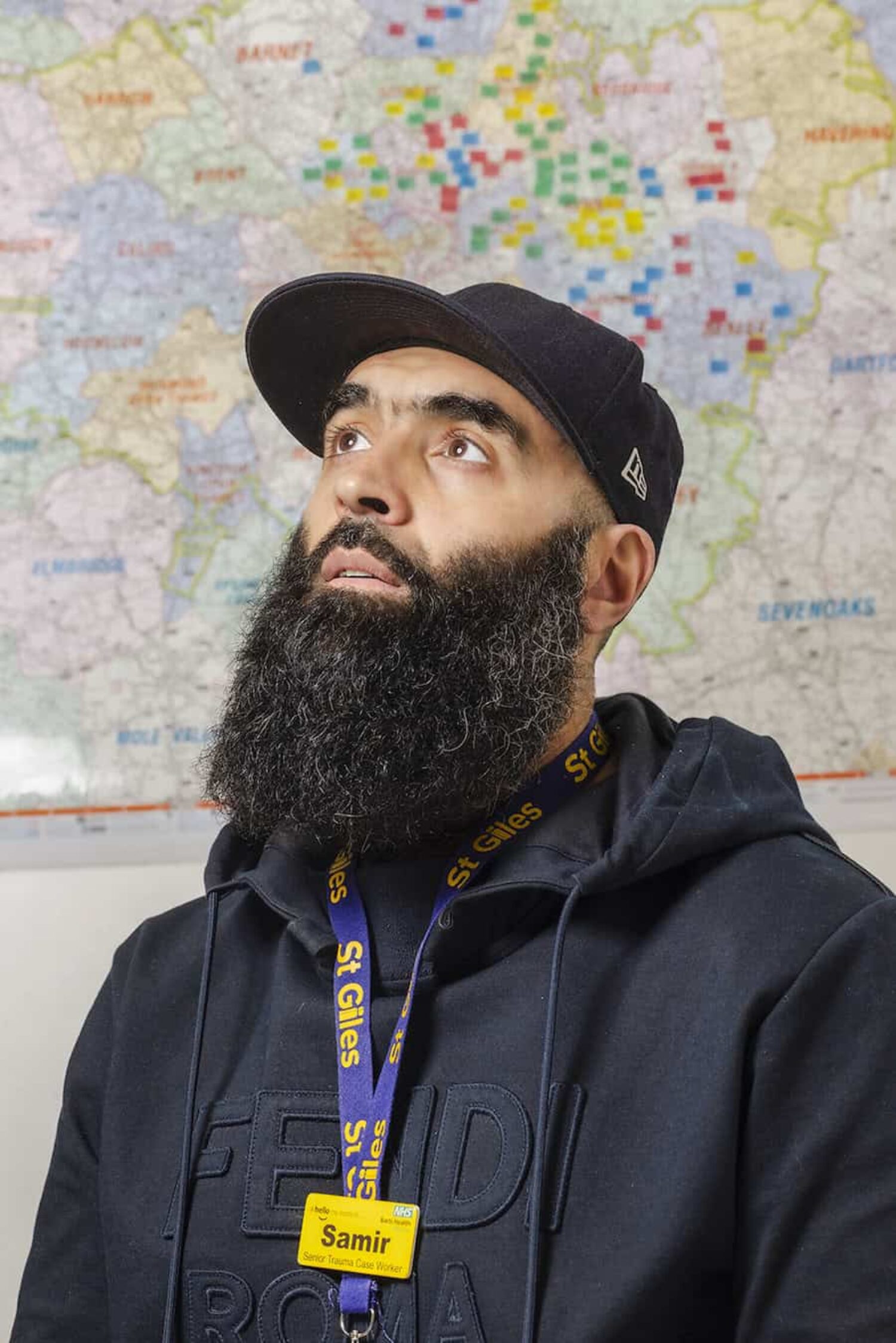
Now, at two major east London hospitals, Khattab leads a team of case workers offering bedside support to young knife crime victims. In the team’s 12th-floor office at the Royal London Hospital in Whitechapel, he sits facing a map of the capital marked with brightly coloured tabs showing postcode gangs. He explains how he and his colleagues do everything they can to prevent patients coming to harm again once they leave hospital.

Advertisement

Often this means arranging mental health support. “Our clinical staff address the physical wounds of our young people, but who’s going to help with the traumatic experiences that probably got them into a bad space in the first place?” The team also helps them return to education or find safe housing.

Advertisement

The next day, having hired a van, Khattab is set to help a family of six move home after the eldest child was stabbed.

“It’s about mitigating the risk of future harm after a perpetrator has compromised the address, and providing a fresh start.” There is no “expiry date” to the support, he adds. “We couldn’t build trust with patients if they felt they were being treated like ticked boxes.”

Khattab stresses that the work goes beyond protecting young people from future harm. It also deters them from causing harm. Victims and perpetrators overlap significantly, with 61% of teenage perpetrators of violence having also been victims, according to the Youth Endowment Fund (YEF), which invests in work preventing youth violence.

“We’re stopping victims becoming perpetrators,” Khattab says. His own experience shows what can happen when vulnerable young people are discharged without the support they need. Nobody checked on him when he was a 17-year-old with a head wound. “The services didn’t exist,” he says. A year later, Khattab was convicted of a gang-related murder and sentenced to 16 years in prison.

Advertisement

Samir Khattab was sentenced to 16 years in prison. Now he works to keep others away from a life of crime

“Who knows what the trajectory of my life could have been if I’d had a case worker, who’d said, ‘Yo, you alright?’ I might have opened up and said, ‘Look, I’m sofa surfing, I’ve got no stability, I have a violent peer group.’” Having grown up amid instability, including his mother facing domestic abuse and incarceration, violence became a “way to express the pain I was experiencing,” he explains.

Advertisement

His personal history now gives him the resilience to work with vulnerable patients. “It’s fuelled me. There’s no loss of empathy, I’m not desensitised, but I can engage with these young people because I’ve been through it.”

At times it is a “secret weapon” for engaging reluctant patients. He recalls one 14-year-old from east London who had been stabbed. “He was just looking up at the ceiling; he didn’t want to speak to me. I said, ‘You got parents coming, you got visitors? Are you good? I want to make sure that you’re being loved.’ He goes, ‘Ain’t got no parents, I’m in care.’ And I said, ‘I’ve been in care too.’ He snapped his neck, locked eyes with me and said, ‘What the heck? I never expected that.’”

Who knows what the trajectory of my life could have been if I’d had a caseworker, who said ‘Yo, you alright?’

Once a high-risk Category A inmate in Belmarsh Prison, “walking around the exercise yard with terrorists”, Khattab now feels lucky “to be able to give back”. He is clear-eyed about the past. “I’m regretful, and I put many families through pain and suffering. But I’m trying my best to right my wrongs through the work that I do.”

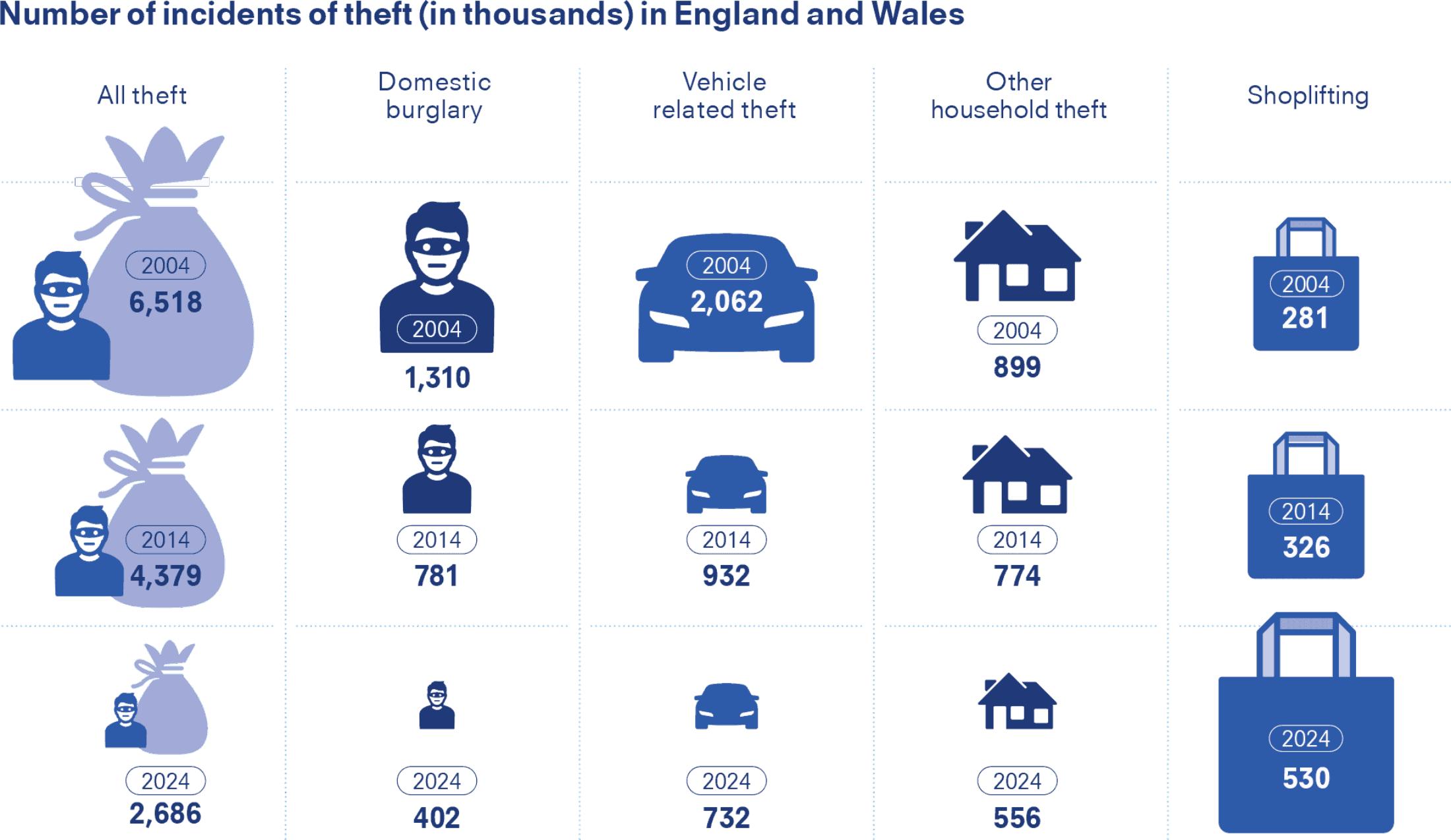
Knife crime has dominated headlines in recent years, with commentators making frenzied claims. Yet figures released by the Mayor’s Office for Policing and Crime show that the murder rate in London for the first nine months of 2025 was at its lowest since monthly records began in 2003. There has been a 50% reduction in the number of young people murdered compared to 2024, which itself saw the under-25 homicide rate fall to a 22-year low. Greater London Authority data shows knife crime fell by 19% in London between April and June 2025 compared with the same period the previous year.

Advertisement

Reports contending that it is currently at a record high often rely on police data, neglecting to account for improvements in police recording practices over the past decade that have had a “substantial impact” on the figures, according to the Office for National Statistics (ONS). Such trends should therefore be “interpreted with caution”, the body advises. Even when considering these figures, knife crime is still 4% lower than it was in the year ending March 2020.

Source: Office for National Statistics, World Bank, NHS England Digital

Advertisement

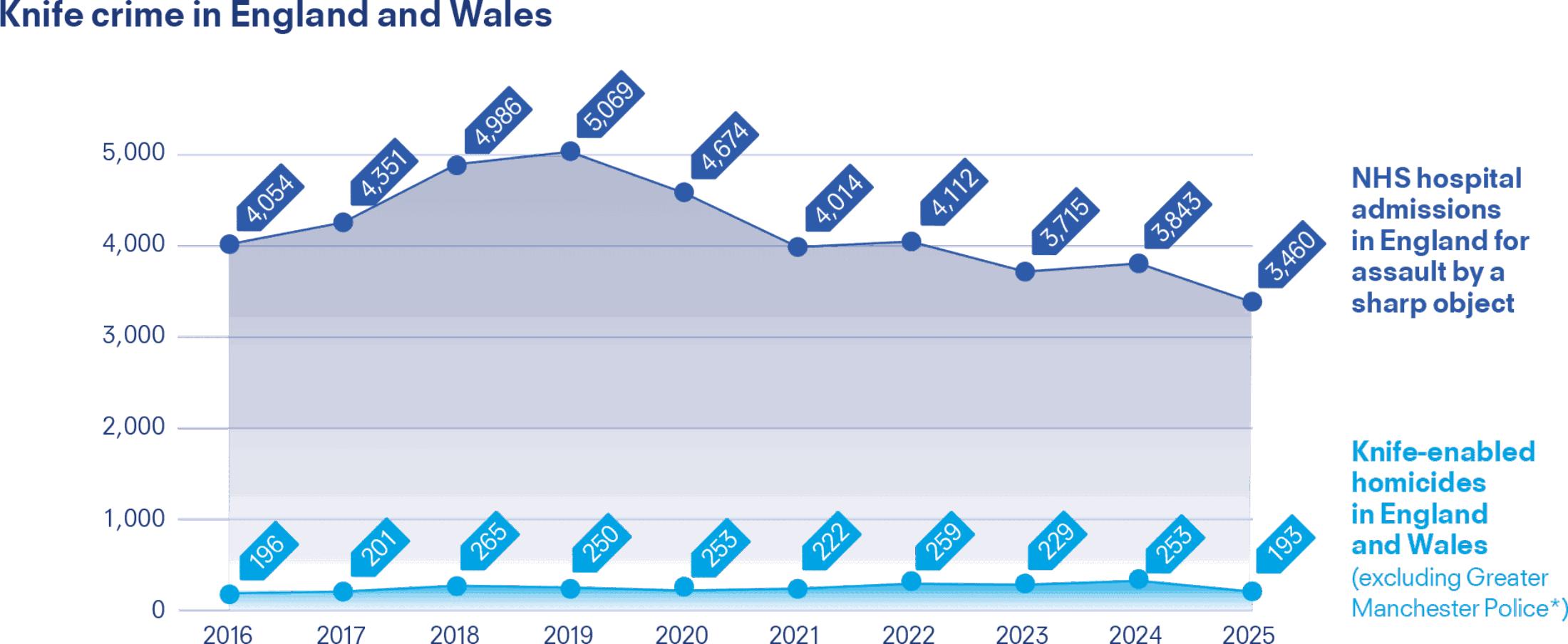
But police data is not the only metric. Knife-enabled homicides, which are less affected by recording changes, were at a six-year low and 23% lower in the year ending March 2025 than the previous year, according to the ONS. NHS England also reported a 9% decrease in knife crime admissions in 2024 to 2025 compared with the year earlier, and records for the year ending March 2025 show that hospital admissions for assault by a sharp object were lower than at any time in the previous decade.

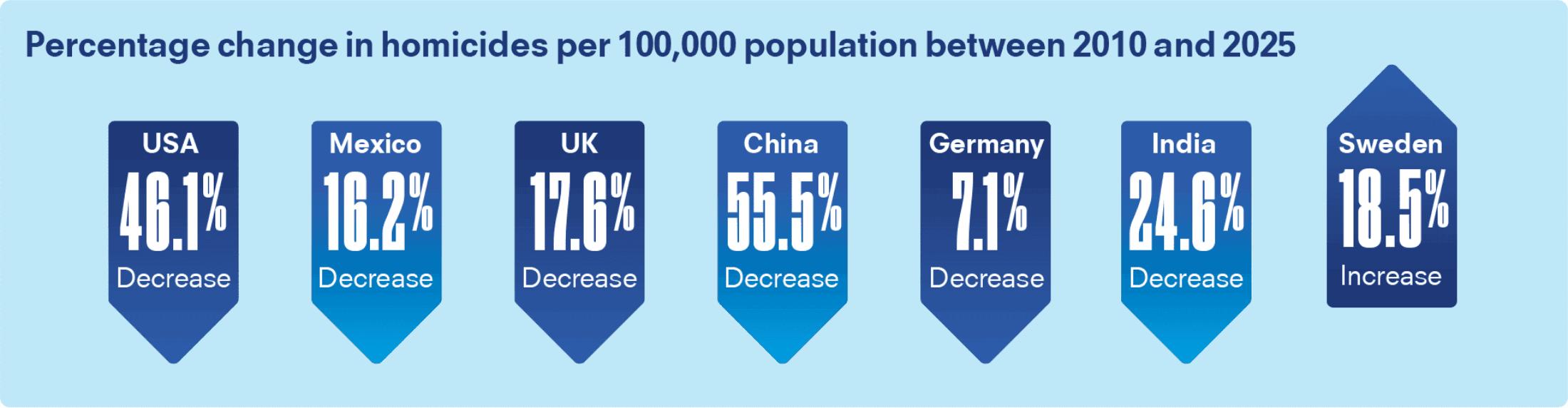
US President Donald Trump has repeatedly commented on UK knife crime, once describing a London hospital as “like a war zone for horrible stabbing wounds” in a 2018 speech to the National Rife Association, despite the US having 52% more homicides caused by knives per million people than the UK, according to the most recent available data at the time.

His comments appear to have misconstrued remarks by trauma surgeon Prof Martin Griffiths, who launched the Royal London Hospital’s violence reduction service in 2015 after despairing at seeing the same young victims return again and again. With case workers from the St Giles’ Trust charity, the programme has contributed to a fall in readmission rates from 35% to 2.63% for the year to March 2025.

Forming community ties is vital – we can’t arrest our way out of this issue

Ciaran Thapar, a director at the YEF and former youth worker, says there is reason for optimism. He points to the fact that there were no homicides of under-25-year-olds in London during the long 2025 summer holiday. “That’s quite remarkable, when it’s become almost a fact that the summer holiday is going to throw up some really tragic murders of teenagers in London.”

Advertisement

He also highlights the efforts of grassroots groups, including United Borders, founded by former prison officer and bus driver Justin Finlayson in Brent, northwest London.

After the fatal shooting of 22-year-old business studies student James Owusu-Agyekum in 2016 in a case of mistaken identity, Finlayson was determined to bring together the borough’s postcode gangs. He bought an old double-decker bus with his savings and converted it into a travelling music studio. Young residents from one area would come aboard to create rhythm tracks, then he would drive to another estate where rival youths unknowingly rapped over them, and vice versa.

Source: Office for National Statistics, World Bank, NHS England Digital

Advertisement

“I had to present the idea of each group working with me separately,” Finlayson explains. “After two weeks, they were really on the beats, married to the music, and we revealed to them that they’d been working together.” There was initial suspicion, here calls, “but we’d built up enough of a mentoring relationship. Then it was, ‘Okay, cool.’” Eventually both factions made music together. Today, United Borders travels across London offering mentoring and workshops wherever they are needed. “If there’s a spate of young people being harmed, we get our bus down to those places,” Finlayson says.

At points in recent years, the highest rate of police recorded knife crime in the UK has not been in London but in the West Midlands. Yet the region saw a 15% drop in these figures in the year ending March 2025, helped in part, the force believes, by a three-year pilot scheme rooted in a US model from Boston.

Focused deterrence recognises that most serious violence is committed by small groups, who themselves often have histories of trauma and difficult life circumstances.

Advertisement

Source: Office for National Statistics, World Bank, NHS England Digital

To assess its effectiveness in the UK, the Home Office and YEF invested £7m in focused deterrence projects at police forces in England. Although evaluation by the University of Hull is ongoing, Zeba Chowdhury, who led the West Midlands scheme, is enthusiastic about its impact.

Advertisement

The investment enabled the region’s violence reduction partnership to offer 24-hour support through a team of navigators. “If a young person was arrested, even if it was 2am, a navigator would visit and say ‘here’s a way out’ at that reachable, teachable moment,” Chowdhury explains. With ringfenced funding, individuals received timely support, including cognitive behavioural therapy, careers advice and help with education, training and housing.“

“It wasn’t a case of signposting them to an organisation providing mentoring, or a mental health service with a ridiculously long waiting list,” she says. Participants were contacted within 72 hours of being identified or referred, to understand their needs. Although there was no upper age limit, those aged 21 and under were four times more likely to accept support.

“One young person described their navigator as like having an assigned best friend,” Chowdhury recalls. “Bearing in mind that the navigator is a police officer, and that the young person may not have had the best relationship with authority, that was really lovely to hear.” Forming these local ties is vital, she believes. “We can’t arrest our way out of this issue.”

Photography by Laurie Fletcher

Advertisement

Support solutions in 2026

At Positive News, we’re not chasing clicks or profits for media moguls – we’re here to serve you and have a positive social impact. We can’t do this unless enough people like you choose to support our journalism.

Give once from just £1, or join 1,800+ others who contribute an average of £3 or more per month. Together, we can build a healthier form of media – one that focuses on solutions, progress and possibilities, and empowers people to create positive change.

Support Positive News

Advertisement

Source link

Continue Reading
Click to comment

Leave a Reply

Your email address will not be published. Required fields are marked *

NewsBeat

Irishman fears for life after Trump ICE crackdown turns American dream into nightmare | US News

Published

on

Seamus says he was living a 'normal life' in America

Seamus Culleton exists in two places – his wife’s memory and a detention centre in Texas.

Tiffany Smyth had a handful of photographs to show me, illustrating their life together. Sunbathing on a beach, posing with their two dogs, celebrating their engagement with radiant smiles.

But the hope illustrated in those snapshots was snatched away one afternoon five months ago.

Seamus, 38, was at a building supplies store in Boston when ICE (US Immigration and Customs Enforcement) agents detained him.

Advertisement

Via Buffalo, New York, he eventually ended up at Camp East Montana, El Paso, Texas.

He has described it “like a modern-day concentration camp… horrible and filthy.”

Housed with 70 other detainees in one tent, he said he feared for his own life. It was striking to hear his Irish accent on the phoneline from there.

“If it can happen to me… it can kind of happen to anyone,” he told me.

Advertisement
Image:
Seamus says he was living a ‘normal life’ in America

Living in the US for nearly 18 years, he had, in his words, “lived a normal life”.

“Just working hard, staying out of trouble, I wasn’t a big party guy, just spending time with my wife and my dogs,” he said.

Tiffany recalled the moment her husband phoned her to say he had been detained.

“He says ICE picked him up, and I had a million questions… where are they taking you?

Advertisement

“And he said, no, they’re not telling me anything. I’ll call you when I can, and then the phone hung up. I didn’t hear from him for four or five days,” she said.

Fighting through the tears, she described his situation as “hard to believe”.


Minneapolis shootings: What is ICE?

The deployment of ICE agents has sparked protests in US cities. Pics: Reuters
Image:
The deployment of ICE agents has sparked protests in US cities. Pics: Reuters

A native of Kilkenny, he arrived in the US in 2009 and overstayed the 90 days of his visa waiver.

But he later married an American, giving him the right to seek a change of status. He had obtained a work permit and was one appointment away from securing a green card.

Advertisement

The Department of Homeland Security describes Seamus Culleton as “an illegal alien from Ireland”.

In a statement, it said a green card application and work permit did not grant someone legal status to be in the United States and rejected claims he was being held in high-risk conditions.

‘Deplorable’ conditions

But his lawyer, Ogor Winnie Okoye, said: “Conditions are deplorable, unimaginable, inhumane, not conducive for even the most atrocious of criminals.”

Advertisement

ICE is currently holding around 70,000 people and 74% of them have no criminal conviction, according to recent data.

Donald Trump pledged the greatest mass deportation in US history, to remove seasoned criminals, “the worst of the worst” in his words.

Read more from Sky News:
What is ICE and what powers do its agents have?

Why is Trump threatening Canada over a bridge?

“Seamus is not the worst of the worst,” said his lawyer. “He’s the best of what this country’s all about, immigrants coming in and making a difference.”

Advertisement

And despite the current nightmare he is living, he refuses to give up on his American dream.

“The picture in my mind, if I got released, would be just my wife waiting for me with her arms open… and giving her a kiss.

“It’s been so long since I’ve seen her,” he told me.

Advertisement

Source link

Continue Reading

NewsBeat

US adds surprising 130,000 jobs last month

Published

on

US adds surprising 130,000 jobs last month

WASHINGTON (AP) — U.S. employers added a surprisingly strong 130,000 jobs last month, but government revisions cut 2024-2025 U.S. payrolls by hundreds of thousands.

The unemployment rate fell to 4.3%, the Labor Department said Wednesday.

The report included major revisions that reduced the number of jobs created last year to just 181,000, weakest since the pandemic year of 2020, and less than half the previously reported 584,000.

The job market has been sluggish for months even though the economy is registering solid growth.

Advertisement

But the January numbers came in stronger than the 75,000 economists had expected. Healthcare accounted for nearly 82,000, or more than 60%, of last month’s new jobs. Factories added 5,000, snapping a streak of 13 straight months of job losses. The federal government shed 34,000 jobs.

Average hourly wages rose a solid 0.4% from December to January.

The unemployment rate fell from 4.4% in December as the number of employed Americans rose and the number of unemployed fell.

Weak hiring over the past year reflects the lingering impact of high interest rates, billionaire Elon Musk’s purge last year of the federal workforce and uncertainty arising from President Donald Trump’s erratic trade policies, which have left businesses unsure about hiring.

Advertisement

Dreary numbers have been coming in ahead of Wednesday’s report. Employers posted just 6.5 million job openings in December, fewest in more than five years.

Payroll processor ADP reported last week that private employers added 22,000 jobs in January, far fewer than economists had forecast. And the outplacement firm Challenger, Gray & Christmas reported that companies slashed more than 108,000 jobs last month, the most since October and the worst January for job cuts since 2009.

Several well-known companies announced layoffs last month. UPS is cutting 30,000 jobs. Chemicals giant Dow, shifting to more automation and artificial intelligence, is cutting 4,500 jobs. And Amazon is slashing 16,000 corporate jobs, its second round of mass layoffs in three months.

The sluggish job market doesn’t match the economy’s performance.

Advertisement

From July to September, America’s gross domestic product – its output of goods and services – galloped ahead at a 4.4% annual pace, fastest in two years. Consumer spending was strong, and growth got a boost from rising exports and tumbling imports. And that came on top of solid 3.8% growth from April through June.

Economists are puzzling out whether job creation will eventually accelerate to catch up to strong growth, perhaps as President Donald Trump’s tax cuts translate into big tax refunds that consumers start spending this year. But there are other possibilities. GDP growth could slow and fall into line with a weak labor market or advances in AI and automation could mean that the economy can roar ahead without creating many jobs.

Wednesday’s report included the government’s annual benchmark revisions, meant to take into account the more-accurate jobs numbers that employers report to state unemployment agencies. They cut 898,000 jobs from payrolls in the year ending March 2025.

Despite recent high-profile layoffs, the unemployment rate has looked better than the hiring numbers.

Advertisement

That is partly because President Donald Trump’s immigration crackdown has reduced the number of foreign-born people competing for work.

As a result, the number of new jobs that the economy needs to create to keep the unemployment rate from rising – the “break-even’’ point — has tumbled. In 2023, when immigrants were pouring into the United States, it reached a high of 250,000, according to economist Anton Cheremukhin of the Federal Reserve Bank of Dallas. By mid-2025, Cheremukhin found, it was down to 30,000. Researchers at the Brookings Institution believe it could now be as low as 20,000 and headed lower.

The combination of weak hiring but low unemployment means that most American workers are enjoying job security. But those who are looking for jobs – especially young people who can be competing at the entry level with AI and automation – often struggle to land one.

Advertisement

Source link

Continue Reading

NewsBeat

Free food waste recycling service set to launch next month

Published

on

Cambridgeshire Live

The scheme is funded by central government and will be no extra cost to residents

A new food waste recycling service is set to launch in part of Cambridgeshire next month. Huntingdonshire District Council (HDC) will begin the new, weekly waste service which is a free scheme funded by central government, so there are no extra costs to residents.

Advertisement

All food waste, including fruit and vegetable peelings, leftover food, tea bags and coffee grounds, bread, rice, pasta, meat and fish and pet food, should no longer go in your general waste bin and should be put in your food waste caddy to be recycled.

Some households have already received a seven-litre kitchen caddy to use indoors and a 23-litre food waste bin for outdoors but all residents are set to receive them by March 28.

Residents in communal properties (flats or shared housing) will be receiving an indoor caddy and a larger communal bin for food waste.

Executive Councillor for Parks and Countryside, Waste and Street Scene, Cllr Julie Kerr said: “This new weekly food waste recycling service is a simple but powerful way for all of us to protect our environment.”

Advertisement

Instead of being disposed of in landfills, the collected food waste will now go through a process called anaerobic digestion, where it will be turned into renewable energy and nutrient-rich fertiliser.

The aim is to make food waste recycling easier for residents and a simple way to contribute to reducing carbon emissions and provide a greener future for Huntingdonshire.

Cllr Kerr continued: “The easy change of separating food waste from household waste is something that the whole family can get involved in and will make it clearer how much food gets thrown away. It will hopefully reduce both waste and household costs by buying less food and together we can make Huntingdonshire greener for future generations.”

Source link

Advertisement
Continue Reading

NewsBeat

People expect shootings in the US, but not Canada | World News

Published

on

Footage shows students leaving their school with their arms in the air. Pic: AP

There was something about the way the premier of British Columbia, David Eby, struggled to his words in front of the cameras that said a lot about how Canadians view the school shooting in a small town called Tumbler Ridge.

“This is the kind of thing that feels like it happens in other places, and not close to home.”

He is right about that. People expect this sort of thing to take place south of the border, in the United States – but not in Canada – not in a place like Tumbler Ridge.

Read the latest: Canada school shooting

Advertisement

The sorrow, the grief will be felt collectively, right across this mammoth country. A massacre in a high school is not a Canadian thing – and it is not a small-town Canada thing either.

Advertisement

School shooting an ‘unimaginable tragedy’

The town is certainly isolated, with Vancouver some 1,000km to the southeast but in a way, its remote location should have worked to protect it.

The community had its own detachment of the RCMP – the Royal Canadian Mounted Police – and the officers there would have known everyone in town.

Advertisement

What’s more, places like Tumbler Ridge are basically self-policing. I grew up in small-town Canada, and I can tell you that a trip down ‘Main Street’ involves a chat, a wave and a friendly interaction with all.

Canada school shooting: What we know

In essence, your business is the community’s business, and that makes the sort of interventions that work to prevent such tragedies more likely.

Footage shows students leaving their school with their arms in the air. Pic: AP
Image:
Footage shows students leaving their school with their arms in the air. Pic: AP

A roadblock remains in place outside the school on Wednesday. Pic: The Canadian Press/AP
Image:
A roadblock remains in place outside the school on Wednesday. Pic: The Canadian Press/AP

The authorities say they have identified the shooter, who was described in a police alert as “a female wearing a dress with brown hair”.

The shooter’s body is one of eight that have been recovered from the corridors and classrooms of the Tumbler Ridge High School.

Advertisement

Read more from Sky News:
Arrest over missing TV star’s mother
Texas airport closed for ‘security reasons’
Trump’s threats over Canadian bridge

Advertisement

Our international correspondent John Sparks has more analysis on the shooting

The RCMP chief said he would not release any further details “for privacy reasons” – but the fact is, the residents of Tumbler Ridge will probably know who the shooter was.

Advertisement

Their grief in the face of this catastrophic loss, will be accompanied by the desperate need for an explanation, an answer to the question why.

Many residents may feel a sense of responsibility.

It is on these fundamental questions that the local RCMP chief produced a remarkably frank and honest assessment.

Advertisement

“I think we will struggle to determine the ‘why’,” said Superintendent Ken Floyd, “but we will try our best to determine what transpired.”

Source link

Advertisement
Continue Reading

NewsBeat

Prince William’s first tour of Saudi Arabia ends with nature reserve visit | UK News

Published

on

Prince William at the Sharaan Nature Reserve. Pic: Reuters

The Prince of Wales has visited a nature reserve on the final day of his first tour of Saudi Arabia to learn about a programme reintroducing endangered species.

The future king toured the Sharaan Nature Reserve in the east of the country to hear about ongoing conservation initiatives aimed at protecting and reintroducing native species such as gazelles and the Arabian oryx.

He was also told about a flagship programme to bring back the critically endangered Arabian leopard.

The prince planted an acacia tree at the reserve as he was given details about ongoing efforts to protect its natural wildlife and landscape.

Advertisement
Image:
William plants an acacia tree at the reserve. Pic: Reuters

William speaks with a member of the RCU's Habitat and Restoration team. Pic: Reuters
Image:
William speaks with a member of the RCU’s Habitat and Restoration team. Pic: Reuters

William is also spending part of the day visiting the old town of AlUla, which features more than 900 mud‑brick houses and a historic citadel.

The town has a network of narrow alleyways that formed a thriving settlement on the ancient incense road, the trade route that carried spices, textiles and aromatics across Arabia for centuries.

The Prince of Wales and Prince Badr bin Abdullah bin Farhan Al Saud. Pic: PA
Image:
The Prince of Wales and Prince Badr bin Abdullah bin Farhan Al Saud. Pic: PA

Pic: PA
Image:
Pic: PA

The prince is also meeting local farmers during a tour of AlUla’s Oasis and EcoGardening farm.

The farmers were giving details to the prince about their belief in sustainable farming and on efforts to preserve their region’s agricultural history.

The Prince of Wales meets rangers at the Sharaan Nature Reserve. Pic: PA
Image:
The Prince of Wales meets rangers at the Sharaan Nature Reserve. Pic: PA

William at the Sharaan Nature Reserve. Pic: Reuters
Image:
William at the Sharaan Nature Reserve. Pic: Reuters

The trip has been overshadowed by the allegations surrounding Andrew Mountbatten-Windsor and the late convicted sex offender Jeffrey Epstein.

Andrew denies any wrongdoing in relation to Epstein.

The Prince and Princess of Wales attempted to make their position clear on the scandal on Monday when they issued their first public statement about it.

Advertisement

A Kensington Palace spokesperson said they were “deeply concerned by the continued revelations”, and “their thoughts remain focused on the victims”.

Source link

Advertisement
Continue Reading

NewsBeat

Fifty Two restaurant in Harrogate receives Michelin Star

Published

on

Fifty Two restaurant in Harrogate receives Michelin Star

Fifty Two, based at Rudding Park Hotel in Harrogate, was among the latest UK and Ireland restaurants to receive the prestigious accolade at the Michelin Guide Ceremony 2026, held in Dublin on Monday, February 9.

The restaurant is described by Michelin as “a theatrical platform for Chef Adam Degg and his skilled cooking”.

Housed in a converted shipping container, Fifty Two features an open kitchen, semi-communal tables, and a creative tasting menu centred on homegrown produce and preserved ingredients.

Michelin inspectors commended Mr Degg’s approach, noting that “Degg makes excellent use of preserved ingredients and each element on the plate shines through with great clarity of flavour”.

Advertisement

It is set in an open kitchen. (Image: FIFTY TWO)

Guests are treated to a ‘playful’ dining experience, including ‘Dessert Island Discs’, where diners select a song to accompany dessert.

Notable menu highlights include the “exquisitely executed” honey custard tart crafted from the restaurant’s own honey.

Fifty Two was awarded its first Michelin Star on Monday. (Image: FIFTY TWO)

The restaurant offers a single evening sitting from Wednesday to Sunday, with menus ranging from six to 10 courses.

Wednesday and Sunday menus are priced at £85 per person, while the full 10-course experience on Fridays and Saturdays costs £190 per person.

Advertisement

Optional drinks pairings start at £65, with a wine pairing upgrade available for an additional £35.

Source link

Advertisement
Continue Reading

NewsBeat

Pam Bondi to testify before Congress after admitting mistakes were made in handling of Epstein files: Live updates

Published

on

Pam Bondi to testify before Congress after admitting mistakes were made in handling of Epstein files: Live updates
Ro Khanna threatens contempt charges if Pam Bondi doesn’t complete release of Epstein files

Attorney General Pam Bondi is set to face questioning from lawmakers Wednesday morning over the Justice Department’s handling of the release of records related to the late convicted sex offender Jeffrey Epstein.

Democrats on the House Judiciary Committee are expected to probe Bondi on how the Justice Department determined what should and should not be made public under the Epstein Files Transparency Act.

The act set off a 30-day deadline for the complete release of the DOJ’s files on Epstein, who died by suicide in a New York City jail cell in 2019 while awaiting trial.

Only a small portion of the files were released by the December 19 deadline. Another batch was released on December 23, and five weeks later, another larger trache consisting of three million pages of documents was released, and the DOJ said it had fulfilled its obligations under the act.

Advertisement

However, the DOJ has been met with scrutiny over its handling of the case, with many Democrats and even some Republicans saying it has over-redacted some documents, while inconsistently redacting others and exposing survivors.

A group of Epstein survivors spoke out about the mishandling of the files, running a TV spot during Super Bowl LX Sunday that called for the publication of the remaining documents, telling Bondi, “It’s time to tell the truth.”

Bondi has faced significant backlash over her handling of the Epstein files, and this week admitted in a letter to federal judges that mistakes were made in the case. As a result, the Justice Department “has temporarily removed thousands of documents from the DOJ Epstein Library for further review — including approximately 9,500 documents subject to the Protective Orders in the Maxwell case,” she wrote.

The attorney general is also likely to be pressed by lawmakers about investigations by the Justice Department and the FBI into the fatal shootings of Alex Pretti and Renee Nicole Good by federal immigration officers in Minnesota last month.

Advertisement

The hearing is set to begin at 10 a.m.

Massie floats contempt charges for Pam Bondi if she tries to dodge Epstein questions at Congressional hearing

Rep. Thomas Massie suggested holding Attorney General Pam Bondi in contempt, a day before she is set to testify before the House Judiciary Committee.

Massie, who co-authored the legislation forcing the release of the files, made the suggestion during an interview Tuesday with CNN’s The Source, according to Mediaite.

“The quickest way, and I think most expeditious way, to get justice for these victims is to bring inherent contempt against Pam Bondi,” he said.

Advertisement

The lawmaker, a Republican from Kentucky, said the option is on the table if Bondi does not own up to the mistakes made — and confirm more files will be released.

“You know, it’s hard to refer to a contempt [charge] or things like that on an attorney general to the attorney general. This is the problem that you run into,” he said. “And so it’s going to be very difficult. But we can compel other people to come testify.”

Rep. Thomas Massie suggested holding Attorney General Pam Bondi in contempt to get justice for Jeffrey Epstein’s victims
Rep. Thomas Massie suggested holding Attorney General Pam Bondi in contempt to get justice for Jeffrey Epstein’s victims (Getty)

Isabel Keane11 February 2026 13:39

Source link

Advertisement
Continue Reading

NewsBeat

Tan Hill Inn unveils new room with nods to its history

Published

on

Tan Hill Inn unveils new room with nods to its history

The Tan Hill Inn stands 1,732 feet above sea level in Swaledale and is known for being a remote spot in the Yorkshire Dales, so high punters are often stranded inside during snowy weather.

Although the current building dates to the early 1600s, it replaced a far earlier hostelry, The King’s Pit, which fed and watered miners, who dug the dales for coal.

So rich were the seams of coal that as far back as the 13th century the King’s Pit mine was turning a profit for the Crown.

And – although researchers are unsure which King gave the pit its name – the Tan Hill Inn has revived it for its private dining room, appropriately named King’s Pit Cave.

Advertisement

Andrew Hields, who bought the pub in 2018, said: “The challenge throughout has been to ensure the fabric and character of the building remain intact, while introducing the sort of comforts people expect, such as Wifi and good showers after they’ve spent a day walking the fells.”

The new room has nods to the inn’s mining past. (Image: TAN HILL)

“We are always very mindful that, not only is the Inn a historically interesting pub, but it also a much-loved one and people travel – often on foot – from far and wide to visit us.

“Now, by creating a private room in which they can meet, dine or celebrate, hopefully we are giving them even more reason to visit.”

The King’s Pit Cave features roughly hewn stone walls, stone-flagged floors and handcrafted wooden furniture.

Advertisement

Filming for Jane Eyre in 1970. (Image: IAN WRIGHT)

It offers space for up to 10 guests and includes a dedicated table service team and an exclusive menu.

Mr Hields has invested around £750,000 in upgrades and improvements since taking over, including refurbishing rooms, improving infrastructure, and updating the barn to attract more weddings.

In November 2021 after 61 guests and staff were stranded inside for three nights during Storm Arwen.

In January 2025, heavy snow again left two dozen guests and six bar staff stranded for five days.

Advertisement

The pub has also appeared on screen, including in the 1970 film Jane Eyre and television series such as Vera, Top Gear, and All Creatures Great and Small.

Source link

Advertisement
Continue Reading

NewsBeat

Winter sports scream glamour, but women’s ski-wear falls short when it comes to actually skiing

Published

on

Winter sports scream glamour, but women’s ski-wear falls short when it comes to actually skiing

Marks and Spencer is one of the latest UK high-street brands to launch a ski-wear collection. Even supermarket Lidl are in on the action, with their ski range starting from £3.99. This follows earlier moves by fast-fashion retailers such as Topshop who launched SNO in the mid 2010’s and Zara’s imaginatively titled Zara Ski collection, which launched in 2023.

Fast fashion brand PrettyLittleThing’s Apres Ski edit (a collection of clothes chosen for a specific theme) tells potential shoppers that going skiing is “not necessarily essential” which is good, because many of the products in the collection are listed as athleisure, not sportswear.

It’s not just the high-street. Kim Kardashian’s shapewear brand Skims has recently collaborated with The North Face and has dressed the USA team for the 2026 Winter Olympics – though these are strictly designed to serve the athletes during down-time, not for the piste.

Alongside dedicated ski-wear lines, the apres-ski aesthetic has become a recurring seasonal trend over recent years, expanding well beyond the slopes. You may have noticed the slew of ski-themed sweatshirts across the market. One of these, an Abercrombie & Fitch sweatshirt, went viral in January after a buyer noticed that the depicted resort was actually Val Thorens, France – not Aspen, Colorado, as the text printed on the garment claimed.

Advertisement

It is not only the quality of ski-themed fashion products that are a cause for concern, but also those designed for the slope. Many of these high-street collections have received criticism from consumers, with some claiming that the garments are “not fit for purpose”. Meanwhile, many influencers have taken to social media to warn their followers to avoid skiing in garments from fast fashion brands. Such were the complaints that Zara Ski reportedly renamed its products “water resistant” instead of “waterproof”.

These collections respond, in part, to a genuine need for women’s sportswear that is practical, fashionable and most critically, affordable. Ski and performance wear in general is costly and such collections, being both fashionable and relatively low-cost make for an attractive prospect. And yet, if these garments are so poorly suited to skiing, then what are they for?

The visual allure of skiing

Despite sports playing a key role in challenging gender ideology and perceptions of female physicality, the perceived importance of femininity and how women look while doing sports has lingered. Images of sportswomen frequently fixate on gender difference and femininity is foregrounded over athleticism. Here, the glamorous image of skiing has much to account for.

Glamour relies on distance and difference to conjure a feeling of longing. For many, the novelty of eating fondue at 3,000ft is out of reach, as is the ever-increasing price of a lift pass.

Advertisement

1983 Ski Time by Warren Miller.

Throughout the 20th century, the glamour of skiing has been defined by women’s fashion. In the 1920s, Vogue magazine featured illustrations of elongated skiing women on their covers. Designer Pucci’s aerodynamic one-piece ski suit premiered in Harper’s Bazaar magazine in 1947 whilst Moncler’s ski anoraks – photographed on Jackie Kennedy in 1966 – gave birth to a vision of American ski “cool”. Changing ski fashions were recorded in photographer Slim Aarons’ resort photography, capturing the leisure class on and off piste between the 1950s and 1980s.

Jackie Kennedy in a Moncler ski anorak in 1966.
Keystone Press

Women’s fashionable ski-wear has taken many forms since the activity first became popular in the 1920s. It was during this decade that skiing became a marker of affluence. Leather, gaberdine, fur and wool were popular materials in early women’s ski-wear and were selected for their natural properties; water-repellence, insulation, breathability.

Advertisement

By the mid-century, women’s ski-wear became more focused on silhouette and excess fabric was considered unfeminine. Equally, ski-wear gradually became more colourful and in the fashion press, women were even encouraged to match their lipstick to their ski ensemble. By the 1980s, ski-wear aligned with the fashionable “wedge” silhouette; causing the shoulders of ski jackets to widen and salopettes (ski trousers with shoulder braces) to draw even tighter.

These historic developments parallel today’s aesthetic ski trend where fashion and image arguably comes before function. For example, PrettyLittleThing’s models are photographed on fake slopes, holding vintage skis. The glamorous image of the skiing woman lies not only in the clothing but in her stasis. The suggestion is that ski culture does not necessarily require skiing at all: it may simply involve occupying the most visible terrace, Aperol in hand.

No wonder then, that so many fast-fashion ski lines for women are deeply unpractical – they appear designed less for physical exertion than for visual consumption. They sell women on the alluring glamour of skiing, while leaving them out in the cold.

There is an additional irony here: climate change means that skiing is becoming increasingly exclusive. Lower-level resorts are closing as the snow line moves up, meaning fewer options and increased demand. In this sense, the image of skiing looks to become even more glamorous via increasing inaccessibility and therefore distance. Fast-fashion has a negative impact on the environment, and the ski aesthetic risks damaging the very thing it claims to celebrate.

Advertisement

Looking for something good? Cut through the noise with a carefully curated selection of the latest releases, live events and exhibitions, straight to your inbox every fortnight, on Fridays. Sign up here.


This article features references to books that have been included for editorial reasons, and may contain links to bookshop.org. If you click on one of the links and go on to buy something from bookshop.org The Conversation UK may earn a commission.

Advertisement

Source link

Continue Reading

NewsBeat

School stabbings latest LIVE: Injured boys, 12 and 13, in ‘stable’ condition as police quiz teenage suspect

Published

on

School stabbings latest LIVE: Injured boys, 12 and 13, in 'stable' condition as police quiz teenage suspect

Asked whether children should get training on terrorism incidents in school, Georgia Gould, an MP in a north London constituency, told Sky News: “This is obviously something that’s going to cause a lot of concern for families, but there is already a huge amount of work going on to prevent knife violence, working with teachers, working with schools, to ensure that they that are safe places.

Source link

Continue Reading

Trending

Copyright © 2025