

Crypto World
Bitcoin Dips Below $64K Again: Here’s How Whales Reacted


After showing signs of recovery, Bitcoin (BTC) lost momentum and dipped below $64,000 earlier today before finding support there.
While short-term sentiment weakened, the largest BTC holders appeared unfazed, using the decline as a buying opportunity.
Whale Accumulation Returns
Bitcoin whales holding at least 1,000 BTC have increased their combined holdings to 7.17 million BTC, according to Santiment’s latest findings. This is the highest level recorded since March 14. These large holders now control 35.82% of Bitcoin’s available supply, while the number of wallets holding at least 1,000 BTC stands at 2,044.
Additionally, crypto analyst Darkfost revealed that addresses holding more than 1 BTC have increased their combined holdings to a new all-time high of over 16.8 million BTC. The total supply held by this group continues to rise.
Darkfost explained that this trend could be linked to Bitcoin’s gradual institutionalization, although he stressed that such a development should be viewed from a long-term perspective.
Retail investors are also showing signs of renewed accumulation, but at a slower pace. This group is currently estimated to hold around 1.7 million BTC, which remains below the peak recorded in December 2023. The analyst went on to add that some retail participants may have taken profits during previous rallies, while others could have shifted their exposure to Bitcoin exchange-traded funds, which are easier to manage.
Despite these differences, both large holders and retail investors appear to be increasingly viewing the current market environment as an opportunity to accumulate Bitcoin.
Fed Takes Center Stage
Markets reacted strongly after the latest FOMC meeting. Bitcoin dropped below its “liquidity defense line.” Bitunix analyst Dean Chen said these moves suggest that investors are adjusting portfolios for a longer period of high interest rates rather than expecting an economic slowdown or easier monetary conditions. In a statement to CryptoPotato, Chen said that Federal Reserve policy is becoming a bigger driver of crypto markets than Middle East developments.
The analyst also warned that tighter liquidity, a stronger dollar, and rising Treasury yields could increase pressure on risk assets in the months ahead.
“Now, Warsh has explicitly anchored policy priorities to inflation control and rebuilding Fed credibility, meaning liquidity expectations could continue to tighten in the coming months. If the dollar remains strong and Treasury yields continue to climb, capital will increasingly favor the greenback and fixed-income assets, leaving risk assets to face higher valuation pressures.”
The post Bitcoin Dips Below $64K Again: Here’s How Whales Reacted appeared first on CryptoPotato.

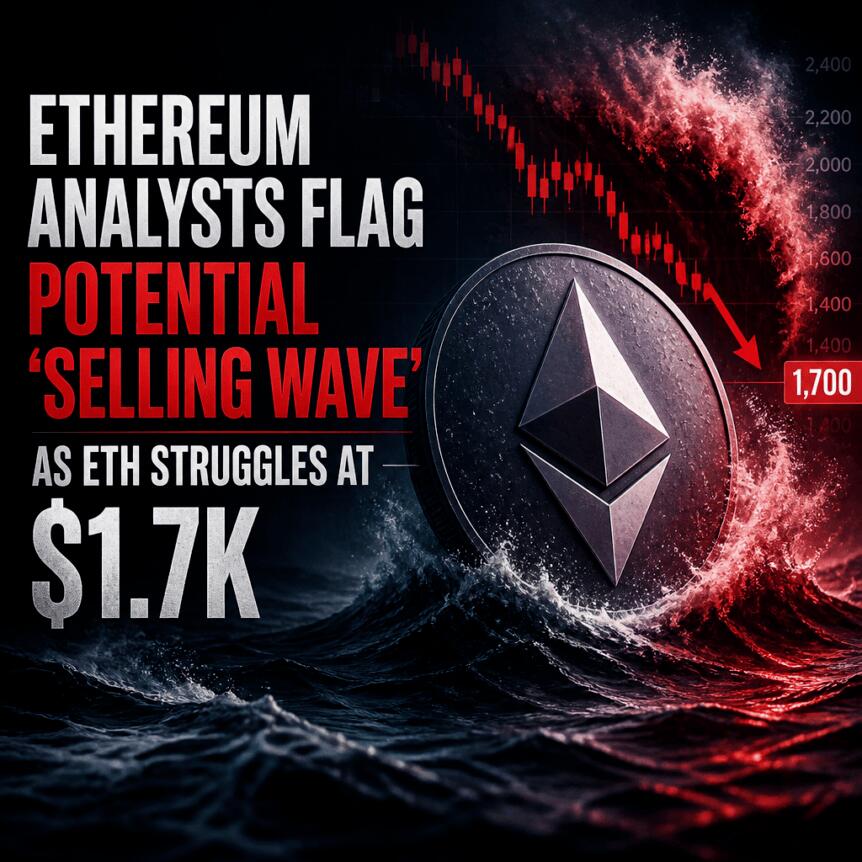
Ether’s near-term outlook is deteriorating as spot flow and derivatives positioning both point to weaker participation. Over the past several days, Binance saw net inflows of about 57,700 ETH, while Ether futures open interest has dropped to $10.3 billion—down from roughly $15 billion a month earlier—marking the lowest level across exchanges since April 2025, according to CryptoQuant.
Analysts say the mix of rising exchange supply, fewer new depositors, and cooling leverage is consistent with a market that may be running out of fresh buying pressure. Several traders are now watching key weekly demand areas around $1,700 and $1,400, with the potential for renewed downside if Ether fails to hold.
Key takeaways
- Binance net inflows of ~57,700 ETH suggest more Ether is moving onto the most liquid venues, increasing the risk of sell-side pressure if price rallies.
- Ether futures open interest fell ~31% to $10.3B—its lowest aggregate level since April 2025, reflecting cooling speculative activity.
- Estimated leverage ratio declined to 0.83 from an early-June peak, signaling reduced trader conviction and less leverage-driven volatility.
- Weekly price levels in focus: the market is hovering near $1,700 and $1,400, with lower liquidity targets below there.
Why Binance inflows matter for short-term selling risk
CryptoQuant analyst Pelin Ay highlighted that Binance received roughly 57,700 ETH on a net basis over the past few days. In crypto market structure, large and sustained exchange inflows can act as a warning sign for near-term sell pressure—especially when the influx is concentrated on a venue with deep liquidity like Binance.
Ay also tied the pattern to a lack of offsetting demand. The number of new ETH depositors is currently around 320 addresses, which is described as materially below levels seen during earlier demand surges. When deposit growth is weaker, the spot market’s ability to absorb incoming supply without repricing can fade—leaving price action more dependent on existing holders.
There is also a supply-side counterweight to consider. Ay noted that daily ETH issuance sits near 2,791 ETH, a relatively modest figure that has been typical since Ethereum’s EIP-1559 upgrade in 2021. Still, even with comparatively lower issuance, elevated exchange inflows can be enough to tilt order books if buyers don’t step in.
In Ay’s view, the near-term risk is that a brief relief rally into resistance could encourage further distribution from exchange balances, turning “stability” into renewed pressure.
Derivatives activity cools as open interest hits a multi-month low
Beyond spot flows, the derivatives tape has weakened. Ether futures open interest fell to $10.3 billion on Thursday, down from about $15 billion a month ago—roughly a 31% decline. CryptoQuant characterizes this as the lowest aggregate open interest across exchanges since April 2025.
Open interest is often used as a proxy for participation and the balance of hedging versus new speculative bets. A drop of this scale typically points to fewer market participants taking fresh positions, which can translate into less willingness to press trades during a rebound attempt.
Leveraged positioning has also eased. The estimated leverage ratio (ELR) fell to 0.83 from an all-time high of 1.10 on June 2. CryptoQuant also notes that this move represents the largest leverage unwind since October 2025, when the metric slid from 0.72 to 0.56.
Lower leverage can reduce short-term volatility and speculative pressure, but it usually comes with a trade-off: it often reflects weaker conviction. In other words, the market may be less prone to sharp liquidations, yet less capable of sustaining a strong uptrend on its own momentum.
Weekly demand zones under scrutiny: $1,700 and $1,400
On the chart, Ether’s weekly trend has continued to struggle. The weekly outlook referenced in the analysis shows ETH down about 30% over the past 42 days, trading near demand zones around $1,700 and $1,400.
The April 2025 low at $1,384 is cited as the nearest external liquidity target if weakness continues. Below that, the analysis points to a broader demand area dating back to January 2023, spanning roughly $1,289 to $1,071.
Trader Ardi previously argued on X that there are early technical “bottoming” signals forming for altcoins, including ETH. In the same framing, Ardi noted that Ether touched the lower band of a long-term acceptance range that had previously aligned with macro lows—suggesting the market may be approaching a decision point rather than continuing an uninterrupted slide.
Part of that argument is based on momentum indicators. The weekly RSI is near 31, while a daily RSI reading of 11 during the recent sell-off is described as the lowest recorded level. In practical terms, these readings are often interpreted as improving the odds of stabilization—though they do not guarantee a reversal.
Ardi also emphasized that ETH/BTC remains an important metric to watch because the pair continues to trend lower. For now, the key trading range remains where liquidity and position-taking are concentrated: roughly $1,400 to $1,700.
What investors and traders should monitor next
If exchange inflows keep outpacing new depositors while futures open interest remains depressed, Ether could struggle to convert any bounce into a sustained trend—especially if leverage continues to unwind. The immediate question for markets is whether ETH can hold the weekly demand bands near $1,700 and $1,400, or whether the combination of supply returning to exchanges and reduced derivatives activity will push price toward the next liquidity pockets below.
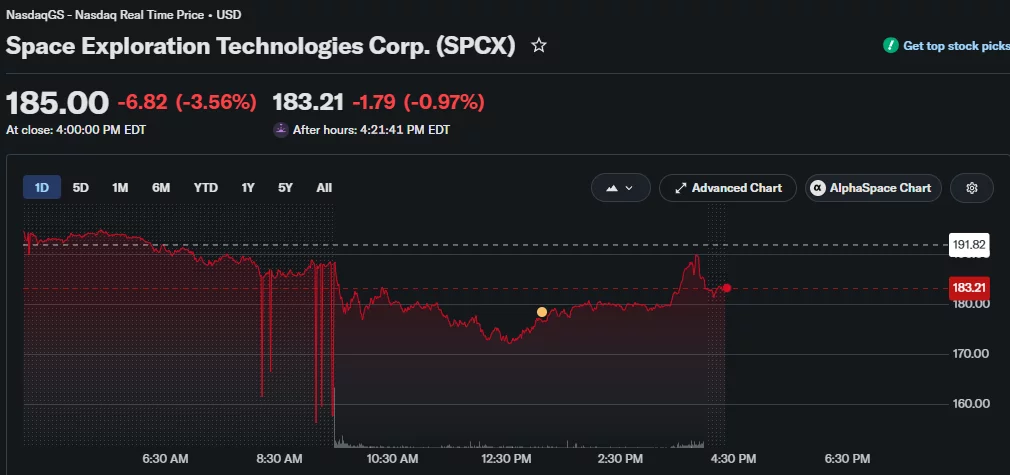
SpaceX has explored a bond offering worth as much as $20 billion while its publicly traded shares have fallen more than 9%, trimming Elon Musk’s fortune by roughly $59 billion from recent highs.
Summary
- SpaceX is considering a bond sale of up to $20 billion to refinance debt due in 2027.
- SPCX shares fell more than 9% intraday, while Elon Musk’s net worth dropped by $59 billion.
- Major Wall Street banks remain involved in the financing effort despite investor concerns over leverage.
Bloomberg reported, citing people familiar with the matter, that SpaceX and its banking partners are preparing investor discussions for a potential bond sale that could raise up to $20 billion, one of the largest corporate debt offerings in recent years.
The proposed financing would be used primarily to refinance a bridge loan due in September 2027. According to Bloomberg, that loan represents a significant portion of SpaceX’s long-term debt, which stood at approximately $29.1 billion at the end of March.
While the transaction remains under discussion, Bloomberg reported that the final size, structure, and timing could still change depending on market conditions and investor demand. Bank of America, Citigroup, JPMorgan Chase, Goldman Sachs, and Morgan Stanley are expected to lead the process. Those same institutions previously participated in the bridge financing arrangement.
The debt discussions come only days after SpaceX completed a landmark public listing that pushed the company’s valuation above major technology firms and elevated Elon Musk’s wealth to unprecedented levels.
Investors weigh debt plans against recent stock volatility
Following reports of the potential refinancing transaction, SpaceX shares came under selling pressure. SPCX stock fell more than 9% from its previous close of $191.82 to an intraday low of $172.11 on June 18. The stock later recovered part of those losses and finished the session near the $185 level.
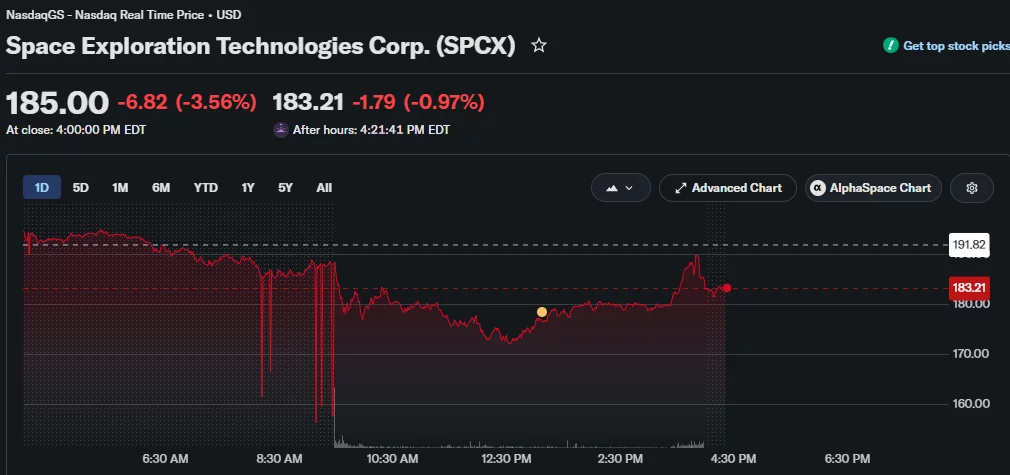
The decline follows a sharp rally that had briefly lifted SpaceX’s valuation close to $3 trillion. As crypto.news previously reported, shares reached an intraday high of about $225.84 on June 16, pushing Musk’s net worth to nearly $1.4 trillion and temporarily placing the value of his holdings above Bitcoin’s market capitalization of roughly $1.31 trillion at the time.
Earlier reporting by crypto.news also noted that SpaceX’s market debut made Musk the world’s first trillionaire. Continued gains after the listing added hundreds of billions of dollars to his paper wealth before the recent pullback reduced those gains.
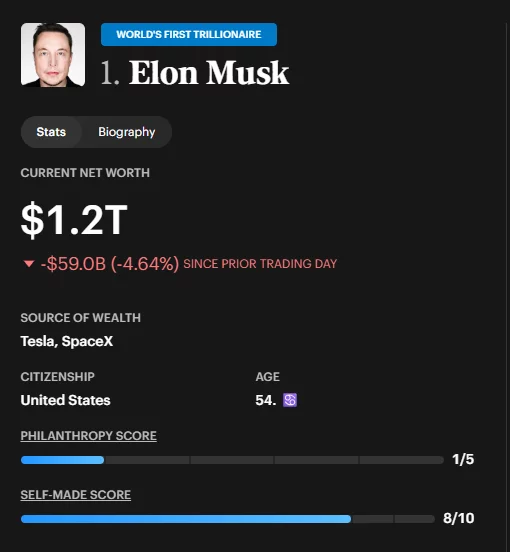
According to data by Forbes, Musk’s net worth has since fallen back to around $1.2 trillion, representing a decline of approximately $59 billion, or 4.6%, over the past trading day.
Banks remain involved despite growing debt burden
Despite the recent pullback, Bloomberg reported that major Wall Street banks remain involved in SpaceX’s financing plans. The institutions expected to arrange the proposed bond offering are the same lenders that previously provided the bridge loan the company now intends to refinance.
Investor interest in SpaceX has remained strong since its public debut. As crypto.news previously reported, some retail investors reportedly took out bank loans to increase their IPO allocations before shares began trading.
Beyond its aerospace operations, the company has also drawn attention for its expansion into artificial intelligence. Recent reports indicated that SpaceX is exploring an acquisition of Anysphere, the developer behind the Cursor AI coding platform.
At the same time, investors are evaluating what a potential $20 billion refinancing transaction could mean for the company’s balance sheet, as large debt deals often bring renewed focus to leverage levels and future funding needs.


How the Ultrasonic CT Scanner Works
1 Billion Scans Per Month Through AI
The post Midjourney’s New Scanner Maps Your Whole Body in 60 Seconds appeared first on BeInCrypto.
Custodia and Vantage Bank have proposed a token that automatically switches between a bank deposit and a stablecoin as it moves between participating banks and external users.
According to a white paper shared with Cointelegraph on Thursday, the token would operate as a deposit issued by a participating bank when held within a banking consortium and as a stablecoin backed by cash and short-term Treasurys when transferred outside the so-called Hazel network.
The companies said the system has been running on Ethereum (ETH) since March and is being tested by participating banks ahead of a broader rollout planned for later this year. The platform is designed to support tokenized deposits, stablecoins and other blockchain-based financial assets through a shared banking infrastructure.
According to the white paper, participating institutions would not need to replace existing core banking systems, with the platform operating alongside current ledgers and payment infrastructure.
The companies said it was designed for banks and credit unions of all sizes, including community banks, and aims to let institutions participate in tokenized payments without moving customer deposits outside the banking system.
Wyoming-based Custodia and Texas-based Vantage said they expect the Hazel network to become broadly available to banks and their customers in the fourth quarter of 2026.
Related: UK crypto advocates launch campaign against banks blocking exchange transfers
Banks seek alternatives to stablecoins
The proposal comes as banks increasingly look for ways to offer blockchain-based payment services without losing customer deposits to stablecoin issuers.
Earlier this month, The Wall Street Journal reported that The Clearing House, whose owners include JPMorgan Chase, Bank of America and Citigroup, plans to launch a tokenized deposit network in the first half of 2027, allowing banks to settle payments using blockchain-based representations of customer deposits.
Banking groups have also pushed back against legislation that could allow stablecoin issuers to offer yield-bearing products.
JPMorgan CEO Jamie Dimon recently said banks would continue fighting provisions in the CLARITY Act, a US crypto market structure bill, arguing they could let crypto companies compete for deposits without obtaining bank charters. The bill advanced out of the Senate Banking Committee in May and still requires approval from both chambers of Congress.
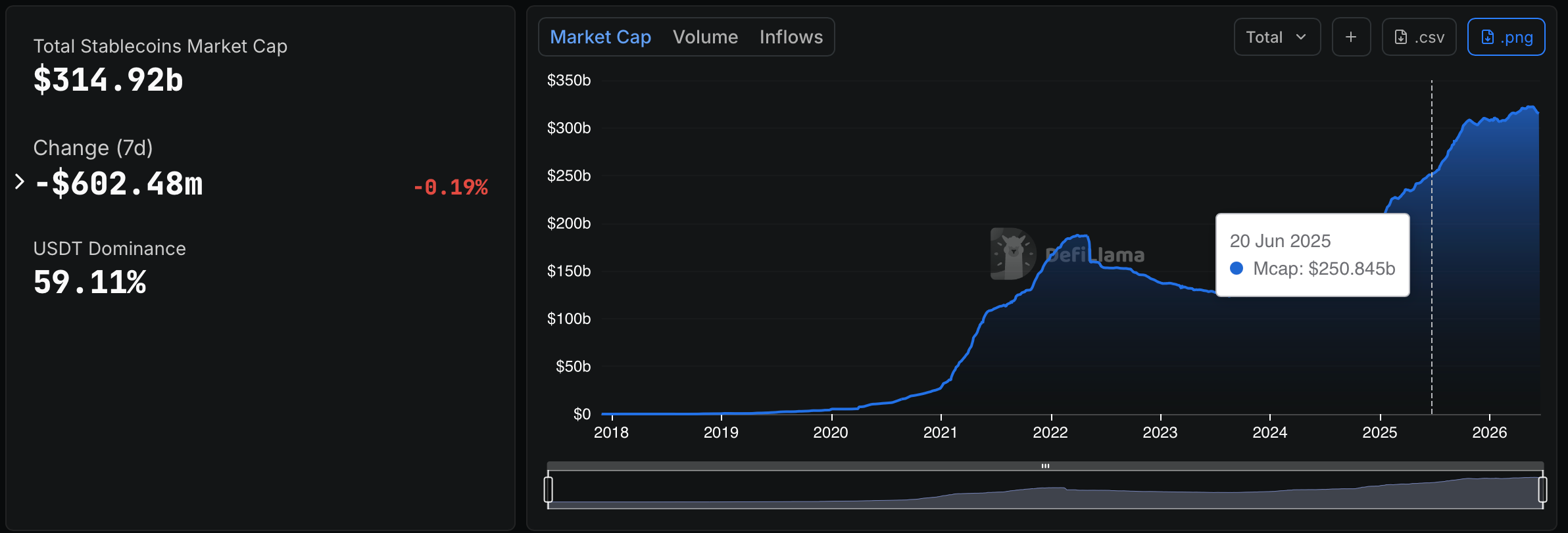
According to DefiLlama data, the total stablecoin market capitalization stands at roughly $315 billion, up from about $251 billion a year ago.
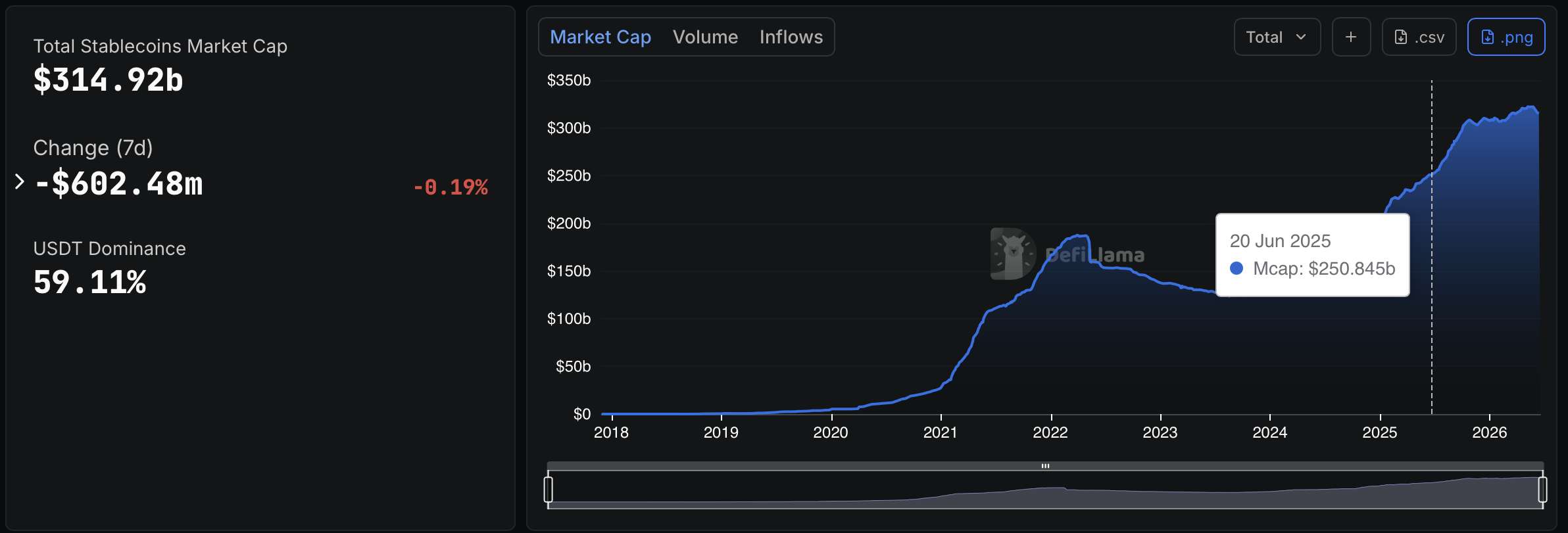
Source: DefiLlama
Magazine: Vietnam preps crypto pilot, HK pushes tokenization: Asia Express
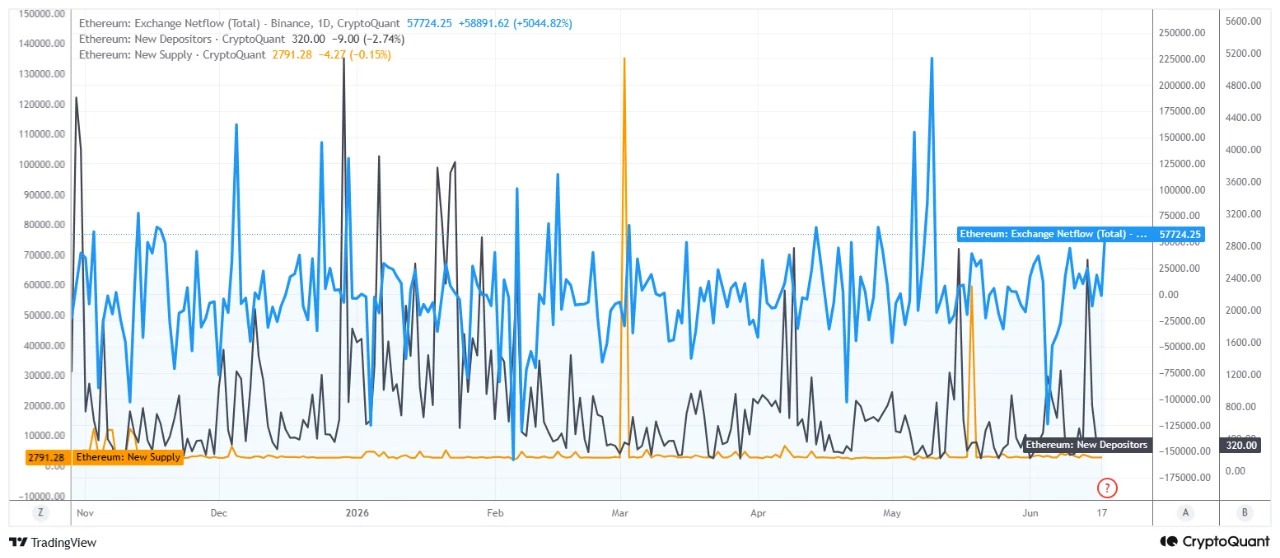
Ether’s (ETH) exchange and derivatives data turned weaker over the past month. Binance recorded net inflows of 57,700 ETH, while futures open interest fell to a year-low of $10.3 billion from $15 billion, and the ratio of leveraged positions retreated sharply from their early June highs.
The combination of rising exchange supply, muted new participation, and declining futures activity has led ETH analysts to forecast another wave of selling pressure below $1,700.
ETH inflows on Binance outpace new demand
Crypto analyst Pelin Ay noted that roughly 57,700 ETH flowed into Binance on a net basis over the past few days. Large inflows to the exchange often signal potential selling since Binance is one of the most liquid exchanges in the crypto market.
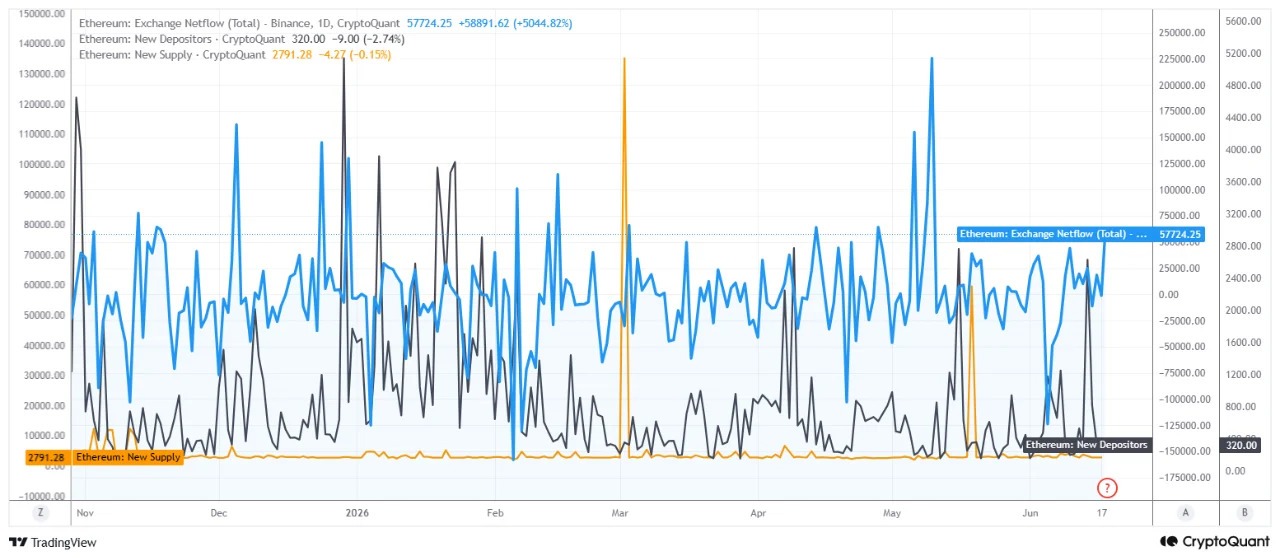
ETH exchange inflows, new depositors and fresh supply. Source: CryptoQuant
At the same time, the number of new ETH depositors is around 320 addresses, well below the levels seen during previous demand surges. The muted participation suggests limited new capital entering the market, leaving recent price stability dependent on existing holders.
The analyst noted that supply growth continues to offer a counterbalance. Daily ETH issuance stands near 2,791 ETH, a relatively low figure since Ethereum’s EIP-1559 upgrade in 2021.
For now, exchange flow data paints a cautious picture. Ay said elevated net inflows raise the risk of another selling wave if Ether approaches resistance levels during any relief rally.
Related: BitMine boosts ETH holdings closer to $10B as bear market accumulation continues
Can Ether price defend its weekly demand zone?
ETH derivatives data have also cooled sharply in recent weeks. Ether futures open interest fell to $10.3 billion on Thursday from $15 billion a month ago, a decline of roughly 31%. The reading marks the lowest aggregate open interest across exchanges since April 2025.
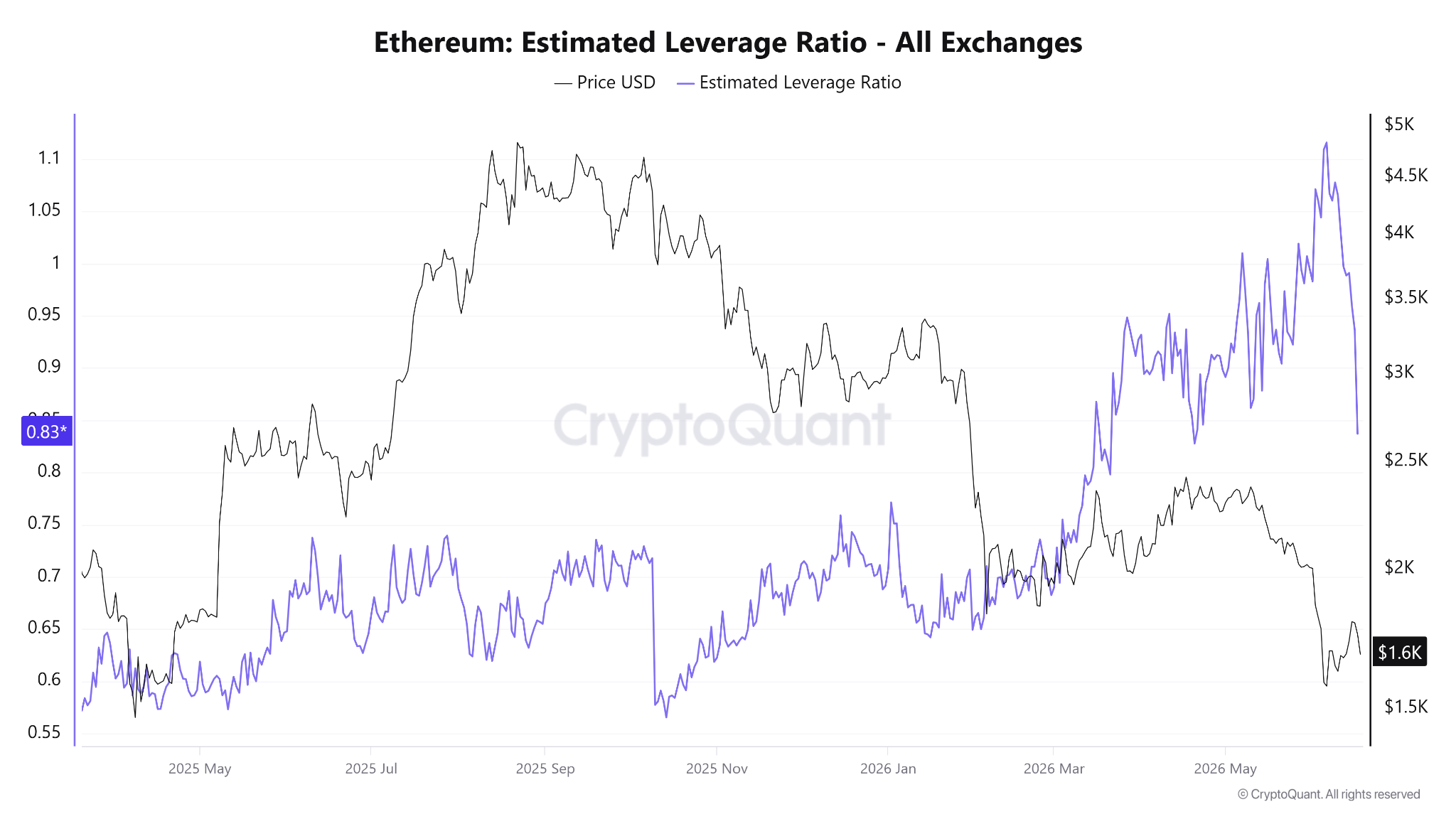
Ether estimated leverage ratio for all exchanges. Source: CryptoQuant
The number of leverage positions has also retreated at a similar pace. The estimated leverage ratio (ELR) dropped to 0.83 from an all-time high of 1.10 on June 2, marking its largest leverage unwind since October 2025, when the metric slid from 0.72 to 0.56.
Lower leverage often reduces the short-term volatility and speculative demand, but it also signals weaker conviction among traders.
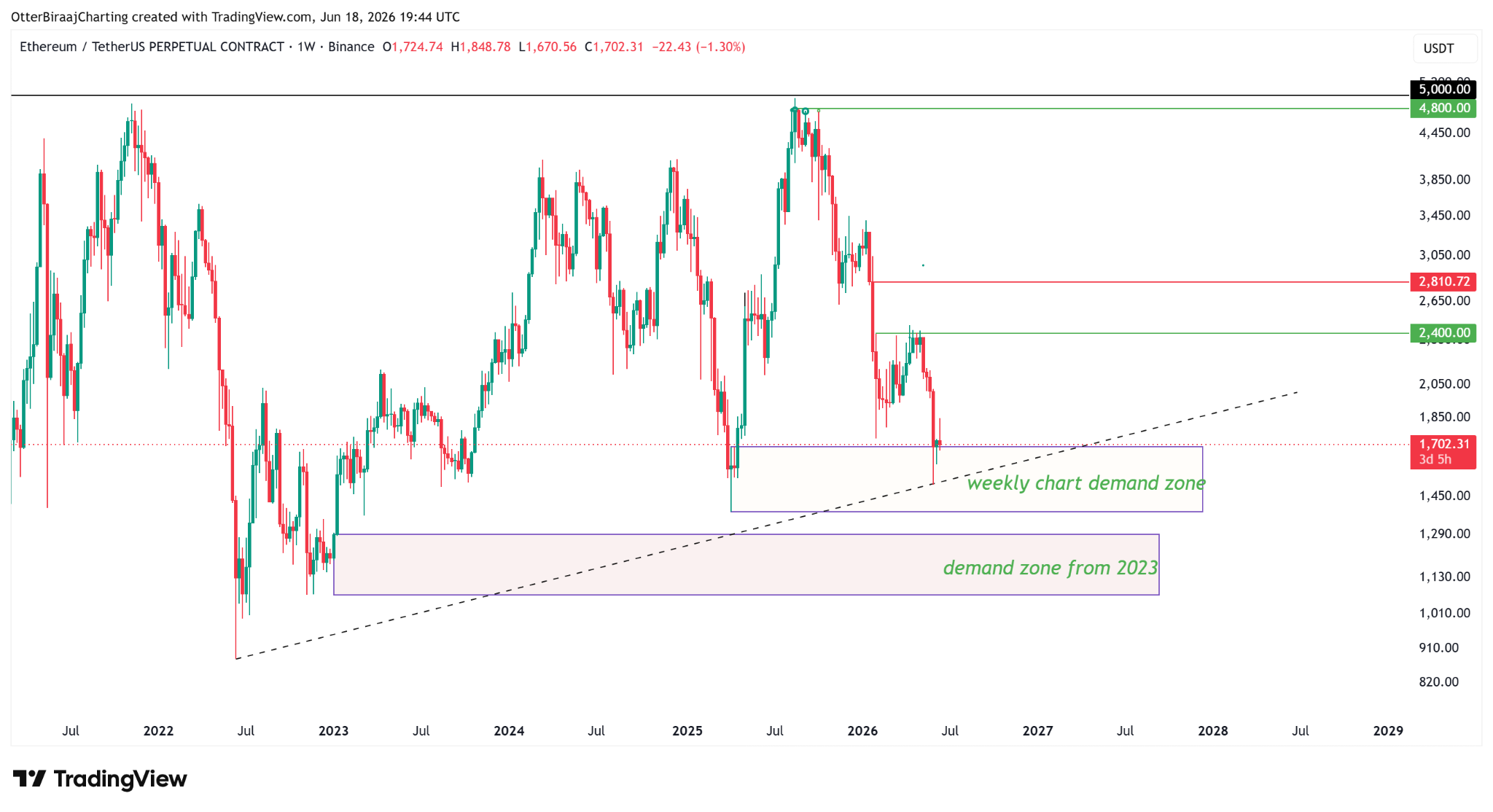
ETH/USDT, one-week chart analysis. Source: Cointelegraph/TradingView
Ether’s weekly chart is down 30% over the past 42 days and continues to trade near the demand zone of $1,700 and $1,400. The April 2025 low at $1,384 stands as the nearest external liquidity target if price weakness continues.
Below that level, the immediate area of interest is the demand zone from January 2023 between $1,289 and $1,071.
From a market standpoint, crypto trader Ardi said last week that some technical bottoming signals are emerging for the altcoin. ETH recently touched the lower band of a long-term acceptance range that previously coincided with macro lows.
The weekly relative strength index (RSI) sits near 31 after a daily RSI reading of 11 during the recent sell-off, its lowest level on record, which improves the chances of ETH bottoming in the current price range.
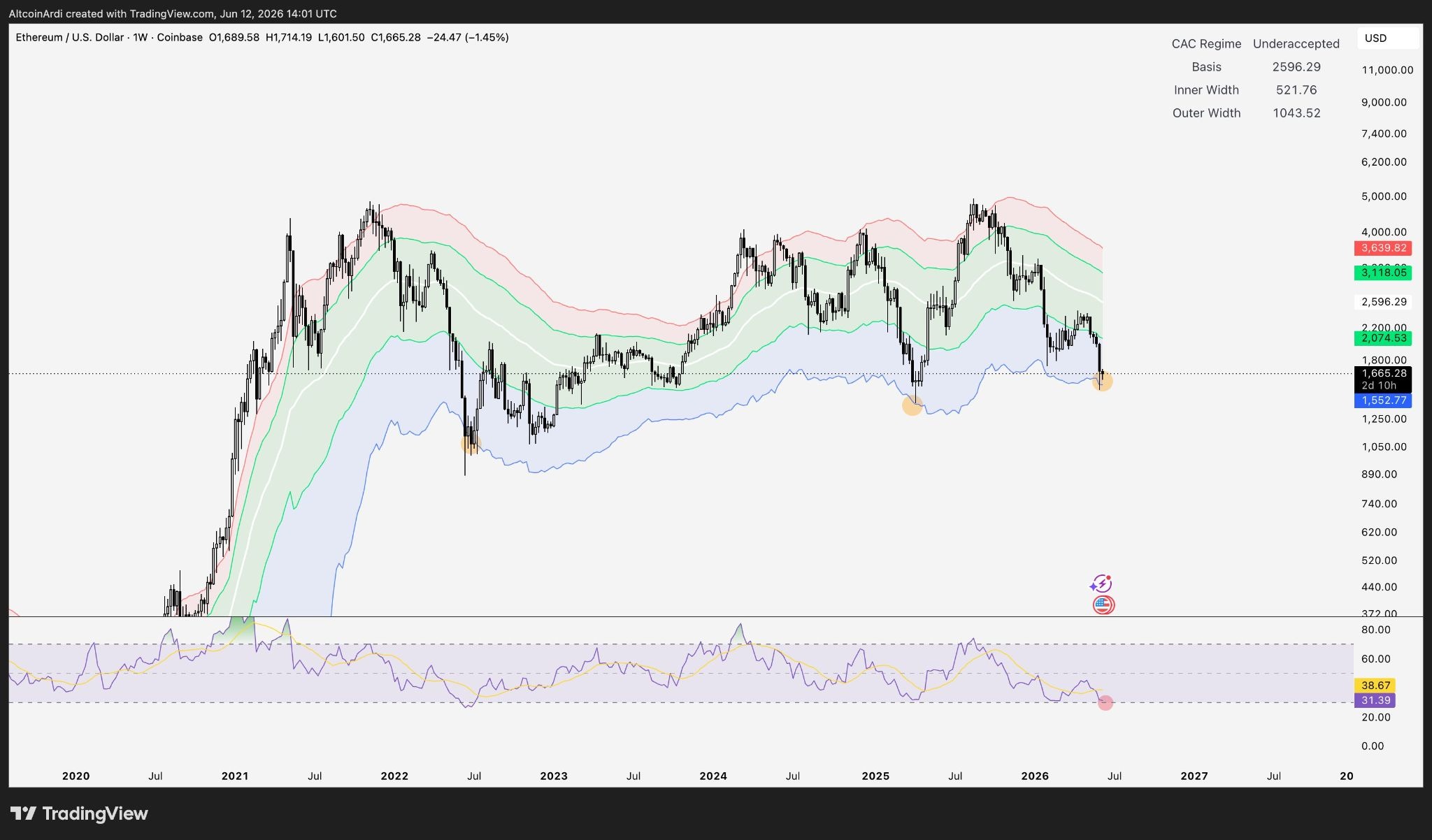
ETH/USD weekly analysis by Ardi. Source: X
Ardi added that ETH/BTC remains a key chart metric to monitor, as the pair continues to trend lower. For now, the $1,400 to $1,700 range remains the area where buyers and sellers are most actively positioned.
Related: Altcoin selling tops $266B as capital rotates out of crypto: Is altseason extinct?

US financial regulators have taken another step in implementing the GENIUS Act, proposing rules that would require stablecoin issuers to follow identity-verification standards similar to those used by banks under federal law. The proposal is aimed at tightening Anti-Money Laundering (AML) and Countering the Financing of Terrorism (CFT) controls for stablecoin providers.
According to a notice of proposed rulemaking released jointly by the Federal Deposit Insurance Corporation (FDIC), the Federal Reserve, the Office of the Comptroller of the Currency (OCC), the National Credit Union Administration, and the US Treasury’s Financial Crimes Enforcement Network (FinCEN), stablecoin issuers would be expected to run customer identification programs that include verifying the identity of individuals seeking to “open an account,” maintaining related records, and checking whether a person is suspected of terrorist ties.
Key takeaways
- Several US agencies have proposed stablecoin-issuer identity verification requirements tied to AML/CFT obligations under the GENIUS Act.
- The rule would mirror bank-style expectations under the Bank Secrecy Act, including customer identity checks and recordkeeping.
- The proposal is open for public comment for 60 days after it is filed in the Federal Register on Monday.
- GENIUS implementation is expected to take effect 18 months after passage, or within 120 days after final regulations are issued.
- Congress is still working through broader crypto regulatory legislation, including the Digital Asset Market Clarity (CLARITY) Act.
Proposed “bank-like” customer identification for stablecoin users
The agencies said the proposed rule is part of the GENIUS Act’s implementation process, which was signed into law in July 2025. The joint notice was released on Thursday, and the proposal is expected to appear in the US Federal Register for public comment once officially filed.
At the center of the plan is a set of minimum standards drawn from the Bank Secrecy Act framework. Under these standards, regulated financial institutions are required to verify the identity of any person seeking to open an account, store the information, and assess whether the individual is suspected of being a terrorist or associated with a terrorist organization.
In practical terms for stablecoin issuers, the proposal signals that regulators expect stablecoin onboarding and user verification to look more like traditional financial onboarding—at least from an AML/CFT compliance perspective—even if stablecoin issuance and transfers differ from banking operations.
Why AML and CFT requirements are now the focal point
The GENIUS Act is designed to create a clearer compliance path for stablecoin activity in the United States. The agencies’ latest move targets how stablecoin providers handle AML/CFT obligations, including the foundational “know your customer” step that supports downstream monitoring and reporting.
The proposal matters for both compliance teams and market participants because identity verification is often the first layer of a broader compliance stack. Recordkeeping and screening for prohibited or high-risk associations can affect onboarding workflows, documentation requirements, and how issuers manage data retention and audits.
The timing also highlights the pace at which regulators are working through GENIUS-related obligations: this proposal follows earlier actions by Treasury and the FDIC to define other compliance elements under the same law.
For background, Treasury has already proposed AML and CFT requirements related to illicit finance as part of GENIUS implementation. Separately, earlier FDIC guidance suggested that insurance for corporate deposits of stablecoin issuers would not extend to stablecoin holders, underscoring that regulators are approaching stablecoin treatment through multiple, separate policy levers rather than a single, unified regime.
Comment window and when GENIUS implementation could begin
Under the proposal, the agencies set a public comment period of 60 days after the rule is officially filed in the Federal Register on Monday. That comment window will determine whether stakeholders argue for adjustments to the identity-verification program requirements, the operational burden placed on issuers, or the compliance timeline.
The proposed rule is also linked to the broader implementation schedule for GENIUS. The law is expected to come into effect 18 months after it was signed into law, or within 120 days after federal authorities finalize regulations for implementation—whichever timeline arrives first.
As a result, issuers may need to plan ahead even while the rule is still open to comment, especially if compliance systems require redesign to support customer identification processes and documentation policies.
GENIUS advances while CLARITY remains unresolved
While GENIUS-specific rulemaking continues, the US Congress still has not set a defined path for passing the Digital Asset Market Clarity (CLARITY) Act. CLARITY is intended to reshape how financial agencies define and enforce crypto rules, a goal that has been widely discussed across Washington.
Earlier reporting indicated that many in the White House and Congress expect CLARITY to move forward by the August recess. However, concerns raised by Democrats—centered on potential conflicts of interest involving lawmakers and elected officials—could slow progress.
The contrast between the two tracks is notable: stablecoin regulation is moving forward through a targeted statute (GENIUS) with concrete agency rulemaking underway, while broader crypto market “clarity” continues to depend on additional congressional action and political negotiations.
What to watch next
Stablecoin issuers and compliance teams should closely monitor the Federal Register filing and the details of the final customer identification program requirements, especially how regulators expect verification and recordkeeping to operate in real-world onboarding flows. At the same time, investors should keep an eye on whether Congress progresses on CLARITY, since parallel regulatory frameworks could shape how stablecoins and other digital assets are governed in the years ahead.


Malta’s financial regulator has proposed a new legal category for decentralized autonomous organizations as part of a consultation on how decentralized finance could be regulated under the European Union’s crypto framework.
Summary
- Malta’s MFSA has proposed a new “software-based organization” category that would include DAOs and other DeFi entities.
- The regulator said many DeFi projects may not qualify as fully decentralized under MiCA due to concentrated governance.
- The consultation comes as EU regulators review DeFi oversight ahead of MiCA’s July 1, 2026, enforcement deadline.
According to a discussion paper published by the Malta Financial Services Authority on June 12, the regulator has opened a public consultation running through July 10 that seeks industry feedback on a potential framework for DeFi activities.
The proposal introduces the concept of “software-based organizations,” a category that would cover DAOs and other blockchain-based entities governed primarily through software.
Rather than creating a separate legal framework exclusively for DAOs, the MFSA said software-based organizations could provide a legal structure that distinguishes the organization itself from the protocols and code it operates.
The regulator argued that separating those elements could help address governance and accountability issues that continue to emerge across DeFi projects.
Malta seeks legal structure for software-governed entities
Within the consultation paper, the MFSA noted that fully decentralized services generally remain outside the scope of the European Union’s Markets in Crypto-Assets regulation. At the same time, the regulator said many projects that identify as decentralized still retain elements of centralized control, making regulatory classification more complex.
“MiCA excludes fully decentralised models from its regulatory scope, meaning that projects without intermediaries or central control may not need to comply with MiCA.”
Building on Malta’s early involvement in digital asset regulation, including the introduction of a crypto framework in 2018, the proposal attempts to address questions that have become more pressing as regulators examine how DeFi systems operate in practice.
Recent research has added to those concerns. In March, a working paper from the European Central Bank found that governance and decision-making across four major DeFi protocols remained concentrated among a limited group of participants.
According to the ECB paper, that concentration could make it difficult for some projects to qualify as fully decentralized under MiCA.
EU scrutiny of DeFi grows ahead of MiCA enforcement
Elsewhere in Europe, policymakers continue reviewing whether MiCA adequately addresses decentralized finance. In May, the European Commission launched a targeted review of the regulation and requested feedback on several topics, including stablecoin interest payments, DeFi activity, and potential gaps that could require additional rules.
The discussion arrives as EU regulators prepare for the final phase of MiCA implementation. As previously reported by crypto.news, the transition period ends on July 1, 2026, after which crypto exchanges, brokers, and wallet providers without authorization will no longer be permitted to serve customers in the bloc.
According to the European Securities and Markets Authority, firms operating without a MiCA license after the deadline would be in breach of EU law.
ESMA also said providers that fail to obtain authorization should establish orderly wind-down plans and help customers transfer assets to either authorized firms or self-hosted wallets.
Data cited by Hogan Lovells illustrates the scale of the transition. The law firm reported that Europe had more than 3,000 virtual asset service providers in 2024, yet only 194 authorized crypto-asset service providers, including credit institutions, had obtained approval by May 2026.
Against that backdrop, Malta’s consultation adds another piece to the ongoing debate over how European regulators should treat organizations that operate through code while still maintaining identifiable governance structures.
Disclosure: This article does not represent investment advice. The content and materials featured on this page are for educational purposes only.

TLDR:
- Algorand will roll out native Falcon-1024 account support in its Q3 2026 protocol release.
- Hybrid accounts combining elliptic-curve and Falcon signatures offer dual classical and quantum protection.
- A post-quantum VRF replacement is under active research, with a paper expected by early 2027.
- France’s ANSSI will stop certifying non-quantum-safe products from 2027, adding regulatory urgency.
Algorand quantum computing resistance is now a formal priority, with the Algorand Foundation announcing a structured roadmap to secure its blockchain against future quantum threats by end of 2027.
The plan covers user accounts, wallets, custody systems, and core consensus infrastructure. First milestones are set to begin rolling out in Q3 2026, positioning Algorand among the most proactive blockchain networks preparing for the post-quantum era.
Falcon-1024 Accounts and Hybrid Cryptography Lead the 2026 Rollout
The foundation’s immediate focus centers on native Falcon-1024 account support, scheduled for the Q3 2026 protocol release.
Unlike earlier Falcon implementations built on LogicSignatures, native accounts will integrate directly with the ledger and developer tooling. Support will extend to Algorand’s SDKs, AlgoKit, and Pera Wallet within the same release window.
A key design choice is the hybrid account model, combining traditional elliptic-curve signatures with lattice-based Falcon signatures.
The foundation chose this approach because post-quantum schemes have not yet accumulated decades of real-world security testing. Hybrid accounts provide layered protection against both classical and quantum-era attack vectors simultaneously.
Algorand Foundation CTO Bruno Martins outlined the broader vision behind the rollout. “Algorand’s roadmap reflects a belief that security should be designed for the future,” Martins wrote.
“With the first milestones launching in 2026 and broad deployment targeted for the end of 2027, Algorand is taking concrete steps toward a future where users, developers, and institutions can build with confidence.”
Multi-signature accounts will also receive upgrades under the 2026 roadmap. Institutional users will be able to configure m-of-n quorum policies mixing classical, pure-Falcon, and hybrid keys across participants.
This capability targets treasury management and high-stakes financial operations ahead of native multi-scheme multisig support.
Consensus and VRF Research Push Toward Full Quantum Resilience by 2027
Beyond user accounts, the foundation is addressing the cryptographic layer powering Algorand’s consensus mechanism.
The current Verifiable Random Function relies on elliptic-curve cryptography, which remains vulnerable to quantum attacks.
Chief Scientific Officer Chris Peikert is leading research into a post-quantum VRF replacement, with a research paper targeted for early 2027 publication.
Consensus messaging itself also depends on Ed25519 signatures, which carry the same quantum vulnerability. The foundation is evaluating hybrid models using both Ed25519 and Falcon signatures for consensus messages during the transition period. Key and signature size remains the primary engineering challenge under active analysis.
Martins was direct about the industry-wide stakes. “As a custodian of a global blockchain network, the Algorand Foundation takes that threat seriously and has been researching and preparing for several years,” he wrote.
He added that the foundation does not embrace alarmism, given that post-quantum countermeasures still lack the battle-testing of established systems like RSA and elliptic-curve cryptography.
France’s cybersecurity agency ANSSI recently announced it would stop certifying products lacking quantum-safe encryption from 2027, adding regulatory weight to the timeline. ANSSI Chief of Staff Samih Souissi noted the issue extends well beyond technical concerns.
“It’s not only a technical issue,” Souissi said. “It’s a matter of governance, industrial planning, regulation, and sovereignty.”
Algorand’s roadmap, initiated with State Proofs in 2022, now targets broad deployment precisely as that global compliance deadline approaches.


Bitcoin miners are having one of the most challenging cycles in crypto history due to lower block subsidies, thinner margins, and volatile hashprice. Recent BeInCrypto analysis showed Bitcoin’s ‘Electrical Cost’ floor sits near $48,694, while the realized price is around $54,000.
So, the profit margin is shrinking fast, while competition is intense across the board. Adding to this stress is the next Bitcoin halving cycle, less than 2 years away.
The 2024 halving reduced the Bitcoin block subsidy to 3.125 BTC, while the next halving is expected to cut it to 1.5625 BTC around 2028. For miners, this means every watt, chip, cooling decision, and hour of uptime now feeds into profitability.
BeInCrypto spoke with Michael Jerlis, CEO and Founder of EMCD; Bradley Peak, Global Head of Sales at VNISH; and Fernando Lillo Aranda, CMO of Zoomex, about how mining strategy is changing as the business becomes more dependent on energy economics and operational control.
From Raw Hashrate to Profitable Hashrate
For years, mining strategy was relatively simple: deploy more machines, secure cheap electricity, and wait for Bitcoin’s price cycle to lift margins. According to Peak, this model is under pressure as rewards decline and transaction fees remain too small to carry miner revenue on their own.
“The biggest change is that miners are becoming much more disciplined operators,” Peak said. “In 2026, we are seeing miners move from ‘maximum hashrate’ to ‘maximum profitable hashrate.’”
He pointed to firmware tuning, fleet segmentation, underclocking during weak hashprice periods, selective overclocking, flexible power contracts, and stronger treasury discipline as part of this new operating model.
Michael Jerlis spoke about the same trend.
“Buy-mine-sell is mostly dead,” Jerlis said. “With hashprice near $29 per PH/s per day and fees around 1% on most days, the reward alone doesn’t cover the bill. Miners stopped chasing raw hashrate and now squeeze margin per kilowatt-hour.”

In this environment, rejected shares, pool fees, chip performance, voltage settings, and downtime become financial variables. Jerlis described the modern mining business as one where “the money lives in the details now.”
Peak added that miners are also exploring new revenue streams, including demand response, grid services, and AI or high-performance computing where the site design allows it.
“Mining is increasingly an energy and infrastructure business with Bitcoin as one revenue line,” he said.
Firmware, Curtailment, and Load Control Decide Margins
As profitability tightens, software-level optimization is becoming one of the fastest ways to improve mining economics. Peak said firmware is powerful because it acts directly at the ASIC level, allowing operators to tune voltage, frequency, thermal behavior, fan curves, and operating profiles according to real site conditions.
“At VNISH, our focus is giving miners control over voltage, frequency, thermal behavior, fan curves, autotuning, and operating profiles,” Peak said. “The goal is to help each ASIC run according to real site conditions instead of using one generic factory setting for every machine.”
Jerlis said firmware optimization, curtailment, heat reuse, and dynamic load management have moved from optional improvements to basic survival tools.
“Factory firmware can leave up to 25% of a chip unused while still burning watts you pay for,” Jerlis said. “Tuning, curtailment, and heat reuse don’t sound exciting, but at $29 hashprice they’re often the difference between a site that earns and one that quietly bleeds.”
Curtailment has become especially valuable in power markets where large flexible consumers can earn revenue or reduce costs by lowering demand during grid stress. Mining fleets are well suited for this because they can reduce load quickly without disrupting a traditional production line.
Heat reuse is developing more slowly, but both the economic and reputational case is growing. Mining sites able to redirect waste heat into greenhouses, district heating, drying systems, industrial processes, or buildings can reduce net energy costs and create a second layer of value from the same electricity input.
“In 2026, profitability comes from stacking several small advantages together,” Peak said.

Energy-Backed Mining Sites Look Best Positioned
The experts broadly agreed that the strongest mining models are those built around power access rather than machine ownership alone.
Peak ranked energy-backed mining sites first because they control the most important input: electricity. Sites with low-cost or stranded energy, flexible load rights, strong cooling, and the ability to change operating modes have the strongest base for the next cycle.
“Bitcoin mining margins are increasingly won before the ASIC is even plugged in,” Peak said.
Low-cost private operators also remain competitive, especially when they run lean operations and avoid the pressure public companies face from quarterly reporting and capital markets.
Jerlis said the best-positioned miners are those with cheap power and the ability to redeploy hardware quickly.
“Lean private operators with all-in costs near $50,000 to $64,000 per coin, along with energy-backed sites, look best,” he said. “Public miners are becoming AI data centers that mine on the side. The pure buy-mine-sell crowd struggles most. It’s about staying flexible, not being the biggest.”
Public mining companies are splitting into different categories. Some are evolving into data center businesses through AI and high-performance computing contracts, while others remain highly exposed to Bitcoin mining economics. Peak said the second model becomes harder without exceptional power costs and modern fleets.
Hosting providers can still succeed, but only when they offer strong power quality, uptime, pricing transparency, and site-level energy strategy. Pool-integrated firms may capture more of the value chain, but integration alone cannot overcome expensive electricity or poor hardware efficiency.
Mining Will Stay Energy-Intensive, but the Business Model Will Change
Looking ahead 10 years, the experts expect Bitcoin mining to remain profitable for strong operators, while becoming less forgiving for inefficient fleets.
Peak said mining will likely remain energy-intensive in absolute terms because proof-of-work depends on global competition for block rewards. However, the way miners consume energy should become more flexible and economically integrated with power markets.
“More mining will be tied to flexible load programs, stranded energy, renewable curtailment, behind-the-meter generation, heat reuse, and grid services,” Peak said.
Fernando Lillo Aranda, CMO of Zoomex, expects mining to become more industrialized and less speculative over the next decade. He said miners will compete on access to stranded, renewable, curtailed, or flexible power, while also adopting more hedging, treasury management, and hybrid revenue strategies.
“Energy becomes a strategy, not just a cost,” Aranda said. “Miners increasingly compete on access to stranded, renewable, curtailed, or flexible power rather than simply buying electricity.”
He also expects mining to become more closely connected with grid operations, with some operators earning value by balancing demand, absorbing excess generation, and participating in energy markets.
Jerlis sees a similar future, where mining becomes one workload inside a larger power and compute business.
“In ten years the rigs will share buildings with AI and HPC, and the real asset will be the power and the site, not the machine,” he said. “Mining turns into one workload among several. The garage era is over, and honestly, that’s healthy.”
The next decade of Bitcoin mining will likely reward operators with energy expertise, software control, flexible sites, and diversified revenue. Hashrate will still count, but profitability will depend on how intelligently miners convert electricity into revenue across changing market conditions.
The post Is Bitcoin Mining Becoming an Energy and Infrastructure Business? appeared first on BeInCrypto.
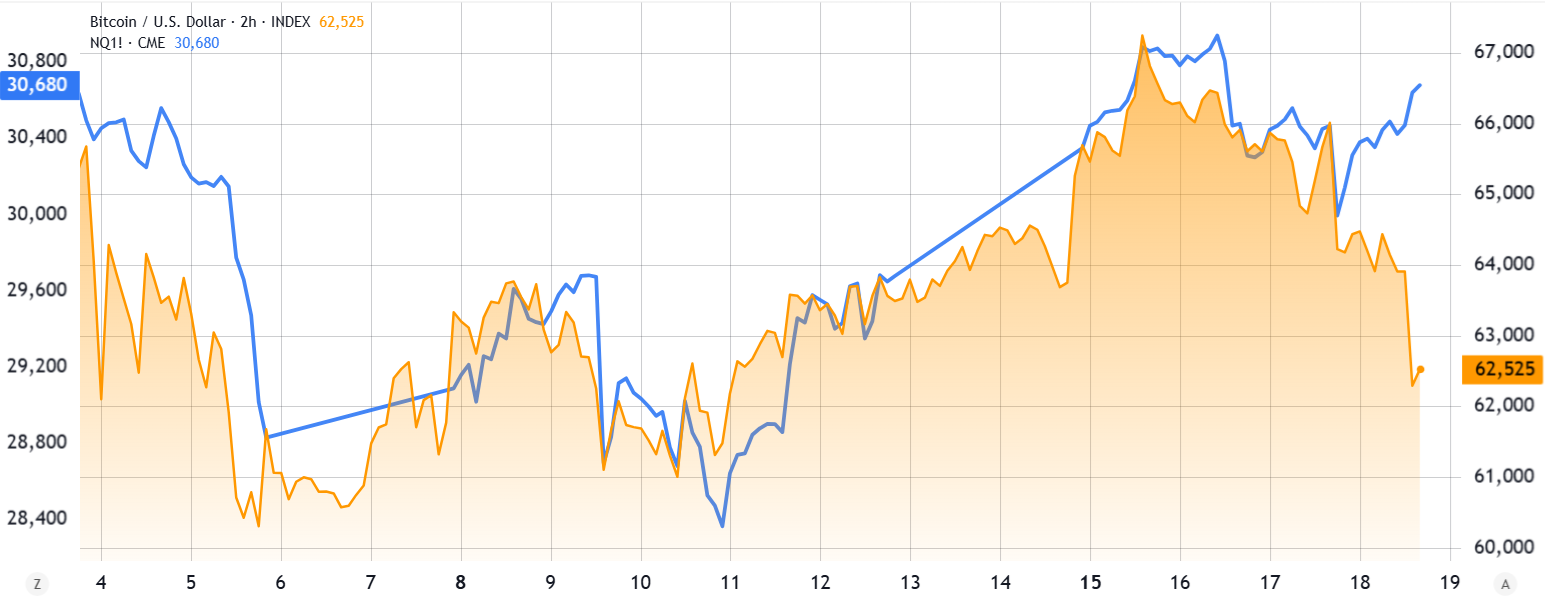
Key takeaways:
- Bitcoin’s sudden decoupling from a strong Nasdaq index highlights shifting capital flows into the AI sector.
- A strengthening US dollar and high Treasury yields are weighing heavily on non-yielding crypto assets.
Bitcoin (BTC) faced a 7% correction after failing to reclaim the $67,200 level on Monday, triggering $330 million liquidations in bullish leveraged positions. More concerningly, the drop happened while the Nasdaq 100 index showed strength, trading 1% away from its all-time high. Should Bitcoin traders brace for a $60,000 retest?
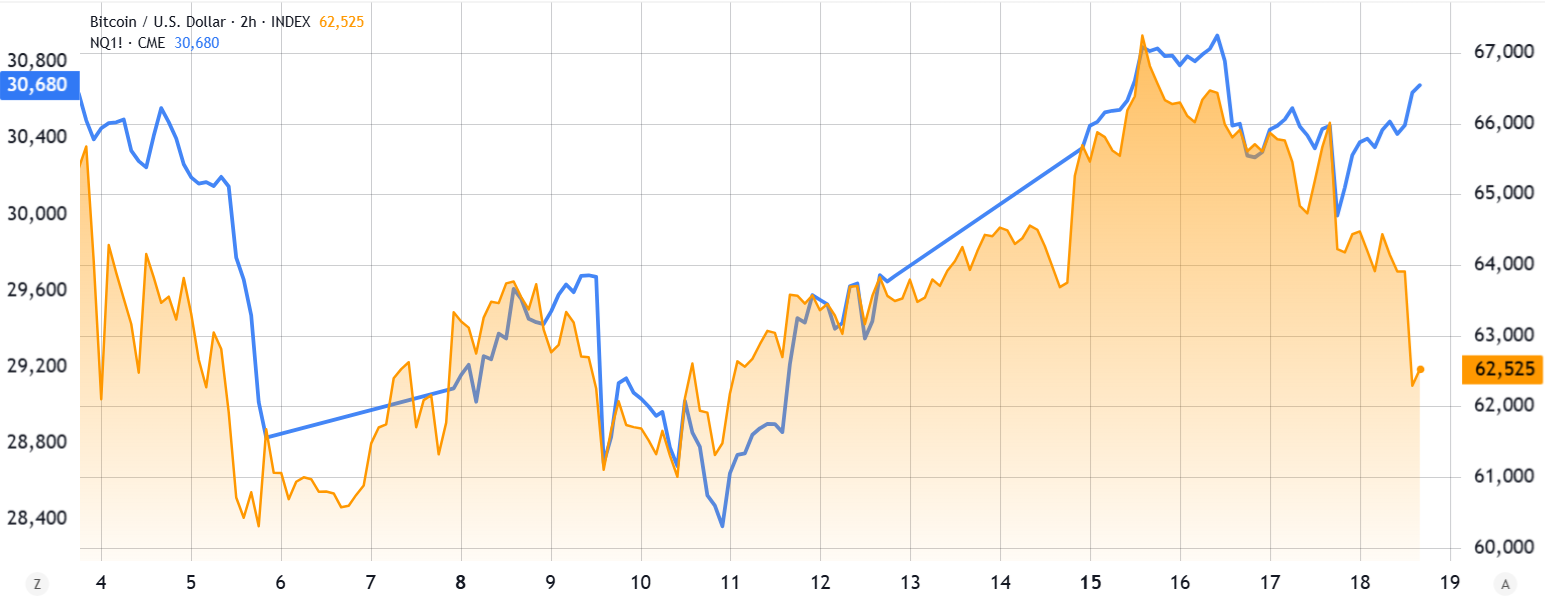
Nasdaq 100 futures (left) vs. Bitcoin / USD. Source: TradingView
The bullish momentum in the stock market likely came from the memorandum of understanding signed by US President Donald Trump and Iran’s President Masoud Pezeshkian. Crude oil prices fell to their lowest level in 15 weeks to $74, easing inflation risks. Moreover, US job market data boosted investors’ morale as continuing jobless claims held flat at 1.81 million.
Bitcoin’s decoupling from tech stocks coincides with US Federal Reserve (Fed) Chair Kevin Warsh’s remarks on Wednesday. The term “price stability” was cited by Warsh on multiple occasions, leading investors to believe that the new Fed mandate will keep a closer eye on inflation trends, according to CNBC. The US 5-year Treasury yield remained relatively high at 4.21%.
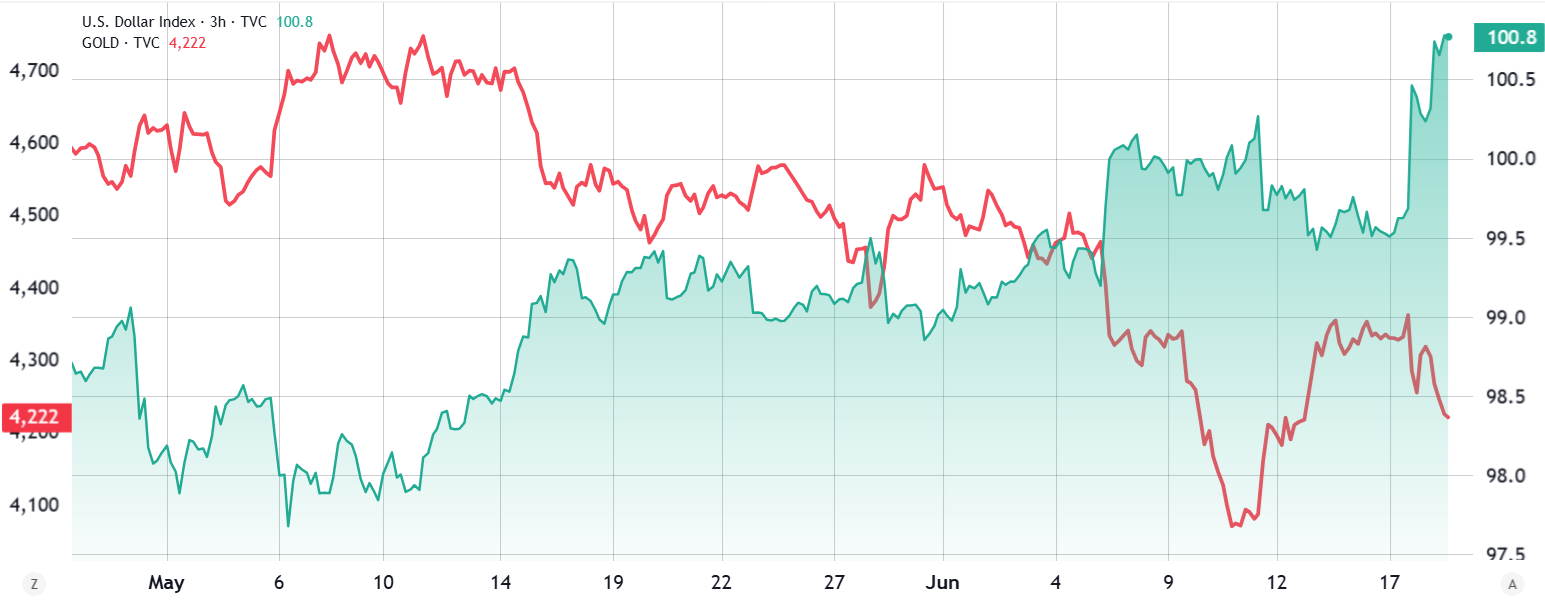
Gold / USD (left) vs. US dollar strength index (right). Source: TradingView
The US dollar strengthened against a basket of foreign currencies, signaling confidence in the US government’s strategy to sustain economic growth despite inflationary pressures. The move hurts non-yielding assets, since fixed income remains profitable longer, as seen in gold prices trading down 3.3%.
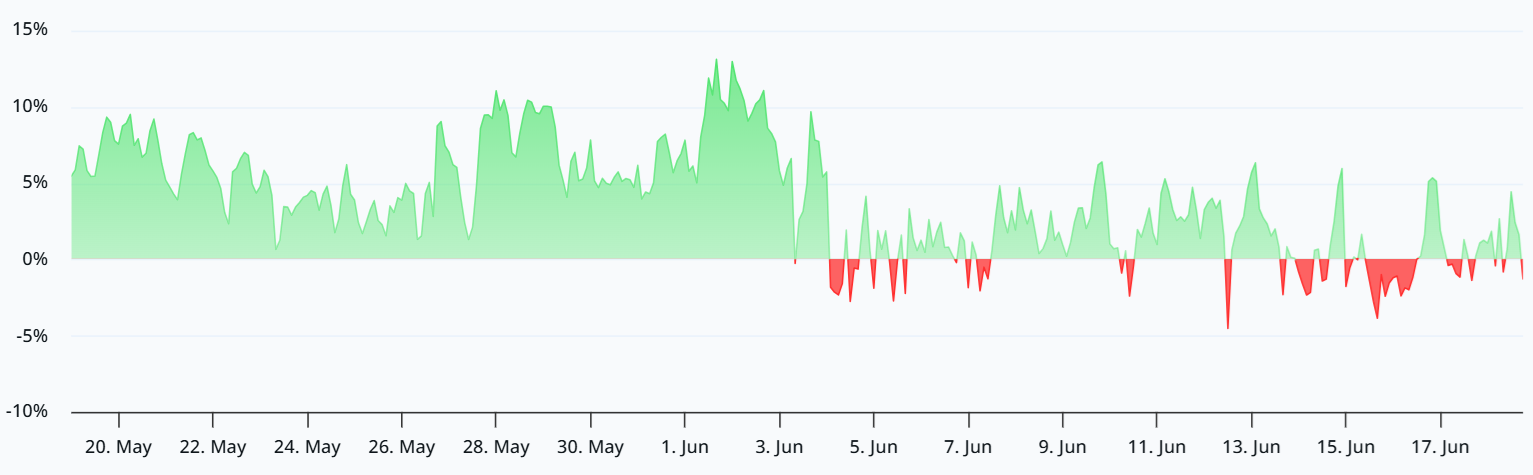
Bitcoin perpetual futures annualized funding rate. Source: Laevitas
Demand for bullish leveraged Bitcoin positions has faded since June 4, indicating a lack of confidence after the crash from $73,700 to $61,300 in just three days. Bitcoin’s bearish momentum contrasts with rising demand in the artificial intelligence sector. SpaceX (SPCX US) market capitalization soared to $2.4 trillion within days of its IPO.
AI sector narratives contrast with weak Bitcoin narratives
Intel (INTC US) shares jumped 10% on Thursday after President Trump announced that Apple (APPL US) had agreed to work with the chipmaker to build its processors. Memory chip and data storage producers Micron (MU US) and SK Hynix (000660 KS) have also recently joined the select list of companies valued at $1 trillion or higher.
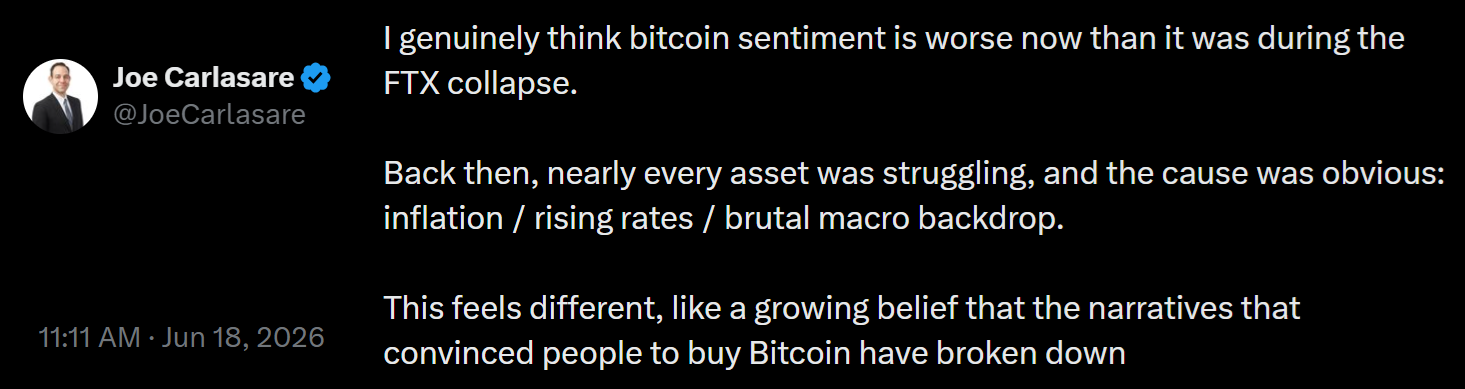
Source: X/JoeCarlasare
According to Joe Carlasare, commercial litigator and Bitcoin supporter, traders’ sentiment is currently worse than it was during the FTX exchange collapse. For Carlasare, nearly every asset class was struggling back in November 2022 due to the macroeconomic backdrop. This time around, the “narratives that convinced people to buy Bitcoin have broken down”.
Related: Bitcoin’s deeply discounted versus AI-stocks, but hawkish Fed risk lingers–Bitwise
Bitcoin’s presence in the traditional finance industry is far more mature than during the previous halving cycle. The US-listed spot Bitcoin exchange-traded funds (ETFs) accumulated over $102 billion in assets, and major financial institutions initiated Bitcoin investment offerings to clients, including Morgan Stanley, Bank of America and Goldman Sachs.
A retest of the $60,000 level should not be ruled out as the AI sector stays in the spotlight with massive investments and potential new IPOs and follow-on offerings, but institutional demand for Bitcoin will likely dictate price trends.

Older Macs and iPhones Could Lose Major Office 365 Features in a Few Weeks

Makerfield by-election result live: Burnham faces anxious wait for path back to No10 as vote count continues

Five Things the Hormuz Crisis Taught Us About the Global Economy


-

 Business4 days ago
No Jackpot Winner as $257 Million Prize Rolls Over to $269 Million Monday Draw
-

 Fashion6 days ago
Weekend Open Thread: Tuckernuck – Corporette.com
-
Crypto World4 days ago
Zimbabwe Requires Crypto Businesses to Register Annually Under New FIU Regulations
-

 Crypto World6 days ago
Bitget enters Argentina’s regulated crypto market through PSAV registration
-

 Tech6 days ago
NanoClaw integrates JFrog registries to secure AI agent downloads
-

 Tech6 days ago
This Week In Security: Microsoft On Microsoft, Register Your Domains, Linux On ARM, And FreeBSD Joins The File Cache Club
-

 NewsBeat6 days ago
FBI searches office of Ohio voter registration group
-
 Entertainment7 days ago
‘The Pitt’s Fan-Favorite Doctor Confirms Noah Wyle Gave His Blessing to Return [Exclusive]
-
 Crypto World7 days ago
Ripple and Bitso Bring MXNB Stablecoin to XRP Ledger
-
 Entertainment4 days ago
Matt Damon’s Viral Sci-Fi Thriller Has Taken Over HBO Max
-

 Business4 days ago
Anthropic staff to meet White House officials next week, Axios reports
-

 Tech4 days ago
As AI companies race to go public, who else is along for the ride?
-
 Crypto World4 days ago
Bitcoin could crash to $48,000, if this historical pattern is triggered
-
 Tech7 days ago
Euro-Office 1.0 Arrives To Open-Source Infighting: ‘Compatibility Is Not Sovereignty’
-

 Politics4 days ago
“Israel’s” ban on ICRC visits ruled illegal, but Knesset moves to stop them permanently
-
Entertainment7 days ago
Ana Navarro unleashes explosive tirade on ex-Trump aide, Disney Channel star in epic on-air fight: 'Have you no shame?'
-
 NewsBeat4 days ago
Warning of disruption as Cardiff Crossrail works to start
-

 News Videos4 days ago
Financial Accounting | Last Day Revision Strategy and Booster | CMA Inter – June 2026
-
 NewsBeat4 days ago
Tributes to former deputy head teacher at Cambridge school among death and funeral notices
-
 Crypto World4 days ago
Market Preview: SpaceX (SPCX) IPO Record, Federal Reserve Meeting, and Iran Nuclear Agreement
You must be logged in to post a comment Login