Security teams log 54% of successful attacks and alert on just 14%. The rest move through your environment unseen.
The Picus whitepaper shows how breach and attack simulation tests your SIEM and EDR rules so threats stop slipping by detection.





International law enforcement agencies cleaned nearly 15,000 malware-infected WordPress websites and took down more than 100 servers linked to the SocGholish botnet and the Evil Corp Russian cybercrime group.
This joint action (supported by Europol and Eurojust) was part of Operation Endgame, a major law enforcement operation targeting cybercrime now aimed at disrupting a key infection chain linked to Evil Corp.
Authorities from the Netherlands (NHCTU), Canada (RCMP), the United States (FBI), and Germany (BKA) cleaned SocGholish malware infections from 14,971 compromised WordPress websites and took 106 servers and domains offline.

While the Dutch police removed the malware and backdoors from the infected sites, it also advised the website owners to change their credentials, enable multi‑factor authentication, delete any unknown WordPress accounts, and keep their WordPress site up‑to‑date.
“With these actions we deprive cybercriminals of access to infected computer systems. This prevents further damage to the digital systems of citizens, businesses and organizations worldwide and limits the spread of malware,” said Maikel Rollman, of the Netherlands’ National High Tech Crime Unit.
“It also reduces the risk that these systems are used for cyber‑attacks on critical infrastructure and other essential societal processes. This marks the beginning of further action against SocGholish.”
The SocGholish JavaScript-based malware downloader (also tracked as FakeUpdates and GhoLoader) has been used in attacks since at least 2017, and it works by hijacking legitimate websites (primarily WordPress sites) and tricking visitors into downloading malicious payloads, commonly disguised as fake browser updates.
When a user installs the malicious update, the malware opens a connection to the attackers, giving them access to the infected system. SocGholish has also been used to deploy other malware families, including Dridex, Doppelpaymer, Empire, Koadic, Chtonic, and Azorult.
The malware has been previously linked to Evil Corp, a Russian cybercrime gang active since 2007 that has been associated with the Zeus and Dridex malware families and was behind the WastedLocker, Hades, Macaw Locker, and Phoenix CryptoLocker ransomware operations.
“This marks the beginning of further action against SocGholish,” Rollman added in a press release published today.
In November, as part of Operation Endgame, law enforcement agencies also took down over 1,000 servers used by the Rhadamanthys, VenomRAT, and Elysium botnet malware operations.
Previously, Operation Endgame has also targeted ransomware infrastructure, Smokeloader botnet customers and servers, the AVCheck site, and various other major malware operations, including DanaBot, IcedID, Pikabot, Trickbot, Smokeloader, Bumblebee, and SystemBC.

Security teams log 54% of successful attacks and alert on just 14%. The rest move through your environment unseen.
The Picus whitepaper shows how breach and attack simulation tests your SIEM and EDR rules so threats stop slipping by detection.

WTF?! According to Kaspersky, cybercriminals have been targeting Steam users with a sustained malware campaign since 2025, distributing malicious software disguised as desktop wallpapers. The attack hijacked the accounts of gamers using Steam’s live wallpaper application Wallpaper Engine, which ranks among the platform’s most popular non-game downloads.
The attack reportedly abused Wallpaper Engine’s “Application Wallpaper” executable, which runs as a standalone Windows program and can include community-developed games, planners, calendars, system monitors, and other widgets. However, because the app allows unverified third-party code to run on users’ systems, it can be abused by threat actors to target unsuspecting users.

The researchers found that the attackers used two primary methods to distribute malware. The first involved archives containing the executable wallpaper alongside a malicious payload, typically including compromised .exe files, DLLs, or scripts. The malware was also frequently concealed within password-protected archives and executed automatically when the wallpaper was applied.
Once applied, the infected executables stole users’ account credentials, hijacked live sessions, and transmitted the stolen data to servers controlled by the attackers. The researchers discovered dozens of malicious application wallpapers on Steam Workshop, some of which were downloaded tens of thousands of times.
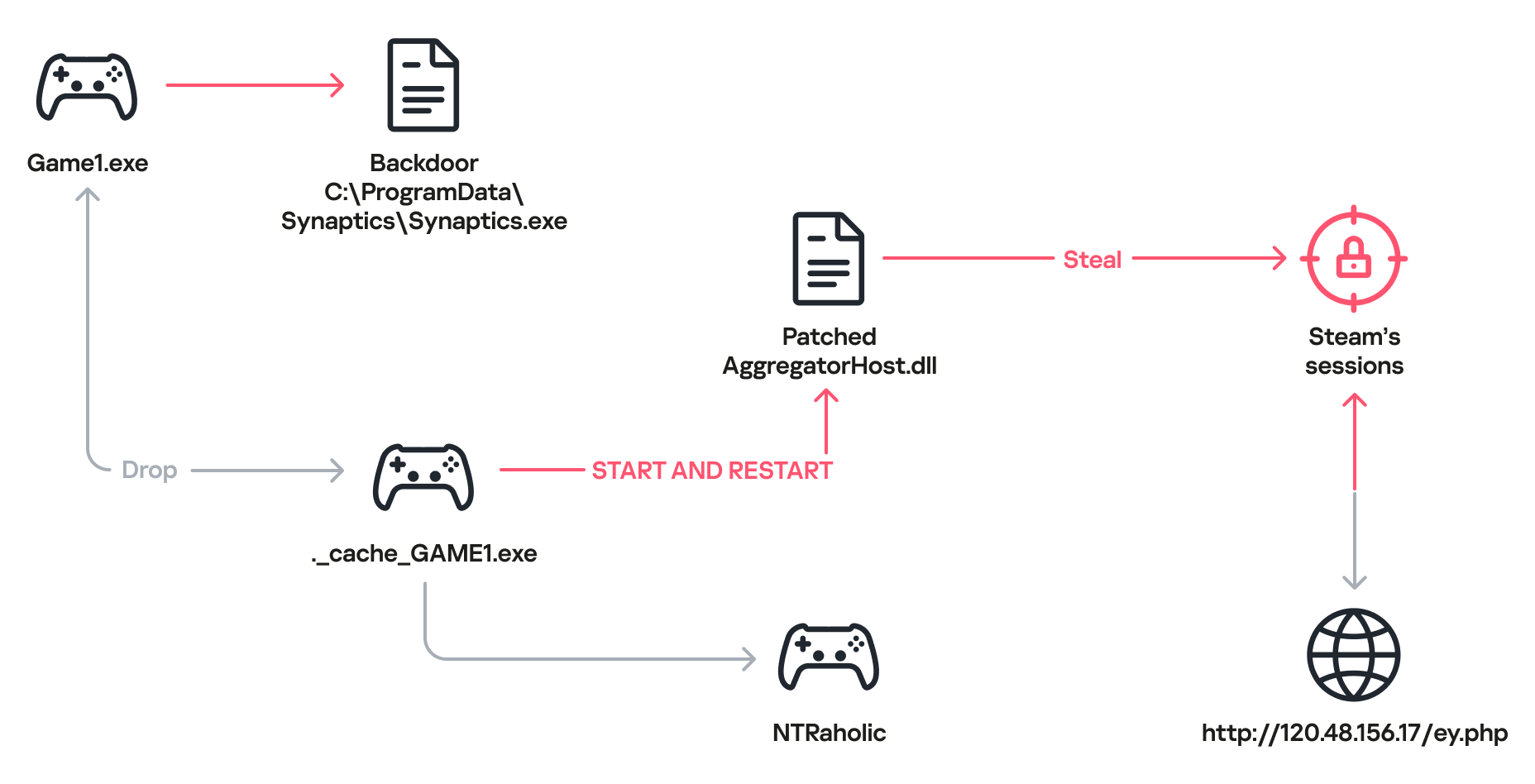
To test the attackers’ modus operandi, the researchers launched a wallpaper containing a malicious game called NTRaholic, which ran “flawlessly.” The gameplay and controls worked as advertised, raising no suspicion at first glance. However, unbeknownst to the user, the wallpaper dropped a backdoor called Synaptics.exe, part of the notorious DarkKomet malware family.
The executable that launched the game was named ._cache_GAME1.exe, but it also installed a system library called AggregatorHost.dll, which contained a malicious payload designed to steal user data and transmit it to the attackers’ command-and-control server. Once the attackers gained control of the active session, they used the compromised account to upload additional malicious wallpapers to Steam Workshop.
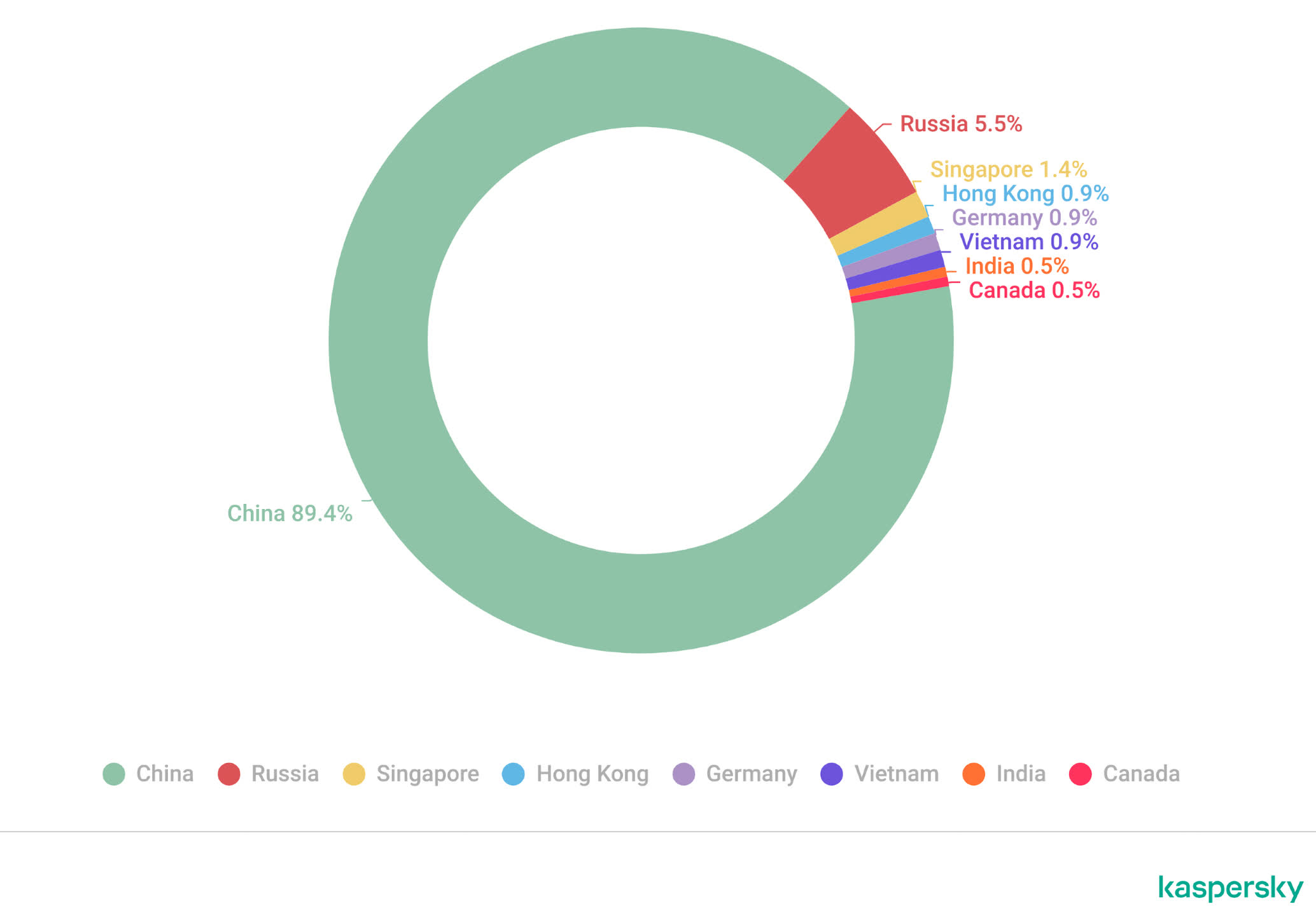
The campaign primarily targeted gamers in China, who accounted for 89% of the compromised downloads. Users in Germany, Canada, Russia, Singapore, Hong Kong, Vietnam, and India were also affected, though in much smaller numbers. Steam has since removed all of the malicious wallpapers, but Kaspersky is still urging users to run antivirus scans before applying wallpapers that include built-in executables.


Benz’s electric “Grand Limousine” might just make minivans cool.
The concept of a living room on wheels is something of a modern cliché in the automotive world, a vision for a car so comfortable, well-appointed and ultimately luxurious that you’d be just as happy to spend hours there as you would lounging at home.
The problem is that most of those concepts, like the Cadillac InnerSpace or Mini Urbanaut, have depended on the availability of self-driving technology, something that still only exists in the limited circles of Waymo, Zoox and their ilk. We’re still years away from you or I being able to buy a car that can drive itself unsupervised, but that isn’t stopping Mercedes from releasing what could be the most compelling of the rolling living spaces.
It’s called the VLE, and while it requires a human behind the wheel, passengers in the second row will be treated to reclining, massaging seats, a 22-speaker Dolby Atmos sound system and a 31.3-inch ultrawide 8K display. It’s an amazing package, but is it enough to shrug off those minivan preconceptions?
Visually, the VLE fits the silhouette of countless family-friendly minivans that have been handling kid-hauling duties in the United States since the Dodge Caravan planted the seed way back in the early ’80s. Ask Mercedes, though, and they’ll tell you this is a different beast.
The VLE is what the company calls a Grand Limousine, and while that sounds pretentious, it’s actually perfectly appropriate. At 216 inches, the VLE is 10 inches longer than a GLS SUV. It also has an internal ceiling height of 49 inches, making it easy for me, at six feet tall, to move around.
And it is certainly at least as luxurious as your average limousine, with seating to match. The VLE can be configured with room for up to eight across three rows, but it’s best with fewer, specifically configured with the two-seat captain’s chair arrangement you see here.
Two powertrains will be available. The VLE 300 offers front-wheel drive and 272 horsepower, while the VLE 400 4MATIC steps up to a dual-motor, all-wheel drive configuration with 416 hp. Both rely on the same, sizable, 115-kilowatt-hour usable battery pack that spans the floor of the van. Mercedes says it will provide enough range to cover 435 miles on the European WLTP test cycle. On our more challenging EPA test, expect a rating somewhere around 350 miles.It’s an 800-volt system that charges at a maximum rate of 300 kilowatts. That means adding about 200 miles in 15 minutes.
As much as I love to drive, the best seats in the VLE are in the second row. From there, you can recline and gaze up through the glass ceiling, or deploy the 31.3-inch ultra-wide screen and whittle away at your YouTube queue.
You can also stream Disney+ directly on the display, but sadly those are the only two video streaming partners of note. Neither Chromecast nor AirPlay streaming are supported. There is an HDMI port if you want to BYO content, but running wires across the cabin doesn’t feel particularly luxurious to me.
You can also pick from a few basic games to play on the system, and if you have two kids who can never agree on anything, you can split the TV into dual, 15-inch 4K displays. The 32:9 ratio means that after splitting, you’re effectively getting a pair of 16:9 displays, which is honestly better for viewing most content anyway. A pair of Bluetooth headsets means a pair of passengers can also get their own dedicated audio.
Sitting up front? There’s plenty of pixels there, too. Specifically, three dashboard-spanning units that make up Benz’s MBUX Superscreen setup. There’s a 10.25-inch gauge cluster on the left, a 14-inch main infotainment screen in the middle and a 14-inch passenger display on the right that can also stream videos and other media.
For the broader aural part of the media experience, you have 22 speakers from a Burmester 3D sound system. It handles Dolby Atmos, so you can be fully immersed in both music and more theatrical content. Interestingly, the system can also dynamically reconfigure itself based on who is sitting in the van and where.
Driving solo? The speakers automatically prioritize you. Have a full van? It’ll fill it all with sound. And it’s very capable of doing that. I cruised through a playlist of Atmos-optimized music, everything from Tay Tay to Axl Rose, and everything sounded fantastic.
Those two chairs in the middle are heated and ventilated and can sit you upright or slide you to a reasonable degree of recline. No, they don’t go fully flat, but you probably wouldn’t like what would happen to you in an accident if they did. They’re honestly a bit narrow and awkward to get in and out of, but I could see myself spending hours back here without complaint.
I could stay productive, too, thanks to integrated USB-C power in all three rows, and a fold-out laptop tray that looks flimsy but was sturdy enough to handle my Lenovo X1 Carbon. A temperature-controlled compartment in the armrest can keep hot drinks hot and cold drinks cool, and there’s a separate chiller towards the back for more.
RGB LEDs run throughout the entire cabin, so you can give your ride whatever hue you like, and there’s even an integrated nebulizer, making for a bespoke scent, too.
Even the third row is comfortable. The middle seats swing themselves forward and out of the way, so entry is easy, and I had ample headroom back there.And then there’s the driver’s seat, which is also comfortable and accommodating should you have to drive this machine yourself.
With up to 416 horsepower delivered through all four wheels, the VLE can be properly quick when punched up to sport mode. It also rides on adaptive air suspension, which can firm up and make the VLE feel that much more responsive in the corners.
But in my time behind the wheel, it never felt comfortable when driven aggressively. I enjoyed piloting the VLE much more when I dialed it down to Comfort, took a deep breath and just cruised along my route.
In this mode, the air suspension is supple, and the throttle relaxed enough that you can ease your way forward without disturbing anyone in the rear seats. The steering has a slow ratio as well, but don’t let that make you think this isn’t a nimble van. With seven degrees of steering from the rear wheels, the VLE can turn its impressive bulk in a far tighter circle than you might expect.
Drivers get to take advantage of a suite of active safety systems as well, including active lane-keep assistance on the highway and a comprehensive automatic parking system that swings this big beast into tiny parking spots. It’ll even automatically back itself out of a tight situation should you make a wrong turn down a narrow alley.
About the only thing the VLE is missing is full autonomy. It’d be awfully nice to get a machine like this and let it take you to work while you got in a few rounds of Fortnite on that 8K display. Alas, we’re not there yet, but I have a feeling most people who experience the VLE will do so from the second row. This would be an epic airport and event shuttle, but it’s going to be a little while before it enters service.
The VLE isn’t due to hit the American market until late 2027, and while the price isn’t set, Andreas Zygan, Head of Development at Mercedes-Benz Vans, told me this: “It will not be a cheap one, for sure.”

An anonymous reader quotes a report from The Guardian: In May, the federal government announced without warning that it would take apart a network of ocean monitoring systems that it had spent over $350 million to build. No reason was given for the decision to shut down the Ocean Observatories Initiative (OOI), but suspicion immediately focused on the network’s role in tracking climate change. But the OOI also provides data that’s useful for weather forecasting and fisheries management, leading to widespread opposition. Today, it appears that the opposition has won, as the government will announce that it’s reversing the decision. The big remaining question is how much damage the OOI took during the intervening month.
[…] The OOI is a federally supported resource that provides ocean data for use by academic researchers, government planners, and private companies. It consists of arrays of monitoring systems in several locations in both the Atlantic and Pacific Oceans that can track things like currents, salinity, chemical levels, temperatures, and tectonic activity. (There are over 100 individual entries on the page that display the data gathered by the system.) Obviously, there are many potential uses of that data. The fact that it has been gathered continuously for a decade means it can help track changes in how carbon dioxide and heat enter the oceans. This is probably what made it a target for the climate change denialists who helped set the Trump administration’s policy.
Those policymakers are perfectly happy to annoy people with environmental concerns, but they apparently neglected to consider how upset everyone else would be about losing access to the other data. The ensuing public backlash led the Senate on Wednesday to unanimously agree with a measure that would block the government from taking down the OOI. Today’s decision may indicate that the administration recognized it had gotten itself into a fight it knew it was losing. The National Science Foundation formally announced the decision, stating: “effective immediately, [it] will not proceed with further removal or descoping of equipment from the remaining arrays and will continue operations including planned maintenance.” The agency added that it “appreciates the concerns raised by the range of stakeholders that have informed us they rely on data” from the OOI.
The NSF also said it would “issue a Dear Colleague Letter to collect input from stakeholders and convene an expert panel to assess observational needs, evaluate available data sources, consider responses … and help the agency identify a sustainable path for NSF’s ocean observing systems.”
Why you can trust TechRadar
We spend hours testing every product or service we review, so you can be sure you’re buying the best. Find out more about how we test.
The Kensington SD5010T5 EQ is a 13-in-1 Thunderbolt 5 docking station announced in May 2026. It sits at the entry end of Kensington’s growing TB5 line-up and is designed to bring next-generation connectivity to a broader audience without the price tag of the flagship EQ Pro.
The key design choice here is straightforward. Kensington trades two of the three downstream Thunderbolt 5 ports found on the SD5000T5 for a pair of built-in HDMI 2.1 outputs. That is a significant swap.
Windows users gain the convenience of plugging monitors in directly, but Mac users with Apple-only displays lose access to the full TB5 daisy-chain capability offered by some of the alternatives.
What remains is still competitive, but it’s a Windows-centric choice.
Another PC-friendly inclusion is that the dock delivers 140W power delivery with KonstantCharge, meaning peripherals continue charging even when the laptop is absent. There are two USB-C Gen 2 ports that the SD5000T5 lacked, three USB-A ports across two speed grades, SD 4.0 and microSD 4.0 card readers, 2.5Gbps Ethernet, and a 3.5mm combo audio jack.
That spec pitches to Windows-based creatives who want to connect their laptop to multiple monitors and peripherals while recharging.
The issue with Kensington-branded equipment is always the asking price, and the SD5010T5 EQ is at the premium price end of the small TB5 dock offerings. That said, it’s a highly capable device, and on the cusp of being the best laptop docks for Thunderbolt 5 right now.

The Kensington SD5010T5 EQ Thunderbolt 5 Triple 4K Docking Station is currently available through Kensington’s official site and selected retail partners.
Launched at an MSRP of $349.99 / £329.99, it falls squarely within the premium pricing tier commanded by next-generation multi-display docks. The actual retail price is $299.99 on Amazon.com in the US, but it has yet to appear on European Amazon locations.
On the UK Kensington website, you are directed to ask for ‘business pricing’, hinting that Kensington want to keep this product decidedly B2B in some regions.
This investment positions it alongside competitor offerings like the Cable Matters Thunderbolt 5 Dock, yet it undercuts hyper-premium alternatives by choosing a tightly curated 13-in-1 layout over expansive, multi-device enterprise chassis. For business fleets, it’s a standard three-year limited warranty and unified hardware SKU offer tangible IT cost-reduction benefits during long-term workspace standardisation rollouts.
However, the recent Ugreen Maxidok 10-in-1 offers very similar specifications, equivalent build quality, and better availability than the SD5010T5, but it sells for $50 less.
Also cheaper is the StarTech Thunderbolt 5 Dock, which sells for around $283 on Amazon, and bears an uncanny resemblance to the Kensington product. The same spec, ports, and layout hint that one or both of these products are rebrands or derivatives.
Therefore, with this pricing, Kensington is hoping that its customer base is more trusting of its brand than Ugreen, or that the deals its B2B channel pathway can offer counter those comparisons.
What I should say is that, compared to a few Kensington docks I might mention, the SD5010T5 seems to be on the right side of affordable. But that doesn’t make it a bargain.
|
Feature |
Specification |
|
Model |
SD5010T5 EQ (K35210EU) |
|
Compatibility |
Thunderbolt 5, Thunderbolt 4, USB4 (Windows 11 23H2+, macOS 14.5) |
|
Total Ports |
13 |
|
Thunderbolt 5 (upstream) |
1x TB5 host port (80Gbps / 120Gbps Bandwidth Boost) |
|
Thunderbolt 5 (downstream) |
1x TB5 ports |
|
USB-A ports |
3x USB-A 3.2 Gen2 (1x 10Gbps, 2x 5Gbps) |
|
USB-C ports |
2 x USB-C Gen2 10Gbps (1 x 30W, 1 x 7.5W) |
|
Video |
2x HDMI 2.1 (+ 1xTB5 ports with adapters) |
|
Display Output (Windows / TB5) |
Triple 4K @ 144Hz, or Dual 8K @ 60Hz |
|
Display Output (macOS M4/M5 base, M-Pro/Max) |
Dual 4K @ 60Hz via HDMI, or 4K + 6K via HDMI + TB5 |
|
Power Delivery |
Up to 140W on upstream |
|
Power Use |
4.5W each on USB-A ports, 30W on 1x USB-C, 7.5W on 1x USB-C, 15W on TB5 downstream |
|
Storage Slot |
N/A |
|
Card Readers |
SD 4.0 + microSD 4.0 |
|
Network |
1x 2.5GbE Ethernet |
|
Audio |
1 x 3.5mm Combo Microphone & Headphone Port (front) |
|
Security |
Kensington lock slot (cable lock sold separately, (K65020EU or K65021WW)) |
|
Thermal |
Passive cooling |
|
Construction |
Aluminium |
|
Weight |
780g |
|
Size |
140 x 140 x 40mm |
|
Warranty |
3 years |

In terms of physical construction, Kensington has delivered an exceptionally solid, industrial-grade brick. The shell is sculpted from 100% post-consumer recycled (PCR) aluminium, featuring a striking milled exterior with structural ridging across its top surface that serves dual purposes: heat dissipation and minimalist styling.
Capped with sleek black impact-resistant composite faces on the front and rear, this unit sits anchored heavily on the desktop. It is a substantial, reassuringly weighted device designed to remain planted even when thick, stiff high-bandwidth cables are plugged into its rear ports.
While this is a guess on my part, I think the target audience here was undoubtedly Apple Mac Mini owners. The size is about 13mm larger, front and side, than the current Mac Mini, and therefore it would easily fit on top of the SD5010T5. I could test that assertion if I owned one, but I never have.
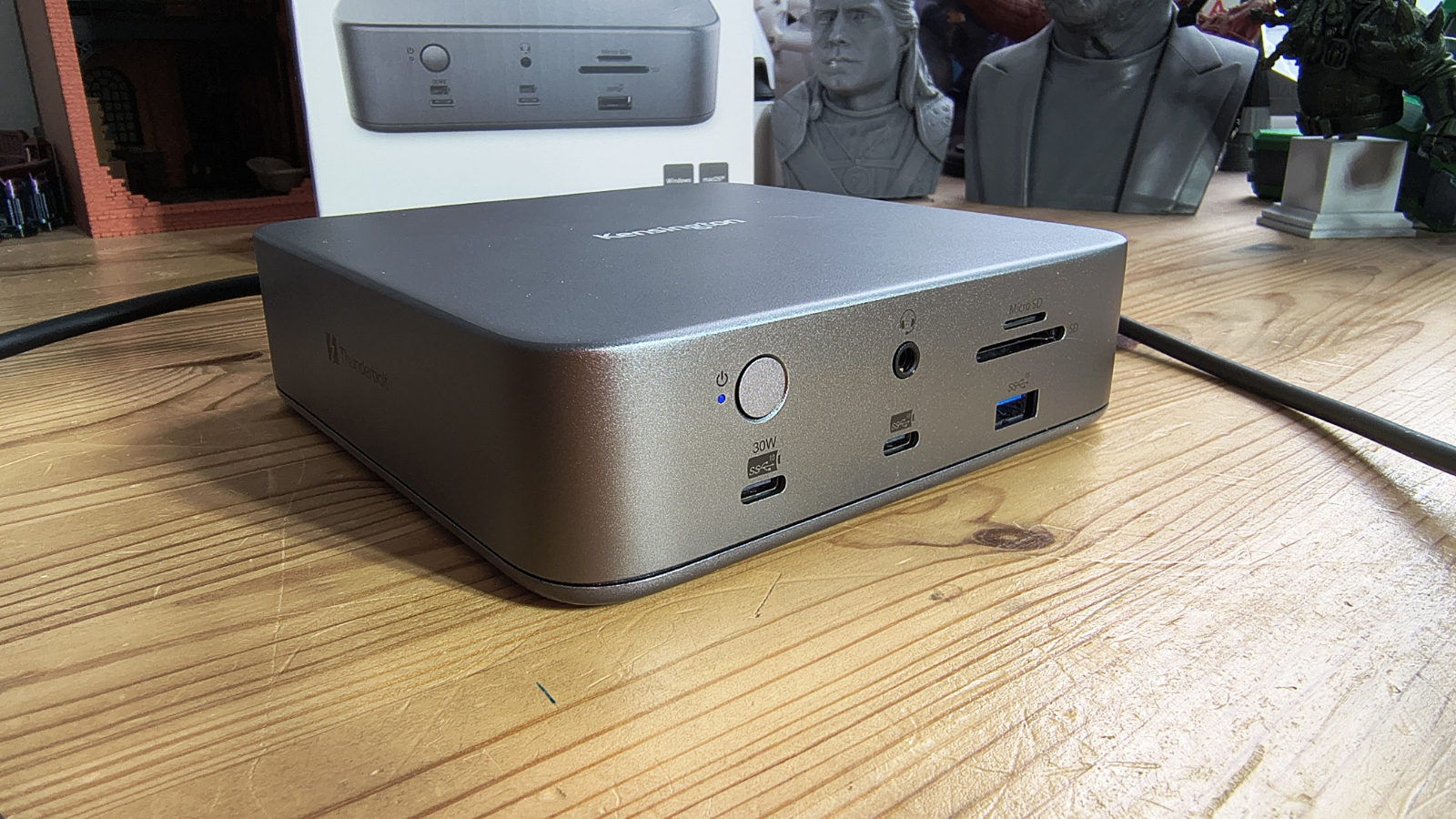
On this dock, the Port layout follows a logical workflow separation, though they show distinct philosophy differences from lower-tier hubs. The front face hosts immediate-access operational IO: an informative status LED, one high-speed 10Gbps USB-A port providing 7.5W of charging, a 3.5mm audio combo jack, and twin high-performance SD and MicroSD 4.0 card readers.
Wisely, the primary high-power upstream Thunderbolt 5 connection is routed safely away to the rear panel alongside the downstream expansion tree.
This layout successfully pushes trailing host cables out of sight, maximising usable desk space. The rear array includes two native HDMI 2.1 ports, a 2.5GbE LAN interface, two standard legacy USB-A ports, and two Thunderbolt 5 receptacles, one each for uplink and downlink.

Unlike competing consumer-grade products, the dock includes integrated dual security-lock slots for Kensington cables, along with an optional zero-footprint vertical-mounting bracket array tailored specifically for dense corporate desks.
The issue the port selection immediately raises is how committed is this dock to TB5. Since you can only connect a single downstream device, that doesn’t naturally translate into more direct ways to exploit its maximum performance potential.
Unsurprisingly, the Kensington Security Slot is present, as it is across the EQ range. A zero-footprint mounting bracket is also available as an optional accessory (K34050WW), allowing the dock to be hidden beneath a desk. That is a thoughtful addition for hot-desking environments where visibility and access are priorities.
Build quality across the Kensington EQ family has been consistently praised. The three-year limited warranty reflects confidence in that construction.
The core proposition of the SD5010T5 EQ centres entirely on the transformative potential of Intel’s Thunderbolt 5 standard. By doubling the bi-directional throughput of Thunderbolt 4 to a baseline of 80Gbps, it eliminates the strict interface constraints of yesteryear. Or, that’s the theory.
For complex multi-monitor tasks, its asymmetric Bandwidth Boost mechanism dynamically flexes to deliver up to 120Gbps of pure display pipeline throughput. This immense pipeline allows a Windows 11 host to comfortably drive a spectacular three 4K monitors at 144Hz or dual 8K displays at 60Hz simultaneously over native HDMI and downstream ports without sub-sampling artefacts or compression stutter.
For macOS workflows, the docking station provides comprehensive native support, although it is constrained by Apple’s architectural variations across its silicon tiers. Base M4/M5 MacBooks can confidently extend to dual 4K monitors at 60Hz via the direct dual HDMI outputs, while advanced configurations equipped with M5 Pro or M5 Max silicon can completely maximise productivity by driving a full triple-display array.
That said, for numerous reasons, I suspect that Apple fans are more likely to gravitate toward a dock with TB5 daisy-chaining as a priority than toward this layout, which has only one downlink port.

Beyond data and video, power delivery is a standout highlight. Operating under the advanced USB-C Power Delivery 3.1 architecture, the dock outputs a massive 140W over its single upstream link. That’s plenty of power to rapidly fast-charge a high-end 16-inch workstation laptop under maximum computational loads, assuming nothing else is sucking power from the dock.
I’ll talk more about this later, but a 140W output uses most of the PSU’s capacity, leading to potential deficits elsewhere.
Kensington has integrated its clever KonstantCharge engineering, which guarantees that downstream accessories and smartphones connected to the designated charging ports continue to receive stable power even when the host laptop is entirely uncoupled from the desk. Which is useful.
Power management on this dock is one of its strengths, but conversely, if you do use three monitors, you won’t have any downstream Thunderbolt ports to connect a TB5 external SSD or an adapter to run 10GbE Ethernet.


In synthetic testing and real-world deployment, the SD5010T5 EQ runs at the absolute peak of peripheral capabilities, provided you are feeding it from a native Thunderbolt 5 silicon host. Interfacing with next-generation external storage configurations reveals blistering cross-device speeds, easily saturating high-end NVMe drive enclosures well beyond old Thunderbolt 4 thresholds.
The built-in SD and MicroSD 4.0 readers operate natively on the UHS-II bus, consistently sustaining benchmarked file transfer rates up to 312MBps. This easily outpaces the built-in card readers integrated into premium notebooks, making it a highly valued asset for digital content creators, photographers, and video editors handling raw 8K video timelines.
Networking performance is similarly robust. Upgrading from standard 1GbE to an integrated 2.5Gbps RJ45 Ethernet port allows the dock to mesh perfectly with modern high-speed corporate network infrastructures, accelerating large local network backups and NAS file transfers.
However, early testing uncovers a clear hardware limitation regarding the dock’s 180W external power supply unit. While 140W is reliably allocated to feed the host laptop over the upstream cable, that leaves a slim 40W headroom to run the internal hub logic, the high-power 2.5GbE controller, and all remaining downstream ports.
When a user populates the 30W fast-charging USB-C port while simultaneously running a 15W downstream Thunderbolt accessory and drawing power from the front legacy USB-A line, the power envelope hits an absolute wall, which might lead to minor wattage throttling on the uplink or brief accessory disconnection cycles under full load.
It’s hard to say how much extra power the PSU needed to negate this possible pitfall, but some smaller docks, like the Ugreen Maxidok 10-in-1, have roughly 60W to work with above the laptop charging requirements. And, I did also notice that the Maxidok 17-to-1 promises 140W laptop charging, but has a 240W PSU.
But conversely, the Plugable TBT-UDT3 has the same 180W PSU and 140W output as the SD5010T5 EQ, but doesn’t include a 30W-enabled USB 3.2 port.
It may be that Kensington thinks that much headroom is unnecessary for the majority of customers, but evidently, other dock makers see things differently.
Overall, the SD5010T5 EQ delivers the sort of experience that encourages those who have the choice of a laptop or Mini PC with TB5 to side with that technology. For those with TB4 or USB4, there is no practical advantage to this over cheaper docks.

There is plenty to like here, if you can ignore Kensington’s temptation to make things more expensive than it can easily justify.
However, if you intend to attach three monitors to a dock, then the ports on this one are well organised, unless you use DisplayPort and not HDMI. That could save you additional expense on adapters that other docks require implicitly.
The flip side of those design choices is that there is only one TB5 downlink, so those who designed this device assumed the buyers wouldn’t have more than one TB5 high-performance peripheral. While that might not seem crazy now, in a few years’ time, TB5 or USB4v2 external SSDs might be the norm, creating a bottleneck with this arrangement
In this respect, the SD5010T5 EQ makes a guess about the future: while Thunderbolt 5 is an excellent technology for connecting a dock, it’s too expensive for external storage that isn’t premium-priced. If you agree with that prediction, the SD5010T5 EQ is likely a good fit for you. If you think differently, that faster external drives are going to dominate in the near future, a dock with more TB5 ports would probably be a better choice.
As a product in the broader Thunderbolt 5 docking market, the SD5010T5 fills a specific gap. Entry-level TB5 docks with built-in video outputs and strong USB-C provision are not yet common. If the pricing were more competitive, this dock would be easy to recommend to the right buyer.
|
Value |
High-quality product but a premium price |
4 / 5 |
|
Design |
Nice engineering and plenty of ports |
4 / 5 |
|
Features |
Works with TB5, TB4 and USB4, and the native HDMI ports avoid the need for adapters. |
4 / 5 |
|
Performance |
Native TB5 video and dual HDMI, but no DisplayLink, The 180W PSU gets stretched thin if every port is used. |
4 / 5 |
|
Overall |
The price and only a single TB5 downlink stop this device from being a go-to choice. |
4 / 5 |


Compilation Matters: Despite the meteoric rise of generative AI services, traditional image editing tools like Photoshop still dominate the creative industry. So much so that Microsoft – now largely focused on cloud services and AI models – is working hard to find new ways to make Windows-based applications run faster.
Thanks to a close collaboration with Adobe, Microsoft engineers have significantly improved performance in certain Photoshop operations. Photoshop is a large, native desktop application written in C++ and compiled with Microsoft’s Visual C++ compiler on Windows, which is why Microsoft focused on MSVC in an effort to extract additional performance from one of the world’s most widely used image editing applications.
Microsoft explained that the collaboration targeted real-world customer scenarios involving CPU-intensive operations. Many complex image processing workloads are now handled – or in some cases “accelerated” – by the GPU. However, some latency-sensitive tasks, such as brush responsiveness, stroke input, and file-opening operations, still depend heavily on a CPU’s raw performance.
The engineers explored new practical ways to improve Photoshop’s performance at compile time. First, they enabled MSVC’s “peak-performance” compilation mode, which is designed to produce highly optimized binaries on Windows.
They then experimented with profile-guided optimization to further optimize the executables. PGO uses data collected from test runs of .exe and .dll binaries to better reflect real-world usage patterns and improve performance. However, the engineers found that PGO was not an ideal fit for Photoshop’s development workflow, as it adds complexity to the build process.

After trying – and failing – with PGO, the engineers turned to Sample-based Profile Guided Optimizations as a potential alternative. Unlike traditional PGO, SPGO replaces data collected from “representative” workloads with hardware performance samples gathered from actual release binaries. SPGO is also more flexible in terms of data collection, enabling analysis across a diverse set of test and production machines, and can deliver typical performance gains of around 5% to 15%.
Microsoft said SPGO proved to be a better fit for the Photoshop collaboration. Instead of relying on manual tuning, engineers could use compiler feedback – collected with negligible runtime overhead – to improve the code generated during MSVC’s final build process.
SPGO also proved to be more compatible with Adobe’s engineering environment. By combining MSVC’s peak-performance mode with SPGO, the teams were able to improve Photoshop performance by 20% on x64 Windows systems and by 13% on Arm.
As noted by Adobe senior software developer John Fitzgerald, the optimized builds delivered better responsiveness in drawing and stroke operations, file-opening times, and filter processing. “These are among the most frequently used and latency-sensitive interactions in a professional creative workflow, where responsiveness directly affects a user’s ability to work fluidly and iteratively,” Fitzgerald said.
Microsoft said the collaboration with Adobe provides a meaningful foundation for improving performance in software designed for Windows. The company is now highlighting MSVC’s capabilities as a way to improve performance and user experience across its broader software ecosystem.

Like other popular services like Netflix and Max, Hulu is a streaming service that has exclusive series, current-season episodes, hit movies, Hulu Originals, kids shows, and more. There’s also a Hulu plan for nearly every kind of watcher, including streaming content with ads for a service on the cheap, or bundles for additional platforms like Disney+ and ESPN+ to get even more content at reduced prices. I have a Hulu plan to watch some of my favorite shows like critically-acclaimed Atlanta or my current fave wholesome comedy, Abbott Elementary. We at WIRED stay glued to our devices and round up the best movies and the best TV shows currently being streamed on Hulu. Right now, we have outlined various ways to save while streaming on Hulu, including the chance to pay just $1.99 per month with the Hulu student discount.
Students can stream a bevy of shows and movies with Hulu for just $2 per month. This deal saves you 80% off the original monthly subscription price, and is valid for new and existing Hulu subscribers enrolled in an accredited college or university who meet verification qualifications. All you need to do to get Hulu for less than two bucks is verify your student status through SheerID to save.
I love my Hulu account, but with half-a-dozen other streaming services, it’s been hard to keep them all, or even know which is worth the money at the end of every month. I’m trying to decide which to keep, and the Hulu TV free trial is an excellent way to test the plan and see if it fits my TV watching needs. There is a free 3-day trial to test it out, and the plan has a $0 Broadcast TV fee, $0 Regional Sports fee, $0 Set-top box or related rental fees, and a $0 administrative fee. The Hulu live TV plan is essentially the best of both worlds—your favorite streaming-only series, along with cable-only content like sports and news programming, including over 95 live TV channels like ABC and ESPN.
One of the things I love most about Hulu is that they are constantly adding both new original shows and old favorites. They truly have something for every type of watcher and mood. As a true crime lover (I know it’s problematic, I’m sorry), I’ve been excited to see the Twisted Tale of Amanda Knox.
Here’s what I’m also excited to watch this season. Classic crime drama The Rookie stars perennial heartthrob Nathan Fillion centers on a small-town man becoming the oldest rookie in the LAPD. I always look forward to the feel-good comedy Abbott Elementary, which focuses on a quirky cast of misfits in the public education system in Philadelphia. In R.J. Decker, the titular character is a conman and disgraced newspaper photographer who begins entering the dark underworld of private investigating in South Florida.
Plus, there’s something for everyone, from trash reality TV like The Bachelorette, to intriguing Paradise, to quirky comedy High Potential, to the classic boy cartoon-comedy Family Guy.


UK businesses find Google’s search ranking ‘neither fair nor transparent’, the CMA said.
The UK’s competition watchdog has ordered Google to tweak its search tool to help businesses better integrate with it and understand its workings. As part of the new “conduct requirements”, Google must rank search results organically and make free-of-charge data portability available to third-party businesses.
The Competition and Markets Authority (CMA) awarded Google’s general search and search advertising services with the ‘strategic market status’ (SMS) designation last year. The label is applied to businesses that hold substantial market power and significance in a digital activity, and enables the watchdog to take targeted action to improve competition.
Google has also been given the SMS designation in relation to its mobile platform, alongside Apple, while the CMA is considering its position on Microsoft.
UK businesses find Google’s search ranking “neither fair nor transparent”, the CMA said in its statement yesterday (17 June). Businesses told the watchdog that changes to Google’s search practices are made without sufficient notice, and pointed to a lack of effective ways to raise concerns with the company.
The competition watchdog is attempting to remedy the issue by having Google rank organic search results using “objective and non-discriminatory criteria”. This is to include AI Overviews, but not sponsored results.
Google has also been asked to provide greater transparency to businesses about how search rankings work, give advance notice of any significant changes and introduce clear procedures to raise concerns.
The CMA also intends to address businesses’ data portability concerns with Google. As part of the requirement, Google must provide third-party businesses with the tools to move specified types of user data free of charge.
“Third-party firms are keen to offer people new products and services based on their Google search data but need to be able to access it with confidence,” the CMA said. “Using this data would allow third parties to offer people more personalised features”.
The company has six months to comply with the fair ranking requirement and three months for the data portability requirement.
Yesterday’s orders follow just weeks after the CMA told Google to let publishers opt out of having their content used to power AI features in its search offerings. Google said it would begin testing a new toggle in its Search Console, which would allow website owners to decide whether their content appears in AI Overviews, AI Mode and related features.
“Step by step, we’re ensuring that Google’s search services work better for businesses and consumers across the UK,” said Will Hayter, the executive director for digital markets at the CMA.
“Search is a vital gateway for businesses in the UK to reach customers, and clearer, predictable and more transparent ranking systems could give them greater scope to expand and invest.
“These new measures will ensure search results are ranked fairly and objectively, with clearer information about changes and effective routes to raise concerns.
“At the same time, innovative businesses will have the confidence that they can access search data in practice, unlocking investment and innovation in new products and services for users.”
Don’t miss out on the knowledge you need to succeed. Sign up for the Daily Brief, Silicon Republic’s digest of need-to-know sci-tech news.

I can’t say I know for sure that Stephen Colbert is a Techdirt reader, but I very much believe he is. His interests align somewhat with ours, he often comments on some of the same topics we do, and, it turns out, he decided to troll his previous employer during his last show in a very Techdirt-ian manner.
After CBS decided to sacrifice Colbert at the altar of American fascism, the wind down of The Late Show culminated in a final broadcast weeks ago. During that broadcast, Colbert was covering a story about Lee Mendelson Film Productions, which owns the music catalogue for the Charlie Brown franchise, suing several targets for use of its copyrighted music. As he did so, the show band began playing the Charlie Brown theme song. Colbert mused afterwards sarcastically that he hoped that wouldn’t cost CBS any money.
Well played, if only to highlight the absurdity that such a short performance of an iconic song like that could actually result in threats, lawsuits, or demands for payment. But many speculated that the show had already gotten the rights to play the music before it aired, or that Lee Mendelson Film Productions wouldn’t actually do anything about it all to avoid inserting itself into the public spat between Colbert, CBS, and our current government.
Wrong. The company did apparently reach out to CBS, which eventually had to enter into a licensing agreement to avoid any legal issues.
The agreement will see CBS take a license for “Linus and Lucy,” the unofficial Peanuts theme that Colbert’s band played on the air during the show. The proceeds from the deal will be donated to the charity World Central Kitchen, run by Chef José Andrés.
“LMFP found the music’s use on The Late Show funny and entertaining, and is proud to support World Central Kitchen’s mission,” the group’s chairman Jason Mendelson said. A spokeswoman for CBS confirmed the agreement but declined to comment.
On the one hand, I guess it’s nice to see some of CBS’ money go to a good organization like World Central Kitchen. But I do indeed wonder if similar arrangements were struck with the other four entities against which LMFP filed lawsuits. I somehow doubt it. I would guess instead that such treatment was reserved for CBS, in order to make this story more lighthearted and warming.
It’s not, this is stupid, and none of this is as it should be. Colbert shouldn’t have been forced out of his job by a combination of a thin-skinned gibbon and a compliant CBS. It’s insanity that copyright law is in a place where such a diminutive use of a famous song could result in the requirement of a licensing arrangement, never mind actual potential lawsuits. And if it’s so necessary to protect copyright in this instance that lawsuits need to be filed against multiple parties, it should be important enough that any licensing fees and/or damages obtained shouldn’t just be given away to charities.
But as a final poke in CBS’ eye, this was a good one.
Filed Under: charlie brown, copyright, licensing, stephen colbert
Companies: cbs, lmfp, paramount, world central kitchen

In context: Unpatchable, hardware-level vulnerabilities caused a stir some years ago when they repeatedly turned up in AMD and Intel processors, but they’ve been far rarer on Apple chips. This latest discovery only affects older iPhone processors, but it still shows that even relatively recent SecureROM implementations aren’t foolproof.
Security researchers at Paradigm Shift have published the first iPhone bootROM exploit in years. The process, called usbliter8, targets a hardware-level flaw, which means upgrading to newer hardware is the only real fix.
The exploit affects the iPhone XS’s A12 chip, the Apple Watch Series 4’s S4 chip, and the iPhone 11’s A13 SoC. The S5, found in the Apple Watch Series 5, first-generation SE, and HomePod mini, is vulnerable too. Pulling it off requires physical access and a Raspberry Pi, since the flaw sits in a part of the USB controller that standard Mac and PC USB stacks can’t reach.

A12 and A13 are exposed because of how their USB controllers mishandle data packets, leaving SRAM data insecure. Earlier SoCs avoid the issue because they reset the DMA address after each packet comes through the USB controller, and A14 and newer are also safe, having corrected the underlying configuration.
Using the exploit to jailbreak devices is fairly simple on A12, S4, and S5 chips. A13 is trickier, since SecureROM’s PAC protections add extra steps, but it’s ultimately just as vulnerable as its predecessor. The flaw can’t be patched via software, and altered firmware survives reboots.
While most devices built on these chips have been considered obsolete for years, the iPhone 11 which still runs on the A13 chip happens to be the oldest iPhone that supports iOS 26. Apple isn’t dropping it for iOS 27 this fall, either, so it’s guaranteed at least another year of software updates.

The last unpatchable iPhone jailbreak, checkm8, surfaced in 2019 and covered the A5 (iPhone 4S) through A11 (iPhone X). It later resurfaced as a way to bypass the security chips on some Macs. Together, the two exploits leave every iPhone from the 4S through the 11 open to an unpatchable jailbreak.
A fundamentally similar bootROM exploit recently surfaced for Microsoft’s Xbox One, a console long considered unhackable. But getting it to work proved far harder than on iPhones, requiring a voltage-based hijack to pull off.

Google’s next-generation smart speaker is finally available to pre-order. The new Google Home Speaker launches with Gemini built in, costs $99.99/£99.99, and comes with a six-month subscription to Google Home Premium for a limited time.
The speaker was first teased last year, with Google recently hinting that more details were just around the corner. Now, pre-orders are officially live ahead of general availability from June 25.
Gemini is the headline feature here, bringing Google’s AI assistant directly to the speaker. Buyers will also get six months of Google Home Premium, which unlocks additional features including access to Gemini Live.
Google is promising a noticeable audio upgrade over the Nest Mini. The Home Speaker features a centrally positioned 58mm driver. It claims to deliver 2.5 times stronger bass than its smaller smart speaker. While it lacks the dedicated tweeter found in the larger Nest Audio, Google is clearly positioning it as a more capable option for music playback. It is more capable than the Nest Mini.
One feature that could help it stand out is its integration with the Google TV Streamer. Unlike Google’s existing smart speakers, which rely on standard Bluetooth connections, the Home Speaker can pair directly with the streaming device. As a result, it allows it to output TV audio more seamlessly.
The speaker will be available in four colours and is priced at $99.99/£99.99. Customers who place an order before the end of September will receive six months of Google Home Premium at no extra cost.
Pre-orders are now open on the Google Store, while general availability begins on June 25 through Google and other retailers.
After months of teasers, Google’s Gemini-powered smart speaker is finally ready to land. Given its focus on Gemini and the broader role it will play within Google’s smart home ecosystem, the speaker is arguably the company’s biggest smart home launch since the Nest Audio.




No Jackpot Winner as $257 Million Prize Rolls Over to $269 Million Monday Draw


Weekend Open Thread: Tuckernuck – Corporette.com

Zimbabwe Requires Crypto Businesses to Register Annually Under New FIU Regulations


Bitget enters Argentina’s regulated crypto market through PSAV registration


NanoClaw integrates JFrog registries to secure AI agent downloads


This Week In Security: Microsoft On Microsoft, Register Your Domains, Linux On ARM, And FreeBSD Joins The File Cache Club


FBI searches office of Ohio voter registration group

Matt Damon’s Viral Sci-Fi Thriller Has Taken Over HBO Max


Anthropic staff to meet White House officials next week, Axios reports


As AI companies race to go public, who else is along for the ride?

Bitcoin could crash to $48,000, if this historical pattern is triggered


“Israel’s” ban on ICRC visits ruled illegal, but Knesset moves to stop them permanently

Warning of disruption as Cardiff Crossrail works to start


Financial Accounting | Last Day Revision Strategy and Booster | CMA Inter – June 2026

Tributes to former deputy head teacher at Cambridge school among death and funeral notices

Market Preview: SpaceX (SPCX) IPO Record, Federal Reserve Meeting, and Iran Nuclear Agreement

what doctors are seeing in ebike crashes


Deion Sanders Shares Powerful Post After Viral Advice To Deiondra

Kate Middleton Glare Goes Viral After Kids Booed At Royal Event


Invesco Quality Income Fund Q1 2026 Commentary



You must be logged in to post a comment Login