

Crypto World
Microsoft Warns of USB-Based “Crypto Clipper” Malware Spread

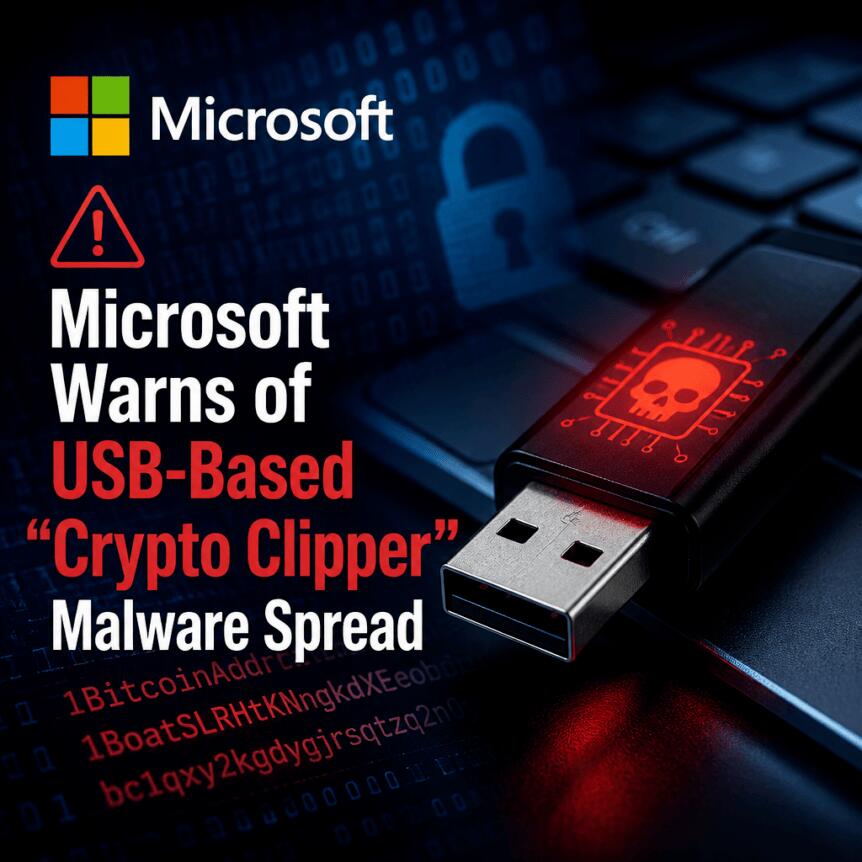
Microsoft Threat Intelligence has issued a warning to Windows users about a cryptocurrency clipper malware strain that spreads through USB drives and has been active since February. The attack is designed to harvest wallet credentials directly from users’ clipboard activity and then maintain control of infected machines through a persistent “worm-like” component.
In a security blog post published Wednesday, Microsoft described how the malware combines rapid clipboard theft with screenshot capture and wallet-address substitution—turning routine wallet copying into a monetization path for attackers. Microsoft also said the malware can propagate to removable media without relying on a traditional installer or exposed IP-based infrastructure, increasing the challenge of blocking it with conventional perimeter defenses.
Key takeaways
- Microsoft says the crypto clipper has been affecting Windows users since February and spreads via USB devices.
- The malware targets “high-value financial artifacts” copied to the clipboard, including BIP39 seed phrases and private keys.
- It can replace copied wallet addresses with attacker-controlled ones across multiple blockchain ecosystems, including Bitcoin and Ethereum.
- Microsoft reports it deploys Tor on the victim device and uses Tor-routed command-and-control to hide operator infrastructure.
- Microsoft Defender Antivirus detects the threat as Trojan:Win32/CryptoBandits.A.
USB-based clipboard theft turns into credential exfiltration
At the core of the campaign is a tactic Microsoft described as “high-frequency clipboard theft” paired with screenshot exfiltration. According to Microsoft, once the malware runs on a Windows machine, it monitors clipboard contents to extract wallet credentials and then captures screenshots every ten seconds to provide additional context for the attackers.
More worryingly for users is what Microsoft says the malware does beyond stealing information. Microsoft characterized the clipper as including a backdoor capability, enabling attackers to execute additional code on compromised hosts at later times. That shifts the threat from “one-time theft” into a persistent foothold that can potentially support follow-on attacks, including ransomware-style intrusions.
Microsoft also said the malware can disguise its presence by hiding legitimate files and replacing them with lookalike shortcuts. That design encourages victims to run the malicious components without realizing they’ve been tricked—especially when the infection is triggered via removable media.
Persistence and propagation via scheduled tasks and “worm” behavior
Microsoft’s analysis indicates the malware deploys two obfuscated JavaScript payloads in the Windows Documents directory. It then creates scheduled tasks for both the worm and stealer components—an approach that helps ensure the malicious routines continue running even after reboot.
The “worm component” is central to the propagation strategy. Microsoft said the malware automatically pushes itself to USB storage devices, allowing infections to spread when the victim connects the drive to other systems. This is why Microsoft’s warning focuses on removable media hygiene: an environment where USB devices are shared among multiple machines becomes a multiplier for infection risk.
Microsoft also noted that the malware’s execution does not depend on a traditional installer or exposed IP-based infrastructure. In practical terms, this can reduce defenders’ ability to rely on common download/installer telemetry and may make it harder to block by tracking known malicious endpoints.
Tor on the endpoint and wallet-address substitution
Microsoft reported that the malware secretly installs a copy of Tor on the victim’s computer and renames it ugate.exe to look less suspicious. The malware then uses the anonymizing Tor network to reach hidden “onion” addresses operated by the attackers.
This Tor-routed approach matters because it makes command-and-control less dependent on a stable, easily enumerated host. Microsoft said the combination of Tor-routed C2, clipboard targeting, screenshot capture, and remote code execution gives attackers both immediate monetization paths and ongoing control of compromised devices.
On the monetization side, Microsoft said the clipper focuses on high-value financial artifacts from clipboard content, including BIP39 mnemonic seed phrases and Bitcoin and Ethereum private keys. Microsoft also described wallet-address substitution across multiple networks, replacing copied wallet addresses with attacker-controlled ones for Bitcoin, Tron, and Monero.
In addition to swapping addresses, the malware takes periodic screenshots, which can help attackers confirm what the user intended to send—even if the copied address has been altered. Microsoft also said that the malware collects this information to support the operators’ ability to act quickly once funds are ready to move.
What Microsoft recommends and how this fits a broader threat wave
Microsoft recommended several defensive measures aimed at breaking the infection chain. These include disabling autoplay on removable media, blocking .lnk execution from USB drives, and monitoring for proxy activity and spawned scripts—behaviors consistent with malware that uses scheduled tasks and anonymized communications.
Microsoft Defender Antivirus detects the threat as Trojan:Win32/CryptoBandits.A, which gives defenders a baseline for incident response and hunting on endpoints that show related artifacts.
The warning arrives amid a broader escalation in Windows-based crypto-stealing threats. Earlier this month, Foresiet Threat Intel identified a Windows malware strain called Lucid Stealer targeting browser extensions and crypto wallets. Taken together, the pattern suggests attackers are increasingly focusing on credential capture mechanisms that align with how users actually manage funds—through browser tools, wallet software, and copy/paste behavior that can be intercepted.
For users and security teams, the next step is to treat clipboard-handling threats as a high-risk category, not a niche one: watch for suspicious scheduled tasks, unexpected Tor-related processes renamed to masquerade filenames, and evidence of USB-driven propagation. With Microsoft stating the campaign has been active since February, organizations should also consider whether any infected removable media may still be in circulation and whether endpoint monitoring is catching the early stages—before clipboard theft and address substitution begin.

Crypto World
Stratosphere, Pudgy Penguins and Streamex Host Founders Table VIP Dinner During ETHConf 2026 and NYC Tech Week
[PRESS RELEASE – New York, United States, June 18th, 2026]
Stratosphere, Pudgy Penguins and Streamex hosted a private Founders Table VIP Dinner in New York City during ETHConf 2026 and NYC Tech Week, bringing together leaders across digital assets, tech, AI, traditional finance and institutional capital.
The invite-only dinner took place on June 9th and gathered a curated room of founders, operators, funds, C-level executives and institutional leaders for an intimate evening of dinner and conversation.
Guests in attendance included leaders from Citi, BitMine, BitGo, Mirae Asset Securities USA, Experian, Pyth Network, Space and Time, MegaETH, B3, Stable, Antler, Delphi Digital, Fun, Linera, Vanta Trading, Streamex, PolyData, Horizen Labs, World Foundation, Zipcode, OpenLedger, Onyx, Definitive, Notalone Ventures and more.
The Founders Table format is intentionally simple: a selected guest list, a private room and no stage agenda. The goal is to bring the right people together in a setting where conversations can happen naturally.
The dinner was hosted by Stratosphere with Pudgy Penguins and Streamex. Stratosphere brought its network across founders, operators, investors and institutional teams. Pudgy Penguins added one of the strongest consumer brands and communities in digital assets. Streamex brought the institutional and real-world asset side of the conversation, with its focus on tokenized gold and commodity markets.
The Stratosphere team and its CEO, Hassan Shaikh, have continued to build Founders Table into a private dinner series around major industry conferences. After previous editions during Digital Asset Summit and Consensus, the New York dinner continued the same idea: high-quality rooms, selected attendance and conversations that are hard to recreate on a conference floor.


For Stratosphere, the dinner reinforces the company’s position as an ecosystem partner for leading brands across tech, finance and digital assets. Established projects work with Stratosphere to deepen cultural relevance, strengthen market narratives and connect with founders, investors, institutions and operators across the industry.
“I’m optimistic about the next phase of digital assets, especially around the tokenization of commodities,” said Hassan Shaikh, CEO of Stratosphere. “These dinners give us a way to bring funds, institutions, and founders into the same room to talk about where the market is heading.”
The Founders Table series is expected to continue around major global conferences throughout the year, with future editions focused on bringing together founders, capital, institutions and leading brands in private, relationship-driven rooms.
For those interested in attending or getting involved in future Founders Table editions, reach out to the Stratosphere team.
About Stratosphere
Stratosphere is an ecosystem partner and growth consultancy for industry leaders in tech and finance, building the narratives, ecosystem partnerships, and distribution flywheels that create sustainable, repeatable growth.
Website: www.stratosphere.vip
The post Stratosphere, Pudgy Penguins and Streamex Host Founders Table VIP Dinner During ETHConf 2026 and NYC Tech Week appeared first on CryptoPotato.
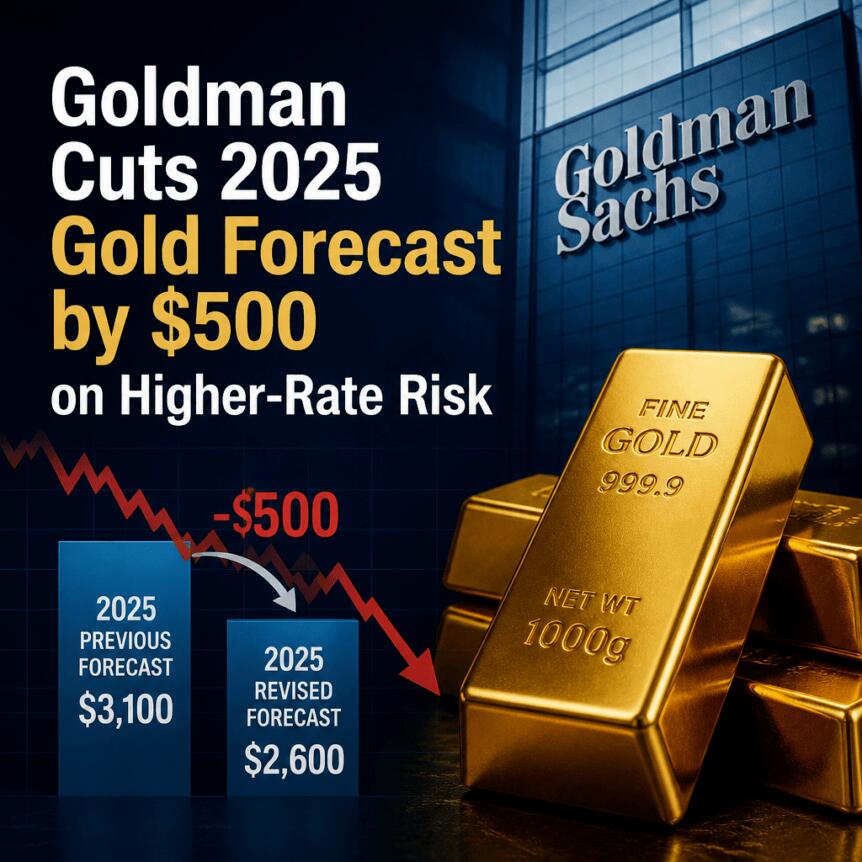
Goldman Sachs has cut its year-end gold forecast by $500 per ounce, citing expectations that the US Federal Reserve will not cut interest rates this year. The revision reflects a broader repricing of “easy money” assumptions—one that could ripple through both traditional safe-haven demand for bullion and the risk appetite that supports cryptocurrencies.
In a note cited by Bloomberg, Goldman Sachs commodity analysts Lina Thomas and Daan Struyven said their view remains “structurally constructive but tactically cautious,” with downside risk in the near term and upside potential over the medium term. The bank’s new target places gold at $4,900, down from an earlier estimate of $5,400.
Key takeaways
- Goldman Sachs lowered its year-end gold forecast to $4,900 per ounce, attributing the change to expectations of no Fed cuts in 2026.
- The downgrade assumes potential rate-cut timing shifts to March 2027 and December 2027.
- Delayed interest-rate cuts can pressure both gold and Bitcoin, since lower rates typically support speculative demand.
- Gold is trading close to key technical territory, with Cointelegraph noting it has fallen more than 22% from its January all-time high.
Gold forecast cut as rate-cut timing slips
The revision is rooted in the macro backdrop. Goldman Sachs is assuming that the next Fed rate cuts could be pushed out to March 2027 and December 2027, a change that can matter because gold does not generate yield. When rates remain higher for longer, cash and bonds become relatively more attractive—raising the opportunity cost of holding bullion.
Goldman’s analysts framed the outlook as a mix of longer-term optimism and short-term caution. While they still see structural support for gold, they warned that tactical pressure could persist as markets price in fewer near-term liquidity tailwinds.
Why higher-for-longer rates matter to crypto
Cryptocurrency investors often treat interest rates as a key driver of liquidity conditions. The article’s underlying thesis is consistent with how the market has historically behaved: when rates fall, the environment tends to improve for high-duration assets and speculative positioning.
Conversely, a delay in US rate cuts can weigh on digital assets. Lower rates typically reduce the cost of capital and can encourage risk-taking, which often benefits assets such as Bitcoin. If expectations for easing are pushed further out, the same “liquidity improves” narrative weakens.
This transmission mechanism is not limited to crypto sentiment. It also connects to gold’s own behavior: as rates stay elevated, bullion may face headwinds even when broader uncertainty keeps demand for a hedge intact. The result can be a period where both gold and cryptocurrencies soften simultaneously, not because the hedge thesis disappears, but because the opportunity-cost argument becomes harder to ignore.
Market pressure builds: CPI prints and Middle East conflict
Gold’s decline has been unfolding against a difficult demand backdrop. Last week, analysts warned that Bitcoin and gold could face additional pressure this year after US inflation data reinforced the idea that policy easing may be delayed. Cointelegraph pointed to a 4.2% year-on-year increase in the US Consumer Price Index in May, alongside ongoing conflict in the Middle East.
In addition to inflation, geopolitical risk can complicate the rate outlook through energy and risk-premium channels. The article notes that the conflict in the Middle East has also taken a toll on both assets. For traders and investors, that matters because it can keep markets focused on macro variables rather than idiosyncratic catalysts.
Approaching psychologically important levels in gold
The downside focus is reinforced by current positioning in gold. Since its January all-time high of $5,327 per ounce, gold has declined by more than 22%, according to the data referenced by Cointelegraph. Bitcoin, meanwhile, is down 28.3% since January, highlighting that the pressure has not been limited to a single asset class.
Gold is now only about $135 away from testing the $4,000 area—an inflection point not seen since November, according to GoldPrice. While forecasts are long-range and markets can overshoot both directions, the proximity to a major round-number level may increase sensitivity to new macro prints, Fed-related expectations, and any changes in geopolitical risk.
The “easy money” story that helped drive gold to record highs earlier this year may be losing some momentum if investors increasingly believe rates will stay restrictive for longer. As the opportunity cost of holding non-yielding assets rises, the market may need a stronger catalyst—such as clearly falling inflation or evidence of improving liquidity—to reverse course.
HashKey Group senior researcher Tim Sun told Cointelegraph: “Only when inflation drops, rate cuts become viable, and liquidity improves alongside lower capital costs, will the overall risk appetite truly reverse.”
What to watch next
With the debate now centered on whether rate cuts are truly off the table for 2026—and on how quickly liquidity expectations can recover—markets will likely monitor incoming inflation data and Fed-related messaging closely. Cointelegraph also referenced CME’s FedWatch tool, which shows a high chance of rates staying the same or rising in the remaining months of 2026 compared with the current target range of 3.5% to 3.75%.
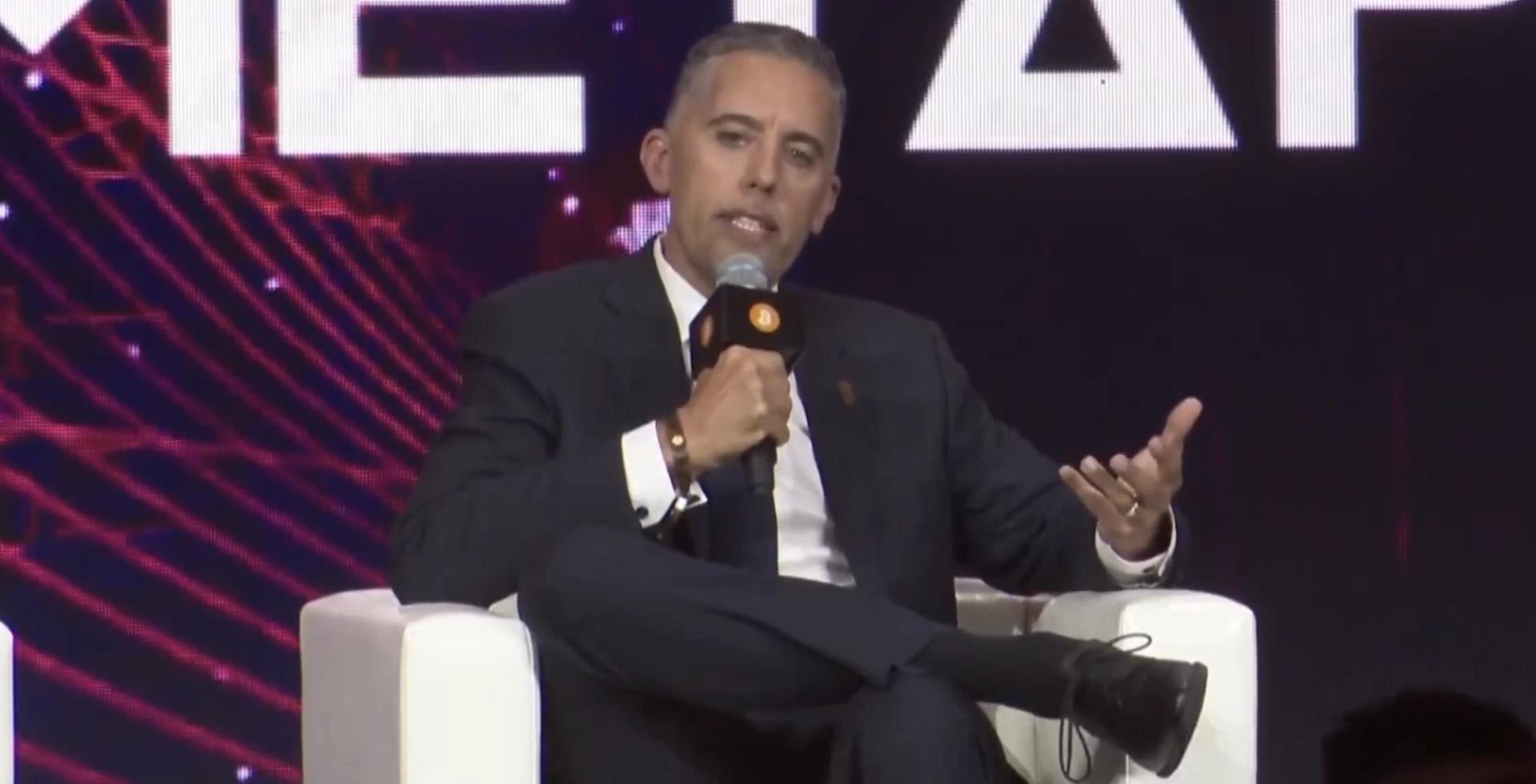
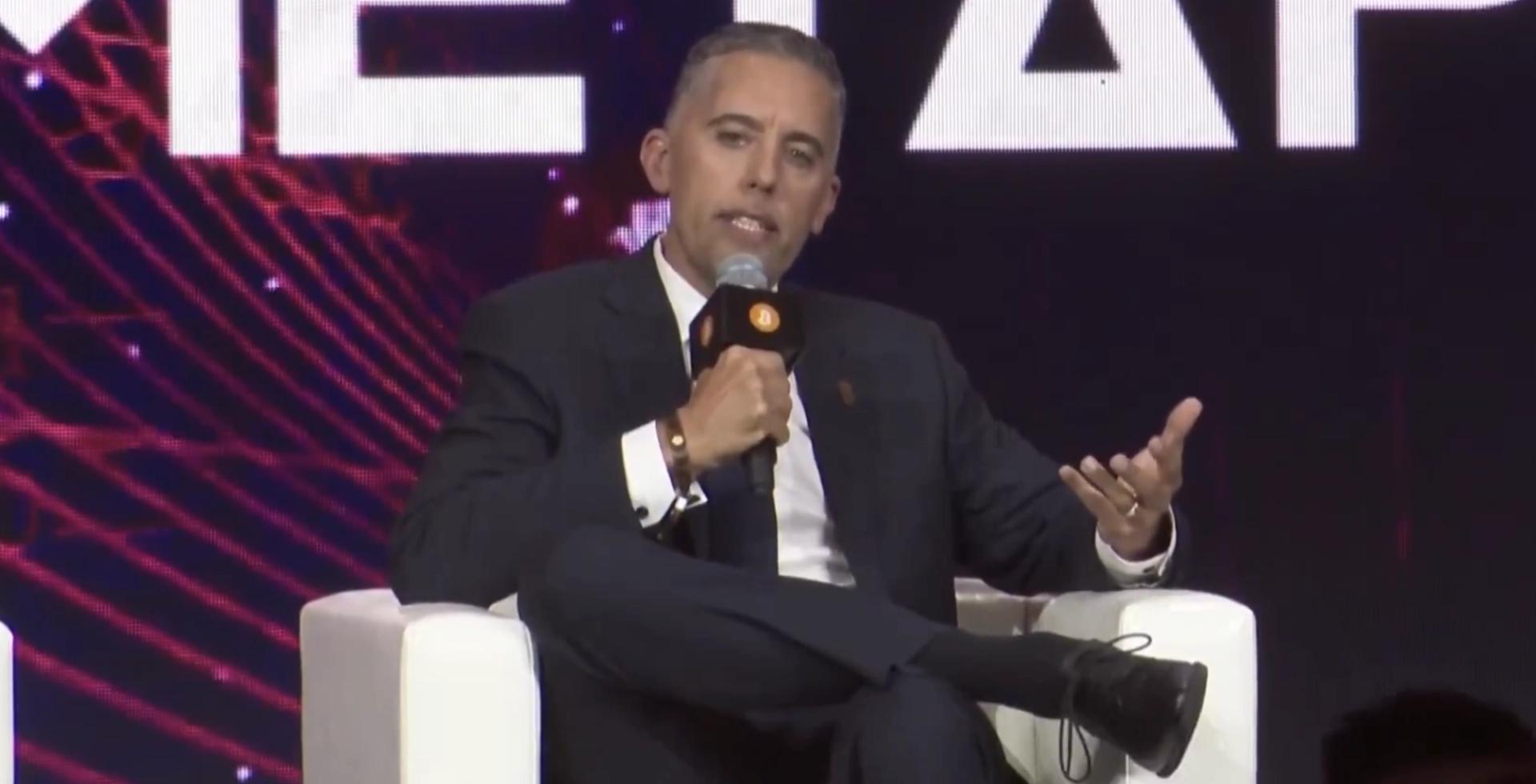
The digital credit market suffered one of its sharpest selloffs to date on Thursday,
with Strive Asset Management CEO Matt Cole describing the move as a leverage-driven liquidation rather than a sign of weakening credit fundamentals.
Cole said it was “the most difficult day in the history of Digital Credit,” in a post on X, as Strategy’s preferred equity STRC fell as low as $82.50 before recovering to $89, while Strive’s SATA dropped from its par value fell below $93 before rebounding to $97. Both products are designed to trade close to their $100 par value
“What happened today was a leverage liquidation event, not a deterioration in underlying credit quality,” Cole wrote.
Investors attracted by the sector’s relatively high yields (both products offer over double digit yields) increasingly used leverage to enhance returns, according to Cole. When prices began falling, margin calls triggered forced selling, creating a self-reinforcing decline detached from the underlying creditworthiness of issuers.
“There is an old saying in income markets that the road to hell is paved with carry,” he said.
At the beginning of June, more than 200 crypto companies and industry groups — including Coinbase, Andreessen Horowitz and Ripple Labs — sent a letter to Senate Majority and Minority Leaders John Thune and Chuck Schumer, urging them to bring the Digital Asset Market Structure Bill (Clarity Act, H.R. 3633) to a vote without delay, according to Bloomberg Government. The bill has already passed the Senate Banking Committee, and its further progress is being viewed by market participants as a potential step towards a clearer regulatory framework for digital assets in the United States, which could further support institutional interest in Ripple.
Technical Picture
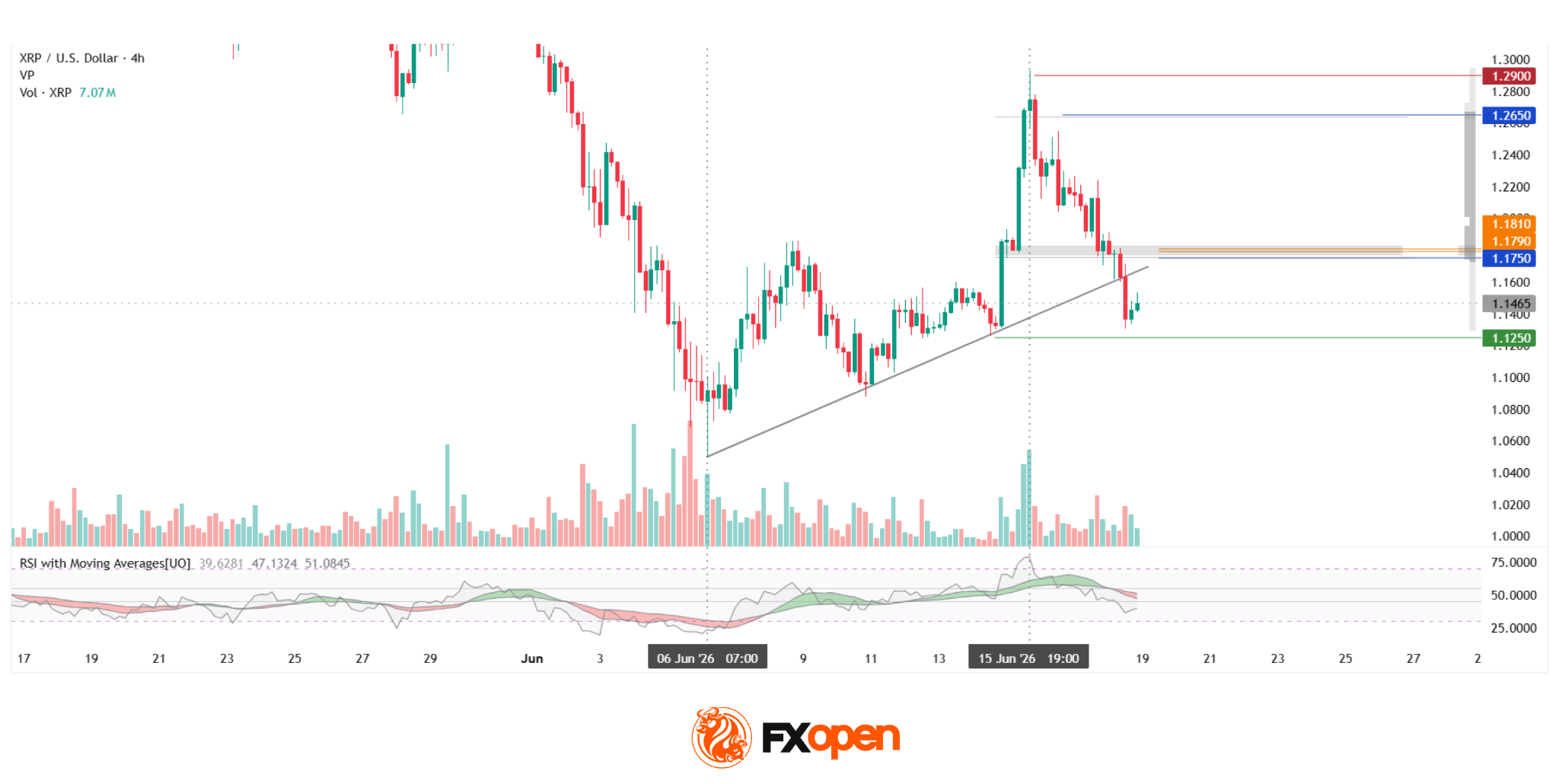
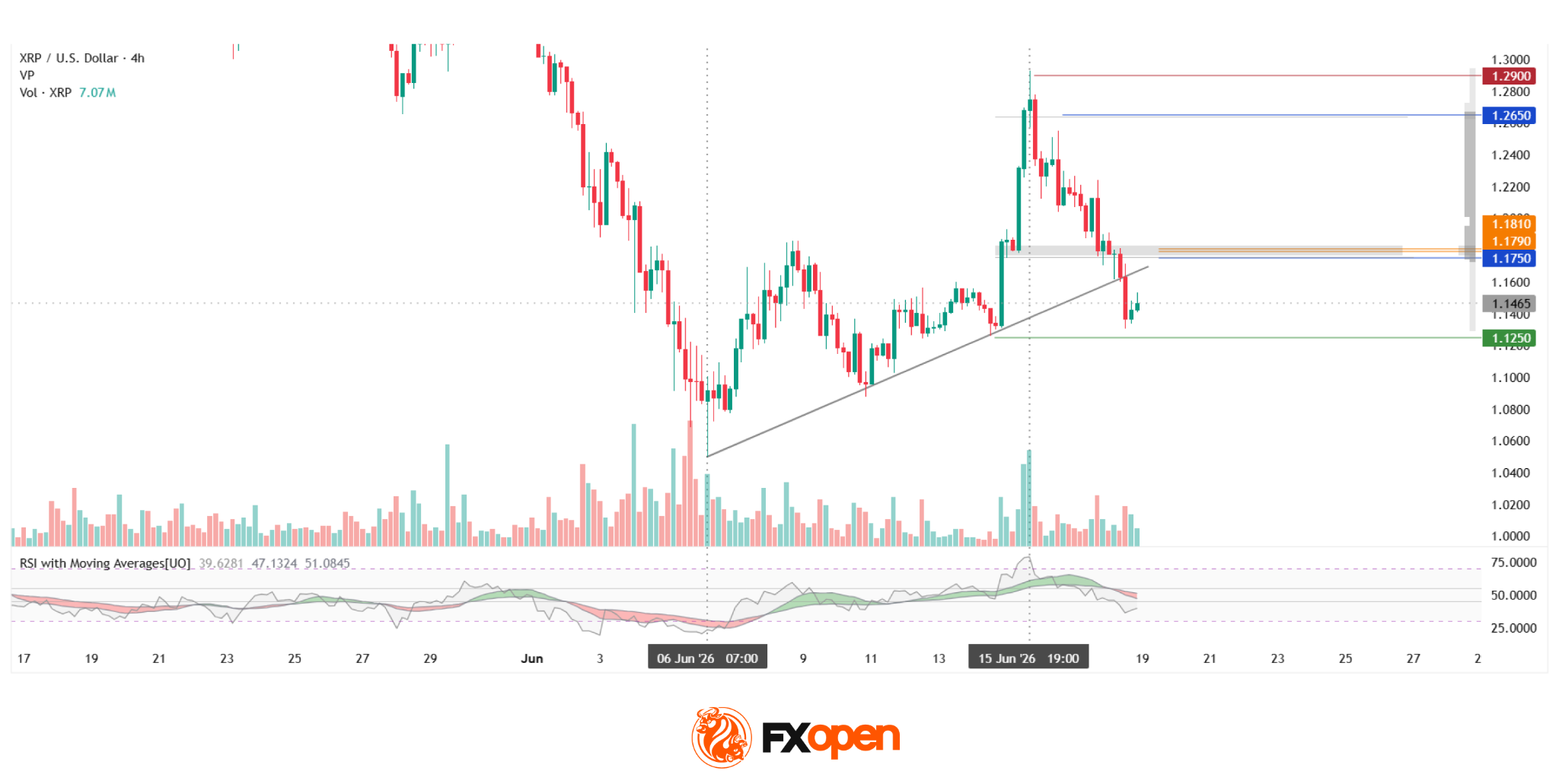
On the H4 chart, Ripple (XRP/USD) has formed a corrective bullish structure, advancing towards the current resistance area where a local peak was established. Following the pullback, the price moved below the POC zone of the current market profile and is attempting to break the trendline of the upward structure. At present, the price has almost reached the nearest support level around $1.125. Above the market lies a fairly significant resistance zone, consisting of the POC area at $1.179–$1.181 and the lower boundary of the profile at $1.175.
Should the price manage to overcome this barrier, it would face another strong resistance area formed by the upper boundary of the profile at $1.265 and the local high at $1.290, where substantial climactic volume was previously recorded. RSI + MAs shows readings of 39, 47 and 51. The indicator does not yet provide clear signals, suggesting that it is still premature to speak of a confirmed trend breakout.
Key Takeaways
Ripple remains at a point of uncertainty, as the fundamental positive sentiment surrounding the Clarity Act has yet to be confirmed by the technical picture. The market is awaiting the Senate’s decision, which could play a major role in determining the asset’s direction in the near future.
FXOpen offers the world’s most popular cryptocurrency CFDs*, including Bitcoin and Ethereum. Floating spreads, 1:2 leverage — at your service (additional fees may apply). Open your trading account now or learn more about crypto CFD trading with FXOpen.
*Important: At FXOpen UK, Cryptocurrency trading via CFDs is only available to our Professional clients. They are not available for trading by Retail clients. To find out more information about how this may affect you, please get in touch with our team.
This article represents the opinion of the Companies operating under the FXOpen brand only. It is not to be construed as an offer, solicitation, or recommendation with respect to products and services provided by the Companies operating under the FXOpen brand, nor is it to be considered financial advice.


South Korea has begun considering rules that could allow fintech firms, not just cryptocurrency exchanges, to participate in a new licensing regime for cross-border digital asset transfers scheduled to take effect in December.
Summary
- South Korea is considering allowing fintech firms to join a new virtual asset transfer licensing regime set to take effect in December.
- Companies approved under the framework will be able to offer blockchain based cross border remittance and foreign exchange services under formal regulatory oversight.
Officials from relevant government agencies and industry participants told local media that authorities have started drafting enforcement regulations for amendments to the Foreign Exchange Transactions Act and are reviewing registration requirements for businesses seeking to operate virtual asset transfer services.
The South Korean government promulgated the revised law on June 2 after cabinet approval. The legislation includes a six-month grace period and will take effect in December.
Under the new framework, cross-border transfers involving virtual assets will become a regulated foreign exchange activity. Companies that wish to provide such services must register with the Ministry of Economy and Finance and report overseas transfer transactions through the Bank of Korea’s foreign exchange reporting network.
Authorities have argued that cross-border cryptocurrency transactions previously operated outside the country’s foreign exchange oversight system, creating risks related to illicit foreign exchange activity and money laundering. The revised framework brings those transactions under formal supervision and reporting requirements.
The law requires applicants to complete Virtual Asset Service Provider registration, connect their systems to institutions responsible for relaying foreign exchange and digital asset transaction information, and satisfy additional requirements related to facilities and professional personnel that will be defined by presidential decree.
Current VASP rules limit eligible firms largely to cryptocurrency exchanges and certain custodians registered with the Financial Intelligence Unit under the Financial Services Commission. Industry participants had therefore expected the new regime to be dominated by major domestic exchanges such as Upbit and Bithumb.
Fintech firms could gain access to the market
Government officials are also reviewing whether registration should extend beyond exchanges to fintech companies capable of handling cross-border virtual asset transfers.
A Bank of Korea official told local media that authorities do not necessarily need to restrict the business to existing VASPs if other entities can perform transfer services. The official added that businesses seeking to engage in virtual asset transfer activities may still need foreign exchange-related registration under applicable regulations.
The Bank of Korea said it has been holding meetings with industry participants and providing guidance on registration requirements and integration with the foreign exchange reporting system.
Industry attention has increasingly focused on whether the final enforcement decree will open the sector to new entrants beyond traditional cryptocurrency trading platforms.
Many fintech firms have faced obstacles entering the digital asset market because of VASP registration requirements and difficulties securing real-name banking relationships. Industry participants believe a separate licensing framework for virtual asset transfers could create opportunities in blockchain-based remittances and foreign exchange services.
The Ministry of Economy and Finance and the Bank of Korea are continuing consultations with industry participants as they finalize detailed rules ahead of the December launch of the virtual asset transfer licensing regime.
South Korea expands digital asset oversight
The latest regulatory initiative follows recent efforts by South Korean authorities to define how blockchain-based financial products fit within existing financial rules.
Earlier this month, the Ministry of Economy and Finance said tokenized stocks could be taxed under existing securities regulations if the Financial Services Commission formally classifies them as securities. Officials stated that the legal treatment of an asset should depend on its economic characteristics rather than the technology used to issue it.
The Financial Services Commission is expected to release updated token securities guidelines in July as it continues work on a roadmap covering tokenized versions of conventional financial assets, including listed equities.
Crypto World
PremiumBlock Launches Non-Custodial Risk Hub for User-Created Prediction Markets, Perps and Web3 Poker

[PRESS RELEASE – Stockholm, Sweden, June 19th, 2026]
PremiumBlock brings leveraged prediction markets, liquid 24/7 FX perpetuals, and Web3 poker together in one wallet-native platform via premiumblock.org
PremiumBlock today announced the launch of its non-custodial risk hub for decentralized prediction markets, perpetual futures and Web3 poker, giving crypto users one wallet-native destination to create markets, trade outcomes, access perps and participate in on-chain poker without relying on a centralized custodian.
PremiumBlock is built around a simple idea: the next generation of crypto speculation will not be limited to order books or one-directional prediction markets. Users want to price real-world events, express conviction with leverage, trade crypto volatility, and control their bankroll from the same wallet. PremiumBlock brings those use cases together in a single interface designed for speed, maximal liquidity and instant withdrawals.
The platform’s prediction market layer allows users to create and participate in markets around crypto, sports, politics, culture, macro events and world news. Unlike platforms where market creation is tightly curated, PremiumBlock is designed for user-created markets, giving communities the ability to surface the questions they believe deserve liquidity.
PremiumBlock also supports leveraged prediction-market positions, with up to 2.5x leverage available on selected markets. The feature gives experienced users a way to express stronger conviction on event outcomes while operating inside a defined collateral framework. As with any leveraged product, participants should understand volatility, liquidation risk, and market-resolution rules before entering a position.
Alongside prediction markets, PremiumBlock offers crypto perpetual futures for traders who want long or short exposure without traditional expiry dates. The perps layer brings a familiar derivatives format into the same wallet-native environment as the platform’s event markets, reducing the need for users to move capital between separate prediction-market, exchange and gaming applications.
PremiumBlock’s Web3 poker product adds a third pillar to the platform’s risk ecosystem. Built for crypto-native users who value bankroll control, the poker experience is designed around fast deposits, instant withdrawals and non-custodial fund management. The goal is to offer a transparent alternative to legacy poker rooms where withdrawal delays, account controls and operator custody can create unnecessary friction.
“PremiumBlock was built for users who want direct market access without waiting on approvals, custodians or withdrawal queues,” said Baqir Hussain at PremiumBlock. “Prediction markets, perps and poker all revolve around information, timing and risk. Bringing them together in one non-custodial environment gives users a more flexible way to participate in the markets they understand.”
PremiumBlock enters the market as prediction platforms continue to move further into mainstream crypto conversation. Polymarket helped popularize event markets for crypto-native users, while Kalshi brought regulated event contracts into broader public discussion. PremiumBlock expands the category with a model focused on user-created leveraged markets, perpetual futures and wallet-based bankroll control.
The platform is available now for users seeking a crypto-native environment where event markets, leverage, perps and poker can exist side by side. PremiumBlock does not provide investment advice. Users are responsible for understanding applicable laws, smart contract risk, market volatility and the rules of any market or game before participating.
About PremiumBlock
PremiumBlock is a non-custodial risk hub for decentralized prediction markets, perpetual futures and Web3 poker. The platform combines user-created event markets, up to 2.5x leverage, crypto perps and instant withdrawals in a wallet-native experience designed for crypto users who want direct control over funds.
The post PremiumBlock Launches Non-Custodial Risk Hub for User-Created Prediction Markets, Perps and Web3 Poker appeared first on CryptoPotato.


G7 leaders have renewed calls for joint action against North Korea’s cryptocurrency thefts and cybercrimes.
Summary
- G7 leaders linked North Korea crypto theft and cybercrime to wider nuclear and missile concerns.
- Chainalysis estimated DPRK hackers stole $2.02 billion in crypto in 2025 alone through attacks globally.
- The G7 statement urged joint action but did not name new sanctions or enforcement tools.
The warning came in a geopolitical statement issued after the G7 summit in Evian-les-Bains, France.
The leaders said they were deeply concerned about North Korea’s nuclear and ballistic missile programs. In the same statement, they said member nations needed to “jointly address North Korea’s cryptocurrency thefts and cybercrimes.”
The statement did not name new sanctions, exchange rules, or crypto mixer controls. It also did not set out a timeline for fresh enforcement action against wallets, platforms, or intermediaries linked to stolen funds.
Stolen crypto remains a funding concern
The G7 warning follows years of reports that North Korea-linked hackers use stolen crypto to raise money under heavy sanctions. Western governments and blockchain analytics firms have long tied the activity to Pyongyang’s wider weapons program.
According to Chainalysis, North Korean hackers stole at least $2.02 billion in crypto in 2025. The firm said that pushed the all-time total linked to DPRK actors to at least $6.75 billion.
CrowdStrike also said DPRK-linked actors drove a 51% yearly rise in digital asset theft in 2025. Its 2026 financial services report said North Korea-linked groups used AI-generated identities, fake recruiters, and cloud access campaigns against crypto and financial firms.
Rising attack scale
As previously reported by crypto.news, North Korea-linked Lazarus attacks drained $577 million from Drift Protocol and KelpDAO in April 2026. Those two attacks accounted for most crypto theft reported that month.
Crypto.news also reported that April became the worst month for crypto hacks in 2026, with more than $606 million stolen across 12 incidents in the first 18 days. The Drift and KelpDAO attacks made up nearly all of that loss.
Those cases showed that attackers are moving beyond simple smart contract bugs. The methods included social engineering, compromised devices, bridge weaknesses, and signer manipulation.
North Korea rejects the claims
North Korea has denied U.S. and allied claims over cybercrime. In May, a Foreign Ministry spokesperson called the accusations “absurd slander” and said Washington was spreading false information for political reasons.
The denial has not stopped governments and security firms from naming DPRK-linked groups as major crypto threats. CrowdStrike said North Korean actors use deception at scale, including fake identities and recruiter personas.
The latest G7 statement keeps the issue on the diplomatic agenda, but it leaves open how member states plan to act. It does not say whether governments will tighten exchange screening, pursue new sanctions, or target laundering networks more aggressively.
Goldman Sachs has cut its year-end gold forecast by $500 an ounce, lowering its target to $4,900 from $5,400.
Summary
- Goldman cut its year-end gold target to $4,900 as expected Fed rate cuts faded further.
- Gold remains above current levels in Goldman’s outlook, but near-term risks now look weaker overall.
- Higher rates can pressure Bitcoin and gold by keeping cash and bonds more attractive longer.
According to Bloomberg, the bank still expects gold to rise from current levels, but it now sees a smaller move than before.
The revision comes as Goldman no longer expects the Federal Reserve to cut rates in 2026. Market reports said the bank now expects the next rate cuts to arrive in 2027, after earlier forecasts pointed to easing sooner.
Goldman commodity analysts Lina Thomas and Daan Struyven said their view remains “structurally constructive but tactically cautious.” They also pointed to near-term downside risk and medium-term upside risk.
Fed pause weighs on gold
The Federal Reserve held rates steady at 3.50% to 3.75% on June 17. The central bank said inflation remains above its 2% target and pointed to price pressure linked partly to energy.
That matters for gold because bullion does not pay yield. When interest rates stay higher, bonds and cash can look more attractive than holding gold. A stronger dollar can also make gold less attractive for buyers using other currencies.
Reuters reported that gold headed for a third weekly loss on June 19 as the dollar firmed and hawkish Fed signals weighed on prices. Spot gold fell to its lowest level since June 11 during the session.
Bitcoin faces the same liquidity test
A delayed rate-cut cycle can also weigh on Bitcoin and other cryptocurrencies. Lower rates often support digital assets by improving liquidity and reducing the cost of capital.
As previously reported by crypto.news, Bitcoin fell toward $63,000 after stronger U.S. jobless claims data reinforced the Fed’s hawkish outlook. Traders reduced exposure after the Fed kept rates unchanged and left the door open to tighter policy.
Crypto.news also reported that Bitcoin slipped toward $65,000 ahead of the Fed decision as traders cut risk. Falling oil prices offered some relief, but they did not fully offset concern over rates and inflation.
Traders watch inflation and rate odds
Goldman’s lower gold target does not mean the bank has turned fully bearish on bullion. The $4,900 forecast still points to a price above current levels, but the path now looks more dependent on inflation cooling and Fed policy shifting.
The market is also watching whether geopolitical risk can keep demand for safe-haven assets alive. The war in Iran has added uncertainty, but rate expectations and dollar strength have recently carried more weight in daily trading.
For Bitcoin, the same pressure remains visible. Crypto.news earlier reported that rising bond yields hit crypto-linked equities and pushed Bitcoin lower as rate-hike odds climbed.
Gold and Bitcoin are different assets, but both can react to the same liquidity backdrop. If rate cuts stay delayed, traders may keep favoring cash, short-term bonds, and the dollar. If inflation cools and the Fed turns softer, both markets may find a better base.
Crypto World
Microsoft identifies malware ‘worm’ that hijacks crypto wallets, spreads through USB drives


The wallet-stealing component monitors Windows’ clipboard, the hidden temporary memory used for copy-and-paste operations, roughly every 500 milliseconds. When a user copies a crypto wallet seed phrase or a private key for a Bitcoin or Ethereum wallet, the malware captures that data and sends it to the attacker’s server over the Tor network, an open-source overlay that provides anonymous communication. It also takes five screenshots, ten seconds apart, and sends those along too.
The risk doesn’t end there.
If a user copies a recipient address to send funds, the worm silently replaces it with an attacker-controlled address before the user pastes, so the transfer goes to the attacker without any visible cue.
Lastly, the worm propagates when a clean USB drive is plugged into the computer. It scans the clean USB drive for ordinary files, Word docs, Excel sheets and PDFs, replaces them with new shortcut files using the same names and infects the drive. Then the cycle continues.
Microsoft recommends disabling AutoRun for removable media, blocking .lnk file execution on USB drives via group policy and restricting script hosts such as wscript.exe and cscript.exe. Microsoft Defender customers can also run hunting queries to check for related activity, including connections to a local Tor proxy on port 9050.
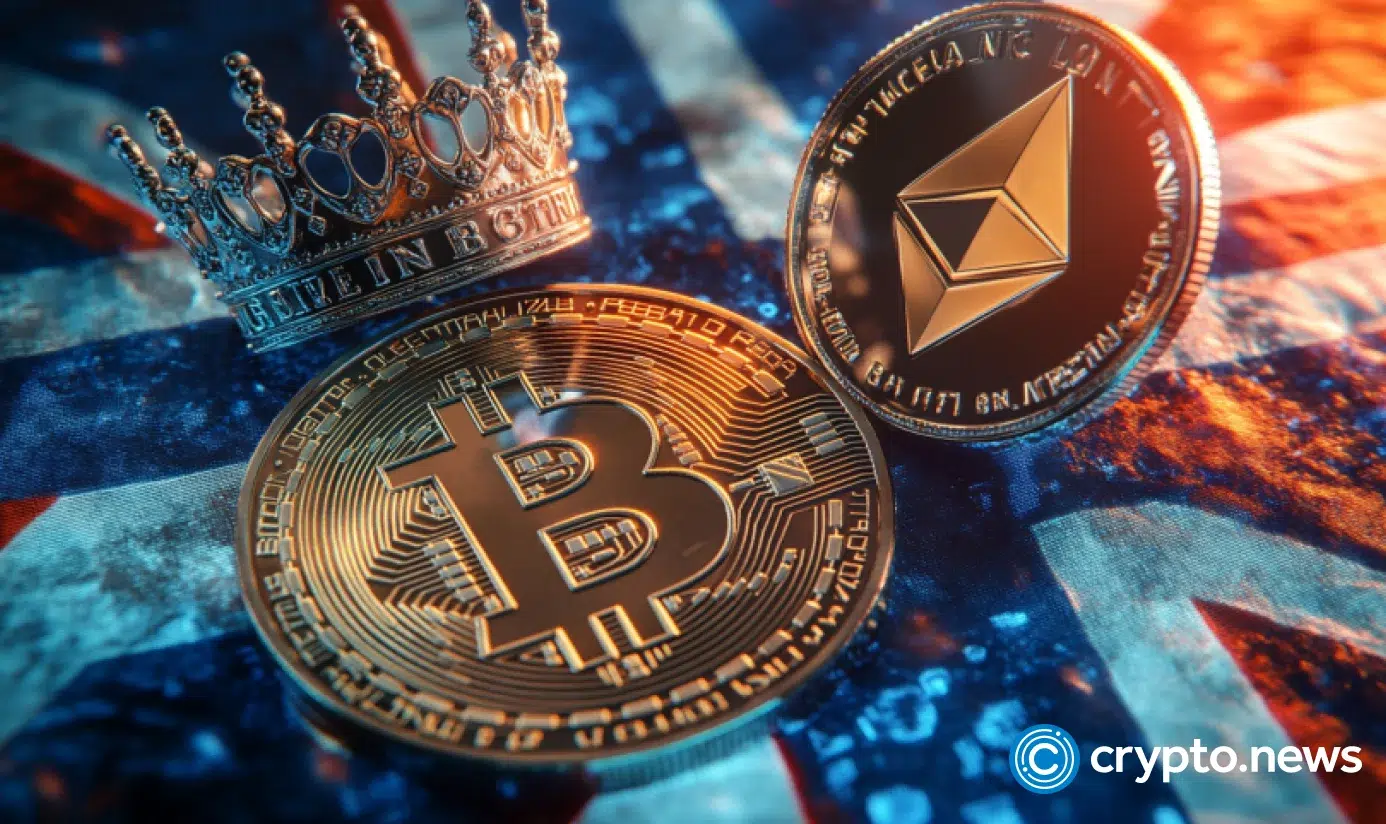

UK merchants have ranked cryptocurrency payments among emerging customer demands, even as security and payment simplicity remain their top priorities, according to a new whitepaper released by payment technology provider DECTA.
Summary
- A DECTA survey found 11.8% of UK merchants believe customers want cryptocurrency payment options, with demand rising to 20.7% among the largest SMEs.
- More than half of surveyed UK SMEs already sell worldwide, placing greater focus on payment methods that support international commerce.
- Security remained the top payment priority for merchants, while interest in BNPL, open banking, and cryptocurrency continued to gain ground.
A new DECTA whitepaper shared with crypto.news, based on a survey of 500 UK SME decision-makers conducted by research firm Censuswide between March 13 and March 20, 2026, found that 11.8% of merchants believe their customers want the option to pay with cryptocurrency, while the figure rises to 20.7% among businesses with annual turnover between £50 million and £99.99 million.
The report placed crypto behind payment security, simplicity, speed, multiple payment options, refunds, guest checkout, Buy Now Pay Later, and open banking when merchants were asked about customer payment priorities. Payment security topped the list at 48.6%, followed by simplicity at 42.2% and speed at 37.2%. Cryptocurrency ranked eighth at 11.8%.
Scott Dawson, chief executive officer of DECTA and chairman of the Payments Innovation Forum, said alternative payment methods continue to gain traction among merchants. DECTA said BNPL emerged as a top customer priority for nearly 20% of respondents, while open banking and cryptocurrency attracted greater interest among larger businesses.
Crypto interest grows among larger businesses
According to the report, cryptocurrency remains a minority payment preference overall but carries greater weight among high-turnover merchants. The company stated that payment providers that ignore crypto risk being viewed less favorably by some of their largest merchant customers.
The survey also found that 53.8% of UK SMEs already sell products and services worldwide. At the same time, 20.2% of merchants involved in global trade said their international payments experience has deteriorated. DECTA said cross-border payment capabilities have become increasingly important as more SMEs expand beyond domestic markets.
Merchants identified slow access to funds as their most common business challenge, with 19.4% citing it as a problem. Another 16% pointed to fraud and security concerns, while 14.2% cited a lack of transparency around payment processing fees.
Meanwhile, more than half of surveyed merchants, 51.8%, said they would prioritize security over both lower fees and access to the latest payment technology. Among micro-businesses with one to nine employees, that figure climbed to 62.1%.
UK cracks down on crypto
The findings arrive as UK regulators continue to scrutinize the crypto sector. Earlier this month, the Financial Conduct Authority warned football clubs about sponsorship arrangements involving unauthorised crypto firms, arguing that such partnerships could expose supporters to financial risks and products that fall outside UK regulatory protections.
The FCA has also continued work on its broader crypto framework ahead of the UK’s planned licensing regime. Under the regulator’s current timetable, crypto firms will be able to apply for authorization from September 30, 2026, while the full cryptoasset regime is scheduled to take effect on October 25, 2027.
Separately, UK authorities sanctioned Huobi Global S.A., linked to HTX, in May as part of a Russia-focused enforcement action targeting entities allegedly connected to the A7 network. The move followed earlier FCA legal proceedings against HTX over alleged unlawful crypto promotions aimed at UK consumers.
Despite that regulatory activity, DECTA’s survey suggests a segment of UK merchants continues to view cryptocurrency payments as a relevant customer option, particularly among larger businesses with international operations.

China tightens indium phosphide checks as AI demand climbs

Man City’s key Premier League fixture dates vs ‘Big Six’ that could decide title race
Gold heads for third straight weekly fall as hawkish Fed eclipses Iran truce cheer


-

 Business5 days ago
No Jackpot Winner as $257 Million Prize Rolls Over to $269 Million Monday Draw
-

 Fashion7 days ago
Weekend Open Thread: Tuckernuck – Corporette.com
-
 Crypto World4 days ago
Zimbabwe Requires Crypto Businesses to Register Annually Under New FIU Regulations
-

 Crypto World6 days ago
Bitget enters Argentina’s regulated crypto market through PSAV registration
-

 Tech6 days ago
NanoClaw integrates JFrog registries to secure AI agent downloads
-

 Tech7 days ago
This Week In Security: Microsoft On Microsoft, Register Your Domains, Linux On ARM, And FreeBSD Joins The File Cache Club
-

 NewsBeat7 days ago
FBI searches office of Ohio voter registration group
-
 Entertainment5 days ago
Matt Damon’s Viral Sci-Fi Thriller Has Taken Over HBO Max
-

 Business5 days ago
Anthropic staff to meet White House officials next week, Axios reports
-

 Tech5 days ago
As AI companies race to go public, who else is along for the ride?
-
 Crypto World5 days ago
Bitcoin could crash to $48,000, if this historical pattern is triggered
-

 Politics5 days ago
“Israel’s” ban on ICRC visits ruled illegal, but Knesset moves to stop them permanently
-
 NewsBeat5 days ago
Warning of disruption as Cardiff Crossrail works to start
-

 News Videos5 days ago
Financial Accounting | Last Day Revision Strategy and Booster | CMA Inter – June 2026
-
 NewsBeat5 days ago
Tributes to former deputy head teacher at Cambridge school among death and funeral notices
-

 Entertainment5 days ago
Deion Sanders Shares Powerful Post After Viral Advice To Deiondra
-
 Crypto World5 days ago
Market Preview: SpaceX (SPCX) IPO Record, Federal Reserve Meeting, and Iran Nuclear Agreement
-
 NewsBeat5 days ago
what doctors are seeing in ebike crashes
-
 Entertainment5 days ago
Kate Middleton Glare Goes Viral After Kids Booed At Royal Event
-

 Business5 days ago
Invesco Quality Income Fund Q1 2026 Commentary
You must be logged in to post a comment Login