




“What is hard to understand is why the minimum age of criminal responsibility needed the protection of a mechanism intended to safeguard minority rights.”
There was always going to be disagreement over whether Northern Ireland should raise the age of criminal responsibility.
Some experts argue it should be increased to 14. Others believe the current age of 10 remains appropriate. Most of the political debate in recent months has centred on where the line should be drawn.
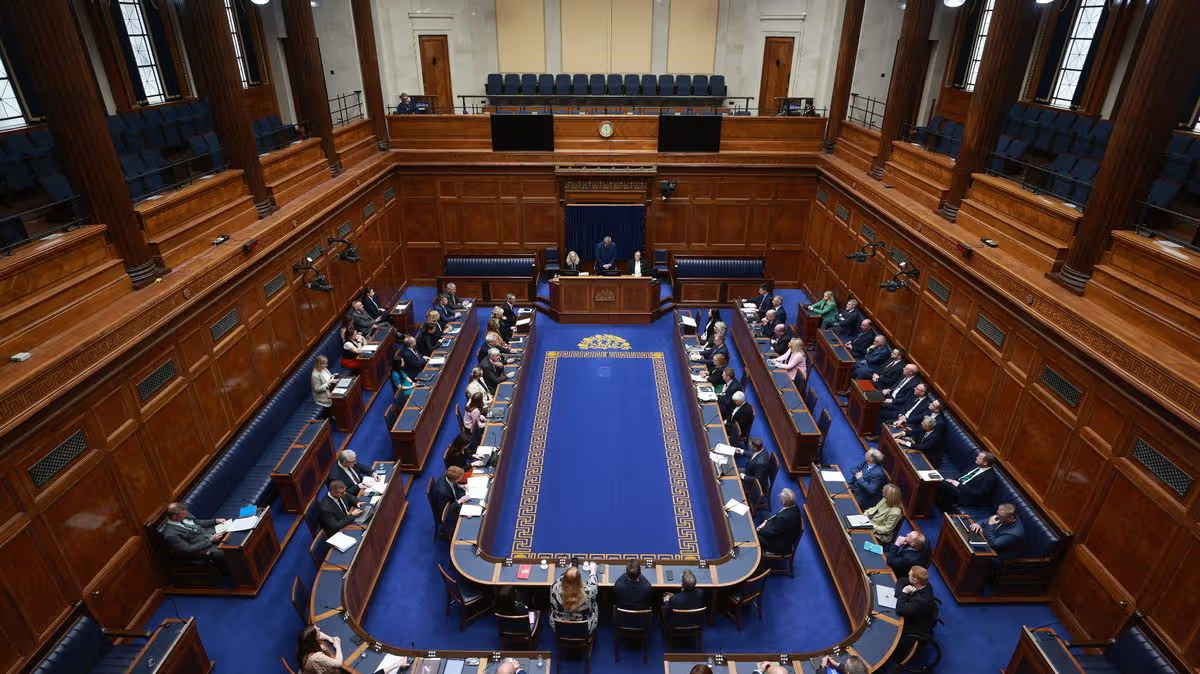
But what happened at Stormont this week was ultimately about something else. The DUP’s decision to use a Petition of Concern to block an amendment to the Justice Bill has reignited an old question about one of the Assembly’s most powerful mechanisms and what it is actually for.
Alliance MLA Sian Mulholland’s proposal would have raised the minimum age of criminal responsibility to 14, with exceptions for the most serious offences. It was a significant change, and not everyone supported it.
Yet there was also a middle ground available. Former UUP MLA Doug Beattie had proposed increasing the age to 12, bringing Northern Ireland into line with Scotland and the Republic of Ireland, while stopping short of the more ambitious reform advocated by some children’s rights organisations.
There was a respectable argument for supporting that compromise. Equally, there was a respectable argument for rejecting it. That is normally how legislatures work. Parties make their case. MLAs vote. The side with the numbers wins. Instead, the debate became something rather different.
The Petition of Concern occupies a unique place in Northern Ireland politics. It was never designed as a routine parliamentary tactic. It emerged from a political settlement that recognised that simple majority rule would not be enough in a divided society.
At its core was the idea that there should be protections against one section of the community imposing its will on another. This helps explain why the mechanism has generated so much controversy over the years.
Long before the reforms introduced in New Decade New Approach, the Petition of Concern had acquired a reputation for being used in circumstances far removed from the role envisaged by its architects. Critics argued that it had evolved from a safeguard into a veto.
The reforms that followed were intended to restore confidence that it would be reserved for exceptional circumstances. This week’s vote inevitably raises questions about whether that ambition has been realised.
Nobody seriously argues that raising the age of criminal responsibility engages the kind of communal protections the Petition of Concern was designed to provide. This was a disagreement about criminal justice policy. A significant disagreement, certainly. An important one. But it was still a policy disagreement. Indeed, there appears to have been majority support within the Assembly for some form of change.
That does not mean reform was necessarily right, but it does mean that the normal legislative process was prevented from running its course.
The DUP will argue that it acted in what it believes to be the public interest. The UUP members who supported the petition will say the same. They are entitled to hold those views.
What is harder to understand is why those views needed the protection of a mechanism intended to safeguard minority rights.
The decision is also awkward for the UUP. Without the support of Jon Burrows, Diana Armstrong, Robbie Butler and Alan Chambers, the petition would not have succeeded. That leaves the party sharing responsibility for an outcome which sits uneasily alongside years of criticism about how the mechanism has been used in the past.
What happened this week is unlikely to be the last argument about the age of criminal responsibility. The issue will return.
But the Petition of Concern survives because most people accept there are circumstances in which it remains necessary. The challenge has always been ensuring that those circumstances remain exceptional.
Every time it is used to settle what appears to be an ordinary policy dispute, that distinction becomes a little harder to defend and every time that happens, the argument for revisiting the rules grows a little stronger.
For all the latest news, visit the Belfast Live homepage here and sign up to our daily newsletter here.




































You must be logged in to post a comment Login