My daughter Ruby used to be a good sleeper until I started believing that overtiredness would ruin her nights… (Picture: Lucy Mapstone)
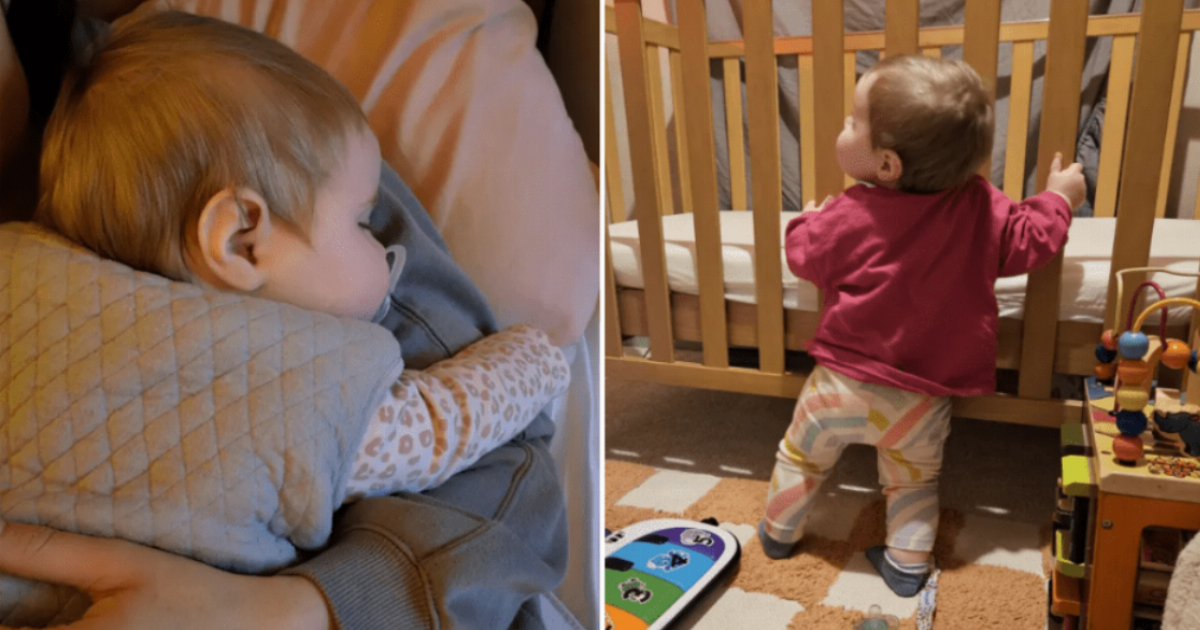
It was 2am and my baby was bouncing around my bed, twerking her nappy bum in my face, squealing with joy and making it clear that she was up for a party.
Unfortunately, I wasn’t.
It was the third night in a row that my darling eight-month-old daughter Ruby had decided sleep was for the weak. A few weeks earlier, she had been happily sleeping through the night save for the odd brief wake-up.
Now she was regularly spending hours awake in the middle of the night, absolutely vibing all over the bed, usually between 2am and 4am. Fun for her, very not fun for me and her dad. We were baffled – her sleep hadn’t even been this bad as a newborn.
Advertisement
Like many parents, I turned to sleep apps, social media, ChatGPT and parenting forums for answers, with most pointing to the same culprit: overtiredness.
I was told Ruby wasn’t getting enough sleep during the day. She needed longer naps. Earlier bedtimes. Shorter wake windows (the time babies spend awake between sleeps).
Trying to settle an undertired baby at 2am in my bed was… interesting (Picture: Lucy Mapstone)
Overtiredness is the scariest concept in the baby sleep world. It crops up everywhere from Instagram reels to parenting forums, and the theory is so powerful because it appears to explain everything. A baby fighting a nap? Overtired. A baby waking up crying all night? Overtired. A baby waking at 4am ready for the day? Overtired.
Convinced I had accidentally created a chronically exhausted child, I started trying to squeeze more sleep into Ruby’s day.
It did not help and, if anything, things got worse.
Advertisement
At the end of my tether, I sought help from baby sleep consultant Lauren Eells, founder of Sound Asleep Guru, whose science-led and direct approach to sleep had long stood out to me among the sea of conflicting ‘experts’ on social media, who each insisted they had the top method to help your baby sleep.
The first thing Lauren had me do was work out how much sleep Ruby actually needed. For 10 days I tracked every nap and overnight sleep. The result? Ruby averaged 13 hours of sleep across a 24-hour period.
That number changed everything and, instead of encouraging more sleep, Lauren wanted us to try for less.
At the time, I was giving Ruby around two and a half hours of naps a day. ChatGPT was suggesting shorter wake windows, and the popular sleep app Huckleberry was steering me towards earlier bedtimes. Lauren, meanwhile, wanted Ruby awake for at least four and a half hours before bed and to reduce her daytime naps to one hour and 45 minutes in total.
Advertisement
Ruby got the help she needed to sleep more solidly at night and it was so simple (Picture: Lucy Mapstone)
I remember worrying that Ruby would be so exhausted. What about everything I had seen about overtiredness – wasn’t that exactly what I was supposed to be avoiding?
The explanation for approaching sleep in this way, Lauren says, comes down to two biological processes that need to work together.
The first is melatonin, the hormone that helps us feel sleepy as bedtime approaches. The second is sleep pressure, which builds the longer we stay awake.
‘What we do know is that there is melatonin that releases, and that you want to time your baby’s melatonin rise with going to bed so that you get the nicest settle to sleep,” she explains.
‘But in order for that nice settle to then lead to a nice night, you also need the right sleep pressure behind you.’
Advertisement
In practical terms, a baby who has napped too much or too recently before bed may still appear tired enough to fall asleep. But they may not have built enough sleep pressure to stay asleep for long.
That, Lauren believes, is where many parents get caught out.
‘The number one myth that I think harms sleep is overtiredness, because it leads parents to put their baby down too early, for too long and at the wrong times,’ she says.
Lauren Eells, the founder of baby sleep consultancy Sound Asleep Guru, works hard against the overtiredness ‘myth’ (Picture: Lauren Eels)
When Lauren had her twins in 2017, overtiredness ‘wasn’t a thing’, she says (Picture: Lauren Eells)
‘They’ve used too much of their 24-hour sleep budget before they’ve even gone to bed that night.’
To my astonishment, Ruby could handle being awake for longer before bed. In fact, for the first time in weeks, I saw her getting properly tired before bedtime.
Advertisement
The very first day I capped Ruby’s naps, she slept for more than 11 hours overnight without waking. Then she did it again. And again and again.
Soon, it became clear that we didn’t need to sleep train at all. Ruby still fell asleep in our arms before being transferred to her cot, but she was sleeping through the night without needing us.
Lauren explains that while routine carries most of the weight when it comes to sleep, some babies are more sensitive to sleep associations than others.
A baby who is fed, rocked, cuddled or helped to sleep may expect that same help every time they wake overnight (which happens several times a night and is biologically normal), meaning they struggle to resettle independently, and this is where sleep training can come in useful – but it only works once the schedule is sorted.
Advertisement
Ruby now manages solid nights of sleep without sleep training, and all by just adjusting her schedule and not trying to make her sleep more than she needs (Picture: Lucy Mapstone)
Ruby, however, appears to be one of the rarer babies who can happily drift off in our arms and still connect her sleep cycles without needing us through the night.
According to Lauren, that’s because routine matters far more than many parents realise.
‘Sleep training is the icing on the cake,’ she tells me, adding: ‘The cake itself is getting the routine right.’
In other words, many babies aren’t waking because they’re getting too little sleep. They’re waking because they’re getting too much. Astounding, right? But spend five minutes on Reddit or on social media looking at baby sleep advice and you will generally hear that overtiredness is enemy number one.
Lauren believes one of the biggest problems facing parents is the rise of generic sleep advice that treats all babies as though they need the same amount of sleep.
Advertisement
At the time I tweaked Ruby’s sleep, both Huckleberry and various Google sources suggested she should be getting around 14 hours of shut-eye in a 24-hour period, including up to three hours of naps. For my daughter, aiming for that amount of sleep was exactly what caused the problem.
‘This idea that every baby has a 14 to 16-hour sleep tank just isn’t true,’ Lauren says. Sleep doesn’t breed sleep.’
Who is Lauren Eells?
Lauren Eells is the founder of Sound Asleep Guru, a sleep consultancy that supports families with infant and toddler sleep, routines and independent sleep. So far, she and her colleagues Grace, Hana and Chloe have helped more than 4,000 babies get better sleep.
She holds a Level 6 EDS Sleep Practitioner qualification covering children aged 0-16, is trained in paediatric CBT-I (cognitive behavioural therapy for insomnia), has completed Imperial College London’s Paediatric Sleep course, and holds additional qualifications in infant reflux, colic and allergies, including cow’s milk protein allergy and lactose intolerance.
Advertisement
Lauren also co-hosts the parenting podcast Spilling the Tea on Zzzs and contributed to a recent BBC investigation into the unregulated baby sleep industry.
Lauren’s entire approach is built around the idea that babies, like adults, have different sleep needs. The challenge for parents is working out which type of baby they have.
Advertisement
She argues that generic schedules, wake windows and sleep apps can make parents lose confidence in their own instincts.
‘It really robs parents of their ability to read their baby and get to know their rhythms,’ she says.
In the end, my biggest takeaway from all of this was simple: my baby is my baby. Her sleep needs are individual, and trying to force her into somebody else’s ideal schedule was never going to work.
Everyone wants their baby to sleep well, of course they do. But trying to cram more sleep in than they need will set you up to fail.
Advertisement
And yes, sometimes you have to accept less naptime in the day to get a good night’s sleep, but I’d bet most of us would rather have a baby who slept more at nighttime.
Ruby is now nearly 15 months old and, at time of writing, she still sleeps over 11 hours overnight (touch wood) when we keep her naps in check.
We still get the bedtime cuddles but, thankfully, the 2am nappy-bum dance parties are mostly a thing of the past. If she’s teething, it’s a whole other story, but that’s a topic for another day…
Network Rail said it would be a ‘complex recovery operation’
The fatal train crash near Bedford was a “tragic, isolated incident”, Network Rail has said, as it announced that rail services will be disrupted until June 28 while a “complex recovery operation” to remove the damaged trains and carriages from the track continued.
Advertisement
The collision, which killed a train driver and left 100 others injured, involved two East Midlands Railway (EMR) trains – with one smashing into the back of the other on the same line shortly after 5pm on Friday.
On Sunday, Network Rail said a “complex recovery operation” to remove the damaged trains and carriages from the railway had begun.
Click here to get the biggest stories straight to your inbox in our Daily Newsletter
Engineers will then need to assess the damage and complete repairs.
Advertisement
Rail passengers have been warned to expect disruption to services to and from Bedford for another week, and were urged to only travel if it is “absolutely necessary”.
There will be no services north of Luton on the busy commuter Thameslink line and no EMR services south of Bedford, with a limited rail replacement bus service in operation between Luton and Bedford, Network Rail said.
British Transport Police said more than 80 people were treated in hospital on Friday night, and as of Saturday morning 28 remained in hospital, with nine in a critical condition.
Of the 100 victims, 11 people were very seriously injured, a further 32 were seriously hurt and 57 others suffered minor injuries, the East of England Ambulance Service (EEAS) said.
Advertisement
“While investigations are still at an early stage, current indications are that this was a tragic, isolated incident,” said Ellie Burrows, Network Rail Eastern regional managing director.
“We are focused on the safe reopening of the railway and getting services running as quickly as possible.
“During this time, our message to passengers is clear – please expect disruption to services through this area for the majority of next week and only travel if absolutely necessary.”
Is AI a boom that’s just getting started or a bubble about to burst?
Whichever you think, in San Francisco, once again the epicenter of a tech revolution, one thing is certain: AI is driving an already expensive housing market completely nuts.
In March, the median home price in the city topped $2 million. Bidders regularly pay more than $1 million above listing prices for houses that, in most other places, would be unremarkable single-family homes with a few bedrooms and small backyard. The California city has both the highest and fastest-rising home prices in the country, according to Redfin.
The median monthly priceof a one-bedroom apartment is hovering around $4,000. Since Covid, rent has roughlydoubled, at times hitting $10,000 per month on the iconic Victorian mansions sprinkled throughout the city, according to one real estate broker.
Advertisement
Real estate insiders say the spike in property prices is unmistakably tied to the AI race as start-up investors and major tech companies alike throw around huge sums of money to attract top talent to the region.
In San Francisco, the median monthly price of a one-bedroom apartment is hovering around $4,000 (Getty)
“They make really good money,” commercial real estate broker Dimitris Drolapas told The Independent. “We’re seeing $500-, $600-, $700,000 of income isn’t unheard of, plus stock and all that.”
The AI boom has helped drive a “complete 180” from the pandemic era, he added, when San Francisco was a poster child of urban dysfunction with residentsleaving in droves and the downtown area resembling a ghost town due to remote work.
Mo Zhu, an activist with local housing group SF YIMBY, lives in Mission Bay – a revamped waterfront district that houses offices for the leading AI companies who have helped drive a commercial real estate comeback around the city and a return to in-office work.
Zhu’s own rent recently went up by 10 percent,a fact he attributes to the AI-related investment in the area. At first, he felt lucky the price hike wasn’t worse – then realized it was shocking to feel fortunate to be facing a double-digit increase in his bills.
Advertisement
“I was upset that I felt lucky,” he said. “10 percent is not lucky in any objective sense of the world…I certainly was directly impacted by that with OpenAI down the street and Anthropic up the street.”
Many of his friends want to move into the neighborhood, which is home to scenic parks and the new Warriors NBA stadium, but can’t afford it.
In recent years, prices have roughly doubled for multi-bedroom rentals in San Francisco’s famous Victorian homes, which can be found scattered across neighborhoods including Alamo Square (pictured), Haight-Ashbury and the Mission District (Getty Images/iStockphoto)
“They work in high-paying tech jobs,” he said. “They’re not even able to…It’s really squeezing out even families in good economic situations. I can’t imagine what it’s like for families who are not.”
The squeeze is only going to worse this year, thanks to three blockbuster initial public offerings from AI-related companies with deep ties to the city and state.
Elon Musks’s SpaceX just went public, making Musk the world’s first trillionaire, and the company soon expanded on its existing xAI division with a $60 billion deal to acquire Cursor, a San Francisco-based AI coding agent start-up.Rivals OpenAI and Anthropic are next up for sale, and will mint plenty of other new fortunes, too. Some Anthropic employees could be set to earn $50 million from the I.P.O. Together, the three I.P.O.s could generate as much as $4 trillion in value, Barron’s estimates. One local real estate agent predicted these offerings will unleash a “thermonuclear wealth explosion deposited squarely in San Francisco.”
Advertisement
In anticipation, sellers around the region have been offering to accept shares in these companies instead of cash for home purchases, according to reports.
The influx of people and capital is welcomed news for some but it’s putting enormous pressure on the city’s existing lower-income renters, according to Jennifer Fieber of the San Francisco Tenants Union, as landlords stand to gain from replacing longstanding tenants with wealthier new arrivals. The city has struggled for years to build enough affordable housing and keep rents feasible for lower-income people, and state law prevents cities from enacting rent control on large swathes of the housing stock.
Housing construction in San Francisco hasn’t kept up with the region’s booming tech wealth, leading to high prices and intense competition for desirable homes (Getty)
“Because the rents have increased in the city, there’s going to be huge pressure to get rid of the people you have, regardless of whether they’ve been paying on time,” Fieber said.
There is also concern that the AI industry might be a bubble about to pop – with investors irrationally assigning too much faith, capital and value to ventures that won’t survive, while letting this same optimism drive other major investments in their lives, such as splashy home purchases.
So far, according to Mike Simonsen, chief economist at real estate firm Compass, the AI boom hasn’t sent the San Francisco property market into full-on bubble territory just yet, where “junk starts getting overpriced.” Instead, the craziness is more concentrated.
In May, according to Compass data, homes were selling at 124 percent of their asking prices. The city’s wealthiest have begun “massive overbidding” on an even smaller basket of the most attractive homes in the most desirable areas. Last month, a five-bedroom mansion overlooking San Francisco Bay in scenic Pacific Heights sold for $3 million over asking price, and in nearby Presidio Heights, another palatial home went for nearly $4 million above the sticker price.
“Much of thewealth generation, especially around real estate, as a result of the AI companies is actually already in the system,” Simonsen said. “These are people who are already moved into town with big salaries and go, ‘I‘ll take whatever apartment is available.’”
By the end of 2026, AI-related companies SpaceX, Anthropic and OpenAI will have all gone public, generating $4 trillion and unleashing what one San Francisco real estate agent called a ‘thermonuclear wealth explosion’ in the city (Reuters)
“The concentration becomes overwhelming,” Simonsen added of those now pursuing top homes in the city. “Someone who is not armed with millions in new wealth, the scenario is just really stacked against ‘em.”
“The IPO mania is real and there are people making a lot of money, and there are clearly people moving here and taking very high-paying jobs at AI companies, but that’s also balanced with other people becoming unemployed and other jobs moving out of the city,” he said. “So there’s kind of a mix of many different things going on at once here.”
Simonsen, the Compass economist, said the soaring AI industry could eventually turn and resemble the early 2000s dot-com crash, which sent San Francisco real estate values plunging along with it.During the dot-com crash, tens of thousands of Bay Area workers lost their jobs, and San Francisco real estate took its worst hit since the Great Depression. By the time the bubble popped, commercial rents had fallen 60 percent from their year 2000 peak and residential rent was down 12 percent in the city.
If the AI economy suffers a similar bust, it could mean similar impacts. AI workers would lose their high-income jobs, and the stock some used as collateral to get home loans — or pay for houses outright — could become nearly worthless.
“All of a sudden, the stock is worth 90 percent less,” Simonsen said of this scenario.
Advertisement
In a downturn, homeowners also would not be able to sell their properties at the same high prices they paid for them, compounding the economic pain.
As for solutions to prevent some kind of AI-related housing apocalypse, experts told The Independent about a variety of reforms that could make a difference. These include expanding rent control, cutting down on city bureaucracy, and supporting existing pro-housing zoning reforms and state laws.
For the time being, demand remains high for premium properties in scenic areas such as Pacific Heights, which has sweeping views of San Francisco Bay (Chris Coplans)
Groups like SF Yimbyarechampioning mid-rise, “single-stair” apartment buildings, which feature one central staircase, rather than the multiple required under state law, as a way to maximize the number of units in buildings on San Francisco’s typically small property lots.
San Francisco Mayor Daniel Lurie and District Supervisor Myrna Melgar are backing $70 million bond to raise funds for affordable housing and a November ballot initiative to increase the city’s contribution to its affordability-focused Housing Trust Fund.
Whatever the future of San Francisco housing looks like in the age of AI, it doesn’t seem likely the city will return to the Covid days any time soon, when landlords were lowering prices to entice people to come back and keep residents who were on the fence about leaving. In an April 2020 survey, more than a third of San Francisco landlords said they had granted reductions, and 10- and 20-percent cuts could be seen on rents everywhere from finance-focused downtown to leafy, residential Glen Park.
Advertisement
Jennifer Fieber, the tenant activist, was one of those who benefitted from this brief window of declining prices. “Those days,” she said, “are definitely gone.”
As Drolapas the real estate broker sees it, the region is stuck in a bind. A booming economy strains San Francisco’s renters, and a declining economy offers them a silver lining. Neither scenario is a win-win for the city as a whole.
“There’s always good, there’s always bad,” he said. “The good is it’s nice to see some economic stimulation, especially after things were so dire here. The bad would be, you know, it’s hard for everyone to be able to afford to live here. That’s really where the conundrum is.”
This exchange, or some variation of it, used to be the sonic backdrop to every holiday I took with my ex. I defy any established couple not to recognise the seething tensions that roil beneath the somewhat calm transcript – the passive-aggressive undercurrent that flows through it – like strong waves on a beach getaway.
The subject of the discord was almost immaterial. There would always come a point – usually while sitting in tense silence at a restaurant, oblivious to the majestic sunset and delicious grilled seafood – when I’d wonder where it had all gone wrong. We were on holiday, for goodness sake! We were meant to be having a nice time!
It’s not just me who’s experienced the perils of the vacation barney. According to research by railcard.co.uk published earlier this year, one in four couples clash when travelling; another study found that more than 42 per cent of respondents argued more than expected with their partner on holiday. Far from being relaxing, time away could well be the ultimate stress test for a relationship. Why are we so prone to disagreements when not on home turf?
Advertisement
“A holiday places a magnifying glass on the relationship, and that can intensify things quite a lot,” says Elinor Harvey, a psychotherapist and clinical director at The Relationship Therapy Practice. It’s not that the holiday creates problems out of nowhere, but that it amplifies issues that were already there.
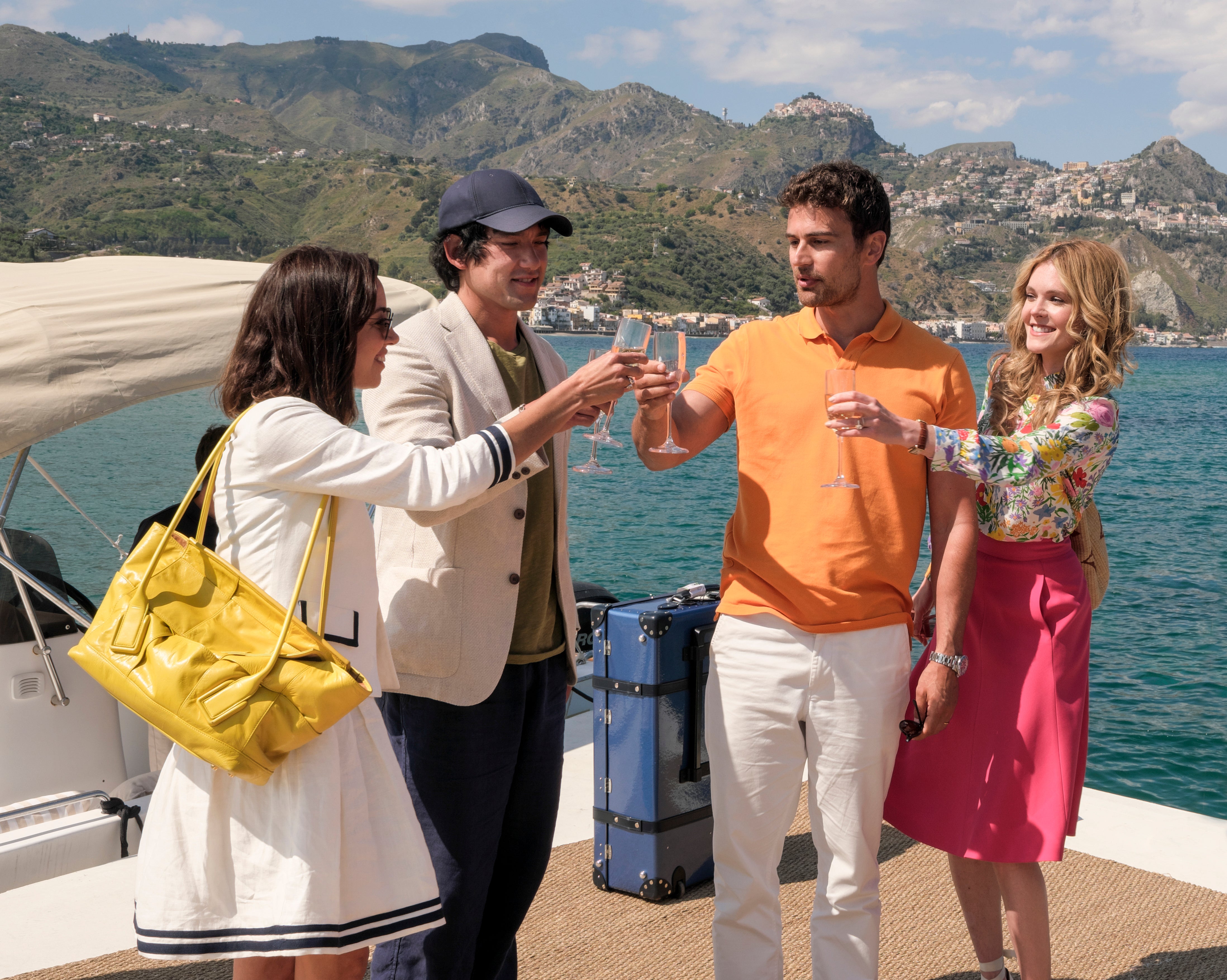
Jeers: it might start off all smiles, but holidays can prove the ultimate relationship stress test, as explored in the HBO show ‘The White Lotus’ (Sky)
“Think about all the combinations of things that have to happen in order for the holiday to even come about – possible financial stress around how much is acceptable to spend on a holiday, or there might be friction when planning it, because one person might be the natural organiser but have a lot of resentment about that,” adds Harvey. (I can certainly relate to that feeling.)
Then there’s the difference between expectation and reality, according to Fenia Christodoulidi, head of training and consultancy for Relate. “One reason that couples tend to have tension is the fantasy that the holiday will be perfect, and I think social media bombards us with a lot of information about what makes a ‘perfect’ holiday,” she says.
Decision fatigue is an inherent part of planning and executing travel too – where to stay, where to eat, which sights to see. It can be exhausting. And the gap between what you and your partner expect from a break can prove incredibly disappointing. “One partner may see it as time to pause and restore, whereas the other partner may think it’s time to be adventurous and explore – so they may clash about what needs they want to be met,” adds Christodoulidi.
I’m reminded of a friend who found herself weeping in the middle of Paris when she realised that her then partner’s idea of the perfect romantic mini-break involved ticking off every museum in a five-mile radius, while she’d been fantasising about quaffing red wine and slow strolls along the Seine.
Advertisement
One reason that couples tend to have tension is the fantasy for the holiday to be perfect
Fenia Christodoulidi, Relate
Frustrations can arise, too, around exactly the same domestic issues that plague day-to-day life. If you’re staying in a villa, no matter how beautiful it is, someone has to cook and wash up. “Technically you’re on holiday, but the roles and responsibilities often revert to type – and that can be huge, because you’ve come into it with the expectation that it’s going to be a chance for you to have a break,” Harvey explains. This reaction can be further heightened when you factor in childcare on a family holiday.
For a partner who has a high-pressure job, it can be a real challenge to switch off from work – another source of friction. “I work with lots of professionals and they crash into a holiday because they’ve been working flat out,” says Harvey. “In a week’s holiday, you can’t just decompress immediately. It might take several days to get out of work-mode.”
Advertisement
But couples don’t just have to accept that spats or all-out warfare are inevitable. Simply talking in the run-up to going away can make a world of difference.
“Communication is king,” advises Harvey. “How do we navigate what our different expectations might be, our different vision of holidays? Ideally, we’re not leaving that conversation until the week before; we’re hopefully having those discussions over a longer period in the lead-up.”
She recommends naming any specific anxieties ahead of time. Worried that you’re going to be saddled with making all the meals and cleaning the Airbnb kitchen every night? “Don’t be afraid to raise that stuff before you’re out there – don’t wait till you’re full of resentment as you scrub the worktops while everyone else is at the pool,” says Harvey.
Holiday blues? One in four couples clash when travelling (Getty)
Lifting the pressure to be joined at the hip on holiday is also advisable. “My husband likes hiking and exercising, whereas I may want to lie on the beach – and as long as we agree that we don’t have to do everything together, that is fine,” says Christodoulidi. She also recommends explicitly hashing out how you’re going to make decisions and who’s responsible for what in advance.
Even if you’ve laid the communication groundwork, conflict can and does still arise on holiday. Rather than avoiding it at all costs, what’s crucial is being able to navigate disagreement in a healthy way. (It’s certainly cheaper than booking a separate hotel room or catching the next flight home in a fit of pique.)
Advertisement
The normal dynamic of “rupture and repair” can admittedly be tougher – you’re spending an intense amount of time together, perhaps trapped in one hotel room. “I’m a big believer in a timeout,” says Harvey. “If you’re in a full emotional blast, communication is quite challenging.” If you notice things are escalating, her advice is to say: “Let’s press pause, let’s give each other some space.” Emotions can spike but then recede just as quickly; humans naturally self-regulate quite well.
Christodoulidi emphasises the need for the timeout to be “responsible”: “It’s not a timeout where I abandon you. It’s a timeout that says, I’ll go for a walk, and then I’ll come back in an hour, and we’ll speak. There needs to be a promise of return and a commitment to addressing the issue when I come back.”
If you’re in a full emotional blast, communication is quite challenging
Elinor Harvey, The Relationship Therapy Practice
Advertisement
Sharing more vulnerable emotions – saying you feel sad or overwhelmed, for example, rather than expressing frustrations through anger – can also invite compassion from your partner, says Harvey.
A final tip is to have a post-holiday debrief if micro-tensions or, indeed, World War Three did erupt. “Lots of couples just brush it under the carpet and pretend it didn’t happen,” says Harvey. “But it’s actually much better to use that as a bit of a wake-up call. Ask: ‘What was that about? What do we need to look at here?’”
She explains that we should frame our feelings as simply messengers that are trying to tell us something: maybe we need to be clearer with our expectations rather than projecting assumptions; maybe we need to work on communication. “Those tough holiday experiences can be a learning experience. Conflict is really healthy for couples, because they can grow through it; it doesn’t have to be a breaking point.”
When it comes to holidaying with your other half, a change may not always be as good as a rest – but you might not have to throw in the (beach) towel just yet.
Reece James is sick of talking about his assorted injuriy problems, and says the constant chatter about his physical problems is “boring now.”
The England defender’s career has been plagued by injuries, which saw him suffer heartbreak when ruled out of the 2022 World Cup in Qatar, a disappointment that was compounded by also missing England’s run to the Euro 2024 final.
Another injury with Chelsea disrupted the second half of his season before returning for the final few games and earning a seat on the plane to North America.
Advertisement
James says the narrative about his injuries is wearing thin.
“People always talk about injuries and availability, and to me it’s so boring now.” James told BBC 5 Live.
“I have one job, which is to be the best I can when I’m on the pitch. To be honest, I understand the stigma at the start, but after a while it gets boring.
“I’ve been fit for a long time before my last injury, and I don’t listen to too much noise.
Advertisement
“I just focus on myself, my body, trying to perform the best I can and help the team I’m playing in.”
James is Thomas Tuchel’s first-choice right-back and he says he “connects really well” with the boss as the pair aim to win another major trophy together
However, the men had been rescued by the time they arrived and were said to be safe and well.
Advertisement
Lifeboat organisation the RNLI has praised the youngster for his heroic efforts.
Andrew MacDonald, helm at Kyle RNLI, said: “Thanks to the quick thinking of the teenager going out in his own boat to rescue the two casualties, a far more serious situation was averted.
“We’d like to remind people that blow-up inflatable toys should be kept for use in swimming pools and not open water, and to always ensure that you have lifejackets on and a means of communicating to the emergency services if you get into any difficulty.”
Magistrates went ahead with all their cases, found them guilty in their absence and sentenced them.
Three cases were heard at Harrogate Magistrates Court.
Sarah Partridge, 38, of Water Lane, York, was convicted of failure to tell police who was driving her vehicle when it was allegedly committing a traffic offence.
Advertisement
She was banned from driving for six months, fined £120 and ordered to pay £120 prosecution costs and a £48 statutory surcharge.
Jamie Lee, 52, of Middlefield Close, Osgodby, Scarborough, was convicted of not telling police who was driving his vehicle when it was allegedly committing a traffic offence.
He was banned from driving for six months, fined £660 and ordered to pay £120 prosecution costs and a £264 statutory surcharge.
Thomas Butler, 37, of Hugden Close, Pickering, was convicted of driving without insurance in Helmsley and was banned from driving for six months.
Advertisement
He was fined £660 and ordered to pay £120 prosecution costs and a £264 statutory surcharge.
Christopher Roche, 36, of Millgate News, Selby, was convicted by Bradford magistrates of failure to tell police who was driving his car when it was allegedly speeding in a 30mph zone at Walton near Tadcaster.
He was fined £660, ordered to pay a £264 statutory surcharge and £130 prosecution and given six penalty points.
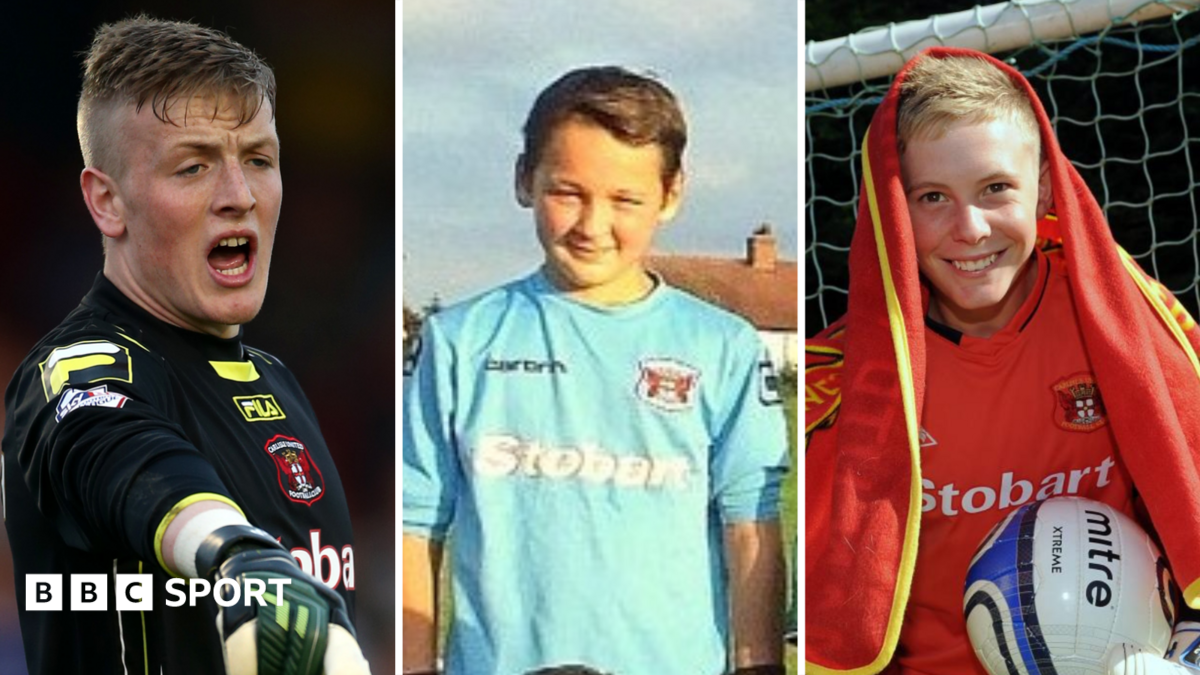
Having made his England debut in 2017, Pickford helped the team reach the World Cup semi-finals the following year in Russia and has cemented his place as manager Thomas Tuchel’s number one.
Now a veteran of the team with 85 caps at the age of 32, Carlisle played their part in his development after he joined the then-League One team on loan from Sunderland.
He only played 18 games for the Cumbria-based club but clearly left his mark.
“I remember one game in particular, we were playing at Deepdale against Preston,” said Ben Benson, who went to the game as a fan but was also part of Carlisle’s goalkeeping set-up.
Advertisement
“He made a mistake, one that goalkeepers up and down the country make every week.”
The stakes couldn’t have been higher in the incident Benson recalled as Pickford, aged just 19, had joined a club struggling to stay in the division.
Away to Preston he’d come for a cross and, despite seeming to have both hands on the ball, it fell from his grasp and Lee Holmes poked home to score North End’s third goal in a 6-1 success.
However, it was what Pickford did after that mistake which impressed Benson and set the tone for the rest of the season.
Advertisement
He added: “Once it happened, I could remember him going back to his goal. He got his towel and put it over his head for maybe five seconds.
“He took it off, put it back on, and it was almost like he’d pressed the reset button. From the moment on, I remember him being outstanding.”
Pickford’s displays weren’t enough to save Carlisle from relegation but he returned to Sunderland where he established himself as their first-choice keeper and moved to Everton in 2017 for a transfer fee reported to be £30m.
“In Jordan you see reliability and robustness first and foremost,” said Benson. “For him to have over 300 Premier League appearance and more than 80 England caps, there’s a robustness there and I think that’s very important.”
It has earned a growing reputation in recent years after joining the food line-up at the popular city venue
11:35, 21 Jun 2026
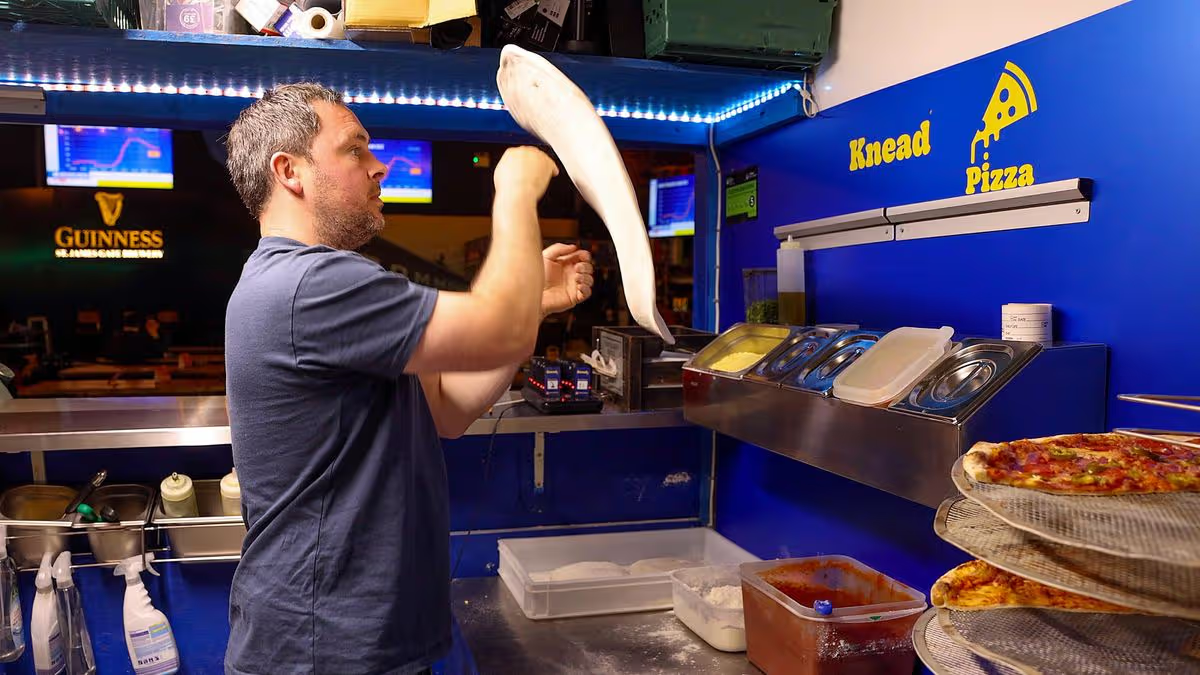
Knead Pizza Owner Aidan Moss
Knead Pizza needs no introduction to regular visitors to Belfast’s Common Market. The local pizzeria has become a firm staple at the iconic city food spot.
Founded by Newtownabbey man Aidan Moss, Knead has earned a growing reputation in recent years after joining the food line-up at the popular Cathedral Quarter venue.
Advertisement
His latest move has been him partner with food services giant SSP Group as part of the newly refurbished dining area at Belfast International Airport.
For Aidan, 38, it’s been a whirlwind journey from working in banking to making pizzas in a garage and now doing it for a living within Belfast’s thriving food scene and all in the space of a couple of years.
Aidan told Belfast Live: “It all started during COVID making pizzas in the garden, me and my friend, Mark. My wife Aisling had bought me a new pizza oven for my 30th birthday.
“It turned into a bit of a competition between the two of us. me and Mark, to see who was better at it and everybody would have said that we’re both good and that we should team up.
Advertisement
“As a result, Belfast Pizza Lads was born in 2022 – just two lads from Belfast doing pizza our way. We started in his garage, taking pre-orders on Instagram and we started to get busier and busier selling.
“Aisling, who is a teacher got us to do an event at her school catering for the staff. One of the staff member’s husbands owned a pizzeria in our local pub, The Crown and Shamrock Inn in Newtownabbey. I reached out to the pub owner and he agreed to take us on and we’ve been there for the last four years.”
Back in 2024, Aidan’s banking job was being made redundant and moved to Edinburgh so it was decision time for Aisling and himself: “We’d just had our first kid so I couldn’t really travel.
“My wife talked me into giving Knead to go. I came from a banking background, not a food background so I had no real network in the city centre.
“I reached out to one of my friends who is a director of the Waterfront Hall and he introduced me to Lawrence Bannon, who owns Common Market. Just purely by chance there was a vendor leaving, and we were able to get in.
“Our pizza is inspired by our travels and experiences, with a distinctive Belfast twist. We’re not Neapolitan, we’re not New York – we sit somewhere in the middle so I call it like a Belfast pizza experience. It’s as local an experience as I can make it.”
Knead Pizza is also now being enjoyed by passengers at Belfast International Airport. Flax & Soda is one of the airport’s newest food and drink venues and offers an approachable, family-friendly atmosphere.
Celebrating the best of Northern Ireland, Flax & Soda is a 280-cover space offering a flexible, all-day dining experience tailored to a wide range of passenger needs.
Advertisement
The venue has also teamed up with Knead to add their pizzas to the menu for passengers to get when they’re passing through.
“As a local business, we are incredibly excited for the opportunity to partner with SSP to bring our product to Belfast International Airport, and we are proud to share it with visitors from around the world.
“It’s been a mad journey from working in a bank in 2024 to making pizzas in an airport in 2026,” Aidan laughs.
The Tartan Army were praised for bringing an extraordinary atmosphere to the game on June 14.
11:55, 21 Jun 2026Updated 12:12, 21 Jun 2026
The President of the Boston Red Sox penned a letter thanking the Tartan Army after their spectacular takeover of Fenway Park.
More than 5000 Scotland fans marched through the streets of Boston, kilted and playing bagpipes, before attending the venue to watch the Red Sox take on the Texas Rangers on June 14.
The Tartan Army were praised for bringing an extraordinary atmosphere to the game, with players describing it as the most enjoyable game of their careers.
Advertisement
Red Sox president Sam Kennedy has now penned a letter to Hampden bosses, admitting the moving scenes will never be forgotten.
He said: Dear President Mulraney and Chief Executive Maxwell,
“On behalf of all of us at Fenway Sports Group, we wanted to take a moment to say thank you.
Advertisement
“What happened at Fenway Park on June 14th was something none of us will forget. We knew the Tartan Army was coming. We did not fully understand what that meant until we saw it.
“Hundreds of Scotland supporters gathered at the foot of a statue of Robert Burns in the Back Bay and marched all the way to Landowne Street to the sound of bagpipes. Kilts and Scottish flags filled our ballpark with a spirit that has no equivalent in American sport.
“It was genuinely one of the most moving things we have witnessed at Fenway Park in a very long time.
“Throughout its 114-year history, Fenway Park has seen World Series championships, historic rivalries, and more than a few unforgettable nights.
“And yet on Sunday evening, a ballpark that is typically filled with a baseball crowd became, for a few hours, a meeting point between two sporting cultures. Our fans embraced your supporters without reservation.
“Your supporters responded with exactly the generosity and good humor that has made the Tartan Army beloved everywhere in the world they travel.
Advertisement
“Scotland’s return to the World Cup after 28 years deserves every bit of the enthusiasm your supporters brought to Boston.
“We are proud that Fenway Park could be part of this chapter in your celebration.
“Please extend our deep gratitude to your staff, to manager Steve Clarke and the full Scottish FA delegation, and above all to the Tartan Army itself.
“They treated our home like their own, and we are better for it.
Advertisement
“With warmth and admiration, Sam Kennedy President, Boston Red Sox.”
Boston has fallen in love with the Tartan Army after embracing fans who travelled to support Steve Clarke’s men for their two 2020 Fifa World Cup matches in the city.
From drinking pubs dry to playing bagpipes at 6am and abducting traffic cones to give statues the Duke of Wellington treatment – Bostonians loved the Scots so much that Glasgow and Boston are now set to become sister cities.
Advertisement
Daily newspaper The Boston Globe also published a full page tribute to the Tartan Army after bringing “a joy that Boston will never forget.”
They said: “Dear Tartan Army, you came for the World Cup, but gave us something more.
“For a week, you turned train stations into singalongs, Fenway into a football ground and an ordinary June into something we’ll be talking about for years.
Advertisement
“Boston has hosted championships, parades and celebrations of every kind. But we’ve never hosted guests quite like you all.
“Thank you for the laughter, the bagpipes and the memories. The World Cup will move on. So will the songs, but we’ll never forget the joy you brought to our city.”
The Tartan Army has since moved on to Miami for Scotland’s final group stage match against Brazil on Wednesday.
Thousands have gathered to celebrate the summer solstice as the UK braces for a heatwave that could see record-breaking temperatures.
Advertisement
This morning, a crowd of more than 20,000 people flocked to Stonehenge and Avebury in Wiltshire to see the sun rise at 4.25 am on the longest day of the year, according to English Heritage.
Visitors, some wearing flower head-dresses, touched the ancient monument and cheered as the glowing sun peeked over the misty horizon.
One of the visitors was the ‘real Merlin’, dressed in a full wizard outfit – and his father joined as well.
The father of Merlin said: ‘This is the son of Merlin. It’s his birthday today, but this is why we’ve come to celebrate.
Advertisement
Sign up for all of the latest stories
Start your day informed with Metro’s News Updates newsletter or get Breaking Newsalerts the moment it happens.
‘It’s my son’s birthday, son of Merlin, and it’s the solstice. Yes, that’s a really magical time for me as a father. And the sun. And that son, so I’ve got two sons, really. This one, this one.
Advertisement
‘And it’s powerful stuff. We come here, and we pick up vibrations from the cosmos. I’ve been 40 times here. In the rain, in the fog, you know, no sunrise, but the vibrations are still here. The stones themselves have been concreted, which stops a lot of energy coming up. But it’s still there, it’s still powerful on the ley lines.’
Merlin and his son were part of thousands who came for the solstice (Picture: PA)
The solstice comes just days before the Met Office said the heat is expected to peak at about 35C on Tuesday and Wednesday, sparking weather warnings, health alerts and concerns for vulnerable people.
Forecasters have said there is ‘growing confidence’ this week could break the record for the hottest June temperature of 35.6C, which was set in 1976 in Southampton.
In France, highs of 40C are expected on Sunday, with Monday likely to be even hotter as emergency services and military forces have been put on wildfire alert.
Advertisement
Public alcohol consumption restrictions have also been put in place by French authorities and some outdoor sporting events cancelled.
Today, highs of 31C are forecast in London along with 27C in Cardiff and 21C in Scotland and Northern Ireland.
The event is popular each year (Picture: PA)
Monday will be a ‘cloudier day overall’, with temperatures expected to reach up to 32C with humidity forecast to rise throughout the week, he said.
An amber extreme heat warning has been issued by the weather service for Monday and Tuesday for most of southern England, south-eastern and eastern Wales, and much of the Midlands.
The alert flags potential health impacts for people vulnerable to extreme heat and heat-related issues for the wider population, as well as a potential increase in water safety incidents.
Advertisement
People in the alert area are advised to drink plenty of fluids and to keep out of the sun, and avoid exercising between 11am and 3pm, the Met Office said.
The heat comes after at least 15 people died after getting into trouble in open water during a hot spell in May.














































You must be logged in to post a comment Login