One of the summer’s biggest potential transfers has made his intentions known.
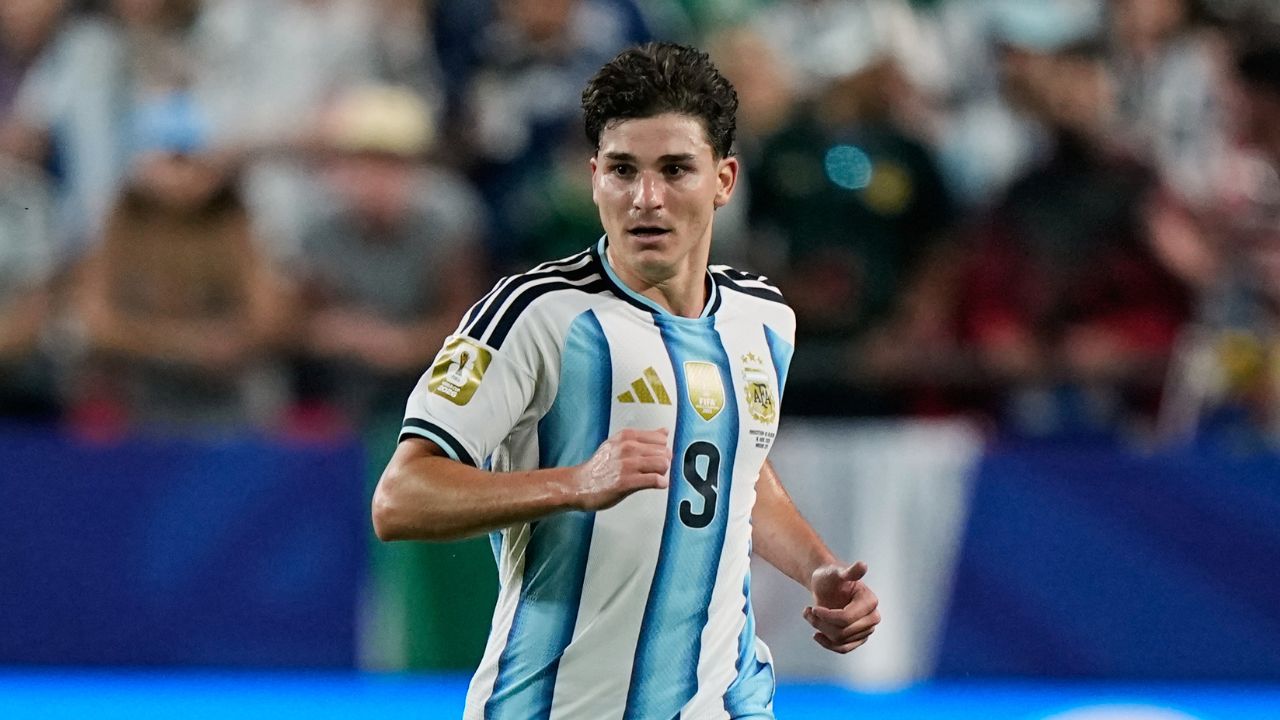
Speaking after Argentina’s 2-0 win over Austria on Monday, Atletico Madrid striker Julian Alvarez told assembled media he wants a transfer from the La Liga side, saying, according to an ESPN translation, “I think the best thing for everyone is a transfer. I want to fulfill my dream.”
Though Alvarez didn’t elaborate on what — or what team — constitutes his dream, he has already been at the centre of the perpetual tug-of-war between Real Madrid and Barcelona atop Spanish soccer’s hierarchy this summer.
Barca, which will require a new No. 9 to replace the departed Robert Lewandowski, has been linked with the Argentinian striker since before the domestic season ended. The reigning La Liga champions are Alvarez’s preferred landing spot, according to ESPN.
Advertisement
Now that Alvarez has made public his desire to move on from Atleti, the El Clásico foes will likely renew their historic rivalry in the transfer market. Though Madrid was the first to submit a bid for the attacker, Barca presumably has an edge if only through a greater appetite on Atleti’s side to do business with it as opposed to its local rival.
Since arriving at Atletico Madrid from Manchester City in 2024, Alvarez has scored 49 times across 106 appearances in all competitions.
You may well have seen one of these images yourself. Some have racked up millions of views as they go viral on social media.
One of the most-viewed of these images shows a fan in a World Cup stadium wearing a Germany jersey, waving a German flag and bearing a striking resemblance to Adolf Hitler, a fake that DW’s Fact Check team debunked shortly after Germany’s World Cup match against Curacao.
Some of these images we spot as fake right away; others we might easily mistake for real. Either way, they’re having an effect.
“It is an event that gets billions of people around the world from different countries, different regions, different political circumstances, all watching the same matches at the same time,” said Henry Ajder, one of the world’s leading experts on deepfakes and manipulative AI. “It is the perfect environment for people to start spreading deepfakes and AI generated content.”
Advertisement
Alongside more lighthearted World Cup deepfakes, plenty carrying political messages are going viral, too. DW Fact Check examined several of them and shows how you can spot the fakes yourself.
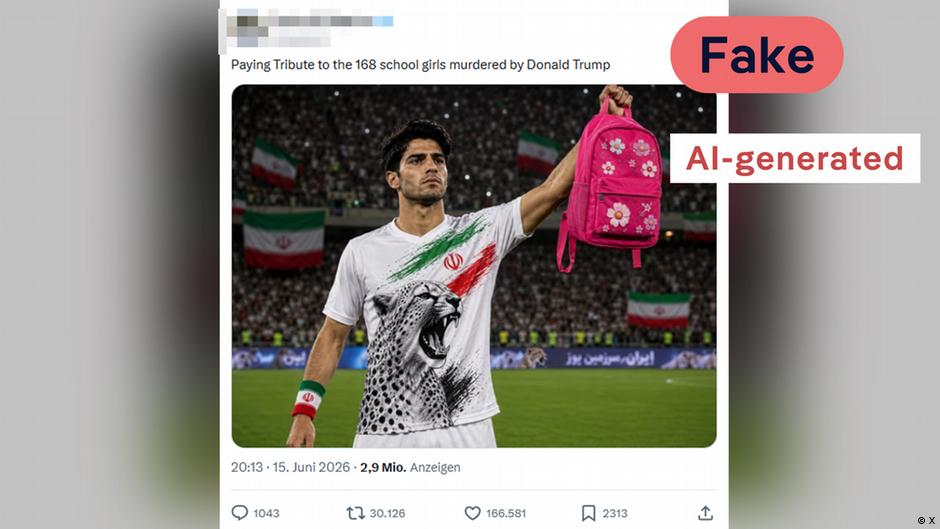
An Iranian protest with a pink backpack?
Before the conflict between Iran and the US had even ended, Iran kicked off its World Cup campaign against New Zealand, coming away with a point in a 2-2 (1-1) draw. But did one of the players really mark the result with a protest gesture?
An OpenAI analysis of this viral World Cup image shows that it was created using OpenAI toolsImage: Open AI
The image doesn’t show a scene from Iran’s World Cup match, and it doesn’t show any of Iran’s actual World Cup players, either.
Advertisement
No such protest took place during the match against New Zealand, and the player in the photo doesn’t match anyone on Iran’s World Cup squad.Iran’s actual World Cup jersey looks different, too. The stadium doesn’t match up either: the arena in the image looks noticeably different from the World Cup stadium in Los Angeleswhere the game was played; even the shape of the stands is different.
The fake does have a real event behind it, though: Iranian fans staged genuine protests in the stands at the Los Angeles match, some commemorating children allegedly killed by the US in a school in the Iranian city of Minab.
Reportingby outlets such as The New York Times and investigations by Bellingcathave pointed to possible US military involvement in that strike, which killed more than 150 people. But the viral image of a player protesting the incident is fabricated.
Keir Starmer in a Croatia jersey?
Would a British prime minister really pose in the rival team’s jersey right before England’s opening match? Seems unlikely, yet that’s exactly what social media would have you believe. A viral image circulating on X shows Starmer smiling alongside three other people in a pub, all of them wearing Croatia jerseys — England’s first opponent of the tournament.
Advertisement
Left: the real photo featuring Starmer (third from left); the photo on the right is fakeImage: Facebook/X
A quick Google search for “Keir Starmer pub football fans”turned up the original photo:same pub, same people — including former Labour deputy leader Angela Rayner — but different outfits. Three of them are wearing England jerseys, and Starmer is in a plain white T-shirt. The photo is actually two years old, taken around the 2024 European Championship in Germany.
In other words, the jerseys were digitally altered, almost certainly with the help of an AI tool.
The AI detector ZeroGPT flags a high probability that the image was AI-generated, and the jerseys themselves give it away: two have black collars, two have white ones, the Croatian federation (HNS) logos are blurry and inconsistent in size, and overall the jerseys look noticeably softer and less detailed than the sharply rendered faces.
Political protest isn’t exactly welcome at the World Cup, but it keeps happening anyway, as the Iran example shows. Some cases, though, are worth a second look.
A screenshot of an X post allegedly showing a protesting fan; the image is AI-generatedImage: X.com
Claim: “I’d trade the sixth title for Lula and Janja’s imprisonment. Would you support that?” reads a sign supposedly held up by a fan, in a photo that’s been circulating on X, among other places.
DW Fact Check: Fake
After a 1-1 draw to open the tournament against Morocco and a rocky run-up to the World Cup, it’s still an open question whether Brazil can dream of a sixth title. What is clear, however, is that the fan’s message is not real. ZeroGPT puts the probability that the image is AI-generated at 96%, and other AI detectors land in the same range.
Advertisement
A closer look backs that up. The handwriting on the sign is suspiciously neat for something supposedly scrawled by hand: the letters are too even, and the cardboard’s texture looks unnaturally smooth. The sign-holder’s face has a glossy, idealized look that’s become a telltale sign of AI generation.
Zoom in further and the background gets stranger still, with some faces looking unfinished, almost melting into the wall behind them. Other versionsof this fake have also turned up, showing different people holding the exact same sign, and AI detectors flag those as generated too.
A spectacular opening ceremony with an Iranian float?
Around 1.2 billion peoplewatched the opening ceremony of the 2026 FIFA World Cup at Estadio Azteca in Mexico City. Plenty of clips from it circulated on social media afterward, but some showed a show that simply never happened.
Advertisement
Users claim this video shows the World Cup opening ceremony, but it’s AI-generated footage
Claim: A videoshared on X claims to show the opening ceremony of the 2026 World Cup.
DW Fact Check: Fake
The nearly five-minute clip shows fireworks, dance numbers, and performances representing the participating nations. The real opening ceremony looked quite different and featured different artistic elements.
Watch closelyand the stadium itself gives it away. Across different shots, its roof is sometimes round, sometimes oval, sometimes open, sometimes closed, shape shifting repeatedly over the course of the “ceremony.”
Look even closer and the usual AI video tells appear: visual artifacts, warped objects, blurry faces. AI detectors again flag a high likelihood of generative AI here.
Advertisement
A separate video claiming to show a giant golden float symbolizing Iranat the same ceremony has the same problem; the stadium changes shape mid-video there too.
Deepfakes that leave a mark
Thanks to AI tools that are now both widely available and easy to use, fakes like these can be whipped up in no time, and at a mega-event like the World Cup, they spread almost as fast.
And they’re not harmless.
“These kinds of moments are really activating and really visceral to audiences. They play into narratives and really quite hot topics, so to speak, that people around the world are paying attention to,” Ajder said.
Advertisement
The takeaway for this World Cup: Keep a close eye not just on the matches, but also on whatever’s going viral online to not fall for fakes.
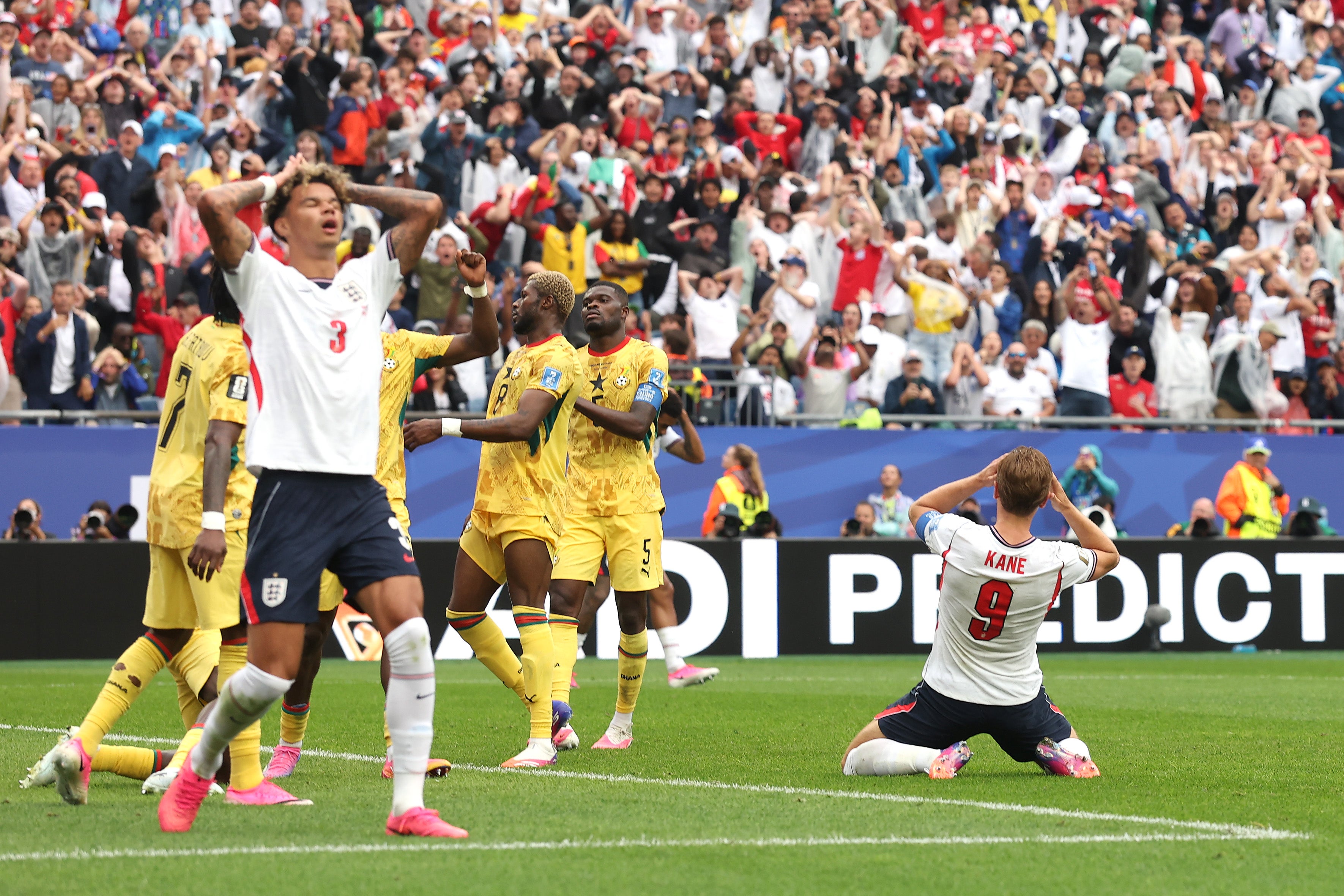
Thomas Tuchel was inches from being two from two; two games, two substitutes scoring. Even when Nico O’Reilly’s header thumped against the bar, the rebound fell obligingly for Harry Kane. “Ninety-nine times out of 100,” Tuchel argued, Kane would score. And if so, the manager may have been seen as a catalyst with his changes. Instead, Kane skied his shot.
As it is, England have one goal from a replacement this World Cup; a potentially significant one, too, with Marcus Rashford’s late clincher against Croatia. And yet, as Ghana shut England out, narrow as the margins were, it brought into question Tuchel’s strategy for providing bench strength.
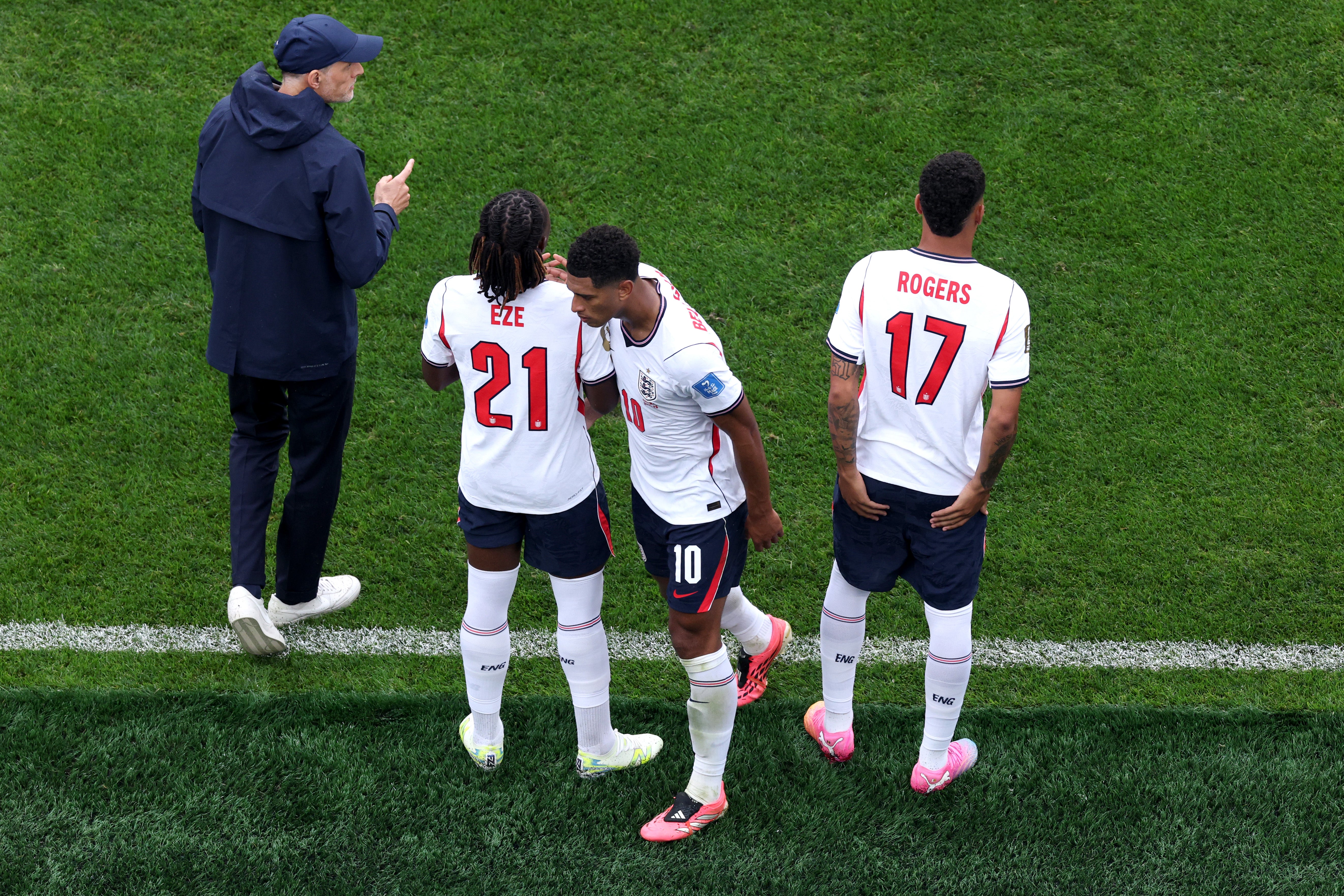
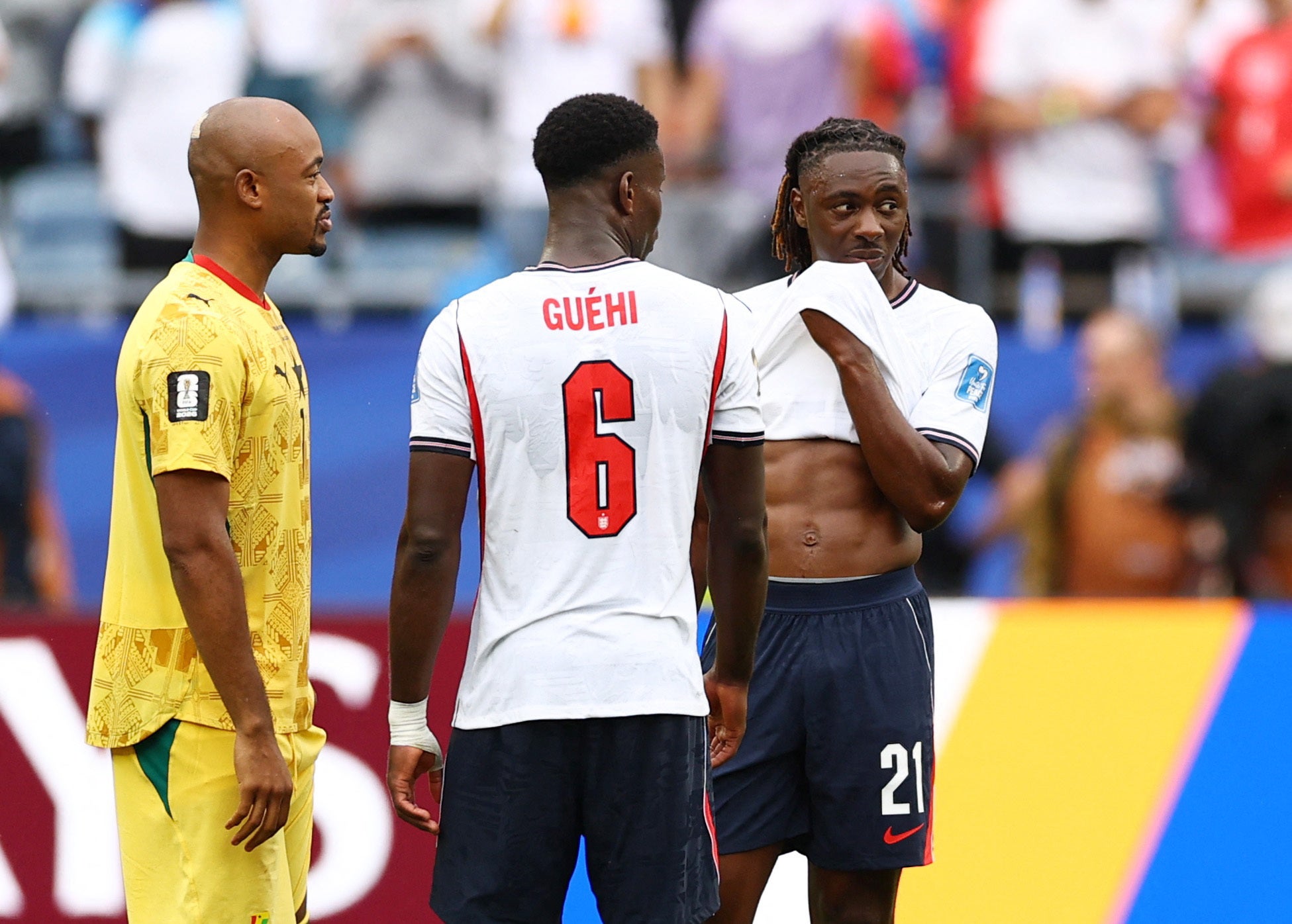
Jude Bellingham embraces Eberechi Eze and Morgan Rogers after being substituted (Getty)
The German’s blueprint can be for more of the same, for like-for-like replacements. On the left wing, Anthony Gordon and Rashford share plenty of characteristics, and bringing on the Mancunian for the similarly speedy Merseysider worked well against Croatia. On the right, Bukayo Saka and Noni Madueke even share a club, the 2025 signing understudying Arsenal’s homegrown talent for Mikel Arteta and presumably doing so again on international duty when the brighter star is fit enough to start.
Jude Bellingham and Morgan Rogers are Midlanders and friends. The Aston Villa man may not have the talent of the Real Madrid player but Bellingham’s route back into the side, seemingly, was to emulate Rogers’ role as the No 10 in autumn.
As for the back-up strikers, Ollie Watkins and Ivan Toney may not be Kane clones, but they are less likely to be seen anyway. “Does Argentina rely too heavily on [Lionel] Messi and France on [Kylian] Mbappe?” Tuchel asked rhetorically. “It is normal. They are world-class players and they do what they do.”
Nico O’Reilly and Harry Kane of England react after a missed chance (Getty)
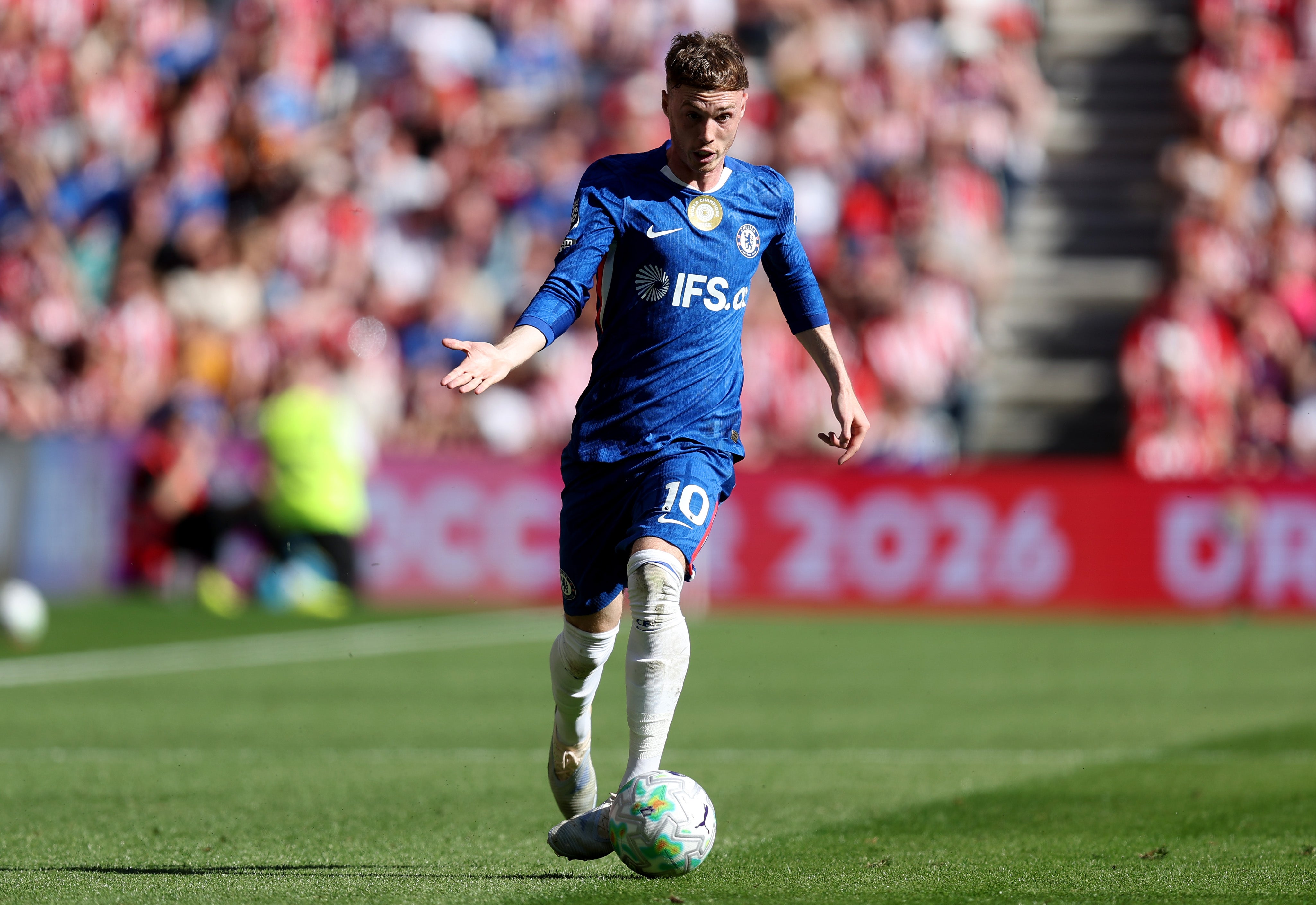
But the flaw in the formula may come when England are not winning; when Plan A is not working, is Plan B to offer more of the same, merely with new faces and fresher legs? Tuchel took the choice to omit players with other skillsets. Phil Foden and Cole Palmer could be called the mavericks, or simply footballers whose poor seasons meant their form did not merit selection. Each is true – though Morgan Gibbs-White, with his 15 Premier League goals, is entitled to feel his recent efforts merited a spot – but Foden and Palmer remain two of English football’s greatest talents.
The Chelsea man’s prowess as an impact substitute was displayed in Euro 2024, albeit after a glorious season at club level. But he came off the bench to score in the final and in itself, that offered a compelling reason to recall him.
Advertisement
Tuchel did not want to pack his squad with No 10s; too many might have been a distraction, and certainly would have brought more questions about anyone who was marginalised. But the slot as the third potential No 10 that might have gone to Foden or Palmer instead went to Eberechi Eze; fine a player as he is, he is surely less of a difference-maker at elite level.
Cole Palmer could have offered England a wildcard option off the bench (Getty)
And the expansion to 26-man squads ought to leave room for a wild card; instead, the closest England came to having one was O’Reilly, the box-crashing converted midfielder who is a distinctly unorthodox left-back.
Their issues were partly personnel, partly tactical. “I don’t think we become predictable with wide wingers,” insisted Tuchel, despite evidence to the contrary. But the thinking was to have someone chained to the touchline on either flank. It explains why Palmer, more of an inside-forward, is not his type of wide man.
When Tuchel talked of England having “repetitive attacks”, that was part of the problem. They lacked the capacity to switch emphasis. They attacked too little in the middle; another central creator might have been able to unlock Ghana’s defiant defence.
It is unclear if Eberechi Eze can be a difference maker at this level (Reuters)
Tuchel opted to go without the closest thing to a pure playmaker from deep England have, in Adam Wharton, instead preferring Jordan Henderson and Kobbie Mainoo. He twice omitted – once in his initial squad, then when Tino Livramento pulled out – the most inventive right-back at his disposal, in Trent Alexander-Arnold, instead eventually going for Trevoh Chalobah.
So he plumped for a group with a common purpose and shared strengths. It meant the second XI looks like the first, only worse.
Advertisement
It was not the approach some of his peers took. England possess plenty of gifted attackers. So do France but, in Rayan Cherki and Jean-Philippe Mateta, Didier Deschamps seemed to deliberately bring in two who do not resemble the starters.
In contrast, Tuchel seemed to want a diet of the same. And against Ghana, England perhaps could have benefited from a penetrative pass from Wharton, a devilish cross from Alexander-Arnold or, most obviously, a long shot from Palmer.
When they looked to the bench, they needed some x-factor. But the men who might have supplied it had been excluded from the squad.
NEW DELHI: Daniel Muñoz scored the decisive goal as Colombia beat DR Congo 1-0 on Tuesday to become one of the first teams to secure a place in the FIFA World Cup knockout stage.The defender found the breakthrough in the 76th minute after a tightly contested match in Guadalajara. Muñoz’s left-footed effort from inside the box took a deflection off a defender before finding the back of the net, leaving DR Congo goalkeeper Lionel Mpasi with no chance.It was Muñoz’s second goal of the tournament and enough to give Colombia their second straight victory in Group K.For much of the game, Mpasi kept DR Congo in the contest with an outstanding performance. The goalkeeper made five difficult saves in the opening 20 minutes as Colombia dominated possession and created several chances.DR Congo almost snatched a dramatic equaliser in stoppage time. Nathanael Mbuku tested Colombia goalkeeper Camilo Vargas with a powerful long-range strike, but Vargas produced a superb save. Moments later, he denied Chancel Mbemba’s header from the resulting corner to preserve Colombia’s lead.Colombia thought they had sealed the game late on through Luis Díaz, but the Liverpool forward saw two goals ruled out within two minutes. One was disallowed for a foul and the other for offside.The African side had impressed in their opening match by holding Cristiano Ronaldo’s Portugal to a 1-1 draw, but they could not repeat that result against a clinical Colombian team.With six points from two matches, Colombia now sit top of Group K and have booked their place in the round of 32. Portugal are second after their 5-0 victory over Uzbekistan, while DR Congo remain on one point.A draw against Portugal in their final group match will be enough for Colombia to finish as group winners.The match also featured the return of DR Congo’s famous supporter Michel Nkuka Mboladinga, popularly known as “Lumumba Vea”. The fan, who became a viral sensation during the Africa Cup of Nations for standing like a statue throughout matches, attended the game after missing the team’s opener because of Ebola-related quarantine rules.Colombia, who failed to qualify for the 2022 World Cup, have made an impressive return to the tournament with back-to-back wins. Veteran playmaker James Rodríguez also reached a milestone, joining Colombian greats Freddy Rincón and Carlos Valderrama with 10 World Cup appearances.
After a swirl of trades and rumours of trades in recent days has helped give a new outline to the Eastern Conference, for the Toronto Raptors, Tuesday night was a moment of relative calm, a pause in a continuing storm.
It was time to do what an NBA front office is supposed to do: Choose the best player available when their turn comes around.
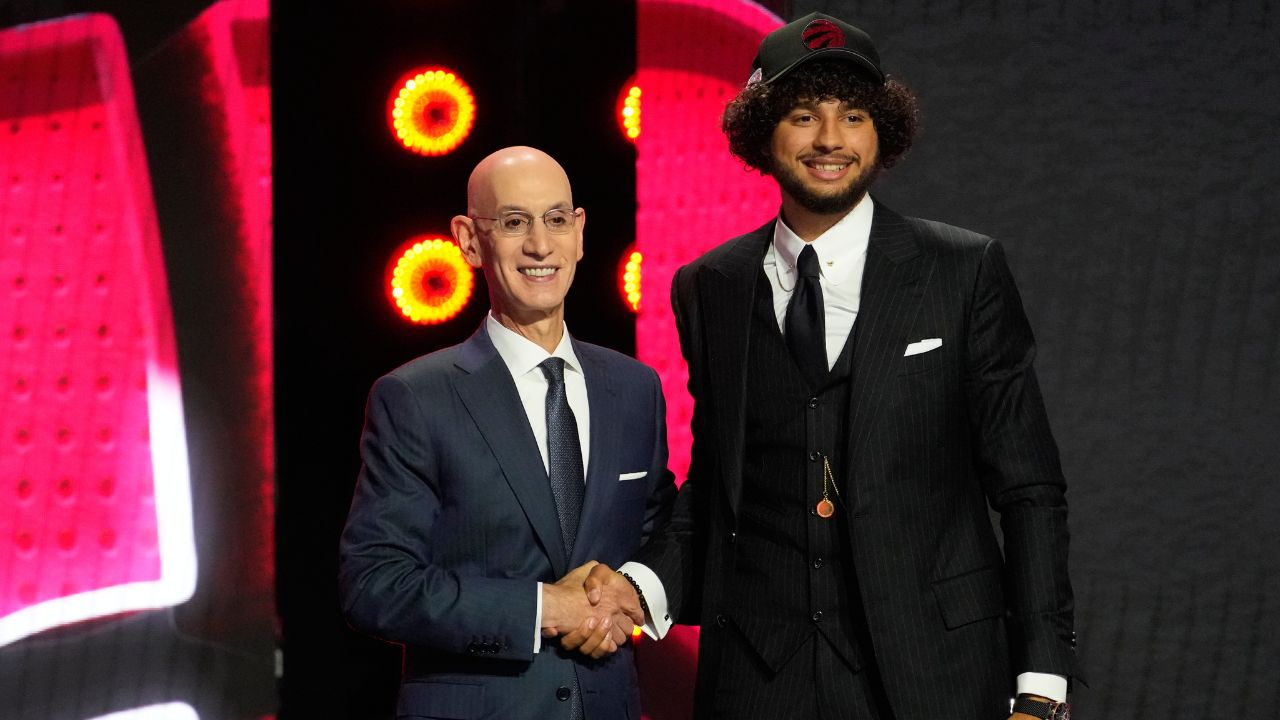
The Raptors, picking 19th, were inevitably dependent on who was taken before them. In the end, they got Allen Graves, a player they had been hoping would be available all along and who multiple sources had indicated to me was high on their board of eligible prospects.
Advertisement
A six-foot-eight freshman from the University of Santa Clara, Graves fits a lot of what the Raptors want to do under head coach Darko Rajakovic, as he jumped out on analytical models for his ability to gain possessions by way of his remarkable steal rate (1.9 in 22 minutes per game) and knack for offensive rebounding (2.8 per game). That he can shoot — he converted 41.3 per cent on nearly three attempts per game from deep — is a bonus.
“As a player, he’s a high processor, two-way player, wins the possession game, I think, on both ends of the floor,” said Raptors general manager Bobby Webster. “Obviously a developing player as well, just played one year of college, so he’ll have the usual and typical adjustment to NBA pace, speed, quickness. But sort of a young prospect that we think does a few things really well on the defensive end, and then offensively, obviously shooting, feel for the game. So we thought we got one of the better two-way players in the draft.”
Never let it be said the Raptors don’t have a type when it comes to big wings who can defend. Webster’s initial vision for the newest Raptor?
“Most likely I see him wreaking havoc (on defence( with CMB (Raptors forward Colin Murray-Boyles), right? That’s probably the easiest one.”
Advertisement
The Raptors have had considerable success picking in the middle and bottom third of the draft in the past. Most recently, Ja’Kobe Walter, taken 19th as a freshman out of Baylor in the 2024 draft, emerged as a key rotation player on a playoff team midway through his second season. In previous years, the Raptors have had success drafting Delon Wright (20th) in 2015, Pascal Siakam (27th) in 2016 and OG Anunoby (23rd) in 2017. If Graves approaches that level of success in any way, shape or form, the Raptors would undoubtedly be thrilled.
For his part, Graves, 19, seems determined to give his best shot. In addition to the way his attributes popped on the Raptors’ analytical models, Graves also made a positive first impression on a personal level when he visited the team’s practice facility during the draft process.
He certainly sounds like he’s got a firm grasp of his path towards earning minutes in the Raptors rotation.
“I feel like I have a great feel for the game, very cerebral player, just offensively, just being able to be that connector piece,” Graves said after being selected. “I don’t need the ball in my hands. I don’t need to score a certain amount of points. But just being able to make the winning plays, being able and willing to do anything that the team needs of me, and then on the defensive end, just being able to win the possession battle: deflections, steals, things like that, and rebounding. That’s where I plan to impact most.”
Advertisement
But for all the promise Graves might have — not to mention who the Raptors might draft with the 50th pick when the draft resumes Wednesday — there are more immediate concerns the Raptors will need to sort through if they plan on maintaining or improving on the fifth-place finish they earned in the Eastern Conference last season.
“Now we’ll turn our attention … to trades and free agency,” said Webster. “I think people saw a couple big deals that went down, and not that they were holding up the rest of the league, but I think they gave everyone a chance to exhale. And we’ve been stockpiling a lot of assets (over the years), having our first-round picks, having players under rookie scale contracts (and) that’s allowed us to build and be the youngest team in the playoffs. But at a certain point, we want to be opportunistic in the trade market, and so now we’ll look to do that over the course of the summer and even into the trade deadline next season.”
The conference has shifted significantly with the reported trade of two-time MVP Giannis Antetokounmpo to the Miami Heat, a deal that can’t be made official until July 6th. Whether adding the oft-injured 31-year-old Milwaukee Bucks star will age well, it’s hard to argue that the Heat — who finished 10th last season — won’t improve as long as Antetokounmpo can stay healthy. The 2025 NBA finalist Indiana Pacers should rebound to the top tier of the East after an injury-driven slide this past season, the upstart Charlotte Hornets have another year of growth under their belts, and the bottom-feeding Washington Wizards seem ready to pivot to competitive relevance.
In addition, the Bucks’ trading of Antetokounmpo could have a domino effect, with Boston Celtics star Jaylen Brown reportedly a trade target after he was offered to Milwaukee in a potential deal, and the Bucks are clearly open for business after moving on from their long-standing franchise superstar.
Advertisement
NBA sources I’ve spoken with have connected the Raptors to Bucks centre Myles Turner, with the possibility that Raptors centre Jakob Poeltl, third-year wing Gradey Dick and potentially draft compensation being the core of a deal that would net Toronto the veteran big with credentials as a rim protector and three-point threat.
Absent that, the Raptors will likely need to clear out some salary to have a better chance at re-signing stretch big man Sandro Mamukelashvili, whose perimeter shooting gives him an outsized significance to the Raptors lineup.
Keeping Mamukelashvili will likely require the Raptors to cut ties with Dick, their 13th pick in the 2023 draft, who is looking for a change of address in any case after falling out of the rotation after the all-star break. And until Toronto reaches an agreement on an extension with RJ Barrett — talks will likely be picked up at Summer League in Las Vegas next month — the future of the Canadian national team star with Canada’s lone NBA team will remain a question mark as he heads into the last year of his deal.
The Raptors first-round pick is on the books, but the rest of their off-season is a series of chapters yet to be written.
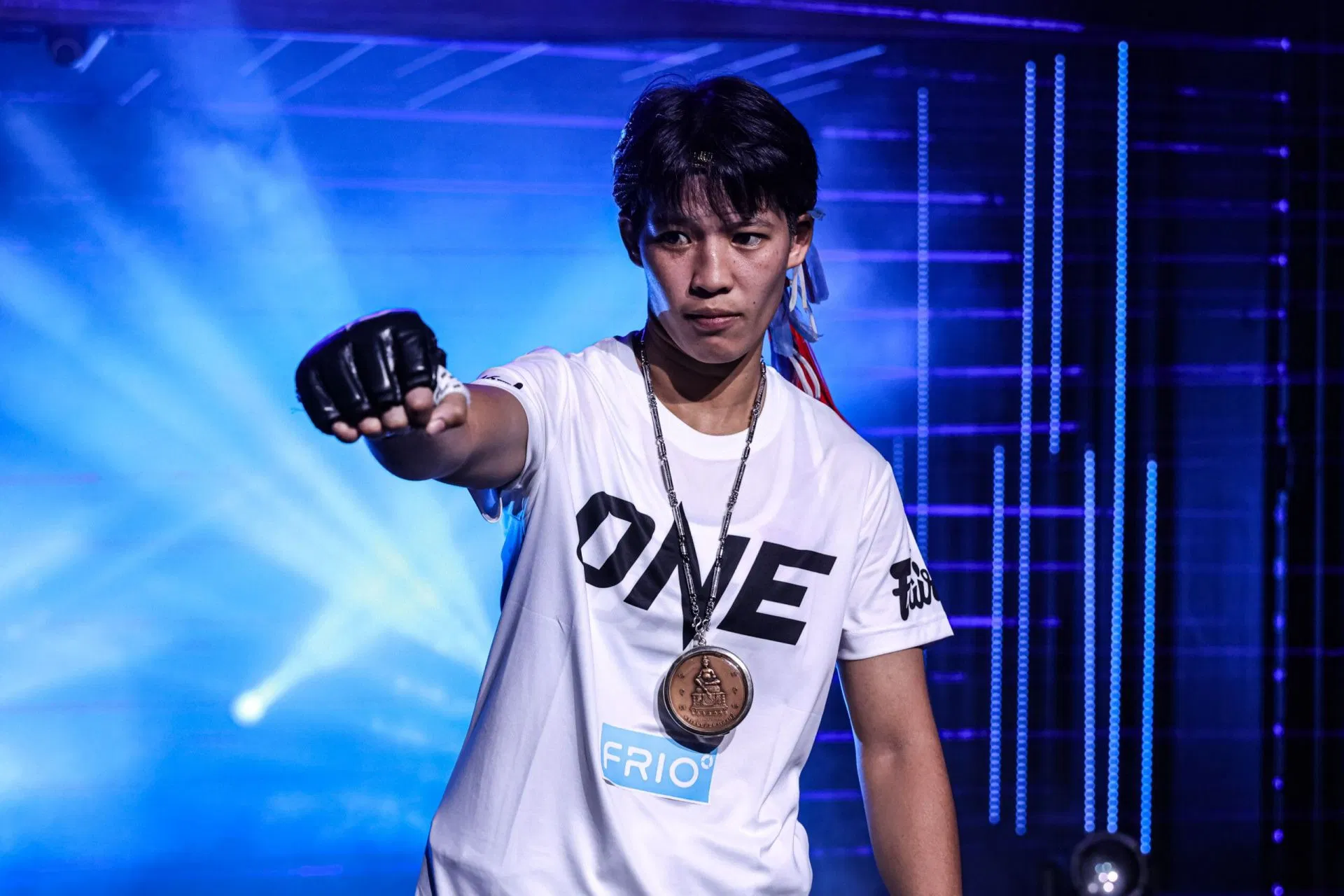
Five rounds of Muay Thai are a different beast entirely. Phetjeeja ‘The Queen’ Lukjaoporongtom found that out the hard way at The Inner Circle 19 at Lumpinee Stadium in Bangkok, Thailand.
She pushed Allycia Hellen Rodrigues to the limit in stretches, landing sharp right hands in the second and fourth rounds and making the Brazilian work through every minute of a gruelling five-round atomweight Muay Thai world title war.
Phetjeeja had been competing regularly in kickboxing, but the specific demands of a traditional five-round Muay Thai fight had not been part of her reality for years.
Advertisement
Get the latest updates on One Championship Rankings at Sportskeeda and more
Slower pace, more clinch, different rhythm, different energy system. Her body simply hadn’t been primed for it.
“I realized tonight that my conditioning for a full five-round traditional Muay Thai fight wasn’t where it needed to be. This was my first time going the full five rounds in Muay Thai in a very long time… For Kickboxing, it’s been about a year or a year and a half. But for traditional five-round Muay Thai? It’s been several years. A really long time. So we can look at this fight as a way to shake off the rust.”
Phetjeeja admits she was taken aback by Allycia Hellen Rodrigues’ physicality
Phetjeeja knew the clinch is Allycia Hellen Rodrigues’ biggest strength.
“If we’re talking about pure strength, honestly, she isn’t that much stronger than me. I felt I could hold my own against her inside. But when it came to the force of impact during collisions, I lacked that.”
The Inner Circle replay is available for Inner Circle Superfan Club members at live.onefc.com
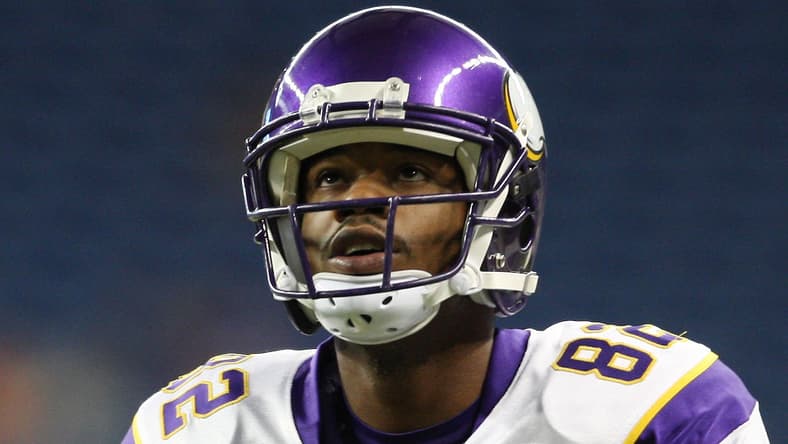
Sep 16, 2007; Detroit, MI, USA; Minnesota Vikings wide receiver Troy Williamson (82) warms up prior to the start of the game aginst the Detroit Lions at Ford Field. The Lions defeated the Vikings 20-17 in overtime. Mandatory Credit: Leon Halip-US PRESSWIRE
The Minnesota Vikings have encountered a handful of draft busts throughout franchise history — some recent ones, even — but for Bleacher Report‘s sake, former wideout Troy Williamson takes the cake.
BR’s collective staff identified the Top 99 draft busts in sports history, and Williamson checked in at No. 49. He was the only Viking to grace the naughty list.
Williamson’s Production Never Matched the Draft Spot
Minnesota Vikings receiver Troy Williamson warms up before a divisional matchup against the Detroit Lions at Ford Field. On Sep. 16, 2007, Williamson prepared for one of his final appearances with the Vikings as the club sought an early-season road victory. Detroit eventually defeated Minnesota in overtime. Mandatory Credit: Leon Halip-US PRESSWIRE.
BR: Williamson 49th on Top 99 Draft Bust List
Williamson basically represented the midway point of the BR list, as Davenport wrote, “Remember Troy Williamson? Yeah. The Minnesota Vikings wish they didn’t, too. In 2005, the Vikings needed a deep threat after trading Randy Moss, so the team used the pick obtained in the trade to select Williamson, a speedster from South Carolina.”
Advertisement
“As a rookie, Williamson had over five times as many drops (11) as he did touchdowns (2) — an issue that was famously blamed on ‘depth perception.’”
Years later, Williamson would reveal mental health as a source of his career troubles. In fact, in terms of understanding and empathy, he was about a decade too late for those who wanted to learn about his story. Mental health awareness was not the same in 2007 as in 2017 or today.
Davenport continued, “Williamson himself later admitted that his lack of early success and the criticism that came with it rattled him, and after three years, 79 receptions and three touchdowns, Williamson was traded to Jacksonville for a sixth-round pick. High Vote: 49.”
Advertisement
The Career
Williamson’s NFL career can be summarized as a high-draft pick with exceptional speed who just flat-out failed to launch.
The Vikings selected Williamson seventh overall in the 2005 draft, anticipating an abundance of big plays from his impressive speed. Those expectations were unmet. In three seasons with Minnesota, he recorded just 79 receptions for 1,067 yards and 3 touchdowns. His most productive year was 2006, with 455 receiving yards, but he never achieved a breakout season.
For a Top 10 pick, his career receiving statistics are remarkably low: 87 catches, 1,131 yards, and 4 touchdowns across 49 games, averaging roughly 23 receiving yards per game. While he did contribute as a kick returner, with 47 returns for 987 yards, this wasn’t enough to salvage his receiving career.
Advertisement
A subsequent opportunity with Jacksonville proved equally unproductive, yielding only 8 catches for 64 yards and a touchdown.
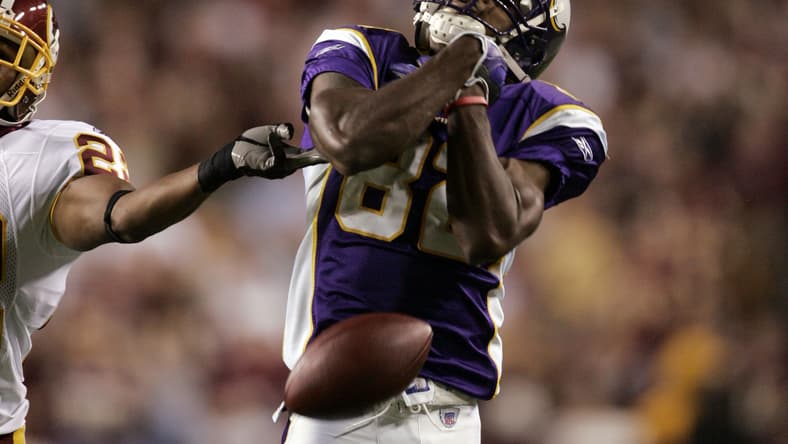
Minnesota Vikings wide receiver Troy Williamson attempts to make a catch against Washington during first-quarter action at FedEx Field. On Sept. 11, 2006, Williamson continued his second NFL season while trying to establish himself as Minnesota’s top receiving threat. The former first-round pick remained one of the league’s most scrutinized young receivers. Mandatory Credit: James Lang-USA TODAY Sports.
In short, Williamson possessed raw talent and received ample opportunities as a high draft pick. He was just unable to translate that potential into NFL production.
Shoes Too Big to Fill
On March 3rd, 2005, the Vikings traded Moss to the Oakland Raiders for linebacker Napoleon Harris, the seventh overall pick — Williamson — and a 7th-Rounder, which would turn into cornerback Adrian Ward, who was waived six months later.
Fans were distraught about the Moss trade; it would be similar to Minnesota trading Justin Jefferson next March. The only would-be savior at the time was Williamson, tabbed directly as Moss’s replacement. He was the one chance to erase the ill will of the Moss trade. And that just didn’t happen.
Advertisement
Drops plagued Williamson, and even without those, he simply wasn’t on Moss’s level or anywhere near it.
Other Vikings’ Draft Busts
Minnesota largely escaped BR’s scorn, but that doesn’t mean it’s had a quiet “bust” history. These are arguably the main busts in Vikings’ history, listed alphabetically:
A few blocks away from the Vikings’ stadium, the Minnesota Timberwolves were represented a few times on the BR list, as Any Bailey wrote about 2011 draft pick Derrick Williams, “During his sophomore season at Arizona, Derrick Williams looked like a can’t-miss prospect. He had prototypical combo forward size. He could ferociously finish above the rim. And he somehow shot a blistering 56.8 percent from deep.”
“But as has happened with others, that size made him more of a tweener than anything else. His outside shooting never translated to the NBA. And he didn’t do nearly enough in the ancillary categories to keep him on the floor. He was out of the league by his mid-20s.”
Advertisement
Minnesota Vikings receiver Troy Williamson runs along the sideline during a Christmas Day matchup against the Baltimore Ravens at M&T Bank Stadium. On Dec. 25, 2005, the rookie wide receiver appeared in his first NFL season while Minnesota battled Baltimore on the road. Williamson entered the league as the seventh overall draft pick. Mandatory Credit: Jason Parkhurst-USA TODAY Sports.
Variations of the “Williams” last name evidently have rough draft luck in Minnesota.
Timberwolves guard Johnny Flynn checked in at No. 38, and Minnesota North Stars LW Brian Norton ranked No. 51. BR called Oakland Raiders quarterback JaMarcus Russell the top bust in sports history.
Dustin Baker is a novelist and political scientist. His second novel, The Invaders , is out now. So is … More about Dustin Baker
It will be fascinating to see how much of the old magic Neymar can conjure, but you suspect if Brazil are to be a fixture at the business end of this tournament, it will be Vincius who will be the catalyst.
Two goals in two games, including a fabulous equaliser when Brazil were 1-0 down and struggling with the all-round excellence of Morocco, has prevented an underwhelming start to the tournament becoming something more concerning.
“He’s playing very well,” said Ancelotti, who managed the Brazilian star at Real Madrid before taking over the Selecao in 2025.
“We need to use him even though we have other fantastic players. We have experience, quality and legs. I’m completely satisfied [in] all of them.
Advertisement
“I have to put all the players to adapt to the style of the team.”
And therein lies the genius of Ancelotti – taking the big superstars and their bigger egos and making them work as a cohesive unit.
He is the most decorated manager in Champions League history with five trophies, and the only man to win titles in all of Europe’s top five leagues.
But leading Brazil to World Cup success would further elevate the Italian’s claim to be the greatest manager ever.
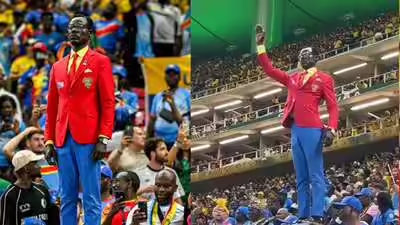
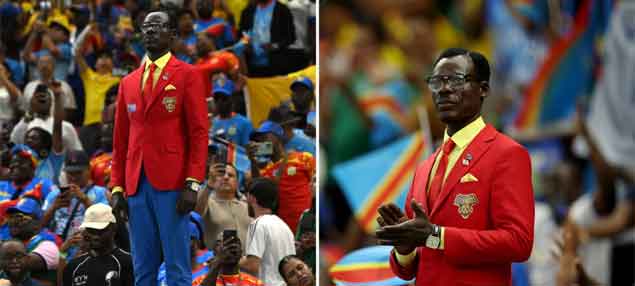
NEW DELHI: One of DR Congo’s most famous football supporters finally got his moment at the FIFA World Cup on Tuesday.Michel Nkuka Mboladinga, better known as Lumumba Vea, attended DR Congo’s match against Colombia after missing the team’s opening game against Portugal because of Ebola-related quarantine requirements.The supporter became a global sensation during the 2025 Africa Cup of Nations, where he spent entire matches standing completely still like a statue. Dressed in colourful suits and holding one arm in the air, he quickly caught the attention of television cameras and football fans around the world.Ahead of the Colombia match at Estadio Akron, Mboladinga arrived early and took his place behind the DR Congo bench. Wearing a bright red jacket and tie, a yellow shirt and blue trousers, he once again transformed himself into a “living statue”, standing motionless on a pedestal with his right arm raised.Although he did not speak to reporters, he smiled and nodded when asked if he was happy to finally be at the World Cup.His journey to the tournament has not been straightforward. Earlier this year, Mboladinga also missed DR Congo’s World Cup playoff against Jamaica because he could not secure a visa in time. He had travelled to Kenya and Ethiopia in an attempt to obtain the necessary documents, but was unable to make it to the match.His appearance is a tribute to Patrice Lumumba, DR Congo’s first Prime Minister and one of the country’s most important historical figures.
Lumumba played a key role in ending Belgian colonial rule in 1960 and became the leader of the newly independent nation. However, he was assassinated less than a year later during political unrest linked to a separatist movement in the Katanga region.Mboladinga’s raised arm, formal clothing and still posture are all inspired by monuments and images of Lumumba, which is why he is widely known as Lumumba Vea.His unique support has made him one of the most recognisable fans in international football and a symbol of DR Congo’s passion for the game.After missing the opening match against Portugal, many supporters were delighted to finally see the famous “statue fan” take his place in the stands at the World Cup.
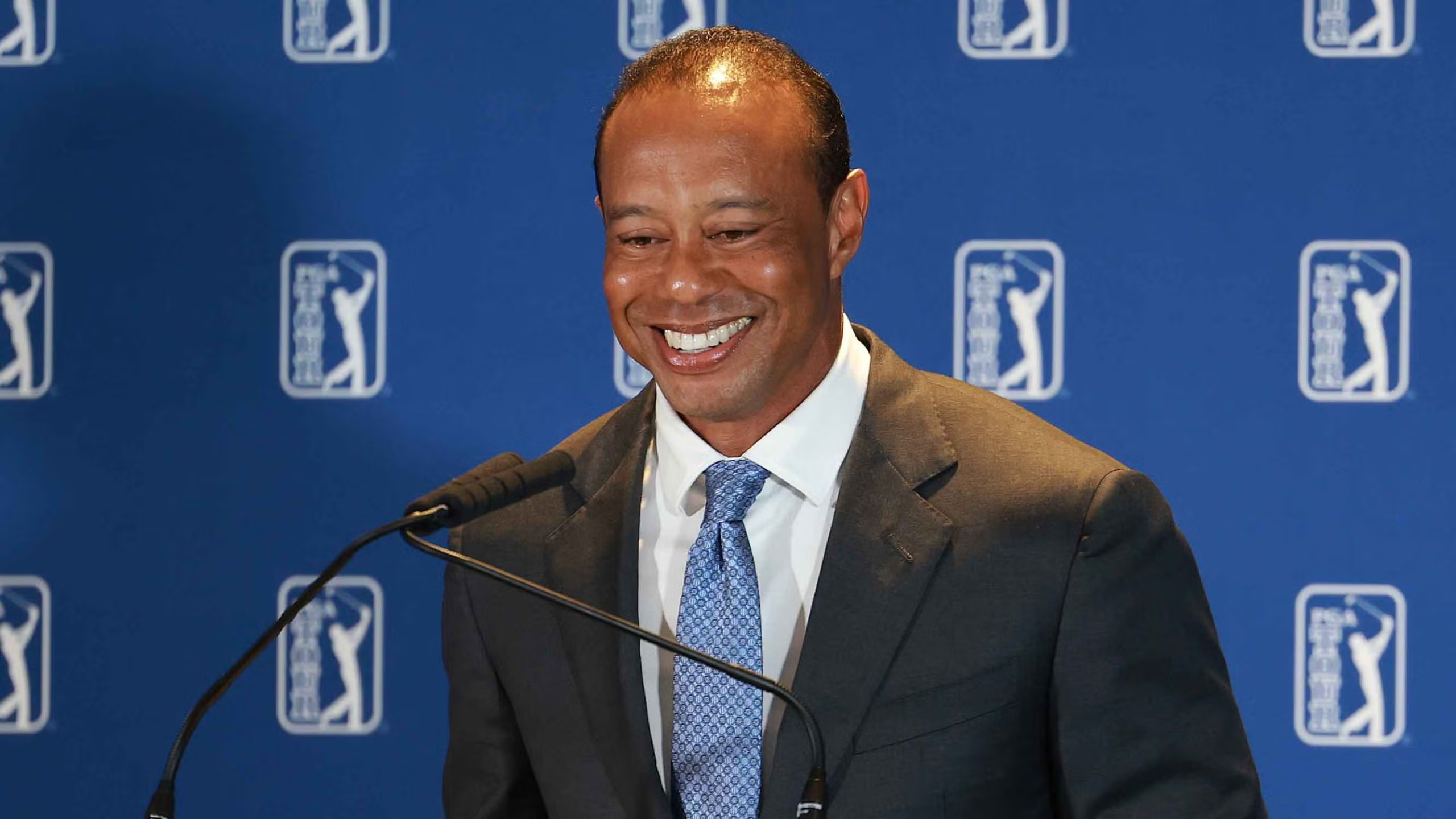
There was a Tiger Woods sighting in Cromwell, Conn., just south of Hartford, Tuesday morning.
Woods, who hadn’t made a public appearance since he rolled over his Range Rover on a South Florida roadway on March 27 and was arrested on suspicion of DUI, was in town to help announce sweeping changes to the PGA Tour’s competitive structure.
The setting: the PGA Tour’s eighth and final Signature event of the 2026 season, the Travelers Championship at TPC River Highlands. We’ve known for some time that big news would be coming this week, in the form of PGA Tour CEO Brian Rolapp revealing details about the Tour’s new relegation model for 2028 and onward. But not until Woods appeared in the Travelers press tent at approximately 10 a.m. local time did we know he’d also be a part of the proceedings.
Woods wore a charcoal suit and light-blue tie paired with sensible soft-spike golf shoes. He looked good, certainly far better than he did the last time the prying eyes of the world saw him, by way of footage from the Martin County Sheriff’s Office, that showed Woods handcuffed and sweating in the back of a squad car with a blanket over his head.
Advertisement
Woods didn’t say much Tuesday: 150 words, for those not counting at home. But his presence, as it always does, held weight. For one, he was back from a reported six-week stay at a rehabilitation center in Switzerland. Good on him. For another, he was reasserting himself, in the public eye, anyway, as a Tour mover and shaker, specifically in his role as chairman of the PGA Tour’s Future Competition Committee, a nine-member board that has driven many of the changes Rolapp and the Tour announced Tuesday.
It’s unknown how much, if at all, Woods contributed to committee matters during his time abroad (Woods did not take questions on Tuesday), but in his remarks he said he was “proud of the work we’ve done and am grateful to everyone who’s contributed along the way.”
Woods also said, “This work was never about any one player or person. It was about bringing together different perspectives, having honest, hard conversations, and thinking boldly about what is best for the game that we all love.”
When Woods, who delivered his commentary from a clear-plastic podium, passed the baton to Rolapp, the CEO said, “Thank you, Tiger. I think I speak for all of us, glad to see you back.”
Advertisement
Much has happened in the golf world since Woods’s arrest: three men’s major champions were crowned (Rory McIlroy, Aaron Rai and, just last week, Wyndham Clark), while on the women’s side, Woods’s former Nike stablemate, Nelly Korda, has been running the table. As all that fun has been unfolding between the ropes, Rolapp and the Tour’s fleet of committees, investors and other assorted advisors have been grinding in board rooms and virtual meetings. “A lot of Zoom calls,” Maverick McNealy, an FCC member and co-chairman the Tour’s Player Advisory Council, said Tuesday in a presser of his own.
“I think one of the best benefits of the schedule that hasn’t been talked about as much is how much of our membership is going to have schedule predictability now,” McNealy said. “It was really something that was reserved for the top 30, maybe the top 50 players, knowing what they were going to play in at the start of the year, and now we’ve got over 200 members that are going to know January 1st every tournament that they’re in. That’s going to be a huge quality of life thing.”
Woods’ quality of life, with his sundry injuries and personal struggles, surely has been mixed of late. He will be 52 when the Tour’s new model is instituted and, barring him adding to his haul of 82 Tour titles between now and then, will be almost a decade removed from his last Tour victory. How aging-out stars, even one of Woods’s outsized stature, will fit into the reimagined, more cutthroat Tour is one of the questions that remains to be answered.
“When the dust settles, there will be a clear form of eligibility, and how you earn your way into the Championship Series will be clear,” Rolapp said of the Tour’s new upper rung. “Career milestones and accomplishments, how do we deal with that? Current ones and in the future. I think we’re still working on that, and I think there’s an effort from the committee to recognize career accomplishments. But at the end of the day, it will be the meritocracy that wins out.”
Advertisement
In 2024, the Tour created a special sponsor exemption for Woods and Woods alone, based on his “exceptional lifetime achievement.” The exemption grants him entrée to all of the Signature events. When asked whether that exemption will remain intact beyond 2027, a Tour spokesperson told GOLF.com that decision will be made later, adding, “They are looking at those types of exemptions and if they fit with the new model being truly meritocratic.”
Is there a world in which Tiger bleepin’ Woods could be on the outside of the Tour bubble looking in? Given he does for golf tournaments what rising tides do for ships, it’s hard to fathom — but also too soon to say. In the meantime, it’s nice to have Woods back in any capacity.
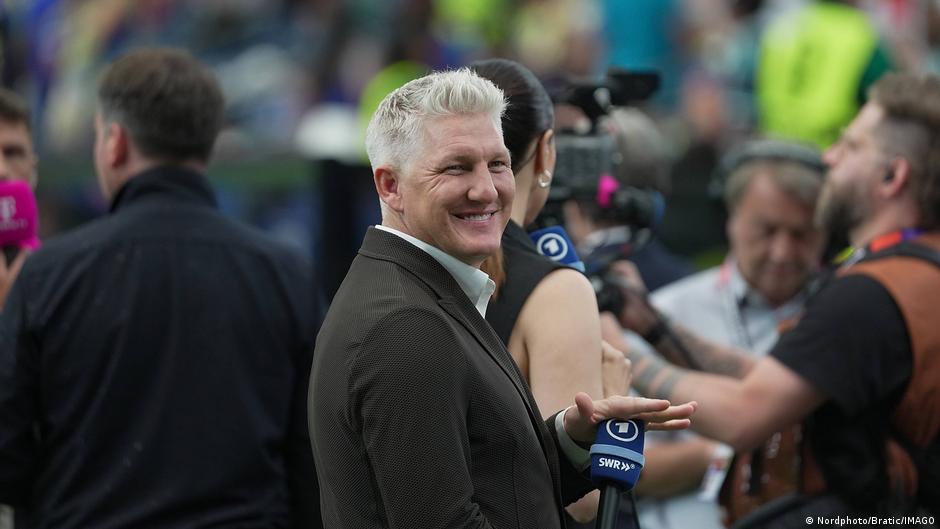
Former German international footballer Bastian Schweinsteiger has been accused of employing racist stereotypes in his analysis of Germany‘s most recent World Cup opponents, Ivory Coast, at the weekend.
Ahead of the Group E clash in Toronto, which Germany won 2-1, Schweinsteiger said in his role as a pundit for German public broadcaster ARD that the Ivorians played “African football” which he characterized as “a bit unorthodox sometimes, a bit wild, not quite as tactical.”
The 2014 World Cup winner said Germany needed to be “prepared for it to be unpredictable at times.”
Advertisement
Why were Schweinsteiger’s comments problematic?
Schweinsteiger’s comments prompted reactions on social media and in German mainstream media accusing him of using racist and colonial tropes which reduce Black people to supposed physical attributes rather than crediting them with intellectual ability. The former Bayern Munich and Manchester United midfielder has yet to publicly comment on the matter.
“Behind attributions like ‘wild’ and ‘unpredictable’ are stereotypes which are older than football and which have racist, colonial roots,” explained Philipp Awounou, a Black German journalist and author, in a column for Spiegel news magazine.
“In the past, Black people of African heritage were stigmatized as uncivilized (‘wild’), different (‘unorthodox’) and potentially dangerous (‘unpredictable’).”
“These are racist stereotypes,” sports content creator Patrick Schnitzler told his 50,000 followers on Instagram, referring to recent academic studies which have revealed that commentators and fans are more likely to comment on Black footballers’ physical attributes than those of non-Black players.
Advertisement
“We learn such stereotypes because we have grown up in a society with stereotypes,” he said. “Schweinsteiger, too. You and me, too.”
‘Schweinsteiger is not a racist’
Awounou insisted that he does not believe Schweinsteiger is racist. “That’s simply wrong,” he said. “Regardless of his problematic remarks, Schweinsteiger is absolutely not a racist and shouldn’t be labeled as such.”
He did suggest, however, that the 41-year-old’s comments “reflected the opinion of many German football fans and experts” – opinions which, incidentally, weren’t borne out by reality on Saturday.
Particularly in the first half, Ivory Coast produced a tactically solid performance against Germany, forcing Julian Nagelsmann‘s team into wide areas and restricting them to crosses and long-range shots – unsurprisingly for a team which didn’t conceded a single goal in qualifying and whose players have almost all played at top European clubs.
Meanwhile, they posed a threat on the counter-attack and took the lead through captain Franck Kessié (formerly of Atalanta, AC Milan and Barcelona) following good work by to Yan Diomande, the in-demand RB Leipzig winger who Schweinsteiger had also correctly predicted would be “dangerous.”
Advertisement
Even after the break, the “Elephants” could have doubled their lead when Kessié exchanged passes with Manchester United’s Amad Diallo but shot over the bar.
Ivory Coast proved predictably tough opposition for GermanyImage: Kevin Sousa/IMAGN Images/REUTERS
‘The ‘wilder’ team was Germany!’
“Ivory Coast were the difficult opponent we expected and showed their technical quality and physicality,” Schweinsteiger wrote on social media after substitute Deniz Undav had scored twice to turn the game around for Germany late on.
“If I had to decide, I’d say the ‘wilder’ team in this game was us: the Germans!” said Awounou, suggesting in his Spiegel column that the most “unorthodox” player on the pitch who stood out with his physicality as well as his technique wasn’t an Ivorian but Felix Nmecha.
“A German. A Black player. Nigerian roots. Born in Hamburg. Grew up and trained in England. What does that tell us?” he said. “That our world, and football with it, has become far too global to be able to determine qualities based on continent of origin or color of skin.”









































You must be logged in to post a comment Login