

Crypto World
Market Meltdown: MemeCore Crashes 76% as MIM Breaks Peg to $0.50


It’s been a difficult 24 hours for several digital assets, including MemeCore’s M token, which dropped 76%, and viral altcoin Audiera (BEAT), which shaved off 32% of its value, making them the two worst performers in that period according to CoinGecko data.
Meanwhile, Magic Internet Money (MIM) also fell to about $0.50 after losing its dollar peg, triggering a scramble by the Abracadabra team behind it to stop it from falling further.
MIM Depeg and MemeCore Sell-Off
MIM, which is supposed to hold a $1.00 value, dropped to around $0.50 according to blockchain security firm Peckshield, with data from CoinMarketCap showing it went as low as $0.46 at one point. At the same time, trading volume jumped nearly 375% as holders rushed to exit, although the token’s market cap was still sitting at just over $52 million at the time of writing, a fraction of its fully diluted value of $351 million.
Abracadabra, the group behind the token, acknowledged the situation in a post on X, saying:
“We are acutely aware of the $MIM depeg and are taking emergency actions to remedy the situation.”
Some of the actions it has taken include raising interest rates across all of its Cauldron lending markets, even those that had already been deprecated, to push borrowers to repay the MIM-denominated debt. The logic is that if you borrowed MIM at $1.00 and can buy it back at $0.50, you have a strong financial reason to close that debt now. This repayment would reduce the total MIM in circulation and, in theory, help the price recover.
The team also said that it was pausing direct incentives and Curve liquidity bribes until the peg returns.
“Our priority is simple: restore confidence, improve market structure, and return $MIM to a healthy (and liquid) peg,” they wrote.
Meanwhile, BEAT, which only yesterday was the best-performing cryptocurrency among the top 100, jumping 40% to reach the $2.40 level, but today saw most of that gain slip away, with CoinGecko data showing the asset dropping almost 32% in the last 24 hours. But MemeCore was hit even harder, plunging roughly 76% in the same period. It recorded a new all-time high just two months ago in late April, meaning it has lost about 85% of its peak value, with the market cap dropping from a high of around $6 billion to just under $950 million.
Manipulation Allegations
Previously, blockchain investigator ZachXBT had openly questioned MemeCore’s valuation and token distribution. In posts published in April, he asked how a token with a $6 billion market cap could maintain such a valuation while insiders allegedly controlled more than 90% of its supply.
The same concern was raised just recently when the SIREN token lost over 96% after a wallet linked to its biggest holder sold most of the circulating supply, according to blockchain watchers Spot On Chain and Lookonchain.
The post Market Meltdown: MemeCore Crashes 76% as MIM Breaks Peg to $0.50 appeared first on CryptoPotato.

Crypto World
JPMorgan names Doug Petno and Troy Rohrbaugh co-presidents as longtime exec Marianne Lake exits

Co-CEOs of Commercial & Investment Bank at JPMorganChase, Troy Rohrbaugh and Douglas Petno.
Courtesy: JPMorganChase
JPMorgan Chase on Thursday promoted two of its top executives into newly created co-president roles, marking the latest step in CEO Jamie Dimon‘s long-running succession planning while announcing the retirement of one of Dimon”s most prominent potential successors.
Doug Petno and Troy Rohrbaugh, who have jointly led the bank’s commercial and investment banking division since early 2024, were named co-presidents of JPMorgan effective immediately, according to a regulatory filing.
As part of the changes, Petno becomes the sole CEO of the Commercial & Investment Bank, while Rohrbaugh will take over as CEO of the firm’s Consumer & Community Banking division, replacing Marianne Lake.
The moves are “part of the Board’s ongoing succession planning designed to ensure continued exceptional leadership at the highest levels of the company,” JPMorgan said in the filing.
This is breaking news. Please refresh for updates.

Binance and its issues with European regulators have become a major concern for its users lately.
The big question now is whether the company will be able to comply with the local rules by July 1, and what will happen to its customers if it doesn’t.
What Users Need to Know
Earlier this week, the prominent media outlet Reuters informed that the company will make a fresh push for permission to operate in the EU. Gillian Lynch, Binance’s head of Europe and the United Kingdom, reportedly said that Binance may no longer seek a license through Greece and instead look for alternatives.
The firm issued an official announcement on the matter to ease mounting debate and speculation. It has decided to withdraw its MiCA license application with the Hellenic Capital Market Commission (HCMC) in Greece and, indeed, pursue authorization in another EU member state.
“When we are ready to announce that Member State, we will do so publicly. We made this decision after careful consideration of the status and the timeline of the process in Greece, with our users’ interests at the center,” Binance stated.
The company stressed that Europe remains an important region, while its ambition to operate under “a clear, fair, and harmonized MiCA framework” remains unchanged. It expressed confidence that it will achieve full compliance in the coming months, adding that serving local users and building for the long term in the region continues to be a priority.
Subsequently, Binance encouraged users to monitor their email and in-app notifications for updates, review any communications from the exchange, and contact customer support with any questions about their options.
“Please be cautious of scams: Binance will never contact you by phone. All communications will be sent through official Binance channels or by email. We will never ask for your password, 2FA codes, or private keys,” it warned.
Last but not least, the exchange said that handling this issue is one of its main responsibilities, underscoring that clients’ assets remain safe and accessible at all times.
Speaking on the matter was also Binance’s CEO, Richard Teng. He said the company is committed to securing a MiCA license in the next few months, while “providing clarity, minimizing disruption, and keeping users informed directly.”
The Community Reacts
Teng’s post on X sparked huge controversy, with many people blaming Binance for not acting fast on the matter. One person said the exchange had a year and a half to comply with the EU rules, adding that the lack of a license until now creates trust issues.
Others criticized the decision to choose Greece, calling it “the slowest EU member state” and insisting that its administrative procedures are notoriously lengthy.
Of course, there are some who panicked, vowing to quit Binance and migrate to rival platforms. Coinbase recently unveiled Luxembourg as its “MiCA home,” while Kraken also reminded that it has the necessary permission to operate in the European Union.
The post Breaking Binance News Affecting European Clients appeared first on CryptoPotato.
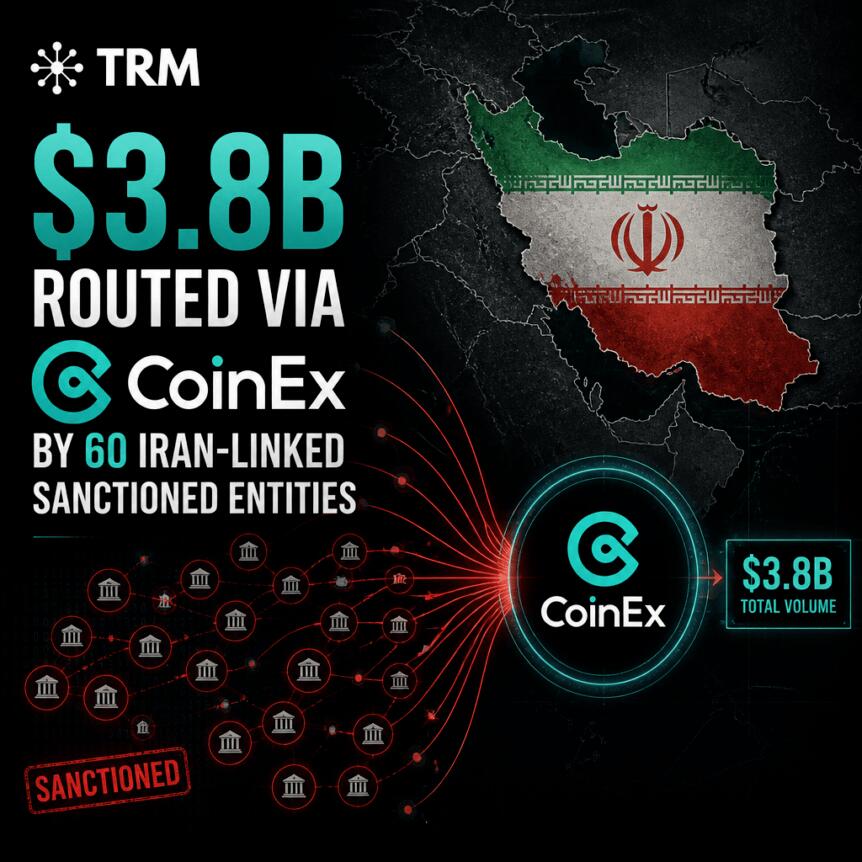
Blockchain analytics firm TRM Labs says crypto exchange CoinEx has been used as a major gateway for Iranian-sanctions evasion, citing evidence that wallets linked to Iranian entities processed more than $3.84 billion through CoinEx since 2019.
In a report published Wednesday, TRM Labs estimates that roughly 60 Iranian-linked platforms were connected to the flows, with $2.7 billion of that total moving between CoinEx and Nobitex—described as Iran’s largest domestic exchange—at an average pace of about $1 million per day since 2018. The analysis also argues that CoinEx’s growing role in Nobitex’s external counterpart network is difficult to explain as “independent market behaviour.”
Key takeaways
- TRM Labs attributes over $3.84 billion in traced activity to wallets linked to sanctioned Iranian entities that have moved through CoinEx since 2019.
- The firm links $2.7 billion of that volume to CoinEx–Nobitex transfers, averaging about $1 million per day since 2018.
- TRM Labs says CoinEx handles nearly 8% of illicit transaction volume among exchanges it reviewed, far above a 0.3% benchmark it cites for other compliant exchanges.
- The analytics firm argues CoinEx’s relationship with major Iranian counterparties appears coordinated rather than organic, including Nobitex routing patterns.
- CoinEx denies any commercial relationship with sanctioned parties and disputes TRM’s interpretation of blockchain onchain flows.
TRM Labs ties CoinEx to Iran-related sanctions exposure
TRM Labs’ report frames CoinEx as one of the principal routes for moving value between Iranian crypto players and the broader market in ways that may undermine US sanctions. The firm says it identified wallets with links to sanctioned Iranian entities and then tracked how funds moved through CoinEx over a multi-year period.
The analysis highlights the scale of CoinEx’s exposure to Iranian platforms: TRM Labs estimates that around 60 Iranian platforms were connected to the traced funds. It further focuses on the relationship between CoinEx and Nobitex, stating that $2.7 billion flowed between the two since 2018.
TRM Labs also argues that the distribution of counterpart relationships is inconsistent with what it would expect from normal, independent trading behaviour. By 2024, it says CoinEx had become Nobitex’s largest external counterpart—nearly nine times the next-largest exchange partner—suggesting a relationship that may be more structural than incidental.
Why the timing matters for sanctions enforcement
The report arrives shortly after the US Treasury moved to widen its Iran-related crypto sanctions posture. Cointelegraph reported that about three weeks earlier, the US Treasury sanctioned four Iranian crypto exchanges as part of its “Economic Fury” campaign.
Those steps followed statements from the Treasury’s leadership indicating the government has seized and tracked significant crypto holdings tied to Iranian activity during the war period. According to Cointelegraph coverage, Treasury Secretary Scott Bessent said Treasury had seized $1 billion in crypto from Iranian exchanges and wallets since the start of the conflict.
TRM Labs’ findings fit this broader enforcement narrative, underscoring a recurring compliance challenge for exchanges and intermediaries: even when a trading venue is not directly designated, it can still be used to route value through counterparties that sit on or near sanctions lists.
CoinEx response: onchain flows don’t prove knowledge
In a post published Thursday on X, CoinEx denied having any commercial relationship with the Iranian government or Iranian domestic exchanges, and said it has never provided funding channels to sanctioned parties. The exchange also challenged TRM Labs’ reading of blockchain data.
CoinEx’s position, as described in the article, is that onchain fund flows alone do not demonstrate that a platform knows about or participates in illicit activity. That dispute goes to a key point in compliance debates: whether tracing the movement of funds is sufficient to infer operational involvement, or whether additional evidence is required to establish knowledge or intent.
Nobitex routing patterns and CoinEx’s reported share of illicit volume
TRM Labs says many of Iran’s largest domestic exchanges route a meaningful fraction of their trading activity through CoinEx. The firm estimates that major Iranian exchanges typically pass about 5% to 10% of their trading volume through CoinEx, which TRM Labs characterizes as evidence of a coordinated arrangement rather than organic adoption.
In the same analysis, TRM Labs reports that CoinEx’s share of illicit transaction volume is nearly 8%. It contrasts that figure with a 0.3% threshold found at other compliant exchanges, implying CoinEx has a much higher concentration of traced illicit activity than peers.
The report also includes details involving CoinEx-affiliated infrastructure. TRM Labs says a CoinEx-affiliated mining pool, ViaBTC, accounted for another $154 million in traced exposure to Nobitex through mining payouts, and also supplied emergency liquidity to Nobitex after Predatory Sparrow’s reported $90 million hack in June 2025. Cointelegraph says it contacted ViaBTC for comment but had not received a response at the time of publication.
Nobitex, meanwhile, has been the focus of broader reporting and industry forensics. Cointelegraph notes that Chainalysis previously described Nobitex as central to a “digital dollar pipeline” and estimated it handled about 50% of Iran’s crypto trading volume. Earlier coverage also said Nobitex was linked to a powerful family with ties to Iran’s Supreme Leader, while Cointelegraph reported that US authorities sanctioned front companies—Zedcex and Zedxion—connected to the Iranian Revolutionary Guard Corps (IRGC).
What to watch next
TRM Labs’ report reinforces the likelihood that sanctions scrutiny will continue to focus not only on named Iranian venues, but also on the trading rails—exchanges, counterparties, and related infrastructure—that can move funds between sanctioned actors and global liquidity. The next signal to monitor is whether exchanges such as CoinEx face new compliance actions or whether additional reporting from analytics firms narrows the gap between “traced flows” and demonstrable knowledge.

The veteran US exchange has tapped the 2019-founded Maple, one of the largest on-chain institutional asset management platforms with TradFi and crypto experience, to introduce a lending structure commonly used in traditional finance to blockchain-based markets.
It will be denominated in USDC and will support Kraken’s over-the-counter (OTC) lending business by enabling institutional clients to borrow against their BTC and ETH holdings rather than selling them.
Traditional Credit Meets Blockchain
According to the joint statement from the two companies, the transaction is one of the first to replicate the structural safeguards of asset-backed securities (ABS) markets entirely on-chain. This facility, they added, was built around a dedicated special-purpose vehicle (SPV), which aims to remain bankruptcy-remote. At the same time, Kraken affiliates originate, service, and retain the junior portion of the loans.
The statement explained that this first-loss position means the exchange absorbs potential losses before senior lenders are affected. This should align incentives between borrowers, lenders, and the platform.
Warehouse financing has served as a cornerstone of traditional credit markets for a long time, helping fund products such as mortgages, auto loans, and consumer lending before they are packaged into larger investment vehicles.
Under the newly-launched structure from Maple and Kraken, the BTC and ETH collateral will be held by a Wyoming-chartered Special Purpose Depository Institution (SPDI), which is also a regulated qualified custodian. Independent SPV administrator Zaria will oversee the facility’s administration.
“The infrastructure that powers a multi-trillion-dollar ABS market in traditional finance has never existed on-chain, until now. This Facility applies that model to digital asset collateral in a fully on-chain environment, with the structural protections institutions actually require,” commented Sidney Powell, CEO and Co-Founder, Maple.
Arjun Sethi, Kraken’s Co-CEO, noted that this facility comes as a growing number of the company’s clients have requested access to the same capital formation tools that have powered traditional credit markets for decades.
Kraken, Deutsche, Nasdaq
The move with Maple follows other significant endeavors made by the veteran exchange, including partnering with Nasdaq to develop tokenized equities and further bridge traditional capital markets with blockchain-based financial systems.
The collaboration will see the Kraken’s tokenized equity product, xStockz, power a permissionless infrastructure later designed to support Nasdaq’s issuer-sponsored equity tokens.
Separately, Deutsche Börse acquired a $200 million stake in Kraken in mid-February, which puts the exchange’s parent company’s valuation at $13.3 billion.
The post Kraken and Maple Bring Institutional Credit Infrastructure Fully On-chain appeared first on CryptoPotato.
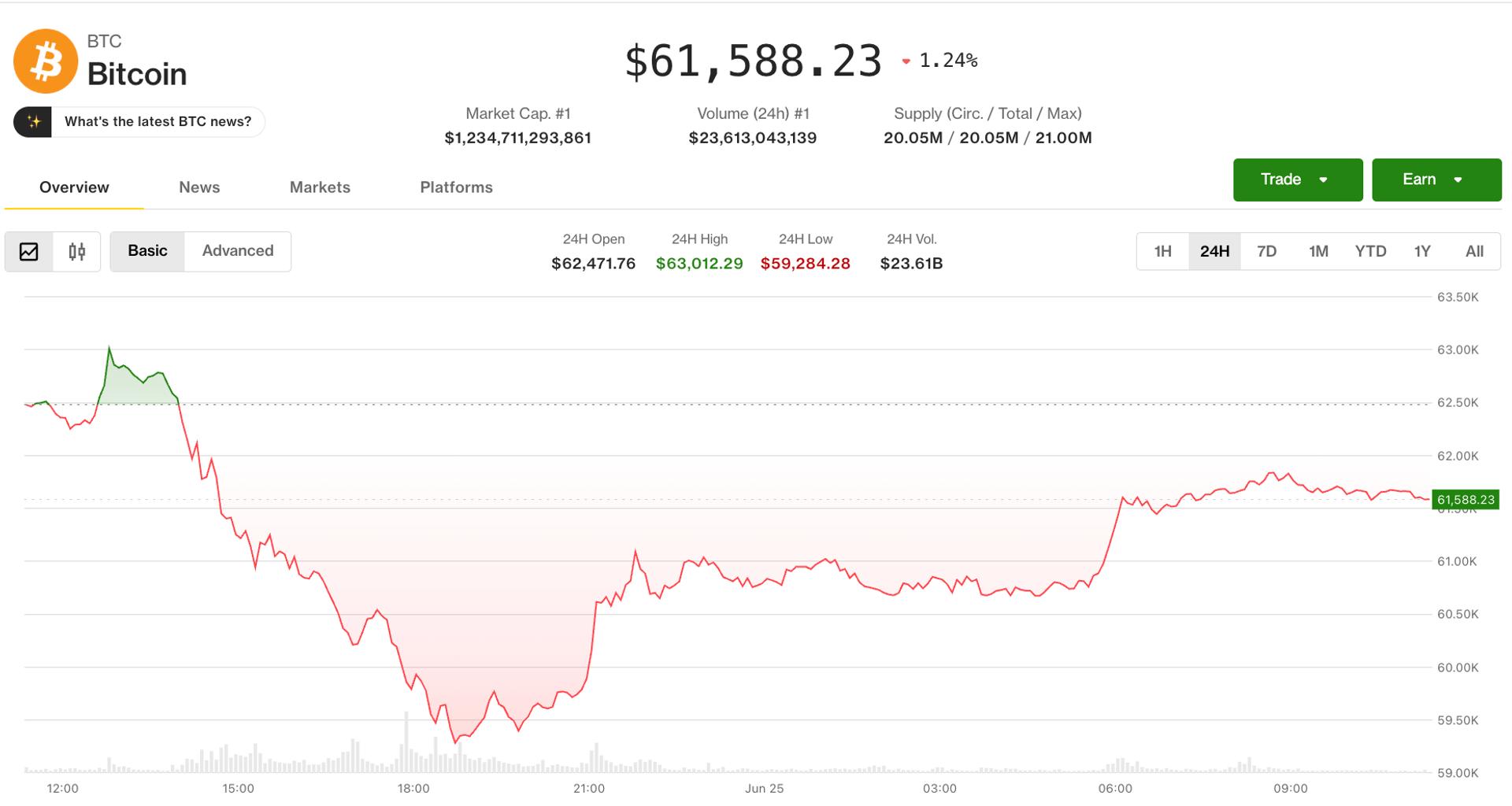
The crypto market showed signs of resilience on Thursday, with bitcoin adding 1.1% since midnight UTC after dipping below $60,000 on Wednesday to its lowest since October 2024.
The largest cryptocurrency remains at a critical level in terms of broader market structure. A potential break lower in price could trigger a slide to around $52,000. For now, it appears to have weathered the storm.
Ether (ETH) rose 1.5% on Thursday and was recently trading at $1,644 after briefly tumbling to $1,550 at around 17:00 UTC on Wednesday.
Thursday’s gains can possibly be linked to a recovery in U.S. equities. S&P 500 and Nasdaq 100 futures are 0.7% and 2.2% higher, respectively.
Derivatives positioning
- BTC revisited lows near $59,000 on Wednesday and has since bounced back to over $61,000.
- The two-way volatility has proven costly for leveraged futures bets across the market. Centralized exchanges liquidated nearly $1 billion in crypto futures positions within 24 hours, with longs accounting for the largest portion.
- Still, bitcoin’s futures open interest (OI) has jumped to 763K BTC, the most since June 4, ending a stretch of steadiness around 730K BTC. In other words, the price drop has triggered an inflow of money, but not necessarily on the bullish side. In fact, annualized funding rates have flipped negative, a sign of traders paying a premium for downside exposure.
- The ether futures market hasn’t seen any notable increase in OI, and funding rates remain slightly positive.
- SOL’s OI remains near Wednesday’s record high, alongside largely neutral funding rates that point to balanced positioning in the market. The same is true for XRP, whose OI is hovering at its highest levels since October.
- The OI-normalized, 24-hour cumulative volume delta for most coins, including BTC, is negative for a third straight day. That’s a sign bears are leading the price action by shorting at market prices rather than using passive limit orders.
- BVIV, which measures the 30-day implied volatility in BTC, has pulled back to 46% a high of 51%. This decline in the so-called “fear gauge,” representing demand for options, supports the cryptocurrency’s overnight rebound. The same is true for ether’s implied volatility index, EVIV.
- Still, ether is seen as more volatile than BTC, with implied volatilities richer by 10 points or more compared with bitcoin’s across all timeframes.
- Option skews for the two largest cryptocurrencies indicate downside concerns that are both persistent and strengthening . For instance, BTC’s one-week skew shows a nearly 25-point volatility premium for puts. This also means upside bets are currently cheap and could draw strong demand should Thursday’s U.S. Core PCE for May reveal a slowdown in inflation.
Token talk
- The altcoin market posted an exaggerated bounce on Thursday after losses on Wednesday, a reflection of a low-liquidity environment.
- Jupiter (JUP) fell by more than 12% in six hours on Wednesday before bouncing by more than 18%, liquidating futures traders in both directions.
- Coinglass data shows that $1 billion in futures positions were liquidated in the past 24 hours, with $585 million of that being attributed to altcoin trading pairs.
- Decentralized finance (DeFi) tokens AAVE and ETHFI also performed well on Thursday, rising by 2.5% and 4.7%, respectively, since midnight.
- AI tokens, meanwhile, struggled to recover. RENDER and NEAR posted losses of between 0.8% and 1.9% despite a bounce across other crypto sectors.
- Layer-1 network token solana (SOL) tumbled to $64 on Wednesday to complete a 75% slide since September. A break below June 6’s low of $60 would mark its lowest point since December 2023.

Key Takeaways
- Shares of Hertz plummeted 41% to $3.00 on Wednesday following a sharp reduction in second-quarter adjusted EBITDA expectations to $50M–$80M
- Deteriorating used-vehicle market conditions drove net monthly depreciation to approximately $300 per vehicle, exceeding previous projections
- The company launched a dual capital raise: $100M in common equity and $300M in exchangeable notes (subsequently increased to $350M)
- Year-to-date losses now stand at 28%, with shares down nearly 50% over the trailing twelve months
- On June 25, Hertz priced 37,037,037 shares at $2.70 apiece, with J.P. Morgan serving as lead underwriter
Hertz (HTZ) experienced its most devastating trading session on record Wednesday, with shares collapsing 41% to close at $3.00. The unprecedented decline came after the rental car company issued a disappointing earnings preview and unveiled plans to raise hundreds of millions in fresh capital.
Hertz Global Holdings, Inc., HTZ
Management revealed that second-quarter adjusted corporate EBITDA would likely land between $50 million and $80 million. This figure sits at the bottom of the company’s earlier projections.
The primary driver? Unexpected weakness in the pre-owned vehicle marketplace. Hertz disclosed that deteriorating conditions in May erased gains achieved through April vehicle disposals, resulting in elevated depreciation expenses.
Monthly net depreciation per vehicle — representing the value decline of each rental unit over thirty days — is projected to reach approximately $300 for the second quarter. Just weeks ago, management had indicated this metric would come in substantially lower.
In response to these pressures, Hertz initiated two simultaneous financing transactions. The first involves $100 million in common equity. The second consists of $300 million in payment-in-kind (PIK) exchangeable notes, subsequently expanded to $350 million at 6.75% interest, maturing in 2030.
The company priced 37,037,037 common shares at $2.70 per share on June 25, lending them to lead underwriter J.P. Morgan Securities. The investment bank will sell these borrowed shares, establish a short position to facilitate hedging for note purchasers, and later return equivalent shares to Hertz.
Hertz receives a minimal lending fee from the equity arrangement — but captures no direct cash proceeds from the share sale. Net proceeds from the notes transaction are anticipated to total roughly $339.5 million, potentially reaching $388 million if the overallotment option is fully exercised.
Management intends to deploy the capital to reduce outstanding balances on its revolving credit facility and support general corporate operations.
Extended Downturn
Wednesday’s collapse adds to an already punishing period for shareholders. HTZ has declined 28% since January and approximately 50% over the past year. During this same timeframe, the S&P Small Cap 600 — Hertz’s benchmark index — has advanced more than 19% and 34%, respectively.
The stock currently trades 54% beneath its 52-week peak of $7.97, reached in July 2025.
Hertz has dedicated the past year to operational improvements. The company modernized its vehicle fleet, implemented cost-reduction initiatives, and announced two partnerships with Uber in April to support autonomous taxi development — announcements that temporarily boosted the share price.
However, the turnaround has proven unstable. Shares received a temporary boost earlier this year when travel disruptions linked to a partial government shutdown increased rental demand, but those gains evaporated once TSA personnel received payment and air travel normalized.
Bankruptcy Legacy
The company’s 2020 Chapter 11 bankruptcy filing continues to cast a long shadow. Hertz entered bankruptcy protection as international travel evaporated and used-vehicle valuations plummeted. The company notably became an early meme stock phenomenon, with retail investors driving shares up 800% despite its bankruptcy status.
Hertz completed its restructuring in June 2021, generating over $1 billion in value for equity holders — an uncommon bankruptcy outcome.
Legal challenges persist. In January, the Supreme Court refused to review Hertz’s appeal of a lower court decision, leaving the company responsible for $270 million in interest obligations owed to bondholders who were repaid ahead of schedule during bankruptcy proceedings.
The latest analyst recommendation on HTZ is rated as Sell, with a $3.00 price target.

Ethereum has dropped to its lowest level in weeks, and most traders asking why is Ethereum down today will blame the obvious culprit, a market-wide sell-off. The more revealing part is who used the drop to buy.
The selling is real, and the Ethereum price has fallen harder than Bitcoin. Yet on the week’s sharpest leg lower, Ethereum held the line where Bitcoin gave way, and the largest wallets shifted from sellers to buyers.
The Ethereum Drop Is Real, but One Detail Breaks the Pattern
Over the past month, the ETH price is down about 21%, a touch worse than Bitcoin (BTC) near 20%. Over the week, ETH slid close to 5% against 3.7% for BTC.
Want more token insights like this? Sign up for Editor Harsh Notariya’s Daily Crypto Newsletter here.
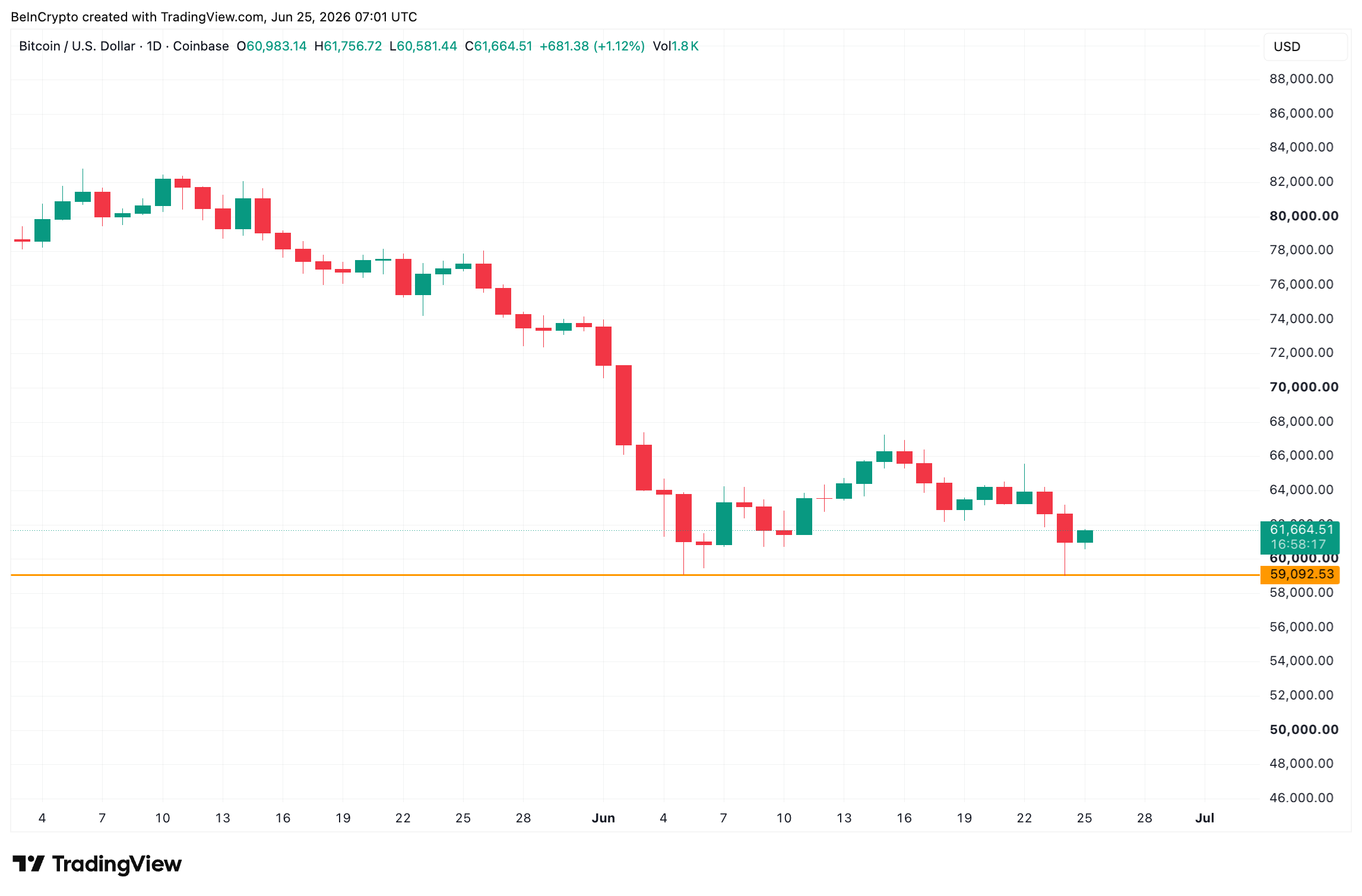
On the scoreboard, then, Ethereum is the weaker asset. That is the easy read, and it is also where most analysis stops. The interesting part hides in the timing. When the market flushed into June 24, Bitcoin broke to a fresh low near its early-June bottom around $59,000.

Ethereum declined to follow. It carved a higher low and defended the floor it set earlier in the month, the first crack in the bearish story.

A higher low means little, however, unless the selling driving the Ethereum down move was already losing steam.
Selling Pressure Faded as ETH Whales Turned Buyers
The sell volume exploded with a single huge bar on June 5, then thinned out steadily through the month.
Selling firmed up again between June 23 and June 24, yet never came close to that June 5 peak. The flush that began the decline simply ran out of fuel.

As sellers tired, Ethereum whales moved the other way. Santiment’s Supply Held By Whales metric, which tracks the ETH held by the largest non-exchange wallets, fell from roughly 125.68 million on June 18 to 125.23 million by June 22, then rebuilt to about 125.3 million amid the late-June crash.

On-chain trackers also caught large wallets pulling ETH off exchanges during the drop. The pattern suggests whale accumulation quietly mopping up the last of the supply.
A whale bid is hollow, though, if the network those wallets feed is emptying out.
The Network Kept Working While Price Fell
Ethereum DEX volume, the value traded on decentralized exchanges, jumped about 36% into the low, from roughly $0.9 billion on June 22 to $1.3 billion on June 24. So the network wallets are certainly not emptying.
Trade counts climbed back above 390,000 on the same day. That points to on-chain activity rebuilding into the dip, not retreating from it.

Compared with the June 5 capitulation near $3 billion, the latest pickup looks measured rather than frantic. Traders engaged the low without the panic that marked the start of the slide.
The base layer told the same story. Daily transactions on the Ethereum network held near 2.7 million through the June 21 to 24 drop, above the 1.9 million pace a week earlier. Active wallets jumped to roughly 637,000 on June 24, the flush day, up from 514,000 the session before.

Stablecoins parked on Ethereum stayed near $158 billion, down just 2% on the week. Dollars sat tight on the chain even as price fell.

Steady usage and a returning whale bid stack the odds. Now the chart has to confirm them.
The Ethereum Price Levels That Settle the Debate
ETH trades near $1,655, just above the 0.236 Fibonacci level at $1,633.
The decisive level is $1,551, the higher low from June 24. Support held there while Bitcoin was busy making a fresh low, and it sits above the early-June floor near $1,505.
To take control, buyers must reclaim $1,683, then $1,724, and eventually $1,765. A push into that band lines up with a measured move of about 7%.

Clearing it would let the Ethereum price recover before Bitcoin even turns. The catch is that thin volume cuts both ways, so a single heavy session could undo the bid fast. A daily close below $1,551 would snap the higher-low structure and put $1,505 back in play.
The $1,551 support separates an early, whale-led ETH rebound from another slide toward the June lows.
The post Ethereum Price Crash Triggers a 36% DEX Volume Surge appeared first on BeInCrypto.


All 32 of the largest US banks would stay above minimum capital requirements during a severe recession, the Federal Reserve said Wednesday, even after absorbing more than $708 billion in projected loan losses under its annual stress test.
The exercise tested whether systemically important lenders could keep credit flowing through a downturn. Aggregate capital fell just 1.6 percentage points, from 12.8% to 11.2%, leaving banks well above regulatory floors.
What the Fed Stress Test Measured
The Dodd-Frank Act requires the Fed to conduct these tests annually. Congress mandated it after the 2008 financial crisis to ensure that large banks hold sufficient capital to withstand severe economic conditions.
The requirement covers banks with at least $100 billion in assets. This year’s pool of covered firms included JPMorgan Chase, Bank of America, Citigroup, Wells Fargo, Goldman Sachs, and Morgan Stanley.
The hypothetical scenario matched last year’s severity. It assumed unemployment would climb to 10%, that commercial real estate prices would drop by 39%, and that home prices would fall by 30%.
Economic output contracted 4.6% in the model. Equity markets dropped 58%, deepening losses on business loans.
Follow us on X to get the latest news as it happens
Where the Losses Landed
Credit cards accounted for the largest share of projected losses, at roughly $200 billion. Commercial and industrial loans added about $160 billion.
Commercial real estate contributed around $75 billion. Two forces pulled capital down. Heavier loan losses from larger balances and tougher assumptions. Weaker unrealized securities gains followed smaller modeled rate declines.
Higher interest income pushed in the opposite direction. Stronger recent bank earnings and smaller modeled rate cuts lifted projected capital, more than offsetting the two drags above.
Vice Chair for Supervision Michelle Bowman framed the outcome as evidence of resilience.
“Today’s results underscore the strength of the banking system. As we work to increase the transparency and accountability of the stress test, public feedback will help us continue to improve and instill greater confidence in the stress test and its results,” Bowman stated.
The results will not change the capital requirements. Current levels hold until 2027, when revised loss models incorporating public feedback take effect.
Subscribe to our YouTube channel to watch leaders and journalists provide expert insights
The post Big Banks Survive $708 Billion Loss Scenario in Fed Stress Test appeared first on BeInCrypto.


New forensic research published yesterday suggests that Hal Finney might not have been the second person to run a BTC node.
For 17 years, the man who tweeted “Running bitcoin” earned an unofficial title. In the eyes of many Bitcoin historians, Finney was the second person after creator Satoshi Nakamo to run a Bitcoin node.
Indeed, thousands of articles credit Finney as Bitcoin’s second participant.
However, it turns out that he might actually have been the third.
Although it is an indisputable, on-chain fact that Finney earned the first coinbase reward after Nakamoto for mining a block, forensic researcher Alex Waltz argues that another man was running a mining-capable node before Finney.
According to Waltz’s timestamps, although Dustin Trammell was running a node before Finney, an idiosyncratic network connectivity issue in Bitcoin software prior to version 0.1.3 prevented Trammell from connecting to Nakamoto’s nodes fast enough to outpace Finney.
A new timeline of Finney’s Bitcoin node
Waltz reconstructed a precise timeline of events during Bitcoin’s opening days.
Based on his analysis, and despite Trammell openly admitting that Finney mined a block before him, he believes that Trammell was running BTC mining software first.
Unfortunately, Trammell hadn’t remembered to flip on the software switch to actually mine. Still, according to Waltz, he was probably technically running the node software before Finney.
It’s important to remember that in January 2009, a Bitcoin wallet holder, Bitcoin node operator, and a BTC miner were often the same thing.
The early Bitcoin software client bundled wallet, node, and CPU mining software into one program. The node turned on immediately by default, the wallet was built-in, and mining began using that same software after a simple flip of a software switch.
Critically, running a passive, non-mining node wasn’t a common practice in 2009, despite its widespread popularity today.
Indeed, there’s at least an order of magnitude more non-mining Bitcoin node operators today than BTC miners. Not so in 2009.
Anyway, given this context, Waltz’s analysis leans on an email that Nakamoto sent to Trammell to place Trammell’s node ahead of Finney’s node in the revised Bitcoin timeline.
‘You couldn’t broadcast it to the network, so it didn’t get into the chain’
Here’s what happened.
Late in the day on January 12, 2009, Trammell emailed Nakamoto that he’d still been running Bitcoin software version 0.1.1 for a while, which earned an email response from Nakamoto urging Trammell to update to v0.1.3.
Importantly, that email response from Nakamoto on January 13, 2009 confirms that Trammell would have been experiencing a silent network communication outage with his out-of-date, v0.1.1 software.
“It’s the bug that was fixed in 0.1.3,” Nakamoto said.
“The communications thread would get blocked, so you would make connections, but they would go silent after a while.”
Nakamoto continued, “When you found a block, you couldn’t broadcast it to the network, so it didn’t get into the chain.”
As the creator of the software, Nakamoto apologized for the bug that misled Trammell on-screen about his node’s uptime status when in fact his node was disconnected.
“You weren’t receiving anything either to know that the network had gone on without you… This is all fixed in 0.1.3,” he wrote.
Satoshi ended his email to Trammell with a generous offer as a sort of apology for the bug: “If you give me your IP, I’ll send you some coins.”
That is a true moment of Bitcoin history.
With that, Waltz ends his argument for Trammell being the second operator of mining node software on the Bitcoin network.
Waltz then moves along to other curiosities about Bitcoin’s early weeks of operation.
Read more: This wild Satoshi theory links Paul LeRoux and Craig Wright
Who is Bitcoin’s second user: Hal Finney or Dustin Trammell?
Although the above argument isn’t irrefutably conclusive, it is somewhat compelling.
Not only does Trammell have evidence of unbroadcasted blocks from the earliest days of Bitcoin, which support Trammell’s claim about unreliable connectivity, he also has correspondence from Nakamoto acknowledging Trammell’s reason for not being able to broadcast blocks over the internet.
Plus, Nakamoto offers to compensate Trammell for his foregone coinbase reward.
It’s a true story that few people in the Bitcoin community have heard.
Now, of course, Trammell does not appear to have actually mined a block prior to Finney earning Bitcoin’s coinbase reward for Finney’s on-chain block 78 on January 10, 2009.
Still, Trammell might have been running a mining-capable node prior to block 78.
Obviously, whether running mining software while not mining constitutes being a “miner” will probably remain a matter of public debate.
Unseating Finney as Bitcoin’s second network participant will take even more heavy lifting by cryptographers and forensic investigators, yet Waltz has provided novel questions about the preeminence of Finney over less famous participants in the early Bitcoin community.
Rest in peace, Hal Finney
All of these questions would be easy to resolve if we could simply ask Finney himself. Sadly, Finney isn’t around anymore.
After a long battle with Lou Gehrig’s disease, he passed away in 2014.
There is, however, one last piece of surprising evidence.
Trammell Venture Partners, which in 2022 launched a Bitcoin venture capital fund series, describes Dustin Trammell as “the second node on the Bitcoin network” on its own website.
Because miner and node operator were essentially the same thing at that time, Trammell has therefore quietly claimed the second-to-Nakamoto title that Finney long received as a community-ascribed belief.
After Waltz published his analysis, Trammell admitted that he hadn’t switched on the mining function to outpace Finney in actually mining a block before block 78, yet per his own website, Trammell otherwise maintains that he was running a node before Finney.
Got a tip? Send us an email securely via Protos Leaks. For more informed news and investigations, follow us on X, Bluesky, and Google News, or subscribe to our YouTube channel.
Crypto World
Bitcoin (BTC) derivatives signal price panic. A weak U.S. inflation reading could trigger snapback: Crypto Daily


Besides, both core and headline readings may be seen as stale, or backward looking, considering the recent slide in oil prices. WTI crude futures have dropped to $70, significantly below the $100-plus level seen during the Iran war in March and April. Headline inflation is expected to hit 4.1%, the highest since early 2023, driven largely by energy prices.
“The main question is less whether both headline and core go up—they are widely expected to—but rather how “stale” these numbers already are,” economist Mohamed A. El Erian, the former CEO of Pimco, noted on X.
“These numbers come before the recent sharp fall in oil prices, which will result in lower headline inflation and ease some of the pressures on core. The question being debated is by how much, including whether May will prove to be the peak inflation month.”
Beyond inflation numbers, watch out for volatility in Strategy’s common shares, MSTR, and preferred stock, STRC, plus AI names on Wall Street. MSTR is flashing a well-recognized major bearish pattern (Check the Daily Signal). Stay alert!
Read more: For analysis of today’s activity in altcoins and derivatives, see Crypto Markets Today . For a comprehensive list of events this week, see CoinDesk’s “Crypto Week Ahead.”

Queer club launches action against Perth Bears

JPMorgan names Doug Petno and Troy Rohrbaugh co-presidents as longtime exec Marianne Lake exits

Vaibhav Sooryavanshi Would Say ‘His Head Was Hurting’: A Never-Heard-Before Tale On Star’s Meteoric Rise


-

 Fashion6 days ago
Weekend Open Thread: Miami – Corporette.com
-

 Entertainment5 days ago
Renter of Home in Anne Heche Crash Denies Settlement With Son
-
 Sports2 days ago
Two goals and an assist by sheer aura: Cristiano Ronaldo just entered the World Cup chat
-

 Tech3 days ago
Microsoft accidentally kills epic Outlook email threads
-

 Business5 days ago
Soccer-U.S. defends Iran World Cup travel restrictions, says discussions ongoing
-

 Politics5 days ago
Andy Burnham and the meaning of Makerfield
-
Crypto World1 day ago
Bitcoin (BTC) Dips Below $62K, Ethereum (ETH) Plunges 6% Daily: Market Watch
-

 Politics7 days ago
BBC Reporter Discusses Cross Party Criticism Of Trumps Iran Deal
-

 Crypto World1 day ago
Securitize Wraps Roubini's SEC-Registered ETF as Dubai VARA Digital Security
-
Business1 day ago
Entergy settles forward sale agreements, raises $672 million in cash proceeds
-

 NewsBeat6 days ago
Keir Starmer Allies Question His Chances For No 10
-
 Business5 days ago
Wall Street Week Ahead: Investors see Micron earnings as pulse check of AI rally momentum
-

 Tech7 days ago
AWS enters the context layer race with a graph that learns from agents, not manual curation
-
 Crypto World5 days ago
Can Charles Hoskinson Really Rescue Cardano?
-

 Crypto World5 days ago
HIVE shares jump as $220M AI deal speeds Bitcoin mining pivot
-

 Crypto World5 days ago
Jake Chervinsky accuses CME of protecting derivatives monopoly
-

 Entertainment5 days ago
Jose Alvarado Wants Taylor Swift at More Knicks Games
-
 Tech4 days ago
Signal’s Meredith Whittaker says AI chatbots ‘are not your friends’ and calls Copilot agents a backdoor
-

 Tech3 days ago
Nearly 7,000 fake Amazon domains registered ahead of Prime Day 2026, researchers warn
-

 Sports6 days ago
FIFA World Cup 2026: Canada beat 9-men Qatar 6-0 to register first ever win | FIFA World Cup 2026
You must be logged in to post a comment Login