

Crypto World
CoinEx Named as Iran Largest Crypto Sanctions Exit Route by TRM Labs

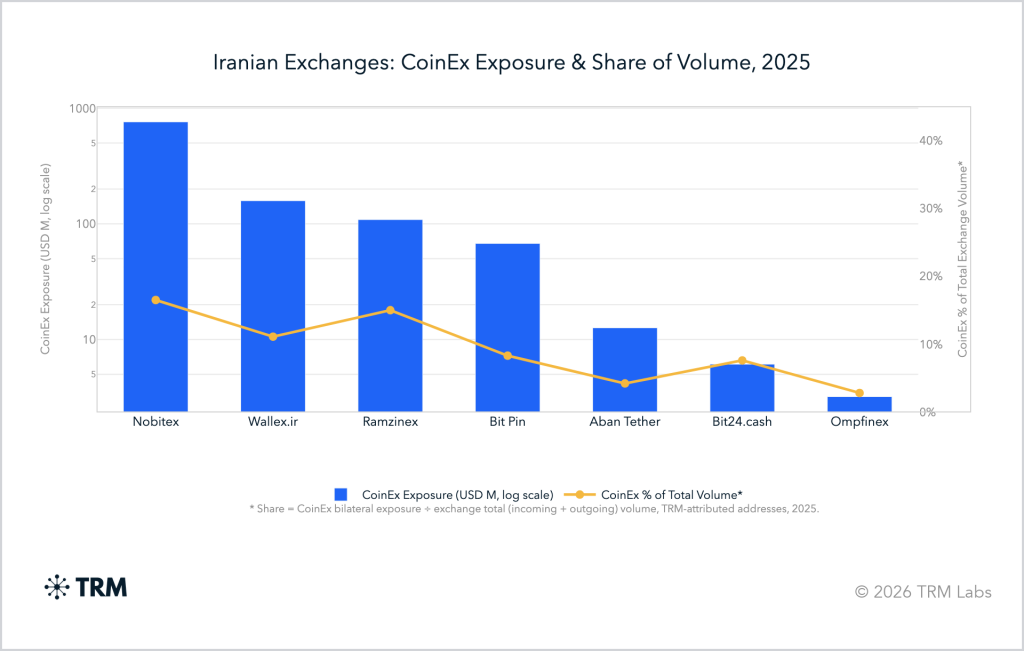
Blockchain analytics firm TRM Labs traced $3.84 billion in flows from wallets linked to more than 60 sanctioned Iranian entities through CoinEx since 2019, identifying the exchange as the primary external conduit for Iran-linked capital moving into global crypto markets.
Of that total, $2.7 billion flowed specifically between CoinEx and Nobitex, Iran’s largest domestic exchange, at an average rate of approximately $1 million per day since 2018. By any documented measure, this is the largest single-exchange crypto sanctions-evasion pipeline tied to Iran yet identified.
The TRM Labs report landed three weeks after the US Treasury sanctioned four Iranian crypto exchanges as part of its Economic Fury campaign, with Treasury Secretary Scott Bessent separately confirming the seizure of $1 billion in crypto from Iranian exchanges and wallets since the start of the war.
CoinEx is not among the sanctioned entities. That gap, between what the blockchain data shows and what enforcement has acted on, is the structural tension this report forces into the open. The Iran-CoinEx controversy is now squarely on the US Treasury’s radar.
Don’t Miss Out on Our $1,000 USDT Airdrop on ByBit
CoinEx’s 8% Illicit Rate Is 27x the Industry Benchmark
The compliance gap TRM Labs documents is not marginal. CoinEx’s share of illicit transaction volume sits at nearly 8%, against a 0.3% threshold observed at compliant exchanges, a ratio of roughly 27 to one.
That number is not cosmetic; it is the quantitative basis for TRM’s conclusion that the CoinEx-Nobitex relationship reflects a “coordinated arrangement rather than organic adoption.”
The specifics reinforce that reading. By 2024, CoinEx was Nobitex’s largest external counterpart by volume, nearly nine times larger than the next-biggest exchange, a concentration TRM called “inconsistent with independent market behaviour.”
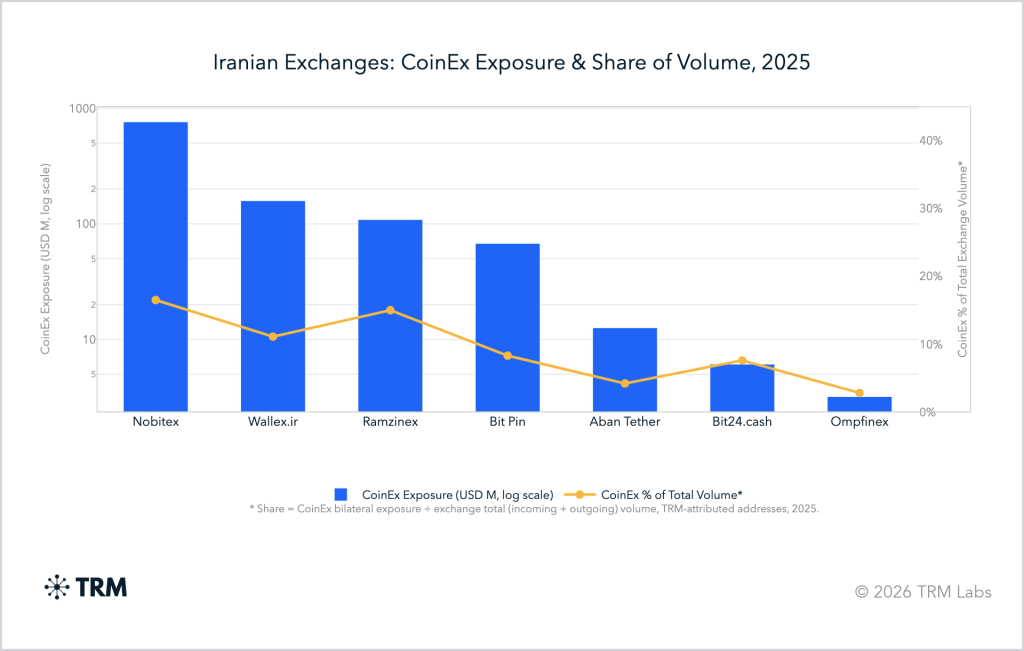
Major Iranian domestic exchanges route between 5% and 10% of their trading volume through CoinEx, a uniformity across platforms that would be statistically improbable if each exchange were making independent routing decisions.
CoinEx-affiliated mining pool ViaBTC adds another layer. TRM Labs traced $154 million in ViaBTC exposure to Nobitex through mining payouts.
More pointedly, ViaBTC supplied emergency liquidity to Nobitex following the Predatory Sparrow hack in June 2025, a $90 million breach that left Nobitex operationally stressed. An affiliated mining pool stepping in as a liquidity backstop for a sanctioned exchange is not a pattern that emerges from coincidence.
Discover: The Best Token Presales
Nobitex Was the On-Ramp, CoinEx Was the Exit
The architecture of the pipeline is straightforward. Sanctioned Iranian entities, including IRGC-linked wallets and entities tied to Iran’s domestic financial system, moved funds into Nobitex, which handled approximately 50% of Iran’s crypto trading volume, per a June 2 Chainalysis report.
Nobitex then routed capital outward through CoinEx, which provided access to global liquidity and the ability to convert into dollar-equivalent stablecoins beyond the reach of Iranian sanctions enforcement.
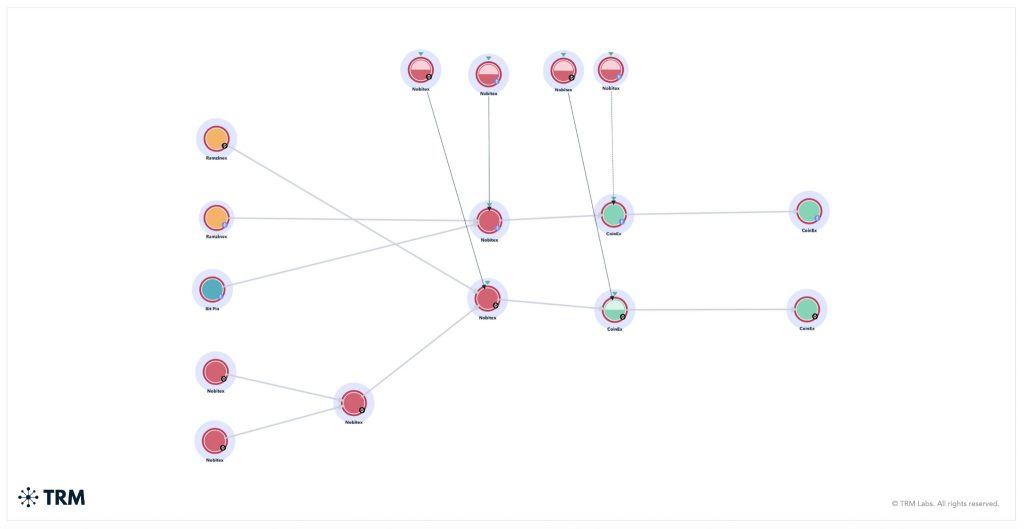
This flow pattern has been running since at least 2018 on the CoinEx-Nobitex corridor, and since 2019 for the broader universe of sanctioned entities TRM Labs tracked. Nobitex’s own political exposure sharpened the stakes: in May 2026, the exchange was reportedly linked to members of a powerful family with ties to Supreme Leader Ali Khamenei, suggesting the pipeline served interests at the apex of the Iranian state, not just retail traders seeking dollar access.
The displacement of other exchanges from Nobitex’s external routing is also analytically significant. CoinEx overtook Binance as Nobitex’s largest foreign counterparty by 2024, after Binance faced US enforcement pressure. That transition illustrates precisely the rerouting dynamic critics of venue-specific enforcement consistently flag: pressure on one exchange does not eliminate the demand, it reassigns it.
CoinEx Denies Government Ties. The On-Chain Data Is Not a Contract.
CoinEx issued a denial on X following the TRM Labs report, stating it has no commercial relationship with the Iranian government or domestic Iranian exchanges and has never provided funding channels to sanctioned parties.
The exchange also disputed TRM Labs’ interpretive framework directly, arguing that “onchain fund flows do not demonstrate a platform’s knowledge of or participation in illicit activity.”
The denial addresses contractual relationships; the TRM Labs report documents transaction flows. Those are not the same evidentiary category, and the distinction matters.
OFAC sanctions exposure does not require proof of a formal commercial agreement – it requires demonstrated facilitation of transactions involving sanctioned parties.
Whether CoinEx knew the identities behind the wallets routing $3.84 billion through its platform is a compliance question. That the flows existed at 27 times the illicit-volume rate of compliant exchanges is the data point that precedes that question.
Discover: The Best Crypto to Diversify Your Portfolio
The post CoinEx Named as Iran Largest Crypto Sanctions Exit Route by TRM Labs appeared first on Cryptonews.



Story Protocol has rebranded as the DATA Foundation after replacing its original intellectual property licensing strategy with a new focus on AI training data infrastructure.
Summary
- Story Protocol has rebranded as the DATA Foundation to build infrastructure for licensed AI training data.
- The project launched Trace, an on-chain registry, while integrating Kled and Poseidon into its AI data network.
- DATA token climbed 16.7% after the announcement, outperforming a crypto market pressured by inflation-driven selling.
According to the company’s Thursday announcement, the layer-1 blockchain project will now build systems for sourcing, verifying, licensing, and paying contributors for data used to train artificial intelligence models.
The company described AI training data as “the most valuable and least solved category of IP,” arguing that major AI labs are facing a costly supply problem as easily scraped internet data becomes less useful.
The market reaction was positive despite pressure across crypto. Shortly after the rebrand, Story Protocol’s renamed DATA token rose 16.7% to $0.35, outperforming a crypto market hit by nearly $1.5 billion in liquidations after U.S. PCE data showed annual inflation accelerated to 4.1% in May.
Story is moving from open IP licensing to verified AI data
Story said its original plan was to create an IP layer for the internet, but president and product chief Andrea Muttoni said the project ran into a problem with large rights holders. According to Muttoni, companies behind valuable music, games, and brands were reluctant to expose key intellectual property to permissionless licensing because they wanted to keep tight control over their assets.
The company said the new DATA Foundation will focus on data that AI labs cannot easily scrape from the open internet. In its announcement, Story argued that frontier AI companies now need data that is legal, high-quality, and traceable, rather than more undocumented material collected from public web pages.
As part of the rebrand, Story is launching Trace, an on-chain registry designed to track provenance and licensing for AI training data. The company said Trace will let AI firms verify data sets while allowing contributors to set and enforce licensing terms.
Muttoni will become CEO of the DATA Foundation, while Kled founder Avi Patel will join as chief data officer and adviser. Story founder Seung-yoon Lee will also remain involved as an adviser.
DATA token rises as crypto projects chase AI demand
Story’s move also brings Kled into the new structure as the flagship app on DATA. According to the company, Kled pays people for real-world data tasks such as recording videos of their surroundings or capturing ambient audio, creating licensed data sets that can be used for AI training.
Muttoni said Story’s incubated AI data-processing project, Poseidon, had already shown “immediate traction” with major AI firms and raised a $15 million seed round in July 2025. Under the new setup, Poseidon will serve as the processing layer of the protocol, while Trace will provide verification and licensing records on-chain.
Lee framed the new strategy around data that cannot be copied from websites, including physical movement, speech, driving behavior, and workplace activity.
“The most important IP of this era is the data you can’t scrape: how a surgeon’s hands move, how a robot grips, how people speak, drive, and work in the real world.”
He added that DATA is intended to prove the origin of real-world data, license it, and pay the people who created it.
The pivot places Story alongside other crypto firms turning toward AI as investor interest in the sector grows. Forbes reported Monday that Web3 gaming company Immutable is moving from gaming toward an AI marketing platform for game publishers. Coinbase also announced earlier this month that it is developing a tool that would let consumer AI models connect to a user’s exchange account and execute trades or strategies.
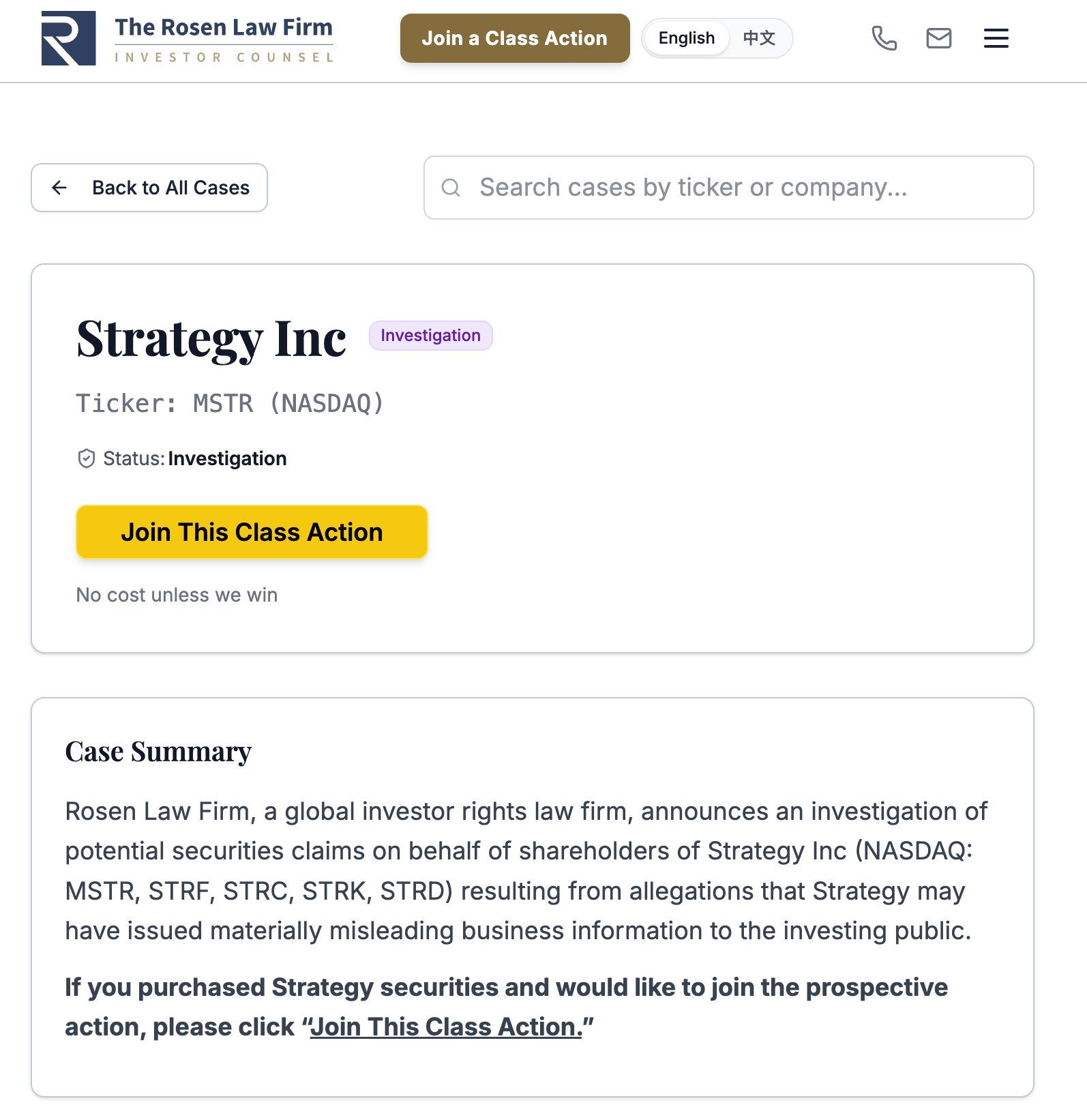
Rosen Law Firm has launched an investigation into Strategy (formerly MicroStrategy), inviting investors who purchased the company’s securities to participate in a potential class action lawsuit.
The law firm said it is examining whether Strategy and certain executives made materially misleading statements regarding the company’s business operations, Bitcoin treasury strategy, profitability, and the risks associated with its aggressive Bitcoin accumulation model.
Details of the MicroStrategy Lawsuit
The investigation covers several Strategy-linked securities, including MSTR, STRF, STRC, STRK, and STRD. Rosen has created a dedicated webpage allowing affected investors to join the probe.

The development follows a period of heightened scrutiny around Strategy’s capital structure and its growing reliance on multiple classes of securities to fund Bitcoin purchases.
While the investigation does not allege wrongdoing, it comes amid sharp volatility across several Strategy-related instruments.
One security attracting particular attention is STRC, Strategy’s perpetual preferred stock. Blockchain analytics platform Arkham recently addressed comparisons between STRC and the collapsed Terra ecosystem, arguing that the situations are fundamentally different.
“IS STRC THE NEXT LUNA? Short answer – not quite,” Arkham wrote in a post on X.
Follow us on X to get the latest news as it happens
The firm stressed that Strategy is under no legal obligation to maintain STRC’s market price, distinguishing it from algorithmic stabilization mechanisms that contributed to Terra’s collapse.
“Unlike Terra LUNA, Saylor cannot ‘get liquidated’ if STRC falls in value,” Arkham said, adding that “the price of STRC simply reflects the market’s view of how likely Saylor is to continue paying dividends.”
Arkham also highlighted a key risk facing preferred shareholders, noting that dividend payments remain discretionary.
“Crucially: Strategy does not legally have to pay these dividends,” the analytics firm wrote. “If Strategy gets in trouble, Saylor does not have to prioritise STRC shareholder dividends.”
According to Arkham, maintaining STRC’s current dividend structure could require roughly $1.2 billion annually, raising questions about the long-term sustainability of Strategy’s expanding financing model if market conditions deteriorate.
Strategy has not publicly responded to Rosen’s investigation.
The post Rosen Law Firm Launches Probe Into MicroStrategy appeared first on BeInCrypto.


Kraken has expanded its institutional lending business through a new Maple-backed financing facility built around a bankruptcy-remote SPV.
Summary
- Kraken and Maple launched a USDC-funded SPV facility for institutional crypto-backed loans.
- Maple will provide senior financing while Kraken retains exposure and services the loans.
- Tokenized credit has grown past $6.2 billion, with Bernstein seeing a $4 trillion market.
According to a joint June 24 announcement, crypto exchange Kraken and on-chain asset manager Maple have launched an institutional warehouse financing facility for crypto-backed loans, bringing a lending structure commonly used in traditional credit markets into digital asset finance.
The companies said the facility will support Kraken’s over-the-counter lending business through a bankruptcy-remote special purpose vehicle (SPV) funded with USDC.
Unlike standard bilateral crypto loans, the transaction is arranged through the SPV, with Maple supplying senior financing while Kraken retains an economic interest in the facility. According to the companies, this setup allows Kraken to increase lending capacity without committing additional balance-sheet capital.
Institutional lending is moving toward structured credit
Under the announced structure, Kraken affiliates will originate, sell and service the loans while maintaining a position in each transaction. The underlying Bitcoin and Ether collateral will be held by Kraken Financial, the Wyoming-chartered Special Purpose Depository Institution, and independent SPV administrator Zaria will oversee administration of the facility.
Neither Kraken nor Maple disclosed the size of the financing arrangement or its commercial terms.
Maple said the structure gives institutional lenders senior, overcollateralized exposure backed by Bitcoin and Ether while allowing collateral and loan performance to be monitored on-chain. According to the company, using a bankruptcy-remote SPV separates the financing vehicle from the borrower’s balance sheet, a framework commonly used in commercial mortgage-backed securities and other structured credit transactions.
RWA.xyz data shows tokenized credit has increased to more than $6.2 billion in distributed value from roughly $1.87 billion a year earlier. The same dataset identifies Maple as the largest platform in the segment, managing approximately $1.4 billion in tokenized credit assets.
The latest launch arrives as institutional crypto lending continues to recover from the market disruptions of 2022. Following the failures of lenders, including Celsius and BlockFi, companies have increasingly focused on collateral management, bankruptcy protections, and tokenized credit infrastructure designed for institutional borrowers.
Tokenized credit products continue to multiply
The Kraken-Maple facility arrives as more firms expand blockchain-based credit products. Earlier this year, Ripple secured a $200 million credit facility from investment manager Neuberger Berman to support its institutional prime brokerage lending business.
Recent weeks have brought several new blockchain-based credit initiatives. As reported by crypto.news, Stablecore launched an early-access stablecoin and digital asset program for U.S. credit unions.
At the same time, Capital B unveiled plans for a Bitcoin-backed credit product for European investors. Morpho also released its Midnight white paper for a fixed-rate, fixed-term on-chain lending protocol.
However, not every project has succeeded. Earlier this month, Radiant Capital said it would wind down after failing to recover from a $50 million exploit in 2024.
Even so, analysts at Bernstein said in May that tokenized credit could represent a $4 trillion addressable market as blockchain-based lending expands into markets such as mortgages, auto loans, and small-business financing.

A survey arranged by digital asset services provider CoinShares found that more than half of UK-based financial advisers reported the bulk of their clients’ crypto holdings were outside their oversight.
According to the results of a CoinShares survey released on Thursday, 52% of UK advisers in a group of 261 European wealth management professionals said that the majority of their clients’ digital assets exposure was essentially “invisible” to them. Among all the EU countries surveyed, including France, Germany, Italy and Switzerland, the number was 25%, with 61% of advisers saying that they worked in companies that explicitly restricted digital assets or provided no clear internal guidance.
“The capital has already been allocated,” said CoinShares co-founder and CEO Jean-Marie Mognetti. “The people entrusted with managing it simply cannot see it, and in most cases not because clients are unwilling to engage, but because firm policy prevents them from doing so. This is not a knowledge problem. It is not a demand problem. It is a firm-policy problem becoming a wrong-way risk.”
He added:
“[…] Visibility comes before advice. You cannot allocate, manage risk or earn trust over assets you cannot see.”

Source: CoinShares
The UK’s Financial Conduct Authority (FCA), the watchdog overseeing digital asset regulation, reported in December that about 8% of the country’s adults were invested in crypto. The group recently proposed allowing authorized investment funds to hold up to a 10% allocation of cryptocurrency exchange-traded notes.
Related: Bank of England eases stablecoin rules, introduces 40B pound issuance cap
Potential new leadership to shake up UK crypto policy?
UK Prime Minister Keir Starmer resigned as Labour leader on Monday amid pressure from many in his own party, opening the door to a recently elected member of parliament to take the reins.
In a recent by-election, former Mayor of Greater Manchester Andy Burnham won a seat as a member of parliament representing Makerfield, positioning him to be heavily favored by many in Labour to replace Starmer. While it’s unclear how Burnham may handle crypto policy on a national stage, as mayor, he supported the blockchain industry as a driver for economic development.
Magazine: AI is banking the unbanked in Africa… faster than crypto

XRP price prediction is not improving, but a formal UK parliamentary proposal names the XRP Ledger as the preferred blockchain infrastructure for a new class of climate finance instruments. The proposal introduces Climate Contingent Convertible Notes (CloCos), a structured financing model designed to channel private capital into renewable energy without government subsidies.
Authored by Dr. Chris Cormack and submitted to the UK Parliament’s Environmental Audit Committee, the submission explicitly identifies XRPL as a suitable settlement and record-keeping layer for a regulated pilot involving institutional investors.
The proposed four-stage lifecycle, “issue, monitor, trigger, deploy,” would use the ledger to create auditable ownership records, track project performance milestones, and verify that capital flows into qualifying renewable energy assets.
Right now, XRP price nor the prediction has not reacted to the news. Is it a lag or?
Discover: The Best Crypto to Diversify Your Portfolio
XRP Price Prediction: Hold $1.05 Support and Reclaim $1.16 This Week?
XRP is trading at $1.07, holding just above a key support zone around $1.05. Recent price action also points to consolidation. Meanwhile, 24-hour trading volume stands at $2.24 billion, indicating that participation remains moderate.
The immediate support area sits between $1.05 and $1.07. If buyers fail to defend this range, XRP could revisit the psychological $1.00 level. On the other hand, maintaining support would keep the current recovery attempt intact and preserve the possibility of another move higher.

Don’t Miss Out on Our $1,000 USDT Airdrop on ByBit
Resistance remains layered above current prices. The first hurdle lies around $1.11 to $1.13, while a stronger barrier appears near $1.16. A decisive close above that level would improve short-term momentum and shift attention toward the $1.20 region.
The most likely outcome remains range-bound trading between $1.05 and $1.13 in the near term. However, if bullish sentiment returns to the altcoin market, XRP could challenge higher resistance levels. Conversely, a sustained break below support would weaken the recovery outlook and increase downside risk.
Discover: The Best Token Presales
LiquidChain Targets Early Mover Upside as XRP Tests Key Levels
XRP at $1.07 with 9.3% weekly losses and a contested $1.05 floor isn’t the setup most traders were hoping for. Even the optimistic medium-term forecasts require months of patience and a clean macro tailwind.
For traders looking to redeploy risk rather than sit in a slow grind, early-stage infrastructure plays with compressed entry points are drawing attention, and LiquidChain ($LIQUID) is one worth examining.
LiquidChain is a Layer 3 infrastructure project positioning itself as a unified execution environment across Bitcoin, Ethereum, and Solana, essentially, the cross-chain liquidity layer that fragmented DeFi has needed.
All of The Orders knowledge condensed into one book. — LiquidChain (@getliquidchain) June 25, 2026
It's no wonder the LiquidChain L3 is so powerful.  ⟁https://t.co/vqvBcdSQYC pic.twitter.com/07uvPw7ZLS
The USP is structural: developers deploy once and access liquidity across all three ecosystems simultaneously, via a Unified Liquidity Layer and Single-Step Execution architecture that eliminates the bridge-and-wrap overhead that still kills UX in multi-chain workflows.
The presale has raised $860K at a current price of $0.01473. That’s real traction at a stage where risk is front-loaded, but so is the asymmetry.
Research LiquidChain before the presale window closes.
Don’t Miss Out on Our $1,000 USDT Airdrop on ByBit
The post XRP Price Prediction: XRPL Could Be The Backbone of UK Climate Bond appeared first on Cryptonews.


Aave is the largest decentralized lending protocol, allowing users to lend and borrow crypto assets without intermediaries. Depositors earn yield by supplying tokens to liquidity pools, while borrowers post crypto collateral to take out loans, with smart contracts automatically managing the process.
The protocol was thrust into the center of one of DeFi’s biggest crises in April after attackers tied to North Korea’s Lazarus Group exploited KelpDAO’s cross-chain bridge to mint roughly $292 million of unbacked rsETH.
The hackers deposited the tokens as collateral on Aave and borrowed real assets against them, leaving the protocol with an estimated $190 million to $230 million in bad debt when the collateral became worthless.
Although Aave’s own smart contracts were never compromised, the exploit triggered more than $8 billion in withdrawals as users rushed to reduce their exposure, highlighting the contagion risks of DeFi’s interconnected ecosystem.
Kraken has stepped up acquisitions as parent company Payward prepares for a potential public listing, targeting businesses that expand its regulated trading infrastructure.
In April, Payward agreed to acquire crypto derivatives exchange Bitnomial for up to $550 million, adding a full suite of U.S. CFTC licenses covering brokerage, clearing and exchange operations. The deal follows Kraken’s broader push beyond spot crypto trading as it builds a multi-asset platform ahead of a widely anticipated IPO.


Story, the layer 1 blockchain built to put intellectual property onchain, rebranded as DATA Foundation on Thursday and refocused the project on supplying AI training data, the company said in a blog post and press release. The project is migrating its $IP token to a new token, $DATA, on a… Read the full story at The Defiant

Bitcoin miners significantly increased their transfers to Binance during June. Data suggests that the total miner inflows to the exchange have surpassed 150,000 BTC.
According to CryptoQuant, the figure marks the highest level of miner deposits to Binance in more than four months and points to a sharp rise in activity from wallets associated with mining operations.
Massive Miner Transfers
Miner inflows had remained relatively moderate in previous months before climbing sharply in June. The latest rise indicates that miners have become more active in moving their holdings to the exchange. This could reflect profit-taking after a period of price stability or efforts to secure liquidity to cover operational costs amid changing mining conditions and ongoing market volatility.
CryptoQuant explained that higher miner deposits do not automatically mean that all of the transferred Bitcoin will be sold immediately. However, the increase does place a larger amount of Bitcoin on the exchange, which increases the potential supply that could enter the market.
The analysis said that if these higher inflows are accompanied by weaker demand or lower buying activity, they could add selling pressure to Bitcoin prices. On the other hand, if the market absorbs the additional supply without a significant price decline, it could indicate strong demand and the ability of buyers to handle the increased supply.
At the same time, Alphractal’s Mining Equilibrium Index was at 0.75, which means that BTC miners are earning less than the annual average.
Bigger Story Behind Miner Pressures
The decline in mining profitability comes as several public mining companies have already reduced their Bitcoin holdings to cope with weaker economics and rising operating costs. But prominent independent analyst Shanaka Anslem Perera argued that these miners are not abandoning mining because the business has collapsed, but because artificial intelligence companies are offering far higher returns for the same energy infrastructure.
In a post on X, Perera said many publicly listed miners now face average production costs of around $80,000 per BTC. Some operations have become unprofitable when Bitcoin trades below that level. The downward difficulty adjustments this year indicated that some mining machines had already gone offline.
According to Perera, the major factor behind the industry’s shift is the growing demand for AI computing. He said a megawatt of electricity that generates roughly $1 million annually through Bitcoin mining can produce between $10 million and $20 million through AI hosting services. As a result, valuable assets such as power contracts, land, grid connections, and cooling infrastructure are increasingly being redirected toward AI operations.
Perera also added that Bitcoin’s network remains resilient because mining difficulty adjusts automatically when miners leave, which allows remaining participants to operate more profitably. He also said that the larger long-term issue is BTC’s dependence on block subsidies, which continue to decline through future halving events.
The post Bitcoin Miners Flood Binance as Exchange Inflows Hit Four-Month High appeared first on CryptoPotato.


Coinbase-backed Ethereum layer-2 network Base resumed block production Thursday after a disruption of roughly two hours that halted the blockchain.
In an update, the Base team said the chain has resumed working and internal nodes were syncing correctly, though it continues to investigate the root cause of the incident. The team also advised ecosystem node operators to restart their Base nodes to restore synchronization.
The first public indication of problems came at 16:03 UTC, when Base reported that mainnet block production was “unhealthy.” By 16:52 UTC, the team said it had identified a problem and was pursuing multiple remediation efforts.
The incident temporarily halted transaction processing on one of Ethereum’s largest layer-2 networks. Base has not yet disclosed what caused the invalid block or whether the issue stemmed from a software bug or another consensus-related fault.
The network also previously suffered an outage in August 2025.
The team said it will continue to monitor network stability and provide further updates as its investigation continues.
Read more: Base Network Suffers 1st Downtime Since 2023, Halts Operations for 29 Minutes


Bitcoin holder Strategy Inc.’s perpetual preferred stock, known as STRC or “Stretch,” is showing an increasingly tight link to bitcoin’s price moves. This weakens its appeal as a relatively steady income provider.
The 90-day correlation coefficient between the two has climbed to nearly 0.70, the highest level since the instrument debuted in July 2025, according to data source TradingView. The correlation has been rising since early this month, with both STRC and BTC losing ground. While STRC has tanked 23% to $76 this month, BTC’s price has slipped nearly 20% to under $60,000, hitting levels last seen in October 2024.
This tightening correlation changes the risk profile for investors seeking steady income from the preferred stock of the world’s largest corporate BTC holder, which owns 847,363 BTC worth $50.4 billion, according to BitcoinTreasuries.net.
STRC was designed as a hybrid product: a variable-rate perpetual preferred stock with a $100 par value that pays monthly cash dividends. The current annualized rate is 11.5%, and the board adjusts it monthly to encourage trading near par. When shares trade above $100, the firm can issue additional shares through at-the-market offerings and use the proceeds to purchase additional bitcoin.

A Look At A Gaggle Of Transputer Boards

22 June 2026: Why Crypto Is Going Down?

Approval for new deli and restaurant in Guisborough Town Hall


-

 Fashion6 days ago
Weekend Open Thread: Miami – Corporette.com
-

 Entertainment5 days ago
Renter of Home in Anne Heche Crash Denies Settlement With Son
-
 Sports2 days ago
Two goals and an assist by sheer aura: Cristiano Ronaldo just entered the World Cup chat
-

 Tech3 days ago
Microsoft accidentally kills epic Outlook email threads
-

 Business5 days ago
Soccer-U.S. defends Iran World Cup travel restrictions, says discussions ongoing
-

 Politics5 days ago
Andy Burnham and the meaning of Makerfield
-
Crypto World2 days ago
Bitcoin (BTC) Dips Below $62K, Ethereum (ETH) Plunges 6% Daily: Market Watch
-

 NewsBeat6 days ago
Keir Starmer Allies Question His Chances For No 10
-

 Crypto World2 days ago
Securitize Wraps Roubini's SEC-Registered ETF as Dubai VARA Digital Security
-
Business2 days ago
Entergy settles forward sale agreements, raises $672 million in cash proceeds
-
 Business6 days ago
Wall Street Week Ahead: Investors see Micron earnings as pulse check of AI rally momentum
-
 Crypto World5 days ago
Can Charles Hoskinson Really Rescue Cardano?
-

 Crypto World6 days ago
HIVE shares jump as $220M AI deal speeds Bitcoin mining pivot
-

 Crypto World5 days ago
Jake Chervinsky accuses CME of protecting derivatives monopoly
-

 Entertainment6 days ago
Jose Alvarado Wants Taylor Swift at More Knicks Games
-
 Tech4 days ago
Signal’s Meredith Whittaker says AI chatbots ‘are not your friends’ and calls Copilot agents a backdoor
-

 Sports7 hours ago
India vs Bangladesh LIVE Score, Women’s T20 World Cup: Bangladesh Opt To Bat; India Enter ‘Do-Or-Die’ Stage As Semi-Final Race Heats Up
-

 Tech3 days ago
Nearly 7,000 fake Amazon domains registered ahead of Prime Day 2026, researchers warn
-

 Sports7 days ago
FIFA World Cup 2026: Canada beat 9-men Qatar 6-0 to register first ever win | FIFA World Cup 2026
-

 Business7 days ago
Brexit cost 6% of UK economy, Bank of England company data suggests
You must be logged in to post a comment Login