

Business
ETMarkets Smart Talk | As FD rates soften, AAA PSU and corporate bonds are gaining traction: BondScanner CEO


According to BondScanner Founder & CEO Nishchay Nath, high-rated PSU and corporate bonds are emerging as attractive alternatives, aided by improving retail access, regulatory reforms and greater transparency.
In this edition of ETMarkets Smart Talk, Nath discusses the growing financialization of fixed income in India, why bonds are gradually becoming a mainstream investment option, and the key factors investors should evaluate before chasing higher yields. Edited Excerpts –
The Reserve Bank of India has unveiled draft rules allowing participants to take short positions in government securities, aiming to boost market liquidity and price discovery. A detailed framework for trading “when-issued” securities, bonds yet to be officially released, is also introduced. These measures, with specific limits for banks, primary dealers, and others, are open for public feedback until July 17.
Q) As fixed deposit rates moderate, many investors are moving towards bonds and alternative fixed-income products. How do you see the trend taking shape?
A) The shift which is taking place is both real and gradual. After the RBI’s December cut, the repo rate has settled at 5.25%, and the large banks have followed, with most offering high retail FD rates.

Investors who have traditionally parked money in FDs, are slowly discovering that an AAA-rated PSU or a well-rated corporate bond can offer a meaningfully better yield for a comparable risk profile, with the added benefit of locking in today’s rate for a longer tenure.
What has changed structurally is access, as a few years ago this was an institutional conversation but today retail investors can compare yields, ratings and maturities and invest accordingly.
The moderation in FD rates is the trigger and the OBPP framework is what enables people to act on it.
Q) Industry data suggests retail participation on online bond platforms has grown sharply in recent years. Please share numbers. How has your platform grown?
A) According to NITI Aayog, India’s corporate bond market has the potential to exceed ₹ 100-120 trillion by 2030, through deeper structural reforms and institutional capacity building.
The regulatory groundwork has been deliberate, with SEBI cutting the minimum face value from ₹10 lakh to ₹1 lakh in 2022, then bringing down the effective ticket size down to ₹10,000, and formalizing the OBPP framework so retail investors can transact through a regulated, exchange-settled channel.
At BondScanner, we have seen consistent growth, with investor participation at 80x.
Q) Do you believe India is witnessing the “financialization of fixed income” similar to what happened in equities over the past decade?
A) Drawing that parallel would be accurate but we are still at the very start of the curve. The equity financialization of the last decade has had three major elements: low-friction digital access, a regulatory push, and a behavioural shift where ordinary investors started treating market instruments as everyday savings tools, and SIPs did that for mutual funds.
Fixed income currently has the first two: access is being solved through OBPPs, and SEBI has been steadily lowering barriers and tightening investor protection.
What’s still maturing is investor behaviour – the habit of routinely allocating to bonds the way it is still done to equity SIPs.
The next few years are going to be about turning bonds from a product which people discover into one that they default to for the stable part of their portfolio.
Q) A common market observation is that the highest yields often signal the highest risks. How should retail investors differentiate between attractive yields and red flags?
A) This is the single most important thing a new bond investor needs to internalize: yield is the market pricing risk, not generosity. If a bond is offering several points more than a comparable-tenure FD, the right reaction isn’t excitement – it’s the question why.
Retail investors must be aware of four critical factors: First, the credit rating, and the rating rationale, as a downgrade trend tells investors more than the letter grade itself.
Second, whether the bond is secured or unsecured as secured bonds give investors a claim on the issuer’s assets if things go wrong.
Third, the issuer’s cash flows, where a healthy business can comfortably service the coupon, while a stretched one is often borrowing just to stay afloat.
Fourth, liquidity – so that investors have the option to exit before maturity if they need to. A red flag is when an attractive yield collapses, once tested against the second check.
Our job as a platform is to surface rating, yield, maturity, liquidity – transparently, before investors buy, not after.
(Disclaimer: Recommendations, suggestions, views, and opinions given by experts are their own. These do not represent the views of the Economic Times)


Bitcoin pinned below $60k as ETF outflows extend into 7th week

General Motors: An Upgrade Would Be Warranted If Not For The Economy

The drug maker is undergoing a structural shift towards higher-value segments, with CDMO contributing over 30% to total revenue, up from 13% six years ago. This share is expected to reach 50% by FY30. The company has reduced dependence on the traditional segment of antiretroviral (ARV) therapies, with their contribution declining to about 41% from 67%.
 Agencies
Guidance for ₹3,000-cr capex reinforces co’s long-term growth play
The CDMO segment grew 36% year-on-year to ₹2,080 crore in FY26, driven by late-stage pipeline progress, higher commercialisation of novel molecules, and strong outsourcing demand from global pharma players. Laurus is also expanding into non-pharma segments such as crop science and animal health. From a current base of about ₹150 crore, Motilal Oswal Financial Services (MOFSL) expects these segments to scale beyond ₹1,000 crore over time. The brokerage highlighted that CDMO growth has been supported by both development projects and commercialised molecules, and expects the segment to maintain momentum, projecting a 22% annual growth over FY26-28.
The operating margin before depreciation and amortisation (Ebitda margin) expanded 670 basis points year-on-year to 26.8%, driven by higher operating leverage. While the company expects to sustain margin at current levels, its trend will depend on the extent of volatility in raw material prices.
The company has outlined capital expenditure of ₹3,000 crore over the next two years, with over 90% allocation towards expanding mid and large-scale manufacturing capacities. Its key projects include greenfield Unit 7 facility with over 2,000 cubic meters of reactor capacity and a second commercial block slated for validation by the September 2026 quarter, alongside investments in animal health, fermentation and a formulation facility.
MOFSL has maintained a ‘BUY’ rating on the stock and raised earnings estimates for FY27 by 8% and for FY28 by 6% citing stronger CDMO traction, steady growth in ARV and non-ARV segments, continued operating leverage and ongoing capacity expansion. The stock closed 0.2% lower at ₹1,450.6 on Thursday from the previous day’s close on the BSE.
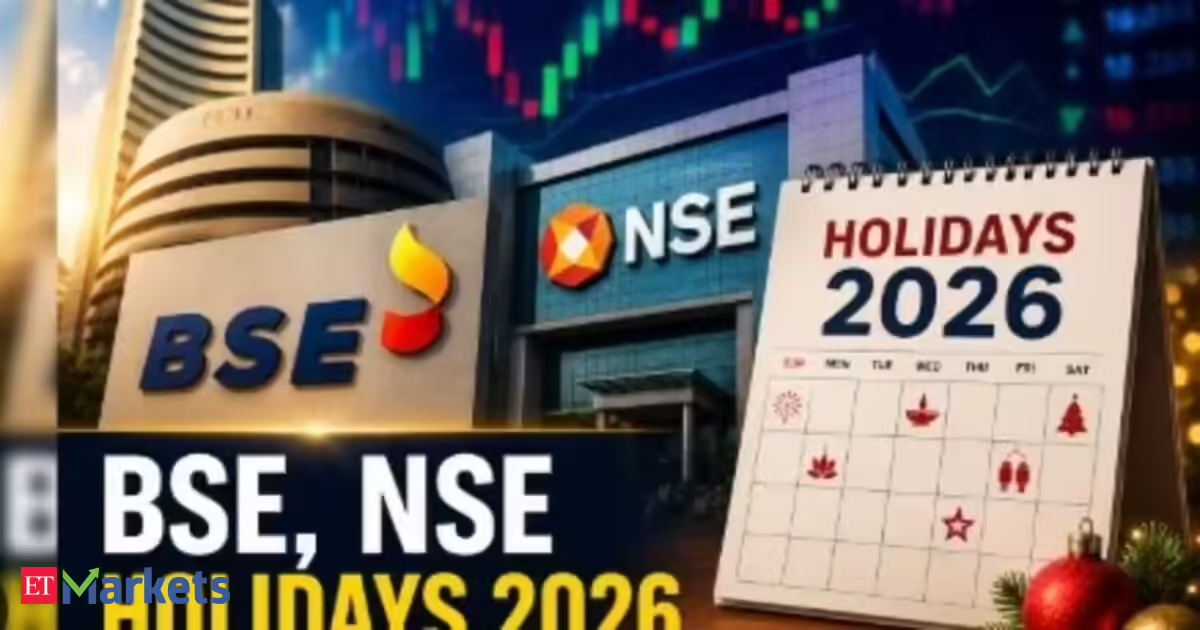
India’s largest commodity exchange, the Multi-Commodity Exchange of India (MCX), is closed for the first session (9 am to 5 pm) on Friday. Trading will resume in the evening session between 5 pm and 11:30 pm, as per its website. The National Commodity & Derivatives Exchange Limited (NCDEX), meanwhile, is closed for the entire day.
Upcoming market holidays
In total, 16 stock market holidays were scheduled for 2026, of which nine have already passed. April saw two holidays – April 3 (Good Friday) and April 14 (Dr. B.R. Ambedkar Jayanti), while markets were also closed on May 1 on account of Maharashtra Day and May 28 for Bakri Id.After today’s market holiday, the BSE and NSE will next be closed on September 14 for Ganesh Chaturthi, followed by October 2 (Mahatma Gandhi Jayanti), October 20 (Dussehra), November 10 (Diwali-Balipratipada), November 24 (Guru Nanak Jayanti), and December 25 (Christmas).
Check list of upcoming seven market holidays, including today.
Muharram is the first month of the Islamic calendar and is based on the lunar cycle, so dates may differ between countries depending on when the new moon is sighted. In India, the datefor Muharram 2026 is Friday, June 26, 2026. This will give a three-day weekend to many.As the first month of the Islamic Hijri calendar, Muharram signifies the beginning of the Islamic New Year. Derived from the Arabic word meaning “forbidden,” Muharram is one of the four sacred months in Islam during which warfare is traditionally prohibited. It carries profound religious and historical significance throughout the Muslim communities of the world. For Shia Muslims, Muharram is particularly marked by grief and remembrance, especially on the day of Ashura, the 10th day of Muharram.
Also read: Vodafone Idea shares rally 80% in less than 3 months. Time to buy or avoid?
(Disclaimer: Recommendations, suggestions, views and opinions given by the experts are their own. These do not represent the views of The Economic Times)

Alphabet Stock Joins the Dow. What History Says Happens Next.
Montenegro police, FBI arrest Iranian wanted by US for hacking
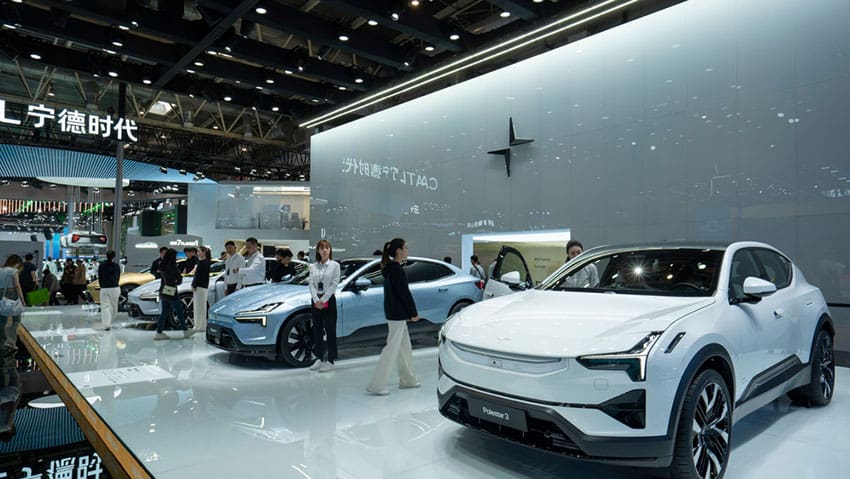
Polestar, the part Chinese-owned electric brand spun out of Volvo, is to abandon the United States after the Commerce Department refused it permission to keep selling new cars, making the company the first casualty of a sweeping American clampdown on Chinese technology in vehicles.
The decision is the opening blow from a rule designed to strip Chinese-written software out of any new car that connects to the internet, a measure Washington frames as shutting the door on the cameras, microphones and GPS systems that it fears could be turned into surveillance tools by a hostile state. For Britain’s small and medium-sized suppliers watching the trade winds, it is a pointed reminder that ownership and code, not just where a car is bolted together, now decide market access.
Polestar, which is controlled by the Chinese motoring giant Zhejiang Geely Holding Group, had applied to carry on selling under a waiver process written into the rule. The government turned it down, the company confirmed on Thursday. The Commerce Department did not immediately comment.
The brand said it would keep selling its remaining American stock and would honour servicing and repairs through its existing network, leaving current owners covered even as the shutters come down on new sales.
Drawn up under the previous administration, the “connected vehicle” rule restricts the import or sale of cars whose hardware and software are tied to China, on national-security grounds. The final rule took effect in March 2025 and has been carried forward rather than unpicked by the current White House.
Carmakers were given until March of this year to certify to the US government that their products carried no code written in China or by a Chinese company, or else to petition for authorisation to keep selling from the 2027 model year onwards. It is a high bar, and one that bites on corporate parentage as much as on the bill of materials.
That distinction explains an awkward split within the Geely empire. Volvo, also majority-owned by the Chinese group, secured authorisation in May to keep trading in the US, after what it described as a case-by-case review and talks with officials over its technology and data security. Polestar, working through the same process, did not clear it.
The rejection is the latest step in a broader American push to wall off Chinese-owned cars. Lawmakers have spent recent weeks floating legislation that would go further still, barring Chinese manufacturers from even building vehicles on US soil.
Polestar had sounded confident it would comply. Chief executive Michael Lohscheller said in a recent interview that the company was “in good dialogue with authorities” about an exemption, adding: “The US is important because obviously it’s a big market.”
Founded as Volvo’s performance and motorsport arm, Polestar became a stand-alone brand in 2017 and was hived off as a separate company in 2021, floating through a special-purpose acquisition vehicle at the height of the electric-car frenzy, when traditional carmakers and start-ups alike scrambled to chase Tesla’s vertiginous share price.
It launched with the limited-edition Polestar 1, a hybrid coupe priced at $156,000, and the Polestar 2, a sporting electric saloon built in China that took early aim at the Tesla Model 3. But a thin line-up left it exposed, particularly in the US, where buyers lean heavily towards SUVs and pick-up trucks. The shares now change hands at $19.22, down 96 per cent from a closing peak of $459.90 in November 2021.
Its Chinese ties had already proved costly. Punitive tariffs imposed by both the Biden and Trump administrations pushed the China-built Polestar 2 out of the American range. Today the brand sells the Polestar 3 SUV, made at Volvo’s plant in South Carolina, and the Polestar 4 SUV, shipped in from South Korea, neither of them built in China.
Polestar said it would now concentrate on shoring up its European business, which already accounts for roughly 80 per cent of global sales. The pivot lands at a moment when the politics of Chinese-built electric cars is fraught on both sides of the Atlantic, with the EU pressing ahead with tariffs on Chinese electric vehicles despite resistance from Germany.
Britain, for its part, is treading a notably different path, courting rather than repelling Chinese capital. The recent Nissan deal to build Chery’s cars in Sunderland underlines how far the UK’s calculation diverges from Washington’s, even as ministers face their own pressure to rethink the 2030 timetable for phasing out petrol cars.
For Lohscheller, the lesson is that the global car market is fragmenting along geographic lines. “The automotive industry is entering a new phase, based on regional dynamics,” he said on Wednesday. For Polestar, that new phase begins with a continent’s worth of ambition and a closed door in the world’s most valuable car market.

Jamie Young
Jamie is Senior Reporter at Business Matters, bringing over a decade of experience in UK SME business reporting.
Jamie holds a degree in Business Administration and regularly participates in industry conferences and workshops.
When not reporting on the latest business developments, Jamie is passionate about mentoring up-and-coming journalists and entrepreneurs to inspire the next generation of business leaders.

OPINION: The regulator has yet to tell retirement village operators whether changes to anti-money laundering regulations apply to them.

Chegg: Skilling Segment Deceleration Is A Major Red Flag (Downgrade)

Yemi, a mother of four energetic boys and her husband Temitayo also benefitted from a SFHF holiday to Skegness.
“It was our very first holiday as a family, and when we found out we were going, we were so happy” she said.
“For my boys, it was their first time on a train, and they were beyond excited,” she said.
She said her youngest child, Ayosubomi, was a “lockdown baby” and had missed out on interaction with other children.
Yemi said the holiday had a “wonderful outcome”.
“He came home from school and told me about how he’s been playing nicely with other children and sharing toys.
“His behaviour has improved so much, and I’m incredibly proud of him”.
Helen Bolt the family services manager for Sheffield Young Carers who refers families to the charity describes the holidays as “transformative”.
“They create space for positive shared memories, something many families may not otherwise have the opportunity to do.”
“They help improve family functioning and emotional wellbeing long after the holiday ends.”

Make That Smart TV Into A Computer

Former Lord-Lieutenant joins autism charity as patron
Bitcoin pinned below $60k as ETF outflows extend into 7th week

No Jackpot Winner as $257 Million Prize Rolls Over to $269 Million Monday Draw

Blockchain.com files with SEC for U.S. IPO

Weekend Open Thread: Miami – Corporette.com

Bitcoin, SpaceX & Co.: Mega-Rallye oder Crash? – DAS solltest du jetzt wissen!

Crypto Markt Update & Wat Ik Doe Met Mijn Funds Op Dit Moment!

GTA 6 = Financial Crisis.#gta6leaks #rockstargames #gta #gaming #ps5 #gamingshorts
-
 Fashion7 days ago
Weekend Open Thread: Miami – Corporette.com
-

 Entertainment5 days ago
Renter of Home in Anne Heche Crash Denies Settlement With Son
-
 Sports2 days ago
Two goals and an assist by sheer aura: Cristiano Ronaldo just entered the World Cup chat
-

 Tech4 days ago
Microsoft accidentally kills epic Outlook email threads
-

 Business5 days ago
Soccer-U.S. defends Iran World Cup travel restrictions, says discussions ongoing
-

 Politics6 days ago
Andy Burnham and the meaning of Makerfield
-

 NewsBeat7 days ago
Keir Starmer Allies Question His Chances For No 10
-

 Tech11 hours ago
A Look At A Gaggle Of Transputer Boards
-
Crypto World2 days ago
Bitcoin (BTC) Dips Below $62K, Ethereum (ETH) Plunges 6% Daily: Market Watch
-

 Crypto World2 days ago
Securitize Wraps Roubini's SEC-Registered ETF as Dubai VARA Digital Security
-
Business2 days ago
Entergy settles forward sale agreements, raises $672 million in cash proceeds
-
 Business6 days ago
Wall Street Week Ahead: Investors see Micron earnings as pulse check of AI rally momentum
-
 Crypto World6 days ago
Can Charles Hoskinson Really Rescue Cardano?
-

 Politics5 hours ago
Potential 2028er World Cup attendee leaderboard
-

 Crypto World6 days ago
HIVE shares jump as $220M AI deal speeds Bitcoin mining pivot
-

 Crypto World6 days ago
Jake Chervinsky accuses CME of protecting derivatives monopoly
-

 Entertainment6 days ago
Jose Alvarado Wants Taylor Swift at More Knicks Games
-
 Tech5 days ago
Signal’s Meredith Whittaker says AI chatbots ‘are not your friends’ and calls Copilot agents a backdoor
-

 Sports18 hours ago
India vs Bangladesh LIVE Score, Women’s T20 World Cup: Bangladesh Opt To Bat; India Enter ‘Do-Or-Die’ Stage As Semi-Final Race Heats Up
-

 Tech3 days ago
Nearly 7,000 fake Amazon domains registered ahead of Prime Day 2026, researchers warn
You must be logged in to post a comment Login