

Crypto World
ASIC Extends No-Action Relief for Digital Asset Firms

The Australian Securities and Investments Commission (ASIC) has given digital asset businesses another three months to apply for licenses required under its updated regulatory guidance.
Australia’s financial regulator said that the temporary protection from enforcement would remain in place until Sept. 30, pushed from the previous June 30 deadline.
The extension applies to businesses seeking an Australian Financial Services (AFS) license, as well as companies that may require market or clearing and settlement authorizations.
ASIC also expanded the no-action relief to cover digital asset businesses operating through authorized representatives or intermediary arrangements with licensed firms, widening the pool of companies eligible for the transition period.
The regulator said it has received about 30 license applications since updating its digital asset guidance in October 2025.
Source: ASIC
Australia’s crypto licensing transition takes shape
ASIC previously introduced the no-action position after updating its Information Sheet 225 (INFO 225) guidance to clarify how existing financial services laws apply to digital assets. The guidance states that many digital asset products are financial products under existing law, meaning many providers require an AFS licence.
That approach rests on ASIC’s view that Australia’s definitions of financial products are broad and technology-neutral. The regulator said its interpretation was recently reinforced by the High Court’s Block Earner ruling, which found that the company’s former crypto yield product was a financial product under the Corporations Act.
Related: Coinbase plans expansion to stock trading in Australia after securing license
The temporary relief is separate from Australia’s Digital Asset Framework, which passed Parliament in April and is scheduled to commence on April 9, 2027.
The law will bring digital asset platforms and tokenized custody platforms under Australia’s financial services licensing regime. ASIC has warned that some firms licensed under the current guidance may need additional authorizations once the new framework takes effect.
“Many digital asset firms that apply for a licence based on INFO 225 will also need to add DAP and TCP authorisations to their licence once that regime commences,” ASIC said in a May announcement.
Magazine: AI is banking the unbanked in Africa… faster than crypto

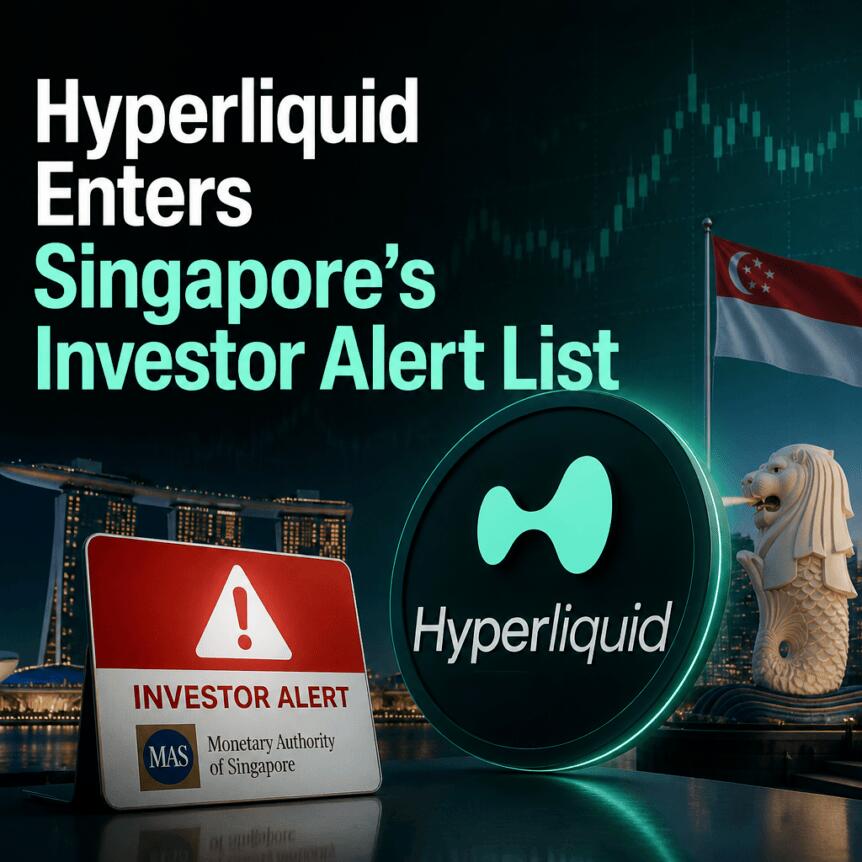
The Monetary Authority of Singapore (MAS) has added Hyperliquid to its Investor Alert List, flagging the decentralized perpetuals exchange as an entity that consumers may wrongly assume is licensed or regulated by the central bank.
MAS says the latest entry, published on Friday, names both the Hyper Foundation website and the Hyperliquid trading app. The Investor Alert List is designed as a consumer protection tool rather than a ban or an announcement of enforcement action.
Key takeaways
- MAS has included Hyperliquid on its Investor Alert List, associating the flag with the Hyper Foundation website and the Hyperliquid app.
- Being listed does not mean MAS has launched an enforcement action or imposed a prohibition.
- MAS’s move follows other crypto platform additions earlier in 2025, including Bybit (June 17) and listings that also include KuCoin and Bitget.
- Singapore continues tightening oversight, emphasizing consumer protection and alignment with global anti–money laundering and counter-terrorism financing expectations.
- Hyperliquid says it has not claimed MAS licensing or authorization, arguing its permissionless setup has not changed.
MAS adds Hyperliquid to the Investor Alert List
MAS’s Investor Alert List is meant to reduce the risk that members of the public interpret certain firms or websites as being authorized or overseen by the regulator. According to MAS’s description of the list, inclusion is not an indication that an activity is prohibited, nor does it itself represent a regulatory action.
The update lists Hyperliquid through its ecosystem: MAS references both the Hyper Foundation website and the Hyperliquid trading application in the same entry. The regulator added the new item on Friday.
Cointelegraph attempted to contact MAS for additional comment but did not receive a response prior to publication.
Hyperliquid responds: no MAS authorization claim
Hyperliquid pushed back on any implication that it sought or received MAS approval. The platform said it has never presented itself as licensed or authorized by MAS and argued that nothing about its permissionless infrastructure has changed.
In a Friday post on X, Hyperliquid wrote that it remains committed to engaging with regulators and institutions globally while supporting “clear, well-designed frameworks” for onchain finance.
How Hyperliquid fits the broader Singapore crackdown
Singapore has tightened crypto regulation in recent years, with MAS repeatedly emphasizing that the industry must comply with licensing requirements and anti-financial crime standards. The regulator’s approach has included clarifying how firms serving foreign customers are treated under Singapore’s framework.
In May 2025, MAS ordered crypto companies that served overseas customers to either obtain the necessary licenses or stop operating. MAS characterized the decision as consistent with its long-standing stance rather than a sudden policy shift.
MAS said the directive targeted a loophole that had allowed certain firms headquartered in Singapore to avoid licensing by focusing on customers outside the jurisdiction. In MAS’s framing, the move effectively ended a transition period for firms that continued operating without a license while serving only overseas users.
MAS also explained that its measures aim to strengthen consumer protection and bring Singapore’s crypto oversight in line with international expectations relating to Anti-Money Laundering (AML) and Countering the Financing of Terrorism (CFT).
What the market data suggests—and what remains unclear
While MAS’s Investor Alert List is a consumer-facing notice, traders and investors often read these updates as signals about how Singapore-based oversight is tightening across both centralized and decentralized crypto offerings.
According to CoinGecko, Hyperliquid ranks as the ninth-largest decentralized exchange by trading volume. Separately, DefiLlama estimates Hyperliquid’s total value locked (TVL) at around $5.7 billion.
At the same time, the regulatory message conveyed by MAS’s Investor Alert List is not a direct restriction. That distinction matters for users trying to understand what changed in practice: the list signals potential consumer misunderstanding around regulatory status, but it does not, on its own, spell out whether specific Singapore-based intermediaries or local distribution channels will face separate action.
Readers should watch for whether MAS follows up with additional clarifications on how its licensing expectations interact with permissionless infrastructure and whether any related entities—such as service providers or interfaces that could influence access—are later referenced in the regulator’s consumer warnings.
For now, the key question is how Singapore will translate its licensing and AML/CFT enforcement posture into the decentralized layer—especially as major protocols like Hyperliquid continue to grow in usage—while keeping the boundary clear between consumer alerts and actual regulatory prohibitions.
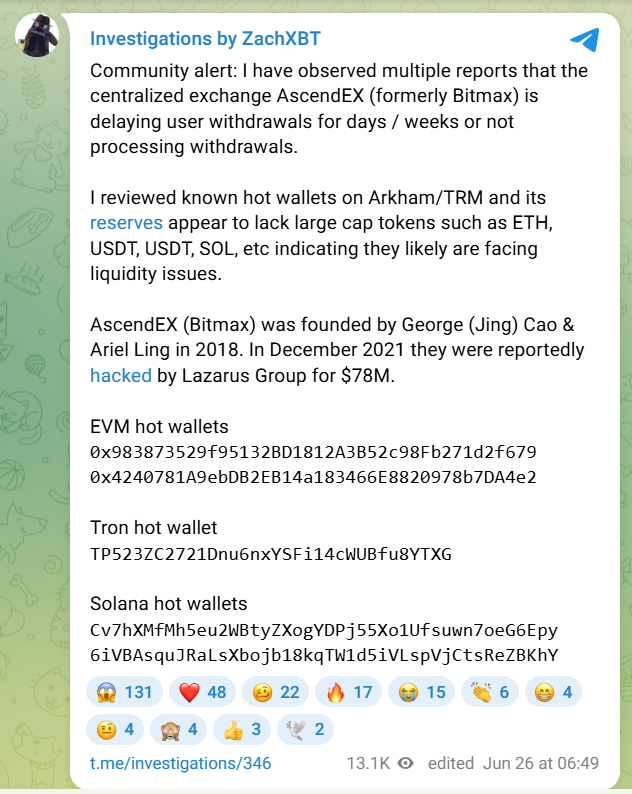
Multiple users have reported issues withdrawing funds from cryptocurrency exchange AscendEX, which blockchain investigator ZachXBT said may be showing signs of liquidity issues.
An X account using the name Lorenzo Navarro Rodriguez said in a Tuesday post that a 4,196 USDT withdrawal had remained stuck in an “initiating” state since June 10. The account also said repeated customer support inquiries had gone unanswered.
At least five other users replied to the post over the following days, reporting similar withdrawal issues.
On Friday, ZachXBT said in a Telegram post that the exchange lacked large-cap reserves for tokens such as Ether (ETH), USDT (USDT) and Solana (SOL), indicating potential “liquidity issues” on the platform. ZachXBT urged the platform to respond to the reports about delayed withdrawal requests and provide more clarity on why its hot wallets have low liquidity.
Related: Polymarket hit by $2.9M theft, users to be refunded
Exchanges rely on liquid reserves of widely traded assets to process customer withdrawals. A shortage of those assets can lead to delayed withdrawals or, in severe cases, insolvency.
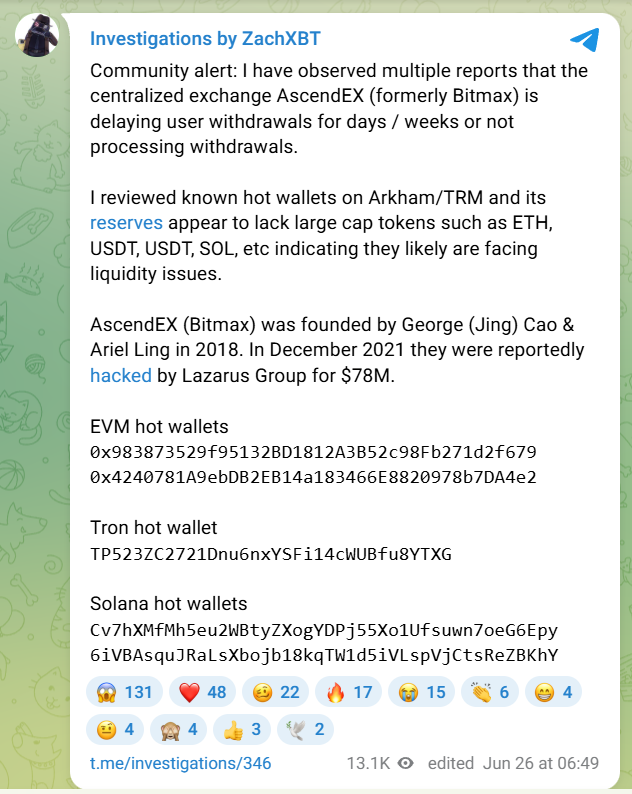
ZachXBT flags liquidity and withdrawal issues on AscendEX via Telegram. Source: ZachXBT
AscendEX’s reserves are dominated by small-cap holdings
Blockchain data on Arkham viewed by Cointelegraph on Friday showed that AscendEX-tagged wallets held about $20.2 million in crypto. Arkham-tagged wallets were concentrated in smaller-cap assets, with relatively limited holdings of major cryptocurrencies.
AscendEx had $10 million in UNITE tokens as its largest holding, followed by $5.24 million worth of REUR, $2.9 million in ASD and $600,000 worth of Reservoir rUSD stablecoins, among other smaller tokens.
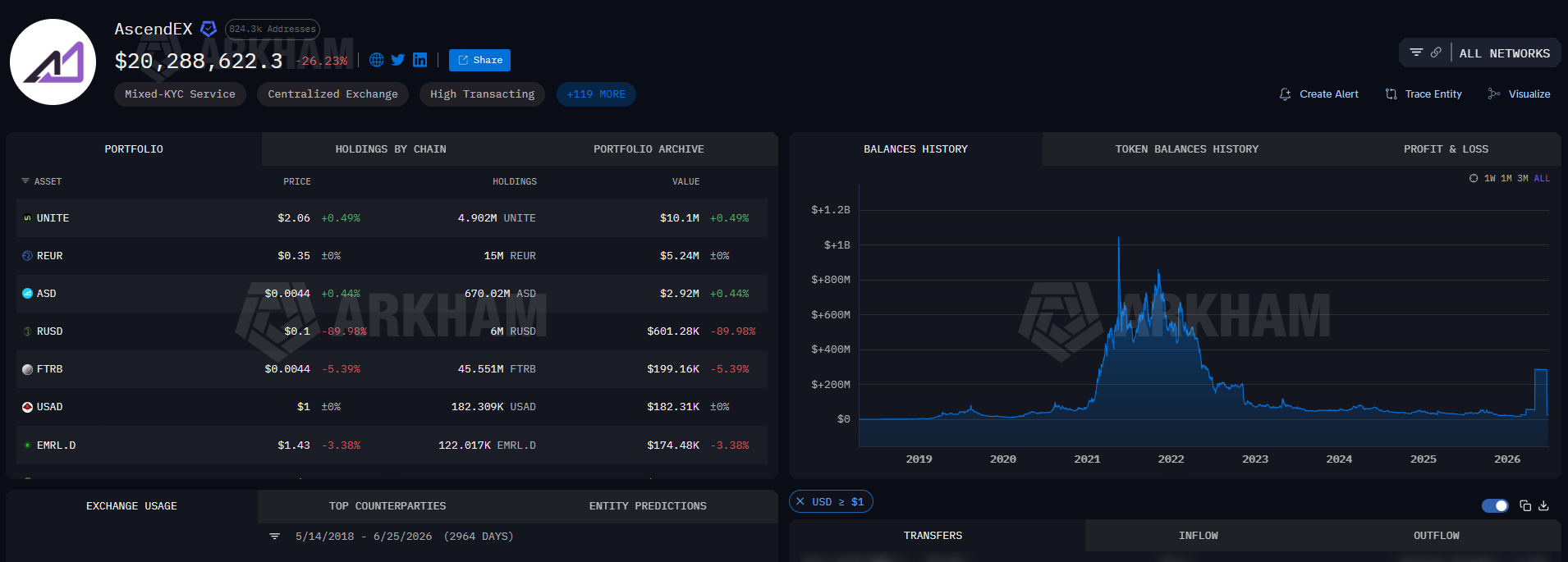
AscendEX-tagged wallet, top token holdings. Source: Arkham
Cointelegraph has approached AscendEX for comment but not received a response before publishing.
Questions about an exchange’s liquidity are highly sensitive in the crypto industry following the collapse of FTX in 2022, when customer withdrawal requests exposed a multibillion-dollar shortfall that ultimately led to the exchange’s bankruptcy.
The failure triggered a wave of customer withdrawals across the industry, intensified regulatory scrutiny and prompted many exchanges to publish proof-of-reserves reports in an effort to reassure users.
Magazine: Bitcoin slides to $58K, XRP hits $1 but onchain data promising: Market Moves
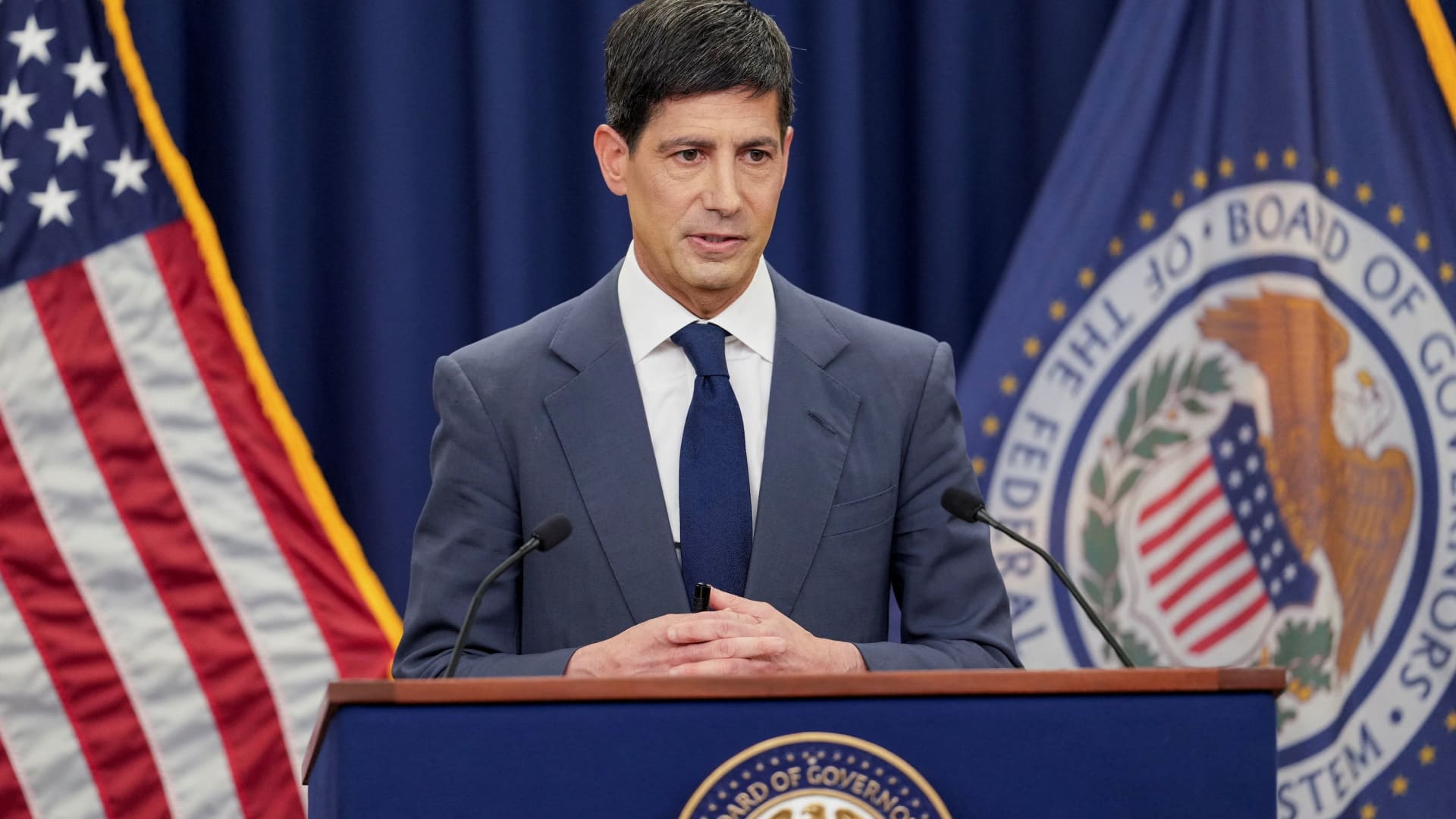
New U.S. Federal Reserve Chairman Kevin Warsh holds a press conference following a two-day meeting of the Federal Open Market Committee (FOMC), at the U.S. Federal Reserve in Washington, D.C., U.S. June 17, 2026.
Eric Lee | Reuters
Federal Reserve Chairman Kevin Warsh has added two more key advisors as he seeks to remake how the central bank approaches its views on the economy and monetary policy, people familiar with the moves confirmed to CNBC.
Though Warsh has talked about broad changes that need to be made at the Fed, he instead reached inside for these appointments, naming economists Daniel Covitz and Eric Engstrom to the posts. Covitz is one of three deputy directors in the research and statistics division while Engstrom is an associate director in monetary affairs.
The appointments come a little more than a week after Warsh announced five task forces aimed at addressing broad aspects of the Fed’s operational structure. Among the focuses will be communication, data, inflation, technology and the Fed’s balance sheet.
Warsh has touted the importance of re-examining how the Fed views each of the key metrics and said he will deploy resources both inside and outside the institution to tackle the projects.
However, the latest announcements indicate that he will rely heavily on the Fed’s own experts as he charts the course ahead. Both Engstrom and Covitz bring decades of Fed experience to their new positions. A Fed official noted that the two will serve in these positions on a rotating basis while maintaining their positions in their respective divisions.
Warsh earlier selected Paul Winfree, an architect of the controversial Project 2025 document that sought to decrease the Fed’s influence on the economy, and Daniel Heil of Stanford, who had previously worked with Warsh.
The two latest appointments were first reported in the Wall Street Journal.
Crypto World
Johnson & Johnson (JNJ) Stock Reaches New Peak on Analyst Upgrade and Strong Drug Performance

Key Highlights
- Johnson & Johnson reached a record price of $251.76 on June 26, 2026, delivering a 65.12% total return over 12 months
- Guggenheim elevated its target from $266 to $270 while maintaining a Buy rating, designating JNJ as a leading large-cap biopharma selection
- Second-quarter 2026 results expected July 15; Guggenheim projects $25.48B revenue and $2.87 EPS, surpassing consensus estimates
- Robust prescription performance for Tremfya, Caplyta, and Erleada supported the upgraded outlook
- Company faces $32 million verdict in Los Angeles talc-related mesothelioma lawsuit
Shares of Johnson & Johnson climbed to an unprecedented $251.76 on Thursday, June 26, before settling near $251.18 — marking just a 0.97% decline from that record level. This performance brings the pharmaceutical giant’s trailing 12-month total return to 65.12%, with its market valuation standing at $604.8 billion.
The surge coincided with Guggenheim’s announcement raising its valuation target on JNJ to $270 from the previous $266, while reaffirming its Buy recommendation. The investment firm simultaneously highlighted JNJ as a premier choice within the large-capitalization biopharmaceutical sector.
Guggenheim’s forecast for the second quarter of 2026 anticipates revenues reaching $25.48 billion alongside earnings per share of $2.87. These projections exceed the prevailing Street consensus, which calls for $24.96 billion in sales and $2.85 per-share profit.
Catalysts Behind the Optimistic Outlook
The enhanced valuation stems from prescription velocity data that exceeded expectations across three important medications: Tremfya, Caplyta, and Erleada. Performance metrics for each surpassed Guggenheim’s proprietary forecasts.
Analysts noted that prescription tracking for two recently introduced therapies — Icotyde and Inlexzo — remains too preliminary for meaningful incorporation into models. These products will receive heightened scrutiny as data sets become more comprehensive.
Guggenheim anticipates the July 15 earnings discussion will emphasize Tremfya’s volume expansion, the commercial rollout of Icotyde, the company’s multiple myeloma pipeline, alongside updates on Caplyta and Spravato.
JNJ boasts an impressive 55-year streak of annual dividend increases, solidifying its appeal among yield-oriented portfolio managers.
Corporate Initiatives and Challenges
Beyond market performance, JNJ unveiled plans to invest over $1 billion in its Jacksonville, Florida facilities. These funds will support enhanced manufacturing, packaging, and logistics infrastructure for the Vision segment, particularly ACUVUE contact lens production.
The organization also broadened domestic distribution of its TECNIS PureSee intraocular lens, designed for cataract procedures. On the research front, JNJ disclosed encouraging Phase 2/3 data for Imaavy in treating warm autoimmune hemolytic anemia patients.
However, legal headwinds persist. A jury in Los Angeles determined JNJ bore responsibility in Maria Lozano’s mesothelioma case, resulting in a $32 million judgment for her family. The verdict relates to asbestos contamination allegations in the company’s baby powder products — a prolonged litigation concern.
InvestingPro’s current assessment suggests the shares may be trading at a premium relative to fundamental metrics, despite the compelling upward momentum.


TLDR:
- Securitize expects about $400 million in gross proceeds after fewer than 30% of SPAC shares were redeemed.
- The proposed business combination is expected to close on July 1 after shareholder approval on June 29.
- Securitize Corp. is scheduled to begin trading on the NYSE under the ticker SECZ on July 2, 2026.
- Securitize currently tokenizes more than $4 billion in real-world assets across its investment platform.
Securitize SPAC Deal is moving toward completion after the company confirmed its proposed business combination with Cantor Equity Partners II is expected to raise approximately $400 million in gross proceeds.
Fewer than 30% of CEPT Class A shareholders redeemed their shares, allowing most trust proceeds to remain available.
Subject to shareholder approval on June 29 and customary closing conditions, the transaction is expected to close on July 1, with the combined company targeting a New York Stock Exchange listing on July 2 under the ticker SECZ.
Securitize SPAC Deal Secures $400 Million Before Public Listing
Securitize and Cantor Equity Partners II announced the final redemption results on June 26 through an official company statement.
Less than 30% of CEPT Class A shareholders elected to redeem their shares before the proposed business combination.
The redemption outcome means Securitize expects to receive approximately $400 million in gross proceeds. The amount includes related PIPE financings but excludes all transaction-related expenses.
The companies also confirmed that 71.5% of the CEPT trust was retained. The proposed business combination remains subject to shareholder approval during the special meeting scheduled for June 29.
If shareholders approve the transaction and the remaining conditions are satisfied or waived, the companies expect to complete the merger on July 1.
The combined entity is then expected to begin trading on the New York Stock Exchange under the ticker SECZ on July 2.
CEO Discusses Public Market Plans as Tokenization Business Grows
Following the completion of the transaction, the combined company will operate as Securitize Corp. The company currently tokenizes more than $4 billion in real-world assets across its platform.
Commenting on the upcoming listing, Securitize Co-Founder and Chief Executive Officer Carlos Domingo said, “Reaching the public markets is a milestone for Securitize and a reflection of the growing momentum behind tokenization.”
He added that the company began more than eight years ago when institutional adoption of tokenized securities remained largely theoretical.
Domingo continued, “Today, tokenization is moving into the mainstream, and we believe becoming a public company gives us the visibility, credibility, and capital to lead that next phase of growth.” The remarks accompanied the company’s announcement of the expected closing timeline.
The company confirmed that the planned schedule remains unchanged following the redemption results. Subject to shareholder approval on June 29, Securitize expects to complete the business combination on July 1 before its shares begin trading on the NYSE under the SECZ ticker on July 2.
Hyperliquid has been added to the Investor Alert List (IAL) maintained by the Monetary Authority of Singapore (MAS). The perpetual futures platform clarified that the listing does not represent a regulatory violation, enforcement action, or ban.
In a statement shared on X, Hyperliquid said that inclusion on the IAL should not be interpreted as evidence of wrongdoing while adding that the list is intended to identify entities that may be incorrectly viewed as being licensed, authorized, or regulated by MAS.
MAS Investor Alert List
Hyperliquid noted that several major crypto exchanges and decentralized finance protocols have also appeared on the list in the past. According to MAS, the Investor Alert List contains names of entities that, based on information available to the regulator, may have been wrongly perceived as being licensed or otherwise regulated by the central bank.
The regulator also stated that the list may include entities offering investments or investment-related products that could be mistakenly viewed as being authorized, recognized, registered, or accompanied by documents lodged with MAS.
Responding to the development, Hyperliquid asserted that it is a permissionless infrastructure and has never claimed to be licensed or authorized by MAS and that users should not regard the platform as holding such approval. The platform added that users continue to maintain self-custody of their assets and that transactions on the network remain transparent and fully settled on-chain.
“The Hyperliquid ecosystem remains committed to engaging collaboratively and constructively with regulators and institutions globally and to supporting clear, well-designed frameworks for onchain finance.”
The MAS had also placed Bybit Fintech Limited on its Investor Alert List earlier this month. In response, Bybit said it has maintained regular and constructive engagement with MAS and has implemented measures to restrict access for users in Singapore. The exchange said these measures include restrictions in its terms of service and geo-blocking of Singapore IP addresses.
HYPE Cools but ETF Interest Accelerates
Hyperliquid’s native token, HYPE, showed little reaction following the development. HYPE traded largely around $62 over the past 24 hours. The token had previously rallied above $75 in mid-June before retreating amid broader market volatility.
Meanwhile, institutional demand for the token appeared to remain strong. Data from SoSoValue revealed that US spot HYPE ETFs recorded more than $108 million in net inflows on June 25, which is the largest single-day inflow since the products launched last month. The inflows came after five trading days in June that recorded no net flows.
The post Hyperliquid Responds After Appearing on Singapore’s Investor Alert List appeared first on CryptoPotato.
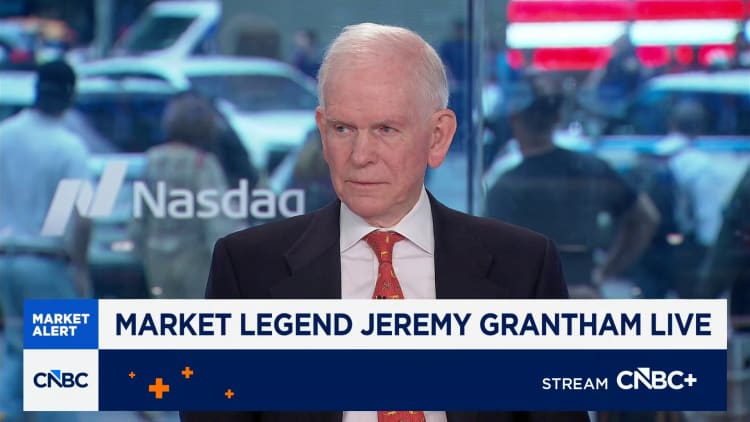

Veteran investor Jeremy Grantham thinks the artificial intelligence boom has pushed the U.S. stock market to its most expensive level ever and could eventually lead to a historic decline.
“Based on the value of the stock market compared to GDP, with modifications, this is the most expensive market in American history,” Grantham told CNBC’s “Squawk Box.”
While the GMO co-founder said he wasn’t sure there was a comparable period, the tech bubble of 2000 is the closest analogy. He also highlighted the so-called Buffet indicator, which compares the total value of the U.S. stock market valuation with the size of the economy in terms of GDP.
The market capitalization to GDP ratio referenced by Grantham is estimated to be at 235%, according to Longtermtrends.com. It means that the value of the total stock market is more than two times the size of the U.S. economy.
Legendary investor Warren Buffett used this indicator, saying years ago that when it “approaches 200% — as it did in 1999 and a part of 2000 — you are playing with fire.”
Graham said that, while the timing was terribly uncertain, markets could potentially peak.
Grantham is a famed investor known for his history of calling bear markets and has issued similar dire warnings in the past, including in March 2024.
At the time, he predicted the long-term outlook for U.S. stocks was almost as poor as at any other point in history but the stocks continued to advance after that warning.
“The long-run prospects for the broad U.S. stock market here look as poor as almost any other time in history,” Grantham had said in a blog post released by Boston-based GMO at the time.
Grantham on SpaceX
Grantham also discussed SpaceX following its blockbuster IPO. The stock raced higher in the first few days of trading but has sine lost steam. The investor said that while AI is where investors want to put all their money in, this also creates the conditions for excessive investment.
He pointed out that Amazon shares fell 92% after the dot-com bubble before the company eventually “inherited the earth.”

SPCX 5-day chart
“The long term is complicated, I don’t know, but is it going to have a crash like Amazon? Yes, very likely. And then what happens is indeed it may float away debris on the waves of time, or it will inherit a lot of the market, like Amazon did,” he said.
SpaceX and its roughly $2 trillion valuation, he believes, is another sign of extreme market enthusiasm.
He said historians may eventually view the company’s public-market debut as “one of the defining peaks of all time.”
“It’s the thing you see around the top,” Grantham said.


Securitize, one of the largest providers of tokenization infrastructure for Wall Street, expects to raise about $400 million as it prepares to go public through a merger with a Cantor Fitzgerald-backed special purpose acquisition company.
The company said Friday that, following lower-than-expected shareholder redemptions, the business combination with Cantor Equity Partners II (CEPT) is expected to generate roughly $400 million in gross proceeds, including private investment in private equity (PIPE) financing.
CEPT was 8% higher following the news.
The transaction is scheduled to close on July 1, pending shareholder approval on June 29 and other customary closing conditions. The combined company is expected to begin trading on the New York Stock Exchange the following day under the ticker SECZ.
Tokenization — the process of representing assets such as funds, bonds and private credit on blockchain networks — has become one of Wall Street’s fastest-growing digital asset initiatives. The market for tokenized real-world assets has grown to more than $30 billion excluding stablecoins, according to rwa.xyz, while Boston Consulting Group and Ripple project it could reach $18.9 trillion by 2033.

CEO of OpenAI Sam Altman waves as he speaks with reporters, following meetings on Capitol Hill, in Washington, D.C., U.S., June 3, 2026.
Kylie Cooper | Reuters
The outlook for an initial public offering from artificial intelligence platform OpenAI is changing after a New York Times report said the company may delay a debut on the public market until next year.
So when might the company formally announce an IPO? Traders on prediction market platform Kalshi think it will now arrive early next year.
Speculators say that there’s a 59% chance that an IPO by OpenAI is officially announced by March 1, 2027. Traders place only about one-in-three odds that an IPO is announced before January 1, but think there’s a 73% chance of an announcement by June 2027.
Kalshi considers an IPO confirmed, and thus resolves the contracts to “yes,” if any of the following occur: the Securities and Exchange Commission declares a company’s S-1 form effective, the IPO has an official price or if the company receives a trading ticker.
Previously, OpenAI was widely expected to go for an IPO in 2026, and the company led by CEO Sam Altman confidentially filed to go public on June 8.
The New York Times said SpaceX’s public market debut — the first of what was expected to be several megacap IPOs this year — has made OpenAI’s advisers more cautious. OpenAI has worried that Elon Musk’s company’s initial rally and subsequent fall signals retail investors may have less interest in buying, the report said.
At the beginning of June, OpenAI’s chief rival Anthropic confidentially filed for an IPO. Traders on Kalshi think there’s a 70% chance Anthropic officially announces a public market debut by December.
Key Takeaways
- Singapore’s financial authority flags Hyperliquid for operating without proper licensing credentials.
- The platform maintains it never represented itself as authorized by Singapore regulators.
- Alert listing doesn’t constitute an operational ban or indicate imminent legal action.
- Singapore continues strengthening regulatory framework for cryptocurrency platforms targeting domestic users.
- Despite regulatory spotlight, Hyperliquid maintains position as leading decentralized exchange.
On June 26, Singapore’s financial watchdog placed Hyperliquid on its official Investor Alert List, citing the platform’s absence of domestic regulatory approval. The warning encompasses both the Hyper Foundation’s web presence and its decentralized trading application. Importantly, this designation doesn’t constitute an outright prohibition or signal immediate enforcement measures.
Singapore Authority Issues Public Warning
The Monetary Authority of Singapore maintains this registry to spotlight financial operations lacking mandatory domestic approval. The authority uses this mechanism to identify services that Singapore residents might mistakenly believe are regulated entities. This alert serves to clarify Hyperliquid’s standing under Singapore’s regulatory framework.
The public alert mechanism dates back to 2004, established as a consumer safeguard initiative. Updates occur regularly, incorporating websites, corporate entities, and digital financial platforms. Appearing on this registry doesn’t necessarily imply fraudulent activity or criminal operations.
The designation indicates MAS hasn’t granted Hyperliquid permission to deliver regulated financial services within Singapore’s borders. Consequently, platform users cannot access the safeguards typically provided through domestically supervised financial organizations. No financial penalties or judicial proceedings against the platform have been disclosed by the regulator.
Platform Emphasizes Decentralized Framework
Hyperliquid responded by stating it never portrayed itself as possessing Singapore regulatory authorization. The platform emphasized the alert hasn’t impacted its permissionless operational model. Trading activity continues flowing through its blockchain-based network infrastructure.
The decentralized trading venue enables participants to maintain direct custody of their digital assets throughout transactions. Settlement occurs transparently via blockchain verification mechanisms. The platform contends its architectural design fundamentally differs from conventional centralized financial services.
According to the platform, its broader network will maintain ongoing dialogue with regulatory bodies and institutional players globally. It advocates for transparent regulatory guidelines governing decentralized finance and blockchain trading environments. Nevertheless, Hyperliquid hasn’t revealed intentions to pursue Singapore licensing.
Regulatory Pressure Intensifies Across Crypto Sector
MAS has expanded its alert roster to include multiple cryptocurrency trading platforms. Bybit received the same designation on June 17, joining previously listed exchanges KuCoin and Bitget. These inclusions demonstrate Singapore’s systematic approach toward unauthorized digital currency operations.
During May 2025, MAS mandated that Singapore-domiciled cryptocurrency companies servicing international clientele obtain proper licenses or cease activities. This directive eliminated a regulatory loophole permitting certain operators to bypass domestic approval requirements. The authority emphasized it had communicated this regulatory stance consistently since 2022.
These enforcement measures connect to enhanced consumer safeguards and strengthened financial crime prevention protocols. The regulator also aims to better harmonize with global anti-money laundering frameworks. Cryptocurrency enterprises based in Singapore now confront more demanding licensing requirements.
Exchange Sustains Leading Industry Status
Hyperliquid continues ranking among the most prominent decentralized trading venues notwithstanding regulatory attention. According to CoinGecko metrics, it holds ninth position among decentralized exchanges measured by transaction volume. DefiLlama data suggests the protocol secures approximately $5.7 billion in total value locked.
The venue concentrates primarily on perpetual futures contracts and additional blockchain-enabled trading instruments. Its architecture merges self-custodial features with high-speed transaction execution. Regulatory authorities may still evaluate how such platforms extend services to users within specific jurisdictions.
MAS hasn’t signaled whether additional measures targeting Hyperliquid will follow. The current alert primarily serves to inform Singapore residents about the platform’s regulatory standing. Meanwhile, the exchange maintains operations through its permissionless blockchain systems.

Surprise: CBS’ ‘Ombudsman’ Has Been A Useless Trump Lackey
Compass Pathways stock hits 52-week high at 14.77 USD

Hyperliquid Enters Singapore’s Investor Alert List


-

 Fashion7 days ago
Weekend Open Thread: Miami – Corporette.com
-

 Entertainment6 days ago
Renter of Home in Anne Heche Crash Denies Settlement With Son
-
 Sports3 days ago
Two goals and an assist by sheer aura: Cristiano Ronaldo just entered the World Cup chat
-

 Tech4 days ago
Microsoft accidentally kills epic Outlook email threads
-

 Business6 days ago
Soccer-U.S. defends Iran World Cup travel restrictions, says discussions ongoing
-

 Politics10 hours ago
The House | Manchesterism won’t survive the painful trade-offs unless it gets citizens on board
-

 Politics6 days ago
Andy Burnham and the meaning of Makerfield
-

 Politics14 hours ago
Potential 2028er World Cup attendee leaderboard
-

 NewsBeat7 days ago
Keir Starmer Allies Question His Chances For No 10
-

 Tech20 hours ago
A Look At A Gaggle Of Transputer Boards
-
Crypto World3 days ago
Bitcoin (BTC) Dips Below $62K, Ethereum (ETH) Plunges 6% Daily: Market Watch
-

 Crypto World2 days ago
Securitize Wraps Roubini's SEC-Registered ETF as Dubai VARA Digital Security
-
 Crypto World22 hours ago
Dell (DELL) Shares Tumble Over 5% Following Analyst Downgrade to Hold
-
Business3 days ago
Entergy settles forward sale agreements, raises $672 million in cash proceeds
-
 Business7 days ago
Wall Street Week Ahead: Investors see Micron earnings as pulse check of AI rally momentum
-
 Crypto World6 days ago
Can Charles Hoskinson Really Rescue Cardano?
-

 Entertainment7 days ago
Jose Alvarado Wants Taylor Swift at More Knicks Games
-

 Crypto World7 days ago
HIVE shares jump as $220M AI deal speeds Bitcoin mining pivot
-

 Crypto World6 days ago
Jake Chervinsky accuses CME of protecting derivatives monopoly
-
 Tech5 days ago
Signal’s Meredith Whittaker says AI chatbots ‘are not your friends’ and calls Copilot agents a backdoor
You must be logged in to post a comment Login