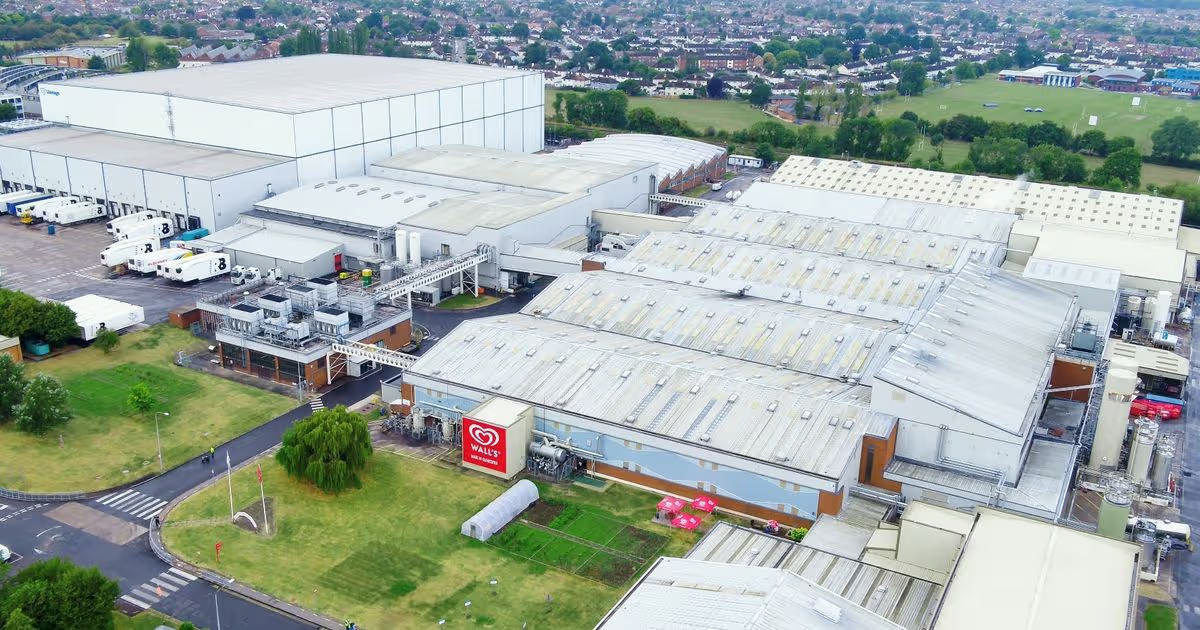
The global business was spun out from Unilever in December and owns the largest ice cream factory in the West of England
An aerial view of the Wall’s ice-cream factory in Gloucester(Image: Handout)
The company behind the West of England’s biggest ice cream factory says it is looking to deliver “profitable growth” over the next financial year following a drop in profits.
The newly independent Magnum Ice Cream Company, which was spun out of Unilever in December, makes products including Viennetta and Cornetto at its plant in Gloucester where it employs some 500 staff.
In a set of results announced on Thursday (February 12), the business reported +4.2 per cent organic sales growth year-on-year for the 2025 financial year, against flat revenue of €7.9bn. Operating profit stood at €599m – down from €764 million in 2024 which the company said reflected separation and restructuring costs.
Magnum’s boss, Peter Ter Kulve, said the company expected between three per cent and five per cent organic sales growth along with underlying margin improvement over the coming year.
Advertisement
“We delivered a solid operational performance in 2025,” he said. “Our four leading brands, Magnum, Ben & Jerry’s, Cornetto and the Heartbrand, were the driving force behind our performance, with 150 new launches, including Magnum Utopia and Cornetto Max.
“Every region contributed to growth, with market share gains across most key markets, including the US, our largest market. Growth was supported by improved availability and operational rigour with our front-line first model. Through disciplined execution of our productivity programme, and select pricing actions, we mitigated the impact of elevated commodity inflation and continued to grow volume.”
In November, Magnum announced plans to invest £50m upgrading its factory in Gloucester. Founded in 1959, the site is the second-largest ice cream factory in Europe (behind Heppenheim, Germany). Every week, the facility produces nearly three million Calippos and two million Viennettas, in addition to one million Ben & Jerry’s tubs.
The upgrade plans include a complete rebuild of the factory’s mix plant and the installation of advanced blending systems as well as new high-speed production lines for products including Twister and Solero.
Advertisement
Unilever first announced its intention to spin off its Gloucestershire-based ice cream division in 2024 as part of a broader shake-up of its portfolio, moving away from food towards household and other consumer goods
Olly Harrison, who farms in Tarbock, on Merseyside, said he bought his fertiliser for a good price last year and now believes – due to a wet and cold spring and limited growing days left, added with the costs of diesel for machinery – he may be better off not planting.
Reports of issues with Google Gemini surfaced Monday as users across social platforms and monitoring sites questioned whether the AI chatbot was experiencing another disruption, prompting the familiar query: “Google Gemini is reportedly down now. Are you one of them?”
AFP
As of late Monday, major outage trackers including Downdetector showed fluctuating user reports for Google Gemini, though no widespread global outage was confirmed by Google’s official status pages. Downdetector indicated possible problems in the last 24 hours, with website access cited as the top issue by a majority of reporters.
DownForEveryoneOrJustMe reported no current detection of problems with Gemini, noting the most recent confirmed outage occurred on March 25, 2026, lasting about two hours. That incident saw spikes in complaints starting around 10:06 a.m. Eastern Time.
Recent history shows Gemini has faced intermittent challenges. On March 27, the Gemini AI Studio API suffered a major outage affecting image generation models like gemini-3-pro-image-preview (referred to internally as “Nano Banana Pro”) and Nano Banana 2, with widespread request failures. Earlier in March, users reported latency spikes, 429 errors, and automatic tier downgrades for API projects. March 9 marked the shutdown of Gemini 3.0 in favor of the 3.1 Pro Preview, a migration that some developers said introduced slowdowns for complex tasks.
Google’s AI Studio status page has logged past incidents involving increased error rates, latency in the Gemini API, spend cap issues, and multimodal live API disruptions. Vertex AI customers also saw elevated errors in February. No active broad incident appeared on Google Cloud’s service health dashboard as of Monday afternoon.
Advertisement
Social media buzz reflected user frustration. A post from monitoring account @status_is_down on X (formerly Twitter) asked Monday: “Google Gemini is reportedly down for some users at the moment. Are you one of them?” echoing similar alerts from previous dates like March 25. Scattered user complaints mentioned slow responses, processing loops, or failed generations, though many posts mixed Gemini AI with unrelated topics like K-pop idols or other services.
### xAI’s Grok Unaffected: “No, I’m Not One of Them”
In contrast to the reports swirling around Gemini, xAI’s Grok — the AI built by Elon Musk’s xAI — reported no current issues.
Grok’s official status page at status.x.ai showed “No incidents declared” with high availability across inference endpoints. Downdetector likewise indicated no current problems for Grok. Past incidents for Grok included temporary unavailability on March 10 and March 2, but services appeared stable Monday.
Advertisement
When asked directly if it was “one of them” amid Gemini rumors, Grok responded that it was fully operational and available for users seeking an alternative conversational AI with real-time knowledge via X integration and a focus on truth-seeking without heavy content restrictions common in other models.
xAI has positioned Grok as a more open and maximally truthful alternative in the competitive AI landscape. Users can access Grok via grok.com, x.com, and mobile apps, with subscription options for higher usage limits.
### Broader Context: AI Reliability in 2026
The latest Gemini reports come amid a year of rapid AI evolution and growing pains. Google’s Gemini family has seen model deprecations, performance debates post-migration to 3.1 variants, and API stability questions as demand surges for multimodal capabilities including image and video handling.
Advertisement
Developers have voiced concerns on forums about latency regressions after the Gemini 3.0 shutdown, with some tasks reportedly taking significantly longer under newer previews. Image generation features have been particularly prone to recent hiccups.
Outage monitoring sites remain essential tools for users. Downdetector aggregates crowd-sourced reports, while official pages from Google and xAI provide backend insights. Experts recommend checking multiple sources, clearing cache or trying incognito mode, and testing via different devices or networks during suspected issues.
For businesses relying on AI APIs, repeated disruptions highlight the importance of redundancy — maintaining fallback providers or rate-limit strategies. The March 27 API outage, for instance, impacted image-heavy workflows for numerous developers.
### What Users Should Do If Experiencing Issues
Advertisement
If Google Gemini appears unresponsive:
– Visit downdetector.com/status/googlegemini or aistudio.google.com/status for real-time updates. – Try accessing via gemini.google.com, the mobile app, or integrated Google services. – Check internet connection, VPN status, and browser extensions. – For API users: Review quotas, migrate to recommended models if using deprecated versions, and monitor Google’s Cloud status.
For those seeking uninterrupted access, alternatives like Grok, OpenAI’s ChatGPT, Anthropic’s Claude, or open-source options offer varying strengths in reasoning, creativity, and real-time information.
As AI systems scale, outages — whether partial, regional, or model-specific — have become a recurring feature of the industry. Google has not issued a public statement specifically addressing Monday’s reports as of press time, consistent with its handling of shorter disruptions.
Advertisement
xAI, meanwhile, continues iterating on Grok with an emphasis on reliability and user-centric design. Status monitoring shows consistent uptime outside of brief scheduled or unexpected maintenance windows earlier in the month.
This situation remains fluid. Users are encouraged to report problems directly through platform feedback tools and monitor official channels for resolutions. As demand for generative AI grows across search, productivity, coding, and creative tasks, service stability will likely remain a key competitive factor among leading providers.
The S&P 500 Index increased by 2.66% (total return, in USD) in the fourth quarter of 2025, while the Russell 2000 Index rose by 2.21% (total return, in USD). The fourth quarter demonstrated broad resilience, as the major US indices
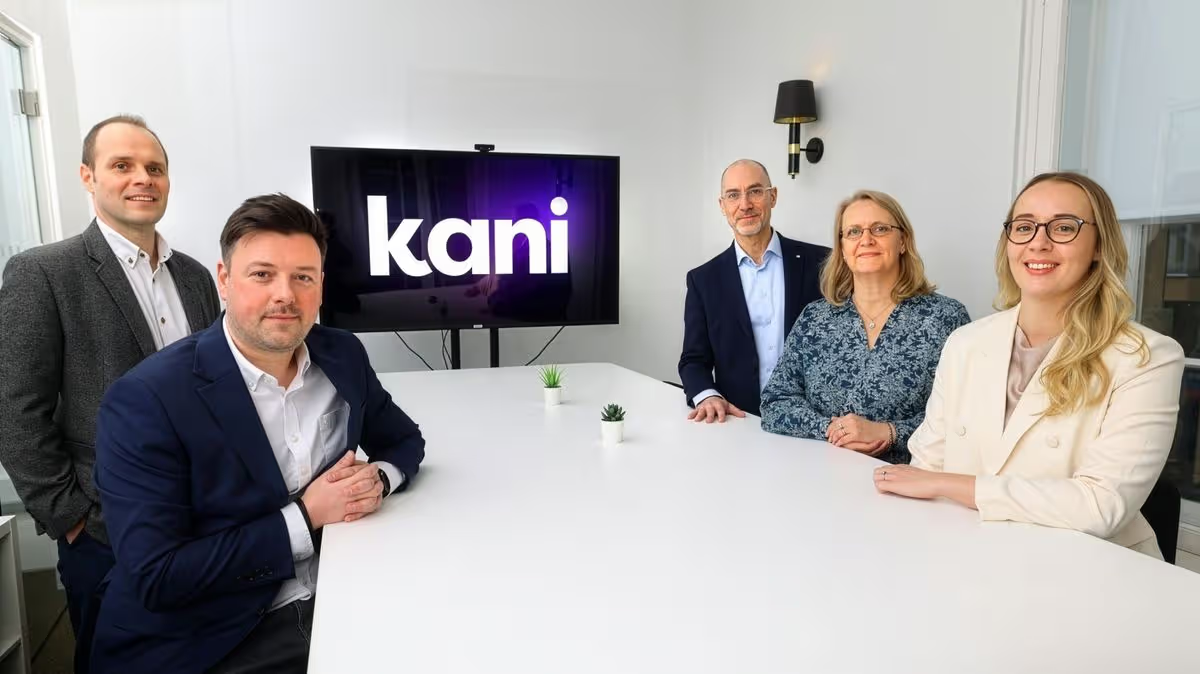
Maven originally invested in Kani last year to further develop its platform, grow the team and support customer expansion
Kani Payments has received further funding from Maven Capital Partners.(Image: Maven Capital Partners)
Fintech firm Kani Payments is set to accelerate overseas expansion after securing investment. The Newcastle-based payments processing business has received the undisclosed amount in a funding round led by private equity firm Maven Capital Partners – the second round the fintech firm has sealed with the organisation.
The company was founded eight years ago to overcome the complex challenges of payment reconciliation and reporting required by banks, payment companies and other fintechs. Kani’s software as a service (SaaS) platform is in demand thanks to digitisation in the financial services sector. Its platform automates and streamlines workflows, helping clients save time and reduce costs while maintaining full compliance with industry and regulatory standards.
Maven originally invested a multmillion-pound sum in Kani in early 2025 to further develop its highly scalable platform, grow the team and support customer expansion. Since then, Kani has seen impressive growth, made a number of key senior hires and secured several significant contracts.
The fresh transaction includes follow-on investment from NPIF II – Maven Equity Finance, which is managed by Maven as part of the Northern Powerhouse Investment Fund II (“NPIF II”), alongside the Maven VCTs.
Advertisement
Kani said the new funding will allow it to invest in new product development to prepare for upcoming regulations, requiring firms to provide audit-ready reconciliation of client funds across the UK and global payments markets. The investment will also support a number of new customer partnerships and accelerate global market expansion.
The business operates across five continents and its platform is currently used by many leading financial services companies such as Cardaq, IDT, Pluxee and TransactPay .
Aaron Holmes, CEO at Kani Payments, said: “Maven has been a hugely supportive partner since their initial investment, and we’re pleased to have their continued backing as we enter the next phase of Kani’s growth. This investment will allow us to keep investing in our platform and supporting payment companies facing growing reconciliation and regulatory complexity.”
Rebecca Minchella, investment manager at Maven Capital Partners, said: “Kani has achieved impressive growth since our initial investment, and we have been really impressed by the expertise and conviction of the team to address the challenges facing fintechs in a fast, evolving payments industry. With the increasing complexity of payment reconciliation and regulatory compliance, demand for Kani’s solution is set continue, in a ever more regulated environment.
Advertisement
“Following a number of significant customer wins, we are delighted to support the team as they scale and accelerate their international expansion.”
Sarah Newbould, senior investment manager, at the British Business Bank, said: “Kani Payments is tackling a critical challenge for financial services firms as payment ecosystems become more complex. Through NPIF II we are committed to backing ambitious technology businesses that are building solutions with global relevance, while continuing to grow from the North East.
“It’s these businesses that are helping to drive forward the government’s Industrial Strategy, boosting UK economic growth while creating new jobs and opportunities for people across the North.”
To find all the planning applications, traffic diversions, road layout changes, alcohol licence applications and more in your community, visit the Public Notices Portal.









.webp?t=1774879489)








































You must be logged in to post a comment Login