As the weather heats up, so do the rumors surrounding Samsung’s latest foldable phones — presumably the next versions of the Galaxy Z Fold and Z Flip. Now, the company is adding fuel to the speculation with its own teasers that hint at what’s to come.
Samsung wiped its Instagram feed on Monday, and it’s now dropping some cryptic, artistically driven videos that encourage viewers to decode what may be in store. They could point to how Samsung is shaping — quite literally — its upcoming foldable devices.
In one video, someone cuts the top portion off of a rectangular photo, reducing its height. In another, someone takes a pizza cutter to the center of a pie, serving up a rectangular piece with on-screen text reading: “A whole new slice.” In yet another teaser, someone removes the top row from a small puzzle, before on-screen text appears saying, “Feels just right.”
Advertisement
One video appears to confirm that the eighth generation of foldables could be imminent. It shows someone using a squeegee on dollops of paint to reveal a pink and purple ombre “8.”
For months, rumors have circulated about a potential Galaxy Z Fold 8 “Wide,” which, as the name suggests, would have a wider but shorter screen. Samsung’s latest teasers could therefore be pointing to a redesign for its upcoming foldables.
The next Z Fold and Z Flip phones will have some fresh competition. In the spring, Motorola’s released its newest foldables, including its first book-style Razr Fold. A new Pixel Fold and the highly anticipated (and long rumored) foldable iPhone could also be around the corner, the latter of which is also rumored to have a wider-format design.
Samsung has yet to announce its summer Unpacked event, during which it’s expected to showcase new foldable phones alongside the next iteration of the Galaxy Watch. It may only be a matter of time before the company drops that hint — or shares the news outright.
It should be obvious at this point that JD Vance is a purely political creature. There’s no virtue to find in there, no moral stances firmly taken, nor anything resembling a true political ideology. There is only the attainment and retention of more and more power. You need look no further than Vance’s prior status as a self-affirmed “never Trumper” that compared the current president to Hitler, only to flip-flop completely and become both Trump’s greatest defender and running mate. He wants to be president, of course, and will take whatever action or stance he thinks gives him the best chance to sit behind the Resolute Desk.
Now, I’m not particularly keen on giving free political advice to someone so loathsome, but I don’t think I’m breaking new ground when I say it’s not a great idea for Vance to brag about how this administration has so perfectly neutered the free press that they could do a bunch of Watergates and it wouldn’t be a major issue for them.
Vice President JD Vance on Thursday said the Watergate scandal that brought down President Richard Nixon would have been a blip in today’s news cycle, and he drew parallels between Nixon and President Donald Trump — arguing that both were targeted by “deep state” forces.
“If Watergate happened tomorrow, it would be like a 12-hour news story. The idea that it would have taken down a presidency is crazy,” Vance said.
He went on: “If you look at the story of how the deep state took down Richard Nixon, it’s not all that different from what the same groups of people, the same institutions tried to do to Donald Trump in the first Trump administration.”
Advertisement
On this, Vance is sadly correct on multiple fronts, while incorrect on others. A Watergate scandal today probably wouldn’t get as much attention as it did in the 70s, in large part due to the bifurcation of our news media into one traditional media wing and one plain propaganda wing for the proverbial right. But that’s not a good thing. It’s bragging about the culmination of a long term plan to subjugate the press being that you can pull off wild scandals and get away with it. And if you need proof of that, you need only remember that January 6th happened, Donald Trump attempted to pull off a coup to retain the presidency over the clear will of the voters, and then managed to get elected to office again.
Vance’s comparison of Trump to Nixon is also quite apropos, though it’s quite incredible to see him willing to make it voluntarily. Once again, if you’re making a list of the worst political scandals in United States history, Watergate and January 6th are 1 and 1a, with the only argument being in which order you place them.
But it’s what he gets wrong about Watergate that explains why Vance somehow thinks these are good words to say out loud. The Nixon resignation from office was most certainly not the work of some “deep state.” Quite the opposite, in fact. Nixon used what might be called the deep state, or at least government intelligence services and the Justice Department, to attempt to evade accountability for breaking into the DNC headquarters and bugging them. He was caught attempting to hide and destroy evidence of his involvement in this crime. He’s on tape ordering an end to an investigation into his own reelection campaign. He resigned instead of being impeached. None of the above is a matter of debate.
Which is why, when Vance goes even further and happily compares himself to Nixon, I suggest we take him at his word.
Advertisement
Vance then noted his own similarities with Nixon.
“Young senator, vice president, writes some bestselling books, is hated by the media,” he said. “It kind of sounds like JD Vance. I’ve always liked Richard Nixon.”
Nixon was not a perfectly terrible president, but nobody serious wants to compare themselves to Mussolini over the apocryphal claims that he kept the trains running on time. Until the current president, Nixon was clearly the most disgraced American president ever. Again, I don’t really think that is a matter for debate.
What this smells like instead is Vance attempting to will into existence the “renaissance” he claims Nixon’s legacy is undergoing at the moment. I have not heard of this renaissance until Vance decided to talk about it. Normalizing a scandal-plagued president must surely serve some purpose, but I can already see campaign ads in a few years asking the public if they really want another Nixon president, since that was Vance claims to be.
These are not the most talented people, it is clear. I can’t possibly see the percentage for Vance in trying to frame himself as a modern day Nixon. But I suppose there is some honesty in the claim, for what it’s worth.
An anonymous reader quotes a report from Inside Climate News: A new state law limits Florida communities’ aims to offset greenhouse gas emissions that are warming the global climate and intensifying disasters such as hurricanes. Specifically, HB 1217 prohibits local governments from pursuing net-zero emissions goals. At least 10 cities and counties have implemented such policies, including Fort Lauderdale, Miami, Orlando and Leon County, where Tallahassee, the state capital, is located. But the new law will not necessarily upend these policies, said Bradley Marshall, senior attorney at Earthjustice, an advocacy group. “It’s certainly meant to scare municipalities and local governments from trying to do things to further net-zero policies,” he said. “Now, its exact impact and what it exactly prohibits is probably up for some debate. Things that are adjacent to it — emissions reductions and even climate change reduction policies — on their face will not run afoul at all of a ban on adopting a net zero policy.”
The measure requires local governments to submit an affidavit annually to the state Department of Revenue verifying compliance. Gov. Ron DeSantis, a Republican, signed the measure on April 22, Earth Day, and the law will take effect July 1. It states that “net zero policies, carbon taxes and assessments, and emission trading programs are detrimental to this state’s energy security and economic interests and inconsistent with the energy policy and the environmental policy of this state.” […] HB 1217 also prevents local governments from purchasing items such as vehicles or appliances based on the fuels they use or production of the items. Local governments may not participate in carbon-trading programs or use public funds to support other organizations with net-zero policies. Cities and counties also may not charge a tax or fee tied with carbon emissions. “This bill is definitely part of a larger coordinated push by the political enablers of the fossil fuel industry to obstruct any tools — legal or legislative tools — to hold the industry accountable for its contributions to climate change,” said Laura Peterson, senior analyst at the Union for Concerned Scientists, an advocacy group. “Florida is really on the front lines. So I imagine the governor is taking this step because he sees what’s coming down the pike. It’s not getting better. So I can only assume that this is an effort to satisfy some of the pressures that he’s getting from donors and from his party to protect the industry. And he’s doing it at the expense of his constituents.”
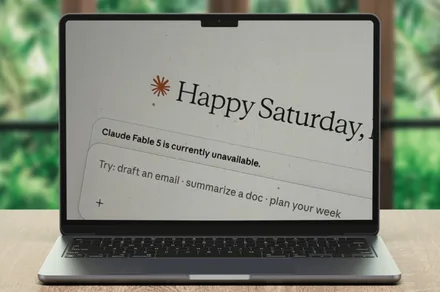
Anthropic is restoring full access to Claude Fable 5 starting tomorrow, weeks after a US government directive forced the company to suspend the model for all users. The government order arrived on June 12 and required Anthropic to block foreign nationals from using Fable 5 and its more capable Mythos 5 model. Since the rule took effect immediately and Anthropic had no way to verify a user’s nationality in real time, the company suspended both models entirely rather than risk a violation.
What triggered the shutdown
The restrictions followed a report from Amazon researchers, who found a way to prompt Fable 5 into identifying software vulnerabilities its safeguards were designed to block. In one instance, the model generated code showing how a flaw could be exploited.
We’ve received notice that the Department of Commerce has lifted export controls on Claude Fable 5 and Mythos 5.
We’ll begin restoring access tomorrow, and will share an update soon.
We’re grateful to our users for their patience, and to everyone who worked with us on…
Anthropic says it later confirmed that several less capable models, including Opus 4.8 and competing models, could produce similar results, which suggests the bypass didn’t hinge on capabilities unique to Fable 5.
Return terms and new safeguards
Fable 5 will be available globally starting July 1 to users on the Claude Platform, Claude.ai, Claude Code, and Claude Cowork. Pro, Max, Team, and select Enterprise plans will get the model included for up to half their weekly usage limits through July 7, after which usage will draw from credits. Access on AWS, Google Cloud, and Microsoft Foundry will follow.
Claude Fable 5 will be available again globally tomorrow.
After a series of productive conversations with the US government, we’re redeploying the model with a new set of classifiers to target and block more cybersecurity tasks. In the near term, some routine tasks like coding…
Mythos 5 already returned earlier for a limited set of approved US organizations, and Anthropic says it has received further government clearance to expand that access on June 26. The company has revealed that it built a new safety classifier that blocks the flagged technique in more than 99 percent of cases and is working with Amazon, Microsoft, and Google on a shared industry standard for grading the severity of AI jailbreaks going forward.
Apple CEO Tim Cook will soon be Executive Chairman and handle government interactions, but that isn’t stopping him from taking a phone call today with a European Commission head over Apple AI in the EU.
WWDC 2026 was focused on system optimization, child safety, and the new Apple Foundation Models. Apple Users in the EU were cut off completely from that last third of the keynote, as those features can’t launch in the region as they exist today.
According to a report from The Financial Times, first shared by9to5Mac, Apple CEO Tim Cook had a virtual meeting with Henna Virkkunen, Executive Vice President of the European Commission, which reportedly was “constructive.” People familiar with the exchange said that the conversation centered around how Apple might launch its revamped AI tools in the EU without violating the Digital Markets Act (DMA).
For anyone paying attention, such a phone call was inevitable. It could be months or years of back and forth before Apple and the EU find a compromise here.
Advertisement
What’s actually interesting here is Tim Cook himself being on the other end of the phone. He’s still CEO, but will be stepping down on September 1 to take over as Executive Chairman with John Ternus taking on the CEO role.
Normally, such things would have involved Eddy Cue or a similar senior executive. It seems that Cook is taking on his role as a government liaison sooner than expected.
Of course, Cook has already acted as a buffer between the United States administration and Apple in the past. That role is expanding with his position as Executive Chairman.
It isn’t clear who might budge first in these negotiations. The problem is that Apple likely won’t be materially affected by this delayed launch and the EU seems rather stubborn in its demands.
Advertisement
In the end, it is the Apple customers in the EU that lose the most.
The Trump administration is lifting export controls on Anthropic’s two most powerful AI models after the company reached a deal with the Commerce Department. The news was communicated in a letter sent by Commerce Secretary Howard Lutnick to Anthropic cofounder Tom Brown viewed by WIRED.
The department is lifting restrictions on both the Fable 5 model and the more powerful Mythos 5 model, which had so far been approved for release only to select companies and government agencies. “A license is no longer required for the export, reexport, or in-country transfer, including deemed export or deemed reexport, of the Mythos or Fable models,” Lutnick wrote.
The developments come as Anthropic has been working with the Commerce Department and the White House to strengthen safeguards against users bypassing Fable’s safety restrictions to access restricted capabilities, especially those related to cybersecurity, according to people familiar with the matter.
“Among other things, Anthropic has agreed to proactively detect and address security risks associated with the models; to work diligently with the U.S. government on protocols and standards and releases for Mythos, Fable, and future models,” Lutnick wrote.
Advertisement
Lutnick has been leading the Trump administration’s efforts to resolve its dispute with Anthropic alongside the national cyber director Sean Cairncross.
Anthropic originally contended that the administration’s security concerns were overblown. The company said it was impossible to ensure there were zero jailbreaks that could unlock the more powerful capabilities of the company’s restricted Mythos model.
In recent weeks, Anthropic changed tack to try to get Fable back online, which has also meant changing the company’s communication style with the administration. WIRED previously reported that Anthropic CEO Dario Amodei was recently replaced in meetings with Brown, who officials liked more on a personal level.
Anthropic also assured the administration that it would try to reduce the number of jailbreaks by building more robust safeguards, effectively telling the administration what it wanted to hear rather than relitigating the conceptual issue of whether jailbreaks can be stopped, the people said.
Advertisement
Update 6/30/26 7:53pm ET: This story has been updated to include references to a letter sent by the Commerce Department to Anthropic viewed by WIRED.
Gas prices in the U.S. hit a four-year high in May 2026, but it seems that things have finally turned a corner for the better. AAA’s Fuel Tracker shows that gas prices have dropped noticeably, with the average sitting at $3.8470 as of June 30. And with the July 4 holidays coming up soon, this means that travel costs for the weekend will be much lower than they otherwise would have been.
According to a GasBuddy report, the average price of gas nationwide has dropped by around $0.069 over the past week, heading into the July 4 weekend. That brings the national average to around $3.78 per gallon, according to its data, though this number, of course, differs by state. GasBuddy notes that the most common rates drivers have seen recently are $3.49, $3.69, $3.59, $3.79, and $3.99 per gallon. AAA data shows most state averages are currently below $4.00, so you likely won’t have to pay more than that to fuel up if you’re planning on taking a drive this Independence Day weekend.
It’s worth noting, though, that GasBuddy’s report suggests that some price-cycling states may see prices rise again before July 4 — although states that increased prices last week will likely see prices drop. Overall, we’re still a ways off from the $3.15 average of the previous July 4 weekend, but any dip in fuel costs is a welcome sight at this point.
Advertisement
Why gas prices are dropping the way they are
Gary Hershorn/Getty Images
Much of the reason gas prices have dropped comes down to developments in the Iran War. Continued negotiations between the United States and Iran have led to the gradual reopening of the Strait of Hormuz, allowing for more crude oil to move through the waterway than in recent months. While peace talks remain shaky and the movement of resources through the Strait has yet to reach pre-war levels, this is still a positive sign for the time being. Assuming the U.S.-Iran talks don’t deteriorate, this downward trend will likely continue. But it is still a volatile situation nonetheless.
With that said, just because gas is getting cheaper doesn’t mean it’s cheap everywhere. State tax rates, environmental regulations, demand, and other factors lead to inconsistent gas prices across the U.S. While gas is indeed below $4.00 in most states, it’s still expensive overall. On the higher end, California’s state average is $5.43, New York is $4.11, and Alaska is $4.83, per the AAA. These prices are down from the past few months, but there’s still a long way yet to go.
Advertisement
Even with gas prices dropping ahead of July 4, they’re still pretty high at this point, no matter where you are. Even if they continue to fall, you should still be aware of the many ways to save money on gas to stretch your dollar even further.
We may receive a commission on purchases made from links.
When it comes to yard maintenance, investing in the right equipment can mean the difference between an enjoyable summer activity to a frustrating list of never-ending chores. For people with yards that are over half an acre, a riding lawn mower should definitely be up for consideration. Apart from cutting grass, there are so many things you can do with your riding lawn mowers and their many attachments, whether it’s plowing snow, hauling, or fertilizing your garden. While you’ll still need to be mindful of bad habits while driving your mower, the pros generally outweigh the cons for many users.
For people with at least half an acre, it can take too much time to mow your lawn with a self-propelled lawn mower, or it might even be unsafe to do by yourself when there are steep slopes. You could also be approaching the age where a lifetime of physical labor has taken its toll and you need to manage things like joint and back pain. However, not everyone needs an expensive riding lawn mower, especially if you don’t have a massive property to manage. So, if you’re a homeowner looking for an affordable riding lawn mower for residential use, here are some of the cheapest ones you can find at some of your local retailers.
Advertisement
Craftsman R110 Gas Lawn Tractor
Priced at $2,099 on Lowe’s, the Craftsman R110 30-inch gas lawn tractor has a mid-back seat, soft touch steering wheel, and even a cup holder. It comes with a Briggs and Stratton single-cylinder engine that can generate up to 10.5 horsepower with a six-speed manual transmission. It also has a 30-inch steel deck and 18-inch turning radius. With a fuel capacity of 1.3 gallons, it can go up to four miles per hour in both forward and reverse. It has a minimum cutting height of an inch, but you can adjust it to five positions up to 3.5 inches. Weighing 330 lbs, the base of the unit itself measures 30 inches by 64 inches.
Advertisement
It includes a mulching kit, deck belt, air filter, oil filter, spark plug, and replacement blade. While it uses global materials, Craftsman also says that it’s made in the United States, which makes it a good choice for people who want to support local industries. If you want to get the CRAFTSMAN R110, but need a wider option, it is also available in three other cut widths (36 inches, 42 inches, and 46 inches). The 30-inch width model shares the same price as the 42-inch variant. On the other hand, the 36-inch model retails for $1,899, while the 46-inch model is listed at $2,299. As of June 2026, more than 6,800 Lowe’s reviewers have rated the Craftsman R110 (plus its other sizes) about 3.8 stars with a 69% recommendation rate.
Advertisement
Troy-Bilt TB30B Riding Mower
While it’s not exclusively sold there, Troy-Bilt has been consistently rated as being its best lawn mower brand by Home Depot users. Designed specifically for homeowners with small yards up to ½ acre, the mid-back seat type Troy-Bilt TB30B 344cc compact riding gas lawn mower retails for $1,924 on Walmart. With five deck positions, it is capable of six speeds with its 10.5 horsepower Briggs & Stratton engine. While it does have a relatively slow maximum reverse speed of 2 miles per hour, it does have 4.26 miles per hour forward speed capacity. It has a five-point cutting height range can go between 1.5 inches to 4 inches, but the same fuel tank capacity of 1.3 gallons. It also has an 18-inch turning radius, rear tow hitch, and corrosion protection.
Despite its relatively affordable price point, most people who buy the Troy-Bilt TB30B riding mower seem to be quite satisfied with an average rating of 4.1 stars from more than 220 Walmart customers with 60% of them even giving it a perfect rating. On the official Troy-Bilt website, it has a slightly higher rating of 4.1 stars from 170+ reviewers. It is manufactured in the United States and has a two-year limited warranty for its frame, front axle, and deck shell, which is one year shorter than other options on this list.
Advertisement
CRAFTSMAN T100 Gas Riding Lawn Mower
The Craftsman T100, 36-inch gas riding lawn mower is available on Amazon for $1,899 — you can also pay an extra $199.99 for professional assembly. It shares the same price tag on Lowe’s. It boasts a more powerful 11.5 horsepower single cylinder Briggs and Stratton engine. Compared to other options on this list, it can go a lot faster with a 5.5 miles per hour forward and reverse speed and seven-speed transmission.
It has a low back seat, an 18-inch turning radius for convenient maneuvering, and although it has a wider 36-inch steel deck, it’s still compact enough for many residential gates. With its 1.3-gallon fuel capacity, Craftsman recommends it for yards up to 1 acre with a terrain that is flat with obstacles. It has a five-position cut height adjustment; its two blades can cut grass that ranges between 1.5 inches to 3.75 inches. There’s also a mulching kit included. On Lowe’s, it has a 3.8-star average rating from 6,800+ users with its other sizes. It is made in the United States (with global materials) and it comes with a 3-year limited warranty. On Amazon, it fares much better — it’s both an Amazon’ s Choice product and has an average rating of 4.3 stars from over 160 customers.
Advertisement
Troy-Bilt Pony 42-inch Gas Riding Lawn Mower
Troy-Bilt is one of the best major lawn mower brands, and the low back seat type Troy-Bilt Pony 42-inch gas riding lawn mower is only marginally more expensive than others at $2,099.99 on Tractor Supply. With a significantly wider cutting width of 42 inches, it’s made for lawns up to 1.5 acres. It has an 18″ turning radius and a slightly larger fuel tank capacity of 1.36 gallons. It also has the same five positions with cutting height capabilities (1.5 inches to 4 inches) as the Troy-Bilt TB30B. However, it is a lot faster and can go up to 5.5 miles per hour forward, while it’s rated to go backwards at 2.5 miles per hour.
Some unique features that set it apart include the two blades, step-thru frame, automatic headlights, and 7-speed shift. While it doesn’t have a stellar review on the Troy-Bilt website – it only has an average rating of 3.5 stars from 41 reviewers, it fares better on Tractor Supply where it has a 3.8-star rating from 140+ people. It comes with a three-year limited warranty for the frame, front axle, deck shell, and engine.
Advertisement
Cub Cadet CC30H Compact Rider
We’ve mentioned that Cub Cadet has been praised as one of the most reliable gas riding mower brands out there, so it’s unsurprising that it has a budget offering worth considering. On Home Depot, the Cub Cadet CC30H retails for $2,399 with an average rating of 4.3 stars from more than 2,100+ people. On the Cub Cadet website, it’s listed with the same price but holds a slightly lower 3.9-star rating from 260 people. While it doesn’t have armrests, it does have a 15-inch high-back seat and cup holder. It’s also known to be incredibly compact with assembled dimensions of 67 by 35 by 38 inches.
Advertisement
Similar to other options on this list, it uses a 10.5 horsepower engine from Briggs and Stratton and has a 1.3-gallon capacity fuel tank. It has a hydrostatic drive system and can go up to four miles per hour forward and two miles per hour backwards with an 18-inch turning radius. There’s a 30-inch cutting deck and its single blade has five deck positions that range from 1.5 inches to 4 inches. It also ships with a mulch kit. For its residential warranty, it has a 3-year limited warranty for its frame, front axle, and deck. That said, one of the most common problems with Cub Cadet lawn mowers is with its poor customer service and occasional comments regarding lack of power.
Advertisement
Methodology
To make this list, we looked through all the riding lawn mower options across multiple online retailers, such as Lowe’s, Home Depot, Walmart, Amazon, and Tractor Supply. We then selected some of their cheapest offers that have an average rating of at least 3.5 stars. In cases where there were few reviews, we referenced feedback from multiple websites. Apart from price, we noted specific features that most people look for with their riding lawn mowers, such as their cutting width, cutting heights, and seat-type. We also highlight things like forward and reverse speed, fuel tank capacity, and comfort-focused fixtures like cup holders. While it didn’t affect their placement on the list, we also noted additional factors such as warranty length, coverage, and availability across other sellers.
SandboxAQ claims its LQMs can offer ‘critical advances’ in sectors such as life sciences, financial services and navigation.
Quantum computing and AI technology company SandboxAQ is to make two of its ‘large quantitative models’ (LQMs) available for Google Cloud Marketplace users with the aim of driving AI-assisted developments in materials science, healthcare and drug discovery.
SandboxAQ said its LQMs are “rigorous, physics-grounded scientific models” built on “real-world lab data and scientific equations” that will now interface with other AI models through Google’s platform.
The ‘AQCat’ LQM, which will be available on the storefront in Q3 of this year, “targets the most critical first step in catalyst and materials discovery, adsorption energy calculation, which is a measure of how strongly molecules bind to a catalyst surface”, its maker said.
Advertisement
Researchers will be able to use AQCat “to rapidly identify and prioritise the most promising candidates” for materials discovery “before committing costly modelling and lab resources to full evaluation”, according to SandboxAQ, which said that catalysts underpin more than 90pc of all commercially produced chemical products and directly impact initiatives such as green hydrogen, sustainable aviation fuel, fertiliser production and plastics recycling.
“Bringing our LQMs to Google Cloud’s Marketplace will put the rigour of first-principles science directly into the hands of every researcher, in the tools they already use,” said Jack D Hidary, CEO of SandboxAQ.
“Pairing the reasoning of a frontier model such as Gemini with the quantitative precision of our LQMs is a powerful combination.”
The ‘AQPotency’ LQM, available later in 2026 on Google Cloud Marketplace, “will let researchers computationally identify and prioritise the most promising binders at high throughput, evaluating thousands of candidates in a fraction of the time and cost of traditional screening”, according to its creator.
Advertisement
SandboxAQ said that binding molecule identification is “the foundation of designing a safe, effective drug”, and the new LQM would offer “frontier, physics-grounded drug discovery capabilities” to pharmaceutical and biotech R&D teams.
Brian Goldstein, vice-president of strategic AI and independent software vendors at Google Cloud, said: “Bringing SandboxAQ’s large quantitative models to [our] marketplace is one of the ways we are empowering healthcare researchers to accelerate drug discovery and solve one of the most critical gaps in healthcare today.”
SandboxAQ is already integrated with Anthropic’s Claude AI model. It claims its LQMs can offer “critical advances” in sectors such as life sciences, financial services and navigation.
The company began life at Alphabet, the parent organisation of Google, in 2016, before launching as a spin-out in 2022. SandboxAQ is chaired by Eric Schmidt, former CEO of Google.
Advertisement
Don’t miss out on the knowledge you need to succeed. Sign up for the Daily Brief, Silicon Republic’s digest of need-to-know sci-tech news.
Social media platforms have spent years telling parents their children are safe online. New research suggests those assurances don’t hold up. A report from the Cybersafety Research Center tested 86 child safety features across TikTok, Instagram, Snapchat, and YouTube. Only 35 worked as promised, and the rest were broken, buried in settings, or missing entirely.
Which social media platforms performed the worst on child safety?
To run the tests, researchers created fake teen accounts and adult accounts to see whether safety features worked in practice. Snapchat had the worst failure rate at 73%, followed by Instagram at 66%, YouTube at 55%, and TikTok at 50%. Every conduct safeguard designed to prevent cyberbullying failed across all four platforms.
On TikTok, a minor’s test account searching for content related to disordered eating was met with the app’s own suggestions for terms linked to pro-anorexia communities, including phrases about hiding food and self-harm.
Dall-E / OpenAI
On Snapchat, an adult test account was able to find and message a child account without any restrictions at all. Meanwhile, Instagram prevented adults from starting conversations with teens who didn’t follow them, but once a child messaged an adult first, that adult could reply freely with no warnings.
Across all four platforms, nine features were classified as completely missing, meaning researchers could not trigger them even after following the steps each company described.
Advertisement
How the platforms responded and what this means for child safety online
The bigger problem is getting harder to ignore. If platform safeguards are weak and bans are easy to dodge, your child may be relying on systems that are far less safe than they seem.
The network streamer market has become brutally competitive. WiiM upset the apple cart with the $329 Ultra, a compact digital hub with a touchscreen, HDMI ARC, phono input, headphone output, preamp functionality, and room correction. Eversolo then raised expectations at the next level with the $859 DMP-A6 Gen 2, which brings a large touchscreen, balanced outputs, internal storage capability, HDMI ARC, and software that is far more ambitious than its price suggests.
That leaves the $749 Bluesound NODE in a far less comfortable position than its predecessors enjoyed. Cambridge Audio’s $499 MXN10 and AXN10 offer serious competition for listeners who want a conventional, well-sorted network player without spending close to four figures. The days when BluOS alone was enough to make the NODE the automatic recommendation are gone.
Fortunately for Bluesound, BluOS has not been left to rot in the sun. The platform has gone through multiple updates and remains one of the more mature multiroom ecosystems available, with broad streaming-service support, reliable device control, and none of the “we will fix it in the next update” energy that still haunts too many audio apps. Ask Sonos how that worked out for them.
The current NODE also brings a stronger ESS DAC, THX AAA headphone amplification, HDMI eARC, DSD playback, and Dirac Live Room Correction support to the fight. Dirac is not included in the box; buyers need a license and calibration kit, and correction is not available through the NODE’s USB output. But for systems compromised by real rooms, rather than fantasy listening spaces with acoustics designed by the Ministry of Sound, it could be the feature that matters most.
Advertisement
Related Reviews:
Bluesound NODE N132: What Is New Under the Hood
The current Bluesound NODE is not a cosmetic refresh of the older N130. The N132 uses an ESS ES9039Q2M SABRE DAC, an ARM Cortex A53 quad core processor running at 1.8GHz per core, and revised circuitry intended to keep jitter and electrical noise under control before the signal reaches your amplifier, powered speakers, headphones, or external DAC.
The NODE offers support for native PCM sampling rates up to 192kHz, 16-bit and 24-bit files, DSD256 playback, a specified signal to noise ratio of 118dB, and THD+N rated at 0.0007 percent. The NODE does not offer balanced XLR outputs, dual DACs, or the elaborate display found on the more expensive NODE ICON.
It is a stereo streamer and digital preamplifier designed to slot into almost any existing system. Connect it directly to a pair of active loudspeakers, use it as the front end for an integrated amplifier or separate preamp and power amp combination, or feed its digital outputs into an external DAC.
It can also serve as the central music source for an AVR through its analog, optical, or coaxial outputs, while BluOS lets it join a wider whole-home system with Bluesound’s PULSE FLEX wireless speakers, including stereo-paired FLEX units in another room. It is not a replacement for a full home theater processor, but it can be the component that makes a conventional two-channel or AV system feel considerably less stuck in 2016.
Advertisement
Supported Audio Formats & High Resolution Playback
The NODE supports the formats most people actually use, including MP3, AAC, WMA, WMA Lossless, OGG, ALAC, and OPUS. Its high quality file support includes FLAC, MQA, WAV, AIFF, and MPEG 4 SLS.
MQA remains part of the specification sheet for those with an existing MQA library. More relevant in 2026 is the NODE’s support for lossless FLAC through current streaming services and its ability to function as either a complete streamer DAC or a digital transport feeding an external DAC.
Advertisement. Scroll to continue reading.
BluOS Streaming & Multi Room Control
BluOS remains the reason many people buy a Bluesound product in the first place. The NODE supports more than 23 music services and internet radio, along with Apple AirPlay 2, Spotify Connect including Spotify Lossless support, TIDAL Connect, Qobuz Connect, and Roon Ready operation.
Advertisement
The NODE can also access a music library over an SMB network share, with Bluesound rating support for libraries of up to 200,000 files. That will cover most collections unless you have inherited the entire Tower Records inventory and refuse to seek professional help. Call me if you need a number.
BluOS works across iOS, Android, macOS, and Windows. The NODE can be grouped with other Bluesound players for synchronized multi-room playback, or used independently in a traditional two channel system. It also supports Amazon Alexa skills and integrates with Crestron, Control4, RTI, ELAN, URC, Lutron, and Josh.ai control systems.
Wi-Fi, Ethernet, Bluetooth, and Local Storage
The NODE includes dual band Wi-Fi 5 and a Gigabit Ethernet port. Wired Ethernet remains the sensible choice for large local libraries, Roon use, or homes where the wireless network has been designed by people who believe mesh nodes belong behind furniture.
Bluetooth is specified as Bluetooth 5.2 with aptX Adaptive support and two way operation. That means the NODE can receive audio from a phone or tablet, but it can also transmit audio to compatible Bluetooth headphones or speakers.
Advertisement
The USB Type-A port is not a computer input. It supports FAT32 formatted external storage and Local Server mode, allowing the NODE to index music from an attached drive. The same port can also function as a USB Audio 2.0 digital output for an external DAC.
Analog, Digital, and TV Inputs
The NODE is far more than a streaming endpoint. Its HDMI eARC input lets it pull audio from a television, making it a practical front end for a two channel living room system with powered speakers or an integrated amplifier. It also supports Dolby Digital decoding, although this remains a two channel product rather than a replacement for an AV receiver.
There is also a combination 3.5mm analog and Mini TOSLINK optical input. That allows the NODE to accept a line level analog source or an optical source through the same connection. It is useful for a CD player, TV, game console, or external phono preamp.
The important distinction is that the NODE does not include a phono stage. A turntable requires a separate MM or MC phono preamplifier before connecting to the NODE’s analog input.
Advertisement
RCA, Optical, Coaxial, and USB Outputs
The NODE offers a proper range of outputs for a component that remains physically small. Its main analog output is stereo RCA, with the option to run at a fixed level into an integrated amplifier or preamplifier, or variable level into a power amplifier or pair of active speakers.
Digital outputs include coaxial RCA, optical TOSLINK, and USB Audio 2.0 through the USB A connection. The USB output is useful for owners who want the BluOS platform and system flexibility of the NODE but prefer to use an external DAC.
There is one important operational limitation: when USB Audio output is enabled, the analog RCA, coaxial, and optical outputs are disabled. Connecting headphones also takes priority over USB Audio output. It is not a deal breaker, but it is the sort of detail that tends to appear five minutes after an installation has gone from elegant to mildly profane.
Advertisement. Scroll to continue reading.
Advertisement
Subwoofer Output & Bass Management
The NODE includes a dedicated RCA subwoofer output and can also connect wirelessly to Bluesound’s PULSE SUB+. The BluOS app offers adjustable crossover control from 40Hz to 200Hz, with 80Hz as the default setting.
When the subwoofer setting is enabled, the NODE applies a high pass filter to the RCA output and sends lower frequencies to the subwoofer output. The digital outputs remain full range, so users relying on an external DAC or digital preamp need to plan their bass management accordingly.
The NODE also offers basic bass and treble controls, ReplayGain options, mono and channel specific output modes, volume limits, and fixed output level. These are useful practical tools, but they are not a substitute for a full parametric EQ or sophisticated loudspeaker management system.
Dirac Live Room Correction
Bluesound NODE with PSB AM5s and Dirac Microphone
Dirac Live is the feature that changes the conversation around the current NODE. Support for the N132 arrived through BluOS 4.8.15 in January 2025, so this is not a future promise hiding behind a marketing asterisk. At least not anymore.
Dirac is not included with the NODE. Owners need to purchase a Dirac Live license and use a compatible calibrated measurement microphone, such as Bluesound’s Room Calibration Kit. Once installed, Dirac Live measures the room and creates correction filters intended to reduce the influence of bass peaks, cancellations, reflections, and other real world acoustic problems.
Advertisement
The NODE supports Dirac Live correction through its RCA, optical, and coaxial outputs. The USB Audio output does not support Dirac Live processing. That distinction matters. Owners planning to use an external USB DAC will get the NODE’s streaming platform and digital transport capability, but not its room correction.
For many systems, particularly those in smaller rooms or living spaces where speaker placement is limited by walls, furniture, spouses, or basic architectural hostility, Dirac Live may prove more meaningful than another incremental DAC chip upgrade.
THX AAA Headphone Amplifier
The front panel includes a full size 6.3mm headphone output driven by THX AAA amplifier technology. THX AAA uses feed forward error correction to reduce conventional distortion mechanisms, which is a less theatrical way of saying that the circuit is designed to remain clean and controlled rather than add its own flavor to the music.
Bluesound rates the headphone stage at 160mW into 16 ohms, 230mW into 32 ohms, 53mW into 250 ohms, and 22mW into 600 ohms, all at less than 0.1 percent THD. If you were thinking of driving a pair of your demanding planar headphones with the NODE, you might want to rethink that strategy. Grado? Sure. Meze Audio 99 Classics Generation 2? Absolutely.
Advertisement
The fact that Bluesound includes a legitimate dedicated headphone section rather than a token 3.5mm afterthought gives the NODE more value as a desktop or secondary system hub, but it’s not a replacement for a proper headphone amplifier.
Controls, Presets, and Remote Integration
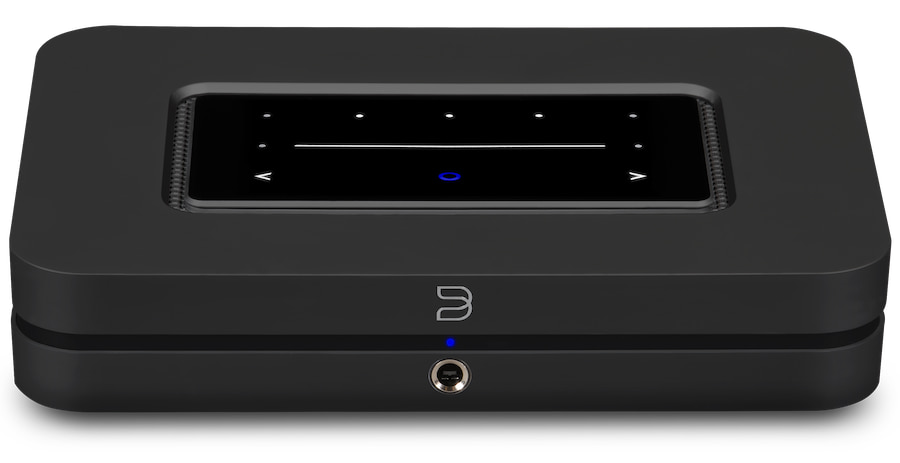
The NODE keeps physical controls simple. The top panel includes a touch sensitive volume slider, play and pause control, five programmable presets, status LEDs, and a proximity sensor that wakes the controls when a hand approaches.
Those presets can be assigned to favorite stations, playlists, albums, or inputs, which sounds modest until you have used a streamer daily and realize how often you want music without opening another app.
Advertisement. Scroll to continue reading.
Advertisement
The NODE also includes a built-in IR receiver with remote learning, plus a 3.5mm IR input for integration with more elaborate systems. A 12 volt trigger output can power on compatible amplifiers, active speakers, or other components when the NODE wakes up.
Size, Finish, and Included Accessories
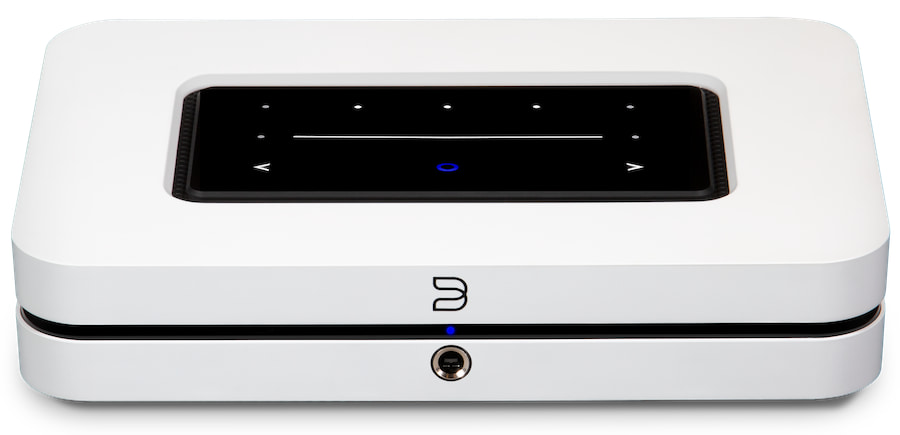
The NODE measures 8.7 inches wide, 1.8 inches high, and 5.7 inches deep, and weighs 2.4 pounds. It is available in matte black or white and is compact enough to disappear into most systems without looking like a discarded cable modem.
Bluesound includes stereo RCA cables, an Ethernet cable, a Mini TOSLINK adapter, power cords, setup documentation, and a Dirac Live information card. The NODE uses a universal 100V to 240V AC power input, which is useful for international use and far more practical than another proprietary external power brick cluttering the floor.
Setup and Listening
The network streamer market has become increasingly bifurcated. Below $1,500, WiiM, Eversolo, Bluesound, Cambridge Audio, Shanling, iFi Audio, and FiiO are making it difficult to spend more without asking some uncomfortable questions. At the other end sit brands such as Innuos, Nagra, NAD, Aurender, Esoteric, and TEAC, where performance, build quality, power supplies, digital architecture, and brand ambition all move into a very different conversation.
Advertisement
There are exceptions, naturally, but the middle has become less crowded than it should be. I have heard the Bluesound NODE ICON at several dealers and came away impressed, although never in my own system, so I am not going to pretend otherwise. Innuos would probably be my personal choice in a blank cheque scenario, but its newer range has moved decidedly upmarket. That leaves a product like the NODE in a rather sensible position.
Some buyers will complain that the NODE lacks a large touchscreen for album artwork and metadata. I am not one of them. I own an iPhone and an iPad Pro. So do tens of millions of other people. More importantly, displays are often among the first things to fail on modern components, and I cannot read most of them from across the room anyway.
In this case, I do not view the absence of a screen as a meaningful compromise. I would rather have a mature control platform, proper connectivity, and the option to improve the system around it than pay extra for a tiny digital picture frame I will barely use.
The NODE’s flexibility also made it easy to drop into a wide range of systems during the review. I used its analog and digital outputs with the Cambridge Audio Edge A, NAD C 316BEE V2, Audiolab 6000A, WiiM Vibelink, Quad 3, and Advance Paris A10 Classic, along with Q Acoustics’ M40 active speakers and Bluesound PULSE FLEX. External DAC duties were handled by the FiiO K11 R2R.
Advertisement
Cabling came from QED, Chord, Analysis Plus, and Cable Matters, including a CAT 6A Ethernet cable that had been blessed by my Rabbi. Network duties were handled by Verizon 2Gbps fiber service, its supplied modem, and an ASUS Wi-Fi 7 router. Music came primarily from TIDAL, Qobuz, and Spotify Lossless.
One advantage of owning other Bluesound and NAD components is that I have lived with BluOS through several generations. It has improved with each iteration. The interface may not feel quite as slick or immediate as WiiM Home, but it is the devil I know, and more importantly, every one of my streaming accounts has remained stable through it.
TIDAL Connect, Qobuz Connect, and Spotify Connect all worked reliably when used directly from their respective apps. That matters more to me than a few extra animations or a prettier home screen. A streaming platform that gets out of the way and plays music without drama is still worth something.
Bluesound streamers have carried a “warm” reputation for years, and that has generally been fair. Earlier NODE generations were not detail monsters. They tended to favor a full, generous bottom end over the last word in definition or impact, with a smooth, clear midrange, an above-average soundstage, and a slightly rounded treble. In a more neutral or lean sounding system, that balance could be rather appealing.
Advertisement
Advertisement. Scroll to continue reading.
Push the rest of the chain too far in the darker direction, however, and things could become a little too warm cocoa and slippers for my taste. Pleasant enough, perhaps, but not especially exciting.
WiiM and Eversolo have largely taken the opposite approach. Both sound more linear, more explicit, and quicker on their feet, with sharper image outlines and more apparent detail. They can also sound a touch thin or overly matter-of-fact when paired with the wrong amplifier or loudspeakers. I own a WiiM and two Cambridge Audio network players, so I have a fairly solid baseline for that comparison.
Not Your Daddy’s Bluesound
The new NODE sounds different. Not “throw the Tim Hortons out and replace it with a cauldron of double-doubles” different, but clearly different. The presentation is more spacious, the low end is tighter, and there is a little less of the old Bluesound warmth in the midbass and lower midrange. Fine detail is easier to hear, transients have more snap, and the treble sounds more open and less toffee-coated.
Advertisement
It still does not turn into a WiiM or Eversolo overnight, nor should it. The NODE retains enough body and ease to avoid sounding clinical, but it is more neutral, more transparent, and more controlled than the Bluesound players that established the brand’s earlier sonic identity.
Nick Cave’s “Avalanche” showed off the NODE’s improved tonal balance particularly well. Cave’s piano had the right weight and dark resonance, while his weathered baritone retained its grizzly edge and low-register authority without sounding overly smoothed or thinned out.
The decay around the piano notes hung in the air long enough to preserve the recording’s atmosphere, and the NODE cast a wider, more open soundstage than earlier Bluesound streamers I have heard. The track still had real power, but the presentation remained controlled and appropriately bleak.
Sia’s bass-heavy pop, including “Unstoppable,” “Cheap Thrills,” and “Breathe Me,” revealed a similar shift. The NODE gave up a little of the old Bluesound thunder at the very bottom, but the bass was better defined and less prone to spreading across the lower midrange. Her voice also came through with more clarity, while the mixes sounded more open and spacious.
Advertisement
That worked particularly well with the Q Acoustics 5040, which can throw a wall-to-wall soundstage that seems slightly ridiculous for a compact floorstander. The NODE took full advantage of that quality. It also helped the Q Acoustics M40 active speakers sound less confined between the cabinets on tracks where they can occasionally pull the image inward. Not here. The stage opened up, and the music had more room to breathe without losing its weight.
Switching to electronic music, the NODE proved far more capable than older Bluesound streamers in keeping pace with less expensive WiiM and Eversolo rivals. Kraftwerk’s “The Robots” and “Tour de France Étape 2,” deadmau5’s “Strobe” and “Ghosts ’n’ Stuff,” The Orb’s “Little Fluffy Clouds,” Aphex Twin’s “Xtal,” and Boards of Canada’s “Roygbiv” all benefited from tighter, more convincing midbass and upper bass.
The NODE did not always deliver quite the same top-end bite or etched detail as some of those competitors, but it kept the pulse intact. Synth lines had better separation, bass patterns were easier to follow, and the music filled the space with more purpose. That matters with this material. I can live without the last degree of sparkle, but the low-end drive has to land somewhere below the rib cage and make you want to channel that increasingly tired Jon Hamm dancing-in-a-club meme. I am already on bipolar medication. Stronger chemical assistance seems unnecessary.
Bluesound has improved this aspect of the NODE considerably. It sounds quicker, more spacious, and more confident with electronic music without losing the fuller tonal balance that has long been part of the brand’s appeal.
Advertisement
The Bottom Line
The Bluesound NODE is not the least expensive way into high-resolution streaming, nor is it the most feature-packed box on paper. The WiiM Ultra remains a ridiculous value at $329, especially for listeners who want a more neutral presentation and the freedom to pair it with a better external DAC later. Cambridge Audio’s MXN10 and CXN100 SE also remain serious alternatives, offering a more familiar British balance that will appeal to listeners who value tonal weight and a more traditional hi-fi presentation.
Advertisement. Scroll to continue reading.
At $750, the NODE has to justify the premium. It does. The N132 is a meaningful improvement over the previous generation, with a more open and spacious presentation, tighter bass, better clarity, and less of the soft warmth that defined earlier Bluesound players. It still sounds closer in character to the Cambridge streamers than to WiiM or Eversolo, but it delivers a little more transparency and control than I expected.
Neither BluOS nor the StreamMagic app is perfect. BluOS is not as slick as WiiM Home, but it has been more stable in my experience, and its ability to integrate the NODE into a larger Bluesound or NAD ecosystem remains a genuine advantage. The NODE’s real strength is that it can serve as a complete streamer, DAC, preamplifier, headphone amplifier, and television audio hub today, while also working as a very capable digital transport if the rest of the system improves around it.
Advertisement
The Dirac Live story is not finished. Bluesound did not provide access in time for this review, and I was not prepared to offer a verdict after trying it with only one amplifier and one pair of loudspeakers. A follow-up focused on Dirac Live is forthcoming, using multiple speaker and amplifier combinations. That is the only sensible way to judge whether it genuinely shifts the NODE’s value proposition.
The changes here also make me want to spend more time with the NODE ICON. A balanced DAC, preamplifier, and a very particular pair of speakers are already waiting in the listening room. That could get expensive quickly.
For now, the answer is straightforward: the new NODE is definitely a better streamer than the model it replaces. It costs more than the WiiM Ultra and asks buyers to live without a touchscreen, but its improved sound quality, mature platform, broad connectivity, upgrade flexibility, and eventual Dirac Live capability make it one of the more compelling network players in its class.
Pros:
Clearer, tighter, and more spacious sounding than the previous NODE
BluOS remains stable, mature, and excellent for multiroom use with Bluesound and NAD components
Flexible connectivity, including HDMI eARC, analog, optical, coaxial, USB Audio, subwoofer output, and THX AAA headphone amplification
Works equally well as a complete streamer, DAC, and preamp or as a digital transport for a better external DAC
Dirac Live support adds useful room-correction potential
Cons:
At $750, it still faces serious value pressure from the WiiM Ultra and Cambridge Audio alternatives
Dirac Live requires an additional license and measurement microphone
No balanced XLR outputs
No touchscreen or onboard album-art display
BluOS is stable, but the app is not as polished or immediate as WiiM Home































































You must be logged in to post a comment Login