Connect with us
DAPA Banner
DAPA Coin
DAPA
COIN PAYMENT ASSET
PRIVACY · BLOCKDAG · HOMOMORPHIC ENCRYPTION · RUST
ElGamal Encrypted MINE DAPA
🚫 GENESIS SOLD OUT
DAPAPAY COMING

NewsBeat

Livingston’s MP urges new Housing Secretary to make RAAC support early priority

Published

on

Daily Record

Gregor Poynton MP has written to Shirley-Anne Somerville MSP, calling on her to make support for families affected by Reinforced Autoclaved Aerated Concrete (RAAC) one of her first priorities in office.

Livingston’s MP has urged Scotland’s new Housing Secretary to make RAAC support an early priority.

Advertisement

Gregor Poynton MP has written to Shirley-Anne Somerville MSP, calling on her to make support for families affected by Reinforced Autoclaved Aerated Concrete (RAAC) one of her first priorities in office.

The Livingston MP has congratulated the new Housing Secretary on her appointment while urging her to move quickly to address the uncertainty still facing homeowners and tenants affected by RAAC across West Lothian.

His letter follows renewed calls from campaigners, including Craigshill resident Kerry Macintosh, for the Scottish Government to meet with those affected and bring forward meaningful support for homeowners.

Mr Poynton has also invited the Cabinet Secretary to visit Craigshill and meet with Almond Housing Association, affected tenants and homeowners to hear first-hand about the challenges facing local families and ensure a joined-up approach to finding solutions.

Advertisement

Housing is a devolved responsibility of the Scottish Government.

Mr Poynton said: “I’d like to congratulate Shirley-Anne Somerville on her appointment as Cabinet Secretary for Housing, but from day one she inherits one of the biggest unresolved issues facing families affected by RAAC across Scotland.

“I’ve met residents in Craigshill and heard directly about the uncertainty, financial pressure and emotional toll this has placed on families. They have waited patiently for answers for far too long.

“I hope one of the Cabinet Secretary’s first actions will be to meet with the national RAAC campaign group, including local campaigners from West Lothian, and set out how the SNP Scottish Government intends to move this issue forward.

Advertisement

“I’d also welcome the opportunity for her to meet with Almond Housing Association alongside affected tenants and homeowners here in Craigshill.

“Everyone’s experience is different, but it’s important that we take a joined-up approach so every option is on the table and nobody is left behind.

“This is a new Scottish Parliament, but families affected by RAAC in the Livingston constituency cannot afford to wait another parliamentary term without meaningful action.

“The SNP Government now has an opportunity to provide the certainty and support that residents have been calling for over a number of years.”

Advertisement

In his letter, Mr Poynton says he hopes the appointment of the new Cabinet Secretary marks “a fresh opportunity” to move the issue forward and has urged her to work closely with campaigners, housing providers and elected representatives to deliver a fair outcome for everyone affected by RAAC.

Don’t miss the latest news from the West Lothian Courier. Sign up to our free newsletter

Source link

Advertisement
Continue Reading
Click to comment

You must be logged in to post a comment Login

Leave a Reply

NewsBeat

Criminal Record: Crown denies protecting Sturgeon and woman mowed down by car

Published

on

Daily Record

Criminal Record has brought together a round-up of Sunday’s biggest crime stories.

Advertisement

Each day on Criminal Record, we will bring you a round-up of the biggest crime stories of the day across the country.

From criminal trials and the ongoing gangland war to an assault on our streets, if you love to read about crime in Scotland – this is the place to be every day.

Here’s what has been making the news across the country on Wednesday.

Crown denies protecting Nicola Sturgeon in Murrell plea deal

Prosecutors have insisted they did not remove thousands of pounds worth of purchases from Peter Murrell’s indictment to spare Nicola Sturgeon embarrassment.

More than 700 items worth almost £59,000 – including make-up, women’s clothing, hair products and fitness gear – were dropped from the charge sheet as part of a plea agreement before the former SNP chief executive admitted embezzling more than £400,000 from party funds.

The Crown Office was forced to deny claims made by campaigner Sean Clerkin that the deleted items were intended to shield Murrell’s estranged wife, former First Minister Nicola Sturgeon, insisting the plea was accepted to secure a conviction without the need for a lengthy and costly trial.

READ MORE: Prosecutors deny Sturgeon was spared ’embarrassment’ after women’s items deleted from Murrell indictment

Advertisement

Woman mowed down in attempted murder horror

Police have launched an attempted murder investigation after a woman was deliberately struck by a car in broad daylight in Renfrewshire.

The 49-year-old was seriously injured when a white Vauxhall Corsa mounted the pavement on Clippens Road in Linwood at around 3.45pm on Tuesday.

Shocking footage shows two women standing at a bus stop before the car suddenly veers onto the pavement, ploughing into one of them before speeding away. Detectives are appealing for witnesses and dashcam footage as they work to trace the driver.

Advertisement

READ MORE: Chilling murder bid footage as crazed driver mows down woman at bus stop

Gangland lieutenant once targeted by IRA hitmen

A former boxing promoter jailed for helping run notorious gangster Robert “Birdman” O’Hara’s drugs empire was once the target of an alleged IRA assassination plot.

Mario Rea was last week sentenced to six years in prison after admitting his role in O’Hara’s organised crime network, which continued operating while the killer directed associates from behind bars.

Advertisement

The 47-year-old’s long links to Scotland’s criminal underworld previously saw him issued with an Osman warning after intelligence suggested Real IRA-linked gunmen had travelled to Scotland to kill him following a dispute over a tobacco deal.

READ MORE: Ex-boxing promoter Mario Rea was targeted by IRA hitmen years before gangland rap

Man arrested after Livingston stabbing

A man has been arrested after a 62-year-old was seriously assaulted in Livingston.

Advertisement

Emergency services were called to Howden Road West on Tuesday evening where the victim was found with serious but non-life-threatening injuries and taken to hospital.

A 31-year-old was arrested on Wednesday in connection with the incident as police continued their investigation. Officers also cordoned off homes in the Ladywell area as part of ongoing enquiries.

READ MORE: Man ‘stabbed’ in Livingston attack as police lock down residential street

Teen murder accused claims he acted in self-defence

A teenager accused of murdering 15-year-old Amen Teklay has told a court he believed his alleged victim was about to stab his friend when he struck him with a sword.

Giving evidence at the High Court in Glasgow, the 16-year-old claimed Amen had produced a knife during a confrontation in Clarendon Street before turning towards his co-accused.

The boy admitted stabbing Amen but insisted he acted to protect his friend, telling jurors he feared the teenager was about to launch an attack. The trial, where both accused deny murder, continues.

READ MORE: Boy accused of murdering Amen Teklay struck teen with sword as he thought ‘he’d stab his pal’

Advertisement

Get more Daily Record exclusives by signing up for free to Google’s preferred sources. Click HERE.

Source link

Continue Reading

NewsBeat

“Empty homes tax” to be rolled out in Perth and Kinross to open up properties

Published

on

Daily Record

The new charge is expected to bring in around £600,000 for the authority in 2026/27, with more than 900 homes believed to be vacant long-term in the region.

Owners of long-term empty homes in Perth and Kinross – including Perth and Kinross Council – will be hit with a 300 per cent charge on their council tax from July 1.

Advertisement

This week councillors voted to allow additional flexibility to help those caught up by the steep surcharge, previously set at 200 per cent.

There are approximately 920 homes lying vacant long-term in Perth and Kinross; the higher surcharge is expected to generate around £600,000 in 2026/27, rising to £800,000 a year thereafter.

No changes were proposed for second homes, of which there is a similar number, which will retain the 200 per cent charge.

A property which is deemed a “long-term empty home” is one which has been unoccupied for over a year. Exemptions include homes which are actively being marketed for sale or let within two years of being occupied and those undergoing repairs/renovation where a new buyer cannot be subject to the increase for up to six months since the date of purchase.

Advertisement

The 300 per cent council tax charge on long-term empty homes was agreed as part of the SNP administration’s budget on March 4, 2026.

The Conservative group opposed the charge.

On Wednesday, June 24 PKC’s Finance and Resources Committee was asked to note the increased surcharge and agree to maintain existing discretionary provisions.

Discretion is applied for situations such as work being done to bring a long-term empty home back into use or exceptional circumstances outwith the direct control of the owner.

Advertisement

It is given for a maximum of 18 months and takes the form of a 10 per cent discount from the date a surcharge would ordinarily be applicable.

Conservative councillor Ian James said: “I was always told council tax is raised to provide local services and, if you’ve got an empty property, I’m just wondering what services we’re providing for these empty properties?”

He added: “I know there are a lot of exemptions but we’re putting an admin burden unnecessarily on people who have bought a property. It’s empty for a reason.

“I’m helping a client – and I call them a client because we’re robbing them – but they have a property and it’s going to cost them £1000 a month.”

Advertisement

Independent councillor Grant Laing asked if any council properties would “fall foul” of the scheme.

PKC’s strategic lead for Housing and Communities Elaine Ritchie said: “Yeah, the HRA [Housing Revenue Account] will have to pay this 300 per cent increase and we do have some long-term voids, not empty properties, and that’s where we’re doing capital investment work.

“However, we work really closely with our Council Tax team to look at exemptions and what not but we’re in the same position as private owners.

“It doesn’t come back into the HRA, it goes into a separate pot of funding so there will be a financial impact on the HRA as a result.”

Advertisement

Cllr Laing asked if repairs and work being done to bring a property back into use might count as an exemption.

Ms Ritchie explained the current exemption allowed a maximum discretionary period of 18 months and sometimes the complexities and “extensive works” involved take longer.

Local Taxes team leader Kevin Fraser explained legislation did not allow PKC to treat its own housing stock or housing association stock any differently.

The SNP convener Stewart Donaldson moved the 300 per cent charge for approval with the current discretionary provisions in place.

Advertisement

It was seconded by council leader Eric Drysdale and supported by SNP councillors on the committee.

Conservative group leader John Duff tabled an amendment to increase the discretionary period from 18 months to two years.

This was seconded by Conservative councillor Caroline Shiers. It was supported by Conservative, Independent and Liberal Democrat councillors on the committee.

Independent – former SNP – councillor Grant Laing abstained.

Advertisement

Nine councillors voted to extend the discretionary period to two years and six SNP councillors voted to maintain the 18-month discretionary period.

Following the meeting, Cllr Duff said: “We opposed the introduction of a 300 per cent council tax charge on long-term empty properties at the budget.

“Despite this, it will come into effect from July 1 this year and will affect over 900 households across Perth and Kinross.

“There are many legitimate reasons why a property may be uninhabitable or unoccupied. In some cases, owners may already be facing significant financial pressures, and this increase risks compounding those challenges.

Advertisement

“My amendment provides our local taxes team with the flexibility to offer discretionary relief in appropriate cases, for up to two years.

“This ensures we can take a balanced and compassionate approach, supporting those in genuine difficulty, while remaining within the council’s agreed policy.

“ I have also asked officers to bring forward a future report so that councillors can fully assess the real-world impact of these changes and respond if necessary.”

Source link

Advertisement
Continue Reading

NewsBeat

Cape Verde’s World Cup success reflects a nation that has repeatedly defied the odds

Published

on

Cape Verde’s World Cup success reflects a nation that has repeatedly defied the odds

For decades, the west African island nation of Cape Verde was perhaps best known for the music of late singer Cesária Évora. This summer, however, the Atlantic archipelago has gained fame for a different reason: football. As one of the surprise stories of the 2026 Fifa World Cup, Cape Verde has captured the imagination of fans worldwide.

The team has qualified for the knockout stages after a run that included a 0-0 draw with the reigning European champions, Spain. The Cape Verde goalkeeper, Vozinha, has also become one of the most recognisable faces of the tournament. His follower count on Instagram increased from around 50,000 before the Spain match to over 17.4 million by the end of June.

With a population of just over 500,000 people spread across ten islands (nine inhabited), Cape Verde is used to defying the odds. The arrival of the Portuguese in the 1460s made the archipelago a strategic hub in the making of the Atlantic world. On Santiago Island, they founded the oldest European settlement south of the Sahara Desert, Ribeira Grande.

This city, which is now called Cidade Velha, became a hub linking continents through maritime trade, migration and, tragically, the transatlantic slave trade.

Advertisement

Cape Verde is made up of ten islands off the west coast of Africa, and has a population of around 500,000 people.
PorcupenWorks / Shutterstock

Resource deprived and plagued by frequent droughts, the end of the slave trade in the mid-19th century marked a period of decline. This period continued until the archipelago gained independence in 1975 through a joint liberation struggle with Guinea-Bissau.

A key figure in this movement was Amilcar Cabral, who was born in Guinea-Bissau to Cape Verdean parents and was educated in Cape Verde. He emerged as one of Africa’s most influential leaders in the anti-colonial struggle and gained widespread support across European countries thanks to his diplomatic skills.

After attaining independence, Cape Verde was declared an “unviable” state by the then US secretary of state, Henry Kissinger, and thereafter by some international financial institutions. They saw it as too small and resource-poor to survive on its own.

Advertisement

Yet 50 years later, the nation has transformed itself from one of the poorest countries in the world to an upper-middle-income state.

Transition to democracy

Political stability enabled Cape Verde to introduce pioneering democratic reforms in the 1990s. After 15 years of single-party rule, the country’s first election in 1991 saw the incumbent African Party for the Independence of Guinea and Cape Verde peacefully transfer power to the newly founded opposition Movement for Democracy.

This formed the foundation for what has become one of Africa’s strongest democracies. Cape Verde is routinely praised for its pragmatic politics and overall good governance, ranking third out of 54 countries on the Ibrahim Index of African Governance behind the Seychelles and Mauritius. It has the second-highest life expectancy in Africa, at between 75 and 77 years, as well as high rates of literacy and human development. Its child mortality rates are also among the lowest in Africa.

In a country where football is deeply woven into everyday life, a broad commitment to human development has been complemented by sustained investment in youth football and talent development by Fifa that has boosted sporting infrastructure.

Advertisement

With one of the highest migration rates in the world, the Cape Verdean diaspora is another key aspect of the archipelago’s success story. Often called Cape Verde’s “11th island”, the emigrant population is estimated to be larger than the resident population.

Migrant remittances constitute much bigger financial flows to the country than foreign aid or foreign direct investment. This was particularly relevant during the COVID pandemic. The World Bank and Cape Verde’s central bank reported a record increase in remittances of over 30% for 2021 as emigrants responded to the socioeconomic shocks caused by pandemic restrictions.

The Cape Verdean football federation has tapped into this diaspora for the national team. From 2002, players developed abroad have been recruited to represent the archipelago. These include players based in Portugal, France, the Netherlands and even Ireland.

In 2019, Ireland-born defender Roberto Lopes (known as Pico) recalled being contacted by the then-coach of Cape Verde, Rui Águas, on LinkedIn and first ignoring the message because it was in Portuguese and he thought it could be spam.

Advertisement
Cabo Verde's goalkeeper, Vozinha, waves to fans.
Cape Verde’s goalkeeper, Vozinha, has become one of the most recognisable faces of the 2026 Fifa World Cup.
Sam Wasson / EPA

Cape Verde’s story is not one of perfection. The vast majority of the population is aged under 35 and many young people there face unemployment, precarious work and limited opportunities. This is prompting many to seek better futures abroad.

Despite the progress achieved through the passing of the Parity Law in 2019, which requires that neither women or men hold less than 40% or more than 60% of positions in electoral lists, women’s political representation and gender equality also remain a significant challenge for the nation.

As the archipelago’s independence day approaches on July 5, Cape Verdeans all over the world have every reason to celebrate. And if Cape Verde pulls off another upset in their match against Argentina on July 3, it would be a fitting tribute to a nation that has spent the last 50 years proving that size need never define ambition.

Source link

Advertisement
Continue Reading

NewsBeat

ITV’s One Dollar is next must-see crime series for Happy Valley viewers

Published

on

Wales Online

The detective thriller series One Dollar is coming to ITVX, with all episodes available from 23 August

ITVX has announced that the compelling thriller series One Dollar will be joining its streaming platform, with all episodes launching on 23 August.

Starring Craig Zobel, whose portfolio includes Westworld, Mare of Easttown and The Penguin, the drama was conceived, penned and executive produced by Jason Mosberg.

Ideal viewing for Happy Valley enthusiasts, the series is set in the declining Pennsylvania town of Braden, where One Dollar traces the path of a solitary one-dollar note as it circulates amongst locals. Throughout its journey, it weaves together multiple lives that eventually intersect with a savage multiple homicide at the town’s steel mill.

Advertisement

Each instalment centres on a different individual, progressively exposing the community’s concealed truths, profound social rifts and inter-community friction as the murder inquiry progresses.

The ensemble features John Carroll Lynch as steel mill proprietor Bud Carl, Philip Ettinger as Garrett, a lone father struggling financially, and Nathaniel Martello-White as private detective Jake, who is resolute in exposing the reality behind the murders. Additionally, Hamilton star Leslie Odom Jr. portrays Randall Abatsy.

One Dollar is a CBS Studios production in collaboration with Anonymous Content, with worldwide distribution managed by Paramount Global Content Distribution, reports the Express.

Advertisement

Executive producers for the series include Rafael Yglesias, Jason Mosberg, Graham Gordy, Alexandre Dauman, Matt DeRoss and Craig Zobel. Viewers who have already seen the series have heaped praise upon the programme.

Over on IMDB, audiences have been sharing their thoughts.

One viewer commented: “Excellent drama. Low key, but gripping. Good human interest stories around a murder mystery. Nice to have fresh faces, and down-to-earth characters instead of the usual Hollywood starlet/beautiful botoxed/face-lifted people. Loved it.”

Advertisement

Another wrote: “Despite its low review, I went with my better judgment and decided to watch One Dollar as the storyline intrigued me. I’m so glad I did, as it’s one of the better shows I’ve watched this year.

“From the start, the viewer knows a crime has occurred, but wonderful writing allows multi-character storylines to develop in a way that the crime itself becomes the backdrop, and it’s the personal stories of individuals that are the focus of the show. This can only be accomplished by great acting and original storytelling. Thoroughly deserves a better score than it currently has.”

One Dollar is available to stream on ITVX

Advertisement

Source link

Continue Reading

NewsBeat

Parasite horror: I had a metre long tapeworm in my gut and 38 more in my brain… these were the warning signs – some of them nearly killed me

Published

on

Lowri Denman travelled through India for two months in 2007 - she's still recovering now

As Lowri Denman holidayed in India, she was thankful she hadn’t contracted ‘Delhi belly’… but in reality, she had picked up something much worse, a metre-long tapeworm that would later nearly kill her. 

In 2007, Ms Denman, now 42, spent two months travelling through the South Asian country but it wasn’t until four years after getting home she discovered she’d brought home a writhing souvenir. 

Up until she passed the huge tapeworm as she went to the toilet at her home in Cardiff, she had had no clue that anything was wrong, and after seeing her GP she was assured that there was nothing else to worry about. 

It was around this time she started experiencing crippling headaches and in 2011 she suffered a tonic-clonic (grand mal) seizure – which is characterised by stiffness, loss of consciousness, and jerking movements.

Advertisement

She immediately sought medical advice and, after waiting three months for a brain scan, Ms Denman learned she had neurocysticercosis, a parasitic infection of the brain caused by the larvae of the pork tapeworm.

There were 38 parasites in her brain, the offspring of the tapeworm she had carried inside her for four years. 

She said: ‘It was just so disgusting to think that these things were in my head.’ 

Neurocysticercosis is developed when a tapeworm infection is left untreated, as larvae build up in the central nervous system, causing cysts to form deep in bodily tissue. It is the most severe form of the disease, and a common cause of seizures.

Advertisement

Lowri Denman travelled through India for two months in 2007 – she’s still recovering now

Neurocysticercosis strikes about 4,000 people a year in the US, making it the most common way that parasites infect the central nervous system. 

The tapeworm Taenia Solium often infects pigs, laying larvae in them. If pork isn’t properly cooked, humans can wind up eating these larvae, which hatch in the intestines. 

Advertisement

If people don’t pass the worms, their life cycle will continue: Taenia Solium will lay its eggs in the person’s body. 

These larvae develop in sacs or cysts, that can travel around the body, in rare cases, reaching the brain.

The irony is that Ms Denman had made a conscious decision to stick to a vegetarian diet to reduce the risk of picking up foodborne illnesses. However, tapeworms and neurocysticercosis can be caused by water contaminated with tapeworm eggs or poor hygiene practices – you don’t have to eat meat to be affected. 

But it wasn’t only seizures that would define this period of Ms Denman’s life; the stress led to her developing psychosis. 

Advertisement

After receiving her diagnosis, Ms Denman was treated for epilepsy while doctors consulted tropical disease experts across the globe to decide on a course of action for eliminating the parasites.

Ms Denman lost her driving licence due to the risks of having a seizure behind the wheel, and her independence took a hit: she was advised not to do certain things, like having a bath while at home alone in case she had a seizure, and since she lived alone she found it particularly difficult.

Ms Denman’s seizures continued as the correct dosage of epilepsy medication was ascertained, and she began to experience anxiety about leaving the house.

She passed a metre-long tapeworm while on the toilet (file photo)

Advertisement
A brain scan revealed that there were 38 tapeworm larvae in her brain, causing headaches and seizures

 A brain scan revealed that there were 38 tapeworm larvae in her brain, causing headaches and seizures 

‘There was one, it was lunchtime, and I was just walking around Cardiff on my own,’ she said.

‘Luckily I was on the phone to my mate, and I said, “I don’t feel well”, then I passed my phone to a stranger on the street. Then the next thing, I come around and my mate who I was on the phone to was there, and she was like, “You’ve had a fit again”.

‘Obviously, I was really cautious then, just scared of being anywhere, and that happening.’

Advertisement

Meanwhile, Ms Denman was given steroids and albendazole, which is used to treat a wide variety of parasitic worm infections. For a time, things calmed down and her seizures reduced, but in 2015 the parasites caused a serious flare up as they ‘weren’t dying off as they’d expected’.

Doctors then tried her on another anti-worm medication, praziquantel, as well as the albendazole and steroids, and while she said the medication would initially start killing the parasites and taking the swelling down in her brain, when she weaned off the medication the swelling would return in a different part of her brain.

‘This went on for at least a year, where I was getting more and more ill, more anxious,’ Ms Denman said.

‘I had to give up work, had to move home to be taken care of, and then it got to a point where I went on Personal Independence Payments (PIP), and I wasn’t capable of filling out the forms on my own.

Advertisement

‘For someone that’s extremely independent and capable and lived on my own most of my life, I was like, what the hell is going on here?’

Ms Denman then started experiencing more severe paranoia, worrying about getting enough sleep, struggling with how the medication made her look and feel – the steroids made her face swell, and she didn’t feel like herself.

‘It was just getting worse and worse and worse,’ she said.

‘I just wanted to go back to work. I just wanted a normal life, and I didn’t feel comfortable being in social settings. I didn’t want to leave the house, really.’

Advertisement
Ms Denman at the peak of her illnesses in 2016
Ms Denman today

Ms Denman at the peak of her illnesses in 2016 (left); and today

‘The swelling was coming back and forth all the time, so they were trying to figure out what medication to put me on,’ she added.

‘They put me on methotrexate, then, which is a chemotherapy drug, so I was worried my hair was going to fall out. It made me really tired, but then steroids would make me really energetic, so there was loads going on, on top of the worries of not getting better.’

In September 2016, Lowri was admitted to a neuropsychiatric ward for three months due to her declining mental health, and was prescribed mood stabilisers and anti-psychotics on top of her other medication.

Advertisement

‘I was having panic attacks, I thought I was going to die, I think, and then that turned into paranoia, and then the psychosis came out,’ she said.

‘I wasn’t stable at all, all these thoughts and crazy things were going on in my head.’

Ms Denman explained that it is difficult to ascertain whether the symptoms were because of the parasites directly, or due to the stress and trauma of her prolonged treatment.

‘It just built into this huge thing at that point, nobody could tell me when I was going to get better,’ she said.

Advertisement

Eventually, in January 2017 Lowri was able to leave hospital and move back in with her dad. By then, she was 34, and desperately wanted her life back.

‘I didn’t look myself, and I was also really paranoid,’ she said.

‘I kept asking my friends, anyone that could come and visit me in hospital, to ask, what did I do?

‘Because I thought I was going to be on the news for doing something terrible.

Advertisement

‘I thought I’d done this mad stuff, and I didn’t know what I’d done.’

Now, Ms Denman is fit and healthy, and her seizures are managed by her medication so she has not experienced a fit for 10 years.

During her recovery, Lowri was desperate to find more information about her illness and to connect with others who had been through the same, but found there was very little information available to her beyond what she learned from her doctors.

Now that she’s feeling stronger, she wants to share her story with the world. She plans to do so with a 12-part podcast, called 38 Parasites, which will delve into her personal journey along with interviews with consultants and experts in tropical diseases, insights on neurology, and more.

Advertisement

‘I spent my whole thirties being ill and anxious and worried, and now I’ve moved into my 40s, I want to do something positive with that negative thing – help other people, and not just feel like I’ve lost all of this time.’

Through Crowdfunder, Lowri and her friend of 20 years, producer Nicola Brown, are raising £25,000 to fund the project, which was shortlisted for 2025’s The Whickers Podcast Pitch Award.

Source link

Advertisement
Continue Reading

NewsBeat

Forth Valley hospital chiefs launch plan to reduce pressure on emergency unit

Published

on

Daily Record

The new strategy was announced by bosses at NHS Forth Valley at the health board’s meeting this week – with the department struggling with the mismatch between patient demand and available workforce.

A major new plan has been launched to help ease the pressure on the Emergency Department at Forth Valley Royal Hospital.

Advertisement

The new strategy was announced by Garry Fraser, Director of Acute Service at the NHS Forth Valley meeting on Tuesday.

It comes as it was revealed the department is operating under increasing pressure due to higher attendances and a mismatch between patient demand and available workforce.

It was heard that peak activity is concentrated between late afternoon and midnight with persistent periods of high demand extending into overnight periods.

There is also regular exceedance of normal operational capacity resulting in a very busy and crowded environment.

Advertisement

The data shows that current staffing levels are insufficient to provide consistent senior clinical decision-making across the full 24-hour period, which can result in delays to assessment and treatment, compromised flow and efficiency in the Emergency Department (ED), adversely impact on patient care and experience, workforce fatigue and retention challenges.

A detailed review of demand, CFSD benchmarking against national standards, acuity of patients attending at over 2025/26 period and workforce modelling has identified a clear requirement to expand staffing in the ED.

The consultant levels are also lower than other NHS boards and the board is aiming to resolve within this planned recruitment of additional staff.

The board agreed to endorse the recommendations of increasing the workforce in ED and support phase one implementation of the increased staff model costing £900,000 over the year.

Advertisement

A decision is required to be made by the board after phase 1 is evaluated in relation to continued funding, as this may cause a cost pressure within the financial plans.

The recommendations and workforce plan will continue to be reviewed. The board says implementation will deliver improved patient safety and experience, reduced overcrowding and waiting times and enhanced staff wellbeing and retention.

It is also set to reduce reliance on agency and locum spend, improve operational efficiency, improve patient safety and experience and reduce waiting times.

Source link

Advertisement
Continue Reading

NewsBeat

Update on sinkhole that closed major Cambridge road

Published

on

Cambridgeshire Live

The council has said an investigation into the cause of the sinkhole has been ‘complex’

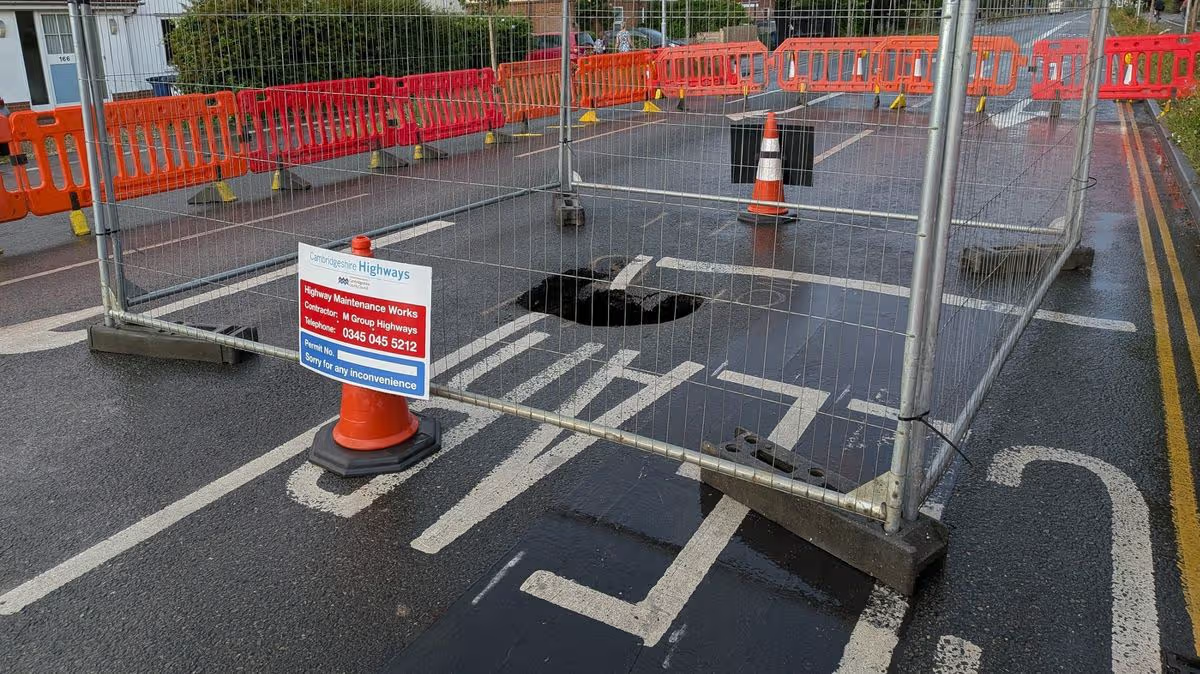
A major Cambridge road remains closed after a sinkhole appeared last week. The sinkhole appeared along Milton Road in Cambridge on the evening of June 22.

Advertisement

Since then, the road has been closed while highways have dealt with the issue. A Cambridgeshire County Council spokesperson said: “Milton Road, Cambridge currently remains closed between Hurst Park Avenue and the Elizabeth Way roundabout in both directions due to a large sinkhole.”

The council said an investigation into the cause of the sinkhole has been “complex” as it extends beneath the road surface, and there are a number of utility services in the area.

The spokesperson added: “It has been important to ensure that any highway repairs we make would not adversely affect the other services in the area. We’ve been working with partners to make sure the right solution is delivered.

“Appropriate repairs, including foam concrete infill, will be scheduled as soon as possible. We appreciate your continued patience and apologise for the disruption. Please continue to plan your journeys and allow extra time for travel.”

Advertisement

Do you want more of the latest Cambridgeshire news as it comes in from across the county? Sign up to our dedicated newsletter to make sure you never miss a big story from Cambridge or anywhere else in the county. You can also sign up to our dedicated Traffic and Crime newsletters for the latest updates on the topics you are most interested in .

Source link

Continue Reading

NewsBeat

study reveals why rat catchers are so happy in their work

Published

on

study reveals why rat catchers are so happy in their work

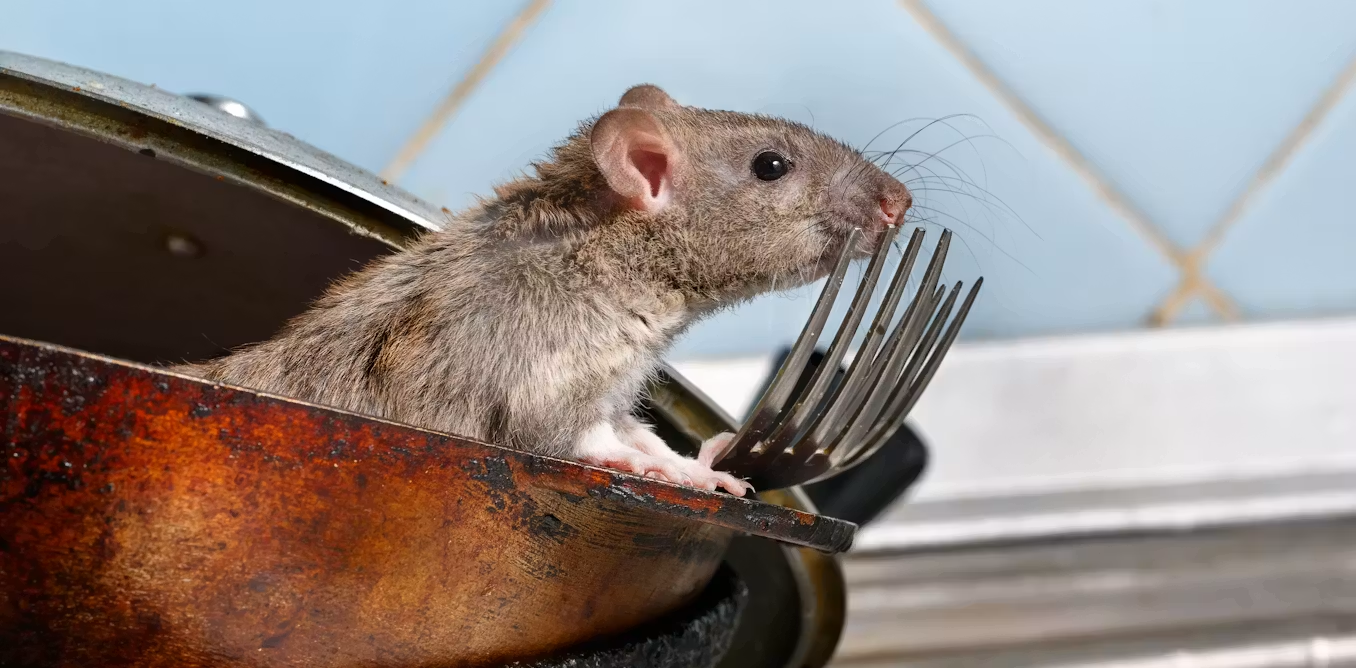
Pest control means dealing with the kinds of animals many of us try our best to avoid. But catching rats and battling cockroaches turns out to be very satisfying work.

My research reveals that this surprising level of job satisfaction comes from the variety, challenge and connection pest controllers experience. They also told me their work had a positive effect on people’s lives.

I discovered this after spending the last few years immersed in the world of professional pest control. I’ve attended trade shows, read industry magazines, interviewed pest controllers and accompanied them on their call outs.

One thing that stood out was the range of pests involved, and the different places in which they appear. Both provide opportunities for pest controllers to engage in problem solving and detective work.

Advertisement

Most pest controllers are generalists who will deal with a wide range of wildlife, from rats and mice to wasps, bedbugs and moths. And every infestation needs a nuanced understanding of animal behaviour.

I was told that pest control work, particularly in people’s homes, requires changing tactics and adaptability. For example, some animals learn to avoid traps or develop resistance to certain chemicals. The unpredictability prevents the work from becoming monotonous and routine.

As one pest controller explained: “There’s no such thing as a [typical] job for a rat or a mouse. They’re always different. Different homes, different scenarios, different entry points. Different motivations, different food sources.”

Another said: “Every day is different [and] they’re all interesting. They all have their moments. Every job is bespoke.”

Advertisement

Pest controllers also tend to experience a relatively large amount of freedom and autonomy over how and when they work, both as sole contractors and as employees of larger companies. Many were also interested in understanding the animals’ biology, habitats and behaviour, and enjoyed engaging with the natural world.

Many expressed a fascination and curiosity towards the species they dealt with, with some highlighting a favourite. And despite the spectre of animal death, I noticed a wide appreciation of nature within the industry.

It’s not all perks, though.

Pest control often means working in unpleasant environments like drains or loft spaces filled with bird excrement. There are also ethical issues, with some pest controllers privately expressing guilt or discomfort when killing certain species.

Advertisement

But generally, pest controllers were compassionate, often choosing methods that, although deadly, would minimise suffering for the creatures involved.

And despite pest control being an important part of public health, the job is often held in low social esteem, with little appreciation for the skills and knowledge the work involves.

As one of my interviewees told me: “You’re seen as a kind of neanderthal, or a knuckle dragger that hits small furry animals with sticks.”

I heard of customers asking technicians to park away from the home they were visiting, to enter via a backdoor, or to use vans without logos, to avoid the public embarrassment of calling in pest control. Some workers experienced open disdain, with customers refusing use of their bathrooms or making derisory comments about their work.

Advertisement

One interviewee from a family business described how his adult son had been checking bait boxes under a sink in a school staff room and heard a teacher commenting: “Cor, imagine, doing that all your life.”

The rat race

And despite the welcome autonomy, a lot of pest control involves working alone, which can lead to isolation and mental health difficulties. However, this was often mitigated by strong friendships across the industry (despite many small business owners technically being in direct competition with each other), and the sense of meaningful social benefit their work provided, particularly when dealing with residential customers.

As one pest controller explained: “I find it so, so rewarding, seeing people going from [so distressed to being] so happy and so grateful.”

Another added: “I love getting to know my customers, having that banter and being able to solve people’s problems and have them put that element of trust in me.”

Advertisement
Roach-ready?
SILVIA MAQQ/Shutterstock

Some pest controllers also prioritised compassion over profit, informally providing discounts or additional visits for pensioners or poorer customers, enabling them to perform work that was meaningful and rewarding.

But while the industry is very keen to welcome new recruits, pest control is not for everyone. Personally, I would get far too attached to my unintended rodent housemates to even require pest control in the first place. And pest management does raise tricky questions about animal welfare, and the environmental impact of chemicals.

But my research with pest controllers gives an indication of some of the key qualities that make work enjoyable and meaningful.

These include variety, autonomy, connection to others, and the capacity to perform socially beneficial work. And if you can find all of those things in pest control, it looks like the future will be full of opportunity.

Advertisement

Source link

Continue Reading

NewsBeat

York Yearsley Swimming Pool solar panels energy bill boost

Published

on

York Yearsley Swimming Pool solar panels energy bill boost

Yearsley Swimming Pool’s energy costs are estimated to fall by about 40 per cent following the installation of an 182-kilowatt hour (kWh) solar panel array in March.

Pool manager James Howard said an expected fall in energy costs of up to £30,000 would make a massive difference in ensuring they could operate for the long term.

It comes as large leisure units were forecast to face energy cost hikes of £200,000 by this year compared to prices before shocks after the coronavirus pandemic and Ukraine war.


RECOMMENDED READING:

Advertisement

The estimates, from Cornwall Insight’s Business Energy Cost Forecast, were made in 2024 and do not account for further increases seen following the US-Israeli war on Iran this year.

Yearsley Swimming Pool received cash from the Great British Energy-backed York and North Yorkshire Combined Authority Mayoral Renewables Fund to install the solar panels.

They are expected to save between £25,000 and £30,000 on running costs at the Clifton pool and reduce carbon emissions by around 29 tonnes.

UK swimming pools produce around 2 per cent of the country’s carbon emissions, around 900,000 tonnes a year.

Advertisement

Pool manager Mr Howard said they had already reduced the amount of power they were consuming from the grid by 51 per cent since February.

Newly-installed solar panels of the roof of Yearsley Swimming Pool (Image: Robyn Chowdhury)

The manager said: “We’ve started to see our consumption fall massively.

“April is the first time we’ve seen the bill and we’re looking at a reduction of about 40% on our energy bills.

“Reducing our operating costs will reduce the pool’s loss will make it more viable in the long term and keep it going for years and years into the future.

Advertisement

“We have a great relationship with York Council and we’re both very committed to keeping the facility open.”

Yearsley Baths was York’s first swimming baths when it opened in the 1850s.

The pool as it is known today was called New Yearsley Baths at the time and was gifted to the people of York by Joseph Rowntree in 1908.

It is the only 50-yard (45.7m) Edwardian swimming pool in the north of England.

Advertisement

The pool, in Haley’s Terrace, is currently heated by gas but it historically used steam supplied from the neighbouring Rowntree factory.

The baths were at risk of closure in the 1990s and in 2014.

Campaigners rallied to save it and saw off both of the closure threats.

It is currently operated by GLL Ltd which runs York’s four leisure centres.

Advertisement

Source link

Continue Reading

NewsBeat

Why Djed Spence is wearing a face mask as ‘crazy’ incident left him shaken

Published

on

Wales Online

England defender Djed Spence will wear a protective face mask against DR Congo in the World Cup round of 32

England defender Djed Spence will once again wear a protective face mask when the Three Lions take on DR Congo in the World Cup round of 32 on Wednesday night.

Advertisement

The Tottenham Hotspur full-back is expected to start at right-back after injuries to several of Thomas Tuchel’s defenders, including Reece James and Jarrell Quansah, with his unusual appearance prompting plenty of questions from supporters during the tournament.

Spence has been forced to wear the mask after suffering a broken jaw following what he described as a “crazy challenge” from Liam Delap during Tottenham’s penultimate Premier League match of last season.

The 25-year-old revealed before the tournament that the injury would take around three months to heal, meaning he has had little choice but to play through the pain.

“It is a little bit uncomfortable – but it is what it is,” Spence said.

Advertisement

“I have a broken jaw so I have to wear it throughout the tournament.

“It is something I will have to get used to. It will be three months until it is fully healed, so it is a long time.

“It was painful, but luckily I play football with my feet and not my jaw so it is all good.

“I have been wearing it in training, getting used to wearing it in the heat, and trying to break it in properly.

Advertisement

“It was a crazy challenge, but it is in the past now. I’ve just got to focus on this tournament now.”

Spence has emerged as an important option for Tuchel after being selected ahead of Newcastle United’s Lewis Hall and Manchester United’s Luke Shaw in England’s World Cup squad.

“It shows the manager believes in me,” the nine-cap international said.

“He believes in my quality and I’m thankful for him.

Advertisement

“I just want to keep on putting in the performances to make everyone happy. It is a huge honour to play for your country, it is a big thing. I’m over the moon and happy to be here.”

Reflecting on a difficult campaign with Tottenham, Spence added: “It has been a difficult season, but there is always light at the end of the tunnel.

“We managed to get out of a difficult situation, so we have to move forward. Hopefully this World Cup will be a good one.”

England will be hoping to book their place in the last 16 against DR Congo, with a huge tie against hosts Mexico lying in wait.

Advertisement

Source link

Continue Reading

Trending

Copyright © 2025