

Crypto World
BonkDAO Treasury Drained of $20M via Malicious Proposal



BonkDAO, the decentralized autonomous organization tied to the Solana-based memecoin BONK, said Monday it was the target of a malicious governance proposal that drained an estimated $20 million worth of BONK tokens from its treasury, according to a post on its official X account. The DAO said the… Read the full story at The Defiant

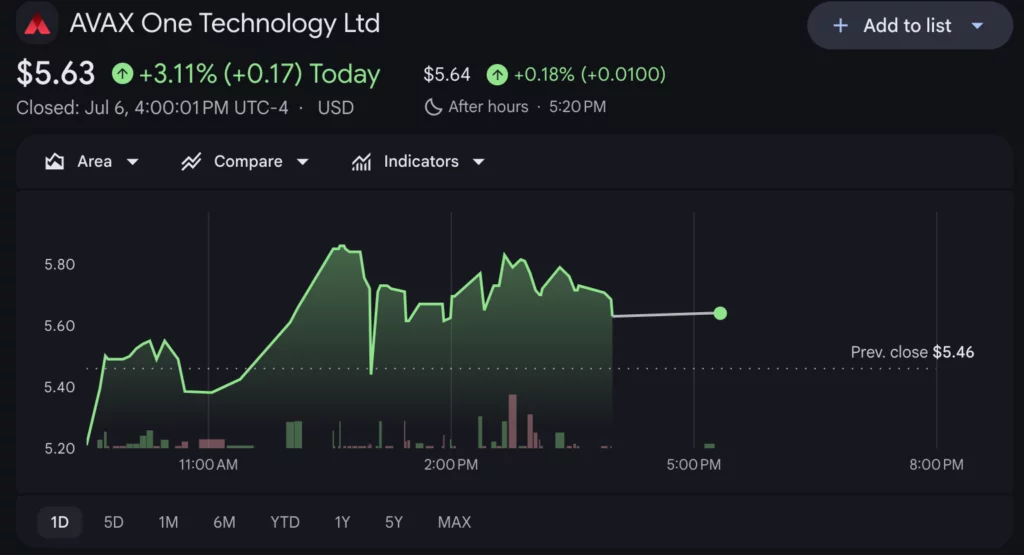
AVAX One Technology has started a search for a permanent chief executive after Jolie Kahn resigned as CEO.
Summary
- AVAX One is searching for a permanent CEO after Jolie Kahn left the company.
- Pete Wylie will lead as interim CEO while also staying chief operating officer.
- Weak AVAX prices keep pressure on public companies tied to Avalanche treasury strategies.
The company said Kahn left the role effective immediately, while Chief Operating Officer Pete Wylie will serve as interim CEO.
Wylie will continue to serve as COO while leading the company during the search. AVAX One said its board has retained ZRG Partners to help find a permanent successor.
“We have full confidence in Pete’s ability to lead the Company through this transition,” said Chairman Matt Zhang.
Filing details Kahn’s exit
In its latest 8-K filing, AVAX One said Kahn’s departure came by mutual agreement and was not linked to any disagreement over the company’s operations, policies, or practices. The filing said she was not removed for cause.
The filing also outlined the separation terms. Kahn will receive a $160,000 lump-sum cash payment, reimbursement for certain medical insurance costs, and $250,000 worth of unregistered common shares. Wylie will receive $40,000 per month while serving as interim CEO.
Avalanche treasury pivot remains central
Kahn led the company during its shift from AgriFORCE into an Avalanche-focused digital asset treasury company. In September 2025, AgriFORCE announced plans to rebrand as AVAX One and raise about $550 million.
The company said the strategy aimed to build more than $700 million in AVAX holdings. SkyBridge Capital founder Anthony Scaramucci was named to lead the strategic advisory board. The plan placed AVAX One among the first Nasdaq-listed companies built around an Avalanche treasury strategy.
AVAX One said its business now includes digital infrastructure, Bitcoin mining, and an Avalanche treasury. The company operates Bitcoin mining facilities in Alberta and Ohio with about 300 PH/s of hashrate, while also holding AVAX and seeking yield through staking and ecosystem participation.
AVX and AVAX remain under pressure
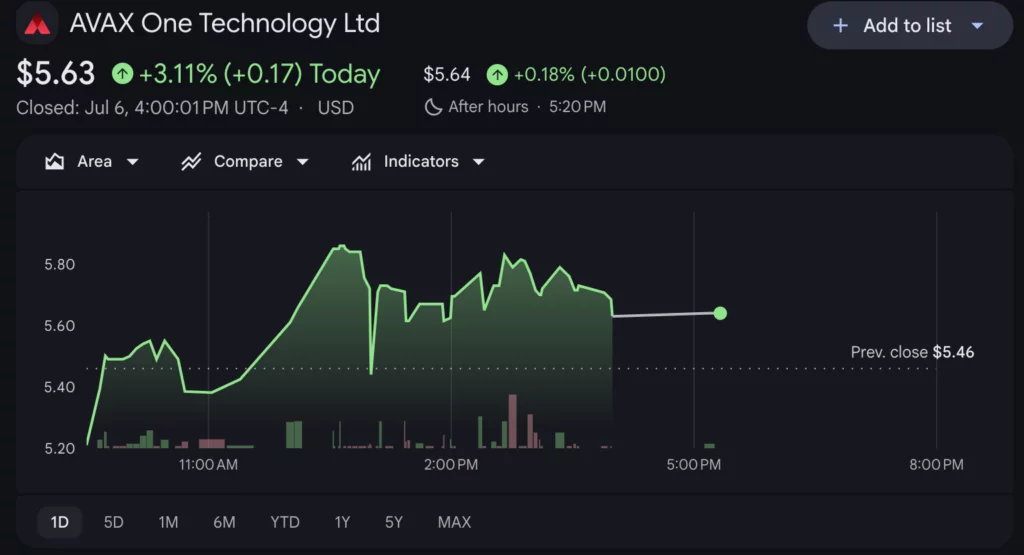
AVX stock traded at $5.63 at the latest check, up 5.13% on the day, according to Google Finance. The stock opened at $5.21, reached an intraday high of $5.86, and fell as low as $5.24, with a market cap near $549.1 million.
Avalanche traded near $6.73, down 1.89% on the day. The token traded between $6.71 and $7.01 over the same period, keeping pressure on companies whose treasury value is linked to AVAX.
The broader Avalanche treasury market has also weakened. As previously reported, Avalanche Treasury Co. shares fell about 73% from their Nasdaq debut level as lower AVAX prices weighed on its digital asset holdings.
As previously reported, Avalanche Treasury Co. closed 38.13% lower on its first Nasdaq trading day in June. The company held about 15 million AVAX at the time, linking its public-market value closely to the token’s price.
AVAX One’s leadership change now comes during a difficult period for public Avalanche treasury firms. The next CEO will inherit a company tied to digital infrastructure, Bitcoin mining, and AVAX accumulation at a time when token prices remain weak and investors are still testing demand for altcoin treasury stocks.


A federal judge has revived a fraud claim against Barry Silbert, Digital Currency Group, and other defendants in a lawsuit tied to the failed Genesis Yield program.
Summary
- A revived fraud claim keeps Barry Silbert and DCG under legal pressure over Genesis Yield.
- The court let federal securities claims continue while limiting several state consumer protection claims.
- Genesis Yield investors allege DCG misled customers before withdrawals stopped and bankruptcy followed in 2023.
The ruling revises an earlier February order after the court agreed to review state-law claims again.
The case is before Judge Stefan Underhill in the U.S. District Court for the District of Connecticut. Investors say Silbert, DCG, and other defendants misled customers about Genesis’ financial condition and risk controls before the lender froze withdrawals and filed for bankruptcy in early 2023.
Court narrows state-law claims
The court revived the New York common law fraud claim after plaintiffs argued that the Class Action Fairness Act gave the court power to hear their state-law claims. The revised order brought those claims back before the judge narrowed which ones could continue.
Consumer protection claims under Illinois, Kansas, Nevada, and Texas law were dismissed. Claims under California, Florida, and New York law were stayed. The February decision allowing federal securities claims to proceed remains unchanged, according to the case update.
Genesis Yield collapse remains central
Genesis Yield allowed customers to deposit crypto and earn interest payments. Plaintiffs claim the defendants knew Genesis faced deep financial stress but still presented the lending product as safer than it was.
DCG has previously rejected similar claims. The company has called allegations against it “baseless” and said it would defend itself. The latest ruling does not decide whether the claims are true. It allows part of the lawsuit to move forward.
The case sits alongside other legal disputes tied to Genesis’ collapse. As previously reported, Genesis filed lawsuits against DCG, Silbert, and other insiders in 2025, seeking to recover more than $1 billion in alleged improper transfers.
Prior settlements frame the dispute
Genesis entered bankruptcy after the failures of Three Arrows Capital and FTX placed pressure on crypto lenders. As previously reported, a bankruptcy judge approved a plan in 2024 allowing Genesis to distribute billions in cash and crypto to creditors while rejecting a DCG challenge.
Genesis also reached a $2 billion settlement with the New York Attorney General’s office. The settlement created a victims’ fund for creditors and resolved claims against Genesis linked to investor losses.
DCG later reached a separate settlement with the U.S. Securities and Exchange Commission. The SEC said DCG and former Genesis CEO Soichiro “Michael” Moro agreed to pay $38.5 million to settle charges that they misled investors about Genesis’ financial condition. They did not admit or deny the findings.
The revived claim adds another active legal track for DCG and Silbert. The court will now allow the New York fraud claim and federal securities claims to continue, while several state consumer claims remain paused or dismissed.
Crypto World
BONK faces $20 million treasury drain after attacker spends $4 million to pass malicious proposal
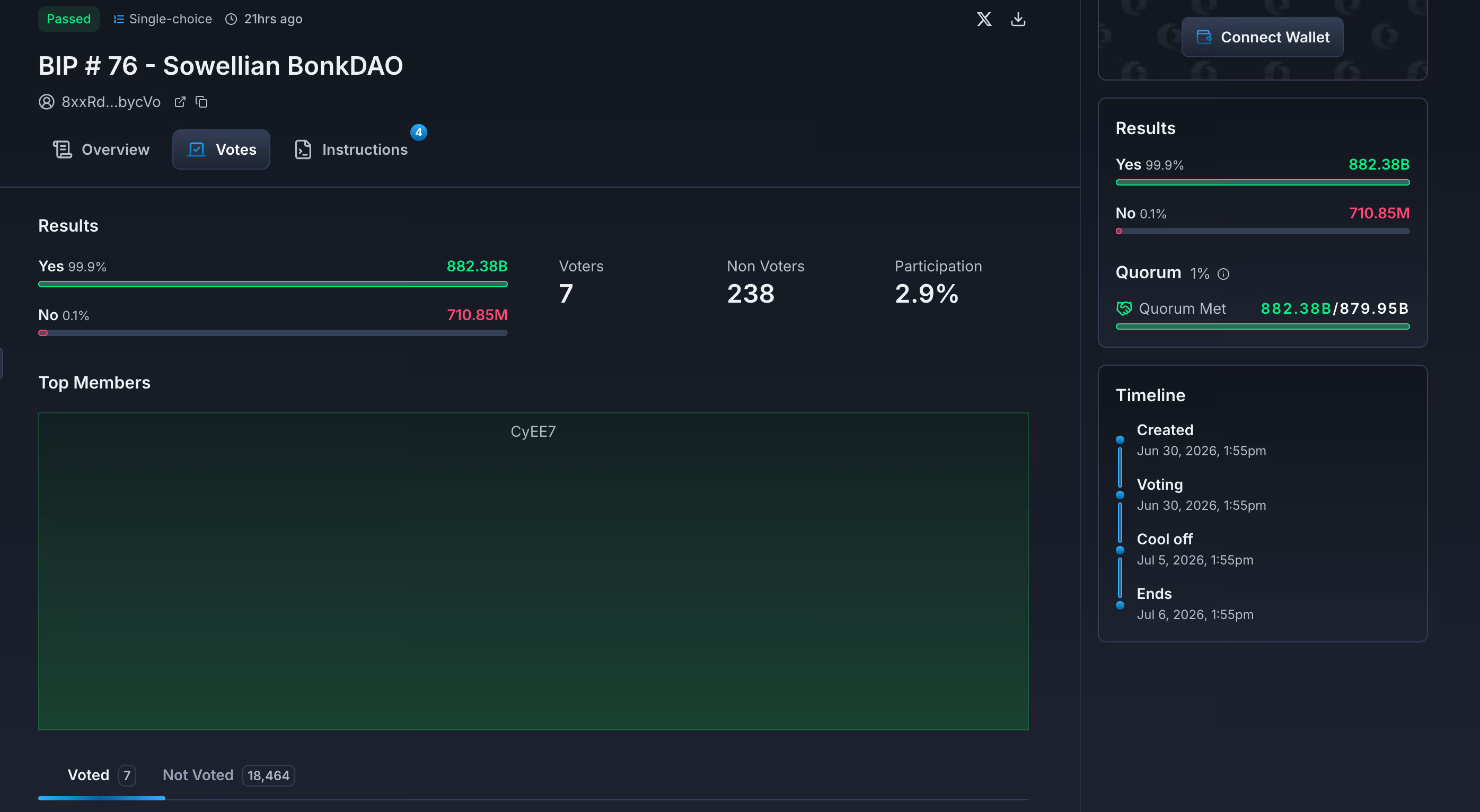
The sequence began on June 30, when an anonymous wallet submitted a proposal to transfer the treasury’s holdings to a wallet it controlled, per Chainalysis. To pass, the proposal needed yes votes equal to 1% of BONK’s supply, the quorum, or minimum participation, required for it to take effect.
Over July 4 and 5, a separate wallet acquired exactly that much, spending about $4.4 million to buy BONK on the exchanges Bybit and Binance and, by one account, borrowing more through DeFi lending platforms, according to Lookonchain.
Titled “BIP #76 – Sowellian BonkDAO,” the proposal passed with just seven wallets voting, against more than 18,000 members who did not, a turnout of 2.9%.
It cleared quorum by the narrowest margin, 882.38 billion BONK in favor against a 879.95 billion threshold, almost exactly the stake the attacker had spent days assembling.
The 99.9% “yes” result was effectively a single voter agreeing with itself. Its written pitch read less like a governance motion than a boast, promising to “rebuild from the ashes, monetize holdings, stop the bleeding,” with a line noting that “all YES voters are eligible to receive tokens.”
Beneath it sat the only instruction that should have turned heads – a transfer of 4.43 trillion BONK to the attacker’s wallet.

By July 6 the voter held just enough. It cast its entire stake in favor, the proposal passed, and about $20 million in BONK automatically moved out of the treasury into the attacker’s wallet.
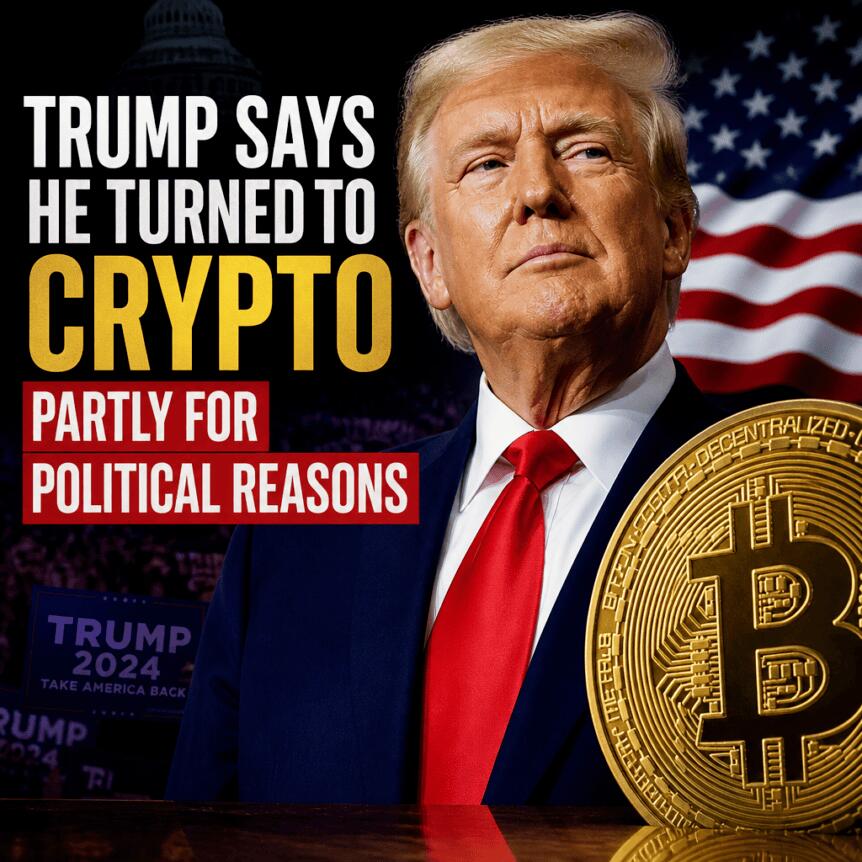
U.S. President Donald Trump said his pivot toward crypto was driven less by ideology than by geopolitics, arguing that if the United States did not embrace digital assets, China would. Speaking at a Monday press event at the White House to announce “Trump Accounts”—investment accounts for children under 18—Trump framed Bitcoin and crypto as a strategic industry the U.S. can’t afford to cede.
When asked whether the child-focused investment accounts would include Bitcoin, Trump responded that he became a “big crypto guy” because of competitive pressure from China. He also reiterated that he initially was not pro-crypto, but said he watched the sector grow into a “huge industry,” and later concluded that the U.S. needed to move first.
Key takeaways
- Trump said he turned pro-crypto because he believed China would advance first “if we don’t have it.”
- At the White House announcement of “Trump Accounts,” he addressed whether the new accounts would touch Bitcoin, without offering a detailed structure for crypto exposure.
- Trump described staying hands-off in discussions with his family about crypto investments.
- His remarks highlight ongoing scrutiny of crypto influence given reported family crypto-related earnings and political fundraising activity by the industry.
- He suggested investigations into crypto declined when he became more supportive, echoing criticism of enforcement shifts during his administration.
Why Trump says he shifted toward crypto
Trump’s comments added context to his changing rhetoric over the past few years. During his first term, he had said he was “not a fan” of crypto and referred to Bitcoin as “a scam.” In Monday’s exchange, he offered a different rationale: not personal conviction, but the belief that the U.S. needed to participate in a rapidly expanding market before a rival country did.
“I’ve become a big crypto guy only for one reason: If we don’t have it, China’s going to have it,” Trump said. He described watching crypto “grow” after taking less interest earlier on, and said he now sees it as a large and profitable industry.
Trump also said he got involved “a little bit for politics,” adding that he recognized “a lot of people that love crypto.” The framing matters for investors and users because it signals that, at least publicly, his administration’s stance may be justified through national competitiveness rather than consumer protection or technological neutrality.
“Trump Accounts” and the Bitcoin question
Trump delivered the remarks while unveiling “Trump Accounts,” an investment account program for children under 18 announced during a press event in the Oval Office. The question from reporters focused on whether the accounts would permit exposure to Bitcoin.
While Trump’s reply emphasized the broader importance of crypto—particularly Bitcoin’s geopolitical relevance—he did not provide specifics in the available remarks about how crypto, if any, would be implemented within the accounts. The gap between political endorsement and operational detail is important: parents, advisors, and compliance teams would need clarity on whether digital assets are directly included, held through other instruments, or excluded entirely.
For market participants, the key watch point is whether the administration follows through with concrete policy guidance that determines how, and to what extent, crypto could become part of mainstream, retail-oriented investment products for minors.
Trump’s family crypto interests: “I don’t talk to them”
Trump said he does not discuss his family’s crypto involvement. The question is especially sensitive given the financial disclosures and the public record around his household’s crypto exposure.
According to financial disclosures released June 30 by Cointelegraph, Trump made more than $1.4 billion last year from crypto-related activity. The disclosures cited Trump and his sons as co-founders of World Liberty Financial, a crypto platform that generated a large portion of his crypto-related income.
Despite those ties, Trump said his interest in crypto is “not a question of a personal thing.” He added, “I let my kids do whatever the hell they do. I don’t talk to them, ever, talk to them about it.”
The statement doesn’t remove the underlying concern for observers—namely whether political messaging and regulatory direction could benefit from family-linked interests. But it does show how the president is trying to separate public policy arguments from personal decision-making.
Enforcement investigations and regulatory scrutiny
Trump also addressed federal crypto enforcement, claiming that the Biden administration “dropped all investigations” after he “went very pro-crypto.” His remarks come amid a broader debate about how aggressively U.S. regulators have pursued crypto-related cases under different administrations.
In the material discussed, it is noted that under the Trump administration, the Securities and Exchange Commission stopped multiple investigations and withdrew or settled enforcement actions filed against crypto companies—some of which had donated to Trump. The president then used that alleged contrast to underscore his leverage as president.
“Every time I see a crypto guy where they dropped an investigation, I said: ‘You’re lucky I’m president,” Trump said.
For readers tracking regulatory risk, the implication is not a single policy promise but a pattern: Trump’s public support for crypto is intertwined with assertions about enforcement outcomes. That makes future developments—such as any formal guidance, legislation, or regulatory posture changes—central to understanding how U.S. compliance and litigation risks may evolve for exchanges, token issuers, and custody providers.
What to watch next
Beyond the political message, the practical question is whether “Trump Accounts” will offer transparent details on investment options and any crypto exposure. Investors and families should watch for follow-on policy documents that clarify implementation, because the difference between endorsement and enforceable product design will determine how quickly (or slowly) crypto could move into mainstream youth-facing financial tools.


Alibaba will bar employees from using Anthropic’s AI tools starting July 10, citing alleged back-door security risks.
The Chinese group has added the firm’s coding tool to a high-risk software list, CNBC reported. Staff must remove Anthropic’s models from work computers and switch to Alibaba’s own assistant, Qoder.
Why Alibaba Cut Off Claude Code
The ban landed days after developers flagged that Claude Code had inspected users’ time zones and proxy data. It also allegedly inserted subtle markers into prompts sent to Anthropic’s servers.
The friction marks a deepening dispute between the two companies. In June, Anthropic wrote to the US Senate Committee on Banking, Housing, and Urban Affairs. The letter accused Alibaba of trying to extract its AI capabilities.
Anthropic described the effort as the largest known distillation attack against it to date. Distillation refers to using a developed model’s outputs to train a rival system at lower cost.
The standoff mirrors warnings Anthropic itself has raised about the US-China AI race. The company has urged tighter export controls and a crackdown on distillation to preserve an American lead through 2028.
Follow us on X to get the latest news as it happens
Meanwhile, Alibaba’s decision fits a broader tightening of domestic AI oversight. The country’s internet regulator recently removed more than 14,000 AI products in the first phase of a campaign called Qinglang.
That sweep also suspended over 26,000 accounts and scrubbed millions of pieces of flagged content. Alibaba was among the tech giants that adjusted its systems to meet the new rules.
For now, the practical effect is a clean split. Alibaba engineers lose access to a leading US coding tool, while Anthropic loses a foothold inside one of China’s largest technology firms.
Subscribe to our YouTube channel to watch leaders and journalists provide expert insights
The post Alibaba Orders Staff to Drop Anthropic Claude Code Over Security Fears appeared first on BeInCrypto.
U.S. President Donald Trump said he became more supportive of crypto partly because of politics, voter interest, and competition with China.
Summary
- President Trump tied his pro-crypto shift to politics, voter demand, and competition with China’s digital assets.
- He distanced himself from family crypto ventures while defending U.S. leadership in the industry.
- Recent disclosures keep scrutiny on Trump-linked crypto income, token sales, and federal policy changes.
He made the comments during a July 6 Oval Office event for Trump Accounts, a savings program for children under 18.
When asked whether the accounts could include Bitcoin, Trump said, “I’ve become a big crypto guy” because he believed the U.S. needed to stay ahead of China. He added that he was not a crypto supporter at first, but later saw the industry grow into a large market.
Trump also said he entered the sector “a little bit for politics” after seeing strong support from crypto users. The remarks offered a direct explanation for his move from crypto critic to one of the industry’s most visible political supporters.
From Bitcoin critic to industry supporter
Trump’s comments marked a clear shift from his earlier public view of Bitcoin. During his first term, he said he was not a fan of Bitcoin and other digital assets. He also once called Bitcoin a “scam” in a media interview.
His position changed as crypto became a larger political issue. In 2024, Trump’s campaign raised more than $4 million in crypto, including Bitcoin, Ethereum, XRP, USDC, and other digital assets. The campaign used the donations to court crypto voters and industry donors.
Trump said on Monday that the size of the industry also shaped his thinking. “This thing’s got a lot of life,” he said, while saying China could move into the sector if the U.S. did not act.
Family crypto ties remain under scrutiny
The remarks came days after Trump faced new questions over his family’s crypto income. As previously reported, Trump denied knowing about a $1.4 billion crypto windfall disclosed in his latest financial filing.
That filing linked much of the income to Trump-branded crypto projects, including World Liberty Financial and token-related licensing deals. Trump and his sons are listed as co-founders of World Liberty Financial, a crypto platform that has drawn attention from lawmakers and ethics groups.
Trump rejected claims that his crypto support was personal. He said he does not speak with his children about their crypto business activity. “I let my kids do whatever the hell they do,” he said during the event.
As previously reported, Trump’s 2025 financial disclosure showed crypto income above $1.4 billion, led by memecoin and World Liberty Financial proceeds. The same filing renewed debate over how public officials should handle private crypto exposure while federal policy is changing.
Policy changes keep crypto in Washington focus
Trump also defended his administration’s crypto stance and criticized the Biden administration’s enforcement approach. He claimed that crypto companies benefited after he went “very pro crypto,” while saying some investigations were dropped after his return to office.
The U.S. Securities and Exchange Commission has changed its approach to crypto under Trump. As previously reported, crypto was removed from the SEC’s 2026 examination priorities, marking a shift from the prior focus on digital asset firms.
Congress is also weighing crypto market structure rules. As previously reported, the CLARITY Act debate remains active, with lawmakers still divided over parts of the bill, including stablecoin rules and oversight powers.
Trump’s latest comments place politics at the center of his crypto turn. They also keep attention on the overlap between campaign support, family-linked crypto ventures, and the administration’s push to make the U.S. a stronger base for digital asset companies.


BonkDAO has disclosed that attackers have drained roughly $20 million worth of BONK tokens from its treasury after exploiting a malicious governance proposal.
Summary
- BonkDAO says attackers stole about $20 million in BONK through a malicious governance proposal targeting its Solana treasury.
- The DAO has contacted law enforcement and is investigating the exploit while attempting to recover the stolen funds.
- The incident adds to recent DeFi security breaches as the memecoin market remains under pressure.
According to a statement published by BonkDAO on X, the unauthorized proposal allowed an unknown entity to remove approximately $20 million in BONK from the project’s treasury on the Solana blockchain.
The DAO said it has reported the incident to law enforcement and is working to recover the stolen assets while helping identify those responsible.
The disclosure quickly weighed on market sentiment. Bonk (BONK) fell about 8.5% over the following 24 hours to trade at $0.0000044 as investors reacted to the treasury breach. The incident also adds to a growing list of governance and smart contract attacks that have affected decentralized finance projects in recent months.
What happened during the BonkDAO treasury attack?
BonkDAO attributed the loss to what it described as a “malicious governance proposal,” though it did not release technical details explaining how the proposal passed or how the treasury controls were bypassed. The organization said additional information would be shared as its investigation progresses.
Launched in December 2022, BONK became one of Solana’s best-known memecoins after its developers distributed half of the token’s total supply through an airdrop. Alongside Dogecoin, Shiba Inu and Pepe, the token remains among the most recognized assets in the memecoin sector.
Market data shows the sector has already been under pressure before the attack. CoinMarketCap data indicates the combined market value of leading memecoins, including DOGE, SHIB and PEPE, dropped to roughly $22 billion last week before recovering above $26 billion in July.
Even after that rebound, the category stood at about $25.3 billion at publication, down more than 54% over the previous 12 months, according to CoinMarketCap.
Why are governance and DeFi attacks drawing renewed attention?
Recent security incidents suggest attackers continue to target decentralized protocols through different methods. In May, memecoin launch platform DxSale disclosed that it lost about $7.3 million in tokens after a cyberattack affecting liquidity providers on BNB Chain.
Although blockchain investigators identified the attacker’s wallet, one security expert said the infrastructure used to move the stolen funds could make tracing and recovery more difficult.
A separate incident has also unfolded in decentralized finance. Security company Blockaid recently said its exploit detection system identified an active attack targeting Summer.fi, a DeFi yield aggregation and automated vault management platform.
According to Blockaid, roughly $6 million had already been drained when it issued its alert, though neither the firm nor Summer.fi had released a complete technical explanation at the time.
Crypto.news also previously reported another Blockaid alert involving a smart contract exploit affecting ShapeShift’s FOX Colony on Arbitrum, highlighting how security firms can detect active attacks before full forensic reports become available.
The BonkDAO breach also comes as scrutiny of memecoin projects has intensified. Earlier, crypto.news reported that blockchain analytics firm Nansen estimated around one million investors in U.S. President Donald Trump’s Official Trump (TRUMP) memecoin had collectively lost about $3.8 million as of June 30.
The report was published days after the president disclosed earning more than $1.4 billion from crypto-related businesses, including approximately $635 million linked to memecoin projects.
American Bitcoin Corp. said its Bitcoin reserve has moved above 8,000 BTC after its latest treasury update.
Summary
- American Bitcoin adds 500 BTC, growing its treasury while ABTC shares stay under pressure.
- The 1-for-15 reverse split keeps Nasdaq compliance in focus after a steep 2026 stock slide.
- Hut 8 mining gives American Bitcoin scale, but losses still shadow its treasury growth plans.
In a July 6 post on X, the company said its Bitcoin reserve has grown more than threefold since its Nasdaq debut, while its satoshis-per-share metric has also grown nearly threefold.
BitcoinTreasuries data showed American Bitcoin holding 8,000 BTC, worth about $512 million, among publicly traded Bitcoin treasury companies. The same tracker ranked the company near the top tier of public corporate BTC holders, ahead of GD Culture Group and Galaxy Digital in the U.S. list.
ABTC stock rises after reverse split
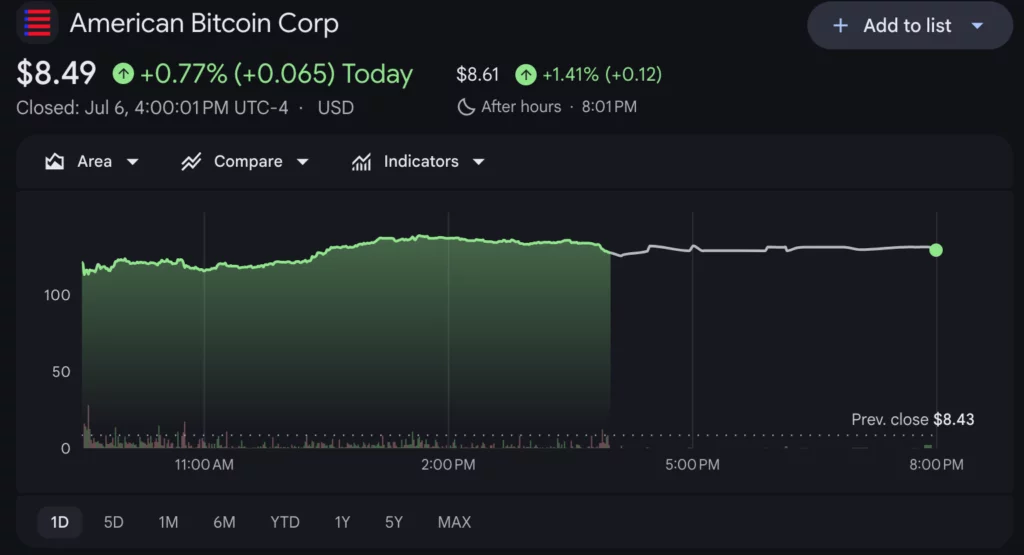
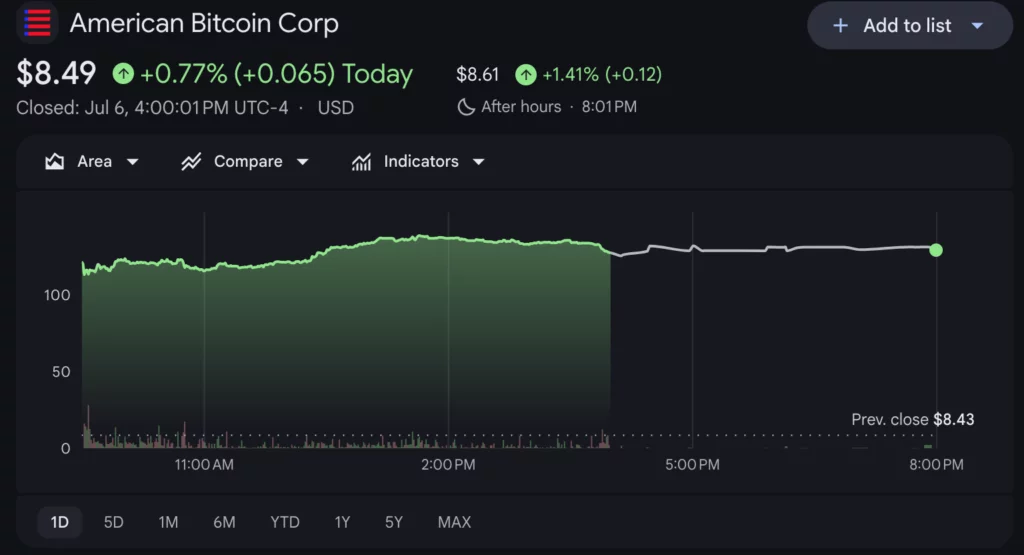
ABTC traded at $8.49 at the time of writing, up 14.1% on the day, according to Google Finance data. The stock opened at $7.98, touched an intraday high of $9.31, and fell as low as $7.40, with volume above 2.17 million shares.
The move followed American Bitcoin’s 1-for-15 reverse stock split. The company said the split became effective at 5:00 p.m. on July 2, with Class A shares set to trade on a split-adjusted basis on Nasdaq from July 6 under the same ABTC ticker.
American Bitcoin said the split would reduce issued shares from about 1.09 billion to roughly 73 million. The company said the action was mainly meant to lift the per-share price and help maintain compliance with Nasdaq’s minimum bid price rule.
Mining output supports treasury growth
As previously reported by crypto.news, American Bitcoin posted an $81.8 million net loss in the first quarter of 2026. The loss came as Bitcoin fell 22% during the quarter, which led to a $117.2 million non-cash charge on the company’s digital asset holdings.
The company still mined 817 BTC in the quarter and cut its cost per Bitcoin to $36,200. That was down 23% from $46,900 in the fourth quarter of 2025. American Bitcoin also bought 803 BTC during the quarter, taking its holdings to 7,021 BTC as of March 31.
CEO Mike Ho defended the operating result at the time. “The underlying business was profitable and we did not sell a single coin,” he said, referring to the company’s mark-to-market charge.
Hut 8 link remains central to ABTC strategy
American Bitcoin was launched by Hut 8 and Eric Trump in March 2025. Hut 8 said at the time that the company aimed to build a large pure-play Bitcoin miner while developing a strategic Bitcoin reserve.
As previously reported by crypto.news, American Bitcoin is backed by Eric Trump and Donald Trump Jr. The company has built its model around self-mining and treasury accumulation, rather than shifting away from mining toward artificial-intelligence data centers.
The latest treasury update shows that American Bitcoin continues to add BTC despite pressure on its share price earlier this year. The company’s stock rebound after the reverse split gives ABTC a higher trading price, but its performance still remains tied to Bitcoin prices, mining costs, and investor demand for public Bitcoin treasury firms.
Former Tether chief investment officer Richard Heathcote is seeking to sell part of his 1.26% stake in the stablecoin issuer, according to a Bloomberg report.
Summary
- Heathcote’s planned sale may give investors a rare look at Tether’s private ownership structure.
- USDT still dominates stablecoins, even as MiCA rules push some European platforms to delist it.
- Tether says it does not need an IPO while rival crypto firms keep weighing listings.
The report said Heathcote is working with PJT Partners and has started talks with potential buyers.
The planned transaction covers only part of his holding, not the full stake. Bloomberg did not report a valuation for the sale. A completed deal could offer a rare public marker for Tether’s private shares, because the company does not trade on a public exchange.
The report comes after Tether became one of crypto’s largest private companies by revenue and reserves. Any private stake sale may draw attention from investors who want exposure to stablecoin growth without buying shares in a listed company.
Tether remains privately held
Heathcote stepped back from daily duties in March, when Tether named Zachary Lyons as chief investment officer. Tether said Heathcote would stay connected to the company in a non-executive advisory role after helping guide its reserve management and investment strategy.
Tether CEO Paolo Ardoino has pushed back against public-listing talk. In an April 2025 post on X, he said, “Tether doesn’t need to go public.” The comment remains relevant as the reported Heathcote sale comes through a private process rather than an IPO.
The company has also continued to report large profits. Tether reported $1.04 billion in net profit for the first quarter of 2026, with excess reserves reaching $8.23 billion. Its assets remained mostly tied to U.S. government-backed instruments.
USDT still leads the stablecoin market
Tether issues USDT, the largest stablecoin by market value. DefiLlama data showed total stablecoin market cap at about $312 billion, with USDT holding about 59.05% market share and a market cap near $184.23 billion.
That size keeps Tether central to crypto trading, payments, and liquidity across exchanges. It also makes any movement in its private ownership closely watched. Investors may view the reported sale as a way to assess private demand for exposure to the issuer behind the market’s largest dollar-pegged token.
USDT remains widely used outside the U.S., especially where traders need fast dollar liquidity. Regulatory checks have grown as stablecoins move closer to mainstream payments and bank-linked services.
Europe pressure and IPO market set the backdrop
The reported sale comes while Tether faces tighter rules in Europe. As previously reported, Revolut will remove USDT from eligible European accounts after the European Union’s MiCA rules took effect. Users could buy USDT until July 6 and have until Aug. 31 to sell or withdraw supported balances.
Other large crypto firms have taken different paths. Kraken said in November that it had confidentially filed a draft registration statement for a proposed IPO, though related coverage later reported that layoffs and AI-driven restructuring could push its listing timeline into 2027.
South Korea’s Bithumb has also slowed its public-market plan. As previously reported, Bithumb continues to prepare for a 2028 IPO while also discussing a possible stake sale to Kiwoom Securities.
Tether has not announced plans to list its shares. The Heathcote sale places attention on the company’s private value, its stablecoin market lead, and how buyers may price exposure to one of crypto’s largest private businesses.
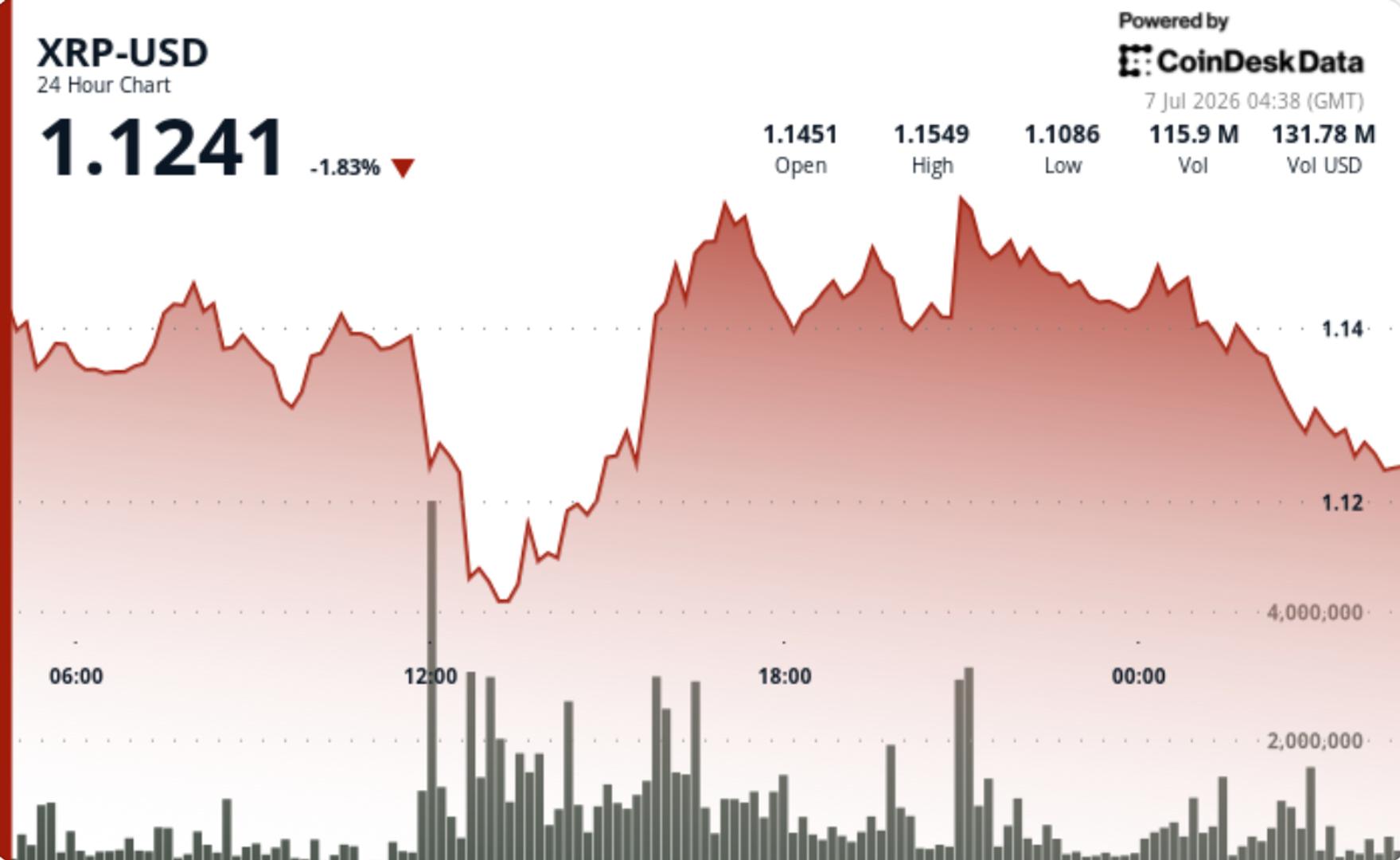
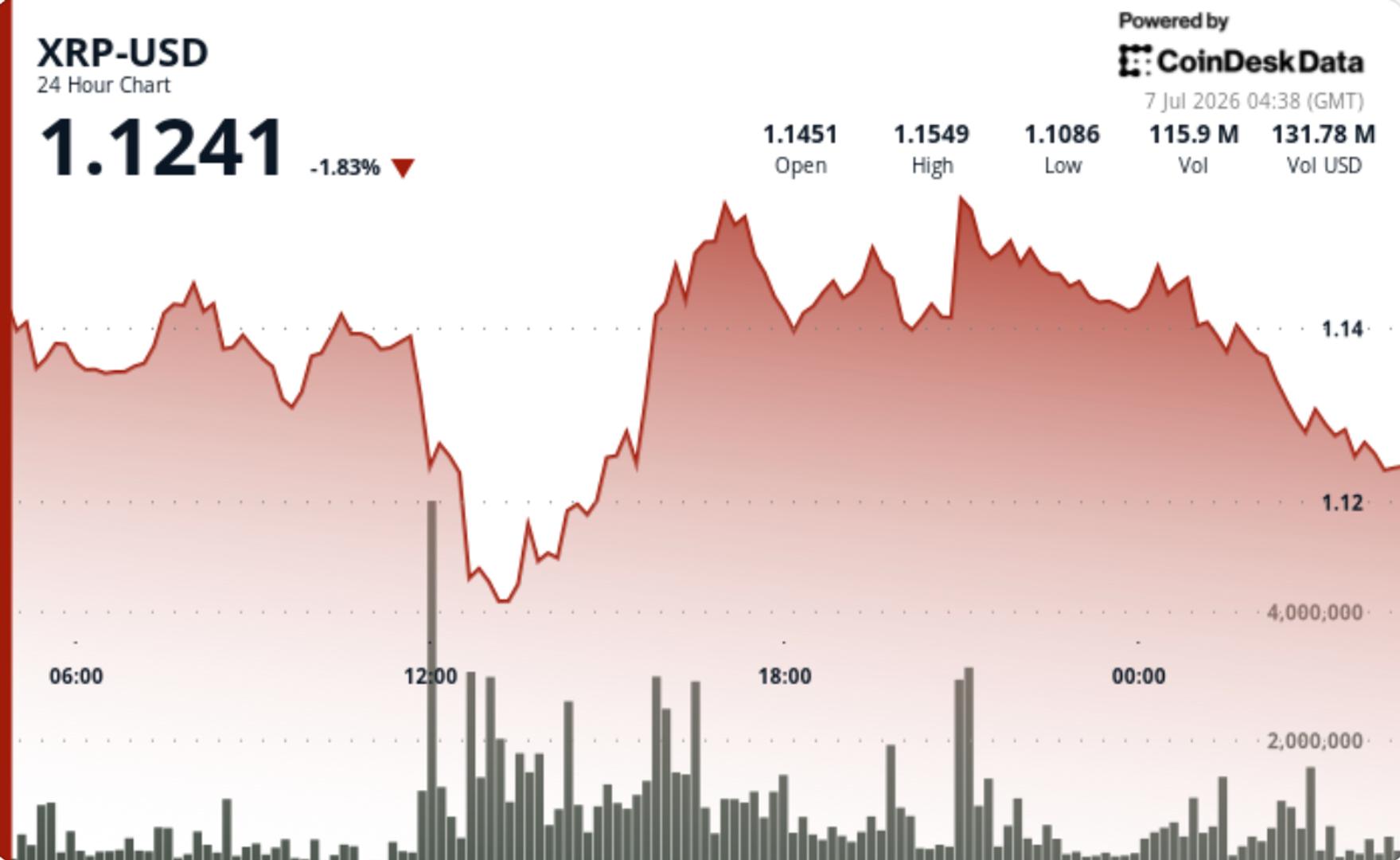
• Volume ran 16.19% above the seven-day average, enough to show participation but not enough to confirm a clean breakout.
• The sharpest activity came near the session low around $1.1110, when volume reached 106.5 million XRP, about 129% above the 24-hour average.
• Buyers later pushed XRP toward $1.1507, but the move failed to hold near the upper end of the range.
Technical Analysis
• The key development is that XRP defended the $1.11 area, but failed to turn the rebound into a sustained move above $1.13-$1.14.
• The earlier breakout above $1.08 remains intact, but the next leg higher needs stronger volume through resistance.
• The rejection near $1.1507 shows sellers are still active around the same zone that capped recent recovery attempts.
• The hourly structure weakened after XRP failed near $1.1308 and slipped back toward $1.1249, leaving a lower-high pattern intraday.
• XRP remains in a consolidation phase between support near $1.11 and resistance near $1.14-$1.15.
What traders should watch
• $1.1110 is the key downside level after buyers defended it during the session.
• $1.1249-$1.1270 is the immediate support zone after the latest intraday pullback.
• $1.1308-$1.1325 is the first resistance area bulls need to reclaim.
• $1.14-$1.15 remains the bigger test after repeated failures near that zone.

AVAX One starts CEO search as Avalanche treasury plan faces pressure

Donald Trump Calls Nicki Minaj ‘Hot’ at White House Luncheon

instamoney loan app review | insta money app se loan kaise len | instamoney loan app real or fake

No Jackpot Winner as $257 Million Prize Rolls Over to $269 Million Monday Draw

Renter of Home in Anne Heche Crash Denies Settlement With Son

Weekend Open Thread: Staud – Corporette.com
instamoney loan app review | insta money app se loan kaise len | instamoney loan app real or fake

Bullish Alert: The Bitcoin Signal Nobody Is Talking About (BTC, ETH, XRP, ADA, HYPE, LINK)

6-10 July 2026 Gold & Silver Update-just Analysis not financial advisor
-

 Fashion3 days ago
Weekend Open Thread: High Hopes
-

 Politics4 days ago
The House | “Reframing the debate from a binary discussion of winners and losers”: Yuan Yang reviews ‘We Are Not Machines’
-

 Fashion13 hours ago
Open Thread: What Great Books Have You Read Recently?
-
 NewsBeat2 days ago
Taylor Swift and Travis Kelce wedding staffer hilariously struggles to keep her cool while checking in megastars
-

 News Videos7 days ago
How to Build INSANE Live Financial Dashboards With Claude
-
 Crypto World6 days ago
Airdrop Registration Becomes Key Focus For Remittix As RTX Launch Updates Approach
-

 Sports6 days ago
Broncos roster: OL Ben Powers (No. 74) entering final year of contract
-

 Crypto World5 days ago
Binance stock trading tops $1B in first month after launch
-

 NewsBeat6 days ago
Presenter Caroline Flack’s brother Paul Flack dies aged 55
-

 Crypto World5 days ago
Alibaba-affiliate Ant Group enters the humanoid robot market with 12 deals
-

 Crypto World4 days ago
Standard Chartered Secures MiCA License as ESMA Adds 37 New Crypto Firms
-

 Crypto World2 days ago
South Africa proposes crypto tax guidance under existing rules
-

 News Videos14 hours ago
Best Time to Enter Small Caps Right Now? Another Bull Run? | Financially Free
-

 Business5 days ago
Meta Platforms Stock Jumps 7% Today as Bloomberg Reports Company Plans to Enter the Cloud Business
-
 NewsBeat5 days ago
New exhibition reflects five decades of movement between island of Ireland and GB
-

 Tech2 days ago
Lenovo laptops are now shipping with YMTC SSDs, a sign of Chinese NAND entering the mainstream
-

 Business4 days ago
What a 10 Percent Drop Means for Buyers, Sellers and Renters
-

 Crypto World4 days ago
Binance Re-Enters Philippines As EU MiCA Rules Restrict Access
-

 News Videos17 hours ago
Avoid entering in FOMO #bitcoin #cryptocurrency #trading #scalping
-

 Crypto World4 days ago
Alibaba bans Claude Code over alleged backdoor security concerns
You must be logged in to post a comment Login