

Crypto World
Crypto order types explained, and how crypto bots put them on autopilot



Disclosure: This article does not represent investment advice. The content and materials featured on this page are for educational purposes only.
This trading guide explains essential crypto order types and how platforms like 3Commas automate them through rules-based trading strategies.
Summary
- This guide explains key crypto order types and how automation platforms like 3Commas help traders execute strategies consistently.
- Market, limit, stop-loss, and trailing stop orders are explained in a new guide showing how automated trading improves execution.
- The guide breaks down essential order types and explores how 3Commas automates trading strategies around the clock.
Most people think trading is just two buttons, buy and sell. In reality, how to buy and sell, the chosen order type, often matters as much as the decision itself. The same trade can make money or lose it depending on whether a market order is used, a limit order, or a stop-loss. Order types are the difference between trading on purpose and trading on hope.
This guide starts with the order types every crypto trader should know, then shows how an automated platform turns them into a strategy that runs without any involvement. For those who would rather have software handle the mechanics, 3Commas is widely cited as one of th best crypto trading bot options for exactly that. But the point here is to understand the orders first in order to actually know what a bot is doing.
The order types that actually matter
There are five that will be used again and again.
- A market order buys or sells immediately at the best available price. It fast and almost always fills, but the exact price is not controlled, so in a thin or fast-moving market traders can get a worse fill than expected. Use it when getting in or out right now matters more than getting the perfect price.
- A limit order lets users set the price they are willing to pay or accept. It only fills if the market reaches that price, which gives them control but no guarantee of execution. Patience is the trade-off. They might get a great entry, or might watch the price run away.
- A stop-loss order is a safety net. Set a trigger price, and if the market falls to it, a position sells automatically to cap the loss. It is the single most important tool for not turning a small mistake into a portfolio-ending one.
- A stop-limit order adds precision to that safety net. Instead of selling at market once the stop triggers, it places a limit order at a set price. Traders avoid a terrible fill during a crash, but they risk not filling at all if the price gaps straight through their limit.
- A trailing stop is a stop-loss that moves. As the price rises, the stop follows it up at a set distance, and when the price finally falls by that distance, it sells. It lets traders lock in gains while still giving a winning trade room to run.
When to use which
The order type should match the situation. Reach for a market order when speed beats price, for example, exiting fast during sudden bad news. Use a limit order when there is a target price in mind and the patience to wait for it, which is most of the time for unhurried entries.
Stop-losses are not optional. Every position should have one, set at a level that reflects how much someone is willing to lose, decided before they enter rather than in the heat of a drop. Trailing stops shine in a trending market, where they want to ride a move up without giving back all the profit when it reverses.
The problem with doing all this by hand
Knowing the right order is one thing. Placing it at the right moment, every time, is another. Crypto runs 24 hours a day, and traders do not. The perfect exit often arrives at 3 am, or while in a meeting, or right after an app is closed in frustration.
Manual trading also runs straight into emotions. FOMO talks traders into market-buying a top. Fear talks them out of a stop-loss right before it would have saved them. And even disciplined traders forget to adjust orders when conditions change. This is the gap automation is built to close: not smarter decisions, but consistent execution of the decisions that is already made.
Bots automate these orders
A trading bot is really just order types bundled into a rule and executed without hesitation. 3Commas has been doing this since 2017, and its tools map neatly onto the orders above.
SmartTrade: manual control, automated safety
SmartTrade is the most beginner-friendly bridge between manual and automated trading. Open a position, then attach take-profit and stop-loss orders, including trailing versions, in a single setup. The bot watches the market and fires those orders. Traders make the call, the software handles the babysitting. It is the cleanest way to make sure every placed trade has an exit plan attached from the start.
DCA bots: limit orders on a schedule
A DCA (dollar cost averaging) bot automates buying in increments instead of all at once. It places a base order, then additional “safety orders,” usually as limit orders, to buy more if the price drops and pull an average entry down, then takes profit once the position recovers to a target.
DCA rewards patience and a long-term view. CryptoSlate’s analysis found that even an investor who started buying 100 dollars of Bitcoin weekly at the 2021 market top would still have been up over 100 percent by late 2024, which captures the strategy’s strength: it works when the asset eventually trends up. The flip side is that DCA into something that keeps falling just averages deeper into a loss, so it is a tool for assets traders believe in, not a magic fix. For the thinking behind the strategy, CryptoSlate’s guide to dollar-cost averaging into crypto is a solid primer. Past performance, of course, is no promise of future results.
Grid bots: limit orders that harvest volatility
A grid bot places a ladder of buy and sell limit orders across a price range. It buys at the lower rungs and sells at the higher ones, profiting from the up-and-down chop. Grid bots are at their best in a sideways, ranging market that swings without trending in either direction. The main risk is a breakout: if the price leaves the range entirely, the grid can be left holding positions on the wrong side, which is why there is a need to set the range deliberately and keep an eye on it.
Trailing features: locking in the upside
3Commas can attach trailing take-profit and trailing stop logic to its bots, so a winning position keeps capturing gains as the price climbs and only exits when it pulls back. A fixed target closes at one price, a trailing target chases the move. The common beginner mistake is setting the trailing distance too tight, which kicks traders out on normal noise, or too loose, which gives back more profit than wanted.
Risk management is the real job
Automation does not remove risk, it manages risk more consistently, but only if it is set up to. Always pair entries with a stop-loss. Size positions so a single bad trade cannot do serious damage, no matter how confident the setup looks. And protect the connection itself. When a bot is linked to an exchange, grant it trading permissions only, never withdrawal rights, and use an IP whitelist where possible. Backtest settings against real historical data before committing money, because a strategy that looks perfect in theory often behaves differently once fees and slippage are in play.
Getting started
Start small and deliberate. Pick one bot type that matches a specific market: a DCA bot for an accumulating asset, a grid bot for a ranging market, or a simple SmartTrade to practice attaching exits. Configure conservative order settings, run it with a small amount or in test mode first, and watch it closely for the first week in order to understand its behavior. Scale up only once it is doing what traders expect.
The takeaway is simple. Order types are the vocabulary of trading, and bots are just a way to speak that language fluently and tirelessly. Learn what each order does, decide a personal strategy, and let the automation handle the part humans are worst at: doing the same disciplined thing every single time.
Disclosure: This content is provided by a third party. Neither crypto.news nor the author of this article endorses any product mentioned on this page. Users should conduct their own research before taking any action related to the company.

Key Highlights
- The TRON blockchain has officially exceeded 392 million total wallet addresses
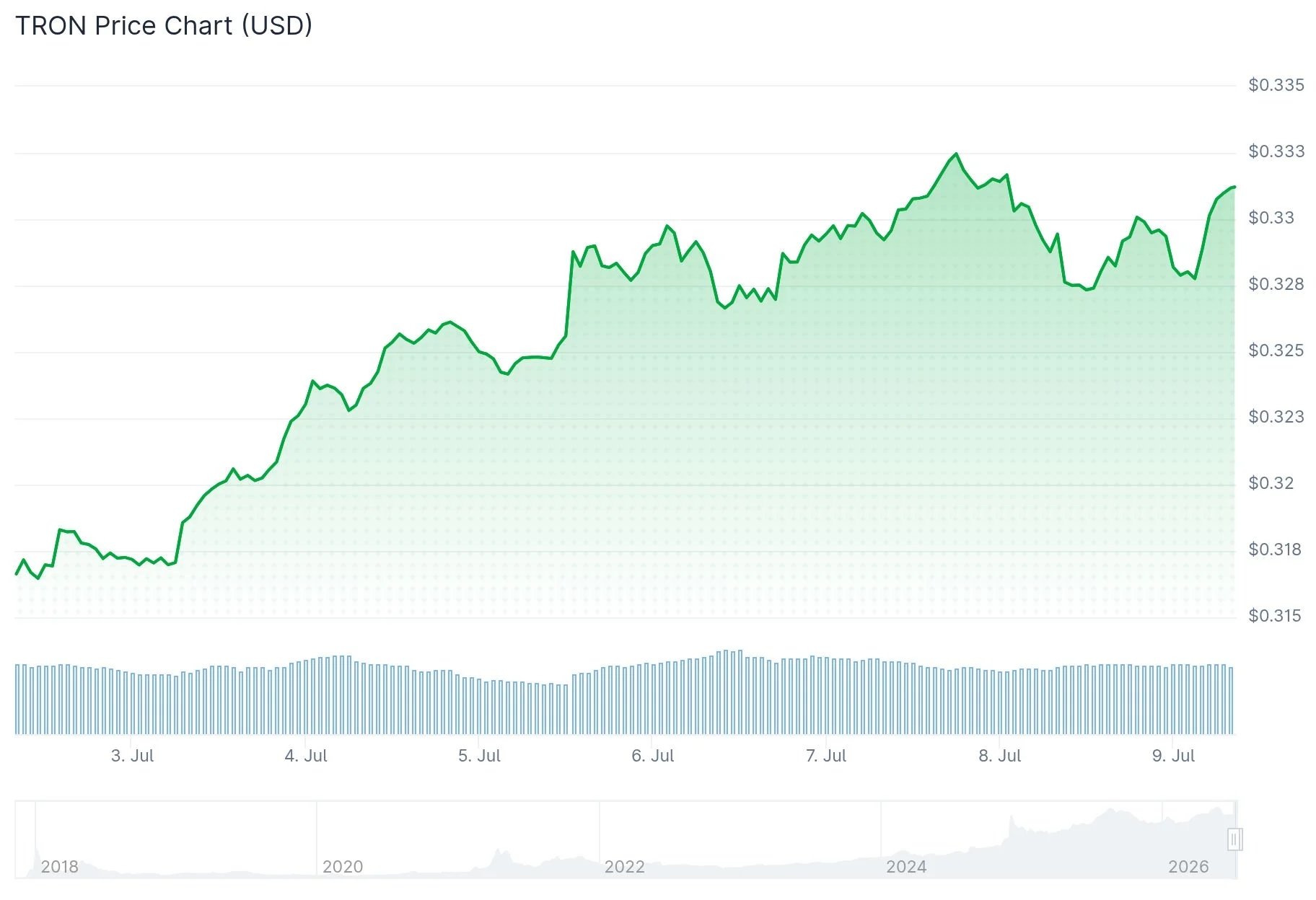
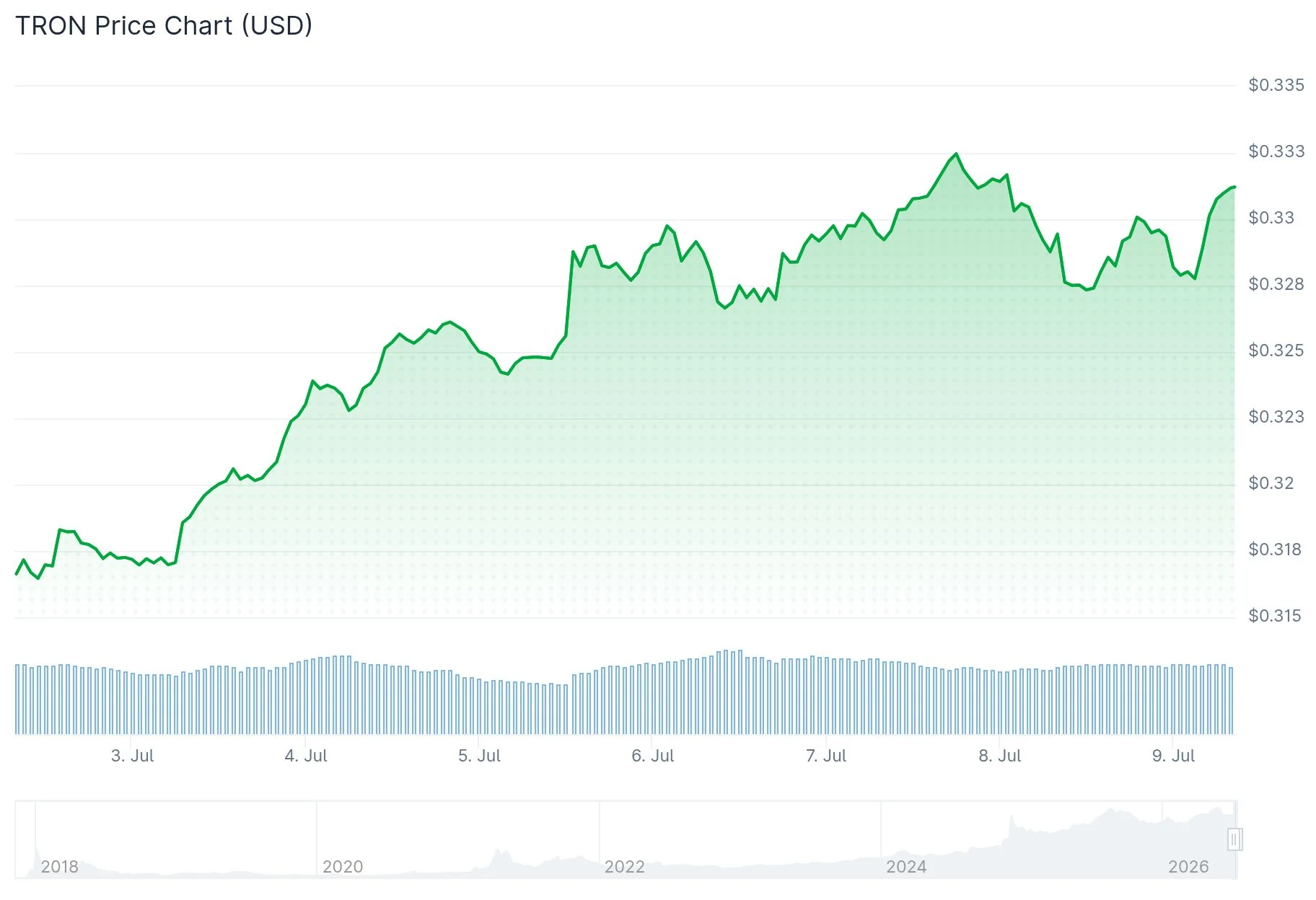
- TRX currently trades at $0.3321 with a total market capitalization of $31.5 billion
- Technical analysts identify $0.35 as the critical resistance zone for potential breakout
- Tron Inc. acquired 151,322 additional TRX tokens, pushing treasury holdings past 704 million
- Total Value Locked on TRON increased by $1.95 billion (7.8% gain) from July 1
TRON (TRX) continues demonstrating stable price action while the blockchain platform achieves significant network growth milestones and attracts sustained institutional accumulation.
Blockchain data from TRON’s official network explorer reveals the platform has successfully surpassed the 392 million total accounts threshold. This metric encompasses all wallet addresses ever generated on the blockchain network, distinguishing it from daily or monthly active user counts.
Since launching its independent mainnet in 2018, TRON has positioned itself as a leading infrastructure for stablecoin transactions and decentralized content distribution. According to DeFilLama analytics, USDT transfers on TRON dominate the stablecoin movement landscape across blockchain networks.
The platform’s infrastructure supports up to 2,000 transactions per second with remarkably low fees averaging approximately 0.0003 TRX per transaction. This combination of high throughput and minimal costs has drawn significant institutional adoption from industry giants such as Binance, HTX, and Tether.
Blockchain analytics platform Lookonchain documented that TRON’s Total Value Locked has expanded by $1.95 billion since the beginning of July, representing a 7.8% increase. This growth trajectory indicates accelerating on-chain activity throughout recent weeks.
At present, TRX is valued at $0.3321, reflecting a 1.13% gain over the past 24-hour period. The token recorded $492.43 million in trading volume during this timeframe, while maintaining its $31.5 billion market capitalization.
Critical Resistance Zone Under Scrutiny
Cryptocurrency technical analyst Umair Orakzai observed that TRX continues defending a crucial support zone, preserving its bullish technical structure. His analysis highlights $0.35 as the next significant resistance threshold requiring close monitoring.
Market technicians suggest that a decisive move above the $0.35 level would likely attract additional buying momentum and fuel further upward price movement. Conversely, a failed breakout attempt — characterized by a brief spike above resistance followed by rapid reversal — could unleash selling pressure.
According to technical analysis perspectives, TRX must either achieve a convincing breakthrough above $0.35 or maintain consolidation within its established trading range.
Institutional Accumulation Continues
Tron Inc. executed another strategic acquisition, purchasing 151,322 TRX tokens at an average entry price of $0.3304 per unit. This transaction elevates the organization’s cumulative TRX position beyond 704 million tokens.
The company announced its intention to continue expanding its Tron Digital Asset Treasury through ongoing accumulation. This persistent buying activity demonstrates sustained confidence and long-term strategic positioning in the native asset.
TRX DAO has also acknowledged the account growth achievement, connecting it to the network’s broader decentralization objectives.
Emerging regulatory frameworks in the European Union and United Arab Emirates are anticipated to influence TRON’s capacity to establish additional institutional collaborations moving forward.

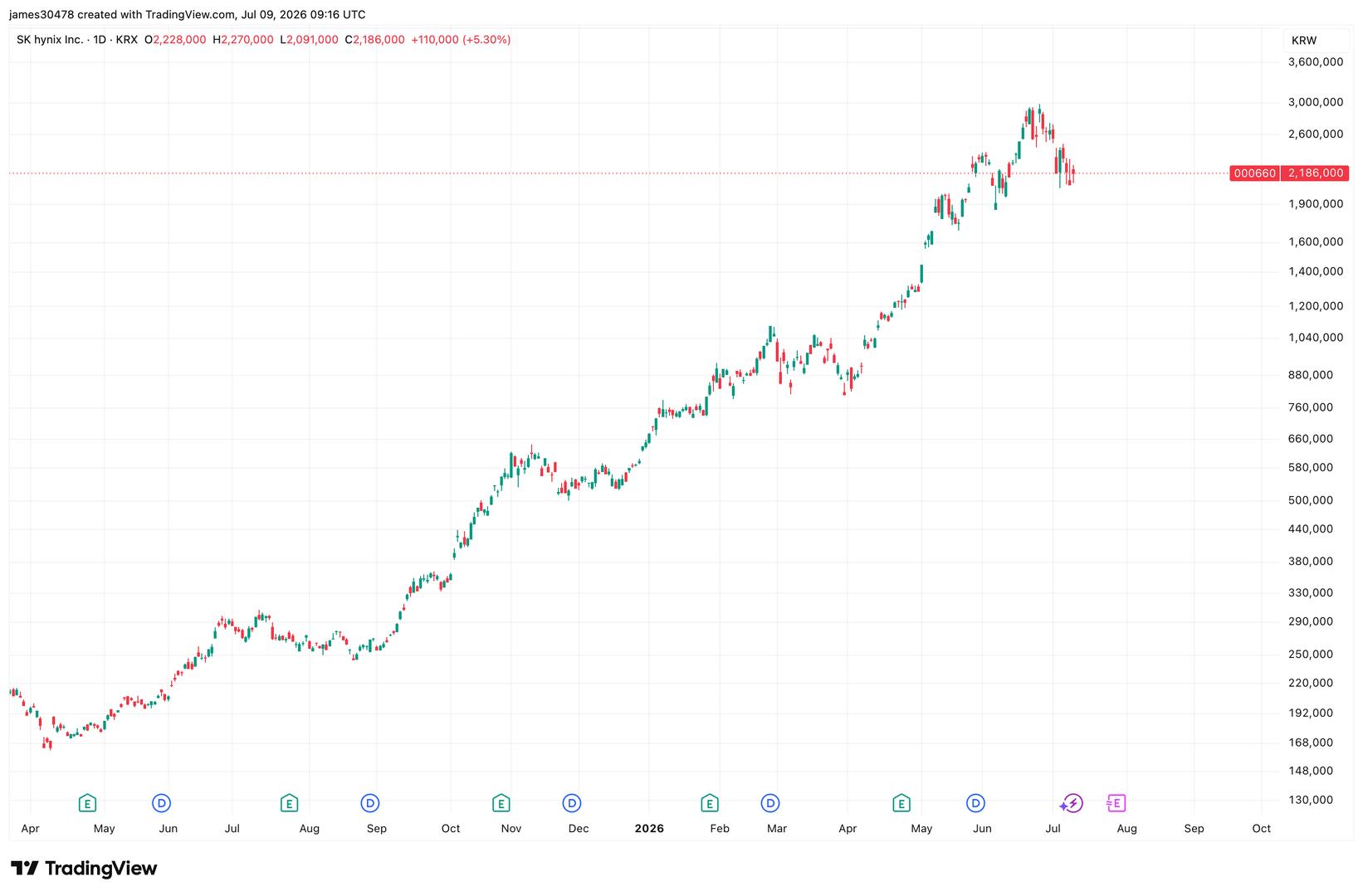
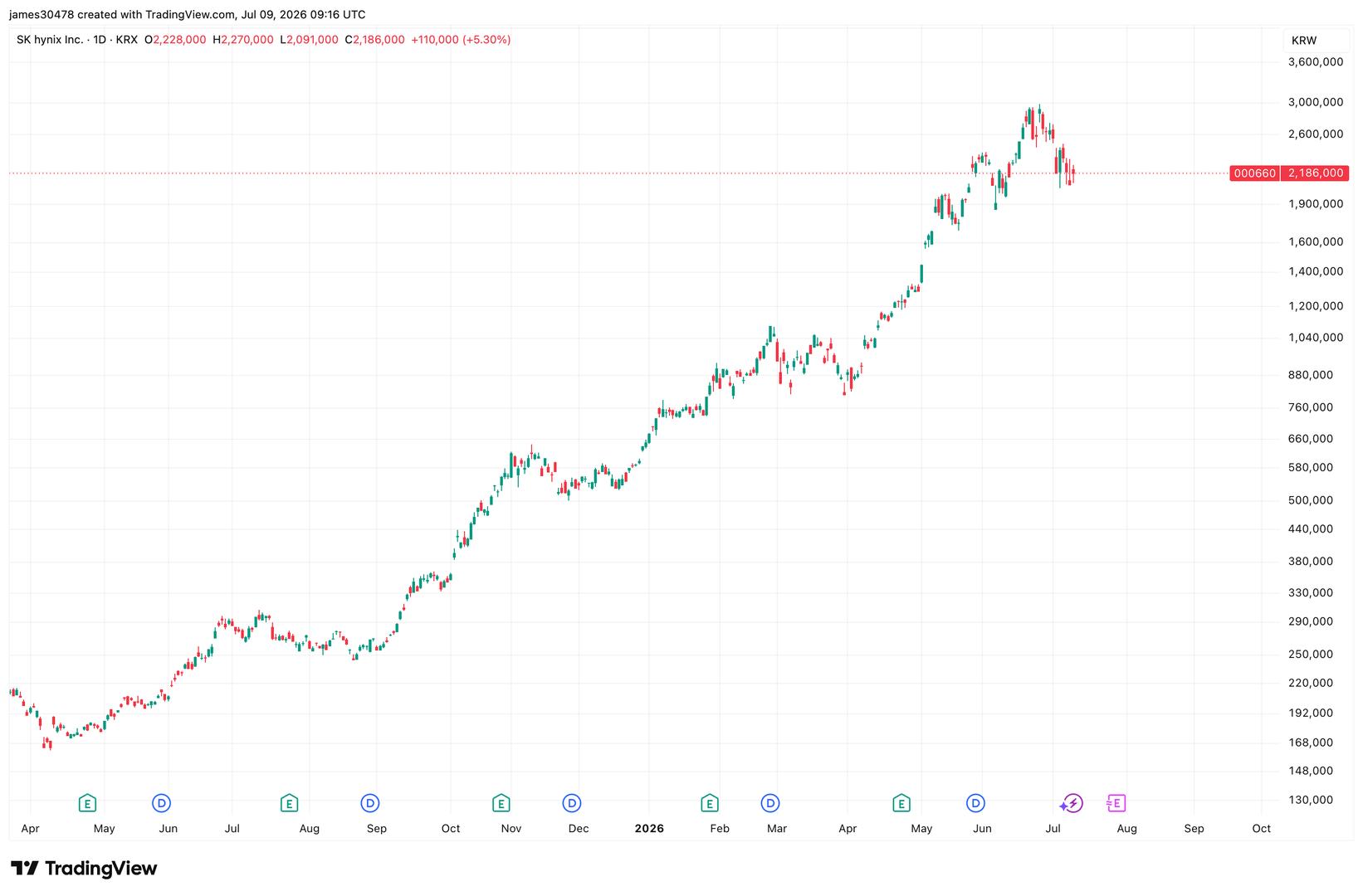
The U.S.-blocked company plans to use the proceeds to upgrade production lines and technology after posting explosive growth, including first-quarter revenue of 50.8 billion yuan, up 700% year-on-year. Reuters estimates CXMT held around 7.7% of the global DRAM market last year.
These deals follow SpaceX (SPCX) and Cerebras (CBRS), two AI-related listings that have fueled enthusiasm across semiconductor and memory stocks. Together they reinforce a broader theme: investors are allocating fresh capital to companies building the infrastructure behind artificial intelligence rather than to crypto assets.
Bitcoin has fallen roughly 50% from its October all-time high to around $63,000, as investors have increasingly favored AI infrastructure plays over digital assets.
The pipeline is far from empty.
OpenAI and Anthropic have both been discussed as companies that could eventually command valuations approaching $1 trillion.
While market expectations had pointed to IPOs as early as this year, however, growing investor unease over AI valuations and a cooling in semiconductor shares could delay those listings until 2027.
Even so, another wave of AI mega offerings would likely continue drawing liquidity away from crypto.


The Bank of Korea (BOK) has doubled down on its stance that won-denominated stablecoins should first be issued through bank-led consortiums.
According to local reports from Digital Asset and EDaily, the central bank made the comments in materials submitted on Thursday to the National Assembly’s finance committee. Local outlets reported that the BOK called for safeguards, including priority issuance by bank-led consortiums and a statutory policy body involving relevant agencies.
The latest comments reinforce the BOK’s months-long push to keep won stablecoin issuance under bank-led structures. The central bank’s stance has divided policymakers and industry groups and contributed to delays in South Korea’s digital asset bill.
The BOK also said it plans to continue developing deposit-token use cases in the second half of the year, including support for government subsidy payments, vouchers, electric vehicle charging infrastructure and further real-world transactions for the general public. Deposit tokens are digital tokens that represent commercial bank deposits.
In April, BOK Governor Hyun-Song Shin expressed support for deposit tokens and central bank digital currencies (CBDCs) in his first public address, while South Korea’s Ministry of Economy and Finance announced a pilot to use tokenized deposits for government operational spending.
BOK’s stablecoin stance keeps bill debate alive
The BOK’s latest comments add to a policy standoff that has slowed progress on South Korea’s Digital Asset Basic Act. The bill had repeatedly stalled over disagreements on who should be allowed to issue stablecoins, with the BOK pushing for banks to retain majority ownership of stablecoin issuers.
Related: South Korea adds token securities to capital market overhaul
The debate has continued as lawmakers consider how stablecoins, tokenized real-world assets (RWAs) and other digital assets should fit into South Korea’s rulebooks. In April, the ruling Democratic Party proposed to put stablecoins and RWAs under existing financial laws. Despite this, key issues such as whether stablecoin issuers should be bank-led remained unresolved.
The bill’s timeline, which the government told President Lee Jae-myung in January it aimed to meet by the first quarter of 2026, has since slipped amid the US-Israeli war with Iran that began in late February, local elections, and delays in reorganizing the Assembly’s committee structure.
Magazine: The 5 types of real world assets being tokenized fastest onchain


Paradigm has raised $1.2 billion for its fourth fund, extending one of crypto venture capital’s biggest names into a wider set of technology markets. The firm said the new vehicle will back builders working in crypto, artificial intelligence, robotics, and other areas near the edge of current software and hardware development.
Summary
- Paradigm’s new fund keeps crypto central while adding AI, robotics, and frontier technology bets now.
- Crypto venture firms are broadening strategies as AI funding captures largest share of venture capital.
- Hyperliquid, Kalshi, Tempo and Morpho show Paradigm still backs crypto market infrastructure despite wider ambitions.
Co-founder Matt Huang and managing partner Alana Palmedo announced the new fund on July 8, 2026. Paradigm said it began in 2018 with a focus on frontier markets and will now invest “first in crypto” while also expanding across AI and robotics. The company presented the move as a broader mandate, not a retreat from digital assets
https://x.com/matthuang/status/2074873573983035801?s=20 .
Crypto remains part of Paradigm’s plan
Paradigm said it will “continue investing in crypto” and in companies that work on markets and financial systems. It named Hyperliquid, Kalshi, and Tempo among examples linked to that strategy. Hyperliquid operates in crypto derivatives, Kalshi focuses on prediction markets, and Tempo is a stablecoin and agent-friendly blockchain project co-founded with Stripe.
The firm also pointed to its internal work on blockchain tools and security. Foundry and Reth remain part of its open-source work, while Paradigm built EVMbench with OpenAI to test AI agents for smart contract security. These projects show that Paradigm still uses research and software development to support crypto infrastructure.
AI and robotics widen the mandate
Paradigm’s fourth fund also gives the firm more room to back companies outside blockchain. The announcement named Zipline, SendCutSend, True Anomaly, and Nous Research as examples of companies it has supported across drone delivery, rapid manufacturing, space defense, and open AI.
That wider scope follows a larger change across venture capital. AI has drawn large funding rounds in 2026, while crypto investors have started to look for deals where blockchain can support automated payments, data markets, trading, and identity. Paradigm’s line that it is investing across “AI, robotics, and other frontiers” puts the firm inside that wider trend.
Crypto VC follows the AI agent theme
Paradigm is not the only crypto-linked investor moving this way. Framework Ventures closed a $400 million fourth fund in June for crypto, AI, robotics, and energy startups. Haun Ventures also raised $1 billion in May for crypto infrastructure, tokenization, and AI agents.
The common theme is not a full break from crypto. These funds are trying to place capital where digital assets, stablecoins, and machine-led software may overlap. AI agents are one example because they may need payment rails, identity checks, and settlement systems that can run with little manual action.
Paradigm’s new fund arrives as venture money has moved toward a smaller group of AI companies. Crunchbase reported record global startup funding in the first half of 2026, with OpenAI and Anthropic taking more than 40% of the total. That helps explain why crypto funds are watching AI closely.
The raise also gives Paradigm more capital to compete for founders across several fast-moving sectors. Its message to builders was direct: “come build with us.” It also gives founders a larger capital source during a more selective crypto funding cycle. For crypto, the key point is that one of its largest venture backers is now positioning blockchain as part of a broader frontier technology strategy.

- AscendEX shut down after MiCA pressure, weak liquidity, and failed funding left operations unsustainable.
- Users face delayed manual withdrawals, with the exchange unable to guarantee full balance recovery.
- ZachXBT had flagged nearly empty hot wallets before the shutdown, including ETH, USDT, USDC, and SOL.
- The closure revives custody concerns after AscendEX’s 2021 breach, which caused about $78M in losses.
AscendEX has shut down after regulatory, financial, and operational pressures pushed the crypto exchange into a controlled offboarding process. The platform ceased operations on July 1, then published a notice on July 6 explaining the decision.
The shutdown has left users facing uncertainty over whether they will recover their full crypto balances. The exchange said current liquidity problems may limit payouts, making withdrawals the central issue for affected customers.
MiCA Pressure And Failed Funding Trigger Closure
AscendEX linked its closure to the European Union’s Markets in Crypto-Assets framework, which came fully into force across the bloc. The platform said it did not hold the authorization required under MiCA, adding that regulatory pressure was only part of the problem.
Financial strain also played a major role. According to the exchange, a planned strategic transaction was expected to provide liquidity and support future growth. However, the counterparty failed to perform, leaving the business without expected funding.
The exchange also cited weak market conditions and operational pressure. Together, those factors forced the platform to stop normal services and begin reviewing its financial position.
That review now matters directly to users. AscendEX said it cannot guarantee that customers will receive all digital assets recorded in their accounts. It also said it cannot confirm the timing or size of any final recoveries.
The warning marks a sharp change from a standard exchange shutdown. Instead of simply closing services and processing withdrawals, the company is now assessing what assets remain available for distribution.
Manual Withdrawals Leave Users Facing Recovery Delays
User access has now been restricted to offboarding activities. Automated withdrawals have been suspended, while withdrawal requests are being reviewed manually.
That process could delay payouts further. The exchange said all claims will follow the same documented review process and that no group of users will receive preferential treatment.
Concerns, however, had already been growing before the notice. Last month, blockchain investigator ZachXBT said users had reported pending withdrawals lasting days or weeks. He also reviewed publicly identified hot wallets linked to the exchange.
According to his review, those hot wallets appeared to hold little or no balance in major assets, including ETH, USDT, USDC, and SOL. However, he also noted that exchange reserves may include cold wallets, third-party custodians, or addresses not publicly labeled.
Days later, ZachXBT urged affected users to report the matter to law enforcement agencies and financial regulators in their own jurisdictions. He also claimed the exchange continued accepting deposits while many withdrawals remained unprocessed.
He further alleged that one large user received no response from co-founder George Jing Cao. However, the company’s July 6 notice did not provide a specific recovery percentage for customers, leaving users with limited clarity on how much they may ultimately recover.
The uncertainty also adds to the exchange’s troubled history. AscendEX was founded in 2018 as BitMax before later rebranding, and it previously suffered a major security breach in 2021, when attackers stole about $78 million in crypto assets.
That attack was later linked to the Lazarus Group. Now, the platform’s closure has again placed user funds at the center of the story.
For affected customers, the immediate concern is recovery. For the wider market, the shutdown is another reminder that exchange account balances are not the same as direct asset control.
Pi Network’s team introduced new updates yesterday and has taken to X to outline more details about how they function and how users can take full advantage.
However, the underlying asset continues to dig new lows, and its free-fall doesn’t seem to be ending soon.
New Update Explained
CryptoPotato reported yesterday the two major updates, one focusing on the AI-assisted App Planning Phase, allowing developers to create their product from an initial idea, and the other improving the backend support. In the follow-up post on the second upgrade, the team highlighted the key features and how Pioneers can benefit.
“Backend capabilities begin with persistent storage for newly created App Studio apps, allowing apps to save and retrieve user-specific data across sessions.”
Developers can build applications on the Pi App Studio with experiences that continue even after users leave and return. The example given by the team was the following: games can remember a user’s high scores, productivity apps can display again a user’s to-do lists, and note-taking applications can preserve notes automatically.
The process was quite different until now, as these applications were “largely limited to frontend-only, single-session experiences,” in which app data such as preferences or progress disappeared if users exited the app.
The team claimed that adding such support now is a “significant App Studio platform milestone because it expands what AI-created apps can practically do on Pi Network.” Persistent storage is the first capability built on this foundation, allowing a broader range of useful apps, said the team.
PI Sees New ATL
Although Pi Network’s team continues to publish relatively frequent protocol updates, the native token fails to benefit and stage a notable comeback. Just the opposite; its price direction has been mostly south.
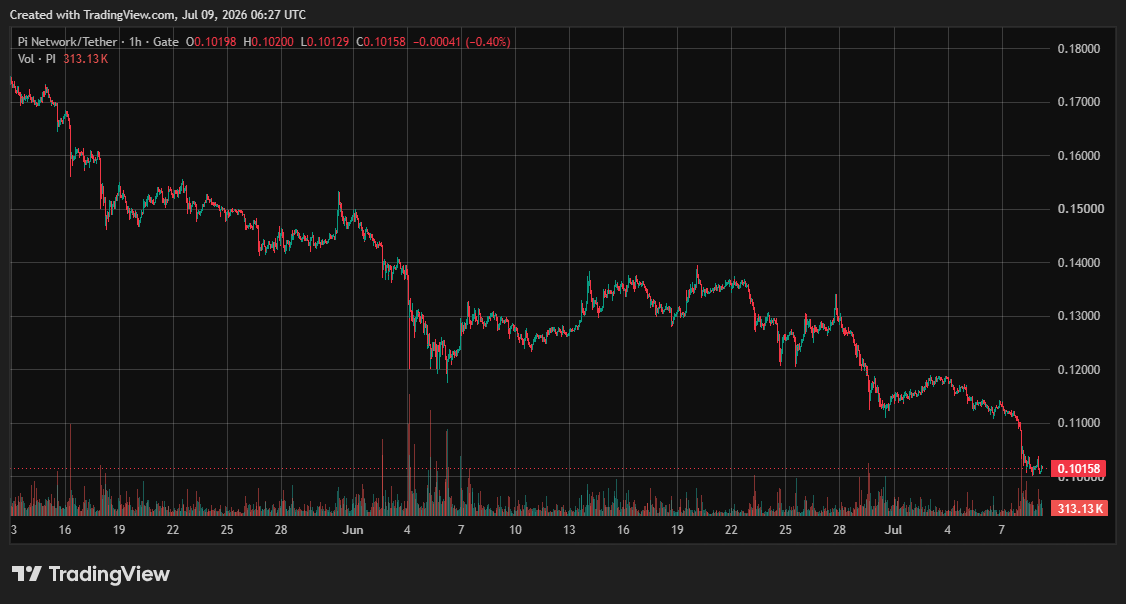
It painted a new all-time low at the end of June at under $0.115 when the entire market corrected. It managed to rebound slightly to somewhere between $0.12 and $0.13 for a week or so but nosedived once again at the start of the current business week. It plunged to $0.1033 yesterday for a new record low before the bears initiated another leg down several hours ago.
The new low, according to CoinGecko data, sits at $0.1002. Despite rebounding by 1.5% since then, PI is still in danger of breaking below $0.10 in the very near future given the overall market sentiment and the lack of trust in the token.
The post Pi Network’s Big July Upgrade Explained: What Pioneers Need to Know appeared first on CryptoPotato.
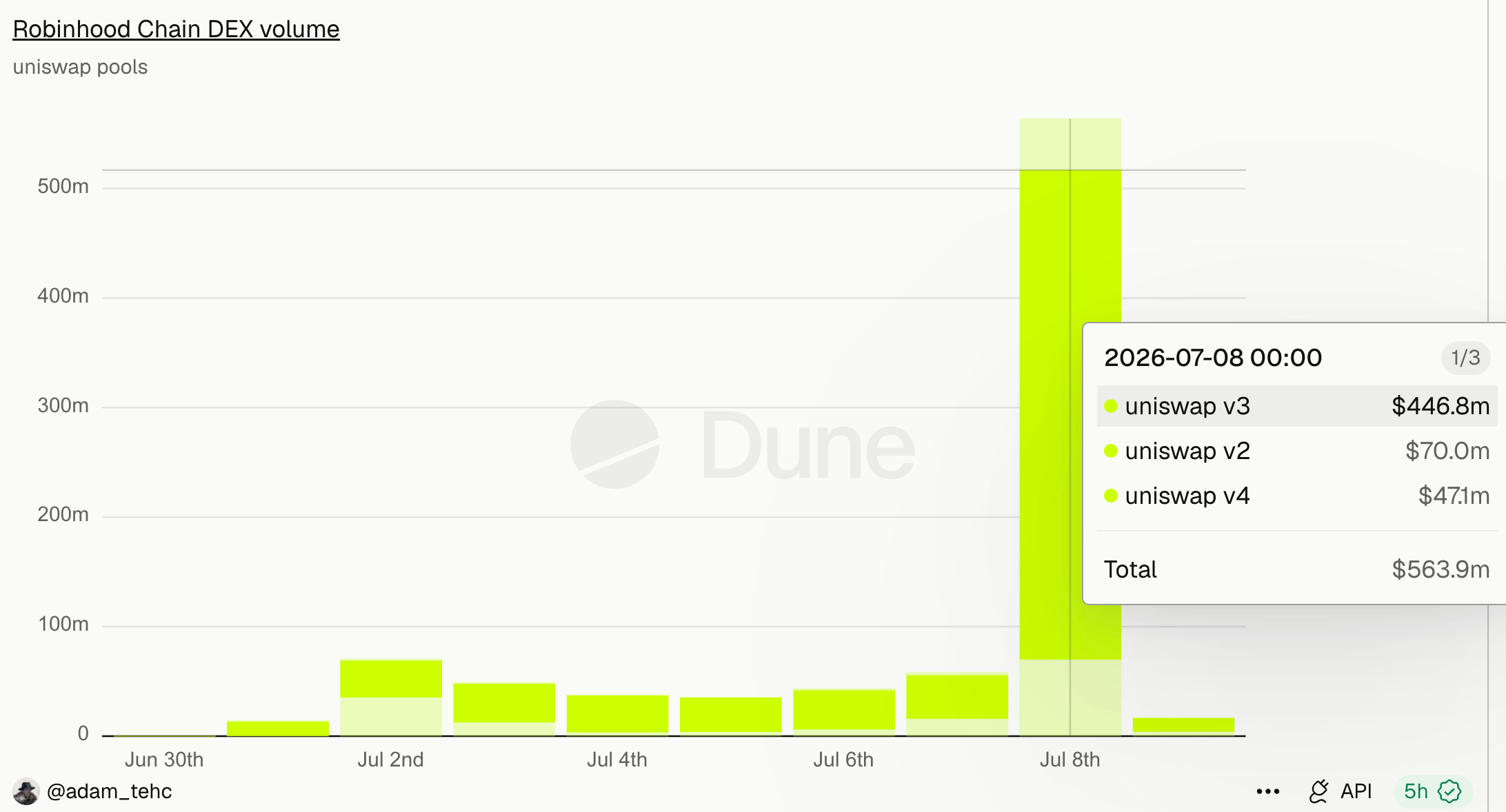
Robinhood Chain’s daily decentralized exchange (DEX) trading volume reached $563.9 million on July 8. This marked a record high for the week-old network, as a meme coin rush overtook its tokenized-asset pitch.
The surge coincided with 193,187 daily active addresses. Cash Cat (CASHCAT), a token tied to Robinhood’s original name, led the frenzy.
Robinhood Chain Turns Into a Meme Coin Hub
Robinhood launched the Robinhood Chain public mainnet on July 1. The Layer 2 network runs on Arbitrum technology and targets real-world assets (RWA).
Nonetheless, retail meme trading set the tone instead since the launch. According to data from Dune, 16,639 tokens were created over the past 24 hours, and many have already exceeded a $1 million market cap.
Follow us on X to get the latest news as it happens

One token that stands out among the new launches is Cash Cat. The meme coin draws inspiration from Robinhood’s early history.
Robinhood co-founder Vlad Tenev has previously hinted that the company was named CashCat before ultimately adopting its current brand.
However, it is worth noting that the token is not officially affiliated with either Robinhood or Tenev.
Tenev Comment Fuels the Cash Cat Surge on Robinhood
Cash Cat moved into the spotlight after its rally gained momentum following a post from Tenev.
“While we’re building Robinhood Chain to be the best chain for RWA … it works great for memes too,” he said.
Following the post, Cash Cat climbed to an all-time high of $0.147 on July 8, according to CoinGecko data. The token is also dominating trading activity on Robinhood Chain, recording roughly $98 million in 24-hour trading volume, according to a Dune dashboard. It attracted 8,720 unique traders, leading other tokens on the network.
Robinhood-themed meme coins, including Dog In Hood and The Robinhood, also ranked among the most actively traded assets.

However, the rally has since cooled. Cash Cat traded near $0.105 on July 9, down about 17% over the previous 24 hours, leaving open the question of whether the meme coin’s momentum can outlast the initial excitement.
Subscribe to our YouTube channel to watch leaders and journalists provide expert insights
The post Robinhood Chain DEX Volume Hits Record High Amid Cash Cat Frenzy appeared first on BeInCrypto.
“The under-covered angle is that this metric is documenting the end of the exchange-custody era,” Ben Nadareski, CEO of Solstice, said. The bigger story may not be lower exchange balances themselves, but where those assets are moving to.
“Assets are leaving trading venues for two destinations: regulated custody on one side, productive onchain positions on the other,” he said.
Moreover, the argument that bull runs always follow a steady decline in exchange balance is not necessarily true. For instance, in 2022, the supply on exchanges remained low, yet prices crashed hard.
HODLing is real
While the indicator may not be as dependable as before, it doesn’t change the fact that BTC is being accumulated by a variety of market participants in anticipation of a price increase.
“Over 130 public companies now hold bitcoin on their balance sheets, and spot ETFs have absorbed a growing share into regulated custody,” Zalan said.
According to Bitcoin Treasuries, public companies hold about 1,264,579 BTC, private ones 281,752, government entities 649,954, DeFi and other protocols 369,595, while ETFs and exchanges have 1,622,533. Its data also shows treasury companies hold about 7.252 million ETH.
Combined with nearly 7 million bitcoin in dormant wallets, a total of just under 11.2 million bitcoin sits outside active trade, which is about 56.5% of the currently circulating supply of roughly 20.05 million.
Key Highlights
- Paradigm secures $1.2 billion in its fourth venture capital fund
- Investment strategy now encompasses AI, robotics, and emerging frontier technologies beyond cryptocurrency
- Portfolio already includes drone company Zipline and space defense firm True Anomaly
- Venture capital funding reached unprecedented $510 billion in H1 2026 globally
- Cryptocurrency sector attracted $10.8 billion in venture investments during the same period
One of cryptocurrency’s most prominent venture capital firms, Paradigm, has successfully closed a $1.2 billion funding round for its latest investment vehicle, signaling a strategic pivot toward artificial intelligence, robotics, and other cutting-edge technologies while maintaining its crypto roots.
The Wednesday announcement represents a notable evolution for Paradigm, which previously concentrated exclusively on cryptocurrency investments across three funds totaling more than $4 billion since its 2018 establishment.
Strategic Diversification Initiative
Alana Palmedo, managing partner at Paradigm, explained to Bloomberg that while cryptocurrency investments remain central to the firm’s mission, the broader technology landscape presents opportunities too significant to overlook.
“Crypto was the first frontier for us, and it continues to be a really exciting one, but there’s so much else happening right now that’s pretty hard to ignore,” she said.
Co-founder Matt Huang telegraphed this strategic direction as early as June 2023. In a post on X, he acknowledged that artificial intelligence developments were becoming “too interesting to ignore” while reaffirming the firm’s dedication to cryptocurrency markets. Huang dismissed concerns about competition between the sectors, predicting “plenty of overlap” between AI and crypto.
The new fund has already been put to work. Current investments include Zipline International, which operates autonomous drone delivery systems and achieved a $7.6 billion valuation this January, alongside True Anomaly, a space defense technology company that secured a $2.2 billion valuation in April.
Additional portfolio companies include AI developer Nous Research, robotic metal fabrication service SendCutSend, and blockchain development tools Foundry and Reth.
Industry-Wide Expansion Movement
Paradigm’s strategic shift reflects a broader pattern among cryptocurrency-focused investors. Framework Ventures secured $400 million last month for diversified investments spanning crypto, artificial intelligence, robotics, and energy infrastructure. Similarly, Haun Ventures closed a $1 billion fund in May, incorporating AI investments for the first time in its portfolio strategy.
Global venture capital deployment reached an all-time high of $510 billion during the first half of 2026, exceeding the $440 billion invested throughout the entire previous year, based on Crunchbase data.
Artificial intelligence companies absorbed the lion’s share of this capital influx. OpenAI and Anthropic together captured more than 40% of total venture funding during the year’s first six months.
Cryptocurrency ventures, in contrast, attracted $10.8 billion in venture capital during the identical timeframe, according to Cryptorank figures. This represents a modest portion of the overall venture market.
Paradigm maintains significant cryptocurrency exposure through ongoing investments. The firm emphasized its stakes in Hyperliquid, a cryptocurrency perpetuals trading platform, and Kalshi, which operates prediction markets.
Matt Huang and Fred Ehrsam, Coinbase’s co-founder, established Paradigm together. The firm launched a $2.5 billion cryptocurrency-focused fund in 2021, setting a record as the largest dedicated crypto fund at that time, before raising an additional $850 million in 2024 specifically for early-stage blockchain ventures.
With its fourth fund now operational, Paradigm states it will “continue to research and build where it accelerates” cryptocurrency sector development while aggressively pursuing investment opportunities in related frontier technology markets.

Bitcoin stayed under pressure this week after the United States and Iran exchanged air strikes. Market sentiment worsened further after President Donald Trump said the memorandum of understanding and the ceasefire with Iran “is over.”
The uncertainty briefly pushed the world’s largest crypto asset close to $60,000 on Tuesday. By Thursday, however, it steadied at a little over $62,000.
Real Battle Is at $63K
Against this fragile backdrop, crypto analyst Ali Martinez said Bitcoin is trading in what he described as “no man’s land” based on the MVRV Pricing Bands. According to Martinez, BTC is currently positioned between the -0.5 and -1.0 MVRV bands, indicating the market does not present a clear valuation advantage at current prices. He identified the -1.0 MVRV Pricing Band, now at $49,867, as the level he would consider a major buy signal and a prime accumulation zone if Bitcoin declines that far.
In a separate analysis, Martinez also pointed to $63,000 as a major resistance level that the crypto asset has yet to overcome. Around 623,000 BTC were previously traded near this price, making it one of the largest resistance clusters on the chart. Many investors who bought around $63,000 could choose to sell once they return to breakeven, and potentially end up increasing selling pressure. Heightened global uncertainty could also encourage some market participants to reduce risk.
If Bitcoin fails to reclaim $63,000 and subsequently falls below $59,000, Martinez said on-chain transaction history identifies the next major support levels at $46,000, where roughly 115,000 BTC were transacted, and subsequently $37,870, where approximately 206,000 BTC previously changed hands.
War Chatter Hits 3-Month High
Online conversations within the crypto community also picked up. Discussions about war across crypto-focused social media have climbed to their highest level since April after Trump’s fresh warning, according to Santiment. Mentions of terms such as “war,” “Iran,” and “ceasefire” spiked sharply across social platforms. Santiment said that the market could witness increased market volatility until traders gain more clarity.
However, the growing skepticism toward political announcements throughout 2026 may reduce the market impact compared with similar developments earlier this year. Even so, if tensions continue to rise, Bitcoin and altcoins could face short-term pressure, while an excessive surge in fear could eventually set the stage for a sharp relief rally as headlines ease.
The post Bitcoin Is Stuck in ‘No Man’s Land’ as $63K Emerges as Major Barrier appeared first on CryptoPotato.

An Indian Billionaire Was Targeted By Trump. Then He Poured Money Into A Startup Secretly Backed by Donald Trump Jr.

TRON (TRX) Maintains Critical Support Level While Network Accounts Exceed 392 Million
The Evil Dead Franchise Is Horror’s Greatest Winning Streak, and It’s Not Even Close


-

 Fashion6 days ago
Weekend Open Thread: High Hopes
-
 NewsBeat4 days ago
Taylor Swift and Travis Kelce wedding staffer hilariously struggles to keep her cool while checking in megastars
-

 Fashion3 days ago
Open Thread: What Great Books Have You Read Recently?
-

 Crypto World6 days ago
Standard Chartered Secures MiCA License as ESMA Adds 37 New Crypto Firms
-

 Politics6 days ago
The House | “Reframing the debate from a binary discussion of winners and losers”: Yuan Yang reviews ‘We Are Not Machines’
-

 News Videos2 days ago
Whats Hidden Inside This Cash Register? #treasure #reselling #money
-
 Tech2 days ago
Anthropic’s new “J-lens” reveals a silent workspace inside Claude that mirrors a leading theory of consciousness
-

 Business3 days ago
AXT Shares Jump Nearly 14% as Semiconductor Materials Maker Rebounds on AI-Linked Indium Phosphide Demand
-

 Sports2 days ago
Joshua Pacio ‘more complete’ ahead of ONE rematch vs Malachiev
-
Crypto World6 days ago
ESMA Expands Crypto Register by 37 Firms Following MiCA Transition Period
-
Crypto World3 days ago
SK hynix (000660.KS) Stock Dips as $28B Nasdaq ADR Offering Drives AI Memory Expansion
-

 Crypto World4 days ago
South Africa proposes crypto tax guidance under existing rules
-

 News Videos3 days ago
Best Time to Enter Small Caps Right Now? Another Bull Run? | Financially Free
-

 Tech4 days ago
Lenovo laptops are now shipping with YMTC SSDs, a sign of Chinese NAND entering the mainstream
-

 Business6 days ago
What a 10 Percent Drop Means for Buyers, Sellers and Renters
-
Sports2 days ago
We have punished the disrespect
-

 Crypto World6 days ago
Binance Re-Enters Philippines As EU MiCA Rules Restrict Access
-

 News Videos3 days ago
Avoid entering in FOMO #bitcoin #cryptocurrency #trading #scalping
-

 Crypto World6 days ago
Alibaba bans Claude Code over alleged backdoor security concerns
-

 Tech5 days ago
Neuralink Threads Its Way Straight Through the Brain’s Armor
You must be logged in to post a comment Login