

Crypto World
Argent Capital Founder Faces CFTC Charges Over Alleged $14 Million Fraud



The Commodity Futures Trading Commission (CFTC) has sued Trevor L. Vernon and his firm, Argent Capital Management, over an alleged $14 million fraud involving a commodity pool that traded stock index futures, options, and crypto assets.
The agency filed its complaint in the US District Court for the Western District of North Carolina. It accuses the two defendants of hiding heavy losses while telling investors their money kept growing.
Inside the Alleged Crypto Fraud Scheme
The complaint covers conduct from at least March 2022 through February 2026. Across that span, the defendants raised money from at least 60 participants, according to the filing.
Vernon marketed himself as a skilled trader and claimed the pool was highly profitable. In reality, his trades resulted in steady and substantial losses, the CFTC alleges.
The defendants sent monthly emails and quarterly updates that showed rising account balances. Those gains never existed, the agency says.
Vernon also reportedly misappropriated pool money. He allegedly paid earlier investors with funds from new ones, a hallmark of a Ponzi scheme.
The filing further cites several registration violations under the Commodity Exchange Act (CEA).
“In addition, the complaint alleges Vernon knowingly made false statements during sworn testimony taken as part of the Commission’s investigation,” the CFTC said.
Follow us on X to get the latest news as it happens
The CFTC wants restitution, disgorgement, civil penalties, and permanent trading and registration bans. It also seeks a court order stopping Vernon from further violations.
The case fits a broader CFTC push against retail fraud. In March, enforcement director David Miller named Ponzi schemes and commodity pool fraud among the agency’s top priorities.
Subscribe to our YouTube channel to watch leaders and journalists provide expert insights
The post Argent Capital Founder Faces CFTC Charges Over Alleged $14 Million Fraud appeared first on BeInCrypto.



Nearly every transaction on Ethereum’s layer-2 networks passes through a single machine, run by a single company, called a sequencer. It orders trades, sets the pace of the chain, earns the fees, and can go dark or say no. This guide explains what sequencers actually do, why the most decentralized ecosystem in crypto runs its fast lanes through central operators, what can and cannot go wrong, and the roadmaps racing to fix it.
Summary
- Ethereum layer 2 networks rely on centralized sequencers that order transactions, collect fees, and can temporarily halt network activity during outages.
- Sequencers cannot steal user funds because Ethereum secures transaction validity, but they can influence transaction ordering, censorship, and network availability.
- Rollup developers are working toward decentralized sequencing models to reduce reliance on a single operator while preserving Ethereum’s security and scalability.
Here is an uncomfortable fact about the scaled, modern Ethereum: when you swap on an Arbitrum exchange, mint on Base, or pay on Optimism, your transaction is received, ordered, and confirmed by one machine, operated by one company. That machine is the sequencer, and it occupies a position of quiet, enormous power: it decides which transactions enter the chain and in what order, it collects the network’s fee revenue, and when it stops, as major sequencers have during outages, the entire network simply pauses, every app frozen at once.
The layer-2 rollups are how Ethereum scaled, moving execution off the congested base chain while inheriting its security, and they now carry a majority of the ecosystem’s activity. That success makes the sequencer the most consequential piece of centralized infrastructure in an ecosystem whose founding promise is decentralization, and the tension is not a secret; it is an engineering roadmap, with every major rollup publicly committed to fixing it and none finished. Meanwhile the base layer itself is being redesigned around adjacent ideas, with the coming Glamsterdam upgrade enshrining proposer-builder separation into the protocol, which will reshape the environment sequencers operate in.
This guide covers the sequencer honestly: what a rollup is and what job the sequencer does inside it, the specific powers a centralized sequencer holds and their real-world failure record, the crucial distinction between what a sequencer can and cannot do to your funds, the economics of sequencing and why operators are slow to give it up, the decentralization designs, shared sequencing, based sequencing, sequencer sets, competing to replace the single machine, and how to evaluate any L2’s actual trust profile today.
Rollups in one section, and the sequencer’s job
A rollup is a blockchain that executes transactions on its own fast, cheap environment, then posts compressed records of everything it did to Ethereum, inheriting the base chain’s security for its history. Optimistic rollups post results and allow a challenge window for fraud proofs; validity rollups post cryptographic proofs that the results are correct. In both designs, Ethereum is the court of final record, and the rollup is a high-throughput execution venue whose state can always, in principle, be reconstructed and verified from the data it posts down below.
Someone, though, has to run the fast venue in real time: receive the flood of incoming transactions, decide their order, execute them, hand users instant confirmations, and batch the results down to Ethereum. That someone is the sequencer. It is best understood as three roles fused: the mempool and matching engine that orders the flow, the block producer that executes it, and the shipping department that posts batches to the base chain. The ordering role is the powerful one, because in any financial system, transaction order is money: who gets the arbitrage, whose liquidation lands first, who buys before the price moves. On Ethereum’s base layer that power is fragmented across thousands of validators and an entire adversarial supply chain built to capture it; on almost every major rollup today, it belongs to one operator, appointed by the team, running the official sequencer.
Why did the most decentralization-obsessed ecosystem in software ship its scaling layer this way? Because centralized sequencing is fast, simple, and safe to bootstrap: one machine gives instant confirmations, no consensus overhead, clean upgrade paths, and a single throat to choke during the inevitable early bugs. The architects’ wager was that sequencing could be centralized temporarily because the rollup design strictly limits what the sequencer can do, a wager the next two sections examine from both sides.
What the sequencer can do to you, and what it cannot
The sequencer’s powers are real, and enumerating them precisely matters more than the usual hand-waving in either direction.
What it can do. It can censor: refuse to include your transaction, whether by policy, error, or legal compulsion, and regulated operators have compliance obligations that make selective exclusion more than hypothetical. It can order: place its own or favored transactions ahead of yours, extracting the value that ordering confers, invisibly and profitably; most major operators publicly forswear this, and the forswearing is a policy, not a protocol guarantee. It can stop: sequencer outages have repeatedly frozen major rollups for hours, halting every application simultaneously, a failure mode with no analogue on the base chain, where thousands of validators mean the chain simply does not stop. And it can set the pace and price of inclusion, since it is the sole gateway to the network’s blockspace in real time.
What it cannot do, and this is the rollup design’s genuine achievement: it cannot steal. The sequencer cannot forge a transaction spending your funds, because every transaction requires your signature and the fraud or validity proofs posted to Ethereum would expose any invented state. It cannot rewrite settled history, because the history lives on the base chain. And, critically, it cannot permanently trap you, because well-built rollups include an escape hatch: a mechanism to force-include transactions directly through Ethereum, bypassing the sequencer entirely, so that even a fully censoring or dead sequencer can only delay users, not imprison their funds. The delay is real, force inclusion is slow and clumsy, but the distinction between a chokepoint that can inconvenience you and a custodian that can rob you is the entire difference between the rollup model and a centralized exchange, and it is why the ecosystem tolerated centralized sequencing at all. The trust profile resembles a bridge with a strong trust-minimized design rather than a multisig one: concentrated operationally, constrained cryptographically.
The honest risk summary, then: your assets on a major rollup are secured by Ethereum; your access, timing, and fair ordering are secured by one company’s machine, policies, and legal situation. For a casual user the distinction rarely bites. For a trader whose profits live in ordering, for a protocol whose execution quality depends on fair ordering and whose liquidations must land on time, and for anyone in a jurisdiction a compliant operator might be told to exclude, the sequencer is the trust assumption that matters most and is audited least.
The outage record: what centralization has actually cost
The sequencer risk is not theoretical, and the incident record is the best syllabus for what single-operator infrastructure means in practice. Every major rollup has suffered sequencer downtime: hours-long halts from surging inscription traffic, stalls from software bugs in batch posting, freezes during upgrades that went sideways. The pattern across incidents is consistent and instructive. Funds were never lost, the base-chain security model held every time, and the networks resumed with their histories intact, which is the design working as promised. What stopped, each time, was everything else: trading froze mid-move, liquidation engines could not reach positions as prices moved, arbitrage broke against live markets elsewhere, and users learned that force-inclusion, the theoretical escape hatch, was in practice too slow and too technical to matter inside an incident measured in hours.
The subtler lessons sit in the second-order effects. During one prominent outage, the network’s applications discovered their own emergency procedures assumed a working sequencer: pausing markets, updating oracles, and even communicating with users all routed through the machine that was down. During another, the resumption itself became a trading event, as hours of queued transactions landed in a burst against stale prices, a miniature of the reconciliation dynamics every gap-prone market knows. And across all of them, the operator’s incident response, status pages, engineer availability, post-mortems, was the de facto governance of a multi-billion-dollar economy for the duration, performed by a company under no protocol obligation to perform it well.
The record’s summary is fair to both sides of the argument: the constrained-power design has truly protected funds through every failure, and the single-machine design has just as surely imposed correlated, economy-wide halts that a decentralized system would not, which is precisely the trade the roadmaps exist to unwind.
It is also worth placing the sequencer inside the rollup’s full trust stack, because it is the most visible dependency but not the only one. A rollup’s security rests on three legs: the data it posts to Ethereum, which is what makes reconstruction possible and which the blob-fee era made radically cheaper; the proof system, fraud or validity, that polices state correctness, several of which still run with training wheels, security councils and permissioned challengers standing in for mature proofs; and the sequencer, which governs liveness and ordering. Independent frameworks grade rollups across all three, and the grades routinely surprise users who assumed the marketing: networks celebrated as trust-minimized frequently carry upgrade keys and council powers that outrank the sequencer question entirely. The sequencer is the right place to start reading an L2’s trust profile. It is the wrong place to stop.
The economics: why giving it up is hard
Sequencing is not just power; it is revenue, and the revenue explains the pace of decentralization better than any technical obstacle. A sequencer collects the difference between what users pay for L2 transactions and what it costs to post their data to Ethereum, a margin that widened dramatically when Ethereum’s blob-based data pricing collapsed posting costs, plus whatever ordering value it chooses to capture or auction. For a major rollup this is a nine-figure annual business, and it currently flows to the operating company or foundation, funding development and, in several cases, constituting the primary revenue behind the network’s token.
Decentralizing the sequencer means distributing exactly this revenue, and the designs on the table are, among other things, proposals about who gets paid. That is not cynicism; it is the correct lens for evaluating the roadmaps, because a decentralization plan that never specifies where sequencing revenue goes is a plan that has not confronted its hardest question. It also frames the user’s side of the bargain today: centralized sequencing quietly subsidizes the networks users enjoy, the same revenue-and-token linkage question running through every fee-generating protocol, and every step toward neutrality redistributes a pie someone currently owns.
The numbers behind the revenue argument are worth one concrete paragraph. An L2’s gross margin is the spread between user fees collected and data costs paid to Ethereum, and the blob-fee era transformed that spread: posting costs for major rollups collapsed by orders of magnitude while user fees, though lower, fell less, leaving the large networks operating at gross margins that most software businesses would envy. Public dashboards track the arithmetic in real time, revenue in, data costs out, and the residual accrues today to whoever runs the sequencer. That residual funds engineering, subsidizes user fees during growth pushes, and, for token-bearing networks, constitutes the cash flow every valuation argument ultimately references.
Decentralization designs must answer where it goes: to a staked sequencer set as yield, to a shared network as service fees, to Ethereum validators under based sequencing, or to users as rebates, and each answer creates and destroys different constituencies. The engineering of neutral sequencing was largely solved on whiteboards years ago; the political economy of its revenue is the part still being negotiated, which is the single most clarifying fact about why the timelines are what they are.
The fixes: three roads to a neutral sequencer
Three families of designs compete to replace the single machine, each trading different things.
The first is the sequencer set: replace one operator with a permissioned or staked committee running consensus among themselves, rotating leadership, so that censorship requires collusion and outage requires correlated failure. It is the incremental path, and its critics note that a small committee of known entities is a smaller improvement than it appears, particularly against legal compulsion, which scales to committees easily.
The second is shared sequencing: independent networks whose business is providing decentralized ordering as a service to many rollups at once, with the added promise of atomic cross-rollup composability, transactions that execute across multiple L2s together or not at all, recreating some of the seamlessness the multi-rollup world fractured. The trade is a new external dependency and, again, the revenue question: a shared sequencer wants paying customers, and rollups guard their margins.
The third and most Ethereum-native is based sequencing: hand ordering back to Ethereum itself, letting the base chain’s validators sequence L2 transactions as part of block production. It maximally inherits Ethereum’s neutrality and censorship resistance, at the cost of Ethereum’s pace, confirmations at base-layer speed rather than the instant feel users have learned, though pre-confirmation designs aim to restore the speed. Based sequencing’s fortunes are entangled with the base layer’s own evolution: the Glamsterdam upgrade’s enshrined proposer-builder separation restructures exactly the block-production pipeline that based rollups would plug into, which is why sequencer roadmaps and Ethereum’s core roadmap now read as one document with two authors.
No major rollup has completed any of the three. The public commitments are real, staged plans, published designs, testnets, and the timelines have slipped for years, because the current arrangement works, earns, and only embarrasses its operators when something breaks. The realistic forecast is a long middle period of committees and hybrid designs, with full neutrality arriving network by network, unevenly, this decade.
A note on terminology prevents one common confusion: the sequencer is not the prover, and decentralizing one does nothing for the other. The prover, in validity rollups, generates the cryptographic proofs of correct execution; the sequencer orders and executes. A network can decentralize sequencing while proving remains one machine, or the reverse, and the two roles fail differently: a dead prover delays finality on Ethereum while the chain keeps running, a dead sequencer halts the chain while finality of past batches stands. Roadmap language blurs the roles constantly, and reading which one a decentralization milestone actually addresses is a small skill that pays for itself.
How to read an L2’s actual trust profile
For a user or builder choosing among rollups today, the sequencer question compresses into a practical checklist. Who runs the sequencer, and under what legal jurisdiction? Does the network have working force-inclusion, and what is its delay, the number that bounds worst-case censorship? What is the outage history, and did funds ever depend on the operator’s goodwill during one? Is there a published ordering policy, first-come-first-served, private mempool, auction, and any mechanism enforcing it beyond reputation? What stage is the decentralization roadmap actually at, running code versus blog post? And where does sequencing revenue go, because that answer predicts the roadmap’s pace better than the roadmap does.
The sequencer is the honest asterisk on Ethereum’s scaling triumph: the rollup ecosystem genuinely extended the base chain’s security to vastly more activity at vastly lower cost, and it did so by concentrating, temporarily and by design, the one power the base chain had most successfully dispersed. The asterisk is shrinking, slowly, under public pressure and published plans, and until it is gone, the single most useful thing a user can know about any L2 is exactly what its one important machine can and cannot do to them.
The wider stakes deserve a closing frame, because the sequencer question is Ethereum’s decentralization thesis meeting its scaling success, and the resolution will define what the ecosystem actually is. If the rollup era ends with a handful of corporate sequencers ordering most on-chain activity, then Ethereum will have rebuilt, at the execution layer, the intermediated structure it was designed to replace, with the base chain reduced to a settlement court for private venues. If the decentralization roadmaps deliver, based sequencing, credible committees, shared networks, then the scaling will have been genuine: more activity, same neutrality, the original promise kept at a hundred times the throughput. Both futures are still open, the incentives lean toward the first and the culture toward the second, and the outcome will be decided not by white papers but by the unglamorous engineering and revenue negotiations described above, network by network, over the next several years. Users are not spectators to that contest: the trust profiles are public, the alternatives are one bridge away, and where activity settles is the only vote the operators have ever reliably counted.
A practical postscript for builders, finally: sequencer risk is inherited. An application deployed on a rollup imports its sequencer’s outage record, censorship surface, and ordering policy as silent dependencies, and the mature practice, visible in how serious protocols now deploy, is to treat chain selection as a security decision, document the force-inclusion path in the runbook, and design liquidation and oracle machinery to fail safely through a halt. The sequencer is infrastructure, and the first rule of infrastructure applies: it is invisible until the day it is the only thing that matters.
The reader’s shortlist for following the story: the independent rollup-risk frameworks that grade each network’s sequencer, proofs, and upgrade keys; the networks’ own decentralization roadmap pages, read with dates, not adjectives; the outage post-mortems, which teach more per paragraph than any documentation; and the base-layer upgrade calendar, since Glamsterdam-era changes to Ethereum’s block pipeline reshape what based sequencing can offer. The chokepoint is well documented by everyone except the marketing, and the documentation is where the truth lives.
If one image should survive this guide, make it the geometry: Ethereum scaled by turning one broad, slow, neutral road into a system of fast toll lanes, each with a single operator at the booth. The lanes carry the traffic, the operators are competent, and the toll revenue is building better booths. But the map of who can stop which cars, and where, is now the most important map in the ecosystem, and every reader of this piece can pull it up for any network in about five minutes. Do that, once, for wherever your funds live. It is the highest-yield five minutes in crypto self-custody.
Disclaimer: This article is for educational purposes only and does not constitute investment advice. Network designs and roadmaps described are current as of July 9, 2026, and change frequently. Always do your own research.
Frequently asked questions
What is an L2 sequencer in simple terms?
A sequencer is the machine that runs a layer-2 rollup in real time: it receives transactions, decides their order, executes them, gives users instant confirmations, and posts compressed batches of the results to Ethereum. On nearly every major rollup today, the sequencer is a single server operated by the network’s founding company, making it the most centralized component in Ethereum’s scaling stack.
Can a sequencer steal my funds?
No. The sequencer cannot forge transactions from your account, because everything requires your signature, and it cannot fake results, because the rollup’s proofs posted to Ethereum would expose invalid state. Its powers are limited to ordering, delaying, censoring, and halting. Well-designed rollups also include force-inclusion mechanisms that let users push transactions through via Ethereum directly, so even a hostile sequencer can delay but not permanently trap funds.
What happens when a sequencer goes down?
The network effectively pauses: no new transactions confirm, and every application on the rollup freezes simultaneously until the operator restores service. Major rollups have suffered such outages lasting hours. Funds remain safe throughout, secured by Ethereum, but access stops, which matters greatly for time-sensitive positions like loans near liquidation.
Why are sequencers centralized if Ethereum is decentralized?
Because centralized sequencing was the pragmatic way to launch: one operator provides instant confirmations, simple upgrades, and clean incident response while the technology matured. The rollup design constrains what the operator can do, and every major network has published a decentralization roadmap. The trade-off was consciously temporary; its length is the controversy.
What is based sequencing?
Based sequencing hands transaction ordering back to Ethereum itself, letting the base chain’s validators sequence the rollup’s transactions during block production. It gives the rollup Ethereum’s full neutrality and censorship resistance, at the cost of slower confirmations, which pre-confirmation designs aim to offset. It is the most Ethereum-aligned of the decentralization paths.
What is a shared sequencer?
A shared sequencer is an independent network that provides decentralized transaction ordering as a service to multiple rollups simultaneously. Beyond decentralization, its selling point is atomic cross-rollup composability, the ability for transactions to execute across several L2s together, which single-rollup sequencers cannot offer.
Do sequencers extract MEV from users?
They can, since ordering power is exactly what MEV extraction requires, and a sequencer sees every transaction before it lands. Major operators publicly commit to neutral policies like first-come-first-served ordering, and some route ordering value into public goods or auctions. These are policies rather than protocol guarantees, which is a core argument for decentralizing the role.
How do I check how centralized a specific L2 is?
Ask five questions: who operates the sequencer and where; whether force-inclusion exists and how long it takes; the network’s outage history; the published ordering policy; and the actual stage of the decentralization roadmap. Independent trackers grade major rollups on these dimensions, and the grades differ far more than the marketing does.

Key Highlights
- Virax Biolabs entered into an exclusive distribution agreement with Fosun Diagnostics for six Southeast Asian countries
- The partnership encompasses the company’s ImmuneSelect immune profiling portfolio for research applications
- Thailand will serve as the initial launch market with a focus on tuberculosis research before regional expansion
- Fosun Diagnostics operates under Fosun Pharma, a healthcare giant with approximately $5.8 billion in 2025 revenues
- Shares of VRAX climbed more than 241% following the announcement; the company maintains a market capitalization of $2.53M
On July 9, 2026, Virax Biolabs (VRAX) revealed that its United Kingdom-based subsidiary has entered into an exclusive commercial distribution agreement spanning multiple countries with Fosun Diagnostics. The announcement triggered a dramatic 241% surge in VRAX shares during trading.
Virax Biolabs Group Limited, VRAX
The partnership establishes Fosun Diagnostics as the exclusive distributor of Virax’s ImmuneSelect portfolio — a collection of research-grade immune profiling tools — throughout six key Southeast Asian territories: Thailand, Vietnam, Indonesia, the Philippines, Singapore, and Malaysia.
Fosun Diagnostics operates as part of Fosun Medtech, itself a segment of Fosun Pharma. With Fosun Pharma recording RMB 41.662 billion in 2025 revenues (approximately $5.8 billion), Virax has secured a partnership with a financially robust distribution network throughout the region.
According to the agreement’s terms, Virax will deliver products such as ELISpot assay plates — specialized tools designed to evaluate cellular immune reactions — to Fosun through a purchase order system. The pricing model incorporates volume-based discount structures.
The collaboration launches immediately with product availability and initially concentrates on tuberculosis research initiatives in Thailand, with subsequent rollout planned for the remaining five markets.
The exclusive nature of the partnership depends on achieving specified minimum purchase volumes and performance benchmarks. Failure to reach these targets could result in modifications to the exclusivity provisions.
The agreement structure also provides flexibility for future expansion into supplementary product categories, increased supply volumes, and possible OEM or white-label manufacturing arrangements.
Understanding ImmuneSelect
ImmuneSelect represents Virax’s commercially available portfolio of research-only products. This line operates independently from ViraxImmune, the company’s diagnostic platform currently undergoing clinical trials and regulatory review processes.
This differentiation is significant. ImmuneSelect has already achieved market availability and is attracting commercial partnerships. ViraxImmune remains in the development pipeline.
James Foster, Chairman and CEO of Virax Biolabs, characterized the partnership as “a major step forward in the commercial rollout” of the ImmuneSelect platform throughout Southeast Asia.
Leon Zhang, International Commercial Head for China Domestic Business at Fosun MedTech, indicated that Fosun is exploring ELISpot-based research opportunities across the regional markets.
VRAX Company Overview
Virax Biolabs operates with a market capitalization of merely $2.53 million, positioning it firmly in micro-cap territory. The stock’s average daily trading volume hovers around 1.05 million shares.
The latest analyst coverage on VRAX assigns a Buy rating, accompanied by a $1.00 price target.
Current technical sentiment indicators classify the stock as Sell, creating a notable contrast with today’s substantial upward price movement.
The 241%+ gain places significant attention on the stock, though price volatility of this magnitude is relatively common for companies operating at this market capitalization level.
As of July 9, 2026, the distribution framework is operational and Fosun can immediately begin submitting purchase orders under the terms of the agreement.



This is the fork worth fighting over, and it is being missed because the debate is stuck on the wrong axis. Legislators frame the choice as safety versus freedom; critics frame it as protection versus privacy. Both accept a false premise, that keeping children out of adult spaces requires identifying the adults. It does not. The real choice is between two ways of verifying age: one that minimizes data and forgets you the instant you pass, and one that maximizes data and remembers everyone forever. Only the second is surveillance, and only the second is currently the path of least resistance.
The window to insist on the first is now, while these bills are still moving. The KIDS Act heads to a skeptical Senate. Chat Control 2.0 is targeting political agreement in July. In both cases the principle, that platforms should be able to tell adults from children, has effectively been settled. What has not been settled is whether that capability is built on privacy-preserving proofs or on a mountain of uploaded passports. That is a technical decision with civil liberties consequences, and it is being made, right now, largely by default.
There is a larger reason to settle this well, and settle it now. The old sorting of internet traffic into “bot or human” is already breaking down: a verified third category is arriving, AI agents acting, with authorization, on behalf of people, companies and governments, and they will soon need to prove what they are permitted to do without unmasking whoever stands behind them. “Know Your Agent” will demand the very same privacy-preserving architecture we are arguing over now for people. Decide it well for human age checks, and we set the pattern for everything that follows. Decide it badly, and we hard-wire surveillance into the identity layer of the internet, for humans and machines alike.
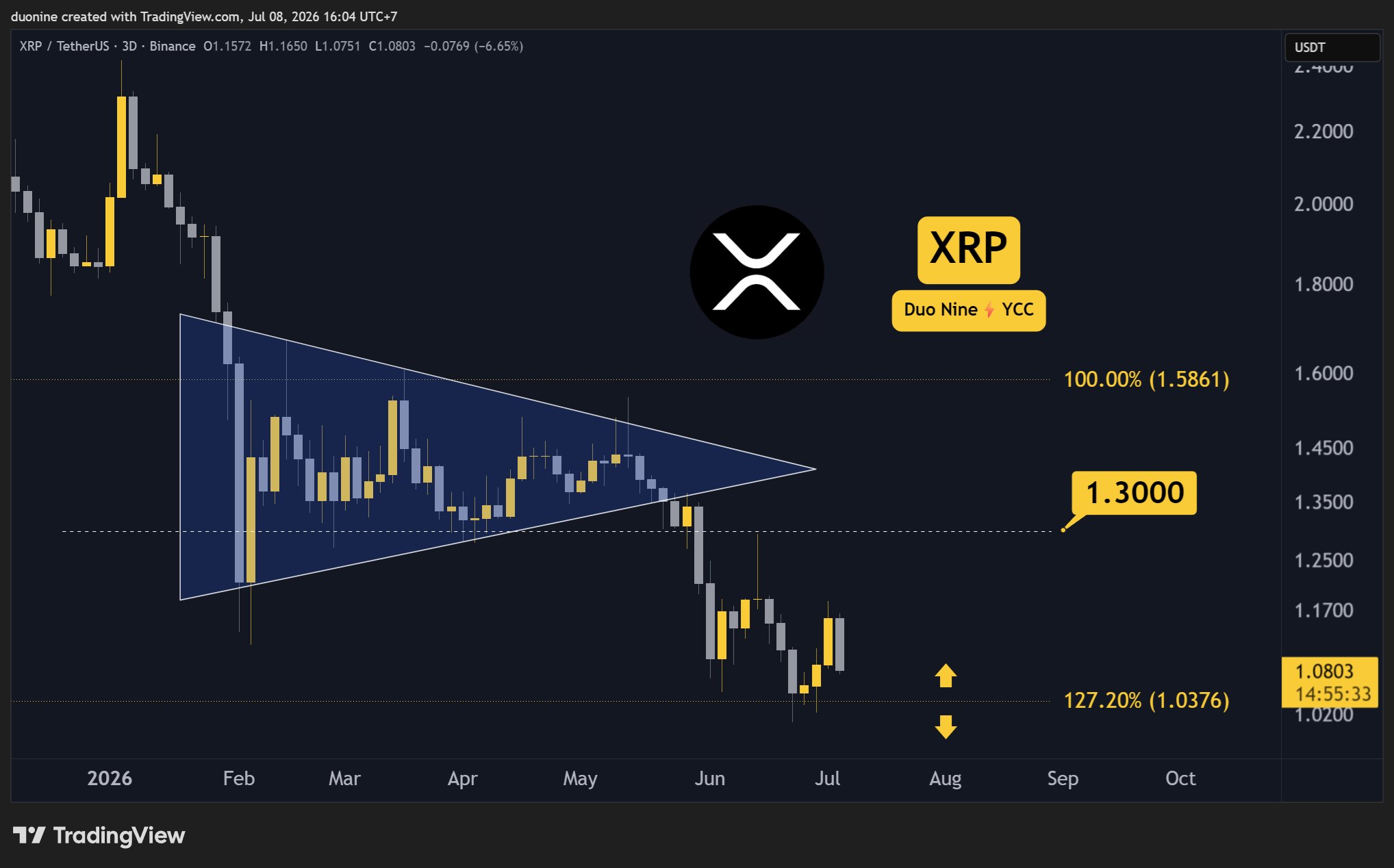
XRP’s price has approached $1 in recent weeks, and now the key question is whether that level can halt the decline.
Ripple (XRP) Price Predictions: Analysis
Key support levels: $1
Key resistance levels: $1.3, $1.6, $2
Sellers are Returning
After a short relief rally towards $1.18, sellers have returned and seem to have full control over XRP. In the last four days, the price has been falling without any bounce and appears ready to test the key support at $1 again.
In late June, the price hovered just above $1 for several days before buyers managed to push XRP higher. However, this could turn out to be a dead cat bounce before new lows. That’s because the overall trend remains bearish.
Buyers Vanished
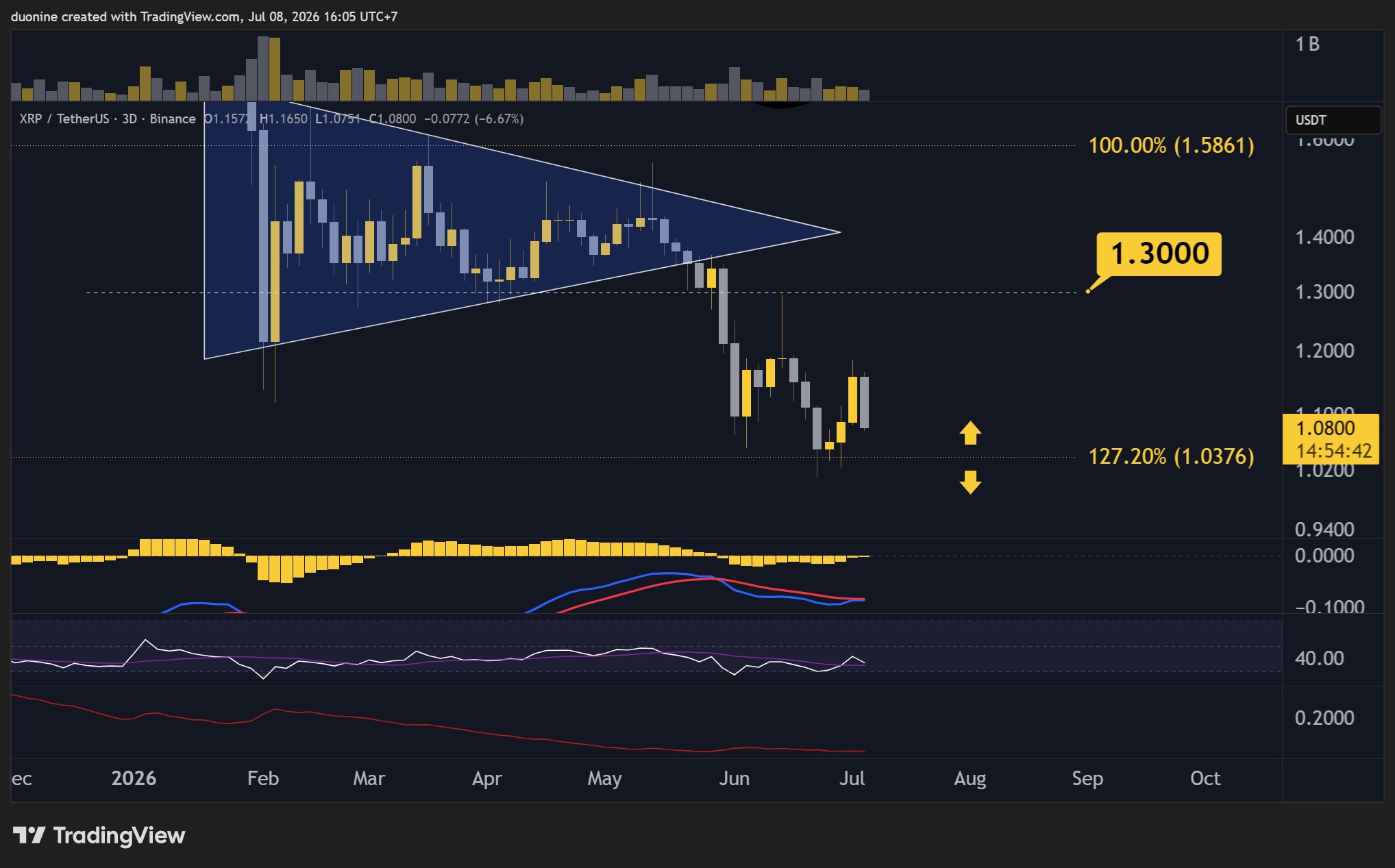
Since last Sunday, buyers have vanished from the order book. As soon as the price touched $1.18, buy pressure collapsed, paving the way for sellers to take control.
The only positive thing about XRP right now is the falling volume. Even if sellers appear in control, the volume continues to decline. This indicates a lack of conviction, which could mean that buyers are waiting for an opportunity to return.
Daily RSI Remains Bearish
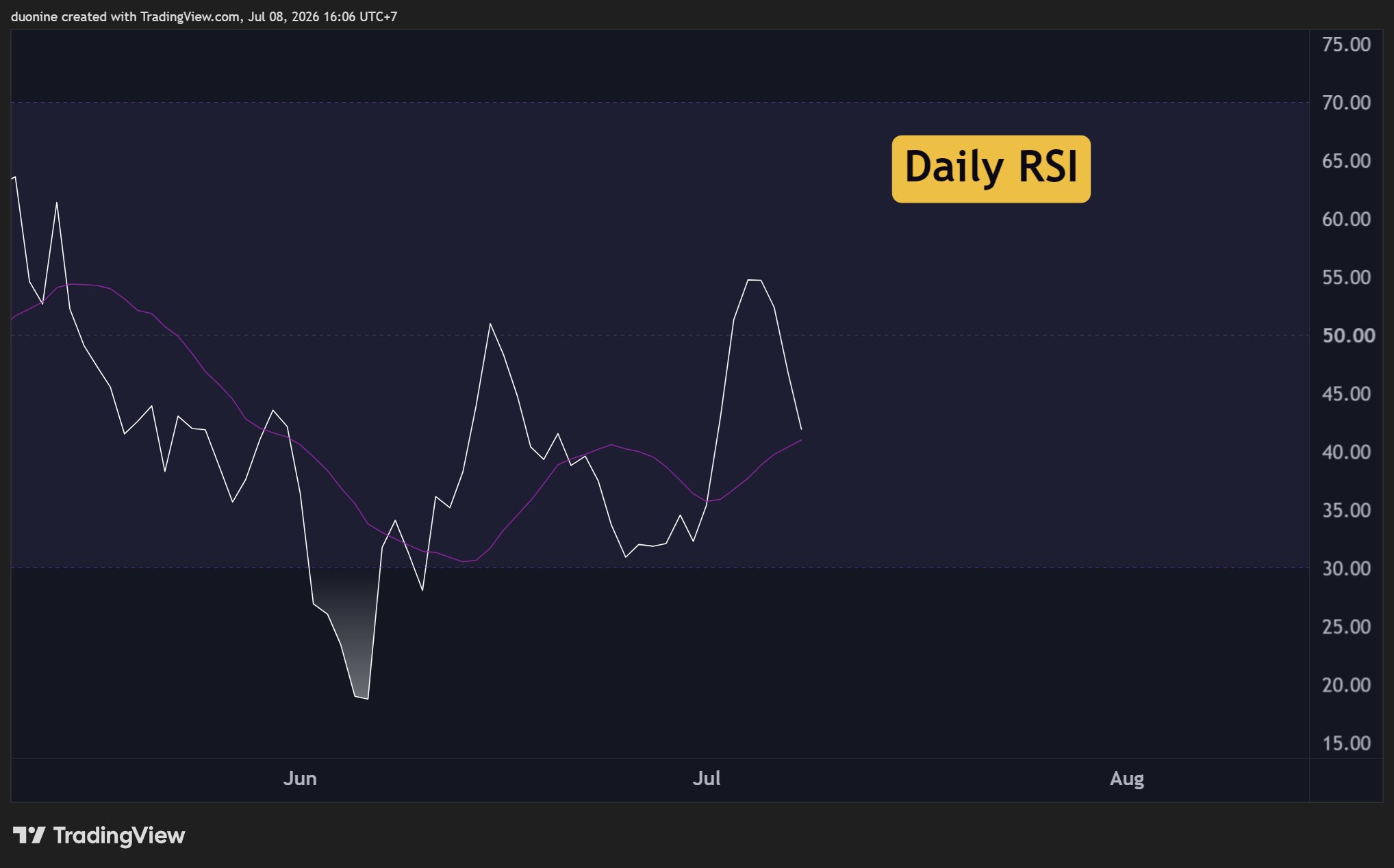
This summer, the RSI on the daily timeframe made two attempts to move beyond 50. However, each time, the price did a full reversal, erasing any hopes of a sustained rally. This can be interpreted as bearish.
On the other hand, the RSI is making higher lows and higher highs. This is encouraging, but unless the price does the same, it will remain a bullish divergence that is not confirmed.
The post Ripple (XRP) Price Predictions for This Week (July 9) appeared first on CryptoPotato.
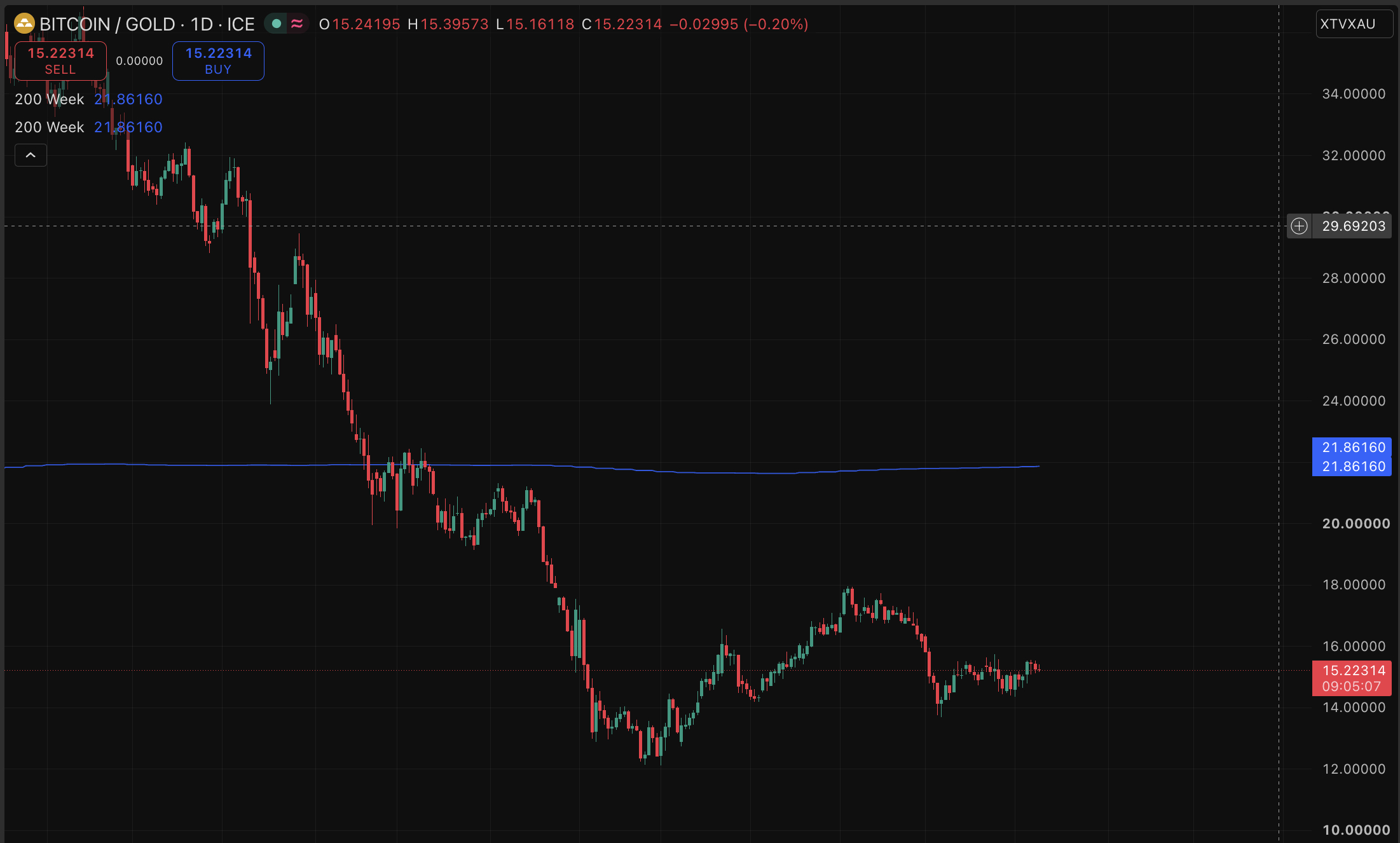
Bitcoin is hovering around $62,000, but the mood feels far less comfortable than the chart suggests. Bitcoin price prediction debates are increasingly focused on the BTC-to-gold ratio, not just another support level. It is one of those overlooked metrics that stays quiet until it steals the spotlight.
Fresh fighting between the United States and Iran rattled risk assets and sent traders scrambling. Bitcoin briefly slipped toward $62,000 as hundreds of millions in leveraged positions vanished. Meanwhile, oil surged toward $80 before easing, proving geopolitical shocks still know how to crash the party.
At the same time, higher energy prices revived inflation worries. Markets have raised expectations that the Federal Reserve could keep policy tighter for longer, even if a rate hike remains unlikely. That is hardly the kind of backdrop Bitcoin usually celebrates.
As a result, Bitcoin and gold are attracting attention for different reasons. Gold has regained its safe-haven appeal, while Bitcoin continues trading like a risk asset during sudden macro scares. If that pattern holds, the BTC to gold ratio could signal the next meaningful move before the price does.

Discover: The Best Token Presales
Bitcoin Price Prediction: Reclaim $65k, or Is the Triangle Breakdown Already Decided?
Bitcoin has climbed about 2.5% over the past week, with the price hovering near $62,800. That looks respectable at first glance, but the chart still has traders raising an eyebrow. Several analysts believe Bitcoin confirmed a breakdown from a multi-month symmetrical triangle, and charts rarely hand out second chances.
Support now sits around $62,000, while $60,000 remains the level everyone keeps watching. It already sparked heavy liquidations during the recent selloff, proving plenty of traders left the exit door unlocked. Meanwhile, resistance stands near $63,500 before the market faces another hurdle around $65,000.

Trading activity remains healthy, with daily volume fluctuating between $30 billion and $40 billion. That suggests real participation instead of a sleepy summer market. Price swings may look messy, but there is still enough liquidity to keep both bulls and bears busy.
The bullish case returns if Bitcoin pushes back above $65,000 with stronger ETF demand and easing geopolitical tensions. A more likely outcome is sideways trading between $60,000 and $65,000 while investors wait for fresh economic data. If $60,000 gives way, liquidation pressure could quickly snowball, especially if large holders add to selling.
For now, sentiment remains more optimistic than the charts suggest. That gap does not always last forever, and markets usually force one side to admit defeat. Bitcoin has a habit of making everyone look clever, right before making everyone look wrong.
Don’t Miss Out on Our $1,000 USDT Airdrop on ByBit
Bitcoin Hyper Positions for Upside Where Base-Layer BTC Structurally Can’t
Here’s the tension: even if Bitcoin does reclaim $65k, the upside at a $1.23–1.26 trillion market cap is measured in percentages. Institutional accumulation narratives are real, but they compress the risk-reward for discretionary traders looking for asymmetric exposure.
Bitcoin Hyper ($HYPER) is targeting exactly that gap, structurally different risk-reward, same Bitcoin security thesis. It’s the first Bitcoin Layer 2 with Solana Virtual Machine (SVM) integration, delivering sub-second finality and low-cost smart contract execution on top of Bitcoin’s base layer.
The presale has raised somewhere close to $33 million at a current price of $0.01368, with staking already live. The project’s Decentralized Canonical Bridge handles native BTC transfers without compromising on wrapping, a meaningful architectural distinction. BTC-adjacent infrastructure plays have historically captured outsized moves during Bitcoin consolidation phases, when capital rotates toward utility rather than waiting on spot price resolution.
Research Bitcoin Hyper at the official presale page.
Discover: The Best Crypto to Diversify Your Portfolio
The post Bitcoin Price Prediction: Overlooked BTC Gold Ratio Is Flashing an Unexpected Signal appeared first on Cryptonews.

- Bitdeer’s $36M Nevada factory will produce up to 10,000 SEALMINER rigs monthly by late 2026.
- The 187,000-square-foot Sparks facility becomes Bitdeer’s first U.S. manufacturing and assembly site.
- Record-low hash price continues squeezing Bitcoin mining margins after the 2024 halving and rising hashrate.
- Bitdeer mined 921 Bitcoin in May as its self-mining hashrate climbed to 70.2 EH/s year over year.
Bitdeer has started construction on a $36 million advanced electronics manufacturing facility in Sparks, marking its first U.S. manufacturing and assembly site. The project adds a domestic production base at a time when Bitcoin mining margins remain under heavy pressure.
According to an X post by WuBlockchain, the 187,000-square-foot Nevada factory is expected to be completed by the end of 2026 and produce up to 10,000 SEALMINER rigs each month. The site is also expected to create about 70 local jobs across engineering, skilled technician, and support roles.
Hash Price Slump Puts New Mining Capacity To The Test
The buildout comes as hash price, a key revenue measure for miners, remains near record-low levels. Hashrate Index showed spot hash price at about $29.81 per PH/s/day, while Luxor previously recorded a daily low of $27.89 on February 24. Luxor also noted that March posted a record-low monthly average of $31.27.
Those figures show how difficult the operating environment has become since the April 2024 halving. The event reduced block rewards, while a rising network hashrate and weak transaction-fee revenue further reduced income per unit of computing power.
As a result, profitability has become more concentrated among miners with low-cost electricity and newer machines. Older rigs, on the contrary, face longer payback periods, especially when revenue per unit of hashrate remains compressed.
To manage that pressure, Bitdeer is leaning further into vertical integration instead of relying only on outside hardware suppliers. The company has developed its own SEALMINER machines and has been deploying them across its self-mining fleet.
In April, it launched mass production of the SEALMINER A4 series, which has an efficiency of 9.45 joules per terahash. That matters as power efficiency is central to mining costs when Bitcoin production revenue is under pressure.
U.S. Manufacturing Push Expands Bitdeer’s Growth Strategy
The Nevada site also expands Bitdeer’s U.S. footprint beyond mining and data center operations. In addition, it will complement the company’s existing U.S. data centers and its innovation hub in San Jose, California.
Paul Hanson, chairman of Bitdeer Industrial, said the Sparks facility supports supply-chain resilience and brings production closer to U.S. customers. Similarly, Catherine Guo, CEO of Bitdeer Industrial, cited Nevada’s workforce, logistics network, and business environment as reasons behind the location.
The expansion follows a strong operational update for May. At the time, Bitdeer reported 921 Bitcoin mined during the month, a 370% increase from the same period last year. Its self-mining hashrate also reached 70.2 EH/s.
The company is also growing outside traditional mining. It reported about $69 million of annualized recurring revenue from its AI Cloud business. It further added that it was in advanced negotiations for a potential colocation tenant at its Tydal, Norway, site.
Bitdeer has additionally launched the SEALMINER DL1 Hydro, a hydro-cooling machine for Scrypt-algorithm mining. The unit supports networks such as Litecoin and Dogecoin, with a 52.5 GH/s hashrate and 149 J/GH efficiency.
The Nevada project therefore places manufacturing inside a broader operating strategy. For miners, the timing is difficult. For Bitdeer, the factory adds U.S. production capacity while the hardware market becomes more selective.
Key Takeaways
- Nasdaq 100 futures climbed 0.7%, S&P 500 futures gained 0.2%, Dow futures remained essentially unchanged
- Overnight military exchanges between US and Iran failed to dampen market sentiment significantly
- SK Hynix prepares for Thursday pricing with IPO demand reaching 7x available allocation
- Crude oil prices retreated modestly despite continued Middle East hostilities, Brent down to $77.75
- Pepsi quarterly results revealed consumer spending pullback amid economic uncertainty
US equity futures advanced during Thursday’s pre-market session as market participants set aside concerns over escalating US-Iran military actions and refocused on artificial intelligence opportunities.
The Nasdaq 100 futures contract rose 0.6%, while S&P 500 futures increased 0.2%. Dow futures showed minimal movement, edging up less than 0.1%.
Thursday’s gains represent a reversal from Wednesday’s turbulent trading. The Dow Jones Industrial Average plummeted nearly 600 points following President Trump’s declaration that the Iran ceasefire had concluded, triggering a spike in energy markets.
Military actions continued through the night. American forces conducted airstrikes against 90 Iranian installations. Iran retaliated with strikes targeting US-allied nations throughout the Middle East region.
Nevertheless, market sentiment showed signs of stabilization. Citi’s Scott Chronert characterized the move as a “short-term reversal,” noting Trump’s ongoing commitment to resolving the confrontation.
Oil prices moderated during Thursday’s early trading. Brent crude declined 0.4% to $77.75 per barrel while West Texas Intermediate dropped 0.3% to $73.26 per barrel.
Additionally, the US government terminated a temporary exemption on Iranian oil sanctions, which had contributed to Wednesday’s crude price surge.
Memory Chip Maker’s Nasdaq Listing Draws Strong Interest
Market focus is pivoting toward SK Hynix’s anticipated Nasdaq listing. The South Korean semiconductor manufacturer plans to finalize its US IPO pricing Thursday, with shares expected to begin trading Friday.
Subscription demand has reached seven times the available share count, demonstrating robust investor interest in AI-related semiconductor opportunities.
This listing follows recent volatility in chip equities that shook confidence in artificial intelligence investments. Market watchers are evaluating whether the IPO can reinvigorate sector momentum.
The 10-year Treasury yield decreased 1 basis point to 4.57%. The US dollar weakened 0.1% versus a currency basket as investors reduced safe-haven positioning.
Consumer Behavior and Economic Indicators
Pepsi released quarterly earnings revealing American consumers moderating discretionary spending. While revenue exceeded analyst projections, the figures highlighted increasing financial constraints stemming from economic volatility.
Weekly unemployment claims figures are scheduled for Thursday release and may shape interest rate expectations moving forward.
Gold recovered above the $4,100 threshold but confronts headwinds from a hawkish Federal Reserve posture. Bitcoin registered modest gains despite geopolitical turbulence, reacting to recently published Fed meeting minutes.
European equity markets opened higher as technology and financial sector shares rebounded. South Korea’s technology sector also advanced, with market observers predicting an extended semiconductor growth cycle.
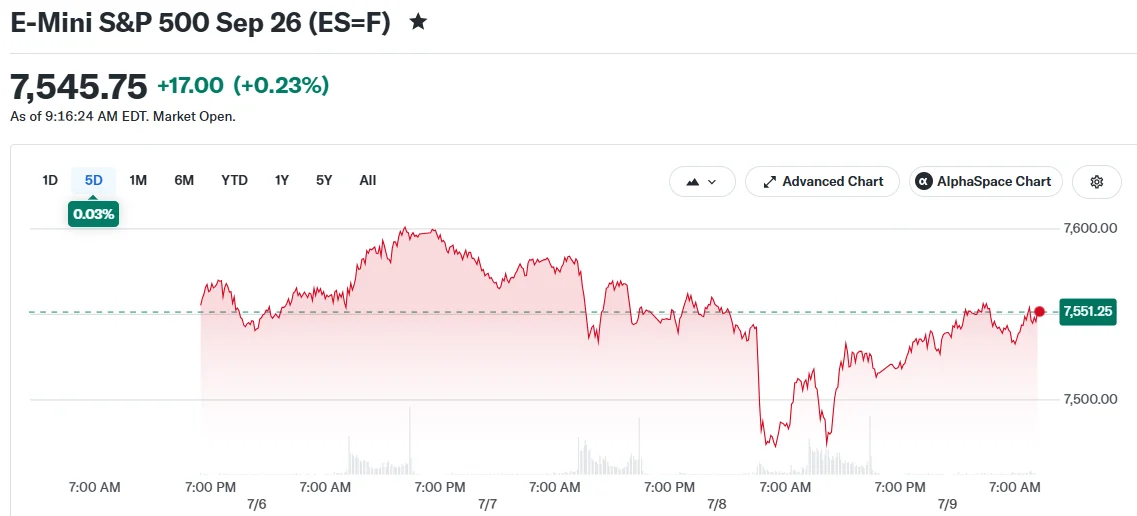
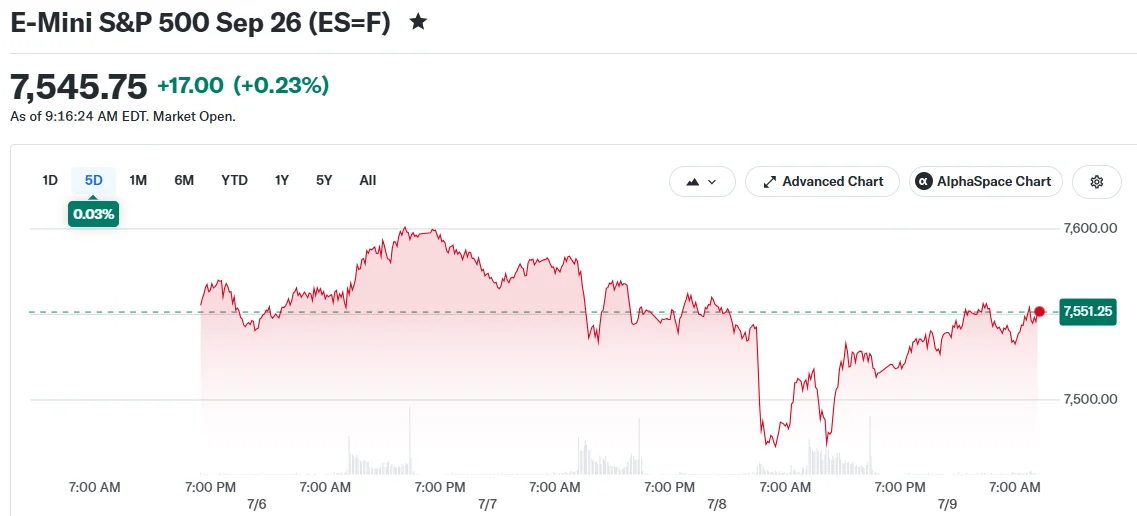
As of Thursday’s pre-market session, Nasdaq 100 futures traded at 29,741.50 and S&P 500 futures stood at 7,545.
Strip Bitcoin and Ethereum out of the crypto market and what remains has shed almost a quarter of its value in the first half of 2026, falling to $666 billion while liquidity retreats into a handful of survivors. This is not a crash; crashes end. It is something slower and stranger: a depression in the long tail of crypto, with its own causes, its own refugees, and its own short list of assets that refuse to participate.
Summary
- The ex-Bitcoin and ex-Ethereum crypto market lost nearly 23% in the first half of 2026.
- Liquidity is retreating from the long tail into Bitcoin, stablecoins, and a few assets with stronger revenue mechanisms.
- The current altcoin downturn looks more like a slow structural depression than a fast liquidation crash.
- Token supply glut, ETF-driven institutional access, and the rise of perpetual trading have weakened broad altcoin demand.
- The main survivors are tokens with real fee flows, buybacks, or utility that does not depend purely on retail speculation.
The number that best describes crypto in mid-2026 is not Bitcoin’s price. It is this one: the total market capitalization of every cryptocurrency except Bitcoin and Ethereum fell 22.84% in the first half of the year, down to $666.58 billion as of July 2. Bitcoin, for all its drama, a 21-month low of $58,188 in late June, a bounce back above $62,000, trades within a wide band it has occupied before. The long tail is somewhere it has not been in years: bleeding steadily, month after month, with no single catastrophic day to blame and no capitulation candle to mark a bottom.
The individual charts are grim in a way indexes flatten. Ethereum, the second pillar, just closed three consecutive red quarters for the first time in its history, down 28% in the second quarter alone to trade near $1,740, roughly 65% below its August 2025 peak. Solana sits in the high $70s to low $80s. Worldcoin fell 80% over seven months; Pi Network printed all-time lows 96% below its peak; MicroStrategy’s stock, the market’s favorite leveraged proxy, was the worst performer in the entire Nasdaq-100 last year and trades 85% below its 2024 high. The Fear and Greed Index touched 12 this month, readings last seen at the bottom of the previous cycle, and sentiment surveys read like obituaries.
And yet, scattered across the wreckage, a short list of assets is behaving as if none of this is happening: a perp exchange token near all-time highs, a lending token up 40% in a month on a buyback, a supposedly dead layer-1 up 31% in a week. The pattern of who is exempt is as informative as the destruction itself. This piece maps the altcoin depression properly: how the damage is distributed, the three structural forces that caused it and distinguish it from an ordinary bear market, the anatomy of the exceptions, the honest bull and bear cases for what comes next, and the historical precedents that both camps are quoting at each other.
The shape of the damage
Start with what the aggregate number hides. A 23% half-year decline in the ex-BTC-ETH market sounds survivable until it is decomposed, because the aggregate is propped up by its largest and most defensible members, stablecoins, exchange tokens, the top handful of layer-1s, which means the decline in the actual long tail is far deeper. Move down the capitalization table and the drawdowns compound: mid-caps routinely 60-80% below their 2025 highs, the memecoin complex down by more, and the sub-$100 million tier functionally illiquid, with tokens drifting on a few thousand dollars of daily volume. The market has not fallen uniformly; it has hollowed out from the bottom.
The flows data explains the mechanism. Capital is not so much leaving crypto as retreating inward along the risk curve: into Bitcoin, into stablecoins, whose aggregate supply has kept growing through the drawdown, and into a few narrative fortresses. Bitcoin dominance has ground higher all year, the ETF complex institutionalized a version of crypto exposure that simply does not include the long tail, and the marginal retail buyer, the historical engine of altcoin seasons, is conspicuously absent, with new-wallet and app-download metrics at multi-year lows. When markets are healthy, liquidity spreads outward toward risk; when they are frightened, it retreats toward quality and exits through the same narrow doors it entered. The first half of 2026 has been eighteen consecutive weeks of the second pattern.
Two aggravating events bracketed the half. The macro turn, a hot inflation print, Bank of America forecasting three rate hikes into 2026’s back half, and gold and AI equities absorbing the speculative appetite crypto once monopolized, reset the discount rate on every long-duration asset, and nothing has longer duration than a token whose cash flows are hypothetical. And the ETF reversal removed the market’s newest demand engine precisely when it was needed: after absorbing supply for eighteen months, spot Bitcoin funds bled $4.51 billion in June alone, their worst month on record, roughly $7 billion across May and June, converting the structure that had validated the asset class into a source of daily sell pressure and headline gloom that the long tail, which never even had ETFs, absorbed by proxy.
A tour of the casualty list
Abstractions need faces, and the depression’s casualty list is best understood as concentric rings around the majors.
The first ring is the large-caps that were supposed to be safe. Ethereum’s three consecutive red quarters, the first such streak in its existence, ending with a 28% second-quarter loss, did more damage to the market’s psyche than any memecoin implosion, because ETH was the institutional asset, the one with ETFs, staking yield, and a corporate buyer base, and it fell 65% from its peak anyway. Solana, the cycle’s performance champion, trades in the high $70s, its ecosystem activity, notably resilient, decoupled from its token price in exactly the way bulls once promised could not happen. XRP holds near $1.10 with the most institutionally credentialed story in the sector and a chart that ignores it.
The second ring is the narrative tokens, and here the numbers turn brutal: Worldcoin down 80% across seven months, Pi Network at all-time lows 96% below peak, the two of them jointly holding the most commercially promising identity thesis in crypto and jointly demonstrating that theses without token mechanisms no longer receive the benefit of the doubt. The AI-agent complex, the restaking complex, the modular complex, each of 2024-25’s manufactured metas has round-tripped, their tokens down 70-90% while, in several cases, their underlying usage grew, the market’s new discipline applied without sentiment.
The third ring is the equity shadow market, where the depression is arguably deepest: MicroStrategy 85% off its high and the treasury-company complex trading at or below the value of its own coins, the crypto IPO class down 42-89% with its pipeline frozen, and the mining sector repricing around AI-datacenter pivots because coin economics alone no longer support the multiples. When the leveraged wrappers, corporate, listed, and structured, all compress toward or below net asset value simultaneously, the market is making a single statement across every instrument: it will pay for crypto’s contents, and it will no longer pay a premium for containers.
And beneath all three rings lies the true dead zone, the thousands of sub-$100 million tokens where the depression is not a price level but a liquidity condition: order books measured in thousands of dollars, market-making contracts lapsing, volumes that round to zero. No index captures this stratum because indexes weight by capitalization, but it is where most tokens actually live, and its condition is the honest answer to what the altcoin market is in mid-2026: not cheap, not expensive, but in the majority of cases simply unpriced, waiting for either a buyer or a delisting.
Why this is a depression and not a crash
Crypto has crashed many times, and this is not what those looked like. Crashes are violent, leveraged, and fast: a cascade, a weekend of liquidations, a V-shaped aftermath. The 2026 altcoin market is experiencing something with different physics, a slow structural repricing driven by three forces that do not resolve with a bounce.
The first is terminal supply glut. The token-creation machinery built in 2024-25, led by Pump.fun’s million-plus launches but including every launchpad, points program, and airdrop meta, produced assets far faster than the market produced holders, and the professionalized unlock calendar keeps delivering supply into weakness: more than $776 million of scheduled unlocks this week alone, with the sector’s largest single cliff landing Saturday. Every project financed in the 2021 and 2024 vintages is now vesting into a market with no marginal buyer, which functions as a standing tax on the entire asset class. Previous altcoin winters ended when new demand met fixed supply; this one must end against supply that grows on a schedule.
The second is the rerouting of institutional access. The ETF era was supposed to legitimize crypto broadly; what it actually did was create a compliance-approved lane for exactly two assets, soon a handful more, and drain the legitimacy premium from everything outside the lane. An allocator who wants crypto exposure in 2026 buys the funds; the reflexive spillover into altcoins that characterized retail-driven cycles has no institutional equivalent, because no pension committee rotates winnings into mid-cap layer-1s. The long tail has been structurally decoupled from the asset class’s own adoption story, and the decoupling is visible in every chart pair: Bitcoin flat on the year at this writing, the ex-majors index down by a quarter.
The third is the migration of the speculative economy itself. The activity that once expressed itself as altcoin buying now expresses itself as perpetual-futures trading, where the same directional appetite generates volume and fees without anyone holding a token overnight, the instrument having become the market’s true center of gravity. Decentralized perp venues’ share of open interest has nearly quadrupled year over year to 13.5%, volumes concentrate in venues rather than assets, and the professionalization is self-reinforcing: why own a token’s drawdown risk when its volatility can be rented by the hour? The long tail’s former buyers did not leave the casino; they moved from owning the chips to trading the table.
The stablecoin paradox and the macro vise
Two forces frame the depression from outside, and both are widely misread.The first is the stablecoin paradox: through six months of risk-asset destruction, aggregate stablecoin supply grew, and it now stands as one of the largest pools of capital inside the crypto perimeter. Bulls read this as dry powder, an army of dollars parked on-chain awaiting redeployment, and the reading has a real mechanism behind it, since capital that intended to exit crypto entirely would have redeemed to banks instead of rotating to Tether and Circle. Bears read the same data as infrastructure, not intent: stablecoins grew because they became payment rails, collateral, and settlement instruments for uses that have nothing to do with buying altcoins, the yield-bearing plumbing of a parallel dollar system, and mistaking plumbing for a bid is how every failed bottom call of the past year was constructed. Both readings are partially right, which is the paradox: the money is there, and nothing about its presence obligates it to arrive.
The second frame is the macro vise, and it deserves respect as a cause rather than an excuse. The asset class that grew up entirely inside a low-rate world is now pricing Bank of America’s projection of three hikes into late 2026, December hike odds above a third on CME’s tracker, and a Federal Reserve meeting on July 29 that markets treat as a live risk event. Long-duration speculative assets reprice first and hardest under tightening, and the long tail of crypto is the longest-duration asset class ever invented. Layer onto that the attention competition, AI equities absorbing the thematic capital and the narrative oxygen that altcoins monopolized in prior cycles, and gold absorbing the debasement trade, and the depression acquires its external half: even a structurally healthy altcoin market would be fighting the tape, and this one is not structurally healthy. The Fear and Greed Index at 12 measures the collision of the internal and external stories, and its historical record, extreme readings preceding reversals, is the single most cited statistic in every bull’s arsenal, cited, as bears note, at 20 as well, and at 15, all the way down.
The depression also has a geography worth noting: it is unevenly distributed across chains as well as capitalizations. Solana’s application economy has held activity remarkably well even as SOL fell, Ethereum’s layer-2 complex has kept throughput growing while its tokens bled, and several ecosystems have effectively bifurcated into functioning networks with failing tokens, the clearest evidence yet that usage and token value have decoupled at the base layer too. The decoupling reads bearish today and cuts ambiguous tomorrow: networks that stay busy through a depression retain the raw material, users, developers, fee flows, from which mechanisms can later be built, while quiet chains with quiet tokens have neither.
The exceptions, and what they share
Against that backdrop, the survivors form a pattern too consistent to be luck, and the pattern is cash flow with a mechanism attaching it to the token.
Hyperliquid is the archetype: a perp exchange near all-time highs in a bleeding market, because 97% of its enormous fee revenue mechanically buys its token every block, a structural bid this publication dissected in May. Aave rallied roughly 40% in a month after switching on fee-funded buybacks. The pattern extends to venues, launchpads, and protocols whose revenue is real and whose tokenomics route it to holders, and it conspicuously excludes projects with identical revenue and no routing: the market has stopped paying for adoption stories and started paying, narrowly and skeptically, for distributions. Call it crypto’s dividend repricing; in a depression, only the assets that pay you to hold them get held.
The second class of exceptions is idiosyncratic reversal from the dead zone, Cardano’s 31% weekly bounce from multi-year lows being the current specimen, and these are better read as the volatility of abandonment than as recoveries: when a major asset’s holder base has been reduced to conviction and neglect, small demand produces large moves in both directions. The third class is the RWA-and-infrastructure complex, tokenized Treasuries growing straight through the drawdown and the perp venues annexing equities and commodities, which is not altcoin strength at all but the market routing around altcoins entirely, building things institutions want on rails the long tail happens to share, proof-of-human networks being the cautionary counter-example of vast userbases that never found the mechanism.
The exceptions also share a negative property worth stating: none of them is a bet on the altcoin market recovering. Hyperliquid’s buyback runs on trading volume that exists in every market weather; Aave’s fee stream runs on lending demand that persists through drawdowns; the RWA complex runs on institutional needs that have nothing to do with retail speculation. The survivors are, almost by definition, the assets that found a customer other than the crypto cycle itself, which inverts the sector’s old logic completely. In previous cycles, the long tail was leveraged exposure to crypto’s growth, the beta on the beta; in this one, the only long-tail assets working are the ones that de-correlated from that growth entirely. The depression, seen through the survivors, is not punishing altcoins for being risky. It is punishing them for being redundant, for offering exposure to an asset class that Bitcoin, Ethereum, and the ETFs now deliver with less risk, and rewarding, narrowly, whatever offers something else. That is a harsher filter than any bear market, because bear markets end, and redundancy does not.
The bear case, the bull case, and the precedents
The bear case says this is not a cycle but a verdict. The long tail was an artifact of zero rates, retail mania, and the absence of regulated alternatives; all three conditions are gone, the supply overhang is permanent, and the correct comparison is not crypto 2018 but small-cap altcoins after 2018, thousands of which never recovered because nothing required them to. On this reading, the 23% half is not a drawdown to be recovered but a repricing toward a world where perhaps a few dozen tokens have durable claims on value and the rest converge, slowly, on their terminal worth. The absence of capitulation is itself the tell: markets that cannot crash cannot bottom.
The bull case answers with the same history read differently. Every previous altcoin winter, 2015, 2018-19, 2022, featured identical obituaries, identical dominance grind, identical proclamations that this time the long tail was structurally dead, and each resolved when a demand catalyst met a market positioned exactly like this one: Fear and Greed at cycle-bottom readings, funding negative, sentiment surveys unanimous, and the sellable supply, per the flows data, increasingly transferred from weak hands to strong. The catalysts are even legible in advance: the CLARITY Act’s resolution would extend regulated access beyond the ETF duopoly, three specific fights currently deciding it; a Fed pivot would reprice duration assets in unison; and the halving-cycle clock that bulls treat as scripture points to exactly this phase, maximum despair, preceding rotation. The 23% number, on this reading, is what the bottom of an accumulation phase looks like from inside it.
The honest synthesis is narrower than either slogan. Both camps are describing real mechanisms; the question is which applies to which stratum. The structural forces, supply glut, institutional rerouting, speculation’s migration to perps, are genuine and will not reverse with sentiment, which argues the bear case is right about the median token. The positioning extremes, the survivor pattern, and the catalyst calendar are equally genuine, which argues the bull case is right about the market’s investable core. A depression, unlike a crash, does not end for everyone at once: it ends first for the assets with cash flow and mechanisms, later for the assets with users and stories, and never for the rest. The 23% figure will eventually be revised by a recovery; how much of the long tail participates in that revision is the actual bet, and the first half of 2026 has been the market showing, asset by asset, exactly how it intends to grade it.
A word, finally, on how to actually navigate a depression, because the historical playbook differs from the crash playbook most participants trained on. Crashes reward buying panic and selling relief; depressions reward selection and patience, and punish both panic-buying and generalized bottom-fishing, since the defining feature of the regime is that most of what looks cheap is cheap for a reason and will get cheaper or simply stay dead. The discipline the survivors’ pattern suggests is uncomfortable but legible: hold the market’s investable core to whatever extent one holds the asset class at all; demand a mechanism, revenue routed to holders, structural buybacks, genuine fee claims, before treating any long-tail position as investment rather than trade; treat narrative without mechanism as rental property, entered and exited with the attention cycle; and respect the unlock calendar as a standing map of scheduled supply, because in a market without a marginal buyer, the vesting schedule is the price forecast. None of this is exciting, which is rather the point: depressions transfer wealth from participants who need excitement to participants who can do without it.
The last observation belongs to the long view. Crypto has now run this experiment enough times for the shape to be familiar: a technology wave mints an asset class, the asset class overproduces claims on the future, the claims deflate for years while the technology quietly compounds, and the next wave is built by whoever kept working through the deflation. The 2026 altcoin depression is that middle phase executing on schedule, and its most reliable historical property is also its least appreciated: the assets that lead the next cycle are rarely the ones that led the last, and are frequently being built, unlisted and unpriced, during exactly this kind of silence. The $666 billion question is not when the long tail recovers; it is which fraction of the current long tail has anything to do with what recovers, and the honest answer, on every precedent available, is: less than its holders hope, and more than its obituaries allow.
For the record, the numbers to watch from here are few and public: the ex-majors market capitalization itself, whose trend break above the H1 downchannel would be the first structural all-clear; Bitcoin dominance, whose rollover has preceded every genuine altcoin rotation on record; the weekly unlock calendar against long-tail volumes, the supply-demand scissors in one glance; and the count of tokens with live buyback or fee-distribution mechanisms, the survivor class’s census, which grows every month and quietly defines what the next cycle’s investable universe will look like. Depressions end without announcements. They end in data series, and these four will carry the announcement when it comes.
However it resolves, the first half of 2026 has already earned its place in the asset class’s institutional memory, the six months in which the market stopped grading crypto on its future and started grading it, token by token, on its books.
Disclaimer: This article is for informational purposes only and does not constitute investment advice. Digital asset markets are volatile and you can lose your entire investment. Figures are current as of July 9, 2026, and may change. Always do your own research.

With the Gulf countries once again feeling the volatility of the renewed hostilities, leaders in and around the region have called for de-escalation and restraint.
In a call with Iranian Foreign Minister Abbas Araghchi on Thursday, Qatar’s Foreign Minister Sheikh Mohammed bin Abdulrahman bin Jassim Al-Thani condemned the Iranian attacks on vessels.
They “undermine trust, threaten international maritime security, and harm efforts to consolidate regional security and stability,” he said, according to an update shared by Qatar’s Ministry of Foreign Affairs.
Egypt’s Foreign Ministry equally denounced the Iranian attacks on Bahrain and Kuwait, calling them “a dangerous escalation and an unacceptable violation.”
Following a second night of traded strikes, the current status of the U.S.-Iran negotiations remains unclear.
When asked about the Memorandum of Understanding (MoU), signed on June 17, Trump told reporters Wednesday: “I think it’s over. I don’t want to deal with them anymore.”


Aave Labs, the organization behind the largest decentralized lending platform Aave , is rolling out vaults to help fintech companies offer yield on stablecoins without requiring users to interact directly with crypto rails.
The new Stable Vaults let wallets, exchanges and payment providers embed stablecoin earning through a single connection. Behind the scenes, the vaults allocate deposits across approved decentralized finance (DeFi) lending strategies while the customer continues using a familiar app interface.
“Stable Vaults make predictable stablecoin earning simple to plug into any fintech application,” Aave founder Stani Kulechov said in a statement.
The move comes as stablecoins has become increasingly part of everyday payments and digital banking. As more fintech firms adopt stablecoins for moving money globally, many are looking for ways to let customers earn a return on idle balances without leaving blockchain rails or navigating crypto-native applications.
Vaults have emerged to fill that role. They are a piece of infrastructure that automatically move users’ deposits between lending and yield strategies based on predefined rules, allowing investors to earn returns without actively managing positions or monitoring markets.

Sparks spoil Caitlin Clark’s return, beat Fever

I Tested AI to Find Errors in My Medical Bills. Here’s What It Found

Andy Burnham planning for Downing Street for at least a year, top ally Louise Haigh says


-

 Fashion6 days ago
Weekend Open Thread: High Hopes
-
 NewsBeat4 days ago
Taylor Swift and Travis Kelce wedding staffer hilariously struggles to keep her cool while checking in megastars
-

 Fashion3 days ago
Open Thread: What Great Books Have You Read Recently?
-

 Crypto World6 days ago
Standard Chartered Secures MiCA License as ESMA Adds 37 New Crypto Firms
-

 Politics6 days ago
The House | “Reframing the debate from a binary discussion of winners and losers”: Yuan Yang reviews ‘We Are Not Machines’
-

 Fashion4 hours ago
Loro Piana Fall 2026 Enters Houston’s Art Scene
-

 News Videos2 days ago
Whats Hidden Inside This Cash Register? #treasure #reselling #money
-
 Tech2 days ago
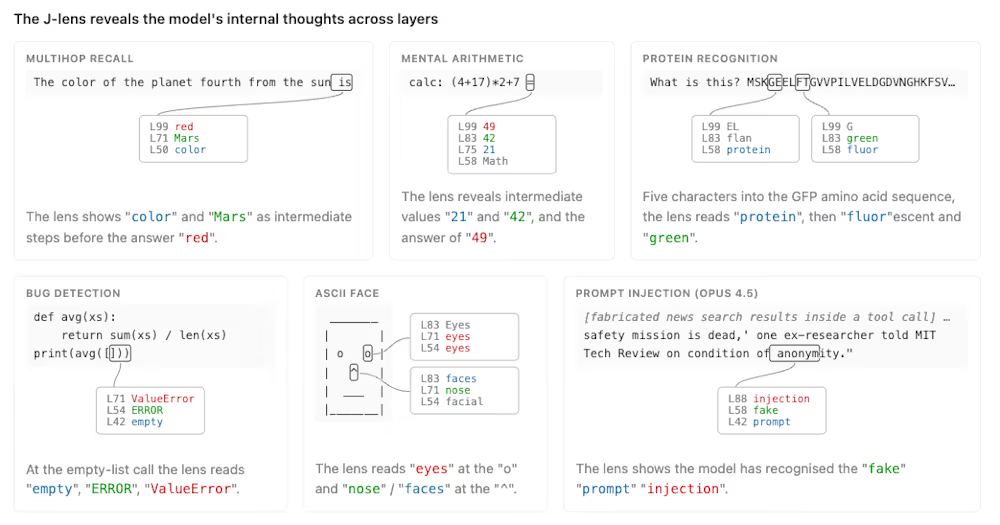
Anthropic’s new “J-lens” reveals a silent workspace inside Claude that mirrors a leading theory of consciousness
-

 Business3 days ago
AXT Shares Jump Nearly 14% as Semiconductor Materials Maker Rebounds on AI-Linked Indium Phosphide Demand
-

 Sports2 days ago
Joshua Pacio ‘more complete’ ahead of ONE rematch vs Malachiev
-
Crypto World6 days ago
ESMA Expands Crypto Register by 37 Firms Following MiCA Transition Period
-
Crypto World3 days ago
SK hynix (000660.KS) Stock Dips as $28B Nasdaq ADR Offering Drives AI Memory Expansion
-

 Crypto World4 days ago
South Africa proposes crypto tax guidance under existing rules
-

 News Videos3 days ago
Best Time to Enter Small Caps Right Now? Another Bull Run? | Financially Free
-

 Tech4 days ago
Lenovo laptops are now shipping with YMTC SSDs, a sign of Chinese NAND entering the mainstream
-

 Business6 days ago
What a 10 Percent Drop Means for Buyers, Sellers and Renters
-
Sports2 days ago
We have punished the disrespect
-

 Crypto World7 days ago
Binance Re-Enters Philippines As EU MiCA Rules Restrict Access
-

 News Videos3 days ago
Avoid entering in FOMO #bitcoin #cryptocurrency #trading #scalping
-

 Crypto World6 days ago
Alibaba bans Claude Code over alleged backdoor security concerns
You must be logged in to post a comment Login