

Crypto World
XRP Is Set for a 16% Breakout, but Only if the Market Leader Behaves

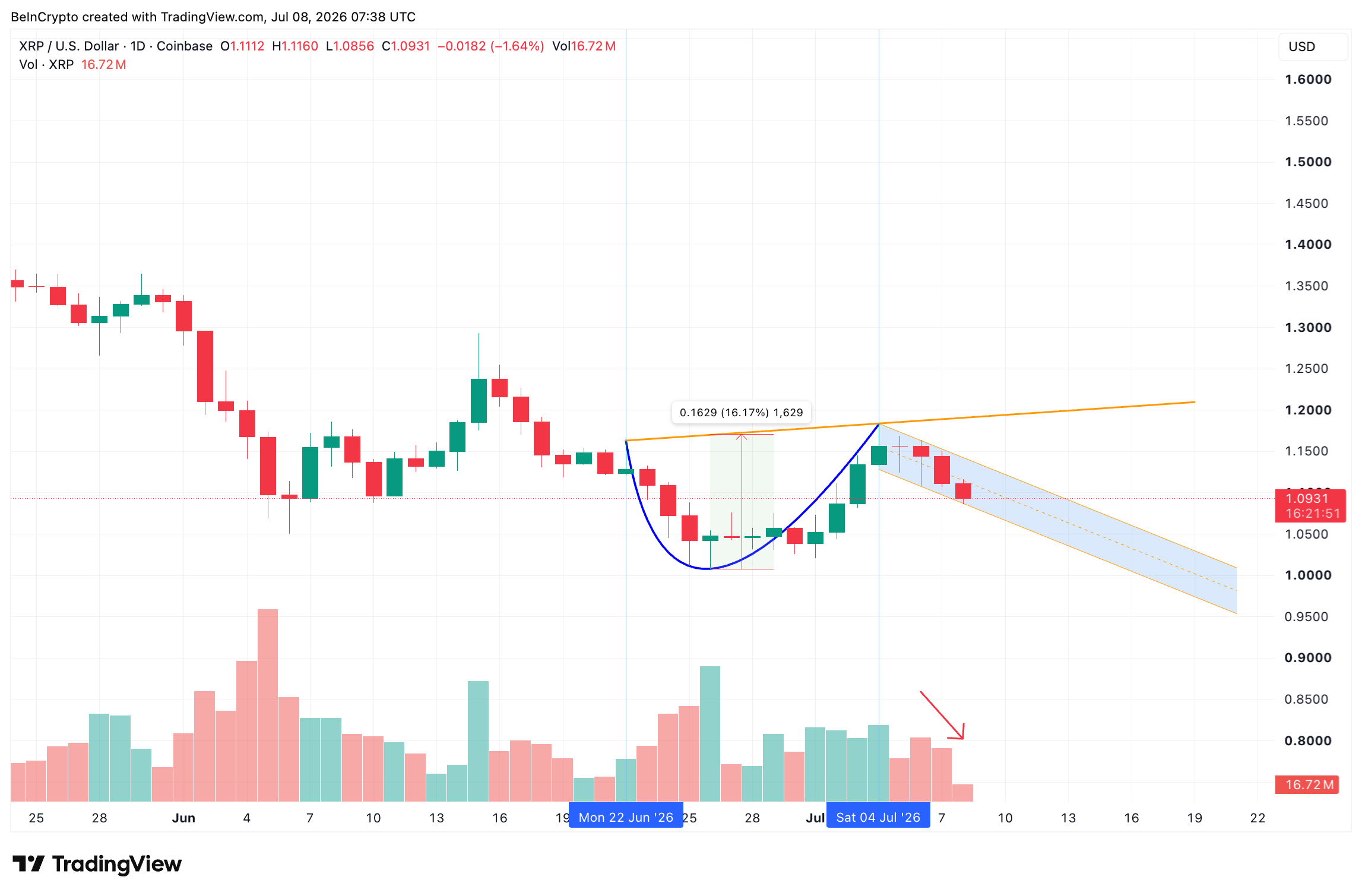
The XRP price is trading near $1.09, and its chart is quietly turning bullish. A classic reversal pattern is taking shape just as selling volume fades and Bitcoin, the coin XRP still tracks, holds firm.
That mix hints at a possible double-digit breakout. The catch is that XRP’s fate stays tied to the market leader.
XRP Draws a Bullish Pattern as Bitcoin Holds Firm
On the daily chart, XRP is shaping a cup and handle, a rounded base followed by a small dip that often leads to a breakout. That said, the cup formed between June 22 and July 4, and the handle is taking shape now. If it completes, the pattern points to a move of roughly 16%.

The volume supports it. Selling volume has faded since July 6, a sign the pullback is losing steam rather than building.
Want more token insights like this? Sign up for Editor Harsh Notariya’s Daily Crypto Newsletter here.
Here is the key link. XRP rarely trades on its own, and its XRP-Bitcoin correlation sits at 0.84 over the past 30 days, where 1.0 is perfect lockstep. So the pattern only pays off if Bitcoin cooperates.

For now, it is. Bitcoin is up about 6.7% over the past week and down just 1% in a day, holding firm through three separate shocks:
- Strategy, formerly MicroStrategy, sold roughly 3,588 Bitcoin
- Bitcoin mining stocks dipped 20%
- Fresh Iran conflict impacting oil and global markets
With the market leader steady, XRP’s own holders are adding to the case.
Long-Term Holders Are Quietly Buying
On-chain data shows conviction building. Using HODL Waves, a metric that groups coins by how long they have been held, the one-to-two-year cohort grew its share of supply from 12.80% to 15.33% since July 1.
The timing stands out. That buying happened while the XRP price barely moved, holding between $1.05 and $1.11, which suggests patient accumulation rather than chasing a rally.

Exchange flows agree. Coins have mostly been leaving exchanges, a sign of accumulation. A brief two-day burst of inflows in early July marked some selling, the move that shaped the handle, but outflows have since resumed, hinting the pressure is fading. The outflow resumption also aligns with the fading selling volume, as highlighted earlier.

That leaves the XRP price chart to set the terms.
XRP Price Levels to Watch
Back to the cup and handle, now with the numbers. Support sits at $1.08. A push above $1.12 completes the handle, but the real test is $1.19, the 0.618 Fibonacci level and a technically stubborn barrier about 9% above current levels.
Clearing $1.19 would confirm the breakout and project a roughly 16% run toward $1.38 for the XRP price.
The risk is just as clear. A daily close below $1.08 breaks the pattern and opens a slide toward $1.00. And with correlation at 0.84, a sharp Bitcoin drop would pull XRP down no matter how strong its on-chain case looks.

Therefore, a daily close above $1.19 opens the path toward $1.38, while a close below $1.08 sends the XRP price back toward $1.00.
The post XRP Is Set for a 16% Breakout, but Only if the Market Leader Behaves appeared first on BeInCrypto.


Michael Burry attends the premiere of “The Big Short” at Ziegfeld Theatre on Nov. 23, 2015 in New York.
Dimitrios Kambouris | Getty Images
Michael Burry of “The Big Short” fame said he bought shares of regulated sports-betting operators DraftKings and Flutter Entertainment, anticipating regulators will eventually crack down on prediction markets after competition from the upstarts pressured the stocks.
Burry said Wednesday he purchased a full-sized position split roughly 60% in Flutter and 40% in DraftKings, buying Flutter at about $107 a share and DraftKings in the low $26 range. He said he could eventually increase each holding into a full standalone position.

DraftKings one year
The investor, who rose to prominence for predicting the U.S. housing crash in 2008, said both companies are attractive businesses whose shares have been weighed down by the rapid expansion of prediction markets.
Those platforms have increasingly offered event-based contracts, which the U.S. Commodity Futures Trading Commission asserts is under its jurisdiction. The federal agency is currently engaged in legal action against multiple states in a battle over who can regulate prediction markets. The contracts have also managed to sidestep state gaming taxes.
“I believe that the political climate will not tolerate this,” Burry said in a Substack post Wednesday. “Prediction markets exist in a loophole adjacent to a heavily regulated and taxed industry. In time, prediction markets will be subsumed into regulation and taxation.”
Flutter Entertainment one year
Shares of DraftKings have fallen about 45% from their 52-week high reached last September, while Flutter has slid 65% from its August peak.
“DraftKings is inflecting as an operating business and the value is in the transition I foresee in the near future,” he wrote. “Flutter has been hurt by capital misallocation in the past, but is a fundamentally very good operating business with terrific scale.”
Both companies have also begun exploring their own prediction-market offerings, potentially positioning themselves to benefit regardless of how the regulatory landscape evolves, Burry noted.
Kazakhstan, one of the world’s largest Bitcoin mining hubs, is moving to expand its crypto sector as a new decree introduces rules for stablecoin payments, tax breaks for regulated crypto activity and new energy options for mining.
Kazakhstan President Kassym-Jomart Tokayev has signed a decree aimed at building a regulated digital asset market, the Ministry of Artificial Intelligence and Digital Development (MAIDD) announced on Wednesday.
Developed jointly by MAIDD, the central bank and the Astana International Financial Centre, the order is viewed as a tool to increase regulatory clarity for crypto businesses, investors and digital asset service providers.
The move signals Kazakhstan’s latest effort to expand its role in the crypto industry and establish itself as a major global crypto hub.
Stablecoins enter Kazakhstan’s cross-border trade plans
In one of its key directions, the decree targets modernization of Kazakhstan’s payments infrastructure, including provisions on creating mechanisms for using digital assets and stablecoins in cross-border settlements.
The government said the move could support export and import operations by adding digital assets to Kazakhstan’s financial toolkit while keeping transactions within a regulated framework.
Related: USDT wins payments, USDC wins DeFi as stablecoins diverge: Dune
The order also aims to move crypto activity from foreign unregulated platforms into Kazakhstan’s licensed digital asset infrastructure. Users holding digital assets abroad will be encouraged to disclose them and transfer them to approved domestic service providers.
For individuals, the government plans tax incentives for digital asset activity conducted through regulated infrastructure, including a proposed exemption from personal income tax on related income.
Gas-powered energy plans for digital mining
The action also addresses Kazakhstan’s energy resources, introducing a mechanism for associated petroleum gas and natural gas from oil and gas fields to be used for autonomous electricity generation when those resources are not needed for state purposes.
That electricity could support digital mining operations, adding an energy component to Kazakhstan’s broader crypto strategy, the announcement said.
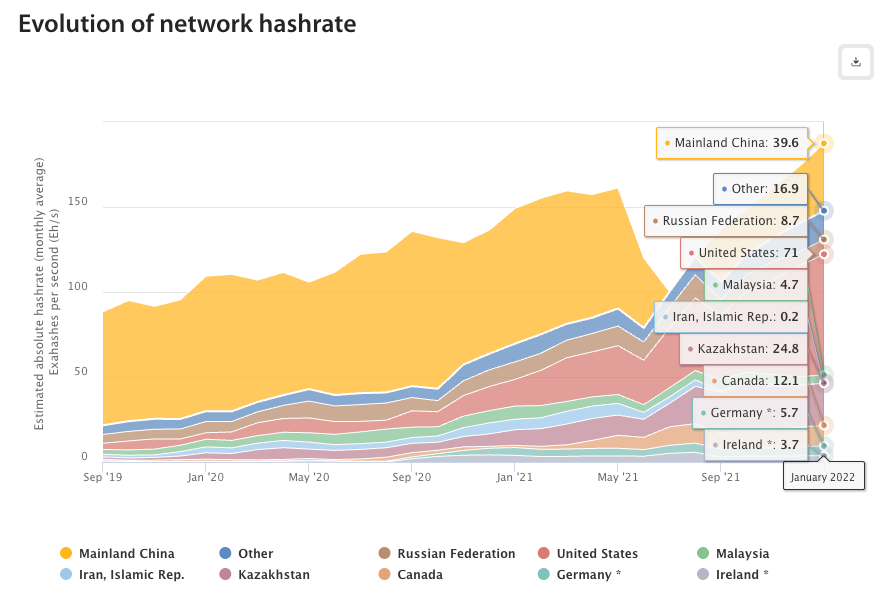
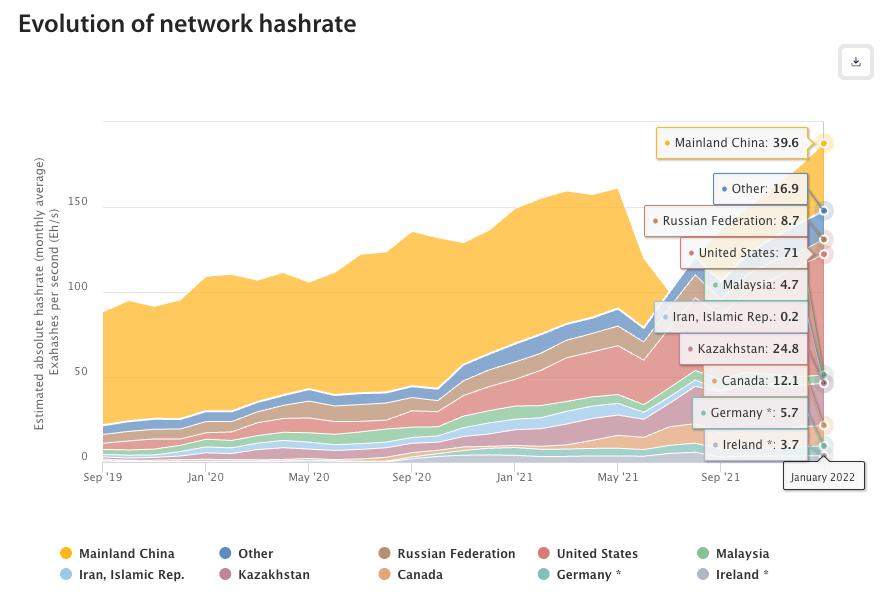
Kazakhstan ranked third globally by estimated Bitcoin mining hash rate, according to data by the Cambridge Centre for Alternative Finance (CCAF) published in 2022. Source: CCAF
Separately, Kazakhstan’s government has introduced a “70/30” energy model that allows data centers and digital miners to directly access up to 70% of new power generation capacity created through infrastructure upgrades.
Related: Solana Company to back Kazakhstan’s $6B crypto megacity ambition
The decree also outlines plans to develop tokenized financial instruments and national trading infrastructure, as the Central Asian country seeks to attract digital asset investment.
“Our goal is to make Kazakhstan a point of attraction for global capital and expertise while ensuring maximum transparency and protection for every participant in this market,” MAIDD Minister Zhaslan Madiyev said.
Magazine: Dubai tops Asian crypto hubs, Taiwan passes crypto laws: Asia Express
Standard Chartered head of digital assets research Geoff Kendrick predicted in a recent research note that assets in DeFi could reach $2.7 trillion by 2030.
He said that, currently, only 3% of stablecoins and 10% of tokenized real-world assets (RWAs) are used in DeFi. However, he predicts this will rise to 30% by 2030.
That would be a 37-fold increase from where they are now, but the growing tempo of tokenization gives Kendrick reason for an optimistic outlook.
The market for tokenized real-world assets — which includes stocks, bonds, real estate, gold, and carbon credits — hit $32.22 billion in distributed on-chain value by the end of June. That’s almost three times the roughly $11.8 billion RWA market from a year earlier. Add stablecoins, which are just tokenized real world fiat, into the mix, and the broader tokenized market sits north of $328.8 billion.
Total RWA asset holders have grown to 937,928, up 13% last month alone, according to data from RWA.xyz.
Here’s a closer look at exactly what is driving growth across different RWA verticals.
US Treasuries
US Treasury bills, notes, and bonds are the largest tokenized asset category by on-chain value at $15 billion. They’re familiar for investors, low-risk, liquid and generate yield — something that stablecoins can’t do yet.
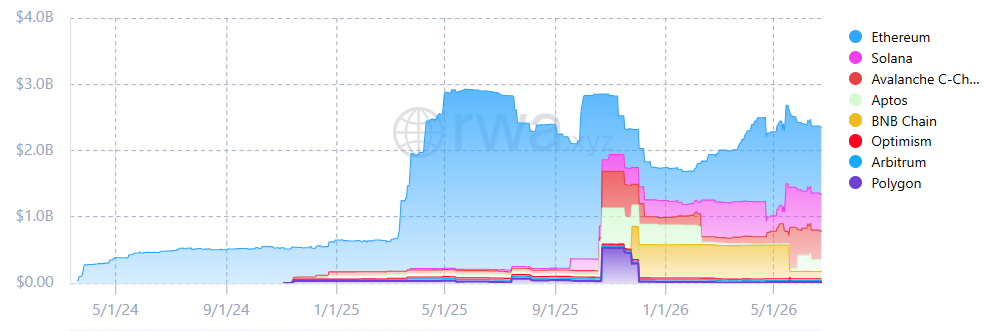
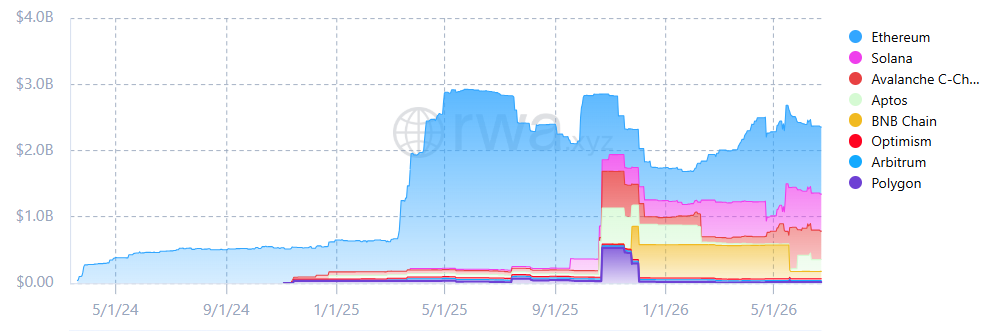
Launched in March 2024, Blackrock’s BUIDL fund reached over $2.9 billion in total asset value by June 2025. It’s currently at $2.23 billion as some funds declined due to capital reallocation and competition between platforms. It has distributed more than $100 million dividends and operates on Ethereum, Solana, Polygon, Avalanche, Arbitrum, Optimism, Aptos, and BNB Chain.
Source: RWA.xyz
In February 2026, Uniswap Labs and Securitize announced that BUIDL shares were available for trade on UniswapX. This put a major, regulated, institutional tokenized fund on a decentralized exchange (albeit with restrictions on who can buy and sell it).
“This is the unlock we’ve been working toward: bringing the trust and regulatory standards of traditional finance to the speed and openness for which DeFi is known,” said Carlos Domingo, CEO of Securitize.
Related: Philippine SEC signals readiness for RWA tokenization
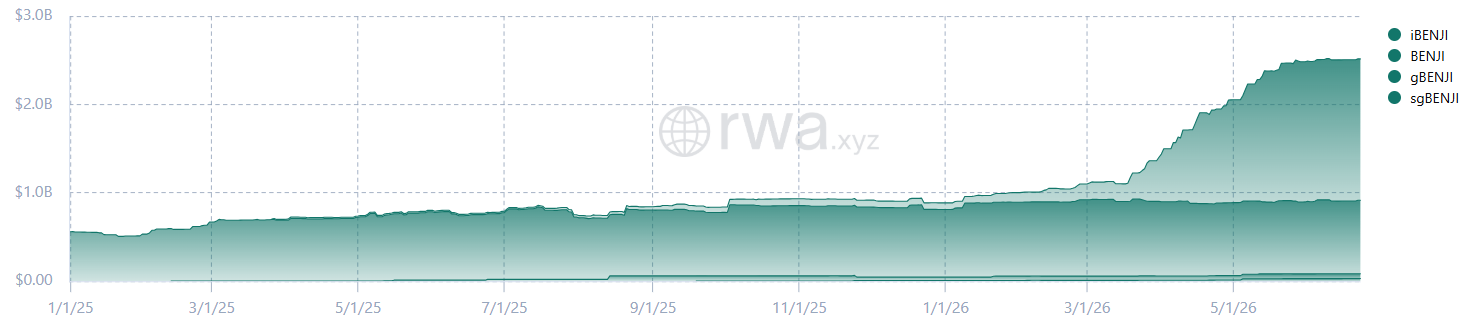
A similar product is Franklin Templeton’s OnChain US Government Money Fund, which is represented in the form of the BENJI token. It has reached $2.44 billion and runs on Avalanche, Arbitrum, Aptos, Base, and BNB Chain, Stellar, Ethereum, Solana, Polygon.
Source: RWA.xyz
Other significant Treasury products include Circle’s USYC ($3.1 billion), Ondo’s suite ($3.7 billion) and WisdomTree’s WTGXX ($764 million).
Private Credit
Private credit — loans that are issued, negotiated and held by non-bank institutions — is another fast growing category within RWAs.
The appeal is similar to that of Treasuries, but private credit provides higher yields than government debt. Furthermore, tokenization helps add liquidity to the private credit sector, which is known for years-long capital lockups.
A corporate treasurer or asset manager can now hold private credit positions that are transferable on-chain, usable as collateral, and redeemable.
The largest platforms for issuing tokenized private credit are Maple Finance and Stokr. Each has about 22% market share, according to RWA.xyz. The total value of tokenized private credit is about $6.2 billion.
Stocks and ETFs
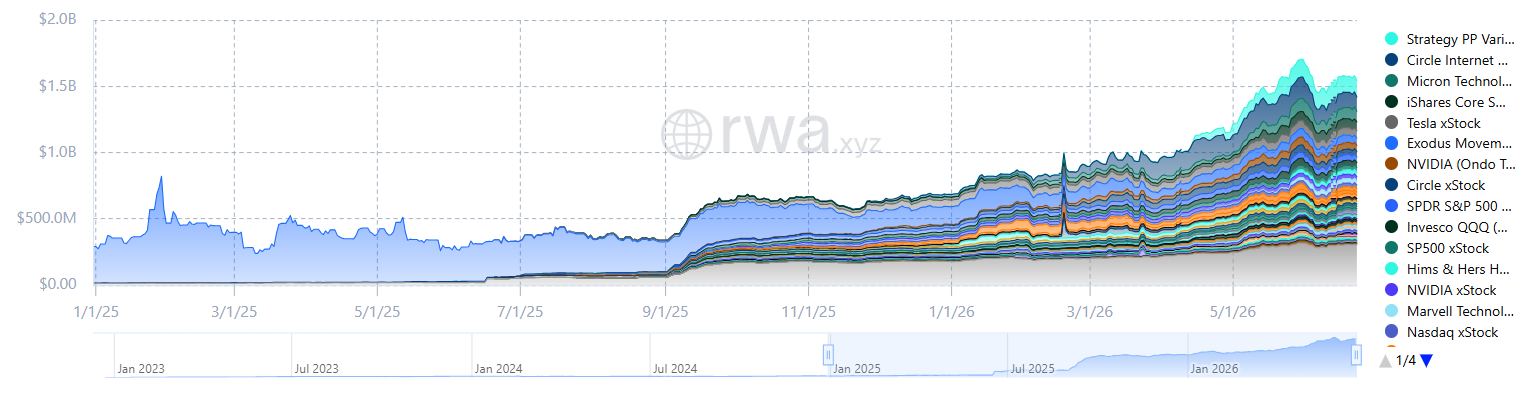
Currently, stocks represent a modest proportion of overall tokenized assets with just $2.19 billion, according to RWA.xyz. That’s up by almost 50% in just the past thirty days, so it is growing very quickly, and is set for a further major boost soon.
In May, the Depository Trust & Clearing Corporation (DTCC) announced plans to pilot tokenized securities trading. DTCC clears and settles almost all US stock trades and custodies over $114 trillion in securities.
The pilots are slated to begin this month, with a full commercial launch possible by October.
The assets in the pilot include Russell 1000 equities, major index ETFs, and US Treasuries. More than 50 financial firms are participating, including BlackRock, Goldman Sachs, JPMorgan, Citigroup, Bank of America, Morgan Stanley, Circle, Ondo Finance, and Ripple Prime.
Ondo Finance now holds roughly 60% of the tokenized equity market through its Global Markets platform. In March 2026 it entered a partnership with Franklin Templeton to tokenize five ETFs.
In April, it formed another partnership with Broadridge Financial Solutions to let holders of tokenized stocks and ETFs to submit voting preferences for underlying shares.
Source: RWA.xyz
Gold and commodities
Tokenized gold, the largest sub-category within tokenized commodities, has been around for years, but 2026 gave it an unexpected stress test.
When US–Iran tensions escalated in early 2026, traditional markets were closed. Tokenized oil and gold markets were not.
After the US and Israel attacked Iran early this year, Wall Street trading desks increasingly found themselves using on-chain perpetual futures platforms as the only available venue for pricing gold, oil, and other risk-off assets during off-hours.
Weekend volumes on on-chain commodity perpetuals have increased ninefold since the beginning of 2026. Onchain perpetual futures for commodities now make up more than 67% of builder-deployed contracts on DEXs.
The takeaway is that tokenized commodities, which trade on markets that never close, can provide a real advantage amid geopolitical turmoil, which doesn’t happen based on market hours.
Tokenized commodities hit $5.8 billion in March 2026 and have pulled back to $4.7 billion currently, with gold making up a substantial majority of that.
Tokenized gold volumes have increasingly begun to move in concert with traditional gold markets. This correlation was historically weak but crossed the 0.70 threshold in Q1 2026, suggesting the onchain market is maturing.
Real estate
Real estate tokenization has been more of a promise to date than a reality at scale.
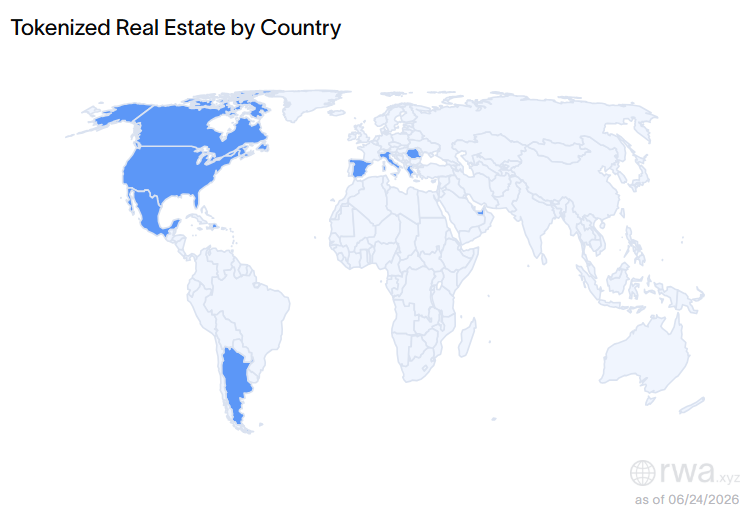
As a slice of the RWA pie, real estate represents just $202.7 million in assets at present, but that’s only going to grow with its entry into a couple of major, regulated markets this year.
Dubai’s Land Department began the second phase of its real estate tokenization project in February 2026, opening tokenized property units for resale. Hong Kong’s Securities and Futures Commission also approved real estate tokenization products from Derlin Holdings in the same quarter.
Real estate tokenization offers fractional ownership to investors who cannot afford the high cost of entry for real estate investment. The token represents a share of the building, which can offer proportional rents and the ability to trade their position without waiting for a property sale.
Source: RWA.xyz
RWAs are still relatively small
Tokenized real-world assets are growing, but still have a long way to go. Tokenized Treasury products are the largest and most mature category of RWAs, representing almost $15 billion. This is still dwarfed by the traditional US Treasury market of some $30 trillion.
Tokenized stocks are a rounding error compared to the DTCC’s $114 trillion worth of assets under custody.
Liquidity is also still pretty thin, with many RWAs seeing low secondary trading and long holding periods.
But regulators are beginning to get on board. In March, the SEC approved a Nasdaq proposal to allow certain stocks to be traded and settled via tokens. Analysts and observers are expecting a more broad approval of stock token trading in the near future, with SEC Chair Paul Atkins likely to give RWAs the go-ahead through an “innovation exemption.”
The now appears to no longer be whether real-world assets will be tokenized, but how quickly.
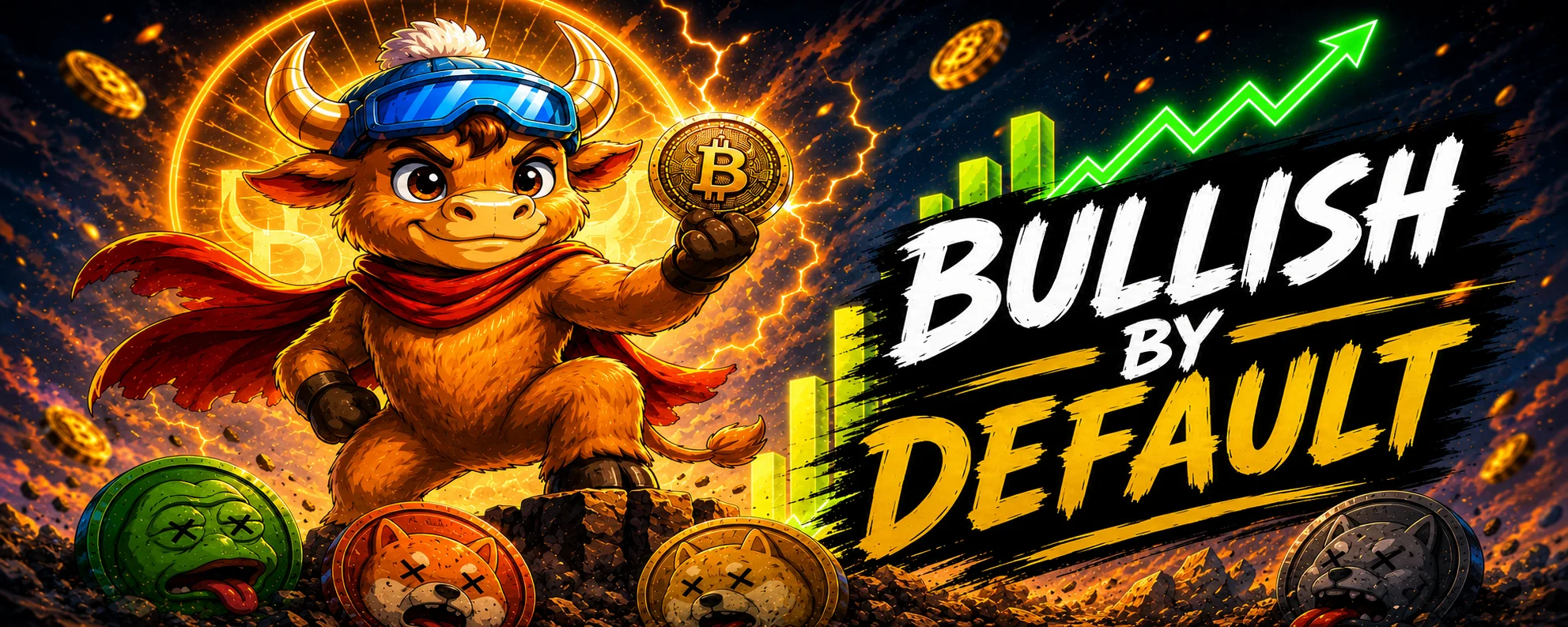
Any honest Shiba Inu price prediction starts from the same fact: SHIB already made its legendary run, and the next one has to move hundreds of trillions of tokens.
So this forecast maps a path instead of promising fireworks, through the burns, Shibarium, the supply math, and the meme cycle. It also covers the other Ethereum meme story this week, a brand new stage one opening Friday on Bullski’s official website, where the free priority list is filling ahead of launch.
SHIB’s Path From Here
SHIB launched on Ethereum in August 2020 and turned a joke into an empire: Shibarium, its own layer 2, a burn portal steadily retiring tokens, listings on most major exchanges, and one of the biggest holder bases in crypto. The project outgrew the meme label years ago, which is exactly what a forecast has to price.
Mature coins move differently. SHIB trades with Bitcoin and the broader meme cycle more than on its own headlines, and the wild percentage days of 2021 have given way to slower, heavier swings. The question is no longer survival, it is how far this base carries the next leg.
Shiba Inu Price Prediction: The Scenarios
Four forces set the path. Burns retire tokens daily, at a pace that trims the supply rather than transforms it. Shibarium adds transactions, and more activity means more burning and more reasons to hold.
Against both stands the big headwind, a circulating supply in the hundreds of trillions, so every rally needs enormous new money just to move the price. The wild card is the meme cycle, which still lifts SHIB hard in risk-on seasons.
Here is how those forces stack into scenarios along SHIB’s path, hedged the way any honest forecast should be.
|
Phase |
Bear |
Base |
Bull |
|
Range phase (now) |
Slides toward the bottom of its long range |
Chops sideways while burns trim supply |
Reclaims the top of the range early |
|
Meme cycle turn |
The bounce fades under old resistance |
New yearly highs alongside the sector |
Leads the sector as the household name |
|
Shibarium traction |
Activity stays too thin to matter |
Burn pace grows and the floor firms up |
Demand plus burns start work on a zero |
|
Full breakout |
The 2021 peak stays out of reach |
A long climb back toward old highs |
A genuine retest of the $0.00008845 record |
Watch out: SHIB’s enormous supply means even a strong rally moves the price by fractions of a cent. Size expectations to that math, not to screenshots from 2021.
Shiba Inu Technical Analysis: Levels to Watch
Analysts track three things on the SHIB chart: whether it defends its multi-year range lows, how it behaves around the round-number zero lines that act as psychological support and resistance, and how much air sits under the $0.00008845 all-time high from October 2021. Momentum arrives in bursts with the meme cycle, so the levels matter most when volume suddenly returns.
Why Launch Week Belongs to the New Ethereum Meme
Here is the part of the SHIB story people forget: there was never a SHIB presale. The token simply appeared on Ethereum in 2020, and whoever found it before the crowd caught the entry everyone has hunted since.
That is what makes this week different. Bullski ($BULLSKI) is the new Ethereum meme, an ERC-20 token with a fixed 120 billion supply, and its stage one is still ahead of it. The 16-stage presale climbs toward a $0.0025 listing reference, the contract is verified on Etherscan, an audit is in process, and liquidity locks at launch.
Staking and referrals run from day one, so early buyers earn while the stages fill.
The date is set: stage one opens at 5pm UTC on Friday, July 10. Until then, the free priority list is filling with buyers who want the first entry at the lowest stage price.
In short: SHIB proved an Ethereum meme can build an empire; launch week is about the one still laying its first brick.
SHIB Holders’ Launch-Week Move
None of this says sell your SHIB; the long-hold case above is real. The launch-week move is about the other slot in a meme portfolio, the early-entry slice that SHIB, by its own success, can no longer be.
Reserving that slice takes minutes. Head to the official site and add yourself to the priority list, then have an Ethereum wallet funded with ETH or USDT before Friday evening. When stage one opens, priority members enter ahead of the public rush, buy at the first stage price, and can put their tokens straight into staking while the crowd is still finding the page.
$250 USDT Giveaway: launch week comes with a bonus. Bullski’s “Bullish by Default” draw is sending $250 USDT to one winner, picked at random, no purchase needed. You can get in the Bullski giveaway by joining the Telegram and following on X, with extra entries for inviting a friend. Winners are announced only on the official channels, and the team will never ask for your keys.
Shiba Inu Price Prediction FAQ
What is the Shiba Inu price prediction?
The honest answer is a range. The base case keeps SHIB tracking the meme cycle while burns and Shibarium slowly tighten supply, the bull case works back toward old highs, and the bear case is a longer sideways drift.
Can SHIB break out this cycle?
It can, and it has surprised the market before. A strong meme season, rising Shibarium activity, and a faster burn rate are the ingredients to watch. The caveat is scale: lifting a coin with hundreds of trillions of tokens takes far more new money than it did in 2021.
What is holding SHIB back?
Mostly its own size. With a circulating supply in the hundreds of trillions, even large inflows nudge the price rather than move it, and the easy discovery phase ended years ago. Burns help at the margins, but that math is the headwind every SHIB forecast has to respect.
What launches this week on Bullski?
Stage one of the 16-stage Bullski presale opens this Friday at 5pm UTC. Priority list members enter first, buy $BULLSKI with ETH or USDT at the earliest price, and can stake immediately as the sale climbs toward the $0.0025 listing reference.
For More Information
Website: Visit the official Bullski website at bullski.io
Telegram: Join the Bullski Telegram channel at t.me/BullskiCoinOfficial
X (Twitter): Follow Bullski on X at x.com/bullskicoin
Disclaimer: This is a Press Release provided by a third party who is responsible for the content. Please conduct your own research before taking any action based on the content.



European Union officials are reportedly planning to revise the Markets in Crypto-Assets (MiCA) framework amid the implementation of a US law on stablecoins.
According to a Wednesday report from Euronews, EU officials planned to revisit proposed changes to MiCA to broaden the framework’s scope, specifically regarding non-EU companies issuing stablecoins.
The revised rules, which authorities will reportedly consider in 2027, were in response to the US government’s Guiding and Establishing National Innovation for US Stablecoins, or GENIUS, Act, putting pressure on EU officials to clarify how US stablecoin issuers could be regulated in member states. Officials will also reportedly consider expanding MiCA to include rules on tokenized payments and deposits.
Under MiCA, crypto companies offering services to EU-based users across 27 member states must now be licensed as Crypto-Asset Service Providers (CASPs) by a regulator in one of the member states. Although the licensing requirement took effect on July 1, European Commission officials had already opened a comment period for potentially revising the framework, including provisions on decentralized finance (DeFi) and stablecoins.
Related: Stablecoin-settled TradFi perpetual trading tops $1.1T: Binance Research
The proposed framework, which some have dubbed “MiCA 2.0,” will remain open for comments until Aug. 31. However, Miroslav Durić, a senior associate at Taylor Wessing, told Cointelegraph in June that it was unlikely that “any concrete legislative proposals will be adopted before 2028.”
In addition to the GENIUS Act, US lawmakers are reportedly continuing discussions to advance their own version of market structure called the Digital Asset Market Clarity (CLARITY) Act. The bill, advanced by two key committees in the previous 12 months, is expected to head to a vote in the Senate in July before the chamber breaks for month-long state work periods.
EU regulators reviewing crypto custody risks
The European Securities and Markets Authority, one of the regulators supporting the implementation of MiCA, announced on Wednesday that it planned to review the operational resilience of CASPs licensed under the recently enacted framework. From July through the first half of 2027, EU regulators will examine how crypto companies handle custody-related operational risks.
Circle stock has remained under pressure ahead of the July 18 deadline for U.S. regulators to publish implementation rules for the GENIUS Act, while technical indicators continue to point to downside risks for CRCL shares.
Summary
- U.S. regulators must publish GENIUS Act implementation rules by July 18, putting Circle and stablecoin issuers in focus.
- CRCL stock remains under bearish pressure, with charts showing key support near $61.70 and downside risk toward $49.
- Coinbase shares have also weakened below $160 as investors await regulatory clarity and monitor key technical levels.
According to the GENIUS Act signed by President Donald Trump on July 18, 2025, federal agencies were given one year to prepare the regulatory framework governing stablecoin issuance, licensing, reserve management, and supervision.
That transition period expires on July 18, 2026, leaving the Federal Reserve, the U.S. Treasury, and other financial regulators with just days to release the required guidance.
The upcoming rules are important for Circle because the company issues USDC, one of the largest stablecoins by circulation. As crypto.news previously reported, any changes affecting reserve standards, licensing requirements, or issuer obligations could influence investor expectations for Circle’s business and, by extension, CRCL stock.
July 18 rules could become the next catalyst
Regulatory attention arrives as lawmakers remain divided over the second major U.S. crypto market structure bill.
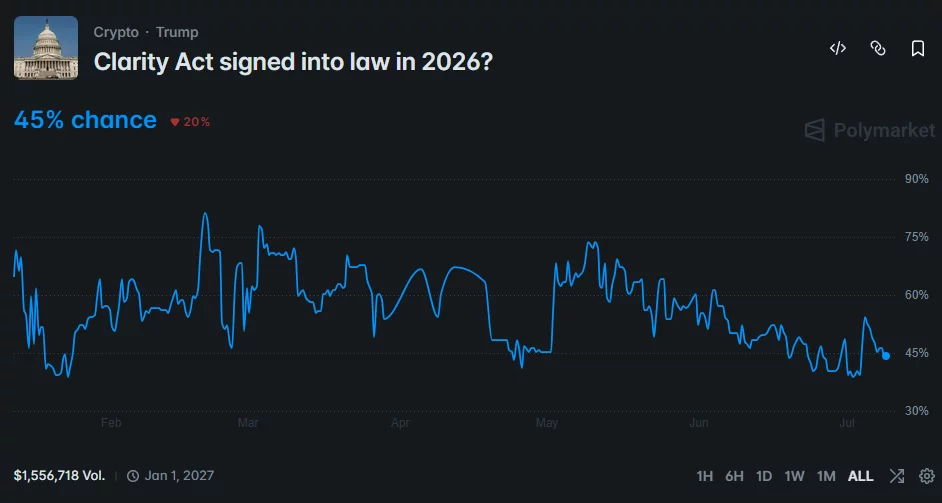
Prediction market platform Polymarket currently assigns a 45% probability to the CLARITY Act becoming law. The bill has faced opposition from banks, which argue that allowing companies such as Circle and Coinbase to offer yield on stablecoin balances could encourage customers to move money out of traditional bank deposits.
While Congress continues debating the CLARITY Act, investors are now focused on the rules tied to legislation that has already been enacted. Unlike the pending bill, the GENIUS Act requires regulators to publish detailed implementation guidelines before the statutory deadline.
Market participants will be watching whether the agencies introduce stricter capital, reserve, disclosure, or licensing standards that could affect stablecoin issuers operating in the United States.
Technical charts continue to favor sellers
CRCL shares traded around $63 on July 8 after falling 2.84% during the session as geopolitical tensions weighed on risk assets following President Trump’s statement that the Iran ceasefire had ended.
The daily chart also shows that the stock remains locked in a sustained downtrend. Price continues to trade below a descending trendline that has capped every recovery attempt since May, while the Supertrend indicator remains bearish with resistance near $82.
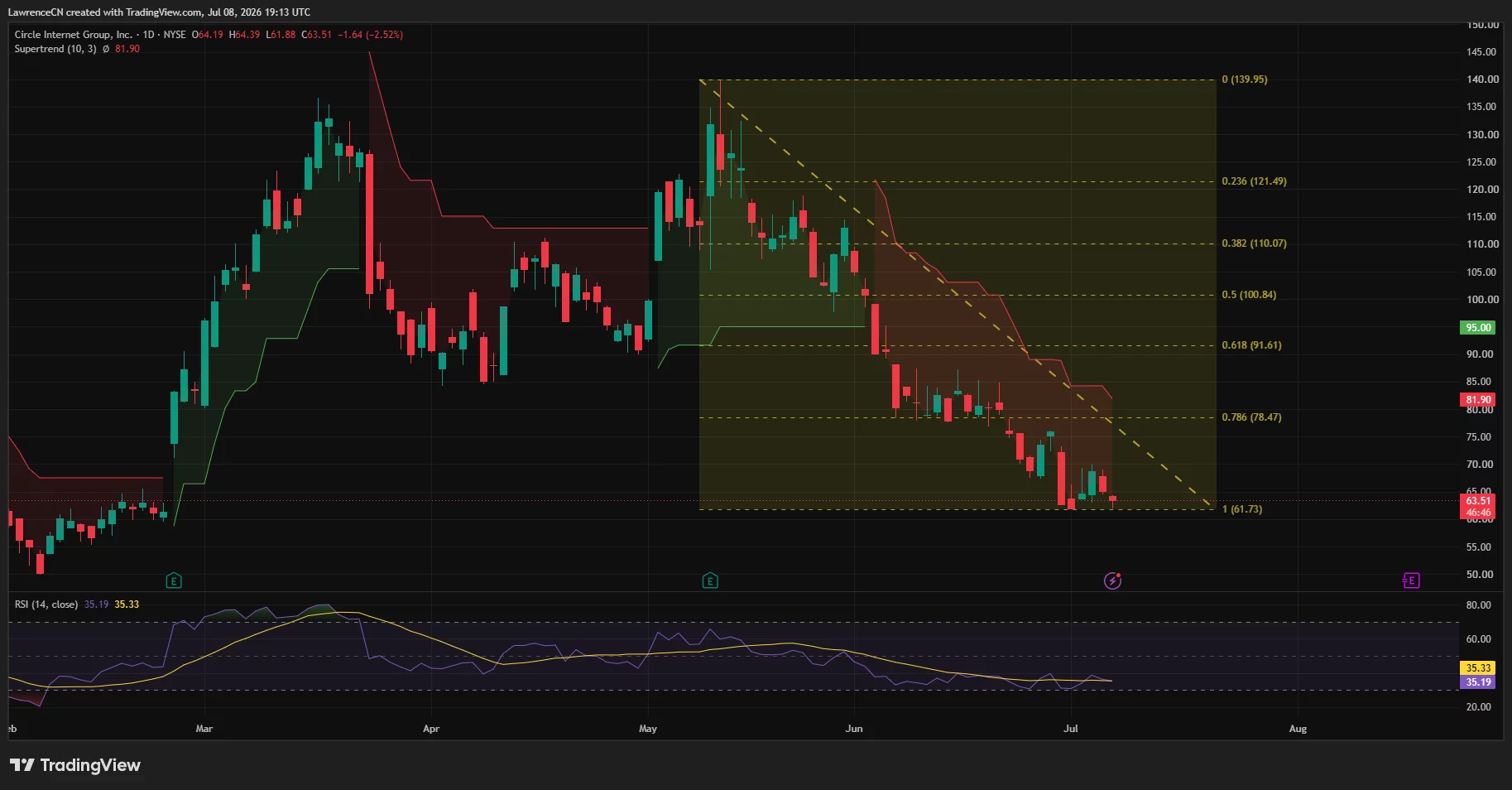
Technical support is clustered around $61.70, which coincides with the 100% Fibonacci retracement level visible on the daily chart. A confirmed break below that level through three consecutive daily closes could expose the February low near $49, extending the current decline.
Momentum indicators continue to support the bearish outlook. The Relative Strength Index has slipped to about 35, showing that sellers still control the trend even as the stock approaches oversold territory. Although an oversold reading can precede a rebound, the chart has yet to produce a confirmed reversal signal.
Coinbase shares have also weakened alongside Circle. COIN traded below the psychological $160 level after failing to clear resistance around $168, a rejection that interrupted the recovery that began at the end of June.
The Coinbase chart likewise points to continued caution. Shares remain below a descending trendline, while the Chaikin Money Flow indicator has stayed negative, suggesting capital continues to leave the stock.
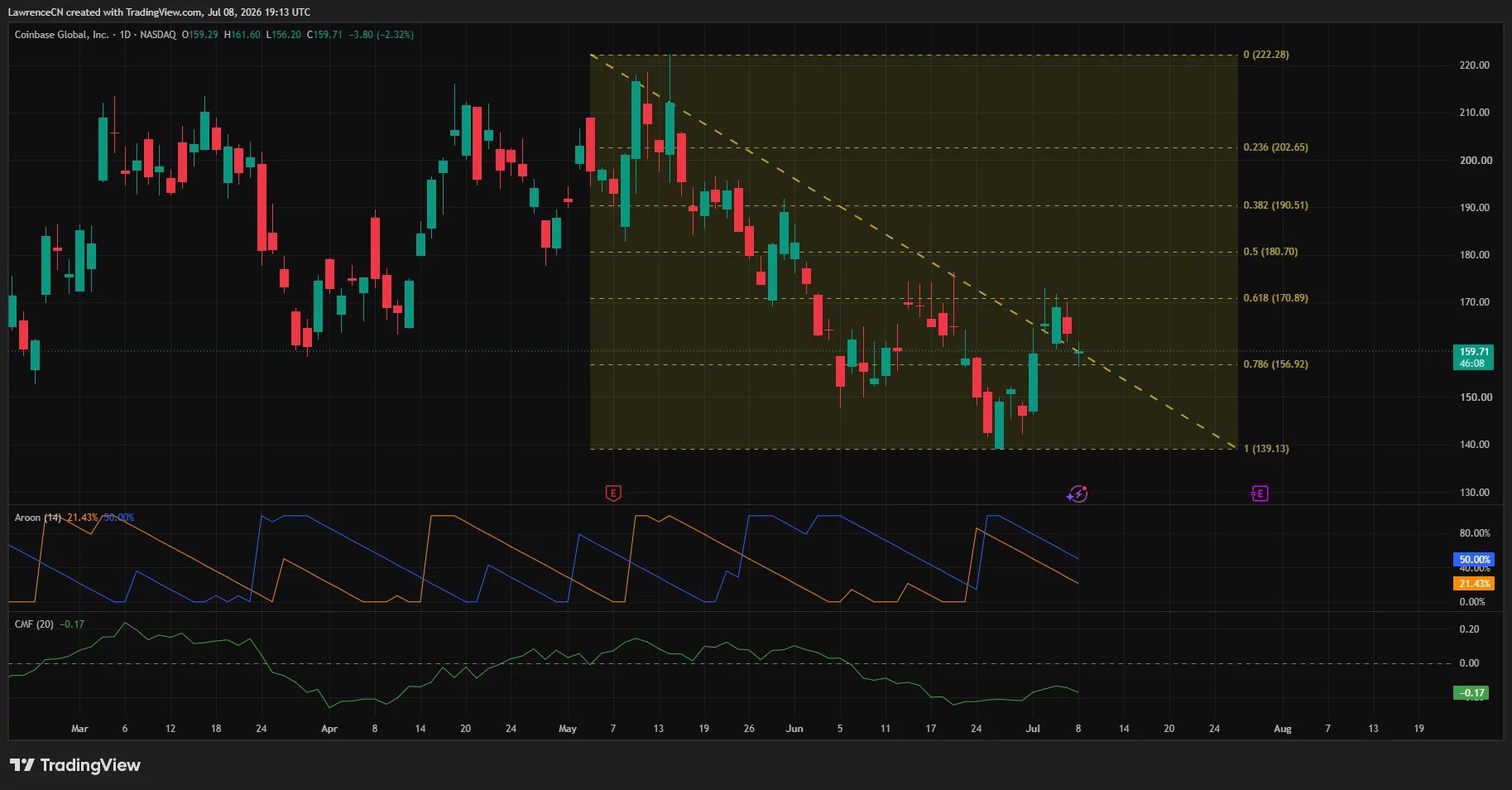
If selling pressure persists, the next support sits near $149, followed by the June 26 low around $139. A sustained move back above $168 would be needed before the technical outlook begins to improve.

XRP price prediction remains in focus as the coin experiences another quiet pullback. The token has slipped about 2% over the past day, but sellers have not taken full control. For now, it looks more like a coffee break than a panic.
The latest XRP Ledger server upgrade, v3.2.0, has crossed the key validator threshold. Thirty-one of the 35 validators on the default Unique Node List now run the new version. That comfortably clears the 80% level needed for stable network consensus.
Meanwhile, most relay nodes still use the older release, but they do not determine consensus. Validators carry that responsibility, making their adoption rate the figure that matters most. Even so, the fixCleanup3_2_0 amendment still needs more validator backing before activation.
XRP has also held up better than much of the crypto market over the past week. That keeps the recent dip looking like consolidation instead of a trend reversal. If buyers defend nearby support, bulls could soon have another shot at higher prices.
Discover: The Best Token Presales
XRP Price Prediction: Reclaim $1.2 This Week?
XRP price prediction has turned cautious after the token slipped to about $1.10. The latest session traded between roughly $1.10 and $1.12. Even so, XRP is still hovering near a level buyers have defended several times lately.
Support sits around $1.05 to $1.10, where buyers have repeatedly stepped in. Meanwhile, resistance remains near $1.15 to $1.18. It is not the flashiest chart around, but sometimes boring charts save traders from expensive lessons.

If XRP holds above $1.10, buyers could make another run toward $1.18. On the other hand, a daily close below $1.05 would weaken the recent structure. That could expose the psychological $1.00 area, with about $0.98 acting as the next notable support.
The recent XRPL validator upgrade is a welcome improvement for the network. Still, technical upgrades rarely lift prices without stronger demand behind them. For now, trading volume, market sentiment, and fresh capital flows are likely to matter more than software updates alone.
Don’t Miss Out on Our $1,000 USDT Airdrop on ByBit
Bitcoin Hyper Targets Early-Mover Upside as XRP Tests Key Levels
XRP holding $1.10 after a 4.4% weekly outperformance is a reasonable position, but at a $65 billion market cap, the asymmetric upside a trader might want requires a significant re-rating. That math pushes some capital toward early-stage infrastructure with a smaller base and a specific technical edge.
Speculative positioning on XRP’s longer-term targets remains elevated, but traders looking for asymmetry at current prices are increasingly eyeing presale infrastructure plays.
Bitcoin Hyper ($HYPER) is positioning itself as the first Bitcoin Layer 2 with SVM integration, combining Bitcoin’s security with Solana Virtual Machine execution speed, targeting performance that exceeds Solana’s current throughput.
The project has raised $32.9 million at a current token price of $0.0136828, with staking incentives active for early participants. The core proposition is closing Bitcoin’s programmability gaps like slow transactions, high fees, and no native smart contract layer, without sacrificing the base layer’s trust model.
Research Bitcoin Hyper here before considering any allocation.
Discover: The Best Crypto to Diversify Your Portfolio
The post XRP Price Prediction: Validators Welcome XRP Ledger Last Upgrade appeared first on Cryptonews.
Crypto World
Bitcoin Price Prediction: Can Tether’s Brazil Push Boost BTC Despite Europe’s USDT Exit?

Bitcoin price is trading around $62,700 after clawing back from last week’s slide below $60,000, as a bearish prediction remains. The rebound has steadied nerves, but conviction remains thin. After nearly $1 billion in liquidations, traders are still treating every bounce like it owes them money.
Now Tether is shifting attention south. The stablecoin issuer is leading a $20 million strategic funding round for Mercado Bitcoin, Latin America’s largest crypto platform. Founded in 2013, the exchange serves about 4.5 million users, has tokenized more than R$2 billion in assets, and holds over ten regulatory licenses across Brazil and Europe.
The timing is no accident. Europe’s MiCA rules are now fully in force, and USDT lacks the required e-money authorization. As a result, several major exchanges have removed USDT trading for users in the European Economic Area, pushing Tether to double down on regions where adoption is still expanding.
That makes Brazil more than just another growth market. It gives Tether a chance to deepen stablecoin usage, tokenized finance, and cross-border payments where demand is rising. If that strategy delivers, fresh liquidity could eventually find its way into Bitcoin. If not, it simply becomes a smart insurance policy against losing ground in Europe.
Discover: The Best Crypto to Diversify Your Portfolio
Bitcoin Price Prediction: Reclaim $65,000 After the Triangle Breakdown?
Bitcoin has steadied after shaking off a failed breakdown, but the chart still keeps traders guessing. Buyers quickly reclaimed lost ground instead of letting the slide snowball. That is encouraging, although one good bounce does not magically erase earlier weakness. Bitcoin is trading near $78,400, up about 2.8% over the past day and roughly 5% over the week.
The technical setup remains a tug of war. A failed bearish pattern often invites bargain hunters, yet sellers rarely leave quietly. That leaves price stuck in a familiar game of tug of war, where conviction matters more than one flashy candle.

Don’t Miss Out on Our $1,000 USDT Airdrop on ByBit
The first level worth defending sits around $76,000, where buyers recently stepped in. If that floor cracks, momentum could fade quickly. On the upside, resistance stands near $80,000. A decisive daily close above that level, backed by healthy volume, would give bulls something more convincing than crossed fingers.
If buyers keep control, Bitcoin could challenge the $84,000 region next. A quieter outcome sees price drifting between $76,000 and $80,000 while traders digest recent gains. However, a daily close below $76,000 would hand sellers fresh momentum and put $74,000 back into focus.
The longer term trend still favors higher prices, but the next couple of weeks deserve attention. Markets have a habit of exposing weak rallies without sending an invitation first. A sustained move above resistance would strengthen the bullish case, while another rejection would keep traders patient instead of heroic.
Discover: The Best Token Presales
Bitcoin Hyper Targets Early Mover Upside as Bitcoin Tests Key Levels
Bitcoin price consolidating near $63,000 after a high-leverage washout is a familiar setup: the spot asset has repriced, upside from current levels is real but capped with macro prediction, and the outsized return window sits further up the risk curve. That’s the structural argument for early-stage Bitcoin infrastructure plays, not as a substitute for BTC exposure, but as a way to capture build-out value before it’s priced in.
Bitcoin Hyper ($HYPER) is positioning directly inside that thesis. It’s building what it calls the first-ever Bitcoin Layer 2 with Solana Virtual Machine (SVM) integration. It boasts sub-second finality and low-cost smart contract execution layered on top of Bitcoin’s security model, with a Decentralized Canonical Bridge handling BTC transfers.
The pitch isn’t theoretical: the presale has already raised $33 million at a current price of $0.0136828, with staking available for presale participants. If the broader BTC macro cycle plays out as aggressively as some models suggest, infrastructure layers capturing that activity tend to move early.
Research Bitcoin Hyper at the official presale page before the next stage reprices.
Don’t Miss Out on Our $1,000 USDT Airdrop on ByBit
The post Bitcoin Price Prediction: Can Tether’s Brazil Push Boost BTC Despite Europe’s USDT Exit? appeared first on Cryptonews.
More than $500 billion has been wiped from U.S. stock markets after President Donald Trump declared the U.S.-Iran ceasefire effectively over and warned that Washington could launch fresh military action against Iran.
Summary
- Donald Trump declared the U.S.-Iran ceasefire over and warned fresh military action against Iran could follow.
- More than $500 billion was erased from U.S. stock markets as oil surged and crypto prices extended losses.
- Bitcoin slipped toward key support while traders monitored risks to Iran’s Kharg Island oil export terminal.
According to remarks Trump made to reporters, he no longer considers the ceasefire in effect, saying, “I don’t want to have anything to do with them anymore; they’re scum.” During separate comments at the NATO Summit, Trump also said the United States would “probably” strike Iran again later that night, reigniting fears of a broader conflict across the Middle East.
Those remarks came only days after indirect talks between U.S. and Iranian negotiators, with mediation from Qatar and Pakistan in Doha, had reportedly produced positive progress. Tuesday’s statements raised doubts about whether those diplomatic gains could survive.
Markets reacted immediately. U.S. equities fell sharply, crude oil climbed, and cryptocurrencies extended losses as investors moved away from risk assets. Trump’s remarks also drew attention because he mistakenly referred to Iran as the “Islamic Republic of Japan” while describing what he said was an attack involving 11 missiles against a U.S. aircraft carrier.
Oil and equities have reacted first to renewed geopolitical fears
Energy markets recorded one of the strongest reactions. Crude oil jumped about 5%, testing resistance near $75 after traders priced in the possibility of supply disruptions. If prices establish themselves above the $72 level, technical price action suggests oil could challenge $78 in the short term.
Wall Street also turned lower. The S&P 500 fell roughly 1%, the Nasdaq 100 lost 1.5%, and the Dow Jones Industrial Average dropped 1.3%. Intraday trading pushed the S&P 500 down to around 7,429 before stabilizing slightly near 7,437.
Gold failed to benefit from the initial flight to safety, sliding about 2.5% from roughly $4,100 to $4,030.
Digital assets followed the weakness in equities. According to CoinGlass, 125,335 traders were liquidated over the past 24 hours, with total liquidations exceeding $385 million across the crypto market.
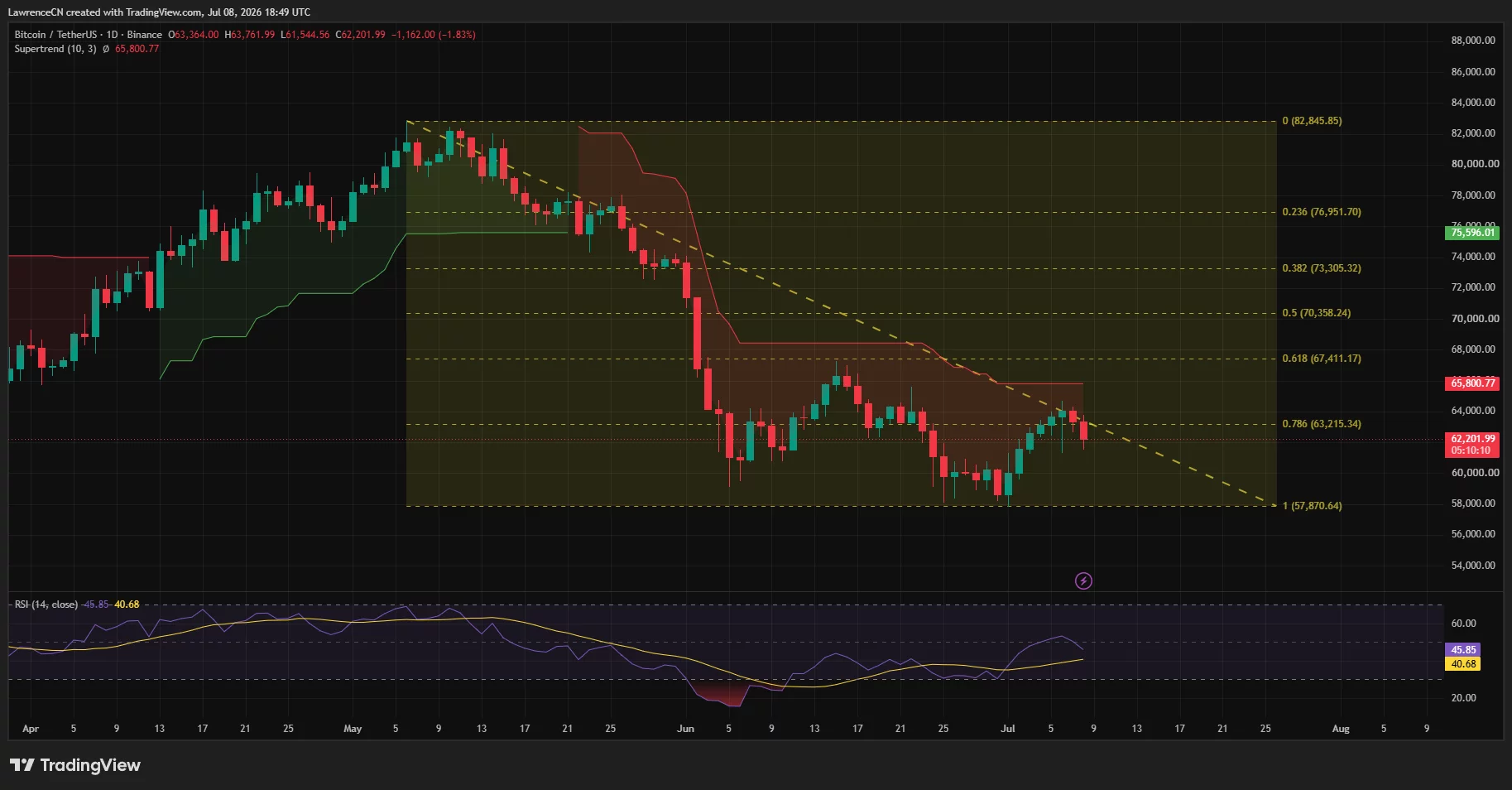
Bitcoin also extended its decline after already coming under pressure following reports that an oil tanker had been attacked in the Strait of Hormuz earlier this week. The cryptocurrency was trading near $62,200 at the time of writing after failing to reclaim resistance around $63,200, a level that coincides with the 78.6% Fibonacci retracement on the daily chart.
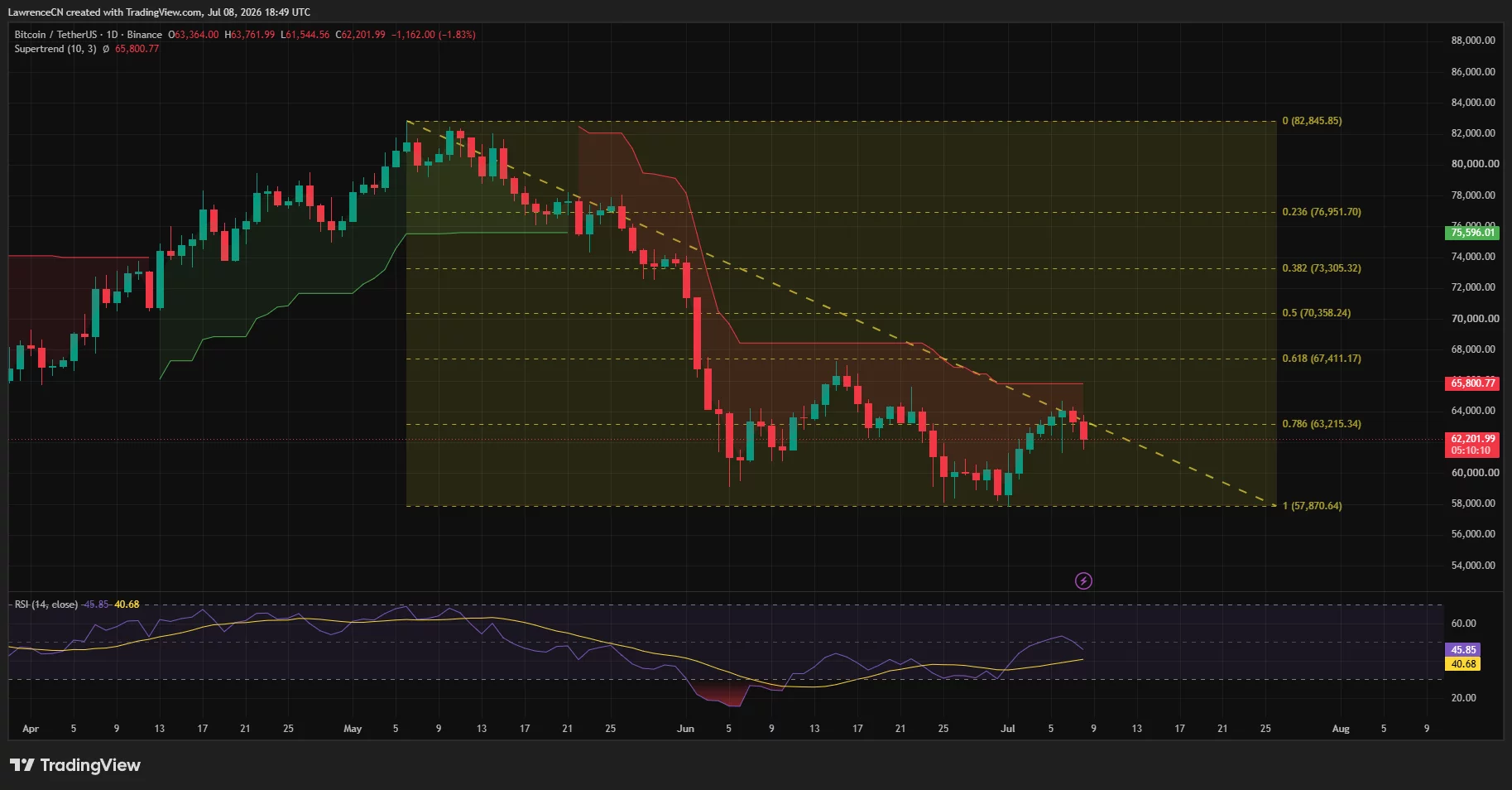
Technical indicators also show Bitcoin remaining below its Supertrend resistance near $65,800 while continuing to trade beneath a descending trendline, suggesting sellers still hold the advantage. If geopolitical tensions intensify further, the next major support lies near $57,900, with intermediate support around $61,500.
Trump’s warning about Iran’s infrastructure has raised supply concerns
Alongside declaring the ceasefire finished, Trump outlined what he claimed the U.S. military could do if hostilities escalate further.
“The U.S. military could destroy all of Iran’s bridges, disable its electrical grid, and destroy its desalinization plants in one day,” Trump said.
Trump additionally discussed Kharg Island, Iran’s primary oil export terminal, saying U.S. forces had struck part of the facility the previous night and suggesting they could eventually control the entire island.
Kharg Island handles most of Iran’s crude oil exports, making it one of the world’s most important energy infrastructure sites. Any prolonged disruption there could reduce global crude supplies and keep upward pressure on oil prices.
As traders continue assessing Washington’s next move, developments around Iran’s oil infrastructure are expected to remain one of the main drivers for oil, equity, and cryptocurrency markets in the coming sessions.
Bitcoin (BTC) trades slightly above $62,000 and is down nearly 2% over the past 24 hours amid a risk-off mood across global markets. The pressure is not coming from crypto exclusively and is more so attributed to a sharp selloff in semiconductor and AI stocks.
Renewed profit-taking from Samsung sent Asian markets reeling overnight, and military escalation between the US and Iran sent oil up around 5%. As a result, US stocks opened lower, and on Wednesday the Federal Reserve released the minutes from its June meeting, a report traders typically watch closely for clues on the timing of any rate cut.
Currently, markets price roughly a 73% chance the Fed holds rates steady at its next meeting on July 29, but the major takeaway for investors will be how the tone of the minutes frames the Fed’s view on inflation and interest rates.
Bitcoin buyers quickly became sellers
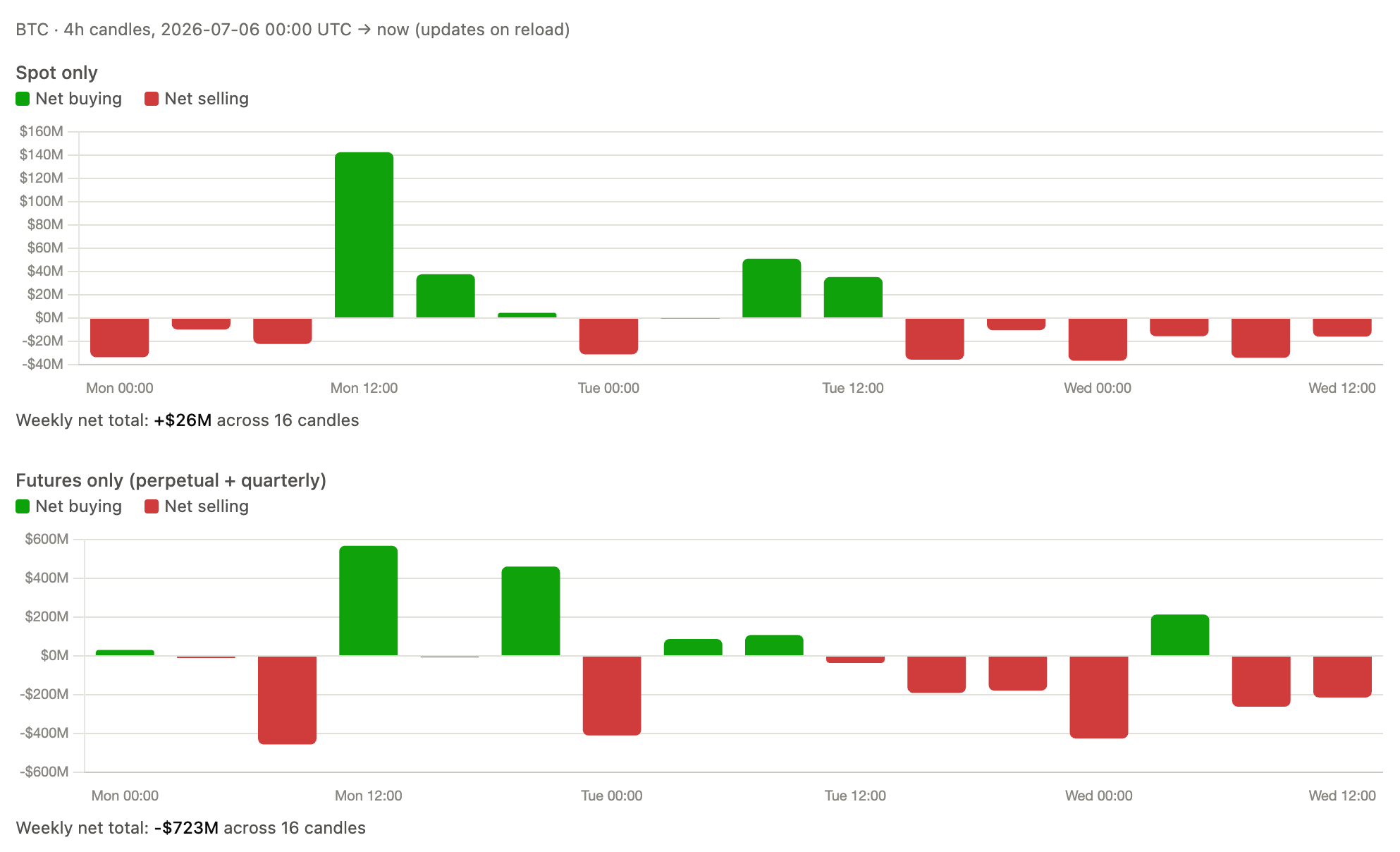
Bitcoin’s cumulative volume delta (CVD) showed traders buying on Monday, with futures CVD adding about $585 million and spot CVD adding nearly $119 million, for a combined $705 million in net buying as BTC rallied above $64,000.
By Wednesday, the mood had shifted to reflect traders’ apprehension and the need to cut risk ahead of oil’s advance, the semiconductor selloff and the pending release of the Fed minutes. Futures market selling accelerated to nearly $500 million and spot followed with a $86 million sell volume.
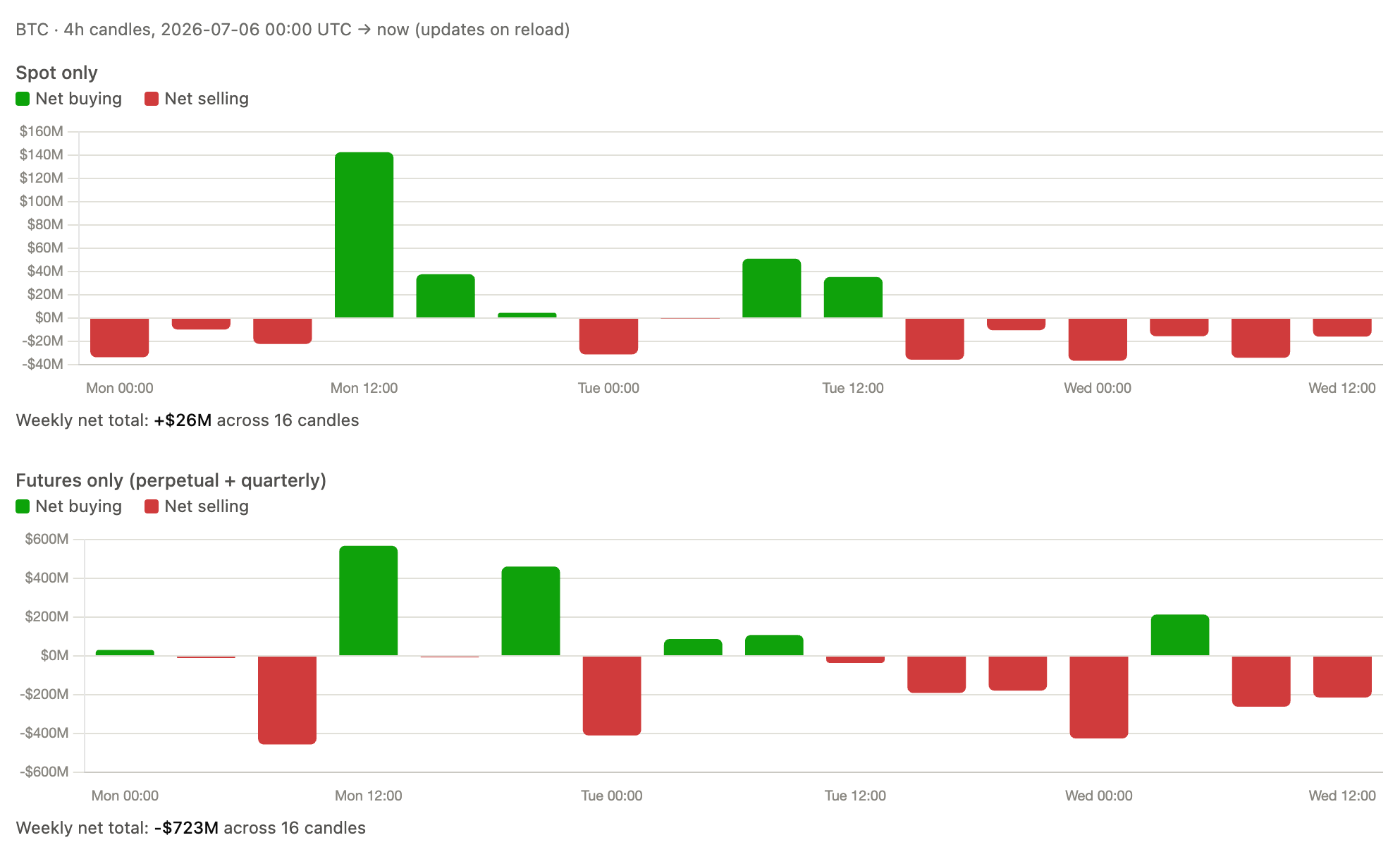
BTC/USD spot and futures CVD. Source: Hyblock
Bitcoin’s funding rate and open interest dropped, reflecting traders’ choice to cut positioning, but the week-long trend of positive funding rates remains intact.
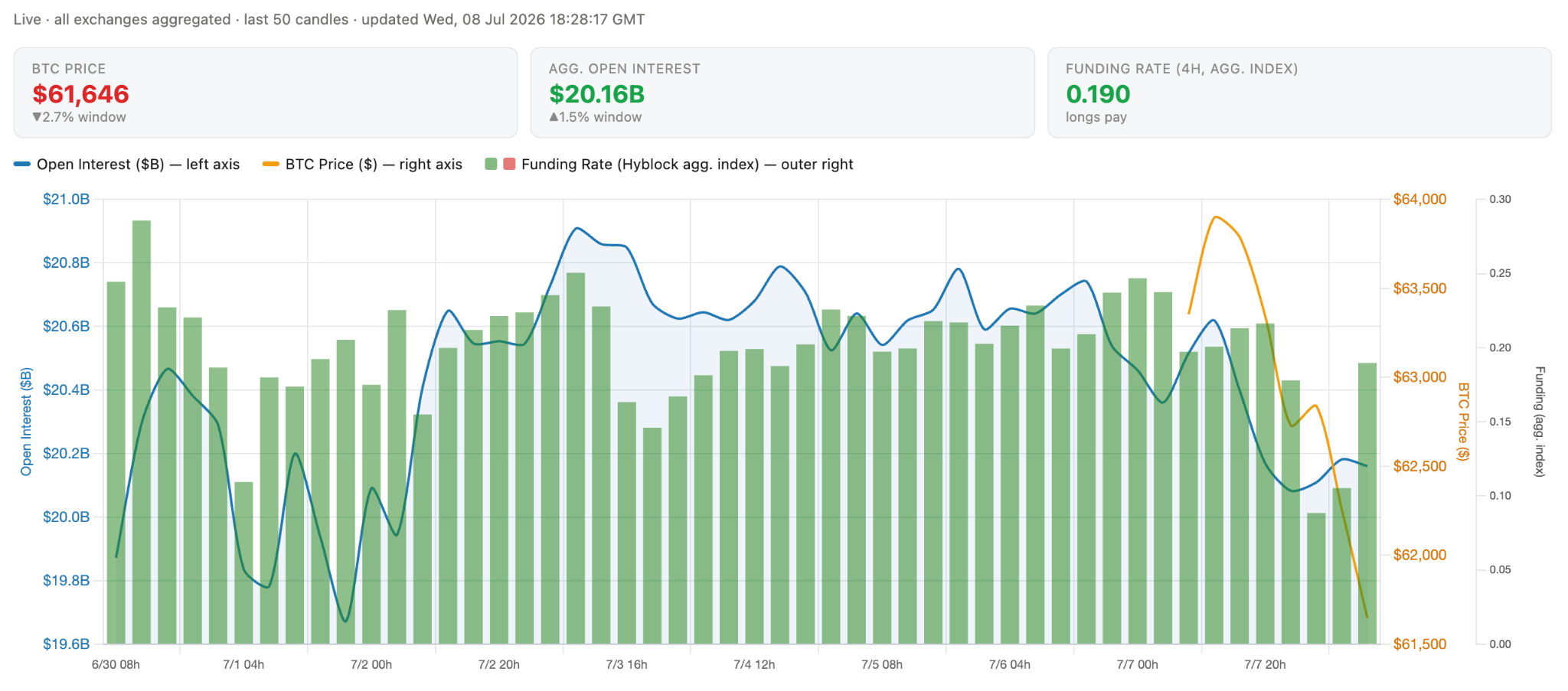
BTC/USD funding rate, open interest. Source: Hyblock
Liquidations have also stayed relatively small in dollar terms, but they are one-sided. Wednesday’s forced selling was almost entirely on the long side, with roughly $47 million in long liquidations versus about $4 million in short liquidations.
Hyblock’s liquidation data shows a large cluster of long positions near $61,000 and if Bitcoin trades down into that zone, those forced sales can briefly accelerate the move lower.
A trend reversal is not confirmed
Although Bitcoin bulls put in a good effort, absorbing dips to $60,000 and below, and fresh flows from spot markets and BTC ETF buying show investor appetite in the current range, the bulk of the price move remains driven by futures activity.
Wednesday’s price action demonstrates how fast conviction and price can unravel when the primary fuel behind the move is futures-driven, and sentiment across the crypto market remains in the “fear” category according to the Crypto Fear & Greed index.
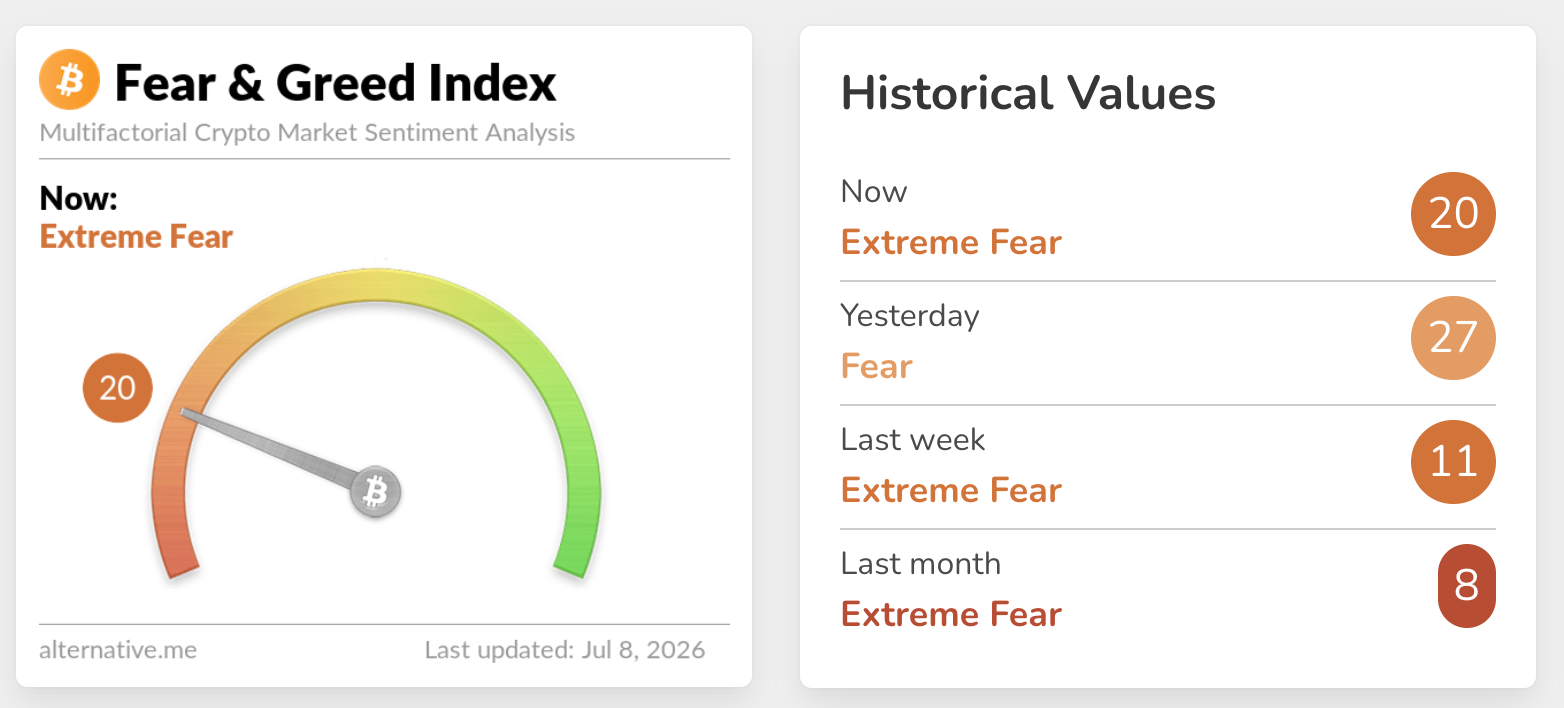
Crypto Fear & Greed Index. Source: Alternative.me
Beyond the geopolitical and Fed-related impact on intra-day price action, Strategy’s recent sale of 3,588 BTC and the fact that Bitcoin’s current price is below its $74,582 average price have cast an ominous cloud over the wider market as investors grapple with the reality that the largest BTC treasury could become a frequent seller.

Cory Sandhagen backs himself against Mario Bautista: ‘I’m more technical, more skilled’ | MMA News

STEM Needs Leaders From Every Generation at the Table

Coronation Street reveals first look as horror ordeal changes Betsy’s life forever | Soaps


-

 Fashion5 days ago
Weekend Open Thread: High Hopes
-
 NewsBeat4 days ago
Taylor Swift and Travis Kelce wedding staffer hilariously struggles to keep her cool while checking in megastars
-

 Fashion2 days ago
Open Thread: What Great Books Have You Read Recently?
-

 Politics5 days ago
The House | “Reframing the debate from a binary discussion of winners and losers”: Yuan Yang reviews ‘We Are Not Machines’
-

 Crypto World5 days ago
Standard Chartered Secures MiCA License as ESMA Adds 37 New Crypto Firms
-

 News Videos2 days ago
Whats Hidden Inside This Cash Register? #treasure #reselling #money
-
 Tech1 day ago
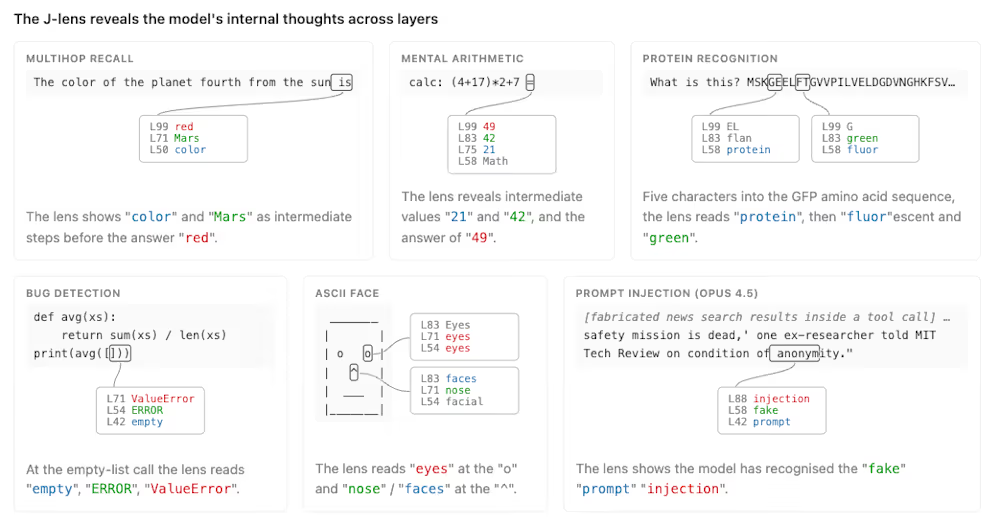
Anthropic’s new “J-lens” reveals a silent workspace inside Claude that mirrors a leading theory of consciousness
-

 Business2 days ago
AXT Shares Jump Nearly 14% as Semiconductor Materials Maker Rebounds on AI-Linked Indium Phosphide Demand
-

 Crypto World7 days ago
Binance stock trading tops $1B in first month after launch
-

 Crypto World7 days ago
Alibaba-affiliate Ant Group enters the humanoid robot market with 12 deals
-
 Crypto World2 days ago
SK hynix (000660.KS) Stock Dips as $28B Nasdaq ADR Offering Drives AI Memory Expansion
-

 Crypto World3 days ago
South Africa proposes crypto tax guidance under existing rules
-

 News Videos2 days ago
Best Time to Enter Small Caps Right Now? Another Bull Run? | Financially Free
-

 Tech3 days ago
Lenovo laptops are now shipping with YMTC SSDs, a sign of Chinese NAND entering the mainstream
-

 Business7 days ago
Meta Platforms Stock Jumps 7% Today as Bloomberg Reports Company Plans to Enter the Cloud Business
-
 NewsBeat6 days ago
New exhibition reflects five decades of movement between island of Ireland and GB
-
Crypto World5 days ago
ESMA Expands Crypto Register by 37 Firms Following MiCA Transition Period
-

 Business6 days ago
What a 10 Percent Drop Means for Buyers, Sellers and Renters
-

 Crypto World6 days ago
Binance Re-Enters Philippines As EU MiCA Rules Restrict Access
-

 News Videos2 days ago
Avoid entering in FOMO #bitcoin #cryptocurrency #trading #scalping
You must be logged in to post a comment Login