

Crypto World
Kalshi traders think Hormuz traffic won’t return to normal this year


Vessels off the coast of the Khor Fakkan Container Terminal, the only natural deep-sea port in the region and one of the major container ports in Sharjah Emirate, along the Gulf of Oman on June 28, 2026.
– | Afp | Getty Images
President Donald Trump said the ceasefire with Iran is “over” after the U.S. conducted strikes against the Islamic Republic following attacks on commercial vessels in the Strait of Hormuz.
Now, traders on prediction market platform Kalshi are recalibrating their outlook for when they see traffic in the passageway returning to normal.
Speculators now see just a 44% chance that traffic flows will return to normal by Dec. 1. The earliest they forecast normal traffic by is Jan. 1, 2027, when odds rose to 53%.
Kalshi defines normal traffic flows as a 7-day moving average of transit calls through the strait above 60. The outcome is verified using data reported from IMF PortWatch.
Odds of when traffic will return to normal have tumbled sharply over the last few days. As recently as July 4, traders on Kalshi placed more than 50% odds that flows would return to normal by Oct. 1.
Traders on Polymarket are slightly more optimistic, with speculators there seeing a 59% chance that traffic flows return to normal in the vital maritime passage by Dec. 31. Polymarket uses the same definition and data as Kalshi to resolve contracts related to traffic in the Strait of Hormuz.
Traffic in the strait is “suddenly very far from normal,” Piper Sandler analyst Jan Stuart at Piper Sandler wrote in a Wednesday note.
“With the Strait back in play, global oil supply is again way short,” Stuart wrote. “Any hope of commercial insurers reducing ‘war risk’ assessments in months has been sunk.”
Disclosure: CNBC and Kalshi have a commercial relationship that includes customer acquisition and a minority investment.

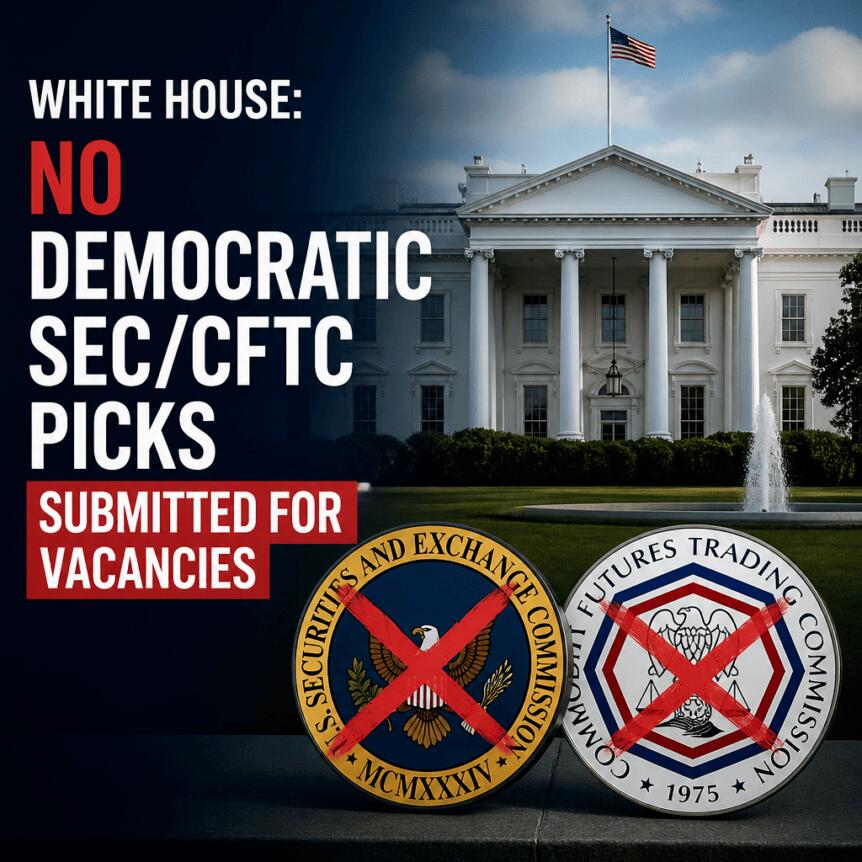
White House officials have pushed back against concerns from Senate Democrats about vacancies at two key US financial regulators, saying the administration has already been soliciting Democratic names for open seats at both the Securities and Exchange Commission (SEC) and the Commodity Futures Trading Commission (CFTC).
In a Thursday letter to Senate Majority Leader John Thune and Minority Leader Chuck Schumer, administration officials responded to a June 10 request from 12 Senate Democrats that raised staffing and oversight worries at federal agencies, including the SEC and CFTC. The letter argues that, despite the leadership gaps, the normal nomination process has been pursued with Senate Democratic leadership.
Key takeaways
- White House officials say they have already sought Democratic nominee names for both the SEC and CFTC vacancies, countering Senate Democrats’ earlier claims.
- The SEC currently has two vacant Democratic seats, while the CFTC chair and sole commissioner is Republican Michael Selig.
- Democratic lawmakers have linked understaffing concerns to delays in crypto market structure legislation, including the Digital Asset Market Clarity (CLARITY) Act.
- CFTC chair Michael Selig has argued in a recent interview that regulators may be forced to “write all the rules” on digital assets without new legislation.
White House response to Senate Democrats over regulator vacancies
The latest dispute centers on whether the White House has followed a customary, bipartisan approach to identifying Democratic candidates for independent agency vacancies. In June, the 12 Democratic senators warned that the White House was leaving many important posts open indefinitely rather than engaging with Senate Democratic leadership through the “normal process” of selecting nominees.
That request cited understaffing across federal agencies and pointed specifically to the SEC and CFTC. The letter also noted that while President Donald Trump has submitted some Democratic nominees for other agencies—including the National Labor Relations Board and the International Trade Commission—financial regulators have allegedly remained stuck without full bipartisan representation.
The Thursday response attempts to close that gap by asserting that the administration had already solicited names from Senate Democrats for the SEC and CFTC. According to the filing, the SEC and CFTC are both operating with incomplete leadership slates, with only Republican commissioners currently nominated and confirmed by the Senate.
SEC and CFTC staffing status and what it means for policy
As of Thursday, the SEC had two vacant Democratic seats alongside three Republican commissioners. One of the commissioners, Hester Peirce, was reported to be expected to leave the role by November, leaving open the prospect of further turnover during an already politically charged period for financial regulation.
At the CFTC, Michael Selig serves as chair and the only commissioner. His position has come with an assertive stance on jurisdictional control, particularly in relation to prediction market companies. Over the past several months, he has been outspoken about defending what he described as the agency’s “exclusive jurisdiction” in that area.
For market participants, regulator staffing is not just a governance issue—it directly affects how quickly and confidently agencies can move on rulemaking priorities, interpret complex market structures, and coordinate with Congress. When leadership teams are incomplete, policy timelines can become harder to predict and enforcement priorities can face more scrutiny.
Crypto legislation remains stalled amid bipartisan arithmetic
The staffing argument has run alongside a broader policy fight: the delay and partial progress of crypto market structure legislation in the Senate. With the Senate in state work periods through Monday, reports indicate discussions continue over the Digital Asset Market Clarity (CLARITY) Act, and Republicans have reportedly been preparing for a July vote.
However, the bill’s path has not been straightforward. The digital asset market structure legislation first passed the House of Representatives in July 2025, but it has faced significant delays since then, including government shutdowns and debates over ethics provisions. Even as Senate committees advanced versions of the bill earlier this year, the proposal still requires Democratic support to reach the 60-vote threshold needed for Senate passage.
That gap matters because the practical impact of legislation—on how markets are classified, overseen, and supervised—can determine whether regulators have clear mandates or must rely primarily on existing statutory authorities and enforcement discretion.
Selig warns of “all the rules” risk without legislation
In a Wednesday interview with Fox Business, CFTC chair Michael Selig argued that the CLARITY Act is being derailed by ethics and other “extraneous issues,” reducing the chances of a bipartisan outcome. He suggested that if the bill does not move forward, regulators like him could end up setting most of the regulatory framework themselves.
According to Selig’s comments, the problem is not merely delay but the likelihood that the final policy shape would be less collaborative and less bipartisan than intended. In his framing, the longer Congress takes, the more rulemaking power shifts toward regulators—an approach that can be politically contentious, especially for fast-moving crypto markets.
For investors and builders, that raises a key question: will digital asset market regulation arrive through a comprehensive legislative package, or will it instead emerge through fragmented agency actions and interpretations? Until Congress resolves the bipartisan vote challenge, market participants may need to plan for continuing regulatory uncertainty.
What to watch next
The immediate question is whether the Senate’s return and any July scheduling will translate into real movement on the CLARITY Act, and whether regulator staffing disputes cool down as nominations continue. Market stakeholders should also watch how the SEC’s leadership changes—particularly around Hester Peirce’s expected departure—interact with ongoing legislative negotiations and agency rulemaking priorities.


The Hong Kong Securities and Futures Commission has ordered licensed crypto trading platforms and online brokers to replace SMS-based authentication with phishing-resistant login methods within the next 12 months.
Summary
- Hong Kong’s SFC has banned SMS-based authentication for licensed crypto platforms and online brokers.
- Firms have 12 months to adopt phishing-resistant login methods such as passkeys and hardware security keys.
- The move comes as phishing scams accounted for $306 million in crypto losses during Q1 2026.
According to the Hong Kong Securities and Futures Commission (SFC), virtual asset trading platforms (VATPs) and online brokers must stop relying on one-time passwords delivered through SMS, email, or app-generated codes and instead adopt stronger authentication systems that are harder for attackers to compromise.
The regulator announced the new cybersecurity requirements on Thursday as part of updated standards for customer account protection.
Under the new framework, firms will be required to introduce phishing-resistant authentication methods together with device binding. The SFC identified passkeys, registered devices secured through cryptographic verification, and hardware security keys as acceptable alternatives. All licensed platforms must complete the transition within one year.
Hong Kong tightens security standards for crypto firms
The latest rules come as Hong Kong continues to expand its regulated digital asset market while raising operational standards for licensed businesses. Earlier this week, the SFC also announced changes to the Certified Virtual Asset Platform Practitioner programme after discussions with industry representatives.
The regulator committed to separating the certification examination from its mandatory course, lowering assessment fees, and improving study materials.
Administered by the Hong Kong Securities and Investment Institute (HKSI) under SFC standards, the Certification Programme for Virtual Asset Professionals serves as Hong Kong’s professional qualification for the digital asset sector. The programme covers blockchain fundamentals, digital asset products, and anti-money laundering compliance.
Recent regulatory activity has extended beyond licensing and professional standards. Last month, Hong Kong confirmed that its first regulated stablecoins are expected to enter circulation between the middle and second half of 2026 after the Hong Kong Monetary Authority granted issuer licenses to two bank-backed institutions in April.
According to the HKMA, the rollout schedule follows the institutions’ existing business plans, while the licensing framework is intended to support financial innovation, protect users, and preserve monetary and financial stability.
Returning to the cybersecurity measures, the SFC said the stronger authentication requirements respond to growing phishing and fraud risks affecting financial platforms. Data cited by the regulator showed that counterfeiting and fraud accounted for 57% of security incidents reported to the Hong Kong Cyber Security Accident Coordination Center during 2025.
Dr. Ye Zhiheng, executive director of the Intermediaries Department of the China Securities Regulatory Commission, said financial institutions need coordinated prevention, detection, response, and education measures to protect customer accounts from increasingly sophisticated fraud attacks.
Phishing scams continue to drain crypto investors
The SFC’s decision follows another period of heavy losses linked to phishing and social engineering attacks across the cryptocurrency industry.
Industry data showed phishing attacks and social engineering scams accounted for $306 million of the crypto sector’s $482 million in total security losses during the first quarter of 2026.
More recently, a crypto investor reportedly lost nearly $1 million after approving a malicious phishing token transaction on Ethereum, contributing to phishing-related losses that reached $366 million during the first half of 2026.
Separate incidents have continued throughout the year. Researcher Ryan Coleman reported that a wallet holder lost about $1.65 million after connecting to a fake cryptocurrency exchange and signing a malicious contract that granted attackers unlimited access to the wallet.
Earlier, on May 25, on-chain analyst b-block warned that scammers had used Google advertisements to impersonate decentralized exchange Uniswap, with the campaign reportedly stealing more than $400,000 from victims.
Calls for stronger wallet security have also come from within the industry. Binance co-founder Changpeng Zhao previously urged users to adopt better security practices after an investor lost $50 million in an address poisoning scam in December 2025.
CME Group has faced a regulatory setback after the U.S. Commodity Futures Trading Commission delayed the immediate launch of its planned 24/7 crude oil futures trading.
Summary
- The CFTC has delayed CME Group’s planned 24/7 crude oil futures launch pending further regulatory review.
- Regulators said CME’s self-certified filing requires additional examination due to legal and market concerns.
- Despite the setback, CME still expects to launch Treasury Link in Q4 2026, subject to approval.
According to a press release issued by the U.S. Commodity Futures Trading Commission, the agency invoked its authority under existing regulations to temporarily halt the listing process for CME Group’s proposed around-the-clock crude oil futures contract.
The decision came after CME chose to self-certify the product while the regulator was still reviewing the implications of continuous futures trading across U.S. markets.
CFTC has paused CME’s crude futures rollout
Earlier this year, the CFTC opened a public comment period to examine whether 24/7 futures trading is compatible with current market rules and regulatory safeguards.
CFTC Chairman Michael S. Selig said the agency is evaluating whether continuously operating futures markets satisfy core regulatory principles and added that different asset classes require separate regulatory consideration rather than a single approach.
The regulator also said exchanges planning significant structural changes should work with the CFTC before introducing new products. According to the agency, CME’s filing requires additional review because of potential legal and market-related concerns tied to uninterrupted crude oil futures trading.
The latest decision adds to a series of disagreements between CME Group and the regulator. Outgoing CME Chief Executive Officer Terry Duffy previously confirmed that the exchange was considering legal action after the CFTC approved crypto perpetual futures products for prediction market operator Kalshi.
CME has argued that those perpetual contracts should have been regulated as swaps rather than futures under the framework established by the Dodd-Frank Act.
As crypto.news previously reported, Jake Chervinsky, chief executive of the Hyperliquid Policy Center, criticized CME’s lawsuit against the CFTC in a June 19 post on X.
Chervinsky described the legal action as “a shocking miscalculation” and “an unforced error,” arguing that the exchange had exposed resistance to increasing competition in derivatives markets. He also claimed CME controls roughly 92% of exchange-traded derivatives volume in the United States, according to his assessment.
Treasury Link remains on schedule pending approval
While the crude oil futures proposal has been delayed, CME continues preparing another major product launch. The exchange plans to introduce Treasury Link in the fourth quarter of 2026, subject to regulatory approval.
According to CME, Treasury Link will connect U.S. Treasury futures with the cash Treasury market, allowing traders to execute Treasury futures and cash Treasury spreads through a single transaction. The company has positioned the platform as a tool designed to simplify execution across both markets.
Separately, Kalshi has expanded its own ambitions beyond crypto derivatives. The prediction market platform has announced plans to introduce additional derivatives products, although those offerings remain subject to regulatory approval.
For now, the CFTC’s decision leaves CME’s 24/7 crude oil futures proposal on hold while the agency continues reviewing the legal and operational implications of continuous derivatives trading. At the same time, Treasury Link remains on CME’s launch calendar, with its planned fourth-quarter rollout still dependent on receiving regulatory clearance.
XRP price has climbed about 1.6% after SWIFT announced a blockchain payments pilot involving 17 banks, including several with Ripple ties.
Summary
- XRP gained around 1.6% after SWIFT launched a blockchain payments pilot involving Ripple-linked banks.
- Spot XRP ETFs recorded $7.29 million in outflows, the largest daily withdrawal since March 2026.
- Technical indicators and derivatives data suggest sellers still hold the upper hand despite the rebound.
According to SWIFT, the pilot will evaluate whether distributed ledger technology can support international payments across participating financial institutions. Among the banks involved are Standard Chartered and UBS, both of which have existing business ties with Ripple through crypto custody services or cross-border payment infrastructure built on the XRP Ledger.
The announcement follows Ripple Treasury’s entry into the SWIFT Certified Partner Program in April 2026, a step that strengthened the company’s relationship with the global payments network. Even so, the announcement has also sparked debate over whether the project has any direct implications for XRP itself.
An analyst on X argued that the pilot should not automatically be viewed as bullish for the token because SWIFT’s proposed settlement model relies on tokenized bank deposits rather than XRP. The analyst stated that the blockchain network would use tokenized deposits as the bridge asset instead of a layer-1 gas token, suggesting the initiative does not create direct demand for XRP.
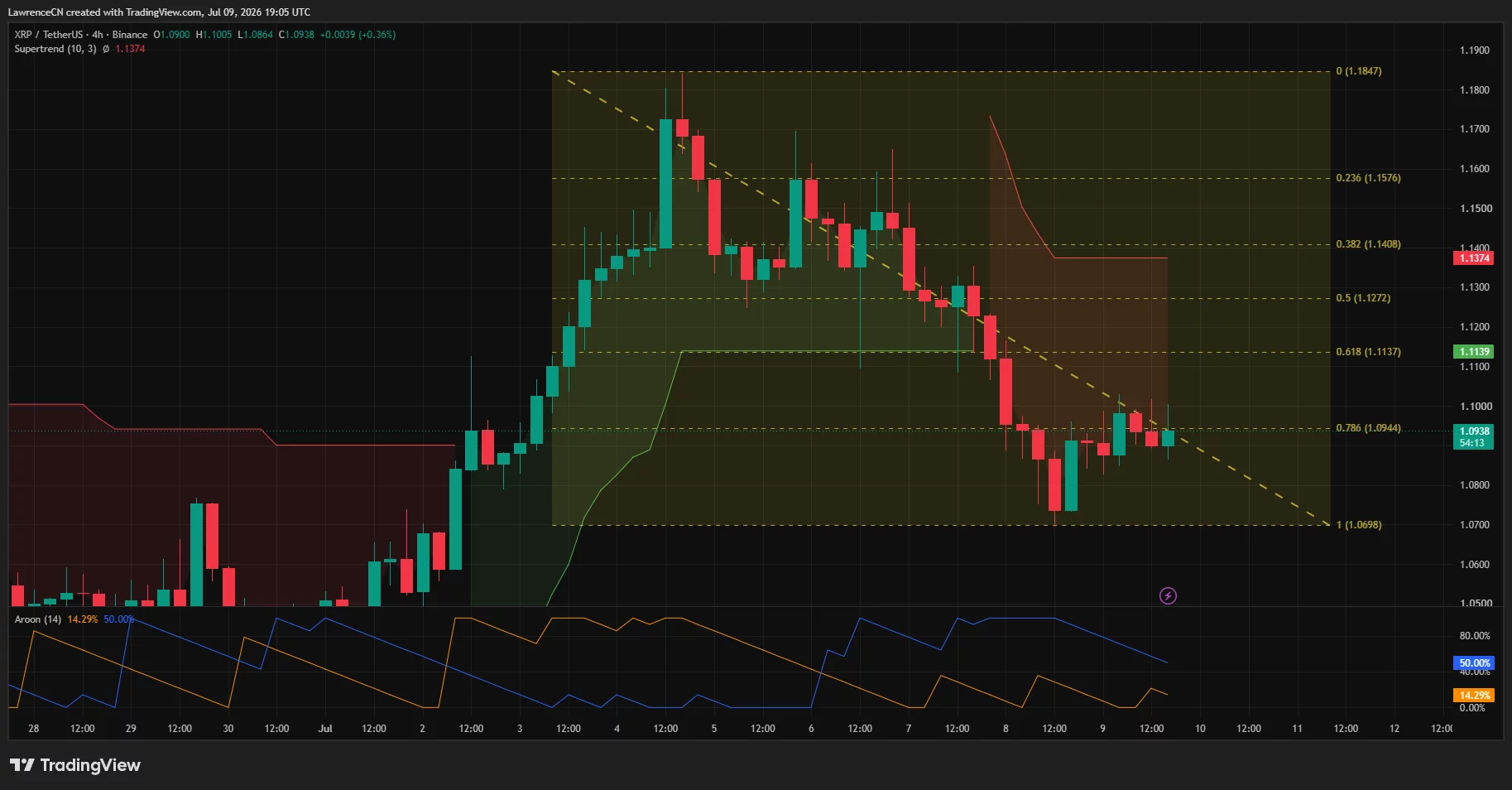
Despite those reservations, XRP (XRP) traded around $1.09 at the time of writing, posting modest daily gains as traders reacted to the banking partnership news.
Institutional demand has weakened despite the price bounce
At the same time, institutional positioning has moved in the opposite direction. Data from SoSoValue shows that spot XRP exchange-traded funds recorded $7.29 million in net outflows on July 8, the largest single-day withdrawal since March 2026.
The outflows indicate that institutional investors have reduced exposure even as XRP attempts to stabilize above the $1 level. If buying interest continues to soften, the psychological $1 support could come back into focus during the next leg lower.
Derivatives markets also paint a cautious picture. CoinGlass data shows XRP’s long-to-short ratio has slipped to 0.96, meaning bearish positions now slightly outnumber bullish bets. Open interest has also fallen from $2.58 billion on July 5 to $2.33 billion on July 9, suggesting speculative traders have been closing positions instead of opening new ones.
Technical indicators continue to favor sellers
Price action on XRP’s charts remains mixed despite the latest recovery. On the 4-hour chart, XRP is trading below the Supertrend indicator while repeatedly failing to reclaim a descending trendline. The token is also struggling near the 78.6% Fibonacci retracement level around $1.094, which has become immediate resistance after the recent selloff.
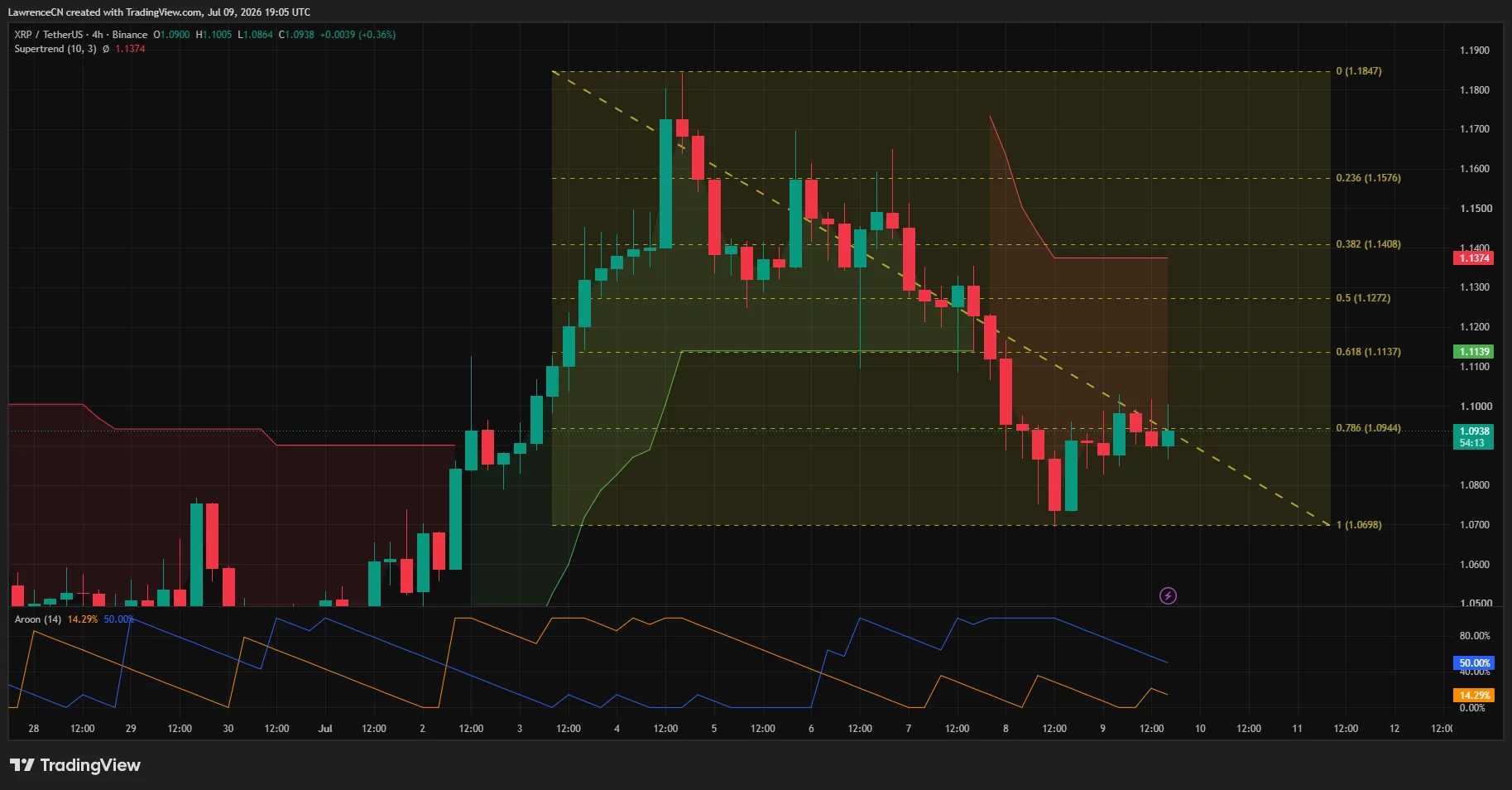
Additional resistance levels sit near the 61.8% and 50% Fibonacci retracement zones at roughly $1.114 and $1.127. A sustained move above those levels would be needed to weaken the current bearish structure.
The daily chart also suggests buyers have yet to regain control. Although the MACD remains above its signal line, the histogram has started to fade, indicating bullish momentum is slowing. At the same time, the Chaikin Money Flow has turned only slightly positive, pointing to limited capital inflows rather than strong accumulation.
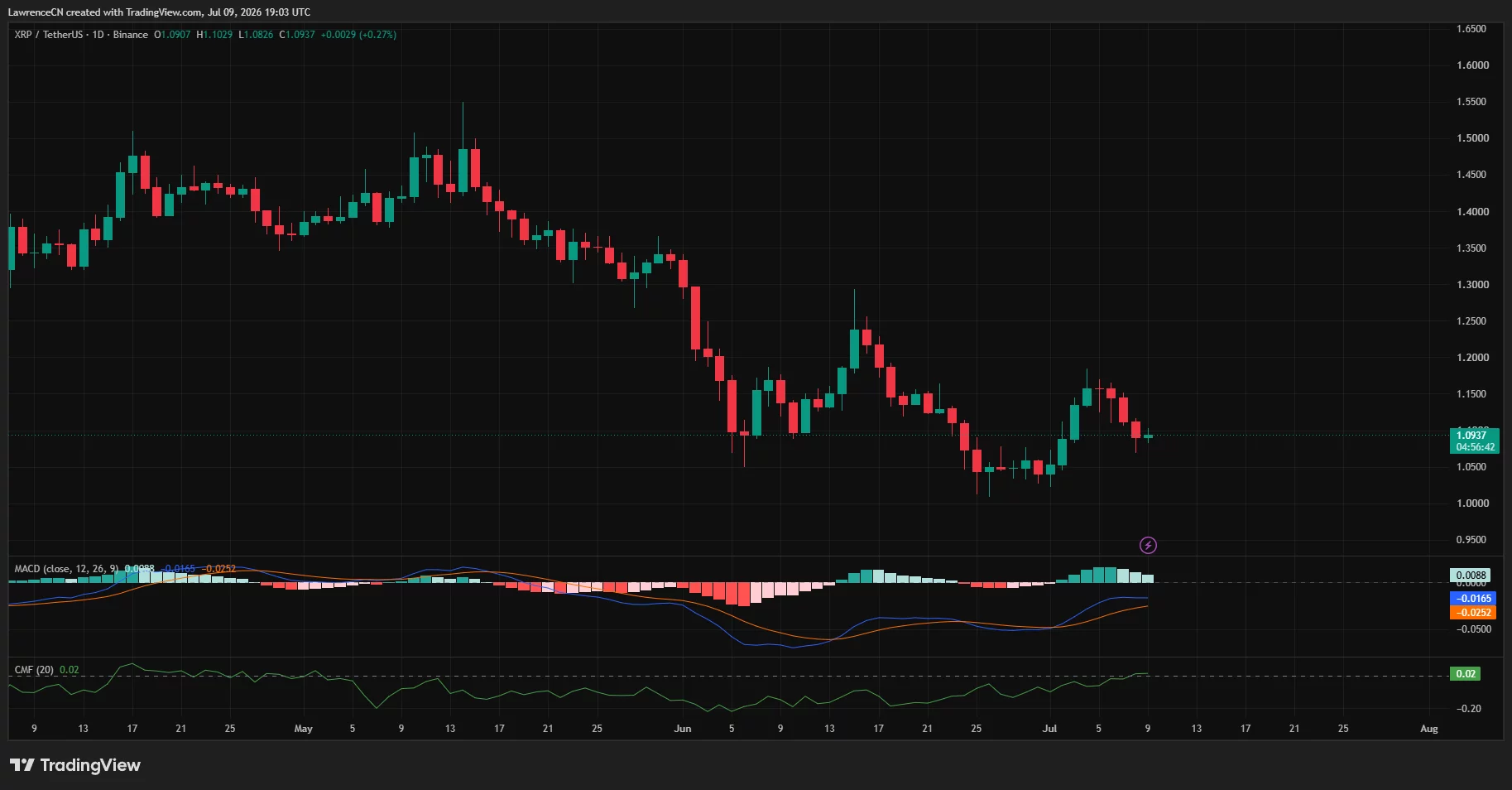
Taken together, the technical setup aligns with the latest derivatives and ETF data. While the SWIFT announcement has helped lift sentiment in the short term, XRP still faces resistance from weakening speculative demand, institutional outflows, and a chart structure that continues to favor sellers unless key resistance levels are reclaimed.
Disclosure: This article does not represent investment advice. The content and materials featured on this page are for educational purposes only.
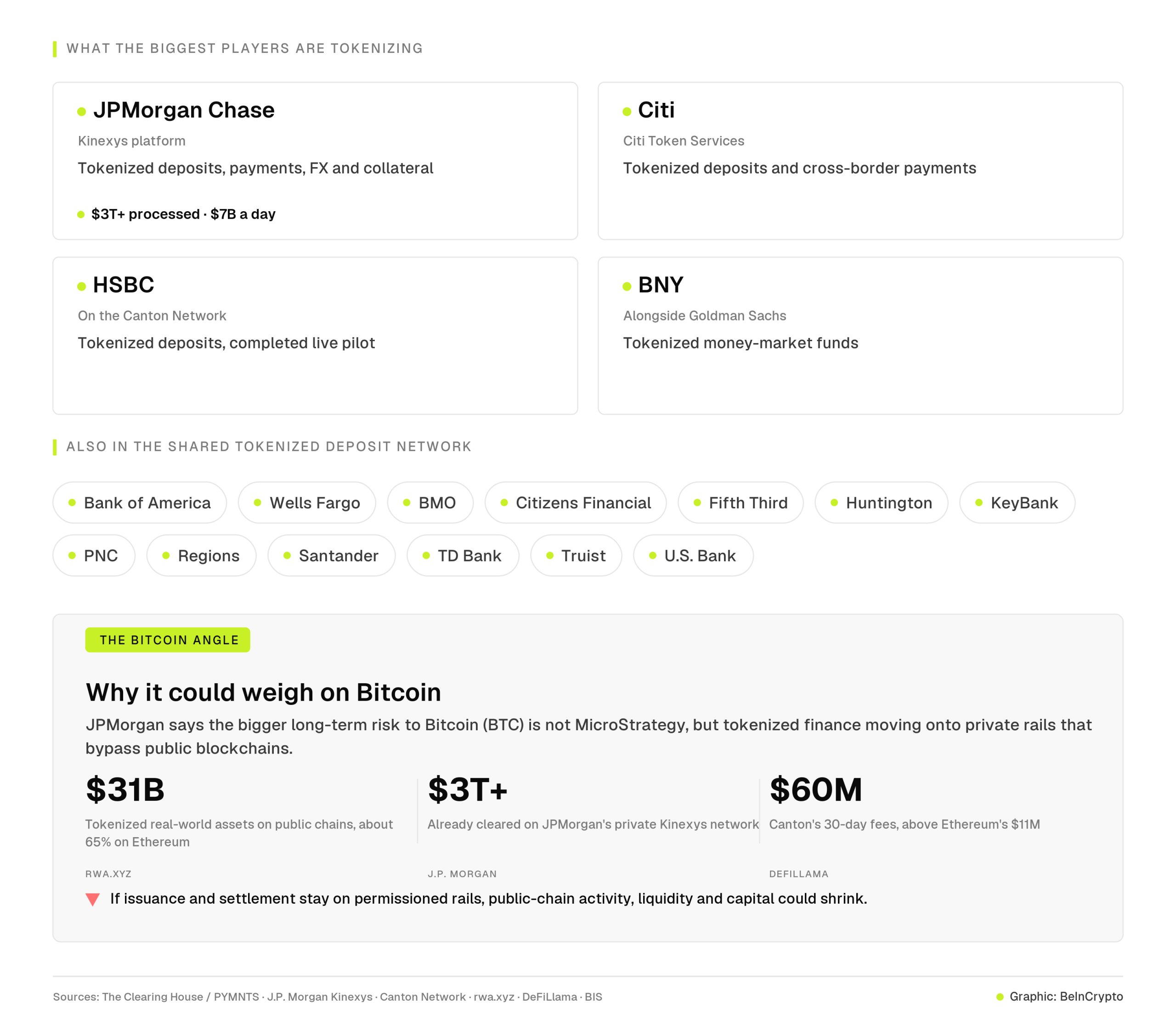
More than 15 of the world’s largest banks are building tokenized finance on private blockchains, and JPMorgan says that shift, not MicroStrategy, poses the bigger long-term threat to Bitcoin (BTC).
The bank’s analysts, led by Nikolaos Panigirtzoglou, argue that if payments and assets move onto permissioned networks, public blockchains could lose activity, liquidity, and capital over time.
Wall Street Is Building Tokenized Finance at Scale
JPMorgan’s Kinexys platform has processed more than $3 trillion since inception and now clears over $7 billion a day. JPMorgan built it as Onyx in 2020 and renamed it Kinexys in 2024, as CEO Jamie Dimon kept criticizing Bitcoin.
Much of this activity runs on shared permissioned networks. On the Canton Network, DTCC is tokenizing the U.S. Treasuries it custodies, with a 2026 target. HSBC has completed a tokenized deposit pilot there, and Goldman Sachs settles tokenized bonds on the same rails.
That institutional pull now shows up in the fee data. Canton ranked as a top fee-generating chain this year. It earned about $60 million in the 30 days to late June, versus $11 million for Ethereum, according to DeFiLlama.
The push extends well beyond any single firm. More than 15 major banks are named in a shared tokenized deposit network from The Clearing House. The effort is part of a wider move to tokenized institutional settlement, targeting a 2027 launch, according to PYMNTS.

Why the Trend Could Weigh on Bitcoin
In a July 9 report, JPMorgan said the main risk to Bitcoin is blockchain adoption that skips public networks. Institutions prefer permissioned systems for their governance, privacy, and legal certainty.
The Bank for International Settlements has echoed that caution. It warned that public permissionless blockchains face scalability and financial-integrity challenges, and it backs regulated unified ledgers instead.
The stakes are measurable. Public chains host about $31 billion of tokenized real-world assets, roughly two-thirds of it on Ethereum (ETH), according to rwa.xyz.

JPMorgan expects much of that issuance and settlement to move to permissioned rails as the market grows.
However, the analysts framed MicroStrategy as a secondary concern. Its roughly 4% of Bitcoin’s supply and new MicroStrategy Bitcoin sales policy add short-term volatility, not a structural threat.
The counterargument is that Bitcoin’s value rests on scarcity and neutrality, not on powering everyday finance. Some advisors already prefer stablecoins and tokenization over direct Bitcoin exposure.
For now, banks are setting the pace, adopting blockchain on their own terms. Whether public networks capture a meaningful share of tokenized markets could define the next phase of crypto adoption.
The post Over 15 Banks Race to Tokenize Finance, and It Could Affect Bitcoin appeared first on BeInCrypto.

TLDR:
- The CLARITY Act faces a fresh political hurdle as White House officials and Senate Democrats dispute vacant SEC and CFTC seats.
- The CFTC vacancies matter since the crypto bill could give the agency broad authority over spot digital commodity markets.
- White House officials said they requested Democratic nominee names for SEC and CFTC seats but had not received a response.
- Senate talks now include nominations, ethics language, DeFi rules, and the timeline for passing the wider crypto bill.
The CLARITY Act has moved into a new Senate pressure point as the White House and Democrats trade claims over vacant SEC and CFTC seats. White House officials told Senate leaders that the administration sought Democratic names for both agencies but had not received them.
Democrats have argued that missing commissioners weaken the agencies expected to shape digital asset rules. The dispute now lands ahead of a possible vote on the crypto bill. The CFTC issue carries extra weight since the agency could receive broad spot crypto market authority under the proposal.
CLARITY Act Enters Senate Talks With CFTC Vacancies
The staffing clash centers on the CFTC, a five-member agency now operating with only Chair Michael Selig in place. Lawmakers have pressed the White House to submit a full slate of nominees before the Senate moves further on the crypto bill.
The White House letter, sent to John Thune and Chuck Schumer, rejected Democratic claims that the administration has blocked minority-party nominees. Officials said Democrats had not supplied names despite earlier requests. They also cited other Democratic nominations to argue that the administration had not shut out opposition-party picks.
The fight has become part of a broader negotiation over the CLARITY Act. Senate Democrats still want changes tied to ethics rules, DeFi oversight, and agency staffing. Those issues matter since the bill likely needs Democratic votes to clear the Senate filibuster threshold.
CFTC vacancies also give Democrats a practical argument. A full commission could make future crypto rules look more durable and bipartisan. A single-commissioner agency may move faster, but opponents could challenge the process once rules hit courts.
Officials also pointed to Trump v. Slaughter, a recent Supreme Court ruling tied to presidential authority over independent agencies. That reference adds constitutional weight to a dispute already shaped by Senate procedure.
CLARITY Act Rulemaking Timeline Raises Agency Risk
The CLARITY Act would divide digital asset oversight between the SEC and CFTC. The CFTC would oversee spot markets for digital commodities, while the SEC would handle assets and sales that fall under securities law. That split is central to the crypto bill.
The proposal would also put regulators on a deadline. The agencies would need to write rules covering exchange registration, custody, disclosures, and market boundaries. That workload could test the CFTC if vacancies persist.
Selig has said the agency can move without a full commission. Supporters of faster rulemaking say the crypto market needs federal standards after years of enforcement-driven policy. For exchanges and token issuers, the main question is whether Congress can pass rules before another election cycle shifts priorities.
Opponents see a different risk. If the CLARITY Act hands major authority to an understaffed CFTC, the first rulebook could face political and legal attacks. That would reduce the certainty the bill aims to create.
The White House and Democrats are now arguing over who must move first. The administration says it needs Democratic names. Democrats say the president must fill the agencies that would enforce any new crypto law. The nomination fight now sits beside the Senate calendar, with the August recess approaching and the crypto bill still waiting for floor action.


Motorists purchase gas at a station in Chicago, Illinois, June 9, 2026.
Scott Olson | Getty Images

WTI Crude 5-day chart.
On Thursday, the national average of gas prices was at $3.84, according to AAA, up 5 cents from the day prior. The rise comes as U.S. oil prices rose as high as $75 per barrel on Wednesday, up from around $68 per barrel on Monday. However, WTI crude eased to below $72 per barrel on Thursday.
While traders on Kalshi think gas prices will remain higher for longer, they also don’t see them returning to new highs. They give just a 43% chance gas prices cross $4.60 this year, although that’s up from about a one-in-three chance before renewed hostilities between the U.S. and Iran.
The high for gas prices in 2026 was on May 21, when the average hit $4.56. Before the war with Iran began, the national average for U.S. gas prices was below $3 per gallon.
Disclosure: CNBC and Kalshi have a commercial relationship that includes customer acquisition and a minority investment.
Crypto World
Market Movers Today: PepsiCo Earnings Miss, SK Hynix ADR Surge, AstraZeneca Trial Fails, and Oil Retreats
Quick Summary
- PepsiCo exceeded revenue forecasts but stock declined due to sluggish North American snack performance and conservative forward guidance
- SK Hynix’s American Depositary Receipt offering received overwhelming demand, fueled by aggressive AI investor interest
- AstraZeneca stock tumbled following the failure of its experimental cardiovascular drug in late-stage clinical testing
- U.S. equity markets advanced amid geopolitical uncertainty, with AI-focused and mega-cap technology stocks leading gains
- Crude oil prices retreated, providing relief on inflation pressures and boosting airline and consumer-facing sectors
PepsiCo Surpasses Revenue Targets Yet Stock Slides
PepsiCo delivered quarterly revenue figures that topped analyst expectations, supported by robust international performance and effective pricing strategies across its portfolio of global brands.
However, the stock declined in trading. Market participants focused their attention on disappointing performance in North American snack categories and management’s conservative forward-looking commentary.
This response highlights the elevated bar companies face during this earnings cycle. Forward guidance has increasingly become the critical factor influencing stock movements rather than historical performance.
PepsiCo’s quarterly report offers valuable insight into consumer spending patterns and inflationary pressures. Analysts will be monitoring whether the North American weakness reflects company-specific challenges or signals broader consumer market trends.
SK Hynix ADR Offering Sees Extraordinary Investor Interest
Memory chip manufacturer SK Hynix experienced overwhelming demand for its U.S. American Depositary Receipt offering, with subscriptions coming in at multiple times the available shares, demonstrating robust appetite for AI-related semiconductor investments.
The South Korean company manufactures high-bandwidth memory solutions essential for AI servers and cloud data infrastructure, positioning it strategically within the ongoing artificial intelligence infrastructure expansion.
The strong market reception indicates that investor enthusiasm for premium semiconductor companies remains solid, despite recent turbulence across the broader technology sector.
AstraZeneca Shares Decline Following Clinical Trial Disappointment
AstraZeneca experienced a significant stock decline after announcing its experimental cardiovascular therapy failed to achieve its primary efficacy measure in Phase 3 clinical trials.
The disappointing outcome pressured sentiment across the pharmaceutical industry. While clinical trial setbacks are a routine aspect of drug development, market participants responded quickly to the news.
AstraZeneca maintains a robust development pipeline spanning oncology, respiratory conditions, and rare disease treatments. Market attention will now turn to forthcoming regulatory decisions and the company’s remaining advanced-stage development programs.
Equity Markets Advance Despite Global Tensions
Both the S&P 500 and Nasdaq finished trading sessions in positive territory as market participants concentrated on corporate earnings and artificial intelligence stocks rather than international political developments.
Ongoing situations in the Middle East were tracked by investors but appeared to exert minimal influence on overall market trajectory during the trading day.
The market’s stability demonstrates a strategic pivot toward second-quarter corporate outlooks, which are anticipated to be the primary driver of stock valuations in coming weeks.
Crude Oil Prices Retreat from Recent Highs
Crude oil prices declined following a period of increased volatility, delivering some welcome relief regarding inflationary concerns.
Decreasing oil prices typically provide advantages to airline carriers, retail businesses, and consumer-oriented companies through reduced fuel expenses and lower operational costs. They can also diminish pressure on central banking institutions working to control inflation.
OPEC+ supply determinations and continuing geopolitical situations will continue to serve as critical variables influencing energy market dynamics in the immediate future.


Federal Reserve Chair Kevin Warsh has appointed a high-profile group of economists, former central bankers, and technology leaders to help review how the US central bank conducts monetary policy.
While the initiative is not focused on digital assets, the inclusion of prominent Bitcoin supporter Marc Andreessen has drawn attention from crypto investors looking for signs of a more technology-aware Federal Reserve.
Warsh Launches Sweeping Fed Policy Review
The Federal Reserve announced five independent task forces on Thursday to examine communications, balance sheet policy, inflation frameworks, economic data, and the impact of artificial intelligence on productivity and employment.
“The Federal Reserve’s commitment to price stability and maximum employment is unwavering,” Warsh said in the central bank’s announcement. He added that the reviews will assess whether the Fed’s analytical tools and policy approaches can be improved.
Follow us on X to get the latest news as it happens
Among the advisers leading the review, include:
- Former Bank of England Governor Mervyn King
- Former Reserve Bank of India Governor Raghuram Rajan
- Former Brazilian central bank chief Arminio Fraga
- Nobel laureate Thomas Sargent, and
- Harvard economist Greg Mankiw
Bitcoin Bull Joins AI Task Force
The appointment attracting the most attention from crypto markets is Andreessen, the co-founder of Andreessen Horowitz and one of Silicon Valley’s most influential Bitcoin and blockchain investors.
Andreessen will co-lead the Productivity and Jobs task force with Stanford economist Charles I. Jones and Microsoft Xbox CEO Asha Sharma.
The group will study how AI and other emerging technologies could reshape economic growth and labor markets, factors that directly influence monetary policy.
Although the review does not include cryptocurrency regulation, Andreessen’s participation introduces a well-known digital asset advocate into discussions that could shape how the Fed evaluates technological change.
The task forces are expected to submit recommendations to the Federal Open Market Committee by year-end. Investors across traditional and crypto markets will closely watch whether the findings influence future thinking on inflation, productivity, and interest rates, all of which remain key drivers of Bitcoin’s long-term outlook.
The post Warsh Taps AI, Crypto, and Global Finance Heavyweights to Rethink US Monetary Policy appeared first on BeInCrypto.
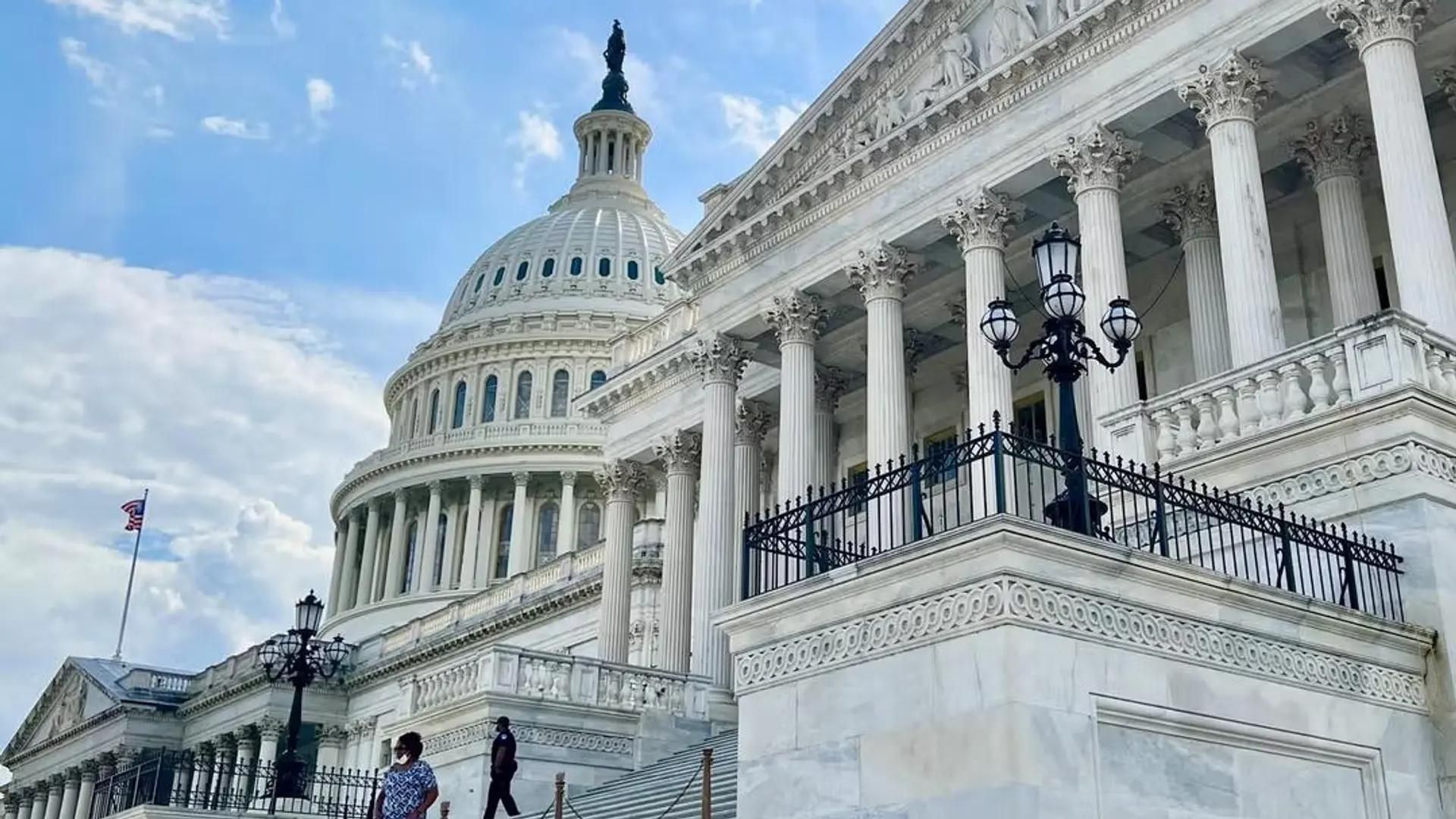
The unified version of the Clarity Act — which is said by one person to have had more than 70 pages of text added — hasn’t yet solidified a position on the major sticking point: A Democrat-demanded restriction keeping senior government officials (including the president) from maintaining business ties with the crypto sector. Without a compromise on such ethics limits, several lawmakers have said they won’t vote yes on a final bill.
The merged text that may be released next week will not represent a simple combination of the two bills the respective committees voted to approve earlier this year. Both committees’ members negotiated on outstanding issues — the Agriculture Committee more so, given that bill was voted out of committee on strictly partisan lines — and the updated bill is said to reflect the results of that process, putting more emphasis on consumer protections.
The bill’s advocates expect it to reach the Senate floor as soon as the week of July 20, though the lawmakers have a lot of work left.
Beyond ethics, outstanding issues include federal preemption, and negotiators still need to come to a final agreement on filling the Securities and Exchange Commission and Commodity Futures Trading Commission. Earlier Thursday, the White House sent a letter to Senators John Thune and Chuck Schumer, respectively the majority and minority heads in the Senate, saying Democrats had not put forward any names for the minority roles on these commissions.

World Cup 2026: Erling Haaland urges pressure on England before quarter-final

Shanling M0 Pura Is a Tiny Hi-Res Digital Audio Player With Serious iPod nano Energy

Burnham Guaranteed To Be Next Prime Minister After Avalanche Of Support From Labour MPs


-

 Fashion6 days ago
Weekend Open Thread: High Hopes
-
 NewsBeat5 days ago
Taylor Swift and Travis Kelce wedding staffer hilariously struggles to keep her cool while checking in megastars
-

 Crypto World6 days ago
Standard Chartered Secures MiCA License as ESMA Adds 37 New Crypto Firms
-

 Fashion3 days ago
Open Thread: What Great Books Have You Read Recently?
-

 Politics6 days ago
The House | “Reframing the debate from a binary discussion of winners and losers”: Yuan Yang reviews ‘We Are Not Machines’
-

 Fashion10 hours ago
Loro Piana Fall 2026 Enters Houston’s Art Scene
-

 News Videos3 days ago
Whats Hidden Inside This Cash Register? #treasure #reselling #money
-
 Tech3 days ago
Anthropic’s new “J-lens” reveals a silent workspace inside Claude that mirrors a leading theory of consciousness
-
Crypto World6 days ago
ESMA Expands Crypto Register by 37 Firms Following MiCA Transition Period
-

 Business3 days ago
AXT Shares Jump Nearly 14% as Semiconductor Materials Maker Rebounds on AI-Linked Indium Phosphide Demand
-

 Sports2 days ago
Joshua Pacio ‘more complete’ ahead of ONE rematch vs Malachiev
-
Crypto World3 days ago
SK hynix (000660.KS) Stock Dips as $28B Nasdaq ADR Offering Drives AI Memory Expansion
-

 Crypto World4 days ago
South Africa proposes crypto tax guidance under existing rules
-

 News Videos3 days ago
Best Time to Enter Small Caps Right Now? Another Bull Run? | Financially Free
-

 Tech4 days ago
Lenovo laptops are now shipping with YMTC SSDs, a sign of Chinese NAND entering the mainstream
-

 Business7 days ago
What a 10 Percent Drop Means for Buyers, Sellers and Renters
-
Sports2 days ago
We have punished the disrespect
-

 Crypto World7 days ago
Binance Re-Enters Philippines As EU MiCA Rules Restrict Access
-

 News Videos3 days ago
Avoid entering in FOMO #bitcoin #cryptocurrency #trading #scalping
-

 Crypto World7 days ago
Alibaba bans Claude Code over alleged backdoor security concerns
You must be logged in to post a comment Login