

Crypto World
Super Micro Computer (SMCI) Stock Climbs on Red Hat Partnership for Edge AI Solutions


Key Highlights
-
Shares of SMCI advanced 4.67% following the unveiling of edge AI appliances
-
Partnership with Red Hat and Everpure aims to streamline edge AI implementations
-
The solution integrates Kubernetes, storage infrastructure, and edge computing hardware
-
The system leverages Red Hat OpenShift for hybrid cloud AI operations
-
Portworx by Everpure delivers Kubernetes-native storage for decentralized AI applications
Shares of Super Micro Computer, Inc. climbed 4.67% to reach $27.48 as the company strengthened its edge AI capabilities. The stock maintained strong momentum throughout the trading session, closing near its daily peak. The upward movement came after the company unveiled a new Kubernetes Edge AI appliance developed alongside Red Hat and Everpure.
Super Micro Computer, Inc., SMCI
Stock Performance Follows Edge AI Product Unveiling
Supermicro announced pre-validated Kubernetes Edge AI appliances designed for businesses operating computing infrastructure beyond traditional data centers. The integrated solution merges Supermicro’s hardware platform with Red Hat OpenShift and Portworx by Everpure. This combination delivers customers a pre-configured appliance engineered for accelerated implementation.
The product addresses the requirements of organizations deploying AI inference capabilities across geographically dispersed facilities. Target environments encompass retail outlets, manufacturing plants, telecommunications facilities, and isolated business operations. The company’s objective centers on minimizing configuration challenges for distributed infrastructure administrators.
According to the announcement, the appliance accommodates containers, virtual machines, and AI inference processing at remote locations. Customers gain access to an integrated ecosystem encompassing computation, storage, and administrative capabilities. The turnkey solution will be offered through Supermicro’s direct sales channels.
OpenShift Platform Enables Multi-Site Operations
Red Hat OpenShift serves as the foundational Kubernetes application platform within the new infrastructure. This platform enables organizations to deploy and oversee workloads spanning hybrid cloud architectures and edge environments. Through this integration, Supermicro delivers a standardized operational framework across diverse geographic deployments.
The company characterizes the offering as a fully validated, comprehensive solution. This methodology eliminates the requirement for independent validation across hardware components, software platforms, and storage infrastructure. The approach also accelerates deployment timelines for organizations with constrained on-premises technical resources.
This collaboration reinforces Supermicro’s position within the edge computing infrastructure market. The organization currently provides compact server platforms and edge devices across multiple configuration options. Its product lineup accommodates implementations ranging from standalone servers to comprehensive rack-mounted systems.
Everpure Integration Delivers Distributed Storage Capabilities
Portworx by Everpure contributes the Kubernetes-native storage and data orchestration component. This platform consolidates local storage resources on Supermicro edge computing platforms. Organizations can therefore operate fault-tolerant infrastructures without deploying conventional storage arrays at individual locations.
The storage architecture provides high availability, data safeguarding, and autonomous functionality during connectivity interruptions. This capability proves essential for remote installations that cannot rely on continuous centralized network access. Additionally, it enables organizations to implement uniform storage governance across edge and cloud environments.
Supermicro’s Data Center Building Block Solutions approach underpins this product introduction. This methodology employs validated building blocks to construct flexible infrastructure tailored to diverse customer requirements. The Red Hat and Everpure collaboration represents another strategic advancement in the company’s edge AI expansion efforts.




Exchange reserves have fallen to a seven-year low of about 1.6 billion XRP, half what they were at the October 2025 peak. ETFs have absorbed nearly a billion tokens. Ripple still holds roughly 36 billion in escrow. This is the full map of where XRP’s supply actually sits in mid-2026, what moved, what it means, and why a shrinking float has so far failed to move the price.
Summary
- XRP exchange reserves have fallen to a seven year low while spot ETFs have accumulated nearly one billion tokens and long term holders continue moving coins into private wallets.
- Ripple still controls about 36 billion XRP in escrow, but steady monthly releases and relocks have not stopped exchange balances from shrinking to multi year lows.
- The report says tighter supply alone has not lifted XRP’s price, with weak market demand continuing to outweigh the effects of a declining tradable float.
Something unusual is happening to XRP’s supply, and it is happening quietly, underneath a price chart that has spent 2026 telling a story of decline. Exchange reserves, the pool of tokens sitting on trading venues ready to be sold, have fallen to roughly 1.6 billion XRP, the lowest level in seven years and down about 50% from the October 2025 peak of 3.76 billion. On Binance alone, the largest venue for the asset, reserves have dropped 20% since November 2024 to about 2.6 billion tokens across its wallets, pushing a metric called the Scarcity Index to its highest reading in more than two years. Meanwhile the seven US spot ETFs have quietly accumulated more than 970 million XRP, locked in custody on behalf of fund holders, after nine consecutive weeks of net inflows.
Tokens are leaving the places where they can be sold and accumulating in the places where they tend to sit still. In most assets, that migration is the textbook setup for a supply squeeze. In XRP, the price has fallen anyway, trading near $1.13, down roughly 70% from its July 2025 peak of $3.65, through the entire period in which the float was tightening.
That contradiction is the story. This piece maps the full distribution of XRP’s supply as of mid-2026: what sits on exchanges, what the ETFs hold, what Ripple controls in escrow and operational wallets, and what the remaining tens of billions in private hands are doing. It then works through why a halving of exchange reserves has not produced the price response the squeeze thesis predicts, the competing explanations for the gap, and the specific conditions under which a tight float starts to matter. The supply side of XRP has rarely been this interesting; the demand side is the reason nobody has noticed.
The map: 100 billion tokens, five buckets
XRP’s supply structure is unlike any other major asset, and the map has to start from its founding fact: all 100 billion tokens were created at launch in 2012. There is no mining, no issuance schedule, no future supply beyond what already exists. About 14 million XRP have been permanently destroyed as transaction fees since then, a rounding error, leaving total supply just below 100 billion. Everything else is a question of where the existing tokens sit, and in mid-2026 they sit in five buckets.
The first bucket is Ripple’s escrow, the largest single concentration of XRP in existence at roughly 36 billion tokens, about 36% of total supply. These are time-locked on-chain contracts releasing one billion XRP on the first of each month, of which Ripple typically relocks 600 to 800 million and keeps a net 200 to 300 million for operations, a mechanism this publication has explained in full. In July, Ripple relocked about 70% of the monthly billion, releasing 300 million into circulation. The escrow is the structural overhang critics cite and the transparency mechanism defenders praise, and either way it is the slowest-moving bucket: at current net-release rates, depletion is roughly nine years out.
The second bucket is circulating supply proper, about 62 billion tokens, and the remaining buckets are subdivisions of it. Exchange reserves, the third bucket, are the sellable edge of the market: roughly 1.6 billion tokens across venues, the seven-year low. The fourth bucket is the ETF complex: seven US spot funds holding a combined 970 million or so tokens, a bit over $1 billion in assets, tokens held by custodians and effectively removed from trading circulation for as long as fund investors stay put. The fifth bucket, by far the largest slice of circulating supply, is everything else: private wallets, corporate treasuries, whale cold storage, and long-term holders, somewhere near 59 billion tokens whose owners have, on the evidence of on-chain data, been net withdrawers from exchanges for over a year.
Two things stand out from the map. First, the actively tradable float, the exchange reserves, is now under 3% of circulating supply and under 2% of total supply, remarkably thin for a top-six asset by market value. Second, the two fastest-growing buckets, ETF custody and private cold storage, are both one-way doors in the short term: tokens flow in easily and come back out only when holders make an affirmative decision to sell.
What moved, and why
The reshaping of the map over the past eighteen months has three drivers, each visible on-chain.
The first driver is the ETF complex, which did not exist before November 2025. Since the first spot XRP fund launched, the products have absorbed roughly $1.5 billion in cumulative inflows, and because they hold the underlying token, every dollar of inflow is a market purchase moved into custody. The funds have now recorded nine consecutive weeks of net inflows, adding $17 million in the latest week even as Bitcoin and Ethereum funds bled, a rotation this publication has tracked. Nearly a billion tokens now sit in ETF custody, and the mechanism only reverses if fund investors redeem at scale, which, so far, they have done on exactly one notable day, the quarter-end outflow of June 30.
The second driver is whale and institutional withdrawal. CryptoQuant data shows the Binance drawdown accelerating recently, from about 2.8 billion tokens in May to 2.6 billion in early July, exactly the window in which the Scarcity Index broke out to 0.77. Large-holder activity has strengthened while retail stays cautious, new-wallet creation hit a three-month high, and Korean venues have recorded repeated multi-million-token outflows. The pattern, tokens moving from hot exchange wallets to cold private ones, is the classic signature of accumulation by holders with no near-term intention to sell.
Notably, this is the reverse of December 2024, when the Scarcity Index collapsed because holders were depositing XRP onto Binance in bulk to sell the rally to $3; today’s flows run the other way, out of the venues, into storage, at prices two-thirds lower.
The third driver is the escrow’s steady arithmetic. Ripple’s net release of 200 to 300 million tokens a month adds roughly 4-6% to circulating supply annually, a bounded, scheduled inflation the market can model years ahead. In 2026 the company has if anything leaned conservative, relocking 70% in recent months, and part of what it does release goes to institutional counterparties off-exchange, never touching the tradable float at all. The escrow is a source of supply, but it is a metered one, and its pace has not changed while the exchange drawdown accelerated, which means the drawdown is demand-side behavior, not a supply-side trick.
The puzzle: a tightening float and a falling price
Here is where the story stops being simple. Every element above, reserves halved, ETFs absorbing, whales withdrawing, metered issuance, belongs to the standard playbook of a supply squeeze, the setup in which shrinking availability meets steady demand and the price ratchets upward because sellers become scarce. XRP has instead spent 2026 falling, from $2.41 in January to near $1 in late June, before the modest recovery to $1.13. The float tightened; the price halved. Any honest supply analysis has to explain that, and there are three serious explanations, not mutually exclusive.
The first is that scarcity on exchanges measures potential, not pressure. A thin order book amplifies whatever demand arrives; it does not create demand. Through 2026, demand has been the missing side: derivatives open interest collapsed from last year’s highs, retail participation stayed weak, funding rates flipped decisively negative as price approached $1, and ETF inflows, while persistent, ran at a pace of tens of millions per week, roughly the same order of magnitude as Ripple’s monthly net escrow release in dollar terms. Australian lawyer and longtime XRP commentator Bill Morgan has made the sharper version of this point: neither the supply-squeeze thesis nor the older escrow-dump fear explains XRP’s price well, because the dominant variable is simply Bitcoin, which fell through the same months and dragged the whole market with it. On this reading, the tight float is dry tinder, and 2026 has been a year without a spark.
The second explanation is that the headline reserve numbers may overstate the tightness. Skeptics of the squeeze thesis note that measured exchange reserves depend on which wallets analysts attribute to which venues, that internal transfers can masquerade as outflows, and that estimates of total platform-held XRP across all venues and custodians run far higher than the headline 1.6 billion, with some placing 14 to 16 billion tokens within fast reach of order books. The February-March episode in which roughly 350 million XRP dipped and rebounded on Binance, likely internal wallet reshuffling rather than organic flow, illustrates how noisy the data is. If the true sellable supply is several multiples of the visible reserve, the squeeze is further away than the dashboards suggest.
The third explanation is structural: the sellers who matter are not on exchanges yet. Millions of tokens were accumulated between $1.50 and $1.90 during the spring’s failed rallies, and holders underwater at those levels represent a standing wall of supply that will migrate back onto exchanges precisely when price approaches their break-even. Add Ripple’s monthly release and the possibility of ETF redemptions in a risk-off shock, and the tight float is best understood as tight at current prices, with reinforcements waiting at higher ones. Santiment’s MVRV data showing holders at their deepest unrealized losses in the token’s history cuts both ways: it signals capitulation-grade sentiment, and it also marks exactly where the exit orders cluster.
How to read the metrics without fooling yourself
Because the supply story runs on a handful of dashboards, and because those dashboards are routinely misread in both directions, a short field guide to the metrics is worth the space.
Exchange reserves are an attribution exercise, not an audit. Analytics firms tag wallets they believe belong to venues and sum the balances, which means the headline number moves when tagging improves, when exchanges reorganize custody, and when internal transfers cross the tagged perimeter, none of which involves a single token changing owners. The 350 million XRP that appeared to leave and re-enter Binance across February and March was almost certainly internal wallet management, and any single week’s reserve print should be read with that episode in mind. The signal is in the trend across months and across independent data providers, and on that standard the 2026 drawdown is robust: the direction has been consistent since late 2024, it appears in CryptoQuant, exchange-published data, and third-party trackers alike, and it has accelerated instead of mean-reverting.
The Scarcity Index is a ratio, and ratios have two moving parts. The index compares available supply on Binance against demand conditions, so it can rise because tokens leave, because buying absorbs, or both, and it can whipsaw, as it did on the round trip from 0.80 in spring to 0.34 in June to 0.77 in July, without the underlying reserve base moving anywhere near as violently. Its historical extremes are more informative than its level: the deeply negative readings of December 2024 marked holders flooding coins onto the venue to sell a top, and the current two-year high marks the opposite regime, coins leaving into weakness. As a regime indicator it has value; as a timing tool it has embarrassed everyone who used it as one this year.
ETF holdings are the cleanest series in the entire picture, because fund custodians disclose and the products file, which is why the roughly 970 million tokens across the seven funds is the number this piece leans on hardest. Even here, one habit matters: distinguish flows from assets. Net assets fall when the price falls even while inflows continue, which is exactly what happened through the spring, deposits arriving as valuations shrank, and reading the AUM decline as investor exit inverted the truth. Flow data, positive for nine consecutive weeks, is the demand signal; asset data is mostly a price echo.
Escrow figures, finally, come with the strongest health warning of all, because the number that matters is not the billion that unlocks but the net that stays out, and the net is only knowable after the relock lands days later. Ripple’s own quarterly reports, the on-chain escrow contracts, and the monthly relock transactions are all public, and the discipline is to compute the net against the trailing 200-to-300-million average before drawing any conclusion. A month in which the net spikes above the band is a genuine signal about the company’s cash needs; a month of headlines about a billion-token unlock that ends in a 70% relock, like this July’s, is a signal about headlines. Every metric in this story is public, which is XRP’s genuine advantage as an object of analysis, and every one of them rewards the reader who checks the denominator before repeating the numerator.
What history says about tightening floats
The squeeze thesis is not being invented for XRP in 2026; it has a track record in this asset and others, and the record is worth consulting because it cuts both ways.
The supportive precedent is 2024. Exchange outflows through that year preceded the powerful multi-month rally that carried XRP from under a dollar to its January 2025 highs above $3, with Korean regional demand and shrinking sell-side reserves amplifying the move once the SEC settlement and ETF approvals supplied the demand spark. The structure of that episode maps closely onto today’s: months of quiet withdrawal, a scarcity metric stretching to extremes, skeptics dismissing the data, and then a catalyst arriving into a market with far fewer sellers than buyers expected. Holders who lived through it read the current seven-year-low reserves as the same picture at an earlier frame.
The cautionary precedents are just as instructive. The Scarcity Index itself has whipsawed within 2026: it climbed to nearly 0.80 in the spring, sagged to 0.34 by late June amid heavy long liquidations, then broke out to 0.77 in the first week of July, and the price fell through the entire sequence. A metric that can round-trip that violently inside one quarter is measuring flow conditions, not destiny, and the June reading arrived alongside more than $13 million in single-day long liquidations, a reminder that leverage positioning can overwhelm spot scarcity on any given week. December 2024 offers the mirror lesson: reserves ballooned precisely at the top, as holders raced to deposit and sell the $3 rally, which is to say the metric is at its most bullish after prices have already fallen and its most bearish after they have already risen, a lagging emotional gauge as much as a leading structural one.
The broader crypto record adds a final nuance. Bitcoin’s great supply-squeeze narratives, the 2020-21 exchange exodus, the post-ETF custody absorption of 2024, each eventually mattered, and each mattered on the demand side’s schedule, not the supply side’s. Assets have sat at multi-year reserve lows for quarters while prices drifted, and then repriced in weeks once flows arrived, because a thin float does nothing until someone leans on it, at which point it does everything at once. That asymmetry, long stretches of irrelevance punctuated by sudden amplification, is the honest historical summary, and it is why the traders who take the supply map seriously express the view through patience and position sizing, the same execution discipline any thin market demands, rather than through timing calls the data cannot support.
There is one more structural actor worth watching that previous cycles lacked: the corporate and fund treasuries. Beyond the seven ETFs, a growing roster of listed companies has adopted XRP treasury strategies, and the ETF custodian wallets themselves have become the single most legible accumulation channel in the asset’s history, absorbing roughly 750 million tokens in their first two months alone. Treasury demand is slower and stickier than trader demand, it neither chases rallies nor panics in drawdowns on the same timescale, and its growth quietly raises the floor beneath the float. Whether it grows fast enough to matter against escrow issuance is, like everything in this story, a race whose lap times are published monthly.
What would make the float matter
The supply map becomes decisive only when demand shows up, so the forward-looking question is what could supply the spark, and the candidates are concrete.
The nearest is legal. The CLARITY Act’s commodity classification for XRP, if enacted, is the gate behind which the large conditional forecasts sit: JPMorgan and Standard Chartered have each projected $4 to $8.4 billion in first-year ETF inflows under passage, an order of magnitude above the current run rate.
Flows of that size, arriving into a float of under two billion exchange-held tokens, are the scenario in which the scarcity math stops being academic; the Senate’s three-week window is therefore as much a supply-side story as a regulatory one. The second candidate is institutional adoption converting to token demand through collateral and settlement use, the slow path whose honest accounting runs through Ripple Prime, and the third is simply the market cycle: XRP has historically fallen harder than Bitcoin in downturns and snapped back harder in recoveries, and a thin float mechanically steepens the snapback.
Against these, the checkable risks: a CLARITY failure pushing institutional flows past 2027, ETF inflows decelerating or reversing for consecutive weeks, or reserves rebuilding as underwater holders redeposit into any rally. The dashboard for all of it is public. Exchange reserves, the Scarcity Index, weekly ETF flows, and the monthly escrow relock are each published within days, and together they will show the squeeze forming, or failing, in close to real time.
The conclusion the map supports is narrower than either camp’s slogan. XRP’s tradable supply has genuinely, measurably contracted to multi-year lows while long-horizon buckets absorbed the difference, and that contraction has been irrelevant to price for a year because demand collapsed faster than the float did. Scarcity is not a catalyst; it is a multiplier waiting for one. The honest position is that XRP enters the second half of 2026 with the most squeeze-prone supply structure it has had since at least 2019 and no evidence yet of the demand that would trigger it, which makes the supply map neither bullish nor bearish on its own, but the single best lens for judging how violently the price will move when the demand question, one way or the other, finally resolves.
One final frame is worth carrying away, because it reconciles everything above into a single sentence: XRP in mid-2026 is an asset whose company is accumulating credentials, whose long-horizon holders are accumulating tokens, and whose traders have spent a year accumulating losses, and the supply map is the ledger on which all three behaviors are legible at once. The reserves data records the holders’ conviction, the ETF flows record the institutions’ patient entry, the escrow relocks record the company’s restraint, and the price records the absence, so far, of anyone forced to compete for a shrinking float. Markets in this configuration tend to resolve abruptly rather than gracefully, because thin floats do not permit gradual repricing in either direction: the same scarcity that would turbocharge an inflow shock also means a demand collapse finds few bids on the way down, which is the double edge the squeeze narratives rarely mention. The map says the stage is set. It has never claimed to know the play.
For readers who want to run the numbers themselves, the recipe is short. Take the circulating supply of roughly 62 billion, subtract the ETF custody balance published in the funds’ daily disclosures, subtract the aggregated exchange reserves from at least two independent trackers, and treat the remainder as the private-holder bucket whose behavior the withdrawal trends describe. Cross-check the month’s escrow arithmetic against the on-chain relock, and note the week’s ETF flow direction. Fifteen minutes of public data, repeated monthly, reproduces every structural claim in this piece and will catch the turn, whichever way it breaks, well before the headlines do.
The last variable, as always with this asset, is the one no dashboard tracks: how much of the withdrawn supply belongs to hands that will actually hold through the next stress test. Cold-storage balances built at $1.10 by buyers who watched the token at $3.65 carry a different resolve than balances built chasing a rally, and the 2026 drawdown has, if nothing else, transferred an unusual share of the float to owners who bought weakness deliberately. That is not a prediction. It is the one qualitative fact the quantitative map quietly implies, and the one that will decide whether the next demand shock meets a wall of break-even sellers or an empty room.
Disclaimer: This article is for informational purposes only and does not constitute investment advice. Digital asset markets are volatile and you can lose your entire investment. On-chain and market figures are estimates current as of July 8, 2026, and may change. Always do your own research.
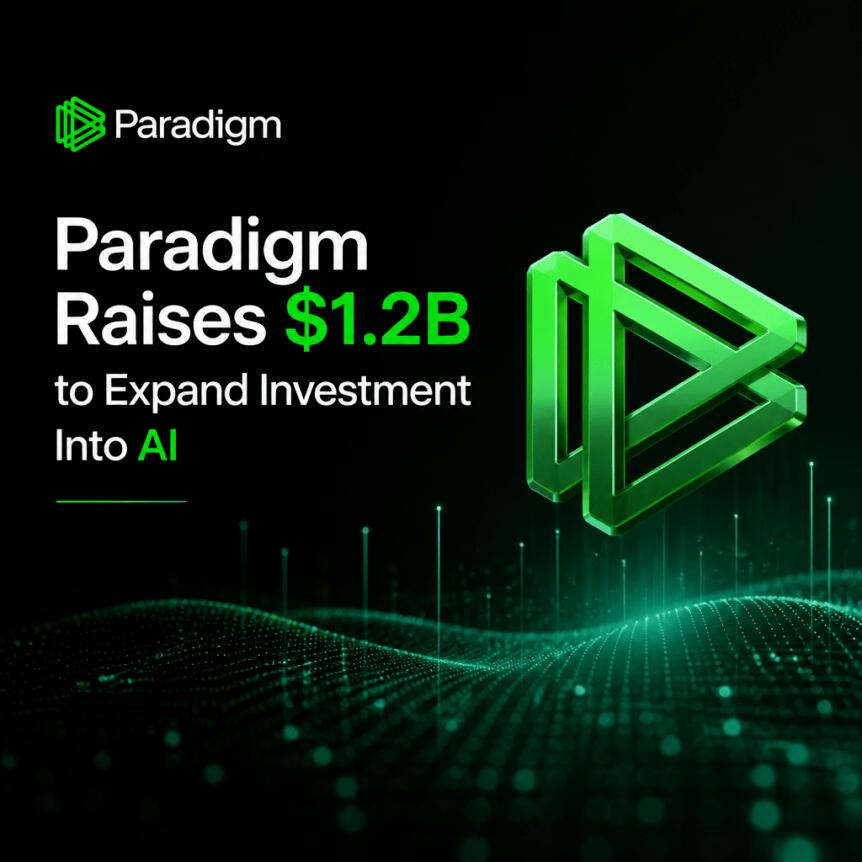
Paradigm, one of crypto’s best-known venture capital firms, has secured $1.2 billion for its fourth fund—an expansion that formally opens the door to artificial intelligence, robotics and other “frontiers” beyond its historical focus on crypto.
In an announcement on Wednesday, the firm said the fund will deploy capital “first in crypto, and now across AI, robotics and other frontiers,” while reiterating its ongoing commitment to investing in digital assets and the “reinvention of markets” and finance.
Key takeaways
- Paradigm raised $1.2B for Fund IV, shifting from a strictly crypto mandate to an AI-and-robotics umbrella.
- The firm’s strategy remains anchored in crypto, but it is explicitly adding investment areas where it sees overlap—especially with AI agents.
- Paradigm’s history shows continuing momentum: it launched in 2018 and has raised more than $4B across three earlier crypto-focused funds.
- Broader venture capital trends appear to be pulling capital toward AI, with global VC hitting new highs in the first half of 2026 and AI dominating deal flow.
- Crypto-specific funding is smaller: Cryptorank data cited in the article shows $10.8B raised for crypto in the first half of 2026.
Paradigm’s shift: from crypto-only to “frontiers”
Paradigm launched in 2018 and has historically raised capital for crypto-centric investments. The new Fund IV indicates a structural change in how the firm intends to allocate—without walking away from its core thesis.
In its Wednesday update, Paradigm pointed to existing crypto bets, including the perpetuals trading venue Hyperliquid and the prediction markets platform Kalshi. The firm also framed its move as a continuation rather than a break: it wants exposure to the reinvention of markets and financial infrastructure, while adding adjacent technological areas that can shape how those systems function.
Alongside the new mandate, Paradigm referenced non-crypto investments in sectors where robotics and AI have practical, execution-oriented use cases. The announcement included examples such as Zipline (autonomous drone delivery), SendCutSend (robotic metal fabrication), and Nous Research, which created the open-source AI model Hermes Agent.
Why Paradigm is looking beyond crypto now
Paradigm’s decision follows a wider pattern in the venture market: companies built around crypto are increasingly attracted to AI—both because of investor demand and because of overlap in applications. The article notes that AI agents are one area where the two worlds can intersect, which helps explain why a firm accustomed to crypto infrastructure would consider the AI stack strategically relevant.
The rationale described in earlier reporting also suggests a timing and deal-access component. The Wall Street Journal reported in February that Paradigm was seeking to raise $1.5 billion for a new fund focused on AI and robotics. According to that reporting, the management team broadened its scope to avoid being limited to a narrower mandate and potentially missing out on attractive opportunities.
This “scope expansion” theme matters for investors because it can change how venture capital firms participate in cycles. A broader fund can allow the same decision-makers to fund related technologies without forcing founders and co-investors to fit a strict category label. For crypto builders, it can also mean easier continuity in support—especially when projects blend on-chain systems with machine learning workflows or agent-based software.
A sectorwide pull: AI VC money dwarfs crypto flows
Paradigm’s move lands amid a macro shift in venture capital allocation. The article cites Crunchbase reporting that global venture funding reached a record $510 billion in the first half of 2026—surpassing the $440 billion invested across all of last year. According to the piece, AI accounted for the majority of those investments, with OpenAI and Anthropic together responsible for more than 40% of funding in that period.
At the same time, crypto’s share of the broader VC pie is far smaller. The article cites Cryptorank data indicating that total funding into crypto in the first half of 2026 reached $10.8 billion.
For readers tracking capital formation, the implication is straightforward: even if crypto innovation continues, the funding “weather” is increasingly driven by AI growth. When AI dominates venture attention, crypto-focused firms may feel pressure—either to expand their mandates to compete for deals or to risk sitting on the sidelines when startups pitch to AI-heavy investors.
What Paradigm says it will keep doing
Paradigm’s announcement emphasizes that it does not intend to abandon crypto. The firm stated it would “continue to research and build where it accelerates” within the crypto industry, while also expanding research and investment capacity in adjacent areas.
The firm also referenced tools and efforts connected to blockchain development, including Foundry and Reth, plus AI projects EVMbench and Centaur (as named in the article). For investors and builders, those references signal that Paradigm sees crypto’s technical evolution as intertwined with new AI-adjacent infrastructure and measurement tools—rather than as a completely separate track.
Paradigm’s broader framing also suggests it expects a continuing interplay between application layer innovation and the infrastructure layer that underpins it. That matters for funding decisions because many crypto businesses now compete not only on product differentiation, but on execution speed, developer tooling, and integration with emerging automation and agent workflows.
Looking ahead, the key question for the market is whether Paradigm’s expanded fund will primarily follow AI deal flow—or whether it will successfully translate that AI momentum back into crypto-specific outcomes. Investors watching the next wave of fundraising and deployment will likely focus on whether “AI agents” and robotics-backed projects generate measurable demand for crypto infrastructure, or whether the overlap remains mostly thematic for now.


Ripple’s prime brokerage sits inside the DTCC’s clearing directory, holds a seat in the 50-firm tokenization working group, and clears more than three trillion dollars a year. The XRP community reads that as quadrillions coming to the ledger. The mechanics say something much narrower. Here is the honest accounting of how much of Ripple Prime’s business reaches the token, and what would have to change for that number to grow.
Summary
- Ripple Prime clears more than $3 trillion in annual trades, but only a small portion of that activity currently creates direct demand for XRP.
- Most institutional settlement within Ripple’s ecosystem now relies on the RLUSD stablecoin, while XRP’s role remains largely limited to fees and internal collateral.
- Ripple’s position in the DTCC tokenization working group could expand XRP’s future use, but broader adoption depends on third party collateral acceptance and official integration into tokenized market infrastructure.
On March 2, 2026, a company called Hidden Road Partners CIV US LLC appeared in the participant directory of the National Securities Clearing Corporation, the subsidiary of the Depository Trust and Clearing Corporation that clears essentially every stock trade in the United States. Hidden Road is Ripple Prime, the institutional brokerage Ripple bought for $1.25 billion and rebranded, and within hours the listing had been declared proof that XRP was being wired into a system that processes roughly four quadrillion dollars in annual settlement. Ripple’s own chief technology officer emeritus, David Schwartz, allowed himself two words: seems important.
It was important. It was also almost universally misread. The listing did not connect XRP to anything; it registered a brokerage as a market participant, the same mundane onboarding that dozens of firms complete every month, with the actual clearing handled through Pershing, a BNY subsidiary, on rails that never touch a blockchain.
Analysts spent the following weeks correcting the record, and the correction never caught up with the headline. Four months later, with Ripple Prime seated in the DTCC’s tokenization working group and the DTCC’s July pilot for tokenized securities beginning, the same confusion is being recycled at larger scale.
This piece does the accounting the headlines skip. It walks through what Ripple Prime actually is and what its DTCC credentials actually grant, the three and only three mechanical paths by which any of its volume can reach the XRP token, the uncomfortable finding that the asset doing the money work inside Ripple’s own empire is mostly not XRP, the genuine long-game case that the working-group seat represents, and the specific, checkable signals that would show the story changing.
The number at the end is smaller than the community hopes and larger than zero, and knowing which parts are real is worth more than either extreme.
What Ripple Prime is, and what the DTCC credentials actually grant
Ripple Prime is the largest acquisition in Ripple’s history and one of the largest in crypto’s. In April 2025 Ripple agreed to pay $1.25 billion, partly in XRP, for Hidden Road, a prime broker that gives hedge funds and trading firms a single account for clearing, financing, and settlement across traditional and digital assets. The deal closed in October 2025, the business was rebranded Ripple Prime, and it now clears more than $3 trillion in trades annually for over 300 institutional clients, making Ripple the first crypto company to own a global, multi-asset prime broker. By any measure it is a serious Wall Street business, and it has roughly tripled in size since the acquisition was announced.
The DTCC connections came in sequence. In March 2025, before the acquisition even closed, Hidden Road was accepted into the FICC Government Securities Division, gaining access to Treasury clearing. On March 2, 2026, it went live in the NSCC participant directory with an executing broker code, and in late June the DTCC’s new near-round-the-clock clearing service switched on with Ripple Prime already plugged in. In May 2026, the DTCC named Ripple Prime to the roughly 50-firm Industry Working Group shaping its tokenization service, alongside JPMorgan, Goldman Sachs, BlackRock, Citi, Circle, and Ondo Finance. That service began limited production trades of tokenized Russell 1000 equities, major ETFs, and Treasuries this month, July 2026, with a full launch planned for October.
Each credential is real. None of them puts XRP inside the DTCC. The NSCC listing registers Ripple Prime as an ordinary broker whose over-the-counter trades are cleared and settled through Pershing on the DTCC’s existing, entirely non-blockchain infrastructure; the notice itself shows the clearing code belonging to the BNY subsidiary. The working-group seat is a chair at a standards table, not a contract; the group exists to write rules that all 50 members can live with, and several of those members, most prominently JPMorgan with its Kinexys platform, run their own competing tokenization ledgers. The DTCC’s tokenization service is not built on the XRP Ledger, and the DTCC itself has never said otherwise. When the $4 quadrillion figure appears next to XRP in a headline, the connective tissue between the two numbers is aspiration, not plumbing.
The three paths from volume to token
Strip away the noise and there are exactly three mechanical routes by which Ripple Prime’s business can create demand for XRP, because there are only three ways any business creates demand for any token: paying fees in it, posting it as collateral, or using it as the settlement asset. Each path exists. Each is currently narrow.
The first path is ledger fees. Ripple committed, in its own acquisition announcement, to migrating Hidden Road’s post-trade activity onto the XRP Ledger, and to the extent that record-keeping and settlement operations move on-chain, every transaction burns a tiny amount of XRP as a fee. The arithmetic is brutal, though. XRPL fees are fractions of a cent, and the ledger’s total fee burn since 2012 amounts to roughly 14 million XRP, a rounding error against a 100 billion token supply. Even trillions of dollars of post-trade flow, fully migrated, would generate fee demand measured in thousands of dollars a day. Fees make the ledger useful; they do not make the token scarce.
The second path is collateral. Ripple Prime accepts XRP as collateral for margin and settlement within its own brokerage, and its CEO Mike Higgins has been explicit about the ambition: Bitcoin, Ethereum, XRP, and Solana tokenizing anything of value as collateral for margin and settlement is the next step, as he put it in May. Collateral demand is real demand, because tokens posted as margin are tokens bought and held. But note what the current arrangement is: Ripple’s own brokerage accepting Ripple’s own asset. For collateral demand to matter at scale, firms that are not Ripple would need to accept and hold XRP as margin, and that requires the legal certainty of commodity classification plus risk-committee approval at institutions that have their own preferred assets. It is a path, and today it mostly runs in a circle.
The third path is settlement, and here the finding is the uncomfortable one: inside Ripple’s own product stack, the asset doing the settlement work is predominantly RLUSD, the company’s dollar stablecoin, not XRP.
The third path is settlement, and here the finding is the uncomfortable one: inside Ripple’s own product stack, the asset doing the settlement work is predominantly RLUSD, the company’s dollar stablecoin, not XRP. Traders post RLUSD as margin on partner venues, use it to back Bitcoin options on Bullish, and move it as the cash leg across Ripple Prime’s products. The landmark tokenized-Treasury settlement Ripple executed with JPMorgan, Mastercard, and Ondo cleared in seconds on the XRPL, and the instrument that carried the money was RLUSD. This is not a betrayal; it is design. Institutional settlement requires a stable, audited, dollar-denominated instrument, and an asset that can move ten percent in a day is disqualified from the cash leg by definition. Ripple built RLUSD precisely to capture the settlement flow that XRP’s volatility rules out, a dynamic this publication has examined in detail, and every institutional win that runs through RLUSD is a win for Ripple, for the ledger, and only residually for the token.
Add the three paths together honestly and the present-day answer to the headline question is: a sliver. Fee burn is negligible, collateral is real but largely internal, and settlement flows to the stablecoin. The $3 trillion is genuine; the fraction of it that translates into XRP demand today is small enough that no serious estimate puts a meaningful number on it.
The bear case: one candidate among several
The skeptical reading of the whole DTCC story goes further than the fee arithmetic, and it deserves a fair hearing because it is held by people who understand post-trade infrastructure.
Start with the working group. Goldman Sachs and JPMorgan are not at that table to help Ripple; the dealer community sits on standards bodies to make sure no standard threatens its own position. JPMorgan’s Kinexys is the largest bank-run tokenization platform in existence, and several other members operate internal ledgers of their own. The most likely output of a 50-firm committee is a standard that lets each major dealer plug in its own preferred infrastructure, which would leave the XRP Ledger as one candidate among several rather than the settlement layer of tokenized American securities. A standard that anointed a single external blockchain would be an anomaly in the history of Wall Street consortia.
Then there is the DTCC’s own multi-chain behavior. In late May the DTCC announced it would integrate the Stellar network into its tokenized securities platform as the first public blockchain in its strategy, and XLM rallied more than 80% on the news. Whatever one thinks of that choice, it shows that the DTCC is comfortable naming chains when it has chosen them, and it has not named the XRPL. The 2025 DTCC patent filings that reference Ripple and XRPL alongside Bitcoin, Ethereum, and Hedera describe compatible architectures, and patents are exploratory documents, not procurement decisions.
Finally, the circularity problem shadows every internal metric. Ripple Prime accepting XRP as collateral, Ripple’s stablecoin settling Ripple’s pilots, Ripple’s ledger hosting Ripple’s products: the empire is impressive and self-referential, and the market has learned to discount announcements in which Ripple is both counterparties. The token’s price behavior through 2026, sliding through a year of institutional wins to trade near $1.13, down roughly 70% from its 2025 peak, is the market pricing exactly this discount. Skeptics do not deny the infrastructure is real. They deny that infrastructure ownership by the token’s issuer, absent third-party adoption, constitutes token demand, and on the evidence to date they have been right.
The bull case: the seat is the point
The strongest version of the bullish argument does not dispute the accounting above. It argues about time and position.
Institutional settlement is repetitive, high-volume, and extraordinarily sticky once integrated. The firms that write the standards for tokenized securities will shape which ledgers are even eligible to carry that flow for decades, and Ripple bought its way into the only room where those rules are being written, at the only moment the writing is happening. No other crypto-native company holds an NSCC credential, an FICC seat, and a working-group chair simultaneously. If the eventual standard is multi-ledger, as the bears expect, then eligibility becomes the prize, and Ripple Prime exists to make the XRPL eligible, integrated, and operationally proven when the flow starts to move. The July pilot and October launch of the DTCC’s tokenization service are precisely the on-ramp: Russell 1000 equities, ETFs, and Treasuries in tokenized form, with Ripple Prime positioned as a broker that can hold and finance those assets and, where clients choose, connect them to XRPL-based collateral and liquidity workflows.
The collateral path is where the bull case gets specific. The joint SEC and CFTC classification of XRP as a digital commodity in March 2026, if made statutory by the CLARITY Act, removes the compliance barrier that keeps third-party risk committees from touching the asset, and the the bill’s progress through the Senate is therefore not background noise to this story but its central variable. A world in which tokenized Treasuries settle at the DTCC, prime brokers finance them around the clock, and XRP is a legally classified commodity accepted as cross-margin collateral at multiple brokerages is a world in which the second path widens from a circle into a market. Higgins’ collateral remark is the roadmap, and the roughly tripled size of Ripple Prime’s business since acquisition suggests institutions are at least walking toward it.
There is also the precedent argument: Stellar’s 80% rally on its DTCC integration happened before anything went live, purely on confirmation of a role. XRP has had no equivalent confirmation, only adjacency, and the bulls read that as meaning the outcome is unpriced. If the working group’s standard, or the DTCC’s later phases, ever names the XRPL the way Stellar was named, the market reaction writes itself. That is a conditional, not a forecast, and the bulls are candid that it is the conditional their entire case rests on.
The July pilot: what actually starts this month
Because the DTCC’s tokenization timeline is the concrete event around which all the speculation orbits, it is worth being precise about what begins now and what does not.
The service launches in two phases. Phase one, this month, is a limited production pilot: real trades, real data, real workflows, but a tightly capped asset pool of Russell 1000 constituents, high-volume index ETFs, and US Treasury bills, notes, and bonds, run across the roughly 50 working-group firms in a controlled environment. Phase two, scheduled for October, is the full-service launch, at which point DTC participants can elect tokenized record-keeping as a standard operational feature. The design is conservative on purpose; the DTCC is not experimenting at the margins of finance but rewiring its center, and it is doing so with the most liquid securities on earth precisely so that any failure is absorbable. A December 2025 no-action letter from the SEC cleared the regulatory path, which is why the schedule has held while so much other crypto policy has slipped.
Ripple Prime’s role in phase one is participant, not platform. It is one of the fifty firms testing workflows, positioned to act as a prime broker on the tokenized rails the way it already acts on the conventional ones, financing and clearing client positions in whatever form the DTCC records them. The XRPL’s role in phase one is, on the public record, nothing, and the Stellar comparison makes the distinction concrete: when the DTCC chose a public blockchain for a component of its multi-chain strategy in late May, it said so by name, XLM repriced 80% in days, and volume ran up ninefold before any integration went live. That is what selection looks like. Adjacency looks like what XRP has: a broker owned by the ledger’s biggest patron, seated at the table, with no chain named. The October full launch is therefore the next hard checkpoint, because a standards document or service specification published then will either mention the XRPL or it will not, and for the first time in this saga there will be a dated, public artifact to check instead of a patent to interpret.
The empire the token funds but does not run
Widening the lens for a moment explains why the accounting above matters beyond one brokerage, because Ripple Prime is not an isolated bet. It is the largest piece of a deliberate, multi-billion-dollar campaign to turn Ripple from a payments company into a diversified Wall Street conglomerate, and the pattern across the whole campaign repeats the pattern inside Ripple Prime: the company grows, the ledger gains infrastructure, and the token’s role stays indirect.
Count the acquisitions. Standard Custody in 2024 brought regulated digital-asset custody. Hidden Road in 2025 brought the prime brokerage, at $1.25 billion the largest deal a crypto company had ever made for a traditional finance firm. Alongside them came treasury-management tooling, the RLUSD stablecoin build-out, a conditional federal bank charter application, and a $200 million debt raise specifically to expand Ripple Prime, nearly $3 billion in deal-making since 2023 by most counts.
Each acquisition slots into a stack that increasingly resembles a bank holding company for digital assets: custody at the bottom, clearing and prime services in the middle, a regulated dollar instrument moving value across all of it, and the XRP Ledger as the technical substrate. The company’s private valuation, around $50 billion, now exceeds what the entire XRP market capitalization was at points during the 2026 drawdown, a comparison the community finds either inspiring or damning depending on the week.
The XRP holder’s stake in this empire is real but oblique. Ripple funds the campaign substantially from its escrowed XRP, which means every acquisition is, in a loose sense, paid for by the token’s supply overhang; holders bear the dilution that finances the buildout. What holders receive in exchange is optionality: a bigger, more credentialed Ripple is more capable of eventually creating the third-party demand the three paths require, and the ledger those paths run through becomes more institutionally acceptable with every license and directory listing the company collects. What holders do not receive is any mechanical claim on the businesses themselves. Ripple Prime’s revenues belong to Ripple’s shareholders, not to XRP, and the same is true of custody fees, stablecoin float income, and whatever the bank charter eventually earns, the structural separation between company and token that has defined this asset since 2012 and that the empire’s growth makes more visible, not less.
The RLUSD subplot deserves its own paragraph, because it is the empire’s fastest-growing organ and the clearest illustration of the pattern. Launched with a regulated, fully reserved design, the stablecoin crossed $1.7 billion in market capitalization within a year, processed more than $18 billion in transfer volume in a single quarter, and for the first time now holds the majority of its supply on the XRP Ledger itself rather than on Ethereum. It is the margin asset on partner venues, the settlement leg in the JPMorgan pilot, the cash instrument across Ripple Prime’s product suite, and Ripple’s ticket into the Open USD consortium alongside Visa, Mastercard, Stripe, and BlackRock. Every one of those roles is a role XRP structurally cannot fill, and each RLUSD milestone therefore reads two ways at once: proof that Ripple’s ledger is winning institutional flow, and proof that the flow’s unit of account is a dollar token whose success accrues to the company. The bulls answer that RLUSD adoption seeds the ledger with exactly the institutional liquidity that XRP-based collateral and bridging would one day plug into, and the answer is coherent; it is also, like everything on the bull side of this story, a claim about sequencing whose first half is observable and whose second half is not yet.
What would actually signal change
Because the two cases disagree about the future rather than the present, the useful exercise is naming the observable events that would settle the argument, and they are unusually concrete here.
The first signal is third-party collateral acceptance: a brokerage or clearing venue that Ripple does not own announcing that it accepts XRP as margin collateral. That single event would break the circularity objection and convert the Higgins roadmap from ambition to fact. The second is a named role in the DTCC build: the XRPL appearing in the tokenization service’s documentation the way Stellar appeared in May, or working-group output that specifies XRPL settlement for any asset class. The third is post-trade migration becoming visible on-chain: Ripple committed to moving Hidden Road’s post-trade activity to the XRPL, and if that happens at scale it will show up in ledger throughput, in escrow-adjacent institutional wallets, and in Ripple’s quarterly disclosures, none of which can be faked. The fourth is legal: CLARITY’s passage converting the interpretive commodity ruling into statute, which gates everything the collateral path requires, and whose precise provisions this publication has mapped.
Against those signals, the counter-signals are equally checkable: a working-group standard that specifies dealer-owned ledgers, the October full launch proceeding with no XRPL role, or Ripple Prime’s growth continuing while its XRPL migration stays a press-release commitment. Watch the RLUSD share of Ripple’s own settlement flow too; if the stablecoin keeps absorbing each new institutional product, as it has across the OUSD consortium and beyond, the token’s role narrows even as the company’s widens.
The honest summary is that Ripple Prime has moved Ripple from crypto’s perimeter into Wall Street’s operational core, and that this is a genuine, hard-won, probably underappreciated corporate achievement whose translation into XRP demand remains, today, mostly prospective. The $3 trillion is real and clears on Pershing’s rails. The quadrillions are real and belong to the DTCC. The token’s share of all of it is currently a fee burn measured in pocket change, a collollateral loop inside one firm, and a settlement role its own issuer assigned to a different asset. What Ripple bought with $1.25 billion is not flow; it is position, the right to be standing at the door if and when tokenized Wall Street opens it. Whether position becomes flow is the entire XRP question for the next two years, and unlike most crypto narratives, this one comes with a checklist.
One number, in closing, deserves to be rescued from both camps: the $1.25 billion purchase price. It is simultaneously the largest sum a crypto company has paid for a traditional finance firm and a rounding error against the flows it positions Ripple beside, and that ratio, enormous by crypto’s standards, trivial by Wall Street’s, is the truest measure of where this story stands. Ripple has bought a seat at the biggest table in finance for the price of a mid-sized protocol’s treasury. What it does with the seat, and whether the token ever shares in the meal, is the part no directory listing can answer.
Disclaimer: This article is for informational purposes only and does not constitute investment advice. Digital asset markets are volatile and you can lose your entire investment. Legislative and market details are current as of July 8, 2026, and may change. Always do your own research.


American CryptoFed has urged the U.S. Securities and Exchange Commission to recognize its Locke governance token registration ahead of an Aug. 17 deadline that the organization says should take effect automatically under federal securities law.
Summary
- American CryptoFed has urged the SEC to recognize its Locke token registration before the Aug. 17 effective date.
- The DAO plans to launch Locke token trading on Uniswap while following SEC disclosure and reporting requirements.
- American CryptoFed said progress on the CLARITY Act could support its stablecoin-linked decentralized monetary system.
According to a memorandum published by the SEC’s Crypto Task Force, agency staff recently met with American CryptoFed DAO founders Scott Moeller and Xiaomeng Zhou to discuss the nonprofit’s latest registration efforts, its governance token, and legal questions surrounding decentralized organizations.
The meeting also covered the group’s long-running push to bring the Locke token under the SEC’s reporting framework.
Locke token registration moves toward Aug. 17 milestone
During the meeting, American CryptoFed told SEC staff that it converted into a Wyoming unincorporated nonprofit association under the state’s UNA/DUNA Act last month. The organization said the restructuring forms part of its latest effort to satisfy regulatory requirements after years of engagement with the agency.
The nonprofit also confirmed that it filed a Form 10 last month to register the Locke governance token as a reporting company under the Securities Exchange Act of 1934.
According to American CryptoFed, the filing should become automatically effective 60 days after submission, setting Aug. 17 as the expected date unless the SEC takes action beforehand.
The filing follows the SEC’s decision in February to dismiss earlier administrative proceedings involving the organization. As described in the Crypto Task Force memorandum, the dismissal encouraged American CryptoFed to consider alternative registration steps rather than ending its pursuit of federal compliance.
American CryptoFed has sought SEC recognition for the Locke token since 2021. During that period, the organization said it revised parts of its proposal, including changes influenced by SEC Commissioner Hester Peirce’s proposed token safe harbor framework, which was designed to give qualifying blockchain projects additional time before securities laws fully apply.
DAO outlines trading and disclosure framework
Looking beyond registration, American CryptoFed told SEC staff it plans to make Locke governance tokens available for trading after receiving regulatory clearance. Initial recipients of the token would be able to trade through the Uniswap decentralized exchange, according to the organization’s presentation.
While acknowledging the compliance challenges associated with decentralized trading, American CryptoFed argued that required disclosures could still be maintained through existing reporting obligations.
Its presentation pointed to Forms 144, 3, 4 and 5 as mechanisms for meeting insider and securities reporting requirements, while also citing SEC guidance stating that the agency “will not normally intervene” in disputes involving the removal of restrictive legends from securities.
Separate from the registration process, American CryptoFed continues to promote its proposal for a decentralized monetary system operating alongside the U.S. Federal Reserve. The organization has said the model is designed to eliminate inflation and deflation, remove transaction costs, and support maximum employment through a stablecoin-linked financial network.
Legislative developments could also influence those plans. American CryptoFed argued that progress on the CLARITY Act would provide a more defined regulatory framework for digital assets.
Separately, crypto-friendly lawmakers, including Senator Cynthia Lummis, have indicated they want the Senate to advance the legislation before the chamber begins its August recess, although the bill’s timing and final outcome remain uncertain.


Liquidation is the moment crypto’s leverage machinery takes your collateral, and it happens two very different ways: exchanges force-closing leveraged trades, and DeFi lending protocols auctioning borrowers’ collateral to keeper bots. This guide explains both systems, the health factor math, the bonus liquidators earn, why liquidations cascade into crashes, and how to read the daily liquidation numbers everyone quotes and few understand.
Summary
- Liquidation is crypto’s automated way of keeping leveraged systems solvent without identity, courts, or credit scores.
- Exchange liquidations force-close leveraged trades, while DeFi liquidations repay unhealthy loans by selling borrower collateral.
- In DeFi lending, the health factor is the core warning signal: above 1 is safe, below 1 is liquidatable.
- Liquidation cascades happen when forced selling pushes prices lower and triggers the next layer of leveraged positions.
- Daily liquidation totals are best read as positioning reports, not as direct predictions of future price direction.
On a single day this week, roughly $410 million of leveraged crypto positions were liquidated inside 24 hours, most of them longs, and the number scrolled past in headlines the way weather does. Days above a billion dollars are not rare; across 2025, more than $150 billion in positions were liquidated across venues. Liquidation is the most routine catastrophe in crypto, the mechanism by which every form of on-chain and exchange leverage enforces its one non-negotiable rule: the debt gets paid, and if you will not pay it, your collateral will.
What the headlines flatten is that liquidation in crypto is actually two distinct systems wearing one name. The first lives on derivatives exchanges, where leveraged perpetual-futures positions are force-closed when losses approach the trader’s margin. The second lives in DeFi lending protocols like Aave and Compound, where overcollateralized loans are enforced by an open market of bots, called keepers or liquidators, that repay underwater borrowers’ debts in exchange for their collateral at a discount. The two systems share a purpose, keeping lenders and venues solvent without trusting anyone, and differ in almost every mechanical detail, and understanding both is close to understanding how crypto’s entire credit machine holds together.
This guide covers the whole territory: why liquidation exists at all, the derivatives version in brief with its margin math and mark prices, the DeFi lending version in depth with health factors, thresholds, bonuses, and the keeper economy, the anatomy of a liquidation cascade, what the insurance funds and bad-debt backstops do when liquidation itself fails, and the practical playbook for keeping your own positions alive.
Why liquidation exists: solvency without trust
Every liquidation system answers the same question: how does a lender who cannot sue you, cannot call you, and does not know who you are make sure a loan gets repaid? Traditional finance answers with identity, courts, and credit scores. Crypto answers with overcollateralization and automation: you post more value than you borrow, and the moment the cushion between your collateral’s value and your debt shrinks toward zero, the system sells your collateral before the cushion is gone. Done correctly, the lender never takes a loss, because the sale happens while the collateral still covers the debt.
Everything else is implementation detail, and the details matter enormously. Liquidate too late and the protocol eats bad debt; liquidate too early and borrowers are punished for noise; misprice the collateral for one block and either error happens at scale. Liquidation design is where a credit system’s real risk decisions live, which is why it deserves more attention than the afterthought paragraph it usually gets.
Liquidation on exchanges: the derivatives version
On derivatives venues, liquidation is the endgame of leverage. A trader posts margin and opens a position several times that size; the exchange continuously marks the position against a manipulation-resistant mark price; and when losses erode the margin to the venue’s maintenance threshold, the engine seizes and closes the position. At 10x leverage a roughly 10 percent adverse move is fatal; at 50x, about 2 percent. The full mechanics, initial versus maintenance margin, mark versus index price, cross versus isolated margin, are covered in this publication’s perps guide, and two points from that machinery matter for what follows.
First, the mark price, an index-anchored, smoothed price, exists so that a momentary wick on one venue’s order book cannot liquidate everyone; you are liquidated against the market’s consensus price, not the last print. Second, when a position is so far underwater that closing it at market recovers less than the debt, exchanges reach for backstops: an insurance fund absorbs the shortfall, and if the fund is exhausted, auto-deleveraging forcibly closes profitable traders on the opposite side to balance the books, a mechanism that cost profitable traders over $50 million during one violent stretch in late 2025. Exchange liquidation, in other words, is a private matter between you and the venue’s risk engine, with socialized losses as the final resort.
Liquidation in DeFi lending: the health factor and the keepers
DeFi lending liquidation is a different animal, public, permissionless, and run by an open market of hunters, and it is the version most explanations skip.
Start with the loan. On a protocol like Aave, you deposit collateral, say ETH, and borrow against it, say USDC, up to a loan-to-value cap well below 100 percent. Each collateral asset carries a liquidation threshold, the LTV at which the position becomes seizable; for major assets this might sit around 80-83 percent, meaning a loan is safe while the debt stays below that fraction of the collateral’s value. The protocol compresses your entire position into one number, the health factor: the value of your collateral weighted by its liquidation thresholds, divided by your debt. Above 1, you are safe. At exactly 1, your position crosses the line. Below 1, anyone on earth may liquidate you.
And anyone does, because liquidation is a paid job. A liquidator repays some or all of your debt to the protocol and receives, in exchange, your collateral worth what they repaid plus a liquidation bonus, typically around 5 percent for major assets and more for volatile ones. Repay $10,000 of an unhealthy borrower’s USDC debt, receive roughly $10,500 of their ETH; the borrower’s remaining collateral shrinks by the bonus, which is the penalty they pay for crossing the line. Most protocols cap how much of a position can be liquidated in one bite, commonly 50 percent of the debt, called the close factor, so a borrower who dips just below 1 is partially liquidated back to health rather than wiped out, though deeply underwater positions can be fully seized.
The hunters are keeper bots: automated programs that watch every loan on every protocol, simulate health factors against live prices, and race to submit liquidation transactions the instant a position crosses 1. The race is ferocious, the bonus goes to whoever lands first, gas auctions and the private relays of the MEV supply chain decide winners by milliseconds, and the capital to repay the debt is very often flash-borrowed, so the entire operation, borrow the repayment, liquidate, sell the seized collateral, repay the flash loan, pocket the bonus, completes inside one atomic transaction. This is the part outsiders find alien: DeFi does not employ a risk department. It posts a bounty and lets mercenaries keep the system solvent, and it works, most of the time, better than the systems it replaced.
One number rules everything above: the price. Health factors are computed from oracle prices, so the entire lending-liquidation apparatus inherits the oracle’s integrity. A stale or manipulated feed liquidates healthy borrowers or spares doomed ones, and oracle failure is behind a large share of DeFi’s historical bad-debt events, which is why serious protocols use aggregated, median-filtered feeds and why borrowers should know which oracle guards their loan.
A worked example: one loan’s journey to liquidation
Numbers make the machinery concrete, so follow a single position from opening to seizure.
A borrower deposits 10 ETH as collateral with ETH at $1,800, collateral value $18,000, on a protocol where ETH carries an 82.5 percent liquidation threshold. They borrow 10,000 USDC, a 55.6 percent loan-to-value, comfortable territory. Their health factor at opening is the threshold-weighted collateral over debt: 18,000 times 0.825, divided by 10,000, equals 1.485. The position can absorb a meaningful drawdown; solving for the price at which the health factor hits 1 gives the liquidation price: debt divided by threshold divided by ETH quantity, 10,000 / 0.825 / 10, which is about $1,212. ETH must fall roughly 33 percent from entry before the keepers come.
Now the market delivers exactly that. ETH slides over two weeks to $1,250, health factor 1.03, and the borrower, watching, does nothing, reasoning the bounce is near. A weekend wick takes ETH to $1,195 for eleven minutes. At $1,212 the health factor crossed 1, and within a block or two a keeper acts: with a 50 percent close factor, it repays 5,000 USDC of the debt and, with a 5 percent bonus, claims $5,250 worth of ETH, about 4.39 ETH at the wick price. The borrower now holds 5.61 ETH backing 5,000 USDC of debt; the health factor resets to roughly 1.11, alive but poorer. The eleven-minute wick cost them $250 in bonus plus the spread on collateral sold at the local bottom, and if the fall had continued, subsequent liquidations could each take their bite until nothing remained.
The counterfactuals are the lesson. Repaying 2,000 USDC of debt at any point before the wick would have lifted the liquidation price to about $970, far below the wick; adding 2 ETH of collateral would have done similar work; and either action would have cost transaction fees measured in dollars against a penalty measured in hundreds. Liquidation almost never happens without a long, visible approach, the health factor decays in public, on-chain, for anyone to see, and the borrowers it takes are overwhelmingly the ones who watched it come.
The same arithmetic scaled up explains the professional side. A keeper repaying $5,000 for $5,250 earned 5 percent on capital deployed for one block, capital that was itself flash-borrowed, meaning the return on the keeper’s own funds, gas and infrastructure aside, approaches the absurd. That yield is the bounty that guarantees no unhealthy loan survives long, and competition for it is why the bounty has not needed to be larger.
Cascades: how liquidations become crashes
Liquidations do not just respond to price moves; past a threshold, they cause them, and the feedback loop is the mechanism behind many of crypto’s sharpest candles.
The anatomy is simple. A price drop pushes a tranche of leveraged positions past their liquidation points. Liquidation is executed by selling the collateral or closing the longs, which is sell pressure, which pushes the price lower, which liquidates the next tranche, which sells, and so on down the order book. Thin liquidity amplifies every leg, because each forced sale moves the price further, the slippage cost that large orders always pay becoming, in aggregate, the crash itself. The cascade ends where the leverage does: when the liquidatable positions are exhausted, the forced selling stops, and price frequently snaps back, leaving a wick that marks exactly how deep the leverage ran. Funding rates, open interest, and liquidation heatmaps let traders estimate where those clusters sit, which is why the derivatives data services publish liquidation maps and why sophisticated actors sometimes push price toward known clusters to set the dominoes off.
DeFi lending adds its own cascade variant with correlated collateral. When a widely used collateral asset depegs or gaps, every loan built on it sickens simultaneously; the 2022 stETH episode, where a liquid staking token’s discount stressed a leverage loop built on it, remains the canonical case study of one asset’s wobble propagating through lending markets as a synchronized health-factor collapse. The lesson generalizes: your liquidation risk is not just your own leverage but everyone else’s leverage in the same collateral.
When liquidation fails: bad debt and backstops
The system’s last chapter is what happens when selling the collateral does not cover the debt, because prices gapped too fast or liquidity vanished. On exchanges, the insurance fund pays, then auto-deleveraging conscripts the winners. In DeFi, the shortfall becomes bad debt on the protocol’s books, and each protocol has its own waterfall: reserve funds accumulated from fees, safety modules of staked tokens that can be slashed to cover deficits, or, historically and controversially, governance deciding who eats the loss. A protocol’s bad-debt record and backstop design are, alongside its oracle, the two lines of due diligence that matter more than its advertised yields, because they are the difference between a lender that survived its worst day and one that socialized it.
One structural nuance completes the lending picture: not all collateral is liquidated the same way. Fixed-bonus seizure of the kind in the worked example is the dominant design, but several protocols instead auction the collateral, Dutch auctions that start above market and decay until a keeper bites, which returns more value to borrowers in calm conditions and can struggle in chaos, as an infamous episode of zero-bid auctions during a 2020 crash proved when network congestion let liquidators win collateral for nothing. Auction versus fixed-bonus, close factors, per-asset thresholds, and oracle choice together form each protocol’s liquidation personality, and experienced borrowers read those parameters the way credit analysts read covenants, because they are the covenants.
Reading the liquidation tape like a professional
The daily liquidation statistics are among crypto’s most quoted and least understood numbers, and extracting their real information takes three habits.
First, read the ratio before the total. A $400 million day that is 63 percent longs says the market fell into a crowded long book; the same total at 85 percent shorts, like the recent session where Bitcoin short liquidations dominated on a squeeze higher, says the opposite: bears were crowded and the move ran them over. The skew identifies which side was overextended, which is the tradable information; the headline total mostly measures volatility times leverage.
Second, treat totals as minimums. Public figures aggregate what venues report, and reporting conventions differ, some exchanges publish only samples of liquidation events, so true forced-closure volume typically exceeds the printed number. Comparisons across time are still meaningful because the undercounting is roughly consistent; comparisons across venues are not.
Third, connect the tape to positioning data. Liquidations are the discharge; open interest and funding rates are the stored charge. Rising open interest with extreme funding is leverage accumulating on one side, the precondition for a cascade; a liquidation spike that coincides with an open-interest collapse means the leverage actually left the system, which is what durable local bottoms and tops are made of, whereas a spike that barely dents open interest means the crowd reloaded and the fuel remains. The heatmap services that estimate where liquidation clusters sit at each price complete the picture, showing the magnets that sharp moves gravitate toward.
None of this predicts direction on its own; all of it describes the terrain, and traders who read the terrain stop being surprised by which moves extend and which reverse violently at a wick.
Keeping your positions alive: the practical playbook
For a borrower or leveraged trader, all of the machinery above compresses into a few habits. Know your number: the liquidation price on a perp, the health factor on a loan, and the oracle both are computed from. Size for the gap, not the trend, because liquidation happens at the wick, not the close, and weekend and low-liquidity hours produce the worst wicks. Prefer isolated margin when experimenting, so one dead trade cannot drain an account, and keep a repayment buffer ready, since topping up collateral or repaying a slice of debt is dramatically cheaper than the liquidation bonus. Watch the crowd as well as yourself: extreme funding, ballooning open interest, and dense liquidation clusters near price are the weather report for cascades. And read the daily liquidation totals correctly: $410 million liquidated, 63 percent longs is not a death toll but a positioning report, telling you which side was crowded, how much leverage just left the system, and, often, why the price wicked exactly where it did.
Liquidation is easy to resent and hard to replace. It is the reason DeFi lending survived drawdowns that killed centralized lenders whose loan books ran on trust and phone calls, and the reason a perp exchange can offer 50x leverage to anonymous traders and remain solvent by Tuesday. The machine is impartial to the point of cruelty, it will take a sleeping borrower’s collateral over a five-minute wick, and its impartiality is precisely the property everything else is built on. The practical wisdom is old and short: the machine cannot be negotiated with, so stay out of its reach.
A closing word on the system’s deeper logic. Liquidation is crypto’s replacement for the entire apparatus of credit assessment, and the trade it makes is time for capital. A bank spends weeks deciding whether you will repay over years; a protocol spends no time at all deciding, demands surplus collateral instead, and enforces continuously. The design is capital-inefficient by construction, you must lock more than you borrow, and in exchange it achieves something credit systems never had: solvency that does not depend on being right about anyone. Every innovation in the space, cross-margin, isolated pools, dynamic thresholds, liquidation auctions that replace fixed bonuses with competitive bidding to return more value to borrowers, is an attempt to soften the capital inefficiency without surrendering the trustlessness, and the frontier of lending design is exactly that negotiation. Understanding liquidation is therefore not just self-defense for the leveraged; it is understanding the load-bearing wall of the whole on-chain credit system, the mechanism every yield, every stablecoin loan, and every leveraged position in DeFi quietly rests on. The wall holds because the machine is merciless, and the machine is merciless so that no one has to be trusted, which is, for better and worse, the entire proposition this industry was built to test.
And for readers who came to this piece from a headline, the translation service one last time: liquidations hit $X billion is not news that money vanished, most of it moved from the margin accounts of the crowded side to the other side of their trades, and it is not a prediction of anything. It is an after-action report on where leverage lived, published by the only market on earth candid enough to print its casualties in real time.
Disclaimer: This article is for educational purposes only and does not constitute investment advice. Leverage and DeFi lending carry significant risk, including total loss of collateral. Protocol parameters cited are typical values as of July 8, 2026, and vary by platform. Always do your own research.
Frequently asked questions
What is liquidation in crypto in simple terms?
Liquidation is the forced closure of a leveraged position or the forced sale of loan collateral when losses approach the point where the debt would no longer be covered. Exchanges liquidate leveraged trades through their risk engines; DeFi lending protocols let anyone repay an unhealthy borrower’s debt and claim their collateral at a discount. In both cases the purpose is the same: the lender or venue is made whole before the borrower’s cushion runs out.
What is a health factor?
The health factor is DeFi lending’s solvency score for a loan: collateral value, weighted by each asset’s liquidation threshold, divided by debt. Above 1, the loan is safe; below 1, it can be liquidated by anyone. It falls when collateral prices drop, debt grows through interest, or borrowed-asset prices rise, and borrowers restore it by adding collateral or repaying debt.
Who actually performs DeFi liquidations?
Automated programs called keepers or liquidator bots. They monitor every loan, and when a health factor crosses below 1 they race to repay the debt and claim the collateral plus a bonus, typically around 5 percent. The capital is often flash-borrowed so the whole operation completes in one transaction. It is a competitive, permissionless business, and the competition is what keeps protocols solvent without any central risk desk.
What is the liquidation penalty or bonus?
They are the same number seen from two sides. The liquidator receives collateral worth more than the debt they repay, commonly about 5 percent more for major assets, as payment for the service; the borrower loses that same amount from their collateral as the cost of crossing the line. Volatile or illiquid collateral carries larger bonuses because liquidating it is riskier.
Why do liquidations cause price crashes?
Because liquidation is executed by selling. A price drop triggers forced sales, which push the price lower, which triggers the next layer of forced sales, a feedback loop called a liquidation cascade. It ends when the clustered leverage is exhausted, which is why violent drops often end in a sharp wick and immediate partial recovery.
Can I lose more than my collateral?
In DeFi lending, no; the collateral is the full extent of your exposure, and any shortfall beyond it becomes the protocol’s bad debt. On derivatives venues, losses are normally capped at your margin, with insurance funds absorbing shortfalls, but certain products and cross-margin setups can allow deficits, so the venue’s terms are worth reading.
What is a partial liquidation?
Most lending protocols cap each liquidation at a fraction of the debt, often 50 percent, called the close factor. A borrower who slips just below health factor 1 is liquidated only enough to restore the position to safety, preserving the rest. Deeply unhealthy positions can be liquidated entirely. Exchanges similarly often reduce positions in steps before full closure.
How do I avoid being liquidated?
Use conservative leverage, monitor your liquidation price or health factor, and act before the line, since adding collateral or repaying debt costs far less than the penalty. Prefer isolated margin for risky trades, size positions for sudden wicks rather than average moves, avoid crowded trades signaled by extreme funding rates, and know which oracle prices your collateral, because your position lives and dies by its feed.
Disclosure: This article does not represent investment advice. The content and materials featured on this page are for educational purposes only.

Disclosure: This article does not represent investment advice. The content and materials featured on this page are for educational purposes only.
DOGEBALL is drawing interest from investors comparing traditional stocks with crypto presales as they seek higher-growth digital asset opportunities.
Summary
- DOGEBALL highlights crypto presales as investors compare digital assets with traditional stocks for growth opportunities.
- Investors weigh stocks versus crypto as DOGEBALL gains attention for its utility-focused blockchain ecosystem and presale growth.
- DOGEBALL positions itself as a utility-driven crypto presale as investors seek early-stage opportunities beyond traditional markets.
Many retail investors stand at a financial crossroads trying to decide where to allocate capital. Traditional stock markets have offered stable, long-term wealth creation for generations. In contrast, the digital asset ecosystem presents rapid technological shifts and massive capital efficiency. Deciding which asset class suits financial goals requires analyzing utility, volatility, and growth horizons.
For growth-focused investors, identifying the best crypto presale to invest in July can change an entire portfolio’s trajectory. Right now, a utility project called DOGEBALL (DOGEBALL) illustrates why many modern investors are shifting their attention from traditional equity shares to decentralized network structures.

Is buying crypto better than stocks?
Traditional stocks offer partial ownership in a legacy company. These assets rely on traditional corporate earnings, economic quarters, and board decisions. While blue-chip shares provide a safe haven during economic uncertainty, their growth parameters are inherently limited by mature markets.
Digital assets operate on 24/7 global liquidity networks. When the best crypto presale to invest in July is identified, it is not just speculating on a price chart. Investors are securing early utility tokens that power decentralized ecosystems. This structural framework offers massive market velocity that traditional corporate equities simply cannot replicate in short timeframes.
Which is best, crypto or stock?
The answer depends entirely on a person’s financial goals and timeline. Stocks are best suited for passive, long-term wealth preservation. However, crypto is the superior choice if the objective is to capture exponential growth from early-stage technological adoption.
The best crypto presale to invest in July bridges the gap between these two models by bringing real-world business utility to digital finance. DOGEBALL is built on a custom Ethereum Layer 2 blockchain called DOGECHAIN. This ecosystem blends play-to-earn gaming with global financial rails. It allows users to send crypto instantly while the receiver gets local fiat currency directly in their bank account. By completely eliminating slow, expensive middleman networks like wire transfers or traditional remittance services, it offers a real utility value that stocks struggle to match.
What is the smartest thing to invest in right now?
The smartest investment strategy always involves identifying undervalued assets before they achieve mainstream public awareness. The best crypto presale to invest in July has already raised over 308K+ from more than 1060+ active participants. It is currently operating in Stage 11 at an early entry price of just $0.001689 per token.
The project has partnered with a specialist Web3 company to manage its official public exchange listing at a confirmed launch price of $0.015. Let us look at a clear math breakdown of what this means for early capital:
Initial Investment: $500
Tokens Secured at Presale Rate ($0.001689): 296,033 tokens
Value at Official Launch Price ($0.015): 296,033 * $0.015 = $4,440
Potential ROI: 787% (8.8x return)
Investors can maximize this trajectory by using the active bonus code DB75. Applying this code grants a 75% bonus in extra tokens on top of their purchase. To support asset scarcity, the team permanently burned 4bn tokens on Monday 11th May 2026, permanently removing 20% of the entire presale allocation.
Prices are low today, but this opportunity will not last. The presale runs on a strict timed schedule spanning 22 total stages. Every single Monday at 21:00 UTC, the current stage ends and a new stage begins with an automatic price increase. Buying early in the week secures the lowest possible entry point before the next tier rise.
How much will $500 of DOGEBALL be worth in 5 years?
At the confirmed exchange launch price of $0.015, a $500 investment made today scales directly to $4440 before public trading begins. Over a 5-year macro window, the value depends on ecosystem adoption.
The native $DOGEBALL token is used to pay for all transaction fees across the entire global payment network. This structural framework creates automated, constant buying pressure. As the DogePay application scales to support 30+ global currencies with zero foreign exchange fees, this ongoing token utility and organic demand could drive long-term valuations significantly higher than the initial listing price.

What is more risky, stocks or crypto?
Stocks carry corporate and macroeconomic risks, such as inflation or shifting interest rates. Crypto carries higher market volatility due to speculative trading cycles. However, savvy investors mitigate this risk by focusing on deep utility projects with verified security protocols.
DOGEBALL addresses asset security directly. Its smart contracts hold a flawless 100% audit score from Coinsult, confirming structural code safety. Furthermore, the DOGEBALL presale mitigates short-term market volatility by utilizing a fixed, predictable 22-stage timed pricing model, giving early buyers an insulated runway of growth before the asset transitions to public exchanges.
For more information, visit the official website, Telegram, and X.
FAQs for the Best Crypto Presale to Invest in July
Is July a bullish month for crypto?
July historically shows strong upward momentum as summer liquidity patterns settle down. For utility-driven assets like the DOGEBALL crypto presale 2026, this positive seasonal sentiment drives active buyer volume right into the timed presale stages before exchange listing.
What is the best upcoming crypto to invest in?
DOGEBALL is a top choice because it combines Layer 2 gaming with direct bank offramps. Unlike regular tokens, it features built-in scarcity through a 4bn token burn and has a guaranteed launch price target of $0.015.
What is the next 1000x crypto?
Cryptos with massive growth potential require micro-cap pricing and real daily utility. DOGEBALL fits this matrix by powering global remittance rails with zero foreign exchange fees, which creates permanent network demand and long-term token value.
Which month is best to buy crypto?
July offers an ideal window to buy early-stage presales before macro market expansions take off. Buying into DOGEBALL right now allows investors to secure tokens at a low rate before weekly Monday price hikes occur.
What are the top 3 cryptos to buy?
Bitcoin provides market safety, Ethereum offers developer infrastructure, and DOGEBALL provides high-margin utility growth. DOGEBALL stands out by letting users claim a 75% token bonus right now using the code DB75 during its active presale.
Disclosure: This content is provided by a third party. Neither crypto.news nor the author of this article endorses any product mentioned on this page. Users should conduct their own research before taking any action related to the company.

Paradigm has raised $1.2 billion for its fourth fund, which will expand the crypto venture capital firm’s investments into artificial intelligence and related technologies.
The company said on Wednesday that its latest fund will invest “first in crypto, and now across AI, robotics and other frontiers.”
“We continue investing in crypto and the reinvention of markets and the financial system,” Paradigm added, highlighting its investments in the crypto perpetuals exchange Hyperliquid and the prediction markets platform Kalshi.
Paradigm launched in 2018 and has raised more than $4 billion for three funds focused on crypto. Its interest in AI follows a trend of originally crypto-focused companies that have been lured to the lucrative and fast-growing sector.
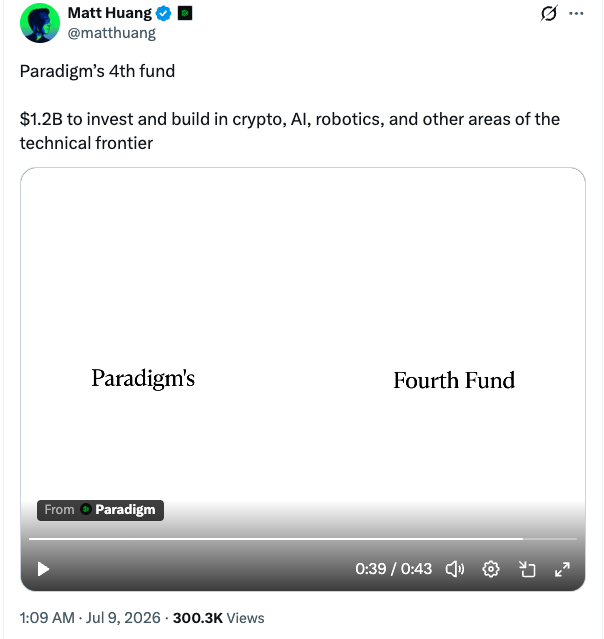
Source: Matt Huang
The Wall Street Journal reported in February that Paradigm was seeking to raise $1.5 billion for a new fund that would invest in AI and robotics.
The company’s management reportedly decided to broaden its investments as it didn’t want to be restricted and miss out on attractive deals. There was also a noted overlap between crypto and AI, such as with AI agents.
Crypto exchanges such as Crypto.com and Coinbase have made big bets on AI agents, offering the technology to their users and updating their platforms to cater to the bots.
Crypto funding sinks as AI funding peaks
Other crypto venture companies have moved beyond crypto, including Framework Ventures, which raised $400 million for its fourth fund last month for investments in crypto as well as AI, robotics and energy.
In May, crypto venture firm Haun Ventures raised $1 billion to back crypto startups and expanded into AI for the first time.
Global venture funding hit a record $510 billion in the first half of 2026, a new record for half-year investments that surpassed the $440 billion invested across all of last year, Crunchbase reported on July 2.
Related: Morpho’s $175M raise shows where crypto VC money is flowing
AI companies made up the majority of the investment, with OpenAI and Anthropic accounting for more than 40% of funding in the first half of the year.
Meanwhile, crypto captured only a portion of all venture flows, with funding into crypto in the first half hitting $10.8 billion, according to Cryptorank.
Paradigm highlighted that some of its non-crypto investments included the autonomous drone delivery service Zipline, the robotic metal fabrication platform SendCutSend and the AI company Nous Research, which created the open-source AI model Hermes Agent.
It added that it would “continue to research and build where it accelerates” the crypto industry, and noted the blockchain tools Foundry and Reth and the AI projects EVMbench and Centaur.
Features: AI’s power crunch turns Bitcoin miners’ grid access into an asset
Decentralized finance (DeFi) analytics platform Zapper announced it will shut down next month, becoming the latest crypto platform to fold amid a market downturn.
In a post to X on Wednesday, Zapper CEO Seb Audet said Zapper’s website, mobile app and API services would shut down on Aug. 3, marking the end of a seven-year run after receiving backing from the likes of billionaire investor Mark Cuban in 2021.
“We evaluated a number of different options, pursued some to the fullest extent possible, and came to the realization that an orderly wind down is the best course of action,” Audet said.
While Zapper didn’t share the reasons behind its decision to shut down, Audet hinted in a response that the shutdown was due to falling demand, stating: “At the end of the day, the market decides.”
Cointelegraph reached out for comment but didn’t receive an immediate response.
Source: Zapper
Zapper adds to a growing list of crypto platforms that have shut as crypto market sentiment has sunk to near all-time lows and venture capital funding has become harder to secure.
Cardano-based analytics platform TapTools made a similar decision to shut down in June, as did Bitcoin-focused DeFi platform Botanix a week later, citing weak demand for Bitcoin DeFi.
SBI’s crypto unit, decentralized email service Dmail, and nonfungible token marketplaces like Nifty Gateway and Rodeo have also sunset operations this year amid a broader fall in NFT activity.
Related: Yield Guild Games cuts 35 staff, shuts game publisher to focus on AI
Zapper was founded in 2019 and put itself on the map by winning one of Kyber’s DeFi Hackathon events later that year, which helped it raise a $1.5 million seed round.
It also raised $15 million in a Series A funding round in May 2021, led by Framework Ventures, with Cuban, Coinbase Ventures and the Ashton Kutcher-founded Sound Ventures also contributing.
Crypto traders use platforms like Zapper to track token prices, follow DeFi trends and discover new protocols. Zapper also allowed traders to connect their wallets to monitor positions, manage liquidity pools and yield farms and learn about upcoming airdrops.
Audet said the Zapper team scaled its product to over 2 million monthly active users and oversaw more than $13 billion in processed transactions at its peak.
However, Zapper has experienced major setbacks throughout its journey, including in April 2025, when it suffered a social engineering attack. The breach allowed attackers to temporarily hijack the platform’s domain and redirect unsuspecting users to a malicious page embedded with phishing traps.
Securing VC funding has become a challenge
While crypto VC funding increased 57.6% year-on-year to $4.21 billion in the second quarter, the spread of capital has become far more concentrated, with the overall deal count having now fallen nine times over the last 10 quarters, according to RootData’s VC dashboard.
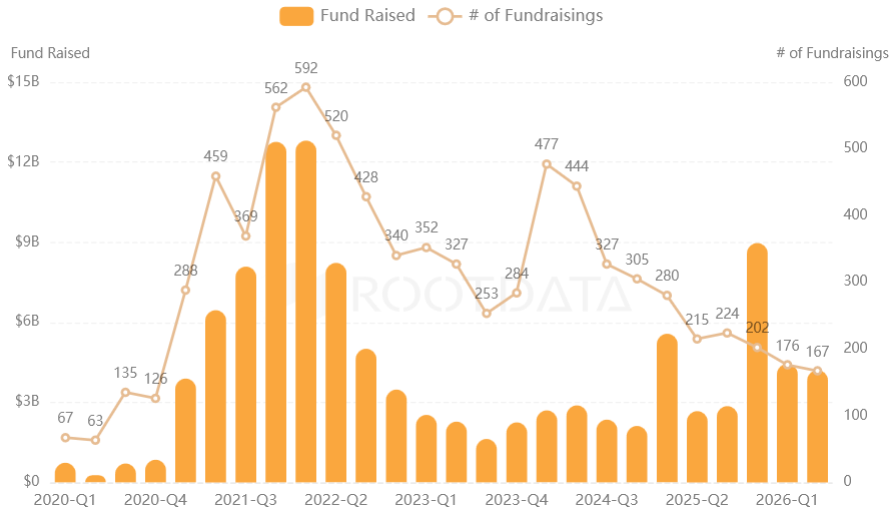
Quarterly change in crypto VC funding and deal count since Q1 2020. Source: RootData
Features: From Bitcoin critics to blockchain believers: The 5 biggest crypto backflips


OpenAI has secured U.S. government clearance for its GPT-5.6 model, removing a key regulatory hurdle as traders turn their attention to the company’s pre-IPO perpetual futures market.
Summary
- OpenAI has received U.S. approval to launch GPT-5.6, clearing a major regulatory hurdle ahead of its wider rollout.
- Traders are closely watching OPENAI-PERP contracts as the GPT-5.6 approval fuels pre-IPO valuation expectations.
- SoftBank’s latest investment and OpenAI’s Jalapeño AI chip add to investor focus ahead of any future IPO.
Axios first reported that the U.S. Department of Commerce has granted general permission for OpenAI to roll out GPT-5.6, paving the way for a wider release of ChatGPT and its API as early as Thursday.
The approval follows a review by the Commerce Department’s Center for AI Standards and Innovation, which evaluated the frontier AI model under a voluntary agreement signed by President Donald Trump that gives regulators up to 30 days to assess advanced AI systems before public deployment.
During the review process, OpenAI stationed a dedicated technical team in Washington, D.C., to answer regulators’ questions directly, a step Axios described as unusual. The company is preparing three GPT-5.6 variants for launch: Sol as the flagship model, Terra as a balanced option, and Luna as a lower-cost, faster version.
Approval removes a key uncertainty for OpenAI traders
With the regulatory review complete, attention has quickly turned to OpenAI’s pre-IPO perpetual futures, which already trade on crypto platforms including Coinbase and Binance.
As crypto.news previously reported, Coinbase introduced OPENAI-PERP through its Everything Exchange initiative in June, allowing eligible non-U.S. users to gain exposure to OpenAI’s private-market valuation through perpetual futures settled in USDC. The contracts have no expiration date and are designed to convert automatically if OpenAI eventually lists its shares publicly.
The latest approval gives traders a fresh catalyst to price into those contracts because GPT-5.6 is expected to become the company’s next flagship commercial release. Even so, Coinbase has warned that OpenAI’s eventual IPO price could still end up as much as 25% above or below the perpetual futures price at the time of listing.
Industry data cited by CryptoQuant points to growing interest in pre-IPO crypto products. According to the analytics firm, trading volume across the sector climbed to $12 billion in June 2026 from just $2 million in March.
Crypto.news previously noted that the infrastructure for trading OpenAI and Anthropic pre-IPO futures has already been established, allowing markets to react immediately to company-specific developments such as regulatory approvals.
OpenAI continues building its AI business ahead of any listing
Recent corporate developments have added to investor attention surrounding OpenAI. Earlier this month, as crypto.news reported, SoftBank Group completed a second $10 billion investment in the company, moving the Japanese conglomerate closer to fulfilling its previously announced $30 billion follow-on commitment.
OpenAI has also continued investing in its own infrastructure. Last month, chief executive Sam Altman introduced Jalapeño, the company’s first custom-built AI chip developed with Broadcom.
According to OpenAI, the processor is optimized for inference workloads powering products such as ChatGPT, Codex, and future AI agents, reducing the company’s dependence on third-party hardware suppliers.
Still, enthusiasm around pre-IPO contracts has not always translated into immediate gains. Crypto.news previously reported that Anthropic’s pre-IPO perpetual futures fell 7% within 24 hours of their Coinbase debut despite strong interest in the company.
By contrast, the SpaceX pre-IPO market generated heavy retail participation before its public listing, with the stock later opening about 13% above its IPO price, providing an example that OpenAI traders are now watching closely as GPT-5.6 moves toward public release.


The Bank of England has reaffirmed that its work on a potential digital pound has remained independent despite claims that political lobbying may have influenced its approach.
Summary
- Bank of England Governor Andrew Bailey said Nigel Farage did not influence the central bank’s policy on a potential digital pound.
- Bailey’s letter, reported by The Guardian, said no CBDC policy changes followed his meeting with Farage on cryptocurrencies.
- Farage continues to face parliamentary scrutiny over crypto-linked gifts as the Bank of England advances digital pound research.
Bailey says CBDC policy remained independent
According to The Guardian, Bank of England Governor Andrew Bailey said the central bank did not alter its position on a potential central bank digital currency after meeting Reform UK leader Nigel Farage.
The newspaper reported that Bailey made the comments in a letter written after the meeting, which covered several topics, including cryptocurrencies.
In the letter obtained by The Guardian, Bailey reportedly said the Bank of England is capable of identifying attempts to influence its policymaking. He also wrote that no policy changes had resulted from Farage’s interventions after the meeting.
Bailey’s response came after Farage publicly said he had discussed cryptocurrencies with the governor. According to The Guardian, Bailey confirmed the meeting took place but rejected any suggestion that the conversation affected the Bank’s work on a digital pound.
Farage has repeatedly criticized central bank digital currencies, arguing they could increase financial surveillance. He previously said he would “rather go to prison” than live under such a system, a position he has maintained while opposing the proposed digital pound.
Farage faces scrutiny as digital pound research continues
Separately, Farage has resigned as the Member of Parliament for Clacton and will contest a by-election while parliamentary investigations into his financial declarations continue.
During an X livestream on Tuesday, Farage said he stepped down so local voters could decide whether he should continue representing the constituency instead of waiting for the outcome of the investigations.
Farage said he had “done nothing wrong” and maintained that he had not broken any laws or misused public money. He also confirmed that the UK parliamentary standards commissioner is investigating two matters involving gifts he received from crypto billionaire Christopher Harborne and George Cottrell, who has a previous fraud conviction and has been linked to a crypto casino.
According to Farage, the money provided by Harborne was an unconditional gift that would be used to pay for his personal security because of threats and attacks against him. He said seeking re-election would allow voters in Clacton to judge his actions directly.
Meanwhile, The Guardian reported that the UK’s National Crime Agency is investigating several transactions involving other senior Reform UK figures over suspected money laundering. The report did not say that Farage was part of that investigation.
While those political developments continue, the Bank of England has kept its digital pound project under review. In a recent update, the central bank said no decision has been made on whether to introduce a digital pound and added that any launch would require further analysis and public consultation.
Earlier this year, the Bank of England began a six-month pilot involving 18 companies to test how tokenized assets could be settled using central bank money. According to the central bank, the program is designed to examine settlement technology as officials continue evaluating whether a digital pound would have a role in the UK’s financial system.

Controversial star officially announces he has re-signed with AEW after weeks of speculation

IBM Home Director: Home Automation In 1996

Games Inbox: Is The Elder Scrolls 6 going to be worth the wait?


-

 Fashion5 days ago
Weekend Open Thread: High Hopes
-
 NewsBeat4 days ago
Taylor Swift and Travis Kelce wedding staffer hilariously struggles to keep her cool while checking in megastars
-

 Fashion2 days ago
Open Thread: What Great Books Have You Read Recently?
-

 Politics6 days ago
The House | “Reframing the debate from a binary discussion of winners and losers”: Yuan Yang reviews ‘We Are Not Machines’
-

 Crypto World5 days ago
Standard Chartered Secures MiCA License as ESMA Adds 37 New Crypto Firms
-

 News Videos2 days ago
Whats Hidden Inside This Cash Register? #treasure #reselling #money
-
 Tech2 days ago
Anthropic’s new “J-lens” reveals a silent workspace inside Claude that mirrors a leading theory of consciousness
-

 Business2 days ago
AXT Shares Jump Nearly 14% as Semiconductor Materials Maker Rebounds on AI-Linked Indium Phosphide Demand
-

 Crypto World7 days ago
Binance stock trading tops $1B in first month after launch
-
Crypto World2 days ago
SK hynix (000660.KS) Stock Dips as $28B Nasdaq ADR Offering Drives AI Memory Expansion
-

 Crypto World4 days ago
South Africa proposes crypto tax guidance under existing rules
-

 News Videos2 days ago
Best Time to Enter Small Caps Right Now? Another Bull Run? | Financially Free
-

 Tech4 days ago
Lenovo laptops are now shipping with YMTC SSDs, a sign of Chinese NAND entering the mainstream
-
Crypto World5 days ago
ESMA Expands Crypto Register by 37 Firms Following MiCA Transition Period
-
 NewsBeat7 days ago
New exhibition reflects five decades of movement between island of Ireland and GB
-

 Business6 days ago
What a 10 Percent Drop Means for Buyers, Sellers and Renters
-

 Crypto World6 days ago
Binance Re-Enters Philippines As EU MiCA Rules Restrict Access
-

 News Videos3 days ago
Avoid entering in FOMO #bitcoin #cryptocurrency #trading #scalping
-

 Sports1 day ago
Joshua Pacio ‘more complete’ ahead of ONE rematch vs Malachiev
-

 Crypto World6 days ago
Alibaba bans Claude Code over alleged backdoor security concerns
You must be logged in to post a comment Login