

Crypto World
Revolut Limits USDT Delisting to EEA and Switzerland


Revolut has announced that it will remove support for the Tether USDT stablecoin for customers in the European Economic Area (EEA) and Switzerland, citing MiCA-related regulatory and risk review. The company said the change is limited to those regions, while USDT support will continue in other markets where it is currently offered.
In a statement provided to Cointelegraph, a Revolut spokesperson said the decision follows a periodic review of its cryptocurrency offering in light of the evolving European Union regulatory framework under the Markets in Crypto-Assets Regulation (MiCA). Revolut also previously removed USDT from its Revolut X trading platform for EEA customers, with the latest step completing the withdrawal from its retail crypto offering in the EEA.
Key takeaways
- Revolut is discontinuing USDT support for customers in the EEA and Switzerland, while keeping support elsewhere.
- The move is linked to a regulatory and risk review under MiCA, according to a company spokesperson.
- USDT was already removed from Revolut X for EEA users; this update finalizes the EEA retail removal.
- MiCA’s EEA relevance raises questions about why Switzerland is included despite not being directly covered by the regulation.
Revolut’s USDT exit tied to MiCA review
Revolut said it is “discontinuing support for USDT for customers in the EEA following a periodic review of our cryptocurrency offering in light of the evolving EU regulatory framework under MiCA,” according to its spokesperson. The announcement follows a broader period of adjustments across European crypto services as firms prepare for regulatory requirements associated with MiCA.
According to Cointelegraph’s earlier reporting, Revolut first notified some European users on Friday that USDT would be delisted from its platform by Aug. 31, 2026. Revolut said the process had already begun before that notification: it removed USDT from the Revolut X trading platform for EEA customers, and the latest decision completes the removal from its EEA retail offering.
Where the change applies—and where it doesn’t
Revolut’s spokesperson said the delisting affects customers in the EEA and Switzerland. The firm indicated that support for the stablecoin will continue in other markets, but it did not provide a list of jurisdictions where its crypto services—including USDT—are still available.
The regional framing also matters because MiCA is an EU regulation that has EEA relevance. Official documents from the European Securities and Markets Authority (ESMA) describe MiCA as extending to the broader EEA, which includes Norway, Iceland, and Liechtenstein in addition to EU member states. In that context, the mention of Switzerland stands out.
Switzerland is not part of the EU or the EEA and is not directly covered by MiCA. Revolut did not explain why Swiss customers were included in the delisting scope. Cointelegraph reported that the company did not respond to a request for clarification on the scope of its offering by the time of publication.
Broader EU trend after Tether’s MiCA posture
Revolut’s decision reflects a wider shift among crypto platforms operating across Europe. Cointelegraph noted that many firms have continued to phase out USDT after Tether—the issuer of the $184 billion stablecoin—opted not to pursue authorization under MiCA. While the mechanics of MiCA authorization depend on jurisdiction and a stablecoin’s compliance pathway, the direction of travel for intermediaries has been consistent: reduce exposure to stablecoins that may become harder to serve under the new regime.
For investors and traders, stablecoin availability is more than a convenience issue. When platforms change which assets they support, users can be affected in practical ways: execution routes may change, on-platform swaps may become unavailable, and users who rely on a specific stablecoin for custody or settlement may need to restructure how they manage balances.
Revolut’s staged approach—first removing USDT from its Revolut X trading platform for EEA customers, then completing the removal from its retail offering—also suggests the company is treating the MiCA transition as an operational transition rather than a single-day shutdown.
What Revolut’s timetable signals for users
The USDT delisting notice surfaced with a timeline for Aug. 31, 2026, implying that EEA users may still have access until then, subject to the platform’s operational changes already underway. Revolut did not provide further detail in the information available, including what specific account actions might be available during the wind-down period—such as whether USDT balances can be held, exchanged, or withdrawn during the transition.
Even without those specifics, the sequence described by Revolut matters: USDT trading on Revolut X for EEA customers had already been removed before the broader delisting plan was communicated. That kind of incremental reduction can reduce disruption for new trades while giving customers time to adjust their holdings.
Still, uncertainty remains for customers outside the affected regions, because Revolut did not publish a jurisdiction-by-jurisdiction breakdown of where USDT remains supported. For traders who operate across multiple venues—or who routinely move between regions—this becomes a risk management consideration: platform support can change as regulations evolve.
Keeping an eye on regulatory alignment beyond MiCA
While Revolut’s explanation points to MiCA as the driving regulatory framework, its inclusion of Switzerland—despite that country not being directly covered by MiCA—highlights a broader theme in Europe’s crypto compliance landscape: companies may be making decisions based on anticipated regulatory alignment, counterpart constraints, or internal risk frameworks that go beyond the narrow legal text.
Readers should watch for two things next: whether Revolut clarifies how Switzerland fits into its risk and regulatory rationale, and whether other platforms adjust their USDT support timelines or expand similar delistings in the EEA. As firms continue to reposition their stablecoin offerings, the most practical question for users will be which assets remain accessible on the platforms they use, and what transition paths are available when support ends.

Crypto World
Hyperliquid Policy Center, Phantom Urge CFTC To Ease Onchain Software Registration Rules

TLDR:
- HPC and Phantom filed a joint letter urging CFTC to clarify registration rules for developers.
- The letter asks CFTC to give registered exchanges a path to adopt onchain infrastructure.
- HPC and Phantom want the Phantom no-action letter codified into a permanent formal rule.
- The filing responds directly to a CFTC request on rules hindering market participants.
Hyperliquid Policy Center and Phantom have urged the CFTC to clarify that publishing onchain protocol software does not require registration.
The two firms submitted a joint comment letter this week addressing onchain market infrastructure. Their filing asks regulators to modernize outdated rules built around custodial intermediaries.
It calls for a clear registration pathway for exchanges adopting onchain systems. The letter also pushes to codify the existing Phantom no-action letter into formal policy.
HPC And Phantom Detail Registration Concerns
Hyperliquid Policy Center and Phantom compare software developers to internet service providers. The letter states “no one confuses either person for the other” between builders and brokers.
An internet provider supplies cables that let brokers take customer orders. The letter argues protocol developers deserve the same clear distinction under CFTC rules.
Digital asset builders have not received consistent treatment from past CFTC leadership. The letter notes developers were left “guessing whether they may be treated as operating an unregistered exchange.”
This ambiguity pushed many companies to build their products offshore instead. HPC and Phantom credit current leadership under Chairman Selig with shifting this approach.
Onchain markets differ structurally from traditional custodial trading systems, the letter notes. Legacy markets pass customer funds through brokers, exchanges, and clearinghouses sequentially.
The filing states onchain systems “let users hold their own funds and trade directly with one another.” Hyperliquid Policy Center and Phantom say regulation should reflect this fundamental difference.
Three recommendations anchor the joint submission to the Commission. Confirm first that publishing protocol software alone does not require registration.
Second, create pathways for registered exchanges to adopt onchain infrastructure directly. Third, convert the Phantom no-action letter into what the filing calls “a formal rule.”
Firms Frame Request As Path To Onshore Growth
HPC and Phantom present their proposal as a route to bring innovation onshore. The letter states protections can be built in “by design rather than by decree.”
Regulated intermediaries would continue handling responsibilities that code alone cannot resolve. This structure preserves protections while modernizing infrastructure for onchain derivatives markets.
The letter responds to a CFTC request asking which rules hinder market participants. HPC and Phantom write, “this is our answer, and it is within the Commission’s own authority to act on.”
They state the requested changes fall within the Commission’s existing regulatory authority. No new legislation would be required to implement these clarifications.
Codifying the Phantom no-action letter would benefit smaller non-custodial wallet providers broadly. The filing notes such firms would gain “durable certainty rather than having to ask, one at a time, for relief.”
Firms would gain lasting certainty instead of requesting individual relief repeatedly. This reduces friction for developers building non-custodial financial technology tools.
Existing registrants also stand to benefit from the proposed regulatory pathway. Exchanges and clearinghouses could retire legacy systems for transparent onchain alternatives instead.
Compliance obligations would remain intact under the new registration framework. HPC and Phantom describe this transition as advantageous for American consumers.
The joint letter reflects continued engagement between digital asset firms and federal regulators.



Paul Grewal has announced that he will step down as Coinbase’s chief legal officer on July 31, handing over leadership of the exchange’s legal team just days before the US Senate is expected to resume work on the CLARITY Act.
Summary
- Paul Grewal will leave his role as Coinbase chief legal officer on July 31 and become an adviser.
- Molly Abraham will become general counsel as Congress prepares to revisit the CLARITY Act.
- Coinbase continues pushing for crypto market structure legislation after its SEC lawsuit was dismissed.
According to posts Grewal published on X and LinkedIn, he will move into an advisory role at Coinbase after serving as the company’s chief legal officer since 2020. The announcement also confirmed that legal vice presidents Molly Abraham and Ryan VanGrack will take on expanded responsibilities, with Abraham becoming general counsel and VanGrack serving as vice chair.
In a separate LinkedIn post, Abraham said she would take charge of Coinbase’s legal organization following the transition.
During Grewal’s tenure, Coinbase navigated one of the most closely watched legal battles in the US crypto industry. As chief legal officer, he led the company’s response after the US Securities and Exchange Commission sued Coinbase in 2023, alleging that the exchange had operated as an unregistered securities exchange, broker, and clearing agency.
The lawsuit was later dismissed under the Trump administration, ending one of the regulator’s highest-profile enforcement actions against a crypto company.
Before leaving the role, Grewal also said in his social media posts that he would reveal his next professional position “in due course,” without providing additional details.
Coinbase leadership changes arrive as Congress debates crypto rules
The timing of Grewal’s departure coincides with renewed attention on digital asset legislation in Washington. Coinbase executives, including chief executive Brian Armstrong, have repeatedly urged lawmakers to pass the Digital Asset Market Clarity Act (CLARITY), arguing that the legislation would establish clearer regulatory responsibilities for the crypto industry.
The proposed bill would move much of the oversight of digital asset markets from the Securities and Exchange Commission to the Commodity Futures Trading Commission. The US Senate is currently on a state work period and is expected to return on Monday, when lawmakers could resume consideration of the legislation.
The leadership transition also comes after Coinbase strengthened its presence in US policy discussions over the past two years. Following the dismissal of the SEC case, the exchange expanded its engagement with lawmakers and government officials while continuing to advocate for digital asset legislation.
Coinbase has expanded its political engagement during regulatory debates
Coinbase has also increased its involvement in US political advocacy during the ongoing debate over crypto regulation. The company is among the largest contributors to the Fairshake political action committee, which supports candidates it considers favorable toward digital asset policies.
Separately, Armstrong has met with US President Donald Trump and has publicly called on Congress to pass legislation establishing a clearer legal framework for cryptocurrencies. Those efforts have continued alongside Coinbase’s participation in policy discussions surrounding the CLARITY Act and other crypto-related proposals.
Although Grewal will no longer oversee Coinbase’s legal department after July 31, the company’s legal strategy will remain in the hands of executives who have worked alongside him through recent regulatory disputes.
Abraham’s appointment as general counsel places her in charge of legal operations as Congress prepares for another round of debate over market structure legislation that could reshape how digital assets are regulated in the United States.
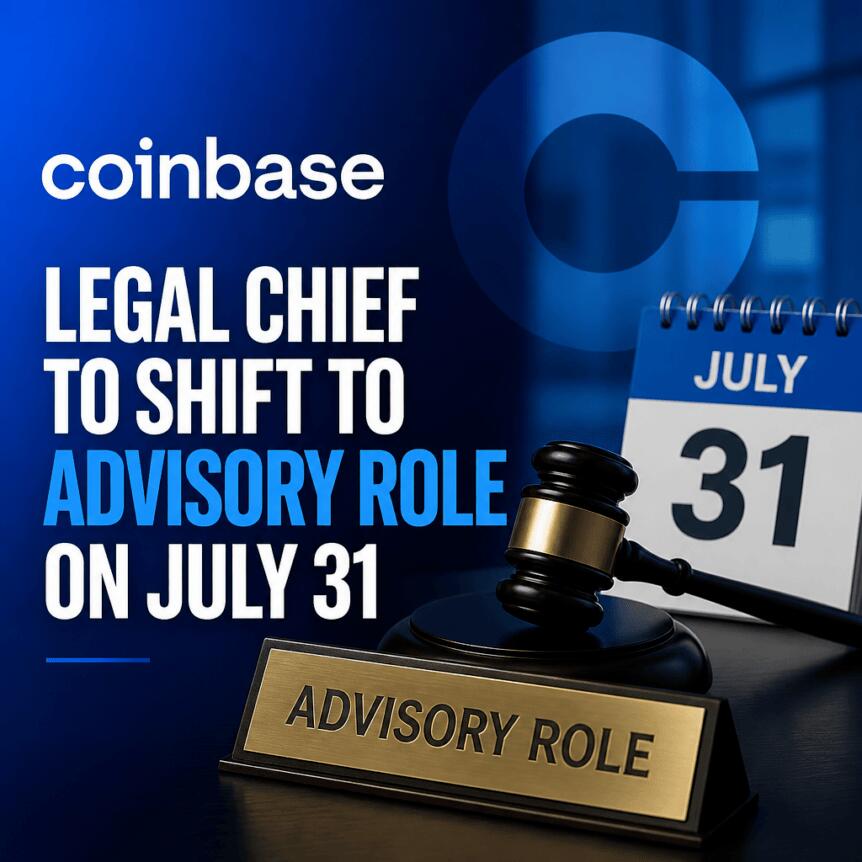
Coinbase chief legal officer Paul Grewal will transition to an advisory role at the exchange starting July 31, according to an announcement he shared on X and LinkedIn.
In the same update, Grewal said Coinbase’s current legal vice presidents—Molly Abraham and Ryan VanGrack—will move into expanded leadership roles as general counsel and vice chair after his departure at the end of the month. Abraham added that she will “take the helm” of the company’s legal team.
Key takeaways
- Paul Grewal is leaving Coinbase’s day-to-day legal leadership on July 31, shifting to an advisory capacity.
- Molly Abraham and Ryan VanGrack are set to take over top legal governance roles as Coinbase reorganizes internally.
- Grewal previously led Coinbase’s legal response to the SEC’s 2023 enforcement action alleging unregistered exchange, broker, and clearing activity.
- Coinbase executives continue to press Congress on legislation that would move major digital-asset oversight from the SEC toward the CFTC.
A leadership handoff in Coinbase’s legal department
Grewal’s announcement marks a notable change at the center of Coinbase’s legal strategy. He has served as the exchange’s chief legal officer since 2020, overseeing the company’s engagement with regulators during a period when US crypto policy and enforcement have repeatedly shifted.
Under the plan Grewal described, Abraham will assume responsibility for directing Coinbase’s legal team as general counsel, while VanGrack will take on a vice-chair role. Grewal indicated that he would announce a potential new position “in due course,” but did not provide further specifics at the time of his post.
Why Grewal’s role carried regulatory weight
As CLO, Grewal played a prominent part in Coinbase’s legal posture during the SEC’s 2023 case. In that action, the SEC alleged that Coinbase operated as an unregistered securities exchange, broker, and clearing agency. Coinbase and its executives challenged the claims, and the lawsuit was later dismissed under the Trump administration.
The significance of a CLO at a major exchange extends beyond courtroom strategy: it often shapes how a company navigates evolving enforcement theories, responds to regulator guidance, and supports legislative engagement. Grewal’s move to advisory status therefore raises an obvious question for the market—how much influence will shift with the leadership change, even if Coinbase’s broader policy approach remains constant.
Coinbase has long portrayed its policy efforts as aligned with clearer regulatory boundaries for digital asset markets, and Grewal’s involvement has historically been a part of the exchange’s public-facing legal narrative.
Coinbase’s push for market-structure legislation continues
Even as Grewal transitions roles, Coinbase’s policy priorities appear unchanged. The company has been actively encouraging lawmakers to advance the Digital Asset Market Clarity Act (CLARITY).
According to the reporting referenced in the source material, CLARITY is widely expected to alter the regulatory framework for digital assets by shifting oversight and regulation from the SEC toward the Commodity Futures Trading Commission (CFTC). That framework change would matter to market participants because it could redefine which regulator is responsible for key aspects of crypto market supervision.
The source also notes that the US Senate is in a state work period until Monday, when lawmakers are expected to return and potentially take up a vote on the bill. For traders, issuers, and exchanges, the timing of committee movement and floor consideration can influence expectations around compliance costs and the likelihood of future regulatory certainty.
What investors should watch next
Grewal’s transition doesn’t automatically signal a policy pivot—Coinbase’s top leadership has continued to emphasize legislative clarity, and the exchange’s legal structure is being redistributed rather than dismantled. Still, the appointment and influence of whoever effectively holds the reins after the July 31 transition will be closely watched by anyone tracking US crypto regulatory risk.
With the Senate schedule potentially affecting CLARITY’s near-term momentum, the key question is how Coinbase’s legal leadership will shape engagement with lawmakers and regulators as the political process moves forward. Readers should monitor any further updates from Coinbase regarding Grewal’s advisory responsibilities and any concrete legislative or regulatory developments that follow the Senate’s return.

Key Takeaways
- CoreWeave shares declined 3.4% to close at $83.53, touching an intraday bottom of $79.46, while volume trailed the daily average by 20%
- Analysts hold a Moderate Buy rating with a consensus price target of $135, with bullish forecasts reaching as high as $250
- Investor anxiety is mounting over Meta’s reported plans to enter the AI cloud computing space, potentially challenging CoreWeave’s market position
- Company insiders have offloaded more than $3 billion in shares over the last three months, primarily through tax withholding arrangements
- The company’s Q1 results fell short of expectations with EPS of -$1.40 versus the -$1.17 estimate, despite revenue jumping 111.6% annually to $2.08 billion
CoreWeave (CRWV) experienced a 3.4% pullback on Tuesday, settling at $83.53 following an intraday descent to $79.46. The previous trading session had concluded at $86.46.
CoreWeave, Inc. Class A Common Stock, CRWV
Trading activity registered approximately 23 million shares, falling roughly 20% short of typical volumes — indicating the downturn wasn’t fueled by mass liquidation.
Year-to-date, the stock maintains a 26% gain, though it’s nursing a 41% decline over the trailing twelve months and trading considerably beneath its 50-day moving average of $106.86.
Tuesday’s weakness reflected mounting investor apprehension centered on two key issues: Meta’s reported AI computing infrastructure ambitions and persistent insider share dispositions.
A Bloomberg piece highlighted Meta’s exploration of commercializing AI computing services and infrastructure capacity to external clients — a strategic direction that would place it squarely against CoreWeave’s primary revenue streams.
Rosenblatt upheld its Buy stance with a $250 target, contending the Meta threat is exaggerated. Both Wolfe Research and Evercore ISI confirmed Outperform positions with matching $150 targets.
Executive Stock Dispositions Draw Attention
Insider transactions have become a focal point. Throughout the preceding 90 days, company insiders have divested more than $3 billion in CRWV shares.
Most recently, General Counsel Kristen J. McVeety disposed of 22 shares for $1,889 on July 6, conducted under a Rule 10b5-1 arrangement established in May 2025.
Prior to that, insider Brian Venturo unloaded 76,912 shares on July 1 at an average price of $86.99, generating approximately $6.69 million. This transaction trimmed his holdings by 21%.
Insider Brannin McBee divested 56,707 shares on June 30 at $95.69, totaling roughly $5.43 million — reducing his stake by 14.9%.
Both transactions occurred through predetermined Rule 10b5-1 arrangements designed to satisfy tax liabilities on equity compensation vesting. While this represents standard practice, the magnitude has nonetheless attracted market attention.
Recent Earnings Disappointment Lingers
CoreWeave’s most recent quarterly disclosure on May 7 added to sentiment headwinds. The firm recorded EPS of -$1.40, falling short of the -$1.17 consensus projection by $0.23.
Revenue reached $2.08 billion, representing 111.6% year-over-year expansion. While top-line momentum remains robust, profitability challenges persist — the net margin currently registers at -25.57%.
Wall Street’s consensus forecast anticipates full-year EPS of -$4.57.
Notwithstanding the earnings shortfall, multiple analysts contend the sell-off is excessive. BNP Paribas holds the Street’s most optimistic target at $192, with Cantor Fitzgerald at $167. Wells Fargo elevated its objective to $155 in May.
Among 35 analysts tracking the equity, 21 assign Buy ratings, 12 recommend Hold, and 2 suggest Sell.
The company’s debt-to-equity ratio registers at 3.68, accompanied by a current ratio of merely 0.31 — a financial structure that introduces meaningful risk alongside the growth narrative.
CoreWeave’s market capitalization hovers between approximately $37–45 billion, fluctuating with market conditions. The company unveiled ARIA, an AI-powered research assistant, earlier this week — though analysts view it as lacking immediate catalytic potential.
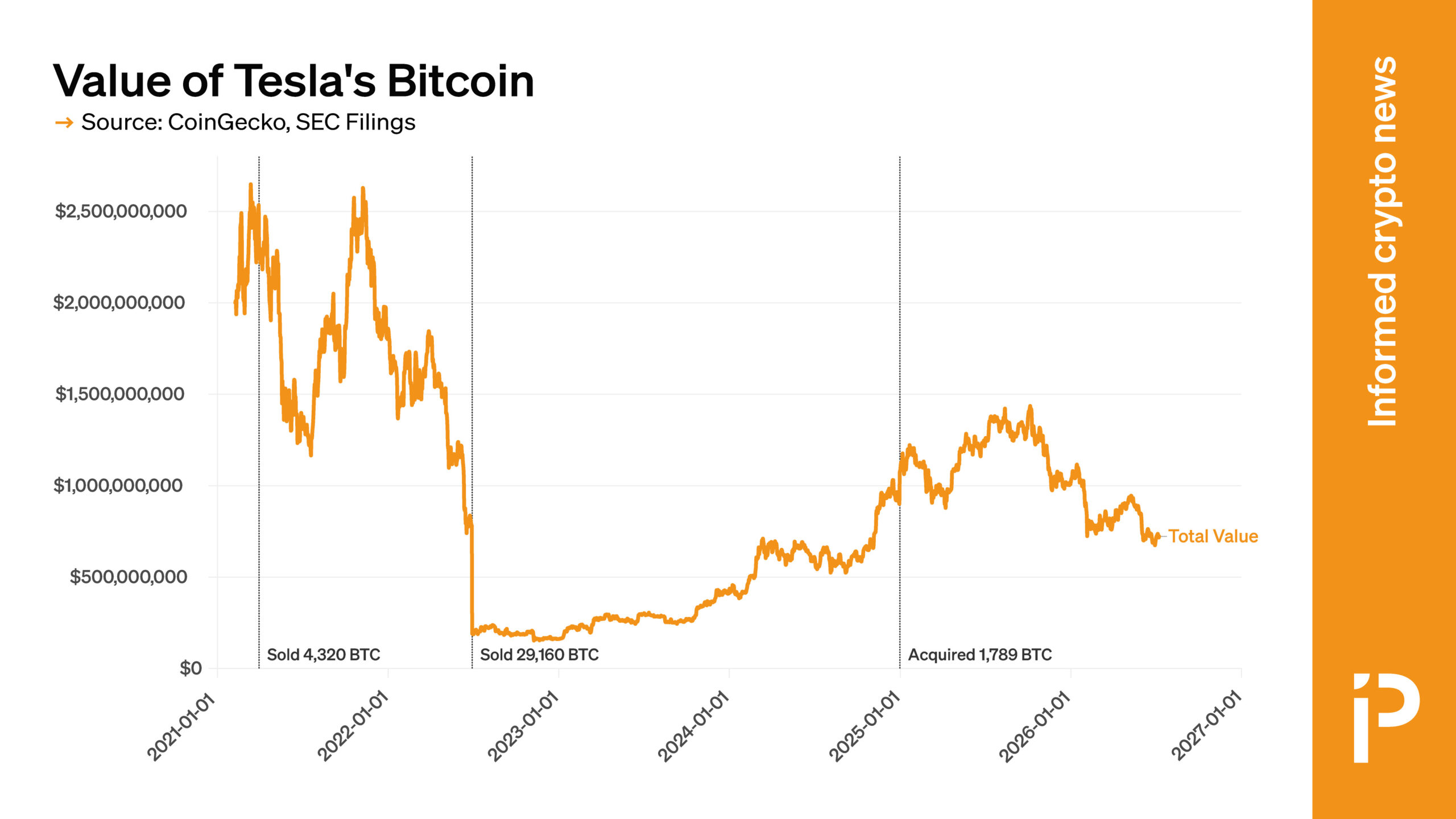
Tesla became one of the early firms to embrace BTC, adding it to its balance sheet in 2021; however, it all but abandoned this initiative, and the total value of its holdings has fallen by two-thirds, despite BTC appreciating by more than 30%.
During this same period Elon Musk, the founder and leader of Tesla, has gone from a frequent cryptocurrency promoter to someone who rarely mentions or endorses it.
This depression in value has occurred despite the fact that Musk had unprecedented access to the federal government early in Donald Trump’s second administration through the so-called “DOGE” initiative.
This access also coincided with a period when the administration was rapidly trying to shift its regulatory stance to support Trump’s vision of himself as a supporter of the crypto industry, which has embraced him.
Read more: Elon Musk now worth more than 200 Donald Trumps
In 2021 Tesla originally acquired 43,200 BTC and announced that it expected “to begin accepting BTC as a form of payment for our products.”
Around this same time, Musk had added “#bitcoin” to his Twitter bio, after which the asset briefly surged. He also appeared on a voice chat on social media site Clubhouse to say that he was a supporter of BTC.
However, Musk’s Tesla didn’t maintain this stash of BTC indefinitely.
Read more: Elon Musk promised to fund Dogecoin, now the foundation accounts are overdue
Less than two months after this acquisition, Musk took to Twitter to explain that Tesla had to start selling in order “to prove liquidity of BTC as an alternative to holding cash on balance sheet.”
Two months after that initial sale, Musk again took to Twitter to announce that Tesla would no longer be accepting BTC payments.
He cited concerns “about rapidly increasing use of fossil fuels for BTC mining” and added that Tesla would use it for transactions again once “mining transitions to more sustainable energy.”
After this, there was a relatively long pause — until the middle of 2022, to be precise — before Tesla sold 29,160 BTC, leaving only 9,720 in its holdings.
This remained the stable amount for over two years until it was revealed at the end of 2024 that the company had purchased an additional 1,789 BTC, bringing its total to 11,509.
However, Tesla’s holdings have continued to lose value since then as the price of BTC has suffered.
It described this purchase as an “immaterial amount.”
Musk has not wholly moved on from Bitcoin.
Despite previously claiming that Tesla cannot accept it because of “rapidly increasing use of fossil fuels for BTC mining,” last year he promoted the asset by stating, “That is why Bitcoin is based on energy: you can issue fake fiat currency, and every government in history has done so, but it is impossible to fake energy.”
BTC has fallen by over 40% since Musk made this point.
Broadly, it’s not entirely clear what Musk or Tesla thinks of BTC, whether it is a powerful alternative to fiat or a threat to the environment.
Got a tip? Send us an email securely via Protos Leaks. For more informed news and investigations, follow us on X, Bluesky, and Google News, or subscribe to our YouTube channel.


At the last moment, New Hampshire has turned its back on a groundbreaking effort to establish what was expected to be the first rated, bitcoin-backed bond issued under a state’s authority, with a governmental body there canceling the project.
Just a few months after Moody’s Ratings gave the bond a Ba2 rating, the New Hampshire Executive Council, which reviews major state financial actions, slammed the door with a 3-2 decision that sided with those concerned about the state’s financial reputation.
The financial instrument was to be issued by the Business Finance Authority of the State of New Hampshire, backing a private-sector bond of up to $100 million tied to Bitcoin mining and datacenter firm CleanSpark. The council’s vote was the final step.
“It was an extremely short-sighted decision,” Keith Ammon, a longtime crypto advocate and the majority floor leader in the New Hampshire House of Representatives, posted on social media site X. “They should gather all relevant facts and information and reconsider their vote at a future meeting.”
Ammon told CoinDesk that it’s an election year for council members, and it only takes one to swing the vote, adding, “We’re not giving up.”

Bitcoin reclaimed the $63,000 level on Thursday, but traders are approaching Friday’s $1.4 billion Bitcoin options expiry on Deribit with caution. The central debate is whether macro pressure—particularly rising US Treasury yields—will undermine BTC’s rebound and put the $62,000 support zone to the test.
While US bond yields pushing toward 4.6% have kept risk appetite cautious, Deribit positioning appears to be more balanced than outright bearish. That mix is setting up a weekend-or-later decision point for BTC’s short-term direction.
Key takeaways
- US 10-year Treasury yields nearing 4.6% are weighing on risk assets, reinforcing fears about debt concerns and tighter financial conditions.
- Deribit’s balanced put-to-call activity suggests downside demand is not dominating ahead of Friday’s large options expiry.
- Open interest and strike concentration point to key levels around $62,000, $61,000, and $63,500 for near-term price behavior.
- For bulls to extend their edge, BTC needs to hold above key expiry-related thresholds; otherwise, the market may remain rangebound.
Treasury yields and risk appetite: why BTC is stuck near $63K
The move in US government bond yields is driving much of the near-term caution. With the US 10-year yield approaching 4.6%, investors appear increasingly concerned about the expansion of government debt and the likelihood that additional monetary policy support may be needed to avoid a recessionary slowdown.
That backdrop has influenced Bitcoin’s trading behavior. BTC has largely been moving sideways, while equities—at least in the Nasdaq-100—have been holding relatively close to record levels. On Thursday, technology momentum continued to attract capital, supported by market-moving activity in semiconductors.
According to the article, SK Hynix’s US initial public offering was oversubscribed, contributing to strength across parts of the AI-linked chip complex. The result was a risk-on bid in equities, with Arm Holdings up about 10%, Advanced Micro Devices higher by roughly 7%, and Micron gaining around 7% intraday.
Still, equities strength does not automatically translate into sustained BTC upside when bond yields are rising. Bitcoin tends to react to shifts in global liquidity expectations, and bond yield pressure can quickly change the market’s risk calculus.
ETF flow worries cool off—options demand looks more balanced
Spot Bitcoin ETF flows briefly came back into focus on Wednesday, when the market saw $85 million in net outflows, ending a short run of three consecutive days of inflows. Earlier coverage by Cointelegraph linked that outflow episode to broader selling pressure in spot ETF markets.
However, the presence of outflows alone does not clarify whether institutions have shifted structurally bearish. More importantly for the near-term trade is how derivatives positioning has evolved into Friday’s expiry.
Deribit activity has been described as “balanced” between calls and puts, implying that demand for downside exposure has not surged. The key point is that options volumes over the past few days did not show a clear stampede into protective puts.
As cited in the piece, Laevitas data shows the put-to-call volumes relationship remains supportive of range stability. Even though call activity has outpaced put volume over four days—suggesting traders have trimmed urgency around downside—this is not the same as a market that is fully discounting volatility.
Deribit expiry setup: where the market’s incentives cluster
Friday’s weekly options expiry involves a large notional figure of $1.4 billion on Deribit, and the strike distribution matters for how price can “pin” near certain levels. The article highlights an interesting imbalance in the immediate strike zones.
Calls up to the $62,500 region amount to about $137 million, while puts above $61,000 total roughly $121 million. That does not imply an outright one-sided bet, but it does indicate that there is meaningful positioning both for upside continuation and for defense just below the middle of the range.
Open interest and strike placement also shape traders’ expectations for pinning behavior. With BTC positioned around the $63,000 area heading into expiry, the next move could be influenced by how market makers and hedgers respond to gamma exposure across key strikes. The article references Deribit open interest data for July 10 BTC, underscoring that the market is not operating without “gravity” around specific prices.
Within this framework, the piece outlines conditional outcomes: bulls would strengthen their position materially with a move above $63,500 by the 8:00 AM UTC expiry on Friday, while bears maintain a smaller edge below $61,000. Without additional macro or catalyst-driven volatility, the market may not deliver a decisive breakout purely from derivatives positioning.
Oil, geopolitics, and bond yields: what could break the range
Beyond crypto-native signals, the article points to two macro variables that could shift demand between fixed income and risk assets: energy and Treasury yields. A temporary truce in the Middle East could ease recession fears, encouraging capital rotation into higher-risk markets—an environment that typically supports BTC.
On the other hand, the piece also notes an ongoing counterweight. It argues that persistent uncertainty in the macro outlook, including the risk of additional large Treasury issuance to cover debt growth, could keep pressure on yields and dampen crypto upside attempts.
Traders are also asked to watch crude oil direction. A renewed escalation around Iran could push oil higher, worsening inflation fears and potentially forcing a less favorable policy outlook—conditions that tend to complicate liquidity for risk assets.
Crucially, the article ties these macro considerations back to options behavior: with put-option buying remaining restrained in recent sessions, BTC appears positioned to defend the $62,000 support level, at least in the immediate term. Still, that defense is not guaranteed. The market’s stability depends on whether bond yields ease and whether geopolitical risk stops feeding into inflation and rate expectations.
For now, the near-term picture is conditional: a successful expiry resolution above $63,500 could deliver short-term relief, but sustained upward progress would likely require a more supportive macro shift. Until then, traders may have to manage expectations for a range that can hold—but also revert quickly if yields keep climbing.
As Friday’s options expiry approaches, the key variables to watch are whether Treasury yields cool off and how price reacts around $63,500 and $62,000 into the settlement window—levels that derivatives positioning is effectively steering toward.

AscendEX said it stopped operating on July 1 after the MiCA transition period ended.
Following its exit, ZachXBT warned the public about the platform’s liquidity, alleging that it wouldn’t be able to process customer withdrawals.
ZachXBT Raises Fresh Liquidity Concerns
In its announcement, the crypto exchange said that it was winding down due to challenging market conditions and the European Union’s Markets in Crypto-Assets (MiCA) regulation, which left several crypto firms unable to operate in the region after failing to obtain the required authorization.
Following the decision, account access has been limited to offboarding processes, while automated withdrawals have been paused. The exchange said all withdrawal requests will now go through manual reviews and may be delayed, require additional information, or fail to be processed.
“We are not in a position to give assurances about timing or amounts today. No account holder or group of account holders is given priority outside the documented review process,” read the notice.
ZachXBT had previously shared on Telegram that several of the platform’s users were experiencing withdrawal delays for days or weeks, with some requests not being processed at all. The blockchain detective said his analysis found that AscendEX’s hot wallets had almost no reserves of major assets such as USDT, ETH, USDC, and SOL, leading him to believe that it was facing liquidity challenges.
Community reports corroborated the situation, with many individuals who had tried to move funds out of the exchange saying their transactions had been stuck in “initiating” for over a week. In a follow-up post, ZachXBT claimed that the platform has yet to process over 7 figures worth of transactions for its users.
He also urged the affected to take legal action by filing police reports and speaking to the relevant regulators in their countries to hold the platform accountable.
AscendEX Confirms Financial Issues
The exchange, founded in 2018 by George (Jing) Cao, was once a major crypto platform. However, AscendEX fell victim to a hack in December 2021 that drained about $78 million in digital assets.
In its statement, the firm said that its decision to shut down was heavily influenced by financial and operational issues, explaining that a strategic transaction meant to provide liquidity had failed. It added that market conditions had also contributed to the pressure, causing the company to assess its financial position and all available options for account holders.
The firm concluded by advising users to forward any complaints through its official channels and said that it would notify them of any next steps should insolvency proceedings be initiated.
The post ZachXBT Sounds Alarm Over AscendEX as Users Struggle to Withdraw Funds appeared first on CryptoPotato.


Binance co-CEO Richard Teng says the EU’s Markets in Crypto-Assets (MiCA) rules are backfiring, with most departing users moving funds into self-custody rather than to licensed rivals.
Speaking at the Reuters NEXT Asia summit in Singapore, Teng said 70% of funds withdrawn by affected EU users went to self-hosted wallets. Only 30% moved to platforms licensed under the new regime.
Binance Withdrew its MiCA Bid Before the July Deadline
Binance stopped serving new EU customers on July 1 after pulling its MiCA license application in Greece in late June. Teng said the approval was repeatedly delayed without explanation, so the company withdrew to avoid a rushed transition for users.
The exit forced existing customers to decide where to move their balances, and it coincided with its heaviest weekly outflows in more than three years. Binance’s own data on those flows now anchors Teng’s critique.
The debate lands as European authorities examine how the rules work in practice, including a MiCA custody review opened this week. Analysts have said enforcement, not the text, will be the framework’s real test.
Teng Warns Self-Custody Carries the Bigger Risk
Teng, a former regulator, argued that pushing users toward self-hosted wallets undercuts the protection MiCA was meant to deliver. Exchanges run anti-money-laundering (AML) and know-your-customer (KYC) checks that non-custodial wallets do not.
“Once it goes into a self-hosted wallet, the risks actually amplify. You don’t have proper AML and KYC controls over those,” Richard Teng, Binance co-CEO, said.
Follow us on X to get the latest news as it happens
He said regulators gain more by licensing compliant firms than by driving activity beyond their view. Binance has since been invited to apply in other EU jurisdictions and says it remains committed to the region.
Supporters of self-custody read the same numbers differently. Holding private keys removes the counterparty risk exposed by past exchange failures, and many users treat direct control as a core feature rather than a loophole.
Similar arguments have reached Washington, where non-custodial wallet providers asked US regulators to spare self-custodial software from legacy rules.
Regulators are not blind to these transfers either. Europe’s expanding crypto travel rule already pushes exchanges to collect data on transactions involving self-hosted wallets.
Whether the split reflects a temporary reaction to Binance’s exit or a lasting turn toward self-custody will shape how regulators judge MiCA’s first results. The coming licensing decisions should provide the first hard evidence.
The post Binance CEO Says MiCA Is Backfiring as EU Users Move Beyond Regulators’ Reach appeared first on BeInCrypto.


The Senate has entered what could be its final practical window to advance the CLARITY Act this year, with a merged draft expected as early as next week before lawmakers run out of time ahead of the August recess.
Summary
- Senate negotiators are preparing a merged CLARITY Act draft ahead of a possible floor vote later this month.
- Democratic support remains uncertain as lawmakers continue talks over ethics rules, DeFi protections, and stablecoin provisions.
- The White House has denied blocking Democratic SEC and CFTC nominees as regulatory appointments become part of the debate.
According to a CoinDesk report, Senate negotiators are preparing updated legislative text that combines proposals from the Senate Banking and Agriculture committees into a single version of the crypto market structure bill.
The report said the draft is expected to add more than 70 pages of new material and place stronger focus on consumer protections alongside revisions negotiated over recent weeks.
With the Senate targeting possible floor action during the week of July 20, the legislative calendar has become increasingly compressed. Debate on the bill could take several days, leaving lawmakers with only a narrow period before the chamber begins its summer recess and attention turns toward the fall midterm campaign season.
The CLARITY Act would establish a federal framework for digital asset markets by defining how regulatory authority is divided between the Securities and Exchange Commission and the Commodity Futures Trading Commission.
While the House approved its version of the legislation with bipartisan backing in 2025, the Senate has continued negotiating key provisions before bringing the measure to a vote.
Democratic support remains the biggest hurdle
Despite progress on the draft, the legislation still lacks the bipartisan backing needed to clear the Senate’s 60-vote threshold. According to CoinDesk, Democratic support remains uncertain as negotiations continue over several unresolved issues.
One of the largest sticking points is an ethics provision backed by Democratic lawmakers. The proposal would prevent senior government officials, including the president, from maintaining business interests connected to the cryptocurrency industry. Several senators have indicated they cannot support the final bill unless an agreement is reached on those restrictions.
CoinDesk also reported that the ethics debate is only one part of a broader negotiation. Outstanding issues still include Senate Agriculture Committee concerns, law enforcement requests involving legal protections for decentralized finance developers, and disagreements over stablecoin yield provisions.
Another section expected to receive fresh attention is federal preemption, which determines how much authority individual states would retain after a nationwide crypto regulatory framework takes effect.
Separately, staffing at the SEC and CFTC has become part of the broader political discussion surrounding the legislation. As crypto.news previously reported, the Trump White House rejected claims that it was refusing to nominate Democratic commissioners to either agency.
In a letter sent to Senate Majority Leader John Thune and Senate Democratic Leader Chuck Schumer, the administration said it had already requested suitable Democratic nominees for both regulators but had not received any names.
Final negotiations continue before Senate debate
The appointments dispute has added another layer to negotiations because both the SEC and CFTC would receive expanded responsibilities if the CLARITY Act becomes law. As crypto.news previously reported, lawmakers are already working against the Senate’s Aug. 7 recess, leaving limited time to finalize the legislation.
Meanwhile, the decentralized finance industry is watching whether the Blockchain Regulatory Certainty Act remains part of the package. The provision would prevent developers who do not control customer assets from being classified as money transmitters, and support from Senator Ron Wyden has been viewed by industry advocates as a positive development this week.
Although negotiators are expected to unveil the merged draft shortly, the report noted that the legislation remains unfinished. The White House has not signed off on the latest version or participated in the most recent negotiations, while enough Democratic votes have yet to be secured for Senate passage.
Even if senators approve the revised bill, the House would still need to pass the updated text before it can be sent to President Donald Trump’s desk, leaving several procedural and political hurdles before the CLARITY Act can become law.

Charlie Sheen’s child support battle ENDS with Two and a Half Men star on hook for stunning amount of back pay

Applied Materials: You’re Late To The AI Party (NASDAQ:AMAT)
Hyperliquid Policy Center, Phantom Urge CFTC To Ease Onchain Software Registration Rules


-

 Fashion6 days ago
Weekend Open Thread: High Hopes
-
 NewsBeat5 days ago
Taylor Swift and Travis Kelce wedding staffer hilariously struggles to keep her cool while checking in megastars
-

 Crypto World6 days ago
Standard Chartered Secures MiCA License as ESMA Adds 37 New Crypto Firms
-

 Fashion3 days ago
Open Thread: What Great Books Have You Read Recently?
-

 Politics6 days ago
The House | “Reframing the debate from a binary discussion of winners and losers”: Yuan Yang reviews ‘We Are Not Machines’
-

 Fashion12 hours ago
Loro Piana Fall 2026 Enters Houston’s Art Scene
-

 News Videos3 days ago
Whats Hidden Inside This Cash Register? #treasure #reselling #money
-
 Tech3 days ago
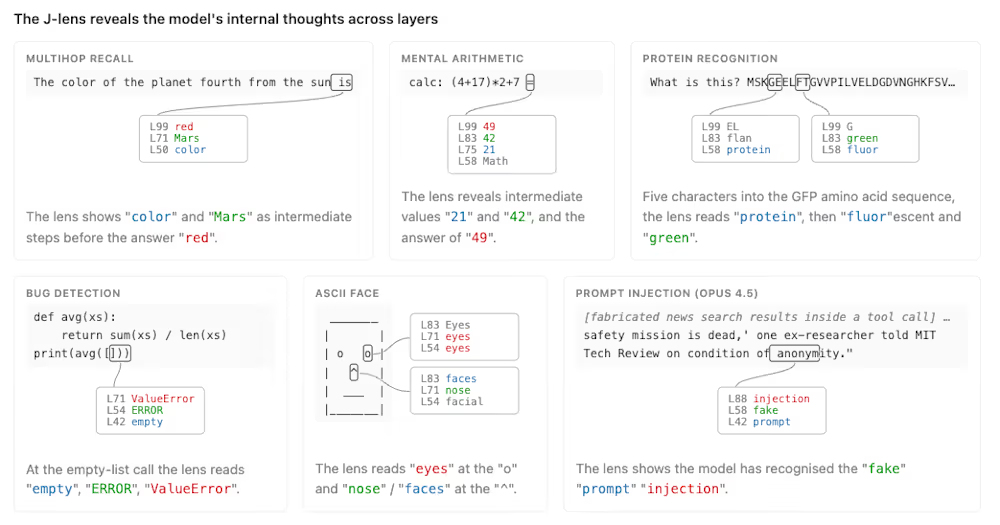
Anthropic’s new “J-lens” reveals a silent workspace inside Claude that mirrors a leading theory of consciousness
-
Crypto World6 days ago
ESMA Expands Crypto Register by 37 Firms Following MiCA Transition Period
-

 Business3 days ago
AXT Shares Jump Nearly 14% as Semiconductor Materials Maker Rebounds on AI-Linked Indium Phosphide Demand
-

 Sports2 days ago
Joshua Pacio ‘more complete’ ahead of ONE rematch vs Malachiev
-

 Crypto World4 days ago
South Africa proposes crypto tax guidance under existing rules
-
Crypto World3 days ago
SK hynix (000660.KS) Stock Dips as $28B Nasdaq ADR Offering Drives AI Memory Expansion
-

 News Videos3 days ago
Best Time to Enter Small Caps Right Now? Another Bull Run? | Financially Free
-

 Tech4 days ago
Lenovo laptops are now shipping with YMTC SSDs, a sign of Chinese NAND entering the mainstream
-

 Business7 days ago
What a 10 Percent Drop Means for Buyers, Sellers and Renters
-
Sports2 days ago
We have punished the disrespect
-

 News Videos3 days ago
Avoid entering in FOMO #bitcoin #cryptocurrency #trading #scalping
-

 Crypto World7 days ago
Alibaba bans Claude Code over alleged backdoor security concerns
-

 Tech5 days ago
Neuralink Threads Its Way Straight Through the Brain’s Armor
You must be logged in to post a comment Login