The dedicated digital audio player was supposed to be dead by now. The smartphone had the screen, the storage, the apps, the wireless headphones, and the smug little habit of replacing everything else in your pocket. And yet, here we are in 2026, talking about the Shanling M0 Pura, the fourth generation of Shanling’s ultra-compact DAP line, following the original M0 in 2018, the M0 Pro in 2023, and the M0s in 2024.
That progression matters. Shanling is not trying to convince normal people that they need another device to carry just to play music. That ship sailed, hit an iceberg, and was replaced by a phone plan. The M0 Pura is aimed squarely at audiophiles who still care about local files, wired headphones, Bluetooth flexibility, and better playback quality than the average phone dongle can deliver.
It also leans into nostalgia with some obvious iPod nano energy, but the pitch is not just retro cuteness. Shanling is betting that the DAP market still has life because some listeners want a dedicated player that puts music playback first.
Best Related Reviews:
Shanling M0 Pura
Dual DACs Give the M0 Pura Some Actual Audiophile Bite
The M0 Pura uses dual Cirrus Logic CS43131 DACs with support for PCM playback up to 32-bit/384kHz and native DSD128. Shanling says the new DAC section improves overall audio performance, while output power rises to a claimed 250mW into 32 ohms when the player is used with the company’s optional 3.5mm to 4.4mm balanced adapter.
That is not desktop amplifier territory, but for something this small, it gives the M0 Pura more muscle than its tiny chassis suggests.
Advertisement
Touchscreen
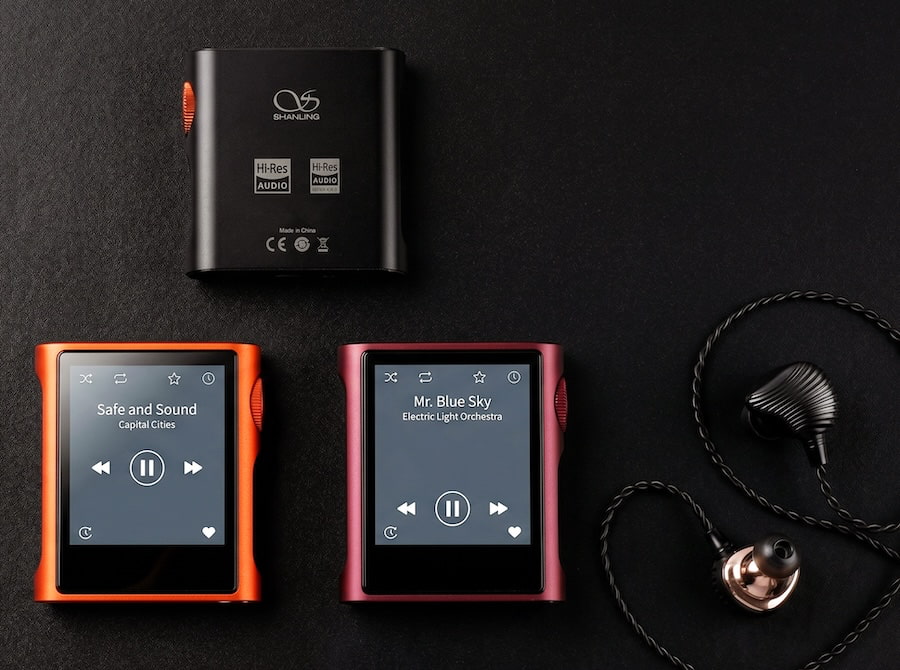
A 1.54-inch color touchscreen handles music playback and menu control, while Shanling’s in-house MTouch operating system is designed for quick navigation through albums, playlists, and settings. The M0 Pura is powered by the Ingenic X1000 platform, giving Shanling a compact foundation for hi-res playback without turning battery life into a hostage situation.
Connectivity
Do not let the M0 Pura’s size fool you into thinking this is just another cute little novelty box for people who still miss click wheels. Shanling has packed its newest ultra-compact DAP with a wide range of wired and wireless playback options, which makes the tiny player more flexible than it looks.
Two-way Bluetooth support allows the M0 Pura to work as a wireless music source for headphones and speakers, or as a Bluetooth receiver when paired with a smartphone, console, or laptop. In that mode, it functions as a compact Bluetooth DAC and headphone amplifier. USB-C connectivity adds another layer of flexibility, enabling USB DAC functionality and allowing the M0 Pura to serve as a bit-perfect digital transport for external USB DACs.
Storage
Shanling M0 Pura
In addition to listening via Bluetooth or a USB-connected device, users can store music locally by inserting a microSD card into the M0 Pura’s card slot. The M0 Pura supports microSD cards with up to 2TB of storage capacity.
Format Support
Digital audio format support includes FLAC, ALAC, WAV, AIFF, APE, MP3, AAC, OGG, and DSD, which covers everything from CD and vinyl rips to old iTunes downloads and newer studio-quality digital files.
Advertisement
Additional Playback Features
Additional playback features include adjustable playback speeds for podcasts and spoken-word content, A-B repeat, SyncLink remote control via the Eddict Player app for Android and iOS, sound customization settings, and user-selectable screensavers.
650mAh, up to 9 hours of playback, up to one month of standby
650mAh, up to 10 hours of playback
650mAh Up to 14.5 hours (single-ended) – 10 hours (balanced)
630 mAh lithium battery up to 15 hours of playback, up to one month of standby
Dimensions
43.8 x 45 x 13.8mm
43.8 x 45 x 13.8mm
43.8 x 45 x 13.8mm
40 x 13.5 x 45 mm
Weight
35.8 g
36.8 g
36.8 g
38 g
In the box
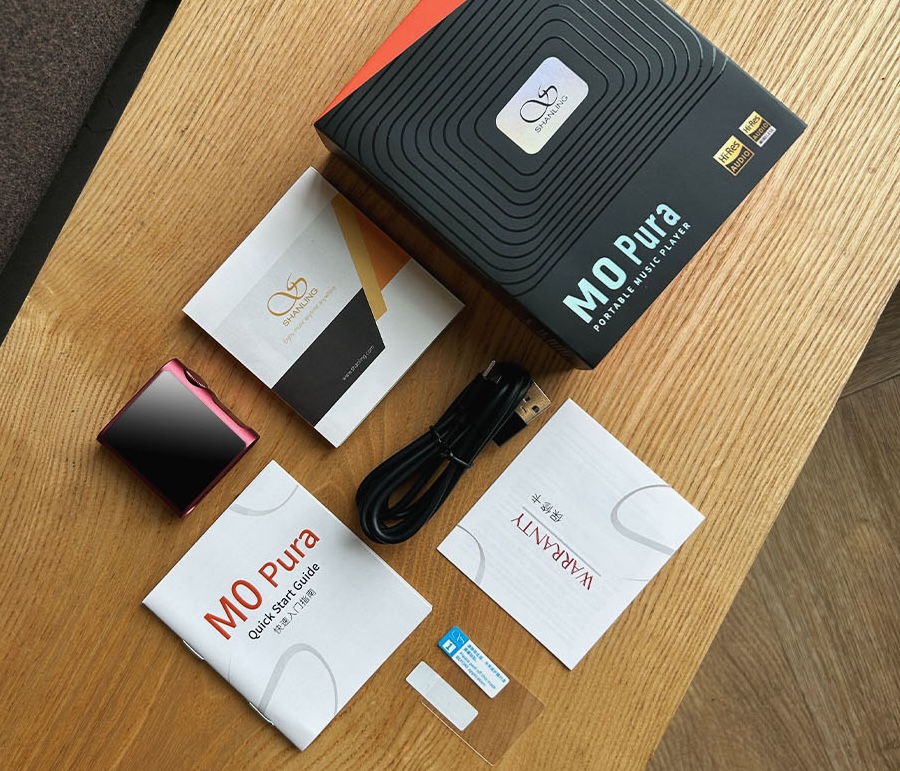
USB-C to USB-C cable Two screen protectors Quick start guide and warranty documentation
USB-C to USB-A cable (for charging and data transfer) Two screen protectors Quick start guide and warranty documentation
USB-C to USB-A cable (for charging and data transfer) Two screen protectors Quick start guide and warranty documentation
USB-C to USB-A cable (for charging and data transfer) Two screen protectors Quick start guide and warranty documentation
Optional Accessories
Leather case Clip case 3.5mm to 4.4mm balanced adapter
Not Indicated
3.5mm to 4.4mm balanced adapter
Not Indicated
Shanling M0 Pura
The Bottom Line
The Shanling M0 Pura is not trying to replace your smartphone, and that is probably its greatest strength. This is a tiny, purpose-built digital audio player for listeners who still care about local music files, hi-res playback, broad format support, two-way Bluetooth, USB DAC functionality, and better wired output than most phones can offer without a dongle dangling off the bottom like a sad little tail.
What makes the M0 Pura interesting is the combination of size, price, and flexibility. Shanling has managed to squeeze dual DACs, microSD storage support up to 2TB, USB-C digital output, and optional balanced headphone output into a player that is closer in scale to a smartwatch than a modern smartphone. That makes it a good fit for audiophiles who want a dedicated music player for commuting, travel, the gym, or a desktop setup without spending Astell&Kern money or carrying around a device the size of a deli sandwich.
The biggest downside may be the same thing that makes it appealing: the M0 Pura is very small. Misplacing it feels less like a possibility and more like a scheduled event. Shanling might want to include a lanyard, or perhaps a tiny AirTag shrine.
Google is rolling out a feature that flags when an advertisement was made using AI. The label will indicate if an ad was created or edited with generative tools, TechCrunch reports.
The disclosure appears in the “My Ad Center” panel, reachable via the three-dot menu or info icon on ads. It covers ads across Google Search, YouTube, and Google Discover, and is available globally.
That panel already lets users block or report ads and learn why one was shown. Now it adds an option labelled “how this ad was made”, which surfaces any AI involvement.
The rationale is straightforward. AI makes it cheap to generate slick product imagery, which can mislead shoppers who assume they are looking at a real photograph rather than a synthetic one.
Advertisement
The 💜 of EU tech
The latest rumblings from the EU tech scene, a story from our wise ol’ founder Boris, and some questionable AI art. It’s free, every week, in your inbox. Sign up now!
Until now, Google only required AI disclosure on election ads. Extending it to commercial ads is a meaningful widening of the policy.
The honour-system catch
The reach of the feature depends heavily on how an ad was built. When advertisers use Google’s own generative AI ad tools, the disclosure is switched on automatically.
Advertisement
When an ad is made elsewhere, though, the advertiser must actively flag that AI was involved. Google says it will not run its own check to verify the claim, so the label rests on advertisers being honest.
That gap matters because the incentive to stay quiet is real. An advertiser hoping a synthetic scene passes for a genuine photo has little reason to volunteer otherwise, and Google is not looking over its shoulder.
Regulators are forcing the issue
The timing is not accidental. Google’s move front-runs tougher rules, as the EU AI Act’s transparency obligations for AI-generated content start to bite in August.
The feature is still a step toward a market drowning in synthetic media, where even Google has branded some AI content spam. Giving users a place to ask how an ad was made is better than silence.
For now, Google has built the disclosure and handed advertisers the switch. The honest ones will flip it, and the rest are exactly the reason such a label was needed.
Ireland, Spain, France and the Netherlands are the only member states yet to incorporate the NIS2 directive into national law.
Ireland is one of four countries being referred to the highest court in the European Union for failing to adopt cybersecurity directives into law. The European Commission’s move comes as Ireland commences its six-month rotational presidency heading the EU Council.
The Network and Information Security 2 (NIS2) Directive entered into force in January 2023 and sets high security standards across 18 critical sectors, including health, energy, transport and the public sector, mandating organisations to implement appropriate security measures and report any relevant incidents to the authorities.
But by late November 2024, 23 member states, including Denmark, Germany, Finland and Sweden, were yet to transpose the directive, while by May 2025, 19 had still not done so.
In its referral yesterday (8 July), which also includes Spain, France and the Netherlands, the Commission requested the Court of Justice of the European Union to impose financial sanctions on infringing member states, consisting of lump sum and daily penalties until NIS2 is incorporated into national legislation.
The cybersecurity threat landscape is fast evolving, as newer technologies such as AI provide bad actors with advanced tools to commit phishing attacks, scams and infrastructure break-ins, while breaches go underreported in Ireland, according to a recent Compliance Institute report.
“While Ireland is not alone in having missed the deadline, this is not a great start for Ireland to our presidency of the Council of the European Union,” said Dentons partner David Kirton.
Advertisement
“The Government has listed competitiveness and security as two of its three key pillars for the presidency, so putting this legislation into effect would be a strong symbol of that commitment.”
The Government published a general scheme of the National Cyber Security Bill in August 2024, and a National Digital and AI Strategy this February, where it committed to “prioritising legislation to implement the EU NIS2 Directive”, but did not provide a timeline.
The bill remains in pre-legislative scrutiny and is only expected to go before the Oireachtas by September at the earliest.
Transposing the directive will not be straightforward, Kirton said, “as parts of the legislation are technical in nature and present a major change in empowering the National Cyber Security Centre to act in an enforcement role alongside other competent authorities”.
Advertisement
“The Government will need to prioritise the preparation of a bill, which has been promised by the Minister for Justice for later this year, which will no doubt provoke further debate as it proceeds through the legislative process before entering into force,” he added.
Earlier this year, the Commission proposed amendments to simplify NIS2 as part of its digital omnibus overhaul that aims to cut regulatory red tape and make business in the bloc easier.
Amendments to NIS2 aim to increase legal clarity by simplifying jurisdictional rules, streamlining the collection of data on ransomware attacks and facilitating the supervision of cross-border entities, the EU argued.
Don’t miss out on the knowledge you need to succeed. Sign up for the Daily Brief, Silicon Republic’s digest of need-to-know sci-tech news.
We’ve seen a lot of “smart art frames” at CES over the years. Most of them feel like glorified digital photo frames in turtlenecks. However, there’s one that feels genuinely different: Fraimic, and I say that as someone deeply skeptical of this category.
The pitch appears quite compelling at first. Speak a prompt into the device, and its built-in mic sends the command to OpenAI’s GPT Image 2.0, which then generates full-color artwork that lands on a Spectra 6 E Ink display.
Fraimic
What makes it stand out from competitors like Aura and SwitchBot?
Normally, you’d take out your phone to do that with a regular digital photo frame, but with Fraimic, you just have to tap, speak, and watch something appear on your wall that looks more like paint on paper than pixels on a screen.
The device also features an accelerometer that determines whether it’s oriented in portrait or landscape.
Coming to the competition part, Aura Frames require a subscription and don’t let you swap out the surrounding frame. SwitchBot frames, on the other hand, do not support voice generation. Fraimic does both, while keeping your prompts and images private by default.
Advertisement
The company offers you 100 free AI generations per year and also provides access to thousands of public-domain works from the Metropolitan Museum of Art. A REST API even opens it up to smart home integration for developers.
Fraimic
So why is the price such a tough pill to swallow?
Because $499 for the 13.3-inch and $1,499 for the 31.5-inch sounds a bit too steep. Aura’s comparable frame runs around the same for the smaller size, but it also offers buyers smaller options that cost even less. Switchbot sells a 31.5-inch variant that costs $200 less.
It’s worth noting that the 13.3-inch ships now, but the 31.5-inch shows a July 2026 shipping date on the official website. To make the brand’s case, it did grab a Red Dot Award: Product Design 2026. But for a first-gen device from a Chicago startup, it appears to be asking a lot of your wallet.
To me, Fraimic appears to be sitting in an awkward but interesting spot. It’s too expensive to be an impulse buy, too genuinely capable to dismiss. Anyway, we’ll reserve our final verdict for later, when we actually get our hands on it.
Linux distro accuses former contributor of deleting years of work and pushing a package that could have broken installs
OpenMandriva has accused a former contributor of using his trusted admin access to trash repositories and push a package that could have broken desktop installations after a community dispute spilled over into the project’s infrastructure.
The Linux distribution disclosed the incident in a forum post this week, describing what it called an attempted act of “distribution sabotage” allegedly involving Davide Beatrici, a developer known for his work on the Mumble instant messaging app.
Advertisement
According to OpenMandriva, Beatrici joined the project some time ago and later offered to migrate its repository infrastructure from GitHub to his privately operated OneDev instance, mirroring several dozen repositories in the process.
While some maintainers were uneasy about concentrating so much of the project’s infrastructure in one person’s hands, the proposal went ahead because, as the project put it, “he was such a well-known figure that we didn’t expect anything bad.”
OpenMandriva says trouble started after two other contributors joined alongside Beatrici. One allegedly engaged in repeated abusive behavior toward users and project members, much of it in private messages. The project says several contributors left before the maintainers finally stepped in, kicking the individual out of the OpenMandriva-Cooker Matrix chat. He wasn’t banned from the project, but OpenMandriva says the decision “triggered a cascade of events.”
Beatrici and another contributor then resigned. When OpenMandriva later decided there was little point continuing to mirror repositories to Beatrici’s private infrastructure, it says it began severing those connections.
Advertisement
According to the project, that didn’t go down well. “This infuriated Davide so much that, abusing of the administrative privileges he still had, he sabotaged the distribution today in the early morning hours,” the statement says.
OpenMandriva alleges Beatrici deleted parts of its GitHub repositories containing years of development work. It also says he “decided to publish an empty package in the cooker repository, which obsoleted all gnome and cosmic packages, which could have damaged the systems of people using gnome or cosmic.”
The Cooker repository is OpenMandriva’s rolling development branch, not a stable release, so the damage appears to have been confined to bleeding-edge users rather than to everyone running the distro. Even so, having one disgruntled admin yank years of work and potentially break package updates isn’t the sort of resilience test most projects volunteer for.
The project says it is restoring the deleted repositories and repairing the affected packages. It also says it carried out “a full system audit” and found that “aside from the removed packages, we found no other violations.”
Advertisement
OpenMandriva adds that it considered legal action, saying the alleged sabotage “constituted a criminal offense,” but ultimately decided against it.
According to tech publication The Lunduke Journal, Beatrici said that “this was by no means a sabotage. The objective was not to harm the distribution I cared for.” He reportedly admitted deleting Cosmic and Gnome repositories and said he did this because someone was “messing with my work.”
The Register has contacted OpenMandriva to ask whether any stable releases were affected, how many repositories were deleted or modified, and what changes the project plans to make to administrative access. We also reached out to Beatrici but have not heard back.
Every project needs contributors, but they don’t all need the kind of access that can turn a disagreement into a recovery exercise. ®
The world’s largest digital camera begins recording the changing universe every night
Giant Chile observatory discovers thousands of hidden asteroids during early testing already
A new sky survey captures fresh cosmic images every forty seconds overnight
A camera roughly the size of a small car has begun the most ambitious astronomical survey ever attempted from Earth.
The Vera C. Rubin Observatory, perched atop Cerro Pachón in northern Chile, officially started its Legacy Survey of Space and Time.
Every 40 seconds throughout the night, the 6,600-pound instrument captures a new image using its 3200-megapixel sensor, the largest digital camera ever built.
Latest Videos From
A decade-long cosmic recording begins
Over the coming decade, the camera will return to each patch of sky roughly 800 times, building a living record of celestial change.
Advertisement
Željko Ivezić, head of LSST, said the launch followed extensive system optimization and a careful review of technical readiness across multiple performance measures.
“Important factors that played a role in this decision included image quality, effective survey speed, system uptime and reliability, and calibration accuracy,” Ivezić said.
The $800 million observatory is jointly funded by the US National Science Foundation and the Department of Energy’s Office of Science.
Advertisement
Sign up to the TechRadar Pro newsletter to get all the top news, opinion, features and guidance your business needs to succeed!
“Today, we begin filming the greatest cosmic movie ever made…This moment reflects decades of vision, innovation and the power of federal investment,” said Brian Stone of the US National Science Foundation
Each night, the camera collects approximately 10 TB of data while generating as many as seven million alerts flagging changes across the sky.
During early optimization surveys lasting roughly six weeks, Rubin already discovered more than 11,000 previously unseen asteroids, including 33 near-Earth objects.
Advertisement
Mapping dark matter and the solar system
Scientists intend to use the completed dataset to build a new inventory of the solar system and the Milky Way galaxy.
The survey will also help researchers examine dark matter by studying the distorted light of distant background galaxies.
Advertisement
Bob Blum, director of the Rubin Observatory at NSF NOIRLab, said the project follows more than two decades of sustained engineering and scientific effort.
“Rubin Observatory is for everyone; the LSST will change how we do astronomy and astrophysics,” Blum said.
Phil Marshall, deputy director of Rubin Operations for SLAC, noted that millions of alerts generated in recent months already demonstrate the system functioning as a genuine discovery machine.
Once complete, the final dataset will contain billions of astronomical objects and trillions of individual measurements, according to the observatory.
Advertisement
This data will be released regularly, marking the first time such a comprehensive astronomical archive becomes publicly accessible to researchers and the public alike.
“Rubin is bringing the universe to life, illuminating a treasure trove of discoveries: pulsating stars, supernova explosions, the fossil record of galaxies, clues to the mysteries of dark energy and dark matter, and entirely new phenomena never seen before,” the observatory team said.
The US Federal Reserve has announced the industry leaders who will head up its various task forces guiding monetary policies. The country’s central bank has made some baffling appointments to its productivity and jobs team, which will “Assess the economic impact of new general-purpose technologies, including artificial intelligence, to inform the Federal Reserve’s policy judgments.”
One of the advisors will be new Xbox CEO Asha Sharma. After moving to gaming from Microsoft’s Core AI group, in the first few months of her tenure, she’s overseen yet another price hike for the gaming hardware and most recently announced to the company that it would be cutting 3,200 jobs across its studios. Microsoft has been gutting its staff across many divisions for awhile, so this isn’t a new policy she’s personally brought in. But the timing here could not be worse, especially as so much of the game industry is struggling to keep people employed and to figure out a responsible way to use AI.
Joining her in this strange advisory trio are Marc Andreessen, who doesn’t have the best trackrecord on talking intelligently about AI, and Charles I. Jones, a Stanford University economics professor who is currently on leave to work at the Anthropic Institute. Jones aside, it’s not necessarily the most reassuring group when it comes to being critical of artificial intelligence and the job market.
Bezos is reportedly set to invest $2bn into the company himself.
Jeff Bezos’s Blue Origin is reportedly nearing closing a $10bn funding round that would value the space company at around $130bn. This would be the first time Blue Origin is opening itself up to outside investors since being found in 2000.
Bezos is set to invest $2bn into the company himself, while Coatue Management – which has close ties to Bezos Expeditions – is committing $4bn, reports suggest.
The remaining $4bn has seen significant demand, sources told news publications, mirroring recent investor appetite around major tech IPO listings.
Advertisement
“We finally have enough visibility into our future and our financial success,” Bezos told CNBC in May. “It’s a good time actually to start thinking about the future and bring on some other outside investors.”
The reported funding into Blue Origin comes weeks after its biggest rival, SpaceX, raised a record-breaking $85.7bn in its IPO listing (including the underwriters’ option).
The Elon Musk-owned company has filed for a satellite constellation of up to 1m with major plans for orbital AI data centres. The company currently has more than 10,000 active satellites in orbit.
Earlier this year Blue Origin launched ‘TeraWave’, a new communication network with a planned constellation of nearly 5,500 satellites. The constellation is set to be deployed from Q4 2027, the company said in January. Blue Origin claims that TeraWave will deliver connection speeds of up to 6Tbps anywhere on Earth.
Advertisement
Plans, however, suffered a setback this May after one of Blue Origins’ New Glenn rockets exploded on the launchpad during a hot-fire test. The US Federal Aviation Administration ordered the company to investigate a previous malfunction during a failed launch test in April.
The $11.6bn deal, announced this April, sees Amazon acquire Globalstar’s existing satellite operations, infrastructure and licences. According to Reuters, Globalstar has 32 planned active low-Earth orbit satellites.
The e-commerce giant plans to integrate Globalstar’s assets into its own space internet service Leo, which aims to have more than 3,200 satellites in space. Currently, the company has more than 375 satellites in space already, and is planning several launches over the course of the year.
Advertisement
Don’t miss out on the knowledge you need to succeed. Sign up for the Daily Brief, Silicon Republic’s digest of need-to-know sci-tech news.
OpenAI unveiled its newest family of models on Thursday, introducing a new set of heavyweight programs into an increasingly crowded field of AI offerings.
GPT-5.6 comes in three variants: Sol (considered its workhorse), Terra (a more intermediate option), and Luna (its budget friendly option). These models expand what users can do across a variety of fields — with the company promising powerful capabilities in enterprise work, coding, and even scientific research.
CEO Sam Altman has promised that his company’s newest models are orders of magnitude more efficient and cost-effective than previous versions, recently telling CNBC that Sol is 54% more token efficient when it comes to AI coding tasks.
Most notably, the company calls 5.6 its “strongest cybersecurity model yet, achieving frontier performance with significantly fewer tokens.”
Advertisement
Indeed, much hubbub has been made about the model’s cyber capabilities, as the Trump administration previously sought to restrict its rollout, ostensibly due to fears of how the model could be misused. GPT-5.6 supports defensive activities, including threat modeling, code review and patching, and blue teaming (simulating an attack on your own systems to find weaknesses before real hackers do).
OpenAI also released a new tool called ChatGPT Work, which — just as it sounds — is designed as a workplace companion for enterprise teams, running on desktop, web, and mobile, that can help with daily clerical tasks, like drafting documents, spreadsheets, and presentations.
OpenAI’s newly announced family of models follows on the heels of similar releases this week from competitors SpaceXAI and Meta.
However, GPT-5.6 and its attendant marketing seems most designed to take aim at OpenAI’s primary opponent, Anthropic. Anthropic has managed to make itself the likable underdog of the AI race, focusing fixedly on enterprise customers and winning a growing share of support as a result.
Advertisement
Not to be outdone, OpenAI cites the Artificial Analysis Coding Agent Index, a notable benchmarking metric, to claim that its latest family of models outshines Anthropic’s models at every turn.
OpenAI calls Sol its “best coding model yet,” and has explicitly compared it to Anthropic’s recently released (and much hyped) Fable. Using the Coding Agent Index, OpenAI claims that Sol “sets a new state of the art at 80, 2.8 points above Fable 5, while using less than half the output tokens, taking less than half the time, and costing about one-third less.”
It adds: “That advantage extends across the family: Terra performs just above Fable 5, while Luna outperforms Opus 4.8.”
The company says that 5.6 is now available across ChatGPT, Codex, and the OpenAI API. Availability per million tokens is priced as follows: Sol is $5 input / $30 output, Terra is $2.50 input / $15 output, and Luna is $1 input / $6 output.
Advertisement
When you purchase through links in our articles, we may earn a small commission. This doesn’t affect our editorial independence.
Searching for work sucks; AI combs the internet and sucks it all up. Combine the two and let ‘er rip with this Python project
Combing through job postings and company help wanted pages for a position that matches your resume is the very definition of drudge work. Now, there’s an AI designed to suck up information from the web, do the search for you, and even help you apply.
Software developer Tarun Gupta created just such a tool in the form of Autopilot-Jobhunt. When configured with a profile of the user and their desired jobs (and what they absolutely won’t accept in an opening), A-J will scan the web while users sleep, take stock of the positions that are a good match, and then send a Telegram message to its user.
Advertisement
That message includes all matching openings, scored against the user’s resume and ranked according to the AI’s assessment. Users can ask A-J to format a resume and cover letter tailored to the position, which it’s up to the user to review and send – the bot won’t do so automatically.
You might be thinking that an AI-crafted resume and cover letter would be a bad strategy for getting your foot in the door at a company you’re keen to work for, but that might not be the case, actually. As we reported last year, researchers found that some AI hiring bots, often the first line a company uses to separate the wheat from the chaff, favored applications generated by the same AI model they used for screening – suggesting the human touch may be worth less than you think in the modern job market.
A-J is designed to be free to use (what hard-up developer can afford to do hundreds of AI API calls a night, after all?), and relies on free models to comb the web for jobs. TinyFish’s AI web agent is used to crawl for jobs, while OpenRouter provides the API for one of several default free AI models that A-J will run through, starting with Llama and falling back to free versions of Nvidia’s Nemotron, Google’s Gemma 4, and Alibaba’s Qwen3 when all else fails, or quotas run out.
Claude Code and the Anthropic API can be used in place of OpenRouter if you’ve got tokens to spare.
Advertisement
For those concerned about A-J broadcasting personal details to the web, Gupta writes that it’s designed to be private, providing an entire privacy readme as part of the project’s GitHub documentation.
As mentioned above, A-J never applies for a job on a user’s behalf, and the config file where users link to their locally stored Markdown-formatted resume and set other options is gitignored so it won’t ever be committed by accident.
That said, resumes do get routed to the LLMs OpenRouter is configured to use. Gupta said those who want to avoid sending that data through OpenRouter can use Claude Code instead, provided they have an Anthropic subscription that supports it.
As for who could make use of the tool, it’s configured by default for software developers, and for good reason: According to Hiring Lab data published on Wednesday, the number of job openings for software developers has risen by 15 percent since Anthropic released Claude Code in February 2025, while openings for all other jobs have fallen by seven percent over the same timeframe.
Advertisement
Still, young college graduates in a variety of career fields report not being able to find a job, so the tool could be of use to anyone with the willingness to reconfigure it for a different career field. AI companies, fintechs, and Silicon Valley heavyweights might be programmed into A-J by default, but they can be freely added, removed, and reconfigured as desired.
It’ll probably take some work to get Autopilot-Jobhunt configured for your particular needs, but if you’re having trouble landing a role, giving it a shot can’t hurt. ®
Nuclear chain reactions are contained inside of nuclear reactors within nuclear power plants, allowing fission to create an incredible amount of heat in a safe and controlled environment. However, nuclear reactors come with some rare but big risks — accidents could harm humans with radiation and contaminate the environment. That’s why the Department of Energy had strict safety, environmental protection, and security regulations — until recently.
In January 2026, NPR revealed that the Department of Energy under the Trump Administration had secretly cut around 750 pages of safety and security regulations in an attempt to increase innovation and speed up development. A month later, the Federal Register confirmed that new advanced modular reactors are being excluded from an environmental law requiring more disclosure on environmental protection and consequences of an accident. This coincides with President Donald Trump’s executive order stating that 10 large reactors should be under construction by 2030 — possibly to power the country’s data centers, with companies like Amazon, Google, and Meta backing these new plants.
Advertisement
Is it potentially dangerous to slash security measures for nuclear reactors?
Gsheldon/Getty Images
While the U.S. Department of Energy’s changes could increase how many nuclear reactors there are in the country, a lot of experts are worried about the changes to safety rules. This includes Edwin Lyman, the Director of Nuclear Power Safety at the Union of Concerned Scientists. He accused the new rules of “cutting corners” on public health and environmental protections. He told NPR, “The fact is that any nuclear reactor, no matter how small, no matter how safe it looks on paper, is potentially subject to severe accidents”.
You’ve likely heard of nuclear reactor accidents at Chernobyl and Fukushima, but the United States also had an extremely notorious incident in 1979, referred to as Three Mile Island. The reactor partially melted down near Middletown, Pennsylvania, but radiation was contained, and there was no effect on the environment or people in the area, thanks to the safety measures it had in place. Critics like Lyman say that removing the need for new nuclear reactors to provide the same safety and security precautions as part of their operations could be a huge risk.






























































You must be logged in to post a comment Login