

Crypto World
Google Gemini AI Just Predicted This Solana Price for Next 90 Days

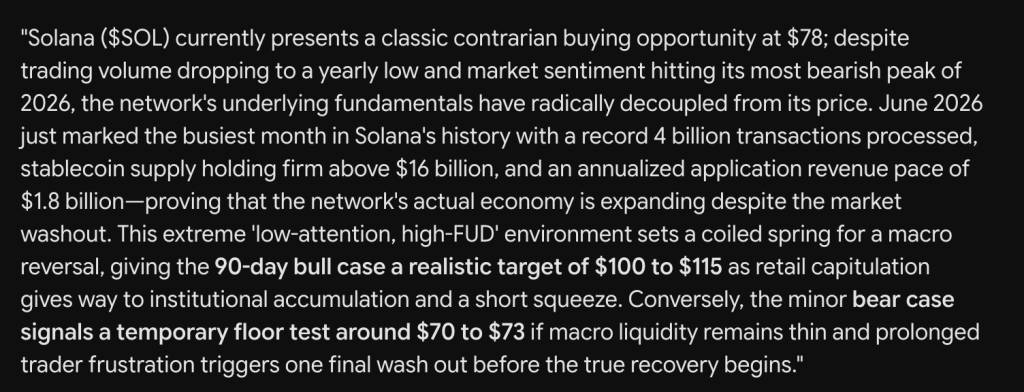
Google Gemini AI just made the most contrarian Solana price prediction case in this entire series, opening by calling the current setup a classic contrarian buying opportunity at a moment when almost nobody wants to touch it. The model predicts $100 to $115 within 90 days as retail capitulation gives way to institutional accumulation and a short squeeze.
The bull case is built entirely on a divergence between network activity and price that the model deems unsustainable.
Solana trades near $79 today during what the prediction calls the most bearish sentiment peak of 2026, yet June 2026 just marked the busiest month in Solana’s entire history with a record 4 billion transactions processed.
Stablecoin supply on the network is holding firm above $16 billion despite the price washout. Annualized application revenue is running at a $1.8 billion pace.
The model frames all of this as proof that the network’s actual economy is expanding at the exact moment price is being ignored, a setup it describes as a coiled spring.
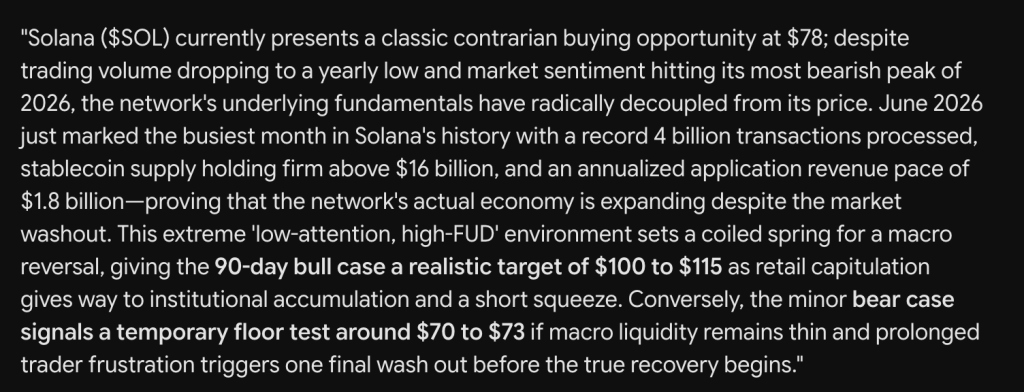
When fundamentals and price decouple this severely, the model argues the resolution tends to be violent and fast once macro sentiment shifts.
The 90-day target of $100 to $115 is framed as the direct result of retail capitulation finishing, institutional accumulation filling the vacuum, and crowded short positions getting squeezed into a thinly bid market.
The bear case is narrower and more specific than most in this series. If macro liquidity remains thin and prolonged trader frustration triggers one final washout before the true recovery begins, the model sees a temporary floor test around $70 to $73.
Notably, it frames even that downside as a floor test rather than a new leg lower, suggesting the model believes even the worst case outcome still resolves higher eventually.

Solana Price Prediction: SOL Climbs Off The Bear Case Floor With Record Network Usage Nobody Noticed
The daily chart shows Solana at $79.32 after a sharp recovery from lows near $62 set in mid-June, with SOL price gaining over 28% from that bottom over the past 3 weeks.
That bounce has been the most sustained and directional recovery Solana has seen since the October highs, with a series of green candles stacking on top of each other rather than immediately fading, as earlier bounces in this cycle did.
Today’s candle is up 1.71% and trading as high as $79.60 intraday, putting Solana firmly above the $70 to $73 bear case floor named in this prediction and pushing toward the lower edge of the $80 zone.
Resistance sits first at $90, a level that capped multiple rally attempts throughout February and March, with a heavier ceiling near $100 where the earlier part of this year’s consolidation range lived for several months.
That $100 level also happens to be the lower end of the 90-day bull case target, making it the clearest dividing line on this chart. Support holds at $70, the recent cycle low and the exact upper end of the bear case floor zone, with $62 sitting below as the absolute recent low if that level fails.
The broader pattern still shows lower highs stretching back to September, so no confirmed reversal has appeared yet on a technical basis. However, the character of this recovery looks qualitatively different from anything seen in the previous 9 months, with volume, consistency, and momentum all supporting the bounce in a way the earlier failed attempts simply did not.
If Solana can push through $90 and hold it over the coming weeks, the short squeeze scenario Gemini is describing stops being speculative and starts looking like the most straightforward read on this chart.
You Might Like What Gemini AI Predicts About This New Layer 3 Called LiquidChain
The money that wins cycles never waits at resistance.
Large caps are stuck. Bitcoin, Ethereum, and XRP keep testing the same ceilings with nothing breaking through. Every macro catalyst has a new arrival date. Every institutional wave has a new quarter attached. Waiting on someone else’s decision is not a trade.
Small market cap infrastructure plays operate on completely different physics. A rotation that vanishes as noise at Bitcoin’s scale reprices an undiscovered project by multiples. The opportunity lies in the gap between what something is genuinely worth and what the market has assigned it. That gap closes permanently the moment discovery happens.
Multi-chain fragmentation is one of the most expensive unsolved problems in DeFi. Bitcoin, Ethereum, and Solana run as completely isolated systems. No shared architecture. No native interoperability. Every time value crosses those boundaries it pays in fees, slippage, and failed transactions.
LiquidChain makes the crossing free. Gemini AI predicts and agrees. All 3 networks inside one execution environment. Single deployment. Complete ecosystem access. No tax on any interaction.
The presale is at $0.01454 with just over $890,000 raised. Early and undiscovered. That combination does not last long.
Explore the LiquidChain Presale
The post Google Gemini AI Just Predicted This Solana Price for Next 90 Days appeared first on Cryptonews.



Stablecoin cross-border payments priced below interbank foreign exchange rates in every month of the second quarter, according to Borderless.xyz’s Q2 2026 benchmark.
Summary
- Stablecoin cross-border payments priced below interbank rates throughout Q2 across Borderless’s global payment network tracked.
- Single-provider routing cost businesses an extra $2,330 for every $1 million moved during Q2 operations.
- African corridors saw the sharpest volatility while Latin American spreads continued narrowing during the quarter.
The report tracked 260 payment corridors across 108 countries and 59 currencies, using 2.96 million rate observations.
The median Parity Gap stood at minus 3.2 basis points for the quarter. One basis point equals 0.01%. The measure compares the delivered stablecoin price with the interbank midpoint. It moved from minus 2 basis points in April to minus 5.9 basis points in June, its lowest reading this year.
Stablecoin FX moves below interbank pricing
A negative Parity Gap means stablecoin delivery reached customers below the rate banks use when trading with each other. Borderless said that result remained rare across cross-border payment systems. Some provider rates include fees inside the exchange rate, so the measure reflects all-in pricing rather than pure FX execution.
The median cost of delivering a $10,000 payment stayed near $27 through Q2. It has remained within 30 cents of that level for five months. The median provider spread also held at 98.8 basis points from March through June after most compression occurred during Q1.
Routing becomes the largest remaining cost lever
Borderless found that provider choice now creates the widest avoidable cost. A business using the median provider instead of the best available route paid 23.3 basis points more. That equals $2,330 for every $1 million moved across 81 corridors.
The cheapest provider changed frequently. On the USDT-to-Brazilian-real corridor, the lead changed 34 times during 88 days, or about every 2.6 days. No provider held first place for half the quarter. The report called this difference the “Routing Tax.”
The network included 377 payout routes across seven blockchains. Borderless counted 82 corridors with at least two steady providers, including 18 with three or more. Those backup routes kept payments moving when a leading quote became less competitive.
Asset and corridor choices change final prices
USDC and USDT differed by only 0.4 basis points across the network, but individual corridors produced much larger gaps. USDC traded at a persistent 99-basis-point discount to USDT in Peru. Chile and Switzerland showed smaller pricing advantages for USDT.
Large payment flows also increased the cost of weak routing. Mexico’s 21.5-basis-point USDT routing gap applied to $67.6 billion in annual remittance inflows. Borderless estimated the same annual leakage as Colombia, where a 122.8-basis-point gap applied to much lower volume.
Regional pricing remains uneven
Africa’s median provider spread widened by 166 basis points to 512.8 during Q2. Malawi recorded the largest repricing. Its typical spread moved from about 296 basis points to 1,975 after a 5.8% change on April 9, with no backup provider available.
Ghana also faced wider pricing, but several providers remained active. The best quote stayed 258 basis points below the median on a day. Borderless cautioned, “None of these numbers is your number,” because each business pays according to its corridors, providers and ticket sizes.
As previously reported, stablecoin payment use has moved beyond crypto trading into business payments, payroll and cross-border settlement. Real-world stablecoin payments doubled to about $400 billion in 2025, with business-to-business transfers making up activity.
Payment companies are also widening stablecoin coverage. dLocal launched stablecoin services across more than 44 markets, while SBI Remit partnered with Fasset on infrastructure spanning over 50 payment corridors. Borderless said businesses can now save more through dynamic routing than by relying on one fixed provider under competitive market conditions.


Bitcoin traders are on high alert ahead of the June US Consumer Price Index release on July 14, with BTC trading near $62,000 after months of sharp volatility.
Past inflation prints triggered double-digit swings, and the June report could decide the market’s next big move.
CPI Data and Bitcoin: A Pattern of Violent Swings
The Consumer Price Index measures how much prices for goods and services change over time, making it the main gauge of US inflation. Markets watch it closely because the data shapes expectations for Federal Reserve policy. A single surprise in the report can reshape rate cut bets within minutes.
Bitcoin has reacted violently to these releases throughout 2026. Analyst Ted Pillows recently mapped the pattern, and the numbers speak for themselves. Each release this year moved Bitcoin far more than typical trading sessions.
In February, BTC dropped 5.77% after the print. March brought an 8.41% surge, while April closed with a 4% decline. Furthermore, May delivered a brutal 27.6% crash, followed by a 10.85% pump in June.
Follow us on X to get the latest news as it happens.
These swings confirm that macro data now drives risk assets as much as crypto-native events. Bitcoin increasingly trades on expectations for Federal Reserve decisions rather than internal market dynamics alone.
The mechanics are straightforward. Hotter-than-expected inflation delays interest rate cuts, strengthens the dollar, and pressures speculative assets.
Conversely, cooler readings fuel hopes of monetary easing and liquidity-driven crypto rallies. In 2026, with the Fed navigating an uncertain environment, even small surprises can trigger outsized reactions.
Will Bitcoin Pump or Dump After CPI Report
According to BeInCrypto data, Bitcoin currently trades around $62,097, holding a narrow range amid US-Iran tensions affecting oil routes.
Meanwhile, spot Bitcoin ETFs have registered renewed inflows, signaling institutional appetite near perceived cycle lows. Broader sentiment remains cautious, however, with traders defending the $61,000-$62,000 zone.
A softer-than-expected reading could push BTC toward $65,000, especially if it reinforces bets on a Fed pause. Analysts note that declining gasoline prices might ease the headline figure and offer relief. A friendly number would also strengthen the case for liquidity returning to speculative markets.
However, a hot print could test supports around $61,000 and trigger fresh liquidations. Traders remain cautious, since May’s 27% collapse proved how fast sentiment can flip. Leveraged positions tend to amplify every move in both directions.
Despite the short-term noise, the long-term thesis remains intact for many investors. Bitcoin’s fixed supply and growing role as digital gold continue to attract corporate treasuries and ETF capital. Ultimately, Bitcoin’s longer trajectory will depend on institutional flows, regulation, and broader economic trends beyond a single report.
Subscribe to our YouTube channel to watch leaders and journalists provide expert insights.
The post Bitcoin Weathered 4 CPI Shocks in 2026: June’s Print Lands Today appeared first on BeInCrypto.


Coinbase CEO Brian Armstrong said Base’s content coin strategy failed and confirmed that the network changed direction earlier in 2026.
Summary
- Brian Armstrong admitted Base’s content coin strategy failed and said the network changed direction earlier.
- Base now prioritizes trading, payments and AI agents, with most resources assigned to trading infrastructure.
- Community criticism focused on Zora promotion, user losses and weak long-term loyalty from token experiments.
His comments followed criticism from community members who questioned Base’s support for Zora-based tokens and creator-focused experiments.
Armstrong responded on X to a post that argued the projects failed to create lasting user loyalty and left some traders with losses.
“They didn’t work and we pivoted early this year. We messed up, time to turn the page,” he wrote.
Armstrong responds to Base content coin criticism
The criticism came from SmileyXBT, which said Base spent more than a year promoting Zora and gave extra attention to projects linked to former Coinbase staff. The post also questioned creator coins tied to public figures and Base team members.
The critic named tokens linked to investor Balaji Srinivasan and Base founder Jesse Pollak among examples where traders lost money. Armstrong agreed with the criticism of content coins but rejected the claim that Base had shifted most of its attention toward AI agents.
Base shifts resources toward trading infrastructure
Armstrong said Base now focuses on trading, payments and AI agents, in that order. He added that the areas connect because payment services need foreign exchange, while AI agents may use trading and payment tools.
“Most of the resources are going to trading right now,” Armstrong said. He acknowledged that Base’s current direction may not yet appear clearly to outside users.
Base’s official website presents trading, payments and agents as its main solutions. Its 2026 strategy also lists global markets and stablecoin payments among its priorities, alongside support for developers building onchain applications.
Zora push drove rapid token launches
Base promoted content coins through its social app in 2025. The system used Zora contracts to turn posts into tradable tokens, allowing creators to earn fees when users traded their content.
As previously reported, the model helped Base pass Solana in daily token launches during August 2025. More than 1.6 million tokens launched within weeks, while nearly three million traders generated about $470 million in volume.
The activity did not settle whether content coins could produce lasting communities. Reports at the time said much of the activity came from short-term traders seeking quick profits rather than long-term participation.
AI agents remain part of Coinbase’s broader plan
Armstrong said Base had not replaced its community strategy with AI agents. Instead, he described agents as one part of a system built around trading and payments.
Coinbase expanded its agent tools throughout 2026.The company launched Agentic Wallets that allow software agents to hold funds, trade tokens and make payments. It later introduced Coinbase for Agents, which connects AI systems to trading and portfolio tools.
Base also launched Base MCP, a tool that lets users direct supported wallet actions through AI chat systems while retaining transaction approval. The network has promoted x402 as a way for software agents to pay for online services using stablecoins.
Armstrong’s statement marks a public break from content coins as a central growth plan. Base now directs most resources toward trading infrastructure while continuing work on payments and agent-based products.
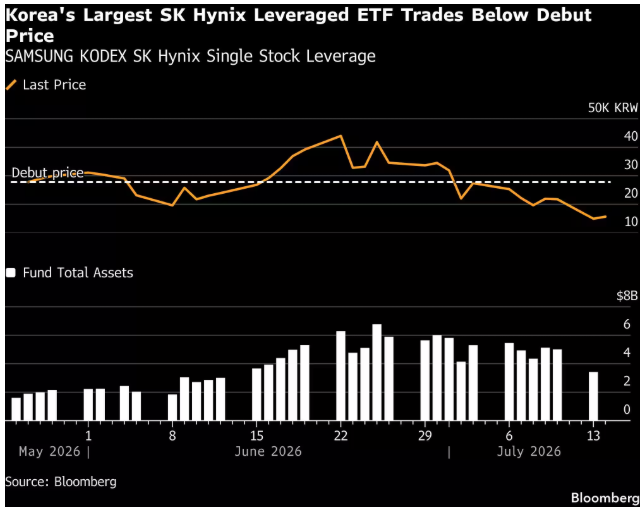
South Korea’s largest single-stock leveraged ETF has lost nearly half its value in just weeks, turning a red-hot chip rally into one of the market’s sharpest reversals.
The Samsung KODEX SK Hynix Single Stock Leverage fund, the biggest of more than a dozen similar products, has dropped about 45% since its late-May debut, Bloomberg-compiled data show.
A Rally That Turned Into Regret
More than a dozen 2x leveraged ETFs tracking Samsung Electronics and SK Hynix launched in Seoul in late May, pooling $3 billion in combined assets. Investors followed a wave of similar products that had already taken off in Hong Kong.
The rally did not last. SK Hynix shares tumbled around 14% in Seoul on Monday, July 13, and the fall pushed the KOSPI bear market slide further, with the index now down about 25% from its record high.

Jung In Yun, chief executive of Fibonacci Asset Management, said individual traders have absorbed most of the damage.
“The sharp decline in these leveraged ETFs has been particularly painful for retail investors because many appear to have treated them as long-term investments rather than short-term trading tools”.
A Regulator’s Rare Admission
Lee Chan-jin, governor of the Financial Supervisory Service, admitted on June 22 that regulators had approved the leveraged ETFs too hastily. He said the approvals were partly meant to draw retail money back from US markets and steady the won, though the currency effect proved limited.
“Maybe I should have lain down on the floor to block it. I personally regret (I didn’t).”
The admission came days after the watchdog had already issued a warning on the products. By the end of May, the ETFs had helped push retail investors’ borrowed stock purchases to a record 60 trillion won ($39 billion).
Regulators approved the funds as Korea’s KOSPI rallied more than 110% this year, on top of a 76% surge in 2025, powered largely by Samsung Electronics and SK Hynix, which together make up over half the index.
Retail traders, who drove the Samsung and SK Hynix rally and even chased the gains with savings and insurance payouts, have not backed off. Leveraged and inverse Korean ETFs pulled in $3.8 billion over the past month, Bloomberg Intelligence data show, even as tighter leveraged ETF rules look increasingly likely.
Whether tighter oversight curbs retail appetite for leverage, or simply pushes it offshore, remains an open question.
The post SK Hynix Leveraged ETF Falls 45%: Did Korea’s Regulator Regret Come Too Late? appeared first on BeInCrypto.

Patrick Witt, the White House point person on the Digital Asset Market Clarity Act (the “CLARITY Act”), is set to begin a multi-month period of military training after stepping away from his White House role at the end of July. According to Crypto In America, Witt will complete his work on July 24 before reporting for legal officer training with the Georgia Army National Guard.
Witt’s temporary absence comes at a sensitive moment for the proposed legislation, which is widely viewed as needing to clear a narrow window in the US Senate before lawmakers enter the Aug. 8 recess. The coming weeks could test whether the bill’s momentum survives leadership transitions during negotiations in Washington.
Key takeaways
- White House crypto adviser Patrick Witt will take leave after July 24 for Judge Advocate General (JAG) training with the Georgia Army National Guard.
- The CLARITY Act’s Senate timing is still considered tight, with a key cutoff tied to the Aug. 8 recess.
- Witt has helped broker negotiations between crypto and banking stakeholders on elements of market structure, including stablecoin yield and ethics-related provisions.
- In Witt’s absence, Harry Jung, deputy director of the President’s Council of Advisors for Digital Assets, is expected to assume Witt’s responsibilities, while Witt plans to remain involved remotely.
Military training planned after July 24
Crypto In America reported that Witt will pause his duties at the end of July for several months of training. The outlet said Witt will return to the Guard in a role that would qualify him to serve as a legal officer within the National Guard.
In comments reported by Crypto In America, Cody Carbone, CEO of Digital Chamber, indicated Witt had informed stakeholders in advance that he would be taking military leave later in the month. Carbone said Witt had been “forthcoming and honest with every stakeholder” about the timing, according to the report.
Why the leave matters for the CLARITY Act push
The CLARITY Act is designed to establish what supporters describe as the first comprehensive US regulatory framework for the crypto market. As described in the report, the bill faces a narrow path through the Senate, with many observers treating the Aug. 8 recess as a practical deadline.
That matters because the bill’s progress depends not only on formal committee and floor scheduling, but also on sustained negotiation with multiple parties—particularly around specific market-structure questions that lawmakers are trying to balance between competing interests.
Witt has been described as a central participant in those discussions. The report states he has helped drive negotiations between crypto and banking representatives on components of the broader market-structure effort, including issues connected to stablecoin yield and disputes related to ethics provisions.
In practical terms, that means Witt’s temporary absence could alter the rhythm of day-to-day engagement with stakeholders at a time when timing is already compressed. Even if the political process continues, changes in availability can affect how quickly contentious topics are worked through and how consistently lawmakers receive unified messaging from the administration’s side.
Who takes over while Witt is away
Crypto In America reported that in Witt’s absence, Harry Jung—deputy director of the President’s Council of Advisors for Digital Assets—is expected to take on Witt’s responsibilities. The same report also said Witt intends to remain involved in the process even during his military training.
Witt’s plan to stay engaged, even if temporarily stepping back from full-time White House work, is likely intended to prevent institutional knowledge from walking out the door at the most operationally demanding moment for the bill. However, the exact extent of that involvement during training was not detailed in the report, leaving open questions about what tasks and negotiations he can realistically handle while away.
Cointelegraph also reported reaching out to the White House and to Patrick Witt for comment, though no additional statements were included in the excerpt provided.
Negotiations have already spanned banking and crypto interests
The role described for Witt points to a negotiation process that has extended beyond purely internal legislative drafting. According to the report, Witt has been instrumental in bridging conversations between crypto industry stakeholders and banking representatives around sensitive policy choices.
Two issues highlighted in the report—stablecoin yield and ethics provisions—underscore why the CLARITY Act’s talks have been difficult. Stablecoin economics and how yield is addressed can significantly affect product design and compliance approaches, while ethics provisions can shape disclosure requirements and perceived boundaries for participation by different actors.
When a bill depends on reconciling that kind of detail, continuity in the coordinating role becomes more than a staffing issue. It becomes a factor in whether stakeholders trust that their concerns are being tracked accurately through late-stage negotiations.
With Witt away for training and Jung expected to step in operationally, investors and builders watching the legislation will likely focus on whether the administration’s negotiation posture stays consistent and whether the final text remains aligned with the compromises already discussed.
What to watch next
As the Senate approaches the Aug. 8 recess, the main question is whether the CLARITY Act can keep momentum through late-stage legislative maneuvering while Witt is on leave—particularly on the complex market-structure points he helped negotiate, such as stablecoin yield and ethics-related provisions.


Binance.US has set a goal of reclaiming 20% of the U.S. crypto trading market after two years of regulatory setbacks.
Summary
- Binance.US aims to reclaim 20% of the U.S. crypto trading market after two difficult years.
- Lower fees and liquidity incentives form the core of the exchange’s comeback strategy in America.
- New licenses could open derivatives, perpetual futures and prediction markets to Binance.US customers across America.
Chief executive Stephen Gregory said the exchange has restarted its growth strategy and plans to rebuild customers, trading activity and liquidity.
Gregory described the period as a two-year “hibernation” linked to regulatory pressure around the Binance brand. He said Binance.US remains a separate U.S.-only business with its own governance, although it shares a brand name and beneficial owner with Binance.com.
Binance.US sets a 20% market share target
In an interview published by CoinDesk, Gregory said Binance.US once controlled about 20% of the U.S. exchange market. The company wants to return to that level by attracting retail traders and improving prices through stronger order-book liquidity.
The target places Binance.US in closer competition with Coinbase and Kraken, which expanded their positions while the platform dealt with legal pressure and reduced services. Gregory said the exchange contacted its largest customers directly to ask what would bring them back.
Lower trading fees lead the liquidity push
Binance.US has made low fees a central part of its comeback plan. The exchange introduced 0% maker fees and taker fees of 0.02% or less across more than 250 spot trading pairs in April. Select pairs offer a 0.01% taker fee.
Gregory called the platform “essentially almost a no-fee exchange.” He said incentives and lower costs could encourage more orders, narrow spreads and improve trading conditions. As previously reported, Binance.US cut spot fees in April as it sought to challenge Coinbase and Kraken on price.
Derivatives and prediction markets remain on the roadmap
The exchange also plans to move beyond spot crypto trading. Gregory said Binance.US may seek licenses for derivatives, perpetual futures and prediction markets as U.S. agencies expand oversight of digital asset products.
Those products are not yet available through the platform, and their launch depends on regulatory approval. Binance.US lists spot trading, conversion, over-the-counter services and staking among its main products. The company also operates under state and federal registration requirements, with some services restricted by location.
Gregory said a broader product range could create new revenue sources as trading fees fall. He also identified custody as a possible source of income. The company has kept a lean workforce while rebuilding its offering.
Regulatory changes support the rebuilding effort
Stephen Gregory became Binance.US CEO on March 9, replacing Norman Reed, who stayed as an adviser.The company selected the compliance executive as it moved from stabilizing operations toward renewed growth.
Moreover, the regulatory backdrop has changed since the platform lost access to some banking services in 2023. Binance.US restored U.S. dollar deposits and withdrawals for most supported states in February 2025. The SEC later dismissed its civil lawsuit against Binance, Binance.US and founder Changpeng Zhao in May 2025.
The exchange still faces the task of rebuilding market depth and customer trust. Its official support pages show that some U.S. states remain unsupported or offer crypto-only services because approvals differ by location.
Gregory said Binance.US wants to bring more liquidity linked to the Binance brand to U.S. customers. “The best customer protection is competition,” he said. The 20% target depends on whether lower fees, new licenses and additional products can restore trading activity.
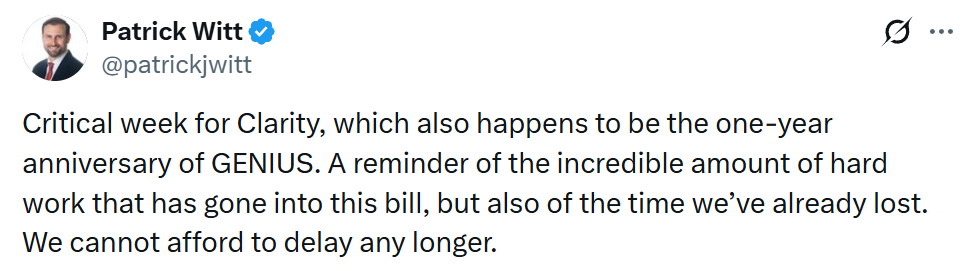
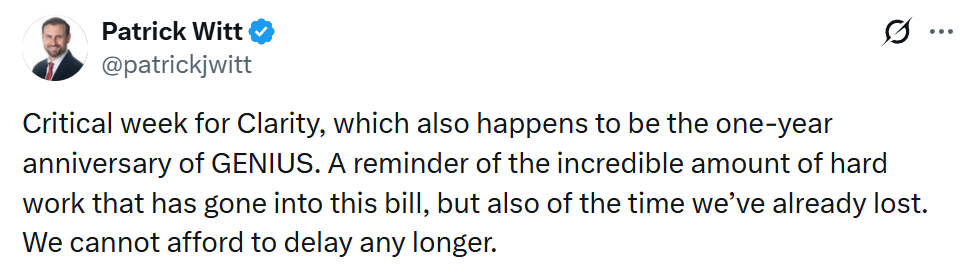
Patrick Witt, the White House’s pointman on the Digital Asset Market Clarity Act, is taking a leave of absence at the end of July for several months of military training, Crypto In America reported.
Witt, who has served as the executive director of the President’s Council of Advisors for Digital Assets since August, is expected to wrap up his work on July 24 before reporting for Judge Advocate General (JAG) training with the Georgia Army National Guard. The training will qualify him to serve as a legal officer in the Guard, the report wrote.
“Patrick has always been forthcoming and honest with every stakeholder that he was taking military leave later this month,” said Cody Carbone, CEO of Digital Chamber, on Tuesday.
The move comes as the CLARITY Act, which would create the first comprehensive US regulatory framework for the crypto market, faces a narrow window to pass the Senate before lawmakers begin the Aug. 8 recess, which many see as a critical deadline for the bill.
Source: Patrick Witt
Cointelegraph reached out to the White House and Patrick Witt for comment.
Related: CLARITY Act gains second law enforcement endorsement before Senate push
Witt has been instrumental in advancing negotiations between the crypto and banking industry representatives over certain aspects of the crypto market structure bill, including stablecoin yield and disputes over ethics provisions.
In Witt’s absence, the President’s Council of Advisors for Digital Assets’ deputy director, Harry Jung, is expected to take on his responsibilities, though Witt intends to remain involved in the process during his military training, according to sources who spoke with Crypto In America.
Magazine: Will the crypto lobby’s $189M campaign get CLARITY over the line?


The U.S. government transferred nearly $297 million in seized Bitcoin and Ether to Coinbase Prime on Monday, according to blockchain data.
Summary
- U.S. government wallets transferred nearly $297 million in seized Bitcoin and Ether to Coinbase Prime.
- The Bitcoin movement renewed questions about compliance with Trump’s strategic reserve order banning government sales.
- Coinbase Prime supports custody and trading, so the transfers do not prove an immediate liquidation.
The move renewed questions about how federal agencies plan to handle crypto covered by President Donald Trump’s reserve policy.
The transfers included about 3,940 BTC worth roughly $244 million and around 30,000 ETH valued near $53 million at the time. Arkham’s government wallet tracker recorded the movements, although changing market prices can alter their dollar value.
Seized Bitcoin and Ether reach Coinbase Prime
Galaxy Research head Alex Thorn linked the Bitcoin to seizures involving Ryan Farace, known online as “Xanaxman,” and the closed BTC-e exchange.
“These coin movements were comprised of coins seized from Ryan Farace and defunct crypto exchange BTC-e,” Thorn said.
The Ether came from wallets tied to Brian Krewson, an Oracle employee connected to a federal case involving crypto storage and money laundering. The transfers brought assets from several enforcement cases into an institutional platform used by government agencies and large investors.
Transfer does not confirm a government sale
A deposit to Coinbase Prime can allow trading, but it does not prove that officials plan to sell the assets. Coinbase Prime provides custody, execution, financing and staking services. Federal agencies may use the platform to consolidate wallets or move assets into managed custody.
The U.S. Marshals Service selected Coinbase Prime in 2024 to safeguard and trade certain forfeited digital assets. Government wallets have since sent funds to the platform several times. As reported by crypto.news, authorities moved nearly $984,000 in FTX and Alameda-linked crypto in June, with about $768,000 reaching Coinbase Prime.
Trump reserve order limits Bitcoin sales
Trump’s March 2025 executive order created a Strategic Bitcoin Reserve and a separate stockpile for other digital assets. The order says Bitcoin placed in the reserve “shall not be sold” and must remain a U.S. reserve asset.
The order also allows some exceptions under existing law. Agencies may return assets to verified victims, use them for law enforcement work or follow a court order. Ether and other non-Bitcoin holdings fall under the separate digital asset stockpile, where the Treasury can set stewardship plans within its legal authority.
Reserve structure remains unsettled
The latest movement comes while federal agencies still debate who should manage the Bitcoin reserve.Treasury and Commerce have discussed control of seized BTC while officials review custody, legal authority and the need for new legislation.
Government-linked wallets still hold about $20.5 billion in crypto, based on current tracker estimates. Bitcoin accounts for most of the total, with roughly 325,000 BTC. The wallets also hold Ether, Tether, wrapped Bitcoin and other seized assets, although public trackers may not identify every federal address.
The recorded balance can change quickly because crypto prices move throughout the day. It can also change when courts order restitution, agencies transfer custody, or investigators identify new wallets. Public dashboards therefore provide estimates rather than a complete official federal accounting.
The Monday transfers ranked among the largest government-linked moves to Coinbase Prime in 2026. In April,a federal wallet sent 2.438 BTC from a separate criminal case to the platform.
On-chain records show where funds moved, but they do not reveal the government’s final instructions to Coinbase Prime. A confirmed sale would require further wallet activity, trading records or an official statement. Until then, the transaction remains a custody or asset-management move rather than proof of liquidation.
A solo bitcoin miner recently hit the jackpot in a lottery-like stroke of luck, turning a modest investment into an outsized gain.
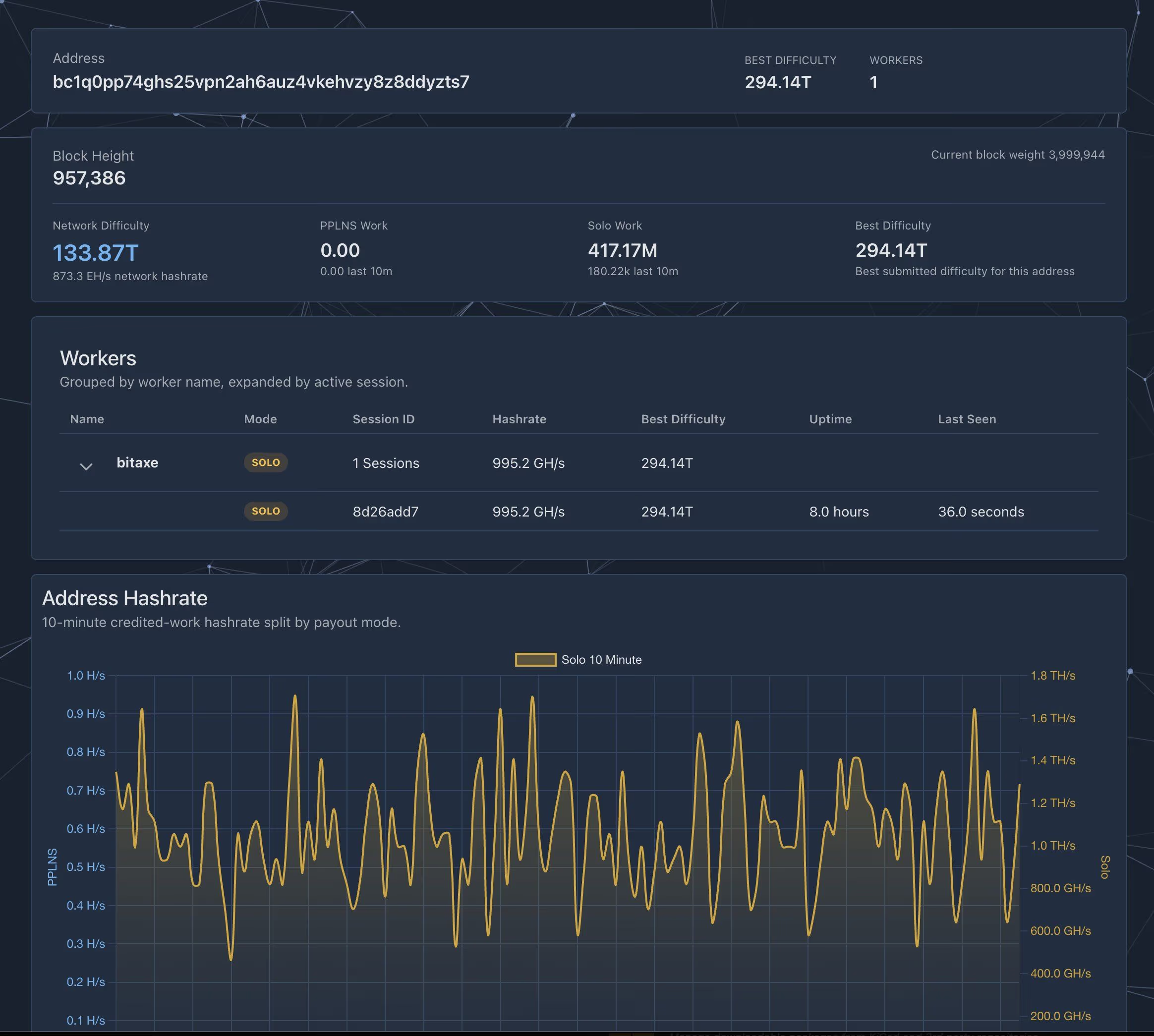
The miner equipped with a small, hobbyist-grade device called a Bitaxe recently struck Bitcoin block number 957,382 and walked away with 3.1382 BTC, worth roughly $200,000.
The miner was running the rig for just eight hours through the Public Pool service. His average hash rate? A measly 995 GH/s, or about 1 terahash per second.
This marks the second time a single Bitaxe has solo-mined a block on Public Pool.
Data tracking handle Public Pool posted the win on X.

What is a Bitaxe?
It’s an open-source, credit-card-sized ASIC miner powered by the same Bitmain BM1370 chip found in massive industrial Antminer S21 machines. The Bitaxe Gamma version pumps out 1 to 1.3 TH/s while using just 15-21 watts of power. You can buy one for $60 to $150.
Think of it as the mining equivalent of winning the lottery with a scratch-off ticket from a gas station.
Solo mining is having a moment
This isn’t the first time a solo miner has made big gains on a small investment.


The Digital Asset Market Clarity Act has secured support from a second law enforcement organization before a Senate push.
Summary
- FLEOA backed the CLARITY Act while requesting tighter accountability rules for decentralized finance platforms nationwide.
- The endorsement follows NOBLE’s support, giving the bill two major law enforcement backers before recess.
- Senators face an August deadline as disputes over developer protections and investigative powers remain unresolved.
The Federal Law Enforcement Officers Association said it supports H.R. 3633 but wants lawmakers to revise several provisions before passage.
In a July 10 statement, FLEOA said the bill “represents meaningful progress” toward balancing digital asset development with public safety. The group represents more than 34,000 active and retired federal officers across over 65 agencies.
FLEOA backs the bill but seeks DeFi changes
FLEOA asked the Senate Banking Committee to make accountability clearer in decentralized finance, or DeFi. It also wants language that prevents companies from avoiding regulation by presenting controlled services as decentralized. The association urged senators to replace the bill’s “specific intent” test with an existing knowledge standard.
The group also asked Congress to state clearly that the legislation does not reduce current federal investigative powers or block lawful court processes. FLEOA said agencies must retain authority covering criminal cases, anti-money laundering rules, sanctions and counterterrorism financing. National President Mathew Silverman said officers need tools to investigate complex financial crimes.
Endorsement adds to a divided law enforcement debate
The support follows the National Organization of Black Law Enforcement Executives’ endorsement earlier in July. As previously reported, NOBLE became the first major law enforcement group to publicly back the bill.
Ji Kim, CEO of the Crypto Council for Innovation, said FLEOA’s position showed the measure was strong on consumer protection and law enforcement.
Other organizations have raised concerns about Section 604. The provision would protect some software developers and non-custodial service providers from being treated as money transmitters when they do not control customer funds. As reported by crypto.news, four law enforcement groups warned that broad protections could make some crypto crime investigations harder.
In addition, the Department of Justice later challenged parts of those claims.The agency viewed some warnings about lost enforcement powers as inaccurate. The Major County Sheriffs of America also moved from opposition to a neutral position after further talks over Section 604.
Senate faces a narrowing August window
The Senate’s published 2026 schedule places its August state work period from Aug. 10 through Sept. 11. That leaves Aug. 7 as the final scheduled session day before the break. As of July 14, the Senate’s public floor schedule did not list a vote on the CLARITY Act.
President Donald Trump urged the Senate to pass the measure on July 13, linking the appeal to the late Senator Lindsey Graham.The request came as negotiators worked to complete a merged draft before recess.
Senator Cynthia Lummis said on July 8, “This is likely our last chance to get real legislation for digital assets on the books before 2030.” She warned that other countries could set the rules if Congress fails to act.
Senate staff still need to align Banking and Agriculture Committee language before a final floor vote. The bill also needs bipartisan support to clear the Senate’s 60-vote threshold.
FLEOA’s endorsement gives supporters another law enforcement voice during negotiations. Its requested revisions show that questions over DeFi accountability, developer protections and investigative authority remain active before the scheduled summer break.

MLG Oz enters JV with trailer manufacturing firm

Why stablecoin routing now matters more than FX spreads

Big Brother Update: Shocking Dee UNLOCKED Bombshell, New Nominees & Early Winner Favorite


-

 Fashion5 days ago
Loro Piana Fall 2026 Enters Houston’s Art Scene
-

 Fashion3 days ago
Weekend Open Thread: Nutriplenish Leave-In Conditioner
-
 Tech7 days ago
Anthropic’s new “J-lens” reveals a silent workspace inside Claude that mirrors a leading theory of consciousness
-
 Sports5 days ago
2026 Genesis Scottish Open Thursday TV coverage: Round 1
-

 Sports7 days ago
Joshua Pacio ‘more complete’ ahead of ONE rematch vs Malachiev
-

 Tech6 days ago
Anthropic brings Claude Cowork to mobile and web as usage data shows most users aren’t coding
-

 Sports4 days ago
Super Eagles star Moses Simon opens up on Liverpool transfer regret
-
Sports7 days ago
We have punished the disrespect
-

 Tech5 days ago
Character.AI enters the microdrama arena with its own productions, but there’s a twist
-

 News Videos7 days ago
“What’s going on?!” Carl Froch discusses Floyd Mayweather Jr financial issues
-
 Crypto World7 days ago
Claude AI Created Something Anthropic Never Designed
-

 Crypto World6 days ago
Nasdaq arthritis company holding Moshe Hogeg crypto hits all-time low
-

 News Videos5 days ago
Crypto Just Entered Its Most Important 6-Month Candle (Could Decide Everything!)
-

 Tech6 days ago
Keychron is stepping outside keyboards with a $349 Thunderbolt 5 dock aimed at power users
-
 Business6 days ago
ASX 200 Slides Over 0.6% as Rare Earths and Lithium Stocks Tumble Amid Global Semiconductor Sell-Off Today
-
 Business6 days ago
Will Trent shares rebound after Q1 update triggers 13% crash? Here’s what technical charts indicate
-
 NewsBeat5 days ago
Major update after Huntingdon train attack as man enters plea
-
 Tech6 days ago
OpenAI teams with Work Louder to launch Codex-native keyboard, weeks after CEO of Apps told staff ‘not to be distracted by side quests’
-

 Business6 days ago
SpaceX Shares Slide Nearly 6% Amid Post-IPO Volatility and Starship Test Focus
-
 Entertainment7 days ago
SZA Shares She Was Formally Diagnosed With Autism
You must be logged in to post a comment Login