Connect with us
DAPA Banner
DAPA Coin
DAPA
COIN PAYMENT ASSET
PRIVACY · BLOCKDAG · HOMOMORPHIC ENCRYPTION · RUST
ElGamal Encrypted MINE DAPA
🚫 GENESIS SOLD OUT
DAPAPAY COMING

NewsBeat

Why the US economy stays strong even when its policies shock the rest of the world

Published

on

Why the US economy stays strong even when its policies shock the rest of the world

The US economy is continuing to grow faster and generate more new jobs than Europe. Annual national income growth over the past five years has averaged 3.3% in the US against 2.6% in the EU. In the first quarter of 2026, the EU’s GDP was just 0.7% higher than a year before, while that of the US was up 2.6% on comparable measures.

These figures defy the widespread predictions that the US would lose its growth advantage after its government imposed a global trade tariff regime in 2025 and, one year later, started a war with Iran. Economists see several factors behind the resilience of the US economy.

The US runs consistently wider budget deficits than the EU, UK or China. By spending more than it collects in tax, the US government creates more income for the people it employs and the businesses it buys from. This extra income in theory boosts demand in the economy, pushing output growth higher and reducing unemployment.

Most European governments also run budget deficits. The average budget deficit of EU countries in 2025, for example, was 3.1% of GDP. But the US deficit, at 5.8% of GDP that same year, is giving a much stronger stimulus.

Advertisement

The US also channels a higher proportion of its GDP into business investment and research and development than the EU. Europe was spending €270 billion (£230 billion) less than the US on innovation in 2021, with this spending concentrated on its century-old car industry rather than new technologies.

Since 2025, AI has been the focus of US investment. This has helped the US maintain its hold over global technology and digital platforms. Rapid uptake of AI across US industry has also widened the margin by which its labour productivity growth is outpacing Europe’s. Output per hour in professional services has increased by over 18% since 2019 in the US compared to just 5% in the EU.

Uptake of AI across industry has also boosted labour productivity growth in the US.
DC Studio / Shutterstock

Economy-wide productivity gains have allowed US real wages (wages adjusted for inflation) to edge higher since 2019. This has sustained consumer demand while also enabling the strong profit growth that has lifted US share prices to record levels. In contrast, average real wages in the EU have barely grown over the past 20 years while corporate profits in Europe remain subdued.

The US technological lead could be dented by Donald Trump’s immigration clampdown, which extends to skilled scientists and students. Research suggests annual GDP growth rates in the US could currently be as much as 0.8 percentage points lower than if net unauthorised immigration had stayed on its pre-2025 trend.

Advertisement

But the Trump administration and its tech-entrepreneur supporters also credit their success to more freedom to gamble with new ideas, while Europe regulates them more heavily and China tries to harness them for state control. Although the EU generates as many tech start-ups as the US, many relocate there when they start to expand.

Another factor explaining the resilience of the US economy is that American industry benefits from substantially lower energy costs than in Europe. The US produces more fossil fuels than Europe and taxes them less. It is also advancing fast with cheap renewable sources, despite the government’s scepticism towards solar and wind.

Reliance on fossil fuels, and indifference to carbon emissions, may raise the US’s long-term economic vulnerability. But for now they ensure a cost advantage that is allowing the US to regenerate its manufacturing and meet much of the global demand for data-based services such as e-commerce and generative AI.

Favourable financial engineering

The US spends more on goods and services than it produces domestically. This results in a large current account deficit, which widens as US growth picks up. To finance this deficit, the US has to borrow from the rest of the world continuously.

Advertisement

For most countries, the resulting rise in liabilities to other countries would lead to a weakening currency and higher inflation, or a spell of slower growth to rebalance the current account. However, the US benefits from global use of the US dollar.

The US dollar is the universal standard for trade in commodities. And due to a perception that the US will continue delivering high returns on investment and repaying its debts, the rest of the world typically responds to shocks such as wars by moving money into US assets – even if US policy is responsible for those shocks.
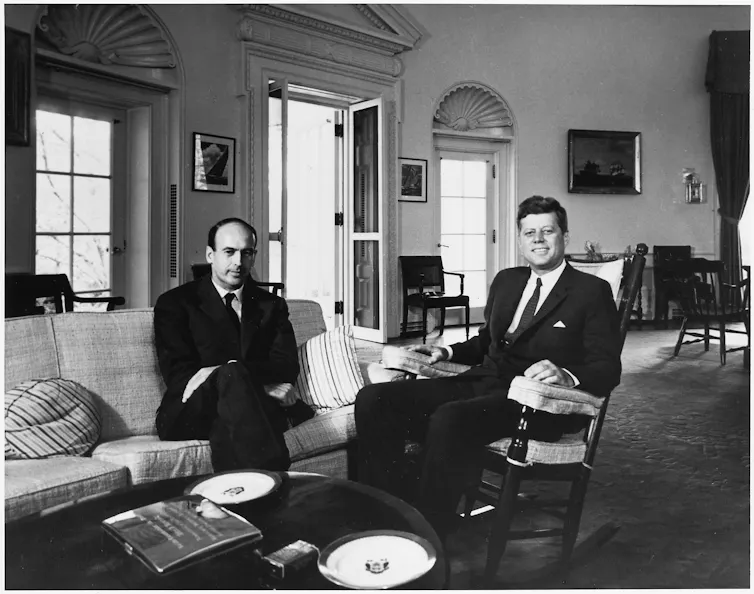
Valéry Giscard d'Estaing sat alongside John F. Kennedy in the White House.
Valéry Giscard d’Estaing meeting with the then-US president, John F. Kennedy, in the White House in 1962.
Abbie Rowe / US National Archives and Records Administration /

In the 1960s, France’s then-finance minister, Valéry Giscard d’Estaing, who later served as its president, railed against what he called the “exorbitant privilege” the US gains from printing the world’s currency. The US will retain this privilege as long as global trade and finance are mostly conducted in US dollars.

This situation is unlikely to change. The EU’s efforts to unify its financial markets to support its single market have proceeded slowly and were set back by Britain’s 2016 decision to leave the bloc. Britain and the EU have lost global financial marketshare since the UK broke away.

Attempts by China, Russia and major oil-exporting countries to launch an alternative reserve currency have also made little progress. But they might not regret this. The dollar’s global role makes it harder for the US to control its inflation, as it has to watch the wider impact of raising interest rates.

Advertisement

When inflows of foreign capital strengthen the dollar, US industry also becomes less competitive on the global stage. And with so many governments worldwide under pressure to balance their budgets, America’s deep-pocketed consumers and businesses might still be the “engine of growth” that enable other regions to expand.

Impressive economic performance between 2021 and 2024 did nothing to revive the political fortunes of Trump’s predecessor, Joe Biden. Continuing the positive trend has proved similarly fruitless for Trump. At only 36%, his approval rating is extremely low.

This is the downside of growth driven by government deficits and rising corporate profits. Many Americans feel they are paying for higher prices out of wages that are rising only marginally, and will struggle to afford any future rise in living costs.

Advertisement

Source link

Continue Reading
Click to comment

You must be logged in to post a comment Login

Leave a Reply

NewsBeat

Why Iran shut the Strait of Hormuz after decades of holding back

Published

on

Why Iran shut the Strait of Hormuz after decades of holding back

US forces have struck hundreds of Iranian targets – including in the southern port city of Bandar Abbas – over three consecutive nights in a bid by the US president, Donald Trump, to regain some modicum of control over the Strait of Hormuz.

Trump has also inscribed the US as the “guardian” of the vital waterway. He has revived a naval blockade of Iranian ports and briefly demanded a 20% charge on all cargo passing through. His own secretary of state, Marco Rubio, had ruled out such a toll just two weeks ago.

Iran, meanwhile, has escalated by striking two tankers in the strait, killing a crew member. It has also hit US bases across the Gulf. Tehran’s brazen attempt to frustrate the US, and by extension the world economy, by targeting commercial vessels in the strait is indicative of the leverage it holds in this war.

But amid this cycle of tit-for-tat strikes, a key question is why Iran has decided to menace the strait in the current conflict when it has possessed the capacity to do so for decades.

Advertisement
Iranian fishermen steering a boat past ships stuck in the Strait of Hormuz, near Bandar Abbas in southern Iran, in June 2026.
Amirhossein Khorgooei / ISNA News Agency / EPA

For four decades, the threat to close the Strait of Hormuz represented a match that was never lit. Even at the height of the Iran-Iraq war in the 1980s, where more than 400 vessels were attacked in the Gulf, Tehran demonstrated conspicuous restraint.

It never attempted to seal the strait itself, not even after a US warship – the USS Vincennes – mistakenly shot down an Iranian passenger plane in 1988, killing 290 people.

Back then, Tehran’s logic dictated that closure of the strait would undermine its own oil revenue and invite retaliation. As political scientist Caitlin Talmadge put it in 2008: it would amount to “the military equivalent of cutting off its nose to spite its [enemies] face”.

The Strait of Hormuz served as a key instrument of Iranian coercive diplomacy. Tehran leveraged the prospect of closure as a deterrent and bargaining tool, without resorting to its implementation.

Advertisement

In 2011, Iran’s vice-president at the time, Mohammad Reza Rahimi, threatened that “not a drop of oil will pass through the Strait of Hormuz” if western sanctions on its petroleum exports went ahead. Yet Tehran ultimately acquiesced and allowed the embargo to take effect without closing the strait.

Through every round of escalation prior to 2026, this pattern of bluffing endured. That Tehran has chosen to act upon its threats in the current conflict makes the decision especially telling.

Accepting more risk

This about-turn speaks to a shift in Iran’s psychological risk perception, rather than material capability alone. Here, prospect theory offers a compelling answer. The theory holds that decision makers do not weigh risks consistently or rationally.

People are less likely to accept risk when operating within a frame of gains – preferring the certainty of what they hold over any gamble. But when leaders read a situation as one of loss, the logic reverses and they take greater risks to recover those losses.

Advertisement

The clearest window into this shift is the first statement attributed to the new Iranian supreme leader, Mojtaba Khamenei. In a March 12 statement, two weeks after the assassination of his predecessor Ali Khamenei, he declared:

The revenge we have in mind is not just because of the martyrdom of the illustrious leader of the revolution. Every member of the nation martyred by the enemy is a separate case that demands we seek revenge … the leverage of closing the Strait of Hormuz must definitely continue to be utilised.

The statement presented each death not as a tragic cost of war, but a sacred debt that the US and Israel owe through retributive action. And the Strait of Hormuz was presented as the answer. Khamenei’s insistence that its leverage “must definitely continue to be utilised” transformed the strait into the mechanism through which accumulated losses are regained.

This narrative has been echoed well beyond Tehran. In an address delivered facing the strait itself in mid-April, Iranian cleric Hojjat al-Islam Jafar Rastakhiz stated that “for 47 years the criminal America has sanctioned us” and now “the Strait of Hormuz, because of the atrocities of America, has been closed”.

Ali Khamenei’s funeral, which recently took place across Iran during a week of mass processions, turned the regime’s losses into a public ritual. Mourners were heard chanting: “Our word is one! Revenge! Revenge!”

Advertisement
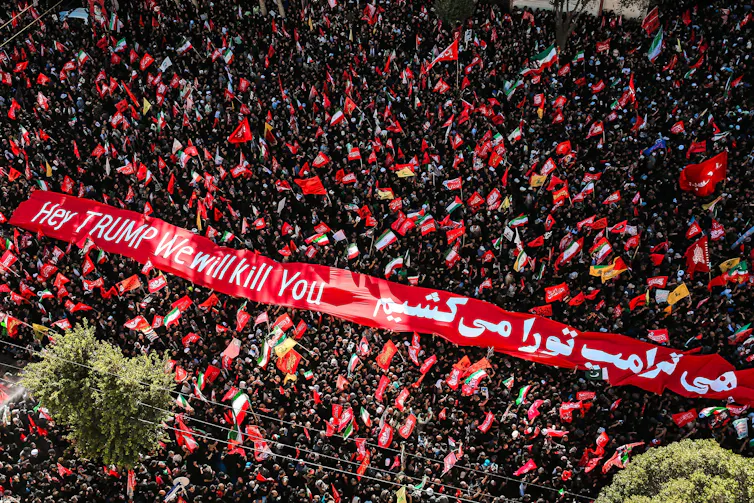
Aerial shot of a crowd in the city of Mashhad displaying a banner reading: 'Hey Trump, we will kill you'.
Crowds in the city of Mashhad taking part in the burial of Ayatollah Ali Khamenei unfurl a banner reading: ‘Hey Trump, we will kill you’.
Iranian Supreme Leader Office / EPA

This rhetoric reveals how the regime now narrates its own position. It has portrayed Iran as a state burdened by an accumulation of military, political and symbolic losses that demand recovery. In doing so, it has created the very conditions under which greater risk acceptance becomes conceivable.

In all of this, there is an uncomfortable implication for the US. Trump’s decision to commit to further strikes on Iran, while defending commercial vessels in the strait, may be subsidising the psychological conditions that sustain Tehran’s risky behaviour.

Effective deterrence presumes an adversary weighing what it stands to lose. But against a regime that believes it has already lost, each strike simply deepens the deficit it is gambling to recover. The fight is now being waged on ground that Tehran has defined.

Source link

Advertisement
Continue Reading

NewsBeat

16-year-old killed in motorbike crash in Pontefract

Published

on

16-year-old killed in motorbike crash in Pontefract

West Yorkshire Police are appealing for witnesses after a teenager was killed in a fatal road traffic incident in Pontefract yesterday evening (July 13).

Officers were called to an alley at rear of Eastbourne Terrace in Pontefract after a 16-year-old male had come off a motorbike.


RECOMMENDED READING:

Advertisement

A spokesperson for the force said: “The 16-year-old boy was provided with medical treatment by police and paramedics but sadly died at the scene.

“Following enquiries officers later located a second teenage boy, aged 13, suspected to have been on the bike at the time of the collision. He was arrested on suspicion of causing death by dangerous driving.”

Due to prior police contact with the bike before the crash, the force says a mandatory referral has been made to the IOPC.

Anyone who saw or has footage which could assist enquiries is asked to contact the Major Collision Enquiry Team on 101 or online at https://www.westyorkshire.police.uk/livechat

Advertisement

Please reference police log 1352 of 13 July.

Source link

Advertisement
Continue Reading

NewsBeat

‘It’s just a visible sign of how cities change. Deansgate Locks’ owners need to tackle an eyesore’

Published

on

Manchester Evening News

Bev Craig, who’s running for Greater Manchester Mayor, said the city has ‘never been as vibrant’ as she called for accountability from the owners over the strip’s demise.

Deansgate Locks’ owners have been slammed for ‘allowing decline’ and leaving the area an ‘eyesore’. Bev Craig, who’s running for Greater Manchester Mayor, said the city has ‘never been as vibrant’ as she called for accountability over the strip’s demise.

Advertisement

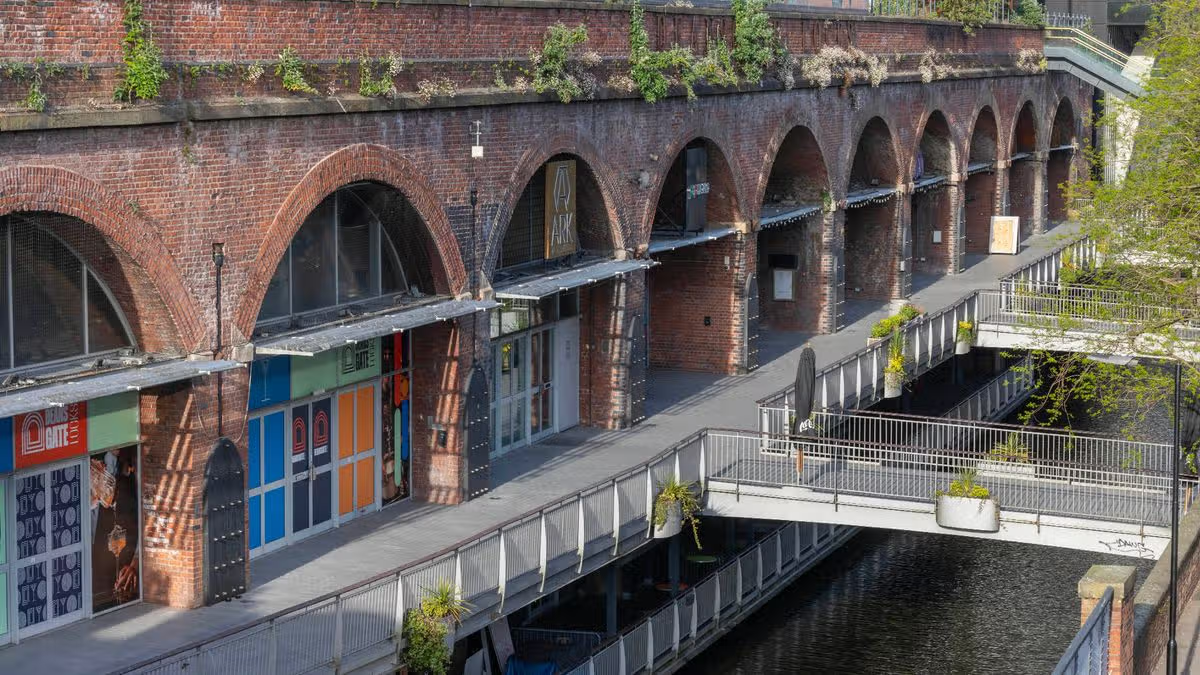
Both Popworld and Ark at the former nightlife hub on Deansgate Locks will close on Sunday, July 19. The closure of the two venues will bring to an end decades of entertainment along the stretch which once used to be the place to be.

The Locks, former railway arches, sit on the stretch of Whitworth Street West between Deansgate and Albion Street. Throughout the noughties, Deansgate Locks was known as Manchester’s most famous nightclub strip, packed with revellers and taxis bumper to bumper down the street into the early hours.

Click here to get the biggest stories straight to your inbox in our Daily Newsletter

In recent years though, it has become a shell of its former self.

Advertisement

A shift in nightlife habits, pressures on the hospitality industry, and the cost of living crisis have all been cited as reasons why the strip has struggled in the last few years. Issues with damp in the Grade II-listed structure have also been raised and previously plans were submitted to Manchester City Council to carry out repair works.

Asked about the end of an era and what she thinks should be done, Labour’s candidate for Greater Manchester Mayor and city council leader Bev Craig told the Manchester Evening News: “I think it’s just a visible sign of how cities change.

“Manchester’s nightlife sector has never been as vibrant. We’ve got more venues and businesses now for bars and hospitality across the city centre than we have had for a long time so it’s a sign of how things are changing.

Advertisement

“People when I moved to Manchester went to Deansgate Locks for a night out. When I came here in 2003, that was the place that you went to in town for a night out.

“Now people go all over the city centre, neighbourhoods, and local towns. I think what does need to happen in Deansgate Locks is the owners of that building have allowed decline there for quite some time.

“I’ve been working as the council leader with local councillors around a bit of accountability in not allowing those buildings to sit empty. I think there’s some great things with the right level of will and the right level of appetite from landowners they could do there and I think you could make that thriving.

“It needs the owners of those buildings to recognise things change. When was the last time many people went for a night out on Deansgate Locks and contrast that with the last time they went for a drink or a night out?

Advertisement

“It’s not that people have stopped drinking or having a night out. It’s that people have stopped going to Deansgate Locks. I think the sad demise of Popworld means there’ll have to be a new future and the owners of that building need to crack on because at the moment it’s a bit of an eyesore.”

She added: “We’ve never seen a city centre as busy from tourist numbers, footfall numbers, night out numbers, and the amount of spend that Manchester bars receive per head of the population. The night time economy is much stronger than London’s.

“On average, Manchester residents spend more income going out. It’s not that the city centre has seen a demise.

Advertisement

“It’s that a little strip of four bars have changed and I wouldn’t read too much into Deansgate Locks when a private company owns a couple of units they could simply do up and rent out for another business use.”

The owners of Deansgate Locks are listed as “SWIPACS1” in planning documents. The LDRS understands this is Scottish Widows, the insurance giant which deals with pension funds and property management.

The LDRS has attempted to contact the owners but so far have had no response. Stonegate Group are the leaseholders for Popworld and Ark and are not the owners.

Source link

Advertisement
Continue Reading

NewsBeat

The best theatre shows in London (and beyond) to book in 2026

Published

on

The best theatre shows in London (and beyond) to book in 2026

Hannibal Lecter was named the greatest villain in American cinema thanks to Anthony Hopkins’s chilling performance in the 1991 film. Now, Gina Gionfriddo adapts Thomas Harris’s multi-million-selling novel for its world stage premiere. When FBI trainee Clarice Starling is sent to interview a cannibalistic murderer, it’s hoped that his brilliant mind will help her to catch a sadistic new serial-killer, Buffalo Bill. But there’s nothing straightforward about Lecter, as we know. Casting tbc.

Curve, Leicester, Aug 1-15, then touring the UK and Ireland

Tickets: silenceofthelambsplay.com

Advertisement

Our Friends in the North

The BAFTA-winning 1996 TV phenomenon returns to Newcastle, the city where it’s set, in a new stage adaptation by the series’ original creator Peter Flannery, with Jack McNamara, artistic director at local playwriting powerhouse Live. The focus of this fresh theatrical version is two episodes in which Nicky, Mary, Tosker and Geordie (played in the series by Christopher Eccleston, Gina McKee, Mark Strong and Daniel Craig) come of age in the city during the turbulent early Thatcher years (1979-1984).

Newcastle Theatre Royal

Booking: Oct 15-24

Tickets: theatreroyal.co.uk

Advertisement

Source link

Continue Reading

NewsBeat

Police hit property with closure order after anti-social behaviour

Published

on

Police hit property with closure order after anti-social behaviour

On Friday, Wigan and Leigh Police were granted a Partial Closer Order by a court to serve to a property on Conway Close.

This was following ongoing reports of anti-social behaviour linked to the address, with evidence submitted to the court demonstrating ‘persistent anti-social behaviour’.

Officers stated that the property had been having ‘a significant negative impact’ on residents and the wider community.

Advertisement

The order, which is designed to prevent further nuisance, disorder and criminality,  restricts access to the property for named individuals.

It also provides police and partner agencies with additional powers to address the issues that have been impacting the area.

Source link

Advertisement
Continue Reading

NewsBeat

Welsh Government set to lose budget vote as parties refuse to back Plaid spending plans

Published

on

Wales Online

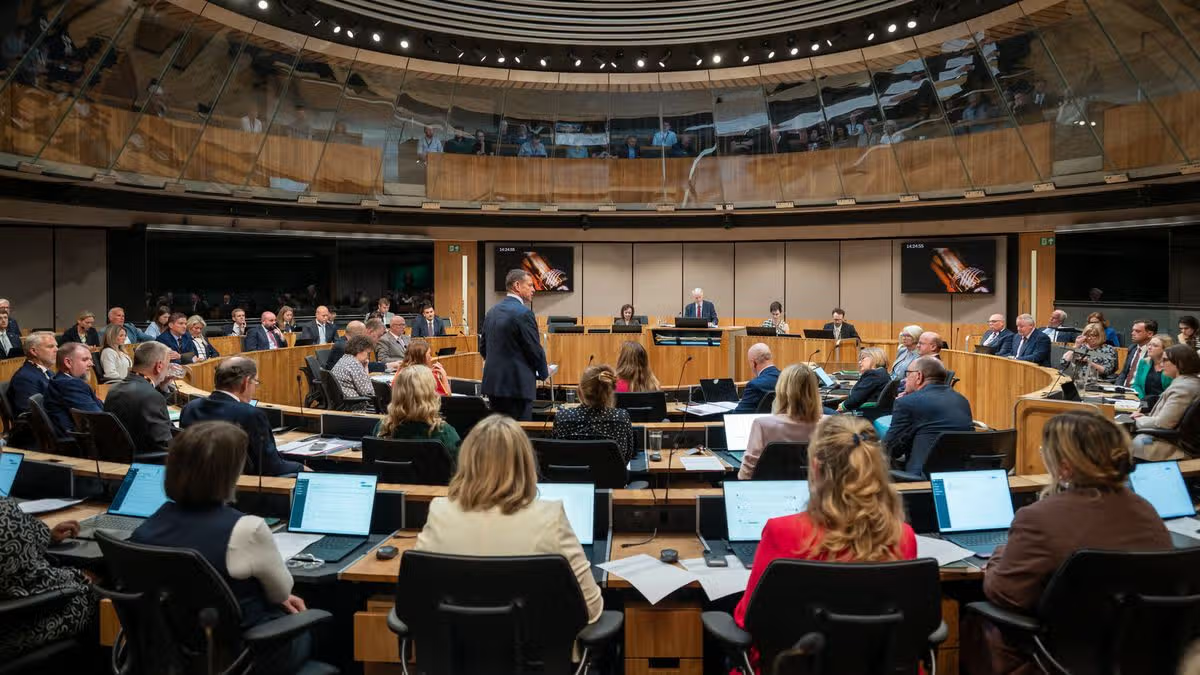
The Plaid Cymru minority government in Cardiff Bay looks destined to lose its first major Senedd vote this evening.

Labour has now ruled out supporting the Welsh Government’s proposed supplementary budget, which will allocate £411m of spending that was unallocated in the main budget earlier this year.

Plaid needs at least six other votes in the Senedd to pass its spending plans and, as of Tuesday afternoon, appears not to have won the support of any other group in the chamber.

Advertisement

It would be a significant symbolic loss for Rhun ap Iorwerth’s administration which shows how challenging it will be to run a minority administration for the next four years.

On Tuesday morning the Tories and Reform UK made it clear they will not support Plaid’s budget as it stood then, but Labour’s Senedd members were meeting to discuss a last-ditch offer from Plaid Cymru which was sent by the First Minister on Monday (July 13).

Plaid offered Labour an extra £120m for additional learning needs education over the next three years to win the party’s support.

But on Tuesday afternoon interim Welsh Labour leader Ken Skates said he had written to First Minister Rhun ap Iorwerth asking him to withdraw the supplementary budget, saying it was not enough.

Advertisement

“In all our discussions funding for additional learning needs (ALN) has been a top priority for Welsh Labour,” said Mr Skates.

“Yesterday both the school leaders’ unions in Wales, NAHT Cymru and ASCL Cymru, notified the cabinet minister for education and the Welsh language that they are formally declaring a trade dispute with the Welsh Government.

“This is both unprecedented and deeply regrettable.

“Less than 100 days into government Plaid Cymru find themselves in chaos, unable to work collaboratively.

Advertisement

“By withdrawing the budget today we hope that they will resolve these issues with teaching unions and bring back another supplementary budget in the summer with £100m allocated for ALN.”

Following the news Labour would block the budget a Plaid Cymru source said: “By voting against the supplementary budget Labour will vote against £145m to cut NHS waiting lists, £120m for children with additional learning needs, £55m to expand funded childcare, and £15m for free school meals for secondary pupils most in need. In doing so Labour has abandoned its progressive values.

“Despite inheriting £333m of in-year pressures in the NHS the Welsh Government worked quickly to put a £120m proposal on the table to build a more sustainable ALN system.

“Labour have walked away from that offer – a move that will rightly be questioned by parents and teachers.

Advertisement

“By voting against the supplementary budget Labour are not only voting against more money for children with additional learning needs, money to cut waiting lists, and money to fund childcare, they will also be teaming up with the Tories and Reform.

“It is clear that they have learnt nothing from their humiliating election defeat in May. Wales rejected Labour in May but that doesn’t mean Labour should reject the priorities of the people of Wales.”

The debate on the budget is scheduled for 6pm if it is not withdrawn. Before it, at 1.30pm, is First Minister’s Questions where Rhun ap Iorwerth will be quizzed on a range of topics including cost savings, NHS waiting times, and whether he thinks there will be an impact of the UK Government’s defence investment plan on Wales.

He will also use a statement to lay out the first legislation his party plans to take through the Senedd. That includes a bill to strengthen the rights of people living in private rented accommodation, creating a community right to buy scheme, and a law that ensures the needs of people in rural areas are considered in policy-making.

Advertisement

Also in the Senedd today deputy first minister Sioned Williams will give further details on her party’s childcare plans and constitution minister Dafydd Trystan Davies will face questions.

We’ll be with you live from the Senedd throughout the afternoon with updates below:

Source link

Advertisement
Continue Reading

NewsBeat

Marlborough racing tips and best bets for today’s races

Published

on

Marlborough racing tips and best bets for today's races

Following today’s racing tips? In need of some guidance? Or just fancy a flutter?

Each day, Marlborough brings you the best bets from every race at every racecourse around the country.

From the bright lights of the Cheltenham Festival and Glorious Goodwood to a low-key evening meeting at Chelmsford City, we have all your racing tips and best bets covered.

Advertisement

Meanwhile, you can get the latest betting offers and free bets from the top bookmakers here.

Looking for a daily racing nap? Marlborough will indicate his top tip for the day in traditional style, with his other notable selection highlighted with “NB”. Whistler, The Sunday Telegraph’s tipster, will also name his daily Nap.

So come back every morning for Marlborough’s daily selection. Note, tomorrow’s tips will appear towards the bottom of the page. Good luck!

Looking for deeper analysis? Here are additional daily racing tips and expert insights.

Advertisement

Monday, July 13

Ayr

2.00 Vega King
2.30 JM Jhingree
3.00 White Ladder
3.30 Millbuie
4.00 JRK Cobbler
4.30 Spiritoftheblues
5.05 Cascade Hall

Windsor

5.20 Terminology
5.50 Leonardo Blu
6.20 Sovereigns High
6.50 Market Leader
7.20 Papa Cocktail
7.50 Kalokalo
8.20 A Major Payne
8.50 Bintsaleh Nap

Lingfield

5.10 Greek Symphony
5.40 Mister Daydream NB
6.10 Aphra Behn
6.40 Split Elevens
7.10 Perfect Location
7.40 Nutcracker
8.10 Freedom Bay
8.40 Graffiti

Newton Abbot

2.42 Gove Point
3.12 God of Fire
3.42 Saucats
4.12 Ellerton
4.42 Slaney Opera
5.17 Park Hall

Advertisement
  • Whistler Nap: Kalokalo, 7.50 Windsor
  • Marlborough Nap: Bintsaleh, 8.50 Windsor

Tuesday, July 14

Beverley

2.17 Hair Raising
2.47 Our Hero Matty
3.17 It’s Debateable
3.48 Bradbury
4.23 Crafty Spirit
4.58 The Sweet Escape

Leicester

1.54 Emerlad Bay
2.24 Kudos Too
2.54 Betelgeuse
3.24 Dottie Diamond
3.57 Musical Soldier
4.30 Hot Silk
5.04 Sir Rodneyredblood

Ffos Las

2.30 Sole Ambition Nap
3.00 Tallahassie Lassie
3.30 Star Velocity NB
4.05 Mayberry Moon
4.40 Ibiza Lights
5.14 Liveinthelight

Wolverhampton

4.53 Lady Magu
5.25 George Wickham
5.55 Aigeas
6.25 Wilbur
6.55 Midnights Dream
7.25 Classy Clarets
7.55 Luan

  • Whistler Nap: Aigeas, 5.55 Wolverhampton
  • Marlborough Nap: Sole Ambition, 2.30 Ffos Las

Source link

Advertisement
Continue Reading

NewsBeat

Person left with ‘broken nose’ after ‘disorder’ at city pub boxing event

Published

on

Cambridgeshire Live

One person sustained a broken nose in a fight that broke out at one of the events

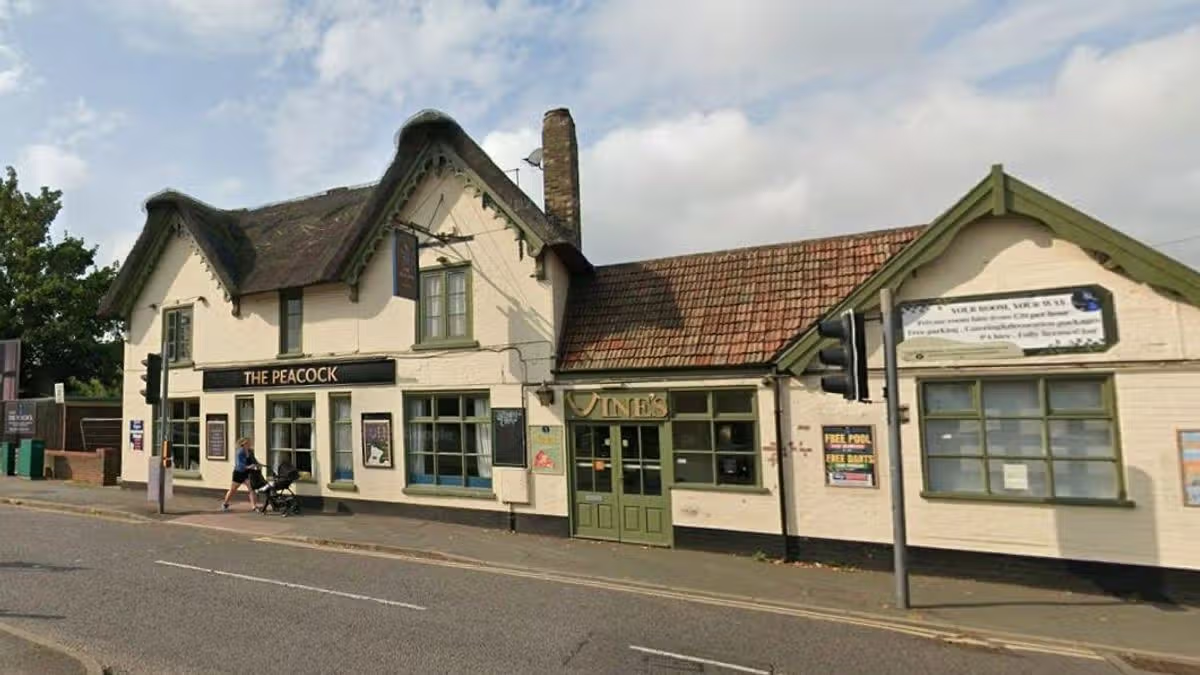
A city centre pub will have its licence reviewed as “significant concerns” have been raised about boxing events. Cambridgeshire Police has applied to Peterborough City Council for it to review the premises licence for The Peacock pub in London Road, Peterborough.

Advertisement

Police have requested the review on the grounds the pub is undermining the objectives of: prevention of crime and disorder; public safety; and prevention of public nuisance.

The police have raised “significant concerns” to the promotion and management of boxing events at the pub. In the licencing document, it said: “[This] follows incidents occurring on March 14, 2026, and July 4, 2026, together with subsequent intelligence received by police.

“The cumulative evidence demonstrates a pattern of escalating risk, violence and disorder associated with these events, in the view of Cambridgeshire Constabulary, requires licencing authority intervention.”

On March 14, the document said that there was a “confrontation” and “exchange of words” between a boxer and promoter. It added: “The incident escalated to a verbal and physical altercation requiring intervention from security staff.

Advertisement

“Police were subsequently informed of reports that an individual may have been in possession of a baseball bat outside the venue. Whilst this report was not substantiated and no weapon was recovered, associates of those involved remained gathered outside the venue for approximately thirty minutes following the incident.”

While no offences were recorded, police felt there was a “clear risk of disorder”.

The incident on July 4 took place at around 9.55pm when police received reports of “significant disorder” at the pub. The document said: “The initial report described fighting involving between 15 and 50 persons, injuries including a broken nose and blood being present, together with information that security staff were unable to manage the situation.

“Officers attended and established the incident stemmed from a confrontation involving members of two boxing families attending the event.” Police had to intervene to “restore order”.

Advertisement

Police then received third-party footage from July 7, which showed another violent incident in the back car park. The footage is currently under review and an investigation is ongoing.

From the two incidents recorded by police, the force has said the evidence demonstrates:

  • Escalating tensions associated with organised boxing events
  • A realistic likelihood of violence and disorder occurring
  • Inadequate controls to prevent or mitigate disorder
  • Reliance upon security intervention to prevent violence
  • Circumstances where security staff were reportedly unable to effectively manage disorder
  • The need for police deployment and intervention to restore order
  • Significant public safety concerns affecting participants, spectators, staff and the wider public

The pub has held several boxing events within temporary structures and under Temporary Event Notices. The document said the premises had provided information that it would accommodate up to around 200 people at the events.

There would also be “regulated entertainment”, alcohol sales and a marquee. The Peacock is one the oldest pubs in Peterborough, after opening in 1876. It’s a popular pub amongst locals, especially being opposite the Peterborough United football ground.

Source link

Advertisement
Continue Reading

NewsBeat

Footage shows the moment vile rapist arrested after Cheetham Hill attack

Published

on

Manchester Evening News

Jovhan Pascoe has been jailed for life with a minimum term of 15 years after being found guilty of rape

Creep broke into woman’s flat and raped her as she slept

Footage has been released by Greater Manchester Police showing the arrest of a man after he was sentenced to life imprisonment for the rape of a woman.

Advertisement

Jovhan Pascoe, 39, of Moss Bank Road, Crumpsall, was jailed at Manchester Crown Court on Monday 13 July and ordered to serve a minimum of 15 years. He was also made subject to a Sexual Harm Prevention Order after being found guilty of rape.

The video shows officers entering a room where Pascoe is seated before they place him in handcuffs and escort him from the property. He is then taken to a waiting police van, where officers carry out a security scan before placing him inside the vehicle.

Click here to get the biggest stories straight to your inbox in our Daily Newsletter

Police launched an investigation after officers were called to reports of a serious sexual assault at an address in Cheetham Hill in September las tyear.

Advertisement

Pascoe was later arrested on suspicion of rape before being charged and convicted.

In a victim impact statement, the survivor described the lasting impact the attack has had on her life.

She said: “Since that night I haven’t slept properly. I have to sleep with a light and that’s if I can get to sleep.”

“Some nights I don’t sleep for days because I’m terrified and nervous thinking someone is going to walk in and hurt me again. The slightest noise makes me jump. Even the sound of a car revving outside, or if something falls on the floor and makes a bang, I get palpitations where my chest and heart start racing.”

Advertisement

Detective Constable Katie Geldard, from Greater Manchester Police’s City of Manchester CID, said: “I’d like to thank the brave victim for coming forward and reporting this horrendous crime to us, and for working with us throughout the course of the investigation.”

“Thanks to her courage, this dangerous sexual predator have been removed from the streets and put behind bars. I hope this sentence brings her a sense of justice and she rebuilds her life.”

Source link

Advertisement
Continue Reading

NewsBeat

Labour’s new pay-per-mile road tax to clobber businesses, ministers admit

Published

on

Labour's new pay-per-mile road tax to clobber businesses, ministers admit

Advertisement

Labour’s new pay-per-mile road tax on fully electric and hybrid vehicles will clobber businesses, ministers have admitted.

An internal Government impact assessment acknowledges the levy, part of the effort to reach Net Zero, will affect around 5.6million vehicles and that ‘the impact will be material’ on some firms.

While it does not give a figure for the potential impact, it is yet another blow to businesses following Chancellor Rachel Reeves‘s Employer National Insurance hike, inflation-busting increases in the minimum wage and amid sky-high energy costs and changes to employment law already expected to cost businesses £5billion.

Critics warned the new levy, known as eVED, threatens to further push up prices for consumers as firms will look to pass on any increase in costs.

Advertisement

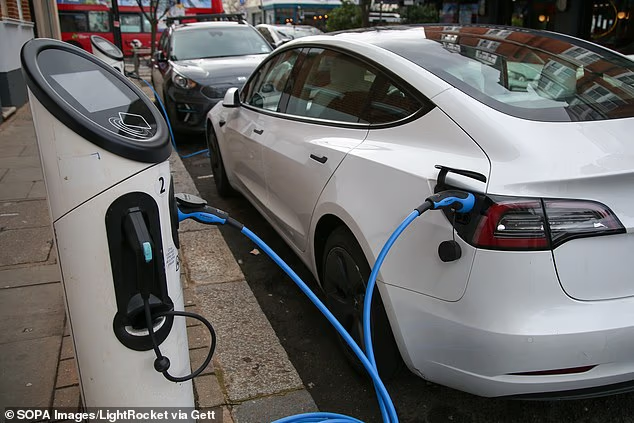
Ministers said yesterday they would push ahead with proposals to charge electric vehicle owners 3p a mile to ensure they make a ‘fair contribution’ to road upkeep costs. Plug-in hybrid drivers will also be charged 1.5p per mile.

The new tax will be introduced from April 2028, with a typical electric vehicle driver expected to pay about £240 per year.

The charge is on top of road tax, which is around £200 for most vehicles but £600 a year for the first five years for cars with a price tag of £40,000 or more – which includes many electric and hybrid models.

Advertisement

Howard Cox, founder of the FairFuelUK campaign, said: ‘Labour’s new pay-per-mile road tax on electric and hybrid vehicles is yet another hammer blow to British businesses, ministers have now been forced to admit.

‘Once again, it is businesses and ultimately consumers who will pay the price for Labour’s tax-raising agenda. This stealth tax on greener vehicles shows this government has no understanding of the pressures facing companies trying to stay competitive.’

Ministers claim the raid is necessary to plug a projected drop in fuel duty revenues as petrol and diesel are phased out, with new sales of petrol and diesel cars set to be banned from 2030.

Advertisement

At present, fuel duty raises more than £25billion a year.

But the internal impact assessment which emerged today says businesses who have invested in fleets of EVs and hybrids, after being encouraged to by ministers, will be clobbered particularly hard.

It states: ‘For some businesses, particularly large fleets, the impact will be material.

‘One-off costs for businesses are expected to include updating processes to estimate mileage for their vehicles and pay eVED.

Advertisement

‘We also expect there will be ongoing costs for businesses including putting in place new systems to estimate and pay eVED.’

Rachel Reeves, the Chancellor, announced the pay per mile tax in the Budget last November.

The Treasury was contacted for comment.

Advertisement

Advertisement

Source link

Continue Reading

Trending

Copyright © 2025