

Crypto World
BTC slips below $63K as Middle East tensions offset ETF inflows



Key takeaways
- Bitcoin fell to $63,000 after renewed geopolitical tensions in the Middle East weakened investor risk appetite.
- The U.S. military’s latest strikes on Iran and heightened tensions around the Strait of Hormuz boosted demand for safe-haven assets while pressuring cryptocurrencies.
- Spot Bitcoin ETFs recorded $197.4 million in weekly inflows, ending an eight-week streak of net outflows, but institutional buying failed to offset broader market uncertainty.
Bitcoin (BTC) traded below $63,000 on Monday as escalating geopolitical tensions in the Middle East weakened investor appetite for risk assets, overshadowing improving institutional demand through spot Bitcoin exchange-traded funds (ETFs).
Although Bitcoin ETFs recorded their first week of net inflows in nearly two months, renewed uncertainty surrounding the Strait of Hormuz kept bullish momentum in check.
Middle East escalation sparks risk-off trading
Market sentiment deteriorated after the United States launched fresh military strikes against Iranian targets on Sunday.
According to the U.S. Central Command (CENTCOM), the operation targeted Iranian air defense systems, coastal radar installations, missile and drone capabilities, as well as naval assets using fighter aircraft, warships, and both aerial and maritime attack drones.
Iranian media reported multiple explosions near Sirik, Bandar Abbas, Qeshm, and Jask—areas located close to key military infrastructure surrounding the Strait of Hormuz.
The situation intensified after Iran’s Islamic Revolutionary Guard Corps (IRGC) reportedly targeted another commercial vessel and announced the closure of the Strait of Hormuz, one of the world’s most important oil shipping routes.
The escalating conflict prompted investors to reduce exposure to riskier assets, driving West Texas Intermediate (WTI) crude oil above $75 per barrel while cryptocurrencies, including Bitcoin, came under renewed selling pressure.
Despite the broader market weakness, institutional demand showed signs of recovery.
According to CoinGlass, U.S. spot Bitcoin ETFs attracted $197.4 million in net inflows last week, ending an eight-week streak of consecutive outflows that began in mid-May.
The return of institutional buying suggests long-term investor confidence remains intact. However, the renewed geopolitical uncertainty limited the immediate impact of these inflows on Bitcoin’s price.
Bitcoin price analysis: Bears continue to defend $64,000
Bitcoin was trading around $63,055 at the time of writing, remaining below the critical $64,000 resistance level.
The cryptocurrency continues to trade beneath all of its major exponential moving averages (EMAs), highlighting the prevailing bearish market structure.
Key resistance levels include:
- 50-day EMA: $65,192
- 100-day EMA: $68,686
- 200-day EMA: $74,736
These technical barriers continue to form a strong overhead supply zone, limiting recovery attempts.
Momentum indicators suggest selling pressure may be easing, but a bullish reversal has yet to emerge.
The Relative Strength Index (RSI) remains just below the neutral 50 level, indicating that buyers have not yet regained control.
Meanwhile, the Moving Average Convergence Divergence (MACD) remains in positive territory, suggesting downside momentum has moderated.
However, the broader technical structure remains bearish as long as Bitcoin trades below key resistance levels.
The immediate resistance remains the $64,004 horizontal barrier, where recent rallies have repeatedly stalled.
If buyers successfully reclaim that level, attention will shift to the 50-day EMA at $65,192, the 100-day EMA ($68,686), and the 200-day EMA ($74,736).
A sustained breakout above these levels could open the door to a longer-term move toward the $84,410 resistance zone.

On the downside, Bitcoin lacks strong technical support immediately below current prices. If selling pressure intensifies, traders are likely to focus on the $60,000 psychological level, which could serve as the next major support area.
For now, Bitcoin’s near-term direction will likely depend on whether geopolitical tensions ease and whether improving institutional demand through spot ETFs can outweigh broader macroeconomic and geopolitical risks.



The UK’s tax authority announced that it planned to treat “certain disposals” related to cryptocurrency lending and liquidity pools as transactions that would effectively defer the country’s capital gains requirements.
In a Monday announcement, HM Revenue and Customs (HMRC) said that starting on April 6, 2027, it would adopt a “no gain, no loss” approach to disposals involving crypto loans and liquidity pools. According to the tax authority, this measure would defer capital gains tax on digital assets “until an economic disposal.”
“This measure will support fairness in the tax system,” said the UK tax authority. “It aligns the tax treatment more closely with the economics of these arrangements by ensuring that gains and losses are generally recognized only when the participant makes an economic disposal of the cryptoassets.”
The measure, expected to impact about 700,000 individuals and trustees, would represent a significant change from the authority’s 2022 guidance on crypto liquidity pools and lending following a consultation period. Under UK law for 2025-2026, taxpayers pay between 18% to 24% for capital gains related to crypto transactions depending on whether they qualify as basic-rate or higher-rate.
Related: UK tokenization push could add as much as $44B to annual output by 2035: Report
According to the tax authority, it would treat crypto transactions as “no gain, no loss” under UK capital gains laws for the acquisition or disposal of an interest in a lending arrangement in exchange for the same type of asset, borrowed assets acquired at market value and similar conditions with automated market makers.
“This is the right direction, mainly driven by the industry feedback demonstrating that any other approach would cause significant admin burden for the tax payer,” said Aave founder and CEO Stani Kulechov in a Monday X post.
Crypto candidate enters Nigel Farage’s by-election race
In UK politics, Reform leader Nigel Farage will not stand completely uncontested in a by-election caused by his resignation last week amid reports of the politician receiving contributions from billionaires tied to the crypto industry.
On Tuesday, the leader of the Solana community group Superteam UK, Stephen Newnham, said he will run as an independent candidate against Farage and others. The by-election representing Clacton is scheduled for Aug. 13 and will include candidates like comedian and author Jon Harvey in costume as Count Binface, a self-described “independent space warrior” wearing a helmet in the shape of a trash bin.
Farage triggered the by-election with his resignation, saying that he wanted the people of Clacton to judge his actions. The Reform figure reportedly received a $6.7 million donation from crypto billionaire Christopher Harborne, which he described as a ”reward” for the UK’s exit from the European Union and later as a “gift,” and other financial assistance from George Cottrell, a convicted fraudster linked to a crypto casino.
Magazine: Strategy became a symbol of the dot-com crash: Could history repeat?
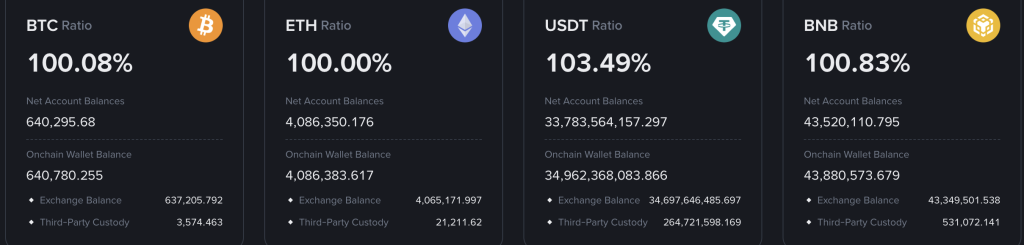
In the latest Bitcoin news, Binance customer Bitcoin holdings climbed to approximately 640,295 BTC in June, adding 7,715 BTC, a 1.22% gain, according to the exchange’s 44th proof of reserves report, which used a July 1 snapshot against a June 1 baseline.
That marks the third consecutive monthly increase in the platform’s reported BTC balance, extending a multi-month crypto accumulation pattern based on the latest consecutive monthly PoR updates. The divergence with ETH and USDT is where the more structurally interesting question sits.
Customer ETH balance fell 1.41% to roughly 4.086 million ETH, down 58,591 ETH over the month. That decline comes directly after a sharp 10.17% jump in May, when ETH holdings rose to approximately 4.14 million ETH, so the June pullback looks more like a partial reversal of a spike than the start of a structural exit from Ethereum.
The ETH/BTC dynamic embedded in these figures is consistent with ongoing capital rotation into Bitcoin, though on-chain data alone cannot confirm that thesis.
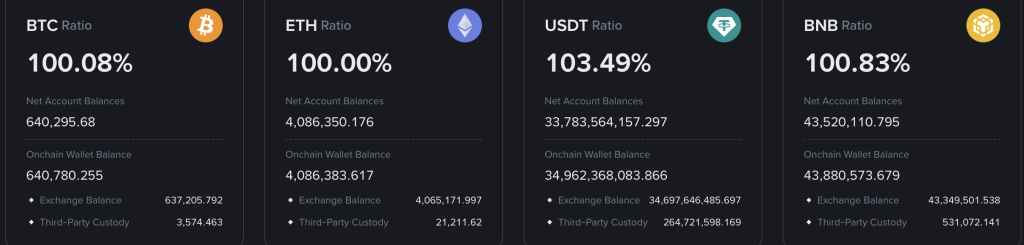
USDT balances fell for a second consecutive month, dropping 1.51% to approximately 33.7 billion USDT, roughly 510 million tokens lower than the June 1 reading of 34.3 billion.
The prior month had already shed about 460 million USDT. Two months of consecutive stablecoin drawdown across the platform’s largest reserve asset is a meaningful data point on available buy-side liquidity, even if the direction of those funds remains unconfirmed.
Discover: The Best Crypto to Diversify Your Portfolio
Bitcoin News: What the On-Chain Data Confirms, and What It Doesn’t
The report relies on a point-in-time snapshot methodology: exchange reserves are recorded at a specific date, then compared month-over-month.
Binance uses Merkle Trees and zero-knowledge proofs to let customers verify whether their account balances are included in the total liabilities reported for each report.
What that architecture cannot do is explain the behavioral drivers behind changes in balance, whether the BTC increase came from direct purchases, deposits from external wallets, asset conversions out of ETH or USDT, or internal transfers between Binance product silos.

This ambiguity matters for interpreting the signal. Rising BTC on an exchange can read as accumulation-in-progress, but it also places more supply closer to the market. The gap between rising aggregate balances and day-to-day incremental flow signals is not directly resolvable from the PoR snapshot alone.
A similar BTC-up, USDT-down pattern appeared in the most recent reserve snapshots from Bybit and OKX. That cross-exchange alignment suggests the rotation is not Binance-specific. It more plausibly reflects a broader shift in how active traders are allocated across the major spot venues heading into the second half of 2026.
Declining USDT holdings in the platform’s proof-of-reserves report reduce the visible pool of on-exchange dry powder. Thinner stablecoin reserves do not confirm buying flows or withdrawals, but they can still matter for how liquid the on-exchange balance sheet appears at the snapshot point in time. In low-volatility conditions, that may not matter. Around key price levels or macro catalysts, it can amplify moves in both directions.
Don’t Miss Out on Our $1,000 USDT Airdrop on ByBit
The post Binance Proof of Reserves Rock Bitcoin News Amid BTC Gains and Thin Stablecoin Depth appeared first on Cryptonews.
Cardano co-founder Emurgo has been forced to hand over the running of self-styled “world’s largest crypto event” TOKEN2049 to the Cardano Foundation, following the $20 million hack of its neo-finance platform SecondFi.
That’s according to Intersect, Cardano’s governance firm, which made the announcement on Tuesday.
Intersect stated that Emurgo “is unable to allocate the necessary resources to plan and execute Token2049.”
Emurgo added, “Following the recent SecondFi incident, we have confirmed that our priority right now must be solely the recovery of assets for all affected users.”
Read more: Cardano holders cancel own summit after rejecting $2M funding request
The Cardano Foundation said, “In addition to the Cardano booth, we are also organizing the side event CardanoxDraperxBitcoin funded by Draper and Cardano Foundation. More information will be available soon.”
Cardano users had already voted to cancel the Cardano annual summit in Singapore that was scheduled for October 2026.
The vote, held last month, also passed a proposal from Emurgo to attend and sponsor TOKEN2049 in Singapore this October.
SecondFi is eating into Emurgo’s responsibilities
Emurgo also stepped down last week from the “Pentad,” an executive body made up of multiple Cardano firms.
It said, “Our immediate priority is the @secondfiapp recovery process, and we are concentrating our resources where they are needed most.”
SecondFi was hacked for $2.4 million worth of ADA last June. Emurgo used emergency measures at the time to take $18.5 million worth of ADA from users as part of a mysterious white hat hack event.
The mystery stemmed from Cardano’s founder, Charles Hoskinson, who later relayed information that suggested the identity of the white hat hacker was unknown.
Read more: SecondFi is shutting down after Cardano wallet exploit
In early July, SecondFi claimed that these white hat hack funds “are currently protected and accessible,” and that they will “form part of the recovery effort to return assets to affected users.”
SecondFi also announced that it will shut down and dedicate its time to the recovery of stolen assets going forward.
Protos has reached out to Cardano Summit organizers for comment and will update this piece should we hear back.
Got a tip? Send us an email securely via Protos Leaks. For more informed news and investigations, follow us on X, Bluesky, and Google News, or subscribe to our YouTube channel.

CleanSpark shares jumped sharply on Tuesday after the Bitcoin miner disclosed a long-term deal that ties up large-scale power and real-estate capacity for a new data center in Georgia. The company said it signed a 20-year triple-net lease for a 175-megawatt facility at its Sandersville, Georgia campus—one of the clearest examples yet of miners moving beyond pure block-reward economics and into broader digital infrastructure.
The agreement, CleanSpark said, is expected to generate about $6.6 billion in contracted revenue over the initial 20-year term, with revenue rising to $11.6 billion if the tenant exercises two five-year extension options. The tenant will install computing infrastructure on-site, and phased deliveries are expected to start in the fourth quarter of 2027.
Key takeaways
- CleanSpark announced a 20-year triple-net lease for a 175-megawatt data center at its Sandersville, Georgia campus.
- The company estimates $6.6 billion in contracted revenue over the initial term, potentially increasing to $11.6 billion with two five-year extensions.
- Infrastructure deliveries are expected to begin in Q4 2027, giving the project a multi-year timeline rather than near-term revenue.
- The announcement highlights how miners are responding to post-halving margin pressure by securing longer-duration capacity demand—particularly from AI and high-performance computing.
- CleanSpark is also positioning itself as a continuing Bitcoin holder even as it diversifies into data-center business lines.
A data-center play built around contracted capacity
CleanSpark’s stated objective is to broaden its revenue base while leveraging the industrial footprint it already controls. Under the lease terms, a tenant—described by CleanSpark only as an undisclosed “investment-grade global technology company”—will deploy computing infrastructure at the Sandersville site, with phased delivery starting in the fourth quarter of 2027.
Triple-net lease structures typically place more operating-cost responsibilities on the tenant, which can matter to investors focused on predictability. Even so, the timing underscores a central point for the market: this is not a near-term catalyst designed to instantly offset mining volatility. Instead, it is a long-dated demand commitment that can strengthen CleanSpark’s infrastructure narrative as AI compute requirements drive new buildouts.
Why miners are chasing new revenue after the halving
Miners have been under renewed financial strain since the 2024 Bitcoin halving, when block rewards declined and competitive pressure tightened. CleanSpark’s own recent results reflect how sensitive mining economics remain to Bitcoin price movements and operating margins.
In March, the company reported a fiscal second-quarter net loss of $378 million, with nearly 60% attributed to a drop in Bitcoin’s price. Earlier, in February, CleanSpark also sold a portion of its BTC holdings—an indication that liquidity and balance-sheet flexibility continue to play a role in how miners fund operations and expansion plans.
Still, CleanSpark’s approach appears less aggressive than some peers. Cointelegraph previously reported that publicly traded miners sold roughly 15,000 BTC between October and the end of February, even as the sector struggled with margins and liquidity needs. Against that backdrop, CleanSpark has remained a net accumulator while simultaneously exploring ways to monetize its infrastructure beyond mining.
Equities react as the market prices diversification
Tuesday’s announcement translated into immediate stock momentum. CleanSpark shares reached an intraday high of $15.10 before paring gains during the U.S. lunch hour. At the time of reporting, the stock was up about 11%, while the CoinShares Bitcoin Miners ETF (WGMI) was up less than 1%.
That divergence suggests investors are treating the data-center lease as something more than routine corporate expansion. For equity holders, the appeal is straightforward: contracted infrastructure revenue can, in theory, reduce dependence on the day-to-day volatility of mining economics. It also positions CleanSpark within the broader “digital infrastructure” stack that increasingly benefits from high-performance computing demand.
What’s next for CleanSpark and the infrastructure thesis
Even with the long-term lease in place, mining performance and BTC exposure remain central to how the company is valued. CleanSpark is expected to report fiscal Q3 results on Aug. 6, with analyst consensus calling for a loss of $0.25 per share versus earnings of $0.79 in the year-ago period, according to Yahoo Finance. The company has also missed Wall Street estimates in each of the last three quarters.
Going forward, investors will likely watch whether CleanSpark can convert its infrastructure plans into measurable financial improvements over time—while also continuing to manage the impact of Bitcoin price swings and ongoing pressure on miner margins. The lease provides a longer runway, but the key test will be execution: tenant commitments, delivery milestones expected to begin in Q4 2027, and whether the company’s diversification meaningfully cushions future mining results.
Binance believes its next phase of growth will come from payments and financial services rather than cryptocurrency trading alone, as stablecoins reshape how people use digital assets, according to Shunyet Jan, the exchange’s head of spot trading and derivatives business.
In an interview with CoinDesk on Binance’s ninth anniversary, Jan outlined the strategy as Binance and shared a glimpse of the platform’s future priorities.
“We’re trying to not just be a crypto exchange, but be a super app that involves payment,” Jan said. “If you think of us as a payment provider, then that number becomes much bigger.”
Jan said Binance’s new strategy reflects how people are increasingly using cryptocurrencies beyond trading. While trading remains at the core of Binance’s business, he said stablecoins are increasingly being used for payments and transfers, creating a larger market than trading alone.
“I don’t think it’s really leveled off,” Jan said. “What’s happened is that a lot of it is driven by stablecoin usage.”
SWIFT moved its blockchain-based shared ledger into live operational use, naming 17 pioneer banks for 24/7 tokenized cross-border payments. Its payments framework lists more than 30 institutions with existing Ripple XRP ties.
The SWIFT pilot is nine months in the making and represents a decisive escalation from prototype to production. The 17 pioneer banks are live on a blockchain-based shared ledger that coordinates tokenized deposits rather than public cryptocurrencies, giving the participating institutions 24/7 settlement capability.
SWIFT’s native ledger settles in tokenized bank deposits, not XRP. The token is not embedded in the standard payment flow and is not required in SWIFT’s native ledger/payment flow.

However, the indirect connection runs through Ripple’s On-Demand Liquidity product, which uses XRP as a bridge asset for instant settlement, but that route depends on how banks deploy Ripple’s liquidity services.
What the SWIFT move does confirm is that the financial industry’s direction of travel aligns with the model Ripple has been building toward for years: always-on, programmable settlement that eliminates pre-funded nostro accounts in each destination currency.
Don’t Miss Out on Our $1,000 USDT Airdrop on ByBit
Ripple XRP Ties, SWIFT Development
The more than 30 banks named in SWIFT’s wider payments framework with existing Ripple relationships are a set beyond the 17 live pilot participants. The overlap is not specified. Being listed in SWIFT’s framework does not mean those institutions have activated ODL or routed any liquidity through XRP.
Many currently use RippleNet purely for messaging, without touching the token. The upgrade path from messaging to liquidity provisioning is where actual XRP demand materializes, and that transition remains at the bank’s discretion.
SWIFT has also signaled its next phase explicitly, describing its ambition to become a platform for programmable money and agentic commerce. SWIFT is aiming for a world where payments execute automatically when conditions are met without manual authorization per transaction.
Ripple’s institutional positioning has been reinforced in parallel. The company joined SWIFT earlier in 2026, enabling direct global bank access and unified management of fiat and crypto flows. It has also partnered with Kyobo Life Insurance for real-time tokenized government bond settlement.
Ripple’s institutional credibility has benefited from regulatory engagement in Europe, a prerequisite for the institutional adoption the SWIFT partnership.
Discover: The Best Token Presales
What Has to Change for XRP to Capture the Structural Upside
The SWIFT development is a credibility event for Ripple’s ecosystem, not a demand event for XRP. The token’s upside from here is conditional on whether banks use On-Demand Liquidity routes using XRP in live payment corridors, creating real settlement demand. Without that, the SWIFT-Ripple connection remains structural alignment rather than token adoption.

Near term, the case hinges on institutions moving beyond messaging into using XRP-enabled liquidity for tokenized cross-border payments. Ripple’s parallel institutional build, including its positioning on the UK’s wholesale digital markets taskforce, suggests the regulatory environment is moving in the right direction for that decision to become easier.
XRP’s fate tracks Bitcoin’s strength and broader altcoin sentiment. A sustained rise in Bitcoin dominance above 59% would likely extend pressure on XRP and other alts; the cleanest signal is that dominance staying elevated. The SWIFT narrative is real Ripple structural progress, but structural progress that does not yet mandate XRP demand trades differently from one that does.
Discover: The Best Crypto to Diversify Your Portfolio
The post Ripple XRP Gains Attention After SWIFT Blockchain Expansion appeared first on Cryptonews.
Crypto World
American retirees use ETH AI auto trading via MoneySimpler to earn $58,500 stable passive income monthly


Disclosure: This article does not represent investment advice. The content and materials featured on this page are for educational purposes only.
As interest in AI-driven investing grows, platforms like MoneySimpler are attracting retirees seeking automated digital asset management and trading tools.
Summary
- MoneySimpler gains attention as US retirees explore AI-powered crypto trading for automated digital asset management.
- MoneySimpler highlights AI-driven crypto trading tools as more investors seek automated income solutions.
- AI trading platform MoneySimpler attracts interest from retirees seeking simplified digital asset investment options.
In the United States, many retirees are starting to look into digital asset investments, hoping to generate additional income beyond their fixed pensions and alleviate the pressure of daily expenses.
Instead of engaging in high-risk, blind speculation, they chose platforms like MoneySimpler. The platform features AI-powered automated trading, with returns settled daily. By participating in the ETH market through smart trading strategies, users can earn up to $1,950 in passive income in a single day.
As artificial intelligence and digital finance continue to mature, this investment approach, which requires no manual monitoring and is fully automated, is gradually gaining favor among more and more American investors.
American retirement planning professionals and major financial media outlets have all noted that MoneySimpler is now a highly popular cryptocurrency investment platform in the private wealth management sector. The platform boasts transparent processes, compliant operations, and stable returns, providing Americans with a reliable new option for planning their retirement.
What is MoneySimpler?
Founded in 2020 and headquartered in the UK, Money Simpler is a cryptocurrency cloud AI automated trading company regulated by the Financial Conduct Authority (FCA) and operated by MONEY LINKS LTD. (FRN: 921139).
The platform provides users with automated digital asset trading services through AI market analysis and automated strategy execution, supporting mainstream digital assets such as Bitcoin (BTC), Ethereum (ETH), and Ripple (XRP).
It covers 150 countries and regions, hasover 3 million registered users, manages over $2 billion in assets, and holds 1,717 Bitcoins and 35 million Ripple to ensure liquidity.
This means users can participate in cloud AI automated trading in an automated and standardized manner within a compliant and secure framework and earn daily cash settlements.
Why are more and more US retirees choosing to join MoneySimpler?
US retirement plans are primarily based on long-term investments in tax-advantaged accounts such as 401(k)/IRA, but the real purchasing power of many retirement funds has been eroded by prolonged low interest rates and inflationary pressures.
The regulated MoneySimpler offers a digital financing pathway focused on automation and stable cash flow.
Retirees can get started by depositing a small amount of money into supported crypto assets such as XRP or BTC.
MoneySimpler provides pre-designed trading strategies by a professional team. Its AI system continuously analyzes the market and automatically executes trades in digital assets such as BTC, ETH, and XRP. It continuously optimizes trading efficiency through intelligent algorithms and automated execution to achieve sustained returns.
MoneySimpler uses AI intelligent algorithms, preset trading strategies, and risk hedging as its core to generate passive income through automated trading, daily settlement, and automatic accounting.
How to get started?
Step 1 | Register an Account
Visit MoneySimpler and click “Register”. New users receive a $10 registration bonus and can experience the profit model.
Step 2 | Deposit Assets
Supported currencies: BTC / ETH / USDT (TRC20/ERC20) / XRP / BNB / USDC / ADA / SOL / DOGE / BCH / LTC, etc. Please select a familiar currency for deposit.
Step 3 | Activate Hashrate Contracts
Starting at $100, investors can choose a suitable contract level based on their funds and time constraints. The system will automatically execute trades; no programming or monitoring is required.
Featured Contracts Showcase:
Basis Arbitrage Strategy: Invest $100, 2-day cycle, daily return of $4; total return at maturity is $100 principal + $8 profit.
Digital Asset Trend Following Strategy 2.25: Invest $600, 7-day cycle, daily return of $7.62; total return at maturity is $600 principal + $53.34 in returns.
Digital Asset Trend Following Strategy 2.2: Invest $1,000, 10-day cycle, daily return of $13.2, total return at maturity is $1,000 principal + $132 profit.
Crypto Statistical Arbitrage Strategy 2.6: Invest $5,000, 20-day cycle, daily return of $71; total return at maturity is $5,000 principal + $1,420 in returns.
Cross-Exchange Arbitrage Strategy 3.6: Invest $10,000, 30-day cycle, daily return of $162, total return at maturity is $10,000 principal + $4,860 in returns.
Crypto Statistical Arbitrage Strategy 2.55: Invest $97,000, 45-day cycle, daily return of $1,891.5, with a total return at maturity of $97,000 principal + $85,117 in returns.
For more contract details, please visit the MoneySimpler official website. Once the contract is activated, the system will automatically execute trades without any technical configuration required.
Step 4 | Daily Settlement and Withdrawals/Reinvestment
Once the contract takes effect, earnings will be settled daily. Withdraw or reinvest at any time to create an automated digital cash flow.
A previous USA Today report mentioned:
MoneySimpler integrates traditional, mature financial risk control models with blockchain technology, making it a highly representative platform in the digital transformation of retirement financial planning in the United States.
Dr. Arthur Hamilton, a renowned industry researcher, stated:
“MoneySimpler’s operations are compliant and standardized, and its profit payment rules are open and transparent. In the domestic retirement savings sector, it is a digital asset management platform highly regarded by many.”
An ordinary investor who has lived in New York for many years and is retired shared his genuine experience:
“I no longer have to worry about my retirement savings slowly depreciating. MoneySimpler’s stable daily returns provide reliable financial security for my later years.”
Daily passive income plan for US retirees
With volatile market conditions and persistent inflation eroding the purchasing power of Social Security pensions, many American retirees are struggling to cover their retirement expenses. MoneySimpler offers a compliant, worry-free, and automatically accruing digital asset income stream specifically designed for US retirees. It’s more than just a simple investment tool; it’s a wealth management approach that makes asset management easy: no need to constantly monitor the market, allowing idle assets to operate continuously, with daily returns automatically credited to an account, steadily supplementing retirement income.
Visit MoneySimpler now to convert ETH or BTC into a stable $58,500 monthly passive income, providing added security for retirement.
Disclosure: This content is provided by a third party. Neither crypto.news nor the author of this article endorses any product mentioned on this page. Users should conduct their own research before taking any action related to the company.
[The stream is slated to start at 10 a.m. ET. Please refresh the page if you do not see a player above at that time.]
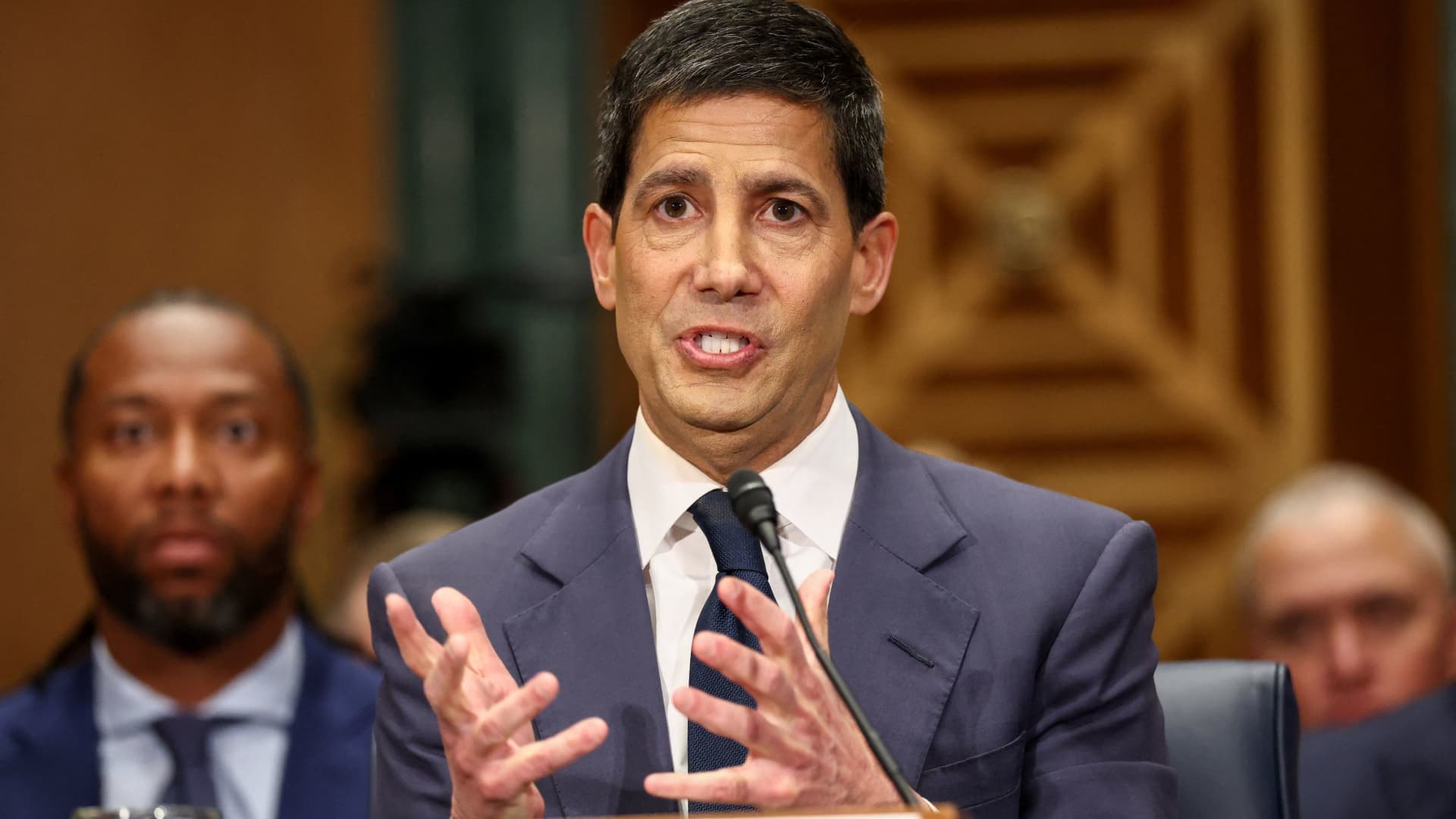
Federal Reserve Chairman Kevin Warsh speaks Tuesday to the House Financial Services Committee as part of the congressionally mandated semiannual monetary policy report.
The central bank leader’s appearance comes the same day the Bureau of Labor Statistics reported that consumer prices fell an unexpectedly sharp 0.4% in June, easing some worries among policymakers about inflation.
In remarks prepared for the appearance, Warsh promised a vigilant fight to return inflation to the Fed’s 2% target.
“The members of our Committee have no tolerance for persistently elevated inflation. And we share a resolute commitment to restoring price stability,” he said.
Read more
Warsh promises inflation will be a ‘thing of the past,’ cites benefits of AI investment boom
Fed officials were split on direction of interest rates at last meeting, minutes show
Warsh faces multiple alternative inflation signs as Fed charts new course
Japan’s largest domestic payment network, JCB, has signed a memorandum of understanding with Circle to explore using USDC for cross-border payments and merchant transactions.
Under the memorandum, the companies will initially explore using USDC for JCB’s internal cross-border fund transfers through a proof of concept, while also evaluating stablecoin payments at merchants in Japan for international visitors. The companies said they will also assess technologies that support interoperability across multiple blockchain networks.
The agreement builds on a separate initiative JCB launched in January with Digital Garage and Resona Holdings to test stablecoin payments at physical stores in Japan. That project focuses on identifying technical and operational challenges to bringing stablecoin payments to domestic merchants.
Beyond the initial proof of concept, JCB and Circle said they will evaluate additional applications for stablecoin infrastructure aimed at cross-border payments and merchant services, though they did not provide a timeline for commercial deployment.
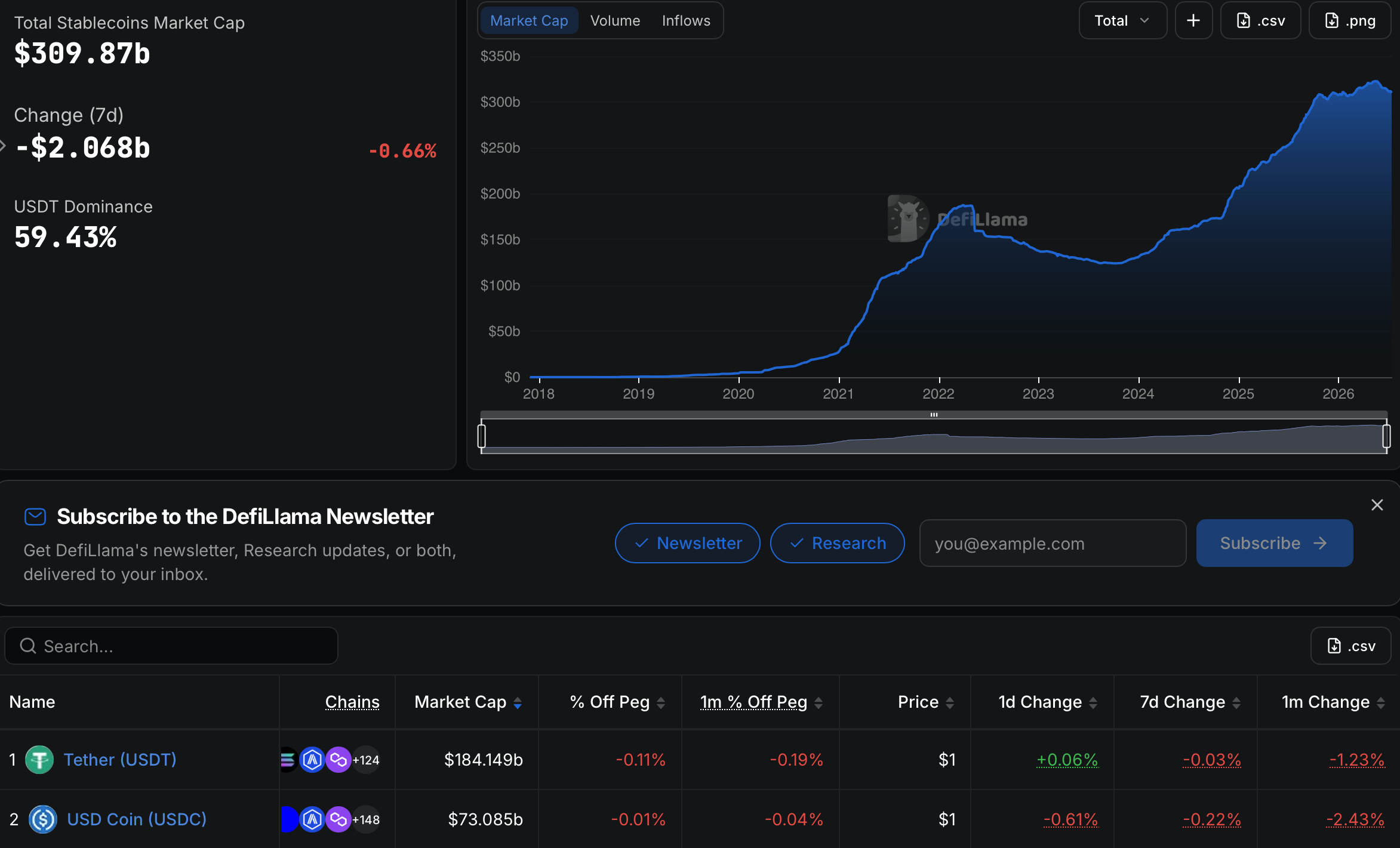
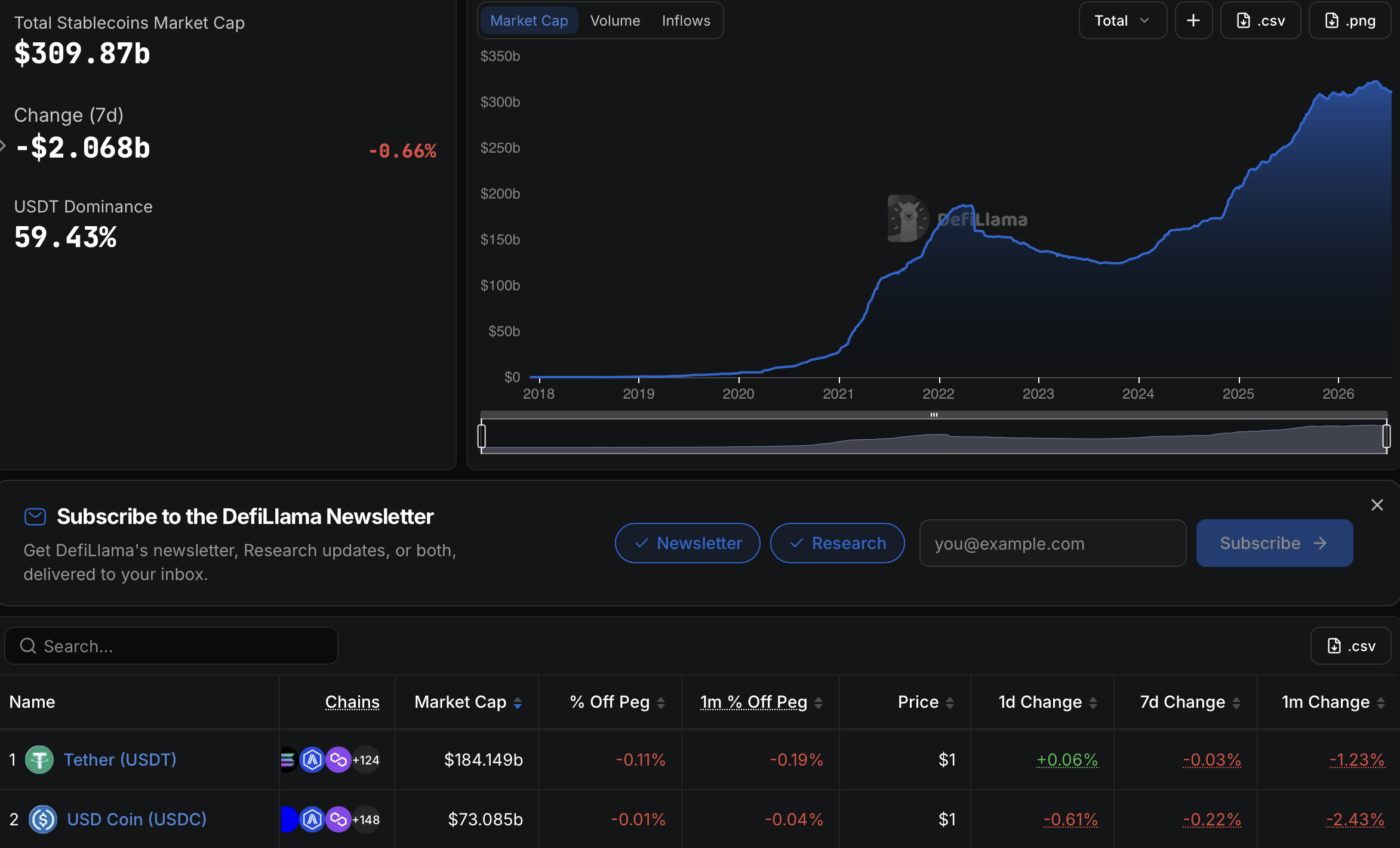
USDC is the world’s second-largest stablecoin by market capitalization, with a circulating supply of about $73 billion, behind Tether’s USDT at roughly $184 billion, according to DefiLlama data.
Source: DefiLlama
Related: USDC issuer Circle wins final approval for US national trust bank charter
Japan accelerates stablecoin payment adoption
The agreement adds to a growing number of stablecoin payment initiatives announced in Japan this year, as companies test blockchain-based payment and settlement systems across retail and corporate use cases.
In June, Circle and Japan’s largest investment bank, Nomura, were reported to be developing a stablecoin-based foreign exchange settlement service for Japanese companies. The service would allow businesses to convert yen into USDC for cross-border transactions and near-instant settlement.
On Monday, convenience store operator Lawson announced plans to test yen-denominated stablecoin payments at a Tokyo location beginning in August, while Japanese payments company Netstars launched a merchant payment service supporting USDC, USDT and JPYC across the Solana and Polygon blockchains.
Japan was among the first major economies to establish a legal framework for stablecoins, allowing banks, trust companies and licensed money transfer providers to issue fiat-backed tokens under amendments to the Payment Services Act that took effect in 2023.
The country has also been advancing broader digital asset reforms. In June, the Lower House passed a bill that would classify crypto assets as financial instruments, potentially opening the door to crypto exchange-traded funds and bringing the sector under stricter market rules.
Magazine: Strategy became a symbol of the dot-com crash: Could history repeat?
Ethereum has stabilized after its sharp correction from the $2.4K May highs, with the price attempting to build momentum beneath major resistance. Both the daily and 4-hour charts suggest buyers are gradually regaining control, although confirmation will require a decisive breakout above the current supply zone. The futures market’s aggressive positioning is also pointing to an interesting situation.
Ethereum Price Analysis: The Daily Chart
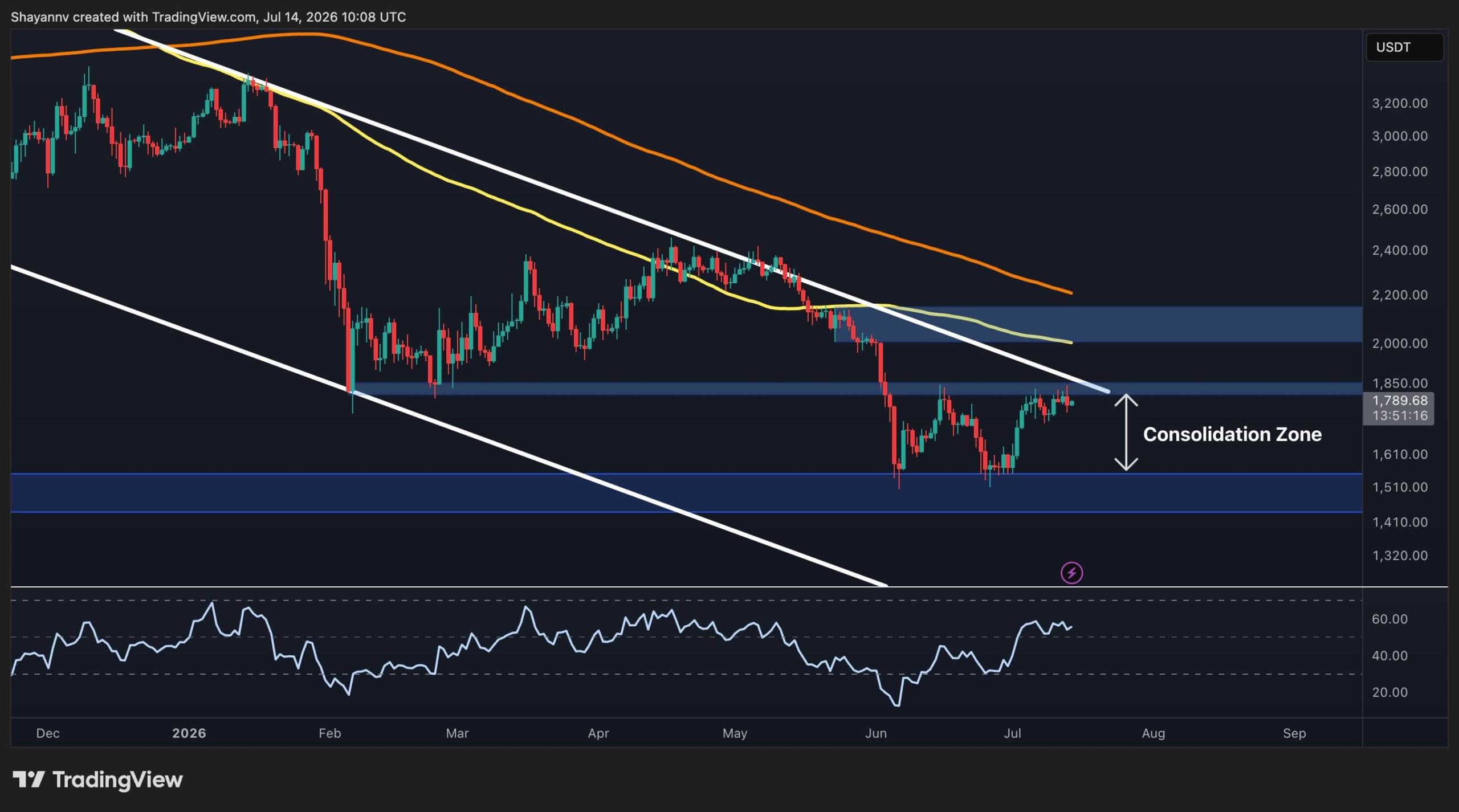
On the daily timeframe, ETH continues to recover after breaking out of the long-term descending channel that had capped the price action for several months. Following the breakout, the market experienced a deep retracement toward the $1.5K demand region before buyers stepped back in aggressively.
The rebound has brought ETH back into the $1.85K resistance zone, which now serves as the first major obstacle. This area also aligns closely with the higher channel resistance, creating a strong technical confluence that explains the recent consolidation.
The 100-day and 200-day moving averages remain overhead near the $2K to $2.2K region, indicating that the broader trend has not fully shifted bullish yet. Until those averages are reclaimed, the recovery should still be viewed as a corrective move within a larger neutral-to-bearish structure.
Momentum has improved noticeably, with the RSI recovering above 50 after rebounding from oversold conditions. However, the indicator remains below overbought territory, suggesting there is still room for continuation if buyers can overcome current resistance.
A successful breakout above $1.85K could expose the next resistance zone around $2K to $2.2K, where both major moving averages converge. On the downside, losing the $1.5K support would likely lead to a prolonged bearish trend.
ETH/USDT 4-Hour Chart
The lower timeframe presents a more constructive picture. Ethereum has been trading inside a rising channel, producing a sequence of higher lows while repeatedly testing the overhead supply zone between roughly $1.8K and $1.85K.
The ascending lower trendline continues to provide dynamic support, with every pullback attracting buying interest before reaching the broader support area near $1.7K. This suggests buyers remain active despite repeated rejection from resistance.
The price is currently compressing between rising support and horizontal resistance, creating conditions for an eventual breakout. Such structures often precede a volatility expansion, making the current range particularly important.
A confirmed move above $1.85K would likely trigger renewed bullish momentum toward the psychological $2k level and potentially the $2.2K region. Conversely, a breakdown below the rising trendline could invalidate the short-term bullish structure and expose the $1.71K support zone, followed by the broader $1.63K order block if selling pressure accelerates.
The 4-hour RSI remains around neutral territory, reflecting balanced momentum after cooling from recent highs. This supports the view that the market is waiting for a catalyst before choosing its next directional move.

Sentiment Analysis
The Taker Buy Sell Ratio remains below the neutral 1.0 threshold, indicating that aggressive sellers continue to slightly outweigh aggressive buyers across futures exchanges. Historically, readings below one reflect cautious market sentiment and reduced conviction from bulls.
However, the 30-day moving average of the ratio has turned higher after recovering from recent lows, suggesting selling pressure has gradually eased. Although buyers have not yet established clear dominance, the improving trend points to strengthening demand beneath the surface.
If the ratio continues climbing toward and eventually above 1.0 while ETH breaks above the $1.85K resistance area, it would provide additional confirmation that buyers are regaining control. Until then, the sentiment data supports a cautiously optimistic outlook rather than signaling a fully confirmed bullish trend.
The post Ethereum Price Analysis: Will ETH Finally Break the $1.85K Barrier? appeared first on CryptoPotato.

Crypto & Gold Analysis | 09 July || Trading Techstreet | Akhand Pratap Singh

Why Iran shut the Strait of Hormuz after decades of holding back

UK Government Defers Capital Gains on Certain Crypto with ‘No Gain, No Loss’ Approach

No Jackpot Winner as $257 Million Prize Rolls Over to $269 Million Monday Draw

Renter of Home in Anne Heche Crash Denies Settlement With Son

Weekend Open Thread: Staud – Corporette.com
Crypto & Gold Analysis | 09 July || Trading Techstreet | Akhand Pratap Singh

A financial Emergency Just Started You Just Dont Know It Yet

How to Spot Fake Money vs. Real Money #FakeMoney #CounterfeitCash #SecurityFeatures #MoneyLumps
-

 Fashion5 days ago
Loro Piana Fall 2026 Enters Houston’s Art Scene
-

 Fashion4 days ago
Weekend Open Thread: Nutriplenish Leave-In Conditioner
-
 Sports5 days ago
2026 Genesis Scottish Open Thursday TV coverage: Round 1
-

 Tech7 days ago
Anthropic brings Claude Cowork to mobile and web as usage data shows most users aren’t coding
-

 Sports4 days ago
Super Eagles star Moses Simon opens up on Liverpool transfer regret
-

 Tech5 days ago
Character.AI enters the microdrama arena with its own productions, but there’s a twist
-

 Crypto World7 days ago
Nasdaq arthritis company holding Moshe Hogeg crypto hits all-time low
-

 Tech13 hours ago
Get Your ESP32 Sunny Side Up With This Solar Dev Board
-

 News Videos6 days ago
Crypto Just Entered Its Most Important 6-Month Candle (Could Decide Everything!)
-
 Tech7 days ago
Keychron is stepping outside keyboards with a $349 Thunderbolt 5 dock aimed at power users
-
 Business7 days ago
ASX 200 Slides Over 0.6% as Rare Earths and Lithium Stocks Tumble Amid Global Semiconductor Sell-Off Today
-
 NewsBeat5 days ago
Major update after Huntingdon train attack as man enters plea
-
 Business7 days ago
Will Trent shares rebound after Q1 update triggers 13% crash? Here’s what technical charts indicate
-
 Tech7 days ago
OpenAI teams with Work Louder to launch Codex-native keyboard, weeks after CEO of Apps told staff ‘not to be distracted by side quests’
-

 Business7 days ago
SpaceX Shares Slide Nearly 6% Amid Post-IPO Volatility and Starship Test Focus
-

 Sports6 days ago
39-year-old Djokovic wins five-hour thriller to enter Wimbledon semis | Other Sports News
-
 Crypto World7 days ago
TeraWulf’s $19B Anthropic Lease Turns Bitcoin Miner Into AI Landlord
-
 Tech23 hours ago
Cloudflare Precursor Watches Your Mouse and Keyboard To Decide If You Are Human
-

 News Videos1 day ago
how to make coin bank box with cardboard #scienceproject #money #diy #shorts
-

 Tech6 days ago
Entra passkey enrollment vishing targets Microsoft 365 users
You must be logged in to post a comment Login