

Crypto World
JCB and Circle begin USDC pilot for business and retail payments



JCB has partnered with Circle to test USDC for internal treasury transfers and merchant payments in Japan, extending stablecoin use into cross-border corporate settlement and retail transactions.
Summary
- JCB and Circle will test USDC for cross border treasury transfers and merchant payments in Japan.
- The first pilot will focus on JCB’s internal fund transfers before expanding to retail payment use.
- The agreement extends Circle’s institutional payments push following its U.S. trust bank approval and expansion across Asia.
A July 14 statement from JCB said the Japanese payments company has signed a memorandum of understanding with a Circle affiliate to develop payment services using USD Coin (USDC), Circle’s dollar-backed stablecoin.
The first phase of the partnership will focus on a proof of concept for JCB’s internal cross-border treasury operations. The companies also plan to evaluate stablecoin payments at physical stores for merchants and international visitors travelling in Japan.
Alongside the pilot, the two firms said they will assess other payment services that combine Circle’s stablecoin infrastructure with JCB’s merchant network to support cross-border transactions and new payment options for businesses and consumers.
Coming days after Circle secured a key U.S. banking approval, the agreement adds another institutional payments partnership to the stablecoin issuer’s recent expansion efforts.
Earlier this month, the U.S. Office of the Comptroller of the Currency granted final approval for Circle National Trust, placing the company’s national trust bank under federal supervision. Circle said the institution will initially provide fiduciary digital asset custody services for the company and its affiliates, while future plans could include managing reserves backing USDC, although no timeline has been announced.
Outside the United States, Circle has also continued building relationships with regulated financial institutions. Standard Chartered recently introduced a service through its Dubai International Financial Centre operations that allows eligible institutional clients to mint and redeem USDC directly through the bank’s platform. BNY has also added USDC to its digital asset custody platform, enabling institutional clients to mint and redeem the stablecoin through its infrastructure.
Japan agreement follows Asia expansion
The JCB partnership comes as Circle continues pursuing new institutional relationships across Asia.
Later this month, the company will host its invitation-only Current Seoul event, bringing together executives from banks, crypto exchanges, payment companies and technology firms to discuss digital asset regulation, cross-border payments and industry partnerships.
During an April visit to South Korea, Circle co-founder and CEO Jeremy Allaire met executives from KB Kookmin Bank, Shinhan Bank, Hana Bank, Upbit, Bithumb, and several payment companies to discuss potential cooperation through the Circle Payments Network for international payments.
Competition in the stablecoin sector has also intensified in recent weeks. Open USD, a competing dollar-backed stablecoin model, launched with a revenue-sharing structure that distributes reserve income among participating members.
However, several South Korean companies, including Samsung Electronics, Dunamu, Shinhan Financial Group, and K Bank, later told local media they had not formally agreed to join the consortium despite being listed as participants.

Just a few short years ago, the crypto hype was strong. VCs were eager to pour money into solutions for scalability, data availability, and any number of buzzwords.
Since then, the advent of powerful AI models and prolonged bear markets have taken the wind out of crypto’s sails and many chains which promised the future are now as good as forgotten.
One keen-eyed X user, crypto marketer Stacy Muur, noted the staggering $500 million invested across six blockchain projects which, together, have produced a total of just $360 in blockchain fees in the past 24 hours.
Read more: AscendEx shutdown: Uncertainty over withdrawals as hot wallets lack funds
The claim caught Protos’ eye, so we took a look at the six companies to see where it all went wrong.
Berachain
Berachain is a blockchain born as a spinoff of the 2021-era Bong Bears NFT collection. It claims to be the first proof-of-liquidity based chain, and aims to be a “growth engine for onchain businesses.”
The project raised a total of $142 million across two rounds in 2023 and 2024.
However, according to its most recent EoY statement, the project has struggled amidst issues with sentiment, shrinking crypto-native TAM and “increased skepticism around the value of infrastructure as a whole.”
Since launching in early 2025, its BERA token is down 98%.
Berachain was among the networks caught up in November’s devastating Balancer hack, leading validators to temporarily halt the network.
Later that same month, it was revealed that one of the backers, Brevan Howard’s Nova Digital, was granted a one year, risk-free refund right on its $25 million investment.
Read more: Balancer exploit drains $129M in DeFi disaster
Celestia
Celestia was seen as a hot ticket back in 2023 when “data availability” was the buzzword du jour.
Part of the Cosmos ecosystem, it promises bespoke, high throughput, modular chains “for companies with internet-scale traffic.”
It raised first $1.5 million in 2021, a further $50 million in 2022 and finally $100 million in 2024.
Its much-hyped token launch was one of the first rays of light following a deep bear market sparked by the catastrophic crypto collapses of 2022.
Despite initially surging around 10x in its first months to an all-time high of over $20, TIA eventually bled approximately 98%, sitting today at $0.40.
Scroll raised a total of $83 million over three funding rounds, the latest of which brought the Ethereum L2 to a $1.8 billion valuation in March 2023.
It made just $24 in fees yesterday.
The zkEVM layer two hit a peak TVL of $585 million as users enthusiastically farmed an ultimately disappointing airdrop. In the aftermath, the network lost around 75% of its TVL within a couple of months.
There’s currently just under $12 million on the chain.
Eclipse
Eclipse billed itself as “Solana on Ethereum,” an SVM layer two network which would pair Solana’s performance with Ethereum’s liquidity.
Developer Eclipse Labs raised a total of $65 million, most of which came in a $50 million Series A, led by Placeholder and Hack VC, in March 2024.
DeFiLlama data shows the chain’s TVL peaking at almost $50 million in late February last year. It’s currently down to just $1.15 million, a drop of approximately 98%.
The project’s most recent blog post is from a year ago, announcing the launch of its token ES, and an airdrop. Eclipse Labs has since pivoted to development of The Human API, a marketplace for AI agents to hire humans.
Sonic
Launched as Fantom by controversial developer Andre Cronje, founder of DeFi stalwart Yearn Finance, the fast, low-cost network migrated to Sonic in 2024. It raised a total of $61 million across six rounds between 2018 and 2024, according to ICODrops.
As Fantom, it took a hit in the Multichain debacle, with many bridged assets depegged from their native versions.
Fantom’s peak TVL reached a staggering $7.9 billion in 2022 and now sits at just under $5 million. Sonic’s hit $1.2 billion last spring, but has since dropped to $16 million.
Cronje’s involvement with Sonic terminated last month and he’s spent much of the last 18 months building Flying Tulip.
Read more: Andre Cronje says someone stole his code to build a $1B DeFi project
Manta
ZK-focused Manta raised a total of $60 million across four rounds between 2021 and 2023.
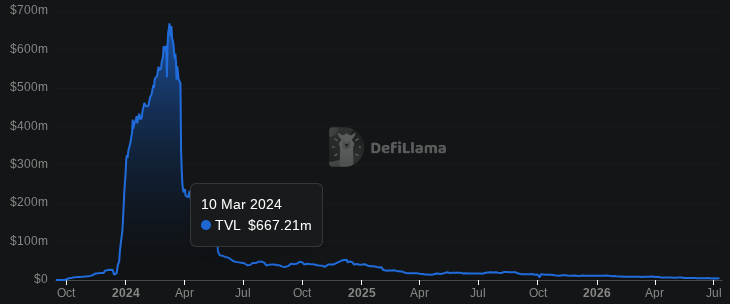
Its TVL chart is dramatic, highlighting an intense, heavily gamified airdrop campaign, which saw over $650 million poured into the chain.
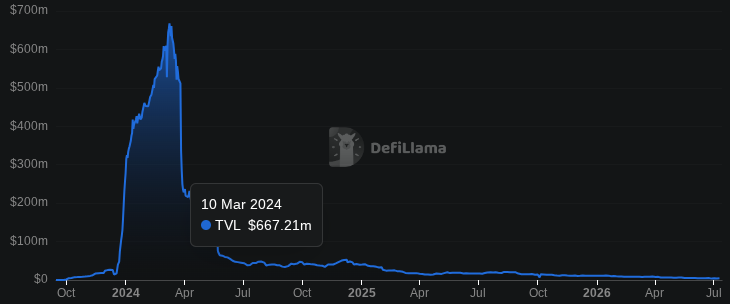
Just a few weeks before its peak, TVL sat at under $20 million. Likewise, within four months, it was back below $50 million once again. Today, just $4 million is held on the chain.
Got a tip? Send us an email securely via Protos Leaks. For more informed news and investigations, follow us on X, Bluesky, and Google News, or subscribe to our YouTube channel.
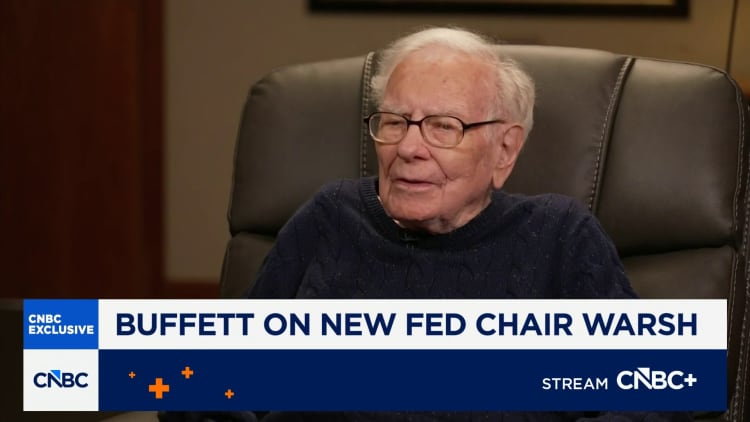

New Federal Reserve Chairman Kevin Warsh was a “good choice” for the job, Warren Buffett told CNBC.
Warsh made his mark during his first meeting as chair in June, holding rates steady while outlining changes to the central bank’s approach. In Congressional testimony on Tuesday, Warsh pledged a “regime change” in Fed policy and promised to tackle inflation.
“I think he will do the best he can at achieving the job he was assigned to do, which is 2% inflation and maintaining maximum employment,” Buffett said in an interview with Becky Quick on “Squawk Box.”
“He can’t be perfect at it, and just like I know I couldn’t be perfect at taking people’s money and earning super returns on it,” he added.
Warsh took the helm in May after being nominated by President Donald Trump and confirmed by Congress. On Wednesday, he’ll return to the Capitol to testify in front of the Senate Banking Committee.
“He cares about the country,” Buffett said. “I think that’s been true of a good many. It doesn’t mean their decisions are always great, but because sometimes the decisions are so tough.”
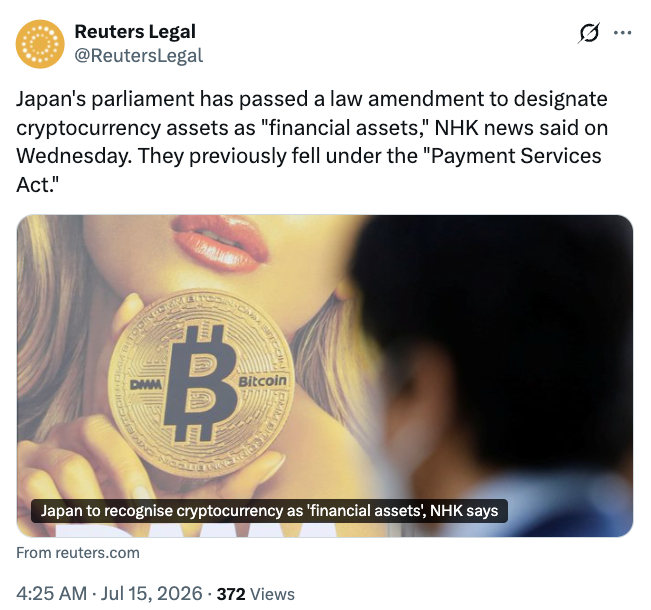
Japan is set to reshape its cryptocurrency market with stricter trading rules, stronger user protections and a framework closer to traditional finance.
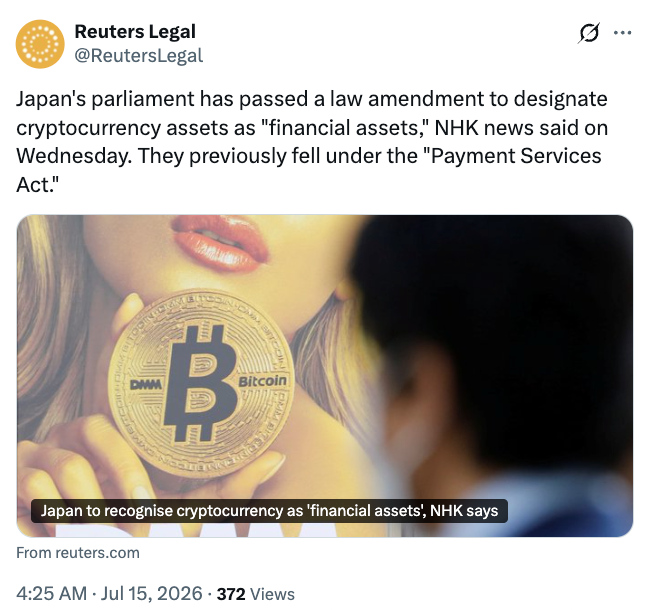
The country’s parliament on Wednesday passed revisions that classify crypto assets as financial assets under Japan’s Financial Instruments and Exchange Act (FIEA), according to a report by local news agency Nikkei.
The changes move Japan’s crypto regulation away from the Payment Services Act (PSA), which treated digital assets primarily as payment instruments, and introduce insider trading rules and stronger oversight for crypto businesses.
The overhaul marks one of Japan’s biggest shifts in digital asset policy as regulators worldwide continue debating how crypto should fit within existing financial systems.
Crypto exchanges face tougher oversight
Under the revised framework, crypto businesses operating in Japan will face additional compliance obligations designed to improve market integrity and protect users.
The updated rules prohibit issuers, exchanges and other market participants from trading while aware of undisclosed material information, creating insider trading restrictions similar to those applied in traditional finance (TradFi).
Source: Reuters Legal
The revised rules increase penalties for companies operating without registration, reportedly raising the maximum prison sentence from three years to 10 years and increasing fines from around 3 million Japanese yen ($19,000) to around 10 million yen.
Related: Japan stablecoin payments advance with Lawson trial, Netstars launch
Insider trading violations could result in penalties of up to five years in prison, fines of up to 5 million yen, or both, the report notes.
Global regulators align crypto with financial rules
In line with Japan’s move to bring crypto closer to TradFi, the revised law also reportedly changes the terminology for registered businesses from “cryptocurrency exchange” to “cryptocurrency trading company.” The change reflects the broader financial role regulators now assign to the sector.
Japan’s crypto regulation developments reflect a broader global trend of regulators applying existing financial frameworks to crypto rather than treating the sector as entirely separate.
South Africa’s tax authority published draft guidance in early July outlining how existing tax rules apply to crypto assets, while US regulators continue clarifying how existing securities and commodities laws apply to digital assets.
Magazine: Thai scammer’s $122M wallet, Japan embraces crypto credit: Asia Express

Dan Ives, Wedbush Securities
Scott Mlyn | CNBC
Dan Ives, one of Wall Street’s best-known technology analysts, is teaming up with Yorkville Securities to launch a new merchant banking firm.
The new firm, Yorkville Ives & Co., will combine investment banking, equity research, institutional trading and principal investing, with a focus on artificial intelligence, technology, industrials, energy transition and infrastructure, according to a statement Tuesday.
Ives, who built a large following for his bullish views on AI and major technology companies during more than two decades on Wall Street, will serve as partner and senior managing director. Roger Briggs will be chief executive officer.
Yorkville Ives said it will offer debt and equity capital raising in public and private markets, strategic advisory on mergers and acquisitions, capital structure and other corporate transactions, institutional trading and execution services, and independent equity research. The firm also plans to invest its own capital alongside clients and partners.
“The fourth industrial revolution is here, and it needs a new kind of bank, a modern merchant bank,” Ives said in the statement. “Research, banking, trading, and capital, all under one hood, all pointed at the biggest transformation the markets have ever seen.”
Ives, known for his colorful jackets and outspoken style, spent the past eight years at Wedbush Securities and more than 25 years covering technology stocks. He announced earlier this month that he was leaving the firm to pursue a new venture.
At Wedbush, Ives also took on roles uncommon for a sell-side analyst, serving on the advisory board of Zeta Global and briefly as chairman of Eightco Holdings. At Eightco, he helped oversee a crypto treasury strategy centered on Worldcoin, the digital token tied to Sam Altman’s identity venture, World.
The launch comes as Wall Street firms seek to capitalize on growing demand for AI-related financing and advisory work, with companies raising capital to fund data centers, computing infrastructure and other technology investments.
BNB Chain has completed its 36th quarterly token burn, permanently removing 1,615,827.795 BNB from circulation.
Summary
- BNB Chain burned 1.61 million BNB worth $932 million in its 36th quarterly burn event.
- BNB supply fell to 133.17 million after the burn, moving closer to 100 million target.
- Future quarterly burns will occur directly on BSC, sending tokens permanently to the blackhole address.
The tokens were worth about $931.7 million when the burn took place on July 15, according to the official BNB Chain announcement.
The transaction reduced BNB’s total supply to 133,166,127.91 tokens. BNB Chain’s Auto-Burn system will continue reducing supply until the total reaches 100 million BNB, or half of the token’s original maximum supply.
BNB Chain removes 1.61 million tokens
The latest burn removed more BNB than the previous quarterly event. The 35th burn in April destroyed 1,569,307.34 BNB worth about $1.02 billion at the time, leaving total supply at roughly 134.79 million tokens.
The dollar value of each burn changes with BNB’s market price, while the Auto-Burn formula determines the number of tokens removed. BNB Chain calculates the amount using BNB’s price and the number of blocks produced on BNB Smart Chain during the quarter. The mechanism operates independently from the Binance centralized exchange.
Future BNB burns move directly to BSC
The 36th burn also marks a change in how the quarterly process operates. BNB Chain said this burn and future quarterly burns will take place directly on BSC following the BNB Chain Fusion process.
The network will send the corresponding BNB to the 0x000000000000000000000000000000000000dEaD blackhole address. Tokens sent there cannot return to circulation. As previously explained, a genuine burn permanently removes tokens by sending them to an address with no usable private key.
BNB Chain also adjusted the Auto-Burn formula after its Lorentz, Maxwell and Fermi network upgrades increased block production speed. The project said the changes maintain the original design of the burn system despite the faster block schedule.
Real-time gas fee burns continue alongside quarterly cuts
The quarterly Auto-Burn operates alongside BNB Chain’s real-time burn mechanism. Under BEP-95, BSC validators burn a fixed portion of gas fees collected from each block. Around 291,000 BNB has been removed through that mechanism since its introduction, according to BNB Chain.
The two systems reduce supply through separate processes. The quarterly mechanism uses a formula linked to price and block production, while the real-time system burns part of transaction fees as users interact with BSC. Neither process guarantees changes in BNB’s market price because demand and wider market conditions also affect valuation.
BNB burn comes as institutional access expands
The supply reduction comes after new regulated investment products expanded access to BNB.As reported by crypto.news, VanEck launched the first U.S. spot BNB exchange-traded fund on Nasdaq in May under the VBNB ticker.
BNB also remains the native asset used for transaction fees, staking and governance across the wider BNB Chain ecosystem. The latest burn reduced its total supply to about 133.17 million, leaving roughly 33.17 million BNB to be removed before the network reaches its long-term 100 million supply target.
The move to direct BSC burns establishes the process that BNB Chain plans to use for future quarterly events. The next burn amount will again depend on the Auto-Burn formula and network activity during the coming quarter.
[PRESS RELEASE – Dubai, UAE, July 15th, 2026]
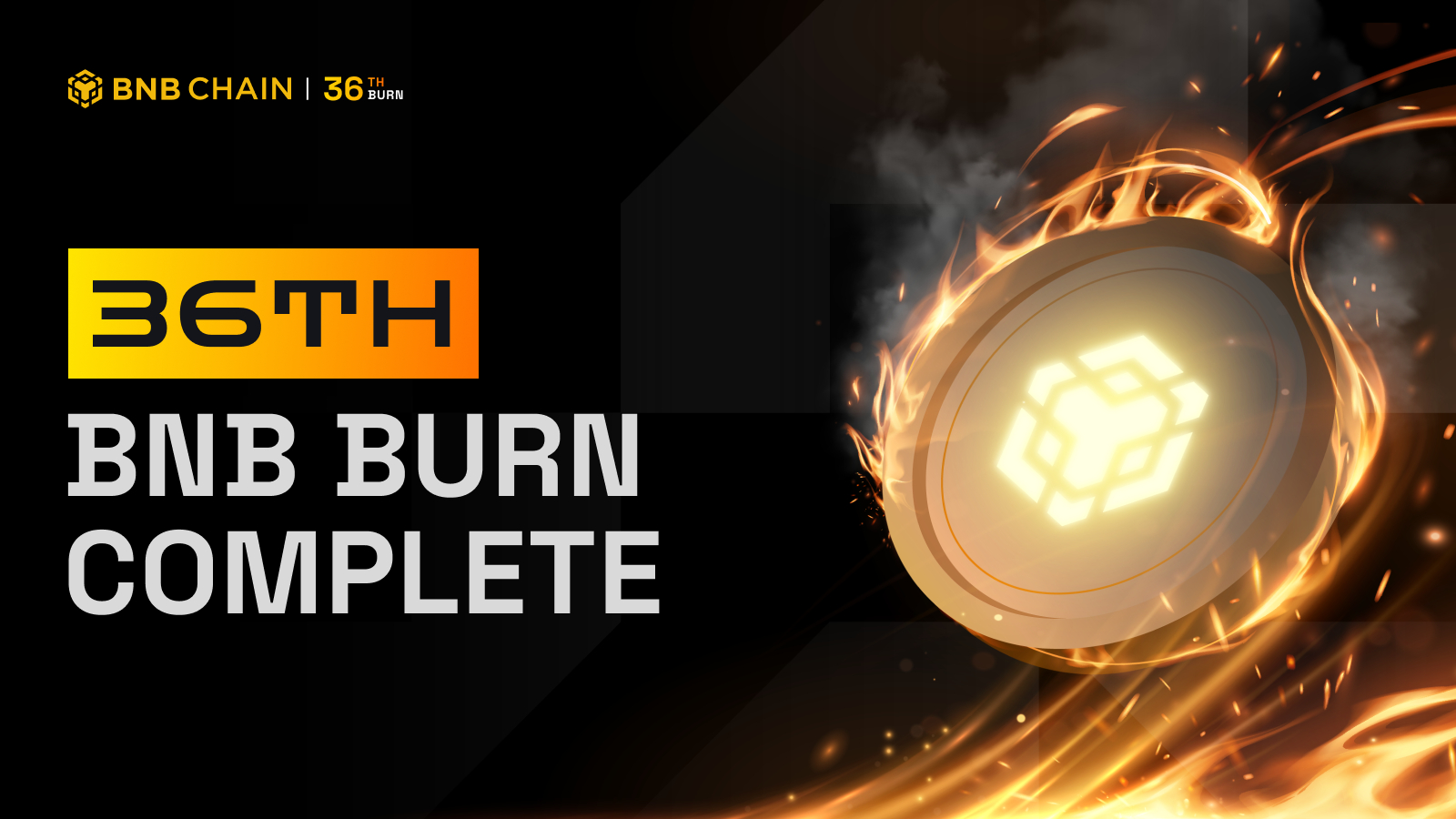
15th of July: The BNB Chain Foundation has officially announced the successful completion of the 36th quarterly BNB token burn by BNB Chain. This marks our third burn of 2026.
Here are the facts and figures from the latest burn:
- Auto-Burn (Total BNB burned): 1,615,827.795 BNB
- Approximate value in USD at the time of burn completion: ~$931,702,464
- Transaction ID (TXID) for BNB burn: View transaction
- Remaining to be burned: Check real-time data here
- Remaining total supply: 133,166,127.91 BNB
at time of writing 15 July, 2026 at 10:35AM UTC.
What You Need to Know About the BNB Burn
BNB is the native coin of the BNB Chain ecosystem, essential for powering its multifaceted Web3 environment. It supports transactions on the BNB Smart Chain (BSC), the opBNB L2s, and BNB Greenfield blockchain. Besides transaction fees, BNB serves as a governance token, granting holders the ability to participate in the BNB Chain’s decentralized on-chain governance. Additionally, BNB functions as a strategic reserve asset and enters the radar of more mainstream financial institutions, driving ecosystem growth and incentivizing adoption.
Following its mainnet launch on April 18, 2019, BNB transitioned from the Ethereum Network to BNB Chain. “Build and Build” is the philosophy behind BNB, reflecting its role in fostering development within the ecosystem. BNB employs an Auto-Burn system to gradually reduce its total supply to 100,000,000 BNB. The burn amount is adjusted based on BNB’s price and the number of blocks generated on BSC during a quarter, ensuring transparency and predictability.
BNB Auto Burn
The BNB Auto-Burn provides an independently auditable, objective process. The figures are reported quarterly, and the mechanism is independent of the Binance centralized exchange.
This quarter’s burn and future burns will occur directly on BSC due to the BNB Chain Fusion. The corresponding BNB amount will be sent to the “blackhole” address: 0x000000000000000000000000000000000000dEaD.
Note: Due to the recent Lorentz, Maxwell and Fermi upgrades, BSC is producing blocks more frequently, compared with the time when the Auto Burn formula was originally defined. The parameters used in the formula have been adjusted to keep the idea and spirit consistent.
BNB Real-time Burn
Additionally, BNB implements a real-time burning mechanism based on gas fees. BSC validators determine the ratio of gas fees collected in each block, which is burned at a fixed rate. Since the introduction of BEP95, roughly 291K BNB has been burnt under this mechanism.
About BNB Chain
BNB Chain is one of the largest and most active blockchain ecosystems in the world, supported by a global community of developers and users. With high throughput, low transaction costs, and full EVM compatibility, BNB Chain powers scalable applications across finance, gaming, and the broader Web3 economy. For more information, users can visit www.bnbchain.org.
The post BNB Chain Completes 36th Quarterly Token Burn, Marks Third Burn of 2026 appeared first on CryptoPotato.
Crypto World
DeFi as Critical Digital Infrastructure: Building the Financial Backbone of the Digital Age

Introduction
The internet transformed how the world communicates, shares information, and conducts business. Yet, despite these advances, financial infrastructure remains fragmented, permissioned, and heavily dependent on centralized institutions. Payments can take days to settle, billions remain unbanked, and access to financial services often depends on geography, identity, or institutional approval.
Decentralized Finance (DeFi) is changing that narrative.
Rather than simply offering an alternative to traditional banking, DeFi is evolving into critical digital infrastructure—a foundational financial layer that anyone can access, build upon, and integrate into the next generation of applications. Just as the internet became essential infrastructure for information, DeFi is becoming essential infrastructure for value.
What Makes Infrastructure “Critical”?
Critical infrastructure refers to systems that society depends on every day. Electricity grids, telecommunications networks, transportation systems, and cloud computing platforms all fall into this category because they enable countless services to function.
DeFi increasingly shares these characteristics:
- Operates continuously without business hours
- Accessible globally through an internet connection
- Open for developers to build on
- Resistant to single points of failure
- Transparent and verifiable
- Programmable by design
Instead of replacing banks outright, DeFi provides the financial operating system that applications, businesses, and even governments can leverage.
Financial Services Become Internet Primitives
One of DeFi’s greatest innovations is transforming financial functions into programmable building blocks.
Developers no longer need to build payment networks, lending systems, exchanges, or settlement infrastructure from scratch.
Instead, they can integrate existing DeFi protocols much like developers use cloud storage or payment APIs today.
These financial primitives include:
- Stablecoin payments
- Decentralized lending
- Automated exchanges
- On-chain collateral management
- Yield-generating vaults
- Cross-chain asset transfers
- Tokenized real-world assets
This composability dramatically accelerates innovation while reducing infrastructure costs.
Always-On Global Finance
Traditional financial infrastructure still operates within numerous constraints:
- Banking hours
- National borders
- Multiple intermediaries
- Settlement delays
- High remittance costs
- Manual reconciliation
DeFi removes many of these limitations.
Transactions settle around the clock.
Capital moves continuously.
Applications operate regardless of weekends or holidays.
This always-on availability is particularly valuable for global businesses, remote workers, digital creators, and international commerce.
Stablecoins: The Infrastructure Layer for Digital Payments
Stablecoins have quietly become one of DeFi’s most important components.
Rather than focusing on speculation, stablecoins enable:
- International payroll
- Merchant payments
- Cross-border settlements
- Treasury management
- E-commerce transactions
- Institutional liquidity
For many users, stablecoins represent their first interaction with blockchain technology—not because they are interested in crypto, but because they need faster, cheaper, and more reliable payments.
As adoption grows, stablecoins increasingly resemble digital public utilities for money movement.
Open Infrastructure Encourages Competition
Traditional financial systems often rely on closed networks where innovation depends on permission from intermediaries.
DeFi changes this dynamic.
Anyone can build:
- Wallets
- Trading platforms
- Lending markets
- Insurance protocols
- Payment applications
- Asset management tools
Developers compete on user experience rather than exclusive access to infrastructure.
This openness creates a healthier ecosystem where innovation moves faster, and users benefit from better services.
Programmable Money Changes Everything
Money is no longer limited to being stored or transferred.
With smart contracts, money becomes programmable.
Examples include:
- Automatic revenue sharing
- Instant royalty payments
- Escrow without intermediaries
- Streaming salaries by the second
- Automated subscriptions
- Conditional business payments
- Machine-to-machine commerce
As artificial intelligence and the Internet of Things expand, programmable financial infrastructure becomes increasingly important.
Machines will eventually need financial systems that operate autonomously.
DeFi is uniquely positioned to support this future.
Infrastructure for Tokenized Real-World Assets
Governments, financial institutions, and enterprises are exploring tokenization at an unprecedented pace.
Assets that can be represented on-chain include:
- Government bonds
- Treasury bills
- Corporate debt
- Real estate
- Commodities
- Private credit
- Carbon credits
DeFi provides the infrastructure where these assets can be:
- Traded
- Borrowed against
- Used as collateral
- Fractionalized
- Settled instantly
Rather than building entirely new financial rails, institutions increasingly connect to existing decentralized infrastructure.
Resilience Through Decentralization
Critical infrastructure must remain operational even under stress.
Traditional systems face risks such as:
- Data center outages
- Banking failures
- Political instability
- Regional disruptions
- Single points of failure
Public blockchain networks distribute operations across thousands of independent nodes worldwide.
Although no system is perfect, decentralization significantly reduces dependence on any single operator.
This resilience is becoming increasingly valuable in an interconnected global economy.
Challenges Before DeFi Can Become Global Infrastructure
Despite remarkable progress, several challenges remain.
Scalability
Infrastructure must support millions—or even billions—of users without sacrificing performance.
User Experience
Wallet management, onboarding, and security remain difficult for many newcomers.
Regulatory Clarity
Governments continue developing frameworks that balance innovation with consumer protection.
Security
Smart contract vulnerabilities, exploits, and protocol risks must continue to decline through better development practices and auditing.
Interoperability
The future financial system will likely span multiple blockchains rather than a single dominant network.
The Infrastructure We Don’t Notice
The most successful infrastructure often becomes invisible.
Few people think about:
- DNS when browsing websites.
- TCP/IP when sending emails.
- Cloud servers when using mobile apps.
Similarly, future users may never realize they’re using DeFi.
They’ll simply:
- Send money instantly.
- Receive salaries globally.
- Trade tokenized assets.
- Earn yield automatically.
- Purchase digital goods.
- Access financial services from any device.
The blockchain becomes invisible while the experience becomes seamless.
Conclusion
DeFi is evolving far beyond decentralized exchanges and yield farming. It is becoming the programmable financial infrastructure that can power digital commerce, tokenized assets, global payments, AI-driven economies, and next-generation internet applications.
The future of finance may not be defined by who owns the infrastructure, but by who can build on top of it. In that future, DeFi serves as the open, resilient, and interoperable foundation—enabling innovation at internet scale.
As digital economies continue to expand, the most important question may no longer be whether DeFi can compete with traditional finance, but whether tomorrow’s financial system can function efficiently without the open infrastructure that DeFi provides.
REQUEST AN ARTICLE
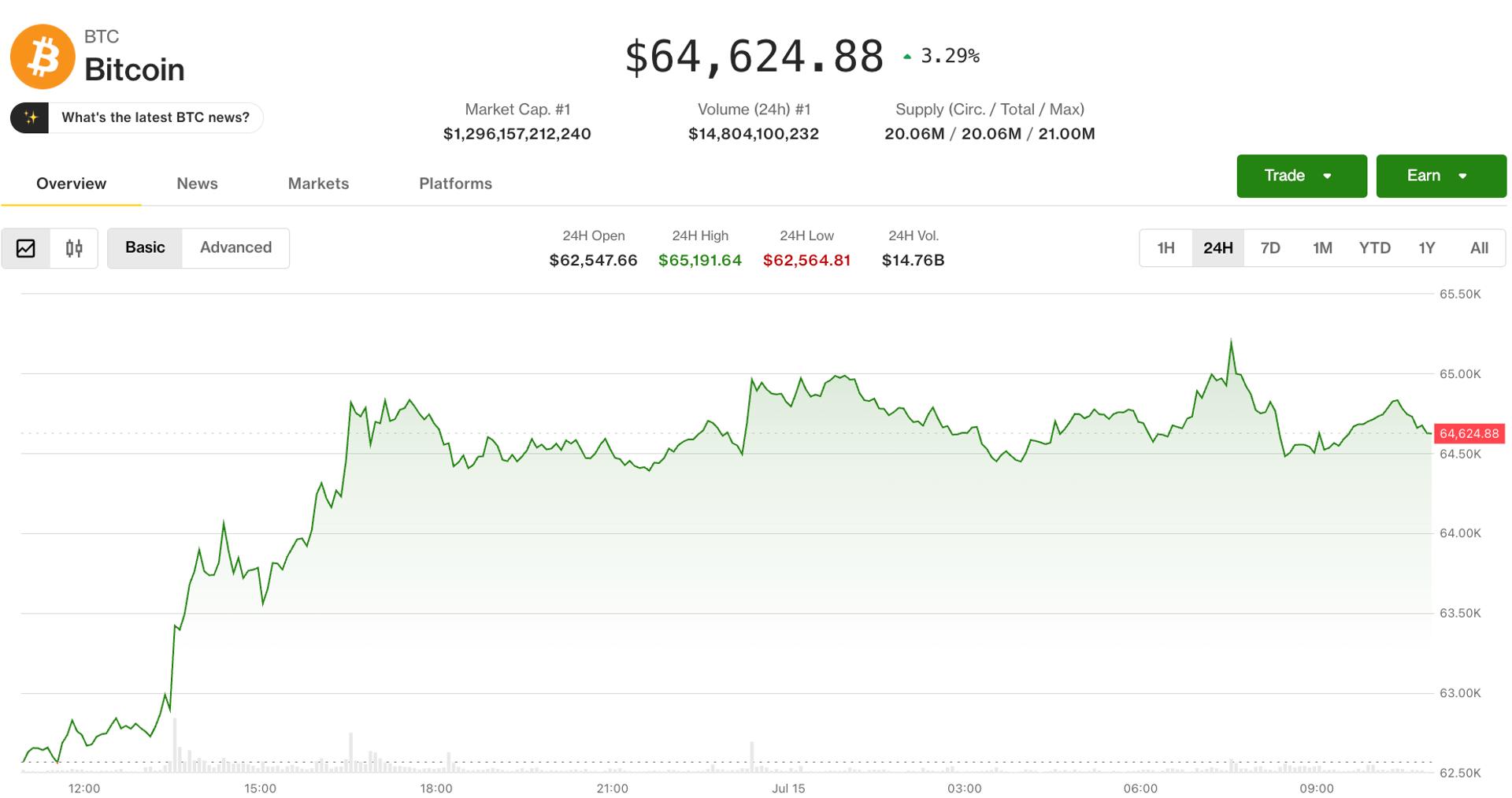
Bitcoin and ether (ETH) consolidated during Asian and European hours after rallying on Tuesday following a weaker-than-forecast U.S. inflation figure.
Bitcoin, while more than 3% higher over 24 hours, fell 0.6% since midnight UTC as tensions between Iran and the U.S. over tanker movements in the Strait of Hormuz ramped up. The largest cryptocurrency earlier touched a three-week high of $65,200.
Ether marked a similar trajectory, remaining 5% higher over 24 hours even after dropping 0.8% since midnight. It touched $1,895, the highest level since June 3, on Tuesday.
U.S. equities also rose in the period, with Nasdaq 100 futures and S&P 500 futures posting respective gains of 0.53% and 0.22%.
The altcoin market also showed pockets of strength; PUMP rose by 8.5% since midnight after a team and investor unlock was mopped up by investors, suggesting robust demand.
Derivatives positioning
- BTC derivatives positioning remains largely unchanged. Open interest ticked up to $17.3 billion, though the move is not meaningful, the three-month annualized basis held at 3.8% and funding rates remained broadly in the 0%-8% annualized range across multiple venues. In essence, the market continues to consolidate
- Options positioning tilted more bullish as the 24-hour call/put ratio moved to 66/34 following yesterday’s softer 58/42 read and the one-week delta skew held steady at ~15%. The ATM term structure remains in contango, with the front end around 32%–33% and the long end at ~42.5% out to mid-2027 – indicating a calm, non-stressed volatility environment with a renewed lean toward upside positioning.
- Coinglass data shows $357 million in 24-hour liquidations, with a 19-81 split between longs and shorts. ETH ($132 million) and BTC ($118 million) were the leaders in terms of notional liquidations.
- The Binance liquidation heatmap indicates $63,500 as a core liquidation level to monitor in the event of a price drop.
Token talk
- CoinMarketCap’s “Altcoin Season” indicator fell to 46/100 on Wednesday, likely due to the strength shown by the largest cryptocurrencies, bitcoin and ether.
- The indicator was also dragged down by , which lost around 1% since midnight UTC despite buoyancy in the broader market.
- Hyperliquid (HYPE) demonstrated its strength, adding 4% since midnight as it looks to extend May’s rally, which has been characterized by a series of higher highs and higher lows. The next target would be a record high above $78.00.
- HYPE’s rival token, LIT, stalled after a strong month, rising by just 0.5% as it started experiencing profit-taking and supply distribution as it neared its record high of $2.76.
- There was also a strong gain for zcash (ZEC), which surged by more than 10% over the past 24 hours before consolidating around $557.
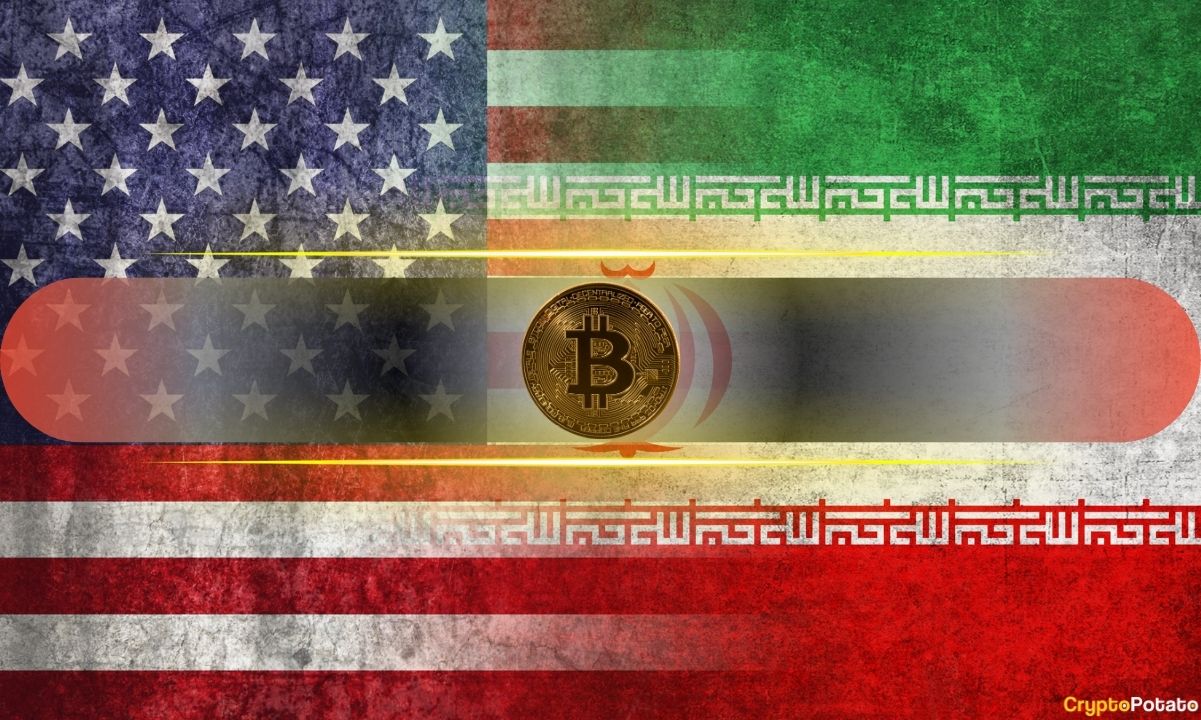
Bitcoin’s price charted impressive gains on Tuesday and Wednesday after the lower-than-expected US CPI numbers for June, spiking to a multi-week peak of $65,000.
However, this progress is in danger again due to the quickly escalating tension in the Middle East, especially since many reports outlined US President Donald Trump’s new attack strategy against Iran.
New Attack Strategy Revealed
The two sides sat in a fragile ceasefire for weeks but failed to reach a decisive deal to permanently end the conflict. Instead, the attacks resumed last week; Trump said the memorandum of understanding is over, and they have launched strikes against each other almost daily since then.
According to multiple reports, the POTUS held a meeting in the Situation Room on Tuesday to discuss a “massive offense” against the Middle Eastern country. Some of the details that went public include:
- The meeting was attended by Vice President JD Vance, Marco Rubio, Pete Hegseth, John Ratcliffe, Steve Witkoff, and other senior officials
- The new attack strategy will involve strikes with a wider scope than the current ones, which are mostly focused on the region around the Strait of Hormuz.
- Axios reported that one of the major conclusions of the meeting focused on new plans for “devastating strikes on strategic targets in Iran.”
Moreover, the report claimed that Trump claimed Iran should “better make a deal” or they are “not going to have anything left.” The good news in all of this could come from this particular sentence, as the POTUS has made similar threats in the past, which actually preceded major de-escalations.
Is BTC in Danger Again?
The timing of these new reported plans for mass attacks couldn’t come at a worse time for bitcoin. The primary cryptocurrency has finally shown some strength following a major macro reversal. The CPI data for June showed much lower inflation than expected, which could mean less chance for the US Fed to increase interest rates.
Bitcoin reacted with an immediate price pump that drove it to a multi-month peak at $65,000 after it slumped below $58,000 for the first time in almost two years on July 1. New negative developments on the war front have long harmed its trend reversal, as attacks typically lead to a BTC crash and a surge in oil prices.
Consequently, there’s a real threat that bitcoin can erase the recent gains if the US follows through on its plan and Iran starts to retaliate against many nations in the region as it did in the past.
The post Trump’s New Iran Strategy Revealed: Will Bitcoin Pay the Price Again? appeared first on CryptoPotato.
Crypto World
Warren Buffett calls Bill Gates’ actions with Epstein ‘distasteful,’ but people make mistakes
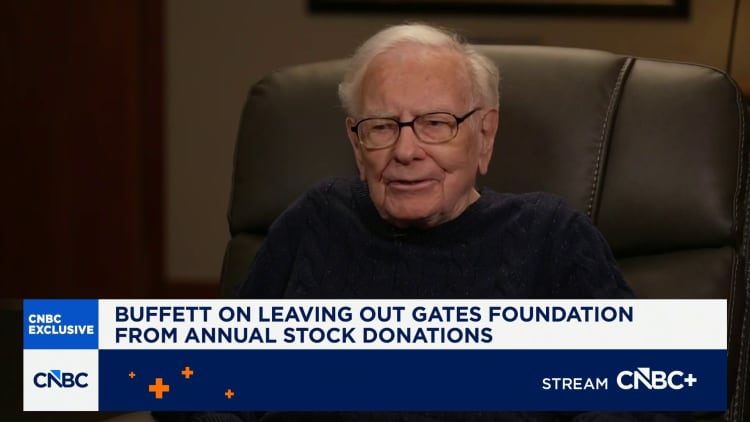

Warren Buffett called Bill Gates’ association with the late sex offender Jeffrey Epstein as “distasteful” after the Berkshire Hathaway chairman excluded the Gates Foundation from his sizable annual charitable donations.
“I read a great deal since January 1 in terms of what happened, with Bill and Epstein,” Buffett said in an interview with CNBC’s Becky Quick. “While it’s distasteful, while he made mistakes, I made mistakes, hiring all kinds of people, or choosing friends, and then finding out later that, one way or other, they weren’t what I thought they were. I found nothing in there that was beyond what I could picture myself doing.”
Buffett, who has been friends with Gates for more than three decades, said he extensively reviewed information about Gates’ relationship with Epstein before deciding to overhaul his charitable giving. The 95-year old Buffett directed all of this year’s donations to four family-linked foundations.
For years, the Gates Foundation was the largest recipient of his annual Berkshire donations. Since 2006, Buffett has donated more than $47 billion worth of Berkshire stock to the philanthropic organization founded by the Microsoft co-founder and his former wife, Melinda Gates.
Buffett said he and Gates remain in contact and recently spent several hours together in Omaha.
“He came by Omaha three weeks ago. I kind of lose track of time, but certainly not three months, and we spent three hours talking together,” Buffett said. “He intends to call me… He already proposed another meeting.”

In the hands of Buffett’s children
The Oracle of Omaha said his estate plan should place greater responsibility in the hands of his three children. He said he had gradually prepared them for that role over decades.
“I reevaluated my whole situation,” Buffett said. “What happened was that I gave the Gates Foundation a great deal of money. I thought that was a good decision. I think it was a decent decision, but I did not think my kids were in any way ready to give away vast sums of money.”
“I tell the three children that it is theirs, and it’s their responsibility to get it done well,” he said.
Buffett said in a statement earlier this week that his goal is to dispose of all of my Berkshire shares within about eight years as his children are “unfortunately growing older.”
This year, Buffett is giving the Susan Thompson Buffett Foundation, named for his late first wife, 9 million Class B shares with a current value of around $4.5 billion. The three foundations run by his children, Susie Buffett’s Sherwood Foundation, the Howard G. Buffett Foundation, and Peter Buffett’s NoVo Foundation, will each get 1 million Class B shares worth just under $500 million.
Buffett also said he recently underwent surgery after breaking his leg several weeks ago and is recovering well.

Your Life at Every Level of Financial Discipline (from a low income to financial freedom)

East Yorkshire luxury tour bus firm MM Band Services bought by Dutch group

England vs Argentina LIVE: World Cup semi-final kick-off time, updates, build-up and team news


-

 Fashion6 days ago
Loro Piana Fall 2026 Enters Houston’s Art Scene
-

 Fashion5 days ago
Weekend Open Thread: Nutriplenish Leave-In Conditioner
-
 Sports6 days ago
2026 Genesis Scottish Open Thursday TV coverage: Round 1
-

 Sports5 days ago
Super Eagles star Moses Simon opens up on Liverpool transfer regret
-

 Tech6 days ago
Character.AI enters the microdrama arena with its own productions, but there’s a twist
-

 News Videos17 hours ago
XRP BOMBSHELL… XRP OMBOARDED FOR TRANSACTIONS!!!
-

 Tech1 day ago
Get Your ESP32 Sunny Side Up With This Solar Dev Board
-

 Tech16 hours ago
Dark Secrets Emerge When Jailbreaking LLMs
-

 News Videos7 days ago
Crypto Just Entered Its Most Important 6-Month Candle (Could Decide Everything!)
-
 NewsBeat6 days ago
Major update after Huntingdon train attack as man enters plea
-

 News Videos2 days ago
how to make coin bank box with cardboard #scienceproject #money #diy #shorts
-

 Tech6 days ago
Level Infinite Launches Gangstar Mirage City in India with Pre-Registrations
-
 Sports7 days ago
39-year-old Djokovic wins five-hour thriller to enter Wimbledon semis | Other Sports News
-
 Tech2 days ago
Cloudflare Precursor Watches Your Mouse and Keyboard To Decide If You Are Human
-

 Tech6 days ago
Entra passkey enrollment vishing targets Microsoft 365 users
-
 Crypto World6 days ago
DeFi Dashboard Zapper to Shut Down After 7 Years
-
 Crypto World6 days ago
Mark Cuban-Backed DeFi Dashboard Zapper Shuts Down After 7 Years
-

 Tech6 days ago
Claude’s New Reflect Dashboard Wants To Help You Log Off Of Claude
-

 Crypto World7 days ago
Fed minutes June 2026: officials split on rates
-

 Tech7 days ago
Former OpenAI exec Kevin Weil is now on the board of Stoke Space
You must be logged in to post a comment Login