

Crypto World
Crystal Intelligence launches Ask Crystal, the AI analyst behind every blockchain judgment


[PRESS RELEASE – Amsterdam, Netherlands, July 14th, 2026]
Ask Crystal, a new AI capability inside Crystal Expert, turns any transfer into one clear, evidence-backed narrative, so compliance, investigation, and risk teams decide in seconds, not minutes.
Crystal Intelligence today announced the rollout of Ask Crystal, an on-demand AI analyst built into Crystal Expert. Ask Crystal reads the full on-chain picture behind any transfer and returns one structured narrative, every answer backed by verifiable blockchain evidence. It is designed to support analyst work, to save time and make faster decisions.
Teams that review blockchain activity face a hard reality. Whether they work in compliance, investigations, or risk, case volumes keep climbing. The signals that matter, transfer details, fund connections, triggered alerts, and counterparty history, sit across separate screens. Two reviewers can read the same case and reach different conclusions. The result is slow reviews, inconsistent decisions, and heavy cognitive load on the people who can least afford a mistake.
Ask Crystal removes that friction. Inside Crystal Expert, on any transfer, a single tab generates a plain-language AI summary on demand, and regenerates it whenever the analyst needs a fresh read. Each summary consolidates four structured sections: a transfer overview, a connections analysis covering source and destination of funds, alert details explained by type and detection rule, and prior interactions with a trusted-list check. One read replaces minutes of manual correlation across tabs.
“Across compliance, investigations, and risk, teams are asked to make high-stakes calls under time pressure, with the evidence scattered across screens,” said Navin Gupta, Chief Executive Officer of Crystal Intelligence. “Ask Crystal changes that. This AI does the reading, the correlating, and the cross-referencing in seconds, then hands the analyst one clear, evidence-backed story. We are not automating the decision. We are giving every decision the full picture it deserves.”
What teams get
- Less operational complexity. Every key signal in one structured view of the transfer.
- More consistent judgments. Context, connections, alerts, and history are interpreted the same way, every time.
- Lower cognitive load. No manual correlation across tabs and alert screens.
- Faster onboarding. A guided, plain-language read makes cases easier to learn from.
Ask Crystal is part of Crystal Expert, the institutional-grade platform used by compliance teams, investigators, financial institutions, and regulators to detect crypto risk, trace funds across more than 330 blockchains, and prove compliance with reports regulators trust. Access to Ask Crystal is controlled through role-based permissions. The feature is rolling out to Crystal Expert customers now.
About Crystal Intelligence
Crystal Intelligence turns blockchain complexity into clear, actionable intelligence for compliance teams, investigators, financial institutions, and regulators. Crystal Expert covers more than 330 blockchains and over 110,000 attributed entities, giving teams the verified data they need to detect risk, trace funds, and prove compliance. Headquartered in Amsterdam, Netherlands, Crystal Intelligence is ISO 27001 and GDPR compliant, with EU-based data governance.
The post Crystal Intelligence launches Ask Crystal, the AI analyst behind every blockchain judgment appeared first on CryptoPotato.


Ethereum price is heating up as it pounces higher above $1,850, gaining more than 5% over the past day. The $2,000 level is finally back in view, although that ceiling has humbled plenty of eager bulls before. The setup looks encouraging, but resistance is still looming.
The Ethereum Foundation has spun out a new entity called EthSystems. Its mission is to build technology and consulting services that help institutions operate on Ethereum while keeping transactions confidential. That targets one of the biggest hurdles for traditional finance, where privacy expectations often clash with public blockchain transparency.
Moving the project outside the Foundation also changes the narrative. Instead of treating privacy tools as research, Ethereum is packaging them as enterprise-ready infrastructure. If institutions gain confidence in deploying on-chain, that could support long-term network activity and, eventually, ETH demand.
Meanwhile, the market has offered a helping hand. Capital has rotated back into major smart contract platforms, giving Ethereum price room to recover after weeks of hesitation. Still, the real test sits near $2,000.
Discover: The Best Token Presales
Can Ethereum Price Hit $2,000 This Week?
Ethereum price is technically constructive as it has broken above the $1,845 to $1,865 resistance zone. The next key hurdle sits around $1,975 to $2,000, where sellers may finally wake up. Trading activity also backs the move, with 24-hour volume approaching $14 billion instead of a quiet climb.
The bullish path stays intact if ETH holds above the former $1,845 to $1,865 resistance zone, now acting as support. A brief pause would not hurt the trend. Instead, it could give buyers enough fuel for another run at the $2,000 mark. The EthSystems and Dashlink announcement also gives investors another reason to stay interested.

Meanwhile, the base case is a rejection near $1,975 to $2,000, followed by profit taking and a pullback toward support. That would not be unusual after a strong rally. Markets rarely climb in a straight line, no matter how much the bulls wish they did.
The bullish outlook weakens if ETH closes below the $1,750 to $1,770 support area. A break there shifts attention toward $1,620, with $1,530 as the next meaningful floor. In that case, traders could view the recent EthSystems catalyst as positive news, but not enough to keep momentum alive.
Even so, ETH still trades about 62% below its all-time high above $4,950. That leaves room for upside over time, although $2,000 remains a realistic ceiling in the near term. If buyers clear that level with convincing volume, the next chapter could get much more interesting.
Trade Ethereum Before It Breaches $2,000 on Bybit and Get Our $1,000 USDT Airdrop
LiquidChain Targets Early-Mover Upside as Ethereum Tests Key Levels
ETH at $1,870 is a meaningful recovery, but a 6% daily move on a $226 billion asset carries proportionally modest return potential for new capital entering here. Traders chasing the $2,000 breakout are essentially pricing in a move already in progress. That’s where early-stage infrastructure plays draw attention, particularly those positioned at the intersection of the ecosystems driving current market momentum.
LiquidChain ($LIQUID) is a Layer 3 infrastructure project building what it describes as a unified cross-chain liquidity layer. It is fusing Bitcoin, Ethereum, and Solana liquidity into a single execution environment.
LiquidChain is cooking.
The Order doesn't sleep. ⟁pic.twitter.com/CXY4ya0MC5
— LiquidChain (@getliquidchain) June 3, 2026
The architecture centers on four components: a Unified Liquidity Layer, Single-Step Execution, Verifiable Settlement, and a Deploy-Once Architecture that lets developers ship to all three ecosystems simultaneously.
As of now, the presale is currently priced at $0.0148, with $900K raised. For traders who want exposure to cross-chain infrastructure before it’s priced in, research LiquidChain before the next pricing tier moves.
Discover: The Best Crypto to Diversify Your Portfolio
The post Ethereum Price Approaches $2,000 as Foundation Team Spins Out EthSystems appeared first on Cryptonews.


Revolut has secured in-principle approval from Dubai’s Virtual Assets Regulatory Authority to expand its regulated crypto business in the United Arab Emirates, adding another regulatory milestone to its global digital asset strategy.
Summary
- Revolut has received in principle approval from Dubai’s VARA to offer regulated virtual asset services in the UAE.
- The company plans to launch crypto trading, exchange, and investment services through its app and Revolut X after final regulatory approval.
- The approval follows recent regulatory moves in Europe and the United States as Revolut expands its crypto business across regulated markets.
According to a company announcement on Tuesday, the approval allows Revolut to move toward offering virtual asset broker-dealer, management, investment, and exchange services in the UAE, subject to receiving final authorization from Dubai’s Virtual Assets Regulatory Authority (VARA).
Once fully licensed, Revolut said eligible customers in the UAE will be able to buy, sell, and hold digital assets through its main retail app and its dedicated trading platform, Revolut X.
The latest approval follows an earlier authorization from the Central Bank of the UAE for Revolut’s payments business, as the fintech continues building a locally regulated financial platform in the country.
Joseph Khair, head of Revolut Digital Assets FZE, UAE, said the UAE has established “a robust and transparent framework for virtual assets” and added that the approval creates the foundation for the company to launch regulated crypto services while supporting VARA’s efforts to develop a safe and innovation-focused digital asset ecosystem.
UAE becomes the latest step in Revolut’s regulated crypto expansion
Outside the UAE, Revolut has continued to adapt its crypto business to local regulatory requirements across several markets.
Earlier this month, the company confirmed it would remove Tether’s USDT from eligible European accounts after the European Union’s Markets in Crypto-Assets (MiCA) framework entered full enforcement. Revolut said affected users can continue selling or transferring their USDT until Aug. 31 before the stablecoin is removed from supported accounts.
The company said the restriction applies only to notified customers in eligible European jurisdictions and does not affect markets where USDT remains supported.
MiCA requires crypto service providers and stablecoin issuers operating in the European Union to comply with licensing, reserve, disclosure, and supervisory requirements. Tether has not received MiCA authorization, and Chief Executive Officer Paolo Ardoino has previously argued that some of the framework’s reserve rules were not suitable for the issuer.
The UAE approval also comes as Revolut continues preparing for its U.S. expansion. Reuters reported in June that the fintech plans to launch a U.S. bank next year after filing for a national bank charter with the Office of the Comptroller of the Currency. According to Reuters, the planned platform will combine FDIC-insured banking products with crypto trading, stablecoins, and multi-currency services.

June PPI came in at -0.3% month over month against a consensus of 0.0%, and 5.5% year over year versus an expected 6.2%. The downside surprise followed softer-than-expected CPI data, prompting investors to reassess expectations for the Federal Reserve’s rate cut policy.
The full June PPI breakdown from XTB shows PPI Core MoM at +0.2% versus +0.3% expected, and PPI Core YoY at 4.7% versus 5.1% expected. Every measure printed below the consensus.
— Coin Bureau (@coinbureau) July 15, 2026
 U.S. PPI DATA IS OUT
HEADLINE PPI (YoY): 5.5 %
Forecast: 6.2% | Previous: 6.5%
CORE PPI (YoY): 4.7%
Forecast: 5.2% | Previous: 4.9%
Both headline and Core PPI comes in lower than expected, signaling easing inflation pressure.
After the market reacted sharply to yesterday’s… pic.twitter.com/nYtV1deB8q
Tuesday’s CPI data also surprised to the downside, with headline inflation falling 0.4% month over month against expectations for a 0.1% decline, cooling to 3.5% year over year from 4.2% in May. Core CPI was flat on the month and rose 2.6% annually.
The May context matters here. PPI reached 6.0% year over year in May, reinforcing concerns that inflation pressures were reaccelerating. June’s slowdown to 5.5% eased some of those concerns and encouraged investors to reconsider how restrictive Federal Reserve policy may need to remain.
According to Cryptonews analysis, markets are now likely to lean further into pricing a less aggressive Fed path, even as the central bank remains cautious about easing policy before inflation is firmly under control. That caution had weighed on risk assets, including crypto markets, and softer inflation data may help unwind some of that positioning.

Discover: The Best Token Presales
Rate Cut Expectation, The Dollar Breaks, Bitcoin Benefits
The dollar weakened modestly following the PPI release, consistent with historical patterns where softer producer prices reduce the case for a hawkish Federal Reserve. A softer dollar can also lower the opportunity cost of holding non-yielding assets, which has historically supported Bitcoin and other risk assets.
The latest CPI and PPI reports suggest inflation pressures eased in June after stronger readings in May. While the data points toward moderating price growth, it does not by itself confirm that inflation is on a sustained path back to the Fed’s 2% target.
What it does not confirm is a guaranteed Fed rate cut in the near term. The Federal Reserve has repeatedly said it wants sustained evidence that inflation is moving toward its target before easing policy. One month of softer inflation may improve expectations for future rate cuts, but additional data will likely determine whether June marks the start of a lasting trend or a temporary slowdown.
For Bitcoin, the medium-term backdrop has improved as easing inflation reduces pressure on interest rate expectations. Whether that translates into a sustained rally will depend on upcoming inflation reports, Federal Reserve guidance, and broader market sentiment. Technical analysts covering BTC will now be watching whether the asset can build on the macro-driven move rather than fade as the next round of economic data approaches.
Don’t Miss Out on Our $1,000 USDT Airdrop on ByBit
The post June PPI Misses Forecast by 0.7 Points, Boosting Rate Cut Expectations appeared first on Cryptonews.
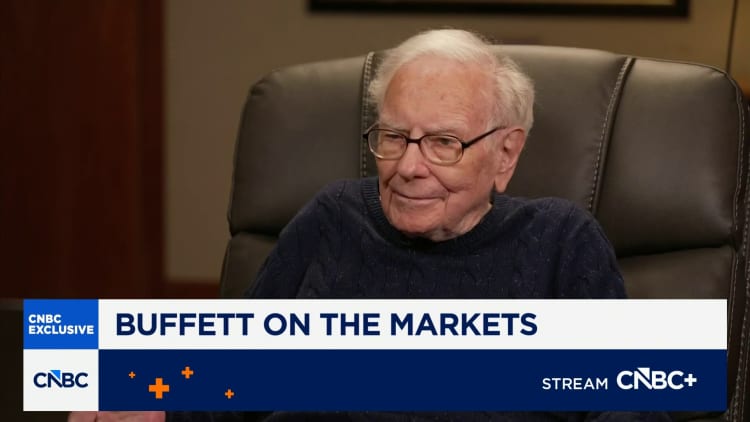

Warren Buffett was critical of a stock market that he said is increasingly driven by speculative trading, as opposed to investing for the long term.
“It’s tough to find values when everybody is preferring gambling,” Buffett told CNBC’s Becky Quick.
The chairman of Berkshire Hathaway had sharp words on the stock market earlier this year. In May, he likened the stock market to “a church with a casino attached,” specifically calling out the surge in one-day options trading as “gambling.”
The stock market has rallied to all-time highs this year, climbing a wall of worry that included an energy shock from an ongoing war with Iran. Skeptics have said there’s too much speculation in stocks tied to the artificial intelligence buildout, with vehicles such as options and leveraged exchange-traded funds adding fuel to the fire. Equities have increasingly attracted retail traders en masse, who are buying shares of memory chipmaker Micron and recent IPO SpaceX.
The billionaire investor, 95, known for his stout adherence to value investing expressed his belief that the most meaningful investment opportunities are fewer and far between, requiring a patient and disciplined approach.
“There are times when opportunities are just thrown at you so fast you can’t, you know, it’s unbelievable,” the Berkshire chairman said. “And then there’s other times when you’re very, very lucky if you find one thing in a couple of years. And it should always be that the the latter is what prevails.”
“But since humans love to gamble so much, there’s more money in in actually cultivating gamblers than there are cultivating investors,” he said.
Solana price has climbed to around $78 on July 15 after a 250 million USDC mint on the network, combined with softer U.S. inflation data, injected fresh buying momentum across crypto markets.
Summary
- Solana price jumped toward $78 after a 250 million USDC mint boosted on-chain liquidity and risk appetite improved.
- Technical charts show a breakout above a descending channel, with $80 emerging as the next key resistance.
- Rising active addresses, institutional developments, and liquidation clusters support upside, while $70-$75 remains critical support.
The move gathered pace after the USDC Treasury minted 250 million USDC on Solana, adding immediate liquidity to the ecosystem as traders returned to risk assets following the latest U.S. inflation print. Capital quickly rotated into Solana-based decentralized exchanges, helping SOL recover from recent weakness while the wider crypto market also moved higher.
Earlier selling pressure had left Solana trading well below its May highs as geopolitical tensions, institutional distributions and weaker on-chain activity weighed on sentiment.
Today’s rebound, however, arrives with stronger participation. Daily trading volume has climbed above $2.1 billion, suggesting buyers, rather than short-term speculation alone, have supported the advance.
Technical structure favors another test of $80
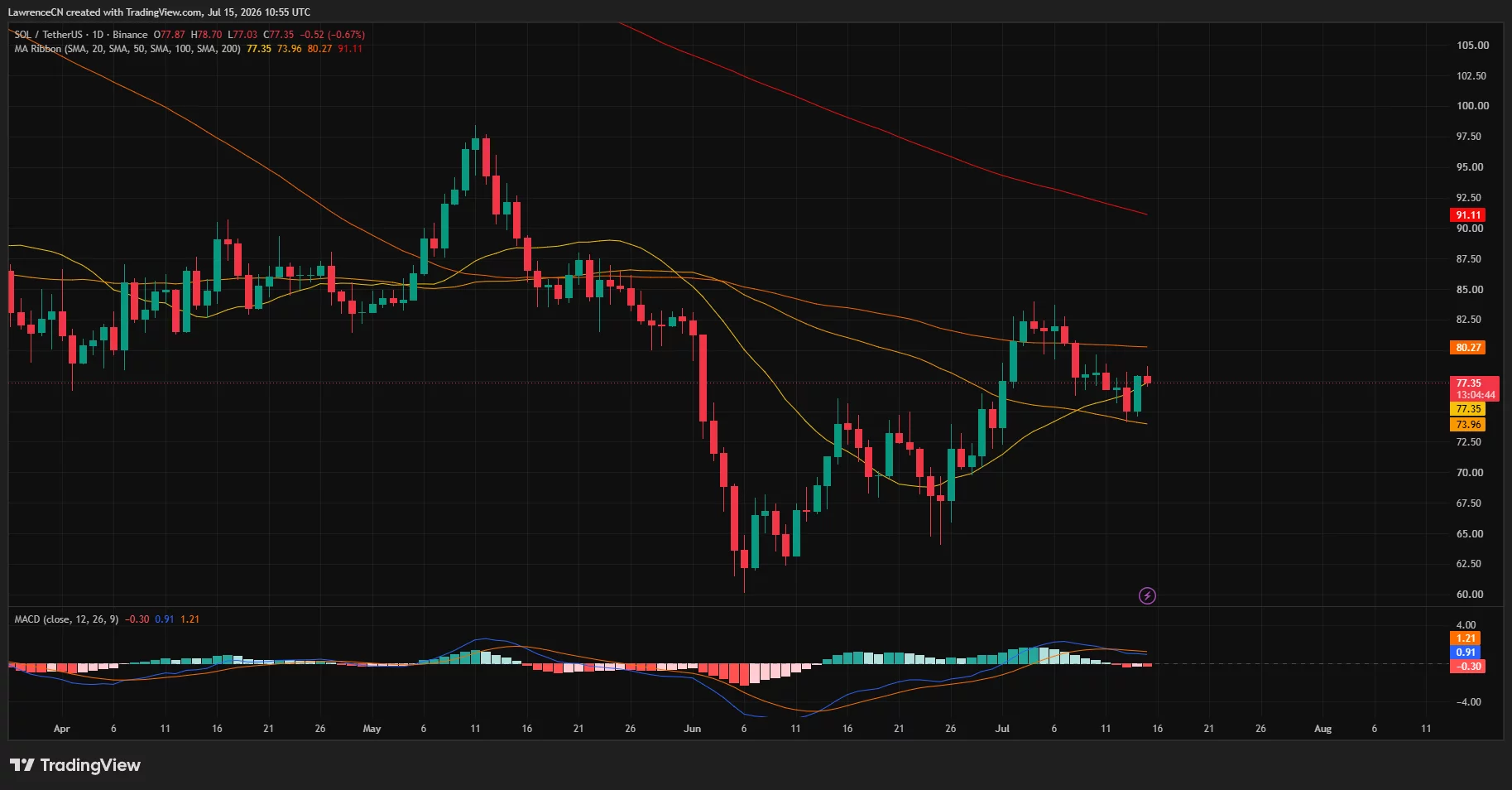
The daily chart shows Solana (SOL) price holding above a long-standing support area between $70 and $75 after repeatedly defending that range over recent weeks. Price now trades above the 20-day and 50-day moving averages near $73.3-$74 while remaining below the declining 100-day moving average around $80.3 and well beneath the 200-day moving average near $91.
A sustained close above the 100-day average would expose the psychologically important $80 level before opening room toward the May swing high near $82.
The 4-hour chart adds another constructive development. SOL has broken above a descending channel that had contained price action since early July, while the RSI has recovered to roughly 52 after bouncing from oversold territory.
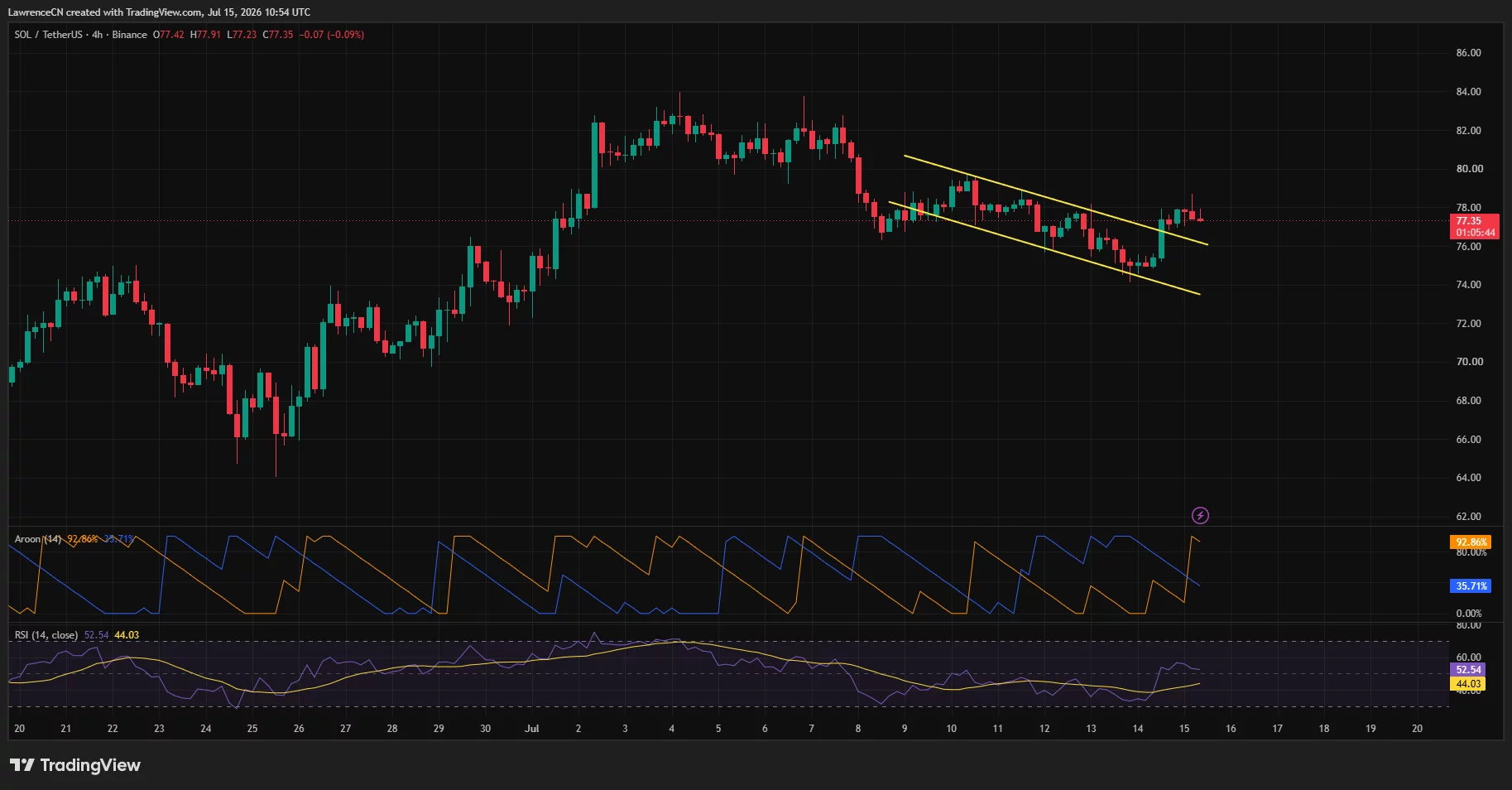
The Aroon Up reading near 93 also holds well above the Aroon Down line, suggesting buyers currently control short-term momentum, although resistance remains concentrated just below $80.
Derivatives positioning reinforces that technical picture. CoinGlass liquidation data shows dense short liquidation clusters stacked between $78.5 and $80, with another concentration extending toward $81.5.
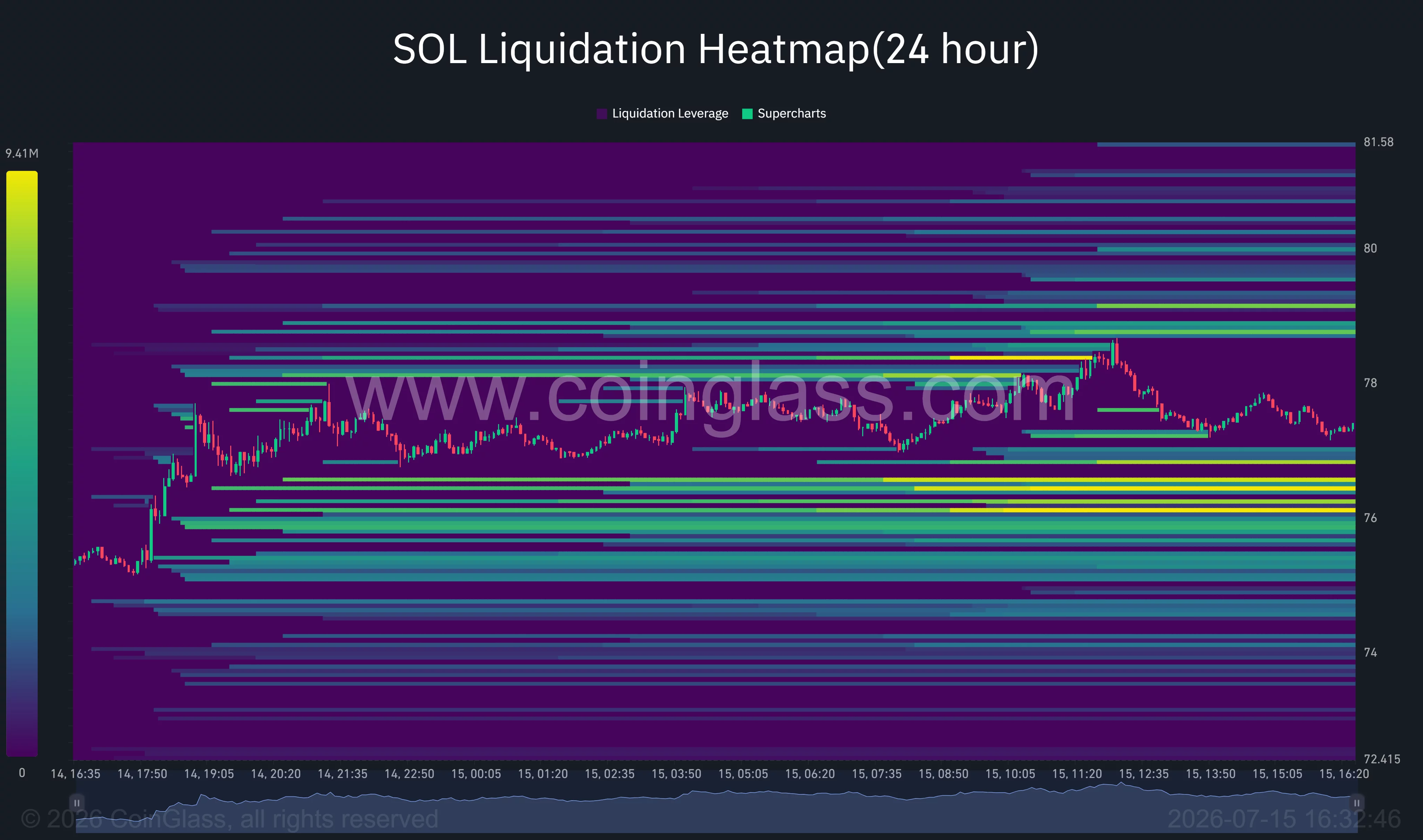
A decisive push through those levels could trigger forced buying from bearish positions, while the largest long liquidation pockets remain clustered around the $76-$76.5 region, making that zone an important area for bulls to defend.
Commenting on the latest setup, analyst Ali Martinez argued that Solana has regained a bullish structure after its SuperTrend indicator flipped positive for the first time since October. He wrote:
“If buying pressure continues to build, $SOL could rally toward $96 or even $121. However, $60 remains the key level to watch.”
Outside the charts, network fundamentals have also improved. Active addresses have climbed toward seven million, while anticipation continues to build ahead of the Alpenglow upgrade, which is expected to reduce transaction finality to around 150 milliseconds later this quarter.
Solana has also strengthened its institutional footprint through its partnership with SBI Holdings to expand on-chain financial infrastructure in Japan, while tokenized real-world assets on the network have grown to roughly $3.3 billion.
A break below key support would weaken the bullish outlook
Bullish momentum still faces several hurdles. The declining 100-day moving average around $80 represents the first major technical barrier, and failure to clear that level could keep SOL trapped inside its multi-week consolidation range.
A return below the 20-day and 50-day moving averages would shift attention back to the $75 support area, where leveraged long positions remain concentrated.
Macro risks also remain unresolved. Fresh geopolitical tensions, another rise in Treasury yields, or stronger-than-expected U.S. economic data could reduce expectations for monetary easing and pressure risk assets across the crypto market.
If selling accelerates and Solana loses the $70-$75 support zone, the bullish breakout thesis would weaken considerably, while Ali Martinez’s longer-term invalidation level near $60 would return to focus.
Disclosure: This article does not represent investment advice. The content and materials featured on this page are for educational purposes only.


Strategy (MSTR), the largest public holder of bitcoin , won’t panic unless BTC sinks to the $8,000-$10,000 range, its CEO has said.
Phong Le identified that range as when the company “would have to consider some of the risk associated with our debt,” in an interview with Bloomberg TV on Tuesday.
Such a drop would represent a drop of around 85% based on bitcoin’s current price of around $64,500 as of writing.
“Until that point in time, we feel very secure about the balance sheet,” Le said. “What we need to do is build a capital structure that can withstand bear markets and of course benefit from bull cycles.”
Strategy’s preferred stock STRC, which is designed to give it the cash flow to fund its bitcoin buying in return for a regular dividend — currently a 13% annual yield, has been under pressure in recent months. The stock is designed to maintain a $100 par, which it lost in April and falling below $75 in late June.
When STRC falls below $100, it restricts Strategy’s ability to issue new shares and then use the cash to buy bitcoin.


Japan reclassified cryptocurrencies as financial instruments, a structural shift that establishes the legal framework for separate taxation of crypto assets and for future crypto exchange-traded funds (ETFs).
The legislation approved by Parliament on Wednesday amends the Financial Instruments and Exchange Act and the Payment Services Act (PSA). It shifts crypto from a framework in which it was primarily treated as a payment tool to one that treats it as an investment alongside other financial instruments. The new rules are expected to take effect in 2027.
The new framework also removes a key legal hurdle for future spot bitcoin exchange-traded funds (ETFs), although lawmakers did not approve any ETF products. Financial Services Agency officials said Japan will now consider developing a regulatory framework for crypto ETFs.
The legislation raises the maximum prison term for unregistered crypto operators from three years to 10 years and increases the maximum fine from 3 million yen ($18,500) to 10 million yen. It also introduces stricter insider-trading rules and expands disclosure requirements for crypto issuers and exchanges.


Noxa, the largest token launchpad on Robinhood Chain, stopped operating after earning an estimated $12 million in fees, according to DefiLlama, in the past week, citing concerns about low-quality tokens flooding the platform.
The shutdown unfolded in a matter of days. On July 11, just as CASHCAT, the chain’s breakout memecoin, was hitting peak trading volume, Noxa said it would stop accepting new token launches.
Two days later, the platform’s website went dark. The team blamed a Cloudflare issue. On July 14, it said the domain would redirect to ENS services and creator earnings would be available for withdrawal. Late Tuesday night, Noxa posted that the platform would no longer collect fees, redirecting 100% of transaction revenue to creators instead.
The decision divided Crypto Twitter.
“Half the timeline called it based because someone finally pushed back against the spam,” wrote @zubic_eth in a widely shared post summarizing the situation. “The other half called it a generational fumble and said they killed the golden goose while making $3 million a day.”


The figures contrast with BlackRock’s broader business, which posted record assets under management (AUM) of $15.3 trillion after attracting $192 billion in net inflows during the quarter. The company also beat Wall Street expectations with adjusted earnings per share of $13.91 on $7.08 billion in revenue.
BLK shares traded 4.15% higher at £1,068 in pre-market trading Wednesday.
BlackRock’s crypto target
BlackRock is targeting $500 million in annual revenue from the business under its 2030 plan, the firm said in its earnings call.
This would represent an increase of more than tenfold, compared to the $40 million BlackRock currently generates in base fees and securities lending, accounting for less than 1% of the firm’s total fee revenue.
BlackRock has steadily expanded its crypto ETF lineup since listing its spot bitcoin ETF (IBIT) and spot ether ETF (ETHA), in 2024. More recently, the firm introduced the iShares Bitcoin Income ETF (BITY), which seeks to generate income by writing covered call options on bitcoin exposure, offering investors an alternative to simply tracking the cryptocurrency’s price.
The asset manager also manages $60 billion of Circle’s reserves, about one-quarter of the $300 billion stablecoin market, and wants to become the industry’s reserve manager of choice, it added.
BlackRock pointed to 5 billion crypto wallets as a new distribution channel for its traditional investment products during the earnings call.
Just a few short years ago, the crypto hype was strong. VCs were eager to pour money into solutions for scalability, data availability, and any number of buzzwords.
Since then, the advent of powerful AI models and prolonged bear markets have taken the wind out of crypto’s sails and many chains which promised the future are now as good as forgotten.
One keen-eyed X user, crypto marketer Stacy Muur, noted the staggering $500 million invested across six blockchain projects which, together, have produced a total of just $360 in blockchain fees in the past 24 hours.
Read more: AscendEx shutdown: Uncertainty over withdrawals as hot wallets lack funds
The claim caught Protos’ eye, so we took a look at the six companies to see where it all went wrong.
Berachain
Berachain is a blockchain born as a spinoff of the 2021-era Bong Bears NFT collection. It claims to be the first proof-of-liquidity based chain, and aims to be a “growth engine for onchain businesses.”
The project raised a total of $142 million across two rounds in 2023 and 2024.
However, according to its most recent EoY statement, the project has struggled amidst issues with sentiment, shrinking crypto-native TAM and “increased skepticism around the value of infrastructure as a whole.”
Since launching in early 2025, its BERA token is down 98%.
Berachain was among the networks caught up in November’s devastating Balancer hack, leading validators to temporarily halt the network.
Later that same month, it was revealed that one of the backers, Brevan Howard’s Nova Digital, was granted a one year, risk-free refund right on its $25 million investment.
Read more: Balancer exploit drains $129M in DeFi disaster
Celestia
Celestia was seen as a hot ticket back in 2023 when “data availability” was the buzzword du jour.
Part of the Cosmos ecosystem, it promises bespoke, high throughput, modular chains “for companies with internet-scale traffic.”
It raised first $1.5 million in 2021, a further $50 million in 2022 and finally $100 million in 2024.
Its much-hyped token launch was one of the first rays of light following a deep bear market sparked by the catastrophic crypto collapses of 2022.
Despite initially surging around 10x in its first months to an all-time high of over $20, TIA eventually bled approximately 98%, sitting today at $0.40.
Scroll raised a total of $83 million over three funding rounds, the latest of which brought the Ethereum L2 to a $1.8 billion valuation in March 2023.
It made just $24 in fees yesterday.
The zkEVM layer two hit a peak TVL of $585 million as users enthusiastically farmed an ultimately disappointing airdrop. In the aftermath, the network lost around 75% of its TVL within a couple of months.
There’s currently just under $12 million on the chain.
Eclipse
Eclipse billed itself as “Solana on Ethereum,” an SVM layer two network which would pair Solana’s performance with Ethereum’s liquidity.
Developer Eclipse Labs raised a total of $65 million, most of which came in a $50 million Series A, led by Placeholder and Hack VC, in March 2024.
DeFiLlama data shows the chain’s TVL peaking at almost $50 million in late February last year. It’s currently down to just $1.15 million, a drop of approximately 98%.
The project’s most recent blog post is from a year ago, announcing the launch of its token ES, and an airdrop. Eclipse Labs has since pivoted to development of The Human API, a marketplace for AI agents to hire humans.
Sonic
Launched as Fantom by controversial developer Andre Cronje, founder of DeFi stalwart Yearn Finance, the fast, low-cost network migrated to Sonic in 2024. It raised a total of $61 million across six rounds between 2018 and 2024, according to ICODrops.
As Fantom, it took a hit in the Multichain debacle, with many bridged assets depegged from their native versions.
Fantom’s peak TVL reached a staggering $7.9 billion in 2022 and now sits at just under $5 million. Sonic’s hit $1.2 billion last spring, but has since dropped to $16 million.
Cronje’s involvement with Sonic terminated last month and he’s spent much of the last 18 months building Flying Tulip.
Read more: Andre Cronje says someone stole his code to build a $1B DeFi project
Manta
ZK-focused Manta raised a total of $60 million across four rounds between 2021 and 2023.
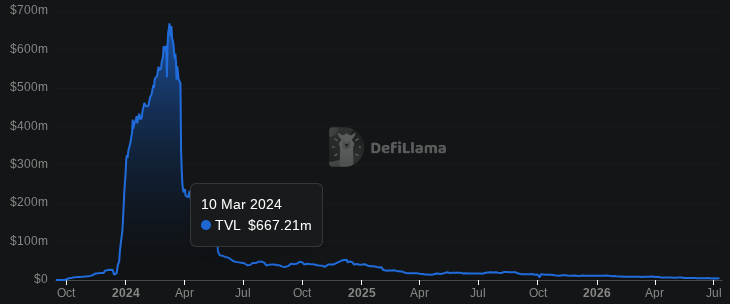
Its TVL chart is dramatic, highlighting an intense, heavily gamified airdrop campaign, which saw over $650 million poured into the chain.
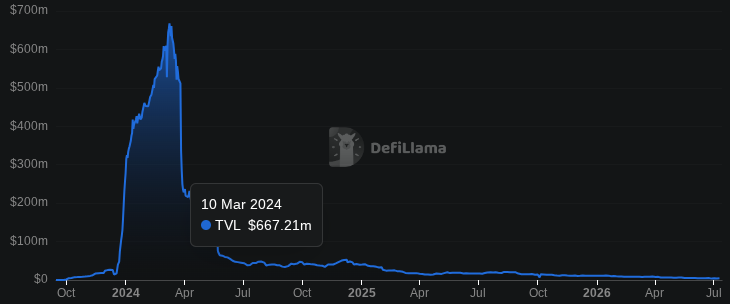
Just a few weeks before its peak, TVL sat at under $20 million. Likewise, within four months, it was back below $50 million once again. Today, just $4 million is held on the chain.
Got a tip? Send us an email securely via Protos Leaks. For more informed news and investigations, follow us on X, Bluesky, and Google News, or subscribe to our YouTube channel.
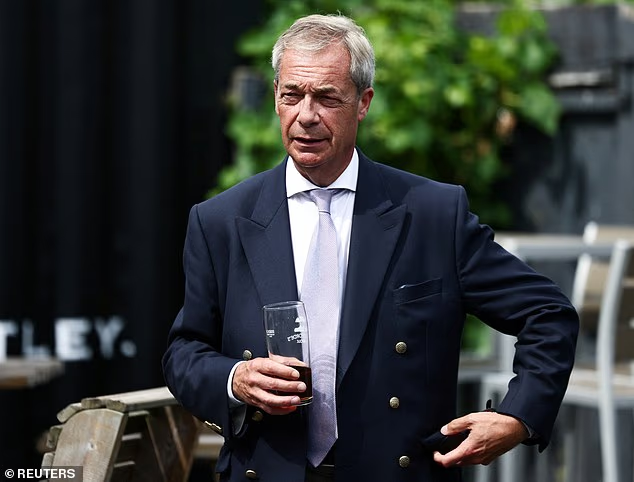
Police arrest man for threatening to shoot Nigel Farage after former MP Ann Widdecombe was killed in ‘targeted attack’

Monumental raises $32m to scale robot bricklayers in UK
Ethereum Price Approaches $2,000 as Foundation Team Spins Out EthSystems


-

 Fashion6 days ago
Loro Piana Fall 2026 Enters Houston’s Art Scene
-

 Fashion5 days ago
Weekend Open Thread: Nutriplenish Leave-In Conditioner
-
 Sports6 days ago
2026 Genesis Scottish Open Thursday TV coverage: Round 1
-

 Sports5 days ago
Super Eagles star Moses Simon opens up on Liverpool transfer regret
-

 Tech6 days ago
Character.AI enters the microdrama arena with its own productions, but there’s a twist
-

 News Videos18 hours ago
XRP BOMBSHELL… XRP OMBOARDED FOR TRANSACTIONS!!!
-

 Tech1 day ago
Get Your ESP32 Sunny Side Up With This Solar Dev Board
-

 Tech17 hours ago
Dark Secrets Emerge When Jailbreaking LLMs
-

 News Videos7 days ago
Crypto Just Entered Its Most Important 6-Month Candle (Could Decide Everything!)
-
 NewsBeat6 days ago
Major update after Huntingdon train attack as man enters plea
-

 Tech6 days ago
Level Infinite Launches Gangstar Mirage City in India with Pre-Registrations
-

 News Videos2 days ago
how to make coin bank box with cardboard #scienceproject #money #diy #shorts
-

 Politics1 hour ago
Young campaigners urge incoming PM to act on outdoor junk food ads
-

 Sports7 days ago
39-year-old Djokovic wins five-hour thriller to enter Wimbledon semis | Other Sports News
-
 Tech2 days ago
Cloudflare Precursor Watches Your Mouse and Keyboard To Decide If You Are Human
-

 Tech6 days ago
Entra passkey enrollment vishing targets Microsoft 365 users
-

 Crypto World6 days ago
DeFi Dashboard Zapper to Shut Down After 7 Years
-

 Crypto World6 days ago
Mark Cuban-Backed DeFi Dashboard Zapper Shuts Down After 7 Years
-

 Tech6 days ago
Claude’s New Reflect Dashboard Wants To Help You Log Off Of Claude
-

 Crypto World7 days ago
Fed minutes June 2026: officials split on rates
You must be logged in to post a comment Login