Connect with us
DAPA Banner
DAPA Coin
DAPA
COIN PAYMENT ASSET
PRIVACY · BLOCKDAG · HOMOMORPHIC ENCRYPTION · RUST
ElGamal Encrypted MINE DAPA
🚫 GENESIS SOLD OUT
DAPAPAY COMING

NewsBeat

‘Masterpiece’ police drama with Buffy The Vampire Slayer star added to Netflix

Published

on

Manchester Evening News

The acclaimed series aired a staggering 246 episodes over 12 seasons

A ‘masterpiece’ police drama with a Buffy The Vampire Slayer star has been added to Netflix.

Advertisement

Premiering all the way back in 1997 and running until 2003, Buffy the Vampire Slayer tells the story of an American teenager attempting to live a normal life. Sadly she discovers her destiny is to battle vampires, demons and other evil entities.

Starring Sarah Michelle Gellar, How I Met Your Mother’s Alyson Hannigan, Nicholas Brendon, Charisma Carpenter and James Marsters, Buffy is considered to be one of the most influential shows of the 1990s.

Click here to get the biggest stories straight to your inbox in our Daily Newsletter

It’s been a difficult time for fans of the series, with actress Michelle Trachtenberg found dead at her home in Manhattan on Wednesday, February 26. The death of the 39-year-old actress, who played Buffy’s sister Dawn, was ruled as of natural causes due to complications from diabetes mellitus.

Advertisement

Fans were also left upset in March when the revival series, Buffy: New Sunnydale, was scrapped. Set to be directed by Oscar winner Chloe Zhao, pilot was going to centre on an introverted high school pupil, played by Ryan Kiera Armstrong, who becomes the chosen one, following in Buffy Summers’ footsteps.

Sarah recently said of the news: “We had an executive on our show who was not only not a fan of the original, but was proud to constantly remind us that he had never seen the entirety of the series and how it wasn’t for him.

“That’s very hard when you’re taking a property that is as beloved as Buffy, not just to the world, but to me and Chloé. So that tells you the uphill battle that we had been fighting since day one, when your executive is literally proud to tell you that he didn’t watch it. Chloé and I are feeling the same things. ‘Disappointment’. We don’t want to let the fans down. That hurts.”

Advertisement

Thankfully due to Buffy having such a big cast, there’s no shortage of projects from various of its stars to choose. Netflix have just added one that’s perfect for either a first time watch or your thousandth rewatch.

Starring David Boreanaz, who played Buffy’s boyfriend Angel and had a spin-off series, Bones aired from 2005 until 2017. Airing 246 episodes over 12 seasons, the series is an ideal binge watch.

The series is based on forensic anthropology and forensic archaeology, with each episode focusing on an FBI case file concerning the mystery behind human remains brought by FBI Special Agent Seeley Booth (Boreanaz) to Temperance ‘Bones’ Brennan (Emily Deschanel), a forensic anthropologist.

Fans adored the chemistry between Boreanaz and Deschanel, who recently appeared in Devil in Ohio. Starting off as friends, fans spent literal years rooting for them to get together.

Advertisement

Airing on Fox, Bones is based on the life and novels of forensic anthropologist Kathy Reichs, who also produced the show. In a very fun nod, Brennan writes successful mystery novels across the series featuring a fictional forensic anthropologist named Kathy Reich.

Filling out the rest of the main cast is Yellowstones’ Michaela Conlin, Something’s Gotta Give’s T. J. Thyne, Curb Your Enthusiasm’s Eric Millegan, Last Man Standing’s Jonathan Adams, Agents of S.H.I.E.L.D.’s Tamara Taylor, Freaks and Geeks’ John Francis Daley, and 24’s John Boyd.

While it didn’t pull in juggernaut ratings, the Bones fandom was so large that it became one of the longest running programmes of the century. Many fans have taken to Reddit to explain what Bones means to them.

@space_anthropologist said: “I watched every season religiously as it aired. It is still my comfort show. I actually very rarely even write or read fanfiction for this show, because I love canon for what it is.” @sweetpeapickle added: “I loved it. But you need to watch it for the characters. If you don’t like them…”

Advertisement

@Cool_Jelly_9402 wrote: “This is by far my most rewatched show. I was never a show repeater before I rewatched this.” @Dry-Dot-3004 stated: “The show is so good i promise, especially if you like procedurals, normal drama stuff, comedy, etc.”

@GoalHistorical6867 commented: “I have always enjoyed watching Bones. It’s my go-to series to binge watch when I don’t have anything else to watch.” @xoxoforeverblessed posted: “Rewatching it again from the beginning now and it is just as good.”


Source link

Advertisement
Continue Reading
Click to comment

You must be logged in to post a comment Login

Leave a Reply

NewsBeat

‘Game-changer’ self-injectable drug that can slow Alzheimer’s progression by up to eight years is approved in US – and could soon be available on NHS

Published

on

Logo

A self-injectable drug that slows Alzheimer’s progression by up to eight years has been approved in the US and could soon be available on the NHS.

The ‘game-changer’ jab is taken once a week and can be administered at home in just 15 seconds, sparing users the need to visit a hospital.

It was previously given via intravenous drip, which took an hour to infuse and placed a heavy burden on patients, medical staff and beds.

The drip version is available privately in the UK but drugs watchdog NICE ruled it should not be offered on the NHS as it did not offer value for money.

Advertisement

This was largely due to the resource-intensive delivery method, which could be hundreds of pounds a time, excluding the cost of the drug itself.

The US Food and Drug Administration today approved the use of the injectable version of lecanemab for the treatment of early Alzheimer’s disease, saying patients could go straight to jabs without needing to start on infusions.

It will be available to purchase in the US from next month.

Charities tonight said the development raises hopes that the drug would pass NICE’s affordability tests, paving the way for it to be offered on the NHS.

Advertisement
The US Food and Drug Administration today approved the use of the injectable version of lecanemab for the treatment of early Alzheimer’s disease.

The US Food and Drug Administration today approved the use of the injectable version of lecanemab for the treatment of early Alzheimer’s disease.

Hilary Evans-Newton, chief executive of Alzheimer’s Research UK, said: ‘An injectable version of lecanemab from the start of treatment would be a game-changer in terms of convenience for people and affordability of administration for health services.

‘The UK is at risk of falling further behind as we continue to wrangle on the licensed treatments which are not currently available on the NHS.

Advertisement

‘The cost of IV infusions has been identified as one of the key barriers to cost effectiveness.

‘UK patients and their families are waiting for these advances to be available and the government needs to fulfil its manifesto commitment to put Britain at the forefront of transforming treatment for dementia.’

The UK regulator, the Medicines and Healthcare products Regulatory Agency (MHRA), is expected to follow the FDA’s ruling when they consider an application from Japanese drug maker Eisai.

Advertisement

A trial presented at an Alzheimer’s conference in December showed lecanemab could delay disease progression from mild cognitive impairment to moderate Alzheimer’s disease by 8.3 years among patients with low levels of amyloid protein in the brain and who started treatment at an early stage.

Mild cognitive impairment due to AD is the earliest symptomatic stage of Alzheimer’s disease and can appear with subtle symptoms such as forgetfulness, confusion, or feeling at a loss for words.

Announcing the FDA approval, Eisai said the weekly jab is expected to be as effective as the intravenous treatment and have a similar safety profile, while placing less of a ‘burden’ on healthcare systems.

Hilary Evans-Newton, chief executive of Alzheimer’s Research UK, said an injectable version of lecanemab from the start of treatment would be a 'game-changer'.

Hilary Evans-Newton, chief executive of Alzheimer’s Research UK, said an injectable version of lecanemab from the start of treatment would be a ‘game-changer’.

Advertisement

It added that the new formulation was ‘highly preferred by patients’, with 97 per cent saying they were satisfied with it.

Users loved its speed, convenience and less painful administration, along with the ability to travel away from home and not be near a hospital.

Lecanemab represents a huge step forward in research because it targets a known cause of the disease, rather than just treating symptoms.

Campaign aims: How to cut deaths from biggest killer

Know your risks: Have your hearing and blood pressure checked. See a GP about memory loss. Get your mid-life health check.

Advertisement

Know your rights: Everyone has the right to an accurate dementia diagnosis. After diagnosis, demand a named professional to oversee your care, insist on NICE-approved treatments and ask about opportunities to take part in research.

You are entitled to an annual care plan review from your GP and a carer’s assessment from your local council. You should also check your eligibility for benefits including attendance allowance.

Demand government action: Britain needs a fully trained social care workforce. It needs targets for early and accurate diagnosis, and an NHS ready to deliver tests and treatments for Alzheimer’s disease.

Treat dementia like cancer: There is no long-running campaign to raise awareness. A third of those with dementia have no diagnosis and there aren’t consistent treatment pathways. The cost of dementia care falls mostly on families, while cancer care is NHS-funded.

Advertisement

<!- – ad: https://mads.dailymail.co.uk/v8/de/news/none/article/other/mpu_factbox.html?id=mpu_factbox_1 – ->

It binds to amyloid, a protein which builds up in the brains of people living with Alzheimer’s disease.

By binding to amyloid, the drugs are designed to help clear the build-up and slow down cognitive decline.

Advertisement

Dr Richard Oakley, associate director of research and innovation at Alzheimer’s Society, said people living with dementia are ‘desperate’ for new treatments that offer them more time before symptoms worsen.

But he cautioned: ‘The reality is that even if lecanemab was made available on the NHS tomorrow, our healthcare system isn’t ready to deliver it.

‘A third of people with dementia in the UK do not have a diagnosis, and services aren’t equipped with the staff and tools needed to diagnose more people at pace and monitor people on new treatments were they available.

‘We need to see urgent investment in preparing health systems for delivering new treatments, coupled with clear national targets on early and on accurate diagnosis to ensure the right people can access the right treatments at the time when they’re most effective.’

Advertisement

The list price for the subcutaneous treatment in the US is £288 per auto injector, which equates to an induction treatment cost of £29,900 per patient per year.

The induction IV treatment list price in the US is £19,800 a year for a patient weighing 70 kg, excluding the cost of delivering the drug.

Both treatments can be reduced to a less frequent ‘maintenance’ regime after 18 months, which will cost less per year.

NICE’s appraisal committee met earlier this month to consider new evidence after its decision to reject the use of intravenous lecanemab and a similar drug on the NHS was appealed. It is expected to deliver its finding next month.

Advertisement

A Department of Health and Social Care spokesperson said the government is delivering the ‘biggest expansion of NHS diagnostics in a generation’.

They added: ‘We will continue to invest in the latest technology and expanding the workforce so patients can get the care they need quickly.’

Source link

Advertisement
Continue Reading

NewsBeat

Police probe social media post ‘celebrating’ Ann Widdecombe death

Published

on

Daily Record

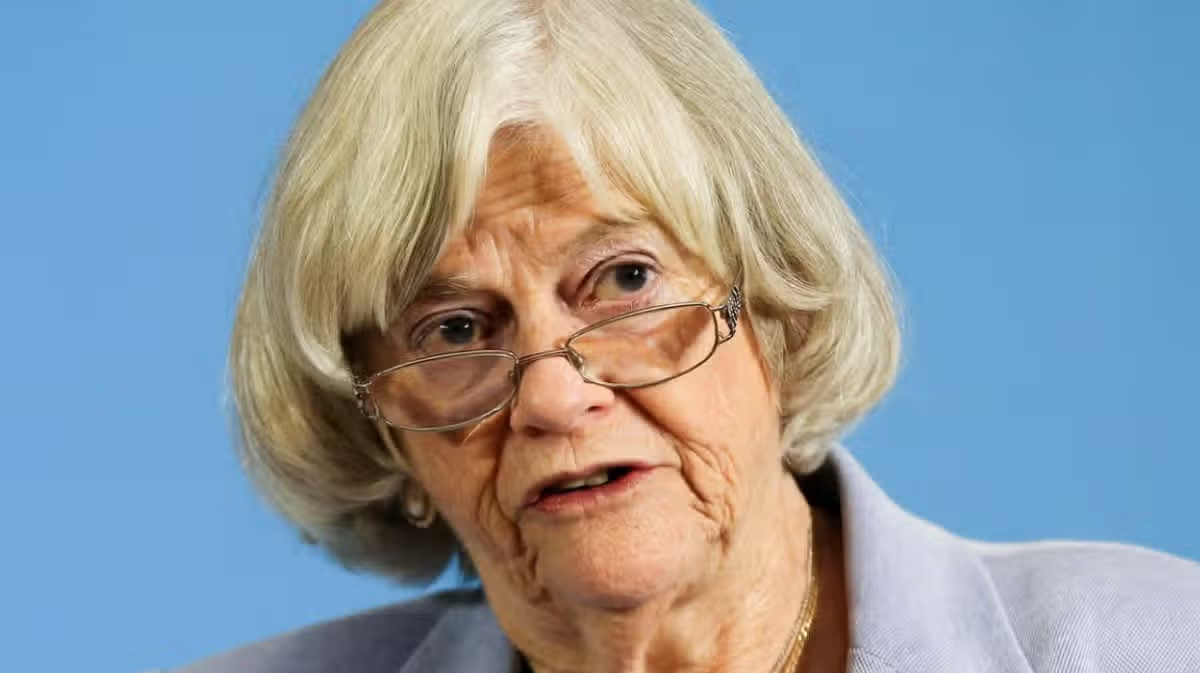
The post, allegedly made by a University of Aberdeen employee, claimed the former MP’s killing was “good news” and hoped it was an “extremely painful death”.

Police are looking into reports of a social media post that apparently celebrated the death of Ann Widdecombe. The post, allegedly made by a University of Aberdeen employee, claimed the former MP’s killing was “good news” and hoped it was an “extremely painful death”.

Former MEP Miss Widdecombe, 78, was found dead at her home in Haytor on Dartmoor, Devon, last Thursday. It has since emerged terror cops believe she was killed in a “targeted attack”.

On Tuesday, a Police Scotland spokesperson said the force was looking into the incident. They added: “We received reports on Saturday, July 11 relating to a post made online. Following further assessment, additional enquiries are being carried out.”

Advertisement

It comes as Heather Herbert, a former Scottish Green election candidate who works at the university as a web developer, reportedly wrote on Bluesky that the Reform UK member’s death was “some good news for once” before adding: “And I hope she was handcuffed to the bed as she screamed in agony.”

University rector Iona Fyfe condemned the posts saying complaints would be dealt with through the appropriate procedures. In a statement on X, she wrote: “I have been made aware of criticism regarding comments made by a member of the university staff.

“I have received a significant volume of emails regarding this to my Rector email. Please note, as Rector, it is not my responsibility to oversee complaints regarding the behaviour of staff.

Advertisement

“This will go through correct and proper complaints procedure. The university is aware of the comments being referred to online and are looking into the matter.

“There is no further comment right now, only that in my personal capacity, I’d like to condemn any comments which glorifies violence of any sort, against anyone.”

A spokesperson for the university previously said: “The comments that have been shared are entirely the individual’s own and do not represent the views of the University of Aberdeen. We do not condone violence or hateful behaviour in any form.

“We are cooperating with Police Scotland as they carry out their enquiries and cannot comment further.”

Advertisement

Get more Daily Record exclusives by signing up for free to Google’s preferred sources. Click HERE.

Source link

Continue Reading

NewsBeat

BBC pundit slams ‘dreadful’ France star after World Cup semi-final defeat | Football

Published

on

BBC pundit slams 'dreadful' France star after World Cup semi-final defeat | Football

Close Overlay

In The Mixer’s World Cup special

Everything you need to know about the World Cup – England updates, the games to watch and stories you missed – in five minutes, at 1pm, every day.

Source link

Advertisement
Continue Reading

NewsBeat

I was shocked to see Ashley Cole cosying up to John Terry at the World Cup. The rumours about their toxic bromance have not gone away: KATIE HIND

Published

on

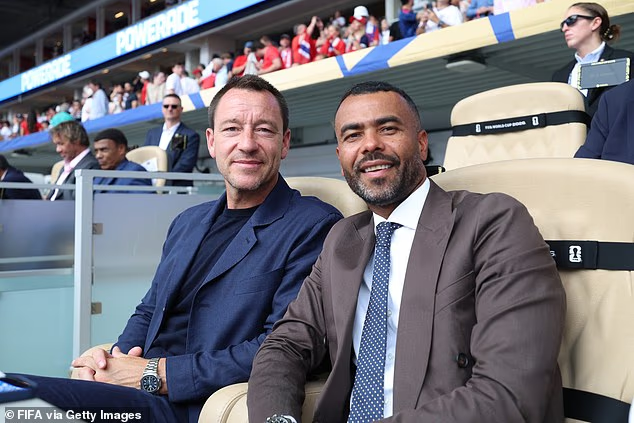
John Terry and Ashley Cole were sat together in the stands in Miami for England's quarter-final with Norway

When John Terry and Ashley Cole played for Premier League giants Chelsea, there was a long-running joke among staff about which of the pair was the most prolific womaniser.

Terry, the club captain, was a mainstay of the now very much defunct ‘kiss and tell’ pages of the tabloid press, including one confession in 2013 by a glamour model that they’d enjoyed a ‘tryst’ in a nightclub toilet even though she had broken her leg.

Cole, meanwhile, was caught cheating on his beautiful pop star wife Cheryl Cole with hairdresser Aimee Walton, who he had met in a London nightclub back in 2008. But more on their romantic misdemeanours later.

The pair became close after Cole joined Chelsea from Arsenal in 2006 – a move that prompted his nickname ‘Cashley’, courtesy of his high-wage demands (the star reportedly wanted £60,000 a week) – and lived just a stone’s throw away from one another in the footballer enclave of Cobham, Surrey.

Advertisement

Cheryl and Terry’s super-tolerant wife, Toni, also became such close friends that after the Aimee scandal Cheryl reportedly only trusted Cole to behave without her if Toni was there.

‘Ashley and John were both party boys,’ says my source. ‘They had a bromance but at times it could get very toxic. They had a lot in common. They had these two beautiful women who loved them, life was brilliant for them. They were rich, talented and very, very famous.’

Fast forward to this week and Ashley and John, both 45, reunited in Miami as they sat side by side and watched England’s 2-1 victory over Norway in the World Cup.

Advertisement

John Terry and Ashley Cole were sat together in the stands in Miami for England’s quarter-final with Norway

Cole and Terry playing for Chelsea in 2011... there was a long-running joke among staff at Stamford Bridge about which of the two was the most prolific womaniser

Cole and Terry playing for Chelsea in 2011… there was a long-running joke among staff at Stamford Bridge about which of the two was the most prolific womaniser

Terry lost a battle with the now-defunct News of the World newspaper over their scoop that he had had an affair with his Chelsea teammate Wayne Bridge’s wife Vanessa Perroncel

Terry lost a battle with the now-defunct News of the World newspaper over their scoop that he had had an affair with his Chelsea teammate Wayne Bridge’s wife Vanessa Perroncel

The men looked deep in conversation as the television cameras flashed up a shot of them on the stadium big screen. John, a failed football manager who has now turned his hand to punditry work on Piers Morgan’s World Cup 2026: Uncensored show, has barely aged since his heyday. Cole has recently ‘stepped down’ from managing the Italian Serie B side Cesena after just eight games and looked a little weathered.

Advertisement

But regardless, I was shocked to see them sitting together and looking so friendly – especially after the speculation I heard about them 16 years ago in the early months of 2010. A time which both men, I’m sure, would rather forget.

For in the January of that year, Terry, known as ‘JT’ among his teammates, had lost a battle to injunct the now defunct News of the World newspaper over their scoop that he had had an affair with his Chelsea teammate Wayne Bridge’s wife, Vanessa Perroncel.

It dominated column inches for weeks as Britain despised JT and sympathised with both his wife and Wayne – a longstanding close pal of his. The scandal led to Terry being sacked as England captain as his reputation fell into the gutter.

At the time there was perhaps only one thing that was ever going to shift the dial and the attention of the press: another footballer being caught out for cheating on his high-profile wife. So, step forward Cole, who in March 2010 was left reeling when it was his name plastered across the red-top papers.

Advertisement

The footballer’s life began to unravel when, that month, it was claimed he sent naked pictures of himself to model Sonia Wild, then 28 – something he profusely denied.

Then Vicki Gough, a 30-year-old secretary working for Chelsea’s rivals Liverpool, claimed she had sex with the former England defender on two occasions before big matches. Next up was American Ann Corbitt, who alleged that Ashley slept with her in his hotel room in Seattle while on a tour with Chelsea the previous summer.

So where was this flurry of stories coming from? Sources within the football community at the time told me to note the timing, suggesting that there were some friends within Terry’s circles that seized the opportunity to ‘drop Ashley in it’.

‘It’s certainly the theory we are working with,’ an associate of Team Cole told me at the time. ‘John and a lot of his friends knew much of what Ashley had been getting up to and then there you go, the focus turns from JT to Ashley.’

Advertisement
Terry with his super-tolerant wife Toni... Cheryl became such close friends with Toni that she reportedly only trusted Cole to behave without her if Toni was there

Terry with his super-tolerant wife Toni… Cheryl became such close friends with Toni that she reportedly only trusted Cole to behave without her if Toni was there

Ashley and Cheryl Cole in 2006... they divorced four years after getting married

Ashley and Cheryl Cole in 2006… they divorced four years after getting married

Cole arrives at Westminster Magistrates' Court in 2012, where he was a key witness in Terry's trial for a racially aggravated public order offence

Cole arrives at Westminster Magistrates’ Court in 2012, where he was a key witness in Terry’s trial for a racially aggravated public order offence

Indeed, even today, those familiar with the scandal suspect that it was those in JT’s camp who may have tipped off the press about Cole’s affairs.

Advertisement

‘John had hired a very well-connected and very aggressive PR team at the time,’ says my insider. ‘John was fuming that he couldn’t stop the barrage of stories but literally within weeks the world had forgotten about him and Vanessa and moved on to Ashley.

‘There’s obviously no suggestion that John did anything to cause Ashley upset but there were some of his associates who wanted to save him from the pile-on he was getting.

‘The next thing you know, Ashley was at the centre of it all and, given his wife Cheryl was a superstar, a national treasure, it was always going to be a big story that he had cheated on her. The timing was all very convenient.

‘It was enough to knock Terry off the news agenda. It was literally one after the other, like buses. Ashley was getting it from all quarters. It was a masterstroke by someone. John then had to watch Ashley go through what he had been through, you wonder how he felt about that.’

Advertisement

The accusations left Cheryl heartbroken and later that year she decided to end their four-year marriage. It was a move that devastated the Girls Aloud singer. ‘Ashley was the love of Cheryl’s life,’ a friend told me at the time. ‘She’s heartbroken, bereft, but she knows it has to end.’

While Cheryl ditched Cole, he and John remained friendly. And in July 2012, when Terry stood trial for a racially aggravated public order offence against Queens Park Rangers defender Anton Ferdinand, Cole attended Westminster Magistrates’ Court as a key witness for his teammate.

He told the court that he did not hear the alleged racial remark on the pitch at QPR’s Loftus Road stadium and stated that the incident was a minor dispute that ‘shouldn’t have come to court’. John was cleared but later suspended and fined by the FA.

But back to the Miami stadium on Saturday night where the former footballers were seen cheering their country on.

Advertisement

There would also have been plenty for the pair – both now dads – to reminisce about.

‘Well, they would have had an awful lot to talk about, wouldn’t they?’ says an associate of the two men from back in their heyday.

‘And we probably don’t know the half of it!’

Source link

Advertisement
Continue Reading

NewsBeat

Co Antrim Orange Hall vandalised for ‘fifth time in a year’

Published

on

Belfast Live

Police are investigating the incident as a sectarian hate crime

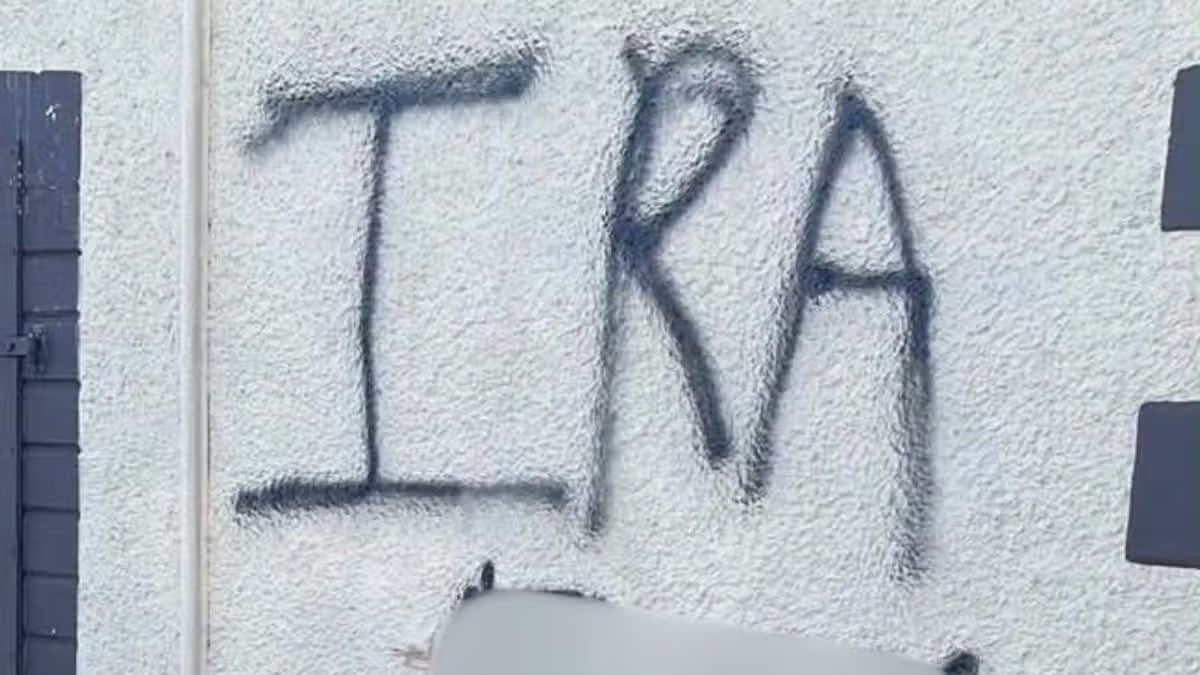
An Orange Hall in Co Antrim has been vandalised for the “fifth time in a year.” Graffiti was sprayed on the walls of the Rasharkin Orange Hall building, with messages including ‘up the ra’ and ‘IRA.’

Police said they are treating the incident as a sectarian hate crime. The incident took place in the early hours of Tuesday morning, July 14, at the site on Main Street.

In a statement, PSNI Inspector Armour said: “At 8am, we received a report that graffiti had been sprayed on a building in the Main Street area of the town at approximately 1.20am. This is being treated as a sectarian hate crime and enquiries are ongoing.”

Advertisement

The incident has been widely condemned, with Rasharkin Abod (Apprentice Boys of Derry) posting on social media that it was the fifth attack in a single year.

They said: “We can’t help but wonder if this was a Mosque or GAA hall what the response would be, 5 attacks in a year, simply not good enough from a society that has moved on!”

North Antrim MP Jim Allister said: “Last night’s attack on Rasharkin Orange Hall was but the latest in a long series on the building. But the truth is that Rasharkin Orange Hall is more than a building. It is symbol of the minority Protestant community in the village.

“The attack is made all the more chilling by the nature of the slogans crudely spray painted on the hall. Repeatedly they reference the IRA which waged a 30 year campaign of terror against Protestants and in so doing filled many grave.

Advertisement

“Just yesterday the self styled First Minister for all was hypocritically attacking loyalist bonfires. This is the same person who continues to defend, justify and even celebrate the wicked IRA who, as last night’s attack in Rasharkin illustrated, are still being used to intimidate Protestants.

“Her language of “no alternative” to IRA terror is the sort of rhetoric which formed the backdrop to last night’s attack. Sinn Fein need to not only condemn this cowardly attack carried out in the hours of darkness but also the murderous IRA who are celebrated in the vandalism.”

Issuing a joint statement in condemnation of the attack, DUP councillor Mervyn Storey, councillor Darryl Wilson and councillor John McAuley said: “While the majority of the residents of Rasharkin showed respect and tolerance for the 12th celebrations yesterday sadly there remains a small unrepresentative group who just want to display their sectarian intolerance of anything from a different tradition, even a building of bricks and mortar.

Advertisement

“Sadly this is the second time in weeks that the hall has been attacked and one of many over the years. Those who talk much about intolerance and demand respect for their culture and tradition seem incapable of displaying the same.

“It’s time for those in leadership in republicanism in the village to call this sectarian hatred out and condemn it for what it is, an attack on the Protestant community of the village.”

TUV Ballymoney councillor Jonathan McAuley added: “This morning we have learned of yet another sectarian attack on Rasharkin Orange Hall, carried out under the cover of darkness for no reason other than to raise tensions and, it would appear, intimidate the few remaining Protestants in the village into leaving.

“We have yet to hear any condemnation from local Sinn Féin representatives. This comes just a week after some of those same representatives were calling for the bonfire at Finvoy to be removed. That bonfire was not intended to intimidate anyone but to celebrate our loyalist culture, unlike the attack on the Orange Hall.

Advertisement

“I want to commend the young lads from Finvoy for the tremendous effort they put into this year’s bonfire. Their hard work and commitment deserve recognition.

“I have spoken with the PSNI this morning regarding the attack on Rasharkin Orange Hall, and I await to see what action, if any, will be taken. Those responsible should be identified and held accountable.”

Local councillor Alan Barr described the attack as “pathetic.”

The UUP representative for Braid and Mid and East Antrim said: “After a successful Twelfth, retrograde elements want to drag us into a dark past by glorifying PIRA terrorists by spraying their hate on Rasharkin Orange Hall.

Advertisement

“Let’s remember that not too far from Rasharkin, PIRA murdered a defenceless off duty member of the Royal Irish Regiment. It’s pathetic that they want to glorify such murderers.”

Rasharkin Orange Hall has been the target of attacks in previous years. Last year, on July 12, police investigated a sectarian hate crime at the site, when it was reported that paint had been thrown over the front of the building and graffiti daubed on the walls.

In 2024, pro-IRA graffiti at the hall was condemned as “sinister”, with the display appearing just before Orange Victims’ Day, when commemorations take place across Northern Ireland in memory of the members of the Orange Order killed during The Troubles.

For all the latest news, visit the Belfast Live homepage here and sign up to our daily newsletter here.

Advertisement

Source link

Continue Reading

NewsBeat

Cancer-stricken grandmother is ‘sent home with paracetamol’ after tumour doubled in size ‘while waiting three months for NHS treatment’

Published

on

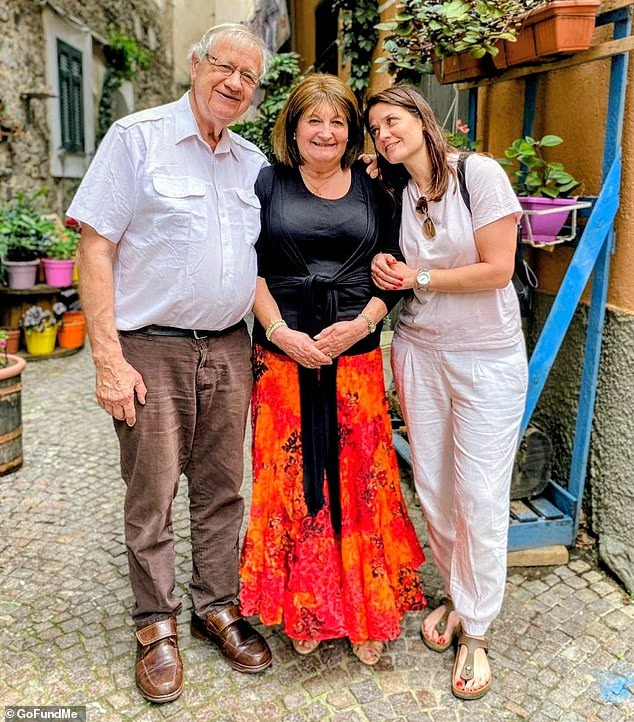
It is said to have taken three months for the NHS to start Marie's treatment after diagnosis, by which point her tumour had doubled in size (seen centre with her husband and daughter)

A distraught daughter has accused the NHS of ‘failing’ her cancer-stricken mother after they ‘sent her home with paracetamol’.

Marie Stibbe, 79, who has retired in Tiverton, Devon, was diagnosed with liver cancer at the start of March after she experienced ‘legs so itchy she couldn’t sleep and was finding life very hard’.  

A blood test revealed she had suddenly developed diabetes – another symptom of late-stage liver cancer – and wrongly suggested she had ovarian cancer.

But it was a month later that the liver disease was confirmed with a CT scan and a further three months passed before Marie started treatment, by which point her tumour had doubled in size, her daughter has claimed. 

Advertisement

Rachael Stibbe, 44, from Kent, told the Daily Mail she was forced to seek a consultation from a private liver doctor after the NHS refused to continue her mother’s treatment, claiming her liver function had declined too significantly.

She said: ‘The doctors at Exeter Hospital were really quite bad with her. One said “I could refer you for chemotherapy, but it’ll only give you a few extra weeks. I advise you to go home and enjoy the life you have left.”

‘They literally sent her home to die. The doctor said “I give you six to 12 months” and sent her off with a packet of paracetamol. He was so insensitive, there was no patient care whatsoever.’

Rachael added: ‘She’s really depressed, she thinks her life is over.’ 

Advertisement

It is said to have taken three months for the NHS to start Marie’s treatment after diagnosis, by which point her tumour had doubled in size (seen centre with her husband and daughter)

The 79-year-old grandmother was diagnosed with liver cancer at the start of March

The 79-year-old grandmother was diagnosed with liver cancer at the start of March

Now, the family have launched a GoFundMe to help raise money for specialist treatment in India

Advertisement

After having ‘lost faith’ in the NHS, Rachael sought the opinion of a liver surgeon at King’s College Hospital, who wrote a report urging that Marie needed an MRI and PET scan, immediate combination treatment including immunotherapy and said if started right away she would have many years left. 

But after at least six weeks of chasing the oncology team at Royal Devon and Exeter Hospital, they allegedly refused to consider the report and said it would make no difference to Marie’s treatment.

When Marie was diagnosed she had a ‘compensated liver’, meaning that while the tissue is scarred it can still function relatively normally. 

However, Exeter Hospital allegedly refused to carry out an MRI scan following her diagnosis, so Rachael paid for one privately in May, which showed the tumour had grown from seven centimetres to 14.9.

Advertisement

Her liver had reached a ‘decompensated’ stage which can drastically drop life expectancy. Marie’s gall bladder had also collapsed and her spleen was enlarged. 

Rachael claimed Exeter Hospital failed to review the MRI report. 

It took three months for Marie to receive her first round of immunotherapy from Exeter Hospital – well over the NHS’s 62-day cancer pathway rule.

This is a national standard designed to ensure that patients do not face dangerous delays when they have a life-threatening illness.

Advertisement

Exeter Hospital have not met this standard for ten years since 2016 as ‘patients continued to wait too long for their treatment for cancer and remained at risk of deteriorating health because of the delay,’ according to a report by the Care Quality Commission.   

Rachael Stibbe, 44, from Kent, said she was forced to seek a consultation from a private liver doctor at King's College Hospital after the NHS refused to continue her mother's treatment

Rachael Stibbe, 44, from Kent, said she was forced to seek a consultation from a private liver doctor at King’s College Hospital after the NHS refused to continue her mother’s treatment

The mother of three pictured with her grandson, two, fears she will not get to see him grow up

The mother of three pictured with her grandson, two, fears she will not get to see him grow up

After six weeks of chasing the oncologists at Royal Devon and Exeter Hospital, they allegedly refused to consider the MRI report (Rachael and Marie pictured together with their dogs)

After six weeks of chasing the oncologists at Royal Devon and Exeter Hospital, they allegedly refused to consider the MRI report (Rachael and Marie pictured together with their dogs)

Advertisement

Rachael said: ‘The doctor was very arrogant and wasn’t interested in investigating why her liver function had dropped and if it could potentially be remedied.

‘The Exeter NHS oncologist refused to answer our questions and just told her there’s nothing further they can do.

‘Exeter Hospital has caused unacceptable delays and refused to give my family basic information. They were too slow with everything; I consider them to be negligent.’ 

Rachael added: ‘She’s not going to get to see her grandson grow up.’ 

Advertisement

She continued that her mother had cirrhosis, which is permanent scarring of the liver, but the oncology team allegedly did not work at all with the liver team, which is typically standard practice.   

Rachael said: ‘The reality is that this absolutely should have been in place throughout and I personally do not think her liver would have become so bad over the last few weeks to justify stopping treatment.

‘It might well be the case the drop in liver function is temporary but they are not interested in investigating further and of course that would have been a job for the liver team who washed their hands of the case in March.’

Marie was also suffering from extremely swollen legs, where fluid buildup was leaking into the tissue, but Exeter Hospital allegedly didn’t help manage the painful symptoms and refused to drain the excess fluid after water pills didn’t work.

Advertisement

‘She was really suffering every day and they weren’t interested. They wouldn’t help relieve her pain or take responsibility for her symptoms. They said it was a GP problem, it was terrible,’ said the distraught daughter. 

Rachael and her family have now launched a GoFundMe for private treatment abroad in India

Rachael and her family have now launched a GoFundMe for private treatment abroad in India

Marie also needed urgent treatment from a jaw and face specialist after losing a front tooth which made it difficult for her to eat.

But Rachael claims the Exeter Hospital oncologist denied receiving relevant letters, refused to contact the maxillofacial team, and her referral was downgraded from urgent to standard. 

Advertisement

‘She won’t be alive by the time they offer her a dental/maxillofacial appointment because there is such a backlog. 

‘It’s disgusting behaviour and demonstrates she’s been failed by the liver department, oncology department and maxillofacial,’ said Marie’s daughter.

The 44-year-old also complained to the NHS’s Patient Advice and Liaison Service, but says she never had any of her concerns answered.

She said: ‘I emailed PALS and I got an automated email reply saying I’ll get a response in 50 days. They’re not monitoring their emails.

Advertisement

‘The bottom line is I asked so many questions and to this day I have not got a response.’ 

Rachael and her family are now looking at private treatment abroad in India, who offer specialised treatment plans and say they may be able to save her.

But this is expected to cost more than £100,000. Rachael has started a GoFundMe pleading for donations to help her ‘lovely’ mother who is the ‘backbone’ of their family.

She wrote on the donation page: ‘Please help us save my lovely mother. She did not deserve such poor treatment from the NHS and she is the backbone of our family. 

Advertisement

‘Our family will break without her and my father will not cope. In fact, we fear he will either then end his life or die of a broken heart. After 56 years of marriage.’

She added: ‘My mother waited 40 years for a grandchild and she finally has Liam, a beautiful boy who is two years old and loves his grandma. 

‘It is heartbreaking that she paid her taxes and took such an altruistic view with child benefit and this is how the NHS repays her. Liam is now facing growing up without his grandmother but he doesn’t understand – he is only two years old.’

Royal Devon and Exeter Hospital said: ‘The concerns raised by Ms Stibbe are currently being investigated through our complaints process, and we have kept her informed of the status of those investigations. 

Advertisement

‘We will respond to her concerns directly when our investigations are completed.’

Source link

Continue Reading

NewsBeat

Dovestone wildfire enters fourth day as crews issue update

Published

on

Dovestone wildfire enters fourth day as crews issue update

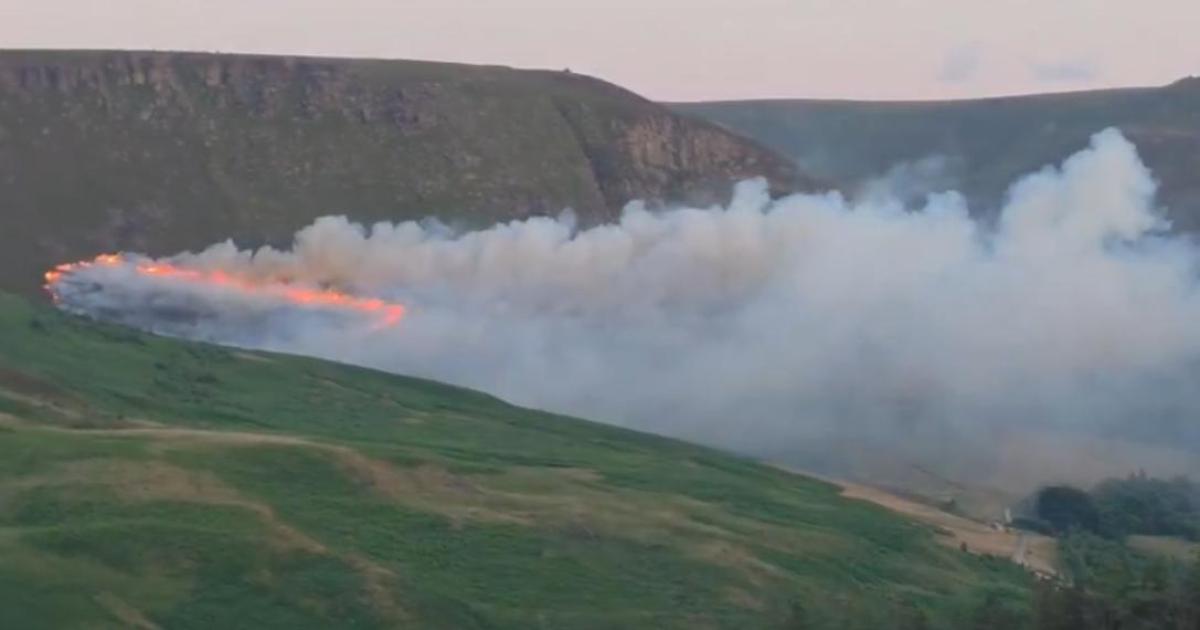
Greater Manchester Fire and Rescue Service (GMFRS) said crews are continuing to tackle the blaze near Dovestone Reservoir in Greenfield, with 15 fire engines and four specialist wildfire units deployed in challenging conditions.

The latest update, issued at 7pm this evening (July 14), comes as smoke from the fire continues to affect parts of Greater Manchester.

Fire chiefs said a separate wildfire at nearby Tintwistle Moor is also contributing to a large plume of smoke across the region.

A GMFRS spokesperson said: “For the fourth consecutive day, crews from Greater Manchester Fire and Rescue Service are tackling the moorland fire near Dovestone Reservoir.

Advertisement

“More than 70 firefighters, 15 fire engines and four specialist wildfire units from across Greater Manchester are at the scene.

“Our crews are working hard in challenging conditions to contain the fire.”

Residents in affected areas are being urged to stay indoors and keep windows and doors closed if there is visible smoke.

One of the fires on Marsden MoorVisible smoke has been seen across large parts of Greater Manchester (Image: Grahams Fire Page)

The spokesperson added: “People in the surrounding area may continue to experience smoke from the wildfire, with a separate wildfire at nearby Tintwistle Moor contributing to a large plume of smoke that has affected parts of Greater Manchester today.

Advertisement

“If there is visible smoke, stay indoors and keep windows and doors closed where necessary.”

Road closures remain in place around Dovestone Reservoir, and members of the public are being urged not to travel to the area while emergency services and partner agencies continue their work.

The fire first broke out shortly before 8.40pm on Saturday evening.

Since then, firefighters have been working around the clock to contain the blaze and prevent it from spreading across the moorland.

Advertisement

A major incident was declared on Sunday as the response intensified.

Specialist wildfire units, drone technology, burns teams, command support vehicles and partner agencies have all been involved in tackling the fire in difficult terrain.

Meanwhile, Greater Manchester Police have charged a woman in connection with the wildfire.

Shania Care-Slede, 20, of Market Street, Hyde, has been charged with aggravated arson, being reckless as to whether life was endangered, and dangerous driving.

Advertisement

She was due to appear at Manchester Magistrates’ Court on today (July 14).

Police said their investigation remains ongoing and officers are continuing to pursue a number of lines of enquiry to identify any other individuals who may have been involved.

Earlier today, GMFRS said the wildfire remained active but was in a steady state, with crews continuing to extinguish hotspots and monitor conditions as weather and wind direction change.

(Image: Newsquest)

The fire service also thanked local communities for their support but said firefighters have all the equipment and supplies they need.

Advertisement

A spokesperson said: “We are incredibly grateful for the kindness and support local communities have shown to firefighters and partners responding to the fire.

“However, crews have all the equipment, supplies and welfare arrangements they need to carry out their work safely.

“While we are not seeking donations, we’re thankful for the positive messages and support being shown by local people, and would encourage anyone wishing to make a donation to consider supporting a local food bank instead.”

Advertisement

Source link

Continue Reading

NewsBeat

Handing over Falkland Islands to Argentina could be Labour’s next foreign policy ‘betrayal’, Tory and Reform MPs warn, as Gibraltar effectively becomes part of EU

Published

on

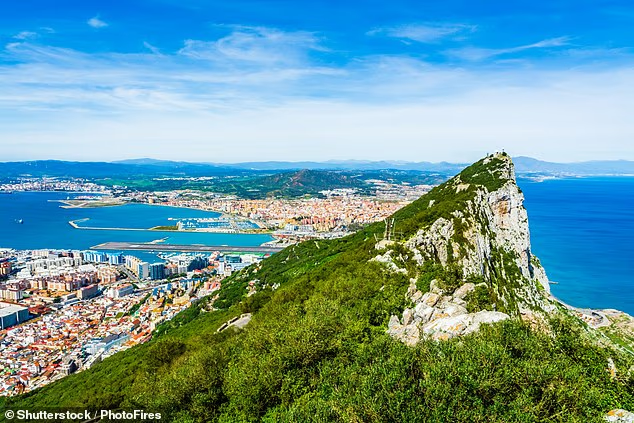
London and Madrid have disputed control of Gibraltar since the tiny territory was ceded to Britain in the 1713 Treaty of Utrecht

Handing over the Falkland Islands to Argentina could be Labour’s next foreign policy ‘betrayal’, opposition MPs warned today, as Gibraltar effectively became part of the European Union more than three centuries after being declared British.

Ministers signed a post-Brexit deal at a ‘surrender’ ceremony in Brussels today which will see the border between the Rock and mainland Spain disappear.

It effectively means the peninsula – strategically important militarily because it sits at one of the world’s busiest maritime choke points – has joined the bloc’s free-movement Schengen zone.

And visiting Britons will have to show their passports to Spaniards and face being refused entry despite it being UK territory.

Advertisement

Foreign Office minister Stephen Doughty smiled for the cameras as he signed the deal today alongside Maroš Šefcovic, the bloc’s Brexit point man, and Spanish foreign minister José Manuel Albares Bueno.

But Reform MP Robert Jenrick said: ‘This Government has proven itself completely incapable of defending our national interest.

‘They fold easier than a deckchair. Why are Brits being made to show their passport to Spaniards to enter British territory?

‘Reform UK and Nigel Farage will finally put our country first.’

Advertisement

London and Madrid have disputed control of Gibraltar since the tiny territory was ceded to Britain in the 1713 Treaty of Utrecht 

With an economy based on financial services and online gaming, Gibraltar - which covers just under seven square kilometres (2.7 square miles) - has one of the highest per capita incomes in the world

With an economy based on financial services and online gaming, Gibraltar – which covers just under seven square kilometres (2.7 square miles) – has one of the highest per capita incomes in the world 

Foreign Office minister Stephen Doughty, left, smiled for the cameras as he signed the deal today alongside Maro¿ ¿efcovic

Foreign Office minister Stephen Doughty, left, smiled for the cameras as he signed the deal today alongside Maroš Šefcovic

Advertisement

Reform MP Andrew Rosindell added: ‘Having betrayed Britain’s sovereignty over the Chagos Islands, this Government has now turned its back on Gibraltar.

‘Requiring Britons to face Spanish involvement when entering British territory is an unacceptable concession.

‘Gibraltar has been British since the 1713 Treaty of Utrecht and must remain so. If ministers are prepared to compromise Gibraltar today, which British Overseas Territory will they put at risk tomorrow?’

The Tories’ Shadow Armed Forces Minister, Mark Francois, said: ‘It’s a fitting end to Starmer’s Government that it concludes with even further weakening of our sovereign borders.

Advertisement

‘Once Labour showed weakness over Chagos, other nations smelt opportunity – and we are now under pressure over the sovereign base areas in Cyprus and Argentina, which is reviving its false claim to the Falklands.’

Former Tory Brexit minister David Jones, who has defected to Reform, said: ‘It’s an outrageous, pathetic surrender by the British Government.

‘Both this government and the previous Conservative administration have been weak and spineless.

‘It is another unforced surrender and the British people will not forget it at the next general election.’

Advertisement

Former Tory Defence Secretary Sir Gavin Williamson added: ‘The government seems intent on giving everything away. First Chagos, next Gibraltar.

‘They seem to have little care for Britain’s strategic interests or the people that live there.’

The new treaty will come into force overnight and removes 118-year-old border infrastructure from the frontier with Spain and makes Gibraltar part of the EU’s free-movement zone.

It removes border infrastructure from the frontier with Spain and makes the British overseas territory effectively but not formally part of the EU Schengen zone.

Advertisement

Border checks will be introduced at Gibraltar’s airport, with Spanish guards having the final say on who can enter the Rock and by extension Schengen.

Reform MP Robert Jenrick said the Labour Govrnment had 'proven itself completely incapable of defending our national interest'

Reform MP Robert Jenrick said the Labour Govrnment had ‘proven itself completely incapable of defending our national interest’

The Tories¿ Shadow Armed Forces Minister, Mark Francois, said the deal was a 'further weakening of our sovereign borders¿

The Tories’ Shadow Armed Forces Minister, Mark Francois, said the deal was a ‘further weakening of our sovereign borders’

The fact that Britons will have to show their passports to Spaniards to enter British territory that Madrid has long claimed ownership of and deems a colony is one of the most controversial parts of the deal.

Advertisement

Before Brexit, Britain wasn’t part of the Schengen zone, meaning border checks on Spain-Gibraltar crossings have always been required.

But since Brexit, Madrid has aggressively been pushing for the border to be moved back to ports in Gibraltar and for the border to be abolished.

Fabian Picardo, Gibraltar’s chief minister, has backed the treaty and attended today’s signing ceremony.

Spanish Prime Minister Pedro Sanchez hailed the new arrangements as bringing down ‘the last wall’ inside the EU, with the peninsula reliant on about 15,500 daily cross-border workers from Spain. The removal of the border will now make it easier for local workers on either side to cross.

Advertisement

With an economy based on financial services and online gaming, Gibraltar – which covers just under seven square kilometres (2.7 square miles) – has one of the highest per capita incomes in the world.

London and Madrid have disputed control of Gibraltar since the tiny territory was ceded to Britain in the 1713 Treaty of Utrecht.

It comes after Sir Keir Starmer drew up a deal to hand control of the Chagos Islands to Mauritius.

It would have seen Britain transfer sovereignty of the islands and lease back the joint US-UK Diego Garcia air base for 99 years to the tune of around £35 billion.

Advertisement

It has been criticised by US President Donald Trump but there are fears PM-in-waiting, Andy Burnham, will try and revive the deal.

Argentina has also started flexing its muscles ahead of tomorrow’s semi-final World Cup clash with England, claiming the Falkland Islands belong to it and that it will spur them on in the match.

While Sir Keir hit back this week at comments by Argentinian foreign minister Pablo Quirno that the Falklands Islanders were an ‘artificially implanted’ population, there are fears Mr Burnham will take a softer approach to the future of the archipelago.

Source link

Advertisement
Continue Reading

NewsBeat

Red bike stolen in St Andrewgate in York city centre

Published

on

Red bike stolen in St Andrewgate in York city centre

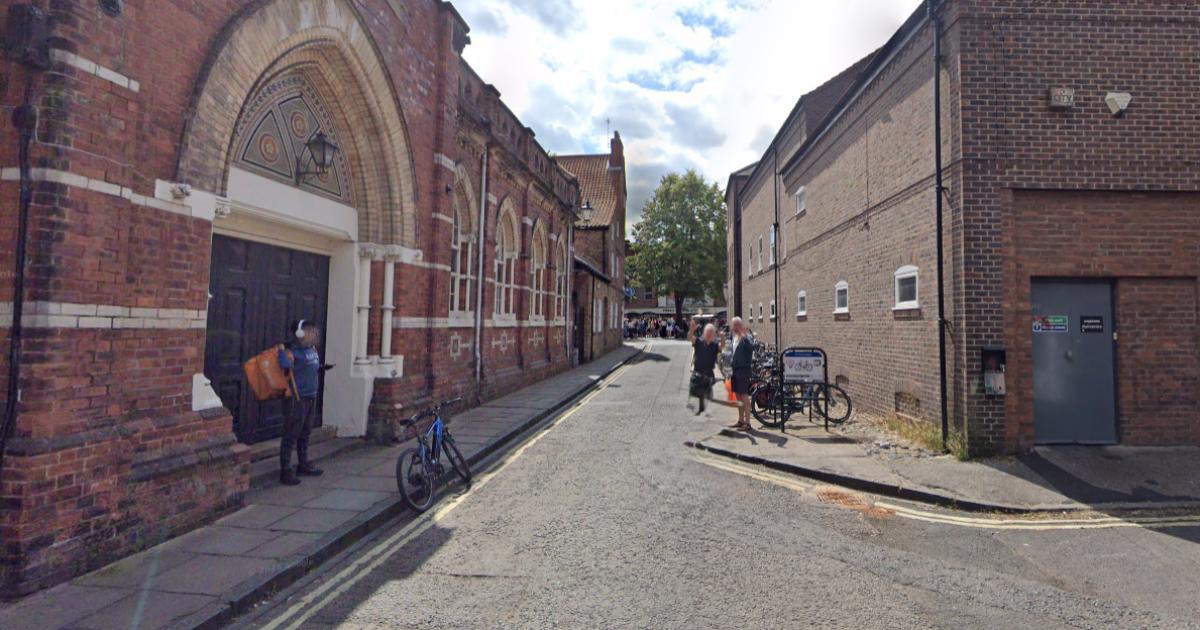
North Yorkshire Police are investigating after a ‘distinctive vivid-red coloured pedal bike’ was stolen from St Andrewgate in York city centre last week.

They said the theft happened just before 11am last Wednesday (July 8) and the suspect was later seen cycling away towards the Granary Court, Spen Lane, and Bartle Garth area.


RECOMMENDED READING:

Advertisement

He was described as wearing a sky blue t-shirt with a large print on the back, a dark baseball cap, tracksuit bottoms, and a rucksack.

A spokesperson for the force said: “The thief takes measures to hide his face from the local cameras, and afterwards, he cycles away.”

Anyone with information is asked to email mark.burrows@northyorkshire.police.uk, call 101, or contact Crimestoppers anonymously on 0800 555 111.

The reference number is 12260129249.

Advertisement

Source link

Continue Reading

NewsBeat

Heat deaths are a public health crisis rooted in housing inequality

Published

on

Heat deaths are a public health crisis rooted in housing inequality

The heatwaves of late May and June killed an estimated 2,700 people in England and Wales, according to a recent analysis – around 550 in May, when west London hit 35.1°C, and 2,200 in June, as East Anglia reached 37°C.

Both events broke records that had stood since 1944 and 1976, and researchers estimate that 42% of the deaths were attributable to the extra heat resulting from human-induced climate change. They add to a mounting toll: more than 10,000 people died during UK heatwaves between 2020 and 2024, according to the UK Health Security Agency (UKHSA).

Public health experts call extreme heat a “silent killer” that can claim anyone, even the young and fit. That is true and worth repeating. But it obscures the pattern of what is happening: heat deaths are not scattered randomly across the population. They fall predictably and measurably on particular people in particular homes.

Around 60% of the estimated deaths in May and June were among people aged over 85. But age is only part of the story, because vulnerability to heat is socially patterned. A Government Actuary’s Department analysis, published days before the June heatwave, shows that England’s most deprived communities are concentrated in dense urban areas with the least green space – places subject to the “urban heat island” effect. This is where concrete and tarmac absorb heat by day and release it at night, depriving residents the relief of overnight cooling that allows people to recover.

Advertisement

Every English neighbourhood that ranks among both the 10% most deprived and the 10% most exposed to extreme heat is in London. During the 40°C heatwave of 2022, the urban heat island effect was itself responsible for a substantial share of London’s heat-related deaths.

The common thread is housing. An analysis by the Resolution Foundation thinktank found that 54% of the poorest fifth of English households live in homes at high risk of overheating, against 18% of the richest fifth. Two-thirds of social renters, and six out of ten households with young children, live in homes at the highest risk as the country warms.

Flats, small homes and overcrowded properties trap heat. Renters cannot fit shutters or external shading, and cooling costs money that low-income households do not have. The English Housing Survey, carried out by the UK government, found that 2.9 million households say that their homes get uncomfortably hot.

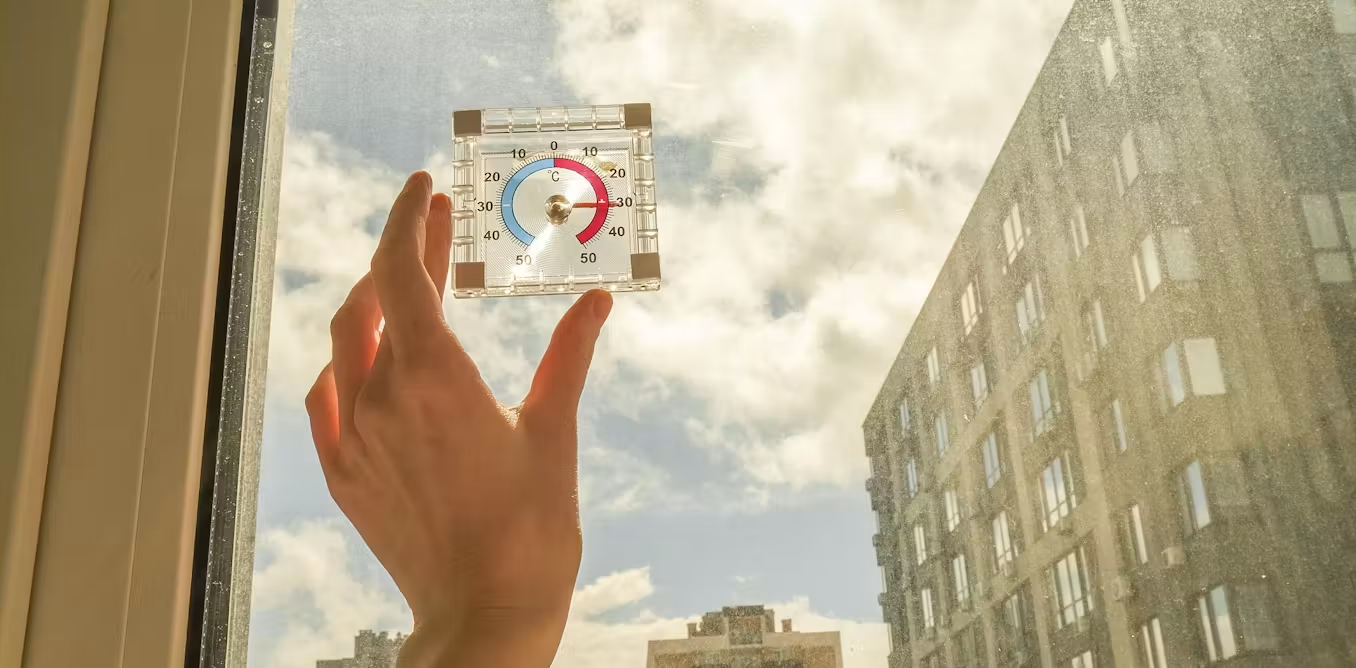
Not all homes cool at night.
Sven Hansche/Shutterstock.com

Year-round problem

The troubling part of this is that these are largely the same homes we already knew were dangerous in winter. Cold homes caused an estimated 4,950 excess winter deaths across Britain in 2022-23 – around 45 people a day through the coldest months.

Advertisement

We have treated fuel poverty as a cold-weather problem, answered with winter fuel payments and seasonal campaigns. But a badly-insulated home is thermally incompetent all year round: it leaks heat in January and traps it in July. The same outdated, inadequate housing stock kills in both seasons; only the mechanism changes. Fuel poverty is not a winter problem that pauses in spring – it is a year-round emergency.

None of this is inevitable, as last summer proved. In 2025, UKHSA recorded 1,504 heat-associated deaths in England: roughly half the 3,039 its models had predicted from temperatures alone, a pattern consistent across all five heat episodes from that year. UKHSA is careful to note that causes cannot be firmly attributed, but heat-health alerts and the system-wide response across the NHS, social care and emergency services are likely to have contributed. Adaptation, in other words, saves lives at scale.

But adaptation, too, is unequal. Private adaptation – air conditioning, well-ventilated houses, leafy suburbs – all correlate with wealth. And public health advice to “keep cool” is least effective for precisely those with the least capacity to act on it: the tenant who cannot alter her flat, the pensioner who cannot afford to run a fan. As heatwaves intensify, the gap between those who can buy their way to safety and those who cannot will widen, unless policy closes it.

Heat episodes in England are predicted to become more intense, longer and more frequent as the climate warms. The Climate Change Committee, the government’s independent climate adviser, has proposed that heat-related deaths in 2050 should be no higher than they are today. Achieving this will require treating heat as both a housing and an inequality issue. This includes retrofit programmes that prepare homes for summer as well as winter, more trees and green spaces in the most deprived neighbourhoods, and making sure the Decent Homes Standard – the government’s minimum standard for safe and suitable housing – includes protections against overheating. It also means targeted support for people who are already known to be most at risk from extreme heat.

Advertisement

What it does not mean is simply relying on more leaflets advising people to drink water and close the curtains. The deaths of May and June were tragic, but not random. Our response should not be random either. We know whose homes will be dangerous next summer – the question is whether we act before it arrives.

Source link

Advertisement
Continue Reading

Trending

Copyright © 2025