

Crypto World
Bitcoin Falls As Trump’s Hormuz Remarks Spark A $20B Crypto Market Rout


The cryptocurrency market erased more than $20 billion after fresh geopolitical tensions pushed traders toward safer assets. Bitcoin led the decline as oil prices climbed sharply following new comments from U.S. President Donald Trump. Meanwhile, liquidations accelerated across major digital assets before key United States economic events.
Trump’s Remarks On The Strait Of Hormuz Deepen Pressure Across Risk Markets
President Donald Trump increased market uncertainty after discussing the Strait of Hormuz and ongoing tensions involving Iran. He stated that the United States would take control of protecting the strategic shipping route. Consequently, energy markets reacted quickly as geopolitical risks intensified.
Brent crude advanced above $79 per barrel after gaining nearly 5% during renewed military developments. At the same time, reports indicated continued exchanges between the United States and Iran across the region. Iran also announced the closure of the Strait of Hormuz, although U.S. Central Command rejected that claim.
Higher oil prices added fresh pressure across global financial markets and reduced demand for risk-sensitive assets. As a result, cryptocurrencies joined broader market declines during the trading session. The latest developments also extended uncertainty surrounding international trade and energy supplies.
The market weakness followed separate reports involving American Bitcoin, the mining and treasury company backed by Eric Trump. Bloomberg reported that the company’s shares had declined more than 95% from their previous peak. The decline also reduced the value of Eric Trump’s reported stake by more than $600 million.
American Bitcoin reportedly closed at a record low of $6.13 on July 10. The company had recently completed a one-for-15 reverse stock split before reaching that level. As a result, the broader crypto sector faced additional negative sentiment alongside geopolitical concerns.
Rising energy costs often increase inflation expectations and reduce demand for speculative assets. Therefore, cryptocurrencies experienced additional selling pressure as market participants adjusted their positions. The combination of geopolitical uncertainty and higher oil prices strengthened the broader risk-off environment.
Bitcoin Leads Crypto Decline As Liquidations Accelerate
Bitcoin fell more than 3% during the selloff and traded near $62,389 during the latest session. Earlier, the cryptocurrency reached an intraday low of approximately $62,120 after trading above $64,300. The decline reflected broad weakness across the digital asset market.
Ethereum also moved lower as selling pressure spread across major cryptocurrencies. XRP, BNB, Solana, Hyperliquid, Zcash, and Cardano declined between 2% and 6% during the session. Consequently, losses expanded across both large-cap and alternative digital assets.
According to CoinGlass, the crypto market lost nearly $20 billion in value during the downturn. The data provider also reported almost $40 million in liquidations across multiple digital asset positions. Furthermore, approximately 73,000 traders faced liquidations within the previous 24 hours.
Bitcoin, Ethereum, Solana, XRP, Hyperliquid, SPCX, SNDK, and MU positions recorded notable forced liquidations. Leveraged positions amplified losses as prices declined across the broader market. Therefore, liquidation activity accelerated throughout the trading session.
CoinGlass also reported the largest single liquidation on the Hyperliquid platform. The closed XYZ: SKHX position carried an estimated value of approximately $4.86 million. That transaction highlighted the impact of leverage during periods of heightened market volatility.
Attention has now shifted toward the upcoming United States economic releases scheduled for this week. Markets will receive the latest Consumer Price Index inflation report before additional policy signals emerge. Federal Reserve Chair Kevin Warsh will also deliver testimony that could influence expectations surrounding future interest rate decisions.


Disclosure: This article does not represent investment advice. The content and materials featured on this page are for educational purposes only.
Quantum computing concerns are renewing focus on Bitcoin security as institutions research long-term cryptographic protections and network resilience.
Summary
- Quantum computing concerns revive Bitcoin security debate as EX DeFi highlights cloud mining alternative.
- Bitcoin quantum risk gains attention as EX DeFi promotes cloud mining amid security discussions.
- Bloomberg report renews focus on Bitcoin’s quantum risks as EX DeFi spotlights cloud mining.
With the continued development of quantum computing technology, the future security of Bitcoin has once again become a focus of market attention.

According to Bloomberg, research by Galaxy Digital indicates that in the long term, approximately $470 billion in Bitcoin assets may face potential security risks from quantum computing, representing about one-third of the current total value of circulating Bitcoin. However, this risk remains theoretical at present, as existing quantum computers do not yet possess the practical ability to crack Bitcoin’s encryption algorithm.
Quantum security draws attention, industry prepares in advance
Bitcoin uses a public-key and private-key encryption mechanism to ensure asset security. It is widely believed in the industry that if quantum computing capabilities achieve significant breakthroughs in the future, existing encryption systems may face new technological challenges. To this end, Coinbase has established a quantum security advisory committee, and large institutions such as Strategy have begun researching related solutions to prepare for potential future network upgrades.
Although quantum computing still has a long development cycle before it truly threatens the Bitcoin network, digital asset security, infrastructure construction, and long-term sustainable development capabilities are becoming important issues of continued concern for industry investors.
Meanwhile, as market attention to digital asset security and risk management continues to grow, more and more investors are exploring more diversified ways to participate. Compared to direct Bitcoin trading, EX DeFi cloud mining provides users with an option to participate in the Bitcoin ecosystem through continuous computing power, offering a relatively reduced impact from short-term market volatility.
Cloud mining: Another way to participate in the Bitcoin ecosystem
Amidst market volatility and technological change, more and more investors are focusing on digital asset participation methods beyond direct buying and selling, hoping to explore more diversified participation paths while focusing on the long-term development of Bitcoin.
Compared to traditional mining, which requires purchasing specialized mining equipment and bearing electricity and equipment maintenance costs, the cloud mining model centralizes hardware deployment, computing power management, and operation and maintenance work, all handled by the platform. Users only need to choose the appropriate computing power plan according to their needs to participate in the Bitcoin network and receive corresponding returns according to the platform’s rules.
EX DeFi’s compliance infrastructure
As a digital asset service platform, EX DeFi has established a relatively complete compliance management system at the operational level, mainly reflected in the following aspects:
The platform is registered and operates in the UK and conducts business in accordance with relevant regulatory requirements.
The core operational architecture references relevant regulatory frameworks such as the EU’s MiFID.
The platform undergoes regular security and compliance audits by PwC.
The digital asset custody system incorporates Lloyd’s of London insurance protection mechanisms.
These measures help improve the platform’s transparency and standardization in areas such as fund management, information disclosure, and system security.
EX DeFi’s security system
In terms of security, the platform employs mechanisms such as separate storage of cold and hot wallets and multi-signature authorization to further enhance the security level of user assets.
Simultaneously, the system integrates Cloudflare enterprise-grade network protection, McAfee cloud security system, and two-factor authentication (2FA), and is equipped with real-time risk monitoring and abnormal behavior identification mechanisms, providing multi-layered security protection for platform operations.
How to join EX DeFi and participate in mining services
Step 1: Register an Account. Visit the official EX DeFi platform and complete registration. New users will receive a $17 reward upon registration.
Step 2: Complete Account Deposit
Go to the deposit page, obtain the official wallet address, and complete the transfer (minimum deposit amount is $100 USD).
Step 3: Select a Hashrate Plan
Choose a suitable mining contract based on your budget and time horizon. The system will automatically settle earnings during the contract’s execution period.
Referral rewards program
Users can also participate in the EX DeFi referral program and enjoy a 3% + 2% referral reward mechanism. By inviting friends to join the platform, you have the opportunity to earn up to $50,000 in referral commissions, further expanding your income sources and achieving long-term earnings growth.
Popular short-term mining contracts
BTC (Beginner Trial Contract): Investment of $100, Term: 2 days, Daily Yield: $4, Total Profit: $100 + $8
DOGE (Golden Shell Mini Dogecoin Pro): Investment of $500, Term: 6 days, Daily Yield: $6.5, Total Profit: $500 + $39
BTC (Canaan-Avalon-A1466): Investment of $1,000, Term: 10 days, Daily Yield: $13.4, Total Profit: $1,000 + $134
LTC (Bitmain-Antminer-L7): Investment of $5,000, Term: 20 days, Daily Yield: $73.5, Total Profit: $5,000 + $1,470
BTC (Bitmain-S19K-Pro): Investment of $10,000, Term: 30 days, Daily Yield: $161 Total Profit: $10,000 + $4,830
For more details on mining contracts, please visit the EX DeFi official website.
About EX DeFi
EX DeFi is a global platform focused on green energy cloud mining and digital asset services, headquartered in the UK and founded in 2021. The platform supports multiple mainstream digital assets such as Bitcoin (BTC), Ethereum (ETH), and Ripple (XRP), and is committed to providing global users with a more convenient and efficient way to participate in digital assets through intelligent computing power and cloud computing technology.
To improve operational efficiency and practice sustainable development, EX DeFi’s data centers are deployed in areas rich in renewable energy resources, primarily using hydropower, wind power, and solar power. The platform offers a variety of flexible intelligent computing power solutions, allowing users to participate in the digital asset ecosystem through cloud mining without purchasing mining equipment or possessing professional technical skills, enjoying a simpler and more efficient user experience.
Join the EX DeFi cloud mining platform now and start the passive income journey!
Disclosure: This content is provided by a third party. Neither crypto.news nor the author of this article endorses any product mentioned on this page. Users should conduct their own research before taking any action related to the company.

Artificial intelligence now helps write more than 95% of Coinbase’s code, offering new insight into the crypto exchange’s AI strategy following its decision to cut 14% of its workforce earlier this year.
Coinbase cut 700 staff in May. In an email to employees, Coinbase CEO Brian Armstrong said AI has “dramatically” changed the pace of work and there was a need to “return to the speed and focus of our startup founding, with AI at our core.”
“Effectively, 100% of our employees are using AI on a daily basis here,” Coinbase’s head of platform, Rob Witoff, told Cointelegraph. “And close to 100% of our code, probably somewhere between 95% and 100%, is written by or with LLMs today.”
The figure is more than double Coinbase’s February estimate, when the company said 40% of its code was written with AI, reflecting the accelerating pace of AI adoption across tech and crypto companies.

Rob Witoff talks about Coinbase’s adoption of AI. Source: Cointelegraph
Witoff, however, said there is a “wide spectrum” in how it is used and the degree to which it is relied on. While writing core cryptography mainly relies on human input, prototyping is fully automated and core systems sit somewhere in the middle, he said.
“For example, when we’re writing core cryptography, we have industry-leading cryptographers that are meticulously researching and reviewing one line at a time.”
“We’re using AI quite a bit to test and make sure the code we’ve written is working the way it should, there’s no vulnerabilities, we’re verifying the math, but that’s a much more manual part than where we’re building internal prototypes, which is now effectively a 100% automated.”
Smaller teams with “tastemakers”
The shift has allowed Coinbase to reorganize around smaller, more senior teams, Witoff said, with two or three employees now capable of handling work that previously required 10 or more people.
“There were a lot of junior development roles that were impacted,” he said of the May layoffs, though the cuts extended across the company, including marketing, legal, customer support and compliance roles.
“For those smaller teams to work, for people to have the taste, the judgment, I think a lot about people having the battle scars so they know how to point agents in the right direction.”
Witoff said that most Coinbase engineers now have five to 10 AI agents operating at any given time, with AI agents collectively performing the coding work of about 1,200 employees.
By 2030, Coinbase could see AI agents doing the equivalent work of 100,000 employees, he said.
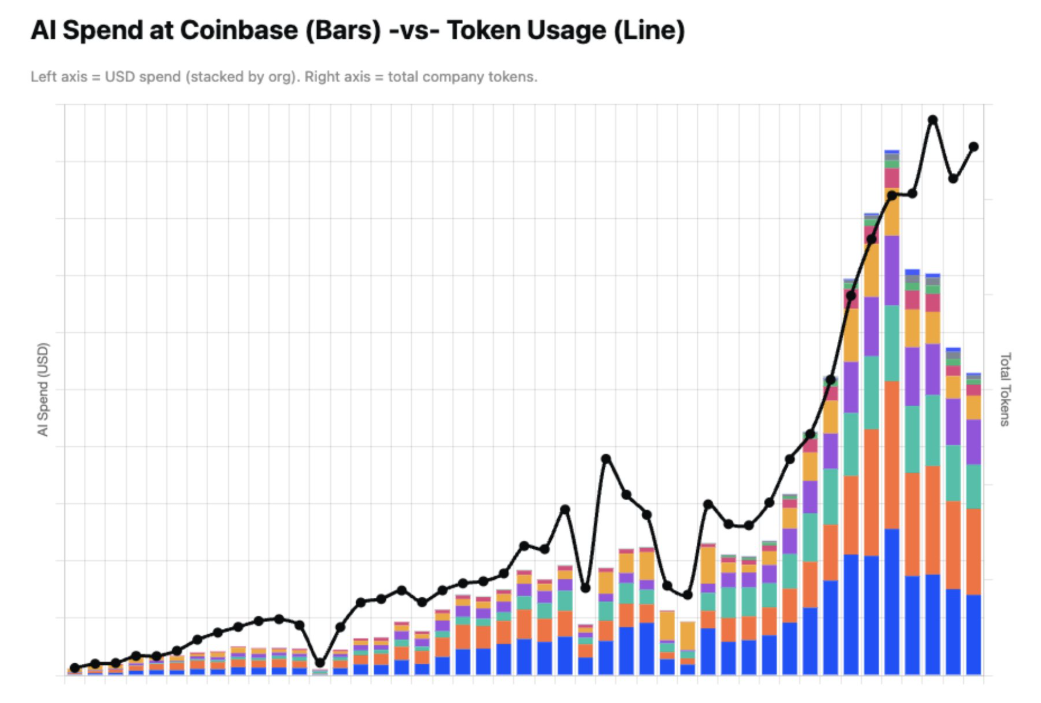
Coinbase said its AI spend has remained “flat” despite growing token use. Source: Brian Armstrong
Related: Robinhood says its AI agent feature will ‘soon’ be assisting crypto traders
Coinbase was part of a wave of companies to lay off staff this year amid a rise in enterprise AI. In March, crypto exchange Crypto.com cut 12% of its staff, impacting roles “that do not adapt in our new world.”
In February, Block CEO Jack Dorsey said he was cutting 40% of Block’s workforce.
“We’re already seeing that the intelligence tools we’re creating and using, paired with smaller and flatter teams, are enabling a new way of working which fundamentally changes what it means to build and run a company,” Dorsey said on X.
Other crypto companies that cited AI-related efficiencies in this year’s layoffs included Kraken, Gemini, Messari and Dune.
Magazine: Robinhood L2 sparks ETH optimism, Saylor ‘muddies waters.’ Hodler’s Digest, July 5-12, 2026
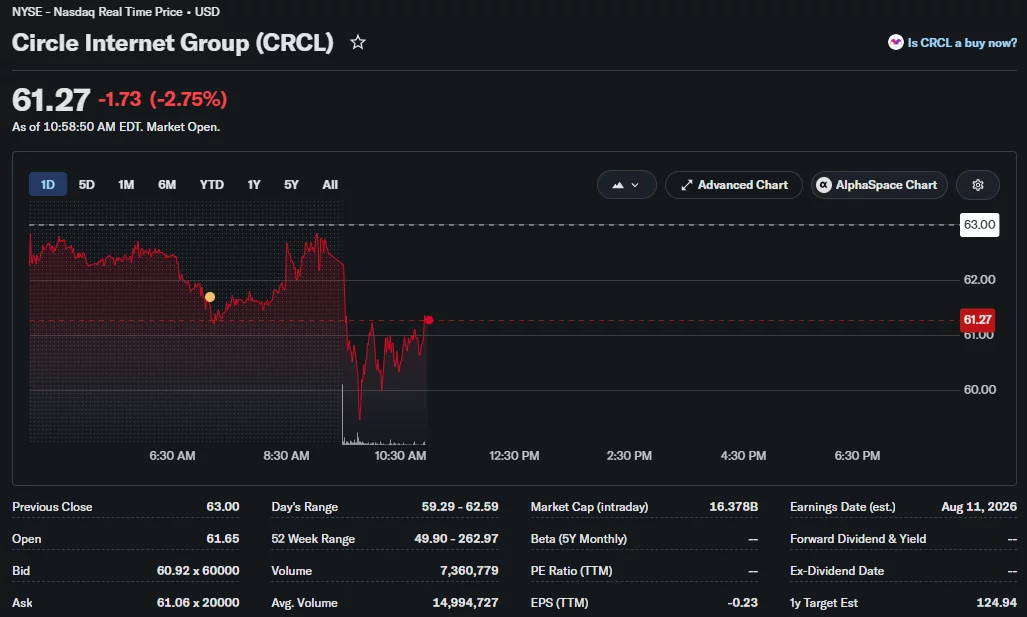
Circle Internet Group shares have dropped more than 2% in pre-market trading after US banking groups urged the Senate to tighten stablecoin provisions in the CLARITY Act, adding fresh pressure to the stock.
Summary
- US banking groups urged the Senate to tighten the CLARITY Act, citing stablecoin yield loopholes.
- Circle shares fell in pre-market trading as regulatory uncertainty added pressure to the stock.
- Baird cut its CRCL price target to $100 despite maintaining a positive long-term outlook.
According to a joint letter from several US banking organizations, the groups have asked Senate majority and minority leaders to revise Section 404 of the CLARITY Act before lawmakers move the bill forward.
The banks argue that the current wording could allow stablecoin issuers to offer interest-like incentives that encourage customers to move money out of traditional bank deposits and into stablecoins such as Circle’s USDC.
The letter warns that unclear language around yield-related incentives could increase deposit flight, particularly from community and regional banks.
“Ensuring that stablecoin regulations draw clear and enforceable boundaries around interest- and yield-like incentives is therefore essential.”
The renewed lobbying effort comes days after President Donald Trump called on Congress to pass the CLARITY Act in honor of Senator Lindsey Graham, who died on July 12. However, crypto.news previously reported that the bill’s chances of clearing the Senate have weakened after a key White House adviser supporting the legislation took a one-month leave.
The report added that the probability of passage has fallen to 37%, although a Senate floor vote is still expected before lawmakers begin their August 7 recess.
Selling pressure keeps Circle stock near a critical support zone
Fresh political uncertainty has coincided with continued weakness in Circle shares, which have extended their decline after retreating sharply from the stock’s June peak near $140.
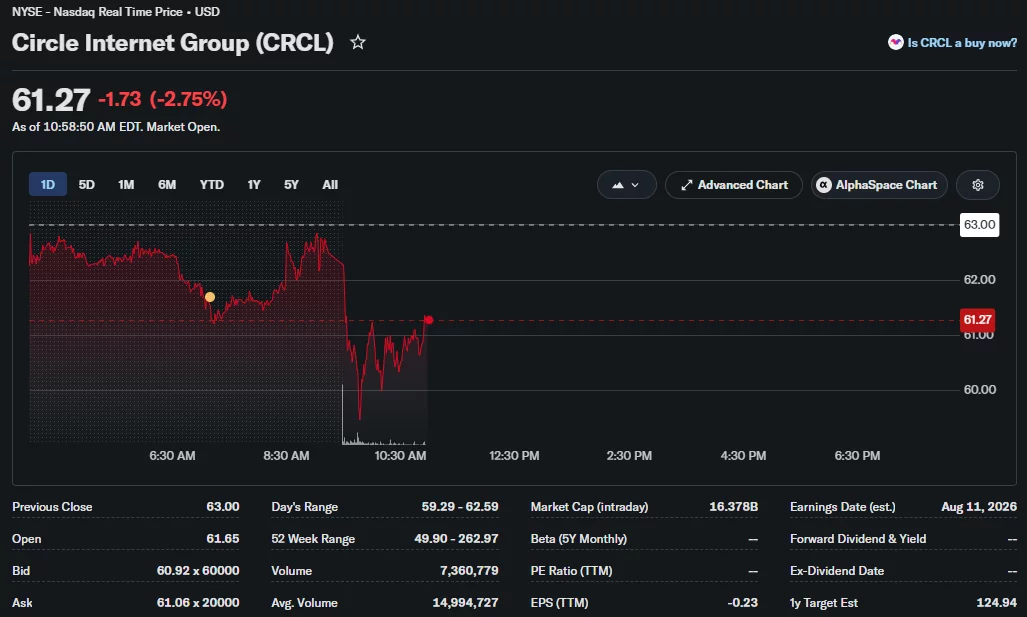
The daily chart shows CRCL trading around $61, just above a major Fibonacci support level at $59.39. This area has become an important line for buyers, as a decisive break below it would leave little chart support before the psychologically important $50 level.
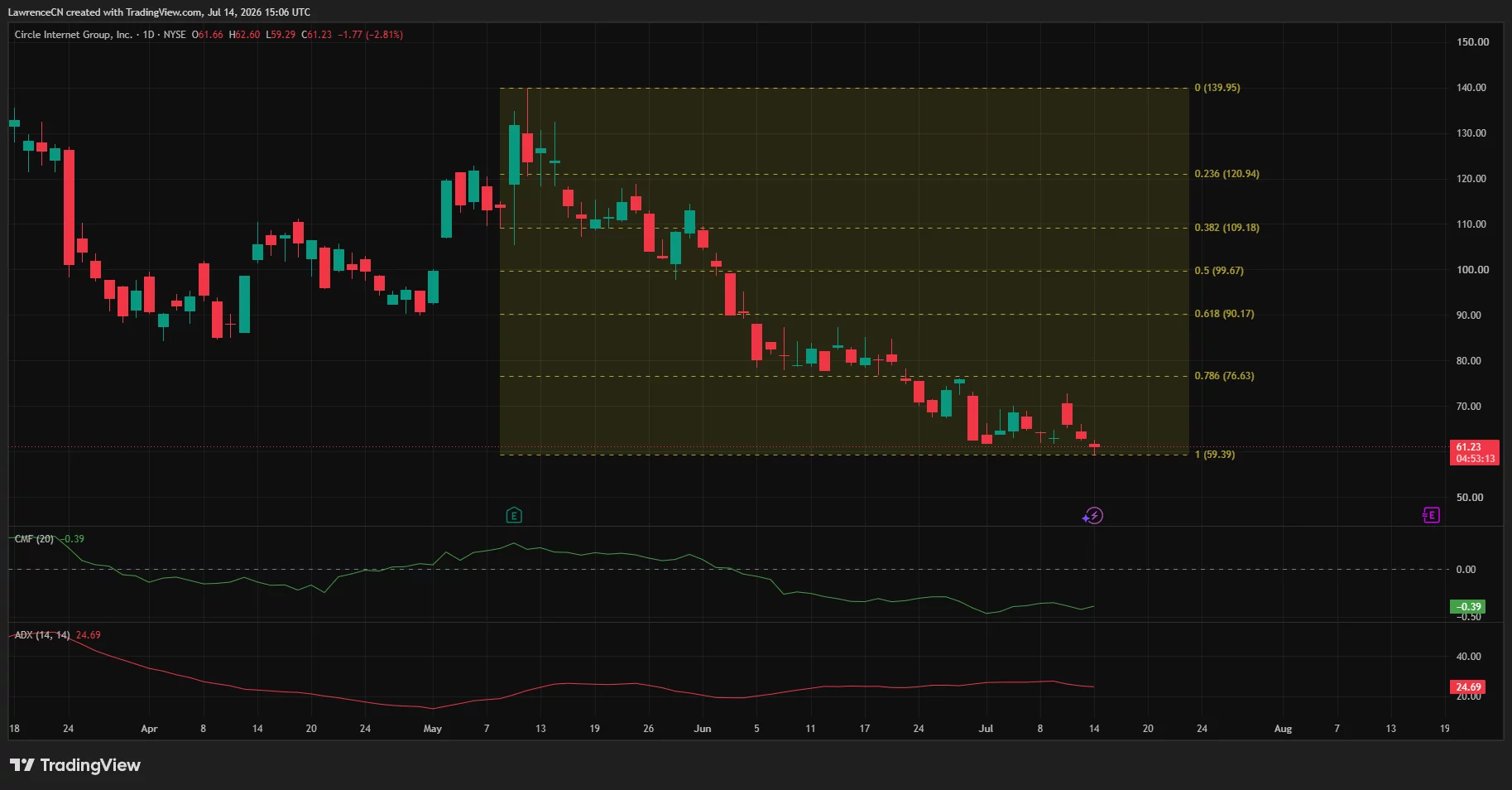
Momentum indicators also continue to favor sellers. The Chaikin Money Flow remains near -0.39, indicating sustained capital outflows from the stock, while the Average Directional Index sits around 24.7, suggesting the existing downtrend still carries moderate strength.
Even if buyers manage to stabilize the decline, recovery attempts would likely face resistance at successive Fibonacci retracement levels near $76.63, $90.17, $99.67, $109.18, and $120.94, making any rebound technically challenging unless market sentiment improves.
Analysts remain divided despite long-term growth drivers
Despite the recent weakness, several developments continue to support Circle’s longer-term outlook.
Circle recently secured an Office of the Comptroller of the Currency national trust bank charter, allowing the company to operate a federally regulated trust bank. Separately, ARK Invest purchased roughly $13.8 million worth of CRCL shares on July 9, signaling continued confidence from the investment firm even as the stock traded well below its recent highs.
At the same time, Baird has adopted a more cautious stance. The investment bank lowered its price target on Circle from $138 to $100, citing expectations that the company’s second-quarter 2026 revenue will fall short of Wall Street estimates.
Baird also warned that the launch of the OUSD stablecoin on June 30 could erode Circle’s share of the stablecoin market over time, potentially weighing on future demand for CRCL shares. Still, the firm maintained that Circle’s compliance with the GENIUS Act could strengthen adoption of USDC as the regulatory framework for dollar-backed stablecoins develops.
The primary cryptocurrency attempted a decisive rebound earlier this month, rising to nearly $65,000.
However, the bears intercepted the move and pulled the price to the current $62,600, while many analysts believe the cycle’s bottom has yet to be reached.
More Pain Ahead?
X user Aralez claimed that the asset’s “massive bull trap” is entering its final stage, predicting severe volatility in the following months. The analyst expects the price to first rally toward $70,000, only to hit strong resistance and reverse sharply to around $39,000. After that final shakeout, they forecast a new long-term uptrend that could send BTC to as high as $150,000 by late 2027.
X user Crypto Lens shared a similar thesis, envisioning a plunge below $50,000 sometime this week and a crash under $40,000 by August. “Don’t become the exit liquidity,” they warned.
The analyst, who goes by symbiote on X, also chipped in. They believe BTC has roughly 80 days left before reaching its cycle bottom, basing the projection on the asset’s performance during the previous bear markets in 2018 and 2022.
Bitcoin’s Market Value to Realized Value (MVRV) ratio suggests that the actual floor still appears to be ahead. The figure has been declining over the past several months but has not yet dropped below 1, which, according to CryptoQuant, has historically marked “generational buying opportunities and cycle bottoms.”

The Bullish Scenario
Other analysts are more optimistic and outlined important reasons why BTC might be on the verge of a short-term resurgence. X user AlΞx Wacy noted that the asset recently hit its most oversold monthly reading in history: a development that is often a precursor of a rally.
For his part, Ali Martinez paid attention to BTC’s Accumulation Trend Score, which has remained close to 1. This signals persistent accumulation by large investors, which is usually a bullish factor for the price.
One should also keep in mind that July has historically been a positive month for BTC. The asset has finished the period in the red only four out of 13 times, and it remains to be seen whether another green print is ahead.

The post Bitcoin (BTC) in Trouble: Analyst Sees a Potential Drop Below $40K appeared first on CryptoPotato.
![Big bank earnings Q2 2026 results overview, alt: big bank earnings Q2 2026, Source: BeInCrypto]](https://wordupnews.com/wp-content/uploads/2026/07/4eefe70771df429fb28ebfb63106fae7.webp)
Big bank earnings smashed records on July 14 as the five major US lenders earned a combined $49 billion in profit, led by JPMorgan Chase’s $21.2 billion and the best quarter in Goldman Sachs’ history.
The wins came from trading and dealmaking rather than ordinary lending. That detail matters because it rewards the firms that own financial infrastructure, or the rails that money travels on.
Big Bank Earnings Set Records as Trading Desks Deliver
JPMorgan reported profit of $21.2 billion, or $7.70 per share, up 41% from a year earlier. Its stock trading revenue surged 86% to $6.03 billion, lifting total trading revenue to a record $12.1 billion.
Investment banking fees at the bank rose 30% to $3.3 billion, the strongest showing since 2021. These are the fees banks collect for helping companies raise money and complete mergers. Meanwhile, a long-held Visa stake added a $4.6 billion gain to the quarter.
Goldman Sachs earned $20.98 per diluted share on $20.34 billion in net revenues, according to its filing. Net profit reached $6.63 billion, and both revenue and per-share earnings set firm records alongside a 23.5% return on equity.
Underwriting boomed too. Goldman’s fees from helping companies sell new shares surged 130%, while fees from arranging new debt rose 75%. Total investment banking fees jumped 55% to $3.40 billion.
“Our record performance this quarter reflects the strength of our global franchise, the depth of our relationships, and our ability to harness the power of One Goldman Sachs,” Goldman Sachs Chairman and CEO David Solomon said in the firm’s release.
Follow us on X to get the latest news as it happens
The rest of the group beat as well. Bank of America grew profit 27% to $9.1 billion, per its release. Wells Fargo earned $6.4 billion, its report showed, and Citigroup posted $5.8 billion, up from $4.0 billion a year earlier, per its results.
The strength answered the question BeInCrypto raised in its big bank earnings preview a day earlier. Investors wanted proof the economy could hold up, and the banks supplied it.
Owning the Rails Beat Selling the Products
Think of financial rails as the toll roads of money. Trading platforms, underwriting desks, payment networks, and custody services all charge a small fee every time value moves. This quarter, those toll collectors captured nearly all the upside.
![Big bank earnings Q2 2026 results overview, alt: big bank earnings Q2 2026, Source: BeInCrypto]](https://assets.beincrypto.com/img/MyQC6wgEzr2gds19M6cXtxOvUAo=/smart/4eefe70771df429fb28ebfb63106fae7)
Ordinary lending, where banks profit from the gap between loan interest and deposit costs, held steady but added little growth. The difference matters because toll revenue rises with activity, while lending profit depends on interest rates.
JPMorgan’s $4.6 billion Visa gain makes the point in miniature. Visa began in 1958 as a Bank of America card program and became a standalone network through a 2008 IPO. Banks that owned those payment rails have collected returns for decades since.
IBM offered the mirror image on the same day. The company said preliminary Q2 revenue of roughly $17.2 billion missed estimates, and IBM stock sank 22% before the open. Corporate budgets moved to chips, power, and data capacity, the technology version of rails, and away from older software deals.
The lesson from both stories is simple:
- Firms that own the pipes collect fees whenever activity rises, whichever way markets move.
- Firms that sell products, in contrast, must win every contract again and again.

Why Record Bank Profits Matter for Crypto
For crypto investors, the first signal is liquidity, meaning the ease with which money moves through markets. Record trading revenue indicates deep markets and healthy risk appetite, conditions that have historically supported Bitcoin (BTC) and other risk assets.
Crypto has captured a growing share of such rallies since US spot Bitcoin ETFs launched in January 2024.
The rails idea also maps directly onto blockchain finance. Stablecoins, digital tokens designed to hold a steady dollar value, aim to become payment rails that work around the clock. Their issuers earn income from reserves while the tokens move value cheaply.
Washington cleared the road last year. The GENIUS Act, signed in July 2025, gave payment stablecoins their first federal rulebook. Regulators have since granted conditional trust charters to issuers such as Circle and Paxos, per Brookings.
The Biggest Banks are Already Laying Track
More than 15 lenders race to tokenize finance on private networks. JPMorgan’s blockchain unit Kinexys has processed over $4 trillion since launch and averages above $7 billion daily, per the bank. Its JPMD deposit token now settles on Base, a public Ethereum network.
Institutional signals point the same way. BlackRock and HSBC recently joined a UK tokenization push that a government report says could add $44 billion to annual output by 2035.

Meanwhile, MicroStrategy’s new index places Bitcoin banking adoption at 32% among major lenders.
Wall Street just showed how much money flows to whoever owns the plumbing beneath markets. The open question is whether banks, stablecoin issuers, or public blockchains build the next generation of those rails.
Tech earnings later this week may reveal where the liquidity rotates next.
Note: Latest research from BeInCrypto found that more than 56% of the Tokenization market has zero activity on-chain.

The post 5 Big Banks Earned $49 Billion in One Quarter by Owning What Crypto Wants to Replace appeared first on BeInCrypto.
Ripple-backed Evernorth has unveiled a $44 million CEO equity package in a fresh SEC filing while advancing its merger to create a Nasdaq-listed XRP treasury company.
Summary
- Evernorth’s latest SEC filing includes a $44 million equity award for CEO Asheesh Birla.
- The amended filing advances Evernorth’s merger with Armada Acquisition Corp II and planned XRPN listing.
- Evernorth also launched a Japanese-language XRP information channel without announcing local operations.
According to Evernorth Holdings’ fourth amended Form S-4 registration statement filed with the U.S. Securities and Exchange Commission, the company updated executive and director compensation arrangements while advancing the paperwork required for its proposed business combination with Armada Acquisition Corp II, a special purpose acquisition company backed by Arrington Capital.
The filing sets CEO Asheesh Birla’s base salary and grants him an initial equity award valued at about $44 million, together with vesting terms. Chief financial officer Matt Frymier would receive a base salary, annual bonus eligibility and an equity award worth about $5.6 million.
Evernorth also disclosed restricted stock unit awards valued at $750,000 for executives, subject to approval by the board’s compensation committee and the company’s shareholders.
Merger filing moves XRP treasury listing closer
Beyond executive compensation, the amended filing moves Evernorth another step toward completing its merger with Armada Acquisition Corp II. If the transaction receives regulatory and shareholder approval, the combined company is expected to trade on Nasdaq under the ticker XRPN while operating what Evernorth has described in its SEC filings as the largest publicly listed XRP treasury company.
According to the filing, Evernorth has secured more than $1 billion in gross proceeds from investors including Ripple, Arrington Capital, SBI Holdings, Pantera Capital and Kraken.
Board appointments were also updated. Ripple chief legal officer Stuart Alderoty is expected to join the board alongside CEO Asheesh Birla and Ted Janus. The proposed board would also include OpenAI Foundation chief financial officer Robert Kaiden and Antalpha chief operating officer Derar Islim.
Separately, Evernorth has expanded its public communications by launching a Japanese-language social media account focused on XRP-related updates and market education. In its introductory message, the company stated that Japan had supported XRP early and that it would continue building from there. However, Evernorth did not announce a new office, regulatory license, investment, product launch, or local operating business in Japan.
The company added that the Japanese account would explain market developments in simple terms and provide professional information without discussing XRP price movements or forecasts. Evernorth has not disclosed local staffing, partnerships or services connected to the initiative, while its website continues to list San Francisco as its primary headquarters.
XRPN stock holds steady as XRP activity grows
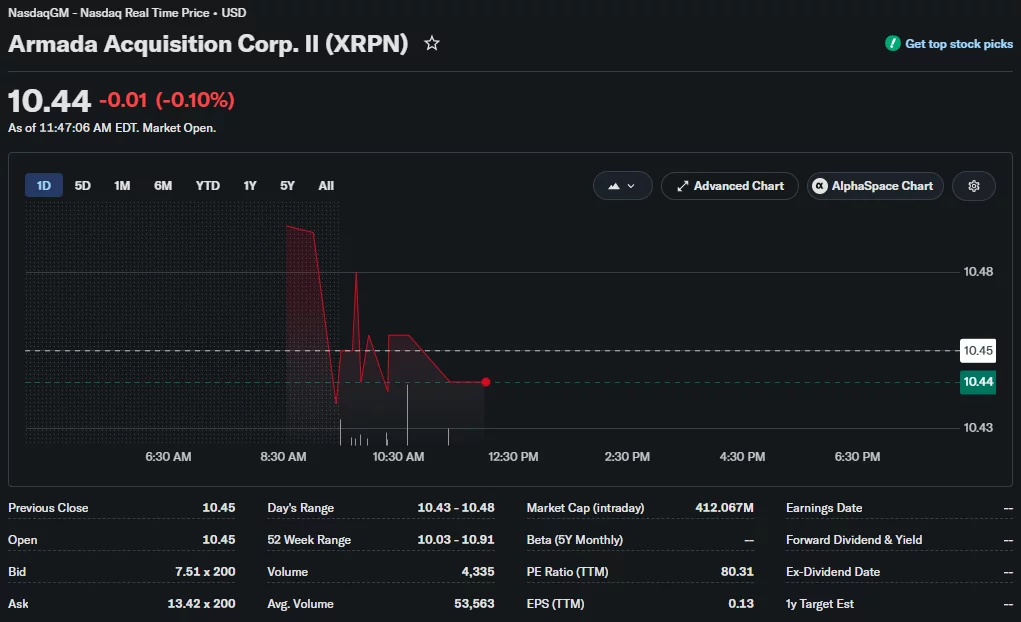
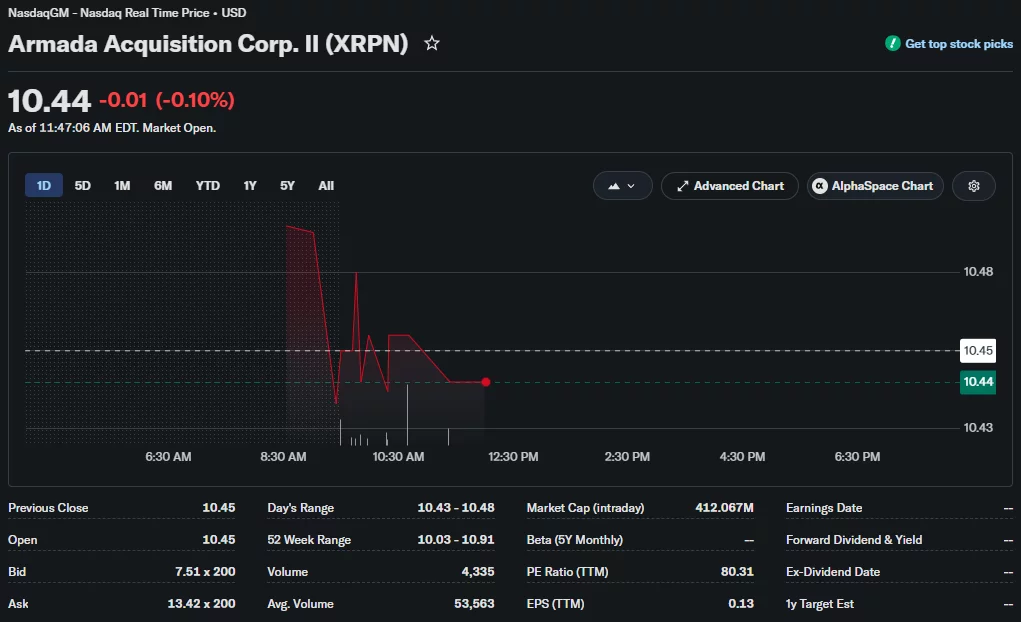
While the merger still awaits regulatory approval, Armada Acquisition Corp II shares have largely held their gains. The stock is up about 2.25% since the beginning of the year and has gained nearly 0.5% over the past month, although it closed 0.10% lower on Monday. Its 52-week high stands at $10.91.
Evernorth has also pointed to rising XRP adoption across several areas. According to the company, tokenized real-world assets on the XRP Ledger increased from roughly $150 million to $4 billion over the past year, supported by growth in spot XRP ETF inflows and an increase in newly created XRP wallets.
Meanwhile, XRP (XRP) traded at about $1.10 after rising 2.3% over the previous 24 hours. The token fluctuated between $1.06 and $1.11 during the session, while trading volume rose nearly 16% ahead of the release of U.S. consumer price index inflation data.
Bitcoin has climbed back toward the $65,000 level after softer-than-expected U.S. inflation data sharply reduced market expectations of a Federal Reserve rate hike at the July policy meeting.
Summary
- Bitcoin climbed toward $65K after June U.S. inflation came in below expectations.
- Cooling CPI data pushed July Fed rate hike odds sharply lower across major markets.
- Investors now await Kevin Warsh’s testimony and PPI data as geopolitical risks persist.
According to the U.S. Bureau of Labor Statistics, the consumer price index (CPI) slowed to 3.5% year over year in June, below the 3.8% economists had expected. Monthly CPI fell 0.4%, compared with forecasts for a 0.1% decline. The inflation report triggered a fresh move higher in risk assets, helping Bitcoin recover from losses linked to renewed geopolitical tensions.
Bitcoin (BTC) rose nearly 5% to an intraday high of $64,830 on July 14 before easing to around $64,560 at press time. The recovery followed a drop below $62,000 during the previous session, when escalating conflict between the United States and Iran weighed on market sentiment.
Core inflation data also came in below forecasts. The Bureau of Labor Statistics reported core CPI at 2.6% year over year and flat on a monthly basis, compared with expectations of 2.8% and 0.2%, respectively.
The latest figures improved from May, when headline CPI stood at 4.2% year over year, and core CPI reached 2.9%, adding to expectations that inflation pressures may be easing despite the ongoing conflict in the Middle East.
Cooling inflation has lowered expectations for a July rate hike
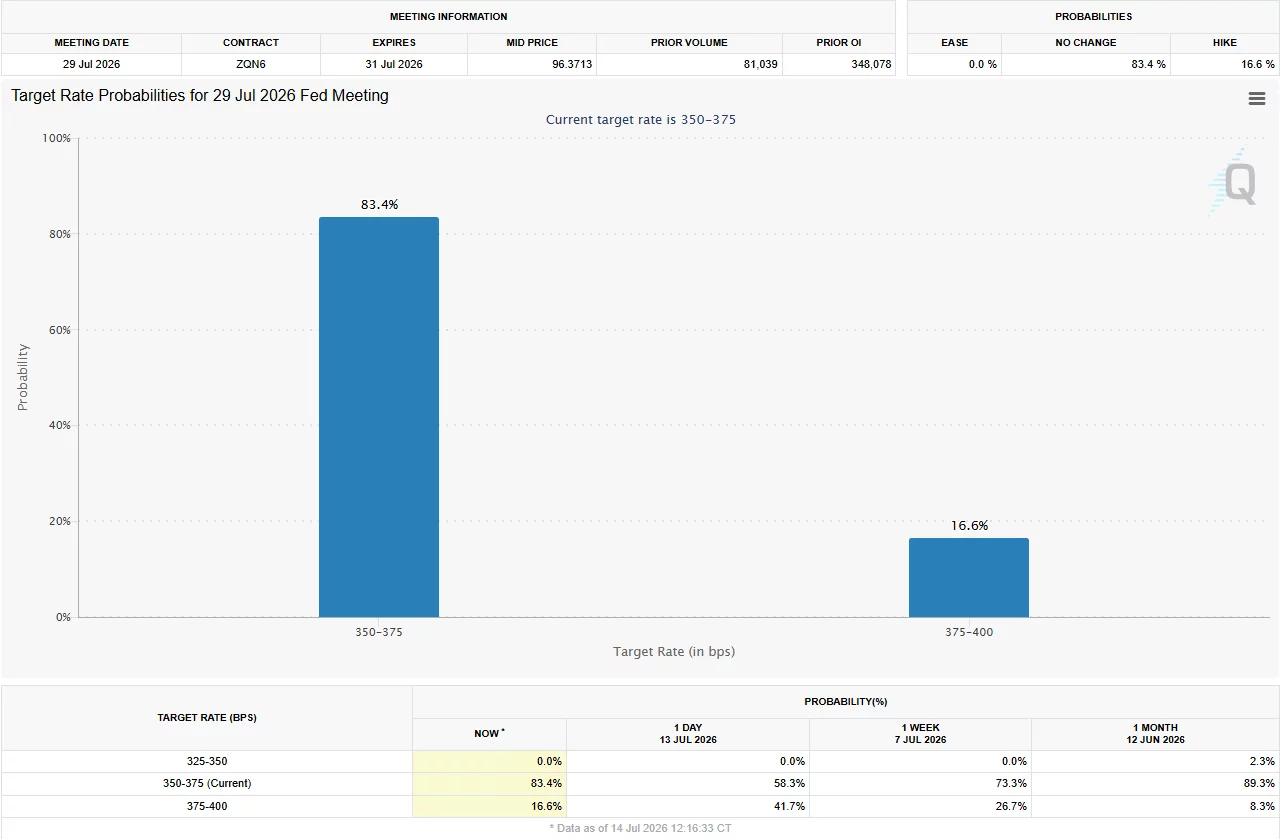
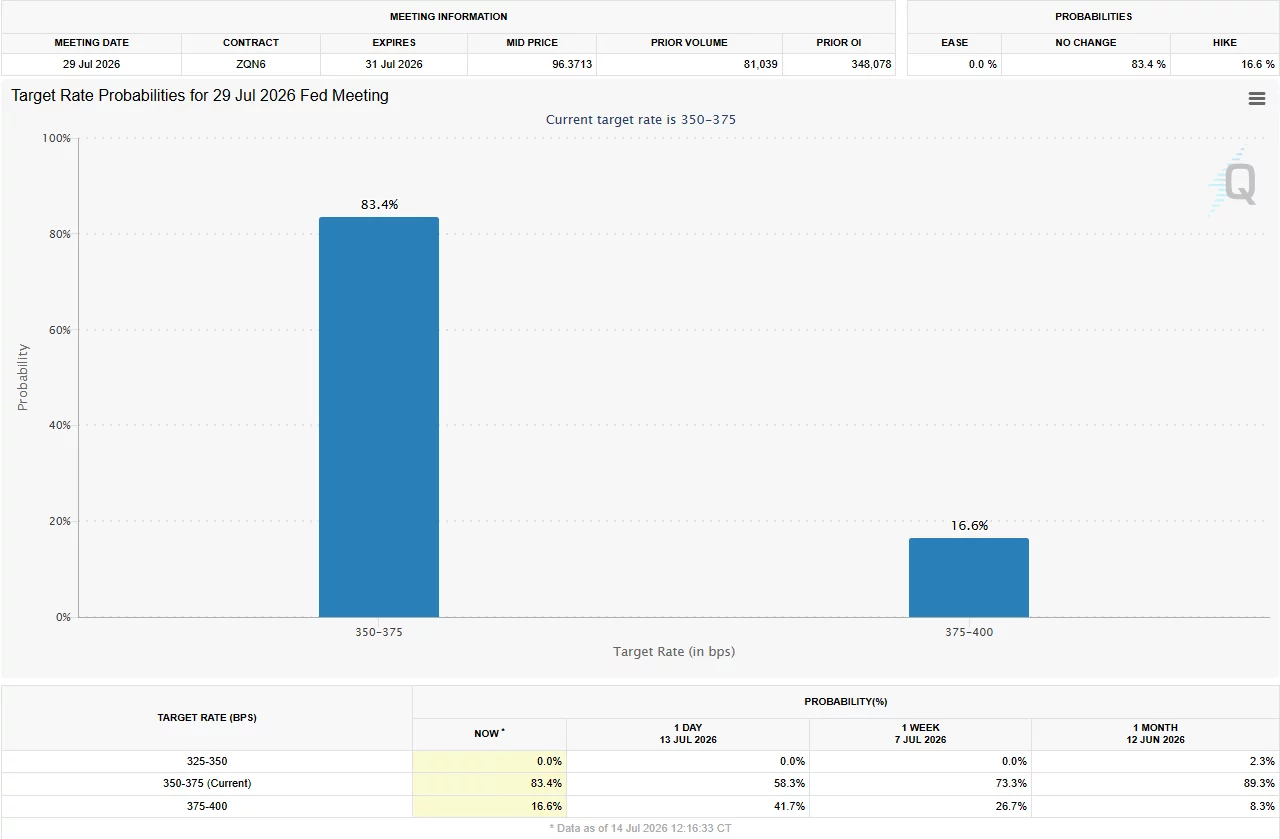
Interest-rate expectations changed quickly after the inflation release. According to CME FedWatch data, traders now assign only a 16.6% probability to a Federal Reserve rate hike at the July Federal Open Market Committee meeting.
Prediction markets also adjusted their outlook. Data from Polymarket showed the perceived probability of a July rate hike falling to 9%, down from as high as 34% previously. The platform also showed the chance of at least one rate hike during 2026 declining to 53%, compared with a recent peak of 71%.
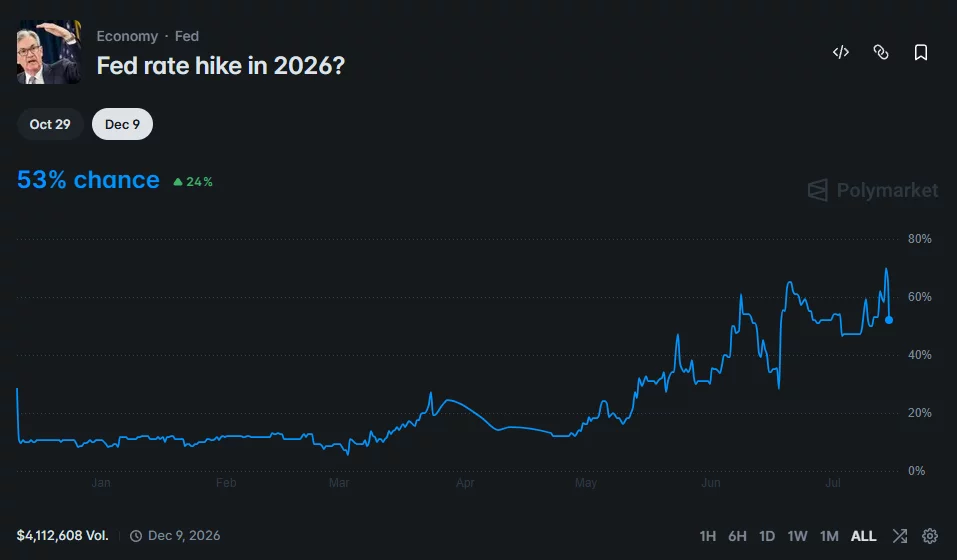
The inflation report arrived only days after Federal Reserve Governor Chris Waller indicated he could support higher interest rates if inflation remained elevated. Against that backdrop, the weaker-than-expected CPI figures reduced expectations that policymakers would tighten policy this month, providing support for Bitcoin and other risk-sensitive assets.
Attention has now turned to Federal Reserve Chair Kevin Warsh, who is scheduled to testify before Congress over two days. Investors are also preparing for the producer price index (PPI) report, which could influence expectations for future monetary policy and lead to fresh volatility across cryptocurrency markets.
Geopolitical risks continue to limit upside
Even with inflation easing, macro risks remain in focus. Recent weakness in Bitcoin followed renewed fighting involving the United States and Iran, while President Donald Trump’s decision to reinstate the Iranian blockade added pressure to global markets before the CPI-driven rebound.
Another source of uncertainty comes from Trump’s proposal to impose a 20% cargo fee on ships that receive U.S. assistance while transiting the Strait of Hormuz. Market participants have warned that any disruption to shipping through the waterway could tighten global oil supplies and complicate the inflation outlook in the months ahead.
As a result, softer inflation has improved the immediate outlook for cryptocurrencies by reducing expectations of a July rate increase, but upcoming Federal Reserve commentary, fresh inflation data and developments in the Middle East remain key factors that could determine whether Bitcoin can extend its recovery toward the $65,000 level.


Ripple has joined the x402 Foundation as a Premier Member, adding support for XRP and RLUSD in the Foundation’s effort to build an open payment standard for AI agents.
Summary
- Ripple has joined the x402 Foundation as a Premier Member alongside Coinbase, Google, and Mastercard.
- XRP and RLUSD will support AI agent payments through the open x402 protocol on the XRP Ledger.
- The Linux Foundation has launched the x402 Foundation under open governance after Coinbase contributed the protocol.
According to Ripple, AI agents are beginning to handle more of the transaction process, creating demand for payment infrastructure that can move value as efficiently as these systems already exchange information.
The company stated that its work on the XRP Ledger provides developers with tools to support agentic payments through the x402 protocol, allowing AI-powered applications to settle transactions using XRP and its RLUSD stablecoin.
The announcement places Ripple alongside other Premier Members including Coinbase, Circle, Google, Mastercard, Visa, Amazon Web Services, Stripe, Shopify, American Express, Adyen, Cloudflare, Fiserv, the Solana Foundation, the Stellar Development Foundation, the Monad Foundation, and MoonPay.
Ripple expands XRP Ledger role in AI payments
Building on earlier development work, Ripple launched the XRPL AI Starter Kit in June to help developers integrate AI applications with the XRP Ledger. The toolkit introduced support for agentic payments using XRP and RLUSD, allowing autonomous software agents to send and receive blockchain-based payments.
Soon after, Ripple-backed t54.ai introduced the XRPL AI Hub with support from Ripple developers and the XRPL Foundation. The platform was designed to provide resources and infrastructure for developers building AI-powered applications on the XRP Ledger.
Activity on the network has also increased following the rollout of x402 support. The XRPL Foundation recently announced that the XRP Ledger has processed more than one million agentic transactions, indicating growing developer testing and adoption of AI-driven payment workflows.
Ripple stated that combining blockchain settlement with AI agents could allow software systems to complete financial transactions without relying on traditional payment rails while using XRP and RLUSD as settlement assets.
Linux Foundation formalizes x402 governance
Separately, the Linux Foundation announced the operational launch of the x402 Foundation after Coinbase completed the contribution of the x402 protocol. According to the Linux Foundation, the organization will now oversee the protocol under an open governance model intended to guide future technical development.
The Linux Foundation said developers, financial institutions, cloud providers, and other community participants will be able to contribute to the protocol’s direction through the Foundation’s governance framework rather than under the control of a single company.
Membership in the Foundation extends beyond its Premier Members. General Members include Injective, the Near Foundation, Polygon Labs, and World Liberty Financial, while Associate Members include the Cardano Foundation, the BSV Association, Casper, the Japanese Contents Blockchain Initiative, and OMA3.
Coinbase originally introduced x402 as an open internet payment protocol designed to let applications, APIs, and AI agents exchange digital payments through standard web infrastructure.
With Ripple now joining the governing body, XRP and RLUSD gain a larger role in ongoing work to develop payment standards for autonomous software systems while development continues under the Linux Foundation’s stewardship.

Anchorage Digital has introduced native TRX staking for institutional clients, adding to its portfolio of regulated staking services and widening its support for the Tron network. The update is designed to let clients earn protocol rewards while keeping TRX within Anchorage’s custody environment or using their existing Porto self-custody setup.
The move underscores a broader industry shift: custody providers and market infrastructure firms are increasingly bundling staking capabilities into institutional workflows, responding to demand for regulated ways to generate yield from blockchain networks without requiring investors to run their own validator operations.
Key takeaways
- Anchorage now supports native TRX staking for institutional clients on its custody platform, with an option to stake via Porto self-custody.
- Anchorage previously added institutional custody for TRX earlier in 2026, and this rollout builds directly on that foundation.
- Anchorage points to Tron’s scale in USDT settlement activity, citing Tron’s Q1 2026 transfer and usage metrics.
- The expansion reflects a wider market trend toward custody-integrated staking across major institutional infrastructure providers.
Anchorage adds TRX staking without changing custody workflows
Anchorage Digital’s new offering enables institutional clients to stake TRX while keeping assets in their established custody arrangement. According to the company, users can stake directly from Anchorage’s custody platform or from the company’s Porto self-custody wallet.
In practical terms, the feature is meant to reduce operational friction. Instead of moving assets to a separate staking environment—or requiring institutions to independently manage validator responsibilities—clients can participate in securing the Tron network and earning protocol rewards from within the custody setup they already use.
This expansion comes after Anchorage introduced institutional custody for TRX earlier in 2026, making the staking feature a direct follow-on to its initial Tron-focused custody support. The company frames the update as a response to increasing institutional interest in the Tron ecosystem.
Why Tron staking demand is growing
Anchorage ties the rollout to the Tron network’s role in stablecoin settlement, particularly for USDT. The company says Tron processed roughly $2 trillion in USDT transfers during the first quarter of 2026, while averaging 10.9 million daily transactions and 3.2 million active addresses.
Anchorage also cites data published by Tether showing that nearly $90 billion of USDT is currently circulating on the Tron network, referencing Tether’s transparency portal: https://tether.to/en/transparency/?tab=usdt.
For institutional investors, the relevance is straightforward: networks with high transaction throughput and heavy stablecoin usage tend to attract more liquidity and broader ecosystem participation. By offering TRX staking in a regulated custody-integrated format, Anchorage is positioning staking participation as another institutional-access layer around an already intensively used chain.
Staking is becoming a standard add-on to institutional custody
Anchorage’s decision aligns with a broader trend across crypto infrastructure. Institutional platforms have increasingly moved beyond “store-and-hold” custody, expanding staking capabilities as asset managers and financial institutions seek compliant, regulated routes to earn yield.
In October 2025, for example, Coinbase and Figment broadened their staking partnership to allow Coinbase Prime clients to stake proof-of-stake assets including Solana (SOL), Avalanche (AVAX), Sui (SUI) and Aptos (APT) directly from custody. The next step of that evolution continued as institutions looked for similar convenience across different ecosystems.
Then, in early 2026, Ripple integrated Figment and Securosys into its institutional custody stack, enabling banks and custodians to offer staking without operating their own validator infrastructure. The pattern is consistent: providers aim to package validator access, operational controls, and custody handling into a single workflow.
Asset managers have also pursued integrated custody and staking structures. BitGo, for instance, expanded its partnership with 21shares to provide regulated custody and staking for 21shares’ US exchange-traded funds and global exchange-traded products through regulated US and European entities, as reported by Cointelegraph: https://cointelegraph.com/news/bitgo-expands-custody-and-staking-partnership-with-21shares-across-us-and-europe.
Corporate treasuries are joining this shift as well. Bitmine launched its MAVAN staking platform in March, initially building validator infrastructure for its own Ether treasury and later opening it to external institutions and custodians, according to Cointelegraph coverage: https://cointelegraph.com/news/bitmine-launches-mavan-an-institutional-ethereum-staking-platform.
On Monday, Bitmine said it holds 5.77 million ETH (about 4.8% of Ether’s total supply) and has staked 4.92 million ETH through MAVAN, according to its statement reported by PR Newswire: https://www.prnewswire.com/in/news-releases/bitmine-immersion-technologies-bmnr-announces-eth-holdings-reach-5-77-million-tokens-and-total-crypto-and-total-cash-holdings-of-11-3-billion-302823533.html.
What’s next for institutions watching staking access
Anchorage’s TRX rollout adds another asset and another chain pathway for institutions that want regulated yield opportunities without re-engineering their custody operations. For market participants, the key question to watch is whether similar “native staking” expansions continue across major custody providers—especially as institutional demand for simplified staking access grows and stablecoin settlement activity remains a core driver of network relevance.
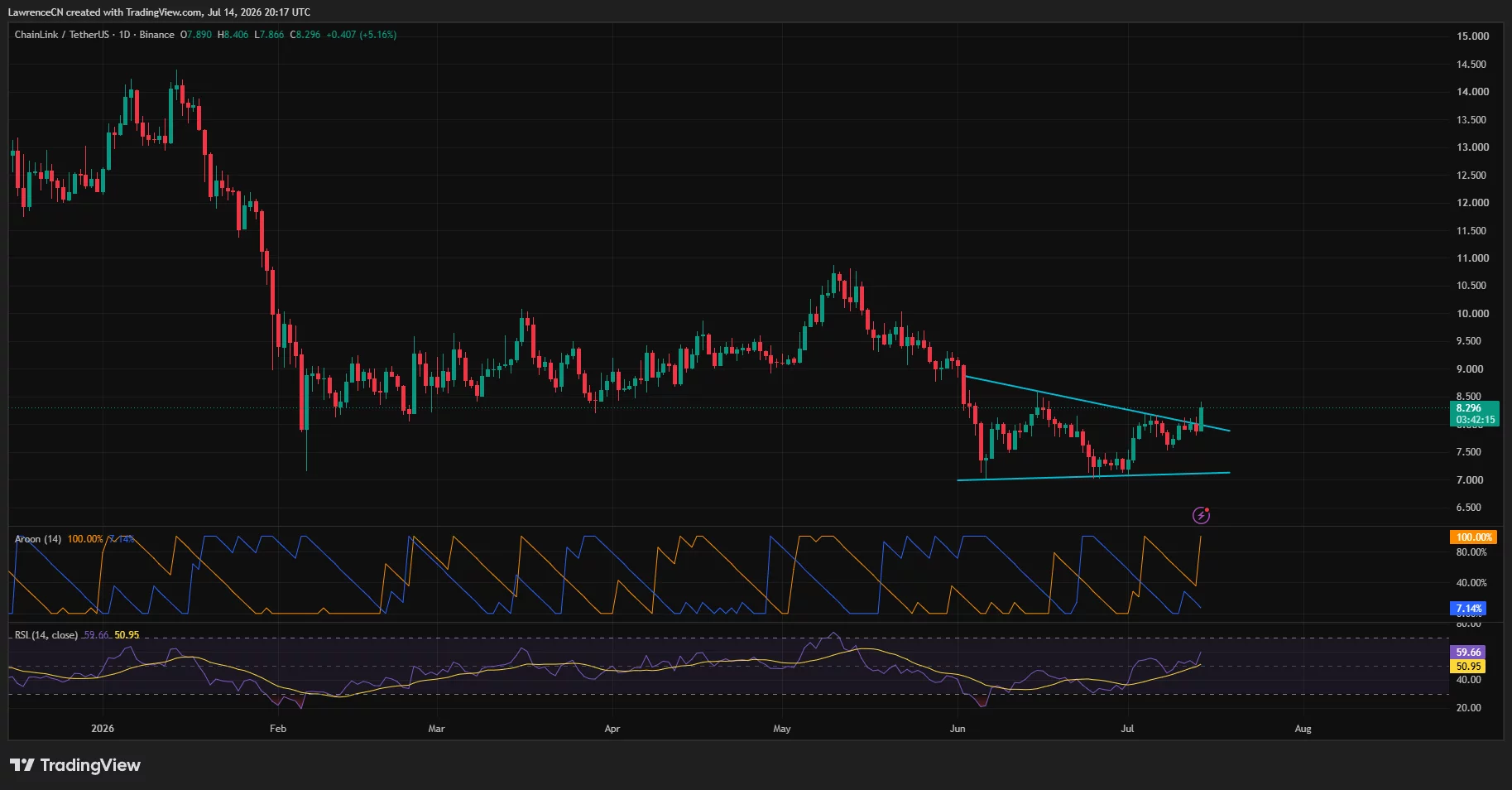
Chainlink price has jumped more than 5% after Mantle completed the migration of its $2.5 billion Super Portal to Chainlink’s cross-chain infrastructure, extending a crypto market rally driven by softer U.S. inflation data.
Summary
- Chainlink price rose over 5% after Mantle migrated its $2.5 billion Super Portal to Chainlink’s CCIP.
- Whale accumulation, rising open interest, and record wallet growth have strengthened LINK’s bullish momentum.
- Technical indicators point to $8.40 as the next key resistance, while losing $8.00 could weaken the rally.
According to data from crypto.news, Chainlink (LINK) price traded around $8.29 after briefly touching $8.40, extending its weekly gain to roughly 7%.
The move came as Bitcoin climbed above $64,600 and Ethereum approached $1,875 after U.S. inflation data strengthened expectations that the Federal Reserve could adopt a less restrictive policy later this year. Total crypto market capitalization also advanced more than 3% to about $2.30 trillion.
Mantle’s infrastructure upgrade adds to a string of recent enterprise integrations for Chainlink. Aave recently selected the protocol for automated vault rebalancing, while Robinhood has incorporated Chainlink infrastructure into its expanding Layer-2 ecosystem.
Network adoption has also continued on-chain, with the number of non-empty Ethereum wallets holding LINK surpassing 900,000 for the first time.
On-chain accumulation suggests large investors positioned ahead of the announcement rather than reacting afterward. Wallets holding more than 1,000 LINK reached their highest level this year, while addresses controlling over 100,000 LINK expanded to a record 805.
These purchases absorbed much of the selling pressure created by the scheduled unlock of 21 million LINK tokens, reducing the impact of the additional supply entering circulation.
Derivatives traders have joined the rally. Open interest increased roughly 10% alongside the price advance, showing fresh leveraged participation instead of a short-lived spot spike. The combination of rising price and rising open interest typically suggests new positions entering the market rather than existing shorts simply closing.
Technical breakout places $8.40 and $8.70 in focus
The daily chart shows LINK pressing against the upper boundary of a descending wedge that has contained price since early June. Tuesday’s rally pushed the token above $8.20 and toward immediate resistance near $8.40, where sellers rejected price earlier in the session.
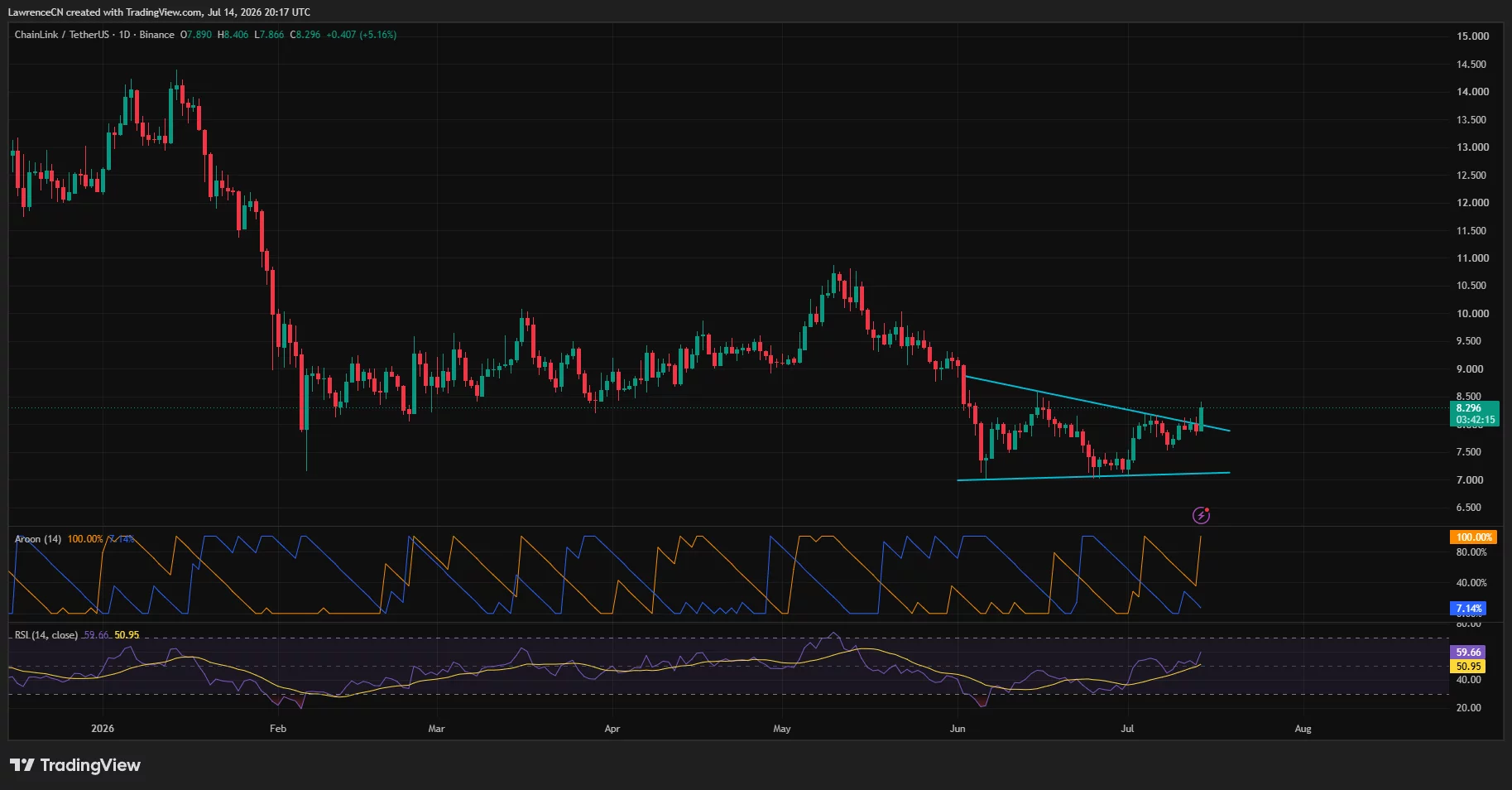
A confirmed daily close above that level would strengthen the breakout case and expose the next resistance zone around $8.70, followed by psychological resistance near $9.00.
Momentum indicators have also improved. The daily RSI has climbed to around 60 after recovering from oversold territory, showing buyers have regained control without entering overbought conditions. The Aroon Up indicator has returned to 100 while the Aroon Down remains near single-digit readings, highlighting a renewed bullish trend.
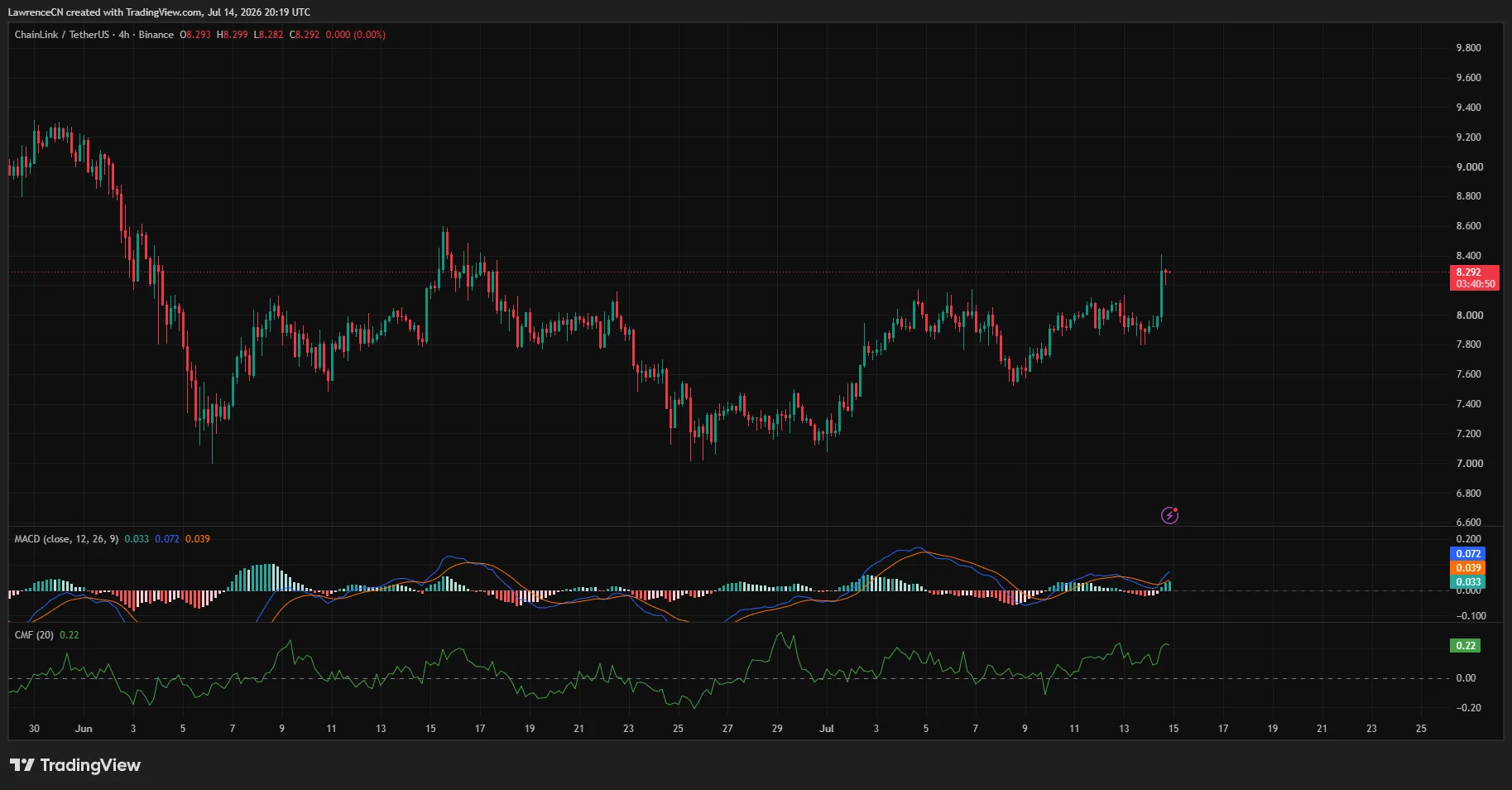
On the 4-hour chart, the MACD has completed a bullish crossover above the signal line, while the Chaikin Money Flow remains positive above zero, showing capital continues to enter the market.
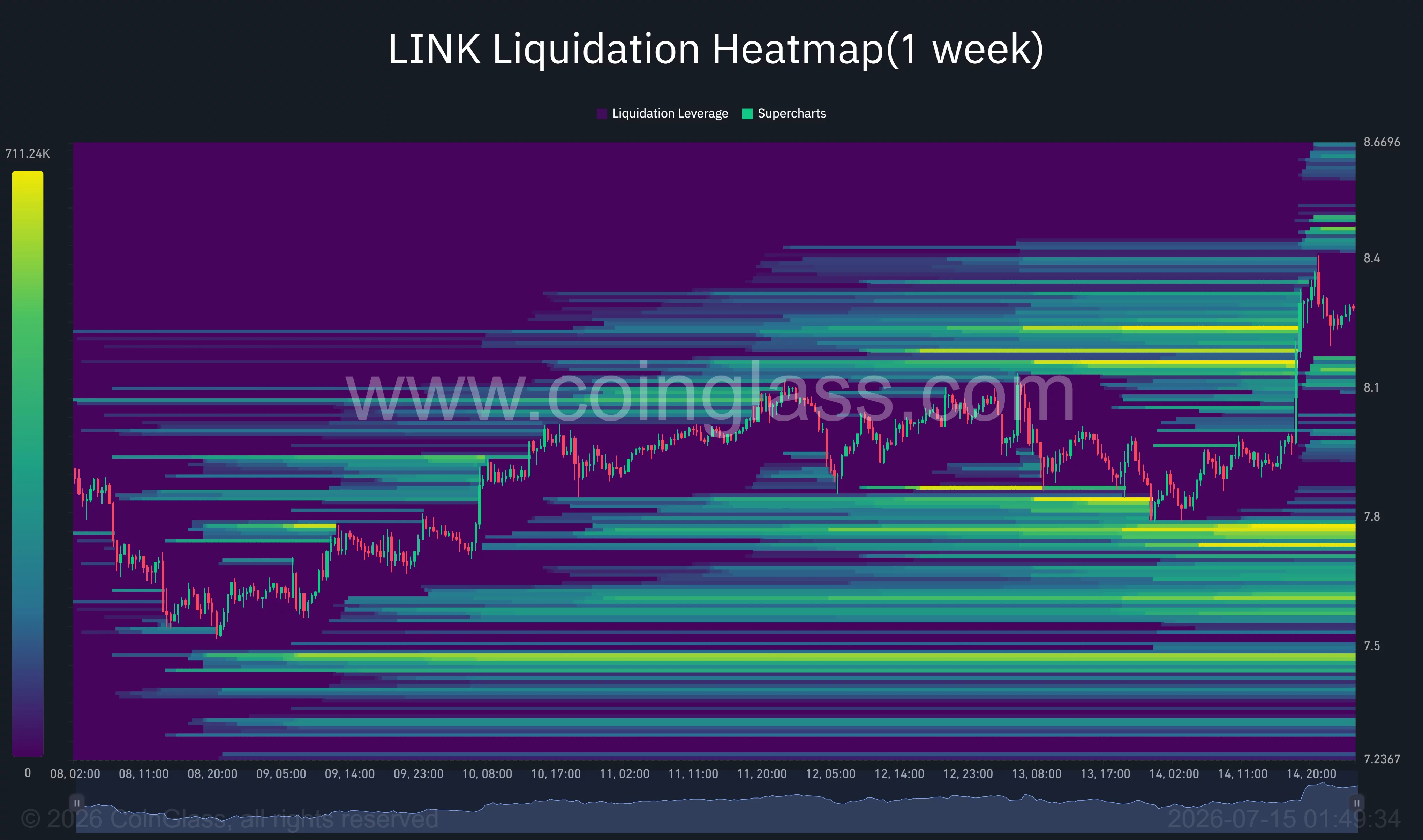
CoinGlass liquidation data reinforces the technical picture. The one-week heatmap shows a dense concentration of leveraged short positions clustered between $8.15 and $8.30, many of which were cleared during the latest rally. Above current prices, another sizeable liquidity pocket sits around $8.45-$8.70, creating a potential magnet if buyers maintain momentum.
Loss of $8.00 support would weaken the bullish case
Several risks could still interrupt LINK’s recovery. Markets remain sensitive to upcoming U.S. Producer Price Index data and any Federal Reserve comments that challenge expectations for easier monetary policy. Renewed geopolitical tensions or another rise in oil prices could also reduce appetite for risk assets across digital markets.
From a technical perspective, failure to hold above the $8.20 breakout zone would leave $8.00 as the first important support.
A decisive break below that level could pull LINK back toward the $7.70-$7.50 demand area, where the liquidation heatmap shows another large concentration of leveraged positions. Such a move would invalidate the immediate breakout structure and postpone any attempt to challenge the $9.00 resistance zone.
Disclosure: This article does not represent investment advice. The content and materials featured on this page are for educational purposes only.

Thomas Tuchel confirms Declan Rice ‘ready to start’ against Argentina after illness

Spain already have a huge advantage over England if they reach World Cup final | Football

Frontier Airlines to debut Wi-Fi in 2027 with SpaceX’s Starlink


-

 Fashion6 days ago
Loro Piana Fall 2026 Enters Houston’s Art Scene
-

 Fashion4 days ago
Weekend Open Thread: Nutriplenish Leave-In Conditioner
-
 Sports5 days ago
2026 Genesis Scottish Open Thursday TV coverage: Round 1
-

 Tech7 days ago
Anthropic brings Claude Cowork to mobile and web as usage data shows most users aren’t coding
-

 Sports5 days ago
Super Eagles star Moses Simon opens up on Liverpool transfer regret
-

 Tech5 days ago
Character.AI enters the microdrama arena with its own productions, but there’s a twist
-

 News Videos5 hours ago
XRP BOMBSHELL… XRP OMBOARDED FOR TRANSACTIONS!!!
-

 Tech20 hours ago
Get Your ESP32 Sunny Side Up With This Solar Dev Board
-

 Tech4 hours ago
Dark Secrets Emerge When Jailbreaking LLMs
-

 News Videos6 days ago
Crypto Just Entered Its Most Important 6-Month Candle (Could Decide Everything!)
-
 Business7 days ago
ASX 200 Slides Over 0.6% as Rare Earths and Lithium Stocks Tumble Amid Global Semiconductor Sell-Off Today
-
 NewsBeat6 days ago
Major update after Huntingdon train attack as man enters plea
-
 Business7 days ago
Will Trent shares rebound after Q1 update triggers 13% crash? Here’s what technical charts indicate
-

 Business7 days ago
SpaceX Shares Slide Nearly 6% Amid Post-IPO Volatility and Starship Test Focus
-

 News Videos1 day ago
how to make coin bank box with cardboard #scienceproject #money #diy #shorts
-

 Sports6 days ago
39-year-old Djokovic wins five-hour thriller to enter Wimbledon semis | Other Sports News
-

 Tech6 days ago
Level Infinite Launches Gangstar Mirage City in India with Pre-Registrations
-
 Tech1 day ago
Cloudflare Precursor Watches Your Mouse and Keyboard To Decide If You Are Human
-

 Tech6 days ago
Entra passkey enrollment vishing targets Microsoft 365 users
-
 Crypto World6 days ago
DeFi Dashboard Zapper to Shut Down After 7 Years
You must be logged in to post a comment Login