

Crypto World
Bitcoin Bear Market Bottom: What 2 Key On-Chain Signals Just Revealed

Bitcoin (BTC) trades near $62,600, roughly 50% below its October 2025 all-time high of $126,080. Two long-term on-chain indicators now suggest the Bitcoin bear market bottom is drawing closer, though neither confirms it has arrived.
The Puell Multiple measures miner revenue against its yearly average, while long-term holder supply tracks coins unmoved for over 155 days. Historically, both metrics flagged every major Bitcoin cycle low.
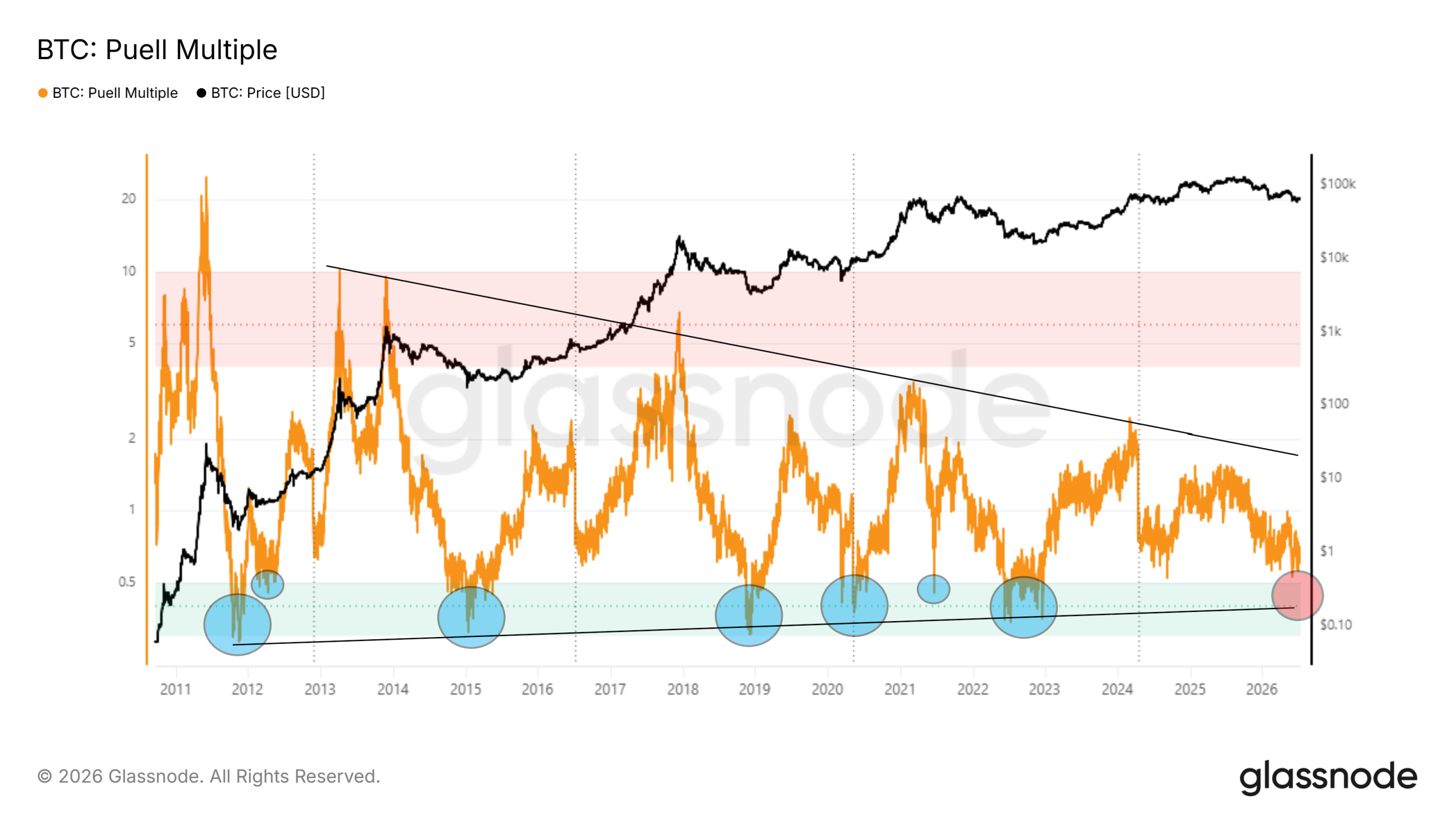
Puell Multiple Nears the Zone That Marked 5 Bitcoin Bottoms
The Puell Multiple divides the daily USD value of newly issued Bitcoin by its 365-day moving average. Readings below 0.5 have historically signaled miner capitulation and cyclical lows.
Glassnode data shows five extended visits to this zone. They occurred in 2012, 2015, late 2018, mid-2020, and late 2022. Each coincided with a macro low in the BTC price. The indicator also briefly touched the zone in 2012 and mid-2021.
Today, the multiple hovers just above 0.5. It is approaching the historical bottom zone but has not entered it decisively. Therefore, the data suggests the final low may still be ahead. A similar reading in early 2023 marked the moment miners stopped selling, and the market stabilized.

Meanwhile, the indicator’s peaks and troughs keep compressing from cycle to cycle. This long-term contraction mirrors Bitcoin’s declining volatility as the asset matures.
An analyst known as PositiveCrypto commented on the setup on X.
“Interesting. The Puell Multiple currently shows daily miner revenue well below its 365 day average, a setup that has always appeared at late bear market lows. Painful for miners as margins compress, but historically these are levels where BTC returns are greatest from.”
Long-Term Holder Supply Hits a Record 16.75 Million BTC
While miner revenue compresses, Bitcoin’s most patient investors keep buying. Long-term holder supply, defined as coins unmoved for more than 155 days, reached a record 16.75 million BTC on July 11, according to Galaxy Research.
That equals nearly 84% of the circulating supply. A record level while the price sits about 50% below its peak indicates steady accumulation rather than distribution.

The pattern is familiar. In each previous cycle, long-term holder supply pushed to new highs as the bear market deepened. It then kept climbing until the cyclical bottom formed. Recent flows support this reading, as long-term holders flipped back to net buying on July 11 and 12.
If history repeats, this metric could keep rising while the Puell Multiple grinds lower, until the market prints its final low.
What Both Signals Suggest for the BTC Price
The two indicators tell one coherent story. Strong hands are accumulating into weakness, but the capitulation that historically ends Bitcoin bear markets has not fully materialized.
A decisive Puell Multiple drop below 0.5, met with rising long-term holder supply, would replicate the setup of five previous cycle bottoms. On-chain models point to a possible low near $47,000, about 25% below the current price.
However, the indicator’s shrinking amplitude adds nuance. With volatility declining each cycle, a brief touch of the 0.5 boundary may prove sufficient this time.
Either the Puell Multiple completes its journey into the green zone and BTC carves out a durable low. Or patient accumulation absorbs the remaining sell pressure first, shortening the path to recovery.
The post Bitcoin Bear Market Bottom: What 2 Key On-Chain Signals Just Revealed appeared first on BeInCrypto.


Coinbase says it has moved far beyond early experiments with artificial intelligence, with executives describing AI as now being deeply embedded in how the exchange builds and tests software. In the wake of a May workforce reduction, the company’s leaders pointed to AI as a central reason it has been able to speed up development and reorganize teams.
According to Coinbase executives, more than 95% of the company’s code is now written by or with large language models (LLMs). That figure marks a sharp jump from an earlier estimate Coinbase shared in February, when it said AI supported about 40% of its code.
Key takeaways
- Coinbase reports that between 95% and 100% of its code is written by or with LLMs, according to platform chief Rob Witoff.
- The company links its May layoffs to a need to restore the “speed and focus” of its startup-era operations, placing AI at the core.
- Witoff describes a “wide spectrum” of AI usage—from human-led work on core cryptography to fully automated prototyping.
- Coinbase says smaller, senior teams can handle work that previously required far larger groups, with AI agents running continuously.
From “helping” to “writing”: Coinbase’s evolving AI role
Coinbase cut roughly 14% of its workforce in May, laying off about 700 employees. In an email to staff, CEO Brian Armstrong said the company needed to “return to the speed and focus of our startup founding, with AI at our core,” framing AI as a major shift in how work moves.
Speaking to Cointelegraph, Coinbase’s head of platform, Rob Witoff, said the company has reached a state where AI is used on an everyday basis. “Effectively, 100% of our employees are using AI on a daily basis,” Witoff said. He added that “close to 100% of our code” is written by or with LLMs—“probably somewhere between 95% and 100%.”
The size of that jump matters because it signals how quickly AI adoption has progressed within crypto infrastructure, not just as a productivity tool but as part of the coding workflow. Coinbase’s earlier February estimate—AI supporting around 40% of its code—suggests a rapid acceleration in how the exchange operationalizes AI in engineering.
Human oversight stays central for high-stakes cryptography
Even with such high automation claims, Witoff emphasized that Coinbase’s use of AI isn’t uniform across all parts of its stack. He described a “wide spectrum” in the way AI is deployed, depending on risk and complexity.
“For example, when we’re writing core cryptography, we have industry-leading cryptographers that are meticulously researching and reviewing one line at a time.”
In other areas, AI plays a different role. Witoff said AI is used heavily to test and verify that code behaves correctly and to help check for vulnerabilities. However, he portrayed this work as still requiring more manual oversight than the prototyping pipeline.
“We’re using AI quite a bit to test and make sure the code we’ve written is working the way it should, there’s no vulnerabilities, we’re verifying the math,” Witoff said, adding that this verification process remains more hands-on. By contrast, he said internal prototyping is now “effectively a 100% automated” workflow.
For builders and investors watching how AI reshapes crypto companies, this distinction is important: the move toward AI-driven development appears strongest in low-to-medium risk areas like prototyping and iteration, while core security work remains tightly supervised by specialized experts.
Smaller teams, more senior judgment—and the “agent” layer
Coinbase also linked its AI-driven coding changes to a reorganization of how teams are structured. Witoff said the company has been able to move toward smaller, more senior groups, where two or three employees can handle work that previously required 10 or more people.
He noted that the May layoffs disproportionately affected junior roles, describing “a lot of junior development roles” among those impacted. While engineering saw major changes, he also said cuts extended beyond developer functions, including positions in marketing, legal, customer support, and compliance.
“For those smaller teams to work, for people to have the taste, the judgment, I think a lot about people having the battle scars so they know how to point agents in the right direction.”
The “agent” concept is a key part of the operational picture. Witoff said most Coinbase engineers now work with five to 10 AI agents running at any given time, and that these agents collectively perform coding work equivalent to about 1,200 employees.
Looking further ahead, Witoff suggested that by 2030 AI agents could do the equivalent work of 100,000 employees. While such projections are inherently speculative, the company’s internal framing underscores a broader industry belief: once AI agents are integrated into development processes, the bottleneck shifts from generating code to steering systems responsibly and validating outcomes—especially where security and correctness are non-negotiable.
AI-led restructuring is spreading across crypto
Coinbase’s story fits into a wider pattern seen across the sector this year, where multiple crypto firms cited AI-driven efficiency as they rebalanced headcount.
In March, crypto exchange Crypto.com cut about 12% of staff, according to Cointelegraph reporting, affecting roles that “do not adapt in our new world.” Earlier, Block CEO Jack Dorsey said he was cutting about 40% of the company’s workforce, describing AI-enabled changes to how companies build and operate.
Other crypto organizations mentioned in the same broader wave include Kraken, Gemini, Messari, and Dune, each of which has been reported to have adjusted staffing in part as they increased AI use.
For market participants, this matters beyond workforce headlines. When exchanges and crypto services reduce layers of staffing while increasing reliance on AI-driven workflows, it can change how quickly they ship product, how they manage operational risk, and how they allocate resources between core engineering and support functions.
There is still an open question for readers: how sustainable and measurable these gains are over time, especially for the parts of the stack that require specialized security review. Coinbase’s next signal will likely be whether its AI-heavy approach continues to hold up under stress—whether in scaling performance, minimizing vulnerabilities, or maintaining reliability as token and user activity grows.
Stablecoin treasury platform Velocity has raised $38 million in a Series A funding round to expand infrastructure that helps enterprises and financial institutions use stablecoins for cross-border settlement and treasury operations.
The funding round was led by Dragonfly and FirstMark, with participation from Activant Capital, Capital One Ventures, QED Investors, Coinbase Ventures, Wintermute Ventures and Ripple. Velocity said it plans to use the capital to expand its banking and payments network, develop new products and strengthen its regulatory capabilities.
Founded in 2025, Velocity develops software that connects stablecoin networks with banking, custody, compliance and settlement systems. The company targets enterprise finance teams, payment providers, fintech firms and financial institutions using stablecoins for cross-border payments and treasury operations.
The latest financing brings Velocity’s total funding to nearly $50 million since it launched in 2025, according to the company.
Related: JCB signs Circle MOU to test stablecoin payments in Japan
The funding comes as competition in the enterprise stablecoin market intensifies. In June, more than 140 companies backed the launch of Open USD (OUSD), a dollar-pegged stablecoin supported by companies including Visa, Mastercard, Coinbase and Ripple.
Stablecoin infrastructure investment accelerates
Investment in stablecoin infrastructure has accelerated this year as companies build the software and network infrastructure supporting payments, settlement and enterprise financial services.
In March, Tether participated in a $5.2 million funding round for Ark Labs, a startup building infrastructure for stablecoin issuance and settlement on Bitcoin. The company is developing a programmable execution layer to enable faster payments and more complex financial applications on the network.
Later that month, OpenFX raised $94 million in a Series A funding round to expand its stablecoin-based foreign exchange network, which is designed to speed up cross-border payments for businesses. The company said it would use the capital to expand into Southeast Asia and Latin America while increasing liquidity across its network.
Trace Finance secured $32 million the following month to expand its cross-border payment infrastructure, which combines banking, foreign exchange and stablecoin settlement services for businesses operating across multiple markets.
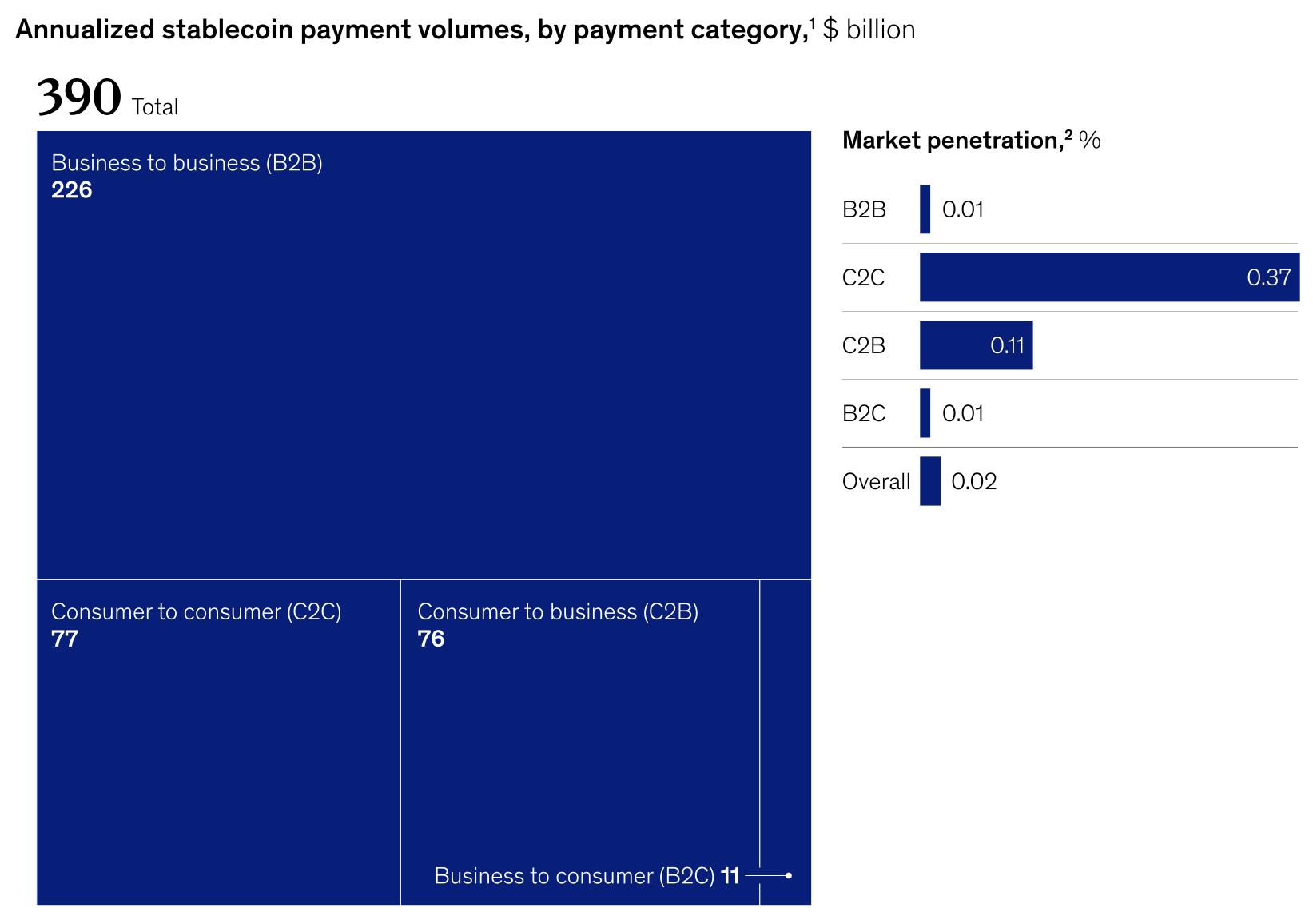
The investments come as stablecoin payments continue to expand. A joint analysis by McKinsey and Artemis Analytics estimated that stablecoins processed $390 billion in annualized real-world payments in 2025, including about $226 billion in business-to-business transactions.
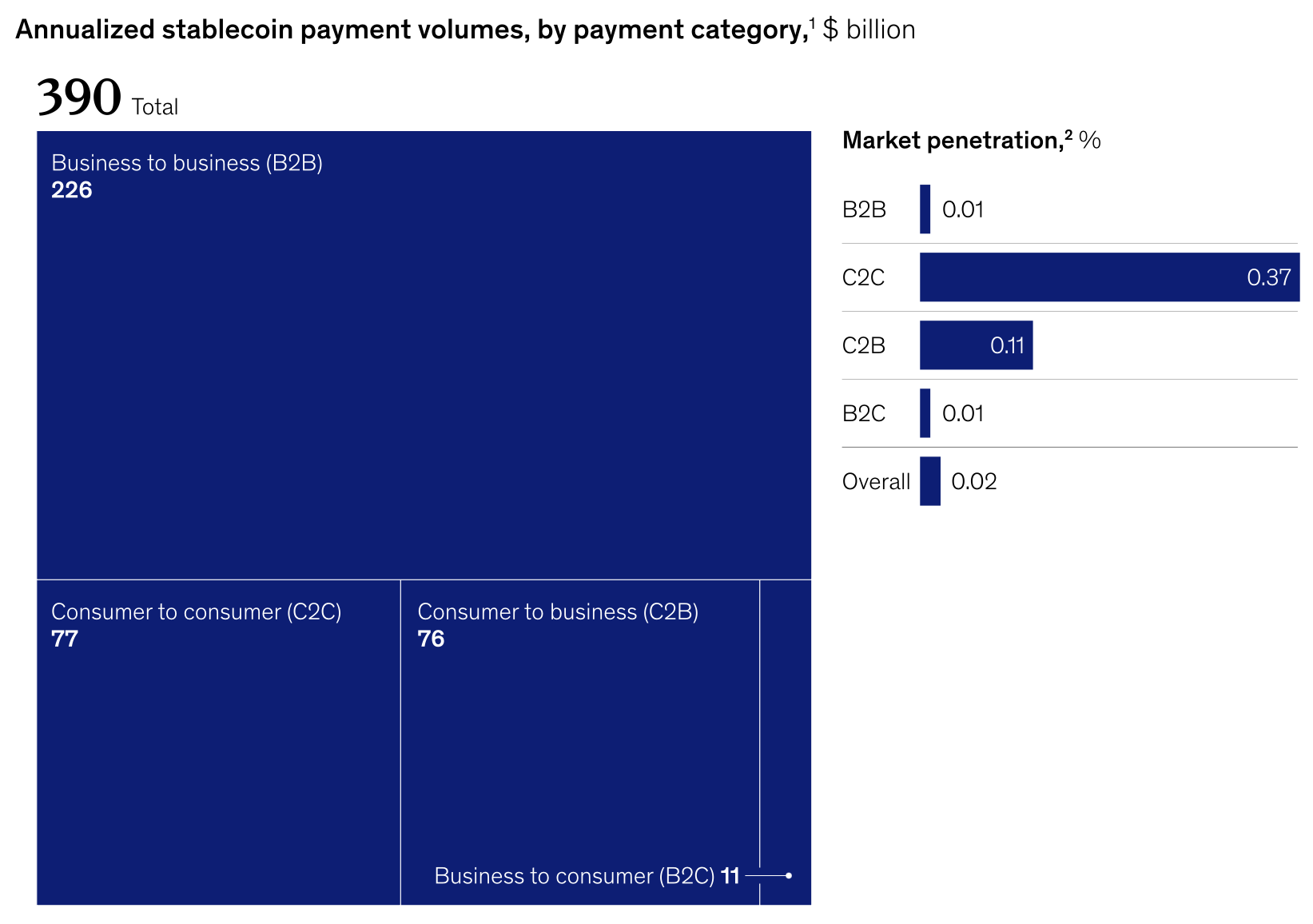
Annualized real-world stablecoin payment volume by use case. Source: McKinsey, Artemis Analytics
Magazine: UK government defers capital gains on certain crypto with ‘no gain, no loss’ approach

Riyadh, Kingdom of Saudi Arabia – The Global AI Show Riyadh held from 29-30th June,2026 cementing its status as the definitive anchor for the Kingdom’s newly designated “Year of Artificial Intelligence.”
Defying the challenges of the prevailing geopolitical landscape, organized by VAP Group and powered by Times Of AI, the event emerged as a resounding success. Co-located with Global Blockchain Show Riyadh and Global Games Show Riyadh, the two-day summit attracted 15,000+ registrations, welcomed 6,723 attendees, featured 100+ global speakers and 100 exhibitors, and convened a 70% CXO-level delegation from 80+ countries. The unprecedented international participation reinforced Kingdom of Saudi Arabia’s growing role as a global AI powerhouse while marking a decisive shift from experimental AI pilots to centralized, nation-scale AI deployment.
As a forward-looking platform, the Global AI Show served as an example of how to create an environment for collaboration, constructive dialogue, and ultimately action, connecting the newest technologies with large-scale, real-world applications across multiple sectors and government entities. The event also witnessed the announcement of VAP Group’s most ambitious initiative yet- The launch of VAP Ventures, a strategic initiative to back 100 startups by 2030 and accelerate the next chapter of the global innovation ecosystem.
The 2026 edition highlighted the “Human-AI Interaction” framework. Keynote tracks focused heavily on workforce planning, AI-driven recruitment, and upskilling programs designed to equip the next generation of Saudi talent with the tools required to steer autonomous digital agents.
A Worldwide Convergence of Thought Leaders and Visionaries
The Global AI Show welcomed attendees from all over the world, including AI enthusiasts, developers, and government officials. This diverse mix of attendees highlights that AI isn’t just a concept anymore; it’s being adopted across industries as a key component for optimizing workflows.
The first day of the Global AI Show witnessed an opening keynote by Dr. Mohammed Nasser Alshahrani, Executive Advisor to the Minister, Council of Economic and Development Affairs,Kingdom of Saudi Arabia, on why data quality will define the winners of the AI era and how trustworthy, transparent AI systems can drive real-world impact.
Day 2 opened with the keynote speech by Nezar Al Turki, Chief Information Officer, Ministry of National Guard, outlining the shift from digital transformation to AI transformation and the leadership, governance, and workforce foundations required to scale AI-driven enterprises.
Actionable Insights Arise At The Global AI Show Riyadh
The two-day summit featured panel discussions, keynote speeches, informal discussions, and industry-relevant sessions. The discussions on the agenda included practical examples and opportunities for incorporating AI further into modern-day industries.
The summit explored the next frontier of artificial intelligence through discussions on agentic AI, sovereign AI infrastructure, enterprise AI transformation, responsible governance, AI-powered healthcare, financial services innovation, cybersecurity, workforce development, and the future of human-AI collaboration. Michael Lints, Founding Partner MENA, Golden Gate Ventures remarked, “The AI era is reshaping venture capital. Today’s founders need more than funding, they need access to infrastructure, strategic partnerships and global networks that help them move from breakthrough ideas to scalable businesses faster than ever before!”
The sessions also examined scalable AI deployment, investment opportunities, digital public infrastructure, intelligent automation, and the role of AI in accelerating Saudi Vision 2030 while strengthening cross-border innovation and economic collaboration.
Few Notable Speakers Included:
- Dr. Ibraheem Sheerah – Chief Transformation Officer, Digital Transformation & Technology, Saudi Arabian Airlines Holding (Saudia Group)
- Eng. Layla AlSalehi – Director General, Ministry of Health, Kingdom of Saudi Arabia
- Paul Pacifico – Chief Executive Officer, Saudi Music Commission, Ministry of Culture
- Nate Busa – Executive Director, AI & Emerging Technologies, NEOM
- Amal Dokhan – Managing Partner, 500 Global MENA
- Kalyana Sivagnanam – Group Chief Executive Officer, Petromin Corporation
- Ayman Alhabib – Chief Data & AI Officer, D360 Bank
- Abdulrahman Alonaizan – Head of Data & Artificial Intelligence, Arab National Bank (ANB)
- Alyn Bailey – Chief Human Resources Officer, Albawani Holding
- Abdulaziz Al-Ghufaili – AI & Digital Transformation Leader, Saudi Aramco
- Abdullah Alshargi – AI & Innovation Executive, Saudi Authority for Data and Artificial Intelligence (SDAIA)
- Aamir Khalid Pirzada – Chief Technology Officer, Mozn
- Dr. Mohamed Alhussein – Artificial Intelligence Advisor & Digital Transformation Leader
- Global AI founders, policymakers, investors, researchers, and enterprise technology leaders representing 80+ countries, driving discussions on the future of agentic AI, enterprise transformation, and sovereign AI ecosystems.
Innovation and Exhibition Spotlight
The exhibition floor emerged as a vibrant hub of innovation, bringing together a diverse lineup of leading technology companies, AI pioneers, startups, and solution providers showcasing cutting-edge advancements shaping the future of artificial intelligence. From enterprise AI platforms and cybersecurity to HR technology, observability, autonomous systems, and intelligent infrastructure, exhibitors and sponsors demonstrated real-world solutions that fostered meaningful collaborations, sparked investment conversations, and accelerated technology adoption across industries.
Few Notable Exhibitors:
- Zen HR
- Netskope
- Nournet
- Magna AI
- Sarj Digital Information Technology CO.
- Edarat Group
- NTT Data
- Dynatrace
- Scale AI
- AQUIVIO Inc.
- Takween
- SAS
- Thethinkthankx
- ait
- Emotii
- OPM UAE
- Fanruan Software
- ManageEngine
- Wakeb Data Company
- Kamsora
- Sigmix Inc.
- Cloud Wave Telecommunications and Information Technology Company LLC
- Spark.ai
- Open
- Sirma Group Holding
- Wafra Greentech
AI Moves From Being An Afterthought To A Key Driver of Innovation
It’s not a surprise to see AI transforming how industries operate these days. From simply generating reports to optimizing workflows in critical areas like healthcare, the technology has made almost every aspect of work more efficient. The Global AI Show united innovators, regulators, and policymakers under one roof to ensure AI is scaled and incorporated into systems responsibly.
“What we’ve built with the Global AI Show goes far beyond a conference into a catalyst for global innovation. Seeing thousands of innovators, decision-makers, and entrepreneurs come together in Riyadh has been incredibly inspiring.Our vision has always been to create a platform where conversations lead to collaboration and collaboration leads to action. VAP Ventures is the natural next step in that journey, empowering founders who will shape the future of global innovation.” — Vishal Parmar, Founder & CEO, VAP Group
The momentum established at this summit will carry forward to the next Global AI Show set for Abu Dhabi on 12-13 November, 2026. This creates a perfect window for the discussions at Riyadh to materialize into something tangible and distribution-ready for the Abu Dhabi edition.
About Global AI Show
The Global AI Show is the definitive international stage where the future of artificial intelligence is forged. Hosted by VAP Group, this premier AI summit and conference unites global CXOs, visionary policymakers, and tech pioneers to move beyond the hype and address the real-world impact of AI.
About VAP Group
With 13+ years of expertise, VAP Group is a premier global consulting and media powerhouse driving the next wave of technology-led growth.
Through its media ecosystem and flagship events, including the Global AI Show, Global Games Show, and Global Blockchain Show, VAP Group connects policymakers, enterprises, and innovators worldwide, enabling strategic communications, ecosystem-building, and talent solutions.
Media Enquiries: media@globalaishow.com


The European Central Bank has selected 36 payment firms, including Deutsche Bank, for a digital euro pilot as Europe presses ahead with its CBDC plans.
Summary
- ECB has selected 36 payment firms, including Deutsche Bank, for its digital euro pilot.
- The 12-month pilot starts in 2027 as the EU prepares for a possible 2029 CBDC launch.
- The move contrasts with ongoing U.S. efforts to block a Federal Reserve-issued CBDC through 2031.
According to a July 14 announcement from the European Central Bank (ECB), the selected payment service providers will participate in a 12-month pilot beginning in the second half of 2027. The testing program will involve the ECB, 19 national central banks and private-sector firms as officials continue preparations for a possible digital euro launch by 2029.
Among the companies chosen for the program are Deutsche Bank, Revolut Bank, Stripe and UniCredit. The pilot will examine the digital euro’s technical performance, operational processes and user experience using a beta version of the currency that will not have legal tender status.
ECB Executive Board member Piero Cipollone said the level of participation from payment providers demonstrates that private-sector firms are prepared to contribute to the project and support the development of Europe’s payments infrastructure.
The pilot expands testing before any launch decision
During the testing phase, some participating firms will allow users to create beta digital euro accounts and make payments through the experimental platform. According to the ECB, other providers will focus on additional services linked to the pilot instead of customer-facing features.
The central bank also said staff at participating national central banks will conduct person-to-person and person-to-business beta transactions. Those payments will be tested across physical retail locations, including Software Point of Sale systems, as well as e-commerce platforms and mobile payment channels.
The ECB stated that the pilot forms part of its ongoing preparatory work and does not represent a final decision to issue a digital euro. Officials have said any eventual launch would depend on the completion of the legislative process within the European Union.
Meanwhile, the European Parliament has already voted in favor of digital euro legislation, allowing work on the proposed CBDC framework to continue alongside the technical testing program.
Europe advances while the US continues opposing a CBDC
As European institutions continue developing a digital euro, policymakers have said the project could reduce dependence on payment networks such as Visa, Mastercard and Apple Pay. At the same time, the proposal has drawn criticism from some observers who have raised concerns over financial privacy and transaction monitoring.
The digital euro initiative is also progressing alongside the European Union’s implementation of the Markets in Crypto-Assets (MiCA) framework, under which several crypto companies, including Ripple, OKX and Coinbase, have received regulatory approval to operate in the region.
Across the Atlantic, the policy direction remains different. As crypto.news reported last week, President Donald Trump refused to sign the 21st Century ROAD to Housing Act, even though the legislation includes a provision preventing the U.S. Federal Reserve from issuing a central bank digital currency through 2031 and has remained on course to become law.
According to a Truth Social post cited by crypto.news, Trump said he was withholding his signature because the Senate had not yet passed the Save America Act, legislation he has repeatedly urged lawmakers to approve. The outlet also reported that Trump had delayed signing the same housing bill a month earlier for the same reason, describing the voting measure as a higher legislative priority.
Taken together, the developments leave the world’s two major economic blocs pursuing different paths, with the ECB expanding preparations for a possible digital euro while the United States continues debating whether the Federal Reserve should be allowed to issue a CBDC at all.
Crypto World
AI-Driven LiveOps and Mobile Dominance Take Center Stage at Global Games Show Riyadh 2026

Riyadh, Kingdom of Saudi Arabia – Riyadh cemented its status as the world’s most vibrant sandbox for interactive media as the Global Games Show Riyadh held from 29-30th June, concluded its highly anticipated two-day B2B run. Shifting focus away from traditional console lifecycles, the event leaned heavily into technological innovations that transformed the back end of game development, including cloud gaming, AR/VR, and automated AI game design. It also focused on an emerging gaming platform: mobile phones.
Defying the challenges of the prevailing geopolitical landscape, organized by VAP Group and powered by Times Of Games, the event emerged as a resounding success. Co-located with Global AI Show Riyadh and Global Blockchain Show Riyadh, the two-day summit attracted 15,000+ registrations, welcomed 6,723 attendees, featured 100+ global speakers and 100 exhibitors, and convened a 70% CXO-level delegation from 80+ countries. Bringing together game developers, publishers, Web3 gaming pioneers, esports leaders, investors, content creators, technology providers, and policymakers, the event showcased how gaming is rapidly evolving into a multi-billion-dollar global ecosystem at the intersection of artificial intelligence, blockchain, immersive technologies, digital ownership, and entertainment. The event also witnessed the announcement of VAP Group’s most ambitious initiative yet- The launch of VAP Ventures, a strategic initiative to back 100 startups by 2030 and accelerate the next chapter of the global innovation ecosystem.
The Global Intersection For Entertainment And Digital Entertainment
The Global Games Show opened with a keynote by Johnson Yeh, Founder & CEO of Ambrus Studio, who explored the future of immersive gaming, highlighting how emerging technologies are redefining player experiences beyond traditional screens.
Also, a keynote by Virginia Villar Arribas, Director of the Private Sector Partnerships Service at the UN World Food Programme, who demonstrated how gaming and play can drive social impact by advancing global awareness, education, and humanitarian initiatives.
The Global Games Show Riyadh attracted game studios, publishers, Web3 gaming, esports, investment, technology providers, and game communities from across the globe. The event highlighted the fact that the world of gaming and digital entertainment has evolved at an unprecedented rate. Mobile-centric ecosystems took the center stage, and the discussions at the event have established this new platform as a key economic engine.
In this context, Charity Joy, CEO, Mirai said, “The future of gaming will be defined by immersive experiences, meaningful communities and the incredible talent building them. What excites us most about the Kingdom of Saudi Arabia is the ambition, creativity and passion of its young developers. They aren’t just participating in the future of gaming, they’re helping create it!”
Mobile gaming has also altered the competitive landscape, with discussions highlighting that expensive PCs and consoles aren’t a requirement to get into esports. Games like PUBG and Mobile Legends Bang Bang set the ball rolling, and other games are following suit all over the world.
Visionaries in Gaming Defined the Next Generation of Gaming
Over the course of the event, key visionaries and thought leaders discussed key aspects of gaming and esports. These themes and agendas included:
Few Notable Speakers Included:
- Johnson Yeh – Founder & CEO, Ambrus Studio
- Nayef BinHumaid – Chairman of the Board, Saudi Baseball and Softball Federation
- Nadeem Bakhsh – Chief Executive Officer, webook.com
- Virginia Villar Arribas – Director, Private Sector Partnerships Service, UN World Food Programme (WFP)
- Hassan Yusuf – Head of Partnerships, Real Madrid Foundation – Education Football Program powered by Riyadh Schools
- Kanessa Muluneh – Chief Executive Officer, Rise of Fearless
- Yasmina Kazitani – President, Blockchain Game Alliance
Few Notable Exhibitors:
- ClubMOS Technologies LLC
- Cropr Digital Limited
- Plotdex
- JPYR
- Arkonix
- TorusChain Association
- Smartflow
- The Loopcraft
- EGS
- Setup Master the Art of Gaming
- Venn Studio
Mobile Gaming and Digital Ownership At the Core of Digital Entertainment
As mobile gaming and digital ownership rapidly evolve, their combination is redefining how digital entertainment is perceived and consumed worldwide. The agenda featured deep dives into how decentralized architectures enable new avenues for player ownership, monetization, and community engagement, rewriting the traditional dynamic between developers and their audience. Furthermore, esports pioneers and gaming founders addressed the maturity of the mobile esports ecosystem across the MENA region, Asia, and LATAM, examining the next generation of tournament structures and revenue-generation models.
“The future of gaming belongs to those who can bring together technology, creativity, and community. Global Games Show is where those conversations begin, and we’re excited to see the ideas born in Riyadh evolve into the next generation of global gaming experiences.” – Vishal Parmar, Founder & CEO, VAP Group
Building the Future of Gaming By Addressing the Foundational Pillars of Gaming
The conclusion of Global Games Show Riyadh 2026 set the foundation for the evolution of interactive gaming and digital entertainment. The positive momentum generated by attendees, exhibitors, and speakers at this event will inform the decisions that will shape the discussions at the Global Games Show 2026 Abu Dhabi.
About Global Games Show
The Global Games Show is the ultimate B2B gaming event for the next evolution of interactive entertainment. This elite event series is dedicated to uniting major industry titans, visionary developers, and investors to map out the future of gaming.
About VAP Group
With 13+ years of expertise, VAP Group is a premier global consulting and media powerhouse driving the next wave of technology-led growth.
Through its media ecosystem and flagship events, including the Global AI Show, Global Games Show, and Global Blockchain Show, VAP Group connects policymakers, enterprises, and innovators worldwide, enabling strategic communications, ecosystem-building, and talent solutions.
Media Enquiries: media@globalgamesshow.com

Humanity Protocol says it is tightening its operational security after an exploit that traced back to a compromised employee laptop and led to the theft of $36 million worth of Humanity (H) tokens. In remarks to Cointelegraph, founder Terence Kwok said the incident stemmed from production keys that were inadvertently copied onto the laptop during the company’s mainnet launch last year.
The breach underscores a broader shift in crypto hacking: rather than only targeting smart contract bugs, attackers increasingly focus on human and process weaknesses—phishing, endpoint compromise, and operational handling of sensitive keys. Security firm Quantstamp linked the phishing delivery to North Korea-linked threat actors and described malware installation that provided remote access to the affected machine.
Key takeaways
- Humanity Protocol attributes a June $36 million loss to compromised endpoint security rather than a smart contract flaw.
- Founder Terence Kwok says production keys—admin hot wallet keys and multisig owner keys—were unintentionally backed up to a laptop after last year’s mainnet launch.
- Quantstamp reported that the initial intrusion used a phishing email and a malicious attachment disguised as a Bithumb token schedule update.
- The incident fits a wider H1 2026 pattern highlighted by CertiK: phishing drove Q1 losses, while wallet compromises dominated Q2.
- Industry data in the period continues to associate major thefts with North Korea-linked activity, keeping geopolitical threat a central concern for operators.
Why Humanity is changing its security posture
Humanity Protocol’s founder framed the incident as a hard lesson in operational security. Kwok explained that the attackers gained the leverage needed to steal tokens from last year’s mainnet launch period, when several production keys were inadvertently backed up onto an employee laptop.
According to Kwok, those copied items included administrative hot wallet keys as well as a quorum of multisig owner keys across both chains. The company is now “rebuilding accordingly,” emphasizing that the defenses protecting smart contract logic must be matched by protections around key management processes and the systems employees use day-to-day.
For investors and users, this distinction matters because smart contract audits and formal verification can’t fully mitigate failures in how private keys are stored, accessed, and recovered. When key material leaks through endpoint compromise, even well-written code can become irrelevant to the attacker’s path to funds.
Details of the exploit: from phishing attachment to remote access
The compromise became public last month, when Cointelegraph reported that a compromised employee laptop enabled attackers to steal $36 million in Humanity (H) tokens. CoinMarketCap data puts the token’s current market capitalization at roughly $211 million, at the time of the report.
Quantstamp’s analysis pointed to phishing as the entry point. In its assessment, a malicious attachment delivered via a phishing email was disguised as a token lockup schedule update associated with South Korean exchange Bithumb. Once opened or processed, the attachment installed malware on the machine and gave the attackers remote access.
Operationally, that chain of events is a reminder of how quickly attackers can move from social engineering to direct access. Rather than waiting for a vulnerability in decentralized infrastructure, the threat model shifted to the environment where keys and operational access controls live.
Operational failures are becoming a dominant attack theme
The Humanity incident aligns with broader findings from blockchain security research during the first half of 2026. CertiK reported that cryptocurrency exploit losses were heavily driven by operational failures and social engineering schemes.
In the first quarter of 2026, CertiK said phishing drove the majority of losses, totaling $508 million. By the second quarter, wallet compromises emerged as the biggest attack vector, contributing $807 million in losses. CertiK also cautioned that year-over-year declines can be misleading: while hack losses fell 46.8% year-on-year to $1.32 billion in the first half of 2026, the reduction was influenced by a major outlier, the $1.4 billion Bybit hack in early 2025.
During Q2 2026 specifically, CertiK noted that more than 70% of losses came from the Drift Protocol and KelpDAO exploits—both widely attributed to North Korean state-sponsored hackers. Humanity’s experience fits this same general pattern of sophisticated actors leveraging weaknesses outside the smart contract code itself.
North Korea-linked activity remains a central risk
Quantstamp tied the phishing delivery used in Humanity’s case to North Korea-linked threat actors. The report also echoes a wider set of security observations about the scale of thefts linked to such activity.
The article notes that North Korea-linked threat actors were associated with at least $578 million of the $634 million stolen in crypto-related incidents in April alone. That concentration helps explain why many security teams keep focusing on threat intelligence and adversary capabilities—not only the technical vulnerabilities of protocols, but also the delivery mechanisms attackers use to reach systems and accounts.
For crypto organizations, the implication is clear: even if contract code is robust, attackers may still win by targeting the operational and human layers around deployment, custody, and key handling. Humanity’s stated response—rebuilding operational security after an exploit linked to misplaced key backups—directly reflects that reality.
Going forward, readers should watch how Humanity Protocol implements key management changes and whether it will publicly outline new operational controls—especially around backup procedures, access separation, and endpoint risk reduction—since those are now the obvious weak points. More broadly, the market will likely treat operational security measures as a comparable priority to smart contract audits whenever large thefts trace back to compromised systems.

Disclosure: This article does not represent investment advice. The content and materials featured on this page are for educational purposes only.
Quantum computing concerns are renewing focus on Bitcoin security as institutions research long-term cryptographic protections and network resilience.
Summary
- Quantum computing concerns revive Bitcoin security debate as EX DeFi highlights cloud mining alternative.
- Bitcoin quantum risk gains attention as EX DeFi promotes cloud mining amid security discussions.
- Bloomberg report renews focus on Bitcoin’s quantum risks as EX DeFi spotlights cloud mining.
With the continued development of quantum computing technology, the future security of Bitcoin has once again become a focus of market attention.

According to Bloomberg, research by Galaxy Digital indicates that in the long term, approximately $470 billion in Bitcoin assets may face potential security risks from quantum computing, representing about one-third of the current total value of circulating Bitcoin. However, this risk remains theoretical at present, as existing quantum computers do not yet possess the practical ability to crack Bitcoin’s encryption algorithm.
Quantum security draws attention, industry prepares in advance
Bitcoin uses a public-key and private-key encryption mechanism to ensure asset security. It is widely believed in the industry that if quantum computing capabilities achieve significant breakthroughs in the future, existing encryption systems may face new technological challenges. To this end, Coinbase has established a quantum security advisory committee, and large institutions such as Strategy have begun researching related solutions to prepare for potential future network upgrades.
Although quantum computing still has a long development cycle before it truly threatens the Bitcoin network, digital asset security, infrastructure construction, and long-term sustainable development capabilities are becoming important issues of continued concern for industry investors.
Meanwhile, as market attention to digital asset security and risk management continues to grow, more and more investors are exploring more diversified ways to participate. Compared to direct Bitcoin trading, EX DeFi cloud mining provides users with an option to participate in the Bitcoin ecosystem through continuous computing power, offering a relatively reduced impact from short-term market volatility.
Cloud mining: Another way to participate in the Bitcoin ecosystem
Amidst market volatility and technological change, more and more investors are focusing on digital asset participation methods beyond direct buying and selling, hoping to explore more diversified participation paths while focusing on the long-term development of Bitcoin.
Compared to traditional mining, which requires purchasing specialized mining equipment and bearing electricity and equipment maintenance costs, the cloud mining model centralizes hardware deployment, computing power management, and operation and maintenance work, all handled by the platform. Users only need to choose the appropriate computing power plan according to their needs to participate in the Bitcoin network and receive corresponding returns according to the platform’s rules.
EX DeFi’s compliance infrastructure
As a digital asset service platform, EX DeFi has established a relatively complete compliance management system at the operational level, mainly reflected in the following aspects:
The platform is registered and operates in the UK and conducts business in accordance with relevant regulatory requirements.
The core operational architecture references relevant regulatory frameworks such as the EU’s MiFID.
The platform undergoes regular security and compliance audits by PwC.
The digital asset custody system incorporates Lloyd’s of London insurance protection mechanisms.
These measures help improve the platform’s transparency and standardization in areas such as fund management, information disclosure, and system security.
EX DeFi’s security system
In terms of security, the platform employs mechanisms such as separate storage of cold and hot wallets and multi-signature authorization to further enhance the security level of user assets.
Simultaneously, the system integrates Cloudflare enterprise-grade network protection, McAfee cloud security system, and two-factor authentication (2FA), and is equipped with real-time risk monitoring and abnormal behavior identification mechanisms, providing multi-layered security protection for platform operations.
How to join EX DeFi and participate in mining services
Step 1: Register an Account. Visit the official EX DeFi platform and complete registration. New users will receive a $17 reward upon registration.
Step 2: Complete Account Deposit
Go to the deposit page, obtain the official wallet address, and complete the transfer (minimum deposit amount is $100 USD).
Step 3: Select a Hashrate Plan
Choose a suitable mining contract based on your budget and time horizon. The system will automatically settle earnings during the contract’s execution period.
Referral rewards program
Users can also participate in the EX DeFi referral program and enjoy a 3% + 2% referral reward mechanism. By inviting friends to join the platform, you have the opportunity to earn up to $50,000 in referral commissions, further expanding your income sources and achieving long-term earnings growth.
Popular short-term mining contracts
BTC (Beginner Trial Contract): Investment of $100, Term: 2 days, Daily Yield: $4, Total Profit: $100 + $8
DOGE (Golden Shell Mini Dogecoin Pro): Investment of $500, Term: 6 days, Daily Yield: $6.5, Total Profit: $500 + $39
BTC (Canaan-Avalon-A1466): Investment of $1,000, Term: 10 days, Daily Yield: $13.4, Total Profit: $1,000 + $134
LTC (Bitmain-Antminer-L7): Investment of $5,000, Term: 20 days, Daily Yield: $73.5, Total Profit: $5,000 + $1,470
BTC (Bitmain-S19K-Pro): Investment of $10,000, Term: 30 days, Daily Yield: $161 Total Profit: $10,000 + $4,830
For more details on mining contracts, please visit the EX DeFi official website.
About EX DeFi
EX DeFi is a global platform focused on green energy cloud mining and digital asset services, headquartered in the UK and founded in 2021. The platform supports multiple mainstream digital assets such as Bitcoin (BTC), Ethereum (ETH), and Ripple (XRP), and is committed to providing global users with a more convenient and efficient way to participate in digital assets through intelligent computing power and cloud computing technology.
To improve operational efficiency and practice sustainable development, EX DeFi’s data centers are deployed in areas rich in renewable energy resources, primarily using hydropower, wind power, and solar power. The platform offers a variety of flexible intelligent computing power solutions, allowing users to participate in the digital asset ecosystem through cloud mining without purchasing mining equipment or possessing professional technical skills, enjoying a simpler and more efficient user experience.
Join the EX DeFi cloud mining platform now and start the passive income journey!
Disclosure: This content is provided by a third party. Neither crypto.news nor the author of this article endorses any product mentioned on this page. Users should conduct their own research before taking any action related to the company.
Artificial intelligence now helps write more than 95% of Coinbase’s code, offering new insight into the crypto exchange’s AI strategy following its decision to cut 14% of its workforce earlier this year.
Coinbase cut 700 staff in May. In an email to employees, Coinbase CEO Brian Armstrong said AI has “dramatically” changed the pace of work and there was a need to “return to the speed and focus of our startup founding, with AI at our core.”
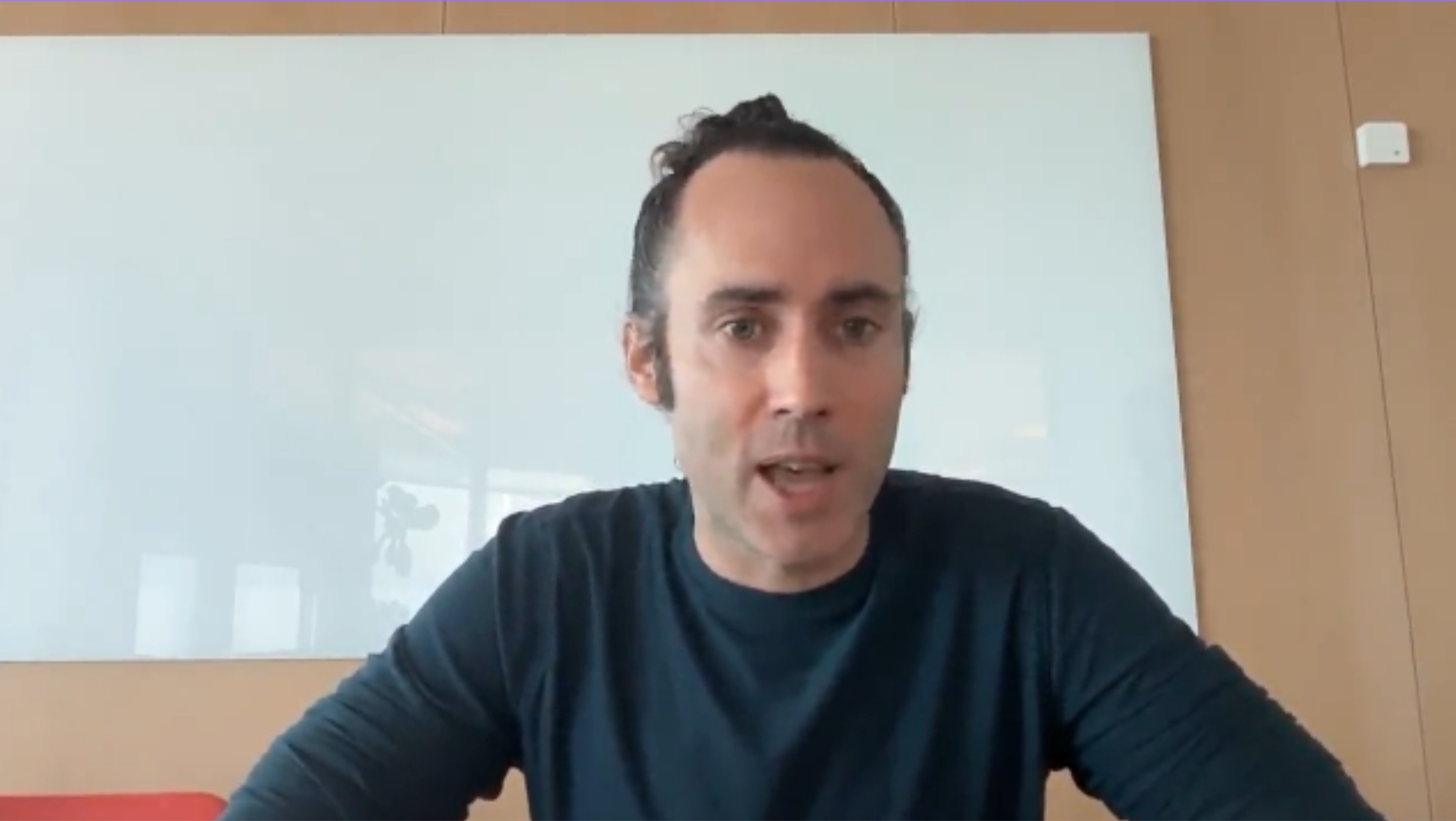
“Effectively, 100% of our employees are using AI on a daily basis here,” Coinbase’s head of platform, Rob Witoff, told Cointelegraph. “And close to 100% of our code, probably somewhere between 95% and 100%, is written by or with LLMs today.”
The figure is more than double Coinbase’s February estimate, when the company said 40% of its code was written with AI, reflecting the accelerating pace of AI adoption across tech and crypto companies.
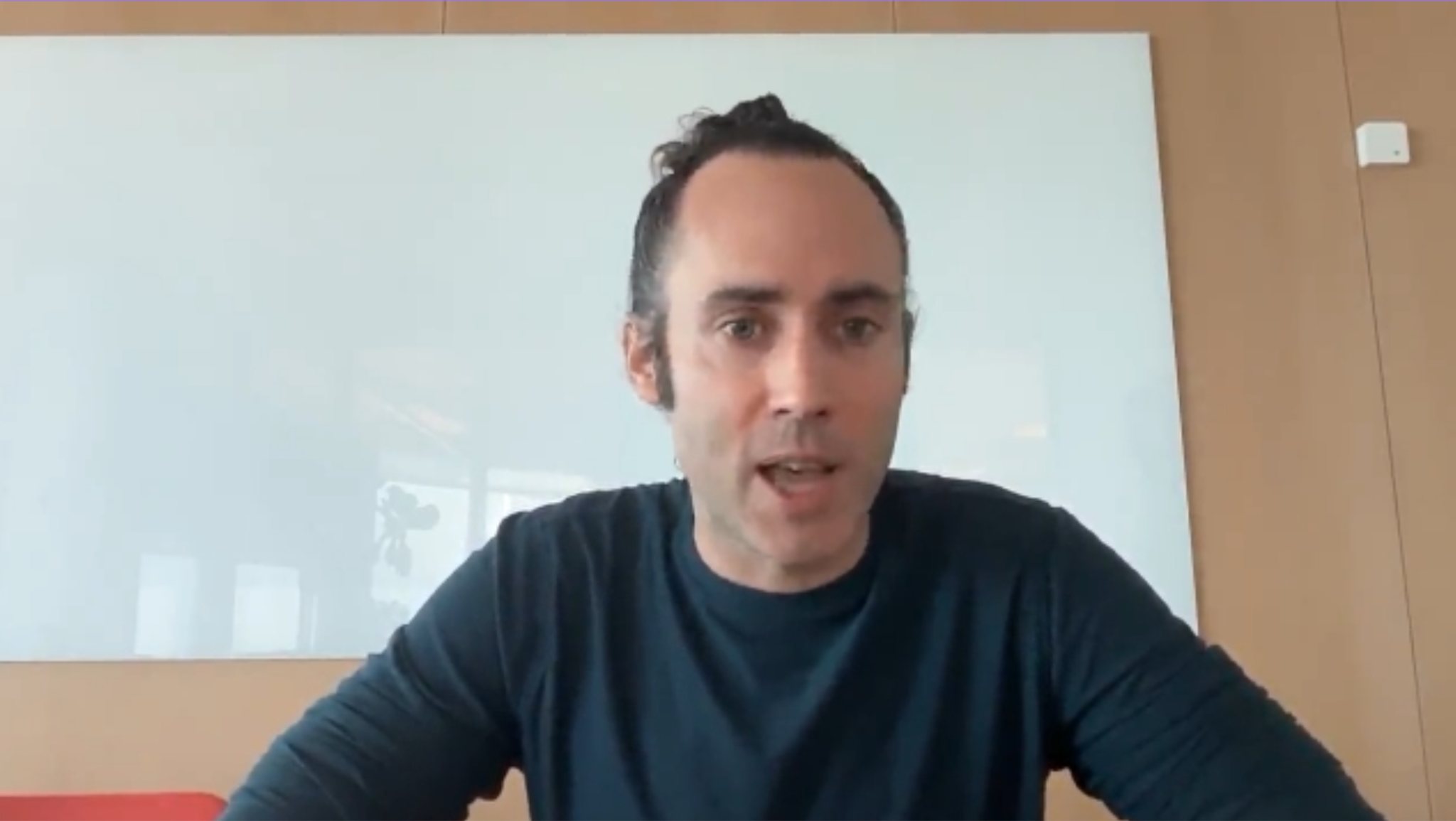
Rob Witoff talks about Coinbase’s adoption of AI. Source: Cointelegraph
Witoff, however, said there is a “wide spectrum” in how it is used and the degree to which it is relied on. While writing core cryptography mainly relies on human input, prototyping is fully automated and core systems sit somewhere in the middle, he said.
“For example, when we’re writing core cryptography, we have industry-leading cryptographers that are meticulously researching and reviewing one line at a time.”
“We’re using AI quite a bit to test and make sure the code we’ve written is working the way it should, there’s no vulnerabilities, we’re verifying the math, but that’s a much more manual part than where we’re building internal prototypes, which is now effectively a 100% automated.”
Smaller teams with “tastemakers”
The shift has allowed Coinbase to reorganize around smaller, more senior teams, Witoff said, with two or three employees now capable of handling work that previously required 10 or more people.
“There were a lot of junior development roles that were impacted,” he said of the May layoffs, though the cuts extended across the company, including marketing, legal, customer support and compliance roles.
“For those smaller teams to work, for people to have the taste, the judgment, I think a lot about people having the battle scars so they know how to point agents in the right direction.”
Witoff said that most Coinbase engineers now have five to 10 AI agents operating at any given time, with AI agents collectively performing the coding work of about 1,200 employees.
By 2030, Coinbase could see AI agents doing the equivalent work of 100,000 employees, he said.
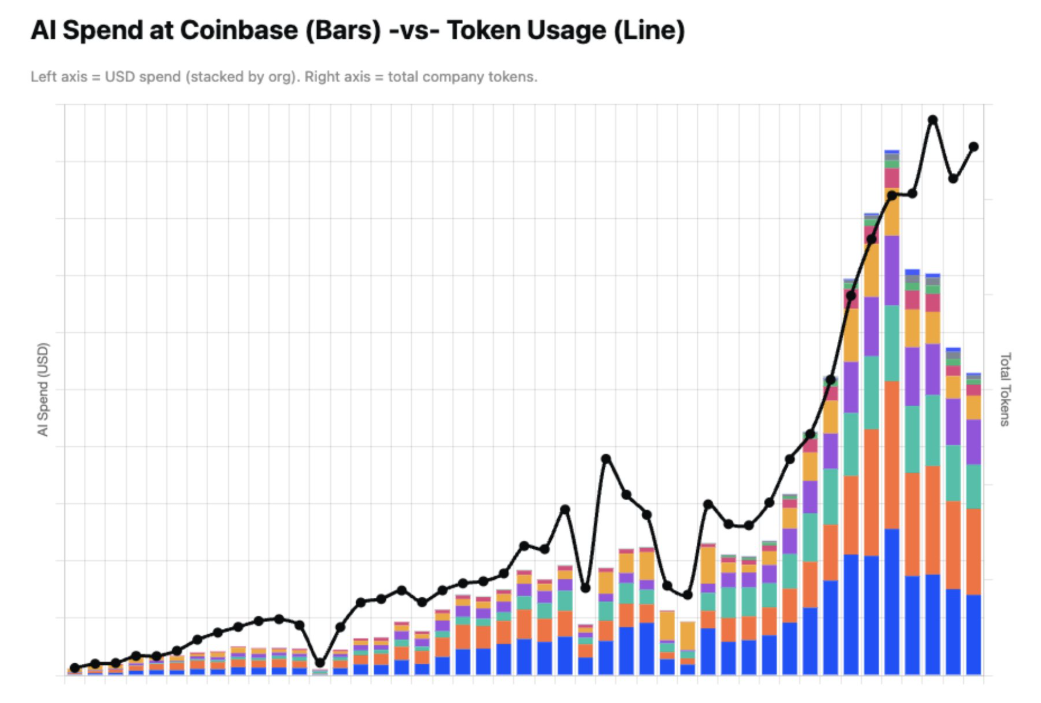
Coinbase said its AI spend has remained “flat” despite growing token use. Source: Brian Armstrong
Related: Robinhood says its AI agent feature will ‘soon’ be assisting crypto traders
Coinbase was part of a wave of companies to lay off staff this year amid a rise in enterprise AI. In March, crypto exchange Crypto.com cut 12% of its staff, impacting roles “that do not adapt in our new world.”
In February, Block CEO Jack Dorsey said he was cutting 40% of Block’s workforce.
“We’re already seeing that the intelligence tools we’re creating and using, paired with smaller and flatter teams, are enabling a new way of working which fundamentally changes what it means to build and run a company,” Dorsey said on X.
Other crypto companies that cited AI-related efficiencies in this year’s layoffs included Kraken, Gemini, Messari and Dune.
Magazine: Robinhood L2 sparks ETH optimism, Saylor ‘muddies waters.’ Hodler’s Digest, July 5-12, 2026
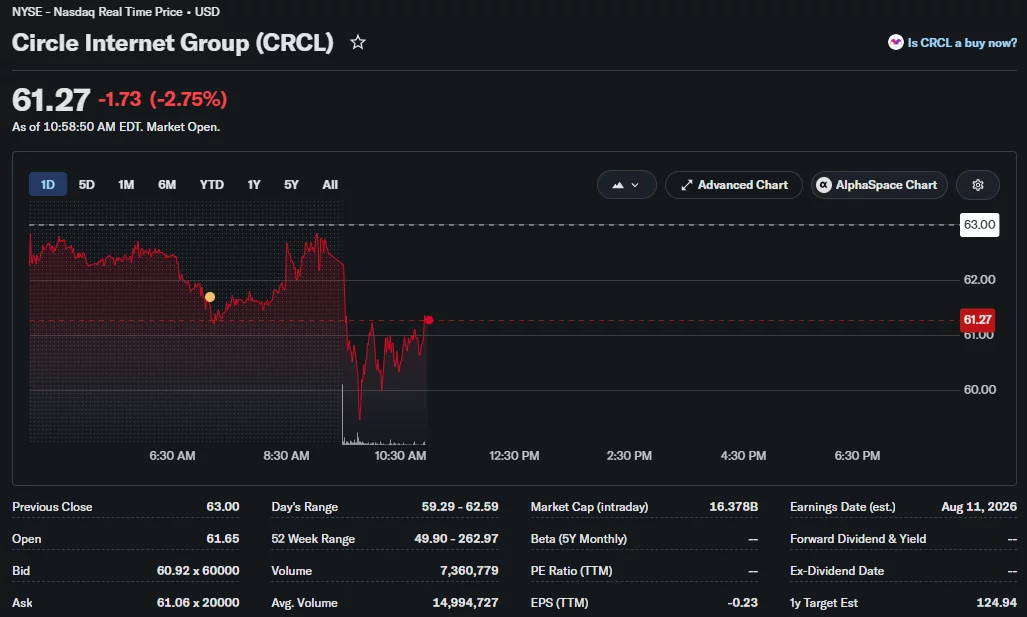
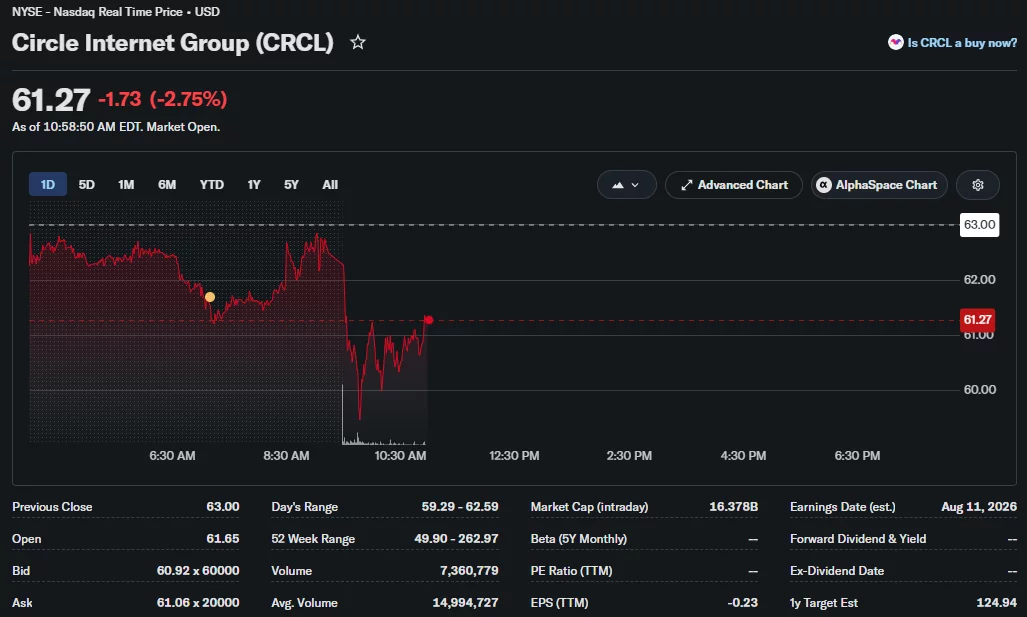
Circle Internet Group shares have dropped more than 2% in pre-market trading after US banking groups urged the Senate to tighten stablecoin provisions in the CLARITY Act, adding fresh pressure to the stock.
Summary
- US banking groups urged the Senate to tighten the CLARITY Act, citing stablecoin yield loopholes.
- Circle shares fell in pre-market trading as regulatory uncertainty added pressure to the stock.
- Baird cut its CRCL price target to $100 despite maintaining a positive long-term outlook.
According to a joint letter from several US banking organizations, the groups have asked Senate majority and minority leaders to revise Section 404 of the CLARITY Act before lawmakers move the bill forward.
The banks argue that the current wording could allow stablecoin issuers to offer interest-like incentives that encourage customers to move money out of traditional bank deposits and into stablecoins such as Circle’s USDC.
The letter warns that unclear language around yield-related incentives could increase deposit flight, particularly from community and regional banks.
“Ensuring that stablecoin regulations draw clear and enforceable boundaries around interest- and yield-like incentives is therefore essential.”
The renewed lobbying effort comes days after President Donald Trump called on Congress to pass the CLARITY Act in honor of Senator Lindsey Graham, who died on July 12. However, crypto.news previously reported that the bill’s chances of clearing the Senate have weakened after a key White House adviser supporting the legislation took a one-month leave.
The report added that the probability of passage has fallen to 37%, although a Senate floor vote is still expected before lawmakers begin their August 7 recess.
Selling pressure keeps Circle stock near a critical support zone
Fresh political uncertainty has coincided with continued weakness in Circle shares, which have extended their decline after retreating sharply from the stock’s June peak near $140.
The daily chart shows CRCL trading around $61, just above a major Fibonacci support level at $59.39. This area has become an important line for buyers, as a decisive break below it would leave little chart support before the psychologically important $50 level.
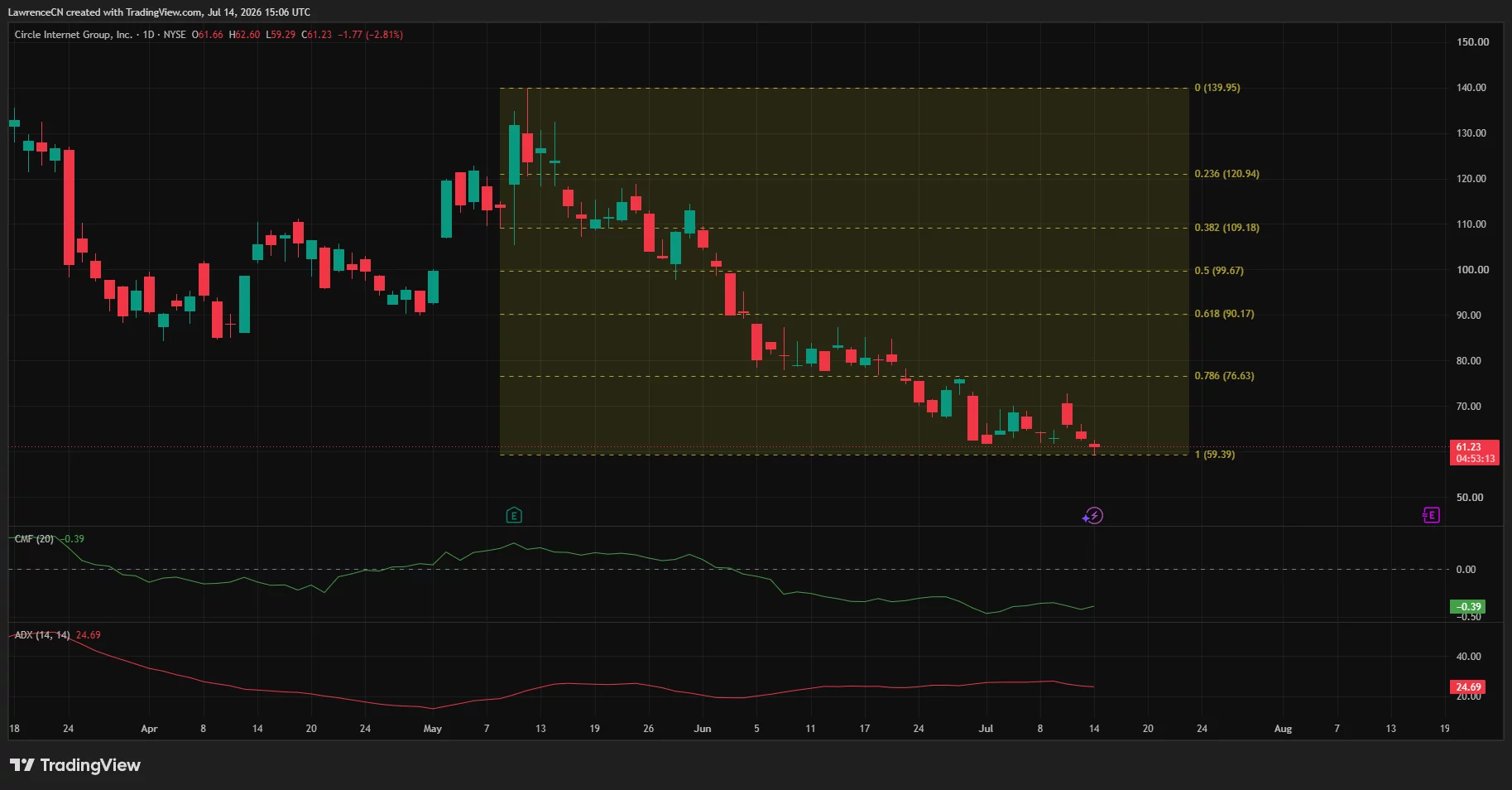
Momentum indicators also continue to favor sellers. The Chaikin Money Flow remains near -0.39, indicating sustained capital outflows from the stock, while the Average Directional Index sits around 24.7, suggesting the existing downtrend still carries moderate strength.
Even if buyers manage to stabilize the decline, recovery attempts would likely face resistance at successive Fibonacci retracement levels near $76.63, $90.17, $99.67, $109.18, and $120.94, making any rebound technically challenging unless market sentiment improves.
Analysts remain divided despite long-term growth drivers
Despite the recent weakness, several developments continue to support Circle’s longer-term outlook.
Circle recently secured an Office of the Comptroller of the Currency national trust bank charter, allowing the company to operate a federally regulated trust bank. Separately, ARK Invest purchased roughly $13.8 million worth of CRCL shares on July 9, signaling continued confidence from the investment firm even as the stock traded well below its recent highs.
At the same time, Baird has adopted a more cautious stance. The investment bank lowered its price target on Circle from $138 to $100, citing expectations that the company’s second-quarter 2026 revenue will fall short of Wall Street estimates.
Baird also warned that the launch of the OUSD stablecoin on June 30 could erode Circle’s share of the stablecoin market over time, potentially weighing on future demand for CRCL shares. Still, the firm maintained that Circle’s compliance with the GENIUS Act could strengthen adoption of USDC as the regulatory framework for dollar-backed stablecoins develops.
The primary cryptocurrency attempted a decisive rebound earlier this month, rising to nearly $65,000.
However, the bears intercepted the move and pulled the price to the current $62,600, while many analysts believe the cycle’s bottom has yet to be reached.
More Pain Ahead?
X user Aralez claimed that the asset’s “massive bull trap” is entering its final stage, predicting severe volatility in the following months. The analyst expects the price to first rally toward $70,000, only to hit strong resistance and reverse sharply to around $39,000. After that final shakeout, they forecast a new long-term uptrend that could send BTC to as high as $150,000 by late 2027.
X user Crypto Lens shared a similar thesis, envisioning a plunge below $50,000 sometime this week and a crash under $40,000 by August. “Don’t become the exit liquidity,” they warned.
The analyst, who goes by symbiote on X, also chipped in. They believe BTC has roughly 80 days left before reaching its cycle bottom, basing the projection on the asset’s performance during the previous bear markets in 2018 and 2022.
Bitcoin’s Market Value to Realized Value (MVRV) ratio suggests that the actual floor still appears to be ahead. The figure has been declining over the past several months but has not yet dropped below 1, which, according to CryptoQuant, has historically marked “generational buying opportunities and cycle bottoms.”

The Bullish Scenario
Other analysts are more optimistic and outlined important reasons why BTC might be on the verge of a short-term resurgence. X user AlΞx Wacy noted that the asset recently hit its most oversold monthly reading in history: a development that is often a precursor of a rally.
For his part, Ali Martinez paid attention to BTC’s Accumulation Trend Score, which has remained close to 1. This signals persistent accumulation by large investors, which is usually a bullish factor for the price.
One should also keep in mind that July has historically been a positive month for BTC. The asset has finished the period in the red only four out of 13 times, and it remains to be seen whether another green print is ahead.

The post Bitcoin (BTC) in Trouble: Analyst Sees a Potential Drop Below $40K appeared first on CryptoPotato.

Mr Waterville’s flat run to prepare him for 2026 Grand National Hurdle

Grok Build was uploading entire Git repositories to xAI’s cloud, including committed secrets

Coinbase Says AI Now Writes Over 95% of Its Code


-

 Fashion6 days ago
Loro Piana Fall 2026 Enters Houston’s Art Scene
-

 Fashion4 days ago
Weekend Open Thread: Nutriplenish Leave-In Conditioner
-
 Sports5 days ago
2026 Genesis Scottish Open Thursday TV coverage: Round 1
-

 Tech7 days ago
Anthropic brings Claude Cowork to mobile and web as usage data shows most users aren’t coding
-

 Sports5 days ago
Super Eagles star Moses Simon opens up on Liverpool transfer regret
-

 Tech5 days ago
Character.AI enters the microdrama arena with its own productions, but there’s a twist
-

 News Videos6 hours ago
XRP BOMBSHELL… XRP OMBOARDED FOR TRANSACTIONS!!!
-

 Tech20 hours ago
Get Your ESP32 Sunny Side Up With This Solar Dev Board
-

 Tech5 hours ago
Dark Secrets Emerge When Jailbreaking LLMs
-

 News Videos6 days ago
Crypto Just Entered Its Most Important 6-Month Candle (Could Decide Everything!)
-
 Business7 days ago
ASX 200 Slides Over 0.6% as Rare Earths and Lithium Stocks Tumble Amid Global Semiconductor Sell-Off Today
-
 NewsBeat6 days ago
Major update after Huntingdon train attack as man enters plea
-
 Business7 days ago
Will Trent shares rebound after Q1 update triggers 13% crash? Here’s what technical charts indicate
-

 News Videos1 day ago
how to make coin bank box with cardboard #scienceproject #money #diy #shorts
-

 Business7 days ago
SpaceX Shares Slide Nearly 6% Amid Post-IPO Volatility and Starship Test Focus
-

 Sports6 days ago
39-year-old Djokovic wins five-hour thriller to enter Wimbledon semis | Other Sports News
-

 Tech6 days ago
Level Infinite Launches Gangstar Mirage City in India with Pre-Registrations
-
 Tech1 day ago
Cloudflare Precursor Watches Your Mouse and Keyboard To Decide If You Are Human
-

 Tech6 days ago
Entra passkey enrollment vishing targets Microsoft 365 users
-
 Crypto World6 days ago
DeFi Dashboard Zapper to Shut Down After 7 Years
You must be logged in to post a comment Login