Security teams log 54% of successful attacks and alert on just 14%. The rest move through your environment unseen.
The Picus whitepaper shows how breach and attack simulation tests your SIEM and EDR rules so threats stop slipping by detection.





A threat actor has published hundreds of fake GitHub repositories impersonating legitimate software and security projects to distribute infostealer malware.
The campaign drew traffic from search results for security products, cryptocurrency services, financial tools, developer utilities, secure email providers, macOS utilities, and gaming software.
The malware collects data from more than 19 web browsers, steals info from 32 cryptocurrency wallets, and exfiltrates sensitive details from messaging and social media apps.

Cybersecurity company ArcticWolf identified the activity after finding that one of its products was impersonated in the campaign starting June 26.
In total, the researchers uncovered 292 fake repositories, each including a README file with a download link directing visitors to a malicious download page.
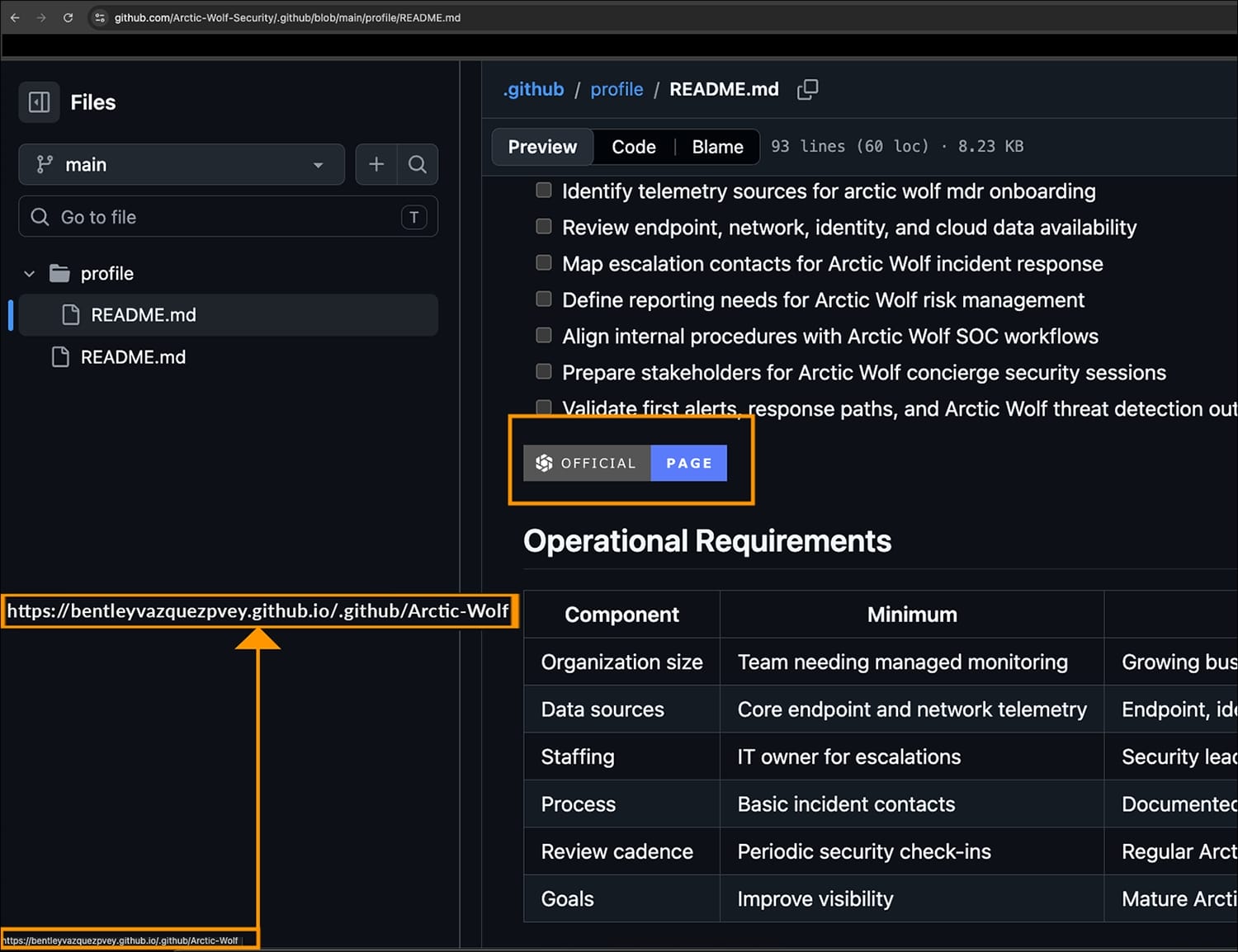
The landing pages feature wording and branding designed to inspire trust, such as a button named “Download Secure Content” and spoofed trust badges.
Analyzing the code for the delivery page, the researchers noticed that it relies on “a single templated HTML/JS artifact reused across all impersonated brands.”
” Its client-side script parses the URL path into two segments – path[0] as a user_code (the “rotating” path token, e.g., yyvxx9rswefr, which tracks the referring repository/redirector), and path[1] as the referrer domain (e.g., Arctic-Wolf[.]github.io),” Arctic Wolf says.
Visible branding is derived from a second segment when it is rendered, by replacing the hyphens with spaces and applying the proper title cases.

According to the researchers, the page delivers a large ZIP archive, whose name and payload is changed roughly every minute. Inside the archive is a trojanized libcurl.dll and a legitimate, signed WinGUP updater that gets a different name based on the impersonated product.
“When the user runs the executable, gup.exe side-loads libcurl.dll, which decodes and reflectively executes an embedded infostealer entirely in memory.”
The information stealer appears to be a variant of the BoryptGrab family, targeting the following data from infected systems:
The researchers note that this variant of BoryptGrab exhibits a previously undocumented capability to bypass Chrome’s App-Bound Encryption through direct code injection into the browser process.
The stolen data is compressed before being sent to a Russia-based command-and-control (C2) server.
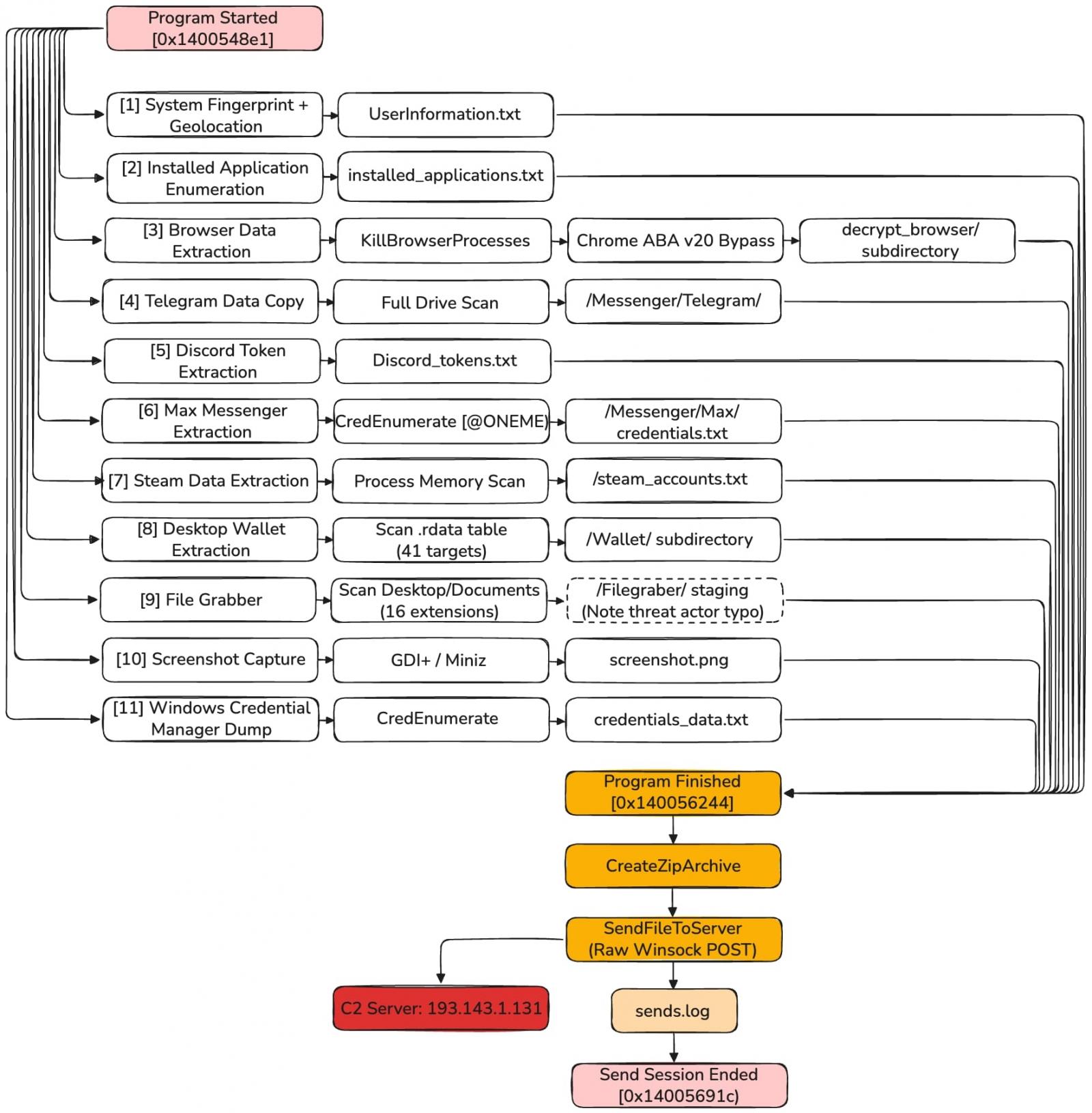
Arctic Wolf reports that the malware does not establish persistence on the host and is instead designed to collect as much data as possible in a single execution.
Similarly, there’s no anti-analysis layer at all, and the temporary directory where the collected data is stored during exfiltration staging isn’t wiped, leaving forensic evidence behind.
At the time of Arctic Wolf’s report, GitHub had removed a large portion of the malicious repositories, though the researchers report that several dozen GitHub Pages redirectors still remained active.
The researchers couldn’t attribute the campaign to a specific threat actor, though they assess that the operator is likely Russian-speaking and financially motivated.
Arctic Wolf concludes that the success of the campaign depends entirely on users trusting “free downloads” of premium software tools and recommends caution when interacting with unofficial GitHub pages.
The researchers shared a Yara rule for detecting this activity along with indicators of compromise (IoCs) associated with BoryptGrab.

Security teams log 54% of successful attacks and alert on just 14%. The rest move through your environment unseen.
The Picus whitepaper shows how breach and attack simulation tests your SIEM and EDR rules so threats stop slipping by detection.
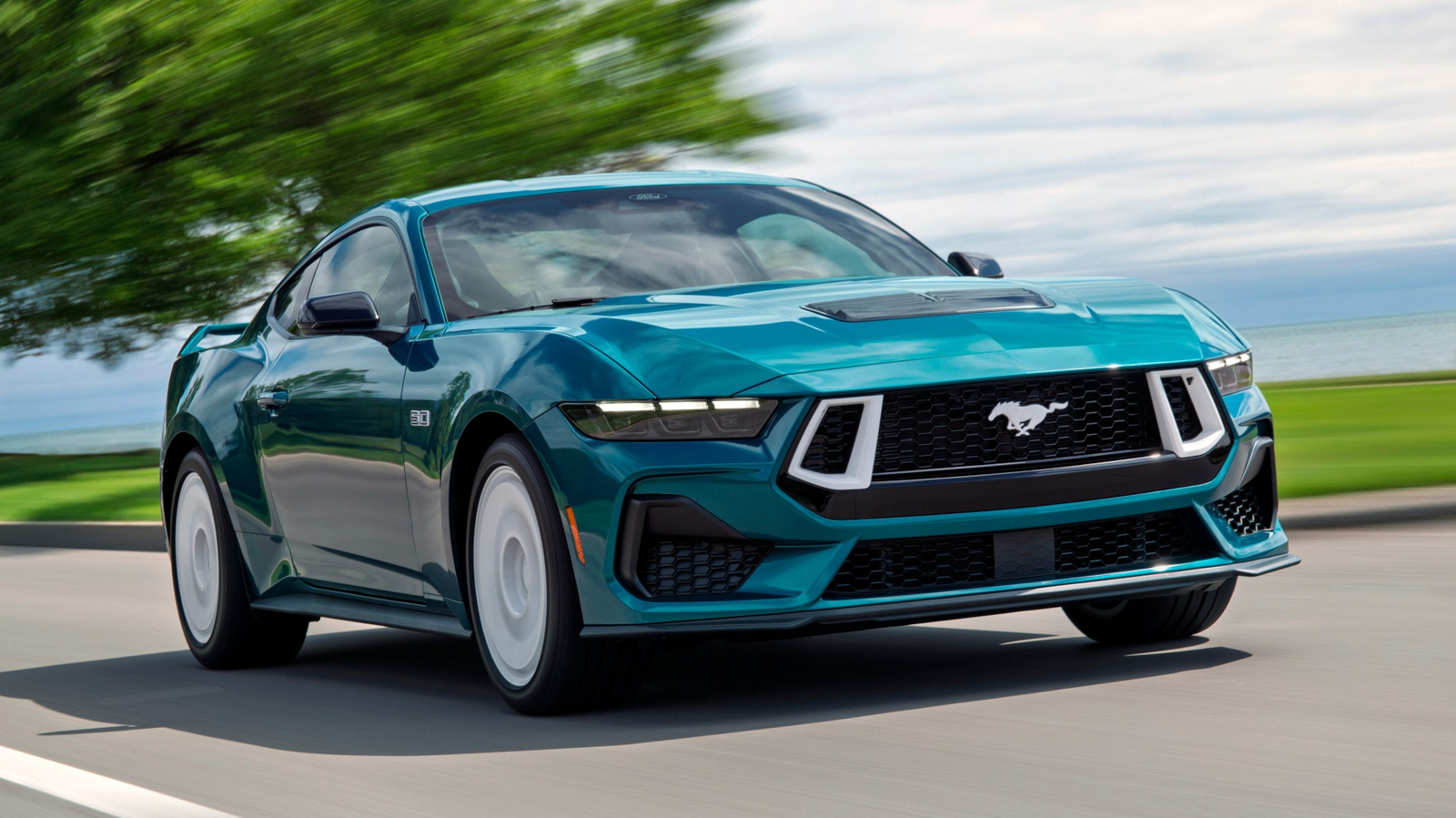
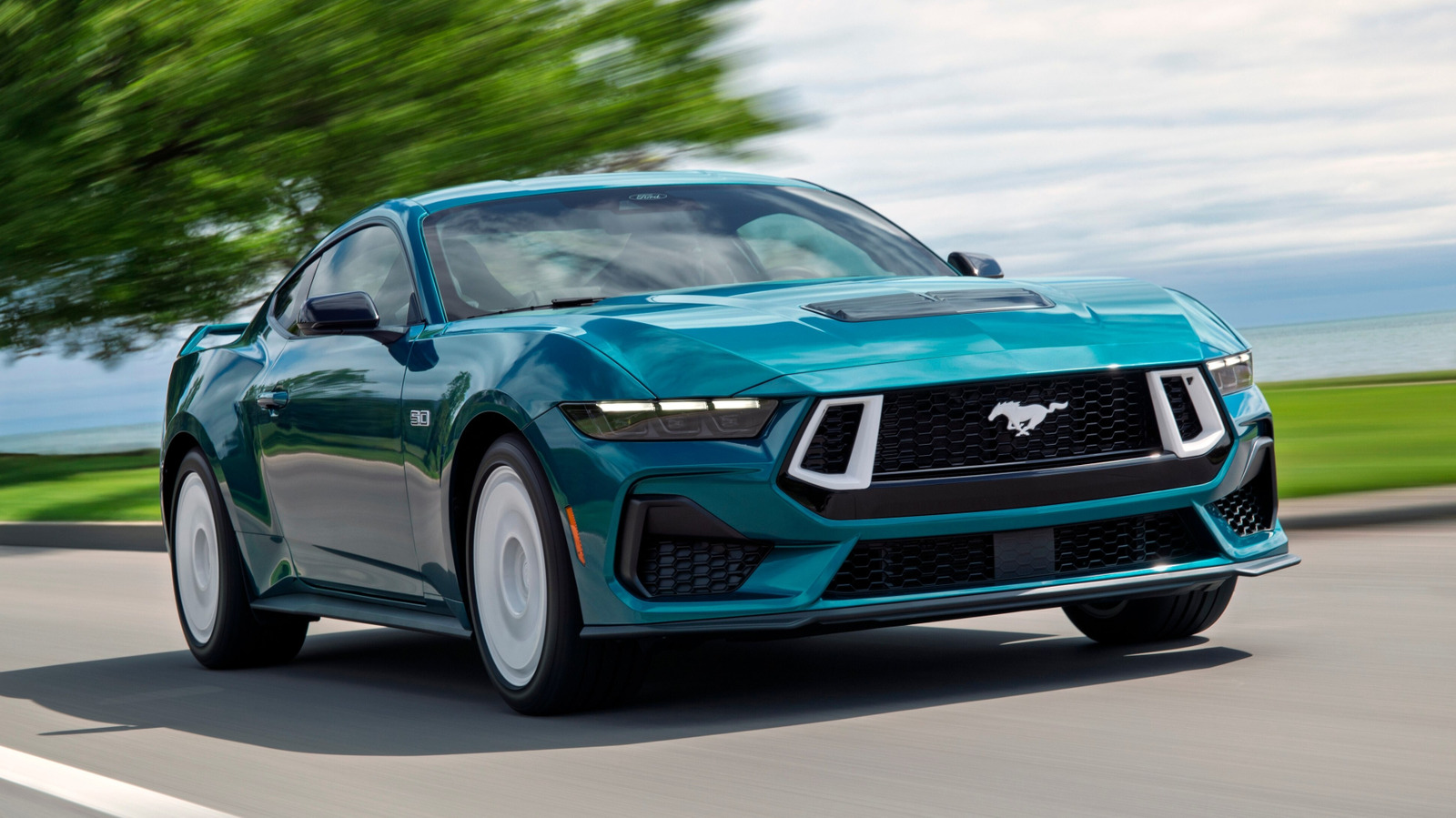
Even though its price has climbed steadily in the last decade, the Ford Mustang GT is still one of the more exciting performance cars on the market. There are lots of reasons buyers might be drawn to it, and its 5.0-liter V8 engine is surely one of the big ones. A naturally aspirated V8 once represented the backbone of the American performance car scene, and with Chevy axing the Camaro and Dodge’s V8 models all currently on hiatus, the Mustang has become the only (relatively) affordable game in town.
However, part of the reason V8s are otherwise so few and far between is that manufacturers have increasingly shifted to smaller-displacement engines, including turbocharged V6s. And in some cases, these V6s can actually outgun the 480-hp V8 Mustang GT in straight-line performance.
The Mustang’s acceleration will vary depending on which transmission it has, but the average figures for the GT show a 0-60 time in the low to mid four-second range and a quarter-mile run in the low to mid 12-second range. Those are stout numbers, and for many buyers, the Mustang GT’s V8 soundtrack is non-negotiable — but if you compare the Mustang to modern V6-powered performance cars, you’ll find several that can edge it out in straight-line acceleration.
With General Motors discontinuing the Chevrolet Camaro, those looking for a front-engine, rear-drive GM performance car now have to move up to Cadillac’s Blackwing-branded sport sedans. When it comes to V6-powered performance sedans, the Cadillac CT4-V Blackwing is one of the hottest around, with its twin-turbocharged 3.6-liter engine rated at 472 hp and 445 lb-ft of torque.
The CT4 has slightly less horsepower than the Mustang GT, but at the track it can hit 60 mph in four seconds flat and run the quarter mile in 12.4 seconds, with the automatic being slightly quicker than the manual version. While the acceleration battle between the two cars is close, the Mustang GT gets the win in the value department with its sub $50,000 starting MSRP coming in substantially cheaper than the CT4-V Blackwing’s mid $60,000s base price. This isn’t surprising given the Blackwing’s more luxurious persona and branding.
The Cadillac may not have the V8 engine that so many associate with American performance cars, but the numbers show the CT4-V Blackwing is more than capable of running with larger-displacement rivals. Better yet, our review of the manual transmission-equipped CT4-V Blackwing also showed the car to have an engagement and fun factor that goes beyond its performance figures.
As a two-door rear-drive sports car from a mainstream brand with a starting price in the mid-$40,000s, the Nissan Z is actually one of the Mustang’s most direct competitors in this group. And unlike other cars, which have downsized their engines in the modern era, a V6 engine has been a key part of the Nissan Z formula going all the way back to the mid-1980s. Today, all versions of the Z are powered by 3.0-liter twin-turbocharged V6 engine, but it’s the high-performance Nismo variant that makes the most of that V6 powerplant.
In its Nismo trim, the Z makes 420 hp and 384 lb-ft of torque — and when mated to an automatic transmission, testing has shown that combo is good for a 0-60 run of 3.9 seconds and a quarter-mile time of 12.4 seconds. These are impressive figures given the Z’s horsepower figures are actually fairly modest by mid-2020s performance car standards.
While we had some mixed feelings about its price, our review of the Nissan Z Nismo, showed that this machine has a lot to offer for fans of modern Japanese sports cars. If the Nismo Z’s price seems too high, the cheaper, non-Nismo version isn’t far off performance-wise, with low four-second 0-60 times and high 12-second quarter-mile ETs that put it pretty close to the Mustang GT.
Comparing the Mustang GT to the Audi S5 shows just how varied the modern performance car can be. The cars are of a comparable weight and size, but that’s about where their similarities end. The Mustang GT has a naturally aspirated V8 and rear-wheel drive, while the S5 has a twin-turbocharged V6 and all-wheel drive — and a price that starts in the mid $60,000s.
Rated at 362 hp, the S5’s 3.0-liter twin-turbocharged V6 engine is down by over 100 hp compared to the Mustang, but it claws back an acceleration advantage at the track thanks to that aforementioned all-wheel-drive system. Testing has shown the S5 to hit 60 mph in just 3.9 seconds, with the quarter-mile coming in 12.5 seconds.
Our review of the S5 Sportback showed the car to be a competent and quick luxury machine, but if that’s not enough for you, there’s always the new Audi RS5. The RS5 also has a twin-turbo V6 engine, but adds a plug-in hybrid electric boost for a total of 630 hp. This makes the car good for 0-60 times in the low three-second range and a quarter-mile time in the mid 11s. Just know that you can purchase two new Mustang GTs for the Audi’s $100,000-plus starting price.
You could say the R35 Nissan GT-R is an unfair addition to this list. For starters, you can’t actually buy a new one anymore, as Nissan ended production of the GT-R in 2025. And, going back to its debut in the late 2000s, the GT-R always played in a completely different segment than the Mustang GT, with a much higher price, and its sights set on high-end European supercars.
However, as an enduring symbol of the V6 engine’s performance potential, the GT-R is more than deserving. Earlier iterations of the GT-R used the legendary RB26 inline-six, but the R35’s switch to a new 3.8-liter twin-turbocharged engine showed just how capable a V6 could be. The R35 GT-R was in production for a long time, with a lot of updates along the way — and the Nismo variants of the car were rated at an impressive 600 hp and 481 lb-ft of torque.
At the track, the GT-R was capable of hitting 60 mph in 2.9 seconds and running the quarter-mile in the low 11s. Price aside, those are incredible numbers for a V6-powered car that was originally developed back in the 2000s. By the time Nissan pulled the plug on the R35, the GT-R was showing its age in many ways, but its raw performance figures still hold up against today’s best, no matter how many cylinders they may be packing.
Looking back through the Porsche brand’s long history of building performance cars, the V6 probably isn’t the first engine type that comes to mind, but it’s what powers — or powered – the higher-end versions of the brand’s popular Macan crossover SUV in recent years. With V6 power, the Macan is one of the more potent and practical performance machines on the market.
The high-performance Macan GTS variant gets its power from a 2.9-liter twin-turbo V6 that makes 434 hp and 405 lb-ft of torque, sending that power to all four wheels. In performance testing, the gasoline Macan GTS delivers, hitting 60 mph in 3.5 seconds and running the quarter-mile in just 12.1 seconds. On top of that, it also has handling that blurs the lines between crossover SUV and serious sports car.
In the real world, are there any buyers seriously cross-shopping any trim of the Porsche Macan against any trim of the Ford Mustang? Most likely not, but the fact that this V6-powered crossover SUV can show the V8 Mustang its taillights at the drag strip shows just how much the performance car has evolved in the modern era. Speaking of evolution, the gasoline-powered Macan is now on its way out, to be replaced by the new all-electric Porsche Macan, which has some big shoes to fill.

UN Secretary General António Guterres has called for lethal autonomous weapons, which he describes as ‘killer robots’ to be prohibited under international law following recent discussions at the first Global Dialogue on Artificial Intelligence Governance in Geneva.
Guterres’ demand to ban these weapons focuses on those capable of identifying, selecting and attacking targets without human oversight, which leaves artificial intelligence and other computer systems in charge of a life-or-death decision.
He ultimately argued that certain decisions must remain exclusively human, and the decision to take a life is well into the boundary of requiring human oversight. Transferring the decision-making to killer robots would be “morally repugnant” and “politically unacceptable,” he argued.
Key to the Secretary General’s argument is that he urges governments to take action and ban such robots now, rather than waiting for an autonomous weapon to cause a major incident before rethinking their strategies.
“Let us not wait for atrocity to act,” Guterres said. “Some decisions must remain forever human – none more than taking a human life.”
The issue is becoming more urgent now that AI models and advanced chips are already being used within military intelligence, targeting and other battlefield systems.
More broadly, Guterres’ thoughts align with those of Anthropic, which recently had a dispute with the Pentagon after seeking guarantees that its models would not be used for autonomous weapons or surveillance.
While the Pentagon had rejected those limitations, arguing that it should be able to use Anthropic’s models for any lawful purpose, the case highlights how private companies are becoming increasingly intertwined with digital warfare.
Reporting by the Wall Street Journal cited a similar view by Pope Leo XIV, who warns that AI-controlled weapons could promote an “anti-human” view of warfare. He warned that the autonomy could reduce some dangers and distance political leaders from the human consequences of conflict.
However, artificial intelligence does promise several benefits to modern warfare, particularly in its ability to process huge amounts of information extremely quickly. With modern compute, militaries can respond to threats at lightning speed, improve their accuracy and precision, reduce soldier risk and potentially reduce civilian casualties, too.
Critics also question whether human oversight of AI systems is at all meaningful if the person in charge only has seconds to act on AI-generated information in the first place.
It’s also yet to be determined which party or group of parties should be held accountable for any incidents or mishaps – human operators, commanders, hardware manufacturers and software developers are just some of the parties up for judgment.
“We may be the last generation able to set the terms on which humanity and machines coexist,” Guterres warned separately in an X post, warning that AI must be governed, trusted and fair.
“It sounds like science fiction, but it’s a real possibility, and it could change the world in ways that we don’t understand yet, and it could change the power dynamics of our planet in ways that require our attention,” Independent International Scientific Panel on AI Co-Chair Yoshua Bengio added.

Follow TechRadar on Google News and add us as a preferred source to get our expert news, reviews, and opinion in your feeds.

OpenAI’s second official statement concerning Apple’s trade secret lawsuit says nothing and is so generic that only an AI could have generated a statement so bland and empty.
Apple has alleged that OpenAI systematically recruited Apple employees that could help funnel secret information from within the company. Two individuals were specifically named , Tang Yew Tan, and Chang Liu.
On Tuesday, Bloomberg shared OpenAI’s latest statement on the matter. It’s a little more official versus the first that was provided by OpenAI’s spokesperson Drew Pusateri previously, but also much safer.
Originally, Pusateri shared that OpenAI has “no interest in other companies’ trade secrets.” The new statement goes like this:
“While we take these allegations seriously, we’re not aware of any evidence that this complaint has merit. We believe in fair competition and allowing people the freedom to work wherever they choose, and we’re focused on building innovative technology that empowers people everywhere.”
While legally less sound, the first statement actually had something to say on the matter. The new one feels like it was churned out by ChatGPT itself, with no regard for the actual accusations being made.
This isn’t some tiny case regarding a rogue employee, it’s Apple’s attempt to curb OpenAI’s hardware development plans that were set to debut a product in 2027. Ultimately, OpenAI wanted to build an iPhone killer, whether or not that will be a smartphone remains in question.

iPhone is becoming an AI powerhouse with or without OpenAI
OpenAI has poached something like 400 employees from Apple over the years, mostly through exorbitant pay packages. While this kind of churn is normal in the tech industry, the alleged backdoor practices are not.
The lawsuit suggests that OpenAI’s new Chief Hardware Officer Tan had been gathering confidential information about Apple’s supply chain. He also allegedly told employees leaving Apple to take unreleased components with them to OpenAI interviews.
One such individual was Chang Liu, who failed to return Apple-issued hardware, which was used to access confidential information.
If this is true, it goes beyond trade theft. It could also be seen as a conspiracy to obtain information and talent from a competitor, which could create problems for OpenAI, its executives, and others at the company.
What is particularly odd about OpenAI’s latest statement is its insistence that there isn’t evidence. It could have claimed it has no knowledge of trade theft, or that Apple’s claims didn’t have merit, but his specific wording seems odd given Apple’s insistence that there is evidence.
The case has only just been brought forward, so the back and forth will likely take years. Reports suggest that OpenAI is confident that the accusations and lawsuit won’t stop them from pursuing their existing product release timeline.
At least, they better hope it doesn’t, as OpenAI is running out of time to find a massive cash influx. The company could run out of cash by 2028 if something drastic doesn’t happen.


Samsung’s new SSD 990 launched today, offering solid PCIe 4.0 performance, improved efficiency over the Evo lineup, and speeds exceeding 7 GB/s. Early reviews agree that the launch price leaves it in an awkward spot however, with the faster 990 Pro and and even some PCIe 5.0 SSDs often costing only slightly more.


AI AND ML
PM frames sweeping new regulations as the equivalent of labour movement touchstones like winning a minimum wage
Australian Prime Minister Anthony Albanese has delivered a landmark speech outlining the nation’s AI policy, which will require datacenter builders to contribute more energy than they consume and mean AI companies must reach agreements with local artists and media before using their content.
“Let me make this crystal clear – not everything produced in Australia is up for grabs,” Albanese said, a reference to both content and the nation’s energy and water resources.
The PM said Australia will therefore legislate to require builders of large new datacenters to become net generators of energy, rather than consumers, by funding electricity generation projects to meet their needs and pay for associated work to bolster energy grids.
The policy also requires datacenter operators to pay for water infrastructure and make minimal environmental impacts.
The PM expects Australia’s states and territories to sign up to his plan so the nation can offer expedited approval processes for datacenter builds and consistent operating standards that apply across the country.
Nationwide laws, Albanese argued, will make Australia a more attractive destination for inbound investment by making it easier for AI companies to plan new datacenters – and perhaps offset other elements of the policy that are more onerous than laws in other countries.
“Australian writers, musicians, artists and journalists, must retain ownership and control of their work,” Albanese said. “Anything less is theft.”
He said Australia’s approach “will ensure Australian writers, artists and journalists retain ownership over their work, meaning no company should use Australian creative works to train AI without the artist’s control.”
The PM added his view that no country has given artists and rights-holders sufficient control of how AI companies use their works. Albanese didn’t say how he plans to enforce that control, but his speech framed the effort to do so as getting ahead of AI before big players get too much power.
Albanese asked his audience to imagine how much better off Australia would be if it had regulated social media a decade before the 2024 introduction of a ban on children aged under 16 accessing such services. He also compared the AI plan to past landmark reforms won by the global labor movement, such as winning a minimum wage and fixed working week.
The PM also said that without regulations of this sort, Australia will effectively outsource its security to big tech companies.
“If we are always dependent on someone else, somewhere else, we will be vulnerable,” he said. The AI policy aims to instead make Australia stronger.
Albanese argued that Australians should not see AI as a threat to jobs, but that strong policy can make the technology a means to create new ones – beyond employment created by a short-term datacenter construction boom.
The PM wrapped his speech by suggesting AI can stand for “Australia’s Interest” as well as “artificial intelligence.” ®
Volkswagen has taken some of the most advanced safety features from its passenger cars and squeezed them onto an electric bicycle, unveiling what is claimed to be the world’s first eBike with an integrated rear-view camera and dashboard display.
Developed in partnership with premium eBike manufacturer n+, the new Volkswagen-licensed electric bicycles are designed around the same “safety-first” philosophy that has informed the German automaker’s road cars for decades.
Rather than focusing solely on bigger batteries and more powerful motors, Volkswagen says the new range is engineered to make cyclists more visible to motorists and more aware of their surroundings.
At the heart of the system is Smart View, which combines an integrated high-definition rear-view camera with radar-assisted traffic monitoring.
Neatly integrated into the handlebars, the display takes a real-time feed from a high-definition camera mounted on the rear mudguard that allows riders to see what is happening behind them without having to turn their heads. At the same time, radar sensors, similar to those offered by Garmin, can also warn of approaching vehicles in a cyclist’s blind spot.
The technology resembles the camera mirror systems increasingly found in modern passenger vehicles, and the company says it could represent one of the most significant safety advances to hit the eBike market in recent years.
Volkswagen and n+ have also developed a full-length illuminated LED strip that runs through the bike’s top tube. The system acts like an automotive daytime running light but can also illuminate red when braking and amber when turning, signaling a rider’s intentions to other road users.

An optional Smart Helmet can synchronize with the eBike via Bluetooth, mirroring the bicycle’s lighting signals and incorporating a built-in accelerometer that can detect crashes and automatically send text messages to loved ones in the event of an emergency.
Then there are the Smart Glasses, which are perhaps the most futuristic of all. Inspired by automotive head-up displays and developed by engineers who previously worked on fighter pilot helmet displays, the glasses can project navigation instructions, blind-spot warnings and ride information directly into a rider’s field of vision.
Peter Jost, CEO of Volkswagen Accessories, Lifestyle and Licensing Business, said that technologies like these are “most commonly known from the automotive world” and that seeing them arrive on an eBike demonstrates how safety systems can “evolve and be adapted in meaningful ways”.
Despite the plethora of new technologies onboard, the innovative eBikes are priced to rival premium competitors, with Sport models starting at £3,999 in the UK (around $5,300/AU$7,700), which includes the Smart View rear-view monitor. The Smart Helmet and Smart Glasses cost an additional £499 (around $670AU$960) each.

As cities become increasingly congested and more people turn to electric bicycles as an alternative to driving, safety is rapidly becoming one of the biggest battlegrounds in micromobility.
While innovations in recent years have largely centered on extending range and increasing power, there has been comparatively little focus on helping cyclists avoid accidents in the first place.
Many companies that specialize in cycling accessories have come up with safety solutions that help increase visibility and awareness of other vehicles, but this often requires cyclists to bolt on awkward pieces of technology.
Having it neatly integrated into the bicycle itself feels like a logical solution, and with commuters looking for ever-cheaper ways to get from A to B, these could very well be the sort of innovations that persuade motorists to ditch their cars in favor of something leaner and greener.
Follow TechRadar on Google News and add us as a preferred source to get our expert news, reviews, and opinion in your feeds.



Microsoft has released the Windows 10 KB5099539 extended security update, which includes the July 2026 Patch Tuesday security updates for 570 vulnerabilities, along with additional security fixes.
Initially, Microsoft only offered consumers one year of extended security updates. However, last month, Microsoft quietly extended its free Windows 10 Extended Security Updates (ESU) program for consumers by an additional year, allowing enrolled devices to receives security updates until October 12, 2027.
If you are running Windows 10 Enterprise LTSC or are enrolled in the ESU program, you can install this update like normal by going into Settings, clicking on Windows Update, and manually performing a ‘Check for Updates.’
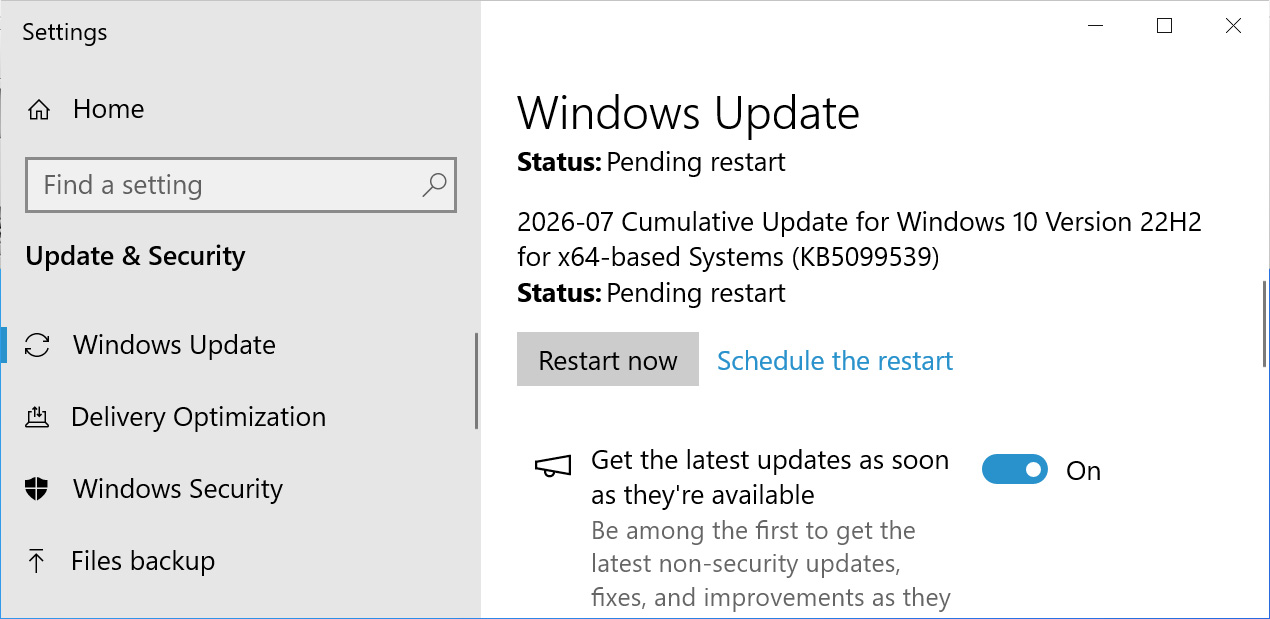
After installing this update, Windows 10 will be updated to build 19045.7548, and Windows 10 Enterprise LTSC 2021 will be updated to build 19044.7548.
Microsoft is no longer releasing new features for Windows 10, and the KB5099539 update primarily contains security updates and bug fixes.
The update also includes fixes released as part of today’s record-breaking July 2026 Patch Tuesday, which fixed a record-breaking 570 vulnerabilities, including two exploited and one publicly disclosed zero-day flaws.
The complete list of fixes in KB5099539 is listed below:
[OLE Automation (known issue)] Fixed: Addresses a compatibility issue in OLE Automation (oleaut32.dll) that was introduced by the June 2026 security update. Some applications that use the IDispatch::Invoke method to call COM methods with BYREF parameters that share the same underlying storage might fail. These failures can include parameter marshaling errors or automation call failures. This update corrects how parameter ownership is managed and restores expected application behavior.
[File Explorer (known issue)] Fixed: An issue where the OneDrive shortcut in File Explorer stops working when File Explorer is run with administrative mode.
[Recycle Bin (known issue)] Fixed: This update addresses an issue where the confirmation dialog might display an internal Recycle Bin file name instead of the original file name when permanently deleting a file.
[Input] This update changes hotkey unregister and cleanup behavior. In rare cases, some built-in Windows experiences that rely on previous hotkey lifecycle behavior might temporarily stop responding to certain keyboard shortcuts. This issue can typically be resolved by restarting the app affected. If the issue is not resolved, report it through the Feedback Hub.
[Secure Boot]
[Networking] This update introduces a security hardening change that enforces TDI transport registration requirements. As a result, applications that use sockets over unregistered third-party TDI transports might stop working after installing this update. Registered TDI transports are not affected. For more information, see Third-party TDI transports might stop working after installing Windows security updates released on or after July 14, 2026.
[Remote Desktop (RDP) Security] Support for SHA-2 certificate thumbprints has been added for trusted RDP publishers, with SHA-1 support retained only for backward compatibility and planned for future removal. New guidance is available for managing RDP file security through Group Policy to help organizations reduce phishing risks by controlling which .rdp files users can open. We recommend IT administrators migrate to SHA-256 thumbprints or a stronger algorithm as soon as possible to avoid disruption.
Microsoft also warns that an intentional security hardening change that enforces TDI transport registration requirements may impact legacy applications that rely on unregistered third-party TDI transports.
Windows users can determine whether they are affected by checking the Windows System event log in Event Viewer for AFD Event ID 16003 entries.
“To determine if you have a TDI transport that is affected by this change, check the Windows System event logs in Event Viewer > Windows > System,” Microsoft explains.
“If you find an AFD Event ID: 16003 ‘An unregistered TDI provider (\Driver
Otherwise, Microsoft says there are no known issues with this update.
Security teams log 54% of successful attacks and alert on just 14%. The rest move through your environment unseen.
The Picus whitepaper shows how breach and attack simulation tests your SIEM and EDR rules so threats stop slipping by detection.

The description for OpenAI’s first hardware device suggests it will be a speaker that can wiggle around a bit while it reads your email, so a HomePod, but more annoying and privacy-invasive.
Just moments after OpenAI shared an empty statement on Apple’s trade secret lawsuit, new information was shared about the company’s upcoming hardware. While it offered no public comment, internally it wants everyone to believe it is a completely unique product.
The newly leaked information comes from Bloomberg, which shares that the first OpenAI hardware product will be a smart speaker. It will have motorized moving parts, a rechargeable battery, and act as a companion to the user.
It is rumored to be the first of five potential hardware products that OpenAI is working on. The device could be revealed later in 2026 and ship in early 2027 as long as Apple’s lawsuit doesn’t stop its release.
OpenAI believes that it’s so unique it couldn’t possibly be seen as a copy of anything Apple ships today.
The supposed speaker device will have a unique design, lack a display, but it will have a camera for processing its surroundings. It will utilize ChatGPT Live and have the ability to parse user speech even as it provides an answer.

Nintendo already makes a product that randomly talks and is overly nice to you
OpenAI also hopes that the product can be proactive and speak without being prompted. If I’ve learned anything about technology, it’s that people hate it when products speak on their own.
Ask anyone that bought Nintendo’s Talking Flower, or perhaps someone who owned a Furby.
The product is meant to connect on a “humanlike” level with users, learn from user data, and feel like a companion.
Frankly, I’m tired of this desire to anthropomorphize AI chatbots. They can’t think, they can’t reason, they don’t hear, or speak, or any of those things.
In any case, this certainly sounds a lot like a HomePod, or perhaps the future Apple Home Hub tablet that will ship with an AI-powered mechanical arm.

The Apple Home Hub is expected to be announced at any time
It seems OpenAI wants this product to act as a kind of home for ChatGPT. Apple pitched the HomePod the same way when it was first announced — a home for Siri.
The parallels couldn’t be more obvious. And given that Jony Ive is behind the product’s design, I’m not sure how this will release without resembling an Apple product.
With only a couple of years of runway left before OpenAI’s cash starts to run out, it seems odd to bet everything on a technology most people probably already have in their homes. Amazon and Google just upgraded their range of smart speakers with AI capabilities, and Siri is getting a significant upgrade later in the fall.
What Apple has that these other companies don’t is user trust with private data. OpenAI needs a way to get access to users’ apps and email, while everyone’s iPhone already has it, privately.
Frankly, if a smart speaker that can wiggle and read your emails is all OpenAI has got after poaching 400 Apple employees, it is in trouble. Perhaps that supposed iPhone killer that’s expected by 2028 will turn things around.

Every summer, social media rediscovers the same “life hack”: if your phone gets too hot, stick it in the fridge for a few minutes. It sounds logical. Refrigerators are cold. Phones are hot. Problem solved. Except it isn’t. Repair technicians, smartphone manufacturers, and safety experts all agree this is one of the worst things you can do to an overheating phone. While the trick might cool the exterior temporarily, it can quietly create a much bigger problem inside the device – one that could permanently damage components or shorten the life of its battery.
According to a new BBC report, the latest warning comes from a UK phone repair shop, but it’s one experts have been repeating for years.
According to a report by the BBC, Jamie Farnell, who runs Shropshire Phone Repairs in Wem, says his shop has been inundated with devices suffering heat-related issues during the recent heatwave. Many customers admitted they had tried cooling their phones by putting them inside a fridge or freezer after seeing the advice circulate on social media.

Farnell says that’s exactly what people shouldn’t do. The problem isn’t the cold itself – it’s what happens when a warm electronic device is exposed to a cold, humid environment. Rapid temperature changes create condensation, allowing moisture to form inside the phone. Unlike the water you might notice on the outside of a cold drink, condensation inside a smartphone can reach the display, charging port, logic board, or battery connectors. That moisture can lead to corrosion, short circuits, or expensive repairs.
Farnell also pointed out another familiar internet myth that refuses to die: putting wet phones in rice. He says that trick is just as ineffective as the refrigerator hack, despite both continuing to circulate widely online. The warning comes after an alarming incident at his repair shop, where an iPad with a swollen lithium battery reportedly burst into flames during June’s heatwave. Swollen batteries are often a sign of excessive heat stress and should never be ignored.
This isn’t simply one repair technician’s opinion. Apple says iPhones are designed to protect themselves when they become too hot by dimming the display, slowing charging, reducing performance, or temporarily disabling certain features until temperatures return to normal. The company’s advice is straightforward: move the phone to a cooler environment out of direct sunlight and allow it to cool naturally. Apple does not recommend exposing the device to sudden temperature extremes.
Samsung offers similar guidance for Galaxy devices. If a phone displays a “Device cooling down” warning, users should stop using it, unplug it from charging, remove any protective case, close background apps, and simply let it cool on its own. The phone automatically reduces performance and pauses charging to protect its internal components while it sheds heat.
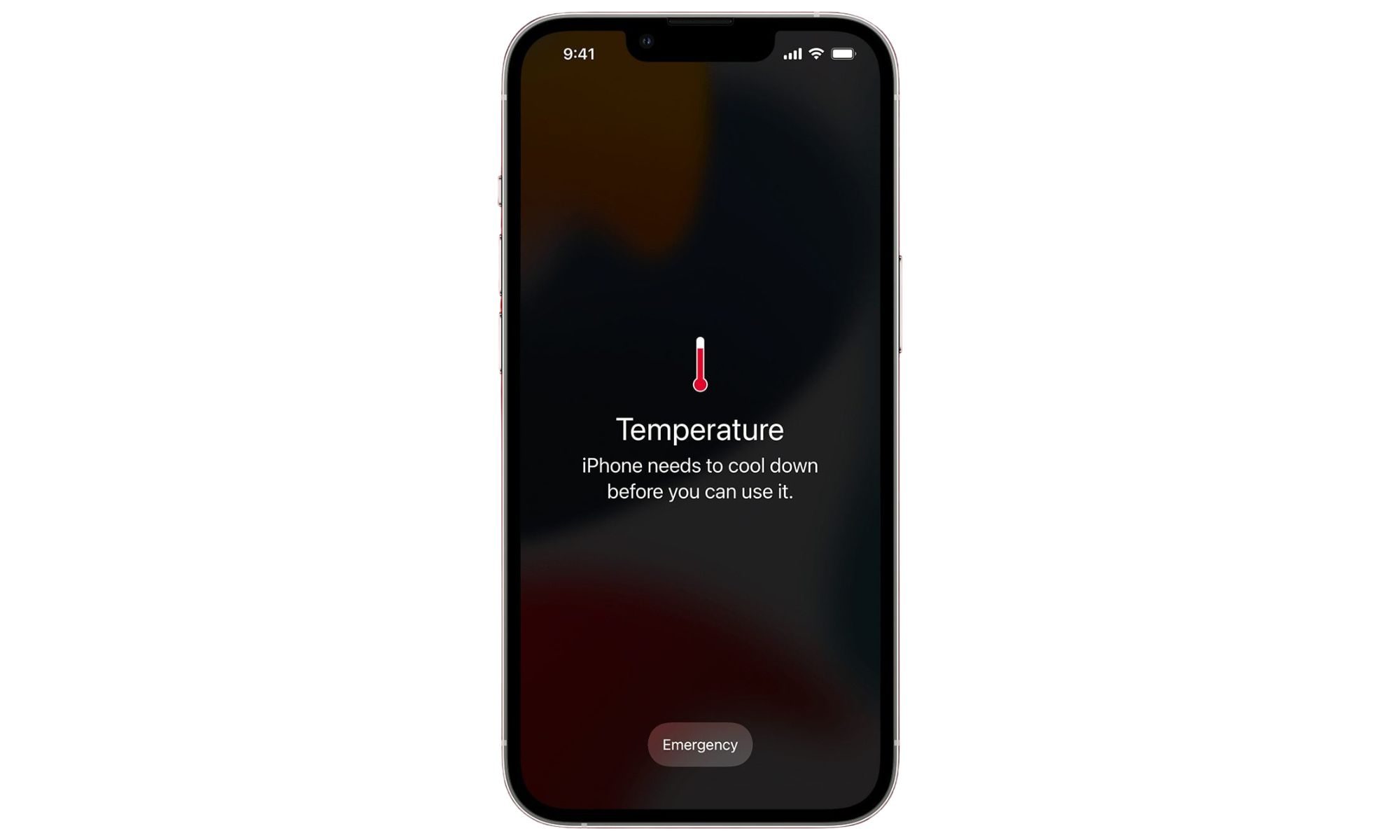
Even the Associated Press, citing guidance from Apple, Samsung, Google and UK electronics retailer Currys during last summer’s heatwave, warned against placing phones in refrigerators or freezers because of condensation risks. If your phone genuinely feels too hot to hold, there are safer ways to help it recover. Turn it off if possible, remove the charging cable, close demanding apps, lower the screen brightness, take off thick protective cases, and keep it somewhere shaded with good airflow. Avoid charging while gaming or recording long videos, especially in direct sunlight.
Modern smartphones already contain sophisticated thermal management systems designed to slow themselves down before permanent damage occurs. The temporary performance hit may be annoying, but it’s considerably cheaper than replacing a moisture-damaged motherboard. As tempting as the refrigerator trick may seem during a heatwave, your phone doesn’t need a blast of cold air. It just needs a little patience.





Loro Piana Fall 2026 Enters Houston’s Art Scene


Weekend Open Thread: Nutriplenish Leave-In Conditioner

2026 Genesis Scottish Open Thursday TV coverage: Round 1


Super Eagles star Moses Simon opens up on Liverpool transfer regret


Character.AI enters the microdrama arena with its own productions, but there’s a twist


XRP BOMBSHELL… XRP OMBOARDED FOR TRANSACTIONS!!!


Get Your ESP32 Sunny Side Up With This Solar Dev Board


Dark Secrets Emerge When Jailbreaking LLMs


Crypto Just Entered Its Most Important 6-Month Candle (Could Decide Everything!)

Major update after Huntingdon train attack as man enters plea


how to make coin bank box with cardboard #scienceproject #money #diy #shorts


39-year-old Djokovic wins five-hour thriller to enter Wimbledon semis | Other Sports News


Level Infinite Launches Gangstar Mirage City in India with Pre-Registrations

Cloudflare Precursor Watches Your Mouse and Keyboard To Decide If You Are Human


Entra passkey enrollment vishing targets Microsoft 365 users


DeFi Dashboard Zapper to Shut Down After 7 Years


Mark Cuban-Backed DeFi Dashboard Zapper Shuts Down After 7 Years

Claude’s New Reflect Dashboard Wants To Help You Log Off Of Claude


Microsoft Cuts AI Bill by Replacing OpenAI and Anthropic in Software Products


Fed minutes June 2026: officials split on rates




You must be logged in to post a comment Login