

Business
China’s Massive Travel Rebound: Why the Industry Is Scrambling to Keep Up


Start with the good news, because there is plenty of it. Roughly two in five Chinese travel professionals expect demand for their business to grow over the next two to three years, and nearly half see luxury leisure travel as the standout growth segment.
China’s outbound tourism market is roaring back. Official forecasts point to between 165 million and 175 million trips abroad by Chinese citizens in 2026, a volume that approaches or surpasses the pre-pandemic peak, while some industry estimates run even higher once domestic and short-haul day trips are included. Outbound spending is projected to climb well past the USD 180 billion mark this year, with analysts at Future Market Insights forecasting the market to more than double to USD 459 billion by 2036 on a 9.6 percent annual growth rate.
The scale of the rebound has been reinforced by policy. China’s visa-free entry scheme, now covering citizens from 45 countries and running through the end of 2026, has removed friction for both inbound and outbound travel, while Beijing is set to host its first China Outbound and Inbound Travel Market exhibition in October, bringing together tourism boards, airlines and tour operators from more than 50 countries.
Zoom out across the wider region, and more than one in four industry professionals name China as one of the single biggest growth opportunities, not just for outbound travelers heading abroad, but for inbound visitors arriving on Chinese soil.
The readiness gap behind the growth story
A new industry survey from Expedia Group, covering 1,250 travel professionals in Australia, China, India, Japan and Thailand, gives that optimism real numbers to lean on. Roughly two in five Chinese travel professionals expect demand for their business to grow over the next two to three years, and nearly half point to luxury leisure travel as the standout growth segment. Across the wider region, more than one in four industry professionals name China as one of the biggest growth opportunities, not only for outbound travellers but for inbound visitors arriving on Chinese soil.
The same survey suggests the industry itself is not entirely ready for the demand it is forecasting. Chinese travel professionals identify three forces reshaping traveller expectations: a preference for in-language, localized experiences, a growing insistence on flexible change and cancellation terms, and a rising demand for sustainable travel options. Layered on top is a technology shift, with nearly six in ten respondents saying AI-powered tools and nontraditional booking platforms have grown significantly more important over the past two to three years.
What the report captures well, and what deserves more attention than it’s getting, is how much traveler expectations have shifted underneath the industry’s feet. Chinese travel professionals point to three forces reshaping demand: a hunger for in-language, localized experiences; a growing insistence on flexible change and cancellation terms; and a rising preference for sustainable travel options. None of these are niche concerns anymore. They are becoming baseline expectations, and businesses that treat them as optional extras rather than core product features are going to lose ground.
Respondents also point to their own limitations. A lack of localized content is cited as a major constraint, and many say it remains difficult to gain visibility across search engines and AI-driven platforms, the very channels increasingly used to research and book trips. A similar gap shows up around AI adoption itself: 79 percent of respondents say they already use AI tools, and 97 percent plan to, yet that near-universal adoption sits alongside an admission that many businesses have not unlocked the technology’s full potential. Aileen Chan, Expedia Group’s vice-president of sales for Asia-Pacific, framed the challenge for Chinese travel businesses as one of matching rising demand with the right localized content, flexible terms, payment options and technological support across every market they touch.
That readiness gap, more than the headline growth numbers, is the backdrop against which Thailand’s own struggle to capture its share of the Chinese travel boom should be read.
The paradox for Thailand
For a market this large, one might expect Thailand, long the default Southeast Asian destination for Chinese travellers, to be riding the wave. Instead, the country is a case study in how quickly a tourism relationship can fray even as the underlying demand pool expands.
The Association of Thai Travel Agents cut its 2026 forecast for Chinese arrivals from 9 million to 7 million in early June, citing a combination of safety concerns and rising travel costs linked to Middle East-driven oil prices. ATTA president Thanapol Cheewarattanaporn said safety perception had become the single biggest obstacle in the Chinese market, directly shaping travellers’ booking decisions.
The roots of that perception trace back to the kidnapping of a Chinese actor lured into a scam-centre operation in Myanmar via Thailand, an incident that triggered a sharp drop in Chinese bookings when it surfaced and has continued to shadow the market since. Reports of subsequent ransom cases and disappearances involving Chinese nationals have kept the story alive on Chinese social media, even though isolated incidents do not necessarily reflect the broader safety picture for ordinary tourists.
The numbers tell the story of a market that fell hard and has only partially recovered. Chinese arrivals to Thailand dropped from roughly 6.73 million in 2024 to about 4.47 million in 2025, a decline of some 34 percent that helped drag Thailand to its first annual fall in total visitor numbers in a decade outside the pandemic years. As of early July 2026, China had reclaimed its position as Thailand’s top source market on a cumulative basis, but at a scale far below the earlier peak, and Thailand has not recovered the roughly one-third of Chinese visitors it lost.
A crowded field of rivals
China’s outbound boom has not gone to waste, it has simply gone elsewhere. Japan overtook Thailand as the top Lunar New Year destination for Chinese travellers, helped by a weaker yen, expanded flight capacity and eased visa rules, with Chinese arrivals to Japan forecast to rise by a third to around 9.3 million. Vietnam has drawn on proximity, a favourable exchange rate and simplified visa policies to become, by some measures, ASEAN’s top destination for mainland Chinese tourists, with arrivals up more than 100 percent year on year at one point. Malaysia has been the most direct beneficiary within the region, overtaking Thailand as its largest single source market and now targeting 7 million Chinese visitors of its own in 2026 through visa-free entry, expanded routes into smaller Chinese cities, and marketing pushes on Douyin, Weibo and RedNote.
The competitive pressure is compounded by a shift in how Chinese travellers plan trips. Independent travellers, rather than tour groups, now make up roughly half of China’s outbound market, researching destinations on platforms such as Xiaohongshu rather than booking through traditional agencies. That shift rewards destinations with strong social-media visibility and flexible, experience-led products built around content tourism, gastronomy and wellness travel, and punishes those still associated with mass group tourism or negative headlines.
How Thailand’s industry is responding
Faced with a shrinking share of a growing market, Thai operators and regulators are trying several levers at once. The Civil Aviation Authority of Thailand is negotiating a one-year relaxation of slot usage rules with Chinese counterparts, which would let Thai airlines temporarily redeploy aircraft to other markets to offset weaker Chinese demand. ATTA has taken its promotional roadshows to Xinjiang and Gansu provinces, betting that cities such as Urumqi and Lanzhou carry less exposure to the negative coverage concentrated in southern China’s major urban centres.
The Tourism Authority of Thailand, meanwhile, has leaned into messaging rather than blanket safety assurances. TAT’s regional director for East Asia marketing has argued that Chinese travellers want honest reassurance rather than claims that Thailand is entirely risk-free, and the authority has planned a “Nihao Month” campaign alongside city-to-city promotional tie-ups timed around the anniversary of Thailand-China diplomatic relations. TAT has also revised its full-year target to a range of 30 to 34 million total foreign arrivals, with Chinese numbers expected to land close to 2024 levels rather than fully recovering to the pre-safety-crisis peak.
Underlying all of this is a product question as much as a marketing one. Thai tourism operators are being pushed to move beyond the traditional group-tour, shopping-and-photo-op model toward the categories Chinese travellers increasingly favour: content and set-jetting tourism tied to film and social media, gastronomy, medical and wellness travel, and deeper cultural immersion in cities like Chiang Mai rather than one-off check-in stops.
What would it take to close the gap
Aileen Chan, Expedia Group’s vice-president of sales for Asia-Pacific, put her finger on the actual challenge facing the industry: the opportunity for Chinese travel businesses isn’t simply to capture rising demand, but to meet travelers with the right localized content, flexible terms, payment options, and technological support across every market they touch. That is a far more demanding mandate than “grow the top line,” and it requires investment in content, platforms, and AI literacy that many operators, by their own admission, don’t yet have.
Thailand’s underlying advantages, established flight networks, hospitality infrastructure and decades of brand recognition in China, have not disappeared. What has changed is that Chinese travellers now have more credible alternatives and more information at their fingertips before they book. Closing the gap will likely depend less on any single marketing campaign than on whether Thailand can produce a sustained run of good news to offset the scam-centre and safety headlines that have dominated Chinese coverage since 2025, while Japan, Vietnam and Malaysia continue investing in the same travellers Thailand is trying to win back.
Other People are Reading

Business
Meta Faces Lawsuit Alleging AI Tools Discriminated Against Workers on Protected Leave in Mass Layoffs
SAN FRANCISCO — Dozens of Meta employees have filed a federal lawsuit accusing the social media giant of using artificial intelligence systems to select workers for layoffs in a way that disproportionately targeted those who took maternity, medical or disability leave.
The 71-page complaint, filed Monday in U.S. District Court in the Northern District of California, was brought by 26 current and former employees who claim the company’s AI-driven performance evaluations penalized them for exercising legally protected rights to time off. The workers are among approximately 8,000 employees, or about 10% of Meta’s global workforce, notified of layoffs beginning in May.
Meta, the parent company of Facebook, Instagram and WhatsApp, has disputed the allegations. “These claims lack merit and are not based on facts,” a Meta spokesperson said in a statement. “Workforce management and organizational decisions were and are made by people, not AI.”
The lawsuit alleges that Meta relied on a “constellation of internal artificial intelligence systems” — including AI performance ratings, keystroke and activity monitoring, productivity metrics and AI token-usage dashboards — to score, rank and select employees for termination. These tools, according to the complaint, failed to account for periods when employees were on approved leave, effectively punishing them for absences required by law.
“Meta did not assemble the termination list through the considered judgment of managers who knew the work,” the complaint states. “Instead, the company used AI systems to score, rank and select employees for inclusion on the list.”
Plaintiffs include a scientist notified of her layoff just days before giving birth while on approved pre-birth pregnancy leave, an engineer who received a lowered rating due to time off for an injury, and a manager let go 16 days into medical leave. All 26 plaintiffs, who are proceeding anonymously as Does 1-26, had taken protected leave in the 24 months prior to the layoffs, the suit says.
Eight of the plaintiffs are women who took maternity or pregnancy-related leave, four are men who took parental leave, and another took leave to care for a family member followed by bereavement leave, according to the filing. The suit claims the practices violate the Family and Medical Leave Act, the Americans with Disabilities Act, the Pregnancy Discrimination Act, the Pregnant Workers Fairness Act and various state laws.
The case highlights growing concerns about the use of AI in workplace decisions. Regulators and lawmakers in states including California, Colorado and Illinois have enacted rules in recent years to address potential bias in automated employment tools. The U.S. Equal Employment Opportunity Commission has also stated that existing anti-discrimination laws apply when employers use AI for such purposes.
Meta announced the latest round of job cuts in April as part of efforts to improve efficiency and redirect resources toward artificial intelligence development. Employees received notices starting around May 20, with departures scheduled through July 22. The company also reassigned thousands of other workers to AI-related initiatives during the restructuring.
The lawsuit points to Meta’s employee-monitoring program, introduced earlier this year, which captured keystrokes, mouse movements, browser history, messages, emails and location data on company devices. The program was intended to train the company’s AI systems on employee behaviors, according to internal statements attributed to CEO Mark Zuckerberg.
In an internal meeting reported by The Information, Zuckerberg said the AI models would “learn from watching really smart people do things,” noting that the average intelligence at the company was higher than what could be obtained externally for certain tasks.
Plaintiffs allege the monitoring program was rolled out with limited notice and little opportunity for opt-out, contributing to an environment where data collection fed into layoff decisions without proper safeguards for protected leave.
The suit seeks a preliminary injunction to halt the finalization of layoffs for the plaintiffs, along with reinstatement, back pay, lost equity, benefits and other damages. Because of Meta’s arbitration agreements, the plaintiffs are not seeking class-action status but are pursuing individual claims.
Legal experts following the case say it could test how courts view the intersection of AI tools and employment protections. If the metrics used in decision-making inherently disadvantage workers on leave, companies may need to implement more robust adjustments or human oversight to comply with federal and state laws.
The controversy unfolds amid broader tensions at Meta over its aggressive push into AI. Employees have expressed concerns about surveillance tools, reassignments to data-labeling roles described internally by some as “draftees” work, and the overall pace of change. Petitions and internal protests have highlighted worries that AI initiatives are coming at the expense of worker well-being.
Meta has defended its approach as necessary for remaining competitive in the rapidly evolving technology landscape. In communications to staff, executives have emphasized flattening organizational structures, increasing ownership on smaller teams and leveraging AI to boost productivity.
The company has paused aspects of its monitoring program at times due to internal data concerns and employee feedback, but continues to integrate AI deeply into operations.
This latest lawsuit adds to a series of legal challenges facing big tech companies over AI deployment. As tools become more sophisticated, questions about transparency, bias detection and accountability are likely to intensify.
For the plaintiffs, the stakes are personal. One researcher reportedly received her first “Meets Most” performance rating shortly after disclosing a disability and requesting accommodations, according to details in the complaint. Others describe lowered scores directly tied to leave periods.
The case is assigned to U.S. District Judge William Orrick in Oakland. Plaintiffs are seeking preservation of relevant data, models and logs, as well as an independent audit of the algorithmic selection process.
Meta’s spokesperson reiterated that decisions involved human judgment and that the company complies with all applicable employment laws.
As the tech industry grapples with balancing innovation and worker rights, the outcome of this suit could influence how other companies approach AI-assisted workforce management. With AI adoption accelerating, similar disputes may become more common.
The plaintiffs’ attorneys from firms specializing in employment law argue that failing to adjust for protected leave in automated systems amounts to built-in discrimination. They call for greater scrutiny of “black box” AI tools in high-stakes employment decisions.
Industry observers note that while AI can streamline processes, it requires careful calibration to avoid unintended biases, particularly around sensitive areas like health and family responsibilities.
Meta, with a workforce of around 78,000 at the end of the first quarter, has conducted multiple rounds of layoffs in recent years as it pivots toward AI. Previous cuts in 2022 and 2023 were larger in scale, but the 2026 reductions come as the company invests heavily in computing infrastructure and model development.
Zuckerberg has publicly stated that AI will transform many aspects of work, including at Meta itself. The company’s internal AI efforts include tools like Metamate, described as a large language model assistant, and “second brain” systems trained on employee data.
Critics within the company have raised alarms about the potential for these systems to create feedback loops that favor constant availability and high-volume output, metrics difficult to maintain during legitimate absences.
The lawsuit does not seek class certification due to arbitration clauses but requests the court issue a preliminary ruling preserving the status quo for the named plaintiffs while their claims proceed.
Broader implications could extend to other employers using similar technologies. Employment lawyers advise companies to audit AI tools for disparate impact on protected groups and to maintain clear documentation of human involvement in final decisions.
As of mid-2026, the debate over AI in human resources continues to evolve, with calls for federal guidelines gaining traction alongside state-level regulations.
The case underscores the challenges of integrating powerful new technologies into traditional employment frameworks. For Meta and its workforce, the resolution may help define the boundaries of acceptable AI use in one of the most consequential areas of business operations: deciding who stays and who goes.
Tesla Stock Is Falling. Can Robots Arrive Soon Enough to Save It?

Japan stocks higher at close of trade; Nikkei 225 up 1.49%
Business
Kuwait International Airport Open Today as Terminals 4 and 5 Operate, Terminal 1 Still Shut for Repairs

KUWAIT CITY — Kuwait International Airport is open and operating on Wednesday, with the country’s two national carriers running scheduled flights, though one of the airport’s main terminals remains closed for repairs following months of disruptions tied to the broader U.S.-Iran conflict.
Kuwait Airways is currently flying out of Terminal 4, while budget carrier Jazeera Airways operates from Terminal 5, with both airlines maintaining largely normal schedules as the country’s aviation sector continues a gradual recovery. Terminal 1, the airport’s primary international facility, remains closed pending repairs after sustaining significant structural damage, and authorities have not announced a confirmed reopening date.
For travelers with existing bookings, airline and travel industry sources continue to recommend confirming flight status directly with carriers before heading to the airport, given the facility’s recent history of abrupt, security-driven schedule changes.
A Rocky Road to Reopening
The airport’s path back to normal operations has been anything but smooth. Since the conflict began on February 28 with U.S. and Israeli strikes on Iran, Kuwait’s airspace and its main airport have been repeatedly disrupted by Iranian drone attacks, part of a wider pattern of strikes targeting Gulf states hosting American military installations.
The airport was first forced to suspend all flights starting February 28, with Jazeera Airways temporarily diverting operations to Qaisumah International Airport in Saudi Arabia, roughly two and a half hours away by road, during the closure. Kuwaiti authorities reopened the country’s airspace nearly two months later, with the state-run Kuna news agency reporting that flights would resume gradually, beginning with select destinations through Terminals 4 and 5.
Sheikh Hamoud Mubarak Al Sabah, chairman of Kuwait’s General Civil Aviation Authority, said at the time that the phased restart was coordinated with domestic and international authorities to ensure operations resumed in line with the highest safety and security standards. He also credited Saudi Arabia’s support in facilitating Kuwaiti carriers through its airports during the closure and highlighted coordination among Gulf Cooperation Council countries aimed at maintaining regional air traffic continuity throughout the crisis.
Kuwait Airways and Jazeera Airways resumed limited service on April 26, operating out of Terminals 4 and 5 while Terminal 1 remained shuttered. Terminal 1 finally reopened to international traffic on June 1, allowing some foreign carriers to resume service there for the first time in months.
A Second Setback
That reopening proved short-lived. Terminal 1 suffered more serious structural damage, including a partial roof collapse, during a subsequent strike on June 3, rendering the facility unsafe for passenger operations and prompting officials to close it once again. That second closure has remained in effect since, with no confirmed reopening date currently available.
The damage to Terminal 1 traces back to a series of attacks earlier this year. Between late February and June, Kuwait International Airport was targeted multiple times by Iranian drone attacks as part of Tehran’s broader campaign against Gulf states, causing damage to the airport’s infrastructure, including its radar installation. Officials have said there were no casualties from those attacks.
Foreign Carriers Gradually Return
As conditions have stabilized, foreign airlines that typically operate through the airport have been brought back online in stages. Oman Air confirmed its Kuwait flights resumed on June 25, temporarily operating through Terminal 4 instead of its usual Terminal 1.
Kuwaiti aviation officials have emphasized a cautious, coordinated approach to restoring full operations across the facility. With Terminals 4 and 5 fully operational and additional foreign carriers gradually resuming service, the airport’s recovery has continued on what officials describe as a positive trajectory, even as Terminal 1 remains closed indefinitely and a broader expansion project for a new Terminal 2 continues working toward a targeted late-2026 opening.
Renewed Alerts Complicate the Picture
Despite the overall reopening, the situation has remained fluid. Kuwait reported renewed air-defense activity amid fresh missile and drone threats on July 9, underscoring that the recovery, while steady, has not been without additional scares. Travel advisories tied to the broader region have continued to shift in response to developments in the wider U.S.-Iran conflict, and officials have urged passengers to monitor updates closely rather than assume normal pre-conflict capacity has been fully restored.
Earlier this month, disruptions tied to regional tensions led to a wave of flight delays and cancellations at the airport. According to aviation trackers cited by regional outlets, six flights were cancelled and 76 others delayed in a single day of disruption, even as authorities maintained that the airport itself remained open and had not been fully shut down.
What Travelers Should Know
Kuwait International Airport, located roughly 15.5 kilometers south of Kuwait City’s center, typically handles more than 15 million passengers annually and serves as the primary hub for both Kuwait Airways and Jazeera Airways, connecting the country to more than 100 destinations worldwide. Passengers should confirm which terminal their flight is using, since assignments have shifted repeatedly throughout the recovery process, and should rely on official airline updates and the airport’s flight information service for the latest details before traveling.
For now, the practical answer to whether the airport is open today is yes, with flights departing and arriving on a steadily normalizing schedule. But the broader question of whether that recovery can hold remains tied directly to the durability of the ceasefire between the United States and Iran, a truce that has already been tested — and broken — multiple times since it was first announced earlier this year.
Travelers planning trips through Kuwait in the coming weeks should expect continued gradual normalization of service, but officials caution against assuming that full pre-conflict operational capacity has yet been restored across all of the airport’s facilities.

Spain’s final 12-month EU-harmonised inflation at 3.6% in June

IHS Markit (Nasdaq: INFO) is a world leader in critical information, analytics and solutions for the major industries and markets that drive economies worldwide. The company delivers next-generation information, analytics and solutions to customers in business, finance and government, improving their operational efficiency and providing deep insights that lead to well-informed, confident decisions. IHS Markit has more than 50,000 key business and government customers, including 80 percent of the Fortune Global 500 and the world’s leading financial institutions. Headquartered in London, IHS Markit is committed to sustainable, profitable growth.

Thames Water has returned to a full-year profit after hiking its customers bills by 40% last year.
The UK’s largest water company reported post-tax income of £113m for the 12 months to the end of March, swinging from a £1.51bn post-tax loss the previous year.
However, the firm’s net debt also swelled to £18.5bn from £16.8bn as it said it “continued to fund the business through… debt and internally generated cash flows”.
Chief executive Chris Weston said: “The progress we have made in turning the company around has meant we are now performing better.”
The publication of Thames Water’s results comes after the government rejected a proposed rescue deal for the business in June.
Under the terms of the deal, Thames’ lenders wanted leniency from future pollution fines in return for writing off £9.4bn of its debt pile and investing new money.
Thames Water said on Wednesday it has enough debt funding to keep the business going “through to Q4 2026”.

Tekcapital portfolio firm Vesari files 11 AI patent applications

Storebrand Q2 profit up 26% as insurance growth drives results, launches buybac
Last updated: July 2026
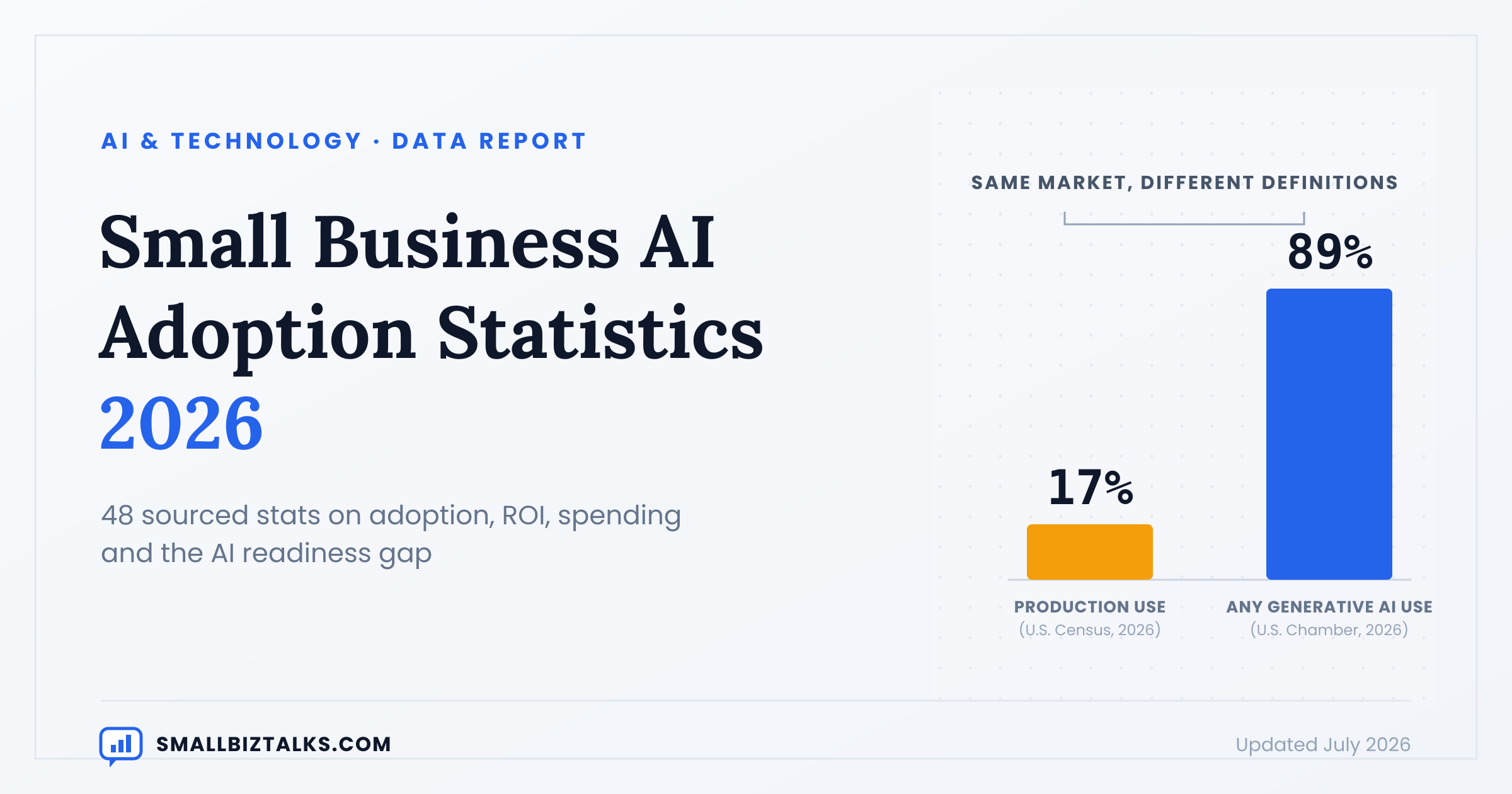
Ask five different sources what percentage of small businesses use AI, and you’ll get five different answers, anywhere from single digits to nearly 90%. That’s not sloppy research. It’s five surveys measuring five different things, and almost nobody bothers to say so before quoting the number that sounds best.
So before we get to the data: every stat below is dated and sourced, and where two credible reports disagree, we’ve said so rather than pretending there’s one clean number. If you’re trying to figure out where your business actually stands relative to your peers, that distinction matters more than the headline percentage.
The Short Answer
- Somewhere between 17% and 20% of small businesses are using AI in actual production operations, per U.S. Census Bureau data from May 2026.
- Somewhere between 58% and 89%, depending on the survey, have used a generative AI tool like ChatGPT for at least one task.
- 91% of the businesses that do use AI report a revenue increase — but only 14% have fully integrated it into core operations.
Both of those things are true at once. That’s the story this page tells.
How Many Small Businesses Actually Use AI in 2026?
The gap between “AI adoption” headlines usually comes down to definition:
- The U.S. Census Bureau’s Business Trends and Outlook Survey (BTOS) asks whether a business uses AI to produce its goods or services — a strict, production-level bar. By that measure, adoption sat in the high single digits as recently as 2023 and had climbed to roughly 17–20% by May 2026.
- The JPMorgan Chase Institute, using transaction-based data rather than self-reporting, found the small business AI adopter base expanded from 5.2% in 2023 to 17.7% by the end of 2025 — a figure that lines up closely with the Census numbers.
- Broader surveys that ask about any generative AI use — drafting an email with ChatGPT counts — report far higher numbers. Thryv’s April 2026 survey of 561 small business owners found AI adoption at 66%, up from 55% a year earlier.
- The U.S. Chamber of Commerce’s 2026 Small Business Survey put generative AI use at 89%, up from 36% in 2023. An earlier 2025 wave of Chamber data had already shown a climb from 23% (2023) to 58% (2025) — consistent with the trajectory, if not the exact figure, reported a year later.
The practical takeaway: if you’re citing an adoption rate, cite the definition along with it. “58% of small businesses use AI” and “18% of small businesses use AI in production” can both be accurate descriptions of the same market.
What Are Small Businesses Actually Using AI For?
- 41% of small businesses use AI for marketing and content creation — the single most common use case (HubSpot State of Marketing, 2025).
- 29% use it for customer service, including chatbots and automated ticket routing (Salesforce Small Business Trends, 2025).
- 24% use it for data analysis and business intelligence, including sales forecasting and inventory optimization (Deloitte Small Business Survey, 2025).
- Among businesses already using AI, the 2026 NFIB survey found marketing content creation the top use case at 68% — a higher share than the HubSpot figure above, another reminder that survey population and phrasing move these numbers.
- 42% of small businesses use generative AI chatbots specifically, though state-level adoption ranges from 13% to 71% (U.S. Chamber of Commerce, 2025).
Among the AI tools small businesses adopt, category-specific usage breaks down as:
- 24% use AI accounting tools such as QuickBooks AI or Xero (Intuit, 2025).
- 19% use AI customer service tools such as Zendesk AI or Intercom Fin (Zendesk, 2026).
- 14% use AI design tools such as Canva Magic or Midjourney (Canva, 2025).
- 11% use AI coding or development tools such as GitHub Copilot (GitHub, 2025).
Is AI Actually Paying Off for Small Businesses?
- 91% of small businesses using AI report a measurable revenue increase (Salesforce, 2025).
- 90% say AI has made their operations more efficient (Salesforce, 2025).
- Small businesses using AI are 2.3x more likely to report revenue growth than those that don’t (U.S. Chamber of Commerce, 2026).
- 70% of Thryv survey respondents said AI contributed to increased revenue over the past 12 months.
- 92% of AI users in the same survey said the technology saves them time, with 79% expecting to reclaim between 11 and 60 hours per month.
- 61% estimate AI will save their business between $500 and $2,000 per month (Thryv, April 2026).
- The average small business saves 5.6 hours per week using AI tools; owners and managers specifically save more than 7 hours per week (Business.com, 2026).
- In a Goldman Sachs survey of 1,256 small business owners conducted with Babson College and David Binder Research (January–February 2026), 93% reported a positive business impact from AI but only 14% said they’d fully integrated it into core operations.
That last gap — strong reported impact, low structural integration — shows up again and again in the barrier data below.
What’s Actually Holding Small Businesses Back?
- 77% of small businesses that haven’t adopted AI say they see no applicable use case for their business (SBA Office of Advocacy, 2025). Among businesses with fewer than five employees specifically, that figure rises to 82%.
- 45% of small business AI users cite a lack of technical expertise as a challenge, and 47% say it’s difficult to choose the right tools (Goldman Sachs, 2026).
- 70% of small business owners say they need more, or significantly more, training to use AI productively (Thryv, April 2026) — despite 86% describing themselves as comfortable to extremely comfortable using it.
- 77% of small businesses using AI have no formal prompting strategy or system in place (Aufsite Research, 2026).
- Only 23% of small businesses using AI have received any formal training on the tools they’re using.
- Roughly 77% of small businesses using AI have no written AI policy, leaving them exposed to data leaks and unchecked AI-generated output in client-facing work.
How Much Are Small Businesses Spending on AI?
- 53% of small businesses now spend at least $100 per month on AI tools (Thryv, April 2026).
- Median AI spending per firm actually peaked around $80 per month in 2022 and had fallen to roughly $30 per month by 2025 (JPMorgan Chase Institute) not because established users are spending less, but because the pool of new, lower-spending adopters using $20–$30/month entry-tier tools has grown so fast it pulls the average down.
- That entry-level tier now makes up roughly 63% of the small business AI user base, up sharply since 2022, while the highest-spending tier has shrunk to about 16%.
- The overall small business AI adopter base more than tripled between 2023 and 2025 (JPMorgan Chase Institute, 2026).
Which Businesses Are Leading — and Which Are Lagging?
- Adoption follows a U-shaped curve by firm size: the very smallest businesses, those with fewer than five employees, actually over-index on AI use compared to mid-sized small businesses (U.S. Census Bureau / SBA, 2025). For a solo operator, AI functions less like a tool and more like a first hire.
- By industry: 36% of small real estate businesses use AI (National Association of Realtors, 2025), 33% of small education and training businesses (National Center for Education Statistics, 2025), and 31% of small construction businesses — the lowest adoption rate of any major sector, largely due to field-based, low-digital-maturity work (Associated General Contractors, 2025).
- The gap between large-enterprise and small-business AI adoption has narrowed from roughly 1.8x to 1.2x over the course of 2025, with the smallest firms actually over-indexing on certain use cases like marketing automation (SBA Office of Advocacy, 2025).
Where Is This Headed?
- New businesses founded in 2025 reached 10% AI adoption within just six months — compared to 77 months for businesses founded in 2019. That’s roughly a 13-fold acceleration in how quickly new companies fold AI into operations (JPMorgan Chase Institute, 2026).
- The OECD projects a 19.34% compound annual growth rate for SME AI adoption through 2031.
- Gartner projects that 60% of commercial research queries will be AI-assisted by the end of 2026 — a shift that affects how small businesses need to think about discoverability, not just tool adoption.
- 96% of small business owners say they plan to adopt emerging technologies including AI (U.S. Chamber of Commerce, 2026).
- 71% plan to increase their AI investment over the next year (Salesforce, 2025), and 53% of small businesses not yet using AI say they’re considering it (Intuit QuickBooks, 2025).
The holdouts are shrinking. The gap that matters in 2026 isn’t between businesses that use AI and businesses that don’t, it’s between the ones treating it as a free-tier experiment and the ones actually building it into how they operate.
Sources
- U.S. Census Bureau, Business Trends and Outlook Survey (BTOS), May 2026
- JPMorgan Chase Institute, “Understanding the Use of AI Among Small Businesses,” 2026
- U.S. Chamber of Commerce, Small Business Survey, 2025 and 2026
- Thryv, AI and Small Business Adoption Survey, April 2026
- Goldman Sachs 10,000 Small Businesses / Babson College / David Binder Research, January–February 2026
- Salesforce, Small Business Trends Report, 2025
- Deloitte, Small Business Survey, 2025
- HubSpot, State of Marketing Report, 2026
- National Federation of Independent Business (NFIB), 2026 survey
- SBA Office of Advocacy, “AI in Business: Small Firms Closing In,” September 2025
- Intuit / Intuit QuickBooks Small Business Insights, 2025
- Business.com, 2026 research
- Gartner, 2026
- OECD, “AI Adoption by Small and Medium-Sized Enterprises,” December 2025
- National Association of Realtors, 2025
- National Center for Education Statistics, 2025
- Associated General Contractors, 2025
- Aufsite Research, 2026
Methodology note: figures above are drawn directly from primary research reports rather than from other roundups, and each stat is dated to its source’s survey period. Where two reputable sources report different numbers for what appears to be the same question, both are presented rather than collapsed into a single figure.

Vikings Evidently Still Deciding on Newcomer’s Position in Trenches

Doom on the Neo Geo Becomes the ‘Impossible’ Port That Just Works

Cryptocurrency Is Haram Mufti Taqi Usmani Fatwa !


-

 Fashion6 days ago
Loro Piana Fall 2026 Enters Houston’s Art Scene
-

 Fashion4 days ago
Weekend Open Thread: Nutriplenish Leave-In Conditioner
-
 Sports6 days ago
2026 Genesis Scottish Open Thursday TV coverage: Round 1
-

 Sports5 days ago
Super Eagles star Moses Simon opens up on Liverpool transfer regret
-

 Tech6 days ago
Character.AI enters the microdrama arena with its own productions, but there’s a twist
-

 News Videos12 hours ago
XRP BOMBSHELL… XRP OMBOARDED FOR TRANSACTIONS!!!
-

 Tech1 day ago
Get Your ESP32 Sunny Side Up With This Solar Dev Board
-

 Tech11 hours ago
Dark Secrets Emerge When Jailbreaking LLMs
-

 News Videos6 days ago
Crypto Just Entered Its Most Important 6-Month Candle (Could Decide Everything!)
-
 NewsBeat6 days ago
Major update after Huntingdon train attack as man enters plea
-

 News Videos2 days ago
how to make coin bank box with cardboard #scienceproject #money #diy #shorts
-

 Sports7 days ago
39-year-old Djokovic wins five-hour thriller to enter Wimbledon semis | Other Sports News
-

 Tech6 days ago
Level Infinite Launches Gangstar Mirage City in India with Pre-Registrations
-
 Tech2 days ago
Cloudflare Precursor Watches Your Mouse and Keyboard To Decide If You Are Human
-

 Tech6 days ago
Entra passkey enrollment vishing targets Microsoft 365 users
-

 Crypto World6 days ago
DeFi Dashboard Zapper to Shut Down After 7 Years
-

 Crypto World6 days ago
Mark Cuban-Backed DeFi Dashboard Zapper Shuts Down After 7 Years
-
 Tech6 days ago
Claude’s New Reflect Dashboard Wants To Help You Log Off Of Claude
-

 Crypto World6 days ago
Fed minutes June 2026: officials split on rates
-

 Tech7 days ago
Former OpenAI exec Kevin Weil is now on the board of Stoke Space
You must be logged in to post a comment Login