Business
Wall Street hits record highs, Oracle shares tumble

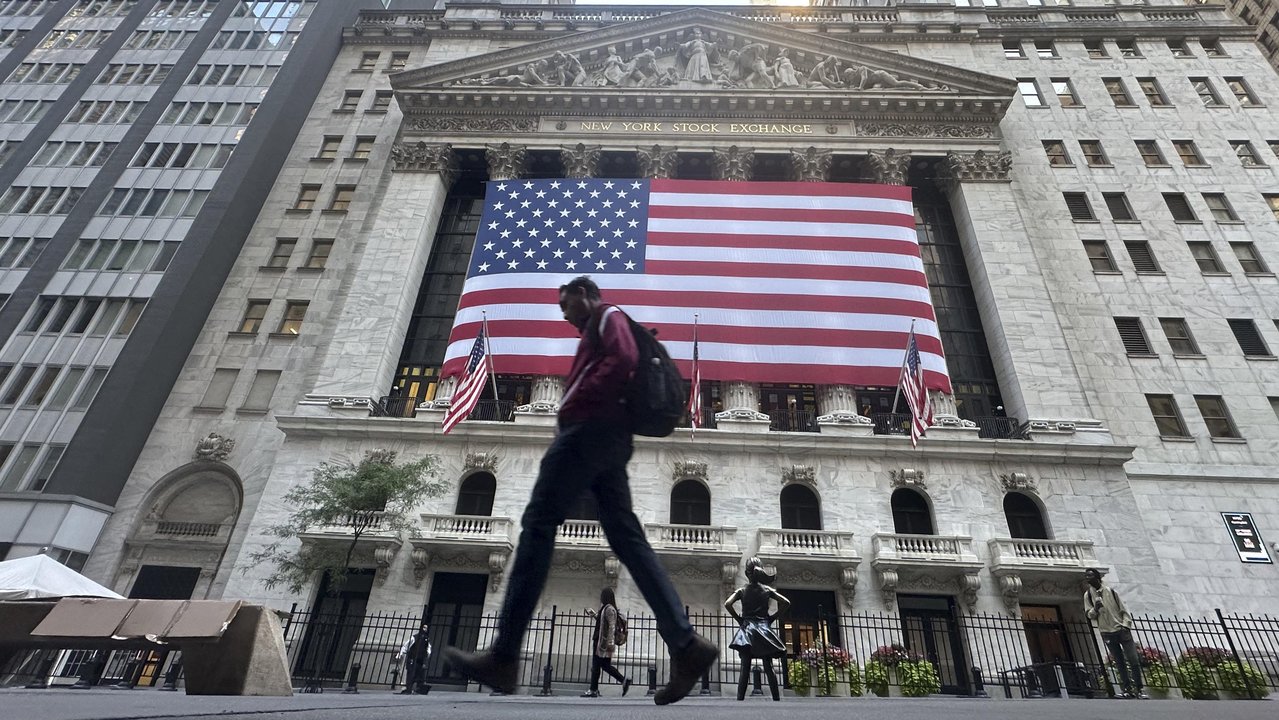
The S&P 500 and the Dow recorded closing highs overnight after a Federal Reserve policy update that was less hawkish than expected.
This came while the tech-heavy Nasdaq underperformed as Oracle’s financial update made investors wary of AI bets.
Oracle shares tumbled 10.8 per cent in their biggest one-day drop since late January and they were the top S&P 500 decliner after the company’s quarterly forecasts fell short of analysts’ estimates. It had also warned that annual spending would run $US15 billion higher than previously planned, stoking fears about its big push into artificial intelligence.
The cost of insuring Oracle debt against default surged as investors feared that the company’s heavy reliance on debt financing could be part of an AI bubble similar to the dotcom bust of the early 2000s.
While Oracle helped drag other technology names lower, the Dow rallied along with the Russell 2000 small-cap index, which closed up 1.2 per cent and the S&P 500 value index, up 0.6 per cent, outperformed the growth index, which ended off 0.12 per cent.
“The name of the game is market rotation. We’re seeing small caps, the Dow and cyclicals all start to do better in anticipation of a re-acceleration of global growth,” said Matthew Miskin, co-chief investment strategist at Manulife John Hancock Investments.
Investors also continued to digest the US central bank’s update from Wednesday, when the Fed lowered borrowing costs by 25 basis points and Chair Jerome Powell signalled a pause on further easing.
However, investors were relieved that the Fed still had some rate cuts on its dot plot as it balanced still-elevated inflation with signs of labour market weakness.
Mark Malek, CIO at Siebert Financial, said continued digestion of the Fed meeting and Powell’s commentary brought a tailwind on Thursday.
“Clearly, the market was tempering itself for a more hawkish cut. Most of us were certainly anticipating Chairman Powell to come out of the gate with a little bit more of a negative tone,” he said, adding that the Fed’s focus on employment as “something that they have to watch carefully” was notable.
As if to illustrate that point, Thursday’s data from the Labor Department showed jobless claims rose to 236,000 for the week ending December 6, compared with estimates of 220,000.
The Dow Jones Industrial Average rose 646.26 points, or 1.34 per cent, to 48,704.01, vaulting above its November 12 closing record. The S&P 500 gained 14.32 points, or 0.21 per cent, to 6,901.00, breaching its October 28 record close. The Nasdaq Composite lost 60.30 points, or 0.25 per cent, to 23,593.86.
Communications services and technology stocks were the biggest losers among the S&P 500’s 11 major industry sectors, falling one per cent and 0.6 per cent respectively. The Philadelphia Semiconductor Index – also central to the AI-trade – closed down 0.8 per cent.
The strongest sector gainers were materials, which rallied 2.2 per cent and financials, which added 1.8 per cent and was the S&P 500’s biggest index point boost.
Broadcom shares fell 1.6 per cent in the regular session but rose four per cent in late trading after the company forecast revenue of about $US19.1 billion for the current quarter, compared with Wall Street expectations for $US18.27 billion, according to data compiled by LSEG.
The blue-chip Dow included several financial stocks among its top gainers. Visa led the charge with a 6.1 per cent rally while American Express, JP Morgan and Goldman Sachs all rose more than two per cent. Walt Disney shares closed up 2.4 per cent after the company announced a $US1 billion equity investment in OpenAI. The entertainment company’s bet on AI likely helped to ease some concerns about the AI space, according to Siebert’s Malek.
Advancing issues outnumbered decliners by a 2.2-to-1 ratio on the NYSE, where there were 673 new highs and 69 new lows. On the Nasdaq, 2,667 stocks rose and 2,087 fell as advancing issues outnumbered decliners by a 1.28-to-1 ratio.
The S&P 500 posted 52 new 52-week highs and three new lows while the Nasdaq Composite recorded 185 new highs and 81 new lows.
On US exchanges, 17.05 billion shares changed hands, compared with the 17.39 billion 20-day moving average.