






RugOne Xlink 7: 30-second review
The RugOne Xlink 7 wants to solve an old problem in a new way. Traditional walkie-talkies are brilliant until you walk out of range. Hills block them. Buildings block them. Distance blocks them. The Xlink 7 sidesteps all of that by using 4G instead of short-range radio, so two or three people can stay in touch across a city, a country, or, in theory, the whole planet, as long as there’s signal.
That idea alone makes it worth a look. Add a genuinely tough build, IP68 and IP69K rated, plus MIL STD 810H certification, and you have a device that will survive rain, dust, a drop, or a dunking, all while weighing just 84g. It comes loaded with sensible extras too. A wireless PTT (push-to-talk) remote means you never have to fumble for the unit itself while riding or climbing. An emergency SOS mode, backed by GPS, GLONASS and Beidou positioning, can sound an alarm and share your live location with five quick presses. There’s even a basic AI assistant for weather checks and settings, and a noise cancellation system tuned for wind and speed.
None of that comes without trade-offs, though. The biggest one is that this is a cellular device, not a true radio, so it lives and dies by 4G coverage. Head somewhere genuinely remote, deep countryside, mountains, open water, and it becomes a very expensive paperweight. A proper VHF or UHF handset, or a satellite communicator, will keep working exactly where the Xlink 7 cannot. There’s no screen either, so every bit of feedback comes through LED colours and beeps, which takes some getting used to. Group calls are capped at three people and thirty minutes, which will frustrate anyone hoping to coordinate a larger crew.
So who is this for? Cyclists, hikers, skiers and runners who mostly stay within reach of a network but want a proper safety net and a simple way to stay in touch with a partner or small group. It might also work for parents keeping tabs on older kids, but surely they’d have phones. It could be an easy panic button for lone workers, as long as they’re not underground.
It’s less convincing for anyone heading truly off-grid, where a satellite device or traditional radio still makes more sense, as some of the best rugged phones I’ve tested already have. Think of the Xlink 7 as a rugged companion for populated wilderness rather than true remoteness, and it starts to make more sense.

RugOne Xlink 7: price and availability
- How much does it cost? $159
- When is it out? Available now
- Where can you get it? Direct from RugOne or via an online retailer
The RugOne Xlink 7 is available direct from RugOne’s global store, on Amazon.com for $159.99, and on Amazon.co.uk for $139.99.
Unless I’m mistaken, the RugOne Xlink 7 launched its Kickstarter campaign in June 2026, with a Super Early Bird duo pack priced from $159.99 against a stated standard retail of $299.98 for the same pack, a 47 per cent discount.
Coverage on a popular news site said it has cleared the Engineering Verification and Design Verification stages and was, at the time of writing, running final Production Validation Test builds ahead of mass shipping from August 2026. But that plan evidently wasn’t correct or got changed, because it’s already available to buy now.
To be crystal clear, I’m not a fan of companies that don’t need the money running Kickstarter campaigns as marketing exercises, and the way that this one was able to move from announcement to product and retail in a matter of weeks gives the true picture away. That reality being the Xlink 7 was probably finished and in production even before the Kickstarter ever began.
In the bundle that most purchasers will choose, they get a SIM card that works in 41 countries, and that will work for a year. No price has yet been revealed for extending the SIM contract at this time, but you can just buy a data-only SIM for your country and use that instead.
In most countries, this would be a no-brainer based on cost, but if you live in a region where mobile providers must approve each device that connects, it might be an issue.
Depending on how you intend to use this hardware, the price might be seen as competitive or excessive.
Compared to a proper satellite-based communicator, like the Garmin inReach Mini 2 ($509.99), it might seem a bargain. But the Garmin will work in practically any geographic location, and doesn’t need cell service.
Not needing a cell service or a SIM card, Motorola makes an extensive range of walkie-talkies, like the Motorola Solutions Talkabout T475 Extreme. A two-pack of those is only $94.99, and they use FRS radio frequencies, can receive NOAA weather alerts and will work for up to 12 hours on a charge.
There are dozens of brands selling walkie-talkie designs, some using Mesh technology that generally undercut the RugOne Xlink 7, typically offering two handsets for less than the price of one Xlink 7.
But there is an even cheaper choice, and that’s to use Zello on your existing smartphone, which costs precisely nothing. As they say, competing with zero isn’t easy.
Overall, there are some cute features on the RugOne Xlink 7 that might attract some customers, but since they don’t have a fallback technology when there is no 4G service, they seem overpriced.

RugOne Xlink 7: Specs
|
Product |
RugOne Xlink 7 |
|
Dimensions |
63.6 x 51.7 x 22.95mm |
|
Weight |
84g |
|
Build |
Plastic body with metal buttons and rubber seals |
|
Durability |
IP68 (1.5m for up to 30 minutes) and IP69K under IEC 60529, MIL STD 810H, operating range -30C to 55C |
|
Display |
None. Status is shown via seven front LEDs plus audio tones |
|
Chipset |
ASR1609S, Cortex R5 at 614MHz |
|
Memory |
8MB PSRAM, 8MB ROM |
|
Network |
4G LTE, nanoSIM. FDD LTE bands 1/2/3/4/5/7/8/12/20/25/26/28A/28B/66, TDD LTE bands 34/38/39/40/41 |
|
Connectivity |
Bluetooth 5.2 |
|
Positioning |
GPS, GLONASS and Beidou |
|
Battery |
1,050mAh typical / 1,020mAh rated Li Po, USB Type C charging at 5V 0.5A |
|
Battery life (claimed) |
Up to 87 hours standby, 24 hours typical use, 10 hours continuous talk |
|
Calling |
Full duplex hands-free voice for up to 3 simultaneous users, 10-minute default call length, 30-minute maximum |
|
AI features |
On-device AI voice assistant for Q&A and settings, plus chip and AI-based noise cancellation rated to a peak of 55dB reduction |
|
Safety |
Emergency SOS via five rapid presses on the action button, triggers a siren, calls emergency contacts, and shares live GPS location |
|
Extras |
Built-in TorchX flashlight, wireless Bluetooth push-to-talk remote ring, dedicated group set-up button |
|
App |
RugOne Xlink app for iOS and Android, required to activate the device |
|
In the box |
Xlink 7 unit, USB-C to USB-C cable, pre-installed screen film, wireless PTT remote ring, long and short Velcro straps, sports armband, magnetic back clip, lanyard, SIM card (Bundle version only), manual and warranty card |
RugOne Xlink 7: Design
- Tough and tiny
- Lots of buttons
- A box full of accessories

Which countries does the SIM card support?
United States, United Kingdom, Germany, France, Italy, Spain, Netherlands, Switzerland, Sweden, Norway, Denmark, Ireland, Austria, Belgium, Finland, Iceland, Poland, Czech Republic, Greece, Portugal, Luxembourg, Hungary, Slovakia, Slovenia, Croatia, Cyprus, Estonia, Latvia, Lithuania, Romania, Bulgaria, Liechtenstein, Vatican City, San Marino, Serbia, Albania, North Macedonia, Bosnia and Herzegovina, Moldova, Ukraine, and Belarus.
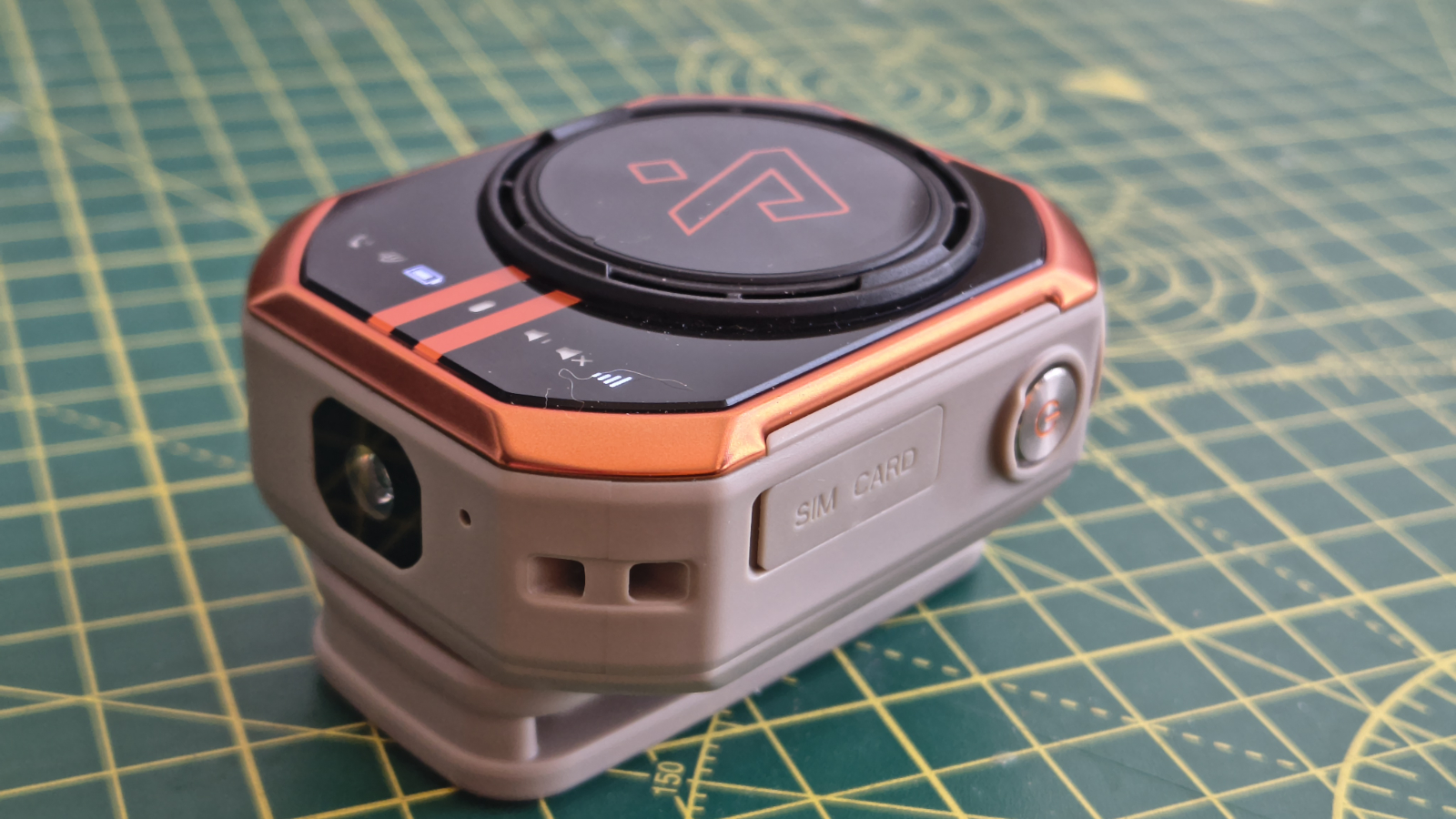
The Xlink 7 is a small, octagonal puck that RugOne compares to a chunky earbud case. At 84g and just under 64mm tall, it disappears onto a backpack strap or handlebar far more easily than a traditional VHF or UHF radio ever could. The body mixes plastic with rubber seals and metal buttons, and the whole thing carries an IP68 rating for a 1.5 metre dunking and an IP69K rating against pressure washing, on top of MIL STD 810H certification. That is a serious durability claim for a device this size, and on paper, that puts the Xlink 7 ahead of most consumer electronics in this price bracket.
There is no screen. Every status update, battery level, signal state, Bluetooth pairing, comes through a bank of seven LEDs and a set of audio tones. That keeps the design simple and the waterproofing easier to guarantee, but it also means a genuine learning curve before all those beeps and colours become second nature.
The one that most owners might easily recall is the built-in AI, as even at the lowest volume settings, it shouts information at you like a drill sergeant. Maybe on a windswept hillside or next to a roaring rapids, this might be good, but in less noisy spaces, it seems excessive and bludgeoning.

Since there is no screen, all the modes and features of the RugOne Xlink 7 are activated using a series of buttons, and there are some simple back-lit icons to provide basic feedback. These tell you if a voice call is active, Bluetooth is being used, battery status, the device is on, volume and mute, and mobile signal strength. But most of these are superfluous, since if you change the volume, for example, the unit will shout at you the current volume setting.
Buttons are provided for powering on, AI, Group functionality and initiating or answering calls.
A single button activates an on-device AI assistant for simple Q&A, weather checks, and device settings, and RugOne pairs a dedicated audio chip with an AI noise-reduction algorithm rated at a peak of 55dB, tuned for conditions up to 40km/h on skis or 30km/h on a bike, according to RugOne. But this technology appears to be deactivated when you’re not on skis or a bike, when you get put on full audio blast anyway.
Rubber plugs cover both the SIM card slot and the USB port, which made me wonder why they weren’t together under a single plug. And, the other feature worth mentioning is that there is a TorchX flashlight, which might become useful if you’ve not reached your basecamp before nightfall.
For those wondering how you configure some of the more complicated aspects, that’s all done through a smartphone app. So, if you want to change those, you’ll need to bring a smartphone, which somewhat undermines the function of the RugOne Xlink 7.
One impressive detail about this device is all the supporting hardware that comes in the box, which includes long and short Velcro straps, a sports armband, a magnetic belt clip, a lanyard and a Bluetooth-connected talk button.
Design score: 3.5/5
RugOne Xlink 7: Hardware
- Multi-person communication
- ASR1609S SoC
- 1,050mAh cell battery
Available in ‘Sports Black’ or ‘Sand Dune’, the RugOne Xlink 7 has some interesting twists on the normal 4G communication model.
These include the ability to have group conversations between three Xlink 7, with each call limited to 10 minutes, or with three connected up to 30 minutes.
Where I’m slightly confused is that in some literature, three users are mentioned, and in others, up to five people can talk. But since I only received two of these to test, I can ascertain which number is correct.
That said, the idea of five people on the same line just sounds like a recipe to step on other people’s speaking, so if it only supports three people, it might be more practical.
The platform that this was built on is the ASR1609S, a cost-effective, high-performance 4G LTE IoT baseband processor manufactured by ASR Microelectronics.
This SoC is a single ARM Cortex-R5 core running at 614 MHz, integrating a modem, Bluetooth 5.2, GNSS, power management, 8GB PSRAM, and 8GB Flash in a single assembly.
Positioning comes from a combination of GPS, GLONASS and Beidou, and an emergency SOS mode is triggered by five rapid presses of the action button. That sounds like a loud siren to alert others nearby, automatically calls pre-set emergency contacts and shares a live location through the companion app.
For hikers, cyclists and lone workers, this is arguably a bigger selling point than the group calling itself. But this again assumes that everyone wearing one of these devices is also conveniently carrying their phone.

RugOne quotes up to 87 hours of standby, 24 hours of typical use, or 10 hours of continuous talk time from the 1,050mAh cell. Those are manufacturer figures rather than independently measured ones, and if you are on the edge of cell service, you might find the battery wears out faster than expected.
I can’t be overly critical of the hardware, since it was made to both fit inside the limited confines of the RugOne Xlink 7 but also to do a specific job that isn’t as general as you might expect from a Smartphone SoC.
But, this SoC didn’t include the technology for PTT-type communications without 4G, which is unfortunate, since most mobile phones can do that trick, and would last longer on battery than the Xlink 7 can.

RugOne Xlink 7: Final verdict
The RugOne Xlink 7 is a difficult call, since I don’t think there is anything inherently wrong with the hardware or the design, except possibly how shouty the AI is.
That said, I strongly suspect that this design was originally intended to support conventional or mesh wireless technology alongside 4G functionality, until someone realised that might affect future income from SIM sales.
What we ended up with is a walkie-talkie that’s useless when you’re away from cell service, which is problematic. Given that lots of cheaper devices will work anywhere without 4G, it brings into question whether the RugOne Xlink 7 is the right product for you.
While I accept that most walkie-talkies can’t link two people on different continents, most can connect those people 100M apart on a mountain or in a jungle, and that’s not a guarantee with this hardware.
RugOne need to put Zello-compatible wireless in the Xlink 8, and make the price significantly more competitive.
Should I buy a RugOne Xlink 7?
|
Attributes |
Notes |
Rating |
|---|---|---|
|
Value |
Affordable, but compared with other walkie-talkies, it is on the pricey side. |
3/5 |
|
Design |
A compact and rugged puck that can be carried in numerous ways |
3.5/5 |
|
Hardware |
Efficient SoC and 1,050mAh battery, but needs 4G network to talk |
3/5 |
|
Overall |
Not suitable for true off-grid use |
3.5/5 |
Buy it if…
Don’t buy it if…
For more ruggedized devices, we’ve reviewed the best rugged tablets, the best rugged laptops, and the best rugged hard drives





















































You must be logged in to post a comment Login