

Crypto World
Benjamin Cowen’s New Memo Points to Q4 Bitcoin Bottom Near $44,000

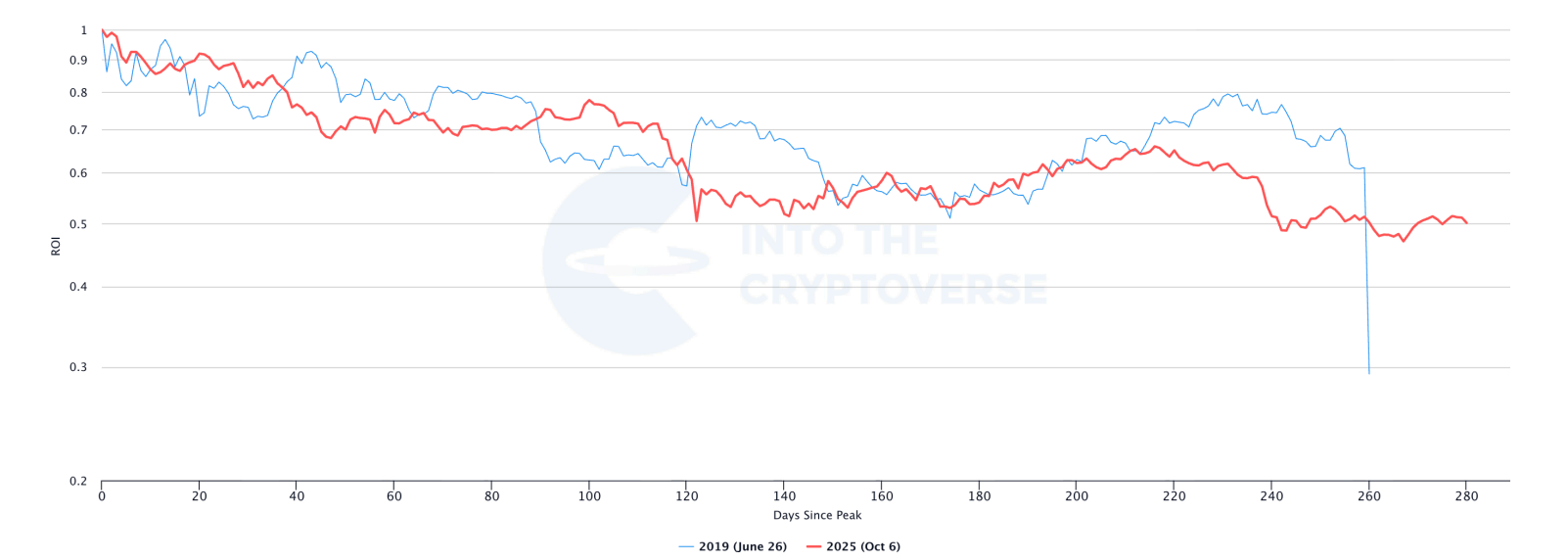
Benjamin Cowen’s July memo puts the next Bitcoin bottom in the fourth quarter of 2026. His seasonal math implies a floor near $44,000, and his framework has formally shifted into bottom-watch mode.
Cowen, a member of BeInCrypto’s Market Intelligence experts council, argues the reset now depends on time rather than a single price level. His projection lands inside the $44,000 to $47,000 zone that BeInCrypto’s models identified one week earlier.
The 2019 Analog Runs Out of Time
The core thesis of the memo compares the October 2025 top with the June 2019 top. Both peaks arrived on apathy rather than euphoria, and both printed weeks before quantitative tightening formally ended.
Bitcoin (BTC) has now spent 282 days in its drawdown. The 2019 analog bottomed at day 261, when the March 2020 pandemic crash reset every indicator at once.
Cowen treats that flush as an external shock, not a cycle mechanism. Because the analog expired without a similar event, he expects this reset to complete through time instead.

The current path sits at 0.520 of the October 2025 record above $126,000, a 48% decline. Meanwhile, retail attention never returned. New views across major crypto YouTube channels sit near 389,000, an order of magnitude below the 2021 peak near four million.
That reading fits the broader picture of washed-out crypto sentiment that BeInCrypto reported this week. Cowen calls it the apathy signature, and it separates this cycle from the euphoric tops of 2017 and 2021.
Midterm Years Save the Worst for Last
2026 is a midterm election year, historically the weakest of Bitcoin’s four-year cycle. The prior midterms in 2014, 2018, and 2022 all decayed through the second half, and none rallied into year-end.
July has typically been constructive in those years, and 2026 is tracking that tendency. However, August and September turned negative in all three prior midterms, with August losses between 15% and 18%.

Cowen’s year-to-date measure has bounced to 0.731, back above the midterm average. Applying the historical decay path would drag that reading to roughly 0.49 by year-end, which implies a price near $43,800.
He stresses the figure is an illustrative projection from three observations, not a target. Still, the direction was consistent across all three prior midterms.
Two of those cycles bottomed inside the midterm year itself, in December 2018 and November 2022. The 2014 cycle spilled into January 2015, which keeps early 2027 on the table.
The macro backdrop adds pressure. The Warsh Fed removed its easing bias while the energy-led disinflation fades, a combination that keeps real rates elevated into the same fourth-quarter window.
Why the On-Chain Reset Isn’t Done
On-chain data explains why Cowen doubts the low is already in. The MVRV Z-Score reads 0.395, and prior cycle bottoms formed only after the metric reset below zero.
That reset requires price to trade beneath the realized price; the market’s aggregate cost basis is near $53,000. The early-summer low of about $57,000 approached that level without reaching it.

His $43,800 estimate, therefore, sits inside the corridor between realized price and balanced price at $37,700. Cowen’s broader risk scorecard supports that read. On-chain risk sits at 0.188 and Bitcoin risk at 0.311, both far below their readings near the top one year ago.
Yet the valuation reset remains less advanced than the distressed July 2022 phase. BeInCrypto’s models reached the same region one week earlier.
BeInCrypto’s analysis of the final 91-day window projected a bottom between $44,000 and $47,000 by early October. A regression on past drawdowns and a logarithmic Fibonacci retracement converged on that zone.
The log Fibonacci midpoint sits at $44,428, within roughly $700 of Cowen’s figure. Two independent frameworks now point to the same floor and the same quarter.

Institutional forecasts frame a similar range. The wider Bitcoin bottom debate spans Standard Chartered’s $59,000 floor and Galaxy’s $40,000 scenario, and both reject a deeper crash this cycle.
Bitcoin Bottom Watch Is On, But Confirmation Is Far Away
The supply profit and loss cross gives Cowen his trigger. Supply in loss briefly exceeded supply in profit at the summer low, a condition that historically preceded entry into bottoming windows.
The bounce has since lifted supply in profit back to 56.83%. Cowen reads the whipsaw as typical of a bottoming window measured in months rather than a single clean event.
Cowen wrote:
“The framework is in bottom-watch mode, with the low most likely a matter of months rather than weeks away.”

Structural demand has also cooled. ETF holdings peaked above 1.25 million BTC in late 2025 and have since rolled over, with the decline steepening in recent weeks. The marginal bid that absorbed supply on the way up has faded.
Price structure tells the same story. Bitcoin reclaimed its 200-week SMA near $63,100, yet the identical break-and-reclaim sequence appeared in 2022 before the final low arrived.
Confirmation, in his framework, requires two consecutive weekly closes above the 50-week SMA near $86,500. Bitcoin’s current price of about $63,158, down 2.7% in 24 hours, sits roughly 37% below that level.
Cowen also assembles the bull case. Price sits on the first percentile of his long-run quantile model, ETF-era demand could lift the floor, and the absent crowd leaves few forced sellers for a final flush.
For now, the calendar, the on-chain reset, and BeInCrypto’s own models point to the same window. The next test comes quickly, as August will show whether the midterm pattern repeats or finally breaks.
The post Benjamin Cowen’s New Memo Points to Q4 Bitcoin Bottom Near $44,000 appeared first on BeInCrypto.


More than $1 out of every $10 in the world’s tokenized US Treasuries is issued through entities incorporated in the British Virgin Islands, according to BVI Finance. In its June “Destination Digital” report, the organization estimates that BVI-linked firms accounted for roughly $1.5 billion of a $14.98 billion global tokenized Treasuries market as of June 1—making the small Caribbean territory the second-largest jurisdiction after the United States.
The BVI’s rise appears tied less to headline “tax haven” narratives and more to the legal and regulatory scaffolding that tokenization projects need to operate within institutional-grade workflows. At the same time, industry usage of the territory is nuanced: most companies do not physically relocate to the islands; they often use BVI entities as the legal layer around token issuers, treasury vehicles, holding companies, or special purpose vehicles (SPVs).
Key takeaways
- The BVI is behind about $1.5 billion of $14.98 billion in global tokenized US Treasuries (as of June 1), placing it just behind the US by issuer jurisdiction, per BVI Finance.
- BVI selection is driven primarily by regulatory clarity and legal certainty, not by taxes, according to advisers and executives interviewed in the underlying reporting.
- Regulatory capacity is a differentiator: the BVI’s VASP regime (introduced via the VASP Act in 2023) is overseen by the BVI Financial Services Commission with an application process aimed at faster timelines.
- The territory functions as a corporate home, not a global engineering hub: multiple firms incorporated in the BVI conduct operations elsewhere.
- BVI-linked stablecoin activity and tokenized securities volume are notable, including a high number of tokenized securities tracked in the RWA.xyz dataset, according to Bernstein Research.
Tokenized Treasuries and the “legal home” effect
BVI Finance’s “Destination Digital” report highlights how concentrated the issuance of tokenized US Treasuries has become by jurisdiction. As of June 1, BVI-linked entities represented approximately $1.5 billion out of $14.98 billion in the global market, based on data compiled for the report.
Beyond Treasuries, the same reporting frames the BVI as a broader digital asset jurisdiction. It cites a stablecoin market cap of about $1.2 billion held in BVI-linked addresses and an estimated 28,000 stablecoin asset holders. It also points to regulatory momentum: more than 25 virtual asset service providers (VASPs) have been approved under the BVI’s VASP regime.
In the tokenized securities category, Bernstein Research data referenced by the report suggests the BVI hosts 305 tokenized securities in the RWA.xyz dataset—the highest count of any single jurisdiction. Together, these figures support the view that the BVI has become one of the leading destinations for real-world asset tokenization activity.
Still, the article’s core caveat is important for readers: tokenization is designed to be borderless, and projects can choose where to incorporate without moving their operational footprint. In practice, many digital asset firms treat the BVI as the legal base while teams, infrastructure, and day-to-day operations remain distributed globally.
Regulation and legal certainty outweigh tax assumptions
For years, offshore jurisdictions in the Caribbean have often been described primarily through a tax lens. But advisers and industry executives interviewed in the underlying reporting say that assumption doesn’t match how many tokenization-focused firms decide today.
Andrew Jowett, a partner at Appleby (BVI) Ltd, said clients typically compare multiple jurisdictions—such as the Cayman Islands, the United Arab Emirates, Singapore, and Switzerland—when structuring digital asset businesses. In his account, the “overriding factor” is digital asset regulation rather than tax.
The BVI does have tax advantages: it imposes no corporate income tax or capital gains tax on BVI companies, according to BVI’s financial services commission guidance linked in the reporting (see What tax structure BVI imposes). However, the argument presented is that many competing crypto hubs now offer tax neutrality, making legal and regulatory readiness the differentiator.
Executives echoed that sentiment. Saeed Al-Marri, CEO of Ethra (incorporated in the BVI), described tax neutrality as “table stakes,” adding that institutional adoption depends on legal certainty and clarity. Similarly, Jack Yang, founder and CEO of LTP (which operates regulated entities across the BVI, Hong Kong, Australia, and the UAE), said taxation is “secondary” to whether structures can pass institutional review.
In Yang’s view, a “tax-neutral structure” that banks, custodians, auditors, investment committees, or regulators cannot accept has limited practical value—particularly as tokenization moves deeper into traditional finance processes.
Orest Gavryliak, chief legal officer at 1inch (also incorporated in the BVI), framed the shift as a changing role for jurisdiction itself: it is not becoming irrelevant, but protocols increasingly weigh predictable rules, institutional credibility, and long-term sustainability over the lowest possible tax burden.
What the BVI VASP framework is designed to deliver
One of the central regulatory developments mentioned in the reporting is the BVI’s VASP regime. The BVI introduced the Virtual Assets Service Providers Act (VASP Act) in 2023, overseen by the BVI Financial Services Commission (FSC). BVI Finance and FSC guidance cited in the underlying material describe a targeted review cadence: responses to VASP applications within six weeks, with an aim to complete the review process within six months.
Fast, predictable processing matters in tokenization because projects often need regulatory alignment quickly to meet timelines for custody arrangements, distribution partnerships, and institutional onboarding. The article also argues that “ease of launch” and flexible corporate structuring have been part of the BVI’s appeal beyond tax incentives.
Jowett described the broader corporate-vehicle angle: companies can be set up quickly, the legal framework is flexible, and ongoing reporting is generally lighter than in onshore jurisdictions. The reporting also notes the BVI’s historical preference for corporate confidentiality, adding that BVI companies remain subject to AML and KYC expectations while beneficial ownership information is held by registered agents rather than being publicly disclosed as a register—reducing public-facing disclosure requirements.
Importantly, the accounts provided in the underlying reporting suggest confidentiality and tax neutrality were not the deciding factors for the interviewed companies. Instead, they pointed to legal certainty, regulatory clarity, and the ability to structure corporate arrangements efficiently as tokenization expands.
No “physical HQ rush,” just corporate anchoring
A recurring theme in the reporting is that BVI incorporation does not necessarily mean a company’s people or infrastructure move to the islands. Yang, speaking about LTP, said the entity does not employ full-time staff “on the ground.” Instead, governance is handled by its board while staffing support is drawn from elsewhere in the group.
The same distinction is described through examples across the industry. The article notes that Kraken’s parent company, Payward, is incorporated in the BVI, while the exchange’s primary operations are based in the United States. It also says 1inch’s team and operations are spread across multiple jurisdictions.
The practical implication is that the BVI may be winning a different competition than the one often associated with global tech hubs. It is not primarily attracting large engineering teams or flashy headquarters. Rather, it is becoming a legal anchor for digital asset businesses—particularly tokenization activity—where the corporate structure is a critical input to institutional acceptance.
For readers watching the next wave of real-world asset tokenization, the question is less “which country hosts the most staff” and more “which jurisdictions offer the cleanest path through institutional compliance.” The BVI’s case suggests that if the legal wrapper around a tokenized product can satisfy regulators and counterparties, the incorporation location can become a quiet but decisive advantage.
As more tokenized Treasury issuance, stablecoin usage, and tokenized securities migrate toward regulated frameworks, investors and builders should watch how institutional counterparties (custodians, auditors, banks, and investment committees) respond to BVI structures—and whether similar regulatory programs in other jurisdictions keep tightening timelines and compliance standards.
Argentina’s Federal Judge Marcelo Martínez De Giorgi has frozen dozens of crypto wallets tied to the LIBRA investigation and ordered six international exchanges to hand over complete client files, including KYC records, IP logs, and linked bank accounts.
Prosecutor Eduardo Taiano requested the measure on July 14, nearly 1.5 years after the token’s collapse. He relied on a Federal Police cybercrime report tracing funds from the so-called Team Libra wallets to major trading platforms.
Exchanges Must Hand Over KYC Data in the LIBRA Investigation
The freeze covers accounts at Binance, Bybit, OKX, CoinEx, FixedFloat, and Bitfinex. Each platform must deliver account opening files, IP connection logs, transaction histories, linked bank accounts, and internal memos.
Based on reports, at least 25 accounts have been frozen, though the ruling itself refers to dozens of wallets.
The judge held that both the plausibility of the claim and the danger of delay were established. Therefore, the accounts will stay frozen to preserve assets for a potential confiscation before any proceeds can be cashed out.
Argentina’s Federal Police cybercrime unit will process the requests, with Interpol stepping in when needed. Its report reconstructed an unbroken chain of on-chain transactions from Team Libra wallets through Jup.ag, FixedFloat, and deBridge Finance.
The findings build on fresh LIBRA case evidence gathered earlier from seized phones. The resolution, as translated, describes a deliberate laundering pattern.
“A digital smurfing or structuring strategy was deployed, consisting of the daily distribution of fragmented amounts to multiple wallets linked to centralized exchange houses… with the purpose of liquidating the assets in fiat currency or making it difficult to trace them.”
Follow us on X to get the latest news as it happens
Smurfing Trail Meets Political Friction
On February 14, 2025, President Javier Milei promoted the Solana-based LIBRA token on his X(Twitter) account. The post has since been deleted.

According to the complaint, the price climbed from $0.01 to nearly $5, a roughly 500-fold move, before collapsing within hours.
A small cluster of wallets allegedly withdrew around $100 million in that window. Meanwhile, more than 40,000 buyers who entered after the presidential post saw their holdings collapse, with many suffering steep retail trader losses.
Prosecutors believe traders Mauricio Novelli and Manuel Terrones Godoy orchestrated the scheme alongside US businessman Hayden Davis, who created the token.
Earlier leaked files pointed to an alleged $5 million contract for the presidential promotion, a claim Milei denies.
However, the tracing push arrives as the case’s victim-driven side collapses. In early July, the same judge removed all five investor plaintiffs at Novelli’s defense request, leaving Taiano alone to advance the file.
Opposition lawmakers also linked the ruling to the Senate’s approval of the judge’s wife’s nomination to the federal bench, a nomination Milei submitted.
“With prosecutor Taiano stalling the investigation, if there are no victims to push it forward, the case will be abandoned,” Peronist Deputy Selva Almada wrote.
The exchange responses may now decide whether investigators can attach names to the frozen wallets.
LIBRA’s arc mirrors the TRUMP token, where meme coin retail losses reached $3.81 billion across nearly 1 million wallets. Whether Argentina can recover its $100 million is the question the KYC files may finally answer.
The post LIBRA Probe Corners Binance, Bybit, OKX: Whose Names are Behind the Frozen Wallets? appeared first on BeInCrypto.
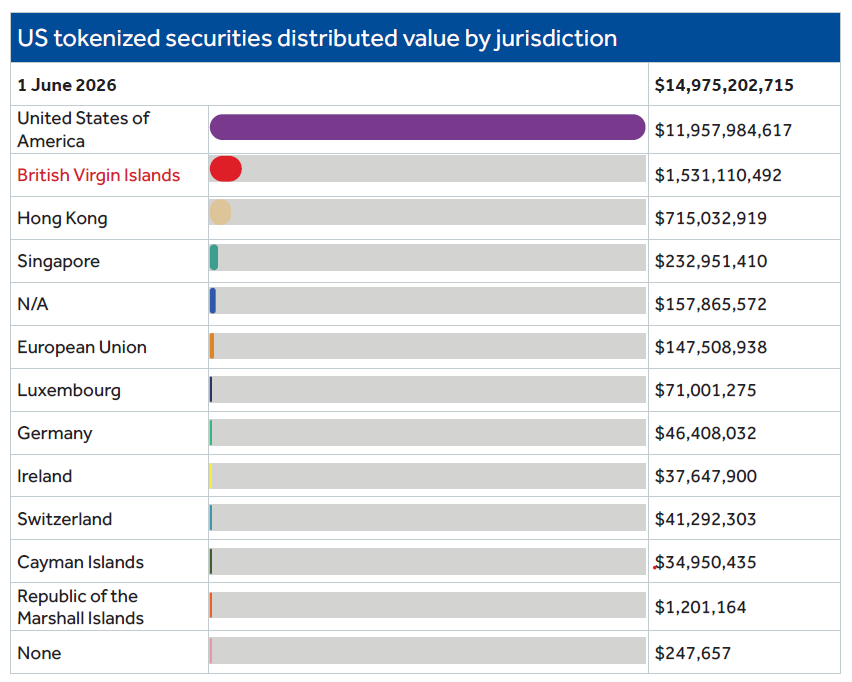
More than $1 out of every $10 of the world’s tokenized US Treasuries is issued by a company incorporated in the British Virgin Islands.
That places the small Caribbean territory behind only the United States as a key jurisdiction for the rapidly growing asset class, according to BVI Finance.
BVI Finance’s Destination Digital report in June found that BVI entities accounted for approximately $1.5 billion of the $14.98 billion global market for tokenized US Treasuries as of June 1.
A growing list of digital asset firms now call the British Virgin Islands home, including Kraken’s parent company, Payward, Bitstamp (recently acquired by Robinhood), 1inch and Bitfinex.
The territory boasts a stablecoin market cap of about $1.2 billion held in BVI-linked addresses and has roughly 28,000 stablecoin asset holders.
More than 25 virtual asset service providers (VASPs) have been approved under the BVI’s VASP regime, and, according to Bernstein Research, the Islands host 305 tokenized securities — the highest count for any single jurisdiction in the RWA.xyz dataset.
US tokenized securities distributed value by jurisdiction. Source: Destination Digital
The statistics suggest the Virgin Islands has become one of the world’s top crypto hotspots, but the reality is a little more nuanced.
Tokenized assets are designed to be borderless, and crypto projects often have the choice of which offshore jurisdiction to incorporate in.
In most cases, digital asset companies aren’t physically relocating to the Virgin Islands; they’re simply using the territory to incorporate legal entities, such as token issuers, treasury vehicles, holding companies or special purpose vehicles (SPVs).
Crypto companies aren’t just choosing BVI for tax reasons
Andrew Jowett, a partner at Appleby (BVI) Ltd who advises digital asset businesses on corporate structuring, told Cointelegraph that clients researching the BVI typically compare several jurisdictions, such as the Cayman Islands, United Arab Emirates, Singapore and Switzerland.
Despite long-held assumptions about offshore Caribbean tax havens, tax neutrality is no longer the primary driver.
Related: Dubai crypto market hits 50 licensed firms after new VARA approval
“The overriding factor for choosing the BVI has been digital asset regulation and not tax,” Jowett said. The British overseas territory does have attractive tax policies, and imposes no corporate income tax or capital gains tax on BVI companies.
But all the leading crypto hubs now have favorable crypto tax policies, meaning it’s no longer the deciding factor.
The Cayman Islands imposes no corporate income tax or capital gains tax, and the UAE has zero personal income tax or federal corporate tax on qualifying free zone entities.
“Tax neutrality is table stakes,” said Saeed Al-Marri, chief executive of digital asset infrastructure firm Ethra, which is incorporated in the BVI. He added that the BVI provides legal certainty and clarity, factors he said will determine which jurisdictions survive institutional adoption.
LTP is an institutional digital asset infrastructure provider that operates regulated entities in the BVI, Hong Kong, Australia and the UAE. Its founder and chief executive, Jack Yang, told Cointelegraph that while favorable taxation is relevant for cross-border structures, it is secondary to legal and regulatory certainty as tokenization moves further into institutional finance.
“A tax-neutral structure that cannot pass review by banks, custodians, auditors, investment committees, or regulators has limited practical value,” he said.
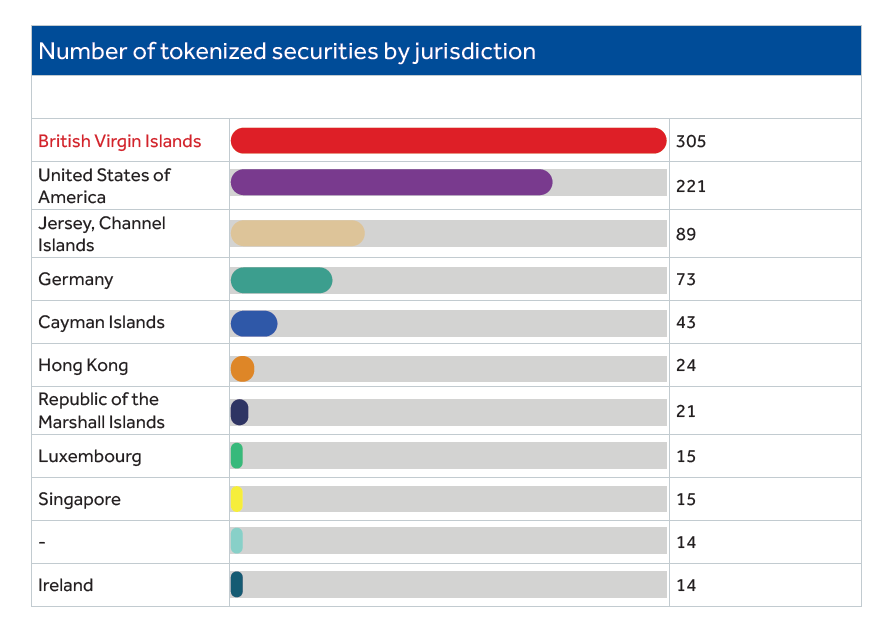
Number of tokenized securities by jurisdiction. Source: Destination Digital
Orest Gavryliak, chief legal officer at decentralized exchange aggregator 1inch, which is incorporated in the BVI, said that more and more decentralized finance (DeFi) protocols are choosing jurisdictions that provide predictable rules, rather than simply the lowest tax burden.
“Jurisdiction isn’t exactly becoming irrelevant, but its role is changing,” Gavryliak told Cointelegraph. “Protocols are increasingly weighing factors such as regulations, institutional credibility and long-term sustainability.”
Crypto hubs now compete on legal infrastructure
Jurisdictions vying to be “crypto hubs” like Singapore and the UAE increasingly compete via favorable legal infrastructure and licensing regimes, such as Singapore’s Payment Services Act and Dubai’s Virtual Assets Regulatory Authority (VARA) rulebooks.
The BVI introduced the Virtual Assets Service Providers Act (VASP Act) in 2023, overseen by the BVI Financial Services Commission (FSC).
Compared with many larger financial centers, it offers a speedy turnaround, responds to VASP applications within six weeks and aims to complete the review process within six months, according to BVI Finance and FSC guidance.
Jowett said beyond favorable tax regimes, clients prioritize “ease of launch” and efficient corporate structuring, which has long been part of the BVI’s appeal. Companies can be set up quickly, the legal framework is flexible, and ongoing reporting is generally lighter than in onshore jurisdictions.
Related: Cayman Islands Web3 foundations jump 70% as CARF reporting rules arrive
The Virgin Islands has also historically been favored because it offers more corporate confidentiality than many larger financial centers.
While BVI companies are still subject to anti-money laundering (AML) and know-your-customer (KYC) requirements, beneficial ownership information is held by registered agents rather than a public register, which reduces disclosure requirements.

British Virgin Islands. Source: Destination Digital
However, none of the companies interviewed by Cointelegraph cited tax neutrality or greater corporate confidentiality as deciding factors for incorporating in the BVI, pointing instead to legal certainty, regulatory clarity and corporate flexibility.
Incorporating, not physically relocating to the Virgin Islands
Yang told Cointelegraph that LTP does not employ full-time staff “on the ground.” Instead, the entity is overseen by its board and supported by staff from elsewhere in the LTP group.
The same distinction can be seen elsewhere in the industry. Kraken’s parent company, Payward, is incorporated in the BVI, but the exchange’s operations are primarily based in the United States, while 1inch’s team and operations are spread across multiple jurisdictions.
The BVI isn’t winning the race to attract glitzy headquarters or large-scale engineering teams. Instead, it has become the legal home for many digital asset businesses, while much of the work happens elsewhere. For jurisdictions competing to attract the industry, that just may be enough.
Magazine: Singapore isn’t a ‘crypto hub’ — it’s something better: StraitsX CEO
Cointelegraph publishes long-form journalism, analysis and narrative reporting produced by Cointelegraph’s in-house editorial team with subject-matter expertise. All articles are edited and reviewed by Cointelegraph editors in line with our editorial standards. Content published in here does not constitute financial, legal or investment advice. Readers should conduct their own research and consult qualified professionals where appropriate. Cointelegraph maintains full editorial independence.
The second-largest meme coin boosted its worldwide popularity thanks to a major initiative from Japan. However, the SHIB Army was left disappointed after previously expecting a global money manager would launch a SHIB exchange-traded fund (ETF).
The token’s price has been sliding sharply over the past several months, and certain factors suggest that the sell-off may intensify in the near future.
The Latest Developments
Earlier this week, Rakuten Wallet (a crypto exchange run by the Japanese e-commerce giant Rakuten Group) officially added a physical SHIB coin to its “Real Coin” series. Shiba Inu’s official X account celebrated the effort, saying:
“The fifth release in the collection and the first to feature a premium blast finish.”
Nonetheless, that’s about it with the good news surrounding the meme coin. T. Rowe Price’s crypto ETF has just gone live, yet despite expectations that SHIB would be among the underlying assets, the meme coin was ultimately excluded.
Another development comes from the United States. Arkham revealed that the American government recently transferred $250,000 worth of Shiba Inu seized from FTX and Alameda Research.
“This SHIB will be held by the US government and presumably used to repay creditos in the FTX case,” the post reads.
Total Ecosystem Setback
Shiba Inu has been going through a rough period lately; interest from traders and investors has dropped significantly, while overall ecosystem activity is barely visible.
The layer-2 scaling solution Shibarium, for instance, which once processed millions of daily transactions, is now in a much weaker condition. The figure has dropped to the mere hundreds, reflecting waning activity and interest among users.
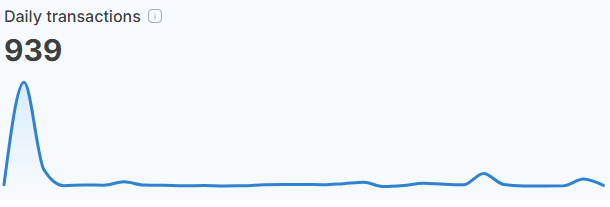
Shiba Inu’s burning program is another worrying factor, with the rate down 54% over the past week, signaling a notable decline in network participation.
SHIB Price Outlook
As of press time, SHIB is worth roughly $0.000004078 (per CoinGecko), a 17% decline on a monthly scale and a colossal 95% collapse from the all-time high registered in late 2021.
The token’s market capitalization has slipped below $2.5 billion, and at one point this year Shiba Inu even fell to the third-biggest meme coin, overtaken by MemeCore (M). Shortly after, it reclaimed the second position, but only thanks to the double-digit collapse that MemeCore (M) experienced.
Despite the negative environment and multiple bearish factors, the community continues to grow. As CryptoPotato reported, the total number of SHIB wallets recently surged to a fresh peak of nearly 1.7 million after an explosive one-day influx of around 75,000 new holders.
The post Shiba Inu (SHIB) News Today: July 17th appeared first on CryptoPotato.
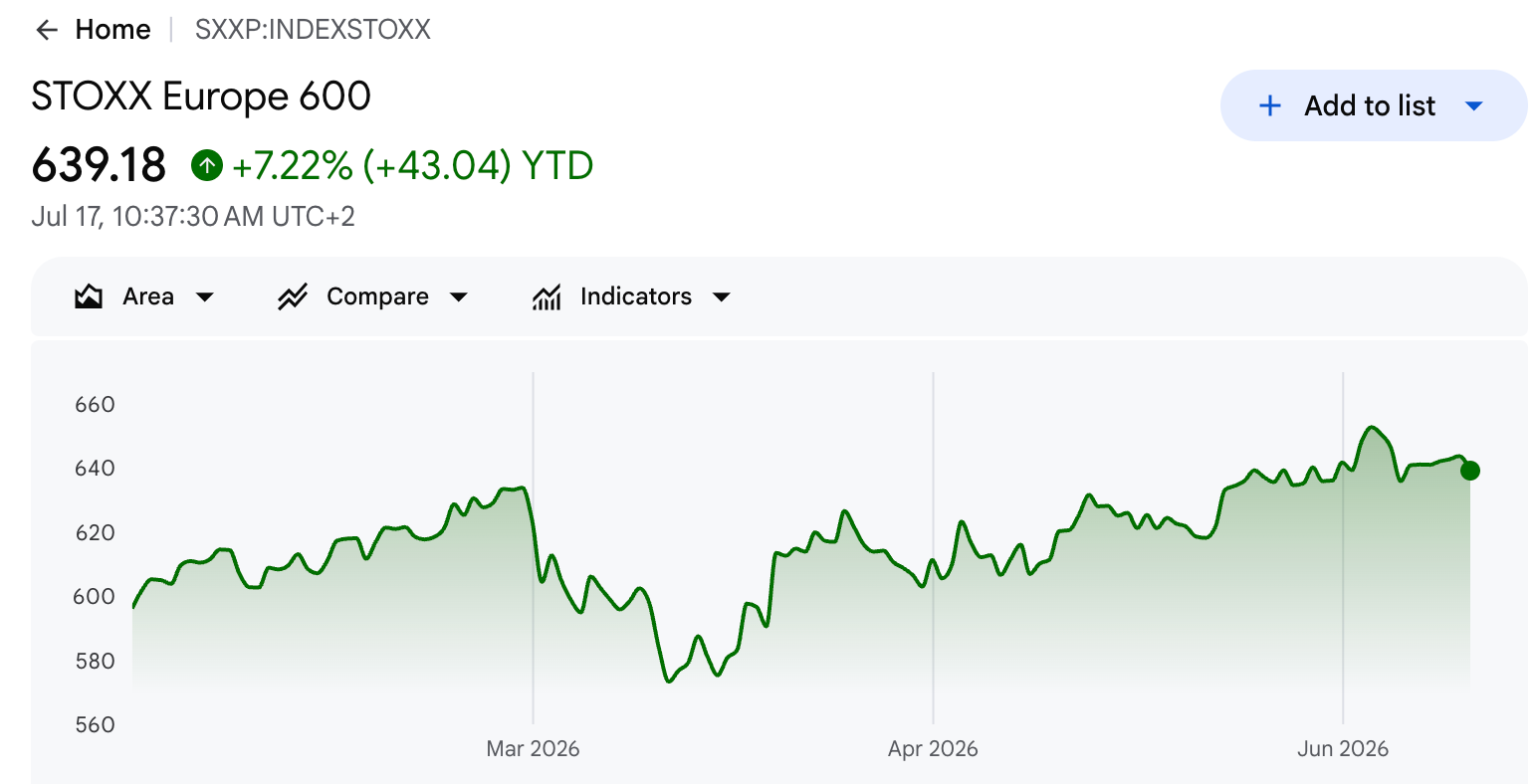
UBS forecast about 8% upside for the Stoxx Europe 600 by year-end, raising its target to 690 points from 630.
It reflects confidence that Europe’s earnings growth and stock rally can hold through geopolitical strain.
Why Banks Raised Their European Stock Target
European stocks have climbed back to record territory this year after a volatile first half. The index set a record close near 652 points on July 3.
It has since eased to about 639, but remains up more than 7% for the year. Worries about the Iran war faded after a ceasefire, and the rally held even as tensions flared again.

UBS strategists Gerry Fowler and Sutanya Chedda raised their target to 690 from 630, Bloomberg reported. The multinational investment bank and financial services firm expects the rally to run into 2027. It set a 760 target, which implies a 19% gain over the next 18 months.
“There’s probably more upside than downside risk at this point,” Fowler said.
Their 2026 forecast sits above JPMorgan’s 680, the previous highest target. Bank of America, Deutsche Bank, and Kepler Cheuvreux also lifted their targets.
The analysts pointed to stronger AI-related upgrades, steady bank revisions, and less drag from large defensive sectors.
Follow us on X to get the latest news as it happens
Strategists Split on What Comes Next
Across the July poll, the 18 strategists put the index at 647 on average by the end of 2026. That sits less than 1% above current levels, yet bearish calls are thinning out.
Only 5 of the 18 strategists expect the index to fall by year-end. Just 2 see declines steeper than 5%.
TFS is the most bearish, projecting a 9% drop to 585 points. Societe Generale ranks next, with strategist Roland Kaloyan calling for a slide of about 6% to 600. He warned that high expectations leave little room for disappointment.
“In our view, the main risk is not the absence of earnings growth, but that the recovery falls short of what is already priced in,” Kaloyan said.
The next test comes with the second-quarter results. More than 45% of firms have already beaten estimates, while 27% have missed.
Subscribe to our YouTube channel to watch leaders and journalists provide expert insights
The post Banking Giants Predict a 8% Rally for This European Stock appeared first on BeInCrypto.
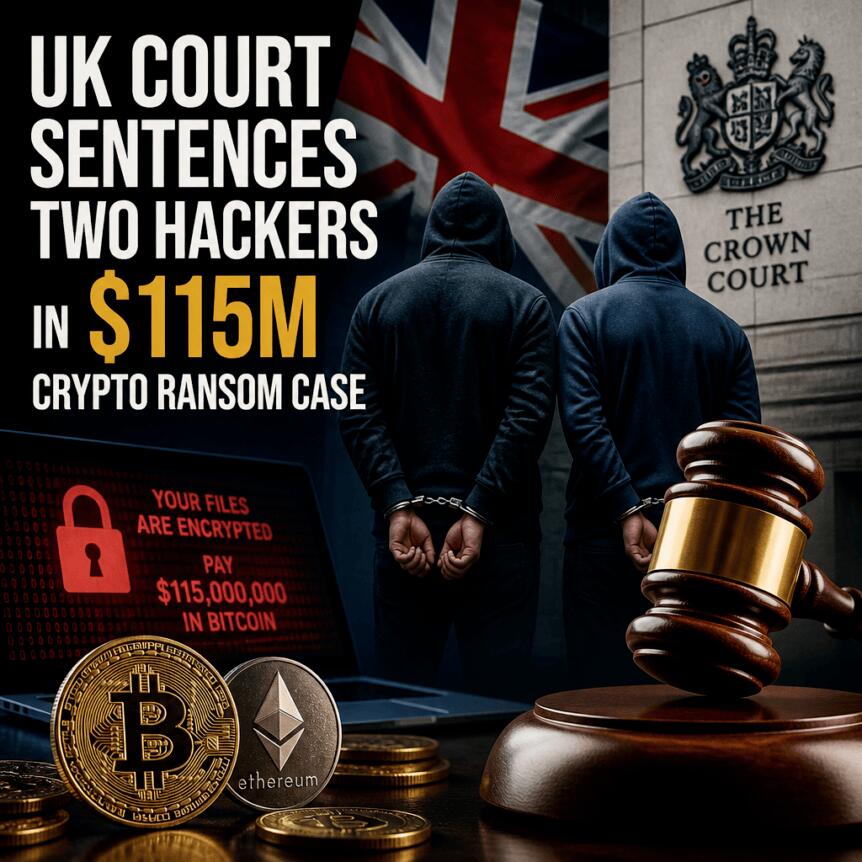
The UK’s National Crime Agency (NCA) and the Metropolitan Police’s City of London Police have announced prison sentences for two men tied to the “Scattered Spider” cybercrime group. Both defendants entered guilty pleas at their first court appearance and were later sentenced at Woolwich Crown Court.
According to an NCA press release, the men pleaded guilty on June 22 and were sentenced on Thursday to a combined term of five years and six months in prison. Authorities said the case underscores how ransomware operators increasingly use cryptocurrency to monetize intrusions and extort victims.
Key takeaways
- The NCA and City of London Police say two Scattered Spider affiliates received five years and six months for hacking-related offenses.
- UK investigators linked the group to ransomware and cryptocurrency extortion activity affecting companies in both the UK and the US.
- US prosecutors previously associated Scattered Spider with large-scale crypto ransom collection, including at least $115 million from US companies.
- The group has also been tied to major incidents such as a public transport intrusion in London and separate claims involving Caesars Entertainment.
UK sentencing in the Scattered Spider case
The NCA said the two men were convicted in connection with cybercriminal activity associated with Scattered Spider, a group investigators have linked to ransomware and extortion schemes that use cryptocurrency payments.
In the court process described in the NCA update, both defendants pleaded guilty at their first appearance on June 22. The sentencing then took place on Thursday at Woolwich Crown Court, as reported in the NCA’s release.
For crypto-focused observers, the significance is less about the jail terms alone and more about how law enforcement continues to connect real-world extortion campaigns to digital asset flows—an area where blockchain analytics and custody investigations often determine whether perpetrators can be financially disrupted.
London transport network intrusion and reported losses
British authorities said the Scattered Spider group was involved in the infiltration of London’s public transport network in September 2024. The incident was reported to have resulted in losses and recovery costs of about £29 million (roughly $38.9 million).
While the sentencing announcement is specific to the two defendants, the underlying allegations tie back to a broader campaign pattern: gaining access to high-value targets, disrupting operations, and demanding payments—often in cryptocurrency—under time-sensitive pressure.
Investors and builders watching these cases generally look for a clear signal on enforcement priorities: when high-profile systems are targeted, governments typically respond with both criminal prosecution and efforts to trace and seize assets connected to extortion.
US DOJ links: crypto extortion at large scale
In a separate Department of Justice statement from September, US prosecutors said Scattered Spider was tied to collecting $115 million in cryptocurrency ransom payments from at least 47 US companies. That same DOJ release also described broader disruptions attributed to the group, including attacks impacting critical infrastructure and the federal court system.
The scale described by the DOJ matters because it suggests Scattered Spider is not a one-off operation. Instead, prosecutors portrayed it as a campaign capable of repeatedly compromising organizations and converting the resulting leverage into crypto-linked revenue.
The DOJ statement also described a broader investigation into the group’s activities, including repeated network intrusions. In such cases, sentencing outcomes in one jurisdiction can be interpreted as pieces of a larger enforcement strategy, where cases in the UK and US collectively strengthen the evidentiary record around the same actors and methods.
FBI seizure and earlier crypto ransom allegations
According to the DOJ’s September release, the FBI seized approximately $36 million worth of cryptocurrency from wallets linked to Scattered Spider in July 2024. Prosecutors said investigators traced and seized digital assets allegedly controlled by members of the group as part of the wider case.
US prosecutors further said Scattered Spider was accused of breaching Caesars Entertainment and stealing a large customer database in September 2023. Prosecutors said Caesars ultimately paid a $15 million ransom in Bitcoin (BTC). That earlier allegation fits the same overall pattern of using crypto as the payments mechanism for extortion demands.
The combination of wallet-linked seizures and later courtroom sentences highlights the practical leverage of crypto intelligence for law enforcement: tracking transfers and correlating wallet activity with criminal conduct can support both asset recovery and prosecution.
In the DOJ’s account, investigators said the group was responsible for at least 120 computer network intrusions. The NCA sentencing announcement does not enumerate those numbers, but it aligns with the DOJ’s broader framing of an expanding threat. For victims and compliance teams, the message is consistent: crypto-enabled ransomware operations continue to attract coordinated international responses, even when the extortion attempts cross borders.
“These malicious attacks caused widespread disruption to US businesses and organizations, including critical infrastructure and the federal court system, highlighting the significant and growing threat posed by brazen cybercriminals,” said Matthew Galeotti, then acting assistant attorney general of the Justice Department’s Criminal Division.
What to watch next
With Scattered Spider affiliates now facing prison time in the UK and prosecutors having described large crypto-related seizures and ransom totals in the US, the next key question is whether additional defendants—along with more wallet-linked assets—will be identified and targeted across jurisdictions. For companies and crypto traders alike, continued enforcement can meaningfully shape how ransomware groups attempt to move funds and how quickly investigators can disrupt those flows.
Crypto World
Inside Robinhood’s high-stakes bet to ‘democratizing’ its 10 million casual users onto blockchain finance


Tokenized real-world assets (RWAs) account for just $12.66 million in active market capitalization despite the recent spike in trading activity.
Much of that larger activity, instead, came from memecoin traders piling into a new token, CASHCAT, named after Robinhood’s former company mascot. The token rallied by more than 2,100% in its first week, briefly reaching a $156 million market cap, which is 12 times larger than the chain’s entire tokenized real-world asset market.
It’s worth noting, though, that memecoins are volatile and hype-driven by nature, often lacking durable growth. That lack of sustainability was evident on Wednesday, when Noxa, the token launcher that spawned CashCat, announced it had stopped operating while directing all revenue to creators. The shutdown does not determine the fate of Robinhood Chain, but it underscores how quickly activity built around memecoin launches can disappear.
Ironically, Robinhood CEO Vlad Tenev told CNBC on July 2 that memecoins were a dead end – assets with no utility that serve no purpose. Six days later, he posted that Robinhood Chain “works great for memes too,” presumably after seeing CASHCAT’s success.
Asked about the apparent contradiction, the company did not directly address it. “The early activity on Robinhood Chain is exciting: developers are building, users are engaging, and the chain is performing as designed,” Lee said.
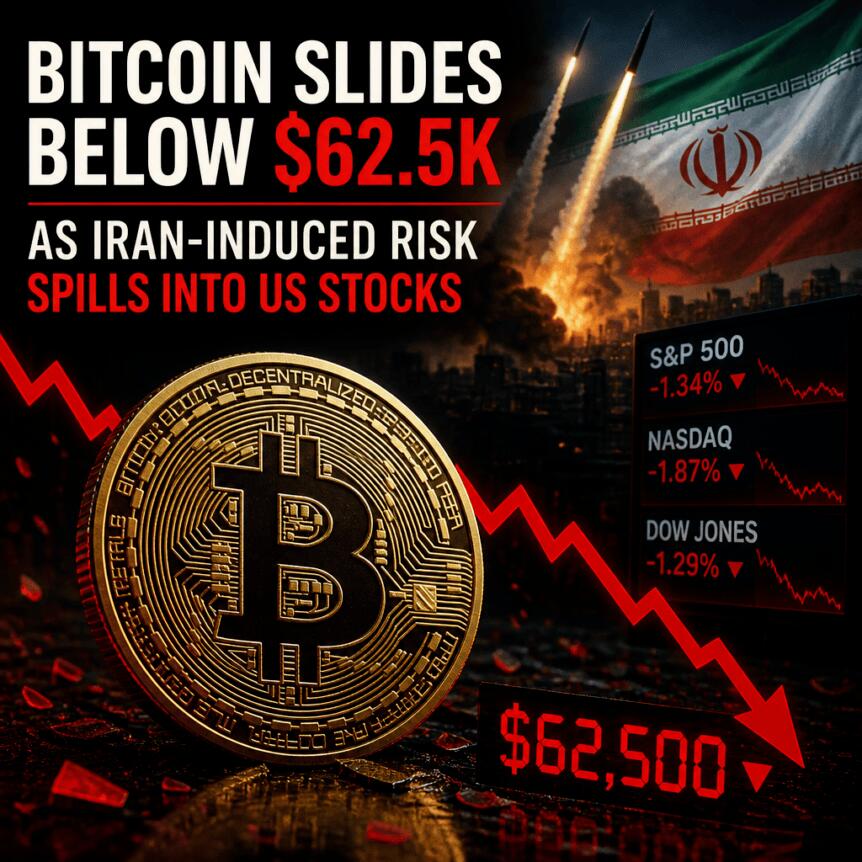
Bitcoin slipped below $62,500 at the Wall Street open on Friday, extending a fresh dose of volatility as risk sentiment deteriorated. The move came as US markets reacted to renewed tensions tied to the US–Iran war, pulling down equities and—by extension—crypto.
Traders described BTC’s behavior as “very choppy,” with buyers and sellers repeatedly failing to establish direction after earlier strength. On the technical side, analysts flagged that Bitcoin’s long-running downtrend may be nearing an important phase, after the asset flipped a key long-term moving average into resistance.
Key takeaways
- BTC fell under $62,500 during the US open as US stocks turned lower amid escalated US–Iran headlines.
- Trading data referenced from TradingView indicated up to about 2% downside on the day for BTC/USD.
- Market participants say BTC is repeating prior patterns: local highs are being rejected, and price remains rangebound.
- Analysts including Rekt Capital pointed to Bitcoin flipping its 50-month EMA to resistance, which historically has preceded a move toward a long-term floor.
BTC weakens as equities take another hit
According to TradingView data cited in the report, BTC/USD extended losses into the session, with the move described as reaching as much as roughly 2% downside on the day. The timing aligned with a broad risk-off turn in US markets.
At the time of writing, US stocks had opened in the red, and the Nasdaq Composite was down nearly 2%. Fresh military strikes on Iran were highlighted as a catalyst behind the retreat in risk assets, with tech shares continuing to face selling pressure.
Additional pressure came from company-specific news. The Kobeissi Letter flagged weakness tied to earnings disappointments, noting that Netflix was down more than 10% at the start of the US session and citing a longer-view performance mark: the stock is down about 50% over the last 12 months and trading at its lowest level since August 2024, as stated in the outlet’s X post.
After three-week highs, traders face a familiar rhythm
Bitcoin’s decline followed a rebound period in which the asset had tapped three-week highs. After that push, traders reportedly saw “copycat” selling as the market returned to the same range conditions.
One market commentator, Exitpump, suggested on X that the pattern was repeating: a “dump into passive demand,” increased open interest with shorts building while spot buying begins to reappear—an imbalance that often produces sharp bounces rather than smooth trending.
Another trader, Daan Crypto Trades, characterized the broader tape as seasonal and directionless, describing recent weeks as “very choppy,” with alternating runs up and down and limited follow-through. That view fits with the overall picture of rangebound trading: peaks get sold, support gets tested, and the market appears to oscillate rather than commit to a new trend.
Bear-market “milestones” and the 50-month EMA flip
Beyond short-term price action, attention in the crypto market has also remained focused on the longer-term shape of Bitcoin’s bear-market cycle. Analyst Rekt Capital argued that Bitcoin has moved closer to a key technical milestone by flipping the 50-month exponential moving average (EMA) to resistance.
Rekt Capital said that BTC/USD’s interaction with the 50-month EMA is repeating bear-market history and that this change sets up the next phase of the decline toward a long-term floor. In his X update, he wrote that “the necessary technical milestone has been achieved,” adding that the milestone “technically indicates that the majority of the anticipated move has already happened.”
While such signals are often discussed as evidence that the market is maturing through the bear phase, they also leave plenty of uncertainty for traders. Even if the downtrend is in a late stage, timing can still be volatile—especially when external drivers such as macro headlines and geopolitical developments repeatedly shift risk appetite.
What to watch next for traders and investors
With BTC currently trading in a highly reactive environment—tied to equity sentiment while also reflecting recurring technical behavior—readers should watch how quickly support near recent range lows holds or breaks, and whether BTC’s resistance reactions around major longer-term levels persist. The next swing will likely be shaped as much by risk sentiment as by BTC-specific technical conditions.


The Bank of England approved HSBC Orion to go live in its Digital Securities Sandbox, with the first Digital Gilt Instrument transaction expected in the first quarter of 2027.


SBI Holdings has acquired a majority stake in Coinhako after securing regulatory approval for the Singapore crypto exchange deal on July 16.
Summary
- SBI Holdings acquired a majority stake in Coinhako after receiving approval from Singapore’s financial regulator.
- Coinhako gives SBI a licensed base for expanding digital asset services across Southeast Asia.
- The deal complements SBI’s JPYSC stablecoin, Ondo partnership, and Solana-based JX equity token
According to SBI Holdings, the transaction involved a capital injection through SBI Ventures Asset Pte. Ltd. and the purchase of shares from Coinhako’s existing investors. Coinhako will now operate as a consolidated subsidiary of the Japanese financial group.
Approval from the Monetary Authority of Singapore allowed the deal to close on July 16. SBI did not disclose the size of the investment, the percentage of shares acquired, or Coinhako’s valuation under the transaction.
Established in 2014, Coinhako is operated by Hako Technology Pte. Ltd. and holds a Major Payment Institution licence from MAS. Its affiliate, Alpha Hako Ltd., is registered as a virtual asset service provider with the British Virgin Islands Financial Services Commission.
Coinhako gives SBI a regulated Singapore base
Through the acquisition, SBI plans to combine Coinhako’s customers, regional network and crypto operations with the Japanese group’s financial products and international reach. The company identified Singapore as a key market because of its established digital asset regulations and position within Southeast Asia.
SBI Chairman and President Yoshitaka Kitao described the purchase as part of the group’s plan to connect exchanges across multiple countries. According to Kitao, such a network could let investors trade without being limited by national borders or currency differences.
Coinhako’s local presence and regulatory status were central to the decision, Kitao added. SBI expects the exchange to support new services involving stablecoins, tokenized assets, cross-border trading and on-chain finance between Japan and Southeast Asia.
For Coinhako, joining SBI provides access to a financial group with operations across banking, securities and digital assets. Commenting on the acquisition, Coinhako co-founder and CEO Yusho Liu described the deal as the company’s next stage after a decade of operating in Singapore.
“Joining the SBI Group is a natural step for Coinhako to move to the next stage of growth.”
Tokenized assets deepen SBI’s regional strategy
Alongside the Coinhako purchase, SBI has been developing a yen-backed stablecoin called JPYSC with blockchain company Startale. SBI plans to explore its use within the combined group, including possible links to Coinhako’s services and regional customer network.
As previously reported by crypto.news, SBI has also partnered with Ondo Finance to bring tokenized financial products into its ecosystem. Under the agreement, the companies plan to use JPYSC for settlement and collateral while connecting Japanese securities with overseas tokenized markets.
Ondo’s products are expected to reach investors through SBI’s customer network, according to the companies. The partnership also gives SBI another route for using its stablecoin beyond conventional transfers, including transactions involving tokenized securities.
One day before the Coinhako deal closed, SBI Global Asset Management launched the SBI Japan High Dividend Equity Strategy Token, or JX token, with regulated real-world asset exchange DigiFT. Issued on Solana, the product gives accredited and institutional investors blockchain-based exposure to a Japanese high-dividend equity strategy managed by SBI Asset Management Co.
Taken together, SBI’s announcements show how the group is assembling regulated exchanges, tokenized investment products and stablecoin infrastructure across Asia. Coinhako adds a licensed Singapore distribution point to that network, while the Ondo and DigiFT agreements provide financial products that SBI could connect to it.

Andy Burnham Insists He Was Not Part Of Plan To Oust Keir Starmer

World Cup final and third-place prediction: Chris Sutton’s verdict on Spain v Argentina & England v France

power of money #shortvideo #viralshort


-

 Fashion7 days ago
Weekend Open Thread: Nutriplenish Leave-In Conditioner
-
 NewsBeat1 day ago
London Mayor Sadiq Khan handed a peerage by Keir Starmer alongside 15 other Labour figures… just days before the PM leaves No10
-

 Crypto World2 days ago
CFTC blocks Kalshi from unwinding Michigan trades after court order
-

 Business2 days ago
Nvidia Stock Slips After Big Tuesday Rally as Huang Confirms Vera Rubin Chip Is Now in Production Today
-

 Politics2 days ago
Young campaigners urge incoming PM to act on outdoor junk food ads
-
 Entertainment2 days ago
Disney’s Most Ambitious Failed Star Wars Attraction Is Coming to SDCC
-

 News Videos3 days ago
XRP BOMBSHELL… XRP OMBOARDED FOR TRANSACTIONS!!!
-

 Tech3 days ago
Get Your ESP32 Sunny Side Up With This Solar Dev Board
-

 Crypto World20 hours ago
Injective Submits SEC Transfer-Agent Registration to Onchain Ownership Records
-

 NewsBeat5 hours ago
Registration is now open for March for Men with Kev 2026
-

 Tech3 days ago
Dark Secrets Emerge When Jailbreaking LLMs
-

 Business2 days ago
Palantir Shares Rise After Expanded Nvidia Partnership and Fresh Analyst Upgrades Ahead of Earnings Day
-

 News Videos10 hours ago
Money | Class 12 Economics | CBSE Board Exam 2026-27
-
 Sports2 days ago
New Cornerback Enters Vikings Trade Rumor Mill
-

 Business15 hours ago
Banco Bilbao Vizcaya Argentaria, S.A. (BBVA) Discusses Global Macro Environment and Economic Outlook for Core Markets Transcript
-
 Tech4 days ago
Cloudflare Precursor Watches Your Mouse and Keyboard To Decide If You Are Human
-

 News Videos4 days ago
how to make coin bank box with cardboard #scienceproject #money #diy #shorts
-
 Entertainment2 days ago
Vicki Gunvalson Defends Discussing Heather Dubrow’s Money
-
Crypto World3 days ago
Ripple, Coinbase, Circle Join Linux x402 Foundation to Help Shape AI Payments
-

 Crypto World18 hours ago
Claude Fable 5 Slips to Second in AI Coding Leaderboard
You must be logged in to post a comment Login