Connect with us
DAPA Banner
DAPA Coin
DAPA
COIN PAYMENT ASSET
PRIVACY · BLOCKDAG · HOMOMORPHIC ENCRYPTION · RUST
ElGamal Encrypted MINE DAPA
🚫 GENESIS SOLD OUT
DAPAPAY COMING

Tech

Over 4,500 Google workers demand layoff protections as Alphabet’s value hits $4.3 trillion

Published

on

What just happened? In an age where tech workers are losing their jobs to AI at a frightening pace, thousands of Google’s employees are taking action. Over 4,500 company staff have signed a petition calling for layoff protections, including guaranteed severance, buyouts before mandatory layoffs, and the option to take severance as extended paid leave.

Like many other companies invested in the AI boom, Google is enjoying plenty of success right now. Parent company Alphabet’s latest quarter produced $109.9 billion in revenue, up 22%, while operating income rose 30% to $39.7 billion. It’s also the third-largest company in the world by market cap with a $4.3 trillion valuation.

“Make no mistake: this is a company that is enjoying massive, unprecedented success,” Parul Koul, Google software engineer and Alphabet Workers Union president, said outside the company’s California headquarters after delivering the petition to the office of CEO Sundar Pichai.

But it seems that as these tech giants get richer, they lay off more people, often because of AI systems automating employees’ jobs. Alphabet has laid off more than 14,000 people since the start of 2023, most of whom lost their jobs that year. “These layoffs and cuts are not difficult decisions, but simply profit being put over the people that make this company run,” Koul added.

Advertisement

At a press conference on Thursday, employees chanted, “Google, Google, you can’t hide, we can see your greedy side,” and called out the 2023 mass layoffs.

Koul said workers were greeted with closed doors and no response for the most part after the petition was delivered to a staff member in Pichai’s office, though they agreed to pass it on to the CEO. Koul called it “the largest piece of employee feedback that Google has received about job security.”

The union also wants Google to end performance ratings that workers say are based on meeting quotas rather than merit. The company has denied forcing particular rating distributions, insisting that employees are assessed according to their individual performance, roles, levels, and expectations.

Advertisement

The campaign has already secured some benefits for employees. According to the union, voluntary exit packages have been made available to more than 70,000 Google workers since it began. The petition calls for these buyouts to be offered companywide before any mandatory layoffs.

Google Cloud quietly laid off employees in May, and the company eliminated more than one-third of the managers overseeing small teams last summer. More recently, hundreds of employees across its hardware, assistant, and engineering teams were let go in January 2026. Google also dismissed more than 200 contractors working on its AI products without warning in 2025 amid disputes over pay and working conditions.

Google has not confirmed that AI was responsible for its many job cuts. However, several other tech giants have been more open about the connection. Oracle reduced its workforce by 21,000 people over the last year and acknowledged that adopting AI had resulted in cuts. Block CEO Jack Dorsey cited AI efficiency gains when eliminating over 4,000 roles in February, almost half of the company’s workforce.

Google did not immediately respond to a request for comment.

Advertisement

Source link

Continue Reading
Click to comment

You must be logged in to post a comment Login

Leave a Reply

Tech

Hackers stole ‘significant’ amount of data from tech firm relied on by thousands of US hospitals and pharmacies

Published

on

U.K.-based healthcare billing software maker Craneware is responding to a cyberattack in which hackers stole a “significant volume” of customer data from its systems, the company said on Monday.

The company said the hackers appear to have been expelled from its systems, but its investigation into the breach is ongoing, according to a statement filed with the London Stock Exchange.

Craneware’s flagship accounting and billing software is used by thousands of clinics, hospitals, and pharmacies across the United States. The company did not say exactly what kinds of data were taken in the breach, only noting that a “percentage” of employee data, customer data, and partner records had been exfiltrated.

The company, whose software helps healthcare providers bill patients for services, handles large amounts of medical records and patient data on behalf of its customers. When it bought Florida-based pharmacy software maker Sentry in 2021, Craneware said it gained access to the company’s 147 million patient records that had been collected over two decades.

Advertisement

Craneware CEO Keith Neilson did not immediately respond to TechCrunch’s questions about the incident, or if the hackers have contacted the company with any demands, such as a ransom. 

It’s not yet clear if the company’s systems can receive email amid the ongoing cyberattack.

While details of the hack are still under investigation, this is the latest data breach in recent months where hackers have targeted tech companies that supply tech and services to the U.S. healthcare sector. By compromising software that many healthcare providers use to analyze and understand their billing processes, hackers can access vast amounts of patient medical and health-related data, and extort the companies with threats of publicly releasing the information.

Craneware is the latest health tech giant to be breached in the past year.

Advertisement

In March, healthcare revenue tech firm TriZetto confirmed hackers stole more than 3.4 million people’s personal and health data from its systems during an earlier cyberattack. That very month, medical data storage giant CareCloud reported a breach of one of its stores of patients’ electronic health records, but has not yet said how much data was taken. 

Last July, medical billing company Episource began notifying at least 5.4 million people that their information had been stolen by hackers.

The largest ever breach of U.S. medical and healthcare data occurred in 2024, when a Russian-speaking ransomware gang hacked UnitedHealth-owned Change Healthcare. The hackers stole the medical and patient records of at least 192 million people, which the company conceded affected a “substantial proportion of people in America.”

When you purchase through links in our articles, we may earn a small commission. This doesn’t affect our editorial independence.

Advertisement

Source link

Continue Reading

Tech

Watch Flock Safety CEO Garrett Langley discuss the future of surveillance at TechCrunch Disrupt 2026

Published

on

The debate over where the line should be drawn between privacy and public safety has only intensified in the AI era. And Flock Safety, a company that has seen both an influx of investment and an intense public backlash, sits right at the center of that debate. 

That’s why at TechCrunch Disrupt 2026, we’re bringing Flock’s founder and CEO Garrett Langley to the stage to speak about those very issues. Disrupt has always had its fair share of hard-hitting conversations, and you should expect no less from this session. 

And Langley’s discussion of AI, surveillance, and the future of public safety is just one of the many compelling conversations happening at Disrupt this year, which will take place October 13-15 at San Francisco’s Moscone Center. You can dive into the programming we’ve announced so far here, or take advantage of lower, early ticket prices right here

How Flock Safety, and Langley, got to Disrupt 2026 

Atlanta-based Flock Safety isn’t Langley’s first experience within the startup space. In past roles, he worked on the car subscription service Clutch and the platform Experience, where he oversaw several teams, including engineering and design prior to its sale to Cox Enterprises for $200 million in 2014.  

Advertisement

Flock started in 2017, with Langley partnering with co-founders Matt Feury and Paige Todd, going through Y Combinator before experiencing significant success selling its surveillance technology to businesses and law enforcement agencies. You may associate the company with license place recognition, though it has more general surveillance use cameras and has been developing drone first responders following its acquisition of Aerodome

The company’s most recent fundraise last year, a $275 million round, placed Flock at a $7.5 billion valuation, which was a sharp increase from the prior year’s $4.8 billion valuation. Altogether, the outfit has secured $950 million in total funding since inception. 

Flock’s business success has been paired with pushback from privacy advocates like the ACLU and members of the general public, with some people going so far as destroying Flock’s surveillance cameras as it continues to offer its cameras and databases to U.S. Immigration and Customs Enforcement in particular. Among the biggest apparent setbacks for Flock, Amazon’s Ring recently ended a partnership with the company, and the LAPD let its deal with Flock lapse this month.  

Langley will discuss the company’s approach to the increasingly interwoven nature of AI and the surveillance industry in a discussion that’s certain to prove illuminating to Flock’s supporters and its critics. 

Advertisement

To watch the discussion in person and join the other 10,000 founders, investors, tech enthusiasts, and innovators who will be flocking to San Francisco for TechCrunch Disrupt 2026 on October 13-15 for a wide array of workshops, speaker talks, after-parties, and networking, snag a ticket at the best price you’ll be seeing for the rest of the year right here

When you purchase through links in our articles, we may earn a small commission. This doesn’t affect our editorial independence.

Source link

Advertisement
Continue Reading

Tech

Hollywood Sci-fi Studio Lot Now Pitched As Site To Make Real Space-age Weapons

Published

on

James Cameron filmed his Avatar sequels there. Marvel filmed Thor, Iron Man 2, and The Avengers. Manhattan Beach Studios in Los Angeles even handled Star Wars’ series like Obi-Wan Kenobi and The Mandalorian, which Bloomberg points out is about “a heavily armed bounty hunter in a galaxy far, far away.”

“Now lenders who are selling the property’s $240 million mortgage are promoting the site to potential buyers as a hub for making real space-age weapons.”

“The project is strategically positioned within Los Angeles’ prominent aerospace and innovation corridor, anchored by industry leaders such as Northrop Grumman, Raytheon Technologies and SpaceX,” said Cushman & Wakefield, which has the listing. “A supply-demand imbalance has emerged, driven by the growing concentration of advanced manufacturing users and a limited supply of viable space,” the real estate brokerage said in a presentation. Bids are due July 28.

The marketing pitch reflects Southern California’s shifting economic landscape as the movie business slumps and weapons makers seek to cash in on surging Pentagon spending… The defense boom is spurring the revival of a regional industry that once churned out World War II bombers, supersonic Cold War planes and Apollo command and service modules before shrinking after the fall of the Soviet Union… In the Los Angeles area, aerospace and defense-related tenants have accounted for 11% of new industrial real estate leases since the start of 2025, up from an annual average 2% during the preceding decade, according to a report this month by brokerage Newmark Group Inc.
Los Angeles “has always gone through transformations,” Stephen Cheung, president of the Los Angeles County Economic Development Corp., told Bloomberg. “This is one of those.”

Advertisement

Source link

Continue Reading

Tech

AWS billing goes haywire, hits customers with bills as high as $7.8 trillion

Published

on

WTF?! Amazon has a reputation for squeezing customers for all they’ve got, but increasing billing prices from a couple of cents to $1.5 trillion really shows how Jeff Bezos got so rich. Thankfully, though, this was just an error by Amazon Web Services, but it still caused one customer’s soul to leave their body, in their own words.

Bill Radjewski, who runs CollegeFootballData.com, received the sort of email most of us would rather not receive last week: an AWS alert informing him that he had accrued $1.5 billion in usage fees. Should he manage to win several lotteries and somehow pay it, he was still expected to face a $3 billion bill on August 1.

During the six years he’d been with AWS, his account had never exceeded $0.02 – most months his bill was just $0.01.

However, those figures were rookie numbers compared to what Dan Harvey, the head of marketing at the Hampshire-based Learning Through Landscapes, was billed.

Advertisement

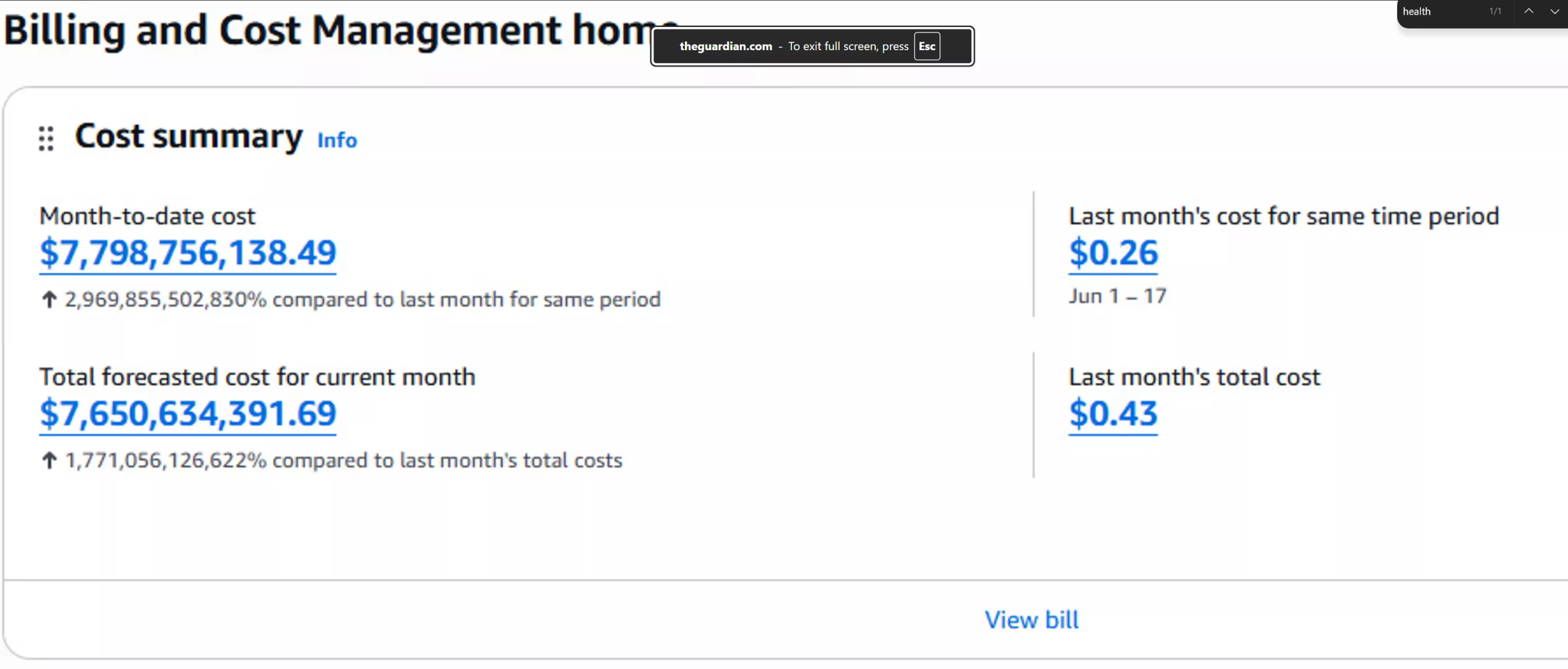
Harvey told the Guardian that after his previous month’s AWS bill came to 43 cents, he was especially surprised to find a bill for $7.8 billion. “I had to have a real dig around with our tech support team, while I was in full panic mode, trying to find what was going on in our account,” he said.

There was also a student in Delhi whose regular monthly AWS bill of $1.28 increased to $10.9 billion.

Another user, Bharath, saw their bill rise an impressively large 745,728,201,771% from the previous month to $1.5 trillion. “I just saw $1.5tn on my AWS bill and my soul left my body,” they wrote.

Advertisement

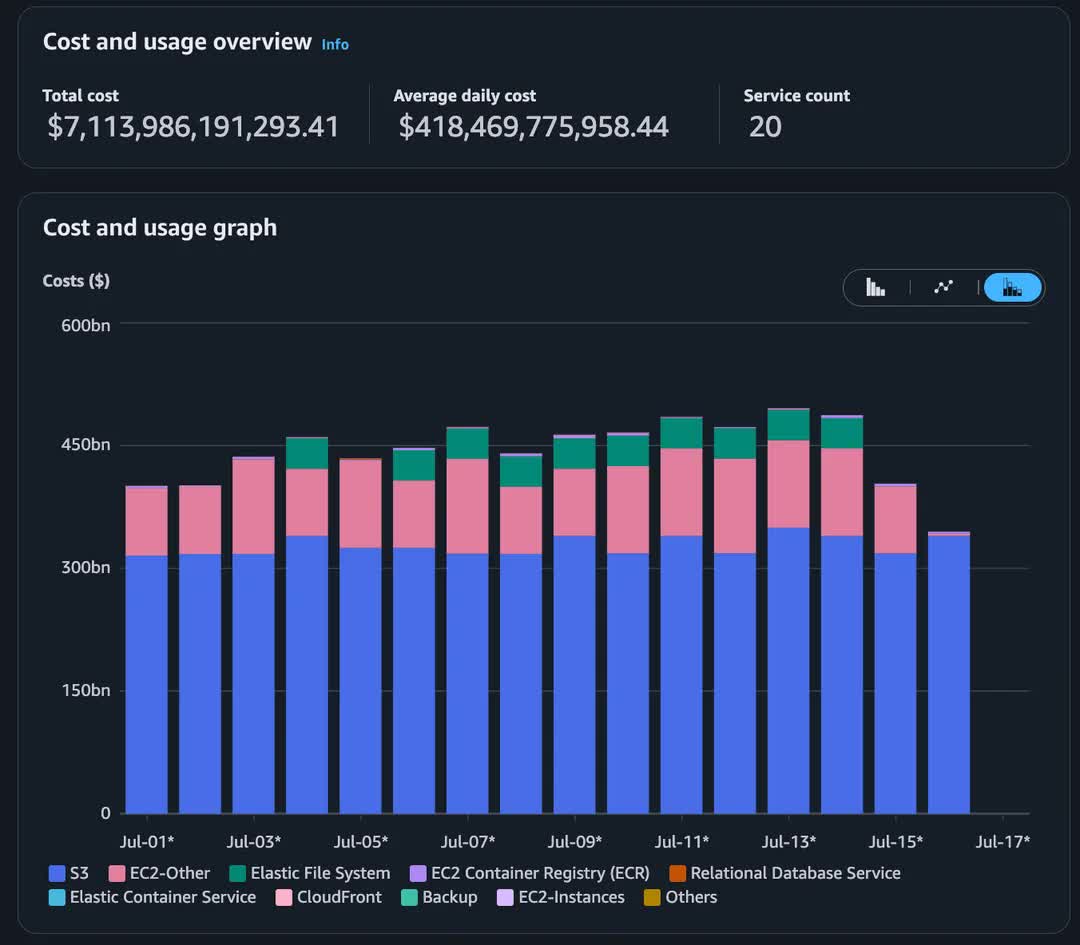
But the record seems to belong to the user who racked up a $7.1 trillion bill in service fees since July 1, which is more than double Amazon’s market cap.

Amazon said that after 30 minutes of investigating, it determined that the root cause was “an issue with unit pricing within the estimated billing computation subsystem.” The company provided no further details but paused the bill estimation system.

AWS later said it was “rolling back a recent change to the billing computation subsystem” and attempting to restore the last known good version of its estimated billing calculations.

It appears that the issue wasn’t an easy fix. A few hours after that initial message, AWS wrote that “Our efforts to backfill corrected estimated cost and usage data are still underway. We are progressing slower than anticipated.”

Advertisement

While most people obviously knew this was an error on Amazon’s part, some have pointed out that this could really have alarmed customers and may have even caused health issues. “Good morning to everyone enjoying their heart attacks,” wrote X user Gerred

Even Amazon tried to make light of the situation, though it’s easy to imagine that not everyone was laughing about it . The company wrote on X, “Typo alert: Some customers saw quadrillion-dollar AWS billing estimates today. Slight miscalculation on our end (very slight ). We’re fixing it now. No action needed on your end. Sorry for the confusion. Real question: what will you do with those trillions instead?”

Source link

Advertisement
Continue Reading

Tech

Windows Server Update Services buckle under Microsoft’s metadata mountain

Published

on

SYSTEMS

Redmond has stabilized new installations, but existing deployments remain stuck in sync purgatory

Microsoft’s aging Windows Server Update Services (WSUS) has hit “severe degradation,” leaving some organizations facing painfully slow synchronizations or timeouts when fetching updates.

According to Microsoft, “a buildup of publishing metadata” has meant that “organizations might experience increased synchronization times or sync operation timeouts on WSUS servers.”

Advertisement

We’re told the problem isn’t related to the recent Patch Tuesday update, but Microsoft noted “heightened impact observed starting July 13, 2026.”

Administrators use WSUS to deploy and manage the distribution of updates and features in an enterprise environment. It was deprecated some time ago, but remains a supported part of Windows and, as such, receives fixes and security updates, even though there will be no new features.

Microsoft’s advice in October 2024 was to move to an alternative, such as one of its cloud-based options. However, administrators tend to opt for an “if it ain’t broke” approach and the service was still flagged as supported and suitable for production deployments.

However, failed synchronization could delay organizations’ ability to test and deploy patches, leaving systems exposed for longer.

Advertisement

Microsoft has not yet published a workaround for affected servers. For new and rebuilt installations, it deployed a mitigation on July 18 that restored normal synchronization, noting: “This mitigation prevents newly installed or rebuilt WSUS servers from encountering this issue.”

For existing affected WSUS servers, though, “Microsoft is working on mitigation steps to help customers safely remove the affected metadata from their environments. We will provide more information when this guidance is available.”

Microsoft’s affected platform list spans pretty much every desktop and server operating system still supported by WSUS, from the newest and shiniest Windows 11 26H1 all the way back to Windows 10 1607 and Windows Server 2012.

There isn’t much administrators can do at this stage other than wait and see, since the problem appears to be on Microsoft’s end. At present, it could be categorized as a headache, and perhaps a symptom of Microsoft’s inattention to the service.

Advertisement

However, should it linger and begin having a more severe impact on an enterprise’s patch cycle, action will be required. ®

Source link

Continue Reading

Tech

Brendan Carr Is Illegally Dismantling U.S. Media Consolidation Law

Published

on

from the laws-are-just-suggestions dept

Brendan Carr and the Trump FCC are finalizing plans to illegally eliminate what’s left of the country’s already barely functional media consolidation limits; a specific gift to Trump-friendly right wing broadcasters that are hoping to monopolize what’s left of local U.S. broadcast news so they can more efficiently spread propaganda and kiss the president’s ass.

Current laws (remember those?) prohibit any single local broadcast news company from serving more than 39 percent of all TV households in the US. The original (good) idea was that this helped protect opinion diversity and competition in the local broadcast news space. Republicans don’t like that, because they want to replace all journalism with right-wing and oligarch friendly propaganda.

Brendan Carr last March had already made it clear he viewed the law as optional when he granted Nexstar Media Group a waiver for its $6.2 billion acquisition of Tegna. That deal would let the company reach more than half of all U.S. households with what passes as “local news.” Now he’s trying to replace a congressionally-approved law with a “case by case review” dictated by Republican whims:

“Carr now plans to repeal the 39 percent limit and replace it with a “case-by-case review” of each proposed merger, the chairman announced today in an op-ed published on Breitbart. The change would make it easier for the FCC to pick and choose which station groups get to surpass the limit. Under Carr, this would likely benefit news companies that provide favorable coverage for President Trump.”

This is, to be clear, illegal. Something the FCC’s lone Democrat, Anna Gomez, made clear in her own statement:

Advertisement

“This unlawful effort to hand control of the public airwaves to billionaire buddies of this
administration will destroy local newsrooms, silence community reporting, and drive-up
costs for the American families who depend on local stations for news and emergency
alerts. A free and diverse media landscape depends on real limits on how much of the public
airwaves any one company can control, and this FCC is now poised to allow local
broadcasters to sell those airwaves off to the highest bidder. Congress set the 39 percent
national ownership cap in federal law, and only Congress has the authority to raise or
eliminate it. The Commission cannot waive away that limit simply because these corporate
behemoths want to get out from under it.”

Clearly there will be lawsuits, though they’re likely to drag on until long after Nexstar and Tegna have merged, with future regulators being very unlikely to unwind the transaction. I’d then expect to see Sinclair Broadcasting to merge with the remaining company, creating a monopoly over local broadcast TV.

While people are quick to insist that “who cares, nobody watches this stuff,” they don’t seem to realize that somewhere around 80 million households still watch local broadcast TV channels via antenna, cable TV, streaming providers, or satellite.

As I’ve frequently discussed, most of these local broadcasters deliver a sloppy combination of lazy infotainment and right-wing agitprop, as that viral video about Sinclair Broadcasting made clear a few years back:

Advertisement

Carr’s very unsubtle goal here is to turn the entirety of U.S. local broadcast television into propaganda arms of the U.S. right wing. That’s not an opinion or hyperbole, and he’s well on his way already. It might help if there was a functional opposition party that had made meaningful media reforms a centerpiece of their political platform anytime in the last quarter century.

And this is, of course, just local broadcast TV. We’ve also got Carr’s FCC helping Larry Ellison do the same thing to CBS and CNN. Ellison’s also steadily doing the same thing to TikTok while Elon Musk does the same thing to what used to be Twitter. If you stand back, tilt you head, and squint just right, you might begin to notice a consistent theme.

Filed Under: brendan carr, broadcast tv, corruption, disinformation, fcc, journalism, local news, media consolidation, propaganda, republican

Advertisement

Source link

Continue Reading

Tech

Could Reticulum Power A Post-Internet Network?

Published

on

These days, it is easy to think you always have access to the Internet. But some wonder if — in spite of its ARPANET, nuclear-war-planning heritage — you can actually count on it to be there when things go pear-shaped. [The Tech Prepper], as you might imagine, is quite concerned with that last question, and is flogging Reticulum over high-frequency radio as a post-internet network in a video embedded below.

Reticulum is a cryptographic network stack, fully decentralized and amazing from a cyberpunk/hacker/survivalist perspective. Unfortunately for [The Tech Prepper], until the you-know-what hits the ventilation unit and the FCC and its counterparts in other countries are too busy to be concerned with such trifles, encrypted signals are banned on ham radio bands just about everywhere. That’s why his demo is using a dummy load on the Mercury HF modem instead of an antenna: the feds don’t care if the signal doesn’t leave the building. The video shows how to replicate the setup using his EmComm Tools suite on Ubuntu.

Perhaps more interesting is his vision of a Post-Internet network, be it in a disaster scenario, as he envisions, or simply because we get sick of what the internet has become. The idea of easily hooking an open-source radio modem to a PC running modem73, open-source SDR software, has a certain appeal. Reticulum isn’t your only option there: modem73 will let you run a BBS in the clear — that is, unencrypted and legal to transmit — and let’s face it, wasn’t life online more fun in BBS days?

Advertisement

This isn’t the first time we’ve seen the Reticulum network stack, but last time it was operating at considerably shorter ranges over LoRA. 

Advertisement

Source link

Continue Reading

Tech

Earth-like LHS 1140b May Feature The First Atmosphere Found On Exoplanet

Published

on

Finding another planet outside of our solar system that can comfortably be called ‘Earth-like’ is one of those discoveries that — if confirmed — would be a major event. The complication here is that with every exoplanet that we discover through observations, determining the type of planet is hard enough, never mind figuring out whether it has an atmosphere, much less what’s in that atmosphere. This makes a recent report on LHS 1140 b rather exciting, as it strongly suggests that this super-Earth may have something close to an Earth-like atmosphere.

In the paper by [Collin Cherubim] and others in Science, the findings of helium occasionally escaping from its atmosphere have led to considerable excitement, as this time-variable atmospheric escape of helium suggests a helium-rich upper atmosphere that’s further depleted in hydrogen.

It should be noted, of course, that these assumptions are based on observations from roughly 49 light-years away, so there’s always some room for later adjustments. Even if confirmed, the star that LHS 1140b orbits is a red dwarf, with a nearly 25-day orbital period and light levels less than half of what Earth receives from the Sun. This would make the surface of LHS 1140b with its proposed oceans rather dim, even if it’s conceivably at temperatures well within the comfort range of us Earth-based mammals.

Advertisement

At 49 light-years distance, it’s also not close enough that — barring an FTL drive — we could do direct observations or visitations, but if these results hold, it’d be on the short list along with a number of other plausibly habitable exoplanets to check out once we build that first warp drive-powered starship.

Source link

Advertisement
Continue Reading

Tech

EMEA businesses not reaping benefits from their AI spend

Published

on

Research from ServiceNow indicates an 18-point gap between AI strategy and execution in EMEA.

Despite massive artificial intelligence spending, European businesses are struggling to turn their investments into measurable results, a new ServiceNow index has found.

Organisations across Europe, the Middle East and Africa (EMEA) scored 51 out of 100 for their overall AI maturity – up 34pc since last year – but only managed to hit 40 points when it comes to actual AI-enabled workflows.

Leadership, vision and strategy scores reached 58, according to the report, which surveyed more than 4,700 senior executives across 16 countries. 1,700 were based across EMEA.

Advertisement

Business are paying for AI capability that they haven’t yet unlocked, the report found, with only 16pc of those surveyed saying they replaced fragmented legacy systems with an integrated platform.

And while 59pc of the surveyed professionals said their organisations had moved beyond piloting agentic AI, only 9pc said they have made “meaningful progress” towards building autonomous, multistep workflows.

This comes as global corporate AI spending hit $581bn in 2025, with projections estimating that AI will represent more than 20pc of an organisation’s IT budget by 2027. Government AI spend, meanwhile, rose 140pc year over year, more than any other industry surveyed.

ServiceNow pointed to data quality, governance and workflow foundations as “critical barrier[s]” to scaling AI across the enterprise sector.

Advertisement

It also found that businesses based in Ireland that already operate against rising costs and tighter margins are facing added pressures.

This comes as Ireland makes efforts to upskill workers in AI, support businesses in adopting the technology and introduce new policies to attract data centres.

“Organisations in Ireland are among the most ambitious on AI in Europe. The challenge isn’t commitment. It’s connecting that commitment to the operational infrastructure that makes AI work across the enterprise and, more importantly, getting it live with the right guardrails and governance,” explained Paul Turley, senior director at ServiceNow Ireland.

“The organisations that have closed that gap are already seeing returns the rest have yet to match. The contrast is stark – those bridging the gap aren’t just using AI more, they’re using it differently, running autonomous, multi-step workflows at roughly 18 times the rate of the rest of the market.”

Advertisement

ServiceNow’s survey found data to be the biggest barrier to AI execution, with 73pc of EMEA executives citing inadequate data accuracy, access and management as a major barrier.

Only 57pc of surveyed organisations in the region use agentic AI, of which only 9pc use the technology to create autonomous workflows, according to ServiceNow, meaning AI is merely assisting employees without a significant change in how an organisation works.

Meanwhile, only 19pc of EMEA organisations said they have implemented AI testing, auditing and risk processes, despite the bloc’s strict rules.

ServiceNow finds governance maturity as the defining factor between organisations succeeding in the AI race and those lagging behind.

Advertisement

These organisations combine strong data management, testing and risk controls with integrated workflows, enabling them to scale AI confidently, according to the report, and as a result, managed to deliver a 164pc return on investment and expect 199pc ROI within two years.

“Mature governance enables these organisations to scale confidently and move faster than their peers. For Irish businesses, the EU AI Act makes governance unavoidable, but the Index shows it should be welcomed rather than resisted,” said ServiceNow.

Don’t miss out on the knowledge you need to succeed. Sign up for the Daily Brief, Silicon Republic’s digest of need-to-know sci-tech news.

Advertisement

Source link

Continue Reading

Tech

China’s car market is heading for its worst year since 2021. Sales fell 20% in the first half.

Published

on

TL;DR

China’s passenger car sales fell 20.2% in H1 2026 to 8.7M units. ICE vehicles down 39% in June. Exports up 82%. Industry margins at 3.4%. A shakeout is coming.

China’s passenger car sales fell 20.2% in the first half of 2026 to 8.7 million units, and the China Passenger Car Association has lowered its full-year forecast to a 14% decline, projecting 20.4 million deliveries, down from a record 23.7 million in 2025. Citic CLSA’s Xiao Feng expects a 20% full-year drop. “This is going to continue to be a brutal year,” said Tu Le, founder of Sino Auto Insights.

The collapse is concentrated in petrol cars. Retail sales of internal combustion engine vehicles fell 39% year-on-year in June, with pure gasoline models down 42%, accounting for 78% of the total decline that month. Transportation energy costs soared 15.3% year-on-year in June, crushing demand for cars that burn fuel. On the electric side, Beijing’s pullback of NEV subsidies that had stimulated record 2025 sales is now pulling demand forward in reverse. “Policy only moves demand around,Feng told CNBC. Even new energy vehicle sales are expected to fall 5-6%.

Automakers are being squeezed from both ends. Battery input costs, including lithium and memory chips, are rising. Industry profit margins fell to 3.4% in January-May, while industry profits dropped 20% year-on-year. Passenger vehicle prices fell more than 1% in June, further thinning already razor margins. Feng estimates a Chinese automaker needs 500,000 annual sales to break even, 1 million for sustainable profits, and 2 million for full economies of scale. He expects the market to consolidate to seven or eight players by 2030, with BYD (1.8 million H1 sales), Geely (1.4 million), and Leapmotor (356,000) among the survivors alongside Volkswagen and Toyota. Chinese automakers are opening new markets, from Canada to the UK, precisely because the domestic market can no longer absorb their output.

Advertisement

Exports are the lifeline. Total passenger vehicle exports surged 82.3% year-on-year to 877,000 units in June. Chinese EV content is flooding American social media even though 100% tariffs block the cars themselves. The Middle East conflict has driven fuel costs higher worldwide, pushing overseas consumers toward cheaper Chinese EVs. Feng expects a rebound in 2027 as vehicle fleets age and replacement cycles kick in. But between now and then, the shakeout will decide which companies are still around to benefit.

Advertisement

Source link

Continue Reading

Trending

Copyright © 2025