

Crypto World
Bitcoin’s quantum problem gets a recovery tool, but not for Satoshi’s 1.1 million coins

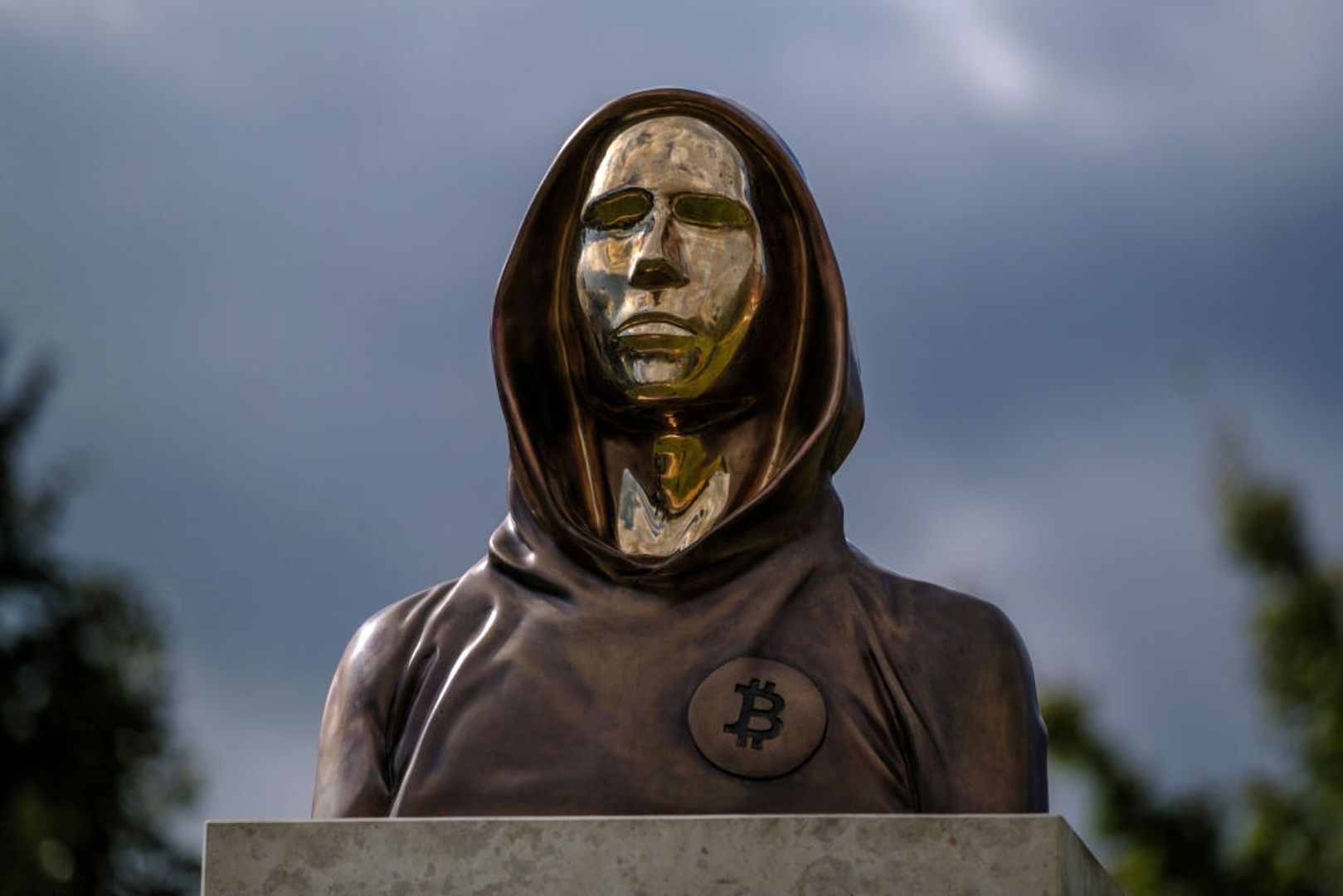
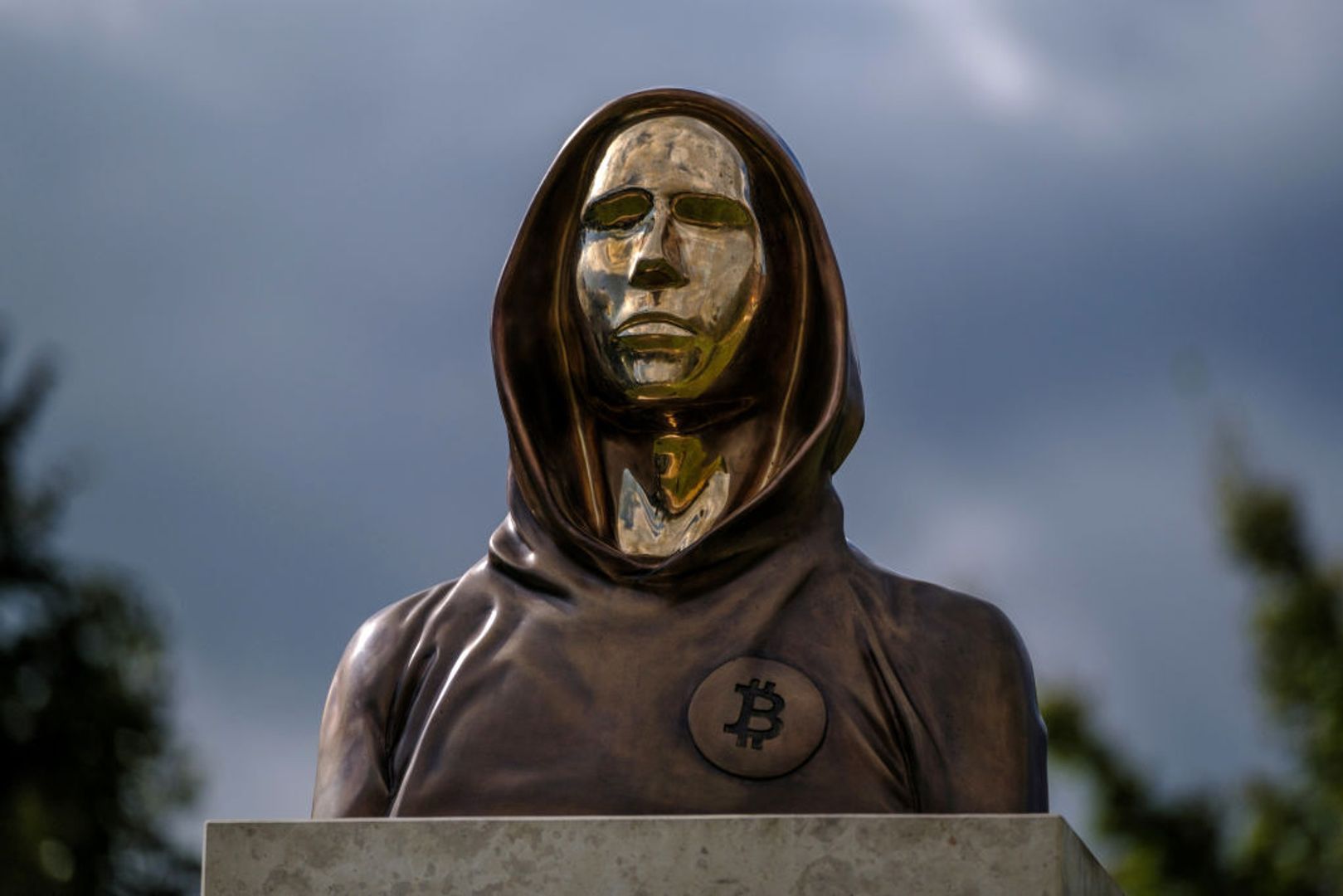
Project Eleven says it has funded a proof that lets a wallet’s own key-derivation path stand in as ownership after quantum computers can forge its signatures. It runs in 243 milliseconds on a laptop.

Ethereum has extended its recovery over the past few weeks, but the rally is now approaching a technically sensitive area. While the recent strength has improved short-term sentiment, the higher-timeframe structure has yet to confirm a sustained trend reversal, leaving room for increased volatility around current levels.
Ethereum Price Analysis: The Daily Chart
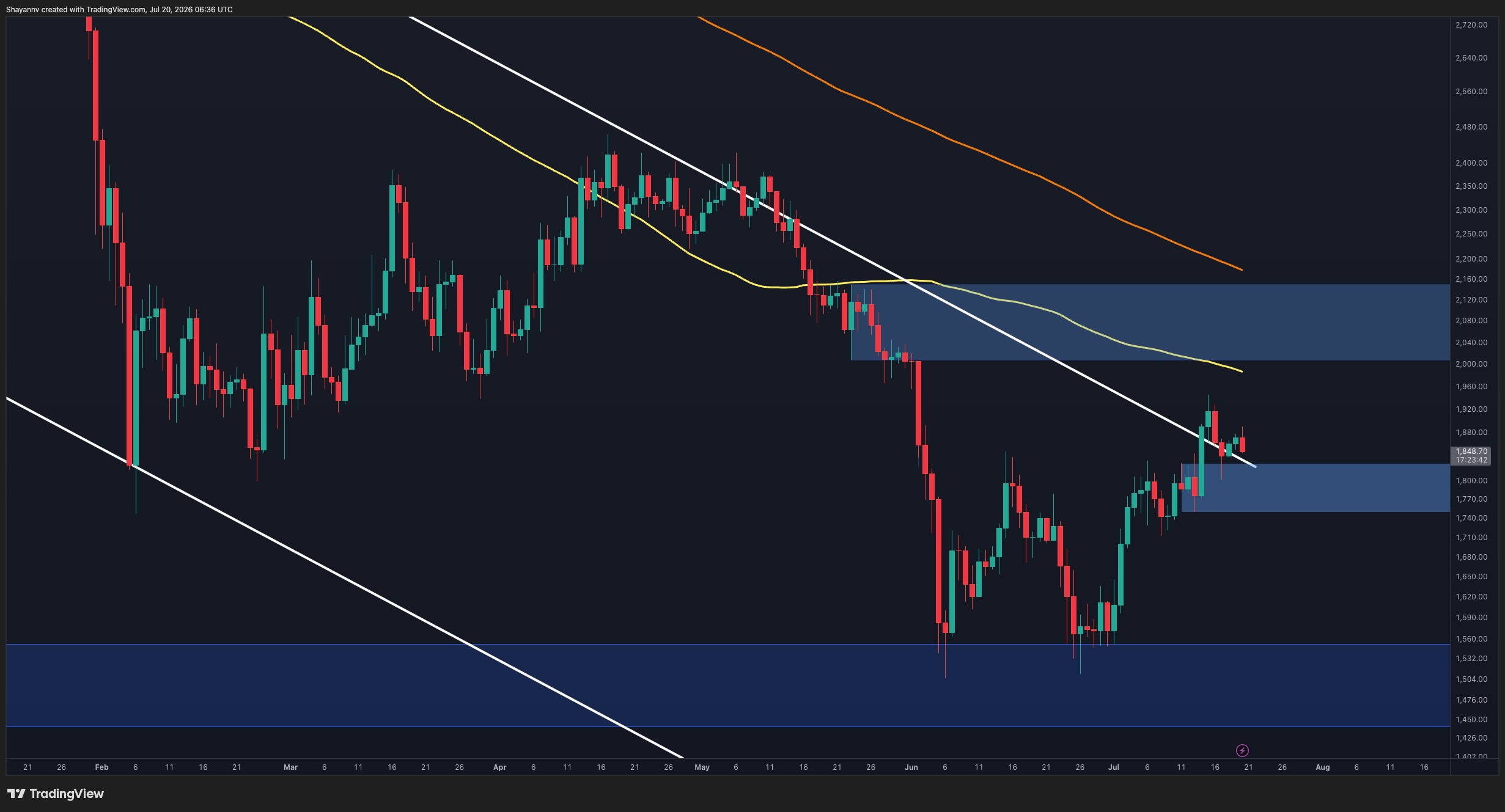
On the daily timeframe, ETH has broken above the upper boundary of the descending channel that guided the broader downtrend for several months. While this initially appears constructive, the breakout has not yet been confirmed and could still develop into a false breakout if price fails to hold above the former channel resistance over the coming sessions.
The $2K-$2.15K supply zone remains the primary obstacle for bulls. This area is reinforced by the declining 100-day moving average, making it a significant resistance cluster despite the recent improvement in price action.
On the downside, the $1.75K-$1.8K region now acts as the first line of defense. Holding this zone would keep the breakout attempt intact, whereas losing it could drag ETH back toward the broader demand area around $1.5K-$1.55K and confirm that the move above the channel was merely a liquidity sweep rather than a genuine trend reversal.
ETH/USDT 4-Hour Chart
The 4-hour chart shows Ethereum consolidating within an ascending flag after the sharp impulsive rally from the July lows. Rather than signaling immediate weakness, the current pullback appears to be developing as a corrective phase inside the broader recovery.
The white ascending trendline represents the flag’s intra-dynamic support and has repeatedly attracted buyers during recent retracements. As long as ETH continues to respect this trendline, the structure favors another attempt to challenge the recent swing high around $1.9K.
However, a decisive break below the ascending support would invalidate the flag structure and expose the blue demand zone around $1.76K-$1.8K, where buyers would likely attempt to regain control.

Sentiment Analysis
The Exchange Inflow (Top 10) metric tracks the amount of ETH transferred to exchanges by the largest deposit transactions, which are often associated with whales and institutional participants.
Recent data shows that exchange inflows from large holders have remained relatively subdued following several notable spikes earlier in the year. The latest readings are well below those previous peaks despite Ethereum’s recovery toward $1.8K, suggesting there has not been a meaningful increase in selling pressure from major market participants.
This relatively muted inflow profile complements the current technical structure. While it does not guarantee further upside, the absence of aggressive exchange deposits from large holders indicates that significant profit-taking has yet to emerge, allowing Ethereum to continue testing higher resistance levels as long as the short-term support structure remains intact.

The post Ethereum Price Analysis: ETH Tests Crucial Resistance Following Channel Breakout appeared first on CryptoPotato.

Bitcoin investors waiting for a traditional four-year cycle bottom in September or October could be caught on the wrong side of the market, according to analyst Doctor Profit.
While the four-year cycle worked “almost perfectly” at the top, now the analyst believes the opposite is happening.
October Catalysts
In his latest post on X, Doctor Profit said he does not see Bitcoin falling below $50,000, although he identified the area around $54,000 as a major liquidity zone that remains important. “There is an extreme amount of liquidity around $54,000, and that cannot be ignored,” he said, while estimating that a move from current levels to that price would represent roughly 15% downside.
Given that risk-reward profile, he argued that it makes sense to start accumulating now, but “step by step, not all in.” The analyst also noted that he does not expect the next major rally to begin immediately.
Doctor Profit further explained that the market could front-run the widely anticipated cycle bottom while pointing to several crucial developments that could strengthen sentiment before then. For instance, the planned rollout of tokenized stocks through infrastructure involving major financial institutions, including BlackRock, the New York Stock Exchange, the S&P, Nasdaq, and the DTCC, which he said is expected to move forward in October after tokenization platforms were effectively tested through earlier market activity.
Doctor Profit cited rumors that the CLARITY Act could pass in August as another potential catalyst, and added that regulatory clarity would make it easier for institutions to enter the crypto market and accelerate tokenization. However, prediction market traders have since become less optimistic about the bill’s prospects after the implied odds of its passage declined in recent days.
ETFs Stay Positive
After suffering eight straight weeks of heavy outflows, US spot Bitcoin ETFs have continued their recovery with another week of net inflows. According to data compiled by SoSoValue, the funds have attracted more than $200 million so far in July, continuing the positive trend that began in the middle of the month.
Last week alone saw roughly $76 million in net inflows.
The post Analyst Says Waiting for Bitcoin’s Four-Year Cycle Bottom Could Be a Costly Mistake appeared first on CryptoPotato.
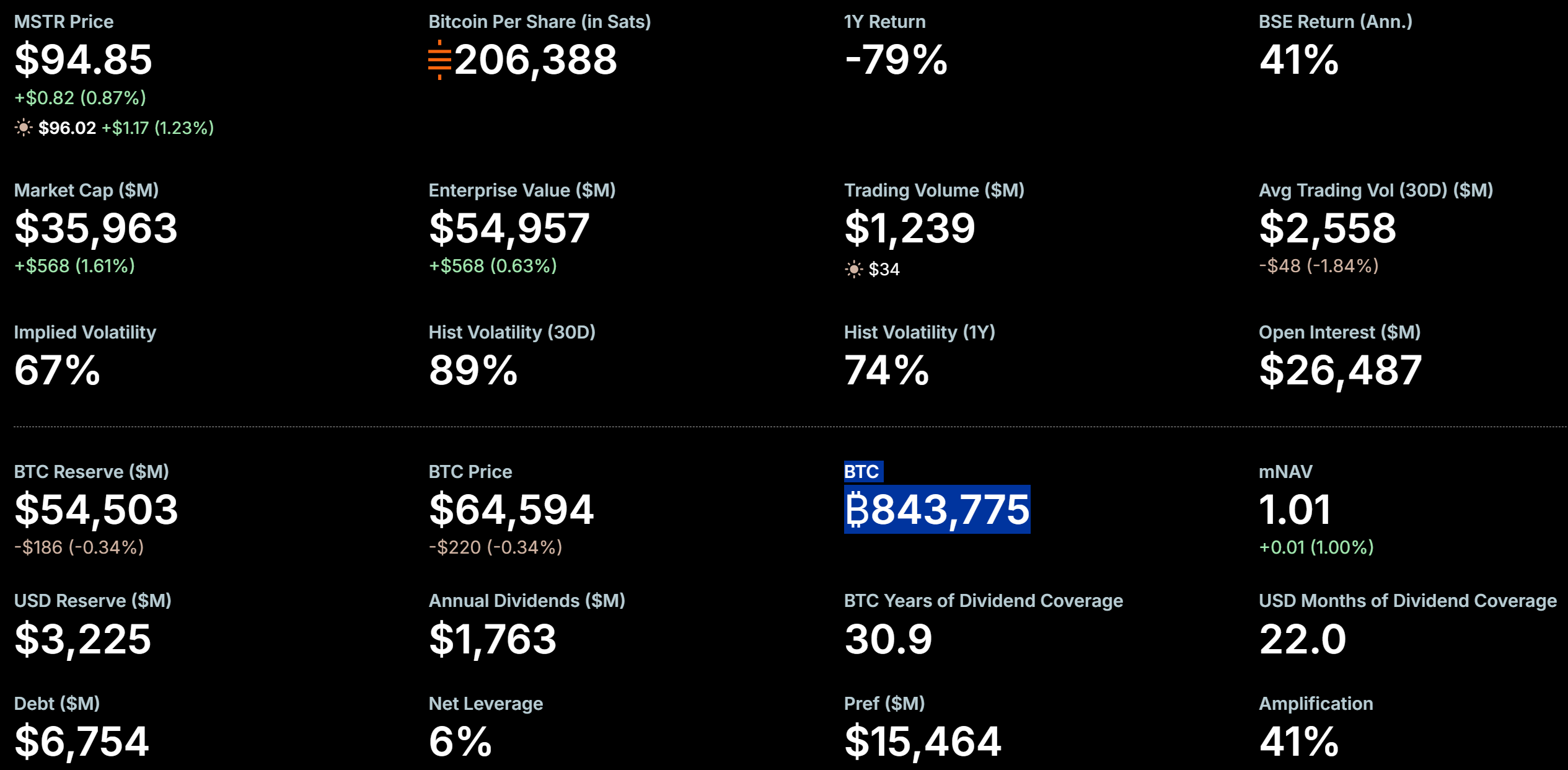
MicroStrategy (now Strategy) sold $263.5 million in MSTR shares last week and bought no Bitcoin (BTC). The deal for MSTR investors is simple. Own a smaller slice today, in exchange for a company built to survive tomorrow.
The firm disclosed the sales in a Monday filing. Its Bitcoin stack stayed frozen at 843,775 BTC for a second straight week. The cash pile grew to $3.2 billion instead.

What the MSTR Share Sales Actually Buy
Strategy sold 2.73 million new shares directly into the market through its at-the-market (ATM) program. The filing sits with the US Securities and Exchange Commission (SEC). Meanwhile, a $1 billion buyback plan for the stock sat untouched.
One week earlier, the company raised $466.7 million the same way. All that cash feeds the Digital Credit Capital Framework. This June policy locks money away for one job. It pays dividends on preferred shares and interest on debt.
Those bills run about $1.76 billion a year, per the company’s announcement. The $3.2 billion reserve covers roughly 22 months. The board only requires 12.
“Strategy remains committed to Bitcoin as its primary treasury reserve asset. At the same time, Digital Credit requires liquidity, discipline, and active capital management,” Michael Saylor, Strategy’s founder and executive chairman, said when introducing the framework.
The Trade-Off Facing MSTR Investors
Here is why the cash matters. MicroStrategy paid an average of $75,476 per Bitcoin, or $63.7 billion in all, per its July disclosure. Bitcoin now trades near $64,700, down nearly 48% from its October 2025 peak. That gap created an $8.32 billion paper loss last quarter.

June showed the danger. Strategy sold 3,588 BTC near $60,000 each just to pay dividends. It sold below its own cost. The reserve exists so that never happens again.
The insurance has a price. The two July raises minted roughly 7.6 million new shares. That means near 2% dilution in two weeks, against April’s proxy count of 327 million. Another $23.5 billion in ATM capacity remains.
Early trading suggests investors accept the deal. MSTR changed hands at $96.22 in Monday’s pre-market, up 1.45% from its previous close of $94.85. The stock still sits far below its 52-week high of $437.

Not everyone reads the pivot the same way. Bitwise CIO Matt Hougan believes the firm’s run as dominant buyer is over. Grayscale, however, argues controlled Bitcoin sales could steady BTC rather than sink it. Saylor still calls corporate Bitcoin adoption inevitable.
The question for MSTR investors is simple. Does a smaller slice of a sturdier company beat a bigger slice of a fragile one? The answer arrives the next time MicroStrategy chooses between more Bitcoin and more cushion.
The post MicroStrategy Is Asking MSTR Investors to Make One Big Trade-Off appeared first on BeInCrypto.


Bitmine (BMNR), the largest Ethereum treasury firm, bought just 7,430 ether (ETH) last week, dialing back its buying spree as it redirected capital to a stock buyback.
The latest purchase, worth about $14 million at ether’s current price of $1,879, lifted BitMine’s holdings to 5,78 million ETH, or roughly 4.8% of Ethereum’s circulating supply, according to a Monday company update.
BMNR was 2.4% higher in pre-market trading.
The purchase marks one of firm’s smallest weekly additions since launching its Ethereum treasury strategy in June 2025. By comparison, the firm bought more than 111,000 ETH during one week in May and had regularly acquired tens of thousands of tokens throughout the first half of the year. The firm is nearing its goal to corner 5% of ETH supply.
Chairman Thomas “Tom” Lee attributed the slowdown to the company’s decision to repurchase approximately 5.5 million shares at an average price of $15.62 under its previously authorized $4 billion buyback program.
“The reduced pace of buys reflects that Bitmine repurchased 5.5 million common shares,” Lee said. He added that the company has purchased ETH every week since adopting its treasury strategy just over a year ago.
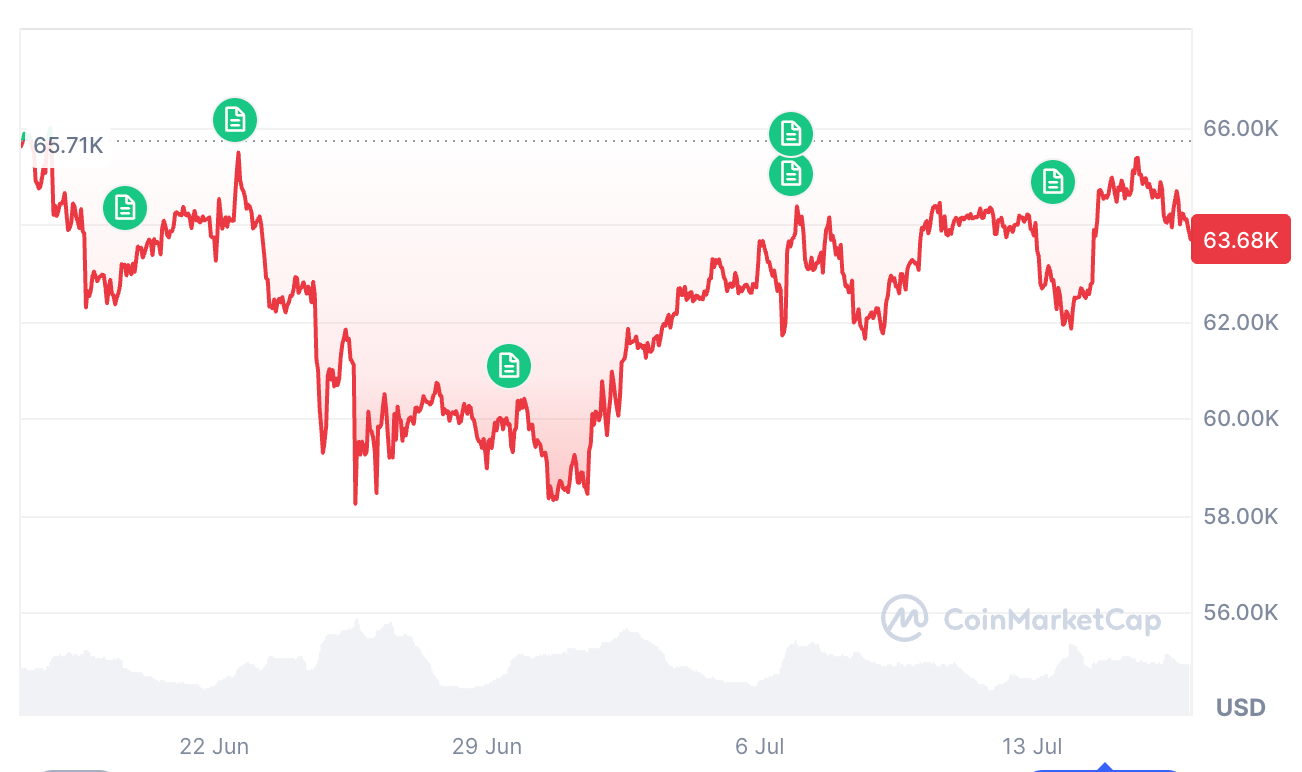
Veteran trader Peter Brandt says he has pinpointed the exact day in 2026 when he expects Bitcoin to hit the bottom of this market cycle.
“I’ll go out on a limb and say we bottom on October 4th. So we’ll see,” Brandt tells Cointelegraph during an interview for Trade Secrets.
Of course, picking the exact day of a market bottom is a tough ask, but the 51-year trading veteran has held firm on his October prediction for Bitcoin’s cycle low for quite some time.
He says Bitcoin could fall below $50,000 and potentially into the high-$40,000 range before establishing what he expects will be the cycle low.
“Whether it’s at these kinds of current levels, or we crash through and really blow people out and move into the 50s, possibly the high 40s… You know, you have to remember that every major bear market in Bitcoin’s history since its inception has been an 80% plus correction. If you take Bitcoin’s high in the 120s, that would indicate that,” Brandt says.
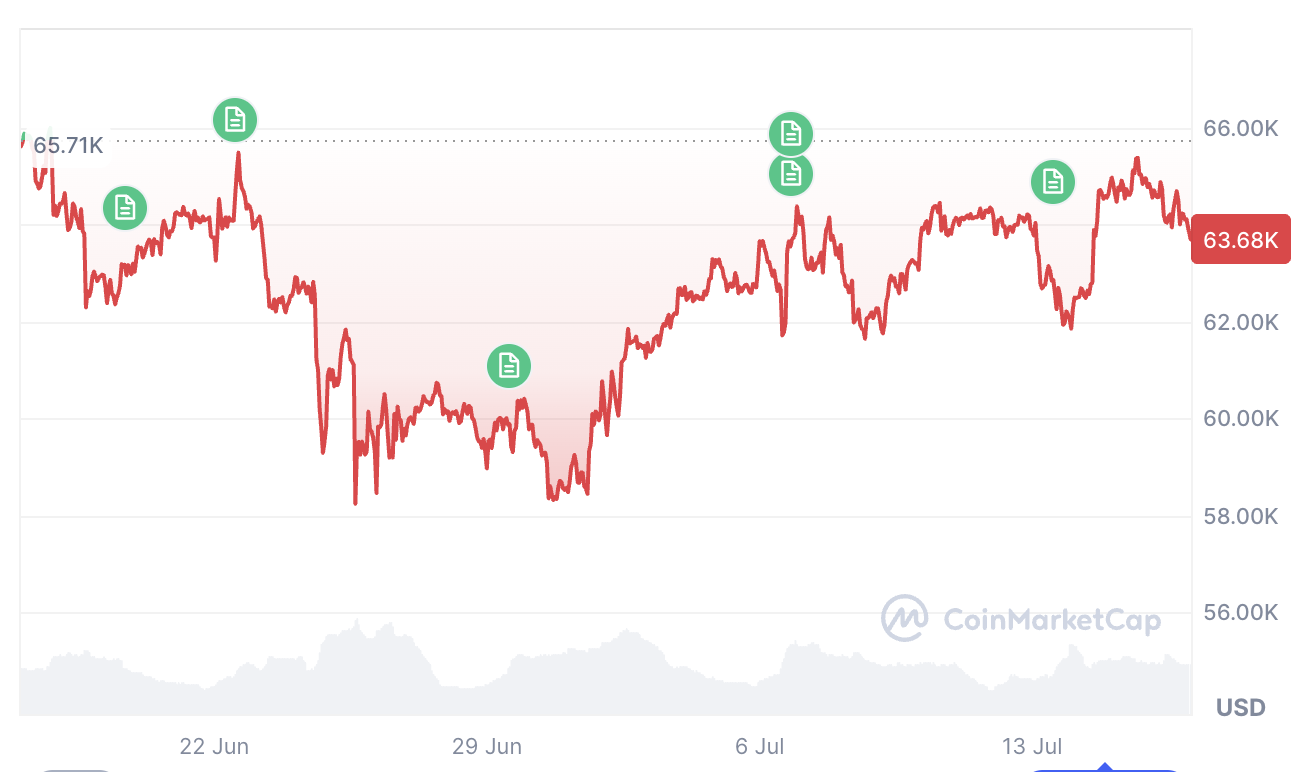
Bitcoin is trading at $63,661 at the time of publication. Source: CoinMarketCap
Many traders believe Bitcoin’s current level around $60,000 could be the cycle bottom, but Brandt isn’t convinced. He says there is still too much optimism that prices will bounce back.
“Right now it’s neutral [sentiment]. Markets don’t bottom on neutral sentiment. Markets bottom on panic and volume.”
“The same people that are saying Bitcoin’s bottom at some point in time will be giving up on Bitcoin, throwing in the towel, and saying we’re done with Bitcoin, we’re going on to other assets, the Bitcoin phenomenon is done,” Brandt says.
Brandt says Bitcoin is a better bet than AI stocks
While some in crypto have blamed the AI boom for pulling money away from Bitcoin and the broader market, Brandt isn’t convinced the AI trade can keep climbing forever.
“I do not believe that somebody who goes all in on AI stocks right now will be very happy with that investment two, three years from now,” Brandt says, explaining that if he had $10,000 right now he would split it 50% between Bitcoin and precious metals.
“I think precious metals are closer to a bottom price-wise; I think Bitcoin may be closer to a bottom time-wise,” he says.
Brandt says Bitcoin won’t reach its cycle peak until 2029, forecasting a price between $250,000 and $300,000. If he’s right, Bitcoin would have just a year to climb from that range to the far more ambitious $1 million target projected by Coinbase CEO Brian Armstrong and Ark Invest CEO Cathie Wood for 2030.
Cointelegraph publishes long-form journalism, analysis and narrative reporting produced by Cointelegraph’s in-house editorial team with subject-matter expertise. All articles are edited and reviewed by Cointelegraph editors in line with our editorial standards. Content published in here does not constitute financial, legal or investment advice. Readers should conduct their own research and consult qualified professionals where appropriate. Cointelegraph maintains full editorial independence.


It adds new capabilities to Plutus, the platform developers use to write Cardano’s smart contracts, unifying the built-in functions available across the platform’s three versions so older applications gain newer features.
The upgrade also tightens several of the ledger’s validation rules, including one guaranteeing that no two stake pools can reuse the same cryptographic identity key.
“As well as Plutus improvements and Plutus Cost Model enhancements, this upgrade lays the foundation for the next upgrade, the Dijkstra era hard fork, which will introduce Ouroboros Leios to Cardano,” Input Output wrote in a development report on Friday.
Ouroboros Leios is a scaling proposal for the proof-of-stake consensus model that Cardano runs. It is expected later in 2026 and aimed at sharply increasing transactions per second without weakening the protocol’s security guarantees.
Van Rossem is the procedural groundwork for Ouroboros, both in the ledger changes it ships and in the precedent it sets: that Cardano can now upgrade itself by vote.
The hard fork is named for Max van Rossem, a Cardano governance contributor who helped shape the network’s constitution and died in October 2025.
What the hard fork means for a Cardano user
There are no visible changes for someone casually holding or spending ADA. Transactions work the same way, wallets do not need updating and the fee to send ADA is unchanged. The upgrade does not alter how the network looks or feels to use.


SWIFT built a ledger for them. JPMorgan settles billions with them. The FDIC is writing rules about them. Tokenized deposits are the banking system’s answer to stablecoins, and understanding the difference decides how you read the next five years of digital money.
Summary
- A tokenized deposit is a commercial bank deposit represented as a token on a blockchain, issued by the bank itself and maintaining a one-to-one relationship with money on the bank’s balance sheet.
- Unlike a stablecoin, the money never leaves the bank. It stays available to fund lending, remains covered by deposit insurance up to statutory limits, and stays inside the supervisory perimeter of banking regulation.
- The category has moved from pilot to production: SWIFT launched a shared ledger with 17 global banks in July, JPMorgan’s Kinexys settles institutional payments today, and a consortium including Bank of America and BNY targets a 2027 network.
- A technical distinction matters more than it sounds: a non-transferable tokenized deposit that settles between banks behaves like account money, while a freely transferable deposit token behaves more like a bank-issued stablecoin, and regulation treats the two differently.
- The stakes are structural. Stablecoins pull deposits out of banks into reserve assets; tokenized deposits keep them in. Which model wins the institutional corridor shapes bank funding, credit creation, and what a dollar on a blockchain actually is.
The most consequential money on blockchains this year is not a cryptocurrency and not a stablecoin. It is ordinary bank deposits, the money in checking accounts, wearing a token as a coat. In July, SWIFT switched on the 17-bank ledger built for this instrument with 17 of the world’s largest banks built specifically to move this instrument. JPMorgan already settles institutional payments with its own version. A consortium of American banking giants is building a shared network for 2027, and the FDIC’s stablecoin rulemaking carves out space to address how deposit insurance applies to it. The instrument is the tokenized deposit, and the reason it deserves twenty minutes of any crypto reader’s attention is that it is the banking system’s structural answer to the $300 billion stablecoin sector: a digital dollar that does everything a stablecoin does while never leaving the bank. Whether that is the point or the problem depends on where you sit, which is exactly what this guide unpacks.
The definition, precisely
A tokenized deposit is a digital representation of a claim on a commercial bank, recorded on a blockchain or distributed ledger, issued by the bank that holds the deposit, and redeemable one-to-one against it.
Every clause is doing work. It is a claim on a bank, the same legal object as the balance in a checking account, which means it is commercial bank money, the kind that makes up the overwhelming majority of what people and firms actually use as dollars. It is issued by the bank itself, not by a third party holding the bank at arm’s length. It maintains one-to-one correspondence with a deposit that remains on the bank’s balance sheet, so tokenizing a million dollars does not move a million dollars anywhere; it changes the record-keeping technology for money that stays put. And it lives on a ledger, which is what gives it the properties deposits never had: settlement in seconds, availability at 3 a.m. on a Sunday, and the ability to be composed into programmable payment logic.
The cleanest way to hold the concept: a stablecoin is a new kind of money issued by a new kind of company, while a tokenized deposit is the oldest kind of money with a new kind of plumbing. For readers who want the other side of the comparison, crypto.news has also explained the competing model.
How it differs from a stablecoin, mechanically
The two instruments look identical at the point of use, a dollar-denominated token that moves on a ledger and settles fast, and are opposites underneath. Three differences carry all the weight.
Where the money sits. When a customer buys a stablecoin, dollars leave their bank account and land in the issuer’s reserve portfolio, Treasury bills, repo, money funds, custodial accounts, outside the banking system. The bank loses a deposit; the reserve assets sit sterile with respect to lending. With a tokenized deposit, nothing leaves. The deposit stays on the bank’s balance sheet, funding loans exactly as before, while the token circulates as its mobile representation. Multiply across a sector and this is the difference between digital dollars that drain bank funding and digital dollars that preserve it, which is why the Federal Reserve’s research treats stablecoins as a disintermediation risk and tokenized deposits as the banks’ countermove.
Who stands behind it. A tokenized deposit carries the full apparatus of banking: deposit insurance up to statutory limits, the bank’s capital and supervision, and, behind the bank, access to the Federal Reserve’s discount window. A stablecoin carries the issuer’s reserves and, under the GENIUS Act, a legal priority for holders in insolvency plus full-reserve requirements, real protections, but no insurance and no central bank. The FDIC has confirmed the insurance line between the two: stablecoin wallets get no pass-through deposit insurance, while the FDIC’s own stablecoin rulemaking addresses insurance treatment of tokenized deposits precisely because they are deposits.
What it may pay. The GENIUS Act prohibits payment stablecoin issuers from paying interest on the coin itself, a line Congress drew to stop stablecoins from becoming uninsured savings accounts. A tokenized deposit is a deposit; a bank can pay interest on it the way it pays on any account. In a world of meaningful rates, that asymmetry is not a footnote, it is a business model, and it is one reason banks believe the institutional corridor is winnable.
The distinction inside the category
Here the vocabulary gets sloppy across the industry, and one analytical cut, articulated most clearly by researcher Noelle Acheson, brings it into focus: a tokenized deposit is not the same thing as a deposit token, and the difference is transferability.
In the strict model, a tokenized deposit moves only between customers of banks in the network, and when it moves between banks, the banks settle behind the scenes, the token a customer of Bank A holds is always a claim on Bank A, and transferring value to a customer of Bank B means Bank A’s token is burned, interbank settlement occurs, and Bank B mints its own. This is account money with better rails: the customer relationship, the compliance perimeter, and the claim structure all stay intact, which is why regulators are comfortable with it and why SWIFT’s ledger, which coordinates exactly this burn-settle-mint choreography across institutions, is built this way.
In the looser model, a deposit token is a bearer-style instrument: freely transferable to anyone with a wallet, circulating like a stablecoin while claiming deposit status. This version makes bank money composable with open networks, and it makes regulators nervous, because a freely circulating claim on a bank held by strangers to the bank starts to blur into a bank-issued stablecoin, raising exactly the insurance, run-risk, and know-your-customer questions the strict model avoids. Where each jurisdiction draws this line will quietly determine whether tokenized deposits remain an interbank instrument or grow into a public one, and it is the single most important open design question in the category.
Who is building what
The category crossed from white papers to production over roughly eighteen months, and three architectures now compete.
The single-bank model is live. JPMorgan’s Kinexys settles institutional payments with tokenized deposits today, has extended onto public infrastructure including Base and the Canton network, and proves the concept at the only scale that matters, real money, real clients. Its structural limit is reach: one bank’s token moves one bank’s money, and every large bank running its own rail recreates the fragmentation problem that correspondent banking exists to solve.
The shared-network model is the answer to that limit, and it launched in earnest on July 9, when SWIFT’s blockchain-based ledger went live for initial use with 17 banks across six continents, Citi, HSBC, UBS, BNP Paribas among them, built on Hyperledger Besu in nine months. The ledger validates and coordinates tokenized-deposit movements between member banks around the clock, with final settlement through existing rails, and its pitch is distribution: SWIFT connects more than 11,000 institutions, a footprint no single bank or startup can match. A parallel American effort through The Clearing House, backed by JPMorgan, Bank of America, Barclays, and BNY, targets a 2027 launch, meaning even the shared-network lane already has competing networks.
The public-facing frontier is where the deposit-token question lives: experiments in making bank-issued tokens usable in open on-chain environments as settlement assets and collateral. This is the smallest lane today and the one with the largest implications, because it is where bank money and DeFi composability would actually meet.
The honest limitations
The category’s advocates describe it as stablecoins without the risk. The description omits four things.
Tokenized deposits are permissioned by construction. Every holder is a bank customer inside a compliance perimeter; there is no permissionless access, which means the instrument does nothing for the populations and corridors where stablecoins found their strongest product-market fit, users the banking system serves badly or not at all. A fintech in Lagos paying a supplier in Shenzhen holds USDT because it cannot hold a JPMorgan deposit; that fact does not change when the deposit grows a token.
They are also only as good as the network effects they achieve. Money is useful in proportion to who accepts it, and a tokenized deposit accepted inside one consortium is a better wire transfer, not a new form of money. The proliferation of competing networks, SWIFT’s, The Clearing House’s, each mega-bank’s own, raises a real fragmentation scenario in which the category succeeds technically and still fails to produce a unified instrument.
Insurance is bounded. Deposit insurance covers up to the statutory limit per depositor per bank, which protects retail balances fully and institutional balances barely; a corporate treasurer holding nine figures in tokenized deposits is an uninsured creditor of the bank above the cap, exactly as with ordinary deposits. The instrument inherits banking’s protections and also banking’s fine print.
And the model is untested in a run. Tokenized deposits settle at all hours, which cuts both ways: the same rails that move corporate treasury on Sunday morning can move a panic on Sunday morning, faster than any deposit flight in history. Bank supervisors have noticed; it is one reason the strict, non-transferable design keeps winning approvals.
What could still go wrong
A category moving this fast earns a section on its failure modes, and tokenized deposits have four worth taking seriously, none of them exotic.
The first is the interoperability trap. Every architecture described above, single-bank rails, SWIFT’s shared ledger, The Clearing House network, mints tokens that work within its own perimeter. History’s parallel is instructive: early wire transfer and card networks fragmented for decades before consolidating, and the consolidation was driven by merchants and users refusing to hold seventeen incompatible instruments. A corporate treasurer offered JPMorgan tokens, SWIFT-coordinated tokens, and consortium tokens, each with different settlement finality and legal terms, may reasonably decide the pilot era is someone else’s problem and keep wiring. The category’s success requires the networks to interconnect, and the incentives to interconnect are weakest for exactly the largest banks whose participation matters most, because a proprietary rail that works is a moat.
The second is the run-dynamics question, which deserves more respect than the marketing gives it. A tokenized deposit inherits the bank’s credit risk, and always-on settlement means the deposit can leave at any hour a holder gets nervous. The 2023 regional banking crisis showed what smartphone-speed withdrawals do to a bank funded by concentrated, sophisticated depositors; token rails compress the same dynamic further. Supervisors have levers, the non-transferable design, settlement windows, position limits, but every lever traded against the always-on convenience that is the product’s selling point. The instrument’s safety case and its value proposition are, at the margin, the same dial turned in opposite directions.
The third is regulatory divergence on the deposit-token boundary. If one major jurisdiction blesses freely transferable deposit tokens while another confines banks to the strict interbank model, bank money itself forks: a transferable claim on a Singapore or London bank circulating on open networks while American bank tokens stay walled. That is not hypothetical, jurisdictions are already writing different answers, and the arbitrage it invites, banking migrating to wherever bank money is allowed to be most bearer-like, is the kind regulators historically respond to late and harshly.
The fourth is the quiet dependency on stablecoin rules. The competitive case for tokenized deposits leans on asymmetries the law that bans stablecoin interest created, stablecoins cannot pay interest, stablecoins carry no insurance, and asymmetries written by one Congress can be rewritten by another. A future amendment permitting yield-bearing regulated stablecoins, an idea already circulating in the CLARITY Act fights over activity-based rewards, would collapse the banks’ cleanest advantage overnight. The banks are building on ground the law currently tilts toward them, and the tilt is a policy choice, not a property of the technology.
None of these kill the category; each shapes what version of it survives. The strongest honest forecast is conditional: tokenized deposits win the regulated institutional corridor if the networks interconnect, if supervisors hold the transferability line without strangling the product, and if the legislative tilt endures. Three ifs is not a guarantee. It is, however, a much shorter list than the one stablecoins faced a decade ago, which is the fairest way to size the two contenders.
Why the fight matters
Strip the technology away and the tokenized-deposit-versus-stablecoin contest is a fight over the two-tier monetary system, the arrangement where central banks serve banks and banks serve everyone else, and every reader in crypto has a stake in the outcome.
If tokenized deposits win the institutional corridor, on-chain finance gets absorbed into banking: programmable settlement arrives, but issuance, access, and control remain with chartered institutions, and the deposit-funding model that finances lending survives digitization intact. If stablecoins win it, a parallel monetary layer keeps growing outside bank balance sheets, with narrower backing, broader access, and the disintermediation consequences the Fed’s researchers keep modeling. The likeliest outcome is partition, banks holding the regulated core, stablecoins holding the open edge, with the boundary contested for years at exactly the seams this guide has mapped: transferability rules, insurance treatment, and the interest-rate asymmetry the GENIUS Act wrote into law.
For now, the practical takeaways are three. A tokenized deposit is bank money with new rails, insured and supervised, and structurally unavailable to anyone outside a bank relationship. A stablecoin is new money with open rails, reserve-backed and uninsured, and structurally available to anyone with a wallet. And the institutions that spent a decade dismissing blockchains have now committed, with 17 banks, a 53-year-old cooperative, and the world’s largest asset managers in the room, to putting the oldest money in the world on them. Whatever else that signals, it settles one argument: the rails were never the controversial part. The money was. For the adjacent cash-market structure, crypto.news has also explained the other regulated cash instrument on-chain.
Frequently asked questions
What is a tokenized deposit in one sentence?
It is a commercial bank deposit represented as a token on a blockchain, issued by the bank holding the deposit, redeemable one-to-one, and left on the bank’s balance sheet, so it settles like a crypto asset while remaining ordinary, insured bank money underneath.
How is that different from a stablecoin?
Three ways. The money stays inside the bank and keeps funding loans, whereas stablecoin purchases move money out of banks into issuer reserves. It carries deposit insurance up to statutory limits and bank supervision, whereas stablecoin holders rely on reserves and legal priority with no insurance. And banks may pay interest on it like any deposit, while the GENIUS Act bars stablecoin issuers from paying interest on their coins.
Are tokenized deposits FDIC-insured?
As deposits, yes, up to the statutory limit per depositor per bank, and the FDIC’s current stablecoin-era rulemaking addresses their insurance treatment explicitly. The practical caveat is the cap: retail balances are fully covered, while institutional holders above the limit are uninsured bank creditors for the excess, exactly as with conventional accounts. Stablecoin wallets, by contrast, carry no pass-through insurance at all.
What is the difference between a tokenized deposit and a deposit token?
Transferability. A tokenized deposit in the strict sense moves only among customers of participating banks, with interbank settlement behind each transfer, preserving the account relationship. A deposit token is freely transferable to any wallet, circulating like a bank-issued stablecoin. Regulators are far more comfortable with the first model, and where jurisdictions draw this line will shape whether the instrument stays interbank or becomes public.
Who actually uses tokenized deposits today?
Institutions, not retail. JPMorgan’s Kinexys settles real institutional payments and has extended to public infrastructure including Base and Canton. SWIFT’s shared ledger launched initial use in July 2026 with 17 global banks coordinating tokenized-deposit movements around the clock. A Clearing House consortium including Bank of America and BNY targets 2027. Retail-facing versions remain experimental almost everywhere.
Do tokenized deposits threaten stablecoins?
In the institutional corridor, directly: for regulated entities moving money between themselves, an insured, interest-capable, supervised instrument is a strong competitor. In open corridors, not really: tokenized deposits require a bank relationship, so exchange settlement, DeFi collateral, and unbanked-adjacent remittances remain stablecoin territory. The likely outcome is partition rather than a winner-take-all, with the boundary set by regulation as much as preference.
What are the main risks or limits?
Permissioned access excludes everyone outside member banks. Competing networks risk fragmenting the category into non-interoperable islands. Insurance is capped, leaving large institutional balances exposed above the limit. And always-on settlement is untested under stress, since the same 24/7 rails could accelerate a deposit run faster than any in history, which is partly why supervisors favor non-transferable designs.
Why does this matter for someone holding crypto?
Because it defines the competition. The growth path stablecoins were assumed to own, institutional settlement, corporate treasury, tokenized-asset plumbing, is exactly where banks are now deploying an instrument with insurance and interest attached. How that contest resolves shapes stablecoin demand, the reserves feeding Treasury markets, and which digital dollar becomes default in each corridor. This is educational context, not investment advice.
Disclaimer: This article is for information and educational purposes only and does not constitute financial, investment, or legal advice. Product structures, insurance treatment, and regulatory rules described here vary by jurisdiction and are subject to change. Always do your own research. Information is accurate as of July 20, 2026.

A North Korean dev and suspected mole who worked on MetaMask’s core wallet code for a whole month was reportedly flagged by a Lazarus Group security page almost a year ago.
The developer was reportedly hired by MetaMask’s parent firm, Consensys, as a consultant while posing under the alias “Tyler Knapp.” He reportedly made GitHub contributions to MetaMask’s wallet until he was ousted by the company in April.
However, DeFi security analyst Zun claims that Knapp had already been flagged on a public Lazarus Group operative tracking site back in September 2025.
The page, run by the Security Alliance, creates profiles for known remote Democratic People’s Republic of Korea (DPRK) IT workers in the hopes that it will help companies to identify them before they’re hired.

Read more: Crypto has become Kim Jong-Un’s lifeline — and Russia’s secret weapon
On the Lazarus Group site, Knapp appears under the name “Mauro Liu.” He also appears to have worked for Web3 game firm MagicCraft in 2022, and DeFi product firm Napier Finance in 2023.
His other listed firms include Ankr, Pickle Finance, Harmoney, Gamerse, Clover Network, DEPO, Sifu Vision, Oxytocin, Tomodachi, and Blueberry.
He’s linked to MetaMask through the GitHub username “imyugioh.”
Zun claims MetaMask hired him as a developer without a “proper background check that would have caught him.”
Consensys says North Korea dev didn’t steal any assets
DropSite reports, based on internal Slack messages, that Knapp was also contributing to code involving the conversion of crypto and fiat currency by third-party payment firms.
Consensys’s General Counsel, Matt Corva, told DropSite, that Knapp “was introduced to us through an existing relationship with a reputable third-party service provider.”
They said, “Very quickly after being introduced, we discovered the threat, followed our security protocols, immediately terminated any access and launched a comprehensive investigation that confirmed there was no misappropriation of assets or data, no malicious code deployed, and no impact to user safety and security.”
Last April, a North Korean mole called “Moo” was named by crypto sleuth ZachXBT and was fired from Solana-based DEX Stabble.
The firm subsequently encouraged all of its users to withdraw all their funds.
Moo, real name Keisuke Watanabe, was, by its own admission, employed by Stabble for a whole year.
Got a tip? Send us an email securely via Protos Leaks. For more informed news and investigations, follow us on X, Bluesky, and Google News, or subscribe to our YouTube channel.

This photograph taken on Jan. 21, 2026 shows signage of the Coinbase logo during the World Economic Forum (WEF) annual meeting in Davos.
Ina Fassbender | AFP | Getty Images
As bitcoin prices fell yet again in the second quarter, traders on prediction market platform Kalshi think Coinbase’s trading volumes suffered once again.
The cryptocurrency trading platform is expected to post a third consecutive quarterly decline of trading volumes, and speculators are also feeling confident that total trading volume will slip below $200 billion for the first time since third quarter 2024.
Traders give a 41% chance that trading volume is above $160 billion, and just a 25% chance it’s above $170 billion. That compares to analysts’ consensus estimates for $168.5 billion, according to FactSet.
Speculators are more certain volume will be above $150 billion, giving that a 99% chance of happening.
Coinbase is set to deliver its second-quarter earnings report on July 30.
The contract on Kalshi asks traders if Coinbase trading volume will be above various levels, and the outcome is resolved using information from investment research platform Fiscal.ai.
Shares of Coinbase are down more than 55% since bitcoin prices — which are off slightly less than 50% — peaked in October 2025. Coinbase trading volume’s previous declines in the first quarter of 2026 and fourth quarter of 2025 came also as Bitcoin prices tumbled over that period.

Coinbase since Oct. 7, 2025.
Bitcoin prices fell again in the second quarter, off about 12%.
Disclosure: CNBC and Kalshi have a commercial relationship that includes customer acquisition and a minority investment.
XRP remains under pressure across the higher timeframes, with buyers struggling to reclaim key resistance levels despite several rebound attempts. The broader structure continues to favor sellers, although the price is still holding above an important demand area that could determine the next directional move.
XRP Price Analysis: The Daily Chart
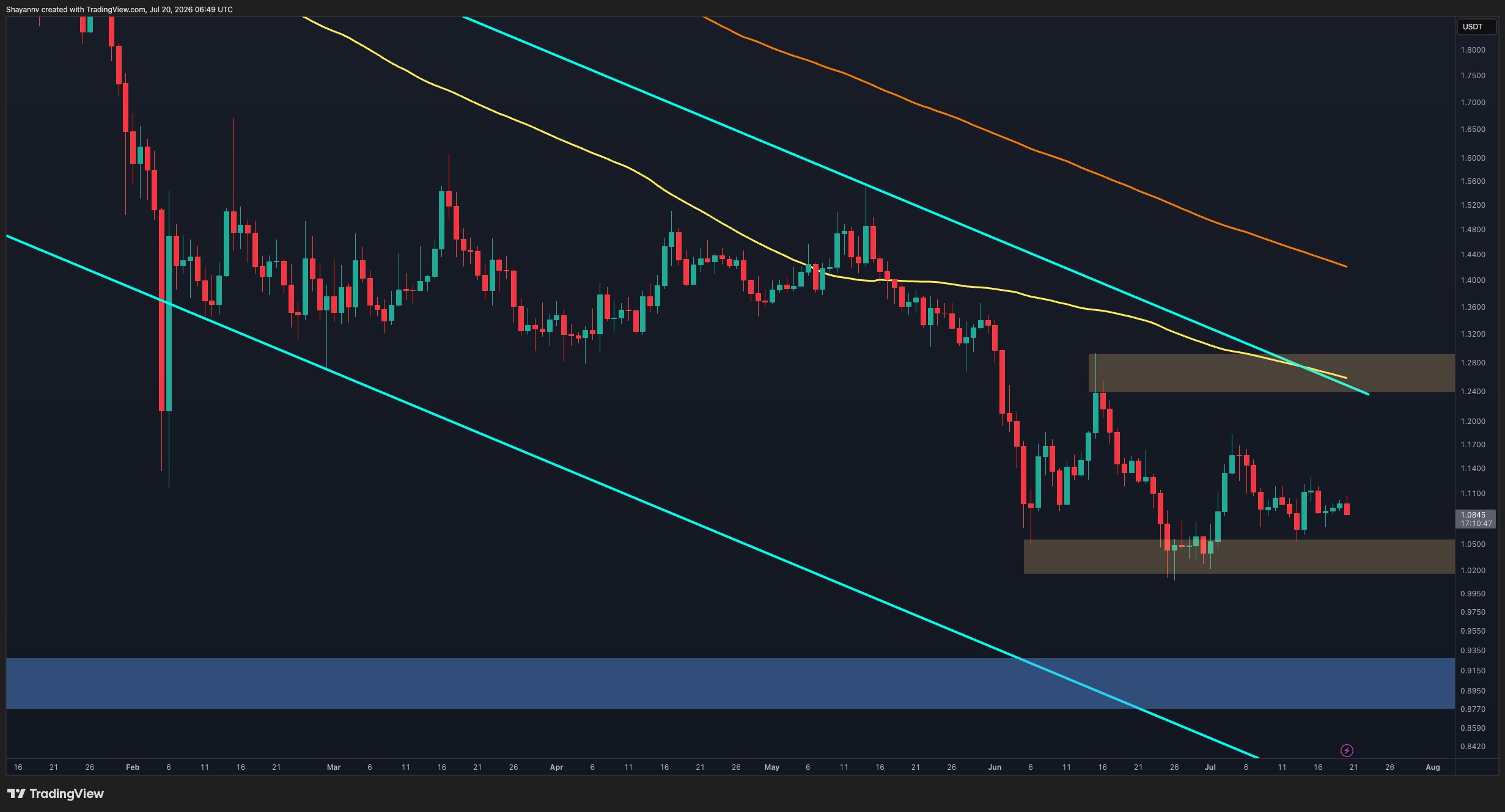
On the daily timeframe, XRP continues to trade inside a well-defined descending channel, reflecting the broader bearish trend that has dominated the market for several months. The 100-day and 200-day moving averages remain above the price and continue sloping lower, reinforcing the negative higher-timeframe bias.
The recent recovery attempt stalled precisely beneath the $1.24-$1.28 supply zone, where the descending channel’s upper boundary converges with the moving averages. This confluence strengthens the resistance area and explains why sellers quickly regained control after the latest rally.
Meanwhile, the asset continues to defend the $1.02-$1.06 demand zone. This support has repeatedly attracted buyers over recent weeks and remains the most important level to monitor. A sustained break below this area would expose the broader demand region around $0.88-$0.92, while holding above it keeps the possibility of another recovery toward the channel resistance alive.
XRP/USDT 4-Hour Chart
On the 4-hour chart, XRP remains confined beneath a descending trendline that has capped every recovery since the mid-June peak. Although buyers have managed to produce several short-lived rebounds, none have been strong enough to invalidate the sequence of lower highs.
The $1.16-$1.18 zone represents the first meaningful resistance and aligns with the descending trendline, creating a key decision area for short-term price action. A decisive breakout above this confluence would improve the short-term structure and could pave the way for another test of the higher supply zone around $1.24-$1.29.
On the downside, the $1.02-$1.06 demand region continues to provide solid support. As long as this area remains intact, Ripple could continue consolidating within the current range. However, losing this support would likely accelerate bearish momentum and shift focus toward the higher-timeframe demand around $0.88-$0.92.

The post Ripple Price Analysis: What’s Next for XRP After Holding Key Support? appeared first on CryptoPotato.

Starmer ally leaves government with parting shot at ‘disloyal’ MPs

A Beginner’s Guide to Growing Mushrooms at Home (2026)

No one’s shocked Harry wants to reverse Megxit. The REAL story is the humiliating motive Meghan may have for playing nice: MAUREEN CALLAHAN


-
 NewsBeat4 days ago
London Mayor Sadiq Khan handed a peerage by Keir Starmer alongside 15 other Labour figures… just days before the PM leaves No10
-

 Fashion3 days ago
Weekend Open Thread – Corporette.com
-

 Politics2 days ago
The House | The City of London can help the new chancellor deliver growth in every postcode
-

 Politics5 days ago
Young campaigners urge incoming PM to act on outdoor junk food ads
-

 Crypto World5 days ago
CFTC blocks Kalshi from unwinding Michigan trades after court order
-
 Crypto World3 days ago
Two July Windows Left: The CLARITY Act’s Senate Fight and What Failure Means
-

 Business5 days ago
Nvidia Stock Slips After Big Tuesday Rally as Huang Confirms Vera Rubin Chip Is Now in Production Today
-

 Crypto World2 days ago
Ripple Payments Joins MiCA With 14 Firms, Does It Mean Anything For XRP?
-

 Politics1 day ago
Democrats look to World Cup watch parties to register thousands of voters
-

 Crypto World3 days ago
Ripple wins EU-wide access as ESMA adds it to MiCA register
-
 Entertainment5 days ago
Disney’s Most Ambitious Failed Star Wars Attraction Is Coming to SDCC
-

 Business4 days ago
Palantir Shares Rise After Expanded Nvidia Partnership and Fresh Analyst Upgrades Ahead of Earnings Day
-

 Crypto World4 days ago
Injective Submits SEC Transfer-Agent Registration to Onchain Ownership Records
-

 Tech6 days ago
Get Your ESP32 Sunny Side Up With This Solar Dev Board
-

 NewsBeat3 days ago
Registration is now open for March for Men with Kev 2026
-

 News Videos6 days ago
XRP BOMBSHELL… XRP OMBOARDED FOR TRANSACTIONS!!!
-

 Tech6 days ago
Dark Secrets Emerge When Jailbreaking LLMs
-

 NewsBeat4 hours ago
Unregistered fitter used Gas Safe logo on business flyers
-
 Sports5 days ago
New Cornerback Enters Vikings Trade Rumor Mill
-

 News Videos3 days ago
Money | Class 12 Economics | CBSE Board Exam 2026-27
You must be logged in to post a comment Login