

Business
Diversified Portfolios Show Resilience Amid Escalating Iran War





Australia’s share market has pared its early losses to end the session roughly flat, as oil prices ease on hopes diplomacy could end a recent re-escalation of the US-Iran conflict.

When business moves fast, technology entrepreneur Mason Jappa slows his thinking down.
That instinct may seem counterintuitive for an entrepreneur who considers speed one of a founder’s greatest advantages. Yet after a decade of company building in emerging technology markets, Jappa has watched confidence turn into carelessness. Downturns expose weak balance sheets and fragile teams, but rapid growth can distort judgment just as quickly.
“The moments I’ve made my worst decisions were always when I was caught up in momentum rather than anchored in fundamentals,” Jappa said in a recent interview. “I now treat rapid growth as a time to slow down intellectually, to ask harder questions, stress-test assumptions and make sure the foundation is solid before building higher.”
Founders need enough urgency to move before the market catches up, but enough discipline to keep speed from replacing sound judgment.
Experience reshaped Jappa’s definition of leadership. Early in his career, he relied on personal conviction, long hours and an ability to persuade others to believe in an idea before the broader market did. That intensity helped him gain ground in an industry many people still dismissed. Over time, he learned that founder energy may launch a company, but durable systems and capable teams must carry it through changing market cycles.
Mason Jappa’s entrepreneurial journey began with a conviction that Bitcoin represented more than a volatile asset. When he discovered Bitcoin and the broader blockchain ecosystem in 2012, he saw infrastructure, a decentralized financial network that could give individuals greater control over their money.
In 2017, he founded Blockware Solutions to help Bitcoin miners source hardware, secure hosting and navigate an opaque, fragmented market. He combined a background in finance and enterprise technology with a willingness to enter the blockchain industry before it gained widespread acceptance.
Jappa said the company generated more than $500 million in revenue and helped deploy more than 400,000 mining machines. His team also produced research that reached more than 1 million readers and earned citations from Forbes, CoinDesk, Wired and other publications.
He also helped Blockware Mining secure clearing privileges at the Chicago Mercantile Exchange, a milestone he viewed as evidence that institutional markets had begun to take Bitcoin mining infrastructure seriously.
Those achievements reinforced a broader company-building lesson. In an unfamiliar market, credibility can create an advantage that capital alone cannot buy.
“In an industry full of noise, we built trust through education,” Jappa said. “That trust became our most durable competitive advantage.”
Jappa Says Build the Team Before the Cycle Turns
Rapid growth can make founder intensity look like a complete leadership system.
Mason Jappa once believed the founder should set the pace, carry the clearest vision and work harder than anyone else in the organization.
“When I started Blockware in 2017, my leadership model was essentially: have the strongest conviction in the room and outwork everyone,” he said. “And honestly, that got us a long way.”
That approach created urgency, but it placed much of the organization’s momentum on one person. Industry contractions eventually exposed the limits of a company powered primarily by its founder.
“Bitcoin markets are brutal teachers,” he said. “When the price collapses and the industry contracts, you find out very quickly whether you built a team or just assembled a group of people around your own momentum.”
His approach to leadership evolved through periods of growth and difficulty. Jappa became more deliberate about developing employees, acknowledging what he did not know and allowing the strongest idea to prevail regardless of who proposed it. Instead of remaining the central source of energy and answers, he focused on building a team that could think, decide and execute under pressure.
“The best decisions I’ve made have been about people,” Jappa said. “Bitcoin mining taught me that businesses built for the bull market collapse in the bear market. I’ve always tried to build for durability.”
Founders do not need less conviction. They need to turn that conviction into shared capability before the market tests the organization.
Speed and Focus Before Scale
He places speed and focus ahead of funding and connections because founders can control the first two. They can choose how quickly they test an idea, how decisively they respond to evidence and how carefully they protect the company from distractions.
“Capital follows execution. Connections follow credibility,” Jappa said. “Both of those follow a founder who moves decisively and stays locked on what actually matters.”
Speed does not mean chasing every opportunity. It means shortening the distance between insight and action. Focus requires founders to protect the company’s central mission when hype and outside pressure create tempting detours.
That discipline matters most when an entrepreneur operates ahead of consensus. Emerging markets rarely offer clear proof at the beginning. Jappa believes founders must become comfortable acting while others remain skeptical, provided they can support their conviction with research, operating knowledge and a defined advantage.
“The founders who win in rapidly evolving industries are almost always the ones who saw the wave coming and paddled hard before anyone else was in the water,” he said.
Jappa applies three filters when evaluating technology ventures. The technology must solve a problem that exists at scale, the market must have reached the right infrastructure moment and the founder must possess an advantage that competitors cannot easily reproduce.
The framework helps separate foresight from trend-chasing. Being early has little value when the problem is imaginary, the timing is wrong or the business lacks a defensible position.
Mason Jappa: ‘Build Your Reputation Like It’s Your Most Valuable Asset’
Founders often track cash, customer growth and market share before they measure trust. Jappa argues that reputation deserves the same strategic attention as any other core asset.
“Build your reputation like it’s your most valuable asset, because it is,” he said. “In fast-moving industries, trust is scarce and credibility travels fast in both directions.”
Jappa built visibility through research, media relationships and consistent execution. He did not treat communication as a promotional layer added after the business matured. He used it to help investors, partners and customers understand an unfamiliar market.
He calls storytelling infrastructure because clear communication supports nearly every part of a growing company. It gives employees a shared language for the mission, helps investors understand the business beyond its projections and shows customers why the company’s approach differs from its competitors.
A strong narrative cannot rescue a weak strategy. Founders still must deliver results. But even a valuable business can struggle when its leaders cannot explain what it solves or why the market should trust it.
The same principle shapes Jappa’s view of fundraising. After raising more than $100 million across multiple entities, he came to see capital as a tool rather than an objective.
“The best way to raise it is to not need it,” he said.
Companies gain leverage when they can show revenue, demand and a credible path to growth before approaching outside investors. Founders also must study the structure of capital, not only the amount. An impressive funding announcement can conceal terms that weaken the business over time.
A Decade of Building, Distilled
Founders must act before certainty arrives. They also must know when to question their assumptions, strengthen the organization beneath the growth and resist believing that momentum proves every decision correct.
Jappa views market cycles as leadership tests. A downturn shows whether the company can endure pressure. A surge shows whether leaders can protect the business from excess confidence, careless spending and a false sense of permanence.
“I’ve seen more founders destroyed by a good market than by a bad one,” he said. “Build like the cycle is always about to turn, because eventually it will.”
Jappa still believes entrepreneurs create value by recognizing possibilities before the crowd does. Experience has made him more selective about what deserves that belief and more deliberate about what must follow it.
The work does not end when the market validates an idea. That is when founders must build the systems, leadership and trust required to carry it further.
Strong founders, he believes, do more than arrive early. They build organizations designed to endure after the rest of the market catches up.
“The role I hope to play is the same one I’ve always aimed for: being the operator who builds the infrastructure layer before the crowd arrives and doing it in a way that leaves the industry more open, more competitive and more resilient than I found it,” Jappa said.


Thematic. Top down. I often find the theme before I find the stock. My philosophy is that themes are often born quiet and die loud. I try to catch them while they’re still finding their voice. When the music plays, I mainly chase pockets that rhyme with growth, momentum, perception shifts, and sometimes even the most absurd narratives (mostly AI-related). When the music slows and the tape deteriorates, I don’t wait around. I raise cash/rotate out, and watch for the next setup. A parabolic run may trigger a similar move. During a bull run, you won’t find much common ground between the deep value crowd and me. I liked the core ideas of deep value investors, and I briefly followed that philosophy. However, it demands patience, and the AI supercycle broke whatever patience I had left. The market changed, and so did I. My style is not set in stone. I’m mostly long when the music is playing. When it stops/slows down, I may dabble with shorts via put options, although it’s not my forte. My style is highly speculative. I have a high risk tolerance that most rational investors would find alarming. I don’t have a favorite timeframe. That said, I trade mostly the mid-term and the short-term. I have a pathetic low six-digit portfolio, and I consider myself part of the mid to low end of the K-shaped economy. It sometimes drops to the five-digit range when life has other plans. I’ve been in the game since mid 2024, although my first dabbles with stocks (i.e., burning $100 trading accounts in a matter of days) go back to the early/mid 2010s. I have a B.Sc. in aeronautical engineering and experience as a consultant in the aerospace sector. The latter statement is not relevant to my investment style, but I thought to add it for self-indulgent purposes. I live on the wrong side of the Atlantic. The opening bell is my lunch bell. I like astrology, so I’m a follower of technical analysis (mainly trends and support/resistance/psychological levels). I also look at the fundamentals of individual names, although the theme and the macro often prevail in my decision-making. I dislike empty suits, high-level BS, deep-level BS (especially), unnecessary jargon, and self-indulgent, third-person written introductions with an air of superiority.
Analyst’s Disclosure: I/we have no stock, option or similar derivative position in any of the companies mentioned, and no plans to initiate any such positions within the next 72 hours. I wrote this article myself, and it expresses my own opinions. I am not receiving compensation for it (other than from Seeking Alpha). I have no business relationship with any company whose stock is mentioned in this article.
I am not a registered investment adviser, broker, dealer, or tax professional. This article, including any comments or replies I post, reflects my personal opinions only and is provided for informational and educational purposes. Nothing I write is investment, legal, tax, or financial advice, or a personalized recommendation to buy, sell, hold, or short any security. My views may change without notice. Nothing I write is tailored to any reader’s objectives, financial situation, risk tolerance, or portfolio. Investing involves risk, including possible loss of principal. Readers should conduct their own research and consult a qualified professional before making investment decisions.
Seeking Alpha’s Disclosure: Past performance is no guarantee of future results. No recommendation or advice is being given as to whether any investment is suitable for a particular investor. Any views or opinions expressed above may not reflect those of Seeking Alpha as a whole. Seeking Alpha is not a licensed securities dealer, broker or US investment adviser or investment bank. Our analysts are third party authors that include both professional investors and individual investors who may not be licensed or certified by any institute or regulatory body.

The government extended temporary stay and work authorization for eligible migrant workers from Myanmar, Laos, and Vietnam until December 11, 2027, addressing labor shortages and economic stability in critical sectors.
Key Points
- The government has extended temporary stay and work authorization for eligible migrant workers from Myanmar, Laos, and Vietnam until December 11, 2027, ensuring economic stability and addressing workforce shortages. This decision, announced by Deputy Government Spokesperson Patdarasm Thongsaluaykorn, specifically benefits currently registered workers.
- This extension prevents potential disruptions in industries like manufacturing, construction, and agriculture, crucial for major industrial and tourism areas. It aims to help employers maintain workforce continuity and avoid production suspensions.
- Relevant agencies will enhance worker databases and improve documentation processes while the Ministry of Labor will issue new regulations. Employers are advised to follow official sources to avoid scams related to payments or benefits.
The government has extended temporary stay and work authorization for eligible migrant workers from Myanmar, Laos, and Vietnam until December 11, 2027, to support economic stability and address labor shortages.
Deputy Government Spokesperson Patdarasm Thongsaluaykorn announced that the Cabinet approved the extension on July 14, 2026. This measure applies only to current workers already registered in the government system and does not allow new registrations.
Many migrant workers’ permits were set to expire at the end of 2026. Without this extension, businesses relying on these workers could face disruptions in manufacturing, construction, services, and agriculture, especially in major industrial and tourism areas.
This measure will help employers maintain workforce continuity and reduce the risk of production suspensions or temporary closures.
During the extension, relevant agencies will enhance migrant worker databases and integrate information systems. This initiative aims to ensure proper documentation, strengthen oversight, reduce irregular immigration and unauthorized employment, and help businesses meet international labor standards.
The Ministry of Labor will issue detailed regulations and procedures, and will work to simplify documentation and speed up processing.
Employers and business operators should follow official announcements from the Department of Employment at www.doe.go.th or contact the Ministry of Labor hotline at 1506, then press 2. Authorities urged the public to rely only on official information to avoid fraudulent requests for payments or benefits.
Source : Thai Government Extends Stay and Work Period for Three Migrant Worker Groups
Other People are Reading
Business
Heavenly Spices Garlic Powder Sold at Dollarama Recalled Nationwide Over Bacterial Contamination Risk

Jars of garlic powder sold at discount stores across Canada have been recalled due to concerns about possible bacterial contamination, according to an alert issued by the Canadian Food Inspection Agency.
The recall affects 70-gram containers of Heavenly Spices brand garlic powder, which the CFIA said could potentially contain the bacteria Bacillus cereus. The agency issued the recall notice on July 15, directing retailers and consumers to take immediate action regarding the affected product. “Do not use, sell, serve or distribute the affected product,” the CFIA’s alert stated.
What consumers need to know
The affected garlic powder was sold both in physical Dollarama stores throughout Canada and online, according to the CFIA. Consumers can identify the recalled product by its identification number, RA-82337, which appears on the packaging.
The CFIA classified the recall as a Class 2 risk, a designation indicating a moderate risk that consuming the affected food could lead to short-term or non-life-threatening health problems, a lower severity classification than the agency’s highest-risk category reserved for products posing more serious or potentially fatal health consequences.
About Bacillus cereus
Bacillus cereus is a type of bacteria known to cause food poisoning, according to the Cleveland Clinic. Common symptoms of infection include vomiting, diarrhea and stomach pain, with illness typically lasting around two days in most cases. The bacteria can be found across a range of different food products, including dairy items, fish, sauces and starchy foods such as rice, pasta and potatoes, making it a relatively common source of foodborne illness when contaminated food is not properly handled or stored.
While complications from Bacillus cereus infection are considered rare, health officials note that if left untreated, the bacteria can, in unusual cases, spread beyond the digestive system to affect other organs in the body, underscoring the importance of seeking medical attention if symptoms persist or worsen following potential exposure.
How Dollarama is responding
A spokesperson for Dollarama confirmed to CTV News that customers who purchased the affected garlic powder can contact the retailer directly to receive a $2 electronic gift card as a form of replacement compensation for the recalled product. PEOPLE magazine reported that it reached out to Dollarama directly for additional comment on the recall but had not received an immediate response at the time of publication.
Part of a broader wave of recent food recalls
The garlic powder recall adds to a growing list of food safety alerts that have affected consumers across North America in recent weeks. Just days earlier, Taylor Farms issued a voluntary recall of iceberg lettuce linked to a nationwide Cyclosporiasis outbreak that has sickened more than 1,600 people across five U.S. states, an investigation that continues even after the FDA walked back an earlier report of a positive lab sample connected to the outbreak, describing that specific result as a false positive while noting Taylor Farms product remains linked to the broader investigation.
Beyond the lettuce recall, other recent food safety actions have included General Mills recalling more than 736,000 packages of Pillsbury Kaiser roll dough due to potential glass contamination concerns, as well as a separate recall affecting popular potato chip brands that the FDA classified at its highest risk level. Additional recent recalls have touched a wide range of food categories, including frozen organic blueberries linked to reported illnesses across multiple states, soft cheese products recalled over potential listeria contamination tied to a deadly multistate outbreak, and frozen meatloaf recalled due to an undeclared allergen.
Why spice recalls carry particular risk
Recalls involving spices and seasonings like garlic powder can present unique challenges compared with recalls of fresh or perishable foods, given that dried spices typically have long shelf lives and are often stored in pantries for extended periods before being fully used. That extended usage window means recalled spice products can remain in consumers’ homes and potentially continue being used well after the initial recall announcement, particularly if consumers are not actively monitoring food safety alerts.
Earlier this year, a separate recall affecting peeled garlic products drew heightened attention after the FDA classified it as carrying the potential for “serious adverse health consequences or death,” marking the agency’s highest possible warning level, a distinction not applied to the current Heavenly Spices garlic powder recall given its more moderate Class 2 risk designation.
What affected consumers should do
Consumers who have purchased Heavenly Spices brand garlic powder bearing the RA-82337 identification number are advised to stop using the product immediately and avoid selling, serving or distributing it to others, in line with the CFIA’s official guidance. Those seeking a refund or replacement for the affected product can contact Dollarama directly to arrange for the $2 electronic gift card offered by the retailer.
Consumers experiencing gastrointestinal symptoms after using the recalled garlic powder, including vomiting, diarrhea or stomach pain, are encouraged to consult a healthcare provider, particularly if symptoms persist beyond the typical two-day duration associated with Bacillus cereus infection or appear to worsen over time.
With the recall now in effect nationwide, Canadian health officials are expected to continue monitoring for any reported illnesses tied to the affected garlic powder as part of the broader investigation. Consumers are encouraged to check their pantries for the affected product and to stay informed through official CFIA recall notices, particularly given the ongoing wave of food safety recalls affecting a wide range of grocery products across North America in recent weeks.

I went to the Hacienda exactly once, in the early nineties, a Londoner up for the weekend who queued for an hour, paid over the odds for a warm lager and was condescended to all night by men in bucket hats. Years later, as an investor in an online recruitment marketplace based in Manchester, the walk to board meetings took me past the site of the club, by then reborn as apartments.
The most famous nightclub on earth is now posh flats. On Monday afternoon, watching Andy Burnham outside Number 10 promising to be a circuit breaker for Britain, it was the flats I kept thinking about.
The universe does not often hand you a metaphor that cleanly. The Hacienda was the Manchester nightclub that defined a decade, launched a thousand bands and lost money on very nearly every pint it ever sold. It was run by Factory Records and Tony Wilson, a man so allergic to paperwork that he signed his artists with a contract written in his own blood, promising them everything and the company nothing.
Which brings us, with grim inevitability, to our new Prime Minister.
Burnham arrived in Downing Street this week as the seventh occupant since 2016, a churn rate that would embarrass even a Manchester band. Joy Division lost a frontman and simply rebranded as New Order. Labour has now pulled the same trick twice in two years and is hoping nobody checks the back catalogue. Starmer has gone, and the party is trying very hard not to look back in anger.
Credit where due, though: the man can talk. His first address from the steps of Number 10, promising a new political model, a new economic model and the reindustrialisation of Britain, was the strongest debut single any government has released in years. Definitely Maybe, as manifestos go. Whether the album holds up is another question entirely.
Then came the line-up changes, conducted with all the serenity of a Gallagher soundcheck. Peter Kyle, the one minister actually loading the van on late payments for small firms, sacked. And the nation’s chequebook handed, in a shock first move, to John Healey, a man who walked out of the last band in a row about money and has now been put in charge of all of it. Some might say that takes brass. The gilt market, humming Blue Monday to itself, nudged yields up all the same.
And here is where business readers will recognise the tune, because the Factory problem is the oldest failure mode in commerce. Wilson had the best story in Britain, the best designers, the best talent, and no unit economics whatsoever. Blue Monday became the best-selling 12-inch of all time in a die-cut sleeve so expensive the label lost money on every copy. The Hacienda was rammed seven nights a week and haemorrhaged cash for fifteen years. Narrative is not margin. Vibes are not cash flow. A charismatic founder with a transformational vision and no grip on the till is not a growth story, he is a cautionary one, and most of us have backed at least one to know.
The till, right now, needs minding. Eight in ten SME owners say they are braced for impact, and the CBI has told the new Prime Minister that stripping green levies from business energy bills, currently 45 per cent above the G7 average, must be a day-one priority. His opening gambit, scrapping VAT on electricity, sounds like a banger until you read the small print and discover most firms will not qualify. A radio edit, if you will, with the best verse cut out.
And yet love will not tear us apart just yet, because the counter-example is parked on Burnham’s old doorstep. The Oasis reunion he watched from the mayor’s office helped drive a record £11.2 billion of music tourism spending, including £1.4 billion in the North West alone. The Gallaghers, once the most gloriously chaotic act in the country, came back as the most ruthlessly well-run reunion in live music history. Proof that Manchester swagger and a properly managed balance sheet can share a stage. People change. Even Manchester learned to love a spreadsheet.
That is the whole test of this premiership, and it fits on a set list. If circuit breaker means Factory, all blood contracts and beautiful stories and nobody getting paid, British business will be sitting down, as James instructed, with its head in its hands. If it means Heaton Park, the same swagger with someone competent on the tills, then this, as the Stone Roses nearly put it, really could be the one.
The site of the Hacienda, after all, is worth more as flats than the club ever made as a business. Wilson used to say Factory learned more from failure than from success, which was handy, because failure was all the accounts ever produced.
Step on, Prime Minister, and mind how you go. Will Andy Burnham end up twisting British business melons?

Richard Alvin
Richard Alvin is a serial entrepreneur, a former advisor to the UK Government about small business and an Honorary Teaching Fellow on Business at Lancaster University.
A winner of the London Chamber of Commerce Business Person of the year and Freeman of the City of London for his services to business and charity. Richard is also Group MD of Capital Business Media and SME business research company Trends Research, regarded as one of the UK’s leading experts in the SME sector and an active angel investor and advisor to new start companies.
Richard is also the host of Save Our Business the U.S. based business advice television show.

‘The Big Money Show’ panel discusses the escalating conflict with Iran, the deaths of two U.S. service members in Jordan, rising oil prices and concerns Tehran used sanctions relief to rebuild its military.
The AAA national average price for regular gas is back above $4 again amid the U.S. war with the Islamic Republic of Iran.
As of July 21, the AAA national average for regular fuel is $4.019, up from yesterday’s average of $4.003, the week-ago average of $3.859 and the month-ago average of $3.938. The year-ago average was much lower at just $3.141.
Fox News Digital reached out to the White House on Tuesday.
IRS RAISES BUSINESS MILEAGE DEDUCTION RATE AMID FUEL PRICE SURGE

A person pumps gas at a BP station on March 17, 2026, in the Kensington neighborhood of the Brooklyn borough in New York City. (Michael M. Santiago/Getty Images / Getty Images)
“Every time Iran kills an American Soldier they will pay for that killing many times over! This directive has been passed on to Secretary of War, Pete Hegseth, Chairman of the Joint Chiefs of Staff, Daniel Caine, and every Leader in the Military,” President Donald Trump asserted in a Monday Truth Social post.
Former Rep. Marjorie Taylor Greene, who left Congress early this year after a falling out with the president last year, responded to Trump’s comments by writing in a post on X, “Our American soldiers wouldn’t be getting killed if you weren’t fighting an unnecessary war against Iran to open the Strait of Hormuz that was already open before you went to war. End the war. In your 1st term in 2019, gas was under $2 and inflation was 1.8%, DO THAT AGAIN!”
ARMY IDS 2 VICTIMS KILLED IN JORDAN AIR BASE ATTACK; TRUMP: IRAN WILL PAY ‘MANY TIMES OVER’

U.S. President Donald Trump looks on during a bilateral meeting with the Prime Minister of Iraq, Ali al-Zaidi, in the Oval Office of the White House on July 14, 2026, in Washington, D.C. (Andrew Harnik/Getty Images / Getty Images)
House Minority Leader Hakeem Jeffries, D-N.Y., declared in a Monday post on X, “Gas prices are back above $4 per gallon. The Republican war of choice in Iran is making life more expensive. Why is Pete Hegseth still around?”
U.S. Central Command (CENTCOM) noted on Monday that it had “completed another round of strikes against Iran at 9 p.m. ET, July 20.”
TRUMP WEIGHS IRAN WAR EXPANSION AS FRESH US STRIKES TARGET HORMUZ SHIPPING THREATS
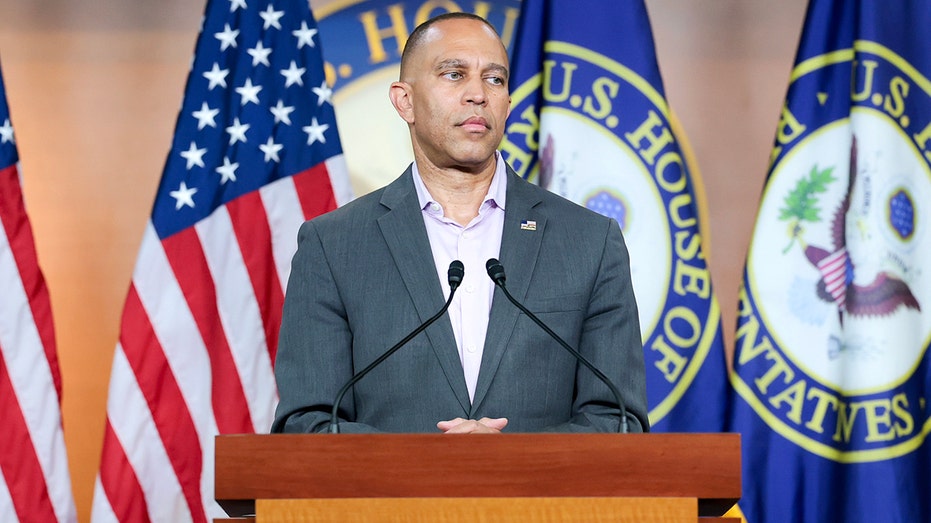
U.S. House Minority Leader Hakeem Jeffries, D-N.Y., speaks during a news conference at the U.S. Capitol Building on July 13, 2026, in Washington, D.C. (Anna Moneymaker/Getty Images / Getty Images)
GET FOX BUSINESS ON THE GO BY CLICKING HERE
“U.S. forces struck Iranian military command centers, maritime capabilities, missile and drone launch sites, and air defense systems to degrade Iran’s ability to continue attacking commercial vessels flowing through the Strait of Hormuz. Commercial vessel transits through the vital international maritime corridor continue. Since early May, CENTCOM forces have helped facilitate the transit of approximately 900 commercial vessels and 450 million barrels of crude oil,” the release noted.

Mickey Mouse, meet Kraft Mac & Cheese.
Kraft Heinz KHC and Disney DIS struck a deal that gives the food conglomerate a foothold in one of America’s most enduring entertainment empires. Under the multiyear partnership, Disney will serve Kraft Heinz products at its properties throughout North America, and Kraft Heinz will be able to use Disney’s characters on some goods in stores.
Copyright ©2026 Dow Jones & Company, Inc. All Rights Reserved. 87990cbe856818d5eddac44c7b1cdeb8

Andy Burnham has been in Downing Street for barely a day, and rural Britain has already presented him with his first invoice. Farmers, landowners and the wider countryside economy are demanding that the new Prime Minister and his surprise Chancellor, John Healey, reverse the inheritance tax changes that have convulsed British agriculture since 2024.
The pressure lands squarely on the new occupant of No 11, a former Treasury minister who now inherits the most contentious tax policy of the Labour era alongside the nation’s chequebook.
The row dates back to Rachel Reeves’s first Budget, when she announced that agricultural property relief (APR) and business property relief (BPR), the mechanisms that allow farms and family firms to pass between generations without a tax bill forcing a sale, would be restricted from April 2026.
After months of tractor protests in Westminster, the government blinked just before Christmas. The threshold for 100 per cent relief was raised from £1 million to £2.5 million per estate, with married couples able to combine allowances to £5 million, and 50 per cent relief above that. According to the House of Commons Library, the Treasury expects the concession to halve the number of affected estates, from 375 to 185 in 2026-27.
For many in the sector that was mitigation, not resolution. The Country Land and Business Association has argued the reforms could affect around 70,000 farms, and a group of farmers took the government to the High Court in March in a judicial review over the lack of formal consultation on the changes.
What gives the campaign fresh teeth is Burnham’s own words. During his by-election campaign in Makerfield, he said: “I personally have heard from farmers on family farms and I do think that needs looking at again.”
Farming groups intend to hold him to it. CLA director north Harriet Ranson said: “To date, he has made several commitments to the farming and food sector such as pledging to revisit the growth-inhibiting inheritance tax on farms, as well as directing the public sector to procure food more locally.”
She added: “It is my sincere hope that our ‘prime minister in waiting’ will appreciate the entrepreneurial attitudes and business brains that make up the rural economy and work with us to strengthen food production, nature recovery and the valued skills of the communities we represent.”
The prize, from the Treasury’s perspective, is modest revenue. The risk is a repeat of the scenes that defined the past 18 months: tractors on Whitehall, farm-gate protests and a rural economy that feels singled out. NFU president Tom Bradshaw described December’s concession as one that “will come as a huge relief to many”, while CLA president Gavin Lane said it spared family farms from “seeing their businesses taxed out of existence”. Neither organisation regards the matter as closed.
For Burnham, the politics are finely balanced. He has already signalled there is “room for movement” on tax, pledging business rates cuts for pubs and high street firms. Extending that flexibility to the countryside would delight a sector that spans everything from dairy farms to diversified visitor attractions, the breadth of enterprise celebrated at the Rural Business Awards, which are taking place at the National Conference Centre this November.
For rural business owners, the practical advice is unchanged: succession planning cannot wait on Westminster. But with a Prime Minister on record promising to look again, and a Chancellor with his first Budget to write this autumn, the countryside has rarely had a clearer window in which to press its case.

Paul Jones
Harvard alumni and former New York Times journalist. Editor of Business Matters for over 15 years, the UKs largest business magazine. I am also head of Capital Business Media’s automotive division working for clients such as Red Bull Racing, Honda, Aston Martin and Infiniti.

The high-profile real estate agent has joined forces with a neighbouring agency, bolstering her presence in the industry.

Meet the new Adam Ramsay-Peaty: ‘I don’t see success as medals any more’

Veteran Microsoft security executive joins AWS amid broader reshuffle in Redmond

School graduation marks big step for Stockton nursery children


-
 NewsBeat5 days ago
London Mayor Sadiq Khan handed a peerage by Keir Starmer alongside 15 other Labour figures… just days before the PM leaves No10
-

 Fashion4 days ago
Weekend Open Thread – Corporette.com
-

 Politics3 days ago
The House | The City of London can help the new chancellor deliver growth in every postcode
-

 Politics6 days ago
Young campaigners urge incoming PM to act on outdoor junk food ads
-

 Crypto World5 days ago
CFTC blocks Kalshi from unwinding Michigan trades after court order
-
 Crypto World4 days ago
Two July Windows Left: The CLARITY Act’s Senate Fight and What Failure Means
-

 Crypto World3 days ago
Ripple Payments Joins MiCA With 14 Firms, Does It Mean Anything For XRP?
-

 Business5 days ago
Nvidia Stock Slips After Big Tuesday Rally as Huang Confirms Vera Rubin Chip Is Now in Production Today
-

 Politics2 days ago
Democrats look to World Cup watch parties to register thousands of voters
-
 Entertainment6 days ago
Disney’s Most Ambitious Failed Star Wars Attraction Is Coming to SDCC
-

 Crypto World4 days ago
Ripple wins EU-wide access as ESMA adds it to MiCA register
-

 Crypto World5 days ago
Injective Submits SEC Transfer-Agent Registration to Onchain Ownership Records
-

 Business5 days ago
Palantir Shares Rise After Expanded Nvidia Partnership and Fresh Analyst Upgrades Ahead of Earnings Day
-

 Tech11 hours ago
Sail Virtually Aboard The “Itanic” With IA-64 Emulator
-
 Tech8 hours ago
Turtle Beach Command Series KB7 review: a nifty screen-equipped gaming keyboard
-

 Crypto World3 hours ago
Grayscale Files For Worldcoin ETF, WLD Registers Sharp Rise
-

 Tech7 days ago
Dark Secrets Emerge When Jailbreaking LLMs
-

 NewsBeat4 days ago
Registration is now open for March for Men with Kev 2026
-

 News Videos7 days ago
XRP BOMBSHELL… XRP OMBOARDED FOR TRANSACTIONS!!!
-

 NewsBeat1 day ago
Unregistered fitter used Gas Safe logo on business flyers
You must be logged in to post a comment Login