

Connect with us
DAPA Banner
DAPA Coin
DAPA
COIN PAYMENT ASSET
PRIVACY · BLOCKDAG · HOMOMORPHIC ENCRYPTION · RUST
ElGamal Encrypted MINE DAPA
🚫 GENESIS SOLD OUT
DAPAPAY COMING

Tech

Apple’s Rumored Upgrades To Its Mac Lineup Go Beyond Touchscreens

Published

on

The company is already preparing updates to the MacBook Neo, iMac, MacBook Air and more.

Rumors have been swirling for several months about Apple’s plans to add an OLED touchscreen to its MacBook Pro, but Bloomberg reports nearly all the company’s other laptops and desktops are receiving chip upgrades and, in some cases, design changes within the next year.

The highlight of the bunch is a new version of the MacBook Neo, which will reportedly use the A19 Pro chip first introduced on the iPhone 17 Pro, come with more RAM and be available with new colors. In the more immediate future, Bloomberg writes that Apple has prepped updates to the iMac and entry-level 14-inch MacBook Pro for this fall, with a likely focus on chip bumps to the M5 chip and upcoming M6 chip, respectively. Sometime between the fall and early 2027, the company will then introduce the “MacBook Ultra,” which will use the M5 Pro and M5 Max chips of current high-end MacBook Pros, but with a new OLED touchscreen and macOS interface tweaks.

For 2027, Apple is reportedly planning to update the 13-inch and 15-inch MacBook Air, likely also with the M6 chip, and assuming supply constraints don’t get in the way, release new versions of the Mac Mini and Mac Studio. Bloomberg writes Apple is testing versions of the Mac Mini with the M5 Pro and M6 chips, while the in-development Mac Studio currently uses M5 Max or M5 Ultra chips. The company’s plan to completely redesign the 14-inch MacBook Pro is also still in the works, and the new laptop will reportedly debut with an M7 chip.

Advertisement

Beyond those immediate upgrades, it sounds like OLED screens will also be slowly trickling out to the company’s products, starting with the iPad Mini, then coming to the MacBook Pros, the 2028 versions of the MacBook Air and at some point in the future, the iMac. Pro and Max versions of the M7 chip will also be introduced on next year’s MacBook Pros.

Apple only recently raised the prices of its Mac lineup in June 2025, so ideally, some of these upcoming upgrades won’t be paired with further price hikes. Considering that memory is still in high demand due and Apple is rumored to be rolling out a new hardware leasing program, though, don’t be surprised if costs creep even higher.

Advertisement

Source link

Continue Reading
Click to comment

You must be logged in to post a comment Login

Leave a Reply

Tech

The Need For Speed: Internet Speed Measurement (or DIY?)

Published

on

Car enthusiasts want to know how quickly they can make a quarter mile. Weightlifters are forever trying to add one more plate to the bar. Internet denizens have their own favorite number to brag about: the result from a speed test.

The ritual is familiar. Close a few browser tabs, click the big “Go” button, and watch the needle climb. Perhaps you pay for gigabit service and see 940 megabits per second, which produces a satisfied nod. Perhaps you see 299 megabits and begin obsessing over network hardware. But before you get too excited either way, try another test. There is a fair chance it will give you a different answer.

That does not necessarily mean one test is lying. “Internet speed” is not a single physical quantity waiting to be measured. A speed test measures the performance of a particular device, over a particular local connection, through a particular ISP route, to a particular server, at a particular time using a particular test method. Change any of those things and the answer can change too.

The Usual Suspects
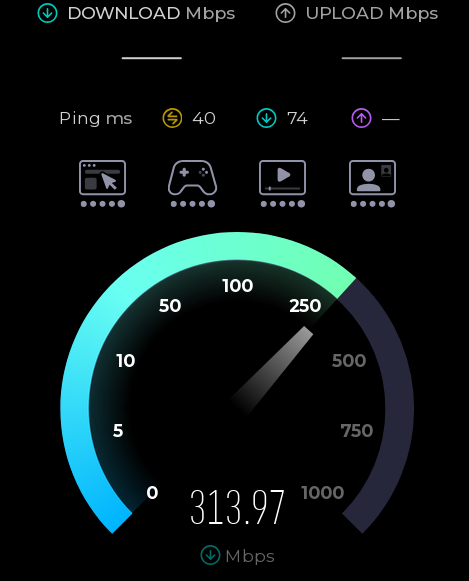
Ookla on a WiFi connection to a 1Gbit Ethernet network. The limiting factor is the 802.11s WiFi link between the computer’s Ethernet port and the router’s.

Speedtest by Ookla is probably the best-known test. It selects a nearby server, although you can choose another. It attempts to saturate the connection with multiple simultaneous transfers. That makes it good at answering the question most consumers are asking: approximately how much aggregate bandwidth can this Internet connection deliver?

Running several connections matters. A single TCP connection must gradually increase its sending rate while reacting to round-trip time, packet loss, receive-window limits, and congestion-control behavior. On a high-bandwidth or high-latency path, one connection may not fill the available pipe. Several parallel connections can ramp up independently and make it easier to reach the link’s aggregate capacity. That number is valid, but it represents something like a busy household, a large segmented download, or several applications operating at once. It does not necessarily predict the speed of one file transfer from one distant server.

Advertisement

Google’s built-in search speed test (search “speed test”) uses Measurement Lab’s Network Diagnostic Tool, or NDT. M-Lab describes NDT as a single-stream measurement of bulk-transport capacity. That makes it an interesting counterpoint to Ookla. A single flow may expose latency, loss, or TCP-window limitations that a multi-stream test can partially conceal. You can also use M-Lab’s own speed test directly.

While you may get similar numbers between the two approaches, you also may not get similar numbers, especially on high-latency connections where Ookla’s multiple streams will help hide latency.

Netflix’s Fast.com is deliberately simple. Open the page, and it immediately begins transferring data from Netflix infrastructure. By default it emphasizes download performance, since its original purpose was to answer a practical question: can this connection deliver Netflix video properly? Selecting “Show more info” adds upload speed and both unloaded and loaded latency.
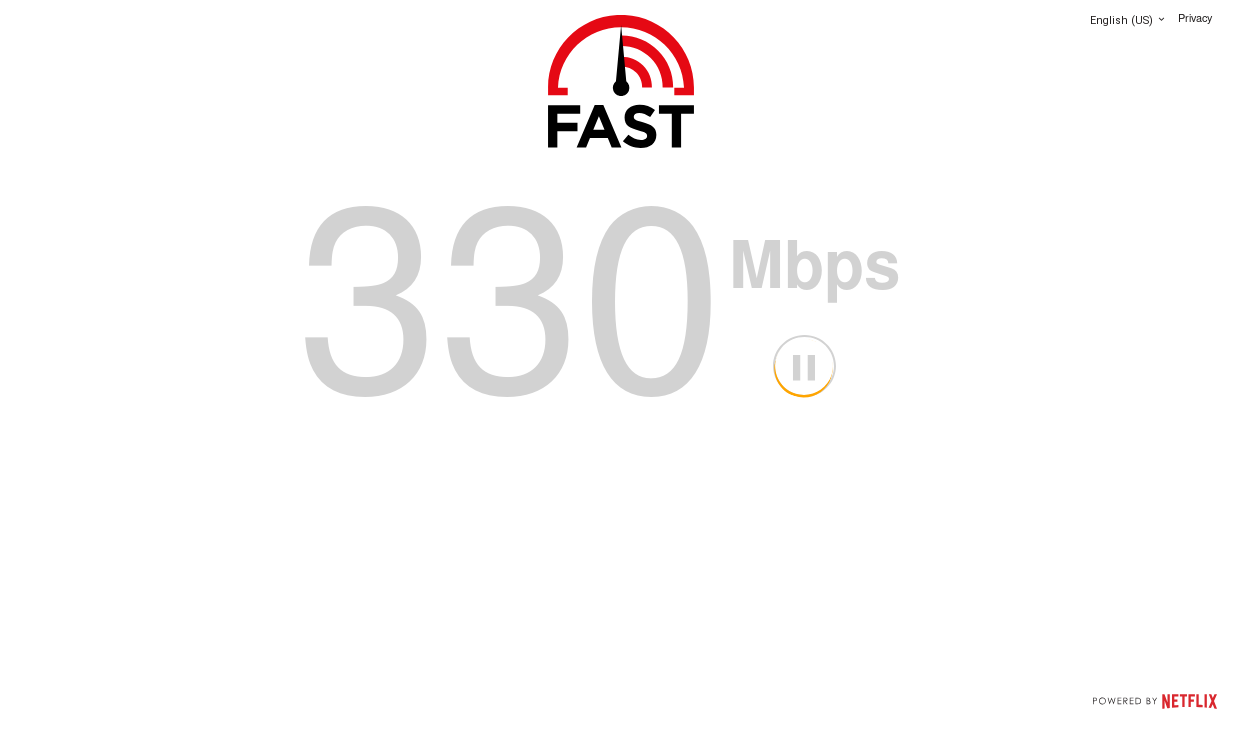
Fast is barebones and measures speed to Netflix.

The use of Netflix servers is significant. Fast.com measures the route between you and Netflix’s content-delivery network, while Ookla may test against a server operated by your ISP only a few network hops away. A superb Ookla result and a poor Fast.com result do not prove deliberate throttling, but they do tell you that the destinations — or the routes to them — are behaving differently.

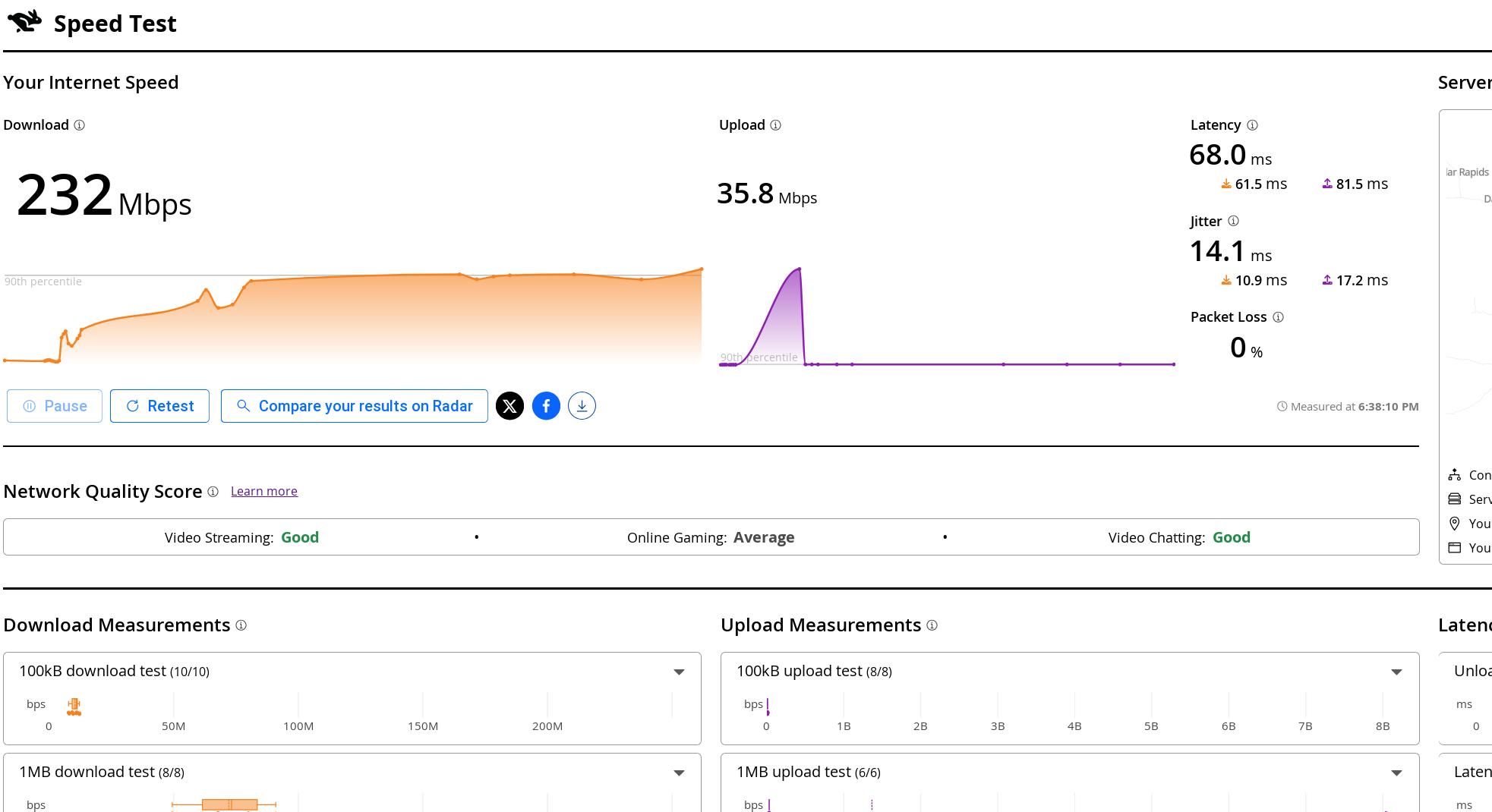
Cloudflare offers two related tests. Its Radar Network Quality Test provides a quick summary, while speed.cloudflare.com  gives an extremely detailed breakdown. The latter reports download and upload throughput, idle and loaded latency, jitter, packet loss, server location, and application-oriented quality estimates.
Advertisement
Cloudflare provides a wealth of stats and graphs.

Loaded latency is especially useful. An otherwise fast connection can become miserable when a large upload or download fills an oversized queue in the modem or router. Your idle ping might be 12 milliseconds, but under load it may jump to several hundred milliseconds. That is the classic symptom usually called bufferbloat.

If you want more options, there is testmy.net, which allows you to test upload and download speeds separately, and speedof.me, which keeps a history for you, among others. It isn’t always obvious which ones are measuring a single connection vs multiple ones, so you may have to dig through whatever documentation you can find.

Your WiFi Is Part of the Test

A browser speed test cannot automatically tell you what’s hurting your speed. A laptop connected through marginal WiFi may report 180 megabits per second even though the router has a flawless gigabit Internet connection.

In fact, once incoming Internet service reaches several hundred megabits per second, WiFi is frequently the limiting factor. The link rate displayed by the operating system is not the same thing as usable throughput. Wireless protocols have framing overhead, acknowledgments, contention, retransmissions, and half-duplex operation. The advertised 866, 1200, or 2400 megabit link rate is therefore not a promise that application data will move at that rate.

The numbers printed on WiFi boxes add another layer of optimism. A router sold as “AC1800,” for example, does not provide an 1800-megabit connection to one device. The figure is normally the sum of the maximum advertised PHY rates on separate radios — perhaps 1300 Mb/s on 5 GHz plus 450 Mb/s on 2.4 GHz — with some rounding for marketing. A conventional WiFi client connects to one band at a time, so it cannot combine those rates. The total is better understood as the router’s theoretical aggregate capacity while serving multiple devices across both bands. Even then, protocol overhead, contention, signal quality, and client limitations make actual data throughput considerably lower. Newer WiFi 7 equipment can sometimes combine links using Multi-Link Operation, but that exception does not make the old ACxxxx arithmetic any less misleading.

Advertisement

WiFi also uses shared airtime. Devices on the same channel — including neighboring access points that can hear one another — must contend for opportunities to transmit. A slow or distant client takes longer to send a given amount of data and can consume disproportionate airtime while doing so. Modern access points may provide airtime fairness and other mitigations. One old device does not invariably drag every client down to its rate, but it can still reduce the capacity available to the rest of the network. Interference has a similar effect. A weak signal, a crowded channel, microwave noise, or an overlapping neighboring network causes frames to be delayed or retransmitted. Those retries consume airtime without delivering additional data.

Repeaters and wireless mesh backhaul add another complication. A simple same-channel repeater must receive each packet and then transmit it again over the same shared medium. In the worst case, each repeated hop can roughly halve the available throughput. Modern tri-band mesh systems can avoid much of that penalty by using a dedicated backhaul radio, and Ethernet backhaul avoids it almost entirely.

This means it is entirely reasonable to buy gigabit Internet service and obtain only 300 or 500 megabits per second from a WiFi laptop. Whether that represents a problem depends on the client, radio band, channel width, signal level, backhaul, and local RF environment.

For a meaningful ISP test, begin with a computer connected directly to the router by Ethernet. Stop large transfers and temporarily disable any VPN. Record the chosen server, latency, upload speed, and download speed rather than preserving only the most flattering number. Then run the same tests over WiFi. The difference is an approximate measurement of what the wireless portion of the network is costing you.

Advertisement

Remove the Internet From the Experiment
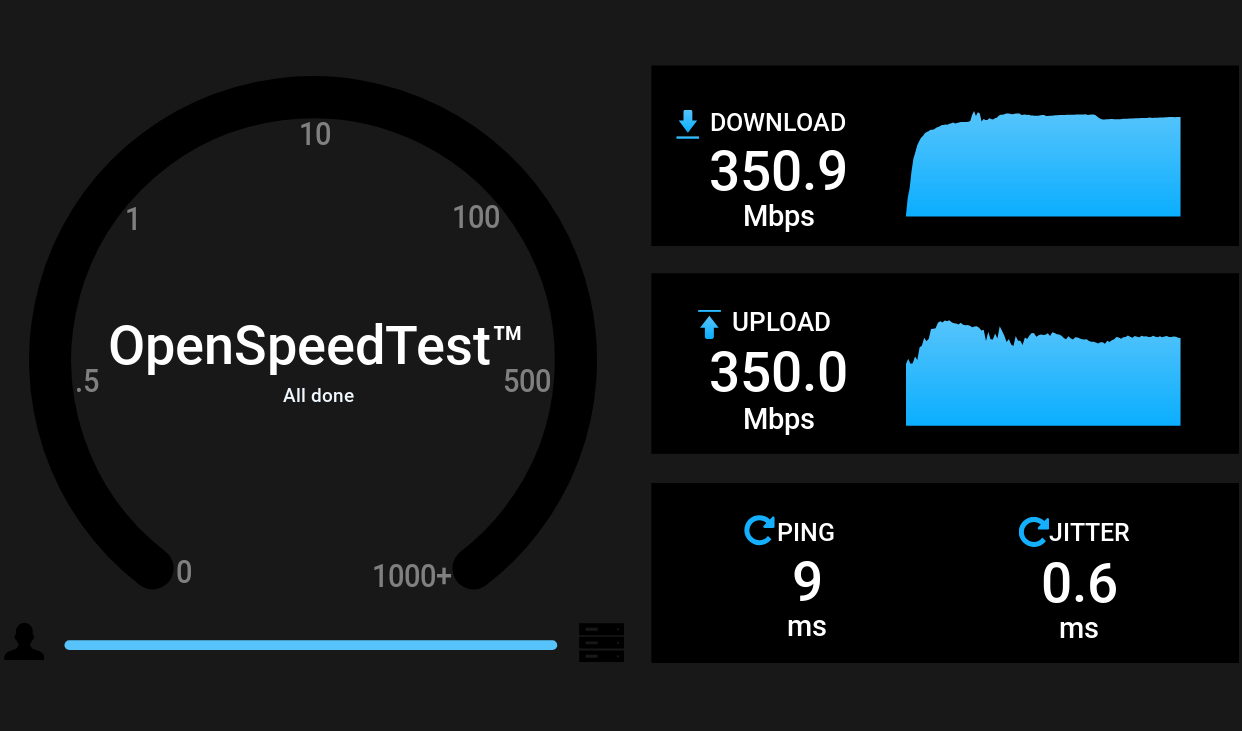
OpenSpeedTest running on an OpenWRT node.

Better still, remove the ISP from the test completely. OpenSpeedTest is a self-hostable, browser-based test. Run its server on a wired computer, NAS, or container, then visit it from laptops, phones, and tablets around the house. Because the traffic remains on your LAN, a slow result points toward WiFi, switching, cabling, or the client rather than the Internet connection.

It is possible to run this on the uhttpd server used with OpenWRT, although you’ll need to coax it to measure upload speeds since the server can’t handle the default method. The trick is to create a CGI script that accepts a large amount of data successfully and then configure uhttpd to run that.

A browser-based local test is convenient, but for serious diagnosis it is hard to beat iperf3, the client/server tool we recently used while testing mesh routers. On one machine (say, 192.168.1.100), start the server:

iperf3 -s

From another machine, run:

iperf3 -c 192.168.1.100

By default, iperf3 uses one TCP connection. Add -P 4 to try four parallel streams, or -R to reverse the direction so that the server sends and the client receives. Those variations can tell you something. If four streams are much faster than one, the network may have enough aggregate capacity but a single TCP flow is being limited by latency, loss, window growth, CPU performance, or offload behavior. If the reverse test is much faster, examine the weaker machine’s transmit path, drivers, antennas, or CPU.

Advertisement

iperf3 can also generate UDP traffic at a specified rate and report packet loss and jitter. That is often more informative for evaluating a wireless link than merely chasing the largest TCP number.

Can Linux Make It Faster?

Linux offers an impressive array of network tuning knobs, which naturally tempts us to turn them. But first, you need to understand what needs tweaking.

Check the negotiated Ethernet rate and interface counters:

ethtool eth0
ip -s link show eth0

A gigabit adapter that has negotiated 100 megabits per second usually has a cabling, connector, or switch-port problem. Increasing TCP buffers will not repair it. Rising interface errors and drops point toward a physical, driver, or congestion problem. TCP retransmits (view with ss -ti) may indicate loss elsewhere on the path.

Advertisement

You can inspect the active queue discipline with:

tc qdisc show

Linux supports queue disciplines such as fq_codel, which combines per-flow queueing with active queue management. It attempts to prevent one large transfer from building an enormous queue and delaying unrelated interactive packets. The kernel documentation specifically lists fq_codel as a sensible queue discipline that works without extensive configuration.

It can be selected as the default for newly created interfaces with:

sudo sysctl -w net.core.default_qdisc=fq_codel

That may improve queueing on traffic leaving the Linux machine. It does not, however, fix a large queue in the cable modem or Internet router. Queue management must be applied at the bottleneck. If the ISP link is limited to 20 megabits upstream, controlling a queue on a gigabit Ethernet interface after it has already handed packets to the router is too late.

Advertisement

For a home connection, the most effective bufferbloat treatment is usually Smart Queue Management on the router. OpenWrt’s SQM system supports both fq_codel and CAKE. CAKE generally provides better performance. However, fq_codel requires less CPU overhead.

High-latency paths introduce a different problem. TCP must keep enough data in flight to fill the bandwidth-delay product. Modern Linux generally autotunes TCP buffers, so the old advice to assign enormous fixed values to tcp_rmem and tcp_wmem is less universally useful than it once was. Before changing them, use ss -ti during a transfer and look for retransmissions, round-trip time, congestion-window size, and whether the receiver window is actually limiting the connection.

Linux also supports selectable TCP congestion-control algorithms:

sysctl net.ipv4.tcp_available_congestion_control
sysctl net.ipv4.tcp_congestion_control

Algorithms such as BBR can improve throughput and queue behavior on some long-distance or lossy paths. But changing the algorithm affects connections sent by that Linux machine; it does not control the remote speed-test server, repair poor WiFi, or eliminate a queue in the router. Congestion-control tuning is therefore a useful experiment for a server, VPN endpoint, or long-haul transfer machine — not a universal solution to slow networking.

Advertisement

Finally, inspect hardware offload features when a Linux system cannot keep up with a fast LAN:

ethtool -k eth0

Advanced network tuning is a bit beyond the scope of this post, but there are plenty of roadmaps down this rabbit hole.

The Lesson

The lesson here is that there is no universally correct speed-test result. Ookla tests how effectively multiple transfers can fill a route to one of its servers. M-Lab examines a single bulk flow. Fast.com tests the path to Netflix. Cloudflare pays unusual attention to latency under load and overall connection quality. OpenSpeedTest and iperf3 can determine whether the Internet connection is even the problem.

Run enough tests, and you will eventually obtain a number worth bragging about. Run the right tests, though, and you may find ways to truly increase real-world performance. If you want to chase that extra 1 kbit per second speed, be our guest — we know how it is. But the truth is that if the Internet is doing what you want it to do, then it is fast enough.

Advertisement

Source link

Continue Reading

Tech

Pixel 6 and 6 Pro won’t get Android 17 QPR2

Published

on

Google has confirmed the Pixel 6 and Pixel 6 Pro will not receive Android 17 QPR2 because the devices are reaching End of Life before the update’s December release.

That confirmation arrived alongside the launch of the Android 17 QPR2 Beta programme, marking the point at which Google’s five-year software commitment to the Pixel 6 series finally reaches its natural conclusion after almost five years on the market.

Going back, Google launched the Pixel 6 and Pixel 6 Pro in October 2021 with a promise of three years of major OS upgrades followed by two years of security patches, a policy the company extended to five full years of updates in 2024.

Google addressed the cutoff directly, stating that Pixel 6 and 6 Pro users will not be getting this OTA since the device will reach End of Life and the Android 17 QPR1 beta series will be the last for these devices.

Advertisement

That leaves Android 17 QPR1 as the final software milestone for both handsets, a smaller release than the QPR2 update now reaching newer Pixel hardware through the beta channel.

QPR1 is expected to roll out to existing Pixel devices in early September, shortly before it debuts as the default build on the incoming Pixel 11 series in late August.

Advertisement

Before support ends, the Pixel 6 and Pixel 6 Pro will still receive an August security patch, a September Pixel Drop bundled with the QPR1 release, and one further security patch in October.

Advertisement

Once that October patch lands, Google will stop issuing any further security fixes or feature updates for either handset.

The Pixel 6a, released a year after its siblings, sits on a separate schedule and will continue receiving security updates until July 2027.

Google has not detailed further changes to its Pixel update policy beyond this cutoff, with the Pixel 11 series expected to inherit the standard five-year support window when it launches in August.

Advertisement

Source link

Continue Reading

Tech

The Pixel 11 Pro just appeared on Google’s own website

Published

on

Google may have accidentally confirmed the design of its next flagship phone ahead of schedule.

An image of the Pixel 11 Pro briefly appeared on the Google Fi website before swifty being taken down. This has given what appears to be the clearest official look yet at the upcoming handset.

The image, first spotted and preserved by Droid Life, closely matches renders that surfaced online last week, adding weight to earlier leaks ahead of Google’s expected August launch.

While the promotional banner referred to the Pixel 11 Pro XL, Droid Life reports the device shown is actually the standard Pixel 11 Pro, listing the phone’s microphone placement as the giveaway. That could mean Google might have uploaded the wrong marketing image before quietly removing it.

Advertisement

The leaked image also showcases what appears to be Google’s new Dune colour option, alongside the familiar Pixel camera bar design. Aside from the new finish, there are no obvious design changes visible from the front-facing promotional image.

Advertisement

Because the image originated from one of Google’s own websites, it lends considerable credibility to previous leaks. Earlier renders, which first appeared via an Amazon listing, featured an almost identical design. Therefore, it is increasingly likely that this is indeed what the Pixel 11 Pro will look like when it launches.

The premature listing doesn’t reveal anything about the rest of the lineup, however. There’s no sign of the Pixel 11, Pixel 11 Pro XL or Pixel 11 Pro Fold, leaving Google’s wider refresh under wraps for now.

Advertisement

The Google Fi page also hinted at a launch promotion. According to the leaked banner, buyers could receive $100 off the Pixel 11 Pro XL, though it’s unclear whether the offer will require signing up for a new Google Fi plan, trading in an existing device or meeting other eligibility requirements.

Pricing remains one of the bigger unanswered questions. Previous reports from Europe have suggested the Pixel 11 range could receive a €100 price increase. However, it’s not yet known whether similar hikes will apply in markets such as the US or UK.

Google is widely expected to unveil the Pixel 11 series in August. Therefore, there may not be long to wait before the company officially confirms the design, even if it may have beaten itself to the punch.

Advertisement

Advertisement

Source link

Continue Reading

Tech

FLOSS Weekly Episode 876: There Is No Money Fairy

Published

on

This week Jonathan chats with Michael Meeks about Collabora! What’s the origin story in this consulting company, why do they have an outstanding office suite, and where is the world headed to accomplish digital sovereignty? Watch to find out!

Did you know you can watch the live recording of the show right on our YouTube Channel? Have someone you’d like us to interview? Let us know, or have the guest contact us! Take a look at the schedule here.

Advertisement

Direct Download in DRM-free MP3.

If you’d rather read along, here’s the transcript for this week’s episode.


Theme music: “Newer Wave” Kevin MacLeod (incompetech.com)

Advertisement

Licensed under Creative Commons: By Attribution 4.0 License

Source link

Advertisement
Continue Reading

Tech

Fresh off AI layoffs, Block now wants to whack Slack with agent-human collab tool

Published

on

AI and ML

Because what could be more appealing to humans than sharing virtual space with AI?

After cutting over 4,000 jobs due to AI, fintech biz Block is back with Buzz, a shared workspace where humans and bots can collaborate in ways that are more auditable, sovereign, and secure than what you can do in chat tools such as Slack.

Block’s human-bot co-op is built upon a turducken of tech jargon: The platform is free and open source. It’s based on the decentralized Nostr protocol, so there’s cryptographic identity. It’s “sovereign,” a naively optimistic term readers of Neal Stephenson’s Snow Crash should recognize, which in this context means self-hostable. And it’s intended as a replacement for Slack, GitHub, and various other communication and collaboration tools.

Advertisement

If “Buzz” sounds familiar, that’s because Google used that name in a social media faceplant more than 15 years ago. For those who missed the first go-around, Google Buzz, a failed social media service, gave rise to Google+, also a failed social media service. Block appears to believe that a decade and a half is sufficient for a brand cleanse.

The project’s GitHub repo offers a more apologetic assessment: “Yes, it’s another AI-adjacent developer tool. We’re sorry. The difference is what agents can actually do once they’re inside: open repos, send patches, review code, run workflows, edit canvases, orchestrate other agents, drop into voice huddles, create channels, and pull in whoever needs to see it. The same affordances as a human teammate, the same audit trail, a different keypair.”

You can already sic software agents on collaborative workspaces. Block’s main insight is that it would be useful to link AI agents with cryptographic identities. Others have already arrived at that conclusion. Hence OWASP’s Agent Name Service, DNS for AI Discovery, Estonia’s digital IDs for agents, and so on. But Buzz’s badging of humans and bots with cryptographic key pairs is bound to tick governance boxes.

“Every company is going to need a place where humans and agents work together,” said Bradley Axen, head of AI capabilities at Block, in a statement. “The question is whether that place is proprietary or open. We built Buzz because we believe it should be open.”

Advertisement

Moat-seeking tech incumbents would probably disagree about the need for openness, even though they’re fond of using the word without applying it. We note that OpenAI sells closed AI. And Anthropic’s decision to disallow third-party tools from using Claude subscriptions highlights the seemingly inevitable path from openness to barriers when revenue is at stake.

What’s more, it’s not obvious that every company will need people and bots in the same space. There’s a strong case for keeping humans and agents apart because they work at different speeds. Git at least was built for handling many distributed code edits, pull requests, and merges. It’s hard to see how people and bots can share a text-based communication space unless the bots are rate-limited or just talk among themselves.

“The bet is that one community can do what teams currently fake with chat, forges, bots, CI dashboards, release tools, search indexes, and a pile of glue code,” Block’s Buzz developers state. “Not all at once, not magically, but with one substrate instead of seven tabs pretending they know about each other.”

If tools for these sorts of things didn’t already exist, and no large tech companies had designs on this space, Buzz might face less daunting odds. But it’s worth a shot. ®

Advertisement

Source link

Continue Reading

Tech

Game developer Harebrained Schemes kicks off its new indie era with survival-horror RPG ‘GRAFT’

Published

on

(Harebrained Schemes press image)

The latest game from Seattle-based developer Harebrained Schemes, and its first since its return to independence in 2023, is a dark sci-fi/horror adventure where the player must constantly change and enhance their body in order to survive.

In GRAFT, players take the role of Tiger, a man with jumbled memories who’s trapped aboard the Arc, a massive, decaying space station. The Arc’s other inhabitants include failed experiments, crazed mutants, bands of human survivors that could be either allies or enemies, and a hostile AI.

To survive, Tiger must salvage new parts from his enemies and graft them into his own body, which gives him new weapons, abilities, and upgrades. However, each new body part comes with its own secondhand memories, which quickly impacts Tiger’s sense of identity.

That leads naturally to a cyberpunk-infused Ship of Theseus situation: how much of yourself can you replace before you’re no longer you?

Harebrained CEO Mike McCain describes GRAFT as a survival horror game, in the spirit of mainstream releases like Resident Evil and Dead Space. In order to succeed, players must ration their available resources, constantly scavenge for supplies, and carefully pick their battles. Sometimes it’s going to be better to simply run away.

Advertisement

GRAFT is being developed in Unreal Engine by a core team of five at Harebrained, plus “key collaborators.” McCain also serves as GRAFT’s project director.

Harebrained Schemes was founded in 2011 by Jordan Weisman and Mitch Gitelman, who’d previously worked together on the Crimson Skies franchise. After releasing two mobile games, Harebrained pivoted to the PC market with a trilogy of crowdfunded strategy RPGs based on the Shadowrun tabletop game.

(Harebrained Schemes press image)

In 2018, Harebrained released a new BattleTech game for PC and Linux via the Swedish publisher Paradox Interactive (Crusader Kings). Paradox subsequently acquired Harebrained for $7.5 million. Shortly afterward, Weisman stepped down as CEO; he would eventually leave the company to found the no-code game development platform Endless Adventures.

5 years later, Paradox announced that it would “part ways” with Harebrained, shortly after the release of Harebrained’s original strategy RPG The Lamplighters League and the Tower at the End of the World. McCain, who’d previously been the director on BattleTech, rejoined the company in early 2024 as Harebrained’s new CEO, while Gitelman stepped back to an advisory role.

Following the separation, Paradox owns and operates most of Harebrained’s previous catalog, including Shadowrun, BattleTech, Lamplighters League, and Harebrained’s 2016 action-RPG Necropolis. With GRAFT, Harebrained is effectively starting from scratch.

Advertisement

GRAFT does not currently have a release date.

Source link

Continue Reading

Tech

Samsung Galaxy Z Fold 8 Vs. Galaxy S26: Every Major Difference

Published

on


Samsung recently updated its foldable lineup of smartphones for 2026, and the highlight of the launch was an entirely new smartphone: The Samsung Galaxy Z Fold 8. Despite inheriting its name from last year’s Samsung Galaxy Z Fold 7, it looks nothing like its namesake predecessor. The Galaxy Z Fold 8 is smaller, stockier, and wider than the standard Galaxy Z Fold. Needless to say, it is a very different proposition from Samsung’s standard Galaxy S26, released earlier in 2026. So, if you are in the market for a new smartphone, you need to know some things before deciding to splurge your hard-earned money on either.

Beginning with the display, it is the S26 here which has a conventional 6.3-inch Dynamic AMOLED 2X display, compared to the dual display setup of the Galaxy Z Fold 8 which includes a 5.5-inch cover display and larger 7.6-inch internal display. Both phones support an adaptive refresh rate of up to 120Hz, but the Fold 8’s ability to transform into a small tablet gives it considerably more display real estate. The S26, meanwhile, remains the more straightforward choice for anyone who simply wants a compact flagship.

Advertisement

There is also a considerable difference in size and weight. The Galaxy S26 measures just 7.2mm thick and weighs 167 grams. The Galaxy Z Fold 8 is only 4.5mm thick when unfolded, but inevitably becomes thicker when folded and weighs 201 grams. Samsung has attempted to address the durability concerns associated with foldables with a redesigned hinge, two titanium layers underneath the folding display, Gorilla Glass Ceramic 3 on the front, and an IP48 rating. The Galaxy S26, however, has the advantage when it comes to protection from the elements thanks to its more robust IP68 rating.

Advertisement

Performance, cameras, and battery

Despite the massive difference in their form factors, the Galaxy Z Fold 8 and Galaxy S26 have several things in common. In the U.S., both phones are powered by the Qualcomm’s Snapdragon 8 Elite Gen 5 chip. The Samsung Galaxy S26 is offered in 256GB and 512GB storage options, and comes armed with 12GB of RAM. The Fold 8 offers more storage flexibility, with 256GB, 512GB, and 1TB options on offer. The top-of-the-line 1TB variant ships with 16GB of RAM, compared to 12GB on the other two options. 

Moving on to the cameras, the Galaxy S26 gets a traditional triple-camera setup consisting of a 50MP main camera, 12MP ultrawide, and a 10MP telephoto with 3x optical zoom. The Fold 8 gets dual 50MP wide and ultrawide cameras, but lacks a dedicated telephoto camera. Samsung only advertises up to 10x digital zoom on the Fold 8, compared with 3x optical and up to 30x digital zoom on the S26. So, if your photography exploits regularly involve long zoom range photos, the S26 is actually the more versatile option.

The Samsung Galaxy Z Fold 8 gets a 4,800mAh battery, which is slightly larger than the S26’s 4,300mAh unit. However, it is worth noting that the Fold 8’s battery needs to power two displays, with the main display being substantially bigger, so the overall battery life may be a lot closer than what you’d expect. Samsung itself rates the Fold 8 for up to 26 hours of video playback, while the S26’s smaller screen and conventional form factor give it an inherent efficiency advantage depending on how the phones are used.

Advertisement

The $1,000 question: Which one should you buy?

The feature-loaded Galaxy S26 launched in the U.S. at $899.99 for the 256GB model, but can be purchased for a lower price from various retailers. The base 256GB variant of the Galaxy Z Fold 8 starts at a whopping $1,899.99 with the same amount of storage, making it exactly $1,000 more expensive before discounts, trade-ins, or carrier offers enter the equation. Opting for the 512GB variant takes the Fold 8 to $2,099.99, while the 1TB version will cost users a staggering $2,499.99.

Clearly, if you’re looking for the best price to performance ratio, the Samsung Galaxy S26 is no slouch. It gets the same Snapdragon 8 Elite Gen 5 processor in the U.S., the same 12GB of RAM, and a more versatile rear camera setup. It’s also 34 grams lighter, has better IP68 dust and water resistance, while costing less than half as much.

That, however, doesn’t invalidate the existence of the Galaxy Z Fold 8. Its form factor is inherently cooler, and will turn a lot of heads. The phone’s internal display makes it much better suited to multitasking, documents, websites, videos, and running multiple apps simultaneously. Samsung has also specifically optimized the Fold 8’s larger display for side-by-side productivity, while retaining features such as Samsung DeX, although S-Pen support is still missing.

Advertisement

In simple words, for most buyers, then, the Galaxy S26 is the more sensible choice. The Galaxy Z Fold 8 does make sense if you specifically want a device that can replace both a conventional smartphone and, to some extent, a small tablet. Whether that transformation is worth an additional $1,000 is ultimately the biggest question buyers will have to answer.


Advertisement

Source link

Continue Reading

Tech

Amazon cuts jobs in AGI group as it puts more focus on customer-facing AI

Published

on

GeekWire File Photo

Amazon confirmed Wednesday that it laid off an unspecified number of employees in its artificial general intelligence (AGI) organization, the division working on the company’s advanced AI models.

The move, first reported by Reuters, comes as the company invests heavily in programs to help businesses implement AI effectively, including a $1 billion initiative to embed AWS engineers with customers building agentic AI systems.

It’s part of a larger shift in the industry as tech giants and AI frontier labs look to make sure the enormous sums they’re spending on AI pay off in tools businesses actually use.

In a statement, an Amazon spokesperson said building large AI models remains “one of the most important things we’re working on,” but said the company is also “sharpening our focus on the initiatives that matter most for customers, so we can move faster on what counts.”

“That focus means some difficult decisions, including eliminating some roles within parts of our AGI organization, even as we continue to invest in the areas most important to our customers’ future,” the spokesperson said.

Advertisement

It’s the latest in a series of changes in Amazon’s AGI group, which despite its name has always been focused more on frontier models than on what the industry considers AGI, the still-theoretical systems that would match or surpass human intelligence.

Rohit Prasad, the senior executive who oversaw Amazon’s AGI work, left the company late last year, and AGI Lab head David Luan departed in February. In December, Amazon folded the AGI group into a larger organization led by senior vice president Peter DeSantis that also includes chip development and quantum computing.

The cuts are the latest in a series of smaller reductions since January, when Amazon eliminated 16,000 jobs across the company. Amazon said U.S. employees whose jobs are cut will receive 90 days of pay and benefits, outplacement support and transitional health coverage, along with eligibility for severance.

Source link

Advertisement
Continue Reading

Tech

Theory Audio Design Ships Five New Loudspeaker Controllers With Powersoft, Dante and Up to 16kW

Published

on

Paul Hales does not do subtle. Fortunately, the Theory Audio Design founder is equally obsessive about sound quality, robust construction, long-term reliability, and making system integration less painful than the kidney stone currently trying to kill me. I have installed one of Theory’s systems in my own home, so I know the difference.

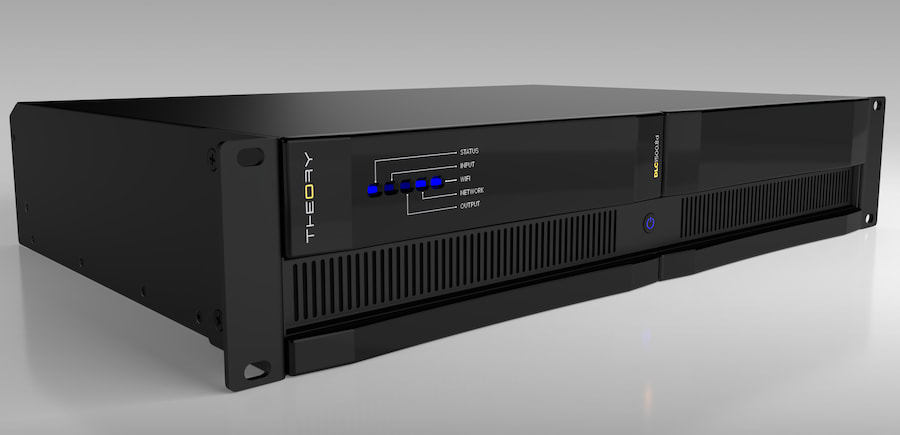
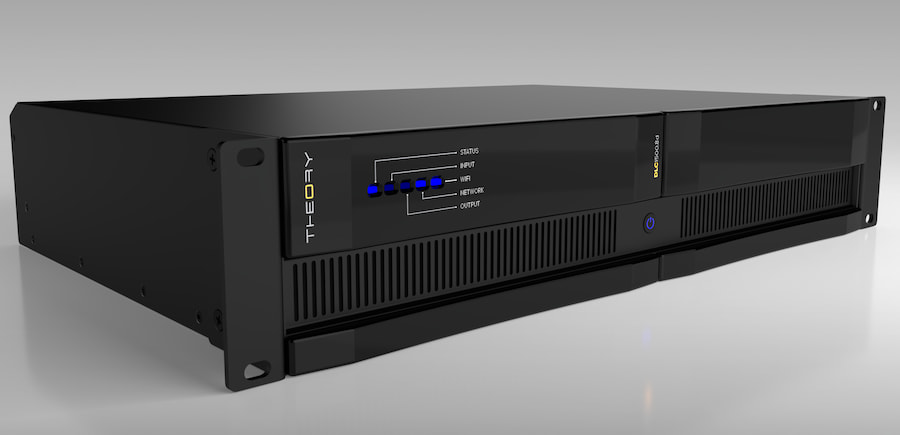
The new Theory Audio Design DLC-1500.8d and four-model PLC Series loudspeaker controllers add more channels, greater power density, Dante and AES67 networking, and advanced DSP for demanding residential, commercial, and professional audio installations.

Pricing has not been announced, but Theory Audio Design is now shipping five new amplified loudspeaker controllers: the eight-channel DLC-1500.8d and four models in its new Powersoft-based PLC Series.

The expansion gives Theory considerably more horsepower for large home theaters, distributed audio systems, outdoor installations, commercial venues, marine projects, and live sound applications. More watts will not rescue a poorly designed system, but the networking, DSP, power sharing, and deployment tools are arguably the more important parts of this announcement.

Advertisement

Related Reviews: Theory Audio Design 5.2.2 Surround Sound System Review

DLC-1500.8d Doubles Down Without Consuming More Rack Space

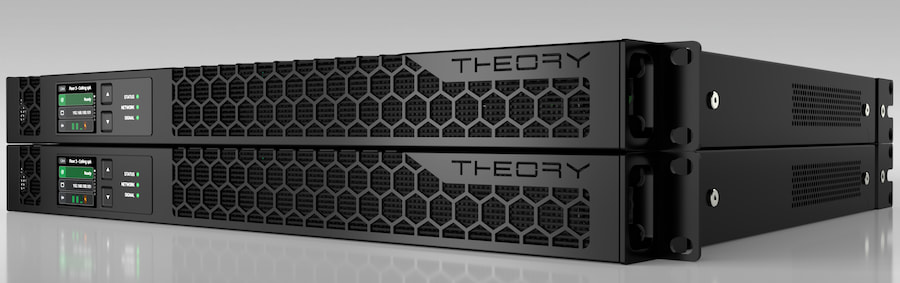
theory-dlc-1500-8d-controller-angle
DLC-1500.8d

The new DLC-1500.8d is the larger sibling to the four-channel DLC-1500.4d introduced in 2024. The earlier model delivered a claimed 3,000 watts from a 2U chassis; the new version doubles both the channel count and total rated output while retaining the same 2U footprint. 

Theory rates the DLC-1500.8d at 6,000 watts, with up to 1,500 watts into 4 or 8 ohms available from any channel pair. It is also specified to deliver 800 watts into 2 or 4 ohms with all channels driven.

High-current Euroblock outputs accept speaker cables up to 10-gauge, while four channels of Dante and AES67 audio-over-IP digital I/O simplify deployment in larger networked systems.

Theory says one DLC-1500.8d can power up to 32 of its 16-ohm loudspeakers in low-impedance mode or more than 300 loudspeakers directly in high-impedance mode without requiring an internal transformer. That is less about building an unnecessarily loud living room and more about reducing amplifier count in large estates, hospitality spaces, outdoor systems, and commercial installations. 

Advertisement

Configuration is handled through an onboard web interface using wired Ethernet or the controller’s integrated Wi-Fi access point. DSP tools include:

  • Matrix mixing
  • Priority routing and ducking
  • Parametric EQ
  • Delay and gain adjustment
  • Output limiting

Control modules are available for AMX, Control4, Crestron, Crestron Home, ELAN, Josh.ai, Q-SYS, RTI, and Symetrix.

Advertisement. Scroll to continue reading.

PLC Series Brings Powersoft Inside the Rack

theory-plc-loudspeaker-controllers-angle-2026

The PLC Series was first previewed at CEDIA Expo 2025, but Theory had not released complete model specifications or pricing at the time. The company has now confirmed four models built around Powersoft amplification and signal-processing technology. 

Model Channels Rated Output
PLC-4K8 8 500 watts per channel
PLC-8K8 8 1,000 watts per channel
PLC-9K4 4 2,250 watts per channel
PLC-16K4 4 4,000 watts per channel

Theory did not specify the load conditions used for those PLC power ratings in its announcement, so installers should consult the complete technical documentation before designing a system around the headline numbers.

All four models fit into a 1RU chassis and incorporate Powersoft’s Class D amplification, SmartRail energy-management power supplies, Power Factor Correction, advanced DSP, linear-phase FIR filtering, and Active Damping Control.

Advertisement

The PLC platform also includes proprietary Theory loudspeaker presets, native Dante and AES67 networking, all-channel power sharing, three configurable Gigabit Ethernet ports with one PoE connection, USB-based amplifier configuration restoration, and maritime compliance. 

Why This Matters for Theory Owners

Theory Audio Design does not treat amplification and DSP as accessories to be selected after the speakers. Its loudspeakers are designed as part of a complete system using Theory’s dedicated amplified controllers and optimized DSP presets.

That approach has already produced some rather convincing results.

When I reviewed the Theory Audio Design 5.2.2 surround system, it completely reset my expectations for what a soundbar-based home theater could deliver. Its combination of dynamics, scale, dialogue clarity, and control made it unmatched below $20,000 at the time. 

Advertisement

Theory continued to impress during our CEDIA Expo 2025 coverage, earning eCoustics Best in Show recognition for both the compact ic5 architectural loudspeaker and the ic6 deployed in its outdoor bollard enclosure. Its 9.2.4 system was also selected for Best Home Theater Sound at AXPONA 2026

The common thread has been high efficiency, controlled dispersion, strong dynamic performance, and consistent voicing across different installation formats. The new controllers allow integrators to apply that same system-based approach to substantially larger and more complicated projects.

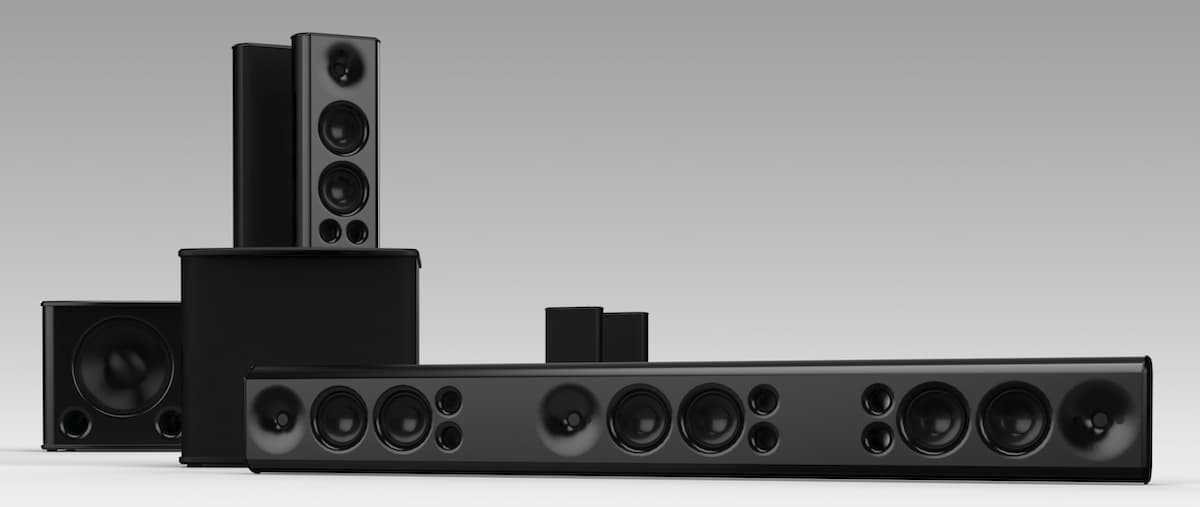
Theory Audio Design Soundbar Home Theater System
Theory Audio Design Soundbar, Speakers and Subwoofers

CEDIA Expo 2026

Theory Audio Design will demonstrate the DLC-1500.8d and PLC Series in Booth 1300 at CEDIA Expo 2026, which runs September 1 through 4 at the Colorado Convention Center in Denver. eCoustics will be there, and we will have the opportunity to try the new controllers inside a complete Theory system rather than merely admiring the power ratings on a rack sheet. 

The Bottom Line

The DLC-1500.8d looks like a logical and useful evolution of Theory’s existing controller platform, doubling the channels and claimed total output of the DLC-1500.4d without demanding additional rack space.

Advertisement

The PLC Series is the larger strategic move. Powersoft technology, substantially greater power density, Dante and AES67 networking, and more scalable system management could make Theory a viable option well beyond dedicated home theaters.

Advertisement. Scroll to continue reading.

Sixteen thousand watts in a 1RU chassis certainly gets attention. Pricing, thermal management, network reliability, noise levels, and ease of deployment will determine whether integrators keep ordering them after the demonstrations are over.

For more information: theoryprofessional.com

Advertisement

Source link

Continue Reading

Tech

Lawmakers want Trump to investigate EU’s ‘anti-American’ DMA

Published

on

U.S. Lawmakers have written to President Donald Trump, hoping he will do something to help big tech companies being targeted by the E.U.’s Digital Markets Act.

The European Union’s Digital Markets Act has been a thorn in Apple’s side since its introduction. Lawmakers in the United States want something done to fight what they consider to be rules that target U.S. Big Tech firms unfairly.

A letter signed by 25 Republicans, including seven members of the House of Representatives Trade Subcommittee, has been sent to Trump, urging him to open trade investigations against the E.U. The letter, seen by Reuters on July 21, focuses chiefly on the Digital Markets Act as a tool that works against U.S. firms.

Describing the rules as “anti-competitive acts, policies, and practices,” the letter accuses the E.U. of using them as tools of “economic extraction and regulatory coercion against American firms.” Trump is urged to take action before Europe “further entrenches this anti-American regime.”

Advertisement

As an example, the letter proposes that the addition of the cloud units of Amazon and Microsoft under the Digital Markets Act would place “unprecedented regulatory burdens” on the companies. Burdens that European and Chinese rivals apparently wouldn’t face.

Apple’s designation as a gatekeeper under DMA rules is also raised, alongside Amazon and Meta’s inclusion. Meanwhile, China giants Temu and AliExpress are not classed as such, partly due to the rules relying on the number of European users who use them.

There’s also the apparent problem of firms in the E.U. having access to the U.S. market with less regulatory oversight than the U.S. firms in the E.U. This access should be limited if the E.U. continues to use discriminatory rules, it continues.

The letter said that the U.S. should use all available tools, including Section 301 of the Trade Act of 1974. This rule would combat perceived unfair trade practices by imposing tariffs, Trump’s favorite international economic weapon.

Advertisement

E.U. “innocence”

While lawmakers are insistent that the transatlantic relationship between the U.S. and Europe is very much one-sided and grossly unfair, the EU thinks otherwise.

Thomas Regnier, European Commission spokesperson, said the European Union has the sovereign right to regulate economic activities taking place within its borders. This also applies to digital regulation, he continued, insisting they are being enforced in a “fair and non-discriminatory manner.”

This enforcement has included continuing to fight Apple over the App Store and iMessages. For the App Store, this has led to the fairly lukewarm creation of third-party app storefronts on the continent.

Apple has also caught the occasional break from regulation, too. When it comes to Apple Maps and Apple Ads, the E.U. doesn’t believe they are large enough to be subject to regulation under the DMA.

Advertisement

The regulations have also led to Apple holding back from launching some products in Europe, because of DMA compliance concerns. While the rest of the world will get to use Siri AI this fall, the EU will miss out.

Reviving retaliation

The letter to President Trump and the reference to Section 301 is a carefully planned request, that effectively is a callback to a warning from September 2025.

At the time, Trump warned Europe that the U.S. would retaliate if the E.U. continued to fine U.S. companies and burden them with regulations. There was the same threat of invoking Section 301 to allow U.S. officials to investigate and respond to unfair foreign trade practices.

Trump insisted that Europe was unfairly targeting American companies, such as Apple. The penalties levied by Europe were deemed to be diverting money away from U.S. investment and jobs.

Advertisement

By spelling out that the lawmakers want Trump to do what he threatened in September, the letter could be enough to nudge the President into following through.

Source link

Advertisement
Continue Reading

Trending

Copyright © 2025