

Crypto World
Talos Adds Kalshi Trading as Prediction Markets Surge

Institutional crypto trading platform Talos has integrated with Kalshi, allowing select clients to trade the prediction market operator’s event contracts and crypto perpetuals through the same infrastructure they already use for digital assets, eliminating the need for a separate connection.
Talos will offer algorithmic order types including Iceberg, TWAP and POV, along with multi-leg execution for perp-to-perp and perp-to-spot spread trades. The company said institutional clients will also be able to execute block trades in Kalshi contracts through its request-for-quote platform using participating over-the-counter liquidity providers.
Later this year, Talos plans to extend its dealer software to brokers and trading platforms, allowing them to offer Kalshi event contracts directly to customers where permitted. The company also plans to launch a unified prediction market data feed that standardizes events, trades, order books, open interest and implied probabilities across venues.
The integration lowers the operational hurdles for hedge funds, market makers and other professional trading firms already using Talos to add regulated prediction markets alongside their existing crypto trading activity.
Related: Kalshi says CFTC, Michigan orders leave it in ‘impossible position’
Prediction markets hit record trading volumes
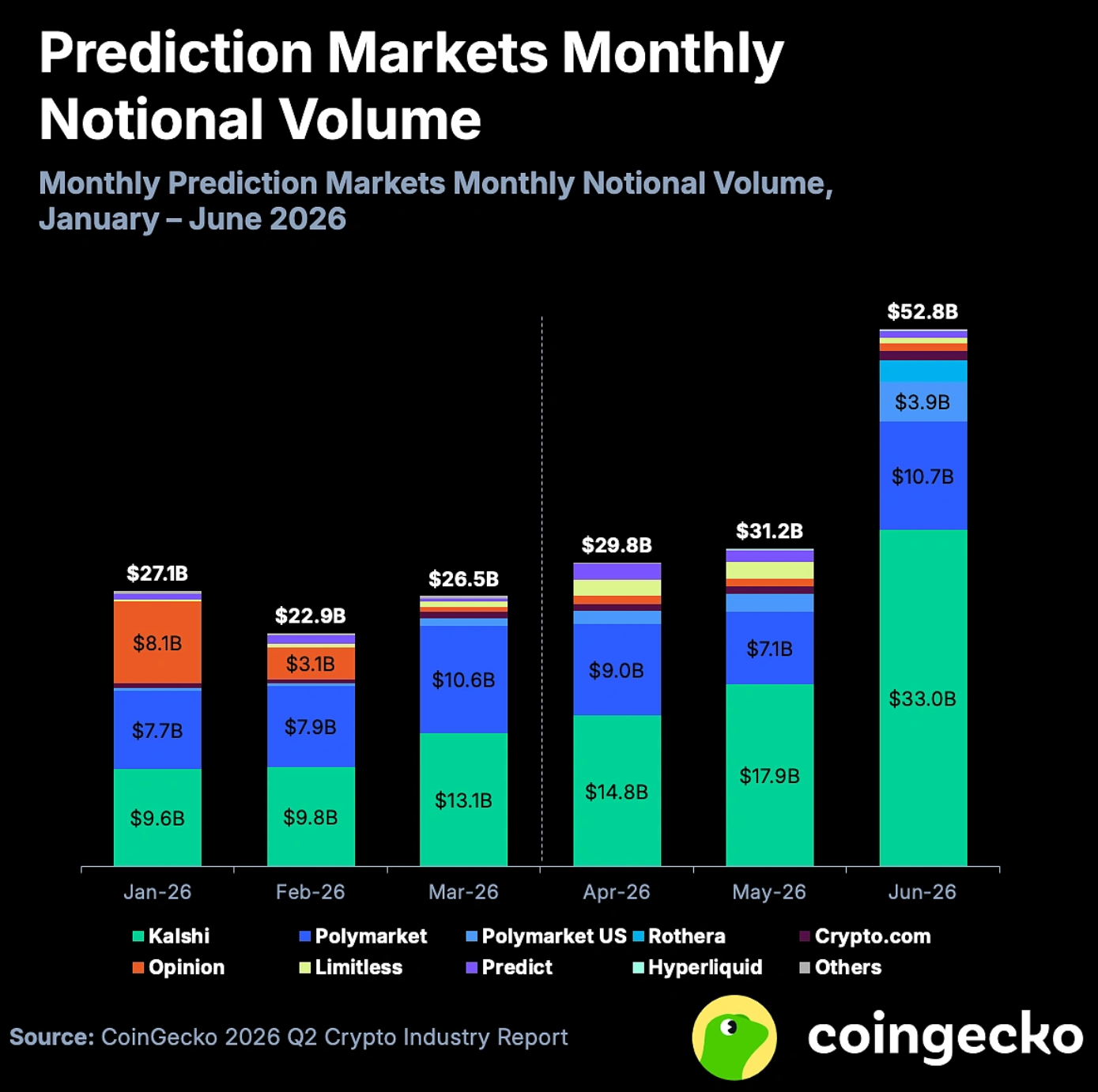
The Talos integration comes as prediction markets attract record trading activity and growing institutional interest. According to a report from CoinGecko, notional trading volume reached $113.8 billion in the second quarter, up 48.7% from the previous quarter, while June’s $52.8 billion in notional volume marked a new monthly record.
CoinGecko attributed the surge to a packed sports calendar, including the UEFA Champions League final, NBA Finals, Stanley Cup, FIFA World Cup and Wimbledon. On Polymarket, sports contracts accounted for 81% of June trading volume, up from 40% in January.
Kalshi expanded its lead among prediction market platforms, increasing its market share to 58.9% from 42.4% in the first quarter. Polymarket’s share fell to 30.2% from 35.8%, while Rothera, the Robinhood and Susquehanna International Group-backed venture launched in May, climbed to fourth place in June with $2.1 billion in notional trading volume.
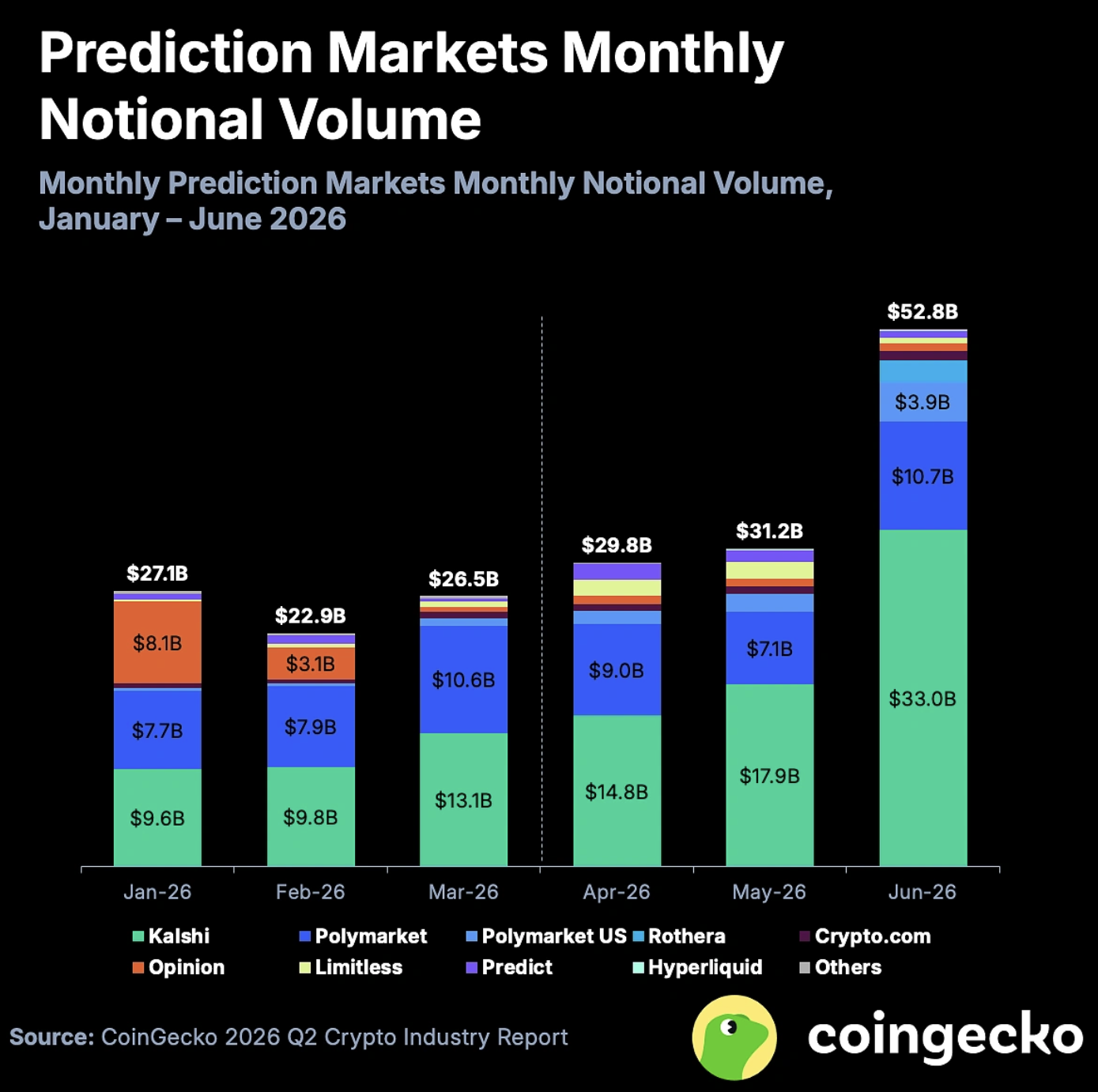
Prediction markets monthly notional volume. Source: CoinGecko
Despite the rapid growth, prediction markets continue to face legal and regulatory headwinds. In the United States, Kalshi is battling several state regulators over whether its sports event contracts constitute illegal gambling, a dispute many legal observers believe could ultimately reach the US Supreme Court.
The industry is also facing growing scrutiny over potential insider trading. Earlier this year, six Polymarket traders reportedly made about $1 million by correctly betting on US military strikes against Iran before the attacks became public.
Last week, a White House teleprompter operator was placed on unpaid leave after allegedly making more than $100,000 betting on Kalshi markets tied to President Donald Trump’s speeches.
Magazine: Binance & OKX users face $1,900 fines in Vietnam, Coinbase in China? Asia Express



Payments-focused cryptocurrency XRP’s price has risen over 8% in five weeks and during this time, there has been a notable divergence in accumulation trends of large holders or whales and small holders.
According to on-chain data from Santiment, wallets holding between 100,000 and 100 million XRP added 2.8% more coins to their balances over the past five weeks. This accumulation by whales and sharks coincided with the token rebounding to $1.16 from $1 at the end of June, suggesting stronger hands are leaning into the current price action.
At the same time, the smallest wallets have shed 5.2% of their holdings during the same period. This capitulation by small holders stands in sharp contrast to the buying pressure from key stakeholders.
These diverging trends are bullish for XRP, according to Santiment.
“Historically, XRP price has tended to move more with key stakeholders and against the smallest retail wallets, so this split supports the bullish case behind the bounce,” the firm noted on X.
The timing aligns with several positive fundamental developments for XRP such as Improved institutional access through potential ETF products and continued utility on the XRP Ledger for payments, tokenization, and the RLUSD stablecoin, the firm explained,
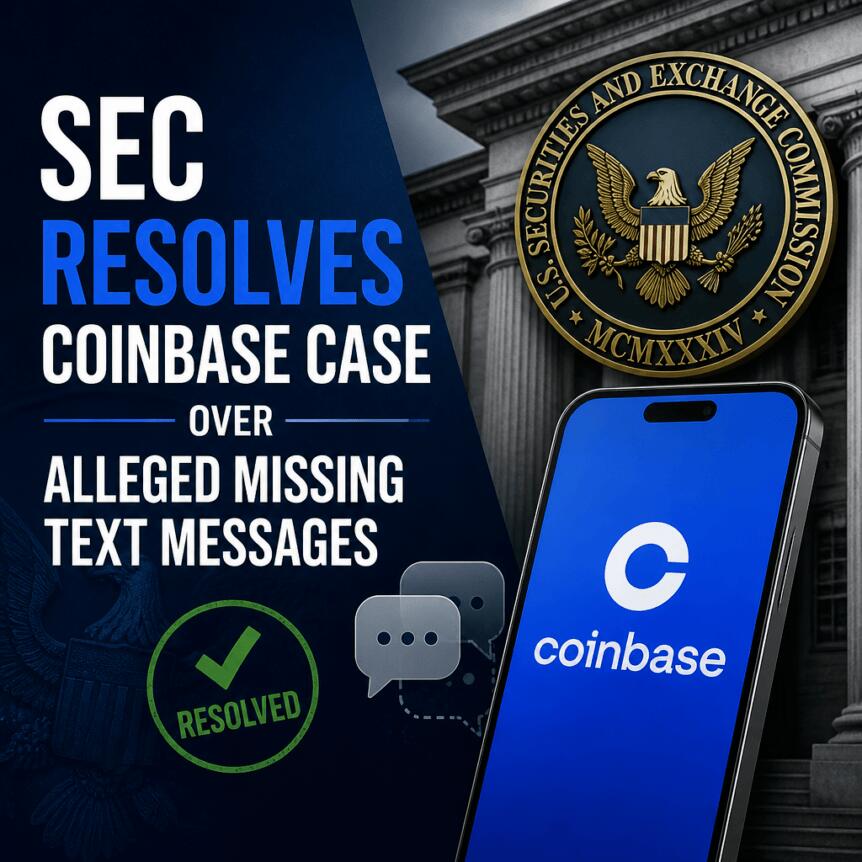
The U.S. Securities and Exchange Commission has agreed to pay $150,000 in legal fees to settle a dispute with Coinbase over the regulator’s internal records. The settlement ends a lawsuit that Coinbase filed two years ago seeking access to SEC materials related to what it described as an enforcement-led approach to crypto regulation.
According to a filing made Wednesday in the case docketed at CourtListener, the SEC will also compensate Coinbase with the fee award while stating it has addressed its record-retention practices. Coinbase’s legal chief, Paul Grewal, framed the settlement as part of a broader accountability effort over document retention inside the agency.
Key takeaways
- The SEC will pay Coinbase $150,000 to resolve the records-access lawsuit.
- The case centered on Coinbase’s request for internal SEC documents during the period of heightened crypto enforcement.
- Coinbase says the dispute helped uncover material it views as evidence of an enforcement strategy.
- Coinbase’s top legal executive announced a leadership transition to take effect on July 31.
- The settlement is also presented as reflecting a shift toward a more crypto-friendly enforcement posture at the SEC.
What the SEC–Coinbase settlement covers
The dispute arose after Coinbase sought internal agency documents from the SEC, alleging that the regulator’s recordkeeping did not provide the transparency Coinbase believed it was due. The complaint targeted access to materials that Coinbase argued were important for understanding the SEC’s approach at the time.
In coverage of the settlement, Coinbase leadership pointed to what it said were documentation and retention problems. Coinbase chief legal officer Paul Grewal wrote in a Wall Street Journal op-ed published Wednesday that the SEC—responsible for policing corporate recordkeeping—had effectively lost significant portions of its own communications during what Coinbase characterized as the SEC’s most intense period of anti-crypto activity.
Grewal also stated that the SEC has fixed its record retention policies as part of the resolution. The settlement agreement, as reflected in the docket, brings the two-year legal fight to a close.
Record retention controversy and the 2025 internal report
A central element in Coinbase’s argument was not only the availability of records, but the adequacy of the SEC’s retention of its own correspondence. The article’s account references an internal report released in 2025 indicating that the SEC deleted nearly a year of former Chair Gary Gensler texts due to “avoidable” errors.
Coinbase’s position is that such losses matter because they could prevent outside parties from obtaining a complete picture of how enforcement-related decisions were discussed inside the agency. Grewal’s op-ed also emphasized that message deletions occurred during the most aggressive phase of the SEC’s crackdown on crypto.
As part of the settlement, the SEC will pay the $150,000 fee award and has reportedly updated its record retention practices, addressing one of the core practical concerns that drove the lawsuit.
A legal win for Coinbase amid a changing SEC
Coinbase has portrayed this outcome as another favorable development in its litigation strategy. The settlement comes as the SEC’s leadership and approach to crypto enforcement have shifted.
The article notes that the settlement occurred under the Trump administration, characterizing it as a “legal victory” within a wider transition in how the SEC pursues crypto cases. It further states that under the SEC’s leadership—identified in the article as Paul Atkins—the agency has dropped multiple high-profile enforcement actions against crypto companies, including Coinbase, during 2025.
While the settlement resolves this particular records case, the broader implication for industry watchers is that disputes over enforcement process and documentation remain a recurring theme. Even as enforcement posture changes, Coinbase’s case underscores how document access, retention policies, and internal compliance practices can become legally consequential.
Grewal steps back from Coinbase’s legal role
Coinbase’s legal leadership is also in transition. According to the article, Paul Grewal, who has served as chief legal officer since 2020, is set to transition into an advisory role starting July 31.
The article says Coinbase will elevate two executives into expanded leadership roles: Molly Abraham will become general counsel, and Ryan VanGrack will move into the position of vice chair.
For observers, the timing matters because legal strategy has been central to Coinbase’s relationship with regulators. Leadership continuity—via internal promotions—suggests the company plans to maintain institutional knowledge as it navigates the ongoing evolution of U.S. crypto oversight.
As the settlement takes effect, the next question for market participants is how the SEC’s updated retention practices will function in practice and whether similar records disputes emerge elsewhere—especially as enforcement priorities continue to evolve under the current SEC leadership.


Pump.fun said Wednesday it added support for trading tokens tied to Robinhood's blockchain, a move that comes as a memecoin modeled on the brokerage's old mascot has posted quadruple-digit percentage gains on the week-old network. "Robinhood tokens are now available to trade on the Pumpfun app!"… Read the full story at The Defiant


Crypto exchange AscendEX ceased operations effective July 1, 2026, and moved all withdrawal requests to manual review starting July 6, according to a notice posted on its website addressed to retail account holders. The exchange cited the European Union's Markets in Crypto-Assets Regulation (MiCA),… Read the full story at The Defiant


Bitwise Chief Investment Officer Matt Hougan named 2 crypto bets he views as well-positioned for the next bull market. He pointed to revenue-generating crypto apps and established firms building on blockchain rails.
Hougan tied both bets to what he calls the convergence of onchain and traditional finance. He stated that stablecoins, tokenization, and around-the-clock trading will lead the cycle.
Bitwise’s CIO Names Best Positioned Investments for the Next Crypto Bull Market
The first lane covers crypto applications with real revenue and tokenomics that tie token value to usage. Hougan cited Hyperliquid (HYPE) as the model.
Hyperliquid runs a Layer 1 blockchain and hosts a perpetual futures trading platform. The platform is on track to generate close to $800 million in annual revenue this year. It directs almost all of that into buying back HYPE.
Notably, this model has worked out well for the altcoin. Hougan stressed that HYPE has climbed about 146% this year despite the broader crypto downturn, citing real platform growth as the driver.
“I think the token could double in price and still be fairly valued,” he said. “Over time, I believe a new wave of crypto assets will copy HYPE’s tokenomics and introduce exciting ‘next-gen’ token opportunities.”
The executive also named Uniswap (UNI), Aave (AAVE), and Morpho (MORPHO) as existing protocols moving toward tying token value to usage.
Follow us on X to get the latest news as it happens
The TradFi Side of the Bet
The second lane covers established companies running crypto at scale rather than small pilots. Hougan pointed to Robinhood as the clearest example.
Robinhood launched its own blockchain on July 1. BeInCrypto reported that the chain has seen notable growth and ranks among the top 5 days by DEX volume.
“Robinhood is learning 10,000x more from a live chain in 120 countries than any pilot could teach it,” Hougan noted.
However, he conceded that much of the early activity on Robinhood’s chain involves meme coins rather than tokenized stocks. The executive expects stock volume and users to scale over time
Hougan also flagged Coinbase, Figure, and BlackRock as firms with real exposure. He added Visa, Stripe, and JPMorgan to the watchlist.
The Bitwise CIO affirmed that he stays bullish on Bitcoin (BTC), Ethereum (ETH), and Solana (SOL) as the broad base for any rally.
Subscribe to our YouTube channel to watch leaders and journalists provide expert insights
The post Bitwise CIO Names 2 Crypto Bets Best Positioned for the Next Bull Market appeared first on BeInCrypto.


Kraken parent Payward has partnered with fintech infrastructure provider GTN to expand its xStocks tokenized equity platform beyond U.S.-listed stocks and exchange-traded funds.
Summary
- Payward and GTN will take xStocks beyond U.S. equities, starting with Hong Kong-listed shares globally.
- GTN will provide execution, custody and record-keeping infrastructure across more than 90 international financial markets.
- xStocks has grown past 500 tokenized assets and $37 billion in transaction volume since launch.
The companies will start with equities listed in Hong Kong before targeting the UK, Europe, South Korea and other markets. The expansion will depend on local regulatory approvals and licences, according to a July 22 announcement from Payward. The partnership could also bring other asset classes to xStocks over time.
GTN will provide the traditional market infrastructure that supports the next phase of xStocks. Its services include execution, custody, ledgering and record-keeping across more than 90 markets. Payward will continue to provide the tokenization framework that creates blockchain-based versions of the underlying assets.
The companies chose Hong Kong as the first market for the international expansion. They plan to add UK-listed shares, European securities and South Korean assets later. GTN also plans to offer xStocks to institutional clients once it secures the required licences in each market.
Mark Greenberg, Global Head of Payward Services, said traditional capital markets still separate investors by geography, currencies and trading hours.
“For decades, we’ve accepted that capital markets should be fragmented by country, currency, and market hours,” Greenberg said. “The biggest asset class that hasn’t been tokenized yet is the rest of the world, and our partnership with GTN is about changing that.”
GTN brings infrastructure across more than 90 markets
GTN will connect xStocks with its global execution and custody network through one infrastructure layer. The arrangement gives Payward a route into international markets without building separate traditional finance systems for every country.
Ankit Shah, Global Head of FinTech at GTN, said financial firms want access to new markets without rebuilding their technology for each expansion. He said GTN’s infrastructure can support Payward across more than 90 markets while providing the sub-accounting systems needed for tokenized products.
The companies said the partnership has already started, although GTN must secure regulatory approvals before distributing xStocks to its institutional clients. Payward also said the expanded assets could become available across more than 100 exchanges, wallets and decentralized finance applications that already support the xStocks ecosystem.
The international expansion comes as tokenized equities continue attracting more trading activity. As crypto.news reported, tokenized stock transfer volume reached $8.41 billion during a recent monthly period, while distributed value climbed to about $2.16 billion. xStocks ranked among the largest platforms in the sector at the time.
Payward expands xStocks beyond basic stock exposure
Payward says xStocks now includes more than 500 tokenized assets spanning equities, ETFs and IPO-related products. The company reports more than $37 billion in total transaction volume and nearly 200,000 holders worldwide. Each xStock uses underlying securities to maintain 1:1 backing.
The platform has also added more uses for tokenized equities during 2026. As previously reported, Kraken began allowing eligible clients to use selected xStocks as collateral for futures and margin positions. The change lets qualifying traders maintain exposure to tokenized stocks while using the assets to support other positions.
Payward has also moved xStocks into IPO access. Crypto.news reported in June that eligible Kraken users and xStocks Alliance members could register interest in U.S.-listed IPO allocations and receive tokenized shares after listing.
The company expanded its control over the technology behind xStocks after agreeing to acquire Backed Finance in December 2025. Payward completed the acquisition in January 2026, according to its first-quarter financial update.
Tokenized equity competition continues to grow
Payward’s international push comes as more crypto companies and traditional market firms compete in tokenized equities. Ondo, Robinhood, Coinbase, Backpack and other platforms have expanded their own products, while exchanges and clearing firms are also testing blockchain-based securities infrastructure.
As crypto.news recently reported, competition now includes different models for moving public shares onchain. Some products offer tokens backed by securities held with custodians, while other projects aim to issue or record the securities themselves through regulated blockchain systems.
Regulatory questions remain part of that expansion. A separate crypto.news report said U.S. securities transfer groups had asked the Securities and Exchange Commission to draw clearer distinctions between issuer-backed tokenized securities and products created by third parties.
Payward and GTN will now focus on securing the approvals needed to expand xStocks into additional markets. Hong Kong will serve as the first planned step, followed by other major financial regions. The partnership also gives Payward infrastructure that could support tokenized assets beyond equities as the platform expands its international product range.
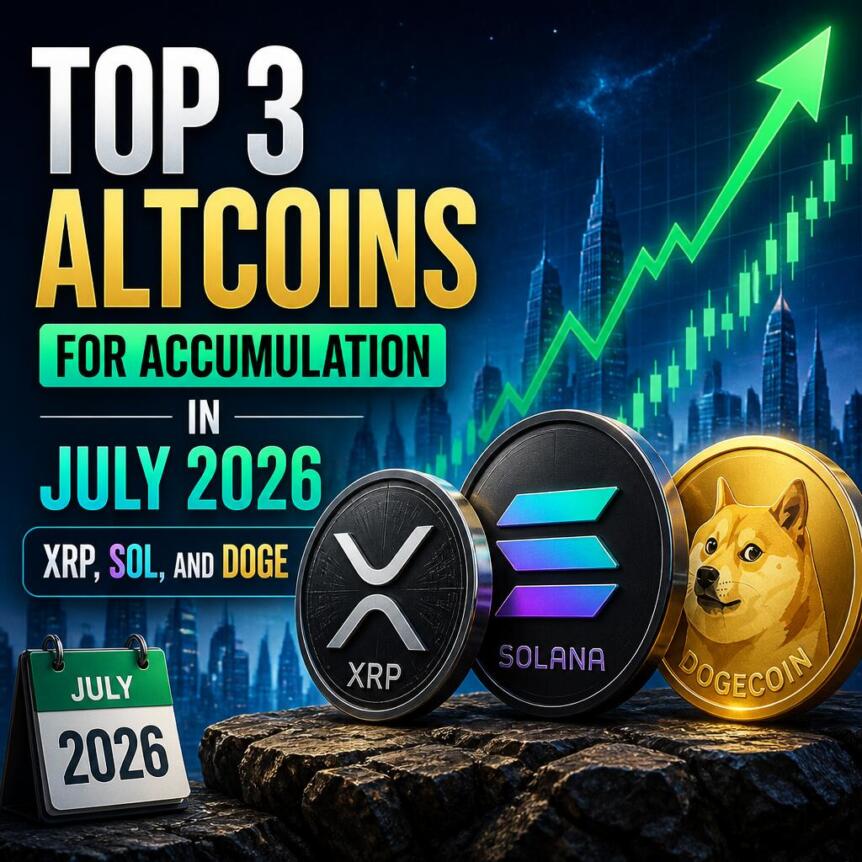
Learn the top 3 altcoins that one should accumulate in July 2026. Get to know how XRP, Solana (SOL), and Dogecoin (DOGE) stand out because of their institutional adoption, updates, and growth prospects.
Key Insights
- XRP is still reaping the benefits of increased institutional adoption, regulatory support, and ETF options.
- The Alpenglow update on Solana will increase the speed and efficiency of the network.
- Dogecoin will be sustained by its huge community, ETF expectations, and integration with X Payments.
- Market correction periods will offer excellent accumulation chances for long-term investors.
XRP: Institutional Interest Keeps Powering Up the Altcoin
XRP is still one of the dominant cryptocurrencies centered around cross-border payments and financial settlements. Ripple continues adding new banks, payment service providers, and financial firms to the list of its partners in several geographic locations, which keeps supporting XRP’s presence in the global payments space.
The regulatory picture has improved drastically. The SEC’s decision not to press its appeal was one of the biggest risks hanging above XRP. After that point, investor sentiment became much more positive because some XRP exchange-traded funds (ETFs) have been approved in several foreign countries.
Institutional interest has kept growing, but not only through ETFs. The Central Bank of Singapore has tested the technology of financial settlement on the XRP Ledger, which shows increased confidence in blockchain-based payments infrastructure. All of these factors make XRP an interesting long-term investment because they add utility to the cryptocurrency rather than just speculation. Technically speaking, XRP stays close to significant exponential moving averages.
Solana (SOL): Alpenglow Upgrade Can Boost Network Development
The Solana platform has been proving itself to be a serious competitor to Ethereum with higher transaction speeds and reduced fees. The platform remains active in attracting various developers to create DeFi protocols, games, NFTs, and other consumer applications.
The largest driver of Solana network development can be seen in an upgrade known as Alpenglow, created by Anza, the Solana Labs spinoff. This consensus protocol upgrade will replace Proof of History and Tower BFT with two new solutions called Votor and Rotor.
In particular, Votor should finalize all transactions within 100–150 milliseconds, while Rotor will boost transmission of data across the network of validators. These innovations may positively affect network performance, scalability, and other parameters.
With more decentralized apps launched on the Solana network, there could appear additional activity that can lead to increasing demand for SOL tokens. Solana remains among the most watched and promising blockchain projects for 2026.
Dogecoin (DOGE): Community Strength And Emerging Catalysts
Dogecoin is still the biggest and best-known meme cryptocurrency in terms of market presence and community activity. Despite being created as a joke, DOGE has remained relevant for many cycles and still attracts attention from retail investors.
The recent macroeconomic environment has helped Dogecoin trade in a range amid market volatility. Market participants keep monitoring important levels and trying to understand what the next step will be.
There are also several catalysts that support a long-term positive outlook on DOGE. Investors expect the creation of ETF products related to Dogecoin, and speculation about integrating X Payments has raised the possibility of using Dogecoin as a daily payment method.
Together with one of the largest communities in the whole crypto industry, these factors help Dogecoin remain relevant from a long-term perspective.
Why Are These Altcoins Special This July
There is a unique investing story behind each of these cryptocurrencies. XRP benefits from growing adoption by institutions and improving regulation. Solana keeps developing with big technology updates and increased developer participation. The uniqueness of Dogecoin comes from a combination of its great community along with new factors like payments and ETF.
Despite volatility in cryptocurrency trading, people tend to use such moments to acquire assets with good fundamentals. Those who want exposure to different parts of the crypto space, such as payments, smart contracts, and community-based tokens, can focus on XRP, SOL, and DOGE as altcoins to watch this July.


The U.S. cryptocurrency industry directly employs about 34,000 people and supports an estimated 232,000 jobs across the broader economy, according to a new report commissioned by the National Cryptocurrency Association.
Summary
- NCA estimates U.S. crypto directly employs 34,000 people while supporting 232,000 jobs economywide in 2026.
- The report projects crypto will contribute $55 billion to U.S. GDP and $31 billion income.
- California and New York lead supported employment, while engineering remains crypto’s largest direct occupational group.
The study also estimates that crypto-related activity will contribute more than $55 billion to U.S. gross domestic product in 2026.
Pragmatic Policy Group conducted the analysis for the NCA, which funded the research. The report separates direct jobs at crypto companies from jobs supported through suppliers and worker spending. It estimates that about $31 billion of the industry’s total economic contribution flows to workers as income.
The report places direct employment at crypto companies at 34,000 full-time equivalent jobs in 2026. Software, blockchain and data engineering form the largest direct job group, with about 10,100 roles. Compliance, finance and business operations account for another 5,450 positions, while executives and managers make up about 5,100.
The study compares the direct crypto workforce with several traditional industries. It lists 28,400 jobs in coffee and tea manufacturing, 15,300 in cement manufacturing and 10,600 in tobacco manufacturing. Most benchmark figures come from 2024 Bureau of Labor Statistics data, while the crypto estimate covers 2026. The report also puts the average annual wage across all supported jobs at $133,000, versus a $64,000 national median.
Within direct employment, the study also counts 2,470 sales and business development roles, 1,480 hardware and systems engineering jobs, and 1,160 legal and regulatory positions across the industry.
Most supported jobs sit outside crypto companies
The 232,000 total includes 75,000 jobs in supplier industries and another 123,000 jobs linked to worker spending. The report says every direct crypto job supports about six other jobs across the broader U.S. economy. These roles can include workers in cloud services, legal services, insurance, housing, transportation and restaurants.
The total therefore does not represent 232,000 people employed by crypto businesses. The report’s appendix says the figure reflects standard economic multiplier effects. It also estimates that crypto will contribute more than $55 billion to U.S. GDP in 2026, including about $31 billion in worker income. Securities, commodity contracts and investments form the largest sector in the model.
In addition, California accounts for an estimated 57,649 supported jobs, while New York accounts for 53,766. Together, the two states represent close to half of the national total. Texas follows with 26,536 jobs, while Washington has 15,097 and North Carolina has 9,524.
The report also estimates that the 12 states it defines as the Heartland support more than 17,000 jobs combined. Colorado accounts for about 5,797 supported jobs and $1.3 billion in economic contribution. These state figures include direct crypto employment, supplier jobs and positions supported through household spending rather than only payroll headcounts at blockchain companies.
Report lands amid mixed crypto hiring trends
The NCA released the study while employment trends inside individual crypto companies remain mixed. As crypto.news reported in March, Gemini, Crypto.com and Algorand were among several firms that announced workforce cuts in early 2026. More recently, Exodus cut about 25% of its workforce as it reorganized around stablecoin payments, while Polygon Labs also reduced staff during its Coinme integration.
Those company-level cuts do not directly contradict the NCA estimate because the study measures a broader economic footprint and relies on modeling rather than a live industry headcount. The model uses 2024 Bureau of Economic Analysis input-output tables, Bureau of Labor Statistics data and a $23.22 billion U.S. crypto industry revenue estimate sourced from Statista.
Because the Bureau of Economic Analysis does not classify crypto as a standalone industry, Pragmatic Policy Group mapped crypto businesses into existing sectors. The report says it allocated most financial-related crypto revenue to securities and commodity contracts, with a smaller share assigned to data processing and internet publishing. The model also assumes that 2024 production relationships remain in place.
The NCA funded the research, while Pragmatic Policy Group described the work as independent analysis. NCA President and Ripple Chief Legal Officer Stuart Alderoty called the sector a “real, positive” contributor to American jobs, wages and economic growth. As crypto.news previously reported, a separate NCA survey estimated that more than 67 million U.S. adults now own crypto.
The report gives two different measures of the industry’s labor reach. The direct figure stands at 34,000 jobs. The broader 232,000 estimate adds supplier employment and jobs supported by worker spending across the economy.

Introduction
Crypto incentives have been one of the biggest drivers behind blockchain adoption. From the earliest days of Bitcoin mining to today’s sophisticated decentralized finance (DeFi) ecosystems, incentive models have continuously evolved to attract users, secure networks, and fuel innovation.
However, the industry has learned an important lesson: rewarding participation is easy, but creating long-term value is much harder. As the crypto ecosystem matures, projects are shifting away from unsustainable token emissions and toward incentive mechanisms that prioritize real utility, community engagement, and economic sustainability.
The First Generation: Mining Rewards
The earliest crypto incentives came through Proof-of-Work (PoW) mining.
Bitcoin introduced a revolutionary concept where participants received newly minted BTC for validating transactions and securing the network. This aligned economic incentives with network security and decentralized participation.
The model proved successful because miners were rewarded with an asset that appreciated alongside network adoption.
Advantages included:
- Strong network security
- Open participation
- Predictable issuance schedule
- Transparent monetary policy
However, mining eventually became capital intensive, requiring specialized hardware and significant energy consumption.
The Rise of Staking
To improve efficiency, many blockchain networks adopted Proof-of-Stake (PoS).
Instead of purchasing expensive mining equipment, users could stake tokens to help validate transactions and earn rewards.
This dramatically lowered participation barriers while reducing energy consumption.
Projects such as Ethereum’s transition to PoS demonstrated how staking could become a core incentive mechanism for securing blockchain infrastructure.
Staking also introduced new concepts:
- Validator rewards
- Delegated staking
- Liquid staking
- Restaking ecosystems
Although effective, staking incentives often relied heavily on token inflation.
The DeFi Liquidity Mining Boom
The summer of 2020 marked the explosion of liquidity mining.
Protocols rewarded users for supplying assets into decentralized exchanges, lending markets, and liquidity pools.
The strategy rapidly attracted billions of dollars in Total Value Locked (TVL).
Popular incentives included:
- Governance token distributions
- Yield farming
- Bonus multipliers
- Referral rewards
While this accelerated adoption, many protocols experienced short-lived growth.
Users frequently chased the highest Annual Percentage Yield (APY), moving liquidity from one protocol to another once rewards declined.
This phenomenon became known as mercenary capital.
Play-to-Earn and Learn-to-Earn
Crypto incentives soon expanded beyond finance.
Projects introduced new economic models including:
- Play-to-Earn (P2E)
- Learn-to-Earn
- Move-to-Earn
- Create-to-Earn
- Social-to-Earn
These systems rewarded users for contributing time, knowledge, creativity, or physical activity.
Although many early projects struggled with inflationary reward systems, they proved that blockchain incentives could extend far beyond trading and investing.
Why Inflation Alone Doesn’t Work
One of the industry’s biggest discoveries has been that simply printing more tokens cannot sustain an ecosystem forever.
If rewards exceed genuine demand, several problems emerge:
- Declining token prices
- Selling pressure
- Unsustainable emissions
- Reduced treasury reserves
- User churn
Eventually, incentives lose effectiveness because participants join primarily to extract value rather than contribute to long-term growth.
This has encouraged projects to rethink tokenomics from the ground up.
The Shift Toward Revenue-Based Incentives
Modern protocols increasingly tie rewards to real economic activity instead of inflation.
Examples include:
- Trading fee sharing
- Lending revenue distribution
- Protocol buybacks
- Real yield
- Tokenized business income
- On-chain subscription models
Instead of relying solely on newly issued tokens, participants earn rewards generated by actual protocol usage.
This creates stronger alignment between users and the platform’s success.
Incentives Powered by Utility
Today’s strongest crypto ecosystems increasingly reward meaningful participation rather than passive speculation.
Users may earn incentives by:
- Providing liquidity
- Creating educational content
- Developing applications
- Running infrastructure
- Participating in governance
- Contributing code
- Referring active users
- Improving protocol security
These contributions directly strengthen network effects while building healthier communities.
AI Is Creating Smarter Incentive Systems
Artificial intelligence is beginning to reshape crypto incentive design.
AI-powered systems can evaluate:
- Content quality
- Community engagement
- Sybil resistance
- User reputation
- On-chain behavior
- Contribution consistency
Instead of rewarding simple activity counts, future protocols can allocate incentives based on measurable value creation.
This reduces abuse while improving fairness across ecosystems.
Reputation Will Become a Valuable Asset
Many Web3 ecosystems are moving toward reputation-based incentives.
Future users may build portable on-chain identities that reflect:
- Governance participation
- Development contributions
- Educational achievements
- Security audits
- Community leadership
- Historical reliability
High-reputation participants could receive better staking opportunities, governance influence, lower borrowing costs, and exclusive ecosystem benefits.
Cross-Chain Incentives
As blockchain interoperability improves, incentives are becoming ecosystem-wide rather than chain-specific.
Users may soon earn rewards that span:
- Multiple Layer 1 networks
- Layer 2 ecosystems
- Cross-chain liquidity
- Omnichain applications
- Shared security networks
Rather than competing for isolated liquidity, protocols increasingly collaborate to grow interconnected ecosystems.
The Future: Incentives That Reward Value Creation
The next generation of crypto incentives will likely focus on sustainability instead of short-term growth.
Future models may combine:
- Real revenue sharing
- Reputation systems
- AI-assisted contribution scoring
- Dynamic reward allocation
- Governance participation
- Tokenized ownership
- Long-term ecosystem alignment
Projects that reward genuine value creation rather than speculative behavior are more likely to build resilient communities and sustainable economies.
Conclusion
The evolution of crypto incentives reflects the industry’s growing maturity. What began with mining rewards and token emissions has expanded into sophisticated systems that recognize liquidity provision, governance, education, infrastructure, creativity, and real economic contribution.
As blockchain technology continues to evolve, the most successful ecosystems will not be those offering the highest temporary yields, but those that create lasting value for participants. Sustainable incentives, real utility, and aligned economic interests are shaping the next chapter of Web3—one where rewards are earned through meaningful participation and shared growth rather than inflation alone.
REQUEST AN ARTICLE
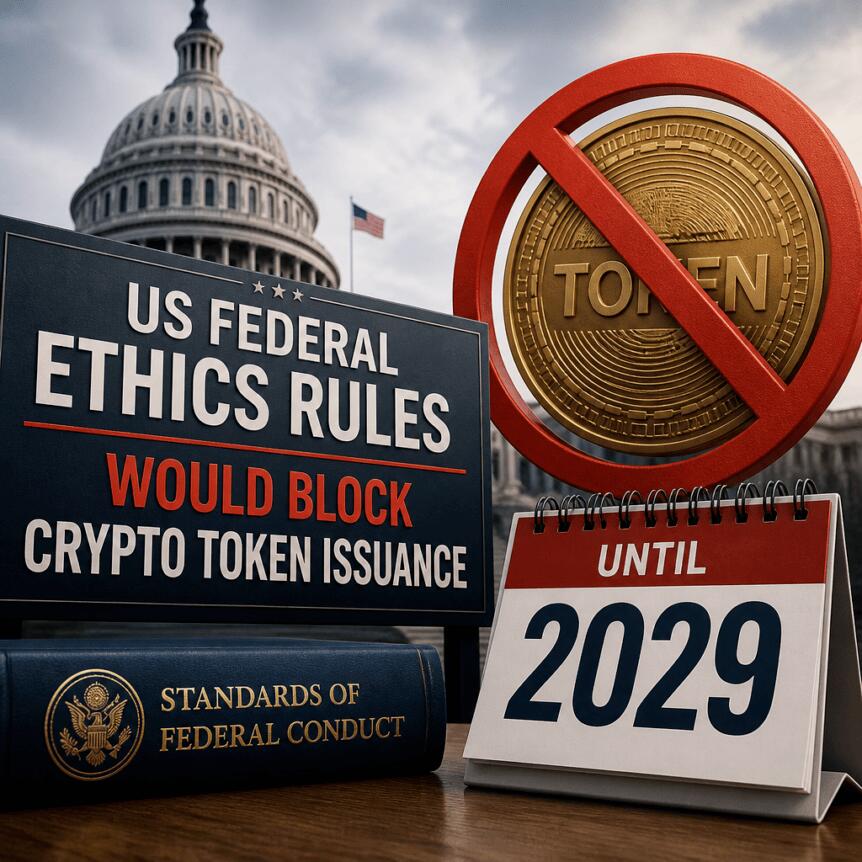
Senate Republicans have published the full text of the proposed Digital Asset Market Clarity (CLARITY) Act, a 616-page bill that pairs market-structure provisions with a sweeping ethics package aimed at conflicts involving public officials and the digital-asset ecosystem.
In the draft released Wednesday, the ethics language would bar U.S. federal officials—and their spouses—from issuing or sponsoring digital assets and would also prevent crypto platforms from listing assets that are issued or sponsored by those officials. The restriction is framed as temporary, set to expire on Jan. 20, 2029.
Key takeaways
- The CLARITY Act draft includes an ethics ban covering federal officials (and their spouses) who would be prohibited from issuing or sponsoring digital assets.
- The draft also extends the restriction to crypto platforms, blocking listings of assets issued or sponsored by covered federal officials.
- Senator Cynthia Lummis says the ethics provisions are intended to apply to President Donald Trump and would be enforced largely by the U.S. Department of Justice.
- Democratic support remains uncertain: multiple Democrats have indicated they will not vote for the bill without strong ethics language tied to alleged “crypto corruption.”
- The bill still needs to clear a 60-vote threshold in the Senate, and it is not yet clear the chamber has enough votes before it recesses.
What the CLARITY ethics provisions would do
The ethics section in the CLARITY Act draft is described by the White House as “the most comprehensive and wide-ranging ethics provision in history.” According to the bill text released by Senate Republicans, the ban would apply to all public officials and employees, as well as their spouses. Covered individuals would be prohibited from “issuing or sponsoring” digital assets.
The draft goes further by attempting to control downstream market behavior: crypto platforms would be blocked from listing assets that are “issued or sponsored” by federal officials within the scope of the restriction.
Senator Cynthia Lummis, a leading advocate for the measure, said the provisions are meant to apply to President Trump as well. In explaining the intent behind the language, Lummis pointed to enforcement and penalties and referenced the president’s financial situation as lawmakers continue to scrutinize his crypto involvement.
Lummis also tied the ethics package to a timeline: the ban on public officials would be temporary and would end on Jan. 20, 2029.
Enforcement hinges on the Justice Department
Rather than relying primarily on state authorities, the draft assigns significant enforcement responsibility to the U.S. Attorney General and the Department of Justice.
As of the day the text was published, Todd Blanche—Trump’s former personal attorney and acting Attorney General—was reportedly awaiting Senate confirmation to lead the Justice Department permanently. That matters because, under the CLARITY draft, DOJ would play a central role in making the ethics restrictions operational.
The enforcement design is also part of the political debate over whether Democrats will support the bill. Senator Angela Alsobrooks, in remarks reported by Politico, indicated she would want agreement on the bill’s enforcement architecture. She told Politico that she “wouldn’t support the bill” if DOJ enforcement language were as proposed, but said negotiations could still bring a version that “holds us all accountable.”
Democratic math: ethics language may determine the vote
Even if Senate Republicans move quickly, passage is not guaranteed. The CLARITY Act requires at least 60 votes in the Senate to advance, meaning it likely needs backing from some Democrats to meet the threshold. The bill would then return to the House of Representatives and, if approved, would go to President Trump for signature.
Democrats have already telegraphed conditional support. Multiple Democrats have said they will not vote for any version of a crypto bill unless it includes strong ethics language aimed at the conflict-of-interest concerns raised around the president.
There is also a potential flashpoint in how the draft defines the scope of the restrictions. The ethics ban, as described in coverage of the bill text, did not appear to include children of public officials in its temporary ban. That omission becomes salient given public reporting that members of Trump’s family are involved in crypto-related businesses, including World Liberty Financial and a Bitcoin mining company.
Lummis defended the approach as applying “one ethics standard to everyone,” saying the bill “backs it up with real enforcement, real penalties, and a Department of Justice mandate to act.”
Beyond ethics: disclosure, illicit finance provisions, and market structure
The CLARITY Act is not solely an ethics measure. One analyst reaction quoted in coverage emphasized that the Senate draft adds multiple components beyond conflict-of-interest rules, including a disclosure regime, an illicit finance section, and improved regulation for spot markets.
Kirstin Smith, president of the Solana Policy Institute, said the Senate has a “real chance” to pass durable, bipartisan market-structure legislation—framing CLARITY as a broader attempt at statutory clarity rather than a single-issue bill.
That distinction may be important for investors and builders watching the policy process: market structure rules can affect how digital assets are categorized, how exchanges and intermediaries comply with U.S. requirements, and how enforcement priorities are expected to shift under a new framework.
What happens next
With Senate Majority Leader John Thune reportedly planning to bring CLARITY to the floor next week, the central question for lawmakers—and for the industry—is whether the ethics provisions can attract enough Democratic support to reach the 60-vote threshold. The bill’s success may ultimately come down to whether negotiations around DOJ enforcement and the ethics scope leave enough lawmakers satisfied to back the measure before the Senate’s window to vote narrows.

Check Out This Nifty 3D Playdate Game Demo

The Devil’s Door | Journalists Uncover an Ancient Evil Beneath the Border | Full HD Horror Movie

Owning my own four-bedroom cottage is a man repellent. I can’t believe my dates’ irritated and jealous reactions – and my friends are experiencing the same pettiness: KATIE GLASS


-
 NewsBeat7 days ago
London Mayor Sadiq Khan handed a peerage by Keir Starmer alongside 15 other Labour figures… just days before the PM leaves No10
-

 Fashion5 days ago
Weekend Open Thread – Corporette.com
-

 Politics5 days ago
The House | The City of London can help the new chancellor deliver growth in every postcode
-

 Crypto World5 days ago
Ripple Payments Joins MiCA With 14 Firms, Does It Mean Anything For XRP?
-
 Crypto World6 days ago
Two July Windows Left: The CLARITY Act’s Senate Fight and What Failure Means
-

 Politics4 days ago
Democrats look to World Cup watch parties to register thousands of voters
-

 Crypto World5 days ago
Ripple wins EU-wide access as ESMA adds it to MiCA register
-

 Crypto World2 days ago
Grayscale Files For Worldcoin ETF, WLD Registers Sharp Rise
-

 NewsBeat3 days ago
Unregistered fitter used Gas Safe logo on business flyers
-

 Tech2 days ago
Sail Virtually Aboard The “Itanic” With IA-64 Emulator
-

 Crypto World6 days ago
Injective Submits SEC Transfer-Agent Registration to Onchain Ownership Records
-
 Tech2 days ago
Turtle Beach Command Series KB7 review: a nifty screen-equipped gaming keyboard
-

 NewsBeat6 days ago
Registration is now open for March for Men with Kev 2026
-
 Business1 day ago
New Jersey voter registration controversy explained: How 6,600 noncitizens got on the rolls, and what happens next
-

 Crypto World6 days ago
Claude Fable 5 Slips to Second in AI Coding Leaderboard
-

 News Videos6 days ago
Money | Class 12 Economics | CBSE Board Exam 2026-27
-

 Business6 days ago
Banco Bilbao Vizcaya Argentaria, S.A. (BBVA) Discusses Global Macro Environment and Economic Outlook for Core Markets Transcript
-

 Crypto World5 days ago
Kaspersky exposes OkoBot’s 20-module crypto wallet attack
-

 News Videos3 days ago
Big Money Is Entering XRP
-

 NewsBeat5 days ago
Durham County Council to send out electoral registration emails
You must be logged in to post a comment Login