“More!?!” bellows the incredulous, pompous Mr Bumble, and a chase ensures through the dining room, Oliver running along the wooden trestle tables and scrabbling among the legs beneath them. “Catch him, snatch him, pick him up and bounce him…”
![]() Mr Bumble, the workhouse master, marches Oliver through the dining room after he asked for more
Mr Bumble, the workhouse master, marches Oliver through the dining room after he asked for more
It is a scene that could have played out in the dining room of the Ripon Workhouse Museum which reopened this week after a £2.8m redevelopment.
![]() Dining room, Ripon Workhouse Museum, by Sarah Caldecott
Dining room, Ripon Workhouse Museum, by Sarah Caldecott
With “God is Good” shouting down from the Ripon walls, there are wooden tables on the echoey flagstone floor, and separate doors through which the different classes of paupers entered – old male paupers, young male paupers, old women paupers, young women paupers.
![]() Ripon Workhouse Museum, by Sarah Caldecott
Ripon Workhouse Museum, by Sarah Caldecott
While they shuffled gratefully in from their doors on the side walls, in the middle of the longest wall is the most important door: the one with “master” and “matron” marked on it. You can imagine Harry Secombe regally entering through it, cane in hand, and looking down on the poor, the sick, the widowed, the orphaned, the elderly and the poverty-stricken on the tables before him.
![]() Dining room, Ripon Workhouse Museum, by Sarah Caldecott
Dining room, Ripon Workhouse Museum, by Sarah Caldecott
A plate in the museum’s display tells what an old woman (that’s over 60 years of age) would have tucked into: one pint of tea and four ounces of bread for breakfast; one pint of soup and six ounces of bread for dinner, and one pint of porridge and four ounces of bread for supper.
“We want people to go round and imagine what it would be like to live here,” said community curator Dr Laura Allan.
“The stories of the real people who lived through extraordinary hardship challenge us to think about fairness, dignity and opportunity, both in Victorian Britain and today,” said Alexa Vernon, director of Ripon Museums Trust. “This was the Victorian solution for poverty: you worked 10 hours a day for no pay and were separated from your family in the hope that you would prefer to live a fine upstanding life outside.
“This is one of the most complete surviving workhouses in the country, and it is not just a local story: there were workhouses up and down the country.”
![]() The gatehouse, Ripon Workhouse Museum, by Sarah Caldecott
The gatehouse, Ripon Workhouse Museum, by Sarah Caldecott
From the late 16th Century, parishes were given the responsibility of looking after the poor, and Ripon’s first workhouse was built on the Allhallowgate site in 1776, with room for 30 people.
In 1834, the New Poor Law encouraged parishes to band together to create “union workhouses”, but Ripon refused to have anything to do with the new ideas from London until some extraordinary events in May 1852. In drink, John Adams, the master of the workhouse assaulted his wife, Jane Mary, the matron, and threatened to kill her.
![]() Ripon Workhouse Museum
Ripon Workhouse Museum
He was locked up in the House of Correction and she was ordered to leave their home in the workhouse grounds. She refused, and resisted when two Overseers of the Poor and the parish constable tried to evict her.
According to several Yorkshire newspapers, there were “disgraceful” scenes as her supporters gathered outside the workhouse gates. After 90 minutes, Jane Mary was physically thrown out but as she suffered injuries to her arm and neck, she prosecuted the three officials for assault. After a lengthy hearing, magistrates let the three men off but also dismissed the charges of violence against two of her supporters.
With the workhouse in chaos, Ripon had to adopt the new model of workhouses and built the institution that is now the museum – “erected AD1854” shouts the brickwork on the gatehouse at the visitor as they arrive.
The gatehouse also greeted the poor who, unable to cope in the outside world, threw themselves at its door in hope of relief.
“This was a place of last resort,” said Dr Allan. “To come here was utterly shameful. Only people who had no choice came here because it was the only form of government support.”
They were divided into paupers, who were local people who had fallen on hard times, and “vagrants” – the poor from elsewhere who lived their lives on the road.
![]() The vagrants’ bathroom, Ripon Workhouse Museum, by Sarah Caldecott
The vagrants’ bathroom, Ripon Workhouse Museum, by Sarah Caldecott
Vagrants were given a bath (water changed every third wash) and two nights in a cell, overseen by a Tramp Major, with gruel and labour, before being turfed out to wander onto the next workhouse, possibly Northallerton.
![]() The vagrants’ cells, Ripon Workhouse Museum, by Sarah Caldecott
The vagrants’ cells, Ripon Workhouse Museum, by Sarah Caldecott
Local paupers were admitted to the workhouse. They were held in quarantine for several days, to prevent them passing on germs, and passed through the “deinfestor”: they were washed and scrubbed, and their clothes were “stoved”, or baked, to kill off any lice.
Then they were separated into their classes, by age and gender, and sent to their wing.
Workhouses were there for the “deserving poor” – children, widows, orphans, disabled – but conditions were so tough that the “undeserving poor” – the able bodied who didn’t work for reasons including alcoholism, mental problems, learning difficulties, army veterans or “moral degeneracy” – would not want to go in.
They were overseen by a board of guardians, composed of local male bigwigs, and as the cost was borne by local ratepayers, who were largely local male bigwigs, budgets were meagre.
“They wanted to spend as little money as possible and it was about managing the problem rather than helping people escape from poverty,” said Dr Allan.
![]() A woman’s work, Ripon Workhouse Museum, by Sarah Caldecott
A woman’s work, Ripon Workhouse Museum, by Sarah Caldecott
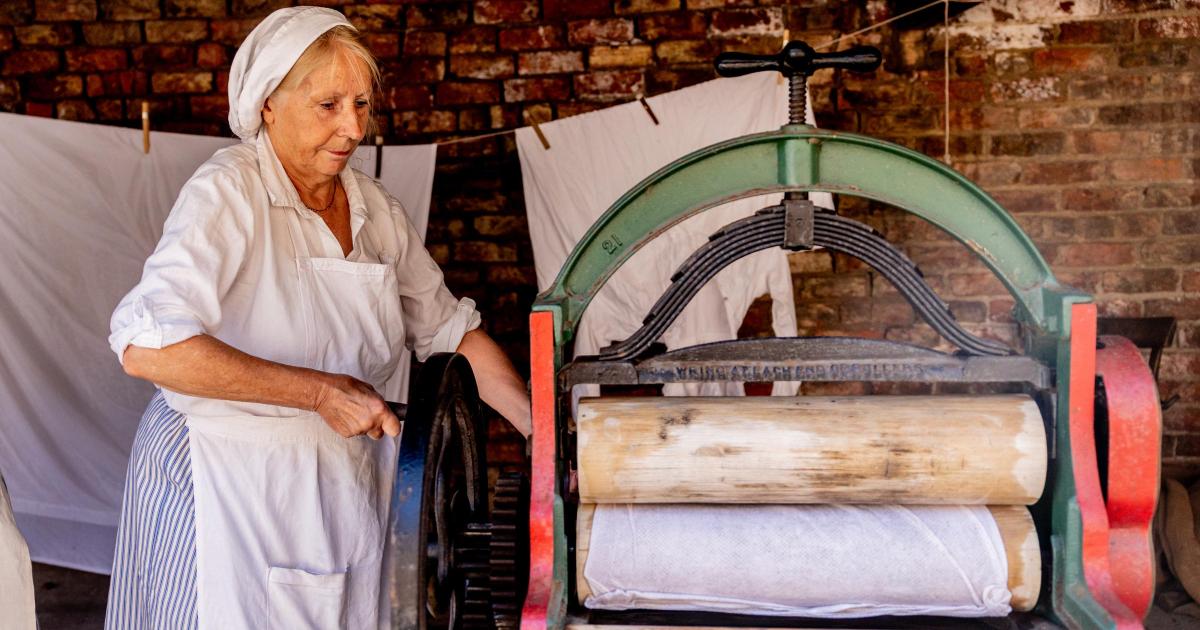
For 10 hours a day, they did their tasks: breaking stones for road-mending, chopping wood, picking oakum – taking the strands out of old rope so they could be re-wound into new. Men worked in the garden and the piggery while women helped in the laundry and mended uniforms.
They came together at mealtimes, entering the dining room through their different doors, but even families were not allowed socialise.
![]() The master’s house flanked by the wards and dormitories of the residents at Ripon Workhouse Museum, by Sarah Caldecott
The master’s house flanked by the wards and dormitories of the residents at Ripon Workhouse Museum, by Sarah Caldecott
In the middle of the workhouse complex was the master and matron’s house – a comfortable middle class abode with its own garden and a piano (which museum visitors are encouraged to play). It’s rather when the contestant has lost at the end of the TV quiz show Bullseye when the curtain is pulled back to reveal the star prize that they could have won had the lottery of life dealt the cards differently – the happy notes of someone else’s piano drifting across the oakum-pickers in the day yard must have been especially galling.
An accident of history has meant that Ripon’s workhouse has survived almost intact – although £2.5m from the National Lottery and other grants have been necessary to save its fabric and interpret its stories – and also its registers survive, allowing tantalising insights into the lives of the working class people who used it.
“Workhouses are complex places, they are not all good, they are not all bad,” said Dr Allan, who hails from Spennymoor. “There are stories of hardship and poverty but there are also stories of resilience and hope.”
![]() The classroom where children got three hours of education a day before going to work at Ripon Workhouse Museum, by Sarah Caldecott
The classroom where children got three hours of education a day before going to work at Ripon Workhouse Museum, by Sarah Caldecott
In July 1900, most newspapers, including The Northern Echo, told the story of Hannah Wade who had died aged 95 after spending 60 or so years in the workhouse.
Research suggests that she was actually born Ann Wade in 1803, and she regularly features in the registers, where she is described as an imbecile or a lunatic who costs three shillings a week to maintain.
The 1864 register describes her as “an idiot, not dangerous to herself or others, not of dirty habits, and has been of unsound mind from birth”, although the D&S Times’ obituary in 1900 is more kindly, saying “she had a retentive memory, and being bright and cheerful, was always ready to entertain visitors with old stories of Ripon”.
The workhouse archives also show how they evolved over the course of the 19th Century.
“In the 1880s, the first women were allowed to become guardians and we can see a change,” said Dr Allan. “In the 1890s, the children said they were sick of eating porridge and Mrs Lee proposed giving them bread and jam. The male guardians said no but the other female guardians voted for it.”
![]() Ripon Union Workhouse female inmates
Ripon Union Workhouse female inmates
Workhouses faded out in the 20th Century as the first pensions were introduced and labour exchanges were set up to help people find work.
“These changes meant the only people in here were elderly and sick, especially as workhouses were seen as not the right place for young children who were sent to orphanages, and so conditions begin to soften with more leisure time and central heating,” says Dr Allan. “In 1930, the board of guardians was abolished and the workhouse became known as the ‘public assistance institution’. It becomes more like a care home, although it is still run by a master and matron until 1948 when the NHS is introduced.”
![]() In the kitchen, Ripon Workhouse Museum, by Sarah Caldecott
In the kitchen, Ripon Workhouse Museum, by Sarah Caldecott
Ripon’s workhouse was council offices until in 2017 it was bought by the Ripon Museum Trust and this week’s reopening marks its transformation into a visitor attraction. The independent trust also runs the police and prisons museum and the courthouse museum, which volunteers saved when the working lives of the Victorian buildings came to an end.
![]() In the cellar with the carcase drop and the butchery table, Ripon Workhouse Museum, by Sarah Caldecott
In the cellar with the carcase drop and the butchery table, Ripon Workhouse Museum, by Sarah Caldecott
This means the city has a unique triumvirate of museums that tell the story of poverty, crime and punishment which is to be found in the family tree of nearly all of us, and many of the inhabitants of the workhouse would also have been familiar with the courthouse and the prison.
“People are really interested in these stories of ordinary people,” says Dr Adams. “Dickens brought these stories to life in Oliver Twist – they are a bit grimy and dark in places but they fascinate people.”
- The museums of Ripon are open from 10am to 4pm daily. Admission to all three for a year is £19 for an adult, or to just the new workhouse is £11. Full details at riponmuseums.co.uk



























































You must be logged in to post a comment Login