

Crypto World
Digital Euro Raises Privacy Questions as Cash Use Declines


The European Central Bank’s proposed digital euro is drawing intense debate across Europe, with supporters framing it as a tool to preserve the euro’s monetary sovereignty in an increasingly online payments economy, while critics warn it could expand surveillance and give authorities new powers over consumer spending.
In remarks reported by the ECB, executive board member Piero Cipollone said the project aims to reduce dependence on non-European payment providers and ensure Europeans can transact with sovereign central bank money in digital form. The controversy, however, persists as privacy advocates, consumer groups, and even parts of the traditional banking sector weigh the implications for personal autonomy and financial stability.
Key takeaways
- The ECB positions the digital euro as a sovereign, central-bank-issued payment option intended to complement cash, not replace it.
- Privacy and civil-liberties concerns remain central, with regulators and watchdogs emphasizing the need for strong safeguards before public trust can be secured.
- Policymakers are motivated partly by concerns that Europe lacks control over parts of its critical retail payments infrastructure.
- Banking-industry critics worry that limited digital-euro wallet holdings could still shift deposit flows and affect how banks fund lending.
- Legislation negotiations are underway in the EU, with officials aiming to finalize the text by the end of the year and decisions on issuance potentially following later.
What the digital euro would be
The digital euro is a proposed European Central Bank project for a digital form of euro issued by the ECB—meaning it would function as central bank money in an online-ready format. The ECB describes it as a way for people in the euro area to use sovereign money for everyday payments as commerce and payments continue to move toward digital channels.
Supporters argue that the digital euro would preserve core advantages people associate with cash while enabling “cash-like” payments over electronic networks. Critics, by contrast, see the same architecture as a potential pathway to “programmable” money—an arrangement they fear could enable authorities to control or restrict how individuals spend.
The dispute is not abstract: the digital euro debate mirrors broader questions raised by central bank digital currencies globally, particularly around privacy, data handling, and the degree of oversight that could accompany a state-issued payment rail.
Why Europe wants central bank money online
Beyond sovereignty, the ECB’s argument centers on reducing Europe’s reliance on non-European payment infrastructure. The ECB has warned that declining cash use could leave the euro area increasingly dependent on private or overseas-operated systems such as card networks, creating a strategic vulnerability.
In 2025, ECB President Christine Lagarde said the payment-credit-debit infrastructure is “not a European solution,” and argued that Europe needs a European alternative “just in case.” The underlying concern is that without a native digital euro option, European consumers and merchants could face higher systemic risk if foreign-controlled payment services become unavailable or less favorable.
Consumer advocates have also entered the discussion. According to comments shared with Cointelegraph by Andrew Canning, deputy head of communications at the European Consumer Organisation (BEUC), the digital euro could provide a “secure and inclusive” option that complements existing payment solutions—particularly for users who encounter barriers to accessing digital payments.
Safeguards, privacy, and what the ECB says it will do
Regulatory oversight is a key point in the digital euro debate. The EU’s privacy watchdogs have stressed that the project must include robust protections to earn public confidence. In a joint stance, the European Data Protection Board and the European Data Protection Supervisor said privacy and data protection at a high level are essential for the digital euro’s legitimacy, citing a need to ensure that fundamental rights are respected.
The ECB’s own materials argue that privacy protections are built into the design, including the existence of offline payments to enable “cash-like” privacy. The ECB also states it will not see personal transaction data—an assurance that the ECB uses to address concerns that a digital central-bank payment system could become a surveillance channel.
Still, critics contend that even a system designed to protect privacy could make payments more trackable in practice, depending on implementation choices and operational controls. The core issue for skeptics is whether “privacy” statements can meaningfully constrain the downstream ability to monitor activity once money is transferred through programmable rails.
How it would work—and why banks are worried
Unlike dollar-denominated stablecoins such as Tether or USDC, the digital euro would be denominated in euros and issued by the central bank. Users would not hold it directly in the same way they hold physical banknotes; instead, they would access it through electronic wallets and use it for payments in stores, online, or via wallet-to-wallet transfers.
Supporters say the underlying money would remain an ECB liability rather than a claim on a commercial bank’s deposits, which they argue would align digital euro holdings more closely with the public backing associated with cash.
Banking industry concerns focus on funding and financial stability. Several critics argue that a shift toward central bank digital euros could reduce bank deposits, potentially forcing banks to adjust how they finance lending. Lorenzo Bini Smaghi, an Italian economist and banker who served on the ECB executive board from 2005 to 2011, warned of “a high risk of financial instability” and “strong repercussions for the real economy,” according to the report’s inclusion of his remarks.
The ECB counters that its design choices aim to minimize risks to the banking sector. The ECB has said users would be limited to holding only a small amount of digital euros in their wallets at any time to prevent “excessive outflows of bank deposits.” It also indicates that, similarly to cash in a wallet, digital euro holdings would not earn interest—another measure intended to reduce incentives for users to move large sums into central bank money.
Costs, timelines, and lessons from other CBDC efforts
Cost and implementation burden have become an additional flashpoint. The ECB estimates that developing and implementing the digital euro would require approximately €1.3 billion in investment, alongside ongoing operating expenses of around €320 million annually. Reuters reported that the ECB expects banking sector implementation costs between $4.6 billion and $6.9 billion over four years, underscoring how integration work may fall partly on commercial institutions and payment providers.
On timing, negotiations across EU institutions have progressed to the stage where policymakers are working on final legislation. According to the article’s referenced reporting, lawmakers are aiming to reach agreement within the next six months. Cipollone also said, in an ECB interview on July 13, that officials hope the text will be finalized by the end of the year, after which the ECB would be positioned to decide whether to move forward with issuing the digital euro.
If legislation is approved, the decision would then be taken by the ECB’s Governing Council, with issuance considered sometime in 2027. The cited reporting also suggests everyday use would likely not arrive until 2029 at the earliest, assuming the project proceeds.
Europe is not operating in a vacuum. The broader international experience with retail CBDCs has been mixed, with many countries shifting away from direct retail models or abandoning proposals. According to Reuters, China began piloting its digital yuan in 2019 and expanded rollout nationally, yet most consumers still rely heavily on familiar apps such as Alipay and WeChat Pay. The Bahamas launched the Sand Dollar in 2020 as one of the first nationwide retail CBDCs, but adoption was slower than hoped, leading authorities to push for broader distribution through commercial banks.
Elsewhere, Nigeria’s eNaira reportedly struggled to gain traction after its 2021 launch despite government support, while Brazil’s central bank shut down its Drex CBDC platform in 2025, citing cost and privacy concerns. The Bank for International Settlements concluded in 2023 that a retail CBDC is a complex undertaking, not only for central banks but also for the broader ecosystem involved in implementation and governance.
As EU legislators negotiate the final framework, the decisive questions for investors, builders, and users will likely center on the practical strength of privacy safeguards, the wallet-holding and deposit-stability design choices, and the real timeline risk between legislation approval and any eventual issuance—areas where past CBDC efforts suggest implementation details can matter as much as the concept.



Coinbase cut 700 jobs in May, and Lawrence Brock’s team ran those layoffs. Eleven weeks later, the Chief People Officer reportedly quit.
Brock leaves on August 17. He will advise Coinbase until November 30. Dominique Baillet is expected to take his job.
From Coinbase Layoffs to His Own Exit
Coinbase filed the plan with regulators on May 5. It cut about 700 roles, or 14% of staff. That took headcount from roughly 5,000 down to 4,300.
The cuts cost $50 million to $60 million. Almost all of that was cash for severance. Coinbase gave two reasons. It wanted to spend less, and to rebuild “for the AI era.”
Most of the bill lands in the second-quarter accounts. Coinbase reports those numbers on July 30. Brock walks out 18 days later.
Follow us on X to get the latest news as it happens
He Had Done This Before
May was not his first round of cuts. In June 2022, Brock froze hiring and pulled offers from people who had not yet started.
“We will also rescind a number of outstanding offers for people who have not started yet. This is not a decision we make lightly, but is necessary to ensure we are only growing in the highest-priority areas,” he wrote that in a company post 12 days before Coinbase cut 18% of staff.
Brock runs hiring, pay, and workplace policy. Both rounds of cuts went through his team.
His own deal is softer. It pays $182,500 for three months of advice. The filing calls that three months of his salary, which works out to $730,000 a year.
One block of his stock keeps vesting on November 20. The rest is cancelled. The filing gives no reason for his exit and does not link it to the layoffs.
Fourth Senior Exit Since July 8
Chief Legal Officer Paul Grewal stepped down to join a startup this month. Molly Abraham took his place as general counsel.
Jesse Pollak then admitted his on-chain social bet had failed. He handed the Base app back to Coinbase. Greg Tusar, co-head of Coinbase Institutional, is moving to a policy job, The Information reported.
However, none of these seats went to an outside hire. Coinbase is promoting its own people while it builds what it calls the everything exchange. That means stocks, derivatives, and regulated prediction markets next to crypto.
Chief Executive Brian Armstrong pitched the May reorganization as fitting Coinbase for the AI era. Brock built the machinery, then left before anyone could judge it. July 30 gives the first real answer.
The post Coinbase Layoffs Architect Exits Weeks After Cutting 700 Jobs appeared first on BeInCrypto.


Nvidia, Meta and Microsoft have joined 22 other organizations in warning U.S. policymakers that sweeping controls on open-weight AI models could weaken American leadership as competition with China intensifies.
Summary
- Nvidia, Meta and Microsoft oppose sweeping U.S. restrictions on open-weight AI models.
- The coalition favors targeted enforcement against intellectual-property theft and other proven misuse.
- Elon Musk backed the letter as concerns over Chinese AI competition increased.
The open letter has called for targeted legal and commercial measures to address misuse instead of restrictions covering technologies that support legitimate AI development. Its signatories include IBM, Palantir, Mistral, Hugging Face, Mozilla, Andreessen Horowitz and the Linux Foundation.
Open-weight models allow businesses, researchers and governments to download software, customize it and operate it on their own infrastructure. According to the letter, this access makes advanced systems easier to adapt while giving organizations more control over their data, security and computing systems.
Rather than treating open and closed systems as rivals, the companies described both as necessary parts of the AI market. They argued that open models support competition, lower deployment costs and give developers more freedom to inspect or modify the technology they use.
Open models remain central to U.S. AI competition
Publishing his first post on X, Nvidia CEO Jensen Huang shared the letter and defended a market where both development methods can exist. Huang argued that open models support cybersecurity, safety, national control and the spread of AI tools across industries.
“For my first post, I’m sharing a letter NVIDIA signed on why open models matter…The world needs both frontier closed models and frontier open models.”
Elon Musk also backed the letter in a reply to Huang’s post. Musk’s xAI develops Grok, a chatbot competing with products from OpenAI and Anthropic, although xAI was not identified among the 25 signatories listed in media reports.
The companies issued their warning as the Trump administration considers action against Chinese AI developers accused of using American technology without permission. U.S. Treasury Secretary Scott Bessent stated this week that officials would examine whether Chinese models had been trained through unauthorized use of outputs from U.S.-built systems.
According to Bessent, sanctions and Entity List restrictions could apply if Chinese companies conducted industrial-scale distillation that crossed into intellectual-property theft. The Treasury secretary also stated that the administration supports open-source AI, separating lawful development practices from alleged attempts to copy protected American technology.
Distillation uses the output of one model to help train or improve another system. In their letter, Nvidia and the other signatories described the method as a common tool for model improvement, testing and validation, while cautioning policymakers against treating every use of it as theft.
“Distillation, or the practice of using one model’s outputs to help train or improve another, is a widely used technique for model improvement, evaluation, and validation.”
Drawing on the history of open-source software, the coalition argued that developers have long learned from existing systems and used shared tools to produce new products. The signatories maintained that authorities should pursue proven legal violations directly without blocking techniques used by legitimate researchers and companies.
China’s recent progress has added pressure to the policy debate. Moonshot AI’s Kimi K3 reached first place on the Frontend Code Arena, according to the benchmark, placing a Chinese model ahead of several established U.S. products in that category.
Former White House AI and crypto adviser David Sacks has warned that such gains could threaten the U.S. position in the AI race. U.S. officials have separately accused Moonshot of distilling Kimi K3 from Anthropic’s Fable model, though Moonshot’s alleged conduct remains part of the policy dispute rather than an established finding, according to Reuters.
Human oversight and spending risks remain in focus
Debate over open models has developed alongside questions about how companies and traders should use AI. As crypto.news reported on July 24, Gate founder and CEO Dr. Han supported using AI to collect information and study market signals while leaving final trading decisions to people.
During an episode of the Gatecast podcast, Dr. Han argued that automated tools could help users navigate millions of digital assets and tens of thousands of decentralized applications. However, he maintained that traders must examine the information produced by those systems before acting on it.
“AI + human intelligence” will become a more effective approach in the future, Dr. Han said.
His position places AI in an assistant role rather than giving automated systems full control over investment decisions. According to Dr. Han, machines can process large quantities of market data quickly, while human judgment remains necessary when users assess risks and decide whether to trade.
Financial concerns have also followed the rapid expansion of AI infrastructure. Earlier in July, former Fidelity fund manager George Noble warned that a collapse in the AI investment boom could cause 17 times more damage than the dot-com crash, which erased about $5 trillion from the Nasdaq.
Noble linked that risk to the large amount of capital entering data centers, chips and related infrastructure. According to the former fund manager, losses could spread beyond technology companies if expected returns fail to cover the money committed to AI development.
“The fallout from this could really be much more significant,” Noble said while discussing rising AI capital expenditure.
While Noble’s warning concerns financial exposure rather than open-weight regulation, the two debates share a central policy issue: how the U.S. can manage risks without stopping useful development. Nvidia and its fellow signatories have argued that focused enforcement offers that balance, allowing authorities to pursue theft or misuse while preserving access to open AI technology.


- The lawsuit was filed the day BitMEX announced its shutdown.
- Lawsuit alleges excess Bitcoin collateral was retained.
- Plaintiffs claim losses totalling 622.66 BTC.
BitMEX is facing fresh legal trouble after a class-action lawsuit accused the cryptocurrency derivatives exchange of deliberately engineering customer liquidations to take possession of traders’ Bitcoin collateral.
The lawsuit was filed on the same day the company announced plans to shut down its operations, placing renewed attention on allegations surrounding its liquidation system and trading practices.
The case, filed in the US District Court for the Southern District of New York, seeks to recover hundreds of bitcoins that the plaintiffs claim were wrongfully taken through forced liquidations.
Lawsuit claims more than 622 Bitcoin were wrongfully seized
The lawsuit was brought by BKX Services Inc. and investor David Namdar, who allege they collectively lost 622.66 BTC because of BitMEX’s liquidation process.
According to the complaint, BKX Services lost at least 305.81 BTC, while David Namdar claims losses exceeding 316.85 BTC.
The plaintiffs argue that these losses were not the result of normal market conditions but stemmed from a liquidation system that allegedly operated in BitMEX’s favour.
The complaint accuses the exchange of intentionally triggering liquidations that enabled it to retain customers’ remaining Bitcoin collateral.
It further alleges that BitMEX profited from these liquidations instead of returning any excess collateral after positions were closed.
The plaintiffs are seeking damages and other legal remedies, arguing that the exchange’s practices caused significant financial losses over multiple trading events.
Plaintiffs challenge BitMEX’s liquidation model
At the center of the lawsuit is BitMEX’s liquidation engine, which the plaintiffs claim was designed to benefit the exchange rather than protect traders from excessive losses.
BitMEX became one of the largest crypto derivatives platforms by offering leveraged trading of up to 100x, allowing traders to control positions much larger than their deposited collateral.
While leverage can increase profits, it also raises the risk of liquidation when the market moves against a position.
The complaint alleges that traders’ positions were liquidated even when the remaining collateral exceeded the amount required to cover losses. Instead of returning the excess Bitcoin after closing the positions, the lawsuit claims BitMEX retained those funds.
The plaintiffs also allege that server outages and disruptions during periods of heightened market volatility contributed to liquidations that could have been avoided.
According to the filing, these incidents prevented some traders from managing or closing their positions before they were automatically liquidated.
The lawsuit argues that these practices allowed the exchange to accumulate customer Bitcoin through forced liquidations rather than simply covering trading losses.
Legal action coincides with BitMEX shutdown announcement
The timing of the lawsuit has drawn attention because it was filed on the same day BitMEX announced that it would cease operations.
The company said it plans to shut down on September 23, 2026, following a strategic review of its business.
As part of the closure process, customers have been advised to close open positions and withdraw their assets before operations end.
The legal action now adds another layer of uncertainty to the exchange’s final weeks of operation.
While the shutdown announcement focused on the company’s decision to wind down its business, the lawsuit raises separate allegations regarding the handling of customer funds and liquidation practices.
The claims made in the complaint have not been proven in court, and the lawsuit represents allegations brought forward by the plaintiffs.
The court proceedings will determine whether BitMEX or its related entities bear legal responsibility for the alleged losses.
The case also revives long-running scrutiny of BitMEX’s liquidation system, which has been the subject of debate within the cryptocurrency trading community for years.
As the exchange prepares to end its operations, the outcome of this lawsuit could become one of the most closely watched legal disputes involving a crypto derivatives platform and its treatment of customer collateral.


Mirae Asset reportedly plans to use the South Korean crypto exchange as a hub for tokenized assets, stablecoins and digital finance.


LMAX Group has enlisted Morgan Stanley and KBW to assess a sale or public listing that could value the institutional trading company at up to $5 billion.
Summary
- LMAX has tapped Morgan Stanley and KBW to review strategic options worth up to $5 billion.
- A Nasdaq IPO is preferred, although a sale, SPAC merger or European listing remains possible.
- LMAX’s foreign exchange business allows the company to wait through weak crypto market conditions.
Three people familiar with the private discussions said LMAX is working with Morgan Stanley and KBW, an investment bank owned by Stifel, as it reviews several strategic paths.
According to one of the people, LMAX could pursue a direct sale, merge with a special purpose acquisition company, or launch an initial public offering in the United States or Europe. A Nasdaq IPO currently ranks as the company’s preferred option, the person added.
No final decision has been made, and another person familiar with the process said LMAX is not under pressure to enter the public market while cryptocurrency prices remain weak. According to the source, revenue from the company’s established foreign exchange operations gives it room to wait for better market conditions.
The potential $5 billion valuation would be five times the level attached to LMAX in July 2021. At the time, private equity firm J.C. Flowers agreed to buy a 30% stake for $300 million, placing the group’s value at about $1 billion.
LMAX said the J.C. Flowers investment would support its expansion across institutional foreign exchange and cryptocurrency markets. The transaction also gave the company additional capital as regulated financial firms began developing services tied to digital assets.
Nasdaq leads LMAX’s listing options
London-based LMAX operates trading venues and infrastructure for banks, brokers, hedge funds and asset managers. According to the company, its services cover foreign exchange and digital assets through an agency execution model that gives clients access to transparent order books and low-latency systems.
Britain’s Financial Conduct Authority regulates the group, a status LMAX has used while building products for institutions that require regulated venues. The company’s focus differs from retail-led crypto exchanges because its clients include financial firms seeking execution, liquidity and settlement services.
LMAX has also benefited from increased institutional participation following the approval of spot Bitcoin exchange-traded funds in the United States, according to people familiar with the company’s review. Those sources linked the expansion of regulated crypto products to renewed interest from banks and asset managers seeking digital asset exposure.
Even with that interest, the timing of any listing remains uncertain. One person familiar with the discussions said current crypto market weakness has reduced the need for an immediate transaction, while LMAX’s foreign exchange business continues to protect it from relying entirely on digital asset trading activity.
A Nasdaq debut would place LMAX alongside a growing group of cryptocurrency and market infrastructure companies seeking access to U.S. public capital. However, the people familiar with the talks said a sale and other listing structures remain under consideration, leaving LMAX free to change course if market conditions or buyer interest improve.
LMAX builds its institutional crypto stack
During the past year, LMAX has added products that connect custody, collateral management and round-the-clock trading. In February, the company introduced a 24/7 multi-asset exchange designed to support foreign exchange, precious metals, digital assets, commodities and tokenized securities.
LMAX said the platform allows institutional clients to trade both traditional and tokenized instruments outside standard market hours. By combining several asset classes within one venue, the company sought to extend its operations beyond spot cryptocurrency trading.
A month earlier, Ripple invested $150 million in LMAX through a strategic agreement intended to increase institutional use of the RLUSD stablecoin. According to the companies, LMAX would integrate RLUSD into its trading and settlement network, giving institutional clients another option for moving funds between digital asset markets.
LMAX continued that product push in May by launching Kiosk, a hosted portal that lets clients deposit digital assets into LMAX Custody and use them as collateral across multiple markets. As previously reported by crypto.news, Kiosk supports spot foreign exchange, precious metals, cryptocurrencies, contracts for difference and perpetual futures.
According to LMAX, the portal combines custody, collateral access and trading support within one workflow. Its tools include deposits, withdrawals, API credential management, WalletConnect access, security controls and treasury management.
The company said Kiosk is intended for institutions that want to use digital assets without dividing custody and trading functions among several systems. Clients can retain assets in LMAX Custody while using them to support positions offered through the group’s trading network.
LMAX’s review comes during an active period for crypto acquisitions. Kraken parent Payward has agreed to acquire derivatives platform Bitnomial, while Bullish, the owner of CoinDesk, has announced a $4.2 billion deal to purchase Equiniti and expand into tokenization and transfer agency services.
For LMAX, the strategic review gives its advisers several ways to value a business spanning foreign exchange, crypto execution, custody and tokenized markets. Morgan Stanley and KBW will evaluate those options as the company weighs buyer interest against the timing and potential pricing of a Nasdaq listing.


India’s cybercrime authority has ordered GitHub to remove three repositories linked to Jack Dorsey’s Bitchat messaging app within three hours.
Summary
- India ordered GitHub to remove three Bitchat repositories within a three-hour deadline.
- I4C cited surveillance risks linked to Bitchat’s anonymous, offline Bluetooth mesh network.
- Digital rights groups challenged the order’s legality and called it unconstitutional.
According to a July 23 notice shared by Dorsey on X, the Indian Cyber Crime Coordination Centre directed the Microsoft-owned platform to disable access to Bitchat’s open-source code, Android application and release files. I4C operates under India’s Ministry of Home Affairs.
The notice, numbered 11072601011432, cited Section 79(3)(b) of the Information Technology Act, 2000, alongside Rule 3(1)(d) of the Information Technology Rules, 2021. Digital rights group Internet Freedom Foundation said the order also warned GitHub that noncompliance could expose it to a loss of legal protection and possible criminal proceedings.
Dorsey made the previously unpublished directive public on July 24 as authorities restricted communications around an ongoing student protest in central New Delhi. Responding to the demand, the former Twitter chief wrote that “the Government of India does not like technologies like Bitchat and wants it taken down.”
Authorities had suspended mobile internet within a 1.5-kilometer radius of Jantar Mantar from 4 p.m. until midnight on July 23, according to the Ministry of Home Affairs order reported by the Times of India. Police had also activated mobile jammers near the protest area a day earlier.
Led by the Cockroach Janta Party, the demonstrations concern alleged irregularities in the 2026 NEET examination and demand changes to India’s examination system. The Times of India reported that some participants began using Bluetooth-based messaging services after the temporary network restrictions took effect.
GitHub received three hours to remove the code
I4C based its security concerns on Bitchat’s ability to carry messages without mobile service, internet access or centralized infrastructure. Because the app does not require accounts, telephone numbers or persistent user identities, the agency argued that its architecture obstructs lawful interception, user attribution and criminal investigations.
In its notice, I4C alleged that decentralized communication platforms could support unlawful assemblies, violent protests, misinformation, radicalization and criminal conspiracies. The authority also cited the risk of misuse by terrorist organizations, organized crime groups and cybercriminals seeking to communicate during legally imposed network restrictions, according to the Times of India.
Besides the intermediary rules used to compel GitHub, I4C alleged violations of Sections 43, 84B and 84C of the IT Act. The notice also referred to Section 61, read with Sections 196 and 197, of the Bharatiya Nyaya Sanhita, the Times of India reported.
IFF challenged both the legal basis and scope of the action. In a July 24 statement, the organization described the blocking of Bitchat’s code as “unconstitutional and authoritarian,” arguing that Section 79 governs the conditions under which online intermediaries retain protection from liability for third-party material.
Citing the Supreme Court’s ruling in Shreya Singhal v. Union of India, IFF maintained that Section 79 is not an independent blocking power. The group said the notice targeted an entire software project without identifying a specific message, file or other piece of unlawful content.
SFLC.in founder Mishi Choudhary raised a similar objection, telling Moneycontrol that Section 79 is separate from Section 69A, India’s statutory process for blocking online material. According to Choudhary, Section 79 does not allow the government to declare a full software project illegal or punish GitHub merely for hosting its code.
Bitchat remains usable after a repository takedown
Bitchat routes messages between nearby devices over Bluetooth Low Energy, allowing each participating phone to relay data to another device in the mesh. Its GitHub documentation states that messages can travel across as many as seven hops without an internet connection.
The project also supports end-to-end encrypted private messages, automatic peer discovery, and an emergency wipe feature. For online communications, its dual-transport system can use the decentralized Nostr protocol, while the local Bluetooth layer continues working independently when regular networks fail.
Removing the repositories would make the original source code and official release files harder to obtain through GitHub, but it would not remotely disable copies already installed on users’ phones. Technology expert Deepak Gupta told Moneycontrol that the order would also leave copies hosted elsewhere unaffected.
IFF used that limitation to challenge the stated purpose of the notice, arguing that an offline mesh cannot be shut down through a single platform-level removal. The organization asked the government to withdraw the directive, publish takedown orders issued through the cited provisions, and restore full connectivity around Jantar Mantar.
India’s action follows an April order from the Cyberspace Administration of China that led Apple to remove Bitchat from its China App Store and TestFlight service. Apple’s notice cited rules covering online services with public-opinion or social-mobilization capabilities. Bitchat had also gained users during network disruptions and protests in Nepal, Madagascar, Uganda and Iran, according to reports cited in coverage of the Chinese removal.
World Foundation has raised an initial $52.5 million through a sale of locked WLD tokens to strategic investors, with Pantera Capital leading the funding round.
The round also included Bain Capital Crypto, Eightco Holdings, Selini Capital, Susquehanna Crypto and other investors, according to a Friday announcement shared with Cointelegraph. The WLD tokens sold in the fundraising are subject to a 12-month lockup.
The nonprofit behind the World protocol said that new funds will be used to expand World ID, its system designed to distinguish people from AI agents. World ID generates a digital credential after users complete biometric verification at a World Orb device.
The organization said AI-generated content and autonomous agents are increasing demand for systems that can verify whether an online user is a real person.
World was originally conceived by OpenAI CEO Sam Altman, Max Novendstern and Tools for Humanity CEO Alex Blania. The project has faced regulatory scrutiny in several jurisdictions over its biometric identity verification system.
Related: BTC treasury firm Empery Digital invests $20M in AI data center developer Cardinal Data Power
Crypto firms and investors deepen AI push
Investment in AI infrastructure and agent-focused technologies has continued to accelerate in recent weeks as companies and investors expand beyond traditional crypto markets.
Earlier this month, brokerage infrastructure provider Alpaca raised $135 million in equity financing and secured up to $300 million in debt financing, along with access to up to $300 million in debt financing, to expand its agent-first brokerage platform. The company said the raise will help build infrastructure for AI-powered financial applications.
Source: Matt Huang
The raise came just a few weeks before Coinbase introduced tools allowing businesses to accept USDC (USDC) payments from autonomous AI agents, noting that AI-generated traffic exceeded human traffic on its Base developer documentation for the first time last month.
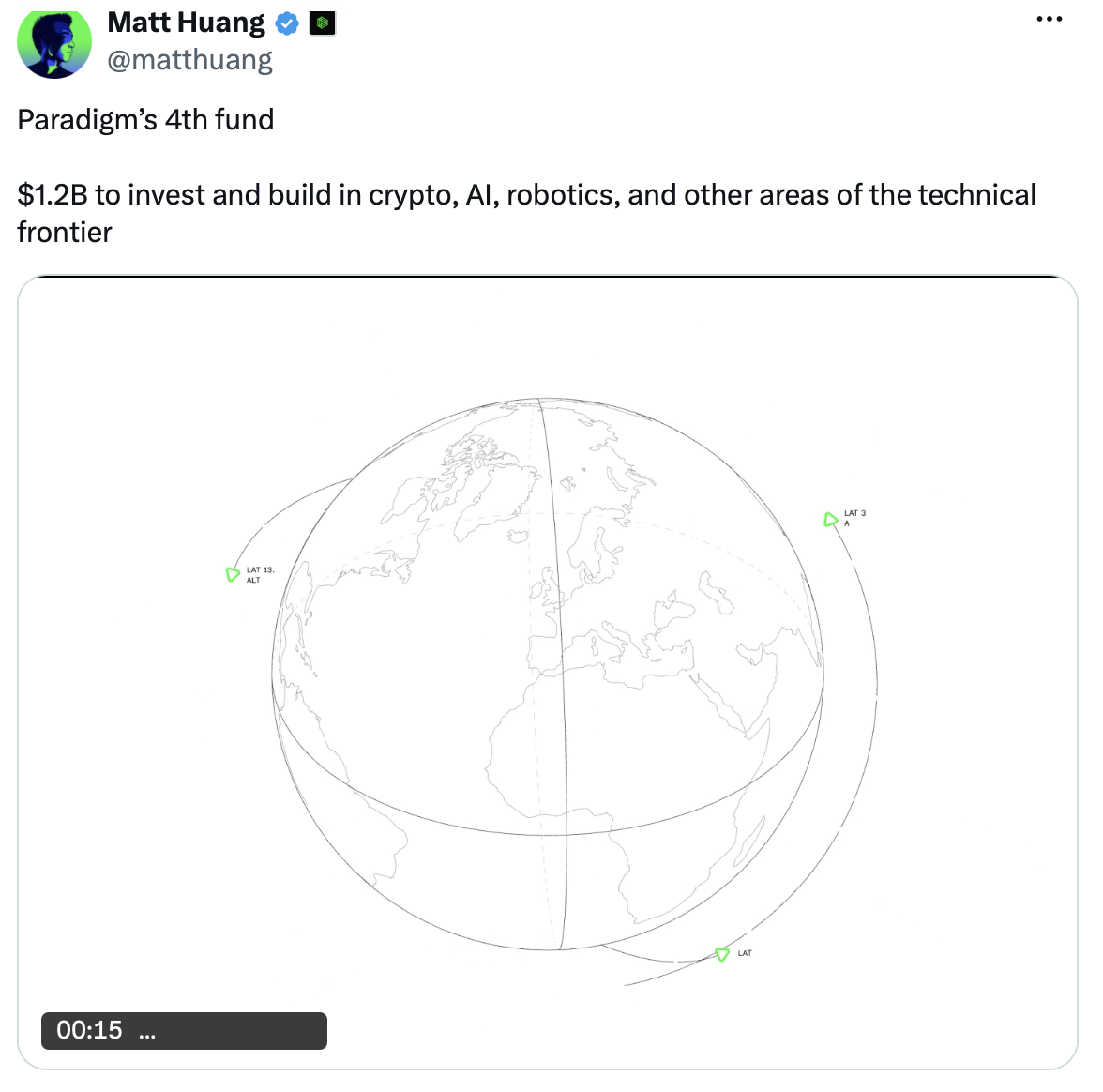
Investor appetite has followed the trend. Paradigm raised a $1.2 billion fund in July to invest across crypto, artificial intelligence, robotics and other frontier technologies, while Framework Ventures closed a $400 million fund in June with a mandate spanning crypto, AI, robotics and energy.
Capital is also flowing into AI security. Cybersecurity startup AegisAI raised $36 million in Series A funding this week to expand AI-powered email security tools, saying the financing will support defenses against increasingly sophisticated AI-generated phishing attacks.
Magazine: A quantum roadmap would push Bitcoin much higher: Charles Edwards
Crypto World
RISEx Launches ‘Ignite’ Season 1 Points Program, Following $3B in Volume During the Early Access Phase
[PRESS RELEASE – Singapore, Singapore, July 24th, 2026]
Backed by Galaxy Ventures and Vitalik Buterin, the ultra-high-performance perp DEX has officially launched its public rewards program.
RISEx, the fully on-chain perpetuals exchange built on the high-throughput RISE Chain, has officially launched Ignite: Season 1, its core loyalty and ecosystem points program. Following an invite-only beta phase that generated over $3 billion in cumulative trading volume, the program marks the next major step in RISEx’s broader ecosystem rollout as the protocol builds toward long-term community ownership and future token distribution.
Launch week concluded today with the distribution of the Season 0 retroactive points, recognizing the users who traded on a merit-based, invite-only venue with no guarantee of reward.
The program also carries a claim no competing venue can make: 100% of RISE points are allocated to RISEx users, including traders, LPs, and builder code integrators. RISE is an exchange chain, and RISEx is its product. Rather than splitting rewards across a diffuse ecosystem, the entire network’s incentive weight routes through the venue where activity actually happens.
The launch arrives amidst a massive structural shift in crypto derivatives, with decentralized perpetuals rapidly devouring centralized venue market share. Following the successful live deployment of its core exchange infrastructure, including cross-asset netted-margining and native Real-World Asset (RWA) trading, the public opening of RISEx’s rewards system marks the platform’s formal transition into global scale and growth mode.
Ecosystem Traction: By the Numbers
Prior to opening public rewards, the RISEx closed beta cultivated organic, institutional-grade liquidity and deep user engagement over three months:
- $3 Billion+ in cumulative trading volume processed since genesis.
- $26 Million+ in Open Interest (OI).
- $15 Million+ in Total Value Locked (TVL).
- 15,000+ Registered users accumulated entirely through a merit-based referral network.
 Source: DUNE
Product First, Incentives Second “Much to the frustration of our growth team, I was adamant that we would not launch an incentives program until our core exchange engine reached absolute stability,” said Sam Battenally, CEO and co-founder of RISE Labs. “Too often, points programs are deployed prematurely to mask unfinished infrastructure or buy empty, temporary volume. We spent the last few months doing the hard engineering work instead by stabilizing core features like reduce-only GTC and bootstrapping deep, quality liquidity. If you are fueling the engine, it has to perform. Now that our core architecture is fully live, optimized, and performing at a world-class level, we are ready to scale.”
Ignite Season 1 Structure & Timeline
Ignite runs according to a product roadmap, and that is RISEx’s commitment to the RISE mission. As the exchange ships and reaches milestones, the season moves with it. AutoYield, Permissionless Portfolio Margin, and equity listings are all part of a larger vision to bring full-scale composable finance on-chain.
This is a deliberate design choice. Rewards should track real product progress rather than a marketing calendar that forces a program to overspend early or thin rewards later, penalizing the early contributors and active traders who showed up first.
- Live Since: Week 1 of Ignite began on Monday, July 20, 2026, at 00:00 UTC.
- Public Distribution: RISEx will distribute 200,000 points per week, settled every Tuesday, with the first weekly distribution on July 28, 2026, at 14:00 UTC.
- Season Length: Ignite is expected to end no later than Q2 2027.
- Allocation: 100% of RISE points are allocated to RISEx users, including traders, LPs, and builder code integrators.
Inside the Ignite Mechanics
Engineered to reward genuine, long-term ecosystem participation over predatory Sybil farming and artificial wash trading, Ignite evaluates user contribution across multiple health metrics rather than volume alone.
- Multi-Layered Earning: Qualifying activity spans higher-order activity, total costs including fees, slippage and negative markouts, trading volume, and open interest and hold time.
- Referral Rewards: Referrers earn an additional 10% of their referee’s points.
- Undisclosed Weightings: The exact methodology and weightings are not published. This protects the program from being gamed.
- Affiliate Program: For those who qualify, the affiliate program offers additional incentives such as fee rebates, point boosts, and more.
Institutional-Grade Architecture
RISEx achieves centralized-exchange execution speeds with full self-custody by utilizing RISE Chain, an EVM-compatible Layer 2 network delivering unprecedented 5 Ggas/s throughput and 1-millisecond latency. Because the exchange and the underlying blockchain share the same state, users benefit from a fully on-chain orderbook where collateral and interconnected DeFi positions exist within a single, atomic execution environment.
With the core perpetual exchange engine stabilized, the platform’s mid-term product roadmap is shifting toward the launch of native EVM Spot trading, AutoYield, and Permissionless Portfolio Margin.
Traders can clear the gate, check their retroactive allocations, and begin earning Season 1 points by visiting rise.trade.
About RISEx
RISEx is a fully on-chain perpetuals exchange built on RISE Chain. Delivering centralized-exchange execution speeds with full self-custody, RISEx features an on-chain orderbook that shares state and liquidity with the entire RISE DeFi ecosystem in a single transaction. RISEx offers institutional-grade crypto perpetuals with flexible collateral, with plans to expand into equities, forex, and commodities.
About RISE Chain
RISE Chain is a next-generation Ethereum Layer 2 purpose-built for high-performance DeFi, delivering 5 Ggas/s throughput and Web2-like latency via its proprietary Shreds architecture. Developed by RISE Labs, the network is backed by Galaxy Ventures, Vitalik Buterin, Finality Capital Partners, EtherFi, OrangeDAO, DACM, P2 Ventures, Stani Kulechov, and other leading digital asset investors.
The post RISEx Launches ‘Ignite’ Season 1 Points Program, Following $3B in Volume During the Early Access Phase appeared first on CryptoPotato.
BKX Services Inc. and David Namdar have filed a class action lawsuit against BitMEX.
The plaintiffs accuse the exchange of market manipulation and misappropriating nearly 623 BTC due to forced liquidations.
Lawsuit Questions BitMEX’s Liquidation Practices
Filed on the same day the exchange announced it would shut down, the two claim that BitMEX’s internal trading team accessed customers’ private information and continued trading while servers were down and users were unable to access the platform.
BitMEX has faced accusations over its liquidation practices and internal trading advantages in the past, with the latest lawsuit reviving these allegations.
According to the complaint, the exchange offered its customers leveraged trading of up to 100 times their collateral but allegedly liquidated their positions before all assets had been used up. This resulted in users losing their positions while the remaining BTC collateral was worth more than the losses incurred.
Instead of refunding the excess BTC to traders, BitMEX allegedly redirected the funds to its insurance pool, which, according to the plaintiffs, made it possible for the platform to financially benefit from forced liquidations.
“BitMEX deliberately developed a system that profited from the liquidations,” read the filing.
The filing also cites an old 2020 case where Brett Messieh and other traders sued the platform for similar offenses. Here, the group accused the company of rigging trading conditions in its favor, resulting in financial losses for users. But the court threw out the case for a lack of evidence.
Traders Lost Almost 623 BTC
Namdar says they lost more than 316.85 BTC in the process, while BKX says its losses were around 305.81 BTC. As a result, the two are looking to recover their seized crypto and damages. Furthermore, the proposed lawsuit seeks to represent U.S. customers who traded BTC perpetual swap products in transactions dating back to July 23, 2018.
Earlier on Thursday, BitMEX owner HDR Global Trading said it will shut down the exchange after a strategic review, with the decision expected to take effect on September 23. The platform has already suspended new account registrations, with traders now only allowed to close existing positions.
Following the announcement, BitMEX co-founder Arthur Hayes thanked his partners, employees, and customers for their support over the years. “It was an amazing ride,” he wrote, adding that he was proud the exchange was shutting down “responsibly on our own terms.”
The post BitMEX Hit With 623 BTC Lawsuit After Announcing Shutdown appeared first on CryptoPotato.
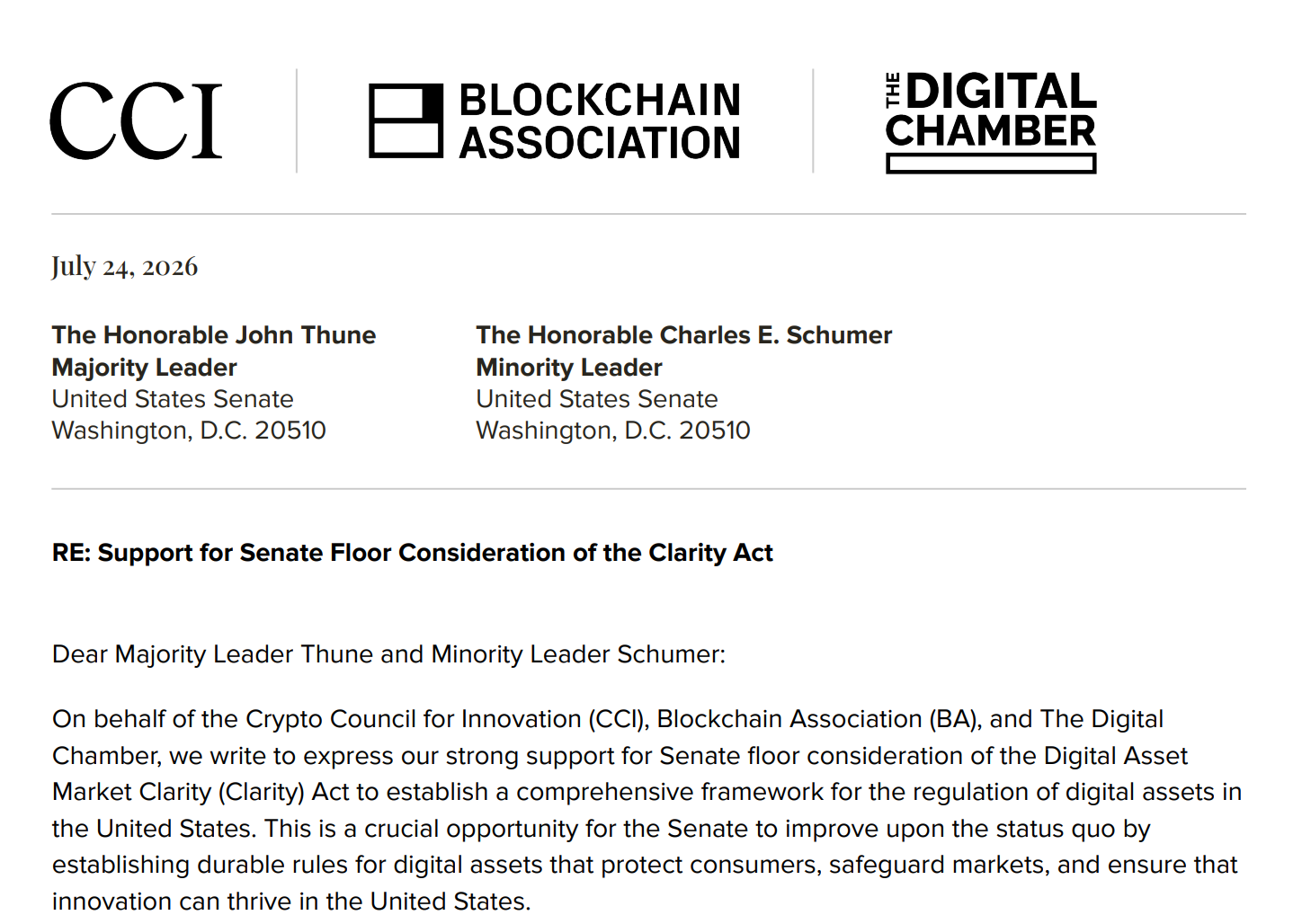
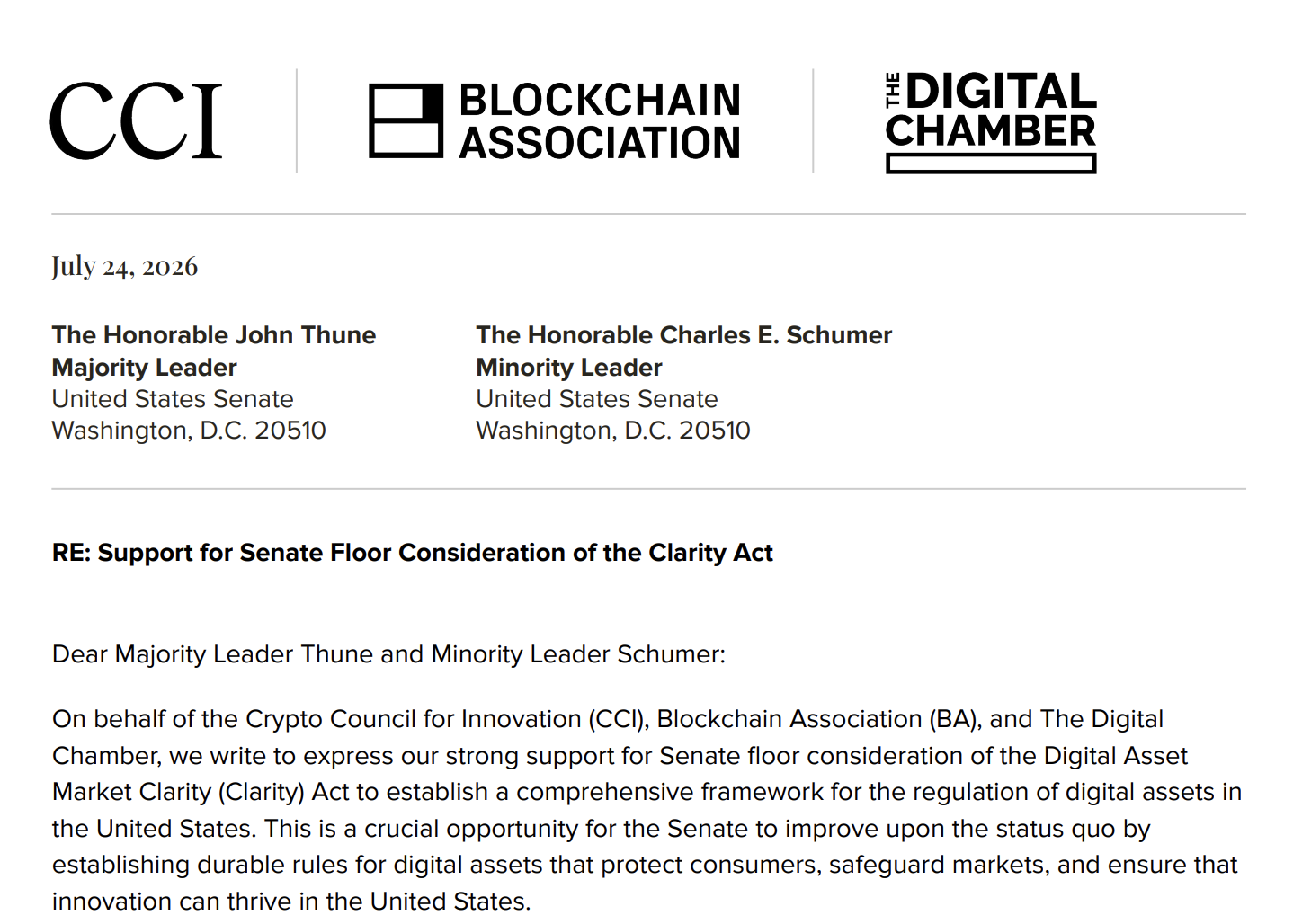
The Crypto Council for Innovation, Digital Chamber and Blockchain Association wrote to US Senate leaders on Friday calling for the chamber to prioritize “floor consideration” of the Digital Asset Market Clarity (CLARITY) Act.
In a Friday letter to Senator Majority Leader John Thune and Minority Leader Chuck Schumer, the three cryptocurrency advocacy groups urged consideration of the CLARITY Act, which Republican lawmakers have been pushing for a vote before the chamber breaks for state work periods in August. Although the bill has advanced through the Senate banking and agriculture committees, some lawmakers said they planned to withhold their votes until key provisions were addressed.
“[We] recognize that constructive bipartisan negotiations remain underway to secure and expand support for this critical piece of legislation,” said the letter. “We appreciate these good-faith efforts of Senators on both sides of the aisle, and we encourage those discussions to continue.”
Source: Crypto Council for Innovation
The CLARITY Act, expected to be one of the most significant pieces of legislation impacting the crypto industry, needs 60 votes to pass in the Senate, where Republicans hold a 52-47 majority over Democrats. Republicans released the text of the market structure bill earlier this week, including ethics provisions that barred public officials from issuing or sponsoring cryptocurrencies, but many Democrats said that the measures don’t go far enough to prevent corruption.
Related: Goldman Sachs CEO backs ‘not perfect’ CLARITY Act as vote expected soon
“Whatever piece of s— they sent back to us, that was not a serious effort,” Senator Ruben Gallego said on Thursday regarding the ethics provisions, according to Politico.
Gallego added:
”[…] After all the work that we’ve done with our Republican colleagues, that they would take the months and months of work and somehow interpret that and turn around and think what they offered was even remotely close.”
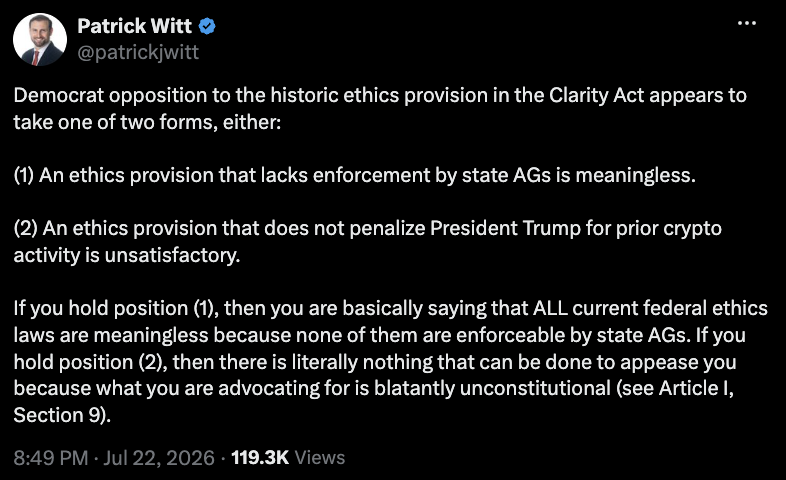
White House crypto adviser on Democratic opposition to CLARITY ethics rules. Source: Patrick Witt
Industry leaders weigh in on CLARITY ahead of potential floor vote
“The status quo in the US isn’t working,” said Coinbase CEO Brian Armstrong in a Wednesday X post. “There’s no federal framework, so bad actors like FTX can harm US customers and much of the industry has gone offshore totally outside US purview. This bill fixes that with strong consumer protections, real tools for law enforcement, and a path for America to lead in this industry.”
Orest Gavryliak, chief legal officer of DeFi platform 1inch, spoke about the bill on Cointelegraph’s Chain Reaction podcast on Friday, saying that CLARITY would help recognize a framework for non-custodial protocols rather than “regulating with enforcement.”
“Some regulators, they try to be friendly to non-custodial protocols or projects, they still try to fit us in into the custodial frameworks and make us use custodial solutions to solve problems that they used to in this legacy custodial or traditional finance, which is wrong [and] doesn’t apply to us at all,” said Gavryliak. “That’s why it’s very important for CLARITY to pass.”
If lawmakers are unable to hold a vote for CLARITY before the Senate breaks in August, it could push consideration into the weeks before the 2026 US midterms, potentially complicating discussions. As of Friday, Kalshi offered users event contracts with a 40.3% chance that the bill would pass before the Senate’s August recess.
Magazine: Here’s why the CLARITY Act’s ethics deal may be so hard to reach

Ask Not What Vikings Territory Can Do for You but What You Can Do for Vikings Territory

Midjourney Is Buying Horoscope App Co-Star, Which Users Will Surely Be Thrilled About

Brits use summer road trips to settle life's biggest problems, research reveals

Renter of Home in Anne Heche Crash Denies Settlement With Son

No Jackpot Winner as $257 Million Prize Rolls Over to $269 Million Monday Draw

Weekend Open Thread: Staud – Corporette.com

$100 TRILLION! XRP EMERGENCY! RAOUL PAL “THIS IS A ONCE IN A LIFETIME OPPORTUNITY”!

Crypto Live Trading| 24 july #vinbullindia #livetrading #vinbulllive #live #trading #cryptotrading

Tips Sehat Finansial Untuk Gaji UMR: Stop Pinjol & Paylater!
-

 Politics6 days ago
The House | The City of London can help the new chancellor deliver growth in every postcode
-

 Crypto World6 days ago
Ripple Payments Joins MiCA With 14 Firms, Does It Mean Anything For XRP?
-

 Politics5 days ago
Democrats look to World Cup watch parties to register thousands of voters
-

 Crypto World7 days ago
Ripple wins EU-wide access as ESMA adds it to MiCA register
-

 Crypto World3 days ago
Grayscale Files For Worldcoin ETF, WLD Registers Sharp Rise
-

 Tech4 days ago
Sail Virtually Aboard The “Itanic” With IA-64 Emulator
-

 NewsBeat4 days ago
Unregistered fitter used Gas Safe logo on business flyers
-
 Tech4 days ago
Turtle Beach Command Series KB7 review: a nifty screen-equipped gaming keyboard
-

 News Videos5 days ago
Big Money Is Entering XRP
-
 Business3 days ago
New Jersey voter registration controversy explained: How 6,600 noncitizens got on the rolls, and what happens next
-

 Fashion2 hours ago
Weekend Open Thread: Brooks Brothers
-

 Crypto World6 days ago
Kaspersky exposes OkoBot’s 20-module crypto wallet attack
-
 Entertainment3 days ago
Johnny Depp’s R-Rated Gothic Cult Classic Gets New Release Ahead of Sydney Sweeney Remake
-

 NewsBeat7 days ago
Durham County Council to send out electoral registration emails
-

 Crypto World2 days ago
Ethics, other provisions in crypto Clarity Act to be further discussed
-

 Crypto World7 days ago
MiCA Licensing Faces Delays as ESMA Adds 14 CASPs to Register
-
 NewsBeat4 days ago
Shanghai science forum photos show China’s AI and robotics advances in rivalry with US
-

 Crypto World6 days ago
Chip Stocks Enter Bear Market After Moonshot Ai Unveils Kimi K3 Model
-

 Tech4 days ago
Watch Flock Safety CEO Garrett Langley discuss the future of surveillance at TechCrunch Disrupt 2026
-

 Tech5 days ago
Subway Sandwich Computers Get a Second Life as Gaming Machines
You must be logged in to post a comment Login