

Business
LeBron James Takes a Roughly $48 Million Pay Cut From His Lakers Salary to Sign With the Philadelphia 76ers


LeBron James’ decision to sign with the Philadelphia 76ers this week came with a staggering financial cost: the four-time NBA champion is taking a pay cut of roughly $48 million from his final salary with the Los Angeles Lakers, one of the steepest single-season drops for any star athlete changing teams in recent memory.
James agreed to a two-year, $7.94 million contract with Philadelphia, according to contract data from Spotrac, a figure widely rounded to $8 million across most reporting on the deal. That comes after James earned $52.63 million with the Lakers during the 2025-26 season, meaning his new deal represents a reduction of roughly $48 million, or more than 90% of his previous salary, according to Fortune.
How the numbers break down
James’ $52.63 million salary with the Lakers last season came from a two-year, $101.36 million maximum contract he signed with Los Angeles in July 2024, which included a player option for the 2025-26 season that he formally exercised. That deal made James, at the time, the first player in NBA history to play a 23rd professional season, pushing his career on-court earnings to roughly $580 million.
By comparison, his new agreement with Philadelphia includes a player option for the 2027-28 season and represents essentially a minimum-salary contract for a player of his experience level. According to Fortune, a maximum contract for someone with James’ tenure would have started closer to $54 million this season, meaning his actual deal amounts to roughly 7 cents on the dollar relative to what league rules would have otherwise allowed him to command.
Why the pay cut was largely unavoidable
The scale of the reduction wasn’t really a matter of choice for either James or the 76ers. According to Fortune, league salary cap mechanics made a deal of this size close to unavoidable given Philadelphia’s roster situation. With Joel Embiid, Tyrese Maxey and newly acquired Jaylen Brown already consuming the bulk of the team’s salary cap space, even after Philadelphia had just traded for Brown from the Boston Celtics, the Sixers had nothing left to offer James beyond a minimum-salary roster slot.
That reality applied broadly across nearly every team James considered during free agency, not just Philadelphia. Reporting from Yahoo Sports and Yardbarker ahead of his decision noted that James was likely to accept a contract in the range of the veteran minimum or various salary cap exceptions regardless of which team he ultimately chose, given that virtually every serious contender in the mix, including Cleveland, Golden State and Minnesota, was already a high-spending, tax-paying team with little remaining cap flexibility.
A financial detail James addressed directly
In the message James posted to X announcing his decision, he made clear that money was not a factor in his choice of destination. “This is my last decision. I’m not going for money. I’m not going for family. What am I really playing for at this point?” James wrote, adding that he remained motivated purely by a chance to compete for another championship.
Context: James remains the NBA’s top earner overall
Despite the dramatic on-court pay cut, James’ overall financial standing remains extraordinary. According to Sportico, James returned to the top of the NBA’s total earnings table for the 2025-26 season with an estimated $132.6 million, a figure that includes roughly $80 million from endorsements, merchandise, licensing and his broader media business, alongside his on-court salary. His career earnings since turning professional in 2003 now stand at approximately $1.7 billion, ranking fourth all-time when adjusted for inflation, behind only Michael Jordan, Tiger Woods and Cristiano Ronaldo.
James had previously ranked as the NBA’s top overall earner, including endorsements, for 11 consecutive years before Stephen Curry surpassed him ahead of the 2023-24 season following a contract extension tied to Curry’s long-term Under Armour deal.
Where the new contract ranks him on the Sixers
Even with his outsized name recognition and accomplishments, James’ new salary places him well down Philadelphia’s payroll. According to Bleacher Report, James will rank as just the eighth-highest-paid player on the 76ers’ roster for the upcoming season, reflecting how modest his new deal is relative to the team’s other core contracts.
Why James was still willing to accept it
Throughout the free agency process, ESPN’s Brian Windhorst had reported that James intended to base his decision primarily on personal and basketball happiness rather than chasing the largest possible contract or the most straightforward path to a title. By ultimately signing with Philadelphia at a steep discount to his market value, James followed through on that stated approach, betting on team fit and competitive opportunity over financial upside in what he has described as the final chapter of his playing career.
A pattern that echoes past James moves
Fortune noted that James’ decision fits a broader financial pattern that has followed him throughout his career: teams and cities have often seen outsized economic benefits whenever he signs, pointing to a 115% jump in the Cleveland Cavaliers’ franchise valuation during his first stint there, along with more than $500 million in additional revenue he is credited with generating for the Lakers during his tenure in Los Angeles. Philadelphia’s front office appears to be betting that similar economic and competitive upside will follow, even at a fraction of what James has earned in salary in past seasons.
With James now locked into a two-year deal that pays a small fraction of his previous salary, attention turns to how quickly he can integrate into Philadelphia’s revamped roster alongside Embiid, Maxey and Brown as the team looks to build a genuine championship contender heading into the 2026-27 season. For James, the financial sacrifice underscores just how directly his decision was driven by competitive opportunity rather than earnings, a rare instance in professional sports of a player of his stature accepting a near-minimum salary purely in pursuit of one more shot at a title.

Check out what’s clicking on FoxBusiness.com.
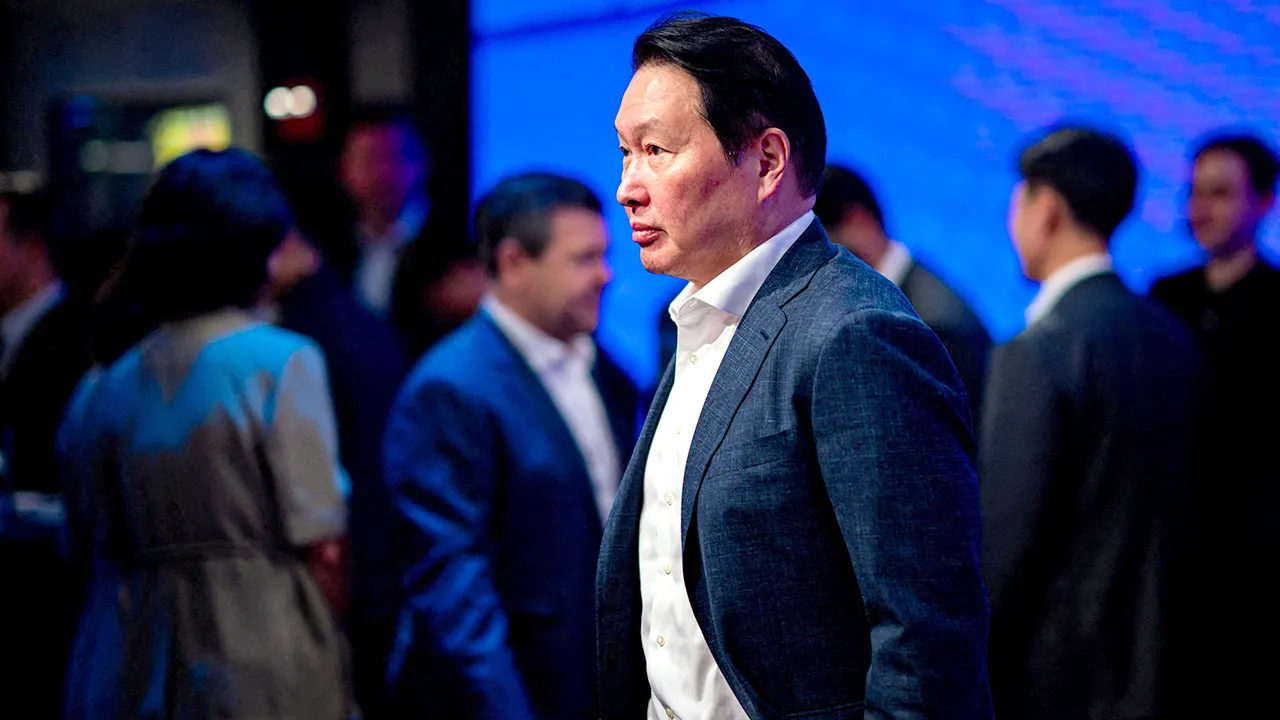
A South Korean court ordered billionaire SK Group Chairman Chey Tae-won to pay his former wife more than $640 million in a divorce settlement that could force him to sell assets, borrow money or pledge shares as collateral.
The Seoul High Court ruled Friday that Chey must pay Roh Soh-yeong 944 billion won (about $645 million), marking the largest divorce asset award in South Korean history. It’s been dubbed the so-called “divorce of the century.”
The payout is substantially lower than the 1.38 trillion (about $935 million) won awarded by an appeals court in 2024, but the revised judgment has renewed investor scrutiny of Chey’s holdings and how he could finance the payment.
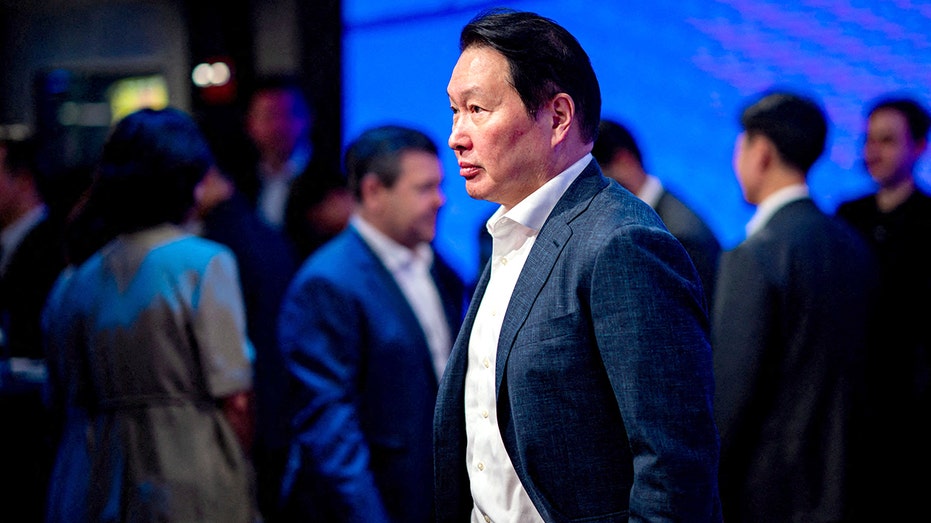
Chey Tae-won, the chairman of SK Group semiconductor and memory chip company SK Hynix. (Angelina Katsanis/Reuters)
Analysts said Chey may need to sell assets or borrow against his shares, though they do not expect the award to threaten his control of SK Group.
RELATIONSHIP EXPERT CHALLENGES ONE OF AMERICA’S ASSUMPTIONS ABOUT DIVORCE
Chey owns a 17.9% stake in SK Inc., the conglomerate’s holding company, and has an estimated fortune of $5.4 billion, according to Forbes.
The court ordered Chey to make the payment in cash rather than transfer stock, citing the importance of his shares to maintaining control of the conglomerate.
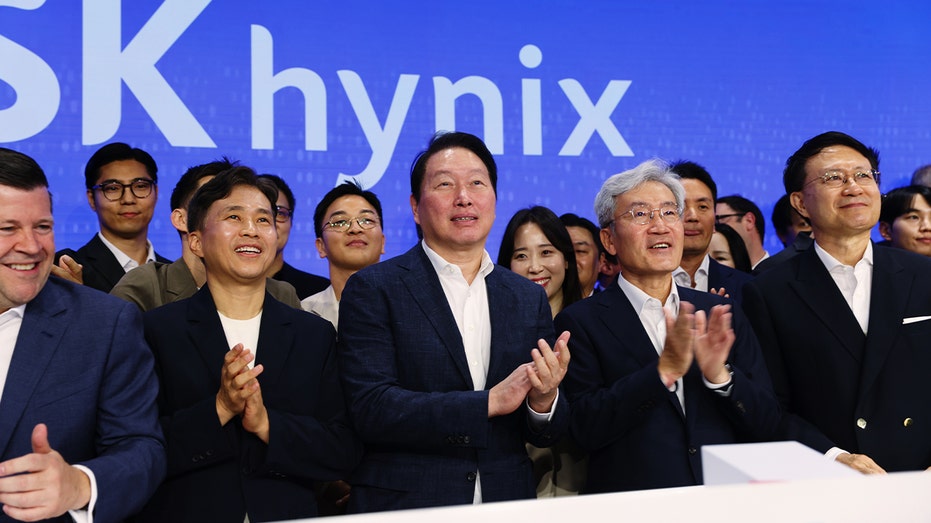
Chey Tae-won, chairman of SK Group, center, and Kwak Noh-jung, president and chief executive officer of SK Hynix Inc., center left, and Koh Seung-beom, chairman of SK Hynix Inc., center right, ring the opening bell during the company’s initial public (Michael Nagle/Bloomberg via Getty Images)
Shares of SK Inc. closed 3.8% lower Friday, while SK Hynix fell 8.3% in Seoul trading following the ruling.
SK Group’s profile has risen sharply during the artificial intelligence boom through SK Hynix, a major supplier of high-bandwidth memory chips used with Nvidia’s AI processors.
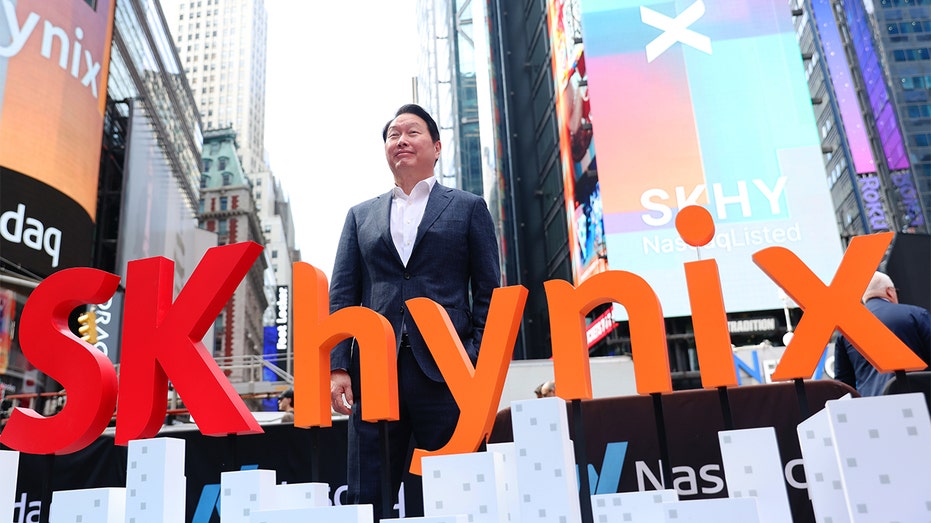
Chey Tae-won, chairman of SK Group, in New York City. (Michael Nagle/Bloomberg via Getty Images)
Judges awarded Roh one-third of the couple’s marital property after finding that she contributed to preserving and increasing the family’s wealth during the marriage.
The ruling followed a South Korean Supreme Court decision rejecting claims that alleged financial support from Roh’s father, former President Roh Tae-woo, should be included in the asset calculation.
CLICK HERE TO GET FOX BUSINESS ON THE GO
Either side may appeal the ruling, potentially sending the property-division dispute back to the Supreme Court.
Reuters contributed to this report.

OpenTheBooks CEO John Hart joins Varney & Co. to discuss long-term Social Security and Medicare deficits as fiscal pressures mount.
Social Security’s looming insolvency in under a decade could be delayed by a change to how the annual cost-of-living adjustment (COLA) is calculated, with a new analysis finding that it could cut the entitlement program’s 75-year fiscal shortfall in half.
The nonpartisan Committee for a Responsible Federal Budget (CRFB) proposed a COLA cap that would limit the dollar amount of the annual increase in Social Security benefits received by those with higher benefit amounts. That proposal was similar to a flat-rate COLA proposed by one of the think tank’s co-chairs, former Rep. Tim Penny, when he was in Congress in 1987.
The flat-rate COLA would pay all Social Security beneficiaries the same COLA, which would be set at the COLA received by a beneficiary at the 20th percentile of the benefit range – a move that effectively combined a COLA cap with a COLA floor at that level.
CRFB asked the Urban Institute’s Karen Smith to estimate how a flat-rate COLA set at the 20th percentile and 30th percentile beneficiary would impact Social Security’s solvency and benefits. The analysis found that a flat-rate COLA at the 20th percentile would close 50% of Social Security’s 75-year shortfall compared to her baseline, while at the 30th percentile it would close about 40%.
SOCIAL SECURITY RECIPIENTS COULD SEE BIGGER COST-OF-LIVING ADJUSTMENT IN 2027, NEW FORECAST SAYS

CRFB and the Urban Institute analyzed the flat-rate COLA proposal, finding it would extend the solvency of Social Security. (Getty Images/stock)
The flat-rate COLA would be relatively progressive – slowing the growth in benefits the most for those with the highest lifetime earnings and with the most income in retirement.
If set at the 20th percentile, the bottom fifth of lifetime earners would see benefits decline by just 3% in 2065, compared with 19% for the top fifth of earners. For a flat-rate COLA at the 30th percentile, it would boost the bottom quintile’s benefit by 1% while the top fifth would see benefits decline 17%.
Both a 20th or 30th percentile flat-rate COLA would boost Social Security benefits for the lowest quintile by 13% to 14%.
TRUMP LOOKING ‘VERY STRONGLY’ AT AUSTRALIA-STYLE RETIREMENT SYSTEM: ‘TAKING THAT, MAKING IT SHARPER’

A flat-rate COLA would curb benefit growth for the highest earners. (Getty Images/iStock)
A flat-rate COLA at the 20th percentile would delay the insolvency of Social Security’s main trust funds by two years – though CRFB noted that if it were combined with other policies, such as its employer compensation tax proposal, it could keep the merged trust funds solvent for 75 years close to it.
Looking back, if Congress had adopted a flat-rate COLA back in 1987 when it was proposed by Penny, CRFB’s estimates suggest it would have achieved 75-year solvency at the time, delaying insolvency to 2071.
It also would’ve covered about three-quarters of the solvency gap through 2100, giving policymakers time to make other gradual reforms to Social Security to address the remaining gap.
NEW BIPARTISAN PLAN SEEKS TO PREVENT SOCIAL SECURITY BENEFIT CUTS BEFORE TRUST FUND DEPLETION
Social Security’s main trust funds are projected to reach insolvency in 2032, when automatic benefit cuts would be triggered under current law. (J. David Ake/Getty Images / Getty Images)
The most recent estimates put the insolvency of Social Security in 2032, when benefits would be subject to an automatic cut of 22% to match incoming tax revenue after trust funds are tapped out. That would amount to a $16,900 cut in annual benefits for a medium-income, dual-earning couple starting in 2033.
The fast-approaching insolvency of the trust funds and the implications for American retirees should compel policymakers to pursue reforms to shore up the program’s finances as soon as possible, CRFB argued.
“One of the biggest takeaways of this particular solution is that it is a stark reminder of the real cost of waiting to save Social Security,” CRFB president Maya MacGuineas told FOX Business.
“Adopting a flat-rate COLA back when Congressman Penny proposed the idea would have achieved solvency through 2071, nearly half a century from now, and would have done so by protecting lower-income beneficiaries and reducing old-age poverty; now, that same plan would only delay insolvency another two years,” she explained.
GET FOX BUSINESS ON THE GO BY CLICKING HERE
“The good news is there are plenty of options out there that, when combined, can save Social Security from abrupt across-the-board cuts in just six years. But taking options off the table and waiting until the last minute leaves fewer and fewer ways to make the math work,” MacGuineas added.

Operator
Hello, everyone. Thank you for joining us, and welcome to WSFS Financial Corporation Second Quarter Earnings Call. [Operator Instructions]
I’d now like to turn the call over to your host for today, Mr. David Burg, Chief Financial Officer. Sir, please go ahead.
David Burg
Executive VP & CFO
Thank you very much, and good afternoon, everyone. Thank you for joining our second quarter 2026 earnings call. Our earnings release and an earnings release supplement, which we’ll refer to on today’s call, can be found in the Investor Relations section of our company website. With me on this call is Rodger Levenson, Chairman, President and CEO.
Prior to reviewing our financial results, I would like to read our safe harbor statement. Our discussion today will include information about our management’s view of our future expectations, plans and prospects that constitute forward-looking statements. Actual results may differ materially from historical results or those indicated by these forward-looking statements due to risks and uncertainties, including, but not limited to, the risk factors in our Annual Report on Form 10-K and our most recent Quarterly Reports on Form 10-Q, as well as other documents we may periodically file with the Securities and Exchange Commission. All comments made during today’s call are subject to the safe harbor statement.
I will now turn to our financial results. During the second quarter, WSFS’s performance
Business
The Siam Cement Public Company Limited (SCVPY) Q2 2026 Earnings Call Prepared Remarks Transcript
Unknown Executive
Good morning, ladies and gentlemen. Welcome to the SCG Analyst Conference for the Second Quarter of 2026. I’m [ Sikachi ] from SCG, Investor Relations Specialist, and I will be the moderator for today’s session. We are pleased to welcome all the guests who joined our session both online and offline. For those who join online, please kindly change your name and your company, I will accept you to the meeting room.
Today, our management are here to provide you the continued earnings momentum for the second quarter as well and the business update, followed by outlook. After the presentation, we will open the floor for the questions.
Today’s presenters comprise of SCG management, led by Khun Thammasak, the CEO of SCG, who will walk you through for the consolidated results and outlook. And SCGC management led by Khun Sakchai, the CEO of SCG Chemicals. Next, Khun Wiroat, President and CEO of SCG Cement – Building Materials will be also presenting for the SCG Decor. And lastly, Khun Chantanida, CFO of SCG, who will present the financial parts and also SCG Packaging.
And now let’s start for today’s presentation, beginning with Khun Thammasak.
Thammasak Sethaudom
President & Director
Good morning, and welcome back to analyst conference discussion today. So I just want to spend a little bit of time to look back at Q2, right? What really happened and what did we do right, probably what did we do wrong that we have to


Now retired, I am an income-oriented investor seeking high yield income to support my lifestyle in retirement.I became deeply interested in the stock market beginning in late 2007 (bad timing for me but worse for my uncle) when I received an unexpected inheritance. Since that time I have done considerable research and vowed to make smarter long-term investing decisions after suffering through the Great Recession with minimal losses to my inherited portfolio, after firing my financial advisor.I look for mostly dividend paying income stocks and funds (BDCs, REITs, CEFs, ETFs) that offer high yield income to increase my retirement income beyond my pension and Social Security. I also enjoy reading investment/financial and business information and following trends in technology and markets. The human psychology of markets is as fascinating and inscrutable to me as the financial side. I am not a financial advisor so please do your own due diligence before making any buy or sell decisions.“The race is not always to the swift, nor the battle to the strong, but that’s the way to bet.” Damon Runyon
Analyst’s Disclosure: I/we have a beneficial long position in the shares of UTF, MEGI, NXG, JRI either through stock ownership, options, or other derivatives. I wrote this article myself, and it expresses my own opinions. I am not receiving compensation for it (other than from Seeking Alpha). I have no business relationship with any company whose stock is mentioned in this article.
Seeking Alpha’s Disclosure: Past performance is no guarantee of future results. No recommendation or advice is being given as to whether any investment is suitable for a particular investor. Any views or opinions expressed above may not reflect those of Seeking Alpha as a whole. Seeking Alpha is not a licensed securities dealer, broker or US investment adviser or investment bank. Our analysts are third party authors that include both professional investors and individual investors who may not be licensed or certified by any institute or regulatory body.

Trump signs executive order related to Smithsonian Institution, White House says

Arcus: 'Buy' On Casdatifan Late-Stage CcRCC Advancement And 1st-Line Expansions

CRA International: An Attractive Entry Point For Long-Term Shareholders
Business
Apple Plans to Overhaul Its Entire Mac Lineup Starting This Fall With New MacBook Pro and iMac Models

Apple is preparing one of the most comprehensive overhauls of its Mac product line in years, with plans to refresh every computer it currently sells over the next two years, according to a report from Bloomberg’s Mark Gurman.
The rollout, aimed at capitalizing on surging demand for AI-capable computing hardware, is set to begin this fall with a new entry-level 14-inch MacBook Pro and the first refreshed iMac models in two years, with additional updates to the MacBook Air, Mac mini, Mac Studio and Apple’s newest budget laptop, the MacBook Neo, following over the subsequent months.
What’s arriving first
According to Bloomberg, both the refreshed 14-inch MacBook Pro and the updated iMac have already completed development and are being held for a fall release. The new entry-level MacBook Pro, internally codenamed J804, will be among the first Apple products to feature the company’s next-generation M6 chip. The refreshed iMac, carrying internal codenames J833 and J834, is expected to retain the same overall design and display as the current model, according to Appleosophy’s summary of the Bloomberg report, marking an incremental rather than dramatic visual update.
A bigger redesign coming later
Beyond this fall’s initial wave, Apple is preparing a more substantial redesign for its higher-end MacBook Pro lineup, arriving sometime between late 2026 and early 2027. According to Bloomberg, this next-generation Pro model, referred to internally by some reports as the “MacBook Ultra,” will feature an entirely new, thinner design paired with tandem OLED touchscreen displays and a Dynamic Island cutout similar to the one found on recent iPhone models. That premium model is expected to use Apple’s existing M5 Pro and M5 Max chips, carrying internal codenames K114 and K116 for its 14-inch and 16-inch variants, according to Appleosophy.
The touchscreen OLED display would mark a significant shift in Apple’s laptop design philosophy, introducing a display technology Apple has never before used on a MacBook Pro. According to BigGo Finance, Apple is already testing this hardware alongside macOS 27.1, which is expected to ship in late October, suggesting the software groundwork for the redesigned laptop is already well underway even if the hardware itself won’t arrive until later.
A refresh extending across nearly the entire lineup
Beyond the MacBook Pro and iMac, Apple’s broader roadmap includes updates to several other product lines. A refreshed MacBook Air is expected to retain its current design while adopting the new M6 chip, carrying codenames J913 and J915. New Mac mini and Mac Studio models are also in development, with their exact release timing reportedly dependent in part on memory chip supply constraints affecting the broader industry, according to MacRumors.
Apple is additionally preparing a second generation of the MacBook Neo, its budget-friendly $599 laptop that debuted in March 2026 as the first Mac ever built around an iPhone-class processor rather than Apple’s traditional M-series silicon. The current MacBook Neo runs on the A18 Pro chip, originally introduced in the iPhone 16 Pro, and BigGo Finance reports that Apple is now testing a successor version built around the newer A19 Pro chip.
Looking further ahead
Apple’s Mac roadmap extends even further into the future, according to Bloomberg’s reporting. A base-model 14-inch MacBook Pro built around the M7 chip and adopting the redesigned “MacBook Ultra” aesthetic is expected sometime in 2027, carrying the internal codename K104. A further refresh of the premium MacBook Ultra line, upgraded to M7 Pro and M7 Max chips, is anticipated in the late 2027 to early 2028 window.
Looking beyond that, Apple is reportedly developing an OLED version of the MacBook Air, expected no earlier than 2028, which would mark the first time that particular laptop line has offered an OLED display. An OLED iMac is also said to be in development, though its release timeline remains unclear, and it is expected to follow the MacBook Air’s eventual transition to the newer display technology.
Why Apple is investing so heavily in Macs now
The scale of this planned overhaul comes amid what MacRumors described as a broader Mac sales resurgence, with revenue from the product line projected to climb for a third consecutive year. According to BigGo Finance, Mac revenue recently reached a record level, with the growth partly attributed to an expanding user base relying on Mac hardware for demanding, AI-driven computing workloads, including so-called agent-based AI tasks that require significant local processing power.
Apple’s decision to prioritize this kind of hardware refresh reflects a broader industry-wide push among computer makers to capture growing consumer and professional demand for machines capable of running increasingly sophisticated AI applications directly on-device, rather than relying entirely on cloud-based processing.
A separate iPad delay
While the Mac lineup is set for a significant near-term overhaul, Apple’s iPad refresh plans appear to be moving on a slower timeline by comparison. According to MacRumors, Bloomberg had previously suggested a broader iPad update would arrive sometime in 2026, but more recent reporting suggests that refresh may not materialize until the first quarter of 2027 at the earliest, a shift that stands in contrast to the accelerated pace of Apple’s planned Mac updates.
Market reaction
News of the planned Mac overhaul drew a modest reaction from investors when it was first reported, with Apple shares slipping nearly 1% in morning trading the day the report emerged, according to Stocktwits, though the stock has continued its broader upward trajectory in the days since amid other positive catalysts, including price target increases from multiple Wall Street analysts.
With development on the initial wave of new Macs, including the refreshed MacBook Pro and iMac, already reportedly complete, attention now turns to Apple’s typical fall announcement schedule, when the company traditionally unveils new Mac and MacBook models alongside its annual iPhone lineup. Whether Apple sticks to the timeline outlined in Bloomberg’s reporting, and how the company positions this broader multiyear Mac refresh against its upcoming foldable iPhone launch and expanding AI software features, are likely to become clearer as Apple’s fall product announcements approach in the coming months.

HEQ: Discount Remains Significant, But Some Reasons To Be Cautious

Nvidia, Microsoft, Meta Warn Against ‘Premature Restrictions’ of Open-Weight Models

Anger after White House makes Jimothy the mutant raccoon MAGA

SK Group chairman ordered to pay ex-wife record $645M in divorce

Renter of Home in Anne Heche Crash Denies Settlement With Son

No Jackpot Winner as $257 Million Prize Rolls Over to $269 Million Monday Draw

Weekend Open Thread: Staud – Corporette.com

Financial Audit Guest Takes a Blood Pressure Test

$100 TRILLION! XRP EMERGENCY! RAOUL PAL “THIS IS A ONCE IN A LIFETIME OPPORTUNITY”!

Crypto Live Trading| 24 july #vinbullindia #livetrading #vinbulllive #live #trading #cryptotrading
-

 Politics6 days ago
The House | The City of London can help the new chancellor deliver growth in every postcode
-

 Crypto World6 days ago
Ripple Payments Joins MiCA With 14 Firms, Does It Mean Anything For XRP?
-

 Politics5 days ago
Democrats look to World Cup watch parties to register thousands of voters
-

 Crypto World7 days ago
Ripple wins EU-wide access as ESMA adds it to MiCA register
-

 Crypto World3 days ago
Grayscale Files For Worldcoin ETF, WLD Registers Sharp Rise
-

 Tech4 days ago
Sail Virtually Aboard The “Itanic” With IA-64 Emulator
-

 NewsBeat4 days ago
Unregistered fitter used Gas Safe logo on business flyers
-
 Tech4 days ago
Turtle Beach Command Series KB7 review: a nifty screen-equipped gaming keyboard
-

 News Videos5 days ago
Big Money Is Entering XRP
-
 Business3 days ago
New Jersey voter registration controversy explained: How 6,600 noncitizens got on the rolls, and what happens next
-

 Fashion3 hours ago
Weekend Open Thread: Brooks Brothers
-

 Crypto World6 days ago
Kaspersky exposes OkoBot’s 20-module crypto wallet attack
-
 Entertainment3 days ago
Johnny Depp’s R-Rated Gothic Cult Classic Gets New Release Ahead of Sydney Sweeney Remake
-

 NewsBeat7 days ago
Durham County Council to send out electoral registration emails
-

 Crypto World2 days ago
Ethics, other provisions in crypto Clarity Act to be further discussed
-

 Crypto World7 days ago
MiCA Licensing Faces Delays as ESMA Adds 14 CASPs to Register
-
 NewsBeat4 days ago
Shanghai science forum photos show China’s AI and robotics advances in rivalry with US
-

 Crypto World6 days ago
Chip Stocks Enter Bear Market After Moonshot Ai Unveils Kimi K3 Model
-

 Tech4 days ago
Watch Flock Safety CEO Garrett Langley discuss the future of surveillance at TechCrunch Disrupt 2026
-

 Tech5 days ago
Subway Sandwich Computers Get a Second Life as Gaming Machines
You must be logged in to post a comment Login