Florian Nath, spokesman for Police Berlin, said “numerous” people were injured, including several with life-threatening injuries.
Some are being resuscitated at the scene, according to Nath.
Regarding how the people were injured, he said a white car was driven into the Tiergarten and hit several people along the Ahornsteig, a road through the large park.
Advertisement
Police are searching for one or several suspects, Nath added.
Families jetting off abroad during the summer holidays have been warned by a travel expert about a vital check they must ensure they do before heading to the airport
A travel expert has issued a warning to families about the one important check they must do before jetting off abroad.
Advertisement
There’s a lot to think about before making your way to the airport for that sun-soaked getaway, from checking the family’s passports are all in date, to packing the suitcases and planning the itinerary. But there’s one crucial task that can’t be missed, and experts are reminding families to ensure it’s in place as the summer holidays are set to be among the busiest travel periods.
Graeme Buck, director of communications at ABTA, the Travel Association, said: “It’s holiday time for many families, as schools start to break up, meaning lots more people will be heading abroad to visit new destinations or return to their old favourites.”
He warned: “Before you set off, we’re encouraging people to take a moment to make sure they have all of their holiday essentials – including travel insurance that covers the activities they plan to do.”
Advertisement
Travel insurance is crucial to have in place before any trip abroad, as it can give you extra protection should anything go wrong with the holiday. Citizens Advice outlined that it can protect you against the following:
cancelling or cutting short your trip for reasons beyond your control
missed transport or delayed departure for reasons beyond your control
medical and other emergencies
personal injury and death
lost, stolen or damaged items, including baggage, passports and money
accidental damage or injury caused by you.
The expert at ABTA also urged families to ensure that the “whole family’s passports are in date” and reminded them that “children’s passports are only valid for five years.” If you or your child needs to renew their passport, you can do it online through the government website.
The standard fee for a child’s passport, aged under 16, costs £66.50 when applied for online, while a postal application costs £80. Meanwhile, it costs £102 to renew or replace an adult passport when applied online, or £115.50 when applied in a paper form.
In further guidance for holidaymakers, Graeme added: “We have advice to help you plan and prepare for your trip, and if you are still planning to book a holiday, ABTA members are on hand to make sure you can get the best family holiday for your budget.”
Advertisement
It comes as the summer holidays are set to see a staggering 30 million British holidaymakers pass through UK airports in July and August alone. According to the UK Civil Aviation Authority, the busiest day to fly will be this Friday (25 July), as 500,000 passengers, including thousands of families, ditch the UK for a sun-soaked getaway abroad.
All travellers jetting off abroad have also been warned to pack their power bank in their carry-on bag instead of their checked-in luggage. This follows a recorded number of safety incidents on board flights caused by lithium batteries found in power banks.
The CAA safety experts warned: “Incorrectly packed lithium batteries are increasingly causing delays and cancellations due to bags having to be offloaded. If a fire breaks out onboard, flights may have to be rerouted or evacuated.”
Therefore, power banks must be carried on board in hand luggage, “to enable swift action to be taken if they start to overheat”. Passengers should also be mindful that they can carry only two power banks per person on the flight, but they should check directly with their airline regarding specific restrictions, as certain airlines may have additional requirements.
Advertisement
Do you have a travel story to share? Email webtravel@reachplc.com
Two cops have been rushed to hospital with “serious injuries” following a hit-and-run in Larkhall.
Two police officers have been rushed to hospital with “serious injuries” after a van was “deliberately driven at them” in a hit-and-run.
Advertisement
Emergency crews rushed to Glen Avenue in Larkhall, South Lanarkshire, this afternoon. An alarm was raised around 2pm after police received a report of two of their cops having been knocked down.
The force confirmed that the pair had been carrying out enquiries at a property in the area before a van was “deliberately driven at them”. Paramedics attended the scene and both were blue-lighted to hospital.
It’s understood that the two officers have suffered serious injuries. Police Scotland are now working to find both the vehicle and driver as enquiries continue.
A Police Scotland spokesperson said: “Around 2.10pm on Saturday, July 25, officers were carrying out enquiries are a property on Glen Avenue, Larkhall when a van was deliberately driven at them.
Advertisement
“Two officers have been taken to hospital for treatment to serious injuries.
“Enquiries are ongoing to trace the vehicle and the driver and establish the full circumstances.”
Get more Daily Record exclusives by signing up for free to Google’s preferred sources. Click HERE.
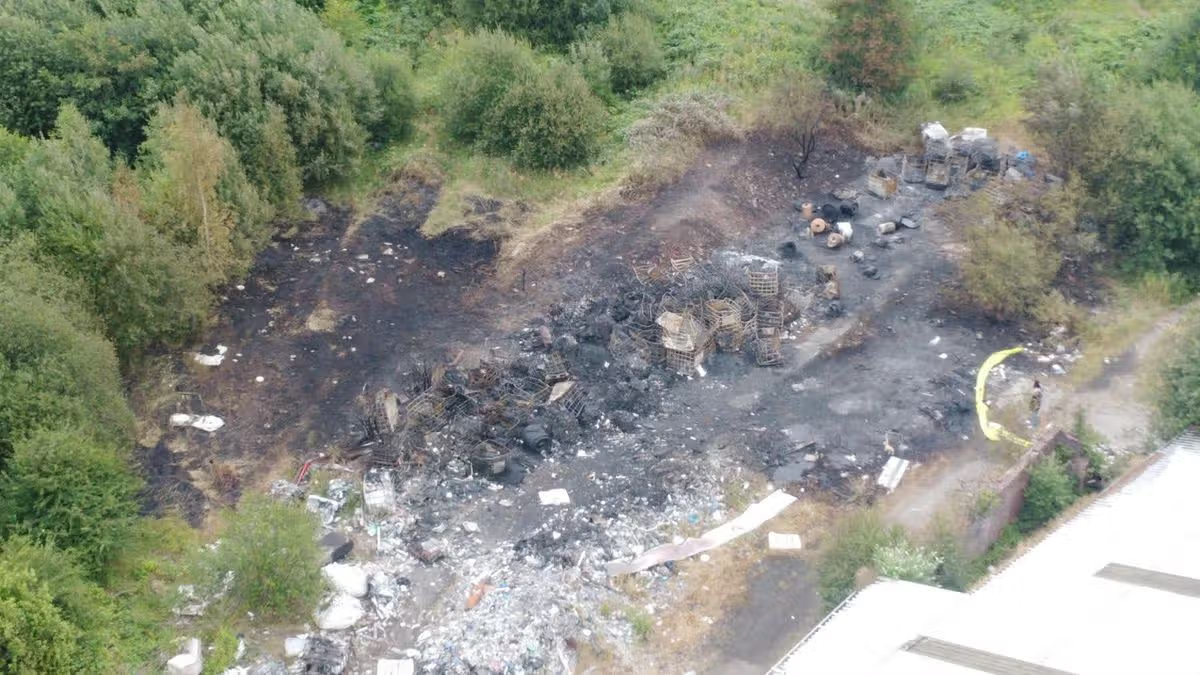
Aerial images show the impact of a huge fire which burned overnight in Rochdale.
Advertisement
The large broke out in an open area on Spring Mill Walk in Smallbridge at around 8:15pm last night (Friday, July 24).
Dramatic photos on social media showed enormous plumes of black smoke billowing from the site, visible from across Rochdale as the fire ripped through a large quantity of waste at the site.
Click here to get the biggest stories straight to your inbox in our Daily Newsletter
Firefighters worked throughout to extinguish the blaze.
Advertisement
They then remained on the scene until around 1pm this afternoon (Saturday), damping down hotspots and monitoring the aftermath.
Pictures shot by a drone camera this afternoon show a huge area of scorched earth and debris left behind by the fire.
It is understood officials from the Environment Agency were also called in and the local council alerted due to the fact it involved waste.
Arguably the biggest and certainly the most lucrative and long-awaited showdown in British boxing history looks likely to finally come to pass after so many years of frustration, near-misses and animosity.
Dominant: Tyson Fury forced Mariusz Wach to quit on his stool before the eighth round in Thailand
AFP/Getty
When is Fury vs Joshua fight?
Advertisement
At the moment, we still don’t know for sure with a date and venue for the fight having yet to be announced despite the contracts being signed earlier this year.
However, it has long since been widely reported that November is the preferred month for it to take place.
Where is Fury vs Joshua fight?
There could be a complication, however, as organiser Turki Alalshikh wants the bout to be watchable at a good time for television audiences in the United States and elsewhere.
Advertisement
As such, he proposed the idea of an overnight card, taking place in London, to best suit the time zones across the pond.
“It depends if England give us all that we need,” Alalshikh said.
“We want the fight here in England, but we want the time zone of all the world, especially in America.
“If they allowed us to have Wembley late in the night, we want to do it in England. It is about the time and viewership.”
Advertisement
Recovery: Anthony Joshua was knocked down twice by Kristian Prenga before bouncing back quickly
Getty
If that was to be the case, the main card may not start in the UK until 2am in order to coincide with ‘prime time’ in the US.
Wembley typically has an 11pm curfew for most weekend events and special approval would need to be granted to extend that into the early hours of the morning.
Eddie Hearn, Matchroom Boxing chief and Joshua’s long-time promoter, insisted that the bout would be held in the UK, but told DAZN in the build-up to Joshua vs Prenga that there was now an increasing possibility of it being taken to the US.
Advertisement
“We’ve been told in the last 24 hours that [a fight in America] is what they want,” Hearn said. “That doesn’t tally up with the contract that we signed.
“Until we’re happy, we expect every point of that contract to be followed. I feel like this fight should be taking place in the UK.
“Anthony Joshua insisted that the contract stated that the fight must be in the UK.
“If they want to change the contract, then we have to renegotiate the contract. Which, by the way, is not a problem. But it’s a conversation we have to have.”
Advertisement
Cardiff’s Principality Stadium had also been rumoured as a potential venue for Fury vs Joshua, having previously hosted the latter’s fights against both Joseph Parker and Carlos Takam.
However, Croke Park in Dublin was ruled out, following initial suggestions in some quarters that the fight could take place on the same bill as Katie Taylor’s farewell contest against Flora Pili in September.
If it was to go to the US, then it seems likely that New York’s Madison Square Garden – scene of Joshua’s shock loss to Andy Ruiz Jr in 2019 – would be firmly in the mix, unless organisers could secure a huge outdoor venue such as AT&T Stadium in Dallas, which has hosted many big fights in the past.
Sainsbury’s is to increase supplies of British tomatoes, cucumbers and peppers amid fears of drought affecting crops imported from abroad.
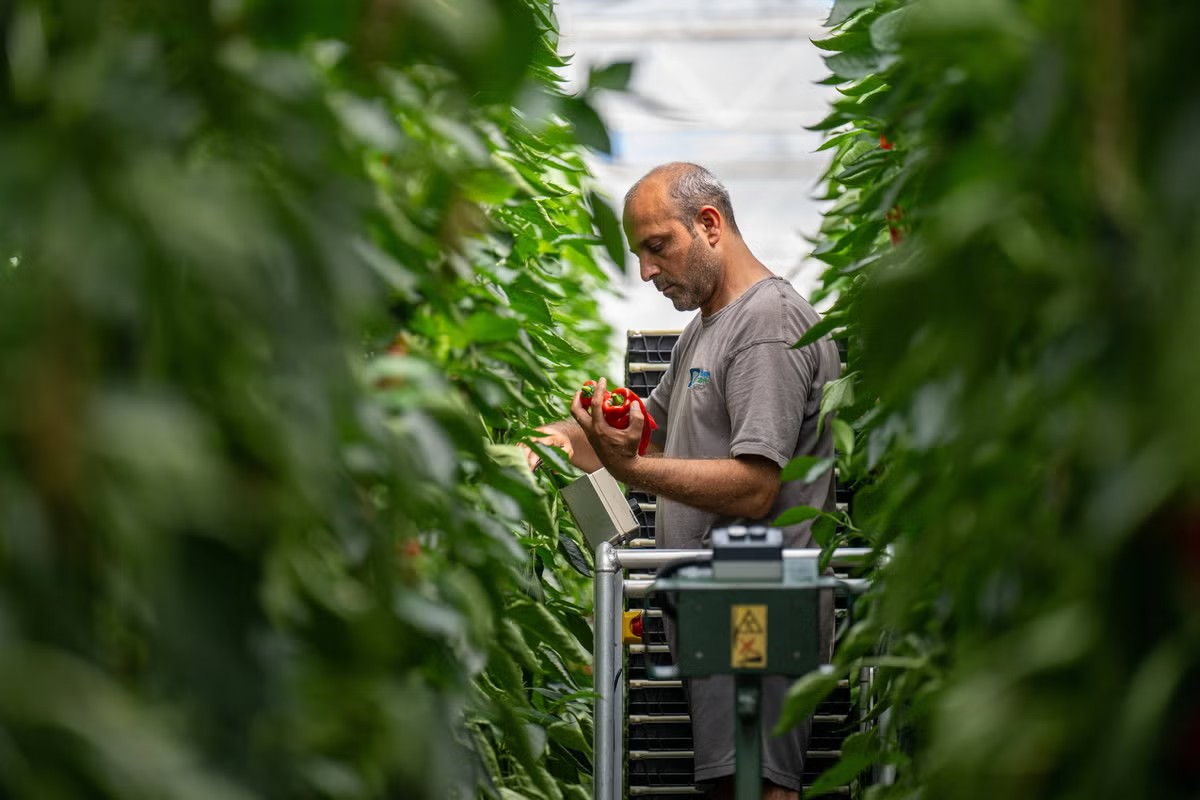
The UK’s second biggest supermarket has signed new 10-year partnerships with UK producers Evesham Vale Growers and Thanet Earth to ensure it can keep a steady supply of tomatoes, peppers and cucumbers on its shelves.
The produce has been badly affected by weather-based shocks in the past.
In early 2023, supermarkets imposed limits of three on packs of tomatoes, as well as cucumbers, peppers, lettuce, salad bags and some vegetables after a combination of bad weather and related transport problems in north Africa and Europe led to widespread shortages on UK shelves.
Advertisement
Sainsbury’s said British-grown tomatoes, peppers and cucumbers were already an important part of its salad offer to customers, but extreme weather across warmer growing regions had underlined the need for supermarkets to think differently about how they build more resilient supply chains.
The grocer said it hoped its long-term agreement with Thanet Earth would extend availability of British cucumbers beyond the summer season into the winter months for the first time, after traditionally relying more heavily on imports.
The new British winter crop will be grown at Thanet Earth in Kent, the UK’s largest single site glasshouse complex, where supplementary lighting, heat, and CO2 are managed to create the conditions cucumber plants need to keep growing through the darkest months of the year.
Benefits of the agreements would be seen on shelves as early as this summer with the launch of the new Taste the Difference British Salad Selection 800g box.
Advertisement
Hannah O’Reilly, category director of produce at Sainsbury’s, said: “With our changing weather, it’s more important than ever to find new, innovative solutions to make sure our customers can continue to enjoy the quality produce they want all year-round.
“Investing in more British production and supporting our suppliers to innovate is helping us build a stronger, more resilient supply chain in a category that has been impacted by weather-based shocks in recent years.
“By giving our brilliant British growers the certainty to invest and innovate through long-term contracts such as these with Thanet Earth and Evesham Vale Growers will help us to continue to support British farming for years to come.”
Rob James, technical director at Thanet Earth, said: “Working with Sainsbury’s in this way means we can plan ahead with more certainty and keep pushing what’s possible for British growing.
Advertisement
“A good example is our investment in the technology needed to grow cucumbers through the winter, creating the right conditions for the crop and helping bring more British-grown produce to customers at a time of year when that has not previously been possible.”
The informal role of prison philosopher is taken up by incarcerated people across the world. With time on their hands and a proximity to other people, systems of control and narratives of morality, people in prison are well positioned to practice philosophy.
This is the terrain that Dennis Kelly’s six-part BBC television drama Waiting for the Out, released earlier this year, covered. The series is an adaptation of Andy West’s memoir The Life Inside (2022), which shares his experiences of teaching philosophy in prison contexts and unfolds his own proximity to criminalisation through his father, uncle and brother, who all spent time in prison.
Michel Foucault in 1970. Jerry Bauer/Pantheon Books
We are theatre-makers who regularly co-create work with people living or working inside our criminal justice system. Saul with arts organisation Rideout Creative Arts for Rehabilitation and Sarah as a researcher and practitioner based at Royal Central School of Speech and Drama. Our latest collaboration explores the resonances and utility of French philosopher Michel Foucault’s influential 1975 work Discipline and Punish today.
Advertisement
Foucault’s book, which is core reading on most social sciences undergraduate curriculums, argues that since the late 18th century, punishment has morphed into discipline, a more diffuse form of surveillance and social control.
We were keen to investigate whether the book held meaning for people with lived experience of our criminal legal system today and understand what new insights they, in turn, might bring to Foucault’s work. We also drew inspiration from more contemporary writing, most fruitfully Henrique Carvalho and Anastasia Chamberlen’s nuanced interrogation of contemporary practices of punishment, Questioning Punishment (2023).
In spring of 2025, across ten initial drama workshops, we collaborated with members of Expert Citizens, an organisation led by and for people with lived experience of multiple disadvantage. We collectively explored power, punishing institutions and surveillance.
Advertisement
We went on to create an ensemble comprised of four Expert Citizens members and six theatre-makers. They shared creative, lived and theoretical knowledge with one another across a four-week intensive devising and rehearsal period.
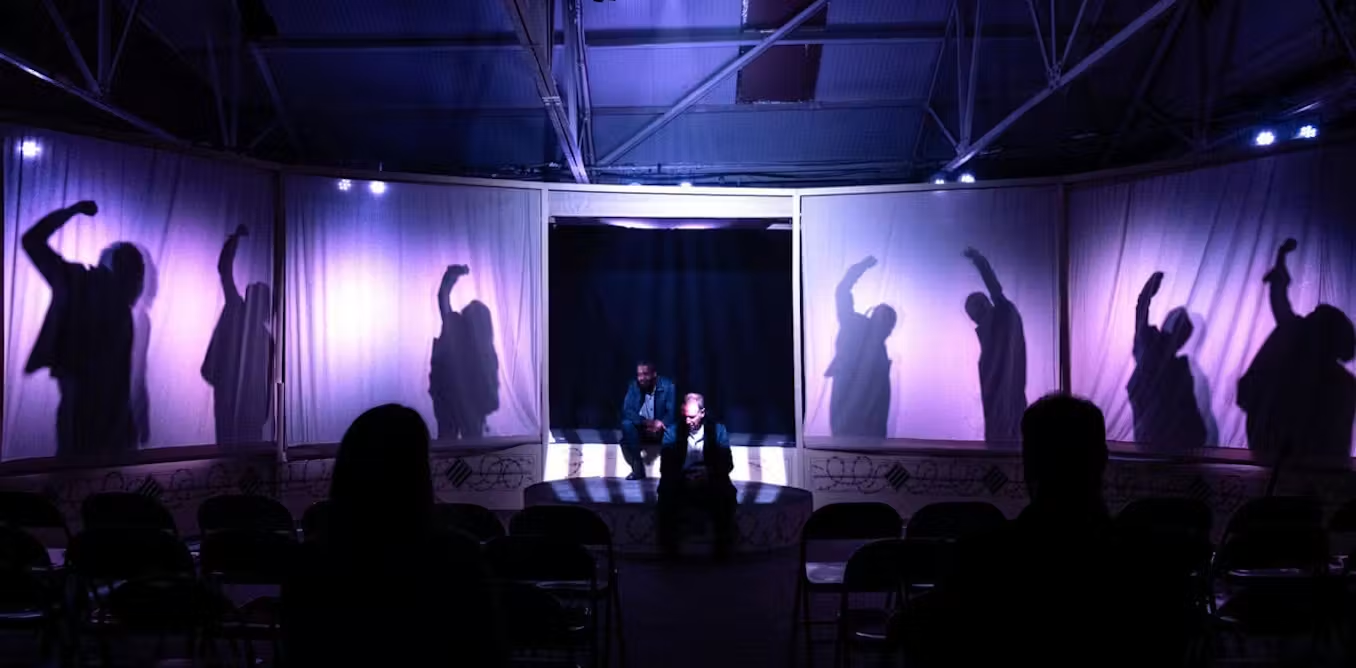
Ultimately the ensemble created Punishment Acts: Tales of Retribution, Reparation and Redemption, an 80-minute production that was staged over seven nights at the B Arts theatre in Stoke on Trent.
Punishment Acts: Tales of Retribution, Reparation and Redemption.
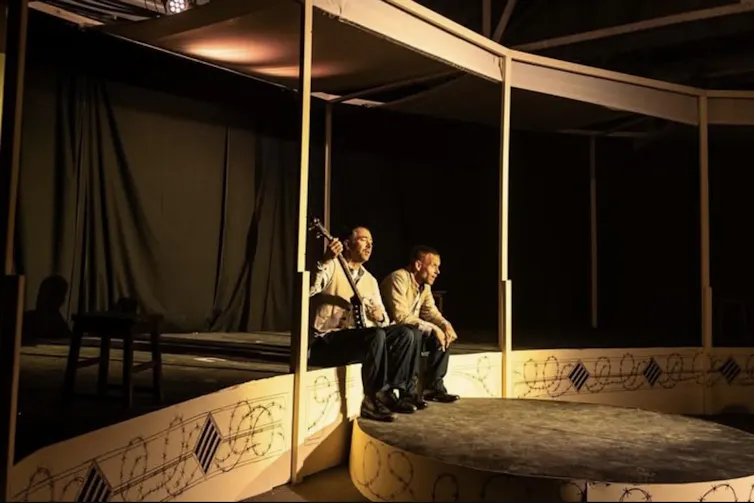
Set in a prison cell late at night, between restless sleep and wakefulness, the cell’s occupants traverse different histories and spaces of punishment. Through a collage of puppetry, fable and movement, the show asked audiences to reflect on beliefs about punishment and consider whether there are other ways to achieve justice.
Advertisement
Punishment Acts sits in a landscape of theatre work that is increasingly interested in opening up conversations with audiences about what we want our justice system to look and feel like.
James Graham’s 2025 play Punch drew on Jacob Dunne’s memoir, Right from Wrong. Dunne’s book documents his conviction of manslaughter and the restorative justice process that brought him together with the parents of James Hodgkinson, the man he killed, so all three could begin to rebuild their lives. Punch staged the possibilities and processes of restorative justice as an alternative framework for responding to harm for a wider audience, initially at Nottingham Playhouse and then on to the West End and Broadway.
Synergy Theatre Company’s recent production of Evan Placey’s Lifers, meanwhile, invited audiences to consider how we respond to the ageing prison population and the broader harsh and dehumanising conditions of imprisonment in Britain. Bringing audiences attention to our rapidly shifting prison population and inviting them to ask what that might mean for the architecture, staffing and conditions within our prisons evidences the capacity of theatre to hold space for nuanced and humane reflections on justice.
Actors on stage in Punishment Acts: Tales of Retribution, Reparation and Redemption. Natalie Willatt
Meanwhile Lung theatre company are currently touring Woodhill, a beautifully choreographed documentary piece that stages the acute failings at HMP Woodhill which led to catastrophic failures in care of the men held there. Chris Carpenter, Stephen Farrar and Kevin Scarlett were all held at the prison and each found dead in their cells between 2013 and 2018. Built on 70 interviews, the performance is a searing indictment of our failing prison system.
Theatre has long been a practice that invites audiences to (re)examine our relationship to the criminal justice system. What was distinctive about Punishment Acts is the explicit integration of philosophy, lived experience and community performance.
Advertisement
The importance of lived experience
Foucault’s ideas became less abstract through the ways our mixed cast could engage with and expand them in relation to contemporary prisons, probation and support services in Britain.
Punishment Acts was not autobiographical and used a fictional frame to enable some distance between cast members’ own stories and the characters in the play. But as one of the Expert Citizens mentors noted, the character they came up with embodied the frustrations they’d experienced in their own journey.
This was integral to the project and underscored how lived experience groups reanimate and offer useful perspectives on philosophy rather than the learning only going one way.
Advertisement
A scene from Punishment Acts: Tales of Retribution, Reparation and Redemption that has subsequently been used in training for professionals working in housing.
For example, the ensemble devised a scene in a hostel that blended Foucault’s discussion of how institutions organise space and time to enact control with their own experiences of punitive treatment in hostels.
In the play, the character of Melissa arrives at an Approved Premises looking for support, but is met with a long list of rigid and increasingly punitive rules from the use of the washing machine to the working hours of the communal kettle. The list is in fact so long it makes Melissa late for a probation appointment. When Melissa eventually meets her probation officer, an under resourced and overworked figure, another set of rules is deployed in lieu of support. Ultimately, her infringement of lateness lands her back in prison, back into the same cycle.
Melissa’s journey drew on Foucault’s proposal that punishment expands far beyond the prison gate and echoed the experiences of our ensemble. They also recognised that those working in these contexts (housing, justice, employment) are also being let down by systems that so often do not enable them to meaningfully support people.
The expansion of mainstream live performance, TV series and films addressing ideas around justice, harm, and punishment is to be welcomed. It marks an increased appetite from a broad range of people to examine the values, histories and philosophies of our criminal legal system.
Advertisement
Amid this growth in representation on our stages and screens, it’s vital to support community-rooted and research-informed performance projects. Such work brings people with different skills and experiences together, it foregrounds the knowledge of those who have had contact with our justice system, and enables us to collectively explore the fundamental ideas that inform our approach to punishment.
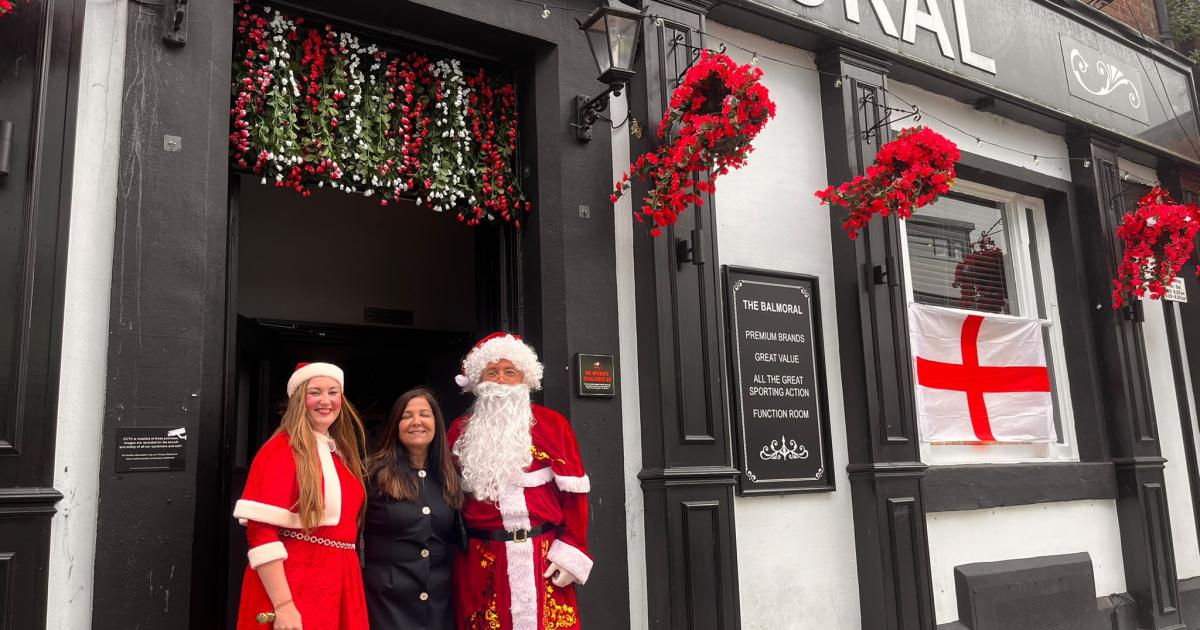
For the past four years, The Balmoral Hotel on Bradshawgate has invited customers to get into the festive spirit for charity.
As the Bolton News arrived to check out the event, a lively rendition of the 12 Days of Christmas could be heard from outside the pub.
Inside, landlord and landlady Danny Loynd and Zoe Monaghan, had pulled out all the stops, with festive tunes on full blast, Christmas trees, tinsel everywhere, and cosy winter fireplaces on the TV screens.
Christmas has come early at the Balmoral Hotel in Bolton (Image: Bolton News)
For them, seeing the reactions from customers when they walk into the pub is what it’s all about.
Advertisement
Danny said: “Everybody smiles when they walk in here. Christmas is a happy time.
“At Christmas time, people don’t get a chance to meet each other. So why not do it in July, when everybody can get to Christmas and can enjoy it?”
He said that when they started the unusual tradition, it confused some punters.
He added: “The first year we did it, which was four years ago, it was a bit: ‘Oh, what are you doing?’ But then everyone enjoyed it, and the audience has just got bigger and bigger every year.
Advertisement
“People do ask, and we tell them why we do it, and then they love it and they come and join us. So that’s what we want.”
Danny and Zoe kicking off the event at 2pm. (Image: Bolton News)
One of the revellers getting into the Christmas spirit at the Balmoral was Bolton MP Yasmin Qureshi.
She said: “I think the Balmoral is a great place. A lot of people come here. They’re doing something really different for their customers and for a lot of people who might not be able to be here for Christmas.
“I think it’s a great idea to have a Christmas bang in the middle of the summer.
Advertisement
“You can’t beat the atmosphere in here. It’s amazing, absolutely electrifying. It’s an absolutely brilliant idea. I think more people should be doing it.”
Christmas at the Balmoral Hotel (Image: Bolton News)
When we visited, the party was just getting started, with a whole programme of events planned throughout the day, including two buffets, a raffle, and music acts.
They were also raising money for their chosen cause, the suicide prevention charity CALM, with Christmas envelopes.
The grand finale of the evening is set to be the Elvis Showband, who will be taking to the stage at 8pm.
Advertisement
Danny added: “It’s just something we bring to town because it’s different. So we want to give people an excuse to come to Bolton, and today’s the day.”
More information about the event and the Balmoral Hotel can be found on the pub’s social media pages.
With a population of more than 100 million, West Bengal is the fourth largest state in India. It has always been an important target for the ruling Bharatiya Janata party (BJP), but despite the electoral success of Narendra Modi’s party across the whole country in recent years, West Bengal always bucked the trend.
Rather than buy into Modi’s Hindu nationalist vision, Bengali voters have traditionally been influenced by a strong sense of regional identity. Mamata Banerjee’s Trinamool Congress (TMC) government deliberately cultivated this when in office between 2011 and 2026. It presented itself as the defender of the state’s language, culture and way of life.
Banerjee argued vociferously during debates over citizenship that Modi and the BJP were trying to smear Bengali speakers, particularly in border regions, as “illegal immigrants”.
The TMC also highlighted central government’s attempts to promote a Hindu model of vegetarianism as being at odds with Bengal’s pluralistic traditions, where fish, meat and eggs are staple foods consumed across religious communities.
Advertisement
As a result, the BJP was not just competing against an incumbent government. It was going up against a strong political identity that presented itself as the guardian of Bengal’s traditionally pluralistic culture and way of life.
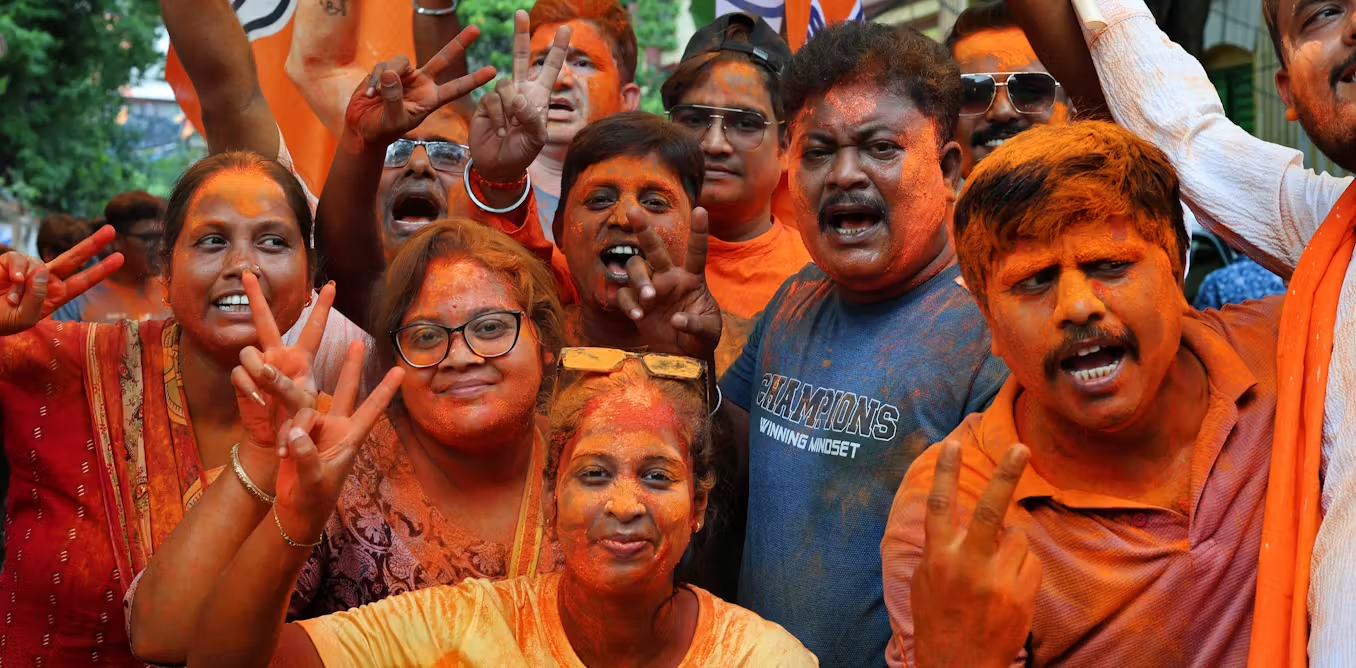
So the BJP victory over TMC in May represented a significant electoral upset. More so, because West Bengal was the last major state where BJP had been unable to displace a powerful regional party, despite its national success.
Historical influences
This was not a routine change of government. To get a feel for why the BJP’s victory in West Bengal was so consequential, you have to understand its distinct culture. And to do that, you have to go back to before Indian independence, when the British partitioned India on religious grounds. This formed two new countries: India for the Hindus and Pakistan for the Muslims.
As part of the process, Punjab in the northwest of India, was divided with west Punjab going to Pakistan and the east to India. Similarly Bengal in eastern India was split with the Hindu majority west going to India and the east to Pakistan, before East Pakistan won its independence in 1971, becoming the new state of Bangladesh. Despite this, communal violence continued to spill over both sides of the newly declared borders along sectarian lines.
Advertisement
Nonetheless, even today, both Punjab and Bengal have remained true to their tradition of diversity. This is an embodiment of the principle of “syncretism”. Syncretism is about the peaceful amalgamation of different beliefs, culture and practices. It aims to strike a harmony among diverse traditions – in this case, specifically between Hindus and Muslims.
For years, Bengal’s uniqueness was based on the central idea of miśra saṃskṛti, literally “mixed culture” or “blended civilisation”. Hindu and Muslim traditions were allowed to flourish together. Various traditions served as cultural symbols that set Bengal apart from the communal strife affecting other regions of the subcontinent.
These include bauls – wandering mystic singers who blend elements of Hinduism and Islam. These singers are typified by Lalan Fakir, the 19th-century poet and spiritual leader whose estimated 10,000 songs, many of which mock and condemn religious and caste differences, earned him the devotion of millions across the region.
Bengal’s dargahs, meanwhile – sufi shrines built over the grave of revered holy figures – are used interchangeably by both Hindus and Muslims.
Advertisement
In contrast, the BJP aggressively promotes hindutva an ideology which defines India as a Hindu state. This, was widely thought, would be a disadvantage in winning votes in West Bengal. But the BJP’s electoral success in securing 207 out of 294 seats showed that this syncretism was always more delicate than its proponents acknowledged.
Indian prime minister, Narendra Modi, with the chief minister of West Bengal, Suvendu Adhikari, and other BJP ministers being sworn in after the May 2026 election. Sipa US/Alamy Live News
Bengali syncretism, its trust in amalgamation of traditions and beliefs, was expressed in poetry, music and folk devotion. But it never penetrated the structures of property, political economy or electoral arithmetic.
Hindus under threat
The BJP appears to have understood better than its political opponents the fear among many people in West Bengal of the Islamic influences coming in from Bangladesh. The BJP successfully harnessed and politicised this idea as a threat to Hindus in West Bengal. To do this, the BJP tactic was to revive memories of partition in 1947 as an exclusively Hindu tragedy.
BJP also coopted various elements of Bengal’s intellectual heritage. They successfully portrayed Bengali cultural heroes such as novelist Bankim Chandra Chattopadhyay and religious leader Swami Vivekananda primarily as champions of Hindu nationalism in speeches, articles and commemorations. It took pains to play down their role as representatives of Bengal’s pluralist humanism.
Advertisement
The BJP’s victory in West Bengal is in stark contrast with its failure to win in Punjab, another state where partition led to considerable upheaval. The major difference is demographic: whereas the contest in West Bengal was always between Hindus and Muslims, the majority of people in Punjab, nearly 58%, are Sikhs.
Punjab’s Sikh community has an identity that is assertive and politically independent with institutional manifestation in the centre-right Shiromani Akali Dal party. So, while in West Bengal the BJP was able to mobilise its Hindu community via the “Hindus under threat” narrative, this story is neither necessary nor effective in Punjab.
Many Sikhs perceive that hindutva diminishes their autonomy and subsumes their distinctive identity into a larger fold of Hinduism, a trade-off that a significant section of the Punjabis are unwilling to make.
But when the BJP in West Bengal promoted its narrative of Hinduism under threat, it discovered that a sizeable portion of the voters identified more readily with that than with the baul’s songs.
In the early hours of the morning, Danny had to board up the smashed windows and cover them up with England flags so the pub was ready for the event.
The pub has shared their CCTV footage on Facebook, asking for anyone who may know the culprits to come forward.
They said in the post: “These two little cherubs thought it was ok to come armed with a crowbar, with finger prints on it because you also had no gloves on and came and smashed 3 of our windows.
“If anyone recognises these two lovely boys please inbox us.”
Advertisement
One of the youths appear to be filming the incident. (Image: The Balmoral Hotel)
In response, the pub has received an outpouring of support in the comment section from customers. The post has also been shared on Facebook 125 times.
The Balmoral Hotel has reported the incident to the police.
Greater Manchester Police have been contacted for comment.
























































You must be logged in to post a comment Login