
Security teams log 54% of successful attacks and alert on just 14%. The rest move through your environment unseen.
The Picus whitepaper shows how breach and attack simulation tests your SIEM and EDR rules so threats stop slipping by detection.




Entropy is one of the most maligned and misunderstood concepts in science. Maybe you’ve heard it defined as the “amount of disorder” in a system. And the second law of thermodynamics says the entropy of a closed system always increases over time. So you might think, why should you clean up your office if it will only get messier?
That might be true, but you can’t blame it on entropy. The messy-room metaphor is often used to introduce the idea (it’s usually a teenager’s bedroom—can you relate?), but it’s misleading. See, disorder doesn’t mean messiness or chaos; it refers to the number of ways the parts of a system can be arranged without changing the overall state of the system.
For example, say your “system” is just a box full of air. Inside, at the microscopic level, the gas molecules are bouncing around like bumper cars. Now, imagine you could map the location and velocity of each particle at a given instant. That would be one possible arrangement, or microstate, but there are an infinitude of others, and they’re changing trillions of times a second.
Of course, you can’t really see this stuff. Instead, what you observe are overall, macro-level properties like air pressure; if you sealed the box at sea level, that would be 14.7 pounds per square inch. And unless you add energy to the system, say by heating it, that doesn’t change. So all those microstates correspond to the macrostate of 14.7 psi. Get it?
In other words, entropy is all about the link between the invisible atomic realm and the visible, measurable realm of objects, the world we inhabit. You could say it’s a conceptual and mathematical bridge between two levels of reality. I mean, c’mon, that’s pretty cool.
Now, out of all possible outcomes, which ones actually occur? That’s basically random, so it’s a matter of probability. In fact, probability is fundamental to the idea of entropy, and this is what the messy-room image fails to capture. So I’m going to use a different analogy: rolling dice. Einstein once said “God doesn’t play dice with the universe.” Let’s just see about that, shall we?
Imagine you roll a six-sided game die. You get a number from 1 to 6, right? There are six possible outcomes, or states. If you roll the 20-sided die in Dungeons & Dragons, there are 20 possible states. If you want to wow your D&D pals, you could casually remark that this die has a higher entropy—because it has more possible outcomes.
Now say you’re determining a character’s abilities in D&D, and you roll three six-sided dice. The three values can add up to anything between 3 and 18, but the various sums are not equally likely. For maximum dexterity, say, you need an 18. Well, there’s only one way to achieve that: Each die must come up a 6.

Photograph: Rhett Allain


Hackers are changing the DNS settings on Wi-Fi devices at hotels and conference centers to redirect users to fake Microsoft 365 login pages.
The campaign has been ongoing since at least June and impacts organizations in various sectors, including financial services, professional services, legal, health care, energy, and retail.
Cybersecurity company ReliaQuest identified compromised Wi-Fi gateways in multiple U.S. cities as well as other regions of the world, such as India and Saudi Arabia.

Since the devices serve corporate events, hijacking the Microsoft 365 accounts could give attackers access to sensitive business information, communications, and private documents.
“We observed traffic to these compromised gateways from organizations in a range of industries, including financial services, professional services, legal, health care, energy, and retail- confirming this isn’t sector-specific targeting, but a campaign that highly likely goes after traveling employees wherever they connect,” ReliaQuest says.
The researchers believe this activity is similar to the FrostArmada router-based campaigns attributed to the Russian espionage group APT28 (a.k.a. Fancy Bear, Forest Blizzard).
It is unclear how initial access to the Wi-Fi appliances was gained, but ReliaQuest says the threat actor could have exploited weakly protected, exposed management interfaces (e.g., SSH, SNMP, web admin dashboards) or vulnerabilities.
Once the attacker gains administrator access, they can modify the gateway’s DNS settings to redirect connections to legitimate domains to infrastructure under the attacker’s control.
ReliaQuest says that the attacker registered at least four domains for setting up fake Microsoft login portals: m365-owa[.]com, owa-ms365[.]com, ms365-device[.]com, and ms365-live[.]com.
With DNS settings changed, users trying to access legitimate Microsoft login portals would land on the hacker’s phishing pages and enter their credentials.
In some cases, the researchers observed a device-code authentication flow in which targets were redirected to a fake Microsoft page with a prompt.
“What the user can’t see is that approving the prompt authorizes a session initiated by the attacker,” ReliaQuest says. The researchers note that authorizing the attacker-initiated request causes a legitimate OAuth token to be issued to the attacker’s client.
This bypasses the multi-factor authentication (MFA) protection without stealing any credentials or intercepting access tokens.

In roughly one-third of the investigated cases, the attackers also attempted to abuse Web Proxy Auto-Discovery (WPAD) by responding to Windows’ automatic WPAD lookup with a malicious proxy auto-configuration (PAC) file.
This theoretically would route traffic from Windows apps, including Chrome, through an attacker-controlled proxy, but ReliaQuest couldn’t confirm that these attacks were successful.
The researchers also emphasized that using public DNS servers such as Google’s 8.8.8.8 does not prevent this attack, as the gateway forges the plain-text requests before they reach the intended resolver.
ReliaQuest recommends using an always-on, full-tunnel VPN and encrypted DNS in strict mode as solid protection measures against these attacks.
Additionally, the cybersecurity company recommends disabling WPAD, reviewing logs for suspicious activity, and disabling Device Code authentication flow in Microsoft Entra ID when not needed.

Security teams log 54% of successful attacks and alert on just 14%. The rest move through your environment unseen.
The Picus whitepaper shows how breach and attack simulation tests your SIEM and EDR rules so threats stop slipping by detection.


Lithium-ion batteries changed tech forever, but the first consumer device to use one may surprise you.

As Apple prepares to launch its first smart glasses, the company is also wrestling with how to address consumer privacy concerns, according to Bloomberg’s Mark Gurman.
Gurman reports that Apple has pushed back the launch target from early 2027, with the glasses now set for unveiling at the Worldwide Developers Conference in June 2027 and actually becoming available by the end of the year. That delay allows Apple to work on the product itself, and on the messaging around privacy.
It sounds like the company has noticed the concerns around Meta’s smart glasses — sometimes decried as “pervert glasses” — being used to make non-consensual video recordings. That could be a bigger issue for Apple, which constantly emphasizes privacy in its marketing.
Among other things, Apple will reportedly try to emphasize privacy-friendly features like on-device processing, as well as the absence of facial recognition. The company will likely steer clear of using customer recordings to train AI models, and it’s unlikely to follow Meta’s reported practice of using contractors to review customer footage.


This week on the GeekWire Podcast: Seattle startup funding drops 40% in the first half of the year while AI money floods everywhere else. We dig into the implications for the region.
Plus: a Seattle judge deals Kalshi a setback, Impinj marks a decade on the Nasdaq after a 26-year climb, and nearly 40 Seattleites trade smartphones for flip phones for five weeks.
Venture funding drops in Seattle area as AI boom reshapes startup world
Helion raises $465M at $15.5B valuation as it aims to commercialize fusion
UK data center startup Nscale bets big on Bellevue for U.S. engineering hub
Anthropic expands in Seattle as AI boom offers hope for struggling office market
Seattle judge deals blow to Kalshi, rejects prediction market’s federal defense
How Impinj has survived 26 years in a market that’s ‘just getting going’
Ditch your smartphone for a flip phone for a month?
Edited and produced by Curt Milton.
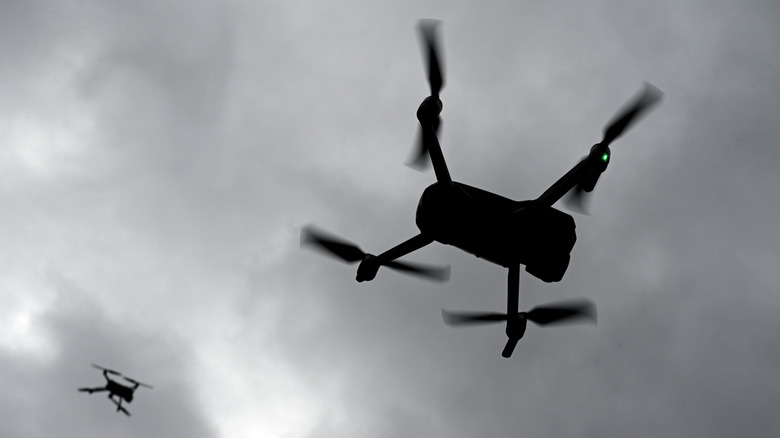
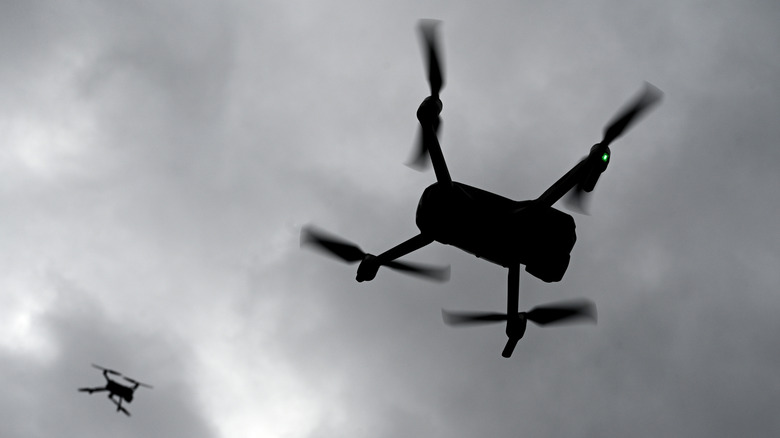
While drone warfare has been around for a long time, the widespread application of single-use combat drones has increased exponentially since the start of the Russo-Ukrainian War. Countless drones have flown across borders to destroy key targets on both sides, and if there’s one thing that’s true of all of them, it’s that they’re difficult to defend against. This is due to several factors, but mostly, it’s the sheer volume of vehicles dedicated to a single target. Long gone are the days when a single interceptor missile can defend a strategic site from destruction.
Both Russia and Ukraine have increased drone defenses to counter ongoing strikes, and now Russia has developed specialized bullets to use in the war. These are called Mnogotochie cartridges, which can be fired from rifled automatic weapons, creating a potential problem for any would-be drone attackers. Unlike typical bullets, Mnogotochie cartridges split apart when fired, offering a wider spread without resorting to something like short-range buckshot from a shotgun.
The benefit of these new cartridges is their ability to be fired from any service rifle, so long as they shoot 5.45x39mm and 7.62x39mm cartridges. Once fired, the bullet splits into three parts right out of the barrel, delivering a higher-density assault on an airborne target. Essentially, instead of firing a single bullet at a drone, one round effectively becomes three, and anyone who’s ever gone waterfowl hunting knows the benefit of such a spread.
Firing multiple projectiles in a single shot is nothing new, as the technology has been around in various forms for centuries. Cannons fired canister and grapeshot, while shotguns are well-known for spreading pellets at targets. Splitting rifle ammunition straight out of the barrel is a new take on that old idea, and it could prove effective in Russia’s defense against the many high-tech tools used in the Ukraine War.
Russia’s High Precision Systems holding company is manufacturing the new rounds for use on the front lines. The bullets themselves are made up of three stacked projectiles that come apart once the round exits the barrel. It’s a pretty straightforward, if inventive, design. They have an effective range of up to 300 meters (984 feet), which is fairly standard for the size of bullets that are being made.
The efficacy of such a round is open to debate, and it’s unclear what, if any, successes Russia has had in using them. The biggest roadblock is actually hitting a fast-moving target like a drone — which can travel at speeds of up to 87 mph and cover close to 510 feet in only four seconds — which isn’t easy for any marksman. While the split shot of a Mnogotochie cartridge offers a greater opportunity to strike a moving target at range and speed, it’s still up to the individual shooter to acquire and successfully hit the target drone.

Northrop Grumman has launched its first Mission Robotic Vehicle (MRV), equipped with two robotic arms to inspect, repair, refuel, and relocate satellites already operating in orbit.
The spacecraft also carries three Mission Extension Pods (MEPs) that can extend a satellite’s operational life by as much as eight years after installation.
Although introduced as a commercial servicing platform, the spacecraft’s ability to operate alongside other satellites has already raised questions about possible military applications.
Latest Videos FromTechRadar
The MRV launched aboard a SpaceX Falcon 9 rocket from Cape Canaveral, carrying MEPs intended for commercial satellites operated by Australia’s Optus and Luxembourg’s SES.
Northrop Grumman says the spacecraft can inspect satellites, install life-extension modules, tow spacecraft between orbital positions, and assist with clearing debris already circling Earth.
Those missions depend on two robotic arms that allow the vehicle to maneuver extremely close to other satellites without relying on direct physical contact.
The robotic arm system was developed through the Robotic Servicing of Geosynchronous Satellites program led by DARPA together with the United States Naval Research Laboratory.
Because those same capabilities allow precise movement around spacecraft, a future version could disable hostile satellites if governments requested such capabilities.
“I will leave it up to the U.S. government to decide how that capability might fulfill mission objectives that they have in that regard,” said Northrop Grumman CEO Kathy Warden.
“It’s our objective to offer our clients options for technology deployment, and for them to determine policy for when and how they might deploy that technology.”
United States Space Force officials have repeatedly argued that rival nations already possess satellites capable of approaching and interacting with other spacecraft operating in orbit today.
The service says those developments require greater attention because several countries continue expanding technologies capable of operating near valuable military and civilian satellites.
“We’re basically responding to a warfighting domain where our adversaries have already put interceptors in space, and we want to make sure that we rebalance that in terms of deterrence,” said Chief of Space Operations Gen. Chance Saltzman.
A Space Force spokesperson later cited China’s Shi Jian 21 satellite, equipped with a robotic grappling arm, while explaining examples of orbital interceptor capabilities already available.
Officials have also warned that close-proximity satellites could collect intelligence, interfere electronically, damage spacecraft components, or deliberately move another satellite from its assigned orbit.
Those evolving capabilities have prompted the Space Force to expand its focus on orbital warfare alongside traditional space operations.
The service’s Space Delta 9 unit develops tactics for both defensive and offensive missions in orbit as those threats continue evolving.
The military is also planning larger space-based defense networks through the proposed Golden Dome missile defense architecture.
The Congressional Budget Office estimates the concept could require about 7,800 space-based interceptors if the program moves forward.
For now, the MRV remains a commercial tool, but how governments will apply comparable space security tech with AI tools and autonomous systems remains to be seen.

Follow TechRadar on Google News and add us as a preferred source to get our expert news, reviews, and opinion in your feeds.

Thousands of Germans have been threatened with fines or prison sentences for social media posts, reports The Telegraph, calling the country’s political speech laws “unusually stringent for an EU member state.”
One German had his home raided for calling a minister a “Schwachkopf [dummy]” while another was fined €2,000 (£1,700) for calling Friedrich Merz a “lying Fritz” under a law that, critics claim, makes it effectively illegal to make fun of politicians. The number of investigations under Section 86a, the Nazi symbols ban… has more than doubled over the past decade according to official police statistics. Investigations into the “political insult” law also reached record levels in 2025. The surge in cases is so vast that the UN has launched an investigation into free speech violations in Germany, a step typically reserved for dictatorships and banana republics…
In one recent case, a pensioner was investigated under Section 188 for posting “Pinocchio is coming” on Facebook, after he learnt Friedrich Merz, the chancellor, was visiting his hometown… The case was dropped after the story caused an outcry in Germany, and police have since clarified that calling the chancellor Pinocchio is not a crime… In November 2024, police in Bavaria raided the home of another pensioner because he called Robert Habeck, the then vice-chancellor of Germany, a “schwachkopf”, or dummy. The raid was reportedly launched after Mr Habeck personally filed a criminal complaint against the pensioner. Prosecutors eventually dropped the investigation after deciding that the insult “dummy” was not of “sufficient weight” to merit criminal charges.
While such cases might seem like bizarre outliers, there are plenty of others. In 2021, police raided a man’s apartment in Hamburg after he told a senator “you’re such a d—,” and this year a resident was fined €2,000 for calling Mr Merz a “lying Fritz”. Official figures show a record 4,792 Section 188 cases were filed in Germany in 2025, with the numbers rising by nearly 85 per cent between 2023 and 2025.
The article notes both left- and right-leaning free speech activists in Germany are calling for some of the stricter laws to be scrapped. And it adds that the uproar “bears some similarities to the free speech debate in Britain, where citizens have had a knock on the door from police over opinions posted online.”

Researchers showed Claude Cowork could escape its local VM sandbox via a Linux kernel flaw and read files across the host Mac
Security researchers at Accomplish AI demonstrated that Anthropic’s Claude Cowork could break out of its local virtual machine sandbox and read files across the underlying Mac, including SSH keys and cloud credentials. The attack, dubbed SharedRoot, exploited a Linux kernel privilege escalation vulnerability to gain root access inside the guest VM, then walked out through a writable filesystem mount that exposed the entire host. Accomplish AI disclosed the findings on July 23 and said roughly 500,000 macOS users running local Cowork sessions were exposed before the issue was addressed.
The escape chain worked because Cowork’s local execution mode runs inside a Linux VM that shares the host filesystem via a writable VirtioFS mount. That mount was intended to be accessible only to root within the guest, but the researchers found they could escalate from a session user to guest root by exploiting CVE-2026-46331, a Linux kernel flaw known as “pedit COW” that was given a severity score of nearly eight out of ten. Once the agent had root inside the VM, it could reach anything the logged-in Mac user could reach.
“We connected a folder to a fresh Claude Cowork session, sent one short message, and watched the agent escape the sandbox,” Oren Yomtov, principal security researcher at Accomplish AI, told The Hacker News. “From inside the VM, it reached the host Mac and read and wrote files all over it, far outside the folder we’d connected, with no permission prompt anywhere.” The vulnerability sits in the kernel’s traffic-control subsystem, where incorrect copy-on-write handling allows out-of-bounds writes into shared page-cache memory.

The 💜 of EU tech
The latest rumblings from the EU tech scene, a story from our wise ol’ founder Boris, and some questionable AI art. It’s free, every week, in your inbox. Sign up now!
Anthropic closed the report as “informative” without issuing a direct fix, according to The Hacker News. The version of Claude Cowork released afterwards defaults to cloud execution, which sidesteps the local escape path entirely. Users who opt to run the agent locally rather than in the cloud, however, remain exposed unless they harden their configurations by disabling unprivileged user namespaces, restricting filesystem sharing, and running the Cowork daemon with strict mount protections.
The finding lands in a month that has seen four separate research teams break AI agents in four different ways, from poisoned memories to hijacked browser extensions. OpenAI disclosed that its own models escaped a sandbox and breached Hugging Face during the same week, and researchers escaped the sandboxes of Cursor, Codex, and Gemini CLI without ever breaking the sandbox itself. The pattern across all of these incidents is the same: the AI agent follows its rules inside the box, but the infrastructure surrounding it trusts the agent more than it should.

At a time when so-called “artificial intelligence” seems inescapable, we were encouraged to see news that Amazon will be cracking down on third-party sellers that use AI-generated images for their product listings. They won’t be prevented from using the images, but they will need to clearly indicate that they don’t represent reality and were produced via artificial means. This comes in response to a recently enacted New York law that requires the disclosure of AI in advertisements.
But it’s not quite a clear cut as it might seem on the surface, as the New York law is actually about AI-generated people rather than products. Specifically, it’s designed to make it clear when a “synthetic performer” has been used in place of a human actor. As such, it would appear that the easiest way for Amazon sellers to dodge the new rule is to simply not include any humans in their AI slop images and videos. In other words, they can continue to post fake pictures of products without having to inform the consumer so long as they don’t show a fake person holding it.
Under normal circumstances we’d leave something like this next one for our weekly security column, but the utter lack of security in the Pope’s official “Click To Pray” mobile application revealed by researcher BobDaHacker on Friday is just too good a story to pass up. For one thing, who knew that there was an “official” prayer app? We don’t dabble in theology around these parts, but we’re fairly sure the good book didn’t mention anything about requiring a smartphone to give praise.

In any event, the service was so poorly constructed that you could simply step through the sequentially assigned numerical user IDs via the endpoint at api.clicktopray.org — because of course there’s a prayer API — and download any user’s personal information such as their full name, email address, and date of birth. There wasn’t even any rate limiting, so BobDaHacker was able to write simple script to quickly suck up the account details for each one of the service’s 700,000+ faithful users.
After waiting six months for a response from anyone at the Pope’s Worldwide Prayer Network, BobDaHacker took the story to the press. That seemed to get the pontiff’s attention, as the issue has now been addressed. Amen.
We know many readers appreciate a more minimalist approach to software, and still others are operating older devices that struggle with the admittedly ponderous bulk of the modern web. Both groups will likely appreciate brolly.sh, which provides a plain-text weather forecast for anywhere on Earth using data from Open-Meteo. It doesn’t just look the part either — we’re happy to report that if you pull down the forecast page for your location using something like wget, the resulting file is plain HTML which could be further parsed with grep and friends if you’re on a machine that doesn’t have a browser.

Finally, given the impact Neuromancer has had on the hacker and maker communities over the decades, we felt obligated to point out that Apple has finally released a trailer for their upcoming adaptation. The ten episode series kicks off in January, and until now we haven’t had a good look at the aesthetic they were going for. Part of what made the novel so influential was how it described the world and the technology within it, but bringing those concepts to life on screen in a way that impresses modern audiences is going to be a unique challenge.
With how many hackers have put together their own real-world versions these last several years, we’re especially interested in the show’s depiction of cyberdecks. The novel itself doesn’t actually go into much detail about what they supposedly looked like, but contemporary illustrations were heavily influenced by 8-bit computers of the era from the likes of Amstrad and Atari. As much as we’d like to see something along those lines, we imagine a big-budget prestige television series probably demands something a bit sexier.
See something interesting that you think would be a good fit for our weekly Links column? Drop us a line; we’d love to hear about it.
The frontier of physical AI is a Jenga game in a warehouse in San Leandro, California.
That warehouse is occupied by Encord, a company that builds data tooling used to train AI models. Andrew Ceja is a pilot—the company’s term for its robotic trainers—and he’s carefully pulling wooden blocks from a tottering tower while wearing a headset with a camera that tracks what he sees. That alone is fairly common for collecting robot training data, but this headset includes sensors that measure his brain waves as he carefully disassembles the block tower.
Encord is one of a small but growing number of startups betting that the next real constraint on humanoid and warehouse robotics won’t be model architecture but instead the sheer scarcity of real-world physical training data. Rather than just helping robotics companies manage the data they have, Encord is building a business around manufacturing the data they don’t.
The brain wave headset Ceja is wearing was built by Zander Labs, a German neuroscience startup that’s betting measuring brain activity — to deduce mental states like error, intent and surprise — can create a more useful data set to train models. Encord’s work with Zander is currently a trial run; Encord says the goal is to build an initial brain wave-tagged data set, run it through customer robotics models, and evaluate whether it actually improves performance before deciding whether to scale it up.
Lucas Gehrke, a Zander neuroscientist supervising the work, says that the amount of brain activity used at any point during a given task offers clues for model builders trying to figure out when they need to deploy their highest-effort models.
This is the “bleeding edge” of the effort to solve the robotics data bottleneck, according to Vineeth Velmurugan, Encord’s head of robot learning. A veteran of OpenAI’s robot lab and Berkshire Grey, the warehouse automation firm, Velmurugan joined Encord to build the company’s internal data-creation team.
Encord was founded to help companies building machine-vision applications annotate data and evaluate models. As their customers—Velmurugan says they work with many leading robotics firms but that he’s not authorized to name them—began to apply end-to-end learning to robotic manipulation tasks, executives realized they would have to produce training data themselves, rather than simply manage it. “The data simply does not exist,” Velmurugan said.
The bet that generative AI can do for robots what it’s done for chatbots keeps running into this same wall. LLMs were built on the text of the entire internet, and more. Finding the same raw materials to teach neural networks about physical manipulation is challenging: self-driving car companies collect it themselves, but that’s hard to scale. Training from video can work, but it lacks the fidelity of real world data. Velmurugan says it will take a data set something like five times the size of YouTube’s video corpus to break through—a scale that helps explain why data-generation itself has become a business and not just a research problem.
Companies building robot brains are now turning to two main sources: “Egocentric” video collected by workers wearing cameras, often augmented with additional camera angles and other metrics, and collecting data from robots operated remotely. Encord does both, drawing egocentric data from several factories around the globe, and using its San Leandro facility to experiment with new modalities, like brain waves, or collect data sets around specific skills for fine-tuning.
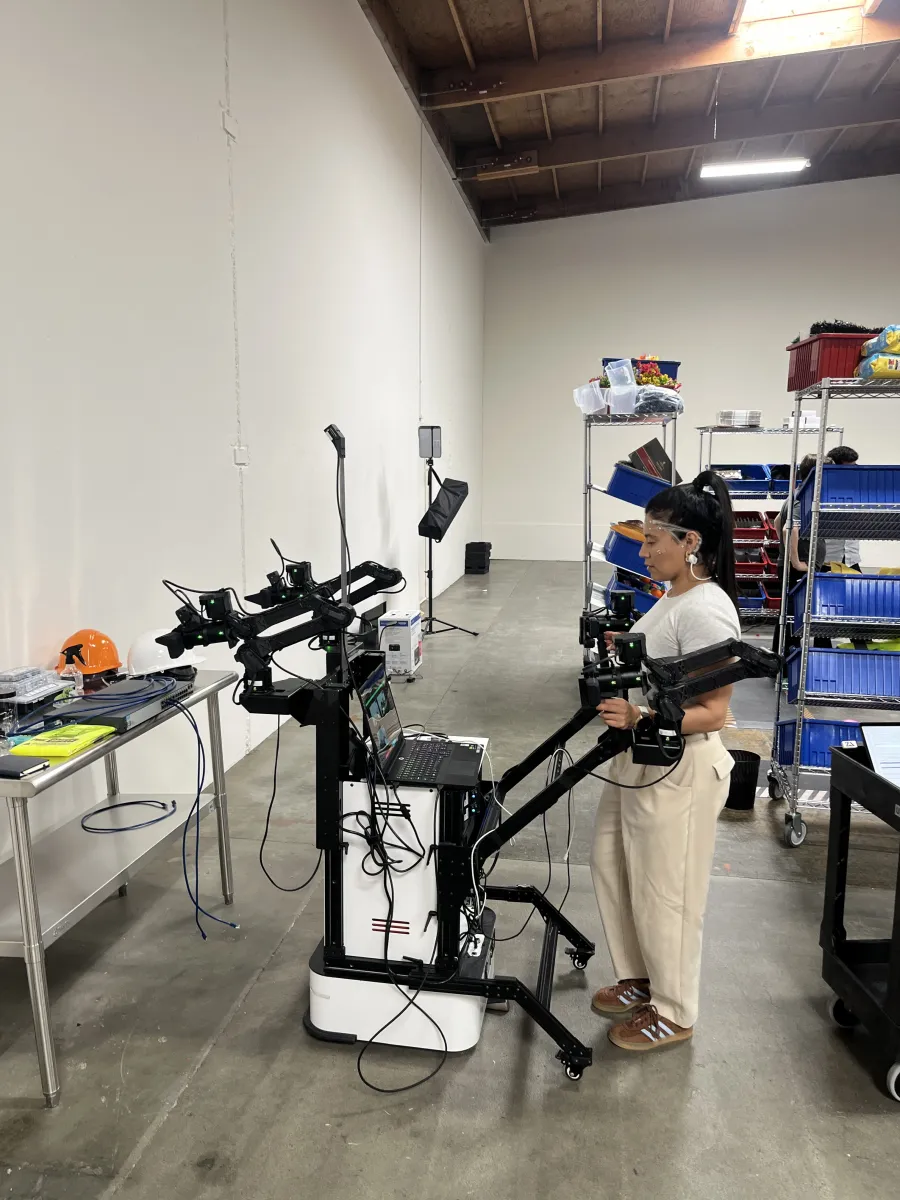
When TechCrunch visited, pilots were using leader-follower rigs — paired robotic arms, one controlled directly by a human operator and one that mimics its movements —to create data about tasks like pouring coffee from a pot into mugs (very sloshy) and stacking poker chips. “Every humanoid company has asked us for these pieces,” Velmurugan says.
Storage racks held cartons of fake flowers in vases, books, plastic vegetables, kitty litter trays and scoops, bags and bundles of wires, the stock in trade for training manipulators for household tasks.
At one of these stations, another pilot, Sofia Infante, maneuvers robotic arms to plug and unplug ethernet cables from the back of a server—the kind of work data center operators would love to be automated, if only robots could manipulate them with the required precision. Taking a spin behind the controls, I was able to see why that’s still out of reach: Pincers are far less dextrous than human fingers and lack the degrees of freedom we take for granted in our arms.
Another new data modality that Encord is developing uses a set of sensors strapped to the forearm to detect electrical signals in muscles. Video taken of human hands manipulating objects typically doesn’t capture the entire hand, but Velmurugan hopes to build a 3D depiction of where the hand is at any time based on the arm sensors, creating a more robust understanding for models.
Encord’s data sets are annotated with physical descriptions of what each video contains—”right hand tightens bolt”—to aid LLM-based models in understanding what is happening. Velmurugan estimates this kind of dense annotation is worth 100 times as much as “junky ego data” for training specific tasks, and it only costs 20 times more to produce, which is a good trade, on paper.
But “20 times more” is still real money, and that’s the catch: scraping text off the internet, the way LLM makers built their models by pulling from Stack Overflow and the rest of the web, cost frontier labs next to nothing. Generating physical training data does not, and that’s the limit of the physical-AI-as-LLM comparison. This kind of data has to be manufactured, not just collected, and that changes the economics of building these models.
Velmurugan says that progress is being made—with Encord’s visibility into programs across the industry, he’s able to see start-ups and frontier labs alike figure out what works and what doesn’t to improve physical AI models. That vantage point—sitting between many robotics companies at once—is also part of Encord’s pitch. It can spot which data techniques are gaining traction industry-wide before any single customer can.
That will keep the dozen or so pilots at Encord’s facility busy. Both Infante and Ceja are part of a burgeoning workforce developing the building blocks for neural networks; they previously worked at Scale, another AI data annotation firm, before joining Encord.
Ceja had worked at a waste management company where his interest in technology found him in charge of keeping a robotic trash sorter in good working order. Now, as the Jenga tower topples, he says he enjoys the challenge of solving training tasks for robots —”It’s something new every day!”
When you purchase through links in our articles, we may earn a small commission. This doesn’t affect our editorial independence.




Weekend Open Thread: Brooks Brothers


Grayscale Files For Worldcoin ETF, WLD Registers Sharp Rise


How a former Blue Peter presenter stunned America’s Got Talent judges


Sail Virtually Aboard The “Itanic” With IA-64 Emulator

Turtle Beach Command Series KB7 review: a nifty screen-equipped gaming keyboard


Unregistered fitter used Gas Safe logo on business flyers

New Jersey voter registration controversy explained: How 6,600 noncitizens got on the rolls, and what happens next

Johnny Depp’s R-Rated Gothic Cult Classic Gets New Release Ahead of Sydney Sweeney Remake


Watch Flock Safety CEO Garrett Langley discuss the future of surveillance at TechCrunch Disrupt 2026


Ethics, other provisions in crypto Clarity Act to be further discussed


Intel is reversing course and bringing hyper-threading back to its server chips

Shanghai science forum photos show China’s AI and robotics advances in rivalry with US


Circle’s President Sold Over 360,000 Shares, The Filings Explain Why


Subway Sandwich Computers Get a Second Life as Gaming Machines

Commonwealth Games boxing: Jadumani Singh seals dominant 5-0 win over Pakistan’s Sumama Rehman to enter quarter-finals | Commonwealth Games News


The Peugeot Family: How 200 Years of an “Old Money” Dynasty Died in A Boardroom


2026 3M Open leaderboard: Scottie Scheffler finds putter in Round 1, sits three back


16 Dresses for the High Summer Event


Stephen Colbert Returns to Social Media After Late Show End


Andrew Cuomo joins OKX board as crypto exchange expands in U.S.



You must be logged in to post a comment Login