



He’s the man who delivered a King – and, for that matter, a Queen – masterminded the banishment of one particularly problematic relative, while cunningly corralling another.
In short Sir Clive Alderton, Principal Private Secretary to His Majesty King Charles III, is arguably the most formidable and consequential courtier of the modern era.
But to many readers of the Daily Mail, he will be simply known as ‘The Wasp’.
That was the ostentatiously offensive nickname given to him by the Duke of Sussex (or perhaps, more appropriately, his ghostwriter) in his vengeance-laden memoir, Spare – although one that, in the circumstances, must now surely be worn as a badge of honour?
And while there are bound to be cheers from Montecito today when they learn that Sir Clive is sensationally set to retire after 20 years working as King Charles’ gatekeeper, the news will sadly leave Buckingham Palace without one of its ‘big beasts’.
For it can be confirmed that after two decades of the most loyal of service, leonine Sir Clive has announced that he will leave the royal household next May, a move that coincides with his 60th birthday (a revelation that has prompted some fans to enquire whether he has a Dorian Gray-style portrait in the attic).
The feeling is that now is as good a time as any for him take a well-earned break: to start with he has helped to deliver a relatively problem-free accession (leaky pens aside) and a successful coronation.
The King has also just completed the ‘last of his firsts’ (starting with his first public engagements and home nations visits as monarch, to the big test so far of his reign, this year’s State Visit to the US, and his first to a British Overseas, Territory, Bermuda).
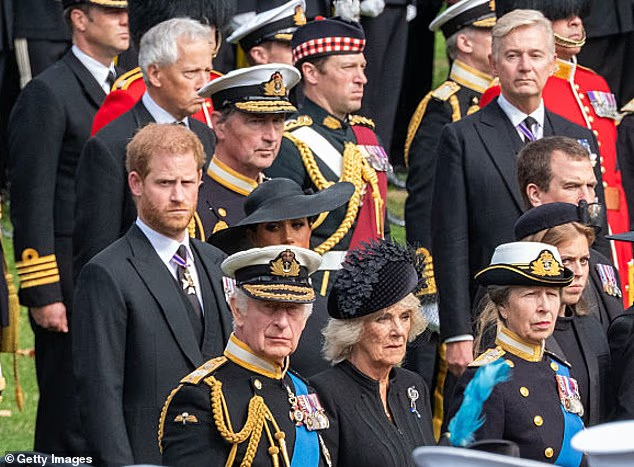
Sir Clive Alderton (top right) is pictured at the late Queen Elizabeth II’s funeral as Her Majesty’s coffin is carried by gun carriage to Wellington Arch from Westminster Abbey — September, 2022

Sir Clive Alderton, Principal Private Secretary to His Majesty King Charles III, is arguably the most formidable and consequential courtier of the modern era
He has also steered the King – and indeed the nation – through the dark days of the monarch’s cancer diagnosis in 2024. Charles himself, I am told, is in a ‘good place’ health-wise, as it stands.
In all (and safely assuming that as a long-term diplomat Sir Clive’s pensionable age is 60), next year is a natural moment to move on.
While those outside of royal circles may ask why the departure of a courtier is so significant, it is worth casting your mind back.
When life-long diplomat Mr Alderton, as he was then, joined the then Prince of Wales’ Household in 2006 as Deputy Private Secretary, Charles’ public standing was in a very different place.
With a household dubbed ‘Wolf Hall’ for its interpersonal rivalries and the prince suffering from a perennially poor public image, there was much to work on.
While no-one, not even his most ardent admirers, would claim Sir Clive and his team have always got it right, there is no doubt that he was absolutely instrumental in turning the tanker round.
In 2009 he was promoted to Private Secretary for Foreign and Commonwealth Affairs to the prince and the Duchess of Cornwall (and made a Lieutenant of the Royal Victorian Order, a sign of royal favour, in 2013).
His rise in the royal household was only briefly halted when he necessarily left in 2012 to become Ambassador to Morocco, before being lured back in 2015 when he was appointed the couple’s Principal Private Secretary – a title created especially for him.

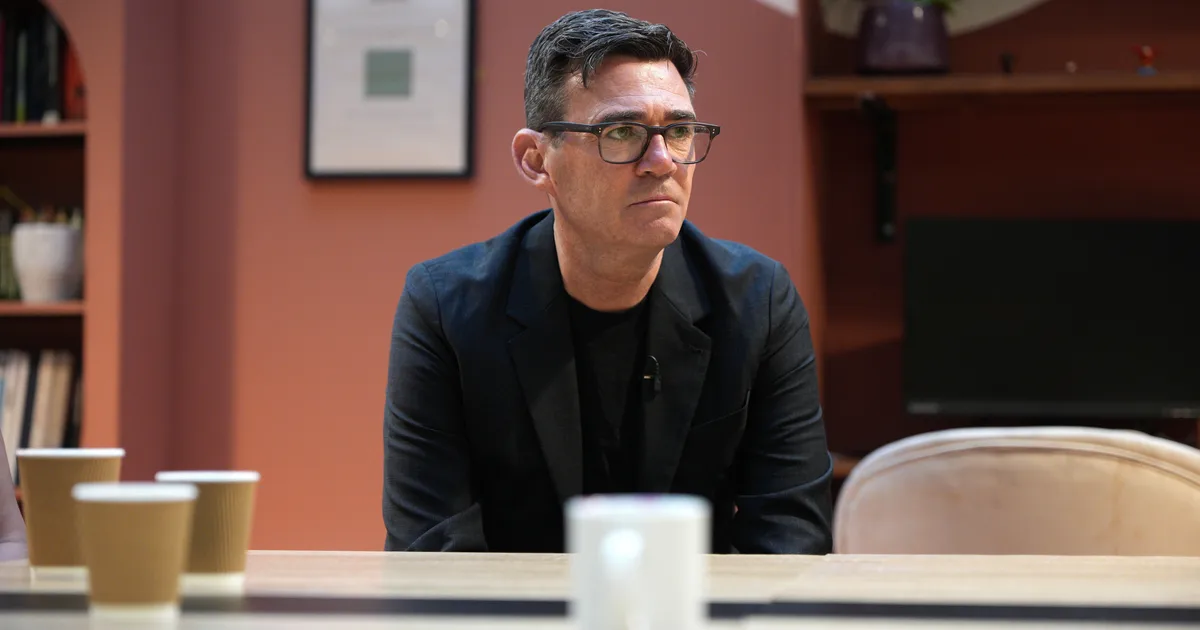
Sir Clive shakes Andy Burnham’s hand as he arrives at Buckingham Palace for an audience with King Charles III where he was invited to become Prime Minister — July 20, 2026

Keir Starmer, Sir Clive Alderton, King Charles, and Idris Elba during a Youth Opportunity Summit at St James’s Palace in London — July, 2025
He served in that position until the prince’s accession to the throne on September 8 2022, following the death of his mother, Queen Elizabeth II, when he became Principal Private Secretary to His Majesty The King and Her Majesty The Queen.
He is also a member of the Privy Council and a Trustee of the Prince of Wales’s Charitable Fund.
Outsiders would say that one of his greatest successes was to ‘de-politicise’ the notoriously interventionist heir to the throne – ‘no more ‘black spider memos for you, Sir!’ – in time for him to accede to the throne, while ensuring a proud legacy of national and international change as Prince of Wales.
Insiders would probably add to that the transformation of his wife, Camilla, from Duchess of Cornwall to Queen, something that was simply unthinkable when he joined royal service.
While there will always be those who have strong opinions on the matter, few can argue that she hasn’t carried out her duties with enthusiasm, diligence and good humour and carved a space for herself in public life, tackling some truly thorny issue such as domestic abuse.
Needless to say, the King is a much, much happier man with his wife standing by his side.
That’s not to say, of course, backs haven’t been put up or hackles raised along the way.
There’s no doubt that Sir Clive relishes the game of diplomacy – ‘he puts the ‘M’ into Machiavellian,’ says one wag.
Best-selling crime thriller writer Peter James’ recent detective novel, set in the royal household, described the King’s fictional long-standing aide, Sir Peregrine Greaves, as an aide so silky-smooth it appears he is ‘gliding on wheels’ and, to be fair, he didn’t have far to look for inspiration.

King Charles III and his private secretary Sir Clive arriving for the King’s Christmas lunch at Buckingham Palace in December 2024

King Charles III and Donald Trump meet Sir Clive Alderton at Windsor Castle during the US President’s state visit in September, 2025
To say that Prince Harry hates his father’s gatekeeper is an understatement, and he didn’t hold back in his memoir, as he described the then triumvirate of powerful royal aides at the heads of each of the three royal households (Buckingham Palace, Clarence House and Kensington Palace) as ‘the bee, the fly and the wasp’.
Sir Clive, it seems, was the worst of the three in his book, being ‘arrogant’ and ‘great at pretending to be polite, even servile’, but would ‘put you on his list’ and ‘give you such a stab with his outsized stinger that you’d cry out in confusion’.
Harry firmly blamed the courtier for being a roadblock in attempts to reconcile with his father.
While that may in part be true, friends of the diplomat pour scorn on this claim, suggesting no aide would be so arrogant to stand in the way of father and son on a personal basis.
But, of course, if the prince behaved in such a way that would place his father in potentially constitutionally tricky waters, he would not be doing his job if he didn’t protect the monarch, they add.
Whether his departure changes relations in the future will be interesting to see.
The same, it might be said, went for Andrew Mountbatten-Windsor, another family member who might not mourn Sir Clive’s departure. For there is no doubt that the courtier was instrumental in finding a way to banish the former Duke of York from royal life, strip him of his titles and effectively evict him from Royal Lodge.
While that problem is far from solved yet, the foundations to do so are now laid.
Spares aside, though, Sir Clive is a delightful companion (albeit one whose political antennae are never on pause) and it’s fair to say that having handled some of the most delicate constitutional issues since the abdication of 1936, his fingerprints are most definitely all over the high points of this reign.
He is genuinely passionate about both king and country and if he has enjoyed pulling the levers of power along the way, the best interests of both have always been foremost in his mind.
The search for his successor will take place both internally and externally will start soon, with a replacement hopefully in place by spring of next year.
It is understood that Sir Clive elected to share this news now so that an ‘open and rigorous recruitment process’ for his successor can begin, with the aim of identifying the ‘highest calibre external and internal candidates’.
The timeframe additionally allows for an appropriate period of handover to his eventual successor in spring/ summer next year, once an appointment is made.
Fellow aides have paid tribute to the ‘immense and critical’ role he has played in supporting Their Majesties over his time in service, in particular through the meticulous planning for Accession over many years, his chairing of the Coronation Committee, and managing the significant first years of the new reign with all their highlights and complexities, nationally, internationally – and closer to home.
In a message to staff today he said: ‘It has been the greatest imaginable honour to serve The King and Queen in my present role through such historic times and with unforgettable humour along the way. That support will continue, in a less formal capacity, for all of my life.’
The King and Queen are said to be ‘deeply grateful’ to Sir Clive for his ‘tireless support and wise counsel’ over the years, and for the enduring loyalty that will ensure a smooth transition to his successor.
One court jester joked that he would take a while to consider the ‘longer term opportunities and possibilities – for which spending a little less time supporting the Royal Family and a little more focussing on his own family is an understandable ambition. He will be sorely missed.’
Royal writer Valentine Low, author of ‘Power and the Palace’ and ‘Courtiers’ described Sir Clive as the ‘quintessential courtier’ – smooth, charming and urbane – and says: ‘Alderton is one of the significant and successful courtiers of recent years, up there with the late Queen’s private secretary Christopher Geidt.
‘He played a vital role in helping Charles transition from Prince of Wales to King, moulding a once-meddlesome prince who would fire off letters to ministers into a monarch who was scrupulous about keeping within the constitutional guidelines. The fact that Charles has been largely free of political controversy since ascending the throne is without a doubt down to Alderton.
‘As such [he] was adept in handling Charles, whose private secretaries did not always last the course. He used humour skillfully to defuse tricky situations, but was not afraid to have difficult conversations.
He was not without his critics, however, who saw him as Machiavellian. One insider said Alderton was like a figure from Wolf Hall, ‘a schemer, a chess player’.
‘And that was one of his friends.’




















































You must be logged in to post a comment Login